Tag: machine learning

  • Predictive QA: Why Performance is so Important in a ‘Big Data’ World

    Predictive QA: Why Performance is so Important in a ‘Big Data’ World

    As organizations across all industries face opportunities and threats in the new digital era, they increasingly look to leverage their full power of the data they possess. Data is a treasure trove for enterprises, and big data mining has grown into much more than a sales tool. Advanced, predictive analytics are now used to hone processes, improve product quality and deliver those products more rapidly.

    Companies that are serious about digital transformation know the importance of big data. And, increasingly they are turning their attention to predictive analytics techniques as a means of assessing the whole product life cycle. In test automation terms, there are several benefits from a predictive QA approach: Getting the most out of the defect management and test automation data enables you to create better models, optimize testing processes and predict defects like never before.

    Features matter a lot with any product or service, of course, but what keeps users truly engaged is the overall experience. More than ever, that experience is dictated by performance—and why product performance matters so much.

    In today’s market, a company that can deliver quality products to market faster than its competitors gains a significant advantage. So, now the performance of teams in the software development life cycle (SDLC) is being closely analyzed to deliver quality at speed. However, enterprises that prioritize product performance over SDLC performance are not taking full advantage of the possibilities digital has to offer.
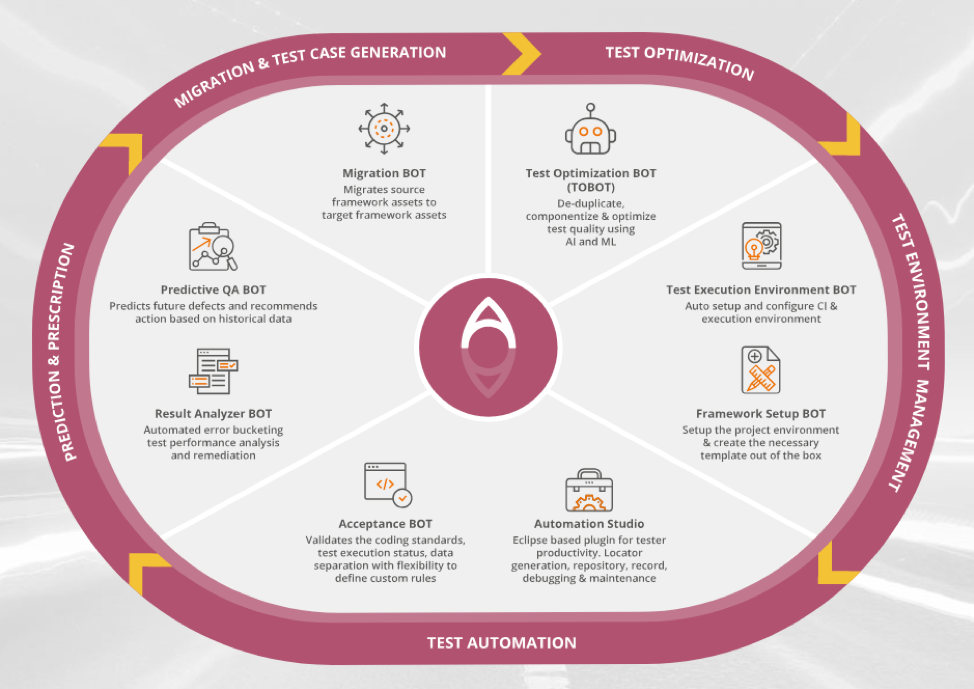
    SDLC QA ecosystem, with analytics engine at the core

    Just as with product performance, the ability to analyze SDLC performance is predicated on the amount of data you have to for analytics. The more data you have, the better—and the best way to gather that data is by automating activities, mainly because of the vast traceability and identification capabilities that technology provides. Because of this, automating testing activities is one of the biggest activities that organizations are implementing to enhance their SDLC performance. This is, in fact, a key driver in enabling digital transformation within any organization.

    However, the issue we see over and over again is this: The sheer quantities of testing activities that need to be automated are actually slowing organizations down. In part, testing complexity is to blame. Teams often feel there is a lack of skills in-house to ensure all the working parts operate and interact seamlessly. While these challenges with regards to automating test cases is valid, test data should not be seen as a huge obstacle, a mountain to be scaled.  With the right tools, that test data is an enabler to optimizing performance and holds the keys to the future success of your product through the analytics it can provide.

    Yet, compounding these challenges is the fact that toolsets have a habit of changing, so the data isn’t always structured uniformly. Now, organizations are going a step further with predictive analytics, powered by artificial intelligence (AI) and machine learning (ML) techniques, by leveraging their large volumes of structured and unstructured data available from defect management tools and test automation results.

    This means organizations are now able to successfully analyze SDLC performance by being able to incorporate data from all their testing activities to give them predictive QA capabilities.

    How predictive QA gives organizations an advantage over traditional QA comes in the form of intelligence. Predictive QA converts test data into actionable insights.

    Here are just some of the ways predictive QA will impact testing efforts:

    • Faster time-to-market
      • The first thing predictive QA will help with is reducing test cycles so that organizations can get top-tier software into customers’ hands faster. Predictive QA calls out inefficiencies, optimizes testing efforts and helps cut down on test cycles. We recently worked with a leading hotel chain that was able to boost test automation efficiency by 30 percent using AI and ML-driven predictive analytics.
    • Better defect detection
      • Defect detection is one of the first things that comes to mind when we talk about improving quality, and it is certainly true that predictive QA can do that with the available data. Using predictive techniques, software teams can drill down to understand root causes and failures, predict defect ranges and the risk of modules for future versions.
    • Understand what’s working (and what’s not)
      • With predictive QA, teams get unprecedented insight into what’s going on in their testing efforts. Using these techniques, teams can assess what is driving greater application lifecycle efficiencies—and they will plainly be able to see what is not. They will be able to address under-performing test cases and prioritize those with the greatest impact. And, it will enable them to better select the right types of testing and resources required for optimization.

    The growing demands of digital are pushing enterprises to the limit, requiring faster release cycles that consume a significant amount of resources. According to the latest World Quality Report, 99 percent of organizations face challenges testing in their agile environments while the average level of automation is only around 16 percent.

    Predictive analytics is beginning to address this in many ways. Invisible to the consumer eye, our increasingly connected world is reliant on accurate, actionable, automated analytics to power it. Predictive QA has proven essential in helping leverage machine learning and advanced analytics techniques, targeting both end-product and the design life cycle as a whole.

    Enterprises are looking to AI to exploit the wealth of data found in various levels of their IT organizations, whether at the software development level or on the production side, said Dominique Raviart, IT Services practice director for analyst firm NelsonHall. “With AI, they have an untapped opportunity to better identify where defects lie, increase the quality of applications, and ultimately improve the user experience of end-users, customers, and other stakeholders.”
    — Manish Mathuria

  • OverOps Brings Machine Learning to DevOps

    OverOps Brings Machine Learning to DevOps

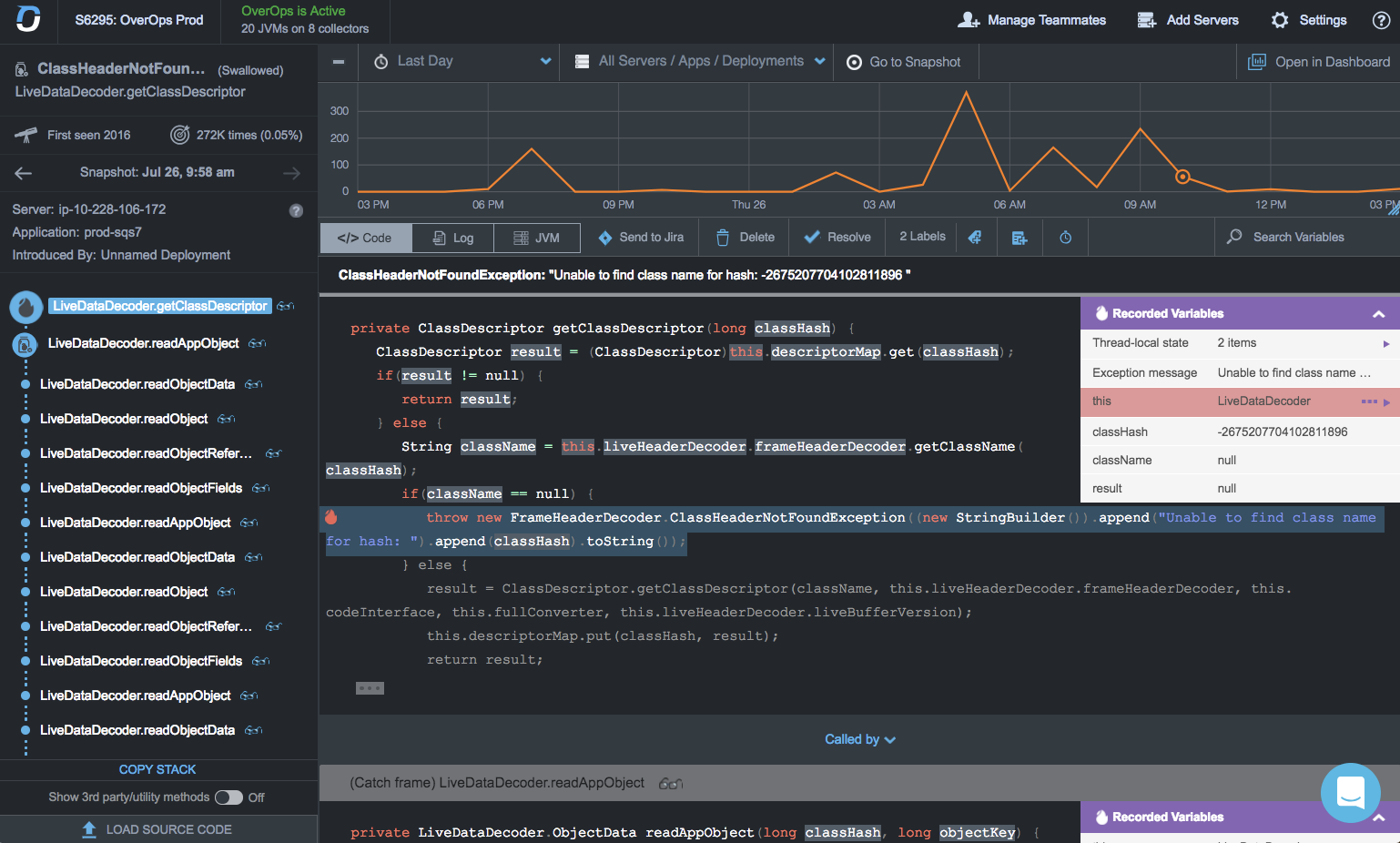
    OverOps has launched a namesake platform employing machine learning algorithms to capture data from an IT environment that identify potential issues before a DevOps team decides to promote an application into production.

    Company CTO Tal Weiss said the OverOps Platform is unique in that, rather than relying on log data, it combines static and dynamic analysis of code as it executes to detect issue. That data then can be accessed either via dashboards or shared with other tools via an open application programming interface (API). The dashboards included with the OverOps Platform are based on open source project Grafana software.

    That approach makes it possible to advance usage of artificial intelligence (AI) within IT operations without necessarily requiring that every tool in a DevOps pipeline be upgraded to include support for machine learning algorithms, Weiss said.

    OverOps also includes in the platform access to an AWS Lambda-based framework or separate on-premises serverless computing framework to enable DevOps teams to also create their own custom functions and workflows.

    Weiss said OverOps is designed to capture machine data about every error and exception at the moment they occur, including details such as the value of all variables across the execution stack, the frequency and failure rate of each error, the classification of new and reintroduced errors and the associated release numbers for each event. Log data is, by comparison, relatively shallow in that it is challenging to determine precise root cause analysis when trying to troubleshoot an issue, he said, noting the OverOps Platform offers visibility into the uncaught and swallowed exceptions that would otherwise be unavailable in log files.

    DevOps teams spend an inordinate amount of time analyzing log files in the hopes of discovering an anomaly. But as IT environments continue to scale out, the practicality of analyzing millions, possibly even billions, of log files becomes impractical. OverOps is making the case for employing machine learning algorithms to analyze events before the log file is even created, which eliminates the need to find some way to store log files before they can be analyzed.

    There’s naturally a lot of trepidation when it comes to anything to do with machine learning algorithms and other form of AI to manage IT. But as the complexity of IT environments continues to increase, it’s clear DevOps teams will need to rely more on AI to mange IT at levels of scale that were once considered unimaginable. For example, while microservices based on containers may accelerate the rate at which applications can be developed and updated, they also can introduce a phenomenal amount of operational complexity. Most DevOps professionals would rather automate as much as possible the manual labor associated with operations, especially if that leads to more certainty about the quality of the software being promoted into a production environment.

    Of course, while making use of machine learning algorithms to analyze code represents a step forward in terms of automation, it’s still a very long way from eliminating the need for DevOps teams altogether.

    — Mike Vizard

  • When AI Met DevOps: Machine Teaching

    When AI Met DevOps: Machine Teaching

    One of my favorite quotes about artificial intelligence (AI) isn’t from a data scientist or tech industry analyst. It’s from a doctor.

    When asked if AI would eventually replace radiologists, Dr. Curtis Langoltz of Stanford University pithily replied “No, but radiologists who use AI will replace those who do not use it.”

    This great insight is highly applicable to IT. Yes, there are many ways we can use AI methods to fully automate a broad range of DevOps tasks. Companies, including CA Technologies, are actively involved in the development of solutions that enable our customers to do exactly that.

    Algorithmic machine learning, however, doesn’t just empower systems to perform tasks and solve problems autonomously. It also makes them great active partners with human beings. In fact, much of what machines learn they also wind up teaching.

    The synergy between AI and human radiologists, for example, stems in part from the fact that digital systems can differentiate about 200 levels of gray in a diagnostic image—compared to only about 16-20 that are discernable by the human eye. Train an AI system with enough images, and that precise cognitive power can more effectively detect that something is going on.

    But for the most effective diagnostic process, you don’t just depend on that detection alone. You use that detection to empower a human diagnostician who can apply a broad understanding of pathologies and deep experience with the complexities of individual patients to deliver the highest quality care.

    In DevOps, we can do the same. We can use AI to capture insights that teach us how to continuously optimize our workflows and processes. We can also use our AI learnings to push our work up higher on the value chain.

    More specifically, the synergy between AI and human intellect can:

    Make development smarter. The speed, quality, and efficiency of development pipelines can be affected by all kinds of subtle factors. A less-than-optimally designed API, for example, can be a small but chronic stumbling block to everyone who has to use it. Scrum outcomes can be undermined by anything from a particular type of technical challenge to a nascent personality conflict.

    By capturing a rich set of DevOps metrics and applying machine learning to those metrics, development leaders can discover process bottlenecks and skilling shortfalls. They can better coach individuals and promote team collaboration. The result: a better working environment that facilitates digital agility for the enterprise and higher satisfaction/retention for valuable employees.

    Make ops smarter. Enterprises are running increasingly volatile and complex workloads on increasingly hybridized infrastructure. At the same time, the tolerance of internal and external users for latency and outages continues to approach zero. There are also real costs associated with performance problems.

    The elastic capacity of public and private cloud does much to help with workload volatility. But adding cloud capacity also has its costs—and end-to-end application performance often depends on back-end systems that are not cloud-based. So not every performance issue can be solved by simply throwing more capacity at it. Nor should it be, if a rearchitecting can fix a bottleneck less expensively.

    Here again, AI can teach us a lot. We can uncover opaque interdependencies in processing load and data throughput. We can spot conditions when it may make business sense to throttle cloud costs that aren’t cost-justified. We can even better understand the real-world conditions—whether patterns in customer behaviors or our own marketing programs—that are driving our demand spikes and troughs. All of this helps us deliver consistently responsive digital experiences at a cost that makes good business sense.

    Make security smarter. AI is already being broadly implemented in security solutions such as endpoint protection and threat response to automate the detection and neutralization of anomalous activities in the enterprise environment. But effective multi-layer security isn’t just about finding and stopping exploits. It’s also about building applications that are themselves inherently less vulnerable to hacking. This is the essence of DevSecOps.

    AI has huge potential value here. We are writing a rapidly growing volume of increasingly sophisticated code. It is very easy for subtle vulnerabilities to hide in that code. As our development practices become more complex—often including multiple contractors—it becomes more difficult to understand exactly where and why these vulnerabilities were introduced into our code. Machine learning can teach us the answers to these questions, so we can more proactively secure our data and our businesses.

    It’s especially interesting to consider what may happen as we start to apply AI to DevSecOps across our organizations, as well as within them. More diverse inputs enable machine learning to discover more factors that impact code pipeline performance. By aggregating our knowledge about how we build, deliver and secure our code, we are all likely to benefit with better practices and stronger guardrails.

    — Cameron Van Orman

  • 6 Ways AI and ML Will Change DevOps for the Better

    6 Ways AI and ML Will Change DevOps for the Better

    There’s been a lot of media attention in recent years about how artificial intelligence (AI) and machine learning (ML) are going to change the world—how they’re going to create new and interesting applications in fields as diverse as education, law, health care and transportation. This may happen. But if I had to bet on a use case where AI and ML will create a tangible, lasting impact, I’m putting my chips on DevOps.

    DevOps is all about automation of tasks. Its focus is on automating and monitoring every step of the software delivery process, ensuring that work gets done quickly and frequently. While it doesn’t eliminate human tasks—far from it—it does encourage enterprises to set up repeatable processes that promote efficiency and reduce variability.

    AI and ML are perfect fits for a DevOps culture. They can process vast amounts of information and help perform menial tasks, freeing the IT staff to do more targeted work. They can learn patterns, anticipate problems and suggest solutions. If DevOps’ goal is to unify development and operations, AI and ML can smooth out some of the tensions that have divided the two disciplines in the past.

    Here are six ways AI and ML can and will change DevOps for the better.

    Promoting Feedback on Performance

    One of the key tenets of DevOps is the use of continuous feedback loops at every stage of the process. This includes using monitoring tools to provide feedback on the operational performance of running applications. This is one area today where ML is impacting DevOps already. Monitoring platforms gather massive amounts of data in the form of performance metrics, log files and other types. Advanced monitoring platforms are applying machine learning to these datasets to proactively identify problems very early and make recommendations. These recommendations go to the DevOps team members so that they can ensure that the application service remains viable. Machine learning is enhancing the continuous feedback loops that are critical to DevOps.

    Enabling Communication

    Communication and feedback is always one of the biggest challenges when organizations move to a DevOps methodology. Human interaction is vital, but with so much information flowing through the system, teams need to set up a wider variety of channels to set and revise workflows on the fly. Using automation technology, chatbots and other systems initiated by AI, these communications channels can become more streamlined and more proactive.

    Correlate Data Across Platforms and Tools

    To operate efficiently, DevOps teams need to simplify tasks. This is getting more difficult as environments get more complex. Start with monitoring tools: Teams tend to use multiple tools that monitor an application’s health and performance in different ways. Machine learning applications can absorb these data streams and find correlations, giving the team a more holistic view of the application’s overall health.

    Manage a Flurry of Alerts

    Since DevOps encourages teams to “fail but fail fast,” it’s critical to have an alert system that spots a flaw quickly. This tends to create scenarios where alerts are coming fast and furious, all labeled with the same severity, making it difficult for teams to react. Machine learning applications can help teams prioritize their responses based on factors such as past behavior, the magnitude of the current alert and the source that specific alerts are coming from. Humans can set up rules, but machines can help manage these types of situations when too much data overwhelms the system.

    Evaluating Past Performance

    AI/ML also has the potential to help developers during the application creation process. By examining the success of past applications in terms of build/compile success, successful testing completion and operational performance, machine learning algorithms could make recommendations to developers proactively based on the code they are writing or the application that they are building. The AI engine could direct the developer in how to build the most efficient and highest-quality application.

    Software Testing

    In the future, we could see AI/ML applied to other stages of the software development life cycle to provide enhancements to a DevOps methodology or approach. One area where this may happen could be in the area of software testing. Unit tests, regression tests, functional tests and user acceptance tests all produce large amounts of data in the form of test results. Applying AI or machine  learning algorithms to these test results could identify patterns of poor coding practices that result in too many errors caught by the tests. This information could then inform the development teams so that they can become more efficient in the future.

    Similarly, leveraging historical data, AI/ML could be used to fine-tune deployment strategies as applications are moved from Dev to Test to Production environments.

    — Mike Hughes

  • How Artificial Intelligence, Machine Learning Can Help DevOps

    How Artificial Intelligence, Machine Learning Can Help DevOps

    Artificial intelligence (AI) and machine learning (ML) can help the humans in DevOps break free from focusing on simple activities. One aspect of DevOps is automating routine and repeatable actions, and AI and ML can perform these activities with enhanced efficiency to improve the performance of teams and business. There are algorithms that can perform many operations and procedures, allowing those in DevOps to execute their part effectively. This article discusses how DevOps engineers can use AI and ML to their benefit.

    Artificial Intelligence, Machine Learning Driving DevOps Evolution

    Businesses are under a lot of pressure to meet customers’ ever-changing demands, and many embrace DevOps to improve their performance to some extent. However, it can be difficult for many companies to use AI and ML because of the complexity involved. To recognize any benefit with AI and DevOps, a creative mindset may be required.

    The adoption curve of AI/ML may be relatively slow. Only 27 percent of CIOs surveyed by ServiceNow for its report, “The Global Point of View,” have hired employed who have skills in machine learning. But the fact is, DevOps experts may have a lot to gain by adopting even the most basic features of AI and ML. The same survey found that around 85 percent of C-level executives believe AI/ML can offer substantial value in terms of accuracy and rapidity of decision-making, which will lead to improved profitability for the company.

    Tracking and organization in a DevOps environment requires effort because of the complexity involved in the distributed application, which traditionally made things difficult for the team to manage and resolve customer issues. Before the evolution of AI and ML, DevOps team members could spend hundreds of hours and a large amount of resources to identify one point within an exabyte of information. To solve such problems, the future of DevOps is AI-driven, helping to manage the immense capacity of data and computation in day-to-day operations. AI has the potential to become the primary tool for assessing, computing and decision-making procedures in DevOps.

    AI’s Influence on DevOps

    AI can change how DevOps teams develop, deliver, deploy and organize applications to improve the performance and perform the business operations of DevOps. There are three common ways through which AI may influence DevOps:

    Enhanced Data Accessibility

    The lack of unregulated accessibility to data is a critical concern for DevOps teams, which AI can address by releasing data from its formal storage—necessary for big data implementations. AI can collect data from multiple sources and prepare it for reliable and robust evaluation.

    Greater Implementation Efficacy

    AI contributes to self-governed systems, which allows teams to transition from a rules-based human management system. This helps address the complexity of assessing human agents to improve efficacy.

    Effective Resources Use

    AI gives much required competence to automate routine and repeatable tasks, which minimizes the complexity of managing resources to some extent.

    How Can Companies Apply AI and ML to Optimize DevOps?

    Organizations can apply AI and ML to greatly optimize their DevOps environment. For one, AI can help in managing complex data pipelines and create models that can feed data into app the app development process. By 2020, it’s expected AI and ML will take the lead in digital transformation, overtaking IoT.

    However, implementing AI and ML for DevOps also presents a number of challenges for organizations of all sizes. To benefit from AI and ML technologies, a customized DevOps stack is required.

    Open source projects such as the Fabric for Deep Learning (FfDL) and Model Asset eXchange (MAX) can lower the barrier of entry for companies, helping to implement machine learning and making the DevOps process more efficient.

    Application of AI and ML can result in true ROI for a company by optimizing DevOps operations, making IT operations more responsive. They can improve efficiency as well as productivity of the team and play an important role in filling the gap between humans and big data.

    Conclusion

    A company that wants to automate the DevOps have to decide whether to buy or build a custom AI/ML layer. However, the first step is to establish a strong DevOps infrastructure. Once the foundation is created, AI/ML can be applied for increased efficiency. AI/ML can help DevOps teams focus on creativity and innovation by eliminating inefficiencies across the operational life cycle, enabling teams to manage the amount, speed and variability of data. This, in turn, can result in automated enhancement and an increase in DevOps team’s efficiency.

    — Subramonian

  • Electric Cloud Applies Machine Learning to DevOps

    Electric Cloud Applies Machine Learning to DevOps

    Machine learning algorithms are being applied to advance DevOps via analytics software that Electric Cloud is making available.

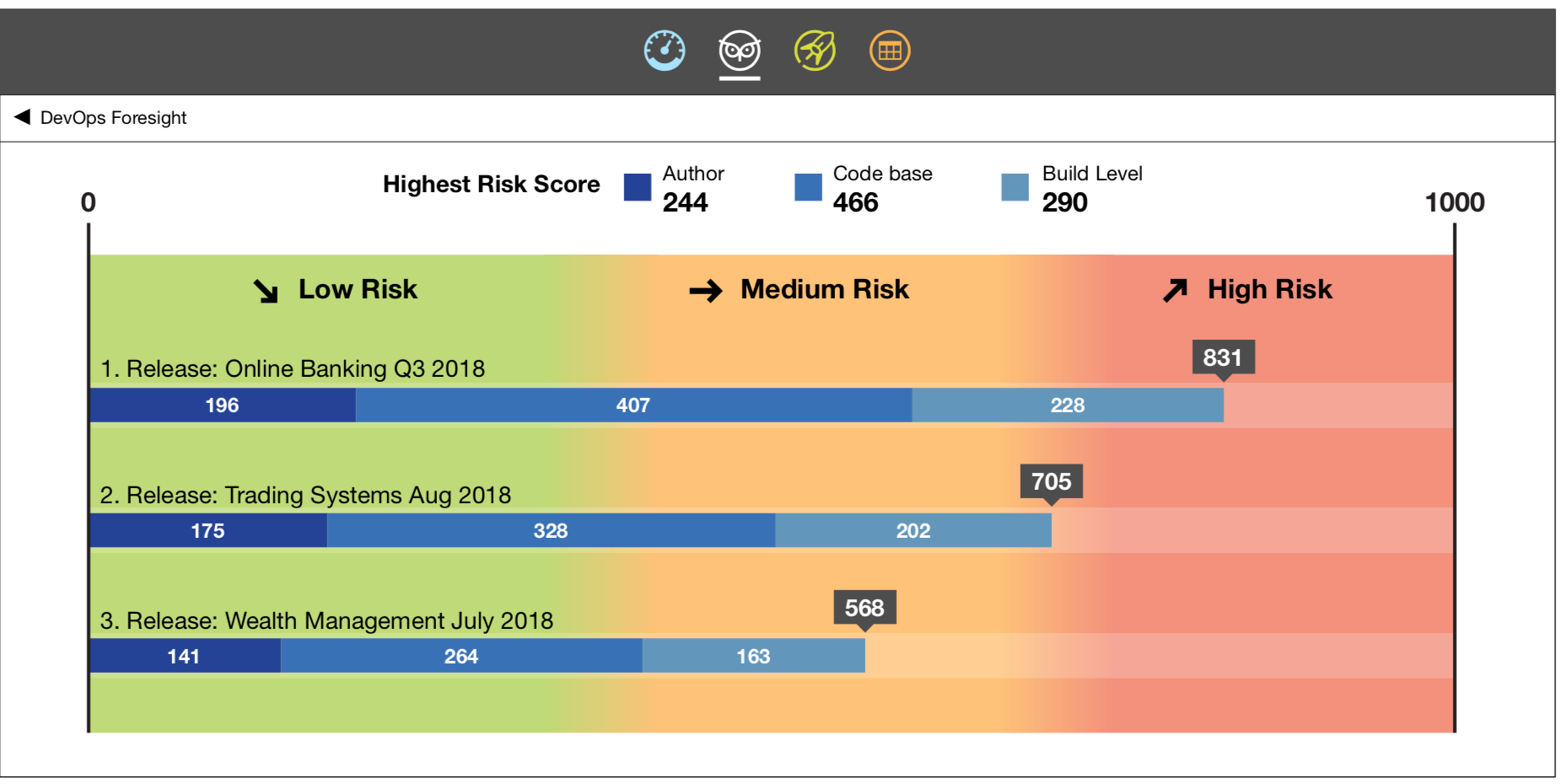
    Electric Cloud CTO Anders Wallgren said ElectricFlow DevOps Foresight is made possible because of the massive amounts of data that Electric Cloud is able to acquire providing an application release and continuous delivery platform-as-a-cloud service.

    Electric Cloud applies predictive analytics against all the data it collects to identify and contrast patterns, which it then uses to generate recommendations to specific DevOps teams based on what’s occurring in their local environment, said Wallgren.

    ElectricFlow DevOps Foresight is able to generate a risk score metric that predicts the probable outcome of a release before being deployed in a production environment. Based on that score, he said, a DevOps team can decide to go ahead and deploy that code or hold it back for further testing.

    The application also will make recommendations on how to improve pipelines based on, for example, the complexity of the code being deployed, Wallgren added.

    As part of this effort, Wallgren noted that Electric Cloud has been extending the level of integration it provides with application performance monitoring (APM) tools that serve as a source of data for a predictive analytics application.

    The goal is not so much to provide a “big brother” application that will determine who should be fired, , for example, but rather reduce as much friction in the DevOps process as possible, he said.

    Being able to apply machine learning algorithms to large amounts of data is becoming a compelling reason to shift DevOps processes into the cloud, he said, adding most organizations aren’t going to be able to collect the critical mass of data required to train machine learning algorithms running in an on-premises environment. ElectricFlow DevOps Foresight enables DevOps teams to leverage a turnkey application where support for those algorithms is already embedded into the cloud service, he said.

    Wallgren noted the result should be a significant reduction in the amount of anxiety surrounding any release of an application.
    Ultimately, the question many organizations will have to come to terms with is the degree to which they want to rely on machine learning algorithms and other forms of artificial intelligence (AI) to automate the DevOps processes. For now, Wallgren said Electric Cloud is focused on predictive applications that make recommendations versus taking independent action.

    It remains to be seen just how comfortable DevOps teams will become with various forms of AI. On the one hand, DevOps teams are clearly interested in accelerating application deployments at a time when the number of applications being  developed simultaneously is increasing exponentially. On the other hand, automating DevOps processes using AI could result in flaws being propagated at a level of unprecedented speed and scale. Long term, however, those organizations that fail to embrace AI to advance DevOps are more likely to find themselves at a competitive disadvantage.

    — Mike Vizard

  • Oracle Advances AI Effort to Automate DevOps

    Oracle Advances AI Effort to Automate DevOps

    Oracle today announced the general availability of an expanded Oracle Cloud Platform service that promises to automate most back-end DevOps processes by relying on a combination of machine learning algorithms and other forms of artificial intelligence (AI).

    The Oracle platform-as-a-service (PaaS) environment has also been expanded to include Oracle Mobile Cloud Enterprise, Oracle Data Integration Platform Cloud and Oracle API Platform Cloud alongside existing continuous integration and continuous deployment (CI/CD) cloud service. Oracle also revealed today that later this year it will also add blockchain, security and management and support for additional database workloads, including OLTP and NoSQL, that expand on existing Oracle Database, Oracle Autonomous Data Warehouse Cloud, Oracle Analytics Cloud, Oracle Integration Cloud and Oracle Visual Builder services.

    Siddhartha Agarwal, vice president of product management and strategy at Oracle, said via the cloud service, Oracle plans to automate DevOps processes to the point where organizations will be able to allocate most of their time and effort to building applications. Today, developers are spending as much as 50 percent to 60 percent of their time on DevOps processes rather than writing application code, he said, and the Oracle Cloud platform automates a broad range of operational functions including tuning, patching, backups and upgrades.

    Oracle Cloud Platform is designed to be an infinitely elastic autonomous cloud service that can both anticipate application requirements and dynamically adjust to changing workload conditions. Over time, the platform also will be able to increasingly provide recommendations based on the characteristics of the application workloads being built and deployed, Agarwal said.

    The Oracle API Platform Cloud service, for example, already continuously learns about usage patterns to recommend allocation limits, configurations and policies using predictive algorithms, he said.

    Meanwhile, the Oracle Cloud Mobile Enterprise service provides access to machine learning algorithms that make it much easier to incorporate chatbots into mobile applications, Agarwal said. Machine learning algorithms are now also relied on to create Big Data lakes and the data pipelines needed to make that data available to application developers.

    Those services are all extensions of an Oracle Developer Cloud service for building applications that supports build frameworks such as Maven, Ant, Gradle, npm, Grunt, Gulp and Bower, as well as command line interfaces for Docker, Kubernetes and Terraform. Frameworks such as JUnit and Selenium for both logic and UI testing are also included.

    Agarwal said one of the primary reasons DevOps process have not been as widely adopted across the enterprise is that it’s simply too complicated for most IT organizations to set up and then continuously manage all the underlying infrastructure required. By moving more of the responsibility for the operations side of the DevOps equation on to an autonomous cloud service managed by Oracle, he said, it becomes simpler for enterprise IT organizations to focus their energy on application development processes.

    It may take some time for enterprise IT organizations to get comfortable with ceding that level of control to a cloud service provider. But whatever DevOps path they choose, it’s apparent that machine learning algorithms coupled with other AI advances are about to automate broad swaths of the DevOps universe.

    — Mike Vizard

  • Machine Learning: Essential in Cloud Service Management

    Machine Learning: Essential in Cloud Service Management

    As businesses today compete more and more on digital experience, you need to ensure that what’s delivered performs optimally and provides an outstanding customer experience. With increasing complexities, growth and change in your IT infrastructure, you need complete visibility into the performance and availability of IT infrastructure, and also the applications that ride on it.  To succeed in this modern domain, your IT operations team needs to be more proactive than reactive.

    Proactive operations management have long been a goal of client-centric operations: the ability to avoid issues rather than simply reacting to issues more effectively or more efficiently. It is time traditional IT service management transforms to remain relevant. The good news is that machine learning has advanced to a stage where this is achievable at scale.

    Machine learning may have been a distant dream, but not anymore. Almost every system or gadget, whether complex or simple, is getting smarter using basic pattern recognition and computational learning, which is the basis of any machine learning technology. Today, public cloud service providers offer machine learning services that make this technology affordable. So, you are not too far away from making your IT operations management more client-centric.

    Machine Learning Meets IT Service Management

    Applying cognitive and machine learning capabilities to service management will help accelerate diagnosis of events and patterns, extract deep insights from IT systems and provide early warnings of anomalies that could cause service impact or poor performance.

    Machine learning will enable your IT service management to:

    Continuously learn: Cognitive service management uses machine learning to learn the behavior of applications and resources and get a true understanding of how it should function normally. With machine learning, you can continuously learn application and infrastructure behavior and then use those insights to set and dynamically manage thresholds for all monitoring data. You can understand the relationships across applications and resources to anticipate service impacts. With these deeper insights, you can quickly and efficiently resolve issues, improve overall operational efficiency and significantly reducing operational costs.

    Anticipate and adjust: With every outage is a potential service degradation. This is exactly where machine learning capabilities help proactively detect and avoid, which traditional service management capabilities lack. Insights from recurring anomalies help forecast potential service degradations. This information is used to proactively alert on potential problems so that organizations can adjust to the rapidly changing environments and intelligently prioritize their resolution.

    Recommend action: Efficiency is critical when it comes to finding and fixing application and systems problems. A skilled service organization backed with machine learning capabilities helps provide expert advice for taking corrective action and can offer greater service assurance. Applying cognitive capabilities turn terabytes of data captured from their IT infrastructure, into relevant and actionable insights for quicker problem solving and better service.

    Because machine learning uses algorithms that can learn by observing data, identifies important patterns in your data and by clustering them, you get to focus on the most urgent issues. It enables you to automatically detect problems and separate real issues from the noise. You gain faster time to resolution for troubleshooting problems that impact service to clients.

    To learn more, join us as we present “Cloud Service Management: Why Machine Learning is Now Essential.” During this informative webinar, you’ll learn why IBM believes adaptive automation, delivered through innovative machine learning, is now essential to achieving cloud service management at scale.

    — Eric Minick

  • Dell EMC Bets on Machine Learning to Drive IT Agility

    Dell EMC Bets on Machine Learning to Drive IT Agility

    Dell Technologies announced it is infusing machine learning algorithms across its portfolio of server and storage infrastructure to optimize the performance of each individual application using artificial intelligence (AI).

    At the Dell Technologies World 2018 conference, the Dell EMC arm of Dell Technologies announced it has joined the Intel AI Builders program. Dell EMC and Intel will enable customers to benchmark Deep Learning and high-performance computing (HPC) workloads running on Intel Xeon Scalable processors and Intel field programmable gate arrays (FPGAs) integrated in the company’s PowerEdge R740 servers at the Dell EMC Innovation Lab and the Dell EMC customer Solution Centers.

    Dell EMC also unveiled Dell EMC PowerMax, an NVMe-based storage array that takes advantage of an embedded machine learning engine into the storage operating system to optimize I/O performance. Dell EMC said that engine is capable of making 6 billion decisions related to optimizing 40 million data sets a day.

    Finally, Dell also announced Dell Precision Optimizer software that compares the behavior of each application deployed on a Dell workstation against a machine learning model that automatically optimizes system settings. According to the company, Dell Precision Optimizer can improve workstation application performance band delivery up to 394 percent.

    Ashley Gorakhpurwalla, ‎president and general manager for server and infrastructure systems at Dell EMC, said the plan is make it possible to compare the state of an IT infrastructure deployment against AI models that Dell EMC is constructing in the cloud using all the data gathered from the company’s systems connected to Dell EMC support services. Armed with that data, it will become possible to optimize system settings for every type of application deployed on it, said Gorakhpurwalla.

    He noted that despite advances in DevOps, provisioning resources in a local data center on demand is still too time-consuming. Many IT organizations have adopted converged and hyperconverged infrastructure (HCI) platforms to unify the management of compute, storage and networking. But machine learning algorithms combined with other emerging technologies should make it possible to make IT infrastructure resources on demand in a cloud-like manner. That increased level of automation should enable IT organizations to allocate more resources to developing applications than managing the infrastructure those applications run on.

    Each IT organization today is at a different stage of maturity when it comes to IT infrastructure. Dell EMC has one customer with a single administrator who manages more than 80,000 servers, Gorakhpurwalla said. Over time, IT infrastructure will become increasingly automated across a much broader range of customers, he noted—critical because it will allow local IT teams to be as agile as any cloud service providers. Today, many workloads are deployed in the cloud because of the perceived agility of the cloud, regardless of the actual costs.

    It may take some time for developers to regain confidence in the agility of local IT departments. But as AI models continue to evolve it’s now a matter of when rather than if local IT infrastructure will become much more responsive to the needs of any given application.

    — Mike Vizard

  • 4 Amazing Quantum Computing Applications

    4 Amazing Quantum Computing Applications

     Researchers across the globe, from the quantum researchers at University of Maryland synthesizing time crystals, to the research team at the University of New South Wales who are embedding atoms and their electrons into silicon, are pushing quantum computers forward, attempting to arrive at the most powerful quantum computing technology.

    IBM, Google and Microsoft are racing for quantum supremacy. IBM expects to create a 50-qubit general purpose quantum computer “within the next few years.” Indeed, the next iteration in quantum computing may be near.

    Why? Quantum computing could be the best path to ultra-powerful computers, and our best bet to solve unimaginably difficult problems. As our need for powerful processors continues to increase, and problems become larger in scope and complexity, we’ll need more complex computational systems to power solutions.

    Quantum Computers in Use

    Here are four amazing applications of quantum computers:

    Machine Learning

    Artificial intelligence needs to be able to pull from large datasets of image, video and text. Thankfully, there doesn’t seem to be a shortage of content. In fact, there may be an overabundance. Big data is out there to be analyzed, but we need more powerful computers to process the petabytes of unanalyzed data.

    Quantum computers could empower machine learning by enabling AI programs to search through these gigantic datasets concerning medical research, consumer behavior and financial markets—and make sense of them.

    Optimization

    Imagine, say, you are a traveling salesman. You wish to visit a handful of cities and want to know what the most optimal routes would be. This would be an example of an optimization problem. It sounds simple enough, but, in reality, the process can get quite involved as you up the number of variables. With only 270 destinations, for example, there are more combinations of travel than atoms in the universe.

    With quantum computers, however, we could expect a machine to be able to handle almost innumerable permutations and combinations, which could advance system design and analysis in massive ways.

    Biomedical Simulations

    With quantum computers, we can create, simulate and model molecular structures. Researchers at Harvard University used a D-Wave One quantum computer to solve the puzzle of how some proteins fold in 2012.

    “The model consisted of mathematical representations of amino acids in a lattice, connected by different interaction strengths,” writes Geoffrey Brumfiel in a news article for Nature about the Harvard researchers’ protein folding models. “The D-Wave computer found the lowest configurations of amino acids and interactions, which corresponds to the most economical folding of the proteins.”

    While the technology was nowhere near perfect—as the researchers cited that “10,000 measurements using an 81-qubit version of the experiment gave the correct answer just 13 times”—it was able to accomplish an amazing feat by modeling the behavior of protein folding with some degree of accuracy.

    Financial Services

    Quantum computing is already on its way. D-wave, a company backed by Goldman Sachs and Bezos Expeditions, among others, deployed its first commercial quantum computer: the D-Wave 2000Q, a quantum annealing system with 2000 qubits and advanced feature controls.

    Despite their prohibitive price, these computers are being utilized by a small niche, as illustrated by Harvard’s use of D-wave’s first model back in 2012. The systems could be used for complex financial modeling and risk management within the financial industry as well. Quantum computing could be used to find “new ways to model financial data” and isolate “key global risk factors,” according to IBM.

    “It would be great to build systems to help Wall Street better manage risk using this type of technology,” D-Wave Systems President and CEO Vern Brownell told Bloomberg. “They spend a lot on computing power [to manage risk].”

    Conclusion

    From managing money to massive datasets, quantum computing’s applications are seemingly endless. Advances in machine learning and optimization could boost efficiency dramatically. Biomedical and chemical simulations could help us land more drug discoveries and uncover new medical treatments in record time. Advanced computing power could lead to more than just innovation; it also could lead to lessened risk. Indeed, enhanced financial services could fundamentally change how we invest.

    As tech companies, computer scientists, and theoretical physicists help to perfect this technology, these truly amazing applications of quantum computing could become ubiquitous—and drive us further into a quantum age.

    — Ellie Martin