Tag: machine learning

  • Research Firms Agree, Cloud Growth Continues to Soar

    Research Firms Agree, Cloud Growth Continues to Soar

    Investment in all the various types of cloud computing has gone gangbusters in recent years, and for good reason: Cloud computing helps to cut cost, shorting time to market, provides unrivaled scale and reliability.

    This will only continue as enterprises continue to divest from on-premises infrastructure over the long term while seeking to scale the tremendous data generated by AI, IoT, machine learning and digital transformation. It looks as though for the few years ahead, it’s nothing but tailwinds for cloud investment and growth.

    According to research firm Gartner Inc., the software-as-a-service (SaaS) market reached $48.2 billion in 2016, growing more rapidly than the firm previously projected—although Gartner didn’t say in the release what its previous revenue prediction had been.

    Currently, Gartner expects the total worldwide public cloud services market to grow 18.5 percent in 2017 to reach $260.2 billion. That’s up considerably from $219.6 billion in 2016.

    According to Gartner, SaaS revenue is expected to grow 21 percent this year to reach $58.6 billion. “The acceleration in SaaS adoption can be explained by providers delivering nearly all application functional extensions and add-ons as a service. This appeals to users because SaaS solutions are engineered to be more purpose-built and are delivering better business outcomes than traditional software is,” Gartner writes.

    The highest-revenue growth will come from cloud system infrastructure-as-a-service, which Gartner says is projected to grow 36.6 percent in 2017 and hit $34.7 billion.

    Cloud Mojo Keeps on Rising

    Cloud is only going to continue to take a greater share of overall spend in the years ahead. According to Sid Nag, research director at Gartner, last year about 17 percent of the total market for infrastructure, middleware, application and business process services shifted to cloud, and by 2021, that will rise to 28 percent.

    Those looking at trends outside of cloud won’t be surprised to see cloud growing so much greater than that of the overall global economy. According to research firm IDC, worldwide information and communications technology (ICT) is set to rise over the next five years, fueled by IoT, robotics, augmented and virtual reality, cognitive computing and artificial intelligence.

    Total ICT spending on traditional IT, telecom services and new technologies will grow to $5.6 trillion by 2021 from $4.3 trillion in 2016, representing a compound annual growth rate of 6 percent in constant currency terms. Annual growth will accelerate through the forecast period, to 6.5 percent in 2021 from 5.5 percent in 2017, as new technologies account for a growing proportion of the overall market, IDC writes.

    Of course, all of this will increase investment in security and, according to a recent report from Markets and Markets, the cloud security marketing, including identity, data leak prevention, intrusion detection/prevention systems, encryption and security information and event management systems. According to Markets and Markets, the cloud security market will grow to $12.73 billion by 2022, up from only $4.09 billion in 2017.

    — George V. Hulme

  • BMC to Infuse AI Across Software Portfolio

    BMC to Infuse AI Across Software Portfolio

    At its recent BMC Exchange event, BMC Software announced it will be infusing machine learning algorithms and other artificial intelligence (AI) technologies across its entire portfolio of IT operations software.

    The first instance of BMC software to make use of machine learning algorithms is the latest version of TrueSight AIOps platform, which ingests data from multiple data sources to automate processes across BMC service desk, IT operations and tools for managing DevOps processes. BMC also is working with IBM to employ the cognitive computing services known as the IBM Watson cloud service across its portfolio.

    In addition, the company launched TrueSight Cloud Cost Control, a tool for managing and tracking usage of cloud services across multiple providers, and BMC SecOps Policy Service, which easier to embed compliance and testing via an external service that gets included in their software development processes.

    Finally, BMC announced it has signed an alliance with Amazon Web Services (AWS) under which the two companies will work to accelerate the migration of application workloads to the AWS public cloud.

    Dan Streetman, a senior vice president for worldwide sales and marketing at BMC, says his company is developing a product strategy around three major themes:

    • IT organizations will require management tools that will work across multiple clouds;
    • As part of general “shift left” developers now expect to be able to programmatically invoke IT operations and security services; and
    • IT professionals now expect the tools they use to manage IT to have the same types of advanced capabilities that consumer applications provide via speech interfaces such as Apple Siri or Microsoft Cortana. Various IT and customer service desks also soon will use speech interfaces to provide a highly automated self-service experience to end users.

    In fact, given the complexity of the IT tasks that now need to be managed, Streetman says a race is now on between IT vendors to live up to those expectations. Much less of a concern, he says, is any notion that AI technologies might one day replace IT professionals that by and large are already overtaxed; rather, it is apparent that IT vendors are now being evaluated on their ability to maximize existing investments in IT professionals that are already in short supply. The real opportunity is to free IT professionals to enable them to concentrate on higher-value tasks.

    Naturally, it remains to be seen how various AI technologies will impact the management of IT. It certainly will take a while for IT administrators to put their faith in AI. But as those technologies continue to mature, there may soon come a day when IT professionals look back with wonder at all the things they used to have to accomplish one manual task at a time.

    — Mike Vizard

  • Machine Learning Is Working for CIOs, Vendor Survey Finds

    Machine Learning Is Working for CIOs, Vendor Survey Finds

    AI’s time has finally come, if a new survey commissioned by ServiceNow is to be believed. Its results showed that nearly 90 percent of CIOs are at least dabbling with machine learning, with 53 percent calling it an area of strategic focus for their companies. What’s more, almost 70 percent of the CIOs surveyed say decisions made by machines will soon be more accurate than those made by humans.

    The new survey was conducted by Oxford Economics on behalf of IT and enterprise software-as-a-service vendor ServiceNow. The survey, titled “The Global CIO Point of View,” was completed by 500 CIOs in 11 countries across 25 industries.

    The report also fits neatly with evidence from other sources that CIOs are in charge of digital transformation. Just under 75 percent say they lead their company’s efforts to gear up for full-fledged digital business. Business intelligence derived from data analytics has always been a pillar of digital transformation. But with some 85 percent of CIOs reporting that machine learning provided “substantial value” or “transformative value” to the accuracy as well as rapidity of decisions, it’s beginning to change the way some organizations operate, according to the report.

    Within three years, two-thirds of the respondents expect to be making an investment in machine learning. Today, one-third are investing. The size of spend as a percentage of the overall IT budget is relatively modest, however: something like 5 percent for machine learning.

    One of the reasons for the move to machine learning is that sometimes you just have to do things smarter. “We were heading to a tipping point almost where there was just so much work coming in,” said Dave Wright, chief innovation officer, ServiceNow, talking about IT shops. “There was just so much work coming in; the workload just continued to increase year over year. CIOs want to know, ‘How do I get to the point where I can deal with this, because I can’t constantly throw heads at it.’” That’s why the report advises that companies direct their early machine learning efforts at the most commonly used services, freeing resources for more rewarding efforts.

    Machine Learning’s Obstacles Aren’t What You Think

    Machine learning technology has matured so much in recent years that it’s no longer the prime obstacle for CIOs. Instead the challenges are outdated business processes, incomplete insufficient skill sets, lack of quality data, insufficient data sources, risk assessment conflicts and budget limitations. When data is siloed across the company, accessing all the right data for the best decision-making is not always easy or possible. There’s also some inertia built into the organizational structures of most companies; the notion of making business decisions based on machine learning (a.k.a. “decision automation”) may require some handholding, for example. Technology is not the problem.

    Early adopters to machine learning, which represent just under 10 percent of the survey sample, share some characteristics and ways of doing things: They prioritize talent. They are working on better business processes and have a road map for future changes developed by monitoring mistakes made by machines. The road map is also guided by the need to implement policies and processes that improve data quality. They have strong technology foundations, with an emphasis on data analytics, cloud, mobile and IoT. And they expect results. Nearly 90 percent of this 10 percent of early adopters expect decision automation to support topline growth.

    What may be more interesting is that, of the other 90 percent of the CIO respondents, nearly 70 percent expect to develop revenue from machine learning. Looking at the data behind this report, the CIOs who’ve gotten their feet wet with machine learning are very excited by its prospects.

    The report outlines five steps to achieve value from machine learning that are worth a quick summary:

    1. Build your technical foundation so as to improve data quality. Successful companies had already invested significantly in analytics, for example.
    2. Prioritize automation of the most common business use cases; they will return the greatest business benefit.
    3. Build an exceptional customer experience. If customers see the man behind the curtain in a machine learning-based tool, it may become a very negative experience for them. Spend extra time making the entire customer journey seamless.
    4. Attract employees with new skills and double down on culture.
    5. Measure and report. The benefits of machine learning may not be obvious to all. CIOs must set expectations, develop success metrics and build a sound business case to acquire funding. Build some success stories.

    — Scot Finnie

  • Using AI to Automate Incident Management Sparks Debate

    Using AI to Automate Incident Management Sparks Debate

    When it comes to incident response with an integrated DevOps environment so much depends on the ability of an IT team to respond quickly and consistently to a specific set of events. Because of that requirement, many IT organizations have invested in incident management systems that everyone in IT can consult whenever an issue arises. Now PagerDuty, a provider of incident management software, is taking that concept a step further by applying artificial intelligence (AI) to automate as many incident response tasks as an organization deems appropriate.

    As promising as that may sound, however, Resilient Systems, a unit of IBM that is an arch-rival to PagerDuty, contends most organizations today do not have anywhere near the level of incident management maturity to make investing in AI worth their time and effort yet.

    Eric Sigler, head of DevOps for PagerDuty, says the the latest edition of the company’s namesake incident management platform is designed to augment the capabilities of the local IT administrator by providing:

    Alert Grouping: Rules-based automation and machine learning algorithms automatically group related issues together to make it simpler to identify related issues.

    Similar Incidents: IT administrators and support specialist can see previous related issues and surface information around incident severity, impact and remediation steps.

    Response Automation: A Response Plays capability allows teams to design and execute an automated response pattern to recruiting responders and stakeholders by a single click.

    Dynamic Notifications and Event Routing: IT teams can select notification and assignment behavior and automatically route events to different teams based on event payloads.

    Sigler says PagerDuty has also redesigned the company’s user interface, creating an enhanced live incident details page that makes discovering events simpler.

    Those capabilities, says Sigler, will collectively prove to be critical in an emergency because most of the time the specialist associated with a specific IT discipline is usually not immediately available when needed. First responders to any given event need as much information as possible as their fingertips to resolve issues as quickly as possible.

    But Ted Julien, vice president of product management for Resilient Systems, says most organizations simply don’t have incident response processes in place that would benefit from that level of AI. Machine learning algorithms require access to massive amounts of incident response data to learn what to do, but most organizations don’t collect that data, much less learn from it, he says. That doesn’t mean AI doesn’t have potential. But he believes AI is not nearly as far along when it comes to incident response as anyone would like. In fact, he notes, machine learning algorithms and other forms of IT automation could just as easily wind up doing more harm than good.

    There may come a day when incident response in an IT environment is fully automated. But the distance between where most IT organizations are today and the achievement of that goal is still nothing less than considerable.

    — Mike Vizard

  • AIOps: Managing the Second Law of IT Ops

    AIOps: Managing the Second Law of IT Ops

    Or, why IT systems keep breaking

    The tension between the two halves of DevOps is long-standing, going back long before the term was even invented. What underlies the split between Development and Operations is a fundamental difference, like an actual physical law. Let’s explore that analogy together.

    IT Ops is fundamentally a constant fight against entropy, meaning disorder. Sysadmins expend significant energy trying to keep everything up and running, in a process which can sometimes feel like trying to shore up a sandcastle while the tide is coming in. Systems are constantly breaking down; users need changes made that introduce risk; and, as if that wasn’t enough, the whole shebang is constantly under attack from malicious outsiders. It’s no wonder that sysadmins have a reputation for being a bit grumpy!

    Homer: In this house, we obey the laws of thermodynamics!
    It’s not just a good idea, it’s the law.

    In contrast, Dev actually increases the level of entropy. Every new release, be it as small as a one-line fix or finding that errant semicolon, is a change that has to be made, reducing the order that Ops fights so hard to maintain. Dev is entropogenic, embracing change as a positive force.

    The interaction between Dev and Ops is analogous to the second law of thermodynamics: Entropy can only increase over time, unless energy is introduced to the system from outside. In other words, unmanaged change will eventually cause something to break, unless people put in continuous effort to prevent those breaks.

    Thermodynamics: Lots of Heat, not Much Light

    These conflicting goals, taken to extremes, can get unhealthy, with Ops actively fighting change or Dev going around Ops to increase their velocity of change. Left unchecked, this tension can turn into a vicious cycle, as frustration with the “Department of No” drives developers into unmanaged “shadow IT.”

    The good news is that the analogy with hard laws of physics is not perfect. The process of increasing entropy is not irreversible, and does not require constant inputs of energy to prevent. New agile approaches to IT Ops are emerging that are light and flexible, taking their structure from that tension. In the physical world, this is called “tensegrity,” and was originally formulated by Buckminster Fuller, one of those annoying polymaths who seem to make breakthroughs in every field they touch.

    Tensegrity structure
    Tensegrity structure

    IT Ops needs its own equivalent to tensegrity, a flexible, holistic structure that is able to embrace change while maintaining its shape. Structures that try to resist change through rigidity are brittle and ultimately fragile.

    Today, this flexible strength is enabled by AIOps, a term coined by Gartner to describe a new way of operating IT, based on augmenting human skills with automated analysis enabled by modern algorithmic and machine-learning approaches.

    Complexity Breeds Complexity

    Modern IT is too complex for any single person or even team to keep track of, instead requiring multiple specializations. In turn, each of these functions requires its own specific support tools that enable that particular role. Beyond a certain point, it becomes very difficult to combine these partial views to gain a holistic understanding of what is actually happening in the environment.

    Because of the scale of modern IT environments and the sheer rate of change that businesses require, old-style rules-based “Managers of Managers” can no longer keep up, requiring more effort to build and maintain their worth. Especially as infrastructure becomes more and more self-modifying in response to changing conditions and demand, IT Operations needs to accelerate just to keep up.

    AIOps brings developing issues to the attention of sysadmins before they become visible to customers and end users, and gives them the tools to collaborate effectively between different teams and specialist roles to avoid outages or restore service quickly and efficiently. In this world, automation is used to augment the capabilities of the human operators to make them more effective, letting people concentrate on adding value, not just fighting fires.

    This is how Ops can get out of the business of fighting Dev, and instead become a supportive partner. AIOps can catch issues that are affecting services and flag them to the right people early on, including the DevOps engineers that are responsible for production support.

    For developers, one of the fears around DevOps is that in “picking up the pager,” they are opening themselves up to a constant stream of irrelevant alerts. Old Ops hands nod wryly at this, or maybe try to share their personal approach to filtering the noise. Instead, AIOps ensures that only valid, actionable alerts get as far as being shown to a human being and taking up their valuable time.

    Eyes on the Prize

    It’s not all roses. As the AIOps market begins to mature, there is a certain amount of “algorithm-washing” going on, with more and more vendors trying to claim that either their legacy tool was AIOps all along, or that their one-trick pony is actually a whole three-ring circus. What gets lost in the excitement is what all of those algorithms are actually supposed to achieve.

    Me too!
    Me too!

    In considering a shift toward AIOps, the goal should not be simply to build a better mouse trap, meaning a smarter filter for monitoring events. The success of the project can be measured not so much in the mathematical results of the algorithms, but in the smoother exchange between the human users. This easier collaboration is especially important across team boundaries, whether these be different specialist units within the Ops function or developers and software engineers who need to work with Ops to understand the performance of their code in production.

    The benefit of transforming operations this way—moving from sequential, waterfall Ops to abile, collaborative Ops—is to turn DevOps-enabled teams into a sort of perpetual-motion machine, able to continue operating without requiring constant massive inputs of energy from outside the system. Modern applications and the complex infrastructures that support them cannot be managed with the sorts of rigid, cobbled-together, industrial approaches that were appropriate in the mainframe days. AIOps is the agile, flexible approach that can not only accomodate that complexity, but thrive on it.

    — Dominic Wellington

  • New Relic Tracing Software Pinpoints Source of IT Issues

    New Relic Tracing Software Pinpoints Source of IT Issues

    At a FutureStack 2017 conference this week, New Relic previewed an implementation of distributed tracing software that has the potential to close the war rooms where IT operations assign blame for application failure.

    New Relic CEO Lew Cirne says a Distributed Tracing capability that New Relic previewed this week will enable developers or IT operations teams to pinpoint the precise source of any given performance issue. Rather than wasting hours on root cause analysis, Cirne says DevOps teams will now be armed with dashboard they can navigate to visually inspect what elements of a distributed computing environment are specifically affecting their applications.

    Based on the open-source Open Tracing software being advanced by the Cloud Native Computing Foundation (CNCF), Cirne says New Relic opted to embrace an open initiative that should lead to more actionable intelligence being derived from the data New Relic collects.

    At this juncture, Cirne contends that deploying an application in production that has not been instrumented borders on the criminal. He concedes, however, the preponderance of applications deployed in production environments today are not instrumented largely because the total cost of instrumenting legacy applications has been cost-prohibitive. But as IT monitoring software becomes less expensive to invoke using agents that communicate back to a software-as-a-service (SaaS) application, most new applications being deployed in the cloud are now being instrumented.

    To help further that goal, New Relic this week also announced support for .Net Core 2.0 framework recently made available on Microsoft Azure and added support for six additional Amazon Web Services (AWS) services. New Relic now supports a total of 25 AWS services.

    At the conference Cirne also showed how IT organizations can now invoke New Relic application programming interfaces (APIs) to spin up a dashboard to track specific events associated with, for example, the rollout of a new application.

    Access to the data New Relic surfaces, notes Cirne, in turn helps fuel adoption of DevOps because organizations gain confidence in their ability to more rapidly build and deploy applications. That confidence will only increase as IT organizations avail themselves of artificial intelligence (AI) software in the form of machine learning and, soon, deep learning algorithms to make more reliable decisions based on patterns in their IT environments. New Relic, he adds, is able to fuel those algorithms because the service collects 1.5 billion metrics and events every minute. That said, humans will still be required to manage the overall IT environment.

    Cirne maintains that the best way to collect all that data is to employ agents, noting New Relic is adopting those agents to make them lightweight enough to even deploy on microservices based on containers.

    New Relic naturally is not the only provider of IT monitoring tools investing heavily in advanced algorithms. In the not-too-distant future, it’s probable that algorithms deployed by different vendors will share insights with one another. In the meantime, IT administrators can take some comfort in the fact that it should soon become easier to manage IT at scale.

    — Mike Vizard

  • Automation: This Time, It’s Different

    Automation: This Time, It’s Different

    It took about 200,000 years for mankind to be able to figure out how to get an airplane to fly. The event took place Dec. 17, 1903, on a field in Kitty Hawk, N.C., when Wilbur Wright piloted the airplane he had made with his brother, Orville, into the air. The flight lasted for 12 seconds. The aircraft covered a distance of 120 feet. The next two flights went a distance of 175 and 200 feet, respectively. The last flight of the day covered a little more than 800 feet. The plane stayed in the air for 59 seconds, at an altitude never greater than 10 feet, before striking the ground and incurring minor damage.

    Although the flights were a significant technological breakthrough, they had absolutely no commercial value. Other forms of transportation could go further and travel for longer periods.

    Almost two years later, having learned from their mistakes, the Wright Brothers were able to keep an airplane flying for 38 minutes, covering a distance of 25 miles at a speed of 40 mph. The aircraft was 30 percent faster than a horse at full gallop, but still slower than a passenger train running at an average speed of 60 mph. Commercial viability was in sight.

    In June of 1919, 16 years after the Wright’s first flight at Kitty Hawk, Capt. John Alcock and Lt. Arthur Whitten Brown of the United Kingdom flew 1,690 miles from Newfoundland to Clifden, Ireland, in a little more than 16 hours. Fifty years later, it took 73 hours and and 5 minutes for the crew of Apollo 11 to fly the 238,857 miles from Cape Canaveral, Fla., to the moon.

    Think about it. It took mankind 200,00 years of technological progress to get a plane in the air, but only 63 years after that to travel to the moon. It’s pretty miraculous, in a way. Technology does not just move forward. It careens ahead exponentially.
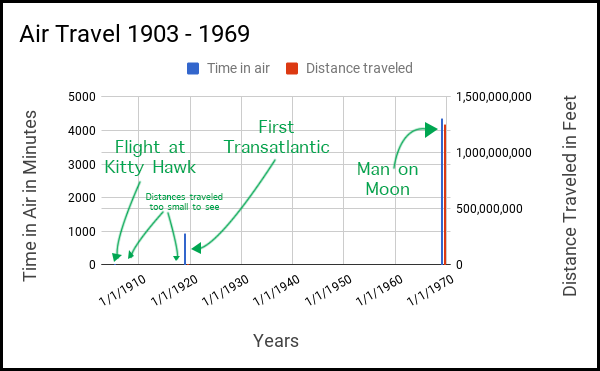
     

    Figure 1: Mankind was able to travel from 12 feet to 238,857 miles by air in 63 years

    What was the stuff of science fiction in my childhood—think video conferencing—is commonplace today. And it’s cheaper than we ever imagined possible. The future possibilities of technology are limitless. Anything can come to be, given enough time.

    But, when it comes to considering artificial intelligence and machine autonomy, there are still a lot of people out there who think that the notion of machines taking over most of the jobs that humans do is far-fetched, if not daffy. According to conventional wisdom, history’s pattern is that for every job eliminated by technology, more are produced. And should machines displace humans from the workforce entirely, that day is a long way off.

    That’s what my grandmother thought. She was born in 1900. If you had told her when she was a teenage girl that the flying contraption she was reading about in the newspapers would have the result of putting a man on the moon in her lifetime, she would think you crazy, and rightly so. She had no historical precedent to think otherwise. Remember, in her day horses still pulled plows. Everything except birds and hot air balloons were land-bound. Yet, despite her disbelief, there came a time when she sat in front of a television to watch Neil Armstrong descend from the Apollo 11 Landing Module to put the first human footprint on the moon. She thought it would never happen. And yet, it did.

    Yes, the historical pattern has been that technology eliminates jobs and creates new ones for humans to do. When the automobile replaced the horse, the out-of-work blacksmiths went to work in factories that filled the ever-expanding industrial landscape. And, with each wave of technological innovation, there were the harbingers of doom predicting the demise of human labor. Each generation of naysayers uttered, “This time it’s different.” Conventional wisdom points out that it never is.

    That was then and this is now. This is the time of the autonomous machine. This time it is different.

    The Rise of the Autonomous Machine

    Machine autonomy is the ability for a device to make decisions and conduct itself independent from ongoing instruction, very much the way a human does. The most telling example is an automated stock trading program used by financial investors. The program is at work continually buying and selling stock with the goal of turning a profit. Certain safeguards are built in to prevent disaster. But for the most part, the application is left on its own to achieve its goal: to make money.

    Until very recently, machine autonomy was confined to software applications such as the stock trading example described above. However, modern robotics makes it so that not only can a machine “think” autonomously, it now also can move autonomously. The most apparent example is the self-driving car.

    Integrating physical and cognitive autonomy into machine behavior changes the game. In prior days, a taxi required a human driver to get the passenger’s destination, find the best route, drive the vehicle and collect payment for the ride. All a passenger needed to do was jump in the back seat and tell the driver where to go. The human driver figured out the rest. As technology improves, the passenger still will jump into the back seat, but in an autonomous vehicle that gets routing information and traffic conditions from a wireless connection to the internet.

    The ramifications are profound.

    For example, let’s imagine we have a diseased tree in our front yard that needs to be removed. Today, we call a landscaping company. The tree removal crew shows up, we point to the diseased tree and ask the foreman to remove it. That’s the only instruction we need to give. The landscaping crew has the ability to act autonomously to do whatever is necessary to remove the tree safely.

    Now, imagine the crew brings along a robot to help with the task. At this point, it’s safe to say that current robotic technology requires a lot of human guidance to remove the tree; the robot is more an aid than an independent worker. The robot might have no other ability than to pick up tree cuttings and take them to a truck to be hauled away. Or, the robot might be able to handle a tree-cutting tool to assist with demolition. Still, the independence of the robot it limited. Either its activities are limited to repeatable tasks limited in scope, or it can act in an ad hoc manner by taking one instruction at a time from a human. The robot is dependent on human instruction to get work done.

    However, let’s imagine that robot technology is on the trajectory of exponential innovation that has been the historic norm. Remember, in the scheme of 200,000 years of homo sapien activity, 63 years from a field in Kitty Hawk to the moon is but a blip in the historical timeline. Autonomous lumberjack robots are entirely possible.

    You call up a landscaping company. A crew of three lumberjack robots show up in an autonomously driven vehicle. These robots know everything there is to know about tree removal and they can do all the physical activities required. The “lead” robot asks you which tree needs removing. You point to the tree. The crew figures out the rest on its own, right down to charging your credit card for work done. Plausible? If you answer no, pretend you are my grandmother and you’ve just been asked whether you think it’s plausible that a man will walk on the moon in your lifetime.

    So the question remains, What happened to the human crew? Did they become data scientists? Don’t answer this question yet. We’ll get to it in moment. First, we need to talk about the next milestone on the road to complete machine autonomy: artificial general intelligence (AGI).

    Narrow AI and AGI

    In the tree-removal scenario described above, all robotic activity—autonomous or otherwise—was confined to a single task: removing a tree. The scope of work is limited. Working within a limited scope of behavior is called narrow AI (artificial intelligence).

    Examples of narrow AI are cutting down a tree, trading a stock, finding a date on Friday night, composing a song, making a pizza, etc. We’re going to see a lot of narrow AI emerge in the next few years. Venture capitalists such as Khosla Ventures, Greylock Partners and Goldman Sachs are already putting money into advancing narrow AI technologies. However, narrow AI is but a stepping stone to get across the pond to the final destination: general AI.

    Think of of it this way: If Kitty Hawk is the starting point of AI, the first transatlantic flight is narrow AI. AGI is landing on the moon.

    What will general AI look like? Let’s go back to the landscaping example.

    We’re back in your front yard sitting in some lawn chairs having ice tea on a hot summer’s night. A driverless vehicle shows up. Two robots emerge. One approaches you and asks your permission to deposit $500 in your PayPal account in exchange for cutting down a diseased tree in your front yard. “OK,” you say, “but how do you know the tree is diseased and why are you giving me $500?”

    While the second robot gets to work, the first robot responds, “The county keeps drones in the air 24/7 analyzing the landscape. A drone did a spectral analysis of your property and noticed the diseased tree. In addition to reporting back the location of the tree, the drone also included a full biological profile. If you don’t remove the tree, the disease will spread. That’s the bad news. The good news is that it’s a cherry tree. And it seems that only 10 percent of the tree is diseased. The rest is perfectly good wood. The price of cherry wood is quite high on the commodity markets right now. Also, there’s a legal statute that requires the county to reimburse property owners when a private landscape is altered for general good. So, the county sold a futures contract on the wood it can reclaim from your tree. The $500 we want to put in your PayPal account reflects your share of the revenue received from the futures contract plus the amount of the reimbursement entitlement required by law.”

    This is what AGI looks like. AGI is the ability for a machine to think in broad terms, using a multitude of knowledge domains. Combining AGI with the advances in physical robotic capabilities expected on the horizon produces a result in which machine autonomy is not only possible, but will exceed human capability.

    If you think AGI is a fantastic notion, go talk to Yves Bergquist, CEO over at Novamente. The company is actively working to improve AGI for general commercial use. One application Novamente is developing uses AGI to determine, if not create, movie scripts with a high probability for profitability. To quote Bergquist: “A story is an algorithm.”

    Making a modern-day Hollywood blockbuster is a billion-dollar undertaking. Given the choice, studios would rather not roll the dice. However, when it comes to scripts, predicting a winner is difficult. Of all the human endeavors that are tough to emulate with artificial intelligence, creative storytelling ranks high. Writing a script requires working in a multitude of knowledge domains: story, character, plotlines, scene design and historical continuity, to name a few. Narrow AI is not suited to the task. You need AGI. There’s too much to consider. In a way, it’s surprising to think of Hollywood is the perfect incubator for developing real-world AGI. But it makes sense. AGI might produce a few flops. But, it’s a whole lot safer to lose at the box office than to lose on the battlefield.

    Given companies such as Novamente, the entertainment industry might well become the incubator in which AGI is perfected. Then, if the trend in rate of technological innovation continues, eventually AGI will become viable everywhere. Then what? What happens when a machine can do everything a human does only faster and better?

    A Turkey’s Life

    Understanding the long-term impacts of a given technology has not been one of the highlights of human endeavor. As cars became commonplace, few people considered the possibility that too many would create too much carbon monoxide and thus threaten the health of the earth’s population. And nobody really thought about what was going to happen to the displaced blacksmith who was no longer needed to make shoes for a diminishing number of horses. Events just ran their course with little or no forethought.

    But, it’s getting better. Some people do think ahead. Military planners consider the improbable as do financial analysts. It’s called risk analysis. These are the people that get paid to think outside the box, so to speak. They understand the even small possibilities might happen. Whether they are heeded or not is another story.

    Today, machine autonomy is real. The possibility exists that in our lifetime automated AI will indeed be able to do everything a human does. And, the machine will do it better at less expense. There will be no new jobs for humans to do as old ones are destroyed. A machine will be able to do the new job faster and cheaper—even those jobs that require a significant amount of AGI. Then, what will happen to the humans?

    We have to think about it today!

    Sadly, few are. We are not hearing any articulation in general industry or in government, at any level, about ideas to address the the impact of automation on human employment as machine autonomy and AGI become more prevalent in the economy. It seems as though most people are relying on the old logic of the conventional wisdom.

    Conventional wisdom is easy to accept. The U.S. economy is reported to be at practically full employment levels. Employers are complaining about how difficult it is to find qualified workers. The stock market is achieving historic heights. Given history and current events, of course it’s reasonable to say there always will be jobs for humans to do.

    This assertion works until the day fully autonomous machines appear on the landscape. Then, conventional wisdom will be that which is uttered by turkeys on the day before Thanksgiving.

    What do I mean? Allow me to elaborate using a previously written analogy.

    Imagine you are a turkey on a farm. Every day the farmer comes by to feed you. This goes on for one week, two weeks, 10 weeks. Given your history, you are completely justified to predict that your future will be one of satisfying meals. It’s always been this way; how could it be otherwise? You go day in and day out predicting that the next day will be full of food and sunshine. You are correct … right up until the day before Thanksgiving.

    In other words, there are things that happen independent of historical precedent. The trick is to imagine what such events might be.

    Everybody agrees that AI is here and that machine autonomy is growing. The conventional wisdom is that, based on historical observation, there have always been jobs as technology grows. Many think the full replacement of human labor by autonomous machines is a possibility, but one that is coming in the far, distant future. When Wilbur Wright took off in 1903, my grandmother’s distant future as was 1969. Those 63 years passed in no time. She lived to see a man land on the moon. Those of us alive today are seeing the beginnings of true machine autonomy appearing on the technology landscape. A world of full machine autonomy is more than probable in the lifetimes of our grandchildren. It will happen. What will be the impact? What will they do if their labor is no longer required?

    Back in 1903, as automobiles began to chug along the planet’s roads, we missed predicting the possibility of air pollution and global warming. Today, will we allow conventional wisdom to prevail and miss preparing for the impact that full machine autonomy will have on human employment? Or will we plan ahead? Hopefully, we’ve learned from our mistakes.

    I’ll leave it to you to decide.

    Author’s Note: The analogy of prediction in terms of historical precedence is taken from the book, “The Black Swan,” by Nassim Nicholas Taleb

    — Bob Reselman

  • Machine Learning and ITSM: Helping Help Desks

    Machine Learning and ITSM: Helping Help Desks

    The field of machine learning is a hot topic. We know that this type of artificial intelligence (AI) provides computers with the ability to learn without being explicitly programmed. For people like me who need it in simpler terms, machine learning deals with systems that can learn from past data and experience to improve performance of a particular task.

    Machine learning already touches our lives, both personally and professionally, more than anyone could have imagined. For example, a lawn sprinkler system can be trained to tell the difference between squirrels and cats and to turn on when cats walk on the grass to shoo them away. Processing online search requests, filtering spam automatically out of our email inboxes and understanding and replying to our speech commands on smartphones are all machine-learning tasks being done on a daily basis.

    Sooner or later, machine learning will also be applied to IT service management (ITSM) to change the way help desks work. The benefits might include predicting issues and problems proactively, improving search capabilities and knowledge management, and classifying and routing issues with greater ease. To be more specific, you can expect the following scenarios in the near future:

    Service Requests Will Have Auto-Approvals and Custom Workflows

    With the implementation of machine learning, help desks can be trained to auto-approve service requests based on the employee’s role, department, work site and other parameters. For example, when a designer requests additional design tools or software, the help desk will be able to automatically approve the request and initiate a workflow without waiting for the manager’s approval. The help desk also can be trained to automatically check the workstation assigned to that designer for minimum system requirements to install the requested tools or software and create a request to upgrade the system, if necessary—all by itself.

    Help-desk systems will also be able to learn from past onboarding experiences and make suggestions such as the type of software and hardware the user needs, the access permissions they need based on their role or department, or even a printer configuration setup. These are all options for improving the speed of service delivered to end users.

    Level 1 Incidents Will Be Resolved Without Technicians

    End users will be able to search for solutions and resolve incidents without the involvement of any technicians. Through machine learning, help desks can be trained to scan incoming tickets and provide end users with solutions automatically, based on the system’s previous experience. Google Assistant-style chat boxes will also help end users resolve incidents or get information without even logging a ticket into the help desk.

    For example, a user would just have to ping the help desk that “the printer is not working,” and the help desk would be able to check the printer’s print threshold level and create a request for a toner replacement, if needed. The system also would be able to immediately and automatically send any relevant knowledge-base articles that might help the end user check network connectivity issues or reset the printer configurations in their machines.

    Help desks also could learn from past experience and data to route tickets or tasks to the appropriate technicians or support groups, thereby automating the ticket assignment process without having to create any rules or workflows. Machine learning would help reduce resolution times and improve the efficiency of the help desk team.

    Problems Will Be Anticipated and Prevented

    With machine learning, help desks will be able to analyze incident patterns and anticipate problems. In addition, trained help desks could automatically trigger notifications or create problem tickets for anticipated issues so that the help-desk technicians can investigate at the earliest. Say the performance of an application server starts deteriorating; help desks would be able to anticipate any application failures from the past performance data of that particular server, warn end users who might be affected, create a problem ticket and associate any relevant incident tickets with the problem ticket.

    Highly Dynamic Change Workflows Will Be Created

    Change implementations are always associated with a certain level of risk. Without a proper plan and workflow in place, change implementations can be costly. Help desks can learn from previous change implementation data and experience to help create highly dynamic workflows.

    For example, with the implementation of machine learning, help-desk systems might recognize potential signs of change implementation failure and prompt administrators to stop the implementation and execute the backout plan even before the failure occurs. Change management modules guided by machine learning will also be able to make recommendations during the planning phase based on previous experiences.

    Intelligence Will Impact Asset Life Cycle Management

    A sizeable number of incidents occur due to old IT assets whose performance has degraded. Machine learning can help automatically identify which assets might repetitively break down based on factors such as their performance levels and incidents associated with them. Once those assets are detected, the help desk can use machine learning to send notifications to technicians and facilitate ordering replacements. The simplest case could be the help desk automatically creating requests for printer toner replacements after a specific number of pages have been printed.

    ITSM is full of opportunities for machine learning. The scenarios above are some of the simplest use cases showing how machine learning can make life easier for both the help-desk team and end users. Though these might not be readily available as out-of-the-box solutions, they are not too far away into the future.

    About the Author / Ashwin Ram R

    Ashwin Ram R is an ITSM evangelist at ManageEngine, a division of Zoho Corp. He writes blogs, customer stories, and easy tips and tricks for the users of ServiceDesk Plus, the company’s IT help desk software. He has also authored the white paper, “The Handbook of Essential IT Service Desk Metrics.” He is interested in photography and is an avid collector of watches. Connect with him on Twitter and LinkedIn.

  • How AI Impacts DevOps Pipelines

    How AI Impacts DevOps Pipelines

    The rise of machine- and deep-learning algorithms is about to create some interesting data-gravity challenges for IT operations teams. Over most of the last decade IT operations teams have been caught up in a public- versus private-cloud computing debate that has mostly been species. The truth is that most organizations wind up employing both. But as IT organizations are just now getting used to that multi-cloud reality, the rise of machine- and deep-learning algorithms to create a new generation of advanced artificial intelligence (AI) applications are about to add some significant nuances to managing the DevOps pipeline.

    New applications tend to be built and deployed where they can access the most relevant data. Most of the data employed by the average enterprise resides on-premises today. But it’s clear that the data being created in various types of cloud services is growing at a faster rate, thereby altering data gravity forces across the enterprise.

    To get the most value out of that, developers are now building a new generation of advanced applications that employ machine- and deep-learning algorithms. In most cases those algorithms are being deployed wherever data happens to reside. For example, Salesforce just announced at its Salesforce TRAILHEADX 2017 conference that it is making available additional APIs to the Salesforce Einstein Platform Services for building custom applications that can now be infused with sentiment analysis, the ability to detect objects and understand customer intent.

    Michael Machado, director of product management for Salesforce Einstein, says that the success of any AI initiative will come down to both the amount and quality of the data being accessed. As a CRM application consisting of a mix of structured and unstructured data concerning customers, Salesforce represents an attractive platform for building AI applications. In fact, to facilitate the building of applications, Salesforce also is making it simpler for developers to collaborate across multiple alliances in addition to providing access to DevOps tools from Atlassian and Github.

    But CRM applications are only one element of the typical application portfolio. The more data that any set of algorithms can be applied against, the faster the application learns and the more accurate it becomes. As developers build the next generation of applications, they are going to want to be able to access as much data as possible. For many IT organizations, that will mean the applications will be hybrid almost by definition—attempting to centralize all their data will prove to be impractical as well as prohibitively expensive. Constructing application pipelines spanning multiple data sources, however, requires a very mature set of DevOps processes.

    Arguably, the rise of these next-generation applications might finally force the DevOps issue inside most organizations. Most have been able to manage application development on various cloud platforms in isolation. Going forward, that may no longer be practical, as developers seek to incorporate more data sources within their application environment. The challenge IT operations teams will need to wrestle with is providing timely access to that data in way that doesn’t ultimately compromise their performance.

    — Mike Vizard

  • Data Science Industry Perspectives in the Cloud

    Data Science Industry Perspectives in the Cloud

    In principle, the cloud is becoming a commodity. Google, Amazon and other companies are trying to commoditize almost everything, including the instruments for data gathering, data storage and data transformation. In the near term, we should expect that platform engineering, which today is overly complex, will become simpler.

    With data engineering, however, the prospects of such simplification in the near future is not that clear. Currently there is no single simple solution even for ETL (extract transform load), such as the Amazon Data Pipelines or Amazon Glue (which hasn’t been fully released). They represent some very humble beginnings of what people are building up right now brick by brick. Data engineers and architects and other professionals are building these to solve real-life cases.

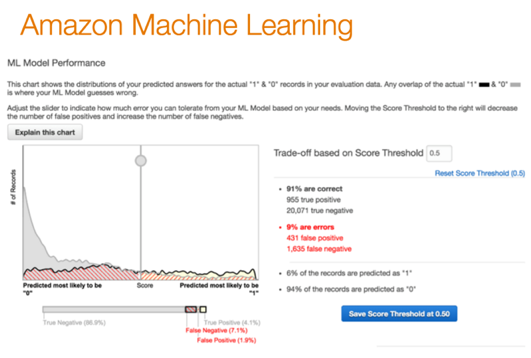
    From the data science point of view, new machine learning-as-a-service solutions are popping up like mushrooms after a spring rain. There are a multitude of them on the market: Big ML, Data Robot, Azure ML, Amazon ML, IBM Watson, Google Prediction and so on. But what is machine learning as a service (MLaaS)?

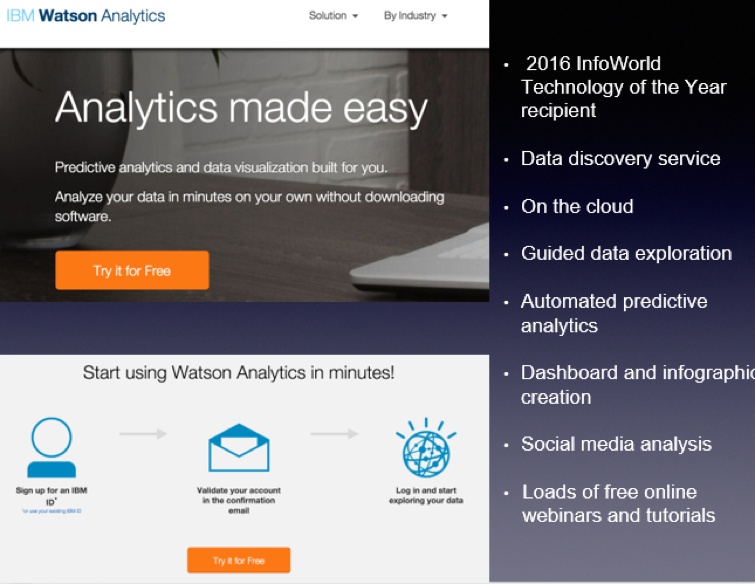
    Let’s look at IBM Watson Analytics as an example:

    MLaaS is a set of preset wizards to create machine learning models and use these models through API. For example, we need to recognize text and separate some facts and data out of it. To do that, we initiate the service in a couple of clicks, insert the original text and get back a marked out and analyzed copy. In this instance, the service is commoditizing NLP (natural language processing). The same goes for VTT (voice-to-text): We insert an audio file and get the text version of the talk back.
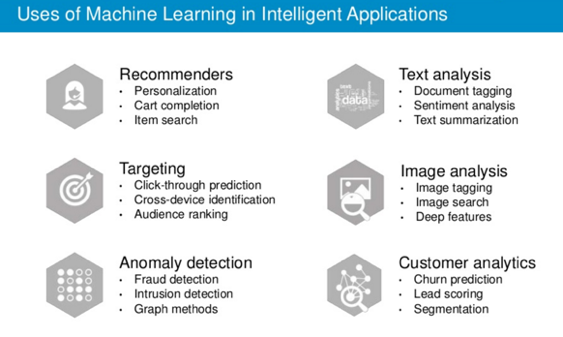
    There are other uses of machine learning technology:

    Machine learning closely works with data. But it is one thing to have data, and another to have actionable data with which you can help users. As seen from the chart, above one of the key trends is the commoditization of data services.
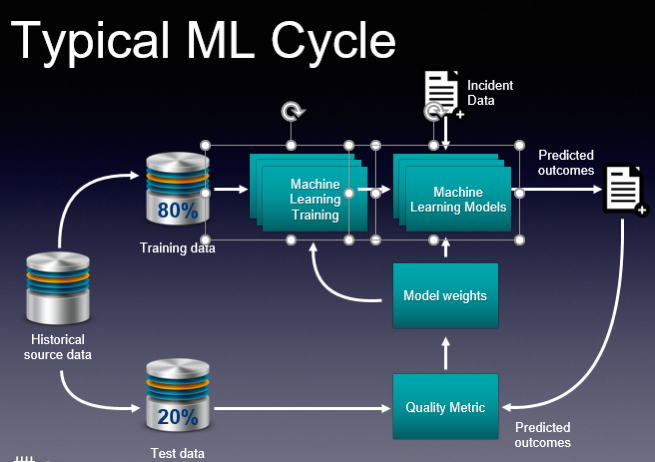
    These basic services do what they are supposed to, and this is great. And you don’t need to employ a data scientist to do some of these tasks. But if you are a company like Grammarly, whose know-how is in actual text recognition, provision of recommendations and text analytics, then ready-made services are insufficient. Grammarly, and companies like it, have to take a hands-on approach that will be very expensive. This is their core business and using third-party services is not viable.

    So how would you go about using ML cloud services?

    Even taking into account a large number of “as a service” solutions, the main challenge is in navigating and understanding “what is better” and “what is best,” and “how it all works.” The issue is that such services are constantly changing. The best choice for you may be to employ tools-consulting services. It’s imperative to understand what is available now and what tools would best suit your business. This is the most basic but essential help you may need.
    Secondly, integrating your operations with these services requires particular engineering efforts. Indeed, most of the data science tasks right now are solved through these cloud “as a service” solutions. But having a proper consulting company with a strong engineering background can help you better utilize such ready-to-use solutions. They offer value to the business at a faster pace. There is no need to invent the wheel, especially when your consultant knows what and where to use.

    If you decide to go to a data science firm where the majority of employees are data scientists, they will create for you some unique genius custom solutions, do great research and so on and so forth. This is what they are good at. This is their bread and butter.

    An end-to-end consulting company may be a better choice for your company, as its goal is to bring value to your business. Consultants will tell you if MLaaS solutions are appropriate for your machine learning needs, and will have a deep understanding of how these services work. A consultancy company also should create and build proper architecture, and provide custom development work that is unique to your services for your business to scale.

    Finally, evolution is key if you plan to grow your business. Start with the ready-made solutions, then in time switch to in-house solutions that can be done with the help of a group of data scientists.

    About the Author / Stanislav Ivashchenko

    Stanislav Ivashchenko is the Senior DevOps Сonsultant at SQUADEX. A certified AWS solutions architect, he is experienced in building, delivering, supporting and optimizing a broad range of software applications. From bare metal to the cloud, from monolith architecture to microservices, he helps improve software delivery processes in startups, mid-sized companies and large enterprises. He has solid skills in orchestrating various DevOps and infrastructure related tools, services and management practices. Connect with him on LinkedIn.