
Tag: devops

  • DevOps: Shift Left to Reduce Failure

    DevOps: Shift Left to Reduce Failure

    DevOps is all about increasing the feedback loop from idea to customer and back again. Tremendous gains have been achieved in automation and tools to drastically reduce the amount of manual labor involved in progressing down the release pipeline. But mission-critical applications in a highly competitive market cannot afford to go down. Complex applications, environments and infrastructure increase risk, which can cause failure.

    The failure rate of production deployments is still too large. Studies show that the average cost of a production outage is roughly $5,000 per minute, while the average cost of a critical application failure per hour is $500,000 to $1 million.

    Why so much failure? All too often we’re still seeing a lack of consistency across the release pipeline. Many times the provisioning and deployment processes are very different at the opposite ends of the pipeline. But by shifting left the operations concerns, you can achieve much more success in production.

    Understanding How to Shift Left

    The term “shift left” refers to a practice in software development in which teams focus on quality, work on problem prevention instead of detection, and begin testing earlier than ever before. The goal is to increase quality, shorten long test cycles and reduce the possibility of unpleasant surprises at the end of the development cycle—or, worse, in production.

    Shifting left requires two key DevOps practices: continuous testing and continuous deployment. Continuous testing involves automating tests and running those tests as early and often as possible, along with service virtualization to mimic unavailable systems. Continuous deployment automates the provisioning and deployment of new builds, enabling continuous testing to happen quickly and efficiently.

    The first and most obvious way to shift left operations is to work side by side with development in creating the deployment and testing processes. Failures observed in production often are not seen earlier in the life cycle. Many times these failures can be attributed directly to differences in deployment procedures. Development may create its own deployment procedures that are very different from those used by operations for production. Sometimes production procedures are much more manual and may even use different tooling. Operations and development need to take ownership in building standard deployment procedures. The deployment process is then practiced potentially hundreds of times in test environments before reaching production. You then have much more confidence that the production deployment will be successful.

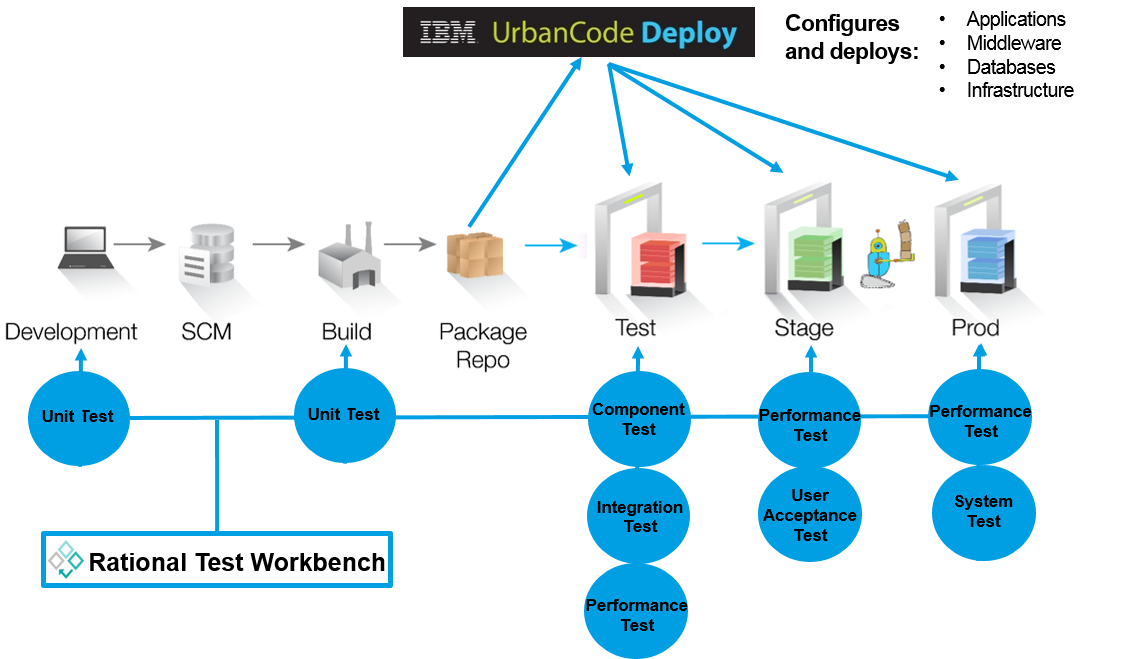
    Another way to reduce the failure rate is to make all environments in the pipeline look as much like production as possible. This is almost impossible using traditional provisioning processes. Production environments usually are much heavier and detailed than are needed by development. But by using cloud and pattern capabilities, you can get much closer.

    The ability to use patterns to define consistent environments eliminates the failures that occur simply by configuration inconsistencies. This again requires operations and development to work together in creating the provisioning process so developers create their test environments the same way they are created in production. Using IBM UrbanCode as an example, this can be done by connecting UrbanCode Deploy to an automated self-service provisioning system such as OpenStack HEAT or IBM Cloud Orchestrator connected to OpenStack.
    Picture1

    These standard patterns can be used to create environments for all stages of the pipeline. And by using cloud capabilities you can deprovision these environments as fast as you can create them. This also allows the enterprise to have confidence in their environment patterns. They are tested on a daily basis and, therefore, operations can feel confident that testing is done on production-like environments.

    No one wants to experience production failures—and it is in everyone’s best interest to do all they can to prevent them. At the root of DevOps is the removal of those silos between development and operations. By applying these shift left operations principles you are well on your way to reducing your failure rate.

    The ingredients to make shift left are real and available: automated testing and deployment tools, service virtualization technology, agile practices and cloud environments. The main obstacle that remains is the mindset of delivery organizations. Learn more from the newly updated Application Deployment and Release for Dummies ebook to find out more.

    About the author / Dr. Darrell R. Schrag

    Darrell Schrag

    Dr. Darrell R. Schrag (@devopsdrs) is an experienced software lifecycle consultant specializing in the IBM cloud solution, helping customers establish their cloud strategy across the enterprise. He’s focused on implementing continuous delivery of software applications through the delivery pipeline incorporating cloud and provisioning solutions. He’s experienced in helping clients transition to “born on the cloud” applications utilizing microservices to take advantage of a flexible and nimble cloud platform.

  • WaveMaker Jump-Starts Delivery of “No Coding” Apps for Mobility

    Pro and Non-Pro Developers Alike Can Combine Visual, No-Coding RAD (Rapid Application Development) with Enhanced WaveMaker Professional Services to Bring Mobile Apps to Life in a Matter of Days

    MOUNTAIN VIEW, Calif., June 1, 2016 – WaveMaker, Inc., a leading enterprise Rapid Application Development Platform software company, today announced the most comprehensive professional services available for rapid mobile-app development.  With the new services, professional and non-professional developers alike can speed the deployment of new apps, allowing their companies to enhance their competitive position, accelerate revenue capture, and relieve their overburdened IT departments.

    WaveMaker addresses the mounting challenge of enterprises to reduce the complexity of application development – and, in particular, applications that must be developed for a variety of platforms or OS’s in parallel.  As an example, WaveMaker professional services address the increasing demand for mobile access to apps, and on platforms including Android, iOS, and Windows.  Modernizing the front-ends of existing apps to add mobile capabilities using web technologies is more efficient and cost-effective than building native apps for each mobile platform.

    Three components are especially critical to improving app delivery times in today’s market:

    • Enterprises are demanding a best-practices approach to Agile development, to reduce development times and to ensure reusability of core app components
    • Developers expect to use micro-services architecture in app development, using individual pretested micro-services to simplify app design, testing, and go-live
    • Developers are demanding new tools to enable quicker service integrations by automating creation of APIs (Application Programming Interfaces)

    The new services are designed to help enterprises propel development projects ahead, leveraging the inherent advantages of rapid app development.  At the core of RAD is rapid prototyping, which allows developers to create “real looking” apps in a matter of days, and without slowing the full development lifecycle. In traditional services delivery, prototyping is intrusive and diverts development efforts from actual software development. With RAD, prototypes reveal the core functionality of an app rapidly, without necessitating a long approval and budgeting process.

    WaveMaker’s new and expanded professional services offer complete, turn-key application development services.   Services include:

    • Development Services offer design, development and hosting of custom applications for enterprise customers.
    • Jumpstart Services are short-term consulting projects to jumpstart application development with help of WaveMaker experts at any stage of the delivery lifecycle.
    • Training Services offer flexible options to get customers up to speed on WaveMaker RAD.

    “Mobile devices across a range of platforms are invading the enterprise at an unprecedented rate,” said Vijay Pullur, CEO of WaveMaker.  “And the apps that will drive productivity of users on those devices are overwhelmingly revenue-producing apps, such as those required in eCommerce.  This has created a challenge in the enterprise to define, develop, and deploy new apps at light speed.  For many enterprises, the only viable option has been to outsource development, and at considerable cost and the loss of direct control over quality.  WaveMaker’s no-coding RAD platform, together with comprehensive professional services, empowers internal developers to take control of their own destiny.”

    For more information on RAD application development or professional services from WaveMaker, visit http://www.wavemaker.com/get-started

    About WaveMaker

    WaveMaker’s software platform revolutionizes how enterprises build, deliver and manage modern custom applications, improving business agility and fostering innovation. WaveMaker leverages the latest trends and technologies in Rapid App Development (RAD) such as multi-device auto-responsive interfaces and componentized app assembly, Docker for app-optimized container deployment on private infrastructures, and APIs and Microservices Architecture (MSA) for scalable integration. WaveMaker, Inc., a Pramati Technologies company, is headquartered in Mountain View, CA with offices in Hyderabad, India. For more information, visit www.wavemaker.com, or like us on Facebook, follow us on Twitter, or connect with us on LinkedIn.

  • Learning in the Continuous Customer Economy

    Learning in the Continuous Customer Economy

    We live in a continuous customer economy. Buyers in the 21st century are continuously discovering, adopting and discarding products and services online, telling us—very loudly and unequivocally—that value isn’t perceived in the actual product itself, but rather in our ability to change a product continuously. So, it’s now about the options to change the product, not the product options themselves.

    This utter lack and loss of brand loyalty puts companies at an insane disadvantage. They’re living with a “see you later” digital mindset, where it’s easy for consumers to say goodbye to something they know online for an opportunity with the newest, next best thing.

    Take this to the next logical business level and you see why continuous transformation of your organization is so critical. If you can’t continuously transform the way you deploy your people, processes, skills and resources, so everything is aligned with the consumer’s “see you later” mindset, there’s no way you can keep up with customers, who are continuously discovering, adopting and discarding products at what seems like warp speed.

    Obviously, this means learning and acquiring new knowledge fast.

    The same old knowledge, the knowledge of the past, just doesn’t work in the world of now. But, more profoundly, to continuously transform your organization and meet customers where they are today, you need to learn how to learn.

    Yes, sure, you have to learn from customers and gain an understanding of what they want and need. But every organization does that today. It’s no longer enough to simply grasp that insight and intelligence and run with it. No, you have to continuously improve how you learn from customers in this fluid and fast-changing world.

    Why? Because, at the end of the day, continuously improving how you learn is the only way to continuously transform your organization. And, thus, continuously improving how you learn is the only competitive advantage you have.

    Continuously Improving What—and How—You Ship

    Assume, for a moment, that you’re shipping an update of 1,000 lines of software code each week.

    That’s great.

    You’re likely using continuous delivery.

    But if you can’t continuously improve how you’re learning from customers and continuously improve the teams inside your organization, you can’t ship continuously improved products. So, you need to improve what you ship and how you ship to continuously transform your organization.

    Here’s an example of how this works.

    Let’s say your software development team senses the customer wants an improved red button that’s square instead of round. Okay, development of an improved red button proceeds and is completed in one week. But, at the same time, the team creates an automated test for the red button as well as clear metrics for determining if the red button is actually the problem. Remember, the idea that the button needed changing is a hypothesis until it has been tested with customers.

    So, in addition to shipping the new square button to some customers, the team keeps some subset of customers using the round button. The customer test is then simply whether the click rate of the square and round button differs.

    Let’s imagine that the processes are not currently in place to enable the development team to receive these metrics, as many teams are kept in splendid isolation from the results of their work. Then the establishment of this relationship, perhaps with the web operations team, is also going to be required.

    This is as much a requirement of successful deployment of these features as the features themselves. The focus on the delivery of function, as well as developing internal capability, is a core principle of continuous transformation.

    The Two-Product Principle

    This is the Two-Product Principle.

    Think of the product we ship to the customer as “Product 1.”

    Meanwhile, the internal capabilities we wish to develop—our view of what we need to improve while we build—is “Product 2.”

    To recap two critical points:

    • You always ship twice—you ship an improved product externally and you ship improved capabilities internally.
    • All of our product decisions, what to build and what to deliver, are theory until the customer actually uses the deployed product and we learn from that interaction.

    If you take these two critical points to heart, then your organization will do all it can to shorten the time to deployment and action to shorten the time to gain new learning in the market. This limits the length of the costly business guessing game, the cash-draining theory time.

    Continuously Learning at High Velocity

    The way you can do this is by continuously shipping, continuously delivering, continuously learning how to improve how you learn and deliver—continuously improving your internal capabilities and continuously transforming.

    Unfortunately, many organizations that want to increase velocity go faster without improving their ability to learn at this new speed.

    The implications of this short-sightedness are profound: When you’re leaning and looking backwards, you’re not improving how you learn from your customers in real time and, instead, you’re adding to your risk going forward because you’re so out of step, and out of touch, with what the market wants and needs.

    Every Act of Design is an Act of Feedback

    Too many companies fail to obtain crucial feedback. They throw a ball up in the air and walk away before it actually lands. We see this in software development when an organization releases a new quarterly product or feature and returns four months later; sadly, this approach doesn’t allow for much effectiveness tracking, or much learning, or much improvement.

    Which is why every single action in the continuous transformation process needs to be an act of design. The act of design is an act of feedback. And, in continuous transformation, you’re continuously getting feedback—whether you’re shipping product externally to a customer or you’re making changes inside your organization.

    The bottom line is that you need to continuously test your assumptions about the world, as well as your effectiveness in responding to those assumptions, if you want to keep up with continuously changing customers in the continuous economy of the 21st century.

  • Lightbend Closes $20 Million in Series C Funding Led by Intel Capital

    Pioneer in Reactive Systems accelerating growth as more and more Global 2000 enterprises move to cloud-first business models built on microservices

    SAN FRANCISCO, CA – (Marketwired – May 26, 2016) – Lightbend (formerly Typesafe), the company behind the Reactive Platform that includes the Akka, Play and Lagom Frameworks as well as the Scala programming language, today announced it has closed a $20 million Series C funding round led by Intel Capital. Blue Cloud Ventures also joined Intel Capital as a new investor, with full participation from previous investors Bain Capital Ventures, Polytech Ecosystem Ventures and Shasta Ventures. Vibhor Rastogi, Director for Enterprise Software at Intel Capital, will join Lightbend’s board of directors.

    Enterprises including Walmart, Verizon, iHeartRadio, William Hill, and Samsung (see case studies) have adopted the Lightbend Reactive Platform to build low latency, fast data applications based on modern microservice architectures. Lightbend’s platform and professional services have become a popular option for enterprises that leverage the Java Virtual Machine (JVM) and JVM-languages like Java and Scala – and that seek the characteristics of application resiliency and extreme scale defined by the Reactive Manifesto.

    “Lightbend is very excited that Intel Capital and Blue Cloud Ventures have invested as we continue to deliver technology, services and expertise to Global 2000 companies that are refactoring their application architectures for Agile development cycles and extreme scale on-prem and in the cloud,” said Mark Brewer, CEO of Lightbend. “Enterprises come to Lightbend because of our track record enabling teams to ship better code faster, and in an operations model that stands up to the most extreme scale.”

    “Mobile and IoT use cases are driving enterprises to modernize how they process large volumes of data,” said Doug Fisher, Senior Vice President and General Manager of the Software and Services Group at Intel Corporation. “Lightbend provides the fundamental building blocks for developing, deploying and managing today’s large-scale, distributed applications.”

    “These changes are happening because application requirements have changed dramatically in recent years,” said Jonas Bonér, founder and CTO at Lightbend, and creator of Akka. “Only a few years ago a large application had tens of servers, seconds of response time, hours of offline maintenance and gigabytes of data. Today, applications are deployed on everything from mobile devices to cloud-based clusters running thousands of multi-core processors. Users expect millisecond response times and 100% uptime. Today’s demands are simply not met by yesterday’s software architectures.”

    About Lightbend

    Lightbend (Twitter: @lightbend) is dedicated to helping developers build Reactive applications on the JVM. With the Lightbend Reactive Platform, developers can create message-driven applications that scale on multicore and cloud computing architectures by using technologies like Lagom, Play Framework, Akka, Apache Spark, Scala, and Java. To help our customers succeed, Lightbend partners with technology pioneers such as Databricks, IBM, and Mesosphere. Lightbend is venture backed by Intel Capital, Blue Cloud, Bain Capital and Shasta Ventures with headquarters in San Francisco.

    About Intel Capital

    Intel Capital, Intel’s strategic investment and M&A organization, backs innovative startups targeting computing and smart devices, cloud, datacenter, security, the Internet of Things, wearable and robotic technologies and semiconductor manufacturing. Since 1991, Intel Capital has invested US$11.7 billion in 1,445 companies in 57 countries, and 595 portfolio companies have gone public or been acquired. Through its business development programs, Intel Capital curates thousands of introductions each year between its portfolio executives and Intel’s customers and partners in the Global 2000. For more information on what makes Intel Capital one of the world’s most powerful venture capital firms, visit www.intelcapital.com or follow @Intelcapital.

  • IBM Offers Watson Services on Twilio Marketplace

    More than one million registered developers will have access to new cognitive capabilities 

    SAN FRANCISCO – 24 May 2016: IBM (NYSE: IBM) today announced it is collaborating with Twilio, the cloud communications platform for developers, to introduce two new offerings, IBM Watson Message Sentiment and IBM Watson Message Insights, which will be available as Add-Ons in Twilio’s recently announced Marketplace.

    Pre-integrated with Twilio’s APIs, the new Watson offerings are now readily accessible as “Add-ons” to the more than one million registered developers in Twilio’s community, in addition to the developers who currently access Watson technology via Bluemix, IBM’s Cloud platform.

    The new Watson Add-ons offer additional message enhancement capabilities through natural language processing to help understand sentiment, keywords, entities and high-level concepts from text messages. The insights gleaned from this unstructured data will give businesses actionable insights. The capabilities include:

    • IBM Watson Message Sentiment: using sentiment analysis, the new service allows users to retrieve sentiment from SMS in a scalable manner. For example, a customer service manager would be able to easily analyze customer SMS messages to determine whether they are positive, negative, and neutral, to help to assess a customer’s satisfaction with a brand, service or product.
    • IBM Watson Message Insights: using a combination of sentiment analysis, keyword extraction, entity extraction and concept tagging, this capability allows developers to distill key meanings from SMS. For example, a developer would be able to extract trending topics and match specific products or services to certain sentiments.

    Add-ons are pre-integrated technologies available through the Twilio Marketplace that allow developers do more with the Twilio API, and are designed to make it easier for developers to integrate with other platforms and technologies.  The new offerings complement the more than thirty Watson services

    currently available from IBM. Future plans include extending these offerings on third party platforms like the Twilio marketplace, bringing cognitive to where developers work.  Watson Speech to Text Add-on, as part of the Recording Add-on category, is up next for Twilio developers.

    “We are committed to equipping all developers, everywhere, with self-service AI and IBM’s cognitive capabilities, backed by the best science, ease-of-use and scalability. We are motivated by what developers are creating with Watson technology, and are constantly seeking new ways to help them build and innovate,” said David Kenny, general manager, IBM Watson. “By joining the Twilio Marketplace, we have opened another avenue for many more developers to harness the power of Watson.”

    “Add-ons make it possible for developers to do more with their Twilio applications using less code,” said Patrick Malatack, VP of Product at Twilio. “The IBM Watson Add-ons apply Watson’s sentiment analysis capabilities to customers’ text messages at scale, better equipping businesses with insights into how their customers feel. We’re pleased that customers can now add the functionality of IBM Watson in a single click.”

    These new services are the latest example of IBM’s commitment to empowering the developer community to build cognitive-enabled apps and businesses with Watson. They build upon IBM’s open Watson platform that offers cognitive APIs in the areas of Language, Speech, and Vision available through BlueMix, IBM’s Cloud platform.

    IBM Watson: Pioneering a New Era of Computing
    Watson represents a new era in computing called cognitive computing, where systems understand the world the way humans do: through senses, learning, and experience. Watson continuously learns from previous interactions, gaining in value and knowledge over time. With the help of Watson, organizations are harnessing the power of cognitive computing to transform industries, help professionals do their jobs better, and solve important challenges.

    To advance Watson, IBM has three dedicated business units: Watson, established for the development of cloud-delivered cognitive computing technologies that represent the commercialization of “artificial intelligence” or “AI” across a variety of industries; Watson Health, dedicated to improving the ability of doctors, researchers and insurers and other related health organizations to surface new insights from data to deliver personalized healthcare; and Watson IoT, focused on making sense of data embedded in more than 9 billion connected devices operating in the world today, which generate 2.5 quintillion bytes of new data daily.

    For more information on IBM Watson, visit: ibm.com/Watson and ibm.com/press/watson. Join the conversation at #ibmwatson.

    About Twilio

    Twilio’s mission is to fuel the future of communications. Developers and businesses use Twilio to make communications relevant and contextual by embedding messaging, voice and video capabilities directly into their software applications. Founded in 2008, Twilio is privately held and has over 500 employees, with headquarters in San Francisco and other offices in Bogotá, Dublin, Hong Kong, London, Mountain View, Munich, New York City, Singapore, and Tallinn.

  • Program Set For DevOps Enterprise Summit London 2016, Last Round Of Speakers Added As Ticket Sales Ramp Up

    Overwhelming number of quality submissions led organizers to add an additional eight-session track

    PORTLAND, Oregon, May 25, 2016 /PRNewswire/ — IT Revolution (http://itrevolution.com), the industry leader for advancing DevOps, today announced the final program and speakers for DevOps Enterprise Summit London (DOES16), the premier industry conference for the leaders of large, complex organizations implementing DevOps in the UK and Continental Europe (http://events.itrevolution.com/eu/). In addition, IT Revolution has closed Early Bird registration for DOES16 London, but, tickets for the conference can still be found at (http://bit.ly/doesldnreg). The event is expected to sell out and is scheduled for June 30-July 1 at the Hilton London Metropole.

    Logo – http://photos.prnewswire.com/prnh/20160322/346968LOGO

    “We had so many compelling submissions of real-world DevOps transformations in large, complex organizations that we added an additional track of eight more sessions than originally planned,” noted Gene Kim, founder of IT Revolution and co-author of “The Phoenix Project: A Novel About IT, DevOps, and Helping Your Business Win.” “We wanted to enable every attendee to hear relevant stories of how DevOps can help them succeed. The phenomenal speaker lineup and remarkable stories being shared in late June shows how much innovation is happening in DevOps.”

    The final round of speakers added to the program include:

    ·         Helen Beal, DevOps Director, Ranger4

    ·         Kevin Bowman, Head of Operations, Sky Betting and Gambling

    ·         Tom Clark, Head of Common Platform, ITV

    ·         Charlotta Croiset Van Uchelen, Chief DNA Officer, Schuberg Philis

    ·         Martin Croker, Managing Director, Accenture Technology Architecture and DevOps, Accenture

    ·         Margo Cronin, Head of Technology Architecture, Zurich Insurance

    ·         Darren Hague, Cloud Infrastructure Architect, SAP

    ·         Simon Parkes, Enterprise Infrastructure Architect, Ordnance Survey

    ·         Scott Potter, (former) Head of Digital, News UK

    ·         Pat Reed, Principal Consultant, iHoriz Inc.

    ·         Robert Scherrer, Head Application Engineering, SIX

    ·         Jan Schilt, Owner Founder, GamingWorks BV

    ·         Jonathan Smart, Head of Development Services, Barclays

    ·         Gebrian Uit De Bulten, DevOps lead Gallia (Netherlands, France, Belgium, Luxembourg), Ingenico ePayments/ Accenture

    ·         Vincent Van Kooten, Domain Manager Front Office, Ingenico ePayments

    ·         Benjamin Wootton, Co-Founder, Sendachi

    The full program is available online and can be found here:  (http://bit.ly/doesldnagenda).

    IT Revolution and Premier Sponsor HPE Software are excited to present the inaugural DOES16 London event. As a vendor-neutral conference, DevOps Enterprise Summit curates stories from the enterprise point-of-view. Most of the presentations follow a very specific “experience report” structure—each speaker describes their organization and their industry, the business problem they faced, where they started their transformation, what they did, and the business outcomes. It’s a simple yet powerful format that reveals solutions to shared problems and new practices that can be used in other business contexts.


    Join the #DOES16 Conversation

    Interested in joining DevOps Enterprise speakers for an online social media chat? DOES16 organizers will be hosting aCrowdChat on Thursday, June 9 at 11am EDT / 4pm BST. To join the conversation, please visit: (https://www.crowdchat.net/chat/c3BvdF9vYmpfMjE0Nw).

    For more information about DOES16 London, please visit: (http://events.itrevolution.com/eu/).

    Share This: DevOps Enterprise Summit London Announces Program http://bit.ly/doesldnagenda  @DOESsummitEU @HPE#DOES16 #DevOps

    About IT Revolution

    IT Revolution assembles technology leaders and practitioners through publishing, events, and research. Our goal is to elevate the state of technology work, quantify the economic and human costs associated with suboptimal IT performance, and to improve the lives of one million IT professionals by 2017. 

    Contact:
    Jeremy Douglas
    Catapult PR-IR

  • Sumo Logic Enables DevOps With Deep Data Insights Into AWS Lambda

    New Integrations With AWS Lambda Offer Developers Improved Monitoring and Correlate Key Performance Indicators for Better Visibility Into Building Serverless Applications

    REDWOOD CITY, CA–(Marketwired – May 25, 2016) –  Sumo Logic, a leading cloud-native, machine data analytics service, today announced the availability of its Sumo Logic App for Amazon Web Services (AWS) Lambda  allowing DevOps and developers to monitor the health of all AWS Lambda functions and better manage the associated costs. In addition, the Sumo Logic Lambda blueprint is now available to route Amazon CloudWatch logs to Sumo Logic for advanced analysis and real-time visualization. The Sumo Logic App and integration enable deeper, real-time visibility into building serverless applications and optimizing AWS deployments.

    “At The Washington Post, it’s critical that we can get a real-time picture of our app performance and stability since the user experience is paramount,” said Hardip Singh, mobile development manager for The Washington Post. “With the AWS Lambda function built from the blueprint for Sumo Logic, we were able to trigger and route our Amazon CloudWatch logs to Sumo Logic for analysis, accelerating our ability to connect with users to troubleshoot potential issues that arise.”

    AWS Lambda lets developers run code at scale with high availability, without provisioning or managing servers. Users pay only for the compute time they consume, while running code for virtually any type of application or backend service with zero administration. Integration with Sumo Logic’s cloud-native machine data analytics platform allows developers to:

    • Analyze operational and performance trends across all the AWS Lambda functions in an account;
    • Gain visibility into the costs of AWS Lambda functions and optimize resources where appropriate;
    • Track the adoption and performance for different versions of a single AWS Lambda function such as resizing an application to fit a mobile device, tablet or laptop, which can help evaluate the impact of that particular function.

    “AWS Lambda changes the way developers design and scale their dynamic applications built on the AWS Cloud,” said Tim Wagner, General Manager, AWS Serverless Compute, Amazon Web Services, Inc. “Sumo Logic has made it even easier for DevOps teams and developers to troubleshoot and monitor modern applications. With today’s release, they can analyze large volumes of data at scale, gaining top-to-bottom visibility in both development and production environments for serverless applications. Using the Sumo Logic app for AWS Lambda, developers can monitor the health of their AWS Lambda functions while easily gaining insights into usage and costs.”

    Sumo Logic helps developers and DevOps teams accelerate the development and deployment of applications in a modern software delivery lifecycle. Its machine data analytics platform is the industry’s first to natively ingest, index and analyze structured metrics data and unstructured log data together in real-time, transforming a variety of data types into real-time continuous intelligence for modern applications and business insights.

    “Development teams are adopting real-time analytic technologies that are integrated with the modern DevOps toolchain to improve all aspects of their application lifecycle,” said Bruno Kurtic, Founding VP of Product and Strategy at Sumo Logic. “As experts in helping organizations build, run and secure modern applications, Sumo Logic delivers a cloud-native, machine data analytics platform that gives AWS users operational insights into their AWS Lambda functions as well as other application components running on AWS so they can quickly and cost-effectively monitor, troubleshoot, and scale their applications.”

    Additional Resources

    • Read the blog to get a deeper look at how the Sumo Logic App for AWS Lambda works
    • Learn more about the Sumo Logic App for AWS Lambda
    • Sign up for a free trial of Sumo Logic

    About Sumo Logic
    Sumo Logic is a secure, cloud-native, machine data analytics service, delivering real-time, continuous intelligence from structured, semi-structured and unstructured data across the entire application lifecycle and stack. More than 1,000 customers around the globe rely on Sumo Logic for the analytics and insights to build, run and secure their modern applications and cloud infrastructures. With Sumo Logic, customers gain a multi-tenant, service-model advantage to accelerate their shift to continuous innovation, increasing competitive advantage, business value and growth.

    Founded in 2010, Sumo Logic is a privately held company based in Redwood City, CA and is backed by Accel Partners, DFJ, Greylock Partners, IVP, Sequoia Capital and Sutter Hill Ventures. For more information, visit www.sumologic.com.

    CONTACT INFORMATION

  • Iron.io Named an IDC Innovator in Platform as a Service (PaaS) Market

    SAN FRANCISCO, CA–(Marketwired – May 26, 2016) – Iron.io, a leading provider of enterprise-grade job processing solutions, has been named as an IDC Innovator in the IDC Innovators: Platform as a Service, 2016 (doc #US41166516, May 2016) report. Companies (under $50M) chosen as an IDC Innovator offer an innovative new technology, a groundbreaking approach to an existing issue, and/or an interesting new business model.

    “Iron.io has the future of computing in their crosshairs: hybrid cloud environments, microservices, containers enabling scale, continuous delivery, and API-driven workload management,” according to IDC’s press release1.

    For architects and developers alike, Iron.io’s event-driven job processing solution is backboned by the Ironworker platform. With IronMQ message queuing and IronCache key/value data store, both of which are managed with the IronDashboard, customers receive superior serverless computing for the modern enterprise.

    “We are honored to be named an IDC Innovator for Platform as a Service,” said Chad Arimura, co-founder and CEO of Iron.io. “By building the Iron.io platform from a microservices approach delivering components into individual functions, we are addressing the needs of our customers who require high-availability, agility and cloud growth.”

    “Iron.io offers a serverless platform for enterprises confronting the challenges of digital transformation,” said Larry Carvalho, IDC Research Manager, Platform as a Service. “Strengths of Iron.io included its microservices/microcontainer capabilities and asynchronous job-based processing, combined with the fact that it supports public, private and multitenant cloud environments.”

    About Iron.io
    Iron.io’s job processing platform delivers and processes hundreds of millions of messages and tasks every day. Its microservices architecture, delivered via Docker containers, enables the world’s most innovative companies to transform large data sets into job processing that drives their revenue. Its asynchronous workloads operate in public and private clouds, on-premises, or hybrid environments, meeting enterprise requirements for flexibility, control and security-friendly solutions. Iron.io is leveraged by some of the world’s most exciting companies such as Turner, Twitter, HotelTonight, Untappd and Google. Learn more atwww.iron.io or follow on Twitter @getiron.

    About IDC Innovator Research
    IDC Innovators reports present a set of vendors chosen by an IDC analyst within a specific market that offer an innovative new technology, a groundbreaking approach to an existing issue, and/or an interesting new business model. It is not an exhaustive evaluation of all companies in a segment or a comparative ranking of the companies. IDC INNOVATOR and IDC INNOVATORS are trademarks of International Data Group, Inc.

    1 International Data Corporation (2016). IDC Innovators for the 2016 Worldwide Platform as a Service Market [Press release]. Retrieved from http://www.idc.com/getdoc.jsp?containerId=prUS41288616

    CONTACT INFORMATION

    • Media Contact:
      Theresa Maloney
      Cogenta Communications
      415-225-5261
      Email Contact
  • Brocade Advances Automation Leadership with Open Network Automation Platform

    Brocade Workflow Composer Transforms IT Operations with DevOps-Inspired, Cross-Domain Network Automation to Increase Business Agility

    SYDNEY, Australia — May 26, 2016 — Brocade (NASDAQ: BRCD) today announced Brocade Workflow Composer, a new server-based network automation platform that enables enterprises and cloud service providers to improve their IT operations and drive greater business agility. Brocade Workflow Composerprovides DevOps-style network automation for provisioning, validation, troubleshooting and remediation of multivendor networks — while integrating with workflows across multiple IT domains for end-to-end automation.

    As companies move to digitise their business, they need an underlying network architecture, including automation, which supports business agility. This New IP architecture enables the network to become a platform for innovation and for developing, delivering and securing new applications. According to a global CIO survey[1], 75 percent of respondents stated that the network is impacting their organisations’ ability to achieve business goals. The lack of network automation and integration of the network with other IT operations and tool chains is the single biggest inhibitor to capitalising on digitisation.

    Automation has been a long-standing hallmark of Brocade solutions, starting with storage networking in 1995. In 2009, Brocade extended its automation leadership with the industry’s first Ethernet fabric comprised of Brocade® VDX switches featuring Brocade VCS® Fabric technology. Earlier this year, Brocade expanded its data centre fabric portfolio with Brocade IP Fabrics, an open, standards-based design that leverages cloud-proven BGP-based architectures, with automation delivered by the new Brocade Workflow Composer. More recently, Brocade acquired StackStorm, an innovator in event-driven automation software, to help bring DevOps-style automation capabilities to the network. StackStorm technology is now a foundational element of Brocade Workflow Composer.

    “Embarking on the digital transformation journey can be overwhelming for most organisations requiring changes to the network infrastructure, organisational and operational models and new skill sets,” said Phillip Coates, systems engineer manager for ANZ, Brocade. “However, when broken down into digestible and evolutionary steps, organisations can navigate the journey at their own pace. One of the first places to start is to bring a new approach to network automation. With Brocade Workflow Composer, Brocade is bridging IT silos and enabling end-to-end automation of cross-functional IT workflows.”

    A Workflow-Centric Approach to Automation Increases Business Agility
    To enable cross-domain automation, organisations must think in terms of workflows. Workflows have emerged as a fundamental part of IT operations within hyperscale cloud providers because they are proven mechanisms for converting business rules and policies into IT services delivered at scale. Since a workflow is a collection of tasks that are often executed manually and routinely, it serves as a strong foundation for developing automation.

    Workflows can be single-domain, such as provisioning a network device, or cross-domain, such as detecting a network device issue and automatically creating and assigning a help desk ticket to a network operator. With cross-domain workflow automation, the manual steps of detecting an issue, identifying the potential cause, performing remediation actions and even creating a trouble ticket or paging a senior engineer can all be eliminated. As a result, IT can minimise human-induced errors, improve operational efficiency and greatly reduce time-to-resolution. According to ZK Research, human error accounts for 35 percent of network downtime. Network automation can reduce that downtime to zero.

    Key Features of Brocade Workflow Composer
    Unlike other network automation solutions that are often monolithic, proprietary and only address the network, Brocade Workflow Composer features:

    • Software-driven lifecycle management. Brocade Workflow Composer automates the entire network lifecycle ranging from initial provisioning and validation to troubleshooting and auto-remediation.
    • Cross-domain integration. Brocade Workflow Composer leverages customisable integration points to recognise events from any network device, cross-domain platform or application, and then invoke action by other tools and applications to execute an automated workflow. Brocade Workflow Composer provides more than 1,900 customisable integration points for popular platforms and applications, such as Linux, Windows, vSphere, AWS, Azure, CloudFoundry, OpenStack, Docker, Kubernetes, CoreOS, FireEye, New Relic, Sensu, Splunk, ChatOps, PagerDuty and VictorOps.
    • Flexible workflow automation for multivendor networks. Brocade Workflow Composer enables IT agility and choice with turnkey, customisable or do-it-yourself network workflow automation—all supported in multivendor network environments.
    • DevOps-inspired methodologies.  Workflow execution is provided by the Brocade Workflow Composer’s open, extensible, microservices-based framework. This framework leverages StackStorm, a variety of other popular, open source DevOps technologies, as well as a thriving community for peer collaboration and innovation.

    Organisations that need help in transforming their network engineering and operations team can utilise Brocade NetDev Professional Services. Staffed with experienced network software developers, Brocade NetDev leverages solutions from Brocade and other vendors to help customers accelerate their automation journey.

    Packaging and Availability
    Acquired by Brocade in March 2016, StackStorm built a thriving open source project and community which Brocade will continue to support and contribute to under the StackStorm name. StackStorm cross-domain integrations are available today on GitHub.

    Brocade Workflow Composer leverages StackStorm open source technology as well as other organic and open source technologies, while adding enterprise-class features and support. A trial version of Brocade Workflow Composer is available today. The product is currently scheduled to be released in the third quarter of 2016.

    Additional Resources

    About Brocade
    Brocade (NASDAQ: BRCD) networking solutions help the world’s leading organisations turn their networks into platforms for business innovation. With solutions spanning public and private data centres to the network edge, Brocade is leading the industry in its transition to the New IP network infrastructures required for today’s era of digital business. (www.brocade.com)

  • Ciena Intros Blue Planet DevOps Toolkit to Deliver Greater Agility and Give Network Operators Enhanced Control of SDN and NFV Enabled Networks

    Enhancement allows network operators to add network resources and program new services, at the speed their business demands 

    HANOVER, Md. – May 24, 2016 – Ciena® (NYSE: CIEN) today unveiled a new enhancement to its Blue Planet network and service orchestration platform that will give network operators a powerful DevOps-style approach that speeds up the creation and delivery of new on-demand, virtualized services within their SDN and NFV enabled networks. Ciena’s Blue Planet DevOps Toolkit features a set of software development tools that can be utilized by network operators’ in-house personnel, and in collaboration with ecosystem partners, to modify new services and add new virtual and physical network resources more quickly and easily. The result is a significant reduction in cost and dependence on professional services associated with monolithic, vendor-controlled back-office systems.

    For example, with the Blue Planet DevOps Toolkit, network operators can utilize their own product development, IT and network operations teams to collaborate in the creation and on-boarding of new virtual network functions (VNFs) such as virtual firewalls, physical network domains such as Layer 2 metro networks, and virtual domains such as a third party cloud, and ultimately deploy these resources as components of new service offerings. 

    Key Facts:

    • Today, developing and deploying new telecom services can be a tedious, time-consuming and operationally inefficient process. One that is heavily dependent on vendor-specific, hard-coded back-office systems. It also typically requires professional services which results in slow service delivery, high costs, and decreased competitiveness for network operators.
    • With a DevOps approach, network operators gain greater control and self-sufficiency in service creation and delivery to meet today’s business challenges. Propelled by the ongoing transformation to SDN and NFV, DevOps enables better collaboration among product development, IT and network operations teams to improve operational efficiency, accelerate innovation, and accelerate “concept-to-revenue” for new services.
    • Ciena’s Blue Planet DevOps Toolkit consists of a set of software development tools and community resources that allow operators to integrate network resources such as devices, functions, or domains (physical or virtual), as well as customize service templates, with the Blue Planet Network and Service Orchestration software. It is also complemented with the Blue Planet Developer Community portal that facilitates open source-like collaboration between Blue Planet customers and ecosystem partners, online documentation and training tools, and features “libraries” of available resource adapters and service templates.
    • Available in June 2016, the Blue Planet DevOps Toolkit offers a number of benefits to Ciena customers, including reduced operational costs, less network complexity and a level of service programmability that was previously unachievable. The DevOps Toolkit is being utilized by a number of leading global network operators today.

    Executive Comments:

    • “Open, multi-vendor, multi-domain networks unlock an operator’s full potential of delivering disruptive user-enabled services, and at ADTRAN, we are committed to leveraging partnerships and programs that help make this a reality. We see real value in how Ciena’s Blue Planet DevOps Toolkit in concert with open solutions like our software-defined access portfolio are helping our mutual customers accelerate their transformation to more open, programmable and scalable networks.”

    Robert Conger, Associate Vice President, Cloud and Portfolio Strategy, ADTRAN

    • “The DevOps approach to networking will be instrumental to network operators because it allows them to significantly improve service velocity, reduce costs and strengthen their ability to compete in today’s challenging business environment. As a recent addition to Ciena’s Blue Orbit ecosystem, LightRiver Technologies looks forward to leveraging our software investments, and the new Blue Planet DevOps Toolkit, as it will allow us to provide greater value to our joint customers, delivering software automation and virtualization specific to their needs.”

    Dean Campbell, Chief Technology Officer, LightRiver Technologies

    • “Network providers are increasingly competing as digital service providers, not simply communications service providers, in the wider digital economy. As a result, they strive to improve network operations and service creation and launch by shifting to a more nimble DevOps approach. Developer communities and tools like Ciena’s Blue Planet DevOps Toolkit give network providers more control over software build/buy decisions; limit custom development requirements; and facilitate faster deployments by streamlining internal and third-party collaboration.”

    Dana Cooperson, Research Director, Analysys Mason

    • “Customers have made it clear that the ‘old way’ of doing business is unsustainable. Blue Planet and the DevOps Toolkit have been selected for key global engagements recently because choice, openness, empowerment, and self-service are key components of our software. Ciena is leading this revolution and our Blue Planet DevOps Toolkit allows network operators to integrate their IT, product development and operations to create an interconnected ecosystem that reduces the time required to offer new services and quickly adapt their network to changing market needs.”

        Kevin Sheehan, Vice President, Global Customer Operations, Blue Planet Division, Ciena

    ###

    About Ciena
    Ciena (NYSE: CIEN) is the network specialist. We collaborate with customers worldwide to unlock the strategic potential of their networks and fundamentally change the way they perform and compete. Ciena leverages its deep expertise in packet and optical networking and distributed software automation to deliver solutions in alignment with its OPn architecture for next-generation networks. We enable a high-scale, programmable infrastructure that can be controlled and adapted by network-level applications, and provide open interfaces to coordinate computing, storage and network resources in a unified, virtualized environment. For updates on Ciena news, follow us on Twitter @Ciena or on LinkedIn.