Tag: devops

  • Perfecto Releases Ultimate Digital Testing Toolkit to Guide Data-Driven Testing Decisions – New set of free resources

    New set of free resources helps enhance mobile and web testing strategies

    LONDON – May 18, 2016 – Perfecto Mobile, the market leader in empowering enterprises to deliver high-quality digital experiences, today announced the availability of their Ultimate Digital Test Coverage Toolkit, a free “starter package” that guides Test, DevOps and Product Development teams to make better-informed decisions about their web and mobile test strategies across devices and geographies. The Ultimate Test Coverage Toolkit helps practitioners reduce risk associated with digital quality by identifying the right mix of mobile devices and browsers to test on across geographies; how to set up and maintain a robust and scalable test lab; and what device/browser platforms to pay particular attention to in 2016.

    According to Criteo’s State of Mobile Commerce report, 40 per cent of transactions today take place on multiple digital platforms – from mobile devices and desktops to wearables. Ensuring that dev/test teams are using the best combination of mobile devices, browsers and operating systems for their target user base is crucial to delivering a great digital experience, yet the diverse digital landscape and rapid pace of releases causes challenges when strategising test plans. A recentForrester Wave™ (Mobile Front-End Test Automation Tools, Q2 2016) report noted the most successful mobile apps are tested on many device models and under a variety of conditions; however anticipating and mitigating the unknown means testing an app “on tens, hundreds, and even thousands” of different devices, operating systems and browsers.

    “A common challenge for teams developing or scaling their test strategies across web and mobile is making the decision of which devices, browsers and geographies to include in their test plans,” said Eran Kinsbruner, Technical Evangelist at Perfecto. The Ultimate Digital Test Coverage Toolkit aims to simplify the digital landscape by showing users how to maximise test strategies, guide users to make data-driven decisions about test coverage, and deliver great user experiences across digital channels.”

    Powered by regularly updated market and proprietary data, the Ultimate Test Coverage Toolkitenables users to stay ahead of the curve and consistently deliver great digital experiences to their customers through a variety of features and resources, including:

    • A free, online interactive tool to answer, “Which mobile devices and platforms should you test on?” With the five most popular devices and operating systems accounting for more than 500 possible browser and device combinations alone, the new Digital Test Coverage Optimiser tool enables teams to discover the optimal device/system mix for maximising test coverage with the fewest devices possible.
    • Resources and data to inform ongoing coverage strategy. The Test Coverage Toolkit includes a number of resources to help app developers, testers and product managers develop a strategy for multi-device interactions that will cover all target markets and user profiles. The Digital Test Coverage Index Report combines data from 4,000+ device profiles, mobile market usage data and proprietary Perfecto analysis to help teams determine the level of digital quality testing required to cover all relevant target markets and customers on an ongoing basis.
    • A comprehensive guide for implementing a digital test strategy. To round out the Toolkit, Perfecto published a step-by-step test coverage e-book that gives practical advice on how to approach, build and maintain a successful digital test strategy, and is based on exclusive enterprise cloud usage data and the experiences of Perfecto’s most-valued customers.

    The Ultimate Digital Test Coverage Toolkit is the first of many information hubs within Perfecto’s new Ultimate Guide to Continuous Quality, a premiere resource centre for practicable, actionable strategies and tips for delivering Continuous Quality to improve digital experiences. To learn more about Perfecto’s Test Coverage Toolkit tune into the webinar “How to Create the Right Mobile & Web Test Strategy” taking place on May 26 at 2 p.m. ET. To register, visit here:http://info.perfectomobile.com/ultimate-test-coverage-webinar.html.

    ###

    About Perfecto
    Perfecto enables exceptional digital experiences. We help you transform your business and strengthen every digital interaction with a quality-first approach to creating web and native apps, through a cloud-based test environment called the Continuous Quality Lab™. The CQL Lab is comprised of real devices and real end-user conditions, giving you the truest test environment available.

    More than 1,500 customers, including 50% of the Fortune 500 across the banking, insurance, retail, telecommunications and media industries rely on Perfecto to deliver optimal mobile app functionality and end user experiences, ensuring their brand’s reputation, establishing loyal customers and continually attracting new users. For more information about Perfecto, visitwww.perfectomobile.com, join our community or follow us on Twitter at @PerfectoMobile.

    ###

    Media Contacts:
    Laura Eardley
    Account Manager
    Laura.Eardley@text100.com
    +44 208 846 0778

  • DevOps is ITSM Best Practice!

    DevOps is ITSM Best Practice!

    What boggles the mind is that opponents of DevOps use risk as an excuse why DevOps would not work in their environments and why using the “traditional ITSM” approach is better and safer.

    When I start asking them about their transition practices, specifically the alignment between transition, change, test and release models, I soon find that these models are either very skimpy or, most of the time, non-existent.

    So here are the facts: You don’t want to do DevOps because you don’t want to do what ITSM best practice dictates!

    ITSM best practice recommends building and aligning change, test, release, deployment and transition models that clearly define transition/change boundaries, practices, artifacts, acceptance criteria, roles, responsibilities and authorities, making transition practices repeatable, less risky and more reliable.

    Is this not exactly what you need to do in DevOps automation? If you have not built the models and made sure they are tried and tested, you can’t automate them—and if you have built these models and made sure they are tried and tested (repeatable), then why not automate them? It’s a no-brainer.

    The reality is that by using DevOps practices, organizations have far better control and manage risk far better than what opponents and detractors of DevOps have in their non-DevOps environments.

    This may not be best practice, but we have for years recommended that during a post-incident review the following questions should be added to the agenda:

    • Will we do this again? If so,
    • Will we do it in the same way?
    • Can we define an implementation approach based on the change just completed and the lessons learned, and can we reuse this approach safely in future (build change, release and test models)?
    • If we can,
      • Build the models
      • Define this type of change as a standard change

    Some say that this is not best practice, as “standard changes” are low risk. This, in fact, is not true!

    ITIL® defines a standard change as follows (ST 4.2.4.7): “A standard change is a change to a service or other CI for which the approach is pre-authorized by change management, and this approach follows an accepted and established procedure … Every standard change should have a change model that defines the steps to follow … Authorization for each occurrence will be granted by a delegated authority … The crucial elements of a standard change are defined triggers, tasks are well-known, documented and proven, authority is given in advance … The risk is usually low and always well-understood.”

    We have for years argued that standard changes are ideal candidates for automation. By extending the post implementation reviews, you identified safe candidates for DevOps automation!

    About the Author/ Johann Botha

    Johann ProfileJohann Botha is the CEO of getITright, a DevOps Institute Registered Education Provider that will run its first African DevOps course May 23 in Johannesburg. Visit www.get-it-right.com for more info.

  • Building DevOps Careers: One Man’s Journey, Part 2

    Building DevOps Careers: One Man’s Journey, Part 2

    In Part One of this two-part series, we introduced former SlideShare and LinkedIn software engineer Sylvain Kalache, who shared his career growth within the two companies. In this second part, we’ll look at San Francisco-based The Holberton School of Software Engineering, which Kalache co-founded to better prepare students to work in a DevOps world.

    School Founder, Still a Coder

    Kalache still uses much the same coding skills in his new role as he did as an engineer. “I still manage machines, the ones that host our website and intranet and the iMacs that students use,” he says.

    The Holberton School of Software Engineering founders removed every manual step possible, using software to automate the admissions process and any process that they could. Even in the classroom, automation rules: Computers automatically review student work on projects.

    “Computers test that students’ code works as expected by simulating user interaction, checking syntax and assessing how fast the code executes. For infrastructure in code, computers check for stability, response times and security breaches. By using multiple ratings parameters that are linked to specific skills, the computers collect detailed data about the strengths and weaknesses of each student,” says Kalache.

    “We have a lot of our own secret sauce in software automation running the school for us,” he adds. “This requires all the technical skills I used in my coding days including designing, building, configuring, testing, deploying and maintaining software and systems.”

    Teaching Methods

    The Holberton School of Software Engineering engages students in building each skill they will need for careers in software engineering through use of industry-standard teaching methods. “Methods include deep learning in building features into software products and classical teaching in clear, documented code,” Kalache says. “We have a team of 150-plus mentors who make sure our curriculum is up to date and in sync with what the industry actually does and who coach and share their knowledge with students.”

    The Holberton School of Software Engineering uses fully practical methods with no formal teachers or lectures, only mentors. “Mentors are like managers in a workplace. I mentor, coaching students in their learning journey and giving advice when there are issues,” he says.

    Students engage in peer learning, working collaboratively on software projects, which encompass the skills they will need to demonstrate in their careers. Successful completion of projects, including solo projects, is proof of attaining the required skills. “Students must defend their projects before mentors with mentors ensuring that every student can present and explain the technical aspects of the project; if even one student can’t explain it, then the group fails on that project,” says Kalache.

    “We teach problem-solving and how to learn new skills because there will constantly be new technologies and concepts for our students to understand and master in their careers in the tech world,” he adds. “Professionals who cannot adapt and retrain themselves will quickly fall out of date with technology.”

    Readying Students for Careers from Day One

    The Holberton School of Software Engineering prepares students to be ready to work when they start their careers. “Graduates of other programs whom I have spoken with have no idea what it is to ship code to production and run a production environment. They are used to academic projects that teachers correct for them,” Kalache says. “That is not how it works in the industry.

    “Even boot camps and universities provide minimal practical experience that will make job hunting difficult,” he continues. Smaller organizations don’t have the money to pay someone to learn before starting them working in production. Thus, he says, startups need to execute fast using professionals with mature skills. “Though our students will fail and struggle, they will do it at the school, which will have a much smaller impact than doing it on the job,” says Kalache. Students are exposed to creating, shipping and working with code in production for two years before graduation.

    What’s more, real, workday DevOps requires effective communications skills. “Whether it is to introduce the last tool you built, explain what happened during an outage or convince your managers that your solution to a problem is the right one, you need to have oral and written communications skills,” says Kalache. As such, the school runs students through a series of exercises in public speaking, technical writing and documentation, as well as post-mortem communications when dissecting an outage, prepping them even further for their careers and the world beyond the classroom.

  • DevOps is a Risky Business

    DevOps is a Risky Business

    I spend a considerable amount of time with clients discussing DevOps and the potential value it can bring to them, but there is one theme that always resonates: the ability of a DevOps approach to eliminate risk. While many of us understand the benefits in terms of being faster (improved productivity), cheaper (reduced cost) and better (improved quality), I find that a conversation based around risk, especially when talking to the business or department heads, usually gets straight to their concerns in a language they understand.

    IBM’s definition of DevOps is not simply about connecting development and operations; it is fundamentally about providing a capability that: 1) allows lines of business to connect with their customers (which may be internal employees) quickly, and 2) facilitates rapid feedback from their customers so relevant adjustments can be made. DevOps, therefore, embraces the philosophy of iterative (and incremental) development and delivery, whereby solutions are delivered through a series of incremental releases.

    DevOps is a Risky Business_1

    By ensuring all aspects of a solution (requirements, designs, code, executables, tests, etc.) evolve over time as each increment is completed, DevOps is fundamentally focused on addressing risks including:

    • The risk of not knowing the requirements (have you ever tried to write down and freeze the requirements for a mobile app?)
    • The risk of not knowing the solution (especially when it’s new, you’re defining a new architecture or you’re embracing new technologies)
    • The risk of not knowing the effort (especially when the solution is novel for the organization)
    • The risk of not delivering on time (when the pace of the team, for example, is an unknown)
    • The risk of not providing the right level of quality (and the impact this may have on customer sentiment)
    • The risk of adopting inappropriate practices (meaning that the approach being taken by the team is not working for them)
    • The risk of having an ineffective delivery environment (including automation through the use of delivery tools)

    I could go on. There are so many risks that can be addressed simply by delivering working software iteratively, that it’s surprising how many organizations continue to fall back to a “waterfall” mentality—even in high-risk environments where much is unknown.

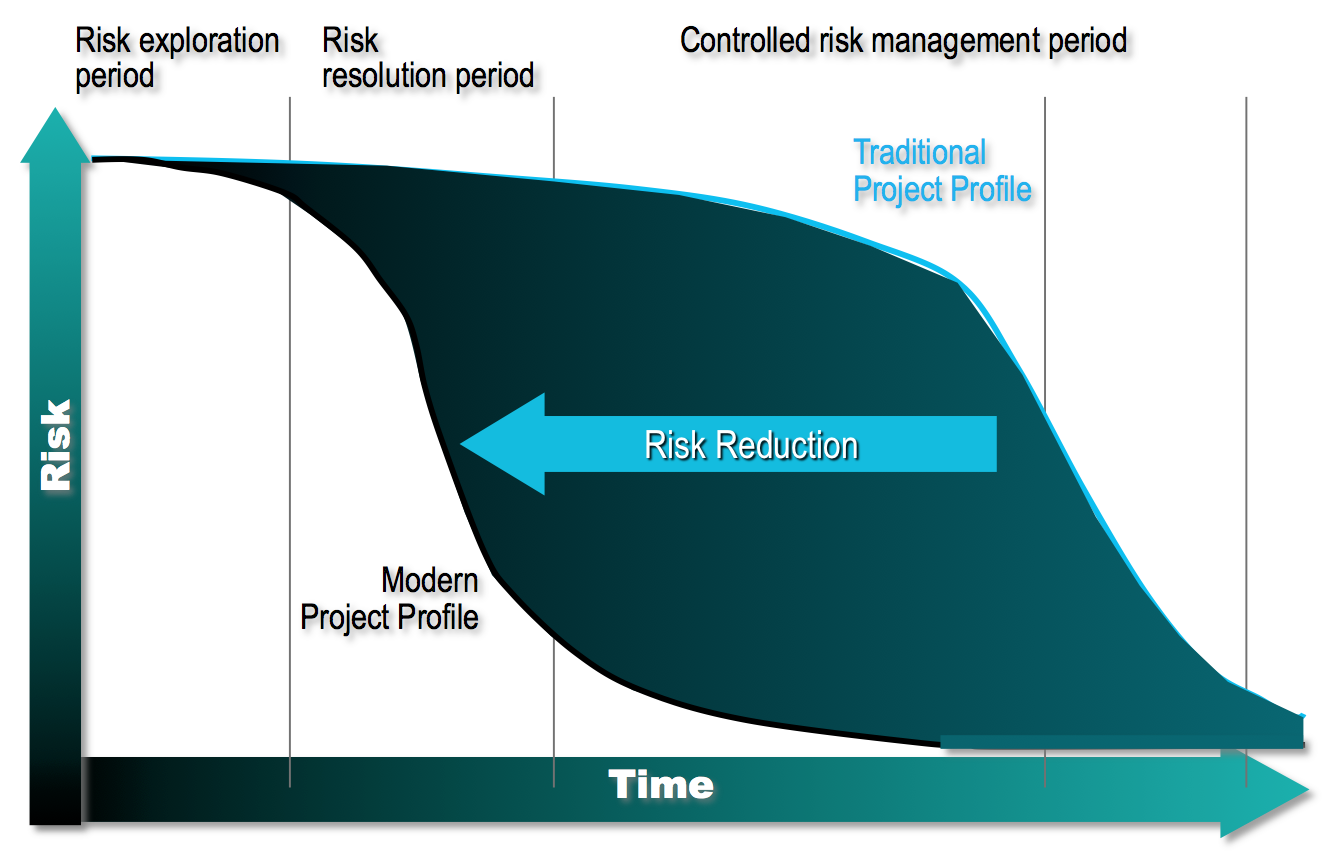
    The tack I’ve taken here originates from my time at Rational Software Corp. (which IBM acquired in 2003), where we would emphasize the need to deliver software iteratively and progress was measured based on the results achieved (i.e., working software) rather that the documents produced. My favorite graphic from that time is the one shown below, which shows how a modern approach changes the risk profile associated with a delivery project, since it focuses on removing risk as early as possible in the life cycle.

    DevOps is a Risky Business_2

    In summary, incremental and continuous delivery evident in a DevOps approach allows us to call out risk early and determine its resolution. DevOps often is used along with “lean startup” thinking (and its build-measure-learn cycle) and monikers such as “fail fast” since these are, at their heart, also focused on addressing risk.

    Take the DevOps self-assessment to find out where are you on your DevOps journey

    About the Author / Peter Eeles

    Peter Eeles

    Peter Eeles is an Executive IT Architect in the DevOps Global Tiger Team, IBM Hybrid Cloud, where he helps organizations improve their IT delivery capability in order to drive tangible business value. He has a particular interest in the adoption of architecture, agile, DevOps and cloud as innovation enablers. In the IT industry since 1985, Peter comes from a delivery background and was previously chief architect of IBM Rational’s Worldwide Solution Delivery organization, where he led many large-scale transformations in a variety of industries. Peter has written many papers and several books, including “The Process of Software Architecting” (2009), “Building J2EE Applications with the Rational Unified Process” (2002), and “Building Business Objects” (1998). He runs his own website at www.architecting.co.uk.

    Connect with Peter on LinkedIn and Twitter.

  • Data Protection for Operational Reporting Platforms

    Data Protection for Operational Reporting Platforms

    Making real-time business decisions based on data from social, mobile and cloud platforms is a requirement in today’s world. That’s why an ecosystem of next-generation operational reporting platforms such as Spark, Apache Cassandra, Kafka, Docker, Mesos, Marathon and more have come to life. Enterprises are using these technologies to re-architect their data storage and processing frameworks to achieve lower costs, scalability and faster response times. However, as enterprises onboard business-critical applications on this next-generation technology stack, they need to prepare for failures or errors that may disrupt customer-facing applications.

    One of the key benefits that operational reporting platforms provide is real-time visibility, which allows businesses to make strategic decisions based on actionable insights. However, the new applications generate a large amount of data and archaic operational reporting platforms (those based on traditional data warehouses, data marts and ETL logic) are unable to catch up and, as a result:

    • Business decisions are based on stale data
    • Fragmented data increases the risk of errors
    • Multiple copies of data increase storage costs

    These issues have driven many progressive, data-centric enterprises to re-architect their operational reporting platforms. In this new architecture, Kafka serves as a persistent message bus that ingests data from relational stores and provides failure resiliency and message buffering. Spark or Spark Streaming may be used for transformation, aggregation and other lightweight stream processing. These processing nodes may be deployed in Docker containers. Finally, Apache Cassandra serves as a distributed data storage layer that provides linear scalability and high-availability. Kafka also enables the ability to add multiple data consumers such as Hadoop/HBase through Flafka.

    Datos IO - operational reporting platforms

    However, as enterprises adopt operational reporting platforms, they want to ensure that bad data feeds and human error do not result in data loss. Apache Cassandra natively replicates data but that does not provide the capability to go back in time to recover data efficiently and at scale.

    As enterprises onboard their critical applications to achieve development agility, scalability and lower operating costs, they must also explore data protection solutions that are specifically dedicated for scale-out databases.

  • Perfecto Releases Ultimate Digital Testing Toolkit to Guide Data-Driven Testing Decisions

    New set of free resources helps enhance mobile and web testing strategies

    BOSTON – May 17, 2016 – Perfecto Mobile, the market leader in empowering enterprises to deliver high-quality digital experiences, today announced the availability of theirUltimate Digital Test Coverage Toolkit, a free “starter package” that  guides Test, DevOps and Product Development teams to make better-informed decisions about their web and mobile test strategies across devices and geographies. The Ultimate Test Coverage Toolkit helps practitioners reduce risk associated with digital quality by identifying the right mix of mobile devices and browsers to test on across geographies; how to set up and maintain a robust and scalable test lab; and what device/browser platforms to pay particular attention to in 2016.

    According to Criteo’s State of Mobile Commerce report, 40 percent of transactions today take place on multiple digital platforms – from mobile devices and desktops to wearables. Ensuring that dev/test teams are using the best combination of mobile devices, browsers and operating systems for their target user base is crucial to delivering a great digital experience, yet the diverse digital landscape and rapid pace of releases causes challenges when strategizing test plans. A recent Forrester Wave™ (Mobile Front-End Test Automation Tools, Q2 2016) report noted the most successful mobile apps are tested on many device models and under a variety of conditions; however anticipating and mitigating the unknown means testing an app “on tens, hundreds, and even thousands” of different devices, operating systems and browsers.

    “A common challenge for teams developing or scaling their test strategies across web and mobile is making the decision of which devices, browsers and geographies to include in their test plans,” said Eran Kinsbruner, Technical Evangelist at Perfecto. The Ultimate Digital Test Coverage Toolkit aims to simplify the digital landscape by showing users how to maximize test strategies, guide users to make data-driven decisions about test coverage, and deliver great user experiences across digital channels.”

    Powered by regularly updated market and proprietary data, the Ultimate Test Coverage Toolkit enables users to stay ahead of the curve and consistently deliver great digital experiences to their customers through a variety of features and resources, including:

    • A free, online interactive tool to answer, “Which mobile devices and platforms should you test on?” With the five most popular devices and operating systems accounting for more than 500 possible browser and device combinations alone, the new Digital Test Coverage Optimizer tool enables teams to discover the optimal device/system mix for maximizing test coverage with the fewest devices possible.
    • Resources and data to inform ongoing coverage strategy. The Test Coverage Toolkit includes a number of resources to help app developers, testers and product managers develop a strategy for multi-device interactions that will cover all target markets and user profiles. The Digital Test Coverage Index Report combines data from 4,000+ device profiles, mobile market usage data and proprietary Perfecto analysis to help teams determine the level of digital quality testing required to cover all relevant target markets and customers on an ongoing basis.
    • A comprehensive guide for implementing a digital test strategy. To round out the Toolkit, Perfecto published a step-by-step test coverage e-book that gives practical advice on how to approach, build and maintain a successful digital test strategy, and is based on exclusive enterprise cloud usage data and the experiences of Perfecto’s most-valued customers.

    The Ultimate Digital Test Coverage Toolkit is the first of many information hubs within Perfecto’s new Ultimate Guide to Continuous Quality, a premiere resource center for practicable, actionable strategies and tips for delivering Continuous Quality to improve digital experiences. To learn more about Perfecto’s Test Coverage Toolkit tune into the webinar “How to Create the Right Mobile & Web Test Strategy” taking place on May 26 at 2 p.m. ET. To register, visit here: http://info.perfectomobile.com/ultimate-test-coverage-webinar.html.

    ###

    About Perfecto

    Perfecto enables exceptional digital experiences. We help you transform your business and strengthen every digital interaction with a quality-first approach to creating web and native apps, through a cloud-based test environment called the Continuous Quality Lab™. The CQL Lab is comprised of real devices and real end-user conditions, giving you the truest test environment available.

    More than 1,500 customers, including 50% of the Fortune 500 across the banking, insurance, retail, telecommunications and media industries rely on Perfecto to deliver optimal mobile app functionality and end user experiences, ensuring their brand’s reputation, establishing loyal customers and continually attracting new users. For more information about Perfecto, visit www.perfectomobile.com, join our community or follow us on Twitter at @PerfectoMobile.

  • New F5 Software Advances Application Security, Management, and Orchestration

     Industry-leading service programmability promotes flexible deployment capabilities, policy-based controls, and hybrid cloud support

    VIENNA, AUSTRIA, MAY 17, 2016 – F5 Networks (NASDAQ: FFIV) today introduced software-based solutions that enable customers to seamlessly integrate availability and security services, simplify device management, and better orchestrate IT infrastructure. To lower costs and boost efficiency, organizations are evolving toward more dynamic infrastructure models that combine physical, virtual, and cloud components. Supporting this transition, F5’s innovative, versatile solutions give customers the ability to take advantage of the benefits provided by traditional data center, cloud, and hybrid architectures.

    Today, F5 is introducing:

    • BIG-IP® 12.1 software, delivering leading application services with enhanced public cloud integration and more sophisticated security policies for on-premises and hybrid cloud environments
    • BIG-IQ® Centralized Management 5.0, providing expanded management for F5’s BIG-IP solution portfolio with significant scalability and performance advances
    • iWorkflow™ 2.0, enabling the orchestration of F5 services with SDN-focused solutions like Cisco ACI and VMware NSX, as well as continuous deployment scenarios using DevOps tools from vendors such as Ansible, Chef, and Puppet

    Programmable Application Services for Ultimate Flexibility

    With the release of BIG-IP version 12.1 software, no other Application Delivery Controller (ADC) vendor offers F5’s level of programmability across traditional, cloud, and hybrid architectures. F5’s new iRules LX™ technology marks a substantial advance in programmability, providing the ability to manipulate and selectively deploy service capabilities via Node.js, and includes easy access to over 250,000 community Node.js packages. These capabilities are especially important in delivering advanced functionality for web applications that require optimized throughput, scalability, and unique traffic steering services. In addition, a new plug-in for the Eclipse Integrated Development Environment (IDE)—commonly supported by other enterprise technology vendors (e.g., CA, Google, IBM, Oracle, Red Hat, and SAP)—enables the rapid delivery of reusable code that drives advanced functionality.

    Strong Policy-Based Security with Protection for Applications Everywhere

    The proliferation of Internet-facing applications has led to pervasive threats on business-critical web services, along with an increase in the sophistication of attacks. F5’s security enhancements allow organizations to more effectively ensure application availability and performance, resolve critical app protection gaps, and strengthen overall defenses. Today’s announcement reflects a number of new security capabilities, with highlights including:

    –          BIG-IP 12.1 enhances industry-leading web application defense via BIG-IP Application Security Manager™ (ASM) with unique, customizable bot detection methods that enable detailed analysis and extensive device ID tracking.

    –          BIG-IP ASM accelerates the blacklisting of malicious IPs in hardware at high rates for layer 7 threats, providing coverage until feed lists are updated.

    –          F5 gives visibility into HTML 5 WebSocket connections for comprehensive policy protection where other WAFs fail.

    –          BIG-IP Advanced Firewall Manager™ now offers enhanced capabilities that automatically mitigate L3–7 attacks upstream in the ISP realm and control SSH channel user-initiated actions with simple custom policy enforcement.

    Tight Integration with Leading Public Cloud Environments

    Application architects and developers must rapidly implement apps and services as part of a continuous deployment pipeline, while ensuring that they remain fast, highly available, and secure throughout. F5 solutions are designed to let customers use the same services in the cloud that they can in the data center. New technologies offer expanded support for AWS and Azure environments, including integration with AWS autoscale to dynamically scale app services, active/standby high availability across availability zones, and added F5 WAF capabilities for Azure Security Center.

    Powerful Management and Orchestration Capabilities for Simplified Operations

    For network architects and administrators, F5 has updated its BIG-IQ Centralized Management solution. The platform provides visibility, reporting, licensing, and management capabilities that simplify operations for F5 BIG-IP products, and now includes support for F5’s award-winning BIG-IP Access Policy Manager®. F5 is the only vendor that combines centralized, role-based management for application delivery, security, and identity management into a united framework. In addition, with this new version of BIG-IQ, customers can now simultaneously manage, update, and configure application services for up to 200 physical and virtual devices, and handle up to 5,000 BIG-IP licenses.

    F5’s new iWorkflow platform accelerates the deployment of applications by enabling the orchestration of network services, such as traffic management and security. Available as a virtual appliance, iWorkflow™ is a multi-tenant solution for deploying application delivery policies with BIG-IP solutions to support a variety of IT environments, including hybrid clouds. Using smart templates, policies can be deployed directly via the iWorkflow GUI, via third-party management solutions such as Cisco ACI or VMware NSX through connectors, or via other orchestration technologies such as Ansible, Chef, and Puppet with an SDK.

    Supporting Quotes

    “To better meet the needs of customers, we have made significant investments in security, management, and orchestration, along with the feature-rich software that supports our flagship BIG-IP product line,” said Karl Triebes, EVP of Product Development and CTO at F5. “Giving organizations the ability to integrate F5 with vendors and solutions such as AWS, Azure, Cisco, and VMware is certainly a priority, but we also have an eye toward making sure our offerings resonate with those using open source technologies like OpenStack, and agile infrastructure from emerging ‘born in the cloud’ companies.”

    “As application services and resources are abstracted across increasingly diverse environments, the ability to easily unify functionality and enforce policies throughout vendors’ offerings becomes essential,” said Brad Casemore, Research Director, Datacenter Networks, IDC. “Similarly, the ability for enterprise IT to programmatically tailor performance and orchestrate services is a necessity for organizational success with multi-vendor SDN and cloud deployments.”

    Availability

    BIG-IP version 12.1 software, BIG-IQ Centralized Management 5.0, and iWorkflow 2.0 will be available in the second quarter of calendar year 2016. Please contact a local F5 sales office for additional product and service availability information pertaining to specific countries.

    Additional Resources

    About F5

    F5 (NASDAQ: FFIV) provides solutions for an application world. F5 helps organizations seamlessly scale cloud, data center, telecommunications, and software defined networking (SDN) deployments to successfully deliver applications and services to anyone, anywhere, at any time. F5 solutions broaden the reach of IT through an open, extensible framework and a rich partner ecosystem of leading technology and orchestration vendors. This approach lets customers pursue the infrastructure model that best fits their needs over time. The world’s largest businesses, service providers, government entities, and consumer brands rely on F5 to stay ahead of cloud, security, and mobility trends. For more information, go to f5.com.

    You can also follow @f5networks on Twitter or visit us on LinkedIn and Facebook for more information about F5, its partners, and technologies.
    F5, BIG-IP, BIG-IQ, iWorkflow, iRules LX, Application Security Manager, Advanced Firewall Manager, Access Policy Manager, and DevCentral are trademarks or service marks of F5 Networks, Inc., in the U.S. and other countries. All other product and company names herein may be trademarks of their respective owners.

    This press release may contain forward looking statements relating to future events or future financial performance that involve risks and uncertainties. Such statements can be identified by terminology such as “may,” “will,” “should,” “expects,” “plans,” “anticipates,” “believes,” “estimates,” “predicts,” “potential,” or “continue,” or the negative of such terms or comparable terms. These statements are only predictions and actual results could differ materially from those anticipated in these statements based upon a number of factors including those identified in the company’s filings with the SEC.

  • Building DevOps Careers: One Man’s Journey, Part 1

    Building DevOps Careers: One Man’s Journey, Part 1

    In 2011, Sylvain Kalache was a software engineer at SlideShare, which LinkedIn acquired in 2012. Kalache was a senior systems reliability engineer (SRE) at LinkedIn, doing project management and planning, documenting and sharing knowledge tools, and adapting himself and his work to the LinkedIn organization and its technology.

    Today, Kalache is helping build DevOps careers as co-founder of Holberton School of Software Engineering in San Francisco, where students learn to code through “project-based and peer learning,” according to information from the Holberton School website.

    This is Kalache’s DevOps career story, how he worked in and then transitioned from a career in DevOps to a personal and professional investment in helping students to build their DevOps talents toward a lifetime of coding and contribution in software engineering and, hopefully, successful careers.

    Software Engineering at SlideShare

    “SlideShare was a very small company when I joined. The San Francisco office had only 10 people; I was only the second engineer at that location,” says Kalache. But the DevOps mindset was strong there, he says, and the company had bet everything on DevOps methodologies. In fact, it was the commitment to DevOps by SlideShare and its CTO at the time, Jon Boutelle, from which Kalache learned of the development approach and took to it so quickly.

    “Boutelle was looking for full-stack or aspiring full-stack engineers and I was a junior programmer and eager to learn. In a small company like that where you are encouraged to work on every aspect of the product life cycle, it became very clear that I was in charge of taking care of my mistakes,” says Kalache, adding SlideShare expected him to take ownership of his code from design to production.

    “Because I was eventually in charge of a lot that was going on with the infrastructure at SlideShare, I had to build and maintain a lot of systems that were serving billions of slide views per month at what was one of the top 100 most visited websites in the world,” says Kalache.

    People from the Dev and Ops teams there did not only their own work, but also the work of their companion team. In essence, Dev was both Dev and Ops and, likewise, Ops was both Ops and Dev.

    “The SlideShare people were writing their own configuration management code, setting up monitoring of new services and features as they built them, deploying their own code, and troubleshooting code in the production environment,” says Kalache. Ops people helped developers design sound code for acceleration while also giving their code a second look to ensure fitness for operations.

    Project Skynet

    “The most exciting project I built for SlideShare was Skynet, an automated tool to monitor, scale and auto-heal a system in the cloud,” says Kalache. Skynet was developed to meet several challenges in the day-to-day work of simply being SlideShare and doing what SlideShare does. SlideShare acted on, renamed and translated countless files from one type to another to share them on the site. As with other slide technologies, the tool was a fit for teaching and presentations.

    There was no way to know exactly how much users would upload, access or view any slide content at a given time. “There were peaks and valleys in upload traffic with mornings seeing high traffic and low volumes in the evening and on weekends. The SlideShare infrastructure had to scale quickly to encompass and convert common document files at speed. This required adding many hundreds of machines to the infrastructure,” says Kalache, which were virtual  machines that spun up in minutes in the AWS EC2.

    One purpose of Skynet was to enable precise analysis of log files for transparency into everything from individual file conversions to changes in the entire machine cluster as the environment scaled up or down. The other purpose of Skynet was to use the analyses to auto-heal; in other words, to restore the cluster back to its initial size once the peaks were over.

    With many thousands more employees at LinkedIn than at SlideShare, Kalache left many of his duties at SlideShare to others while he dove much more acutely into specific aspects of his work.

    Co-Founding a School That Builds Careers

    In speaking with his colleagues and representatives from various enterprises, Kalache continually confirmed that organizations using DevOps are in need of lots of engineers but they can’t find candidates who are knowledgeable and experienced. “I was actually recruiting for SlideShare and for LinkedIn. What saddened me was to see a graduate who had just spent half a decade and a lot of money on a master’s degree only to be far from employable,” he says.

    Kalache found it hard to find people who knew basic software engineering, DevOps, and how to be an SRE for LinkedIn. “We instead had to hire early graduates who had coding skills and an interest in operations and train them on being an SRE,” he says.

    Kalache decided to combine an awareness of alternative teaching methods with his passion for the coding and ops communities to find a solution to how to better prepare software engineers for careers. “After mulling it over for two years, I decided to quit my job at LinkedIn and create the Holberton School,” says Kalache.

    In Part Two, we dive headlong into the teaching and learning experiences at the Holberton School of Software Engineering to help students learn and understand the DevOps methodologies and increase their chances for success in their respective careers.

  • ‘DevOps is a Lifestyle, Not a Title’

    ‘DevOps is a Lifestyle, Not a Title’

    “DevOps is a lifestyle, not a title.” This is a quote from Ron Melanson, of Amazon, and I hope he won’t mind me sharing it here. It struck a chord with me, and this blog explains why.

    I have spoken about DevOps on a few occasions. Some audiences are not from a development background, so I explain the “why” of DevOps to them to help set context.

    Chances are you are past the “why” stage and into the “how” stage. Even so, it is always useful to think about the “why” part, or even to revisit it—it is important to make sure you really are getting what you want from the DevOps journey.

    In my DevOps presentations I vary between the transactional aspects of the “why” and the emotive aspects of the “why.” The transactional aspects are what the tooling can help with, and so that matters to a degree. However, since emotions influence us the most, especially from a lifestyle perspective, it is the emotional aspects that I want to focus on here.

    The picture below captures, for me, the essence of why people care about DevOps: they want to be happy at work, and to sleep soundly at night. If you are not where you want to be with respect to those things, then you need to change the way you lead your life.

    The DevOps lifestyle is a virtuous cycle
    The DevOps lifestyle is a virtuous cycle

    I highlight the “change the way you lead your life” aspect to illustrate contrasts among the differing approaches to DevOps that I have witnessed.

    Now that DevOps has grabbed the popular imagination, it is quite common to see job advertisements for people to be part of a DevOps team.

    One ex-colleague of mine, hired to lead a DevOps team, expressed some concern about whether that notion actually made sense. He saw his team off in a corner focused on tooling and processes, i.e. the transactional, while everyone else in the organization seemed to be doing what they always did.

    When his team suggested a change to a process, or tried to explain how a tool could be adopted, they often were at a disadvantage. The people in development and operations, whose working practices would be affected, had not actually bought into the whole idea in practice, and/or simply did not have the bandwidth to think about it.

    Consequently, with little or no time to pay attention to what the DevOps team were doing, there was no engagement from the people for whose supposed benefit the DevOps team was laboring. Thus, there was no driver for changes in behavior. They were all missing the emotive “why” part.

    The challenge my colleague faced is common. Hiring someone to do DevOps does allow you to focus on getting people with the skills and experience for the transactional and technical aspects of DevOps. That is necessary, but it is far from sufficient.

    If the benefits are to accrue to the people working in development and operations—and, indeed, the wider company and business they serve—then it is those people who have to own the idea, top to bottom.

    Owning the idea means rethinking what you are doing, and why—in other words, changing your lifestyle. At least at work, anyway.

  • CircleCI Secures $18 Million in Series B Led by Scale Venture Partners

    Industry Shift Toward DevOps Propels CircleCI as It Scales to Meet Rising Demand for Unified Web and Mobile CI/CD Solution

    SAN FRANCISCO, CA –(Marketwired – May 16, 2016) – CircleCI, the leader in continuous integration and continuous delivery, today announced it raised $18 million in Series B funding led by Scale Venture Partners. Existing investors DFJ, Baseline Ventures, and Harrison Metal also participated in the round, bringing total financing for the company to $28 million. Timed with the investment, Andy Vitus, Partner at Scale Venture Partners, has joined the CircleCI Board of Directors.

    Founded in 2011, CircleCI helps software teams rapidly release code they trust by automating the build, test, and deploy process. Built for developers, CircleCI offers a modern software delivery platform that lets teams ramp up quickly, scale easily, and build confidently every day. Thousands of technology-driven companies including Facebook, Sony, Kickstarter, and Spotify rely on CircleCI to accelerate delivery of their code, helping software developers focus on creating business value fast.

    The company plans to use the funds to drive product development, expand operations to support a growing global customer base, and to scale sales and infrastructure to support new and existing customers of both the SaaS and Enterprise solutions.

    CircleCI joins an impressive list of Scale Venture Partners portfolio companies, companies including Chef, Box and DocuSign. “We are in the midst of a transformation to the software delivery pipeline, mainly driven by the demands for speed as enterprises move toward releasing code daily and hourly. As complexity rises, enterprises large and small have new demands for speed, assurances of quality, and automation, making the software delivery phases a critical business driver,” said Andy Vitus, CircleCI Board Member and Partner at Scale Venture Partners. “CircleCI is at the core of helping modern organizations build software across languages in a single interface. We look forward to working with them as they continue their rapid growth.”

    CircleCI will use the investment to continue the tremendous momentum it experienced over the past year including:

    Key Product Launches

    • CircleCI Enterprise on-prem deployment further expands options for modern software teams who want powerful CI/CD behind their firewall. CircleCI Enterprise enables customers to maintain complete control over access to their secure source code, test databases, and other resources.
    • CircleCI for OS X enables mobile app developers to test and deploy iOS apps quickly and easily. After a successful public beta and limited release, the new hosted OS X testing platform is now available for companies of all sizes and across industries to purchase and use.

    Employee Accolades

    • CircleCI was recognized as a winner of the 2016 Bay Area Best Places To Work, an awards program presented by the San Francisco Business Times and the Silicon Valley Business Journal. CircleCI was among the top 30 small Bay Area companies whose employees rate them as the highest on such values as fun, collaborative culture, solid compensation and benefits offerings, and other amenities as well as management practices.

    “The market is shifting with a keen eye toward DevOps and developer-centric solutions for good reason,” said Jim Rose, Chief Executive Officer, CircleCI. “We provide the velocity developers need to turn the release cycle from days to minutes without sacrificing quality. We are experiencing incredible momentum and we are eager to continue to bring the best possible solution to market for our customers and partners.”

    About CircleCI

    CircleCI helps software teams rapidly build code they trust. Thousands of technology-driven companies rely on CircleCI’s modern continuous integration and delivery platform to automate the build, test, and deploy processes. CircleCI empowers developers to focus exclusively on creating business value fast.

    CircleCI is a Bay Area Best Places to Work 2016 award winner. Founded in 2011 and headquartered in San Francisco, CircleCI is venture backed by Scale Venture Partners, DFJ, Baseline Ventures, and Harrison Metal Capital.

    Follow CircleCI on Twitter. Visit circleci.com to get started.

    About Scale Venture Partners

    Scale Venture Partners invests in technology companies with a focus on SaaS and Cloud Infrastructure. We partner with entrepreneurs, from their first dollar in revenue and invest to accelerate growth and establish market leadership. ScaleVP has$1B in assets under management and is investing its fifth fund. Representative investments include: Box, Chef, Cloudhealth, DataStax, Demandbase, DocuSign, ExactTarget, HubSpot, PubNub, Omniture and WalkMe. ScaleVP is located in Silicon Valley and invests nationwide. For more information, visit www.scalevp.com or follow us on Twitter at @scalevp or LinkedIn at www.linkedin.com/company/scale-venture-partners.

    CONTACT INFORMATION