Tag: devops

  • Ciena Intros Blue Planet DevOps Toolkit to Deliver Greater Agility and Give Network Operators Enhanced Control of SDN and NFV Enabled Networks

    Enhancement allows network operators to add network resources and program new services, at the speed their business demands 

    HANOVER, Md. – May 24, 2016 – Ciena® (NYSE: CIEN) today unveiled a new enhancement to its Blue Planet network and service orchestration platform that will give network operators a powerful DevOps-style approach that speeds up the creation and delivery of new on-demand, virtualized services within their SDN and NFV enabled networks. Ciena’s Blue Planet DevOps Toolkit features a set of software development tools that can be utilized by network operators’ in-house personnel, and in collaboration with ecosystem partners, to modify new services and add new virtual and physical network resources more quickly and easily. The result is a significant reduction in cost and dependence on professional services associated with monolithic, vendor-controlled back-office systems.

    For example, with the Blue Planet DevOps Toolkit, network operators can utilize their own product development, IT and network operations teams to collaborate in the creation and on-boarding of new virtual network functions (VNFs) such as virtual firewalls, physical network domains such as Layer 2 metro networks, and virtual domains such as a third party cloud, and ultimately deploy these resources as components of new service offerings. 

    Key Facts:

    • Today, developing and deploying new telecom services can be a tedious, time-consuming and operationally inefficient process. One that is heavily dependent on vendor-specific, hard-coded back-office systems. It also typically requires professional services which results in slow service delivery, high costs, and decreased competitiveness for network operators.
    • With a DevOps approach, network operators gain greater control and self-sufficiency in service creation and delivery to meet today’s business challenges. Propelled by the ongoing transformation to SDN and NFV, DevOps enables better collaboration among product development, IT and network operations teams to improve operational efficiency, accelerate innovation, and accelerate “concept-to-revenue” for new services.
    • Ciena’s Blue Planet DevOps Toolkit consists of a set of software development tools and community resources that allow operators to integrate network resources such as devices, functions, or domains (physical or virtual), as well as customize service templates, with the Blue Planet Network and Service Orchestration software. It is also complemented with the Blue Planet Developer Community portal that facilitates open source-like collaboration between Blue Planet customers and ecosystem partners, online documentation and training tools, and features “libraries” of available resource adapters and service templates.
    • Available in June 2016, the Blue Planet DevOps Toolkit offers a number of benefits to Ciena customers, including reduced operational costs, less network complexity and a level of service programmability that was previously unachievable. The DevOps Toolkit is being utilized by a number of leading global network operators today.

    Executive Comments:

    • “Open, multi-vendor, multi-domain networks unlock an operator’s full potential of delivering disruptive user-enabled services, and at ADTRAN, we are committed to leveraging partnerships and programs that help make this a reality. We see real value in how Ciena’s Blue Planet DevOps Toolkit in concert with open solutions like our software-defined access portfolio are helping our mutual customers accelerate their transformation to more open, programmable and scalable networks.”

    Robert Conger, Associate Vice President, Cloud and Portfolio Strategy, ADTRAN

    • “The DevOps approach to networking will be instrumental to network operators because it allows them to significantly improve service velocity, reduce costs and strengthen their ability to compete in today’s challenging business environment. As a recent addition to Ciena’s Blue Orbit ecosystem, LightRiver Technologies looks forward to leveraging our software investments, and the new Blue Planet DevOps Toolkit, as it will allow us to provide greater value to our joint customers, delivering software automation and virtualization specific to their needs.”

    Dean Campbell, Chief Technology Officer, LightRiver Technologies

    • “Network providers are increasingly competing as digital service providers, not simply communications service providers, in the wider digital economy. As a result, they strive to improve network operations and service creation and launch by shifting to a more nimble DevOps approach. Developer communities and tools like Ciena’s Blue Planet DevOps Toolkit give network providers more control over software build/buy decisions; limit custom development requirements; and facilitate faster deployments by streamlining internal and third-party collaboration.”

    Dana Cooperson, Research Director, Analysys Mason

    • “Customers have made it clear that the ‘old way’ of doing business is unsustainable. Blue Planet and the DevOps Toolkit have been selected for key global engagements recently because choice, openness, empowerment, and self-service are key components of our software. Ciena is leading this revolution and our Blue Planet DevOps Toolkit allows network operators to integrate their IT, product development and operations to create an interconnected ecosystem that reduces the time required to offer new services and quickly adapt their network to changing market needs.”

        Kevin Sheehan, Vice President, Global Customer Operations, Blue Planet Division, Ciena

    ###

    About Ciena
    Ciena (NYSE: CIEN) is the network specialist. We collaborate with customers worldwide to unlock the strategic potential of their networks and fundamentally change the way they perform and compete. Ciena leverages its deep expertise in packet and optical networking and distributed software automation to deliver solutions in alignment with its OPn architecture for next-generation networks. We enable a high-scale, programmable infrastructure that can be controlled and adapted by network-level applications, and provide open interfaces to coordinate computing, storage and network resources in a unified, virtualized environment. For updates on Ciena news, follow us on Twitter @Ciena or on LinkedIn.


  • What is a DevOps ‘Best Practice’?

    What is a DevOps ‘Best Practice’?

    In IT, we love our frameworks. Whether agile, ITIL, lean, cobit, six sigma or others, our thirst for “best practice” guidance seems to be unquenchable.

    The concept of a “best practice” is an enigma. Who decides if a practice is actually the best? And best for whom? While an “adopt and adapt” mentality is advocated in most frameworks, there is still a tendency to benchmark efforts against and conform to published best practices. Whether promoting “best in breed,” “world-class,” or “best practices,” many organizations swing these terms around as some form of competitive advantage.

    Is it really? Shouldn’t business outcomes be the real competitive advantage and measure whether IT’s practices are really the “best” to meet customer requirements?

    The DevOps Institute was founded in 2015 as a global learning community for emerging DevOps practices. Since our launch, we have intentionally avoided any reference to DevOps “best practices.”

    We believe that DevOps practices are constantly emerging and, in many cases, being proven in the wild.

    Through research, interviews, conferences and the experience of our Regents and partners, DOI’s goal is to identify, capture and share emerging DevOps practices through knowledge, education and certification models that best serve the learning community and enterprise IT. We feel it is premature to certify an individual as an “Expert” or “Master” when the expertise and mastery needed for successful DevOps is not clear and may not be appropriate in a single person.

    DevOps is fairly young. It does not have a single body of knowledge. There is disagreement on whether it is a philosophy, movement or framework. Despite that, DevOps is crossing the chasm from innovators to the early majority faster than any other IT framework. Why? Perhaps it is because DevOps speaks to many of the cultural and technical challenges that IT has been amassing for years.

    So instead of focusing on best practices, let’s agree on DevOps’ core principles:

    • Go faster
    • Shorten feedback loops
    • Experiment and learn
    • Cultural transformation
    • Deliver business and customer value constantly and consistently

    No doubt, some practices have clearly risen as being critical to the realization of DevOps’ core principles:

    • Agile software development
    • Continuous integration
    • Continuous delivery pipelines
    • Automated and continuous testing
    • Proactive monitoring
    • Improved communication and collaboration

    Still, over the past year, DOI has seen additional practices gain interest

    • DevSecOps/rugged DevOps
    • ChatOps
    • Agile service management
    • Lean
    • Immersion practices (Garage, Lofts, Dojos)
    • DevOps teams

    What will emerge next year? Who knows—but that’s the exciting part of DevOps. As time passes, there is less contradiction and more supplementation. Each emerging practice seems to complement and fine tune what came before.

    Even without a standard definition, DevOps is already encouraging organizations to examine their proprietary practices, identify gaps, assess their automation and, most importantly, engage in collaborative discussions. Transformations have taken seed without defined best practices. That’s awesome! Let’s not quell the momentum by attaching a static set of best practices.

    Will DevOps’ best practices eventually be agreed? Maybe. DevOps touches almost every aspect of IT management—people, practices and automation. That’s a tall order for a set best practices. Certainly some will try to publish their version of a “definitive” DevOps body of knowledge. Even “The DevOps Handbook,” an important book publishing later this year, was built as a collaborative effort between many of the early founders of the DevOps movement. Their perspective and insight will be awesome but not finite.

    I understand the frustration by the lack of a single body of knowledge and prescribed best practices. In past frameworks, the body of knowledge was both a enabling tool and constraining limitation. Bodies of knowledge are difficult to keep current. For DevOps, let’s embrace the concepts of spirit of sharing, collaboration and continuous innovation by promoting an inclusive and collective body of knowledge of emerging practices.

    If we settle on a set of DevOps best practices, are we actually inhibiting the very values that we are trying to instill? I hope not.

  • Tales of DevOps Discovery Part 2: Definitions Matter

    Tales of DevOps Discovery Part 2: Definitions Matter

    Definitions Matter: Step Two in a DevOps Transformation

    The first post in this series on DevOps Discovery discussed the importance of asking fundamental questions of stakeholders to facilitate alignment on priorities and establish a mission statement when beginning a DevOps transformation. Part 2, below, reviews definitions of common DevOps-related terms and provides examples of how failure to agree on such terms can hinder your transformation.

    The industry is full of terms such as continuous integration, agile, continuous delivery, DevOps, etc. The practices described by these terms often are defined differently by various industry “experts,” resulting in stakeholders in the software delivery process having different understandings of what constitutes these practices. Some will state they are already following the practices; others will state they do not. Some will believe the objectives unachievable, while others will be bullish on the prospects; differing interpretations blocking agreement on the organization’s current and target states. If stakeholders cannot agree on the current state (or the start point) and the target state (or the destination), it is impossible to “map a route” for the journey to DevOps.

    For example, let’s look at how some define continuous delivery:

    Continuous Delivery – Definition 1:

    A software engineering approach in which teams produce software in short cycles, ensuring that the software can be reliably released at any time. It aims at building, testing and releasing software faster and more frequently.

    The approach helps reduce the cost, time and risk of delivering changes by allowing for more incremental updates to applications in production. A straightforward and repeatable deployment process is important for continuous delivery.

    Source: Wikipedia


    Continuous Delivery – Definition 2:

    Continuous Delivery is a software development discipline where you build software in such a way that the software can be released to production at any time.

    [Continuous Delivery Blog Post by Martin Fowler]


    You may read the above and initially think there is no difference in the definitions but, note that the first definition addresses deployment of software with the statement: “A straightforward and repeatable deployment process is important for continuous delivery,” whereas the second definition addresses deployment of software with the statement: “Build software in such a way that the software can be released to production at any time.”

    This distinction may seem trivial, but it is the often the source of confusion between the practices of continuous delivery and the practice that is commonly called continuous deployment. In contrast to continuous delivery, which states that every software build “could be released,” continuous deployment is loosely defined as “the practice of releasing every good build to users.”

    When establishing your target state for the DevOps transformation a seemly slight confusion such as this can result in pushback from stakeholders concerned that continuous deployment is unachievable or too disruptive. These sentiments include:

    • Business: “We cannot gather, spec and track our requirements at that rate.”
    • Operations: “There is no way we can support daily delivery into production, ensure security, uptimes and perform our day-to-day work. It takes us an entire weekend and multiple attempts to deploy today.”
    • Customers: “Our compliance team needs three months to review and approve every new version of our accounting system.”

    The confusion and potential pushback exemplify the need for establishing baseline definitions and alignment at the start of a DevOps transformation, and doing so in the specific context of your organization. The importance of points such as how far it deploys varies with the organization—some organizations can support continuous deployment to production multiple times a week or even multiple times a day, such as Netflix does. Other organizations, such as providers of critical financial systems, may never pursue this cadence of deployment. Be sure to apply these industry practices pragmatically as fit for your organization, not dogmatically based on generic industry definitions.

    Let’s look at a couple of definitions of DevOps:

    DevOps – Definition 1:

    “DevOps (development and operations) is an enterprise software development phrase used to mean a type of agile relationship between Development and IT Operations. The goal of DevOps is to change and improve the relationship by advocating better communication and collaboration between the two business units.”

    [Webopedia]


    DevOps Definition 2:

    “DevOps (a clipped compound of “development” and “operations”) is a culture, movement or practice that emphasizes the collaboration and communication of both software developers and other information-technology (IT) professionals while automating the process of software delivery and infrastructure changes. It aims at establishing a culture and environment where building, testing, and releasing software, can happen rapidly, frequently, and more reliably.”

    [Wikipedia]


    Like the example with continuous delivery, these two definitions also are very close. Yet on detailed observation, it is clear the first definition describes DevOps as being focused on relationships (i.e., culture and collaboration). The second definition extends this to include the “automating the process of software delivery and infrastructure changes,” giving consideration to tools and technical practices such as continuous delivery.

    Does this matter? Yes. Often if the executive sponsors and key stakeholders do not account for the need to establish tools and technical practices and only focus on relationships, there is a high chance for unrealistic expectations for timeline, budgets and results. Conversely, if the need for changes in culture and process are not considered and the DevOps transformation focuses only on tools and technical practices, the efforts are also unlikely to yield the expected results. A DevOps transformation must account for the trinity of “People, Process and Tools.”

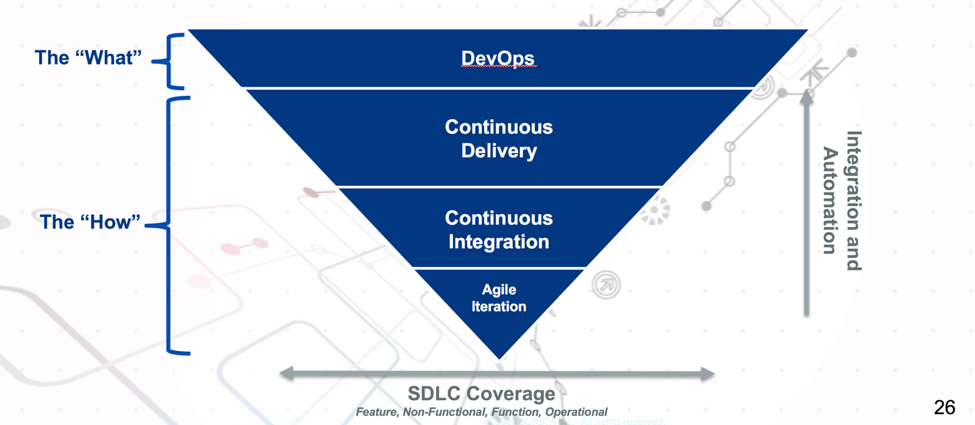
    When considering DevOps, it objectives and the objective of its component practices it is useful to establish a clear idea of the relationships between theses practices. It is often useful to visualize them as below:


    DevOps Transformation Triangle
    The DevOps Transformation Triangle


    DevOps is the “What,” the target state as defined by a set of guiding principles. Agile development, continuous integration and continuous delivery are the “How,” a collection of process, practices and tools that together build the foundation for a sustainable DevOps implementation.

    In the next section, we will review some of the initial discovery questions asked when beginning on a DevOps transformation, provide real-world examples of answers from various stakeholders in real organizations, and analyze those answer to better understand the journey to DevOps.

  • Q&A: Quali’s Wrabetz on Security Testing

    Q&A: Quali’s Wrabetz on Security Testing

    DevOps is the perfect storm of automated testing and development that should make secure software commonplace. Yet, there are hurdles to testing for security. devopsy.kinsta.cloud asked Joan Wrabetz, CTO of Quali, about security, DevOps and her laundry list of those testing challenges.

    David Geer: Isn’t secure software important to DevOps?

    Wrabetz: DevOps is a practice of continuously deploying applications into production clouds. In order to automate the deployment of applications into production, it would seem essential for security testing to be a part of that automated process. In fact, when talking with one financial services firm, they said that they don’t deploy continuously into production because they are concerned that to do so would break the law. They are required by law to ensure that applications comply with their regulatory and privacy requirements before they are deployed into production. The only way to do that is to perform security testing. Thus, in order to achieve continuous deployment, they would have to integrate security testing into their DevOps flow.

    Geer: So, why isn’t security testing a core part of DevOps already?

    Wrabetz: The reasons are both technical and organizational. Organizationally, security testing is usually handled separately from development or product release-oriented testing, often by a completely separate group. As a result, it is not necessarily associated with the application release process.

    The technical reasons are related. Historically, security testing has involved reproducing the production infrastructure and network configuration as accurately as possible so that security vulnerabilities can be identified. Often, development and test teams working on DevOps do not invest in creating accurate reproductions of production infrastructure for their normal development and testing. So, they are not prepared to perform security testing as part of their normal DevOps flow.

    Security testing at many financial services firms exemplifies both of these issues. These firms typically outsource their security testing to one of a number of service firms who perform that testing on their own networks or in the cloud. The outsourcing of the security testing process is a big inhibitor to incorporating security testing into a continuous and automated DevOps process. In addition, when we asked these financial services firms how well their outsourced security testing represents their real production information technology infrastructure, they really have no idea. Clearly, any testing that does not match the production environment is not helping to reduce the security risk that the organization faces.

    Geer: What kinds of security testing do you feel is most relevant to DevOps?

    Wrabetz: The type of security testing that is most relevant to the DevOps flow is application compliance testing. For this type of testing, new applications are inserted into a network that emulates the information technology production network as accurately as possible. Testing with load, traffic and disruptive events is performed to determine whether the new application or upgrade might open up a vulnerability in the production environment. That includes privacy and data protection regulations, security requirements and any other business compliance standards that the organization is subject to. This testing is performed before pushing any new upgrade or application into production to ensure that compliance requirements will be maintained.

    Geer: What are some common problems with security testing as part of DevOps?

    Wrabetz: There are some common problems that make this type of testing uniquely difficult as part of a DevOps process, and in many cases, much harder to perform than other hardware and software testing. For example:

    • The tests must run in a configuration that exactly matches the current production configurations.
    • Security tests are systemwide tests, not tests of a single piece of hardware or software.
    • The tests must run with realistic traffic that simulates typical production traffic.
    • Security testing must allow automation of setup, configuration and testing processes in order for it to be incorporated into a DevOps flow.
    • Networks are large-scale and difficult to reproduce in a test.

    Security Testing Critical

    DevOps is in its infancy, but it won’t be forever. Now is the perfect time to surmount these obstacles, test for security and feed the results back into coding for security early and often.

  • New Faces Of Devops

    New Faces Of Devops

    RECORDING

    SLIDES

    [seoslides embed_id=”77abd5e6ff38″ script_src=”https://devopsy.kinsta.cloud/embed-script/new-faces-devops/15682/” overview_src=”https://devopsy.kinsta.cloud/slides/new-faces-devops/” site_src=”https://devopsy.kinsta.cloud” site_title=”devopsy.kinsta.cloud” title=”New Faces of DevOps” /]


  • PTC: Using DevOps to Transform Applications

    PTC: Using DevOps to Transform Applications

    Large companies and monolithic applications are not usually associated with DevOps. But I recently discovered that some of the best DevOps operations have come from the largest organizations and most complex applications, and PTC is the latest example.

    If you are not familiar with PTC, the company has a wide range of offerings for enterprises looking to improve their operations. Its solutions range from enterprise resource planning (ERP) to product lifecycle management (PLM) and Internet of Things (IoT) platforms as a service (PaaS). Its existing products started as on-premises solutions, and have expanded to modern solutions including IoT. But now there is a large demand to convert them to cloud-based offerings. And as PTC goes down this path, it needs to have a modern delivery chain to support it.

    Enter Cloud Services

    So PTC created its Cloud Services group to deliver cloud-based versions of its existing platforms to customers. Its cloud-based offerings are subject to all the same demands of any other modern software-as-a-service (SaaS) and PaaS offering—faster releases, more frequent updates and higher quality. After a few years of building the Cloud Services group, the company has proven it can automate and improve delivery of its traditionally on-prem platforms in the same fashion as poster-child DevOps environments.

    The journey was not easy, and it did not start with DevOps as a goal. The goal was simply to deliver solutions to its customers. DevOps was the natural outcome following the challenges it faced. Some of the challenges were common for all development operations, but others were very unique:

    1. Lots of variables: PTC has to support a wide range of customers across a wide range of deployments. PTC works with its customers on their varying needs of platform versions and also understands their varying requirements around software updates. And each potential variation has a unique snowflake configuration, which, unlike most cloud platforms that offer one production version to all users, its entire ecosystem of releases is actually a wide range of configurations and versions.
    2. Data integrity: Data is important no matter what. But PTC works with customers that have had data in their on-premises solution for a long time, and that same data needs to make it to the cloud, securely, without a single flaw. That data is part of business-critical applications and ongoing business processes.
    3. Educating users: As customers continue on their journey to the cloud, PTC is there to support the changes and enable them through customer success, continuous knowledge transfers and an endless online platform of PTC educational services.

    So not only does it face technical challenges, it also is facing huge change control and people challenges. Before any software delivery can begin, there is a specific part of the Cloud Services group that is responsible for the necessary development to SaaS-ify the existing applications and build a gold master for each release.

    The initial delivery chain was hand-to-hand combat: one solution, one customer, one release at a time. This required a lot of warm bodies to manage manual release processes and customers.

    “We could not keep on throwing people at the problem,” notes Tameem Hourani, senior director of Cloud Services. Even though PTC had established workflows via ServiceNow, each step was manual and simply not scalable. But the customers and releases were increasing at an ever-climbing rate. It simply would not be feasible to on-board new team members to handle the load.

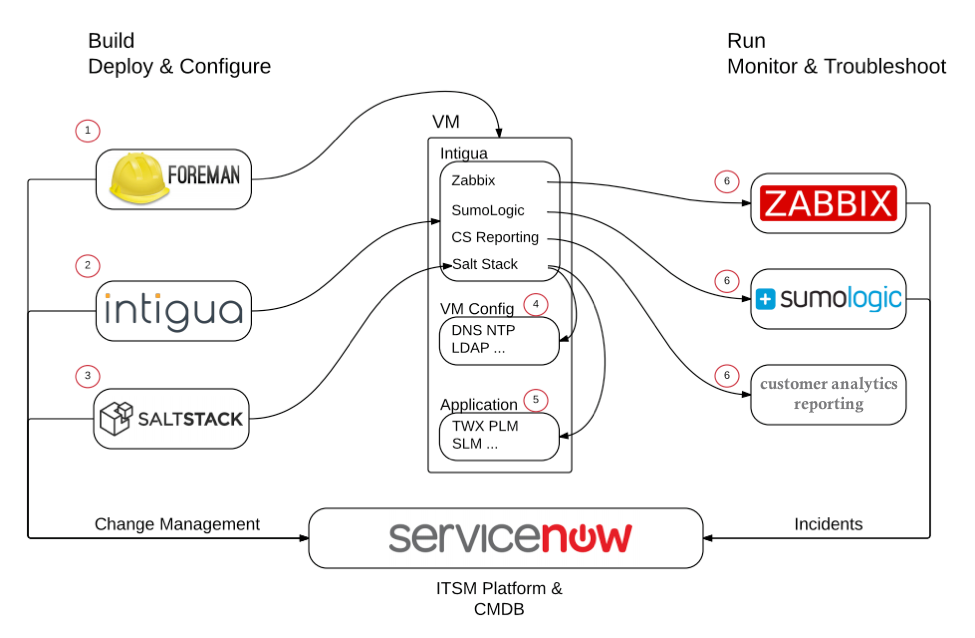
    So it turned to good practices and tools to build a delivery chain that can take care of a brand-new deployment in less than two hours, instead of days, and upgrades in less than 10 minutes. Here is what the resulting setup looks like:

    ptc_flow

    PTC was not new to automation. The company had been leveraging ITIL practices for some time. But what ITIL lacked was exposure to the customer. So with the ITIL backbone and ServiceNow in place, PTC added pipeline-level orchestration called Foreman.

    In this configuration, both ServiceNow and Foreman essentially act as a system of record for the entire environment. ServiceNow is the system of record for all states and workflows. It also is the base entry point for any new update or deployment. And Foreman is the system of record for infrastructure and configurations across all customers and all deployments. But it also serves as the “checklist” of all the aspects of orchestration.

    To manage the infrastructure orchestration and create the templates for configurations, PTC turned to Saltstack. It originally used another tool, but the benefit of Salt is that it allows for more sequential orchestration, as opposed to another tool with a stateful-only option.

    PTC uses another unique tool called Intigua. Intigua peaked my interest because I have previously talked about the overhead in both resources and management of server agents. And because so much of what is done for headless monitoring and control of servers these days is done by agents, this actually becomes a serious management problem.

    “The only way to grow a modern delivery chain is tools. And most new tooling is driven by agents,” Hourani notes. “It is easy to forget that the new tooling and processes also come at a cost. Usually the cost is less than the benefit they provide, but it is there nonetheless. Management of agents seems simple enough, but [when] actually doing this at scale, things can easily get out of hand.”

    PTC had four-plus unique agents across a wide range of configurations. One of Intigua’s value points is the ability to “self-heal” and make sure the agents are always running correctly.

    Once it is handed an IP, Intigua installs and configures agents based on tags, policies and AWS regions. When Intigua is running, it will make sure agents are up to date, and that self-heal agents go to work should something go wrong. The ability to use Intigua as a single pane of glass in a highly variable grid of configurations is a huge benefit.

    Triggered by ServiceNow, configured by Foreman, Salt and Intigua, the infrastructure and code are deployed. But to learn and maintain all environments for the customer, PTC needed some strong production monitoring tools. It uses SumoLogic, deployed as an agent via Intigua, for log analysis. For most applications, using a single instance of Sumo is fine. But PTC has to segregate an instance per customer, and the process must be fully automated. There is some overlap with another monitoring tool, Zabbix, which has been set up to attempt self-healing upon a triggered alert.

    And then there’s Jenkins. While not used for the entire deployment process, it is used to drive testing and manage states during the testing process. Upgrades to production releases are done incrementally, and complete deployments are done full-stack.

    Services Layers Are All the Rage

    Cloud services and shared services are not necessarily new. I recently did a write-up on Wix, which has a similar approach. But the complexities associated with SaaS-ifying on-premises solutions, along with the number of variables, adds not only another layer of complexity, but also another layer of value to a repeatable delivery chain.

    I am humbled by case studies like these, because it proves that those who say their environments are too complex for DevOps have yet to see what’s possible.

  • Echidna Takes DevOps to E-Commerce Site Creation

    Echidna Takes DevOps to E-Commerce Site Creation

    The Echidna e-commerce firm installs and evolves e-commerce platforms, providing ongoing development so its clients can leverage e-commerce experiences to the satisfaction of their customers. “We apply carefully selected user experience technology, marketing and analytics abilities to our clients’ strategic goals to do this,” taking what it calls an “anti-Big Bang” approach to continuous deployment, says Mike Pierce, CTO of Echidna.

    “Traditional e-commerce deployments were often Big Bang deployments that people developed on the basis that they had to pressure the business leaders into feeling like they had only one chance to pack as much scope as possible into a large software development project. That approach voids any practical innovation,” says Pierce. With that mindset, it can take years to finish e-commerce sites, and e-commerce companies can go out of business by the time they actually finish such a site, since it would be far out of date by then.

    Echidna sees continuous deployment as one piece in a much larger agility play designed to ensure that businesses compete in digital economies, now and in the future. Continuous deployment is the ultimate goal of DevOps, an approach that enables the business to innovate fast enough to maintain the business’ sharp marketplace edge through acute, turn-on-a-dime competitive dexterity. “In order to do this, continuous deployment helps companies learn to develop high-quality software and deploy it on a rapid, reliable and repeatable schedule,” says Pierce.

    Continuous Deployment Timelines and Challenges

    Depending on the client, its needs and the features in the pipeline, Echidna deploys software to each e-commerce platform from monthly to daily, and at intervals in between those extremes. Echidna seeks to increase the degree of automation of each deployment over time. The challenge is that with so many different clients and platforms, Echidna must achieve its automation victories for each customer individually, solving similar and unique issues. “We are finding our greatest success using PaaS (platform-as-a-service) e-commerce platforms like Four51 because it eliminates a lot of the administrative overhead that is typical with deployments to on-premise platforms,” says Pierce.

    The development model Echidna follows to deploy e-commerce sites affects each software component, even though components deploy at different times. “Payment system modifications require significantly different testing—more testing—and we must deploy them much less often than other components. Marketing components don’t need as much regression testing as other software modules and so we can deploy them much more quickly,” he says.

    The most difficult software to move into continuous deployment in an e-commerce platform are the components that integrate deeply into enterprise systems. That is why Echidna advises business customers to use DevOps methodologies to deploy their enterprise production software at accelerated rates. When they do this, Echidna potentially can speed its deployment of the e-commerce platform components that are enmeshed with those production systems.

    The Four51 Path, Through Jitterbit

    Echidna connects Four51’s OrderCloud to the Jitterbit iPaaS integration server platform, a point-and-click integration tool. “This enables us to streamline further integrations and data exchanges with many of the disparate systems in an ecosystem,” says Pierce. Echidna sees increasing continuous deployment orchestration opportunities as more and more third-party application vendors become compatible with these kinds of integration tools.

    Four51 enables an ecosystem of connected digital services and applications where e-commerce uses numerous disparate systems that exchange data and facilitate work streams in the enterprise in question, Pierce says. “As these systems eliminate disparities and we align them on the central integration and deployment standards that we use, there will be increasing opportunities to introduce clients to lean development practices like continuous delivery and continuous deployment.”

    Conclusion

    Continuous deployment is miles apart from what information technology is used to, especially where manual change management and change control are concerned. But once Echidna exposes its customers to continuous deployment, their managers, C-levels and boards soon begin to witness the accelerated software innovation continuous deployment provides and how this makes information technology—and the business—more nimble, both technologically and competitively.

  • Datadog Adds Hadoop and Spark Integration to Leading Cloud-Scale Monitoring Platform

     Users can now monitor the four most widely-used technologies in the Hadoop ecosystem: HDFS, MapReduce, YARN, and Spark

    NEW YORK – May 24, 2016 – Datadog, the leading SaaS-based monitoring platform for cloud applications, today announced support for Hadoop, bringing its unified view of applications to the Hadoop ecosystem. Hadoop users can now benefit from Datadog’s rich dashboards, full stack visibility and correlation, sophisticated and targeted alerts, collaborative tools and integrations, and easy setup with no maintenance. Integrations can be turned on immediately, adding to the long list of technologies DevOps teams can monitor easily and collaboratively with Datadog.

    By adding the power of Datadog to Hadoop, users can now see hundreds of Hadoop metrics alongside their hosts’ system-level metrics, correlating what is happening within Hadoop with what is happening throughout their stack. Users can also avoid problems by setting alerts when critical jobs don’t finish on time, on outliers or any other problematic scenarios.

    This product update supports:

    HDFS: Using the HDFS integration, users can monitor the number of data nodes and blocks, disk space remaining on each host and cluster, as well as namenode load and lock queue length.

    • MapReduce: The MapReduce integration includes metrics for map and reduce jobs pending, succeeded and failed, bytes read by job or in total, as well as input/output records.
    • YARN: The YARN integration gives visibility to nodes, applications, cluster cores and cluster memory.
    • Spark: With the Spark integration, users can see driver and executor, RDDs, tasks, job stages and more.

    Since launching in 2010, Datadog has been adopted by thousands of enterprises, including Twilio, Airbnb, Netflix, EA, Spotify, Warner Bros. Games and AdRoll. For additional information on Datadog, please visit www.datadoghq.com.

    Supporting Resources

    Company Blog

    Twitter: @datadoghq

    About Datadog

    Datadog is a monitoring service that brings together data from servers, databases, applications, tools, and services to present a unified view of the applications that run at scale in the cloud. These capabilities are provided on a SaaS-based data analytics platform that enables Dev and Ops teams to work collaboratively to avoid downtime, resolve performance problems, and ensure that development and deployment cycles finish on time.

    #

    Media Contact

    Mindshare PR

    Heather Fitzsimmons, 650-279-4360

    heather@mindsharepr.com

  • Five Harsh Truths About DevOps

    Five Harsh Truths About DevOps

    DevOps can provide tremendous productivity improvements, but it’s not a panacea. As much as we’d want it to be the solution for all of our software development problems, here are five truths you should consider.

    1. DevOps may lead to juggling job roles and coming out of your comfort zone

    Five Harsh Truths on DevOps_pic 1With DevOps, the development team is responsible for writing the automated scripts that deploy the application. That used to be manual work done by someone in operations. Just as in manufacturing, automation will eliminate jobs. Typically, that system administrator can be retrained to work in development writing those deployment scripts, but programming is a different skill from restoring databases. If you can’t adapt, it’s time to update that resume.

    2. Not everything should be automated

    Yes, DevOps can be made to work on any platform, including the mainframe. No, it’s not confined to projects using agile. You don’t have to use Ruby or PHP; it’ll work for Fortran applications too. But be realistic. Transforming an application to use DevOps is expensive. You should not invest in something that is slated for sunset, or only has one release per year to fix some minor bugs. Legacy systems are considered legacy for a reason. Focus on the top 20 percent of your portfolio instead.

    3. Developers will need to get their hands dirty

    Five Harsh Truths on DevOps_pic 2Some developers like to do one thing, and one thing only: write code. Grudgingly, they’ll test; they’ll attend team meetings if they have to; and, if tortured, they’ll write documentation. But forget about getting them to create the installation scripts.

    That mindset is not going to fly in a DevOps world. Developers need to think about how the application will run as a nonfunctional requirement, and treat it with the same level of importance as security, performance and data privacy. Unless they feel ownership of the installation process, monitoring the environment and collecting end-user feedback, you have not really implemented DevOps.

    4. Operations no longer can be ticket-driven

    Usually, the operations team doesn’t get involved until someone from the development side opens a ticket for deployment. That’s too late for any kind of meaningful integration. The answer is not opening a ticket three months earlier; tickets are meant to be assigned, worked and closed within a short period of time. The type of collaboration needed between development and operations is far more complicated, and should be treated like it’s a project. That’s really difficult for most operations organizations. It’s not part of their culture, and they’re not staffed for that.

    5. Your process is really, really bad

    Five Harsh Truths on DevOps_pic 3As soon as you start automating your software delivery process, you’ll find out exactly how inefficient it really is: duplicate reviews, inconsistent forms, competing standards … When you take away the people layer, you can’t hide the crazy anymore. You don’t want to take what you have today and force it into an automation tool. You will need to standardize before you optimize, and optimize before you automate. That means a lot of different towers will need to cooperate—something that won’t happen unless there is an outside party driving the cooperation with a big stick.

    To learn more, check out the hangout with industry experts: What will DevOps look like in three to five years?

    What aspect of DevOps do you think people are uncomfortable to talk about? Leave a comment below or contact me @baspluim

    About the author / Jan S (Bas) Pluim

    Bas Pluim

    Bas Pluim is a Cloud/ DevOps solution architect in IBM’s innovation practice. He works with clients on infrastructure solutions, process re-engineering, automation tools and transforming the overall software delivery process. Bas is also a member of the IT Specialist certification board, a gaming enthusiast and an advocate of social media tools

  • JFrog Introduces Xray – Makes DevOps Omniscient


    JFrog Xray provides organizations a new standard of Radical Transparency and Deep Impact Analysis

    NAPA, Calif. – May 23, 2016 – JFrog today introduced its 4th and newest product, JFrog Xray, which gives organizations unprecedented visibility into the contents of software components. The announcement – made at swampUP, JFrog’s annual user conference – represents a major advancement in improving development, DevOps and InfoSec teams’ effectiveness and accelerating the continuous delivery pipeline.

    JFrog Xray is the first universal impact analysis product, giving organizations an unparalleled level of understanding about all of their container images, software packages and binary artifacts, even with the huge volume and variety of components that development teams share in the software build and distribution process.

    JFrog Xray is the only product on the market that provides radical transparency into every component an organization has ever used. It includes:


    • Impact analysis that indicates how production and CI environments are impacted
    • A full dependencies graph on which users can easily zoom in to find vulnerability or compliance issues
    • An open API that enables integration with all current and future types of component-scanning technology to allow custom scanning capabilities for performance, quality, popularity or any other criteria required
    • A universal solution that integrates with vulnerability and license compliance databases such as VersionEye, BlackDuck and WhiteSource
    • A powerful integration with user’s registry and repository to allow full sync through all the CI/CD flow.

    Through tight integration with JFrog Artifactory and access to the exhaustive metadata that Artifactory indexes, JFrog Xray is in a unique position to analyze the relationships between binary artifacts across an entire organization and analyze the impact that one component has on any other. In addition to security vulnerabilities, JFrog Xray can also analyze the potential impact of performance issues or architectural changes.


    “JFrog Xray responds to a profound pain of our users and the entire software development community for an infinitely expandable way to know everything about every component they’ve ever used in a software project – from build to production to distribution,” said Shlomi Ben Haim, CEO of JFrog. “While container technology revolutionized the market and the way people distribute software packages, it is still a ‘black hole’ that always contains other packages and dependencies. The Ops world has a real need to have full visibility into these containers plus an automated way to point out changes that will impact their production environment. With JFrog Xray, you can not only scan your container images but also to track all dependencies in order to avoid vulnerabilities and optimise your CI/CD flow.”


    JFrog Xray is a fully automated platform with a powerful REST API allowing integration and automation with an organization’s continuous integration and continuous delivery pipeline, and enabling other inspection and security tools to fit into the full build-to-production automated flow.

    JFrog Xray includes the VersionEye technology and database. VersionEye, a startup company based in Mannheim, Germany, improves developer productivity through a system that tracks open-source libraries and alerts developers in real time to key information such as security vulnerabilities, license violations and outdated dependencies.

    “VersionEye technology monitors over a million open source projects on a daily basis,” said Robert Reiz, CEO and co-founder of VersionEye. “Integrating the VersionEye technology with the JFrog platform creates an unparalleled capability for deep understanding of the quality and provenance of the software components organizations depend on. JFrog has leveraged its Universal approach, supporting all type of components, into a leadership position with its artifact repository and addresses a real community pain with JFrog Xray. We are excited to be part of the solution.”

    The technology solves a critical problem for companies as they increasingly use container technology and make open source a mainstay of their development strategies. With so many open source components available, it has become extremely difficult, if not impossible, for application builders to know pertinent information about each one and avert security issues, such as the Heartbleed bug in the popular OpenSSL cryptographic software library that put user passwords at many popular websites at risk.

    JFrog Xray will be demonstrated at swampUP, taking place May 23-24 in Napa, Calif. The product will be generally available on June 30, 2016.

    Resources

    About JFrog

    More than 2,000 paying customers, 60,000 installations and millions of developers and DevOps engineers globally rely on JFrog’s world-class infrastructure for software management and distribution. Customers include some of the world’s top brands, such as Amazon, Google, LinkedIn, MasterCard, Netflix, Tesla, Barclays, Cisco, Oracle, Adobe, Intel and VMware. JFrog tools – comprising open-source, on-premise and SaaS cloud solutions – are revolutionizing the way companies and individuals develop, release and distribute software. JFrog Artifactory, the Universal Artifact Repository, and JFrog Bintray, the Universal Distribution Hub platform, are used by millions of developers and DevOps engineers around the world. The company is privately held and operated from California, France and Israel. More information can be found at www.jfrog.com.

    ###

    Media Contact

    Danielle Salvato-Earl

    Kulesa Faul for JFrog

    (650) 922-7287

    danielle@kulesafaul.com