Tag: application performance management

  • Micro Focus Updates LoadRunner Testing Tools

    Micro Focus Updates LoadRunner Testing Tools

    Micro Focus has revamped its venerable line of LoadRunner testing tools as part of an effort to both unify code bases and provide tighter integration with third-party application performance management (APM) tools from AppDynamics, a unit of Cisco Systems.

    Vicky Giavelli, director of product management for performance engineering at Micro Focus, said Micro Focus in now in the first stages of unifying the code base of instances of LoadRunner that run on-premises and the cloud to enable DevOps teams to more flexibly test applications regardless of where they are deployed.

    DevOps teams can already share licenses across LoadRunner products and rapidly scale up or down based on seasonal or ad hoc demands, she noted.

    As testing continues to shift left, Giavelli said, Micro Focus continues to invest in aligning the LoadRunner family of application testing tools with multiple DevOps platforms. LoadRunner tools currently support more than 50 application protocols and technologies and more than 52 scripting technologies in addition to providing integrations with open source continuous integration/continuous delivery (CI/CD) tools and data visualization platforms such as Grafana and InfluxDB.

    The alliance with AppDynamics extends that strategy by making it easier for DevOps teams that employ LoadRunner to consume and share data with users of one of the most widely employed APM platforms, she noted.

    Giavelli said Micro Focus continues to enhance the user experience of a testing platform that has been widely employed now for a quarter-century. While competition has increased considerably during that time, the LoadRunner family of tools has maintained its base among application testers, she said, while extending its appeal to developers, who increasingly are taking responsibility for testing as part of an integrated set of DevOps processes.

    Of course, it’s still not clear how far left toward developers application testing might shift. While the consensus might be that more testing on the part of developers is good, application testers may provide a more unbiased opinion about how well an application accomplishes the ultimate business goal.

    Regardless of the role of testing within the organization, the one thing that everyone agrees on is it should be easier to generate meaningful tests that reflect real-world use. No matter who does the testing, the goal is to not have to roll back an application once it is deployed in a production environment. As applications become more complex, Micro Focus continues to invest in machine learning algorithms and other forms to advanced analytics to identify potential issues sooner than later, noted Giavelli.

    It’s too early to say how the battle between application testing vendors will play out in the months ahead. The one thing that is certain is that in the wake of the COVID-19 pandemic, application testing has never been more critical. More organizations than ever are building digital business applications to make it easier to engage with their customers, at a time when many of them might not be returning to an office anytime soon. The issue, of course, is that not many of their end users will be especially tolerant of issues such as a mobile computing application that doesn’t live up to expectations the first time it’s deployed.

  • Splunk Updates SignalFx APM Platform

    Splunk Updates SignalFx APM Platform

    Splunk today unfurled its first major update to the SignalFx application performance management (APM) platform since acquiring it last October.

    Karthik Rau, general manager for application performance management (APM) at Splunk, said SignalFx Microservices APM combines for the first time the SignalFx platform with Omnition, a software-as-a-service (SaaS) platform for implementing distributed tracing as an alternative to application sampling that Splunk also acquired last year.

    In addition, the latest iteration of SignalFx adds a Kubernetes Navigator tool to a SignalFx Infrastructure Monitoring module to make it easier to manage Kubernetes clusters alongside the microservices-based applications running on that platform. The module surfaces recommendations to expedite triaging and troubleshooting based on machine learning algorithms that are embedded in the platform. Splunk has also enabled workflow integration across Kubernetes Navigator and Splunk Enterprise and Splunk Cloud to provide IT teams with additional insights and context, noted Rau.

    With the acquisition of SignalFx, Rau said Splunk is at aiming to advance two major DevOps trends. The first is the rise of open source agent software that makes it increasingly feasible to instrument the entire IT environment. Omnition, prior to its acquisition by Splunk, was a founding member of and contributor to the OpenTelemetry project now being managed under the auspices of the Cloud Native Computing Foundation (CNCF).

    The second is the need to eliminate relying on sampling in favor of employing distributed tracing to be able to analyze every event that has occurred within an IT environment.

    At a time when IT environments are getting more complex, Rau said being able to resolve IT issues is critical. Modern applications based on microservices can be especially problematic given all the dependencies involved, he noted. In contrast to legacy APM platforms built to monitor monolithic application environments, SignalFx is built from the ground up to address application environments based on microservices, he said Rau, noting core to that effort is the ability to ingest massive amounts of distributed tracing data.

    Historically, APM platforms were used sparingly to help manage the most mission-critical applications in the enterprise largely because of concerns about cost. Given the complexity of modern applications, however, it’s become apparent that observability is now a core tenet of any approach to implementing best DevOps practices. The issue many DevOps teams will need to address is determining to what degree the existing tools they have for observing their IT environments sufficiently meet the requirements of new classes of applications. In many cases, that decision may be predicated on the rate at which those organizations are embracing microservices-based applications.

    Of course, Splunk is not the only vendor making a case for an APM platform optimized for microservices. Competition between emerging and legacy providers of APM platforms that have added support for containers and Kubernetes clusters is already fierce. The real issue going forward, however, is determining which of the platforms will enable DevOps teams to discover the most relevant issues soonest. After all, when short-handed DevOps teams encounter an issue, every second it takes to remediate that problem counts.

    — Mike Vizard

  • New Relic Gives COVID-19 Relief Agencies Free 90-day Access

    New Relic Gives COVID-19 Relief Agencies Free 90-day Access

    New Relic will provide free access to the entire New Relic One observability platform for 90 days to any organization engaged in COVID-19 pandemic relief efforts that have a specific benefit to the public.

    Erin Dieterich, director of corporate social responsibility at New Relic, said it’s apparent that the IT platforms of both nonprofits and private companies that are lending their services and expertise to mitigate the impact of the COVID-19 pandemic will be taxed in unexpected ways.

    To help IT teams rise to that challenge, New Relic will make it possible to identify both software and infrastructure issues that are having an adverse impact on applications, noted Dieterich. Those issues undoubtedly will be experienced by both non-profit organizations as well as private companies trying to leverage their existing IT environment to make additional digital services available. Examples of organizations beyond those providing humanitarian aid that are being invited to register to use New Relic One via NewRelic.org include public and private schools and other providers of education services.

    New Relic also has a crisis management team in place to make sure the New Relic One service is not disrupted as the company’s own employees work from home across multiple geographies.

    Many of the providers of COVID-19 relief services are likely to find their efforts stymied at some point by IT issues. As IT environments have become more intertwined in the age of the cloud, it’s become difficult to ascertain the root cause of any application performance issue. Platforms such as New Relic One provide access to a cloud service through which IT teams can more easily pinpoint where a specific issue is potentially creating a wave of downstream application issues that would not be obvious to the average IT administrator.

    Beyond the teams of employees New Relic already allocates to New Relic.org on a full-time basis, Dieterich said the company is tapping volunteers from its own base of employees. Many of those employees themselves are now working from home, much like most of the rest of the global workforce.

    It’s too early to say to when the COVID-19 pandemic might subside, so New Relic plans to re-evaluate this initiative three months from now. In the meantime, the company has also pledged to make available $100,000 to match employee contributions to COVID-19 relief efforts.

    In the days and months ahead relief agencies of all sizes are going to be put to the ultimate test. While most of the focus is now on health care, it’s clear the COVID-19 pandemic also represents a major economic disruption. IT expertise will be needed to augment relief efforts spanning everything from tracking coronavirus cases to making sure people who are out of work receive food assistance. IT expertise that enables relief agencies to access public and private funding as quickly as possible is likely to be among some of the most important tasks ahead, regardless of whether anyone realizes today or much less even appreciates it tomorrow.

    — Mike Vizard

  • SolarWinds Strengthens AppOptics APM Platform

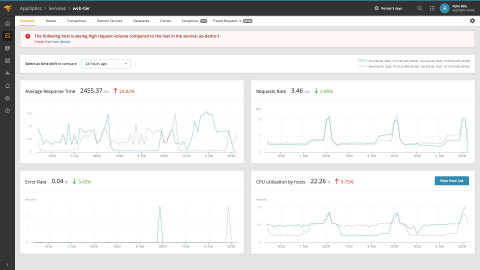
    SolarWinds today updated its AppOptics application performance management (APM) platform by adding both service- and trace-level root cause analysis capabilities.

    Jim Hansen, vice president of products, application management for SolarWinds, said the goal is to provide most of the same capabilities any IT organization would find in an APM platform that would cost 10 times more than AppOptics.

    That’s critical at a time when thanks to the rise of microservices-based applications based on containers more IT organizations are discovering they need to apply APM platforms more broadly, added Hansen. Previously, IT teams tended to reserve usage of APM platforms to their most mission-critical applications because of the costs involved. However, as SolarWinds moves to drive the cost of accessing an APM platform delivered via a software-as-a-service (SaaS) application, Hansen noted APM platforms are becoming more affordable.

    The service-level root cause analysis module is also designed to more accessible to the average IT administrator by reducing the number of steps and clicks required to identify the specific performance problem or issue. A complementary AppOptics trace-level root cause analysis then makes it possible to drill down into application metrics all the way down to specific lines of code and transactions. The goal is to make APM platforms more accessible to IT generalists, said Hansen.

    Those service- and trace-level root analysis features are available both in the core platform as well as a free AppOptics Dev Edition tool that SolarWinds makes available for developers.

    While AppOptics is the core APM platform provided by SolarWinds, the company also makes available a Loggly log management platform and Pingdom performance monitoring tools for websites. Collectively, those platforms make it easier to manage IT environments that are becoming increasingly complex to manage, said Hansen.

    In general, Hansen said IT organizations are starting to converge application and infrastructure management, especially if they have embraced best DevOps processes. In some cases, one member of a DevOps team is managing both, while other organizations are having teams of IT professionals collaborate around the same APM platform.

    At the same time, Hansen noted IT organizations want to be able to employ the same APM platform to manage both monolithic and microservices-based applications versus having to acquire separate APM platforms for both types of applications.

    It’s too early to say to what degree SolarWinds might be able to usurp rival providers of APM platforms that have been available for more than two decades. However, Hansen noted that in terms of market penetration, fewer than 10% of IT organizations have standardized on an APM platform.

    As organizations transition to microservices-based applications, APM platforms become a necessity. The overall IT environment is simply becoming too complex to manually monitor and manage. At the same time, businesses are starting to have a greater appreciation for how dependent digital processes are on software. The issue now isn’t so much whether those organizations need an APM platform as much as it is figuring out which APM platform can they afford.

    — Mike Vizard

  • Cloud Confessions: Full Stack APM Is a Necessity

    Cloud Confessions: Full Stack APM Is a Necessity

    IT environments have become more dynamic and complex, which has created the need for robust monitoring tools. As a result, companies are increasingly adopting more than one platform, catapulting us into the multi-cloud era. Technology professionals are also embracing and acknowledging the need for comprehensive, full-stack application monitoring and management, bringing application performance management (APM) into the mainstream.

    The recent SolarWinds survey Cloud Confessions 2020 reveals even though APM has become mainstream (with a majority of tech pros using APM tools regularly), there’s still work to be done to move beyond troubleshooting. This finding is consistent with last year’s study, in which nearly half of the respondents said troubleshooting was a top-three task they managed daily.

    Tech pros have an opportunity to fully leverage the benefits of APM across the entire application stack, not just for troubleshooting. They should enable tech pros at any stage in their APM journey to realize the value and richness of end-to-end optimization with APM.

    In 2020, implementing solutions to achieve integrated application performance and availability management for any type of organization will become increasingly important.

    The Cloud Confessions survey showcases how application owners, developers and support teams currently use APM tools. It also shows areas where tech pros feel they need more education and support to confidently utilize APM solutions.

    Cloud Confessions Key Findings

    This survey explores how extensively technology professionals are using APM tools, whether on-premises or for SaaS-based application management and how they monitor these environments. It also showcases areas where tech pros feel confident in their APM tools and strategies, as well as challenges and avenues for building confidence.

    The key findings show:

    1. Tech pros are using APM tools, employing a nearly even mix of SaaS and on-premises to support the three architectures most often found in modern environments. Despite this, confusion around which tools are ideal for specific IT environments is consistent across application owners, developers and support team roles.

    • Nearly nine in 10 tech professionals are using APM tools in their environments.
      • 59% are using APM for monolithic (traditional on-prem) app development architectures.
      • 40% are using APM for N-tier service-oriented architectures.
      • 39% are using APM for microservices.
    • The top three most commonly deployed tools in support of APM strategies are:
      • Database monitoring (64%).
      • Application monitoring (63%).
      • Infrastructure monitoring (61%).
    • Two-fifths of tech pros face challenges due to lack of awareness of what APM solutions are currently offered and confusion over which currently offered APM solutions are best for their needs (respectively).

    2. Overall, tech pros are confident in their ability to manage and monitor applications on-prem, in hybrid environments and in the cloud; this confidence mostly sits within their ability to troubleshoot.

    • Over eight in 10 (84%) respondents are confident in their ability to successfully manage application and infrastructure performance.
    • Two-fifths (40%) of tech pros surveyed are most confident troubleshooting application issues and monitoring application availability and performance (respectively) given their existing skillset, followed by one-third (32%) of tech pros confident in collaborating with team members.
      • Troubleshooting and monitoring as the top two areas where tech pros have the most confidence is consistent with last year’s findings—in 2019, troubleshooting app issues was the number one activity tech pros spent their time on, with 48% of respondents choosing this as a top three task.

    3. The largest challenges tech pros face when monitoring and managing application and infrastructure performance relate to an existing knowledge and skills gap. As a result, tech pros have continued to deal with the troubles of troubleshooting, despite nearly all using some type of APM tool in the last 12 months.

    • When ranking the challenges, tech pros said:
      • Lack of training for personnel was the top challenge (57%), followed by lack of awareness of what APM solutions are currently offered (44%) and confusion over which currently-offered APM solutions are best for our needs (42%).
      • All other challenges were at, or under, the 30% rate.
    • Nearly eight in 10 (78%) tech pros report spending less than 10% of their time proactively optimizing their environments (vs. reactively maintaining).
      • In 2019, 77% of respondents reported spending the same amount of time on proactive optimization.

    4. Tech pros value the business insights delivered from APM tools, but greater skills development is needed in establishing KPIs and communicating IT performance to the business.

    • The top three business insights tech pros gain from APM tools include:
      • Ability to prevent applications outages (73%).
      • Ability to prevent app slowdown related to performance and/or capacity (63%).
      • Ability to improve user/customer experience (62%).
    • Tech pros are collecting these business metrics, but there’s a need to bridge the gap between business metrics collected and tech pros’ confidence in their ability to communicate performance to the business.
      • 34% of tech pros feel they need to improve their current skillset/ability to track impact across key business metrics to more confidently manage their organization’s IT environment, followed by 30% of tech pros who feel they need to improve their current skillset/ability to troubleshoot application issues, improve the performance of application code (29%) and manage/ensure/improve end-user performance (29%) (respectively).

    The key findings uncover the importance of knowing which combination of APM elements are right for your environment. Today’s environments are highly complex and distributed, involving microservices, N-tier, monolithic and commercial off-the-shelf (COTS) applications. This means the potential benefits of APM are even greater in modern contexts, as long as tech pros take time to educate themselves on the right tools for their environments.

    While APM tool usage is widespread, it’s not nearly as effective as it could be—an important distinction to business leaders in charge of digital transformation efforts. When we understand the APM world beyond troubleshooting, the possibilities for application performance optimization open up across the stack and across previously siloed teams.

    APM, when used to its potential, can be the great unifier of tech pro teams all working toward the goal of having highly available, well-performing applications and it can change the way modern businesses operate in the age of performance.

    — David Wagner

  • New Relic Adds Support for W3C Trace Context Spec

    New Relic Adds Support for W3C Trace Context Spec

    New Relic has begun adding support for the W3C Trace Context standard within the agent software it uses to collect metrics for its application performance management (APM) platform.

    W3C Trace Context is a specification that defines the format for propagating distributed tracing context between services. Distributed tracing makes it simpler for DevOps teams to track events across multiple services. Each step of a trace is correlated through an ID that is passed between services, with the specification defining a standard for the context propagation headers.

    The W3C Distributed Tracing working group moved the Trace Context specification to the point where it could be consumed by platform vendors late last year. TraceContext has since been adopted by the OpenTelemetry project, an open source observability framework being developed under the auspices of the Cloud Native Computing Foundation (CNCF), along with providers of APM platforms such as New Relic, LightStep and Dynatrace. Vic Soares, director of product management for New Relic, said many of the individuals working on the TraceContext and OpenTelemetry projects come from the same organizations.

    The first phase of the Trace Context project has focused on HTTP. The members of the project are also working toward defining trace context propagation for other formats, starting with AMQP and MQTT for IoT. The project team is also working on providing context propagation from clients and web browsers.

    That approach solves an issue that arises when using proprietary formats: As trace context headers move across boundaries such as proxies, service meshes and messaging systems, proprietary headers tend to be dropped, which often winds up breaking traces, said Soares.

    Soares said DevOps teams will need to upgrade the agent software they have in place to take advantage of Trace Context to provide more context across distributed services. Distributed tracing, however, will not replace sampling. Rather, distributed tracing provides a mechanism for identifying the root cause of issues that may first be uncovered using sampling techniques.

    New Relic APM agents for Java 5.1.0 and higher, Python 5.5 and higher, Go 3.1.0 and higher and the New Relic open source Elixir agent now support the standard. Support for Trace Context support in other New Relic agents, as well as the New Relic Browser agent, are expected to be available shortly. New Relic APM agents that support W3C Trace Context can accept and emit both the W3C Trace Context header format and the New Relic header format. The new agents are also backward-compatible to enable trace context and will be propagated between services with older and newer releases of New Relic agents. IT organizations can also opt to disable the New Relic proprietary trace format once they’ve upgraded all agents to a W3C-compliant version.

    Given the complexity of microservices-based applications, many organizations that deploy these applications will be among the first DevOps teams to take advantage of distributed tracing to not just troubleshoot applications but also proactively manage their application environments. Going forward, a lot more of the DevOps focus needs to be on identifying potential issues long before they can become a bigger problem.

    — Mike Vizard

  • Survey Finds Much Room for APM Improvement

    Survey Finds Much Room for APM Improvement

    A survey of 317 application owners, developers and support team professionals in the U.S. and Canada published by SolarWinds finds that while reliance on application performance management (APM) tools is widespread, most IT teams are still relying on these tools to react to events rather than to proactively improve application experience and performance.

    The survey finds 9 out of 10 IT professionals are making use of APM tools that are either deployed on-premises or accessed via a software-as-a-service (SaaS) platform. Nearly 8 in 10 respondents spend less than 10% of their time proactively optimizing their environments, according to the results.

    In fact, the biggest APM challenges identified by survey respondents were lack of training for personnel (57%), followed by a lack of awareness of what APM solutions are currently offered (44%) and confusion over which APM solution best fits their needs (42%).

    Jim Hansen, vice president of products for application management for SolarWinds, said some of those challenges stem from the fact that there are too many APM tools to deploy and master. Survey respondents are employing a mix of database monitoring (64%), application monitoring (63%) and infrastructure monitoring (61%).

    IT management is further being complicated by the adoption of a wide variety of application architectures. According to the survey results, organizations are applying APM tools to manage monolithic (traditional on-prem) app development architectures (59%), N-tier service-oriented architectures (40%) and microservices-based applications (39%).

    Hansen said as organizations increasingly move away from monolithic applications, the need for a more proactive approach to APM across the full stack will become more apparent. The level of dependencies between microservices especially will drive organizations toward APM platforms capable of correlating events across both applications and the underlying infrastructure on which they depend, he noted.

    Less clear is to what degree IT teams are comfortable using the analytics surfaced by APM tools to automate the remediation of any given issue. According to the survey results 84% of respondents are confident in their ability to successfully manage application and infrastructure performance, with 40% reporting they are most comfortable from a confidence perspective to use APM tools to troubleshoot application performance issues. The top three insights survey respondents said they gain from APM tools are the ability to prevent application outages (73%), the ability to prevent app slowdown related to performance and/or capacity (63%) and the ability to improve user/customer experience (62%).

    In terms of areas for improvement, survey respondents identified improving their current skillset/ability to track impact across key business metrics (31%), followed closely by the need to improve their current skillset/ability to troubleshoot application issues (30%). The ability to improve the performance of application code and manage/ensure/improve end-user performance tied at 29%, respectively.

    Of course, troubleshooting an existing issue is one thing. Proactively using APM tools to prevent issues from occurring represents a more advanced approach to managing IT in keeping with best DevOps practices. It will be interesting to see how much the adoption of N-tier and microservices applications will foster further adoption of best DevOps practices.

    Most organizations today have embraced DevOps practices to varying degrees. However, as IT becomes more complex to manage in the age of the hybrid cloud it’s now only a matter of time before legacy approaches to managing IT as simply no longer practical to employ.

    — Mike Vizard

  • Four Ways to Modernize Processes and Measure Performance With APM

    Four Ways to Modernize Processes and Measure Performance With APM

    Change is everywhere and the stakes are high. For 2019, businesses are on track to spend over a trillion dollars on digital modernization, according to a recent study from IDC.

    A crucial part of modernization is the growing number of IT organizations using the latest in dynamic, cloud-scale technologies to develop applications. As a result, technology professionals in the businesses you serve must now work with a much more complex and dynamically changing tech stack.

    When building and maintaining an app, it’s becoming even more common to have hundreds (or thousands) of pieces of code in containers being continually reconfigured and brought in and out of production. And many of these operations take place in customer-facing applications.

    The stakes are high, because if something goes wrong operations could halt. It’s therefore vital to understand the underlying technologies throughout an organization’s IT environment to better equip customers with the tools needed to be successful. Application performance management (APM) tools that simplify stack management, whether it’s on-premises, hybrid or fully cloud-native, provide a level of visibility needed for modern businesses—and they work across multiple cloud environments, such as AWS or Azure.

    As a channel partner, you need to be prepared to help your businesses and their customers through this modernization process. 

    Try the following to help your customers modernize business processes.

    Help Them Realize Software Is Now Business-Critical

    As IT departments move from on-prem infrastructure and a mix of commercial off-the-shelf (COTS) and monolithic custom applications to increasingly adopted cloud-based Kubernetes microservices applications, they’re accelerating the adoption of software at the core of all their business processes. The result? Business is increasingly dynamic and responsive—new applications are built and delivered to market faster than ever. But companies are also at risk now when things don’t go well—that strategic app could degrade or fail.

    All the tech layers underpinning these applications are also becoming more sophisticated, dynamic and interwoven—and making it still harder to administer as they continuously change at an even faster rate.

    Focus Your Customers on Core Competency

    There are plenty of open-source tools out there for your customers to use to build their own monitoring. The biggest obstacle for businesses rolling out their own apps while using an open-source tool is core competency. 

    If, for example, your customer is a wholesale plumbing supply company, is their competency sourcing plumbing supplies or knowing how to write instrumentation code for all their plumbing supply chain applications? Help them focus on what they’re good at and give them tools to manage the rest.

    Perhaps you have a large financial services customer who is spending tens of millions, across multiple years, on a team of outsourced experts to write precisely the code required. This is an extremely time-consuming and costly effort, but financial institutions do this because their needs are highly specific and mission-critical, and the cost of not doing it is even higher. 

    If you look at real-time high-frequency trading environments—where billions of dollars are moved in matters of tenths of a second—you come to understand the stakes justifying these herculean efforts. All of which supports the need for APM tools to help empower the tech pros in-house who monitor and manage these high-speed trading environments.

    At the other end of the spectrum are the small tech companies with a new idea they’re out to promote. But when it comes to most companies, their core competency is often not monitoring and managing their infrastructure and applications. It’s understanding the market requirements for their custom apps and getting those apps to market quickly. At the same time, organizations of all shapes and sizes are still confronting the reality that to successfully deliver modern applications we must shift from pure infrastructure performance metrics to the KPIs that best demonstrate end-user experience.

    Ultimately, many of the organizations described above have either focused on IT as a core competency or, in the absence of dedicated tech teams (at SMBs, in particular), they have outsourced management of their complex, dynamic tech stack and custom application builds. In both instances, APM tools are a necessity and it’s prime time for the channel to deliver those services.

    Be the Most Viable Modernization Partner

    By understanding the needs of modern organizations as they grapple with their complex tech stacks, you can ensure you have the right set of tools for your customers. 

    Provide full-stack capabilities for today’s businesses to manage their applications and keep operations running smoothly. Cater to unique business problems and equip your customers with APM tools based on their needs—advanced logging, trace metrics, performance optimization and full-stack visibility across applications and the compute infrastructure on-premises, hybrid and cloud. Help them check all their functional boxes.  

    Measure Performance with Full-Stack APM

    In all cases, your customers should be measuring performance. Because every company uses a mixture of digital technologies, arming them with full-stack APM will help gain visibility into performance throughout the business. With APM, businesses can see if their system is degrading—and fix it before disaster strikes. That’s the business value for APM—it gives visibility into the complexity underpinning today’s application environments. Full-stack APM provides this visibility, whether the apps are cloud-based, on-premises or hybrid.

    But here’s the reality—not all APM tools are the same. Traditional APM solutions weren’t built for the environment IT departments now have, with the addition of containers and microservices-based applications to their existing monolithic and n-tier/SOA applications. Those solutions were made to manage hundreds or thousands of objects with slower rates of change, not the tens of thousands, or even hundreds of thousands to millions of objects IT works with today.

    Also, note the ephemeralness of container-based microservice applications able to live and die in a matter of seconds or less. There’s no time to automatically install a traditional agent, let alone do so manually. The container’s life span is shorter than the time it would take to do such instrumentation. Direct them instead toward a full-stack APM solution with complete coverage of all application architectures: monolithic, n-tier/SOA and microservices based. With anything less, they’re running at a higher risk of brand damage and revenue impact.

    By being the experts on APM, providing full-stack visibility and measuring performance, your customers will find modernization success.

    — David Wagner

  • APM for All: Simplifying the Complexity of Cloud

    APM for All: Simplifying the Complexity of Cloud

    As companies adopt hybrid and even multi-cloud strategies, their IT departments are beginning to use dynamic technologies to build new application features on top of existing back-end business systems. Most organizations now have a blended, multi-cloud architecture where public clouds are integrated with the existing on-premises, private or hybrid cloud infrastructure and applications.

    This means, for all the agility, flexibility and scalability the cloud affords us daily, the cloud is also a source of increased complexity for technology professionals required to assure the availability and performance of the application environment. This, in turn, is expected to have a substantial impact on overall management. Gartner predicts that by 2020, “75% of enterprises will experience visible business disruptions due to infrastructure and operations (I&O) skills gaps.”

    It’s vital, then, to first understand the underlying technologies supporting application availability and performance throughout your entire IT environment. Next, you must understand how your technologies are dynamically interacting with each other in both development and production. And you need to know this not just at the various levels of the application stack itself—across all infrastructure as well as services, function calls and code—but for various types of applications themselves: monolithic, service-oriented architectures (SOA) and microservices-based.

    That’s why, whether on-prem, hybrid or cloud-native—and whether you’re running AWS, Azure or Google Cloud (IaaS or PaaS)—you need comprehensive visibility into your complete infrastructure and application stack. Application performance management (APM) gives you this visibility into your IT environment by simplifying, and more importantly, normalizing, app stack management. 

    The Case For APM

    APM has significant business value. In today’s environments, an IT team typically no longer has only one application per virtual machine—but rather dozens of virtual machines per physical host (whether on-premises, private or public cloud), with hundreds or thousands of containerized microservices per virtual machine. Additionally, these business environments with hundreds (or many thousands) of containers are continually being reconfigured and brought in and out of production underneath customer-facing applications. If something goes wrong, the digital operations can collapse. And they all need to play nice together since the underlying resources are shared.

    At the same time, the game has changed. The red, yellow and green glow of infrastructure dashboards now has less bearing on whether you’re really delivering high-quality user experiences. Instead, success metrics are now based on evolving real-world, end-user experiences. You are customer-facing, because clients interact with you through your applications and websites. If your site is slow, you lose money and it negatively impacts the business brand.

    To fix the problem, you need specifics. For example, is the transactional performance slow because you don’t have enough compute? Or is it slow because the application code is bad? These factors are interrelated. In our dynamic, shared-and-virtualized everything environments, it’s challenging to understand where the true causes of your problems are.

    When Amazon went down for an hour during Prime Day last year, experts estimated the company lost 100 million dollars in sales. Imagine the impact of a potential outage during the holiday season. Of course, those are Amazon-sized numbers. But scale down those Godzilla figures to your size, and it still hurts—either through lost revenue or damaged brand reputation.

    With APM, you can see all the metrics and find out how the application’s performing over time. You can see it degrade, giving you time to figure out why it’s slowing—before it stopped getting you your raw materials on time. You can understand down to the line of code, or database query, exactly what, where and why it’s slow.

    But what are we talking about when we talk about APM? Gartner has pointed out the historical confusion on terms. There’s also a matter of differing capabilities among APM tools. Some are geared toward monolithic applications; others for Java and the web (and other applications) and still more are tuned for microservices. Beyond that, there are full-stack APM solutions that can measure it all.  

    Normalizing IT Management With APM

    APM strategies and toolsets aren’t all the same. By my count, there are three iterations of APM implementations. First, there’s APM dating from when all tech was monolithic, of which the best example is the old CA Wily Introscope. Then came a second generation, which covered areas such as SOA, Java and the web—a good example here would be AppDynamics and the old Dynatrace. After that comes a version of APM tuned specifically for microservices and containerized application environments, such as the new Dynatrace and Instana.

    In some cases, the actual APM technologies themselves haven’t kept up to date with the underlying infrastructure changes. That’s especially true for microservices. There are some legacy APM solutions that don’t support microservices in containerized application environments. On the flip side, some new companies in the APM space only operate in the microservices space. They are container-based, and don’t support old monolithic code. They also don’t support n–tier/SOA application environments.

    Most customers, however, have mixed environments. Almost no one is operating with 100% microservices in containers operationally managed by Kubernetes.

    By my reckoning, modern APM systems should monitor it all, because everything is mixed and likely to stay that way, if history is any indication. Companies still rely upon massive databases of proprietary information—databases of business records. They’re just building all-new applications in front of them.

    If you posit that it’s now more important than ever to ensure availability and performance as experienced by the user, then you need APM across all those three categories of applications and their environments, including public cloud providers such as AWS and Azure. You need full-stack APM.

    Getting Started

    Before you do anything else, first remember your due diligence. Ask around and seek out first-hand knowledge about the APM solution vendor. Don’t just trust them to give you objective advice on how good they are; there’s a great deal of hype in the APM market that can often cloud our understanding of a certain solution’s actual function. So, where do you start? Typically, it’s best to start your thinking as if you were the end user coming into your application and infrastructure stack. This means monitoring, measuring and understanding the real performance of your web-based or custom applications. You should start with the customer (external-facing) side and then work your way back in through the stack from a monitoring perspective. Next, monitor, measure and understand the performance metrics of the application itself. Here you’ll find critical capabilities, such as distributed transaction tracing and code profiling, to be critical to truly understand how all the application components relate from a performance perspective. Finally, while it’s essential to also know how your infrastructure components are performing, it’s critical to do so in full application performance context. This application-context infrastructure monitoring must encompass both performance instrumentation as well as all logs associated with your application and related infrastructure.

    Start small for quick success and to build a foundation from which to make APM more broadly successful for your organization. Start with one, or at a most a handful, of applications needing the greatest attention. Prove value and success and then ramp up adoption from there.

    In all cases, remember—unless you’re solely relying on serverless computing, with only microservice-based applications in containerized environments, you’ll need visibility across the three application architecture types: monolithic, SOA and microservices. Otherwise, you’re not getting all the information you need.

    It’s always been the goal of IT throughout all technology revolutions—whether it was mainframe, time-sharing, client-server or distributed, and whether it’s hybrid or full-on public cloud—to get a single pane of glass for operational management. True, full-stack APM delivers that view.

    — David Wagner

  • Instana Rolls Up 3 Acquisitions to Extend APM Reach

    Instana Rolls Up 3 Acquisitions to Extend APM Reach

    Instana revealed today it has acquired three technologies that will extend the capabilities of an application performance management (APM) platform optimized for microservices-based applications.

    Capabilities being added to the Instana platform include StackImpact, a polyglot production application profiler developed by StackImpact GmbH that can be applied to applications built in multiple languages; a high-frequency metrics analysis tool developed by BeeInstant; and a tool for analyzing complex system signals developed by JINSPIRED B.V.

    Instana has acquired StackImpact and BeeInstant outright and acquired only the software JINSPIRED B.V developed.

    Instana APM

    Instana CEO Mirko Novakovic said that as organizations embrace microservices typically built using containers that get deployed on Kubernetes clusters, IT organizations are discovering their existing APM platforms are not able to monitor and observe microservices-based applications to the level of depth required.

    The Instana APM platform achieves that goal by automatically deploying monitoring sensors for each part of the application technology stack. Those sensors trace all application requests without requiring any configuration or application restarts. Instana also detects changes in the application environment that allow it to adjust models and visualizations in real-time.

    As IT organizations embrace the Instana APM platform to manage microservices-based applications, Novakovic said they discover they can employ Instana also to monitor legacy monolithic applications, enabling them to standardize on one APM platform. Instana currently claims more than 300 customers, most of which are using its APM to monitor multiple types of application workloads, he said.

    In general, Novakovic said it’s becoming easier for organizations to swap out APM platforms because the proprietary agents that many legacy APM platforms rely on are being replaced by open source initiatives that make it possible to gather metrics from multiple platforms. In fact, as APM platforms continue to evolve, Novakovic said it’s apparent that tools for tracing, tracking metrics and log analytics are all starting to converge.

    Of course, the biggest challenge Instana and other providers of APM platforms face today is that many developers are relying on open source Prometheus software developed under the auspices of the Cloud Native Computing Foundation (CNCF). Instana and other APM platform providers are making a case instead for commercial platforms that provide richer visualizations and are easier to employ than Prometheus.

    It’s still too early to say how the APM platform wars might play out. However, all the dependencies between microservices make APM platforms a requirement today. Historically, many IT organizations have opted to make use of APM platforms only for their most mission-critical monolithic applications because of the costs involved. Many organizations going forward are likely to try to strike a balance between APM costs and the need to monitor application services more broadly.

    Naturally, different DevOps teams within an organization may wind up preferring to employ different APM platforms. However, the pressure to standardize on a single APM platform to contain costs will only increase over time.

    — Mike Vizard