Category: Blogs

  • Get Ready to Become a Full-Spectrum Engineer

    Get Ready to Become a Full-Spectrum Engineer

    The more things change, the more they stay the same. In software development, change has been a constant. I’ve been a software engineer for more than 25 years and have had to morph, pivot and learn new things to remain current and in demand. Plus, the industry swings like a pendulum between the need for specialists and generalists and that cannot be ignored: The advent of new architectures, methodologies and disciplines drives the need for specialists. Once assimilated, the market drifts back toward generalists.

    Back in the day, it was not uncommon to have 50+-person teams building applications using the Waterfall methodology. From a technology perspective, development was kept in silos for each specialty. It was uncommon for a developer to straddle specialties such as GUI, business logic, database and quality assurance.

    The swing back to generalists was driven by the shift to Agile. When the Agile methodology became prevalent, we saw the teams of 50 reduced to teams of six to 12. The reduced team size also reduced the number of specialist you could have on a team. Developers needed to know more and do more. Today, most companies are looking for generalists who can do it all—otherwise known as the full-stack engineer. These developers work on web applications and can operate in any vertical tier of the application. They write HTML, CSS and JavaScript for high-performing and functional UI for the front end. They can also work from the server side to develop the business logic to support the UI. Behind that are the database schema and queries they write to move data in and out of the application.

    Enter the Full-Spectrum Engineer

    DevOps has ushered in a new trend. Teams are moving from batched releases of functionality to single-piece flow. In other words, we no longer think about collecting the work of multiple engineers over multiple sprints into a release. Our ability to bring value to the customer as soon as possible and out-innovate the competition will be driven by releasing the work of a single engineer as soon as it is ready. This typically is accomplished through a continuous integration/continuous delivery (CI/CD) pipeline directly from the source repository through automated testing and finally deployment into production, preferably without any human intervention.

    What does this mean for developers? Plenty. Here’s a look at the major capabilities needed by software engineers who want to thrive as full-spectrum engineers (FSEs.)

    1. Be a good software engineer. That means keeping up with the latest trends in design and implementation. You need to assimilate new frameworks and open-source libraries into your first party code to build software quickly. Furthermore, you must understand scale and performance of the system under load. Creating services that scale out and back based on demand will enhance the user experience.
    2. Have an eye toward quality. This means testing both the functional and non-functional aspects of the application. Well-written unit tests are just the beginning. An FSE must think about how to create automated regression tests that can run in a staging environment to assure that the entire system will not be negatively impacted by their deployment. Testing for non-functional aspects such as performance are a must as well.
    3. Understand the complexities of deployment. Whether that be containers, cloud or infrastructure as code, you need to know where and how the software runs and be able to create those environments from scratch. Using stable, version controlled configurations for the running environment will ensure that Dev, QA, Staging and Production all look and behave the same. That makes testing repeatable and operations more straightforward.
    4. Don’t forget about operating the software. As part of a DevOps team, you will be expected to take part in pager duty. When writing new functionality, consider how to debug it remotely and whether your teammates will be able to do the same. That means logging and other telemetry are critical but insufficient. Turn that data into information that can be consumed by both people and machines. Can the software detect that it is not running properly? Can it heal itself? Can it call for help?
    5. Make security a priority. The fast pace of software development means that there is no longer time to wait for a security analysis or pen test when your release candidate is ready to deploy. Security standards should be part of the acceptance criteria and security scanning must be added to your definition of done. Use tools that can provide quick feedback and diagnosis of security vulnerabilities while writing code as well as identify vulnerabilities in your open-source components. This preventative scanning will not only train you to write secure code, but it will also allow the software to run successfully through the assurance scans that are part of any good CI/CD pipeline.

    DevOps is turning the concept of a full-stack engineer on its side. Now the vertical tiers of technology and architecture are secondary to the horizontal disciplines that must be mastered to create software at the speed of DevOps. While I am eager to tell you that the future of software development is generalist, it does not mean that we should get rid of our specialists. What it does mean is that we will need fewer of them—the skills and capabilities of a full-spectrum engineer are the future of software development. DevOps has smashed the velocity barrier but to reach the full potential will require a new breed of multi-disciplined generalists—Full-Spectrum Engineers.

    About the Author / Peter Chestna

    As Director of Developer Engagement at Veracode, Pete provides customers with practical advice on how to successfully roll out developer-centric application security programs. Relying on more than 10 years of direct AppSec experience as both a developer and development leader, Pete provides information on best practices amassed from working with Veracode’s 1,000+ customers. Pete joined Veracode in 2006 as a platform developer and was instrumental in delivering the first version of Veracode’s service to customers. Later, as Director of Platform Engineering, Pete managed the Agile teams responsible for delivering Veracode’s SaaS platform and built the first DevOps team. Follow him on Twitter @PeteChestna.

  • DevOps Chat: State of DevOps Report 2017, Nigel Kersten, Puppet

    DevOps Chat: State of DevOps Report 2017, Nigel Kersten, Puppet

    The results and analysis of the State of DevOps Report 2017 report are due out in early June. just in time for the DevOps Enterprise Summit London June 5-6. In this DevOps Chat we speak with Puppet exec and one of our favorite interviews, Nigel Kersten.

    Of course, Nigel and the folks over at Puppet have been co-producing the State of DevOps report and survey for six years now. For this year, Nigel along with Dr. Nicole Forsgren and Jez Humble of DORA, will be co-presenting at the DOES London, where they will announce the results of this year’s survey. It should be quite interesting.

    Nigel gave us some sneak peeks and early trends for this years report, as well as discussed the DevOps Enterprise Summit and, as usual, some good info on what is happening at Puppet and the DevOps world in general.

    You know the drill by now: The streaming audio of our conversation is immediately below and the transcript of our conversation is below that. Enjoy!

    Streaming Audio

    Chat Transcript

    Alan Shimel: Hey, this Alan Shimel, DevOps.com, and we’re here for another DevOps Chat. And we’re happy to be joined again by a repeat guest on DevOps Chat, none other than Nigel Kersten of Puppet. Nigel, welcome.

    Nigel Kersten: Hey, Alan. Nice to talk to you again.

    Shimel: Good to speak with you. So, Nigel, we’re not talking about the latest and greatest from Puppet today. Well, maybe if you wanna just mention it quickly, feel free, but I wanted to really talk a little bit about the upcoming DOES London event, Gene Kim’s DevOps Enterprise Summit, which is June 5th and 6th in London at the QEII Center, and you will be presenting there. Correct?

    Kersten: I will be. Yep, with Dr. Nicole Forsgren, who’s one of the other authors of the DevOps report, and DevOps Enterprise Summit London last year, I think, was honestly one of the best events I’ve been to in this space for a long time and I adore London for lots of reasons, and so it’s always great to be back there.

    Shimel: Yeah. And, Nigel, correct me if I’m wrong – is Jez Humble also presenting with you and Dr. Nicole?

    Kersten: I think Jez probably will be, but I’m not sure if it’s quite confirmed yet. We’re sort of trying to work out how we’re covering all of the different events, for the various roadshows and webinars we’re doing around the DevOps Enterprise Summits and the DevOps enterprise report.

    Shimel: Yep. Okay, so I guess we’ll stand by for final confirmation on that, but, certainly, you and Dr. Nicole will be on, and, of course, Nicole has appeared on our show before and we’ve talked a little bit about not only this year’s DevOps survey but past years’ as well. But, Nigel, for some of our listeners who maybe weren’t lucky enough to hear previous talks about it, this is what? The sixth or seventh year of the State of DevOps survey?

    Kersten: This is the sixth year, which is kind of amazing ’cause, you know, I think, when we first started with the fantastic Alanna Brown, who also works here at Puppet, everyone was a bit skeptical about it. I think this was even before you’d started DevOps.com and people were like, “Is this really a thing? Do we really need a survey about all of this?” but I think it’s just gone from strength to strength over the years. So, yes, I guess, for the people who are sort of new and may not have come across the report before, what we essentially do is we survey a whole bunch of practitioners—we’ve done tens of thousands of ’em around the world over the last six years—and what we do is we ask about the practices and the tools that they use, but also some metrics about “What’s your mean time before failures? How quickly can you deploy your software? What sort of practices do you use?” as well as what sort of outcomes you have. And then we do a statistical analysis on all of that so that we can—and we actually end up showing that there’s a huge gap between what we call “high-performing” IT organizations and everyone else.

    And, in fact, interestingly enough, over the last few years, we’ve shown that the gap is increasing over time, so the people who’ve adopted DevOps practices—because, essentially, what we’re showing is we’ve been able to show statistically that what we tend to call “DevOps practices,” around using CI, using CD, using infrastructure-as-code software, doing continuous deployment, using testing, storing things in version control, all of these practices, when you cluster them, are the people—the people who employ these practices are the people who have high-performing organizations. And they’re really huge statistics—they tend to be thousands of times better, being able to deploy just ridiculously faster—and, essentially, what this ends up showing is you really don’t have to sacrifice quality for speed or vice versa, so we’re seeing that these people are both producing high-quality infrastructure and applications and they’re doing it far more quickly than everyone else.

    I think one of the things I’m really proud of with the DevOps report is that it’s useful to sell DevOps practices within your organization, so I talk to an awful lot of customers and practitioners out there who are really thankful for the report because it tends to be focused on business outcomes. So, even though we’re surveying practitioners, it’s something that’s really applicable to C-levels and VPs and directors. They can look at this with them and go, “Ah, this is where the industry’s moving and these are the sort of benefits we’ll actually get.”

    Shimel: Excellent. And, Nigel, in typical humble Nigel self, you’re—I mean, let’s give a little bit more flavor, if we can. Over the five previous years, I think there’s over 25,000 responses to these surveys.

    Kersten: Yeah, no, that’s right. 25,000 over five, six years. It’s pretty crazy.

    Shimel: So that does represent a—in a field like DevOps, which is fairly new, right, it represents a sizable amount of people and organizations who have taken the time and contributed to the data that you guys have analyzed over the years. And another important thing, I think, to note for our audience is not only the analysis of the data but even the questions themselves are, from a statistics point of view, a statistician’s point of view, rigorous—rigorously designed and rigorously analyzed. And, look, having a Ph.D. statistician helping you with it doesn’t hurt, but so these are not just some –

    Kersten: No, it’s not your average –

    Shimel: – go up and doing surveys.

    Kersten: – sort of marketing survey at all, and I think this is why it’s always really important for us that—you know, we’re a software vendor and we’re in this space and there’s a lot of people in our space who do pretty fluffy kind of surveys that only take two or three minutes and then some sort of ridiculous claim gets made, so this is why we’ve always been really keen on working with the external parties of Gene Kim, Jez Humble, Dr. Nicole Forsgren. Particularly Nicole. She’s a trained statistician who’s literally got a Ph.D. and has spent her career working on studying organizational performance, which overlaps with DevOps in really interesting ways, but I think having that external rigor, and I think it helps keep us honest as a software vendor. So this is something we really loved, having a partnership with them, ’cause this is their specialty.

    They actually—to give them a little bit of a plug, they have their own organization, DORA, DevOps Research and Assessment, where they’ll come in and do benchmarking of your organization and actually measure how you’re actually doing, so I think it’s just really great. We’re clearly really plugged in as Puppet into this whole community, but they plugged in at a different level, and working together, I think, means that we both get to expand reach and bring a bunch of statistical rigor to something that could easily devolve into a self-serving survey, which ultimately doesn’t –

    Shimel: Hey, Nigel?

    Kersten: Yep?

    Shimel: I thought I lost you there for a second. I apologize. Agreed, I mean, on all of the above. And that’s really—I want people to understand that, that this isn’t a marketing survey they up and have done now for six years running. I wanted to make another point, Nigel, and that is, certainly, over the last two years at least, and I would imagine for this year as well, one of the real nuggets of wisdom that have come out of this analysis is really just how high-performing or what high-performing IT organizations mean to the bottom line of these companies that are doing it. I think, at some level, we all at a gut level say, “Well, if you’re performing better, you’re releasing faster, it should translate into a better company,” but, certainly, the State of DevOps report—survey and report is one of the few that are out there that really connects the dotted lines here.

    Kersten: Absolutely. So you look into the sort of things that people are actually sort of seeing. What we’re seeing, so to sort of hit some of the boon stats from last year, is that we’re seeing the high-performing IT orgs, three times lower change-failure rate, 200 times more frequent deployments, and 24 times faster recovery from failures. And those are really amazing stats because I think they really resonate, both with practitioners who’re the people who are getting woke up in the middle of the night or having to deal with the pain of a deployment that didn’t work properly, but they’re also the sort of stats that your average, been-away-from-the-technology-keyboard for a few years, high-level executive, can look at it and they go, “No, that’s actually what we want. We want to be able to deploy more frequently,” because, I think, one of the lessons that SAS has taught us is the reason a lot of SAS companies outstrip on-premise competitors is because, every time they deploy, it’s a chance for learning, it’s a change for feedback.

    And Agile has taught us, from traditional software development, the more frequently you can deploy, the smaller the deltas are in those deployments and you can do more frequent cost correction, so you can actually produce a much better outcome over time by deploying more frequently and being able to correct course more frequently.

    And, to, I think, bring it back to enterprise folks, not everyone always thinks about deployments in this way, but, every time you get a patch from your vendor, that’s another deployment. Every time you respond to a security incident internally, every time you have to follow through a recommendation of your audit and compliance committee—all of those things are deployments and the more pain-free and friction-free you can make the ability to deploy within an organization, the more responsive you’re gonna be to all the different stakeholders.

    Shimel: Yeah. Let me give you my favorite stat that you omitted or you just didn’t get a chance to, and that is these high-performing IT organizations have 50 percent less vulnerabilities post-deployment.

    Kersten: Yep.

    Shimel: That’s huge.

    Kersten: It’s a major. And you’re spending less time on that. And I think the other related one that’s really amazing is that the high-performers spend 22 percent less time on unplanned work and rework. And, for anyone’s who’s been neck-deep in infrastructure, it’s the unplanned work that kills you. It’s the context switching. You’re not making progress on your defined road map every time you’re having to spend time on unplanned work.

    Shimel: Yeah. So, Nigel, these are all fantastic insights and metrics, so now, of course, though, we’ll turn the table on you and say, “Hey, what have you got for us this year?” I know it’s early; I know you haven’t released the report yet. You’ll probably be announcing a lot of the results, I think, come out just at the time of DOES London, which, again, is June 5th and 6th, but is there anything you can share with our audience as maybe a preview?

    Kersten: So I think one of the things that I could share is we’re still going through doing the analysis, but we’re seeing that, again, the high-performing orgs are achieving just as well compared to everyone else, as they have in previous years. It doesn’t look like there’s only sort of peak, as far as implementing these practices. I think the whole industry, even people who have been doing this for a while, have still a fair way to improve.

    I think one of the really interesting things—well, there’s two big ones I wanna call out. One is that, this year, we spend a bit of time working on non-profit performance ’cause, in previous years, we’ve shown that commercial companies who are high-performing IT orgs tend to outperform their financial metrics, outperform in the stock market, their internal company goals, but, this year, we decided to focus on non-profit performance, and so we’re looking at things like, “What’s their operating efficiency like? Customer satisfaction? Quality of the products that have been shipped?” So we’re actually, I think, showing that DevOps practices in high-performing IT orgs impact in a positive way all sorts of industries, so I think that’s gonna be one of the really interesting sections.

    The other section, I think, that’s gonna be really fascinating is that we’re actually looking at what’s the—there’s a myth out there, to sort of back up a little bit, that DevOps practices tend to work if you’re building all of the software yourself, if you’ve got a web app, if you’re building a whole bunch of stuff in Node.js or something like that, and deploying it to the cloud, sure, you can do DevOps—you can do continuous integration; you can do continuous delivery—but, for those of us who are sitting there running commercial, off-the-shelf software, we can’t actually do that and we can’t actually obtain the benefits that are available by employing DevOps practices. So I think what we’re gonna be showing is that this isn’t true, that there’s a couple of things you can do as an organization, in the way you consume commercial, off-the-shelf software, to actually let you employ continuous integration, continuous delivery.

    Now the reality is you’re not gonna be able to test all the same kinds of things because, unfortunately, you know, lots of vendors that release software don’t necessarily have an API-first policy, so you’re not always gonna be able to test everything inside the application, like you can’t run unit tests, necessarily, ’cause it’s not your code, but there are a whole bunch of things you can do. And one of the big bits of guidance that we’re gonna be pushing is that, when it comes to commercial, off-the-shelf software, really try to make the installation as vanilla as possible. Don’t spend forever customizing it. And, if you’re having to customize it because that’s what your business processes say, in many ways, the lower-cost and better-outcome approach is to not customize the software and adjust your business processes because there’s something within your control, generally. And if you adjust those, then it becomes simpler to deploy that software into a CI system, to have Jenkins or Bamboo or whatever do deployments of it, do external black-box testing, make sure that it actually works, and then roll it out to production.

    So we’ve got a pretty strong belief that, when it comes to utility computing, to sort of use Martin Fowler’s distinction between utility and strategic computing.

    Shimel: Yep.

    Kersten: There are huge efficiency gains to be made there, but there’s a few things you can do to avoid those problems. The analogy I kind of come back to is that there was a period, I think, in the late ’90s and early 2000s, when lots of people would customize their Apache installs. They would sit there and come up with this fine-grained list of modules, configured in specific ways, and, every time they deployed a new version of Apache, they’d eke out another one or two percent performance by having this really customized installation. It turns out the actual cost to the business is really great because those tend to be manual processes—you’re turning yourself into a snowflake when you didn’t actually need to be—and I think the more you can commoditize the software you’re buying and that you’re building and that you’re deploying, the faster and more friction-free a lot of these processes are gonna be.

    Shimel: Got it. You know, Nigel, that—so I’m old. That’s firing up some old synapses in my brain back from the dot-com days, when I helped start a company called “Interliant.” We were an early ASP. And, mind you, this is before we have a modern cloud and virtualization and ubiquitous connectivity, but we were offering hosted Lotus Notes, PeopleSoft, Oracle applications, Lawson ERP—I don’t know if you remember Onyx was an early CRM tool back then.

    Kersten: Oh, yeah. Yep.

    Shimel: That’s a blast from the past, huh?

    Kersten: Totally.

    Shimel: Anyway, so our thought was to offer hosted versions of these applications. This is early, right? We called them “application service providers.” And what we quickly learned in—you know, when you go to market, and we did the whole IPO thing, all of that, but what we learned from our enterprise customers was that, as much as we wanted them to run a vanilla PeopleSoft or a vanilla Lawson or Onyx or even Lotus Notes, for that matter, the best we could hope for was about 80 to 85 percent of out-of-the-box, just plug-and-go. They always needed—and so what happened was we had to change our whole business model and we wound up acquiring a bunch of service bodyshops, for lack of a better word, who would come in and do that last-mile customization, if you will, that last 15 percent. And, as a result of that, I will tell you, the business model failed, ultimately bankrupt. And, if you look at all those early ASPs, none of them really succeeded—USinternetworking and Corio, some others—because we weren’t able to get people to use the vanilla configs that would have been easy for us to host, spin up, and put down.

    I think you see the same thing a lot today, with kind of bare-metal hosting. Right?

    Kersten: Yep.

    Shimel: Versus a traditional cloud virtual, you know, kind of hypervisor thing. How many people are using just vanilla bare-metal kind of config versus how many have—and you guys are Puppet, right? You’re dealing with this more than most, right? How many people are highly, highly customizing their bare-metals?

    Kersten: I think we’re seeing people shift away from customization. I think there’s probably a few things. One is I think people are realizing that a lot of this industry is sort of commoditizing, and so you may as well use off-the-shelf stuff. And so, if you’re just consuming stuff the way it was sort of shipped from the vendor, whether it be hardware or software, there’s sort of a general expectation that, I think, both software quality has improved—as much as we like to bitch and complain about software, I generally think software has gotten better than it used to be. There was no sort of Golden Age of incredibly rigorous enterprise software, as far as I’m concerned. I think stuff’s getting better. So I think there’s a couple of different pressures there, is that software’s gotten better, people have gotten more used to the idea that various things are being commoditized, and so they’re more willing to entertain the notion that the next layer up is getting commoditized.

    Shimel: Yep.

    Kersten: I think we’re also seeing things like—so here’s a good example, I think. If you consume Atlassian’s JIRA, the hosted version, versus the on-premise version, you can’t customize it as much. And, if you’re consuming GitHub the public service, versus GitHub enterprise, you can’t customize it as much. And so there’s a general understanding from people that, you know, an uncustomized version, or as much as is sort of possible, is actually pretty good and we don’t need to make everything completely different for everyone else because it means that documentation just works out of the box and people who’ve used the software somewhere else can join the company and have much faster on-ramp.

    And I think we’re seeing that—and this is a somewhat optimistic approach—that there’s a general desire for people to adopt software engineering principles and sort of DevOps cultural changes to get to that higher-performing IT organization state. And I genuinely think, if we keep pushing this sort of attitude out to people that, “If you don’t customize your software, adjust business processes to fit instead, that’s cheaper and you’ll get a better outcome,” I think all of those things combined sort of give me hope that we’re actually heading towards a world where people are giving up unnecessary customization.

    Shimel: I hope so. But, Nigel, we’re so far off our course here. You know, we were supposed to be talking about DOES London, and let me try to bring you back. So, I mean, obviously, all of this is background and the—this is why this survey is so important, so that we see these trends and we see it manifest itself in how companies are doing things and so forth. Let me ask a little bit—so, Nigel, you’ve presented at DOES before and I did an earlier interview today—I was talking to one of the program committee’s members for London, Jonathan from Hiscox—and –

    Kersten: Ah, yes.

    Shimel: Yep. And, forgive me, his last name—Jonathan Fletcher from Hiscox.

    Kersten: Yeah.

    Shimel: You know, and I’ve known Jonathan for some time—great guy. What we—you know, we forget—all rolled into one place in the space of two days, we’re gonna be jam-packed with all of this great information around DevOps and what we’re seeing and not only what we’re seeing but people are gonna talk about what they’re doing right now and what they did last year versus this year versus next year, what the findings are in our surveys, and I think that’s what really makes for a great event. Right? I think –

    Kersten: Yeah, I think there’s a couple of things that are really unique about it. I think one is that it’s not a vendor event, and I’m in the business of working the software company and we make and sell software, but it’s also really refreshing to go to an event where everyone who’s on stage is really there just telling case studies, their real-world stories. They’re not product-pitching to you. We’re not getting up and pitching Puppet Enterprise to you at all. We’re getting up and talking about the DevOps report, and everyone who’s there is—I think this is Gene’s big focus, is that everyone’s telling a real-world case study about what they’re actually doing, where the challenges were. It’s war. It’s honest. So I think that’s one section of it, that it’s real stories from out in the field.

    But, perhaps more importantly, it’s not just practitioners. And I think those of us who sort of have had a technical background can sometimes get too in the weeds about going and watching someone’s talk about this incredibly interesting deployment they’ve done and what they achieved, but we’re seeing business leaders talking about the actual impact on the business, how they ran large departments, large transformation projects. You know, the term “digital transformation”’s been kicking around for quite a long time, but we tend to see very sanitized case studies, driven either by a software vendor or a large consulting firm or the PR department of some multinational corporation talking about what they’re doing, and these tend to be really warts-and-all stories, going, “This is what we did and this is how it worked or this is how this didn’t work.”

    And I think some of those are some of the more fascinating stories, where people are getting up and talking about “Here were our lofty ambitions and we only got 60 percent of the way there and these were the problems we ran into.” And that, I think, is just really, really powerful, so I think the fact that you’ve got senior business leaders and executives there, as well as the fact that they’re all real-world case studies, is just a really, really powerful combination.

    Shimel: Yep. I agree with you. As a matter of fact, one of the things I’d love to see is more people get up and talk about failures, right, where maybe DevOps, they didn’t do it right, or what they could have done differently or what have you, where it didn’t work out right and this is what we did as a result, ’cause I think too many people come out of these events, out of Gene’s things, sometimes, and it’s like it’s all rainbows and unicorns and horses and such, and that’s great, but we—you know, as a dad, I try to teach this to my kids—you don’t always win. And that’s why you gotta learn to deal with failure and how to recover from that as well. And I think those are some of the best lessons for people to learn, is we learn more from our failures than from our successes sometimes, so.

    Kersten: Absolutely. And I think it’s hard because we haven’t always had a culture in the IT industry of actually performing postmortems and retrospectives on large projects that we’ve done, so it’s people don’t always have great answers for how they would have done things differently, but I think that’s something that’s actually also starting to shift quite considerably. We’re seeing DevOps has been a big part of that, of “Let’s do blameless postmortems,” and, hopefully, that continues so that we see more people being open about their failures.

    ‘Cause I think one of the things I find really frustrating—this has happened to me more than once and I don’t think this is gonna identify me, one customer or user, because they do so many of them—seeing your executives at Amazon summits get up and talk about how fantastic their whole cloud migration journey has been and that they’re all in the cloud and everything’s done and it’s absolutely wonderful. And then you go talk to the VPs or directors who are actually running those deployments and they’d be like, “Oh, God, no. We’ve only moved five percent of things and it’s been a miserable failure and we’ve now added three years to the project because we’ve fallen over organizational boundaries.” So I think that gap between the sort of PR-style business leader talk and the reality—that’s not a gap that actually exists at the DevOps Enterprise Summits, which I think’s been really fantastic.

    Shimel: Yep. Agreed. Agreed. Well, Nigel, our little 15-minute chat has turned into a solid half-hour, and I think we’re gonna need to call a break here. We are looking forward to the release of this year’s analysis of the survey, looking forward to your presentation along with Dr. Nicole at Gene Kim’s DevOps Enterprise Summit in London, June 5th and 6th, and just always looking forward to what you’re up to and what the folks in Puppet are up to. Many people, you know, when they think DevOps, they think of companies like Puppet, right? A leader in—I don’t know if they’re ever gonna do a DevOps Magic Quadrant, but—or some sort of stuff like that, right? But, I mean, seriously, Puppet’s one of the cornerstones here and you’re one of the cornerstones in Puppet, so it’s always great to hear what’s happening from you and getting caught up. It’s a pleasure.

    Kersten: Aw, thanks, Alan. So I will get one little pitch in, which is, because of DevOps Enterprise Summit being in London that week, we’re going to be announcing pretty soon that we’ve got a Puppet Camp happening pretty soon afterwards, so there’ll be a Puppet Camp in London, and this will be a slightly different tweak on the Puppet Camp format. We’ve run hundreds and hundreds of these events over the last few years, but we’re doing a slightly different thing, where we’re having a sort of more executive-manager-focused morning and a more practitioner-focused afternoon. So, if you’re someone who’s an IT architect, you might find mornings and afternoons both applicable, but we’re really looking to try and join together the conversation for sort of senior executive leaders as well as practitioners on the ground. So we’re already collecting a whole bunch of really great talks, both for the morning and for the afternoon, but, for those of you who are into Puppet, look out for a Puppet Camp London coming soon after DevOps Enterprise Summit.

    Shimel: All right. We’ll try to get info on that up on DevOps.com for anyone interested. Nigel, fantastic, man. Thank you so much for the time today. We appreciate it. Nigel Kersten of Puppet here on DevOps Chat. This is Alan Shimel for DevOps Chat. Hopefully, we’ll see you soon at the next—on the next DevOps Chat. Until then, have a great day.

    — Alan Shimel

  • Advancing DevOps with Diagrams

    Advancing DevOps with Diagrams

    The Application model can be incredibly useful to map out application features, planned changes and current flaws, and even for roadmapping. The model takes organizational time and effort, and can only be created and maintained when a universal language has been developed by a modeling team. The effort is well worth the cost, however, since it can lay the foundation for a better DevOps environment.

    The modeling team will represent various organizational backgrounds and must bridge gaps of understanding that are common between technical and non-technical personnel. The team also will include operations and development professionals so that collaborations produce not just deeper understandings, but also lay framework that meets, corporate, Dev and Ops needs from the beginning.

    Diagrams can be used by the modeling team to foster the understanding and creation of a universal language by adding more context to ideas and processes. Diagrams serve as a drill-down exercise and can be drawn on a whiteboard, sketched on a notepad or formalized with a UML tool.

    Diagrams become more technically correct as they are iterated on, and can be easily retained for future discussions. Further, the base of some diagrams often enable other types of diagrams that can be helpful to the development team (such as Class or ERD) and provide a level of technical documentation. They also provide a base of discussion for the modeling team to relay discussions back to their organizational units for feedback and improvement.

    Last, and perhaps most importantly, diagrams help to remove ambiguity that is inherent to narrative descriptions and discussions. Removing ambiguity is at the heart of the universal language and enables clear communication, a key tenant of DevOps.

    We can show this drill-down in diagramming by focusing on a small and simple operation: describing what happens when a new customer enters a banking system for a business loan.

    UseCase Diagram

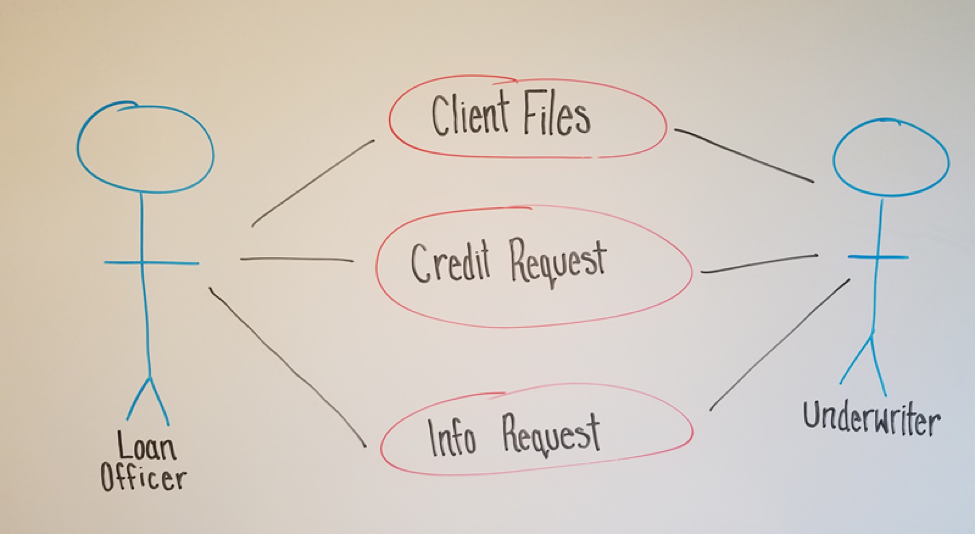
    A common place to start is a UseCase Diagram like the one below.

    The diagram shows a few key points of data:
    • There are two types of employees (actors) that are involved: a Loan Officer and an Underwriter
    • The Loan Officer and the Underwriter interact with three business elements: Client Files, Credit Requests, Requested Information

    This diagram might not seem very useful to those outside of the discussion, but it is the first step to creating more in-depth and useful diagrams.

    Activity Diagram

    A logical and easy step from a UseCase Diagram is an Activity Diagram. It takes many of the same concepts and expands them to a step-by-step order of procedures, which are established by discussion of current procedures as well as compliance and regulatory needs.

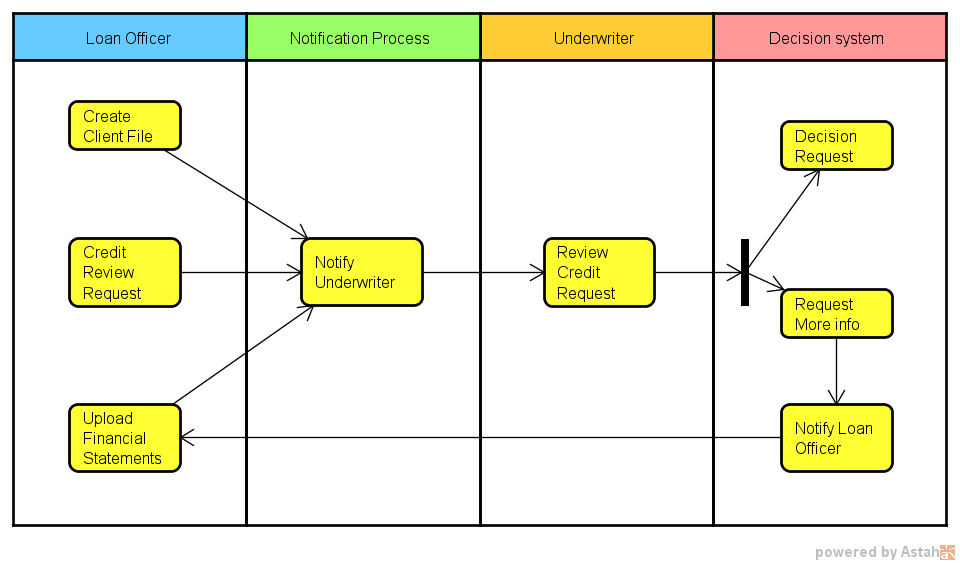
    By partitioning procedures into vertical “swim lanes” we now have an order to the processes as well as who or what is responsible for it.
    The first partition, labeled Loan Officer, shows three processes (Create a Client File, Create a Credit Request, and Upload Financial Statements) that they are responsible for before the system can do anything. All three pieces must be present before moving beyond this first position.

    Once those items are taken care of, the system then notifies the second Actor, the Underwriter, that there is a credit review for him or her to perform as well as where to locate the needed data.

    The Underwriter then decides whether the loan is approved. Whether this is a semi-automated process or done entirely by humans is beyond the scope of this diagram; all we need to know is that a decision happens next. What we can see is that the Underwriter has two options. He or she can:

    1. Decide on the loan (approve or deny—again, beyond the scope), at which case the system takes over from there.
    2. Request more information from the Loan Officer (perhaps the wrong files were uploaded or more data from the client is needed). The system would then notify the Loan Officer and the process starts over.

    Activity Diagrams are useful for documentation because they start to add structure to the overall business process. They also start to define which processes are:

    • Managed by humans
    • Managed by the application being developed
    • Represent a system that the application will interact with, and operations will need to secure

    Even if not 100 percent technically correct (as our sample isn’t entirely correct), they still represent information in a meaningful way that anyone with little or no guidance can understand.

    Data Flow Diagram

    With Data Flow Diagrams (DFD) the diagrams start to map out the system and procedures that happen and the flow of data. DFDs, which are more involved than the other diagrams so far, become keenly useful in showing how different processes interact. Even though DFDs become more detailed as more layers are added, they are still understandable and explainable to any member of the modeling team no matter the background.

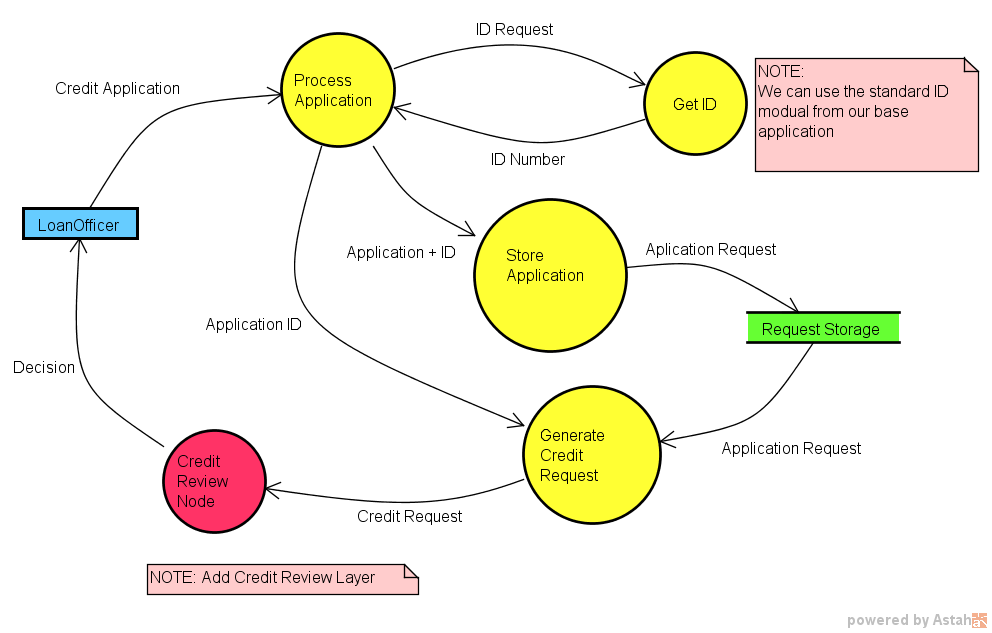
    Operations teams often find them helpful since they map out when sensitive data may be accessed or stored. In our example, things such as corporate tax returns will be stored and accessed; there obviously would need to be some security measures implemented to ensure only those with clearance can see them.

    Discussions are key when creating Data Flow Diagrams because it would be very rare for an individual to have all of the knowledge needed to create one without questions and answers. Based on our current diagrams and a few questions such as:

    • Are Client IDs manually created, or is it part of a system?
    • Do requests go to specific people or are they delivered via queue?
    • Is the credit decision part of the original application or saved as a separate file?

    A DFD can be drawn up:

    The DFD may look complex at first, but when taken piece by piece it is quite simple and understandable with very little (if any) explanation. It also can be helpful to the Dev team because it isolates specific processes at a granular level.

    For example, the Dev team may see the process “Get ID,” know that it’s a system process (non-manual) and realize that they already have a module like that in an existing application that they can use for this application.

    Of course, this would be one of many DFDs created during an Application Model, which is another key advantage of using DFDs. Data Flow Diagrams can be layered, starting with a context diagram and working down granularly to the smallest process needed. This layering also naturally helps to break down the application to discreet parts, helping both in creating different parts of the Application Model as well as having natural starting and stopping points for conversations.

    With the idea that there can be many diagrams used during these discussions, it can be useful to use a modeling tool to easily create, edit, layer and store the diagrams for future use.

    Other Diagrams

    Of course, these are only a few diagrams, but they demonstrate how a process of diagramming can be useful to help a modeling team communicate. While a team could start with a Data Flow Diagram, it would be a much more difficult process. However, by walking through a UseCase and an Activity, it becomes easier since it breaks a system down into digestible parts.

    It also provides the modeling team easy-to-understand diagrams when they go back to their business units. They can explain the Application Model and get quality feedback, as well as suggestions to be added into the Model.

    These diagrams also can be helpful for teams as a starting point for documentation. The DFD is a good starting point for:

    • The Development team to create a detailed class and component diagrams that outlines the application architecture.
    • A deployment diagram for Operations to note which data to isolate behind a firewall with limited access.

    While no process of diagramming can create a universal language by itself, diagrams are supremely helpful to create team clarity. They also serve as a memory of Application Model discussion so that human error and memory can be reduced. Last, by helping to eliminate ambiguity among the modeling team, they help drive better communication that is part of the essence of DevOps.

    Note diagrams were created in Astah Professional and used with permission. To learn more about Astah and modeling please visit the company’s website.

    About the Author / Scott Reece

    ReeceScott Reece is a huge fan of the greater visibility and communication enabled by DevOps. As a Friend of Astah Scott has been successfully closing project communication gaps by using models and team building. With more than 10 years of project management experience, Scott currently serves as a Partner Director at Inedo.

  • Backup: Not So Easy in Certain Environments

    Backup: Not So Easy in Certain Environments

    We discussed how backup needs to be reinvented for a new era cloud-native applications, and what you should look for in a modern database backup and recovery solution. But even if you scrap the traditional approach to back up and write scripts to handle the task, backup and recovery of next-generation applications and databases (Apache Cassandra, MongoDB, Amazon DynamoDB, Microsoft DocumentDB, Apache HBase, et al) can be frustratingly difficult. But why is that?

    The short version is this: In an eventually consistent write-anywhere non-relational database architecture, it is almost impossible to capture a consistent state backup. Successful data recovery is even less likely!

    There isn’t just one reason why this is the case. It comes down to the basic nature of a distributed architecture that’s designed to both scale and withstand node failures without downtime. As we’ve highlighted below, there are several challenges from the start that make backing up a distributed architecture difficult:

    • Data is written to an available node. The first landing point for data is not predictable, so there’s no way to catch data as it lands on the node.
    • Then data is replicated to at least one other node before verification. That ensures a valid write, but also immediately creates a copy of the data.
    • … then replicated to one or two more nodes for availability. This happens afterwards, and the same data can get updated in quick succession.
    • … meaning there are three or four copies of data at any time.
    • … and nodes are never immediately consistent.
    • … and backups are hugely inefficient since every replica is copied.
    • And when a node fails, the topology changes mid-flight.

    Theoretically, a good DevOps team might be able to write scripts that will back up the database successfully 80 percent to 90 percent of the time (cases such as multi-node failures, changing topologies, compaction of databases and many more are complex to model, so scripts are difficult to get right).

    Unfortunately, backup is the “easy” part of the equation. Restoring a backup is where it really gets challenging. A successful restore is far more complicated than most people assume. It involves the following steps:

    • Rebuilding the correct topology. Because each node was backed up individually, the database has to be restored to the same topology (six nodes to six nodes, 12 nodes to 12 nodes), etc. This relates to enabling recovery across clouds, test/dev and CI/CD use cases.
    • Waiting for the database to repair and restore itself. The non-relational database architecture can withstand node failures and keep running, but a full restore with data reconciliation will bring back memories of the worst RAID rebuilds on slow drives.
    • Deduplicating multiple inconsistent copies. The backup copy has three or more copies of all data that may be in an inconsistent state. It needs to be deduplicated or reconciled first.
    • But data history isn’t always available. In most distributed architectures, the oplog is a circular buffer that essentially eats itself as it goes! It may not be possible to even recover the necessary log data to reconcile the database.
    • And there’s no reliable way to go back to a point-in-time. Even with the oplog data, it would be very difficult to reconstruct point-in-time data. At best, you’d get a recent, mostly accurate copy of the database.

    In the real world, restores can take days or weeks—if the data can be recovered at all.  But as the recent Gitlab outage shows, it is difficult for even technically savvy organizations to get it right. Human error can be as fatal to a database as a natural disaster if there isn’t a reliable backup and recovery process in place.

    — Shalabh Goyal

  • What Is DORA and Why Should You Care?

    What Is DORA and Why Should You Care?

    Many of you may already know that Gene Kim, Jez Humble and Dr. Nicole Forsgren launched a new company called DORA. DORA stands for DevOps Research and Assessment.

    Some of you probably also know that DORA and the individuals behind it have been providing a lot of the science and analysis behind the State of DevOps survey and report for a number of years now. But beyond the 3 rock star founders, what is DORA really about? What is the business model to generate revenue? I had a chance to sit down with DORA CEO Dr. Nicole Forsgren and find out for myself.

    nicole forsgren DORAI actually caught up with Nicole when she made a pilgrimage to the DevOps Mecca of Miami. Well OK, Miami may not be a DevOps Mecca, but we do have good Cuban food. It was the Cuban food that got her. Over a delicious lunch on Calle Ocho in Little Havana, Nicole explained to me what DORA is all about.

    Dr. Forsgren is CEO of the company and currently wearing multiple hats (you have to love the smell of startup in the morning). Jez Humble is now also full-time with DORA and is working away building out the backend here. Gene is also very involved, but as you can imagine, his time is pretty tight these days.

    DevOps Assessments

    While developing the annual State of DevOps Survey and then analyzing the data is a job in and of itself, that is really just the jumping off point for DORA. By taking the data from something like 25,000 responses over the past years, DORA has been able to create baselines and models from which they can compare how your organization compares to others who have taken the survey. They can pinpoint where you are lacking or not performing up to par, as well as where you are over performing. The entire process is built on rock solid statistical modeling and has already proven itself with several large enterprises.

    DORA’s business is in providing assessments and surveys of organizations to see if you are a high performing IT organization or where you might need help and attention to become even better. When should you consider a DORA assessment?

    Consider a DORA Assessment if you have problems:

    • Improving technology and organizational performance

    • Prioritizing improvement efforts

    • Attracting and retaining talent

    • Establishing your brand as a high-performing organization

    How it works:

    Running a DORA Assessment follows four stages:

    1. Decompose an Organization
      • Identify the Lines of Business and teams to be assessed
    2. Prepare for Assessment
      • Socialize the survey and prepare email distribution lists
    3. Take the Assessment
      • Everyone takes a 15- to 20-min survey
    4. Generate and Deliver Reports
      • Team capabilities and outcomes benchmarked against the organization
      • Team capabilities and outcomes benchmarked against the industry

      • Prioritization analysis, with capabilities arranged by impact to Technology Performance

    As I mentioned earlier, the results have been pretty impressive to date. For good reason too. DORA is sitting on a treasure trove of data and Dr. Forsgren has the chops to perform the analysis that makes it invaluable. With Gene Kim and Jez Humble, this analysis can be and will be turned to helping others improve their business performance by utilizing the insights gleaned from all of that data.

    It is only a matter of time until their benchmarks and modeling become the industry standard.

    But wait. there’s more. Dr. Nicole also told me about some white paper and book projects on the boards at DORA. Again, analyzing the data of all of the State of DevOps reports they are going to shine a light on the ROI of DevOps (I can’t wait for that one), as well as a book by all three DORA co-founders due out this summer further explaining the science and findings behind their research.

    Best of all, because Dr. Forsgren is a PHD professor, most of their work has been collaborated and peer reviewed by some of the leading people in our DevOps community.

    Right now DORA maybe the best kept secret in DevOps, but I suspect before long it will be a household name for those who are striving to be part of high performing IT teams.

    — Alan Shimel

  • DevOps Chat: Why Real Transformation Starts with Culture, Bryson Koehler and Shelbee Smith-Eigenbrode, IBM

    DevOps Chat: Why Real Transformation Starts with Culture, Bryson Koehler and Shelbee Smith-Eigenbrode, IBM

    While culture is of the utmost importance to enable digital transformation, there are many other milestones in a successful DevOps journey. In this DevOps Chat, join Alan Shimel, Editor-in-Chief, DevOps.com, as he hosts Bryson Koehler, GM, Distinguished Engineer and CTO of IBM Watson and Cloud Platform, and Shelbee Smith-Eigenbrode, Senior Software Engineer/IT Architect at IBM.

    Learn about challenges that The Weather Company (TWC) faced during the transition from TWC, to being TWC: an IBM company. Koehler is CTO of IBM’s newly formed Watson and Cloud Platform, as well as GM and distinguished engineer for IBM. Prior to this role, he served as executive vice president, distinguished engineer and CIO/CTO of TWC. He has an extraordinary record of leading significant business transformations and underlying cultural shifts. To do so successfully, Koehler maintains cultural change must first be incited in tech companies at the developer level. While at TWC, Koehler built a DevOps culture and practice that encourages transparency, accountability and collaboration. It is his mission to replicate this model in the transformation of IBM’s culture from a legacy IT enterprise to a true cloud platform company.

    As usual the streaming audio of our conversation is below with the written transcript below that:

    Alan Shimel:                Hi, everyone. This is Alan Shimel, Editor-in-Chief of DevOps.com, here for another DevOps Chat. We have a special edition of DevOps Chat this time and we’re joined by two special guests. First of all, we have Bryson Koehler, GM and Distinguished Engineer and CTO of IBM Watson and Cloud Platform. Bryson, welcome.

    Bryson Koehler:          Thanks so much, great to be here.

    Alan Shimel:                Thank you. And we are lucky to be joined by a DevOps Dozen winner, Shelbee Smith-Eigenbrode of IBM, and also a DevOps.com columnist. Shelbee, thank you for joining us along with Bryson.

    1. Smith-Eigenbrode: Thank you for having us.

    Alan Shimel:                Of course when Shelbee is not writing for DevOps.com, Shelbee is a Senior Software Engineer/IT Architect at IBM.

    Bryson, let’s turn to you first, if it’s okay. First of all, you’re involved with IBM Watson, and I think everyone kind of feels a little bit about Watson like I did about the space program when I was young, which is that’s cool. Everybody wants to be an astronaut and I think everyone can’t wait to see how Watson changes our lives. How did you come to be involved in the Watson program?

    Bryson Koehler:          Well, I was the CTO of the Weather Company prior to the acquisition by IBM. If you think about the Weather Company, the Weather Company really at its core was a decision company. We helped people in businesses make smarter decisions, and we used a lot of machine learning techniques in our weather forecasting and how we looked at creating those inputs into our decision applications, whether those were businesses or consumers. So we’ve been doing that kind of work for quite some time, and if you look at Watson, Watson is a very revolutionary way to look at cognitive learning, machine learning, and augmented intelligence capabilities. So they’re very similar and they go hand-in-hand.

    So when you look at how do we take Watson forward, Watson becomes smarter every day as it ingests more data and it learns more. So the more we can teach Watson and the more we can help Watson learn and become educated, the smarter it will become. So it becomes a data scaling problem, and that was a problem that we had been solving at the Weather Company.

    So I think there was just a very natural marriage between the work that the Weather Company team had been doing, the work that we wanted to do with Watson as we continued to evolve it and its capabilities. So I’ve been honored to have a role with helping Watson move forward now in kind of its next stage of evolution.

    Alan Shimel:                Sure. If you don’t mind, let’s just stay on that one for a while, Bryson, and Shelbee, if you want to add in. This is a fairly new kind of not department, but a fairly new grouping of IBM Watson and Cloud platform. What exactly – I mean it kind of says it for itself, but, Bryson, is there anything special about it that our audience should know about?

    Bryson Koehler:          Yeah. I think it is amazing and really only someone like IBM has the breadth of capabilities to do what we are doing. Bringing together all of the groups around IBM that have been working on cloud native capability, whether it’s in our video team and our storage team, the infrastructure group, Watson, our analytics team, the Weather Company itself, all of these groups were working in and around cloud native capabilities.

    What we have set forth to do is to bring all of those groups together and make sure that as we journey forward that we are building a single unified platform. The view of the Watson and Cloud group together is around a unified platform that’s very developer-friendly, focused on cloud native capabilities, that really enables us to bring to life not just a bunch of piece parts. Right?

    You can go to our competition and you can find ways to get individual services. We offer those, too. But how do we do it in a much richer way? How do we make data less of a conversation around, “Hey, I have some data. I need to store it somewhere,” and how do we bring data to life? How do we take that data and actually treat it as a living, breathing part of the organization, where as we ingest it and as we enrich, and as we use that to create better and smarter signals and capabilities for our applications to learn from, we need to treat all of this as a unified platform, not a set of bespoke capabilities or service offerings.

    So it’s really exciting when you think about bringing together video, for example, as well as then the image and video recognition capabilities that Watson has. So plumbing in the ability to ingest a stream of video or content from images, having Watson natively there to be able to recognize and manipulate and do things, do metadata tagging or additional enrichment of that content as part of literally a pipeline versus it being, “Oh, I’ve got to now reach out over – I’ve ingested the data. Now I’ve got to store the data. Now I need to reach out over here and make another service call. I’ve got to create another application that manages that service call.”

    We’re trying to make the life of the developer easier, and by providing a native platform that is pre-built, pre-plumbed and really focused at incredible data analytics and data management capabilities, I think we have a real differentiator on our hands, and we’re really excited about bringing these teams together to do that.

    Alan Shimel:                Very cool. Shelbee, let me turn a little bit away from the Watson stuff and talk about you recently did a DevOps blog on culture transformation. Interestingly enough, you interviewed Bryson about it. We haven’t really spoken about DevOps and cultural transformation here. I’m interested in why. What made you think Bryson was a cultural transformation kind of dude, for lack of a better word?

    1. Smith-Eigenbrode: First off, let me just say that at the time I reached out to Bryson he was not in my management chain. So it wasn’t a brown-nosing activity at all. I had the opportunity to work within the Weather Company and work with some of the Weather Company employees who are now of course IMB’ers, while working on a project to move an application to the Sun platform and utilize some of the Sun services.

    During my time that I was there and able to work with some of the employees there, I was so impressed with the culture that they had. They had a great balance between agility and time to market, but also having that quality of operational readiness. Of course for me operational readiness has always been key, because I’ve always felt the pain of not having that included upfront.

    Then this was a terrific collaboration with passionate people that were extremely skilled, one, but you could also tell that they actually enjoyed their jobs. They loved what they did. They were extremely willing to help others. It was always very quick to find who was the expert in this area, a very high degree of empowerment as well.

    So being able to see that firsthand, I really wanted to reach out to Bryson, because I know he had led cultural change at the Weather Company, to get his views on how that transformation went, what he did to enable it, and then also how he’s planning to bring that forward into the broader IBM Watson today. He was very willing to help me and provide input. So that was why I reached out.

    Alan Shimel:                Excellent. So now, Bryson, Shelbee has put you on the spot. What are some of your secrets? What’s the secret sauce here? Because that’s probably the single biggest question we get from our audience, which is: how do you do this culture thing? How do you lead the transformation from a cultural perspective? What do you want to tell our audience?

    Bryson Koehler:          I would say, first of all, everybody that recognizes the cultural challenge, they’re definitely on the right track. All of the transformation that a company that I have had the privilege of leading over the years, they are not technical challenges. They’re all people challenges. They’re all cultural challenges. And fundamentally, at the end of the day, the technical success of your strategy, whilst you need a good architecture and you need a good plan, you more than anything need great people and great culture.

    So first, you’ve got to focus on that and you’ve got to spend the time on it. It doesn’t just happen. Everybody spends a lot of time in front of a whiteboard working on their architecture. But how much time do the leaders really spend doing the same thing, but focusing on their people and culture?

    So to me it starts with a very simple premise. I want people to love what they do. I want you to get out of your bed every morning and I want you to love what you do. I want you to be excited about coming into the office. And if you don’t love what you do, then I want to help you go find a different job. Life is too short for any of us not to love what we do.

    We haven’t all won the lottery. We all have to get up and earn a living, so we might as well enjoy it. I think that it sounds simple, but you’ve got to create an environment where people are free to actually love what they do.

    I think understanding the mission is important. Why are we building this? Why is this feature important? Why is this product important? You can find a great mission in just about any industry or any application or any part of the business as to why it’s critically important that the team excel at what they’re doing.

    Then I think you have to allow decision making to be pushed down to people. You need to learn to make very fast decisions. I always tell my team, “If you walk into a meeting and you don’t know who’s making the decisions or what decisions need to be made, you should disband the meeting and just leave.” People get frustrated if there’s just too much time being spent discussing things and not enough action being taken.

    So I look to create an environment where we have high velocity decision making, where we’re willing to take some risks together as a team, where we are passionate and love what we do. It starts with me, it starts with my leadership team, and it starts with the employees. Everybody has a piece and a role to play in bringing all of this together, and you have to work on it every day.

    This is not a, “Hey, we had an offsite and we talked about culture. We had three PowerPoint slides and now we all feel loved.” This is something that every single day we have to lead by example. We have to reinforce the energy and the passion for what we’re doing. We have to enable our leaders to be able to make quick decisions. We have to have the courage to change, and the courage and the guts to admit mistakes and move on from that, and enable the team to feel like they’re in a safe place as long as they’re working hard and loving what they’re doing and passionate about their outcome, that they’re in a safe place.

    I think it takes time to create that environment. It doesn’t happen overnight. I have to reinforce it every day. So you have to have the patience that you’re going through a technical transformation, have the patience to do the cultural transformation, too, realize you’re going to have to repeat the same message a thousand times, over and over again. Over time it begins to stick and over time, as the winds happen, it builds momentum and pretty soon you have a self-fulfilling prophecy, because the team kind of takes care of itself and now you’ve actually created a native culture, that as a new person joins the organization they’re converted to your way of working and they’re converted to a way that you’re proud of.

    Startups have it easy because they start with employee one and then employee two, and the culture is kind of created organically over time. But when you start with large teams of people in a preexisting culture or workplace, or if you’ve brought two companies or teams together that each have their own cultures, you don’t have that luxury to start with a clean sheet of paper. So, honestly, there’s just no substitute to realizing that that is a key part of a leader’s job is to work at that every day.

    Alan Shimel:                Got it. Bryson, you described a situation and I guess your real-life situation is that to the umpteenth degree. Coming from a company like the Weather Company, I think that had under 1,000 employees, right?

    Bryson Koehler:          The Weather Company was just around 1,000 employees, yes.

    Alan Shimel:                And now working even just within a division of IBM, but nevertheless it’s IBM. I forgot – I think it’s 400,000 or some crazy number. How do you take that? How do you scale that? How do you take that philosophy, that cultural mantra and bring that to an organization the size of IBM?

    Bryson Koehler:          Ha. It takes time. There’s no substitute to that. I’m spending my time going around, meeting with as many teams as possible, and still hold to the town halls and still bring people together. Town halls are bigger now than they would have been at the Weather Company, but the Weather Company had offices in Atlanta and Boston and New York and San Francisco.

    The town halls now, we still have them in different parts of the country and different parts of the world. They’re just bigger, but my style and my approach doesn’t change. It is continue to reinforce the journey we’re on, the vision that we have, the reason why our mission is so critically important, the role that each person plays, why we have to do this together as one team to create one platform, not an individual kind of bespoke set of capabilities that everybody has done independently, but how we have to do this together as one IBM Cloud approach.

    I think it resonates with people, but I also don’t think for a second that just because I – last week I was in Germany, and I was in Ireland meeting with teams there. I can’t just check that off my list and say, “Okay, Ireland is good. Germany is good.” I have to continue to reinforce that, help and encourage the teams, get back out there, share the wins, showcase the challenges, and just be very visible and never disappear from those teams.

    I look at is as kind of like a rollercoaster. As those cars are clickety-clacking up the track to get up to the top of the hill, if that chain that was pulling it up to the top broke before the car or the set of cars got enough over the top, it would just roll back down to the station. So if you’re thinking about the organizational change, you’ve got to get enough momentum over the top of the hill, so that if the chain broke the weight would actually carry it down the other side.

    So my job is to continue to push and encourage that change every day, to ensure that, yeah, at the end I do want the momentum of the team to carry it forward on its own, but it doesn’t just happen because you went and had one meeting. This is an ongoing, every day, live this, breathe this and own this. It’s just going to be a constant reinforcement and encouragement to the team that we are serious. We are going to do what we said we were going to do. We are going to have fun and enjoy and love what we do.

    People want to believe that, but I think a lot of times, “I’ve heard that. I’m not really sure if I believe it. Is he serious? Are we really actually going to do what we say we’re going to do? Are we going to follow through or will this too pass?” You have to stick with it, because you don’t want anybody ever doubting or believing that you’re not serious in the mission that you’re one.

    Alan Shimel:                Absolutely. You know, Bryson, you brought up another point earlier on in your last comment, which is I think fostering cultural change and change in general isn’t a hit and run exercise. You can’t stop in, in Ireland or Russia or wherever and say, “Okay. I talked to them and they’re good now. Let me move on. Maybe I’ll stop here next year or whenever.” It’s a constant tendering. It’s like a shepherd and their flock or a farmer and his crops. I think to do it right, these groups and so forth, they do need – not constant attention, but steady attention.

    Bryson Koehler:          I don’t view this as my employees. This is my family. It needs love and encouragement and coaching and guidance and feedback, positive or negative, every day.

    Alan Shimel:                Agreed.

    Bryson Koehler:          That’s why I was saying, to me, we spend so much time as technical leaders working on either architecture or budgets or contracts and all of these kind of gross behind closed doors things, although doing architecture is my fun. But do we spend the same amount of time being leaders to our people and encouraging and growing them? If we spent as much time doing that as we did all of the other things, I think more of our problems would take care of themselves.

    Alan Shimel:                Agreed. Guys, we went way over our 12 to 15 minute time allotment, so we’re going to need to wrap up. But before we do, Bryson, I wanted to ask you my famous closing question. That is: if you had to recommend one book for our audience to read that might help them in their careers or in their life in general, what book would that be?

    Bryson Koehler:          My answer to that might be a little bit old. The back out I think in 2003.

    Alan Shimel:                That’s not old.

    Bryson Koehler:          I’m just not the latest business book of the day. Bob Lutz, who was an executive at many of the auto companies over the years, wrote a book called Guts. It was around the guts and courage of leadership in transformational times in challenging business environments. I still to this day find that to be one of the best books around the type of culture I try to drive in the team. So I would recommend reading Guts by Bob Lutz.

    Alan Shimel:                Got it, excellent book. Well, Bryson Koehler, thank you so much for being this episode’s guest on DevOps Chat. Shelbee, always a pleasure to have you on here as well. We hope to have you both on again in the future.

    You know, we didn’t even mention – Bryson, will you be at InterConnect, IBM InterConnect?

    Bryson Koehler:          I will absolutely be there and I hope that all of your podcast listeners sign up. It’s going to be a really great conference this year, a little bit different than we’ve done it in the past. You’re going to hear, I think, a lot of new messages from IBM and some really exciting positioning of where we’re headed, and how a lot of what we’ve been talking about here at the platform come to life. So you don’t want your audience to miss out on being there. Come to InterConnect in March; it’ll be great.

    Alan Shimel:                Absolutely. And I am doing a panel there on “DevOps: It Takes a Village,” which is very much in line with some of the concepts you’ve been talking about, Bryson.

    Bryson Koehler:          I will come and be in the room with you, and I’ll meet your fans and your audience there. It’ll be great.

    Alan Shimel:                All right. We may drag you onto the panel. Bryson, thanks very much for being with us here today on DevOps Chat. Shelbee, as I said, keep up the great work, and we look for more columns on DevOps.com from you as well.

    But until next time, this is Alan Shimel of DevOps.com. Thanks for listening, everyone, and we’ll speak to you or listen to you all soon.

    — Alan Shimel

  • The State of DevOps Adoption and Trends in 2017

    The State of DevOps Adoption and Trends in 2017

    DevOps has come a long way, and we see a tremendous increase in adoption in the recent years. To outrank your competition and be ahead in the growth curve, it has become an essential element for software-powered organizations. DevOps has taken a center stage in the software development field with no signs of leaving.

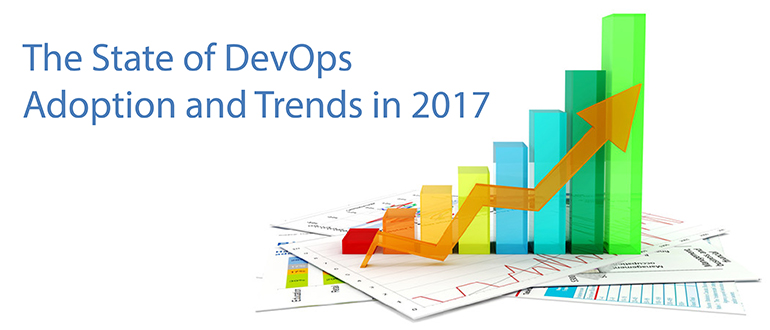
    Below is an infographic of DevOps and some of the trends we see happening this year in DevOps:

    DevOps trends in 2017

    Sources:

    http://www.rightscale.com/blog/cloud-industry-insights/new-devops-trends-2016-state-cloud-survey

    https://www.storybase.com

    slideshare.net

    https://en.wikipedia.org/wiki/DevOps

    Google.com

    7 DevOps Trends

    1. DevOps will be the mainstream and garner a lot of attention; hence, 2017 is going to be the “Year of DevOps.”
    2. Along with DevOps, the three C’s—Continuous Integration, Continuous Deployment, and Continuous Delivery—are going to gain a huge momentum.
    3. A number of new DevOps automation tools will be released that change the way we do software development.
    4. “Containerization” also will be in the limelight.
    5. Many software firms will move to a microservices architecture.
    6. Automation and continuous testing will become more popular—and more important.
    7. Must-have tools and platforms including Docker, AWS, GitHub and JIRA will become even more popular within developer zones.

    The Names to Know

    Below are the names of the top DevOps experts you need to follow:

    Name Twitter Profile Who is He/She Klout Score Website
    patrickdebois https://twitter.com/patrickdebois bridging the gap between creativity and technology with a #devops mindset; eternal researcher and pragmatic implementor; cto @townheroes; started @devopsdays 50 http://www.jedi.be/blog/
    Avi Cavale https://twitter.com/avinci ceo @beshippable, wildlife photographer, scotch lover 50 https://app.shippable.com/
    Kris Buytaert https://twitter.com/krisbuytaert Everything is a Freaky #Devops Needs Sushi Problem, Open Source, Infrastructure as Code, Consultant, Speaker, Author, Organiser of #devopsdays, #cfgmgmtcamp 53 https://about.me/krisbuytaert
    Gene Kim https://twitter.com/realgenekim DevOps enthusiast, The Phoenix Project co-author, Tripwire founder, Visible Ops co-author, IT Ops/Security Researcher, Theory of Constraints Jonah, rabid UX fan 64 http://www.realgenekim.me/
    Jez Humble https://twitter.com/jezhumble Co-author of Continuous Delivery, Lean Enterprise, DevOps Handbook; CTO devops-research.com, lecturer @BerkeleyISchool. PGP: https://keybase.io/jezhumble 63 https://continuousdelivery.com/
    Gareth Rushgrove https://twitter.com/garethr Software developer, occasional sysadmin, general web, programming and technology geek and curator of Devops Weekly. Engineer at @puppetize. @gdsteam alumnus 56 https://www.morethanseven.net/
    Denise Dubie https://twitter.com/ddubie Strategic Content Creator @CAInc, editor/writer/techie focused on App Economy, DevOps, Mobility, ITSec.& Mgmt., Cloud; former Network World/IDG tech journo. 50 https://www.ca.com/us/rewrite.html
    Sanjeev Sharma https://twitter.com/sd_architect #DevOps #Agile #Cloud #TechSales #CTO #Architect #Author – #DevOpsForDummies #Blogger #Inventor #Disruptor #IBM #DistinguishedEngineer. 52 https://sdarchitect.blog/
    Donnie Berkholz https://twitter.com/dberkholz Research director for development, DevOps & IT ops @451Research. PhD biophysicist. Open-source OG. Emerging tech, craft beer, and zeroth-world problems 59 https://451research.com/analyst-team/analyst/Donnie+Berkholz
    Nathen Harvey https://twitter.com/nathenharvey VP, Community Development at Chef 57 http://nathenharvey.com/
    Damon Edwards https://twitter.com/damonedwards DevOps, IT operations, and improving how businesses operate is my thing. Rundeck is where I work. 49 https://www.rundeck.com/

    We hope DevOps will be a rock star in 2017 and continue to rule the software industry.

    — TeamShippable

  • Meet the Citizen Developer

    Meet the Citizen Developer

    Much has been written on the rise of citizen developers, but little about who they are and why they choose to do what they do

    The enterprise is always thirsty for new applications. More than ever, this thirst seems unquenchable. Consider a recent market analysis from Global Market Insights, which expects the enterprise application market to grow at a rate of 7.6 percent annually from 2016 through 2024. That’s a clip swift enough to more than double its 2015 $150 billion market size by 2024.

    The demand for enterprise applications—and especially for mobile apps—is so high that most enterprise IT departments can’t meet it and often have backlogs of months to more than a year.

    We’ve written extensively about how the citizen developer is now stepping up to fill this gap. Citizen developers are helping enterprises to not only close the application demand gap but also innovate more rapidly. However, we haven’t seen much regarding the nature of these citizen developers—who they are and what makes them decide to tackle app development independent of IT.

    Recently, Apple subsidiary FileMaker Inc. surveyed hundreds of citizen developers within organizations ranging from five employees to more than 1,000 employees. Those surveyed either created or were involved in the creation of custom apps, didn’t classify themselves as IT professionals and were not full-time custom app developers.

    As we’ve written before, we consider the rise of the citizen developer to be an extension of the consumerization of the IT trend, which began with endpoint devices, evolved to include many cloud services and now encompasses citizen development. Just as  users began choosing which tablets and smartphones they would use for work, many staff members now are choosing, independently, to shun old-fashioned spreadsheets and endpoint databases for higher-level, cloud-based platforms that make it possible to build applications with little to no coding.

    Why do citizen developers choose to develop work apps on their own? According to the FileMaker survey, it’s because a sizable majority—83 percent—wanted to create a better way to work, while 63 percent wanted to be more productive and 42 percent wanted to help others in their organization. Only 12 percent of citizen developers had been asked by their boss to start building apps. Currently, the citizen developer movement is self-directed and self-motivated—41 percent started developing business apps to improve their skill sets.

    So who are these citizen developers? Not surprisingly, the majority are savvy computer users with no formal background in computer science or software engineering, and 34 percent play a management or supervisory role in their organization. When respondents were asked what three words colleagues would choose to describe them, about half chose “problem solver.” Other descriptors such as “creative,” “hard-working,” “organized” and “leader” also ranked high.

    The citizen developers also reported that citizen development had a significantly positive impact on their career. Nearly half, at 48 percent, cited increased satisfaction at work, while 42 percent found that the practice increased their confidence, 29 percent received more recognition within the organization and had more time to work on efforts they enjoyed, and 26 percent felt increased motivation at work.

    Finally, because citizen developers can spot a business need and fill it quickly with an app, they are helping to fill the application demand gap in many enterprises. Eighty-two percent of citizen developers said they witnessed a reduction in inefficient tasks, 71 percent reported an increase in team productivity, and 60 percent said their apps helped to reduce data entry.

    They’re building these apps quickly, too—often building their first app in less than three months, according to 71 percent of respondents. Only 12 percent reported it taking three to six months to do so. That type of accelerated app delivery—when the idea is conceived, designed, and delivered by the users who needs the functionality—will not only help to clear app backlogs but also could become a cauldron of internal innovation.

    — George V. Hulme

  • Infographic: DevOps Lessons from Lean Auto Manufacturing

    Infographic: DevOps Lessons from Lean Auto Manufacturing

    Lean principles are as relevant to software delivery today as they were to auto manufacturing in the 20th century. And when you apply lean practices to software delivery, you get the same great results — lower costs, faster cycle times and higher quality.
    See the below infographic from Puppet to explore what software can learn from lean auto manufacturing, including the role DevOps practices and continuous delivery play in improving organizational performance, productivity and profitability.


  • The Perfect Combination: Imperative Orchestration, Declarative Automation

    The Perfect Combination: Imperative Orchestration, Declarative Automation

    There are two fundamental approaches of how to design automation processes, declarative (also often known as model) and imperative (also often known as workflow or procedural).

    The purpose of this article is to explain the principles of each, explore a little of how they work, try to highlight some of the strengths and weaknesses and explore how they can be used together. I don’t think one size fits all—based on your requirements and some of what is explored below you may use a combination of the two, even if some of the tooling you use leans toward one way or the other.

    Declarative/Model-Based Automation

    The fundamental of the declarative model is that of desired state. The principle is that we declare, using a model, what a system should look like. The model is “data driven,” which allows data, in the form of attributes or variables, to be injected into the model at runtime to bring it to a desired state. A declarative process should not require the user to be aware of the current state; it will usually bring it to a required state using a concept known as idempotent.

    Idempotent

    What this basically means is that if you deploy version 10 of a component to a development environment and it is currently at version 8, changes 9 and 10 will be applied. If you deploy the same release to a test environment where version 5 is installed, changes 6 through 10 will be applied, and if you deploy it to a production system where it has never been deployed, it will apply changes 1 through 10. Each of the deployment processes brings it to the same state regardless of where they were initially. The user, therefore, does not need to be aware of the current state.

    Maintaining State

    Once we have a model for our infrastructure or applications, any future changes required are made to the model. This means that as a model changes over time—and may have a current, past or future state. This raises the question of how can a model be applied to a target system, how can it know what changes to make? This is not always easy to answer and is not the same for every platform and runtime you are managing.

    State Management

    It’s hard to cover a broad subject like this without making some generalizations—and there are some in this section. There are broadly three methods used to keep an environment or system and its desired state models in line:

    Maintain an inventory of what has been deployed. This where we maintain the state of what has been deployed, and what is in the desired state of a release, and only apply the difference.

    For example:

    1. My release or ‘desired state’ contains database updates: 1.sql, 2.sql, 3.sql, 4.sql, 5.sql
    2. My example test system has had 1.sql, 2.sql, 3.sql already deploy (recorded in my inventory)
    3. Automation determines to only run 4.sql and 5.sql

    Use Case: This type of state management is particularly useful for things such as databases or systems that requires updates from a propriety API where the state of the target cannot always be easily determined.

    Validate/compare the desired state with what has been been deployed. As a simple illustration, we may want to determine if important_file.xml from my desired state deployment exists on the target system and whether it looks the same as the one in my package.

    1. If it doesn’t exist – create it / copy it, etc.
    2. If it does, determine whether it is different
    3. If it is different, how do I update it (converge, copy over, etc.)?

    Use Case: Probably the most widely used implementation is to simply manage the files that many cloud-native runtimes use to store configuration definitions, such as ssh keys for a server or xml files to manage a java runtime such as tomcat. This also can be used to maintain runtimes that are managed via an API; for instance, What is my heap or config item for my WebSphere Server? Is this what it should be? If it is doing nothing, set it to correct desired state value.

    Just make it so. There are occasions when we don’t really care about what exists. The most obvious example here is anything that is stateless, such as a container. There are probably very few example of why you would want to run any automation within a container to change its state; you would just want to instantiate a new one that has the new configuration you require.

    Imperative/Procedural/Workflow-Based Automation

    The fundamental of what often is referred to as workflow, procedural or imperative approach is that a series of actions are executed in a specific order to achieve an outcome. For an application deployment, this is where the process of “how the application needs to be deployed” is defined, and a series of steps in the workflow are executed to deploy the entire application.

    A standard example might include:

    • Some pre-install/validation steps
    • Some install/update steps
    • Finally, some validation to verify what we have automated has worked as expected.

    The often-cited criticism of this approach is that we end up with lots of separate workflows that layer changes onto our infrastructure and applications—and the relationship between these procedures are not maintained. The user, therefore, needs to be aware of the current state of a target before they know which workflow to execute. That means the principle of desired state/idempotent is hard to maintain—and each of the workflows are tightly coupled to the applications.

    The reality here is that the situation is not black and white. Puppet is an example of what is seen as a Declarative automation tool, while Chef is said to be Imperative. Do they both support concepts of desired state and are idempotent? The answer is, of course, Yes. Is it possible to use a workflow tool to design a tightly coupled release that is not idempotent? The answer is, again, yes.

    What are the Benefits of Workflows?

    The benefit of using a workflow is that we are able to define relationship and dependencies for our units of automation—and orchestrate them together. In the example above, we can create a workflow to perform pre-install, installation and post-install steps, perhaps adding additional conditional steps if it’s in a particular environment such as production (disable a monitoring system, additional security configurations, etc.).

    Procedural workflows also allow us to, for example, deploy component A & B on Server1, then deploy component C or Server2 and then continue to deploy D on Server1. This give us much greater control in orchestrating multi-component releases.

    It is often suggested that the choice is between Imperative- and Declarative-Based Deployment. However, these two approaches are not mutually exclusive.

    Workflow for Applications

    One of the issues in the world of DevOps is the lack of a consistent lexicon or terminology. Just ask someone who works in the industry what their definition of an environment is or what the term application means to them. My guess is you will get differing answers.

    To me, an application is made up of components and a release is generally in the form of an application that is created from multiple versioned components. Now, depending on the organization you work in, you may or may not recognize the definition I have given—and if everything in your world is a stateless loosely coupled microservice on a cloud native platform, then this may be the case. If you work  in a more traditional enterprise organization, you will more likely recognize the requirement for multi-component release orchestration, requiring procedural or workflow processes to handle the coordination and dependencies between the different components.

    Model for Components

    When it comes to deploying a specific component, I think it’s hard to argue against the benefits of using a Declarative or model-based approach. The concept of something being Idempotent—I can deploy any version to any target system if it has never been deployed to before, if we want to introduce a new change to an already existing environment or even if we want to roll a unit of automation back—is hard to argue against for its consistency and simplicity.

    Imperative Orchestration & Declarative Automation

    The future of IT Operations is doubtless based on things such as stateless microservices running in fungible containers, using Kubernetes watchers to trigger event-driven automation, much as the future of retail is for Amazon to deliver milk to my IoT-connected refrigerator using a drone.

    That being said, most of us still live in the present and have the need, for some time to come, at least, to address some of the automation and orchestration challenges that exist in today’s IT landscape. With this in mind, a combination of Declarative (or model-driven) units of automation, coordinated by Imperative (or workflow-based) Orchestration can be used to achieve this. An imperative/workflow-based orchestrator also will allow you to executive not only declarative automation, but also autonomous imperative units of automation should you need to.

    My recommendation is that an application workflow defines the order and dependencies of components being deployed. The Declarative Model for a component determines what action needs to be taken to bring a target system into compliance with the model.

    It is hard to underestimate the importance of desired state—it has changed the way we look at system and application updates and drastically improved the visibility, audit and control of IT systems. Any progressive organization looking to move to a continuous delivery/deployment model or implement things such as autoscaling or “deploy and destroy” for development or testing purposes will benefit from the use of declarative/model-based automation.

    However, a model-based approach does not answer all the difficult questions around orchestration. This, in my opinion (for the moment, at least) is best achieved using Imperative, Procedural or Workflows processes.

    About the Author / Dave Sayers

    Dave Sayers is a co-founder and technical services director of MidVision, a provider of Release Automation and Continuous Delivery Software. He works closely with customers and partners on DevOps and Automation initiaitves throughout Europe and North America and is responsible for devising and managing the partner and channel strategy. Connect with him on LinkedIn.