A lot can happen in a second, especially if your business is digital. Google receives 68,000 search requests. Amazon averages $2,361 in sales. In this application-centric world, those are just examples of what application outages can cost the business. Imagine if you didn’t even know there was a problem for just one minute. Sixty seconds of downtime would result in almost 3 million unfulfilled Google search requests and it would cost Amazon about $141,660 in missed sales.
In an economy where consumers will abandon an application in six seconds if the experience isn’t satisfying, shopping carts are routinely deserted for poor performance and brand loyalty depends on immediate gratification, one minute of poor application performance can be disastrous for today’s digitally transformed organizations. Businesses must be able to see how their application (which is essentially their business) performs in real time, by the second.
The Need for Speed in Today’s Modern Applications
Those who code fastest will be the winners in a digitally transformed world. To increase velocity, developers are embracing more modern development methodologies such as Agile and using containers and microservices for their flexibility, scalability and speed. This is having a tremendous effect on the technology makeup of today’s applications and services.
Operations must respond to this development speed revolution, especially when applications are deployed in a containerized environment. Consider this: Within 15 seconds of starting a script, an array of newly created containers can alter (or significantly impact) performance and/or quality of an organization’s applications—and its business. If those applications aren’t monitored within the same realm of speed at which the application is morphing, IT Ops won’t know about problems until unhappy customers start calling—something every business wants to avoid.
Traditional application management products architected for monolithic applications struggle with visibility into modern applications. They also struggle to match the speed of change within the modern dynamic applications that digital businesses are rolling out today. In essence, using a traditional tool to monitor modern applications removes the benefits of a high-velocity development process through the increased risk of insufficient monitoring. High-resolution, time-based metrics (i.e., one-second granularity) are critical to modern application performance management.
This need for one-second visibility actually goes beyond monitoring. Operations teams require feedback whenever a new application component is deployed, whether it’s a long-term server, a short-term container or a change of host. With application changes occurring with increased frequency and regularity, feedback is necessary in seconds, not minutes.
One Second Means Business Success or Failure
For monitoring tools to catch up with development progress and innovation, one-second visibility, or granularity, is essential.
In today’s modern, dynamic application world, where the application is the business and possibly the only direct engagement with customers, one second means everything. It can mean the difference between business success or failure.
The technology that allows developers to deploy applications so quickly is a great advantage, but that same attribute—speed—creates a huge hazard if these more complex applications can’t be adequately monitored and managed. The only way to ensure your IT Ops team—and your business—are protected against application outages is to monitor (and manage) your applications on a second-to-second basis.
About the Author / Mirko Novakovic
Mirko Novakovic is CEO and co-founder of Instana, where he brings deep technological experience with a background that includes performance management software, agile development and DevOps. Prior to Instana, Novakovic founded codecentric AG, a leading software consulting firm focused on performance, agile software development and software architecture. He received a Bachelor of Applied Science in Information Technology at Stuttgart University and an SMB Management at the University of St. Gallen. Connect with him on LinkedIn and follow him on Twitter.
When an organization takes on a new initiative, it typically develops a procedure to optimize execution and limit blowback from the transition. Whether it’s the introduction of new processes, personnel, structures or technologies, there are a number of established ways—often gleaned from experience—to support the individual, the team and the wider organization.
That said, while this procedure may work for one department or team in a certain discipline—say, when marketing invests in a new marketing automation tool—what if the initiative impacts multiple teams, processes, structures and technologies, as it does with enterprise software delivery? A standardized procedure won’t work; there are just too many variables to consider.
And as organizations continue to provide digital services and products for their discerning customers, the number of variables will only increase as enterprises look to ramp up their software delivery to gain a competitive edge in a digital world. How do you manage all this change?
Moreover, what if this change disrupts some of your best teams, many of whom who are fiercely protective of their own unique processes? Much time and thought has been committed to hone a process that is right for them. Who are you to tell them to pull up the floorboards and start again? Sure, the wider organization may want everyone operating from within one end-to-end system, but that’s just not how software delivery works. Nor, for that matter, is it how practitioners think.
You Can’t Please Everyone — or Can You?
Very rarely do practitioners look beyond their core function and specialism, unless it truly impacts their job. For instance, developers want clear requirements to write accurate code that is tested, validated and out the door. They have to write and maintain reams of code, meaning they have little time to think about the rest of the value stream. Typically, if you’re not a business analyst, tester or in ops, then you’re unlikely to be on their radar. They certainly won’t welcome any interruption or change to the way they operate from someone “outside” their world.
This dilemma is exactly why organizations need to think long and hard about how they deal with these differences within software delivery value stream. Not only can practitioners be hostile and resistant to change, but it’s extremely complicated to deconstruct or adjust these processes. They’re highly detailed in practice (although rarely documented due to the frequency with which they’re modified!), covering:
Work items to utilize/prioritize
How backlog items vs. issues are represented on their backlogs
How items flow through day-to-day processes
Whether they use Scrum and/or Kanban
The required information that developers need to submit to management level
The person responsible for submitting certain elements of the management report
When Standardization Isn’t Enough — How to Accommodate the Cowboys
While standardization is possible (and preferred) across organizations, e.g., ITSM for managing multiple systems for multiple functions from one centralized point of control, unifying teams across the software value stream isn’t so simple. There always will be one or two rogue teams that will reject any new process because they know better and only want to do things their tried-and-tested way. We call these teams “cowboy teams.”
Cowboy teams, while problematic, are a force for good as they can be leaders in experimentation and innovation: Consider Alan Turing and his “Enigma” team. Nor are these teams stubborn sticks in the mud. Often it just boils down to the fact that introducing a new process comes with a lot of baggage that people are naturally going to want to avoid, including:
Financial cost (new tools, staff and accompanying training)
Time cost (training etc.)
Reduced productivity during implementation period
No guarantee of success
Potential of negative impact on function
Detrimental influence on employee satisfaction
Unforeseen complications and conflicts such as mismatch with tools used by the team
Last but not least, haphazardly introducing a new process can undermine your software delivery value stream. We know that large-scale software development and delivery requires all teams, tools and disciplines within the value stream to be connected for end-to-end visibility, traceability and governance over the whole process.
And in an ideal world, the process would be underpinned by a single cohesive system. But in reality, this is not the case. Teams work in silos because their purpose-built tools aren’t connected to other stages in the value stream since these tools are unable to automatically flow information between systems. Not only does this state foster siloed thinking, but there always will be one or more teams that will resist any wholesale change to their way of working, even if they’re told it will help the organization meet its business objectives.
Fortunately, there’s a way to unify and connect your value stream while simultaneously accommodating these cowboy teams, and that’s a modular tool chain.
Modularity — The Backbone of Autonomous Teams Functioning Within the Bigger Picture
The software delivery process isn’t a conventional manufacturing process. It’s more like a network of thousands of people with different functions, tools and processes that work on different components of the same project at the same time. And these components simply must communicate in real time to share collaborative data. Supporting such a system is complex, because all the best-of-breed tools for planning, building and delivering software do not naturally integrate—there’s no interconnection, the lifeblood of any network.
However, you can connect these tools via model-based integration through a modular value stream; i.e., not point-to-point integration, but an adaptable, integrated network that communicates through a model in the center of this complex universe. Not only does this account for all different tools, teams, disciplines and processes, but this paradigm enables organizations to plug new elements in and out without disrupting the all-important flow of information across the value stream.
This means any information that is shared throughout the value stream is done so in a normalized format—a common language, if you will—that allows teams to operate in their preferred tool and methodology. For example, if your management wants to know the number of tickets/defects submitted per program during each release, they don’t want to know there were 10 “high priority” ones from one team and 15 “important” from the other team. If “high” and “important” mean the same thing, priorities should be normalized and reported back to the management in a standardized fashion.
Thanks to the automated flow of information into a language everyone understands, the whole value stream, even the cowboys, are on the same page without the need for laborious time-consuming manual forms of communication, such as email threads, status meetings, phone calls, spreadsheets and duplicate data entry. Not only does this improve the working conditions for practitioners, enhancing employee engagement, but it also can save up to $10 million a year in productivity-related savings.
So, the choices for organizations are either to:
Force all teams to use the same system, creating a litany of individual, team and organizational problems due to disruption, or
Use a modular value stream method that maps each team to the standardized model, while at the same time allowing teams to continue working in their preferred system using their carefully devised processes.
Change is constant, inevitable and vital for progression and innovation. At the same time, change can be a threat to those important parts of your business model that are working and delivering business value. With value stream integration, you can have the best of both worlds: Your pioneering cowboys can continue to work in the ways that make them happy and productive, while the rest of the stream can continue to collaborate, evolve and adjust to the fast-paced digital landscape.
About the Author / Mara Puisite
Mara Puisite is a Pre-Sales Engineer at Tasktop, bringing with her years of industry and technical experience. Prior to her current role, Mara worked as a Product Manager running Tasktop’s connector program and managing the development and maintenance of 50+ integration systems. Today, she helps companies solve various bottlenecks in their software development and delivery process through the power of value stream integration. Connect with her on LinkedIn.
“C++ is not only the most powerful language in terms of performance, but it’s also a great language! It has true generics, it is expressive, and one of the most loved languages out there by programmers.”
— Diego Rodriguez-Losada, SW Engineer at JFrog and creator of Conan.io
This very powerful language that has unbeatable performance continues to be used and favored in all industries. However, while DevOps has become pervasive in other major domains of software development such as Java, implementing modern C and C++ DevOps hasn’t been easy, despite solutions out there that can actually help.
Let’s take a look at the challenges C/C++ developers face, and then see how they can be solved.
tl;dr
C and C++ are are favored by many developers for many great reasons. However, implementing modern DevOps and continuous integration in C and C++ projects isn’t easy. It is still challenging due to the nature of the C/C++ programming languages and ecosystem. Today, we have the knowledge and experience to identify the requirements we need to meet today’s DevOps needs for C and C++. And I’ll demonstrate with the below case study that this is possible.
Building C and C++ Projects
Ideally, we want the CI/CD flow from the developer changes to production to be as smooth and fast as possible. However, when compared to other development languages, C/C++ developers face greater challenges:
Long build times: This is not because C and C++ compilers are slow. In fact, they are blazing fast and some of the most advanced and brilliant pieces of technology in the whole IT world. But, C/C++ have the problem of headers and the preprocessor basically copying every included file again and again in each translation unit, bloating the lines of code that they have to compile. There are some mechanisms as pre-compiled headers that can partly alleviate the issue for second and subsequent rebuilds. Also, C/C++ languages are used many times for huge projects compared with other languages, with millions lines of code (MLoc)—a typical AAA game has 20 MLoc.
Diverse platforms and ecosystems, different build systems: C and C++ are ubiquitous. They are used in computers, embedded devices, mobile devices and more. But in every platform they will use different compilers (such as MSVC cl.exe in Windows, GCC in Linux, apple-clang on OSX) and with many different build systems. CMake, MSBuild and Makefiles or autotools are widely used, but companies are also using many other build systems, even developing their own custom solutions.
Binary compatibility: C and C++ are built to native/binary code, but binaries compiled with a certain compiler version are not compatible with other compilers, or even with the same compiler of a different version. This problem is known as ABI (Application Binary Interface) incompatibility, which other languages don’t have to deal with. ABI incompatibilities can result in link errors, which are easy to catch at build time, but oftentimes can produce runtime errors.
Code inlining and embedding: Shared libraries directly embed native code of static libraries they are linking. But not only that, even static libraries might embed code declared in headers from another library. This means it might be necessary to rebuild binary artifacts from source code libraries that have not been modified at all, just because some of its dependencies have changed.
Lack of standard for OSS: OSS libraries can host their source code in GitHub, GitLab or Bitbucket, but that doesn’t make them ready to use. Users need to build binaries from sources (which can be painful), retrieve prebuilt binaries from a system package manager (which may be obsolete and in any case different for each platform) or by using other installers or precompiled modules (which must be downloaded from a website). After that, they typically also require different tweaks to the consumer build system, which is also different for each platform.
Modern DevOps Requirements for C and C++
Given the above list of challenges, what are the modern DevOps practices and tool requirements for C and C++ projects?
Manage and reuse binaries: Building from sources every time is very expensive, error-prone and doesn’t scale for large projects. Reusing binaries should be consistent for different platforms, and deal with the ABI compatibility issues.
Manage all binaries in a single repository or server: Creating and maintaining packages in several systems (such as apt in Debian, rpm in RH, nuget/choco in Windows and pkg in OSX) is very costly for developers or DevOps engineers. Being able to store, manage and retrieve binaries from the same location is a great simplifier of infrastructure and flows, thus a big time saver.
Adapt to any build system, platform and tool, from legacy to latest: Creating good CI and package management would be much simpler if everyone was using a single build system. But thinking projects can migrate to a build system is plainly naive. The cost of migrating some libraries or projects to a new build system is a huge investment that can take months. Processes and tools must be able to adapt to to deal with any build system and existing legacy tool.
Have good integrations with other tools: Not only build systems, but tools must integrate as simply as possible with other kinds of tools. For example, continuous integration platforms such as Travis and Appveyor cloud services for Linux/OSX and Windows, popular for being free for OSS projects, as well as Jenkins, which is the de facto standard in the industry for proprietary code. Also tools must integrate well with popular IDEs such as Visual Studio or XCode and testing, coverage, static analysis, multiple control version systems, etc.
Conan C/C++ Package Manager Case Study
Conan is a free OSS C/C++ package manager. It is decentralized, portable, and multi-platform, running on many operating systems, such as Windows, Linux, Mac, BSD and Solaris, but targeting any possible target of C/C++ applications.
Here’s how Conan addresses the above requirements:
Conan is able to build, upload, and share binaries for any number of different configurations. It manages binaries, retrieving the correct one for each corresponding platform as needed, and is also able to build from sources when necessary, minimizing ABI incompatibility issues.
Conan packages and pre-built binaries can be uploaded to a server and shared within They can be shared privately within a team or companywide, using the OSS conan_server or JFrog Artifactory Pro. If desired, Conan packages can be distributed worldwide using JFrog Bintray either with private or public repositories, completely free for OSS projects. All different binaries for all supported platforms can be uploaded and managed in the same server with exactly the same interface.
Conan works with any build system. It includes built-in integrations with CMake, Visual Studio, Makefiles, SCons, QMake and more. It also has good user-side extensibility to support any other build system, using “generators.” This means extensions can be developed to translate the Conan dependencies model to any build system format and generate files that can be read by those build systems.
Conan integrates well with different CI systems, with specific tools and helpers for Travis, Appveyor and GitLab, and also features custom DSLs in the Jenkins Artifactory Plug-in.
Conan package recipes are written in Python, so they can be used to easily customize behavior to a great extent with standard Python syntax, allowing users to easily plug-in many different tools that were previously mentioned in this article: static analysis, testing, code coverage, and more.
Let’s take a look at a typical flow, from a DevOps perspective, to illustrate how Conan works. First, a developer makes some source code changes to a specific library (LibB), committing and pushing these changes to the shared version control system server (Git Repo).
Diagram: CI Cycle example for C/C++ with Conan, Artifactory and Jenkins (build systems: CMake, VS, MakeFile)
Then the CI system will listen to the Git repository, ideally with Git hooks since polling is not recommended, and fire a job for it (Jenkins). Below is an example of how this would be defined with a Jenkins pipeline:
The first stage in the above example is straightforward. The second stage invokes the package creation that is internally split into the two subtasks:
The LibB dependencies are retrieved in binary form, to avoid rebuilding them from sources and wasting time.
The dependency graph for all transitive dependencies is built and one or more files are written. In this example, LibB uses CMake as the build system and Conan generates a “conanbuildinfo.cmake” file that includes all of the dependencies information to enable LibB find and correctly link to them. Conan will then call the LibB build system to generate a binary package for it. And finally, in the last Jenkinsfile stage “Upload packages,” the generated binary is uploaded to the Conan package server (JFrog Artifactory). The LibB binary package is immediately available for consumption by developers or other CI jobs.
This example illustrates a build configuration for a 32-bit architecture as specified in the “conan create” command with the “-s arch=x86” argument. Note that many additional configurations can be built in parallel using parallel tasks and jobs for different compilers, OS, architectures and more.
Conclusion
C and C++ have extra challenges compared to other programming languages in development. This also makes it more challenging when trying to implement modern DevOps, but not impossible. C/C++ has been overlooked and it’s time we update the tools to meet the needs of developers. What DevOps principles and practices are you implementing with your C/C++ projects?
About the Author / Baruch Sadogursky
Baruch Sadogursky is the Developer Advocate at JFrog. For a living he hangs out with JFrog’s tech leaders, writes code around the JFrog platform and its ecosystem, and then speaks and blogs about it all. He has been doing this for the last dozen years or so, and enjoys every minute of it. He also is a professional conference speaker on DevOps, Java and Groovy topics, and is a regular at the industry’s most prestigious events including JavaOne (where he was awarded a Rock Star award), DockerCon, Devoxx, DevOps Days, OSCON, Qcon and many others. His full speaker history is available on Lanyrd. Follow him on Twitter @jbaruch on Twitter, or read his blogs here and here.
Software is at the core of every modern business, and software-driven companies are disrupting most traditional industries. As the demand for rapid delivery in digital services grows, companies are looking for ways to release products and upgrades in weeks instead of months, or in days instead of weeks. Many DevOps groups are adopting the continuous integration/continuous delivery/continuous deployment cycle of Agile software development to address the high velocity of releases and faster time-to-market requirements. In the CI/CD/CD cycle, developers and testers continuously integrate and test new code, deliver applications and upgrades to production, and from there, deploy them to customers through cloud- or web-based venues.
But in most companies, dev/test teams are dependent on IT and operations (IT Ops) teams to provide the physical and software stacks they need, and IT Ops teams can’t provide developers and testers with infrastructure and applications fast enough to meet the ongoing and relentless pace of the CI/CD/CD cycle.
DevOps Challenges
The most common IT Ops obstacles are long procurement and provisioning cycles, lack of automation and organizational silos.
Long Procurement and Provisioning Cycles: In many software companies, the IT Ops team has a lengthy procurement and provisioning cycle, and developers may have to wait anywhere from several days to a few weeks for IT Ops to handle each request.
Lack of Automation: Developers may be using an outdated IT ticketing system to request infrastructure and software. Each time a developer issues a ticket request, an IT Ops person must follow a certain workflow to fulfill that request, and must complete each step before sending the ticket on to the next IT Ops person in the chain. These workflows often consist of time-consuming manual steps. For example, an IT admin may spend hours manually copying database software from a file server over to the hardware using command line interface (CLI) scripting. The admin must then install and configure the database software and connect it to the network.
Organizational Silos: In large enterprises, individuals or sub-teams fulfill certain tasks for a dev/test request separately from the others. These silos turn IT Ops procurement into a long series of handoffs, where each team member must complete their assigned tasks before handing the job off to another team member.
What’s a company to do? The answer is to implement a self-service, automated private or hybrid cloud. Here are some of the reasons for this approach.
On-Demand, Self-Service Provisioning
Every developer is different, and each should have the power to create their own workspace. A self-service cloud automates the provisioning process by letting developers and testers manage their own initial deployments and configurations. The cloud platform should offer a set of automated provisioning tools to allow developers and testers to create their own dev/test environments. The cloud solution should include both a self-service user interface and an API-driven infrastructure-as-code that lets developers create VMs and databases, access storage, set up network connections, etc., using RESTful API coding.
An Intelligent, Well-Organized User Interface
A self-service cloud should have an intelligent user interface (UI) that gives developers access to a set of common infrastructure tools and applications. Ideally, a self-service UI should allow IT Ops administrators to assign resources in an organized manner. Admins should be able to designate business units (BUs) on the UI (i.e. “AppDevTeam1,” “WebDevTeam1”) based on units within the company, assign team members to BUs, and designate current projects (i.e. “AppDevProject1”) on the UI according to BU. They should also be able to assign quotas to each BU (i.e. AppDevTeam1 gets 100 VMs, 25 vCPU cores, 100GB memory and 400GB storage), and to each individual project (i.e. AppDevProject1 gets 10 VMs, 5 vCPU cores, 8GB memory and 40GB storage).
An Application Store
A self-service private cloud should have an online “application store” that provides single-click access to common tools and services for CI/CD, workload management, middleware and storage back-ends.
Seamless, Two-Way Hybrid Cloud Migration
A self-service hybrid could should have seamless, two-way migration to allow developers and testers who have public cloud access to easily move applications and workloads back and forth between public and private clouds.
Administrative Dashboards
A self-service cloud should have a set of administrative dashboards that allow the IT Ops team to control access to resources on the UI. These dashboards should deliver complete visibility into which teams and team members are using which resources, and allow the IT Ops team to perform admin tasks such as:
Creating user accounts and passwords on the UI
Creating BUs, and projects for each BU, on the UI
Assigning developers and testers as “members” of a certain BU or project
Assigning self-service infrastructure tools (compute, storage, network) on the UI, and set quotas for those tools according to BU or project
Importing new applications to the application store or the UI.
A Software-as-a-Service Platform
A software-as-a-service (SaaS) platform with portal-based access is the best venue for a self-service cloud solution. A SaaS platform offers the flexibility to do upgrades and customization to the various features of the UI, application store and administrative dashboards. The flexibility of the SaaS private-cloud solution gives it the potential to become the de facto standardized platform for CI/CD/CD in Agile software development.
In short, DevOps teams need to keep up the CI/CD/CD pace in a modern enterprise, and self-service cloud platforms offer the self-provisioning and customized workspaces that keep developers productive and happy.
About the Author / Kamesh Pemmaraju
Kamesh Pemmaraju leads product management, product marketing, and technology partnerships at ZeroStack. Kamesh is a seasoned product management/marketing leader with a strong engineering and consulting background. In his most recent product roles at Mirantis and Dell, he focused on delivering private and hybrid cloud solutions to enterprises. He holds a Master of Science in Computer Science from Indian Institute of Science. Connect with him on LinkedIn and Twitter.
It only takes a headline-grabbing mass internet outage or two to drive home the financial and brand incentives of keeping an application up at all times. That’s why in today’s DevOps organizations, incident response is a common topic of conversation.
There’s a lot of talk within the DevOps community about organizational processes and designs for effective incident response such as the Incident Command model, as discussed by our friends from Fastly in this talk. We also frequently discuss technologies and tools for incident response, spanning monitoring, alerting, logging, mitigation and many other focus areas. At NS1, we make use of the Incident Command model and have invested in the usual array of technologies for incident response, along with developing many of our own.
Even after investing significant time considering how to respond to an incident and the budget they allocate for related technologies, it’s still possible for organizations to fail to respond effectively when a real incident arises. As a provider of mission-critical DNS and traffic management services for many of the largest internet properties, we know there’s little room for failure. We’ve learned that augmenting our processes and technologies with three simple practices makes a huge difference in real-world incident response situations.
The Value of a Good Checklist
A good checklist is a favorite tool of mine when it comes to effective incident response. A checklist is a simple, concise, easy-to-understand tool to help an operator recall key steps to take in a particular situation. In an intense incident response scenario, it can be easy for an operator to skip or forget steps in their response. Rather than being overly prescriptive, a checklist’s job is meant to help an experienced professional who is familiar with the systems they’re operating make the best use of their knowledge in a high-pressure situation.
A checklist that I have really come to appreciate doesn’t have anything to do with DevOps or networked systems operations. It is the Cessna 172S Emergency Procedure for engine failure during flight:
In his book, “The Checklist Manifesto,” Atul Gawande discusses this checklist in depth. This example demonstrates some of the key principles behind a good checklist: it’s simple and short, not overly specific or prescriptive; it’s limited to only the most important actions the operator needs to recall during an incident mitigation; and, because of its simplicity and clarity, it helps the operator calmly execute those key actions.
This Cessna checklist offers another great lesson for operators of today’s IT infrastructure. As Gawande writes, “Because pilots sometimes become so desperate trying to restart their engine, so crushed by the cognitive overload of thinking through what could have gone wrong, they forget this most basic task: FLY THE AIRPLANE.” In IT operations, it’s no different—we can sometimes become so distracted by root cause analysis and the desire to know why an incident has occurred that we forget to focus on mitigation first—analysis can come later, once the incident is resolved.
Running Drills
It’s possible to have well-vetted checklists, great tools and technologies and the best organizational models, but they all can be forgotten in an instant of panic if people aren’t used to using them. So, how do we get great at using them all in real-world situations? Through practice.
Any incident response strategy needs to incorporate fire drills because they ensure we regularly exercise our processes, tools and checklists in simulated scenarios that approximate real-world incident response situations. There are a number of ways to create fire drills with respect to networked systems. One tool we often discuss in the technical operations community is one built by Netflix called Chaos Monkey, a software embodiment of what has become an emerging discipline: chaos engineering. It’s a methodology for improving the resilience of a distributed system by creating failure situations—for example, by randomly “breaking” virtual servers in a distributed application to force failure handling systems to engage. This is a kind of “automated” fire drill that drives resilient architecture.
A “war game” that simulates DDoS attack situations is another drill we have benefited from. We build tools similar to those used by sophisticated attackers and regularly exercise our DDoS mitigation response by literally attacking production systems. In this type of fire drill, we split our team into attackers and defenders (similar to the red/blue team approaches used by information security organizations for penetration testing). We’ve learned that running good DDoS war games requires us to attack real systems with real attack techniques, which helps us understand the dynamics of our distributed systems and builds muscle memory in our team around key steps needed to respond to real-world incidents. We’ve also found that fire drills such as these are great tools for team-building; they’re almost like running football or soccer scrimmages at the end of a long practice session, helping everyone on the team understand how they can best contribute and what “position” they should play in a real-world event.
Analyzing After the Fact
Postmortem or retroactive analysis is a final practice for driving effective incident response. After any incident, real or simulated, a thorough review of the incident and the response is critical. Asking and carefully answering some simple questions about the response to the incident is the key: What happened and why? What worked well in our response? How could we have responded more effectively?
The reason to do this type of analysis is to apply learnings from the incident and create a feedback loop, so that in the future, your team’s response to incidents in general—and certainly to similar incidents—is more effective. Obviously, it’s critical to fix any issues that surface during an incident response in your systems, incident response processes and mitigation tools. You should also review relevant checklists after an incident: what was missed, or what was confusing? And finally, feed the outputs of real or simulated incidents into your fire drills so you can practice similar scenarios in the future.
Be Prepared
Like death and taxes, incidents are going to occur. Companies that deliver content or applications in networked systems need to be prepared for them. Best practices such as creating a simple checklist and conducting drills helps a team’s incident responses improve over time, helping to reduce stress during an actual incident and increasing the likelihood of a swift resolution.
About the Author / Kris Beevers
Kris Beevers is founder and CEO of NS1. He is a recognized authority on DNS and global application delivery, and often speaks and writes about building and deploying high performance, at scale, globally distributed internet infrastructure. He holds a PhD in Computer Science from RPI. Prior to founding and leading NS1, he built CDN, cloud, bare metal and other infrastructure products at Voxel, which was acquired by Internap in 2011.
The idea of “full-stack developers” is becoming a fairly common one, although it is still widely contested. But what about full-stack operations?
There are cycles in the IT industry, and if you wait long enough, you can see the same ideas swing in and out of favor. Business applications used to be fairly monolithic, and so it was expected that their programmers would have a good understanding not just of the application’s code and business logic itself, but of its underpinnings as well.
Over time, different parts of those underpinnings were separated, breaking out data silos in a process of modularization. With the increasing complexity of architectures, the expectation became that specialists would be in charge of each module and simply ensure that standard interfaces were available to teams whose modules needed to interact with each other.
While modularization at the architecture level is here to stay, there is now some push back against it being extended too aggressively to the hum
an developers in charge of building the system. This takes the form of a quest for “full-stack developers,” who are able to understand all the nuances of the entire application stack.
There is a similar need on the IT operations side of the house. Different specialized support teams used to be able to focus on one particular area (server, network, database, middleware and so on) and use their own specific tools to analyze and understand the performance of one particular module of a complex enterprise architecture. The assumption was that if each module was up, then ipso facto, the entire stack was up, and therefore the application as a whole was also up.
As it turns out, it’s not that simple.
Let’s Do Some Root-Cause Analysis
These days, failures of business services rarely are caused by a catastrophic outage of one particular component. Hardware is cheap, resiliency is built in and experience from web-scale environments has trickled down to become common best practices. What actually causes problems—such as getting you embarrassing news coverage or angry customers demanding refunds—is the unexpected: many seemingly minor and isolated issues that suddenly add up to a big problem.
When this sort of cascading failure occurs, modular operations teams and processes are not able to cope. Multiple tickets are opened for each affected module and routed to that module’s support queue. Each of those tickets contains only partial information, by definition, and may even describe only a symptom of a failure in another module. Because of this, precious time is wasted diagnosing, reassigning and escalating those tickets, until eventually a complete picture of the actual problem is laboriously assembled.
At this point, representatives of all of the various affected support teams assemble, either in person or on a conference call, and try to determine what to do to restore service as quickly as possible. All too often, these efforts are further delayed by unproductive blamestorming and finger-pointing, but eventually, the issue does get resolved.
Given the complexity of modern-day enterprise architectures, it is impractical for any single IT operations specialist to understand the entire stack in depth, including all the interactions between different modular components. Even if it were possible to do so for a snapshot in time, these days most environments are self-modifying to a greater or lesser degree, provisioning or decommissioning capacity in response to demand, balancing load across available resources and performing routine maintenance tasks. This sort of dynamism is impossible for humans to model accurately in real time.
How Is It Possible To Do Full-Stack Ops?
No single person can be a full-stack ops specialist, but that does not mean that the whole team cannot work to deliver full-stack support. The key is to break down the walls between the different siloed teams supporting each module, and make it easier to build an overall picture of, yes, the full stack that is supporting a particular business service.
This bringing-together must happen in real time, because that is the pace of business today. An outage that has a technical duration measured in a handful of minutes may cause hours-long business repercussions. Ops teams need tools that can relate signals from different modules into a comprehensive picture of what’s going on in the IT environment, proactively inform the right people, and give them the support they need to pool knowledge and work together effectively to resolve the outage and restore service to affected users.
These tools cannot be simple incremental improvements in the monitoring of one particular module, important as that is. The responsiveness that the organization as a whole expects from its IT operations requires that silos be broken down and information and expertise be pooled. Real-time collaboration between specialists in different domains is the only way to deliver truly full-stack operations.
The rapidly maturing discipline of AIOps aims to do just that. The beauty of this approach is that, unlike rip-and-replace approaches in the past where moving to the new thing meant ripping out the old thing, AIOps takes advantage of what was done in the past, simply joining together what were previously disconnected islands of knowledge and making information available when it is needed.
Take a look at some of the players building out these capabilities in the AIOps Market Survey from Gartner. Normally these documents cost $1,295, but you can get it for free courtesy of Moogsoft at this link.
Both development and operations teams are popping up in enterprises all over the world, and even though DevOps programs are still in the early stages, our ultra digital world calls for even more software applications. This is why many analyst and consultants alike believe that, in the near future, DevOps will be even more powerful than legacy IT. DevOps will be something businesses of all sizes will not be able to live without and the sooner you initiate the DevOps transformation, the better.
Why DevOps Transformation?
One of the most exciting aspects of DevOps is enacting technology practices and architecture that help organizations create an agile and continuous product flow, from development to testing, operations and all the way to deployment while increasing stability, reliability and security at the same time.
More importantly, adopting DevOps can enact changes in the culture of your business, such as allowing teams to work more quickly with more independence. Back in the days before DevOps, deploying even a minor update, upgrade or bug fix would involve literally hundreds of developers doing weeks worth of work.
Today’s top-performing businesses and DevOps adopters are deploying much faster, and the products they release generally have greater reliability. Still not convinced that DevOps is the holy grail? Consider the following.
Focus on Speed, Not Cost
Do you want to achieve the same capabilities of Amazon and Netflix? Of course! Who doesn’t? It’s easy to make an excuse that they have a lot of money to spend, but, when we look deeper, companies that achieve DevOps success are more focused on optimizing speed, not cost. Organizing and optimizing for cost creates functional silos for networking and database people, server admins and many others.
When you optimize for speed, you are willing to cultivate talent from within, increase engineers’ salary and send them to conferences. You would not necessarily do these things if you were simply optimizing for cost. There are a whole bunch of techniques we can use to optimize for speed, such as using small, cross-functional teams that can deploy value to the customer independently without having to rely on hundreds or, in some cases, thousands of people.
Best of all, you don’t have to be a big conglomerate to make this transition. Even small and medium-sized businesses can choose to optimize for speed, break down silos and get their product to market faster. After all, this is what DevOps is all about.
Software Speed vs. Quality
Businesses that rely on developing and deploying software to support or supply their customers often are faced with choosing speed or quality. If you go to market before your competitor(s), you could be cutting corners in terms of testing and quality assurance, which can ruin your launch. However, if you wait until your code is perfect, you could end up lagging behind in the race for the next big breakthrough. Fortunately, the DevOps approach can resolve this dilemma while improving the bottom line.
Way back in 2015, the “State of DevOps Report” collected the DevOps health and habits of more than 20,000 tech professionals and found that top performers using DevOps show more agility and reliability in their releases and they were twice more likely than non-DevOps users to exceed productivity goals. In the roughly 800 companies that had a stock ticker symbol, the top performers had an almost 50 percent higher market capitalization growth over three years. This indicates that DevOps is great for IT performance as well as organizational performance.
What everything boils down to is that all modern businesses are increasingly more reliant on technology when it comes to acquiring new customers and bringing value to those customers. It is becoming increasingly apparent that agility and speed are key attributes for companies who want to win in today’s marketplace.
DevOps Transformation Guide
With all of the benefits listed above, you are probably eager to get started with DevOps. Here is a simple step-by-step guide to assist you in your DevOps transformation.
Conduct an Enterprise Readiness Audit – The highest probability of a successful DevOps transformation is when it is championed from the very top. The participation of business leaders is just as vital as operations, security and development teams. To get everyone on the same page and to ensure that your DevOps transformation gets off to a good start, seek assistance from an experienced, external consultant or coach. The purpose of this first step is to get executives to buy in, create mutual goals and get an understanding of what an Agile-DevOps program looks like.
Create a DevOps Center of Excellence (CoE) – One of the most important things you must do here is designate an Executive DevOps lead with enterprise authority. There is no use in creating this Center of Excellence at the incorrect organizational level. It must be spearheaded by someone who has the support and trust from all branches of the organization including delivery and vendors.
Create a Program Governance – Such a program will include creating a communications plan, an enablement program as well as establishing program KPIs. In terms of making a cultural impact on your organization, this is perhaps the most important step. The roles and responsibilities of practitioners will change with Agile and DevOps and it is vital that they understand collaborations between structures where historically animosity could have existed so they can break down these organizational silos. The KPIs will also need to be transitioned from individual metrics to holistic customer business results.
Create a Project Intake Process – Project intake really sets the tone for how successful each new sprint that comes into the program will be. What matters here is not the tools and process, but rather the proper sizing of the tools and process. There is a need to fit for purpose when selecting accelerators, toolchain and development methods. Once it is created, the communication of the intake process needs to be disseminated across the organization. Keep gathering feedback and and continuously evolve and mature based on this feedback.
Identify and Initiate Pilots – To achieve the highest probability of success, apply this step to a specific portfolio of applications or a domain solution. The purpose here is to create a value-stream map of a specific application with company wide participation on all levels. This needs to be done with the necessary amount of detail to identify manual and automated processes, end-to-end process tooling and the people and skills that are involved.
The next aspect of the intake project is the collaboration between the subject matter experts from the Center of Excellence with the project team. The goal is to advise on “to-be” processes with proper tooling, reusable assets and automation. As the application goes through the development and test cycle, be sure to identify and capture the KPIs for the program in order to compare with existing KPIs.
Scale Your DevOps Program – This final step involves taking feedback from the pilot metrics and scaling them by taking different application portfolios and running multiple release trains. It is not enough to merely do automated deployments and daily builds. The last, but by no means least, piece of the DevOps puzzle is constant feedback and optimization.
Key Takeaways
To keep up with top-performing businesses and stay alive in today’s ultra-competitive, fast-paced environment, implementing DevOps is an absolute must. DevOps is not solely reserved for giant enterprises such as Amazon and Netflix and can be implemented in any-size organizations.
In the not too distant future, DevOps will become something businesses of all sizes will not be able to live without. To reap all the benefits DevOps has to offer, the sooner you make the transition to DevOps, the better.
With DevOps, there is no longer a reason to choose between speed and quality when deploying your software. When implemented properly, DevOps will allow you to deploy software with both agility and reliability increasing your customer base and the bottom line.
The step-by-step approach mentioned above can and should be implemented in any flavor and variety that best suits each individual organization’s needs and constraints. Pay particularly close attention to large gaps or excessive deviations as they are red flags which will need to be corrected.
About the Author / Stanislav Ivaschenko
Stanislav Ivaschenko is a certified AWS solutions architect at Squadex with more than 10 years of professional experience in building, delivering, supporting and optimizing a broad range of software applications. From bare metal to the cloud, from monolith architecture to microservices his expertise and experience help to meet business needs for startups, mid-sized companies and large enterprises. He has experienced a large number of DevOps and infrastructure related tools, services and management practices.
Product development programs all start with great optimism regarding their potential to provide an excellent product to customers, along with excellent profits to the company. But researchshows that a majority of product developments end in failure. The reasons for each failure are unique, but the overarching reason often can be described as the lack of systems engineering.
I managed a program several years ago that is a great example of how programs that have an excellent idea, sound technical basis and talented people working on them can still fall into this trap, and how systems engineering and a systems mindset can rescue these programs from the brink of failure and propel them to a successful conclusion.
Here’s the scenario: Scientists working for a Department of Defense electronics supplier devised and patented a method for doubling the frequency range of a radar amplifier in the same physical footprint. Additionally, advances in technology allowed two of the most sensitive components to be replaced by components that were substantially more reliable, increasing the amplifier’s projected life by more than 500 percent. Further, these new components were not destroyed by the absence of a vacuum, allowing easier, faster and cheaper repair of the parts. Funding was secured, and the product development process commenced. The project was not plagued by requirements issues (though many product developments are), as the performance requirements were identical to the product it was replacing, aside from the increase in bandwidth and reliability.
Unfortunately, prototypes were failing to meet the requirements in either bandwidth, power or both. As the program neared the end of its allocated development funding and the pressure on the engineering team increased, each subsequent amplifier prototype was billed as being “full spec,” with multiple changes made in each iteration to meet this promise. Each prototype failed to live up to this billing, and the program was eventually deemed a failure and scheduled for termination.
How did this program devolve to this point? The scientists and engineers involved were brilliant individuals with a history of successful projects and a long list of patents to their names. The requirements were well-understood, and the program had avoided the all-too-common pitfall of neglecting to consider how the piece would fit into the overall system and its effects on upstream and downstream components, overall system power and cooling budgets, etc., which tends to happen in projects run by component designers that focus on the design and capabilities of their particular widget. However, as the program budget and schedule for development was steadily consumed, those involved felt obliged to make each next prototype do everything, rather than taking a deep breath, seeing how far they’d come and how far they had left to go and then creating a road map to get there.
When I was brought in to the program and we had secured some additional development funding, we got down to the business of creating the road map. In addition to the electronics company’s scientists and engineers, we brought in experts from both academia and a federally funded research and development center to review the initial concept and progress to date, determine whether the program had a path forward and, if so, delineate a series of experiments that would culminate in a successful prototype.
Termination of programs is always an option and should not necessarily be viewed as a bad outcome for a program in dire trouble. In evaluating whether it the right move, look beyond the siren call of spent budget, take a stark look at the chances for success and determine if the program or project can still deliver its anticipated benefits. Many programs in trouble attempt to recover by “dumbing down” the requirements; while that may offer an “out” for a development that is in trouble and allow the program to move to the next phase, ask whether continued investment in the system worth the lesser benefits of a product that meets the revised, easier requirements.
After careful review, we determined that the program had a path to success. A series of six prototypes were planned: three experiments to evaluate the performance of individual design changes, a fourth to combine successes from the three experiments, a fifth planned to be production representative/fully specification-compliant and a sixth to show repeatability.
With this new plan in place, the project was able to proceed in a systematic fashion without pressure to produce instant success. Previously, multiple improvement ideas were incorporated into each new prototype with the hope that this would be the full-spec version, and the program could then proceed into production (and the company could reap its financial reward). Experiments were defined up front, and their results were evaluated without the uncertainty of multiple changes masking the successes (or failures) of individual changes.
Success was achieved on the fourth prototype, and the program eventually was successful in creating a significant capability and reliability enhancement for this weapon system. Much of the credit belonged to the hard work and dedication of the engineering leader for the electronics firm (who received its Product Development of the Year award). But even more so, the credit for this dramatic (and very unusual) recovery was earned by the team that had the wherewithal to take a step back and apply basic systems engineering principals to lay out a plan to recover the project from its death spiral.
All too often, companies or program offices bring in a “Cleaner,” but many of these are just tyrants who bully everyone into working long hours, hoping that if you try everything under the sun, something will work. A systems engineer, however, has the composure to take a step back and review, despite the immense schedule pressure. Rather than rushing into the next setback, a systems engineer will look at what the program or project is supposed to accomplish (high-level requirements), review the efforts underway to support those requirements and set a plan with discrete steps and measurable progress points. By not trying to do everything all at once, wherein successes and failures are indistinguishable and possibly masking each other, having a systematic (there’s that word “system” again) approach allows the system engineer to move toward a path that will result in meeting the original requirements.
About the Author/ Jay Schatz
Jay Schatz is senior program manager at Base2 Solutions. He is a high-performing technical project management and program management professional with the breadth of experience that comes from over 22 years of experience managing programs for the aerospace industry and in the US Air Force. Jay is currently providing program management and systems engineering support to the Boeing 787 program, providing expert advice to clients on program management, supplier relations and engineering solutions. Connect with him on LinkedIn.
The story you’re about to read and its recommendations are real; they contrast with what you have heard so far about digital transformation and DevOps implementation. Its objective is to convince you about that the time to go digital is now; it’s about transforming your business, not only IT; and to do it you’ll have to implement DevOps entirely.
In September, Toys R Us, one of the world’s largest toys store chains, filed for bankruptcy protection. A better understanding of how disruption in the retail industry impacted the company would have helped to prevent its downfall and to reinvent its business model. For example, providing Toys 2.0 (a generic term referring to a new generation of toys built on cloud, mobility, IoT and AI technologies) gaming services could have helped the company survive.
Shifting to Toys 2.0 demands a revolution in thinking, vision, practice and value that business leaders, CIOs and IT vendors haven’t done yet. They must forget the obsolete notion that technology and speed determine business success. Adopting paradigms that stress innovation and solve competitive constraints is the safest path toward fast and durable revenue.
The biggest problem Toys R Us faced was the fact that consulting firms and IT vendors either didn’t understand the challenge as an industry disruption issue—or if they did, they improperly addressed it.
Let’s clarify: To tackle your industry’s disruption, you must adapt your business model including the set of interactions, staff and skills, processes and practices, beliefs and values and infrastructure and tools used across your company to generate revenue. Industry disruption is the challenge, and DevOps through its many assets is the unique business capability companies need to quickly transform and win their digital battles.
The problem, as Alan Shimel, founder, CEO and editor in chief of devopsy.kinsta.cloud, puts it:
“While so many companies have already started to use DevOps or planning to use DevOps and related methodologies soon, there is only a small percentage of companies that are end-to-end DevOps. This means there is still tremendous opportunity in bringing DevOps to market.”
How should have Toys R Us leveraged DevOps to tackle its industry’s disruption? Why did investing in that global digital e-commerce platform prove insufficient? How well did they transform their business model? How would have implementing DevOps 100 percent helped to overcome Amazon and Walmart competition?
The principles, ideas, practices and solutions in this article are part of a case study we developed at ITaaSNow to see how to help companies facing similar challenges.
What is DevOps?
Alan, who is a major contributor to DevOps, is right: Only a small percentage of companies have fully adopted it. DevOps is much more than the automation toolchains consultants and vendors talk about. If they want to help lines of business survive and keep their job, CIOs must get a grasp of DevOps’ business facets.
So, what is DevOps? Why do I think, it would have saved Toys R Us from digital downfall?
DevOps Beyond the Operations Automation
From my experience implementing it, DevOps is a business capability that seeks to optimize business operations (versus the sole IT operations). It provides companies with four competitive advantages needed to meet the digital business competitive challenges:
Enterprise collaboration
Business agility
Short time-to-value
Innovation culture
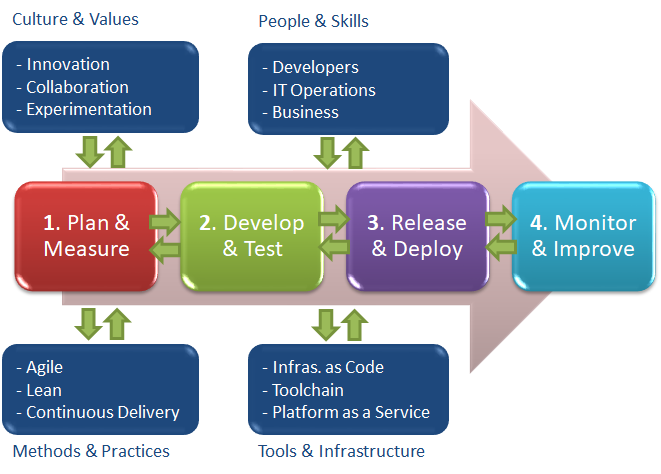
Figure 1 – DevOps Overview
As the picture shows, DevOps is a set of concepts aggregated around the notion of value stream to form a digital business management capability. It’s structured around four stages that format the company’s interactions and workflows into a powerful digital business management capability. These stages include:
Plan & Measure – addresses strategic watch, service prioritization and revenue generation through innovation portfolio management practices and infrastructure.
Develop & Test – takes advantage of agile and lean practices and infrastructure to ensure innovations design, development and testing.
Release & Deploy – leverages continuous delivery practices and infrastructure to timely deliver the right innovations to the right markets.
Monitor & Improve – stresses continuous improvement to guarantee not only premium customer experience but also customer value.
Four business value catalysts are used to act as revenue generators:
Culture & Values
People & Skills
Methods & Practices
Tools & Infrastructure
As you can see, DevOps transcends application development issues; it covers the entire business life cycle.
DevOps Framework as a Facilitator of DevOps Implementation
So, what is a DevOps Implementation framework?
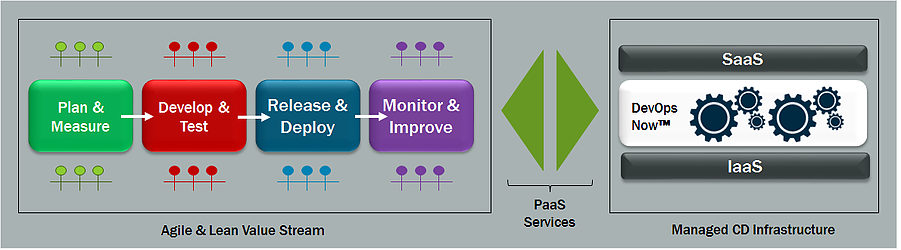
Concretely speaking, it’s a bundled DevOps platform combining managed PaaS infrastructures and optimized value streams to help companies boost their digital business:
Figure 2 – DevOps Implementation Framework
The platform seeks to help businesses implement DevOps end to end and builds on three principles to guarantee digital profits:
Innovation as the revenue driver – It’s the belief that business can resist the competition imposed by technology companies such as Apple, Google, Amazon and Facebook when they use innovation to keep customers loyal, attract new ones and generate revenue.
Value stream agility as the foundation of market responsiveness – It’s the demonstrated notion that companies are market-responsive when they rely on agile and lean value streams.
Managed cloud as the catalyst of business performance – It’s the proven idea that when companies are focused on their core business, they innovate and offer superior customer experience.
The 5-Step Digital Transformation Blueprint
The 5-Step Digital Transformation Blueprint makes DevOps implementation fast and easy. As illustrated, it’s a comprehensive business transformation framework I developed to help clients with their digital transformation initiative:
Figure 3 – The 5-Step Digital Transformation Blueprint
It’s an integrated and inclusive approach to business transformation that involves the company’s relevant contributors. It structures the transformation effort into a five-stage transformation journey:
Digital strategy: In this step, the transformation team uses tools like the SWOT analysis matrix to help business and IT executives understand the changes in the disrupting industry along with the impacts on the company’s business model.
Value stream: In this step, the transformation team uses tools such as the value stream mapping to identify the required changes and get business and IT executives agree on the company’s future value stream. Interactions, staff, skills, processes, practices and tools are at the heart of the discussions.
Digital platform: In this step, enterprise and solution architects work together to identify and implement the technology and tools selected to support activities in the value stream.
Digital organization: In this step, a panel of business and IT users at the operational and executive levels experiment the new digital business model under actual business conditions. The tested digital business model is then deployed as the new digital organization.
Digital business management: In this operation phase, the value stream and the digital infrastructure are extensively used to run the business.
How Chief Digital Officers Set Up Top Digital Businesses
It would be remiss on my part not to recommend the online digital transformation course that gives DevOps practitioners—executive and operational from both the business and IT—the insights about implementing DevOps as the foundation of digital business.
Analyzing Amazon and Walmart Disruptive Impacts to Spot Guidelines for Reinventing the Company
Many bankruptcies happen because business leaders don’t take the time to understand their industry’s disruption and the impacts on their overall business.
The reality on the ground is, industry analyses and competitive strategies are either overlooked or totally ignored. Understanding the toy industry’s disruptive effects would have helped to identify Toys R Us’s transformation as the safest solutions to avoid bankruptcy.
DevOps implementation framework makes the difference, it sees DevOps as the foundation of digital business success. It considers industry and competitive analyses essential steps of the DevOps transformation initiative. Figure 4 outlines the outcomes that resulted from our industry analysis:
Figure 4 – Toy Sector’s SWOT Analysis
As illustrated, it was shown that Toys R Us should have exploited Amazon’s vulnerabilities and take advantage of the technological opportunities to reinvent itself as a Toys 2.0 gaming service provider. These vulnerabilities include little product differentiation while technological opportunities refer to the new toy generation built on cloud, mobile, IoT and AI technologies.
The company’s strengths—reputation, longtime industry presence, brand equity—combined with the cost savings resulting from managed cloud adoption would have not only simplified its transformation but also challenged Amazon on costs.
Changing the Value Stream to Establish Innovation and Invent the Company’s Digital Business Model
Business leaders don’t take the right transformation decisions because they lack insights into the changing competitive environments. Aggressive marketing and sales campaigns supporting short-term financial gains. Toys R Us failed because it bet on its debt reimbursement at the expense of its business model reinvention.
A DevOps implementation offers a value stream mapping framework that not only facilitates innovation culture implementation but also speeds up digital business models development.
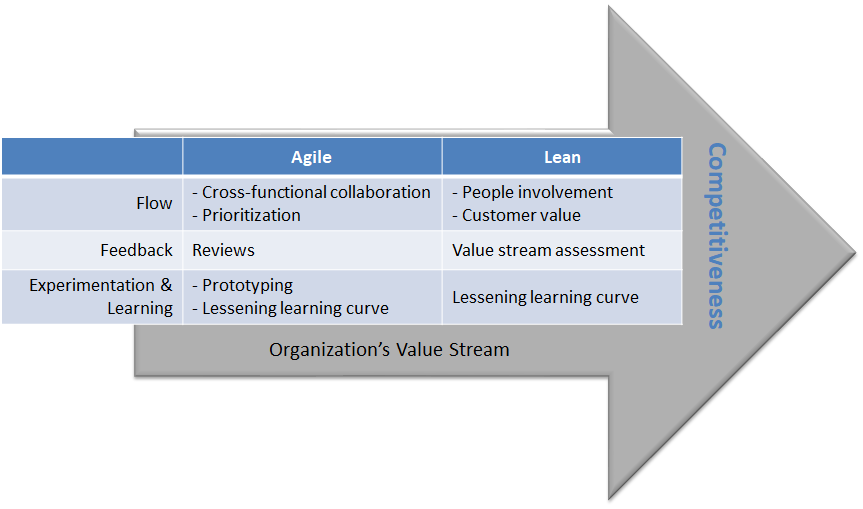
Figure 5 – Value Stream Mapping, Agile, and Lean
The objective of the value stream mapping I performed was to outline the features of work environments that take advantage of DevOps Three Ways to equip the company with the competitive advantages needed to resist Amazon and Walmart. The following lines summarize the outcomes.
Implementing DevOps Flow Principle to Defeat Amazon and Walmart on Innovation: The value stream mapping recommended to leverage Agile and Lean principles to properly implement the flow principle and defeat Amazon on its little product differentiation. The Agile’s features to stress included collaboration and prioritization while focus on people engagement and customer value were the Lean’s benefits to emphasize. Their combination were likely to not only foster innovation culture but also accelerate time-to-market and time-to-value.
Implementing DevOps Feedback Principle to Guarantee Superior Customer Experience: As to the feedback principles, the value stream mapping recommended to use Lean’s value stream assessment and Agile’s review mechanisms. The objective was to institutionalize continuous improvement practices as a means to ensure superior customer experience.
Implementing DevOps Experimentation and Learning as the Foundation of the Innovation Capability: As to the experimentation and learning principle, the recommendation was to take advantage Agile’s prototyping and learning curve-lessening features to institutionalize innovation and risk-taking cultures. They were likely to not only help the company challenge its competitors on innovation but also ensure durable revenue and customer loyalty.
Enabling the Value Streams with Managed PaaS Services
Using technology ingeniously to boost business activities is clearly one of the keys to succeed in the digital business. Today’s DevOps-timid approach focused on speeding up IT operations alone not only is ineffective, but it also doesn’t make sense. It’s the entire value stream that needs optimization, not just IT.
The findings of the digital platform assessment I performed, showed as illustrated, that the global e-commerce platform wasn’t enough to compete against Amazon and Walmart. The company was at the embryonic stage of digital transformation maturity practices:
Figure 6 – Toys R Us Possibly at the Embryonic Stage of Digital Transformation Maturity
The findings suggested that using technology to innovate or creating the operational conditions to cut cost, accelerate time-to-market and be responsive to market opportunities were either overlooked or improperly addressed.
Using a digital platform engineering framework allowed me to design in a record time the following architecture:
Figure 7 – Possible PaaS Platform for Toys R Us
The digital platform would have built on two cloud services supporting the value stream: managed software as a service (SaaS) and platform as a service (PaaS). Let’s discuss them.
How Managed SaaS Services Would Have Helped to Fix the Cost Leadership and Business Agility Issues
SaaS services would have supported the Plan & Measure stage. In addition to supporting varied management activities, it would have provided two fundamental tools that possibly could have enabled the Toys 2.0 strategy: customer relationship management (CRM) and innovation management portfolio. CRM tracks, measures and improves customers’ experience, keeps them loyal and guarantees revenue. Innovation portfolio management identifies innovation ideas, supports their implementation into digital services and monitors generated value. It gives the company opportunities to disrupt and control its industry.
The on-demand and metered billing features of SaaS services would have allowed Toys R Us to get the needed software in record time while enabling time-to-market, time-to-value and responsiveness competitive advantages.
How a Managed PaaS Platform Could Have Helped to Address the Express Delivery Issue
PaaS services would have supported activities covering the Develop & Test, Release & Deploy and Monitor & Improve stages. In addition to providing the technologies needed to implement Toys 2.0 gaming services, it would have built on microservices to set up the automation tool chain and accelerate innovations development and delivery.
Wrapping Up
The recent IT innovations are disrupting several industries and expanding the digital economy. To avoid troubles, businesses must urgently start their digital transformation. Toys R Us, Sears and many others learned it the hard way.
It’s urgent to understand that the digital transformation of your business isn’t only about migrating your IT to the cloud, implementing automation tool chains or deploying artificial intelligence tools across the company. It’s primarily about transforming with a strategic mindset your company’s business model from the ground up.
Digital transformation is a complex process that engages the entire company, and requires specific methodologies, practices and tools. I renew my recommendation to take the online course, “How Chief Digital Officers Course Set Top Digital Businesses“—you’ll get from it the practical vision, approach, processes, practices and tools that’ll help you create the conditions for successful digital business with DevOps.
The new year is upon us, and that can only mean one thing: outrageous tech predictions! This year, we have a few that are easy to believe and a few that are completely off-the-wall. See if you can pick them out.
Serverless Overtakes Containers
Serverless is the future and containers are dead. Some (or maybe even a majority) of the industry will come to realize this. Serverless is largely defined as using functions as a service (FaaS) as the backbone of your architecture. These services are a layer on top of containers that provide an opinionated way to run code that scales with demand and ties true compute usage to costs at sub-second billing increments. Much like virtualization in the data center was dwarfed by cloud providers doing opinionated virtualization a decade ago, serverless offerings will overtake the container market.
DevOps Backlash Gets Loud
DevOps has been happily spreading through the industry as an extension of Agile to the rest of IT. But in 2018, the pushback comes. In the early days of DevOps, there was a movement called “No-Ops.” It was championed by some, but then later, reversed back to DevOps. This year, we will see stories of failed digital transformations and DevOps attempts at conferences across the globe. At first, they will be marked as “not doing DevOps right,” but as more and more happen, they will be branded with the old-new stigma of No-Ops—and they won’t come back.
Chaos Engineering Overtakes the Airwaves
You remember the Chaos Monkey Netflix released to the IT world that captured the hearts and minds of software engineers everywhere? Well, this is the year when chaos reigns! We’ve already had a taste of it through the new open-source project ChaoSlingr on the Modern Security Series show at Signal Sciences, but my guess is that we are far from done. With the release of Nassim Taleb’s book “Antifragile” in 2014, this has been brewing for a few years. Expect to see more chaos-themed engineering books, conference talks and podcasts in the coming year.
Software Flaws Mean Prison Time
Unit testing used to seem like such a good idea, but this year it’s going to become illegal to release software without testing rigor applied. Congress has been on the edge of threatening software accountability legislation for years now, but at this point it looks unavoidable. Will this be the year that a landmark legal battle happens and an engineer who didn’t do proper testing gets thrown in jail? Don’t laugh. We have already seen the first signs of this with the VW diesel scandal; just imagine if it was a pacemaker failure. In 2018, lawyers make the new rules for software engineering.
Promise Theory Finds New Adoption
Mark Burgess brought physics to IT through his groundbreaking book on Promise Theory and its implications for the way our applications and infrastructure will be built over the coming years. Instead of making assertions of obligation from machine to machine, networks will be composed of voluntary agents making promises. At the time it was released, Promise Theory received a lukewarm reception. But with the new services-based architectures such as serverless and even the rise of container orchestration platforms, the industry is now ready to adopt Promise Theory thinking. Networks, applications and systems are already functioning as voluntary agents working together through promises. This year, we will see more and more mainstream adoption of the concepts and more examples of how to get it right. Get ready to learn how systems can be self-organizing.
Application Security Becomes More About the Application
The perennial web application security checklist is to avoid XSS, SQLi and all the rest of the OWASP Top 10. Application security will finally shift from language and framework vulnerabilities to more conversations around how applications are getting attacked. In the new year, the conversation hinges on account takeovers, fraud detection and abuse inside the application. This is good for the industry because we will move past fighting automatic scanning by adding real instrumentation to detect bad actors.
Happy New Year!
The next 12 months are certainly going to be an adventure, and I hope you have a happy new year.

 Mirko Novakovic is CEO and co-founder of Instana, where he brings deep technological experience with a background that includes performance management software, agile development and DevOps. Prior to Instana, Novakovic founded codecentric AG, a leading software consulting firm focused on performance, agile software development and software architecture. He received a Bachelor of Applied Science in Information Technology at Stuttgart University and an SMB Management at the University of St. Gallen. Connect with him on LinkedIn and follow him on Twitter.
 Mara Puisite is a Pre-Sales Engineer at
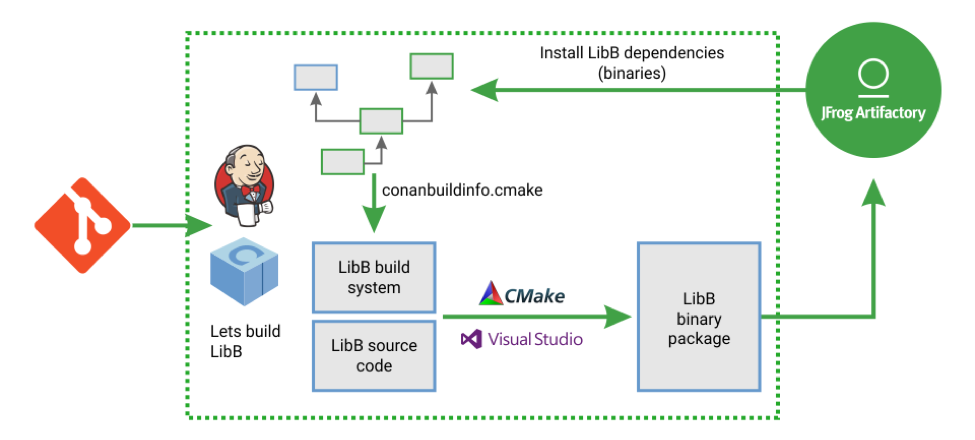 Diagram: CI Cycle example for C/C++ with Conan, Artifactory and Jenkins (build systems: CMake, VS, MakeFile)
 Baruch Sadogursky is the Developer Advocate at JFrog. For a living he hangs out with JFrog’s tech leaders, writes code around the JFrog platform and its ecosystem, and then speaks and blogs about it all. He has been doing this for the last dozen years or so, and enjoys every minute of it. He also is a professional conference speaker on DevOps, Java and Groovy topics, and is a regular at the industry’s most prestigious events including JavaOne (where he was awarded a Rock Star award), DockerCon, Devoxx, DevOps Days, OSCON, Qcon and many others. His full speaker history is available on
 Kamesh Pemmaraju leads product management, product marketing, and technology partnerships at

 Kris Beevers is founder and CEO of



 Stanislav Ivaschenko is a certified AWS solutions architect at
 Jay Schatz is senior program manager at