Category: DevOps Practice

  • Understanding the Mobile DevOps Process

    Understanding the Mobile DevOps Process

    In today’s current technology scenario, mobile app developers are always on the lookout for the latest IT innovations to stay on the competitive edge. To make the process of developing mobile apps more efficient, mobile service providers have adopted mobile DevOps.

    Mobile app development adopts the latest trends, technologies and tools for developing intuitive mobile application across different platforms as well as industry verticals. There are many mobile developers who are experts in the development of hybrid and native mobile applications across the platforms for end-to-end mobility, such as iOS, Android and Windows. Service providers aspire to achieve the business objective of the clients through leveraging people, processes and the latest technology.

    Why Mobile DevOps

    There are so many discussion and articles on mobile app development and how mobile DevOps practices could be integrated, adopted with existing processes and even how to use efficient resources that are beneficial for organizations. However, little has been said about why mobile DevOps could make a difference to companies that strive to enable their IT, development and operations to integrate with business goals.

    DevOps is vital for modern app development and delivery. However, leaders in the mobile application development and IT operations should address the unique collaboration, testing the release and analytics needs of mobile DevOps environments.

    Mobile DevOps for a Mobile Apps Developer

    The mobile DevOps discipline needs important business and technical decisions to be usable and to provide value for organizations. To get all critical pieces together and allow continuous mobile DevOps workflow, potential problems and bottlenecks should be identified. Nevertheless, mobile DevOps has its pros, as well.

    For a mobile developer to win the loyalty of mobile users, it must ship the right applications to the right customer at the right time. One has to continuously ship high-quality software and continuously listen and learn from users, providing them features before they know that they want them. Agile development methods are not enough; to win in mobile application, a developer needs mobile DevOps. It combines great automated tooling with a “continuous everything” culture.

    The Pros of Mobile DevOps

    Mobile DevOps has a number of advantage, including:

    • Shortens release time. DevOps, it’s been said, is about collaboration across teams, something that was not managed properly with the old waterfall practices. Actually, mobile DevOps is more than that. The simplified processes, when operations and development come together, could enable organizations share information between the teams and others and considerably shorten the time from the design-development phase to the actual release. Iterative cycle during development enable more frequent deployment of code, get new regressions tested, verified and released faster than regular phase-by-phase process. Mobile DevOps offer a faster path of fixing occurring problems with the product. Once enhancements and features implemented for each build are done, continuous integration with the right test setup provide a faster solution to problems.
    • Enables creation of better applications. More time spent on making new features, advantages and benefits for users simply are enabling the creation of better user experiences. User experience is the true differentiator today in the competition of the mobile apps popularity. Only those that enable delivery of experiences that users expect could remain in the competition. One of the most important things in doing DevOps is enabling instant feedback and reporting, transparent visibility to development and regression testing is paramount. This provides the mobile team an easy way of troubleshooting issues faster and fix, refactor and optimize user experience.
    • Saves time and make use of efficient resources. Faster features delivery, new build and updates are achieved when operation environments such as development, staging and production are stable and the operating environments work easily for development. This itself makes the whole mobile app development process more productive and helps maximize business advantages. One enabler of mobile DevOps is automation. Automation is available from source code management to testing and development tools and further to actual mobile app monitoring in production.
    • Provides multiple tools options. There are hundreds of thousands of tools that mobile applications are developed with daily. For any kind of feature, there should be a tool that could help build, test and deploy a certain part or feature of the app. Nonetheless, for good reason, some tools are used commonly by the mainstream. Most of the tools used and mobile DevOps processes that establish mobile DevOps core facilitate continuous integration, continuous release as well as continuous deployment. Part of the process is app release automation tools, which help up packaging and deploying app from development to production using automation. These tools help mobile DevOps flow to produce capabilities for implementing continuous delivery for even huge number of releases. Release management tools enable organizations to plan and to execute releases, offer a single collaboration portal for all stakeholders and provide traceability for a release and its components across all the build and delivery pipeline stages.
    • Could dodge inefficiencies and bottlenecks. The major idea behind Mobile DevOps is to make things transparent and efficient, boost internal communication and help in building better products or applications. When mobile DevOps practices, processes and tools are in line, several bottlenecks and inefficiencies could be avoided, such as:
      • Inconsistent development environments
      • Stability and maturity of workflow
      • Manual interventions
      • Lack of operational practices
      • ‘Old way’ and ‘new way’ integration
      • Competing/misaligned procedures and lack of ownership
      • Old-fashioned or manual testing process.

    Mobile DevOps is capable of transforming how an organization handles the development process for the better. It is no wonder  it has become the way of the future for mobile organizations. The DevOps approach principle puts emphasis on people and culture above tools and processes; thus, bringing business owners intimately to the design process can boost the success of the process. Organizations have to embrace a combination of collaboration and integration tools from both parties. Seamless interaction unlocks full benefits of the method and could ultimately contribute to overall business and operational success.

    About the Author / Drumit Shukla

    Dhrumit Shukla has been working as Business Development Manager in a software development company named TatvaSoft since 5 years. He is profoundly skilled and well experienced in providing software development services on various technologies ranging from Microsoft .NET to JAVA, Salesforce, BizTalk, SharePoint, PHP, Open Source, iOS, Android, Pentaho and more. Connect with him on LinkedIn.


  • LightStep Unveils APM for Microservices

    LightStep Unveils APM for Microservices

    Various forms of application performance management (APM) platforms have been around for some time. But with the rise of microservices many IT organizations are discovering that legacy APM platforms were not designed to handle the volume of software modules or the rate at which those modules are updated. But LightStep, a startup founded by former Google employees and flush with an additional $29 million in funding, is positioning itself as the first APM written from the ground up for microservices environments.

    LightStep CEO Ben Sigelman says regardless of where software modules and components get deployed, LightStep [x]PM is capable of monitoring and troubleshooting performance issues across all web and mobile clients, monoliths and microservices.

    Most of the demand for LightStep [x]PM, he says, is being driven primarily by microservices based on containers such as Docker. But the APM platform itself can support both microservices and legacy monolithic applications. That creates an opportunity to rationalize APM platforms as organizations make the shift to microservices while continuing to need to support existing legacy applications running in a production environment, Sigelman says.

    Twilio, Lyft, Yext, GitHub and DigitalOcean are already using LightStep [x]PM, which traces its roots back to Dapper, an always-on distributed tracing system that Sigelman developed at Google in production environments. A decentralized architecture enables LightStep [x]PM to continuously analyze 100 percent of transactions across all services. A statistical engine is then employed to detect anomalies, which the APM can then record and replay as part of an end-to-end tracing capability based on OpenTracing, an open API standard co-created by Sigelman and others that has now become a project administered by the Cloud Native Computing Foundation (CNCF).

    Other capabilities embedded within LightStep [x]PM include support for service mesh and load-balancing technologies such as Envoy, linkerd, nginx and haproxy.

    With every new era of enterprise computing, a contest occurs between startup companies such as LightStep and incumbent providers of technology platforms. LightStep is clearly trying to fill a void before incumbent providers of APM platforms can add support for microservices. Incumbents occasionally rely on their own organic efforts to upgrade their platforms, but more often they buy a startup company and then spend several years trying to unify disparate code bases.

    Of course, there are many organizations that are just beginning their DevOps journey. Many of the them may not have any kind of APM platform in place. Most tend to be cost-sensitive as well, so offerings based on open-source code tend to have greater appeal.

    However the APM wars play out, it’s apparent they are about to enter a new phase. The winners and losers of those wars will be determined by DevOps teams rather than C-level IT executives trying to impose a framework from on high. After all, if IT organizations have learned anything in the last few years, it’s that DevOps tends to have a more lasting impact when it comes from the bottom up.

    — Mike Vizard

  • How Data Drives the Business of a Clean Energy Company

    How Data Drives the Business of a Clean Energy Company

    Imagine using kerosene lanterns to light your way into the evening, at home so you can cook, read, shower and the kids can do homework, or outside to keep a business or medical center open or play night games in a park or field. This is life in undeveloped nations. Not only is the light source insufficient, but burning kerosene is harmful to individual health and pollutes the air.

    These issues are important to the team at BBOXX, a new generation utility company that develops clean renewable solar energy products for developing countries. Its team has developed its own “Battery Box,” a solar-powered battery box that powers lights and appliances for rural Africa—providing clean energy for numerous products and appliances including TVs, lamps and mobile phones and any other item that lights up or needs to be powered.

    BBOXX describes itself as a service company, not a technology company, and as such focuses on being a data-driven company, capturing customer data, analyzing and manipulating it to provide better services and to continue to improve the battery box.  Customer data is critical to its overall success: Knowing how and why customers buy and use the battery, when they use it, length of time … there are a number of data points that help BBOXX understand the customer. In addition, BBOXX needs to monitor the batteries to ensure they’re working properly, help maintain connectivity and disable units, if need be.

    BBOXX’s development team captures data by remotely monitoring units. They are able to access data that is being sent from sensors via a 2G network and through the Amazon Web Services infrastructure into the cloud. Once the raw sensor data is in AWS, it is then stored in a database designed for metrics and events. From here, they are able to analyze it, provide business dashboards, generate predictive maintenance alerts and notifications and predict and find interesting business trends such as energy consumption spikes during soccer events, for example.

    In addition, the team at BBOXX can also correlate and aggregate usage information, which helps them upsell additional power capacity based on upcoming events. For example, a football match between Kenya and Zambia increased demand for more energy to support extended viewing times.

    Becoming a data-driven business meant that BBOXX needed access to real-time data at its core, which had another set of challenges:

    • Securely monitor a distributed set of devices across low bandwidth 2G networks
    • Provide real-time 24-7 monitoring to a distributed team who expects the data to always be right and available
    • Provide the ability to monitor and react to high-speed time-series data
    • Ability to remotely monitor and manage the distributed devices
    • Ability to track usage statistics and bill based on these statistics
    • Proactively monitor units so they could be repaired before the customer lost power
    • Provide insight into customer usage patterns to develop compelling pricing plans
    • Gather, harmonize and use three different sets of data from the various components:
      • Raw telemetry data (voltage, current, temperature)
      • Logs from the box firmware
      • Derived data (power, daily energy usages, state of charge)
    • Lack of staff to manage another solution
    • Keep latency systems at a minimum – their systems were already hosted in AWS and the performance was meeting the needs of the company

    BBOXX is now able to gain insight into its data and apply lessons learned from analyzing past data to develop new and exciting products. The company now uses data stored in a whole new way:

    • Developers ​analyze the data for ways to create new data streams
    • Analysts look for irregularities in usage and write algorithms to detect alerts
    • Business managers look for customer usage patterns
    • Technicians analyze time series voltage and current patterns for remote diagnostics
    • Centralized call center operators reconcile more technical issues for customers by seeing the reason for the outage (hardware failure, over-usage, non-payment)

    In addition, their investors are highly interested in their data collection and analysis as a marker for competitive advantages, reduced delinquencies, growth potential and decreased risk.

    BBOXX uses Amazon Web Services (AWS) to receive store and analyze its steadily increasing portfolio of products. By designing its software architecture with scalability in mind, BBOXX takes advantage of a wide range of AWS’s integrated features including load balancing, auto scaling groups and code deploy to maintain fast, reliable and consistent access both internally and externally.

    Without access to user data, BBOXX would not be able to offer the unique services it does today, which is a fully vertically integrated service, controlling every part of its customer experience.

    About the Author / Mark Herring

    Mark is a zealous marketer who believes that the road to marketing success always leads with the developer. Before InfluxData, Mark was VP of corporate marketing and developer marketing at Hortonworks, SVP of Products at Software AG, VP of Middleware, Java and MySQL Marketing at Sun Microsystems, and VP of Marketing at Forte Software. Earlier in his career, Mark was a developer and technical support engineer for Oracle. Mark holds a B.S. Degree from the University of Witwatersrand, South Africa. Connect with him on LinkedIn and follow him on Twitter.

  • Logz.io Extends Scope of Log Analytics Service

    Logz.io Extends Scope of Log Analytics Service

    Log analytics is all the rage these days among IT and security professionals trying to discover the root cause of any performance issue or security breach. But there’s little consensus about how best to go about analyzing logs. Many IT organizations have made major investments in commercial platforms such as Splunk, while others prefer to rely on the less expensive, open-source tools Elasticsearch, Logstash and Kibana, collectively known as the ELK stack.

    As a provider of a cloud service based on the ELK stack, Logz.io has been providing organizations that prefer to rely on open-source software an alternative to deploying and maintaining their own ELK stack. Now Logz.io is extending that service to include Logz.io Application Insights, which employs machine learning algorithms to create a model of normal IT operations that can be used to more easily identify anomalies, and Logz.io Data Optimizer, which helps identify which logs are worth keeping long-term.

    Fresh off raising an additional $23 million in capital, Logz.io CEO Tomer Levy says his company is building up a pool of machine data to drive advanced analytics fueled by machine learning algorithms. Those insights then can be shared proactively with other Logz.io customers to head off production issues before they even occur. At present, Logz.io has more than 400 customers.

    Levy says the Logz.io Data Optimizer should enable IT organizations to substantially reduce their costs. Most providers of log management tools charge based on the amount of data collected. By helping organizations identify extraneous log data, the cost of implementing analytics of machine data drops considerably, Levy says.

    Logz.io Application Insights, meanwhile, provides a simple way to identify the last changes made to the environment that might have created a performance issue or introduced a security vulnerability.

    Levy says Logz.io, via application programming interfaces (APIs), can be integrated with multiple continuous integration/continuous development (CI/CD) platforms, including Jenkins. In fact, log analytics is now a fundamental element of any mature set of DevOps processes, he notes.

    Platforms for analyzing machine data is one of the fastest growing sectors of enterprise IT. New research from Zion Market Research forecasts that the IT operations analytics market is expected to grow on a 23.7 percent compound annual basis to reach $9.2 billion by 2020.

    Most DevOps issues only take a few minutes to resolve. But identifying the root cause of an issue can take weeks, sometimes even months, to identify. In more advanced IT organizations, centers of excellence around log analytics are now being created to identify not only potential IT and security problems, but also issues impacting, for example, the amount of revenue being generated via a specific application.

    It still may be a while before log analytics become pervasive across the enterprise. But every event in the IT environment generates a log, so the real challenge and opportunity is correlating all those log events into something that manifests itself as a truly actionable intelligence.

    — Mike Vizard

  • Axway Extends API Management Reach

    Axway Extends API Management Reach

    With application programming interfaces playing a larger role in the DevOps environment, Axway has added to its API toolkit for developers. The company expanded its AMPLIFY API management platform to include a visual tool for composing and integrating APIs and enhanced its API Manager tool so that it now can be invoked to scale resources up or down as needed. In addition, Axway unveiled API Central Service that makes it easier to integrate APIs across an ecosystem of organizations that make their services available via the AMPLIFY marketplace.

    Other new capabilities include an open-source MQTT connector for building internet of things (IoT) applications, a connector to the Microsoft Azure Cloud and tighter integration between Axway’s MFT file transfer software and the Syncplicity file synchronization software it acquired earlier this year.

    Axway also merged the Titantium SDK for building native mobile applications using JavaScript into the Core SDK for developers and is previewing the Query Builder Analytics tool, which enables users to do ad hoc query of mobile statistics. The Titanium code is based on technology developed by Appcelerator, which Axway acquired early last year.

    The announcements were made at the recent Axway SPARK 2017 conference. Vince Padua, vice president of platform and products for Axway, says these and other enhancements to the Axway API portfolio are intended to make it easier for organizations to craft microservices spanning multiple platforms. In some instances, those microservices will be crafted by developers, but Axway believes more advanced users will be stitching together microservices on their own using visual tools, says Padua.

    While most early use of APIs was driven by web-based applications facing external users, using APIs to interconnect services inside the enterprise now dwarfs the number of instances of published external APIs, he notes. The proliferation of those APIs has created a significant DevOps challenge for organizations and requires an API management platform to streamline the management of various back-end service. At the same time, Padua notes that DevOps teams working in collaboration with line-of-business units have taken over much of the API management, which previously was left up to individual developers. Now, IT organizations are trying to strike a balance between maintaining control and developer productivity, he says.

    The shift in API management responsibilities has also driven a wave of mergers and acquisitions over the last two years as API management has become embedded in mainstream application development platforms. But there’s also a fierce debate over the degree to which legacy API management platforms can support microservices. As microservices based on emerging technologies such as containers or more mature Java programming tools continue to evolve, API management is becoming more critically important. Each microservice generates its own API that needs to be maintained as each microservice gets continually updated. That requires an API management platform that can support all levels of API call activity that once would have been assumed to be unimaginable.

    — Mike Vizard

  • Core Factors Influencing Java Memory Consumption

    Core Factors Influencing Java Memory Consumption

    Java is known for having an insatiable appetite for resources, requiring strict controls to not exceed budget limits. However, the latest JDK updates and other developments have helped to make Java runtime extremely flexible in terms of memory usage. When configured smartly, Java can be cost-effective for different types of applications—cloud-native or legacy, microservice or monoliths. Today, it’s possible to make Java very slim from the start and scale it up gradually without consuming unnecessary resources.

    Here we’ll take a closer look at the factors influencing resource usage inside JVMs, see what tools can help and how processes can be tuned to gain more elasticity and scalability, ultimately reducing TCO.

    Scaling Possibilities: Virtualization vs. Containerization

    Within JVMs there are several scaling options: vertical, horizontal and a combination of both. To maximize results, it is important to start with a vertical scaling configuration that optimizes RAM and CPU usage inside every instance, based on current load levels. As a next step, these settings will be replicated across all instances while scaling horizontally.

    VMs Scaling

    While starting to run a project inside a VM, it is important to pick the right size machine, as too small an instance can lead to performance issues or even downtimes during load spikes. However, over-allocating will result in wasted unused resources during normal load or idle periods that still must be paid for. This can be a tough choice.

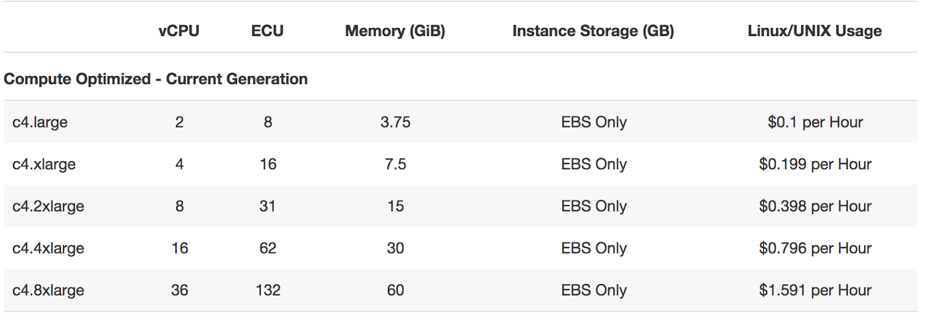
    Start with a smaller VM and scale it as the project grows. When just a bit more resources are required, the cloud vendor can offer you to double the size, as this is the most commonly used scaling step (e.g. see AWS offer below).

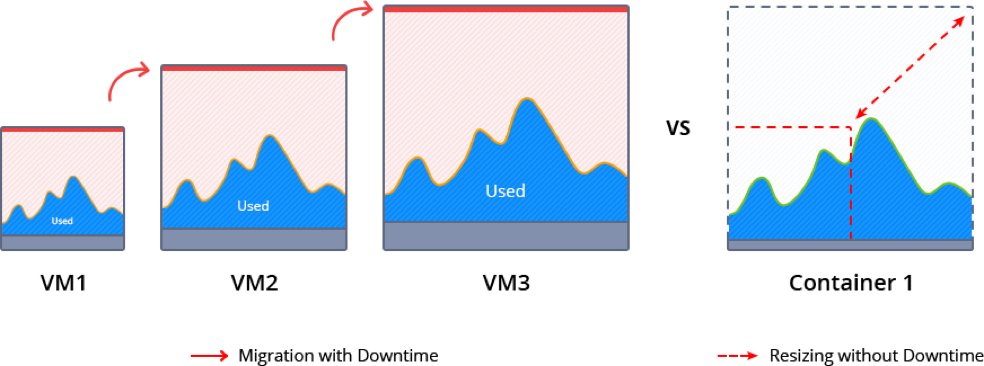
    During such scaling, the current VM normally is paused to migrate and redeploy the application. This inevitably causes some downtime and requires manual intervention.

    Memory ballooning provides a possible way (although rather complicated) to modify the amount of resources inside VMs on the fly without incurring downtime. However, this process is not fully automated and requires special tools to monitor the memory pressure in the host and guest OS and then activate vertical scaling based on the needs. As a result, memory ballooning doesn’t work well in practice, as the memory sharing should be automatic to present the expected advantages.

    Unfortunately, lack of VM elasticity and efficiency in terms of resource usage often leads to overpaying.

    Containers Scaling

    Containerization presents a new way of application packaging that makes resource consumption more granular and flexible, by automatic resource sharing among containers on the same host using cgroups. Unlike VMs, containers’ boundaries can be easily scaled up and down without the need to pause and reboot running instances.

    There are two types of containers: application and system containers. Both use the same scaling approach but they are intended for different purposes. An application container (such as Docker or rkt) typically is more lightweight, runs a single process and is used mainly for creating new projects, as it is easy to build them from pre-existing Docker image templates.

    A system container (LXD, OpenVZ) behaves like a full OS and can run full-featured init systems. This type of container is preferable for monolithic and legacy applications, as it can reuse the originally created design and important “old school” settings.

    Even system containers are much thinner compared to virtual machines, so scaling up and down takes much less time. And the horizontal scaling process is very granular and smooth, as a container can be easily provisioned from scratch or cloned.

    Garbage Collector Choice

    To maximize the efficiency of the above mentioned vertical scaling inside a Java-based container, it is important to select the appropriate garbage collector (GC) and tune it according to the project needs.

    Let’s review five widely used garbage collector solutions:

    • G1: From JDK 9, this modern shrinking garbage collector is enabled by default. One of its main benefits is the ability to compact free memory space without lengthy pause times and uncommit unused heaps. This GC is considered the best production-ready option for vertical scaling.
    • Parallel: A default GC in JDK8, it is a good option for low pauses but not for memory shrinking. This makes it inappropriate for flexible vertical scaling.
    • Serial, ConcMarkSweep (CMS): Both of these are shrinking garbage collectors with the ability to scale memory usage in JVMs vertically. But in comparison to G1, they require four Full GC cycles to release all unused resources. A new JVM option (-XX:-ShrinkHeapInSteps) in JDK 9 can  speed up memory release by bringing down committed RAM right after the first Full GC cycle.
    • Shenandoah: Shenandoah is a rising star among garbage collectors which promises to be the best solution for JVM vertical scaling. Its main benefit over the others is the ability to shrink in live mode without necessity to call Full GC, which helps eliminate significant performance degradation.

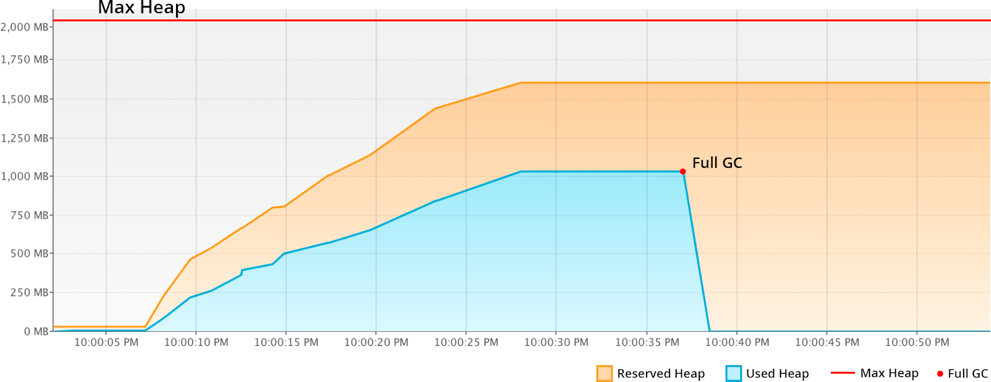
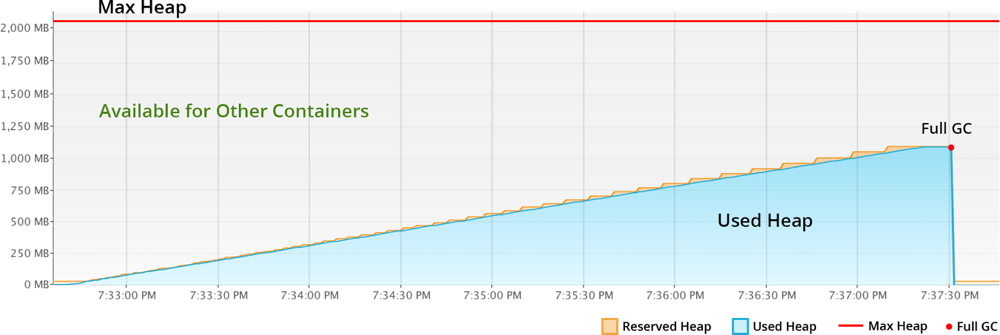
    Let’s compare memory behavior with shrinking G1 and non-shrinking Parallel:

    With Parallel, the unused RAM is not released back to OS. JVM keeps it forever, even disregarding the explicit Full GC calls. So even if your application has low RAM consumption, the unused resources cannot be shared with other processes or other containers as it’s fully allocated to the JVM.

    The modern shrinking G1 garbage collector significantly improves resource utilization compared to the previous example. The reserved RAM increases slowly according to the real usage growth. And all unused resources within the Max Heap limits are not wasted by standing idle, but made available to other containers or processes running in the same host.

    To summarize, Java applications with non-shrinking GC or non-optimal JVM start options hold all allocated RAM. For scaling Java vertically, the garbage collector should provide memory shrinking in runtime. In other words, it has to package all the live objects together, remove garbage objects, uncommit and release unused memory back to the operation system.

    Charging Model of Cloud Providers

    Nowadays, most of the cloud vendors offer a “pay as you go” billing model. This means that it is possible to start with a smaller machine and then add more servers or migrate to a twice-bigger instance as the project grows. But as described above, usually you reserve more than the application actually consumes to avoid the risk of downtime during the load spikes. As a result, many organizations overpay because the account is charged per VM but not based on the consumed resources inside.

    At the same time, there are providers offering  “pay as you use” billing approaches that became possible with the help of containerization, resource granularity and automatic vertical scaling. The payment is based on the resource units inside container. And the required capacity is provided and reclaimed on the fly in accordance with the load at the current moment. As a result, you are charged based on actual consumption and are not required to make complex reconfigurations to scale up or down.

    Taking into consideration all these factors and implementing the right settings can significantly reduce the costs for Java hosting resources, as well as positively influence application performance as a whole. Cloud and container technologies continue eliminating barriers and offering new opportunities for projects with different architectures and budgets.

    About the Author / Ruslan Synytsky

    Ruslan Synytsky is CEO and co-founder of Jelastic. He designed the core technology of the multilingual cloud platform that runs thousands of containers in a wide range of data centers worldwide. Ruslan worked on building highly available clustered solutions, as well as enhancements of automatic vertical scaling and horizontal scaling methods for legacy and microservice applications in the cloud. Ruslan is actively involved in various conferences for developers, hosting providers, integrators and enterprises. Follow him on Twitter.


  • Cuba Embraces DevOps, Despite Infrastructure Challenges

    Cuba Embraces DevOps, Despite Infrastructure Challenges

    A few weeks ago I had the pleasure of speaking at the second DevOpsDays event in Cuba alongside some great technologists from across the United States, Europe and Latin America. The conference was held in a beautiful hotel in Varadero overlooking a marina right by the beach. Varadero is approximately two hours by car from Havana.

    The first thing I noticed is that Cuba is full of anachronisms. This became evident as soon as I walked out of Havana Airport and realized that the whole “they have some old cars” thing was real. It was fascinating to see that every single car was pre-1950s, some perfectly maintained with great paint jobs and others in worse condition yet still capable of doing their core job as a mode of transport.

    Talking technology in Cuba was eye-opening, to say the least. Do not expect to have 3G or 4G data on your cellphone. Do not expect to have WiFi in most hotels (you can purchase prepaid internet credit, but the speed will be slower than what you are used to) and definitely do not expect to have WiFi in a private home. These are luxuries.

    But here’s the surprising part: There are companies in Cuba with fully automated CI/CD pipelines achieving 10 to 12 deployments per day and solving real problems, such as the team working under Anesto del Toro at Datys. Cuba even has its very own Docker Captain, who gave a superb demonstration on the value of Docker in front of the DevOpsDays audience.

    Now let me remind you, these guys are not working with stable internet connections and they manage to get the job done on a daily basis.

    Why am I Rambling on About Cuba?

    Engineering is about solving problems. No matter how big or small, it’s about looking at a problem and finding the solution. Now, this is part of Cuban life. If something is broken, they don’t throw it in the trash and buy a new one; they fix it. Their 80-year-old car breaks down two hours outside of town? They get out of the car to fix it and—take my word for this—their friends, family and neighbors will come outside to fix the problem, too. This creates a mindset of solving the problem at hand without fail. This is easily demonstrated when you talk to Cubans about software development: They won’t say they are a Python engineer, a Java engineer or any other choice of language—they are software engineers who understand how development works as a whole. They will use the language required to get the job done to the highest standard.

    Like everywhere else in the world, there were huge differences in levels of DevOps adoption between the various organizations in the country. In contrast to the companies mentioned earlier, there also are organizations that have only just heard of these methodologies or are now considering setting up their first CI pipelines. Like many of us, they are still figuring out how to solve their technical debt and modernize their IT Infrastructure, but the key point is that the stakeholders, C-level executives, junior engineers and everyone else in between want to learn. They are open-minded to the principles of DevOps. Every person in the room at DevOpsDays Cuba was focused and listening to what we had to say. This excited me as a speaker and everyone else in attendance. We could see people who really did want to change and transform the cultures within their technology teams and overall businesses to start adopting these modern and proven practices.

    The journey ahead is a long one. The infrastructure challenges remain in place and there is much to be learned, but it was great to see such positive energy and eagerness to adapt. I want to thank everyone who attended DevOpsDays Cuba for making it such an amazing experience. An even bigger thanks to the organizers Enrique Carbonell, Rudy Gevaert, Yadier Perdemo, Manuel Oliver, Mike Rosado, Manuel Morejon and anyone I’ve missed. The event couldn’t have been better and it was a genuine pleasure to visit Cuba, I hope to return soon and reconnect with as many of you as possible!

    About the Author / Conor Delanbanque

    conordelanbanque

    Conor Delanbanque has been recruiting and leading recruitment teams in the DevOps space for the past few years. As well as being exclusively responsible for growing some of the most innovative DevOps & SRE teams in the US and Europe as an external consultant and recruiting partner, Conor also founded the Future of DevOps Thought Leaders Debate, sponsors DockerNYC Meetup on a regular basis and co-hosts ServerlessNYC. You can tweet him at @ConorDevOps, find him on LinkedIn or at events, expos and writing articles on devopsy.kinsta.cloud.

  • IPsoft’s 1Desk Advances AI Labor Force Reality

    IPsoft’s 1Desk Advances AI Labor Force Reality

    IPsoft wants to put a digital face on the future of IT operations that will be infused by artificial intelligence (AI). Its recently launched 1Desk service desk combines the Amelia digital assistant with IPsoft’s Apollo virtual engineer technology to automate multiple backend processes.

    Allan Anderson, director of enterprise solutions for IPsoft, says 1Desk effectively combines two longstanding areas of IPsoft research to provide IT organization with an ability to manage IT at scale using digital personal assistants and virtual engineers.

    IPsoft has been providing managed services based on its Apollo AI framework for several years. The launch of 1Desk creates an opportunity for IT organizations to not only employ that AI framework on their own, but also combine it with a digital assistant technology christened Amelia that IPsoft has trained to handle a variety of technology and business process requests.

    Anderson says the virtual engineer AI technology developed by IPsoft make use of machine learning algorithms to continually monitor how humans complete a task. Armed with that data, those virtual engineers can then incorporate that information into their knowledge base to learn a process or fine-tune an existing one.

    A continuing shortage of IT skills in key areas is significantly reducing resistance to AI technologies being applied inside IT organizations—AI technologies may enable organizations of almost any size to operate IT environments at unprecedented levels of scale while minimizing human errors. IPsoft, says Anderson, expects virtual engineers to be employed as a digital labor force capable of performing tasks such as identifying and killing a long-running query to configuring and executing runbooks across the most complicated data center environments. To facilitate the automation of the those processes, IPsoft has developed a Digital Labor Studio tool that organizations can use to create and train a virtual agent.

    There’s no doubt that many of the tasks associated with managing an IT environment are repetitive. In fact, any repetitive IT task is arguably a ripe candidate for automation. How those advances will impact DevOps processes remains to be seen. It’s not difficult to imagine that each development team will be assigned its own digital assistant. The role of the IT operations staff then would evolve into one where a smaller group of people train and manage a pool of digital labor.

    IT professionals are generally used to the idea that IT will be used to automate a task that used to be part of someone else’s job. But now IT is being used to automate many of the tasks performed by IT professionals. It may take some time for them to first accept that idea and then evolve their skills accordingly. There will also be a need for some level of human involvement when it comes to IT. But instead of thinking in terms of managers and administrators, perhaps the brave new world will be one where everyone in IT is now the manager of their own digital force of labor.

    — Mike Vizard

  • The DevOps Cha-Cha from DOES San Francisco

    The DevOps Cha-Cha from DOES San Francisco

    DevOps Cha-ChaThe 4th annual DevOps Enterprise Summit (DOES) in San Francisco this week was, in my opinion, the best one yet. Lots to report about, but I wanted to call out a new trend I am seeing that I call the DevOps Cha-Cha. You remember the Cha-Cha: three steps forward, two steps back, cha-cha-cha. Actually besides being a great dance with the right beat, that same three-steps forward, two-steps back is about what you would expect from large enterprises that are undertaking profound digital transformations.

    I say that this is normal because, despite all the great firsthand accounts of DevOps transformations on display at DOES this week, there was a bit of a whispered undercurrent. More than several people I spoke to talked about the fact that “this DevOps thing isn’t that easy.” Others spoke about the large number of “failed DevOps transformations or implementations.” Obviously, as the editor in chief of devopsy.kinsta.cloud, I might have a skewed view of this, but let me put in my 2 cents and then some on this subject.

    DevOps Transformations Are Not Easy

    First of all, no one ever said DevOps transformations would be easy. I’m not sure why anyone would even think that. Changing cultures can be gut-wrenching. Sometimes it means replacing people who just can’t wrap their heads around a new culture and way of doing things. Other times it means ripping up the way people and teams interact with job roles and positions. Change is never easy. Frankly, if it was easy, everyone would have done it already. That is just the cultural piece. Imagine coupling that with new tools, new processes and new ways of building, testing and deploying software. Again, I’m not sure why anyone would think such an undertaking would be easily accomplished.

    Is anything truly worthwhile ever that easy, though? The real question is, Is the pain and trouble worth it? If you were at DOES this year or have read other success stories around DevOps and digital transformation, I think you will find the answer is, “You bet it is.”

    If you go into a DevOps transformation thinking it is going to be easy, you are setting yourself up for disappointment. Doing DevOps is not just a matter of being one of the cool kids on the block or trying something new for kicks. It means you are dedicated to seeing it through. It means you are going to think through, plan, learn and do what needs to be done.

    Failure Is Not An Option

    Also important to keep in mind—and this is really the meat of it—is that DevOps transformations shouldn’t and don’t proceed in a smooth linear manner. While at a macro level over a period of time you should be able to discern progress (depending on how you define progress), when you drill down you find fits and starts, steps forward followed by steps backward. There also will be steps sideways and sometimes no steps at all in any given moment. But like life itself, that is how DevOps transformations go.

    I was speaking with someone at DOES (I don’t remember this moment who), who told me every business plan they had ever seen had revenue growth like a hockey stick—just straight up on sharp angle. The same is true for the benefits realized in every DevOps transformation plan. If only DevOps and life worked that way. It is the rare bird that has shows a revenue line that is straight and angled that way.

    Real life is filled with starts and stops. You learn from your mistakes; you get it right the next time. Sometimes you need to take a step back to take more steps forward. DevOps is no different. It is not homogenized and doesn’t always (if at all) proceed smoothly. The real test is whether over a longer period of time you are achieving your goals (did you even define your goals or just thought DevOps would fix everything?). You can’t look at any given moment or event and say, “Our DevOps transformation was a failure.”

    Your DevOps transformation is only a failure if you end it before you get started, or before you can overcome the roadblocks in the way. At its heart DevOps means we keep improving. Think of those failures and feedback loops. You do your post mortem, you learn from your mistakes and you keep plowing ahead. It is only a failure if you let it be one by stopping.

    The DevOps Cha-Cha

    In my opinion, you look at your failures during your DevOps transformation and you make lemonade from those lemons. You learn from them and keep moving forward, one foot after another. Imagine a hot Latin beat in your head. Start moving, one, two, one-two-three, one, two, one-two-three, that’s it—now you’re doing the DevOps Cha-Cha. Keep the beat, keep dancing and keep doing DevOps.

    More DOES Coverage

    If you are interested in hearing what some of the speakers, attendees and sponsors of DOES 2017 in San Francisco have to say, be sure to visit our DevOpsTV YouTube channel, where we have a DOES San Fran 2017 playlist. There are about a dozen videos up there now, but will be adding to that every day as editing completes.

    Also, we have lots of coverage of past DevOps Enterprise Summits. Here is one for this year, but search devopsy.kinsta.cloud for lots more and DevOpsTV for videos of years past.

    — Alan Shimel

  • 6 Must-Haves When Using Chat for Incident Management

    6 Must-Haves When Using Chat for Incident Management

    Over the last few years, teams have realized the benefits of sharing and distributing knowledge in chat applications such as Slack. Today, teams are extending the use of these applications beyond collaboration by embracing ChatOps. ChatOps empowers teams by bringing complex day-to-day operational work into shared chat channels. If done correctly, it drastically reduces context switching and increases the speed at which teams can tackle tough challenges.

    Companies are realizing incredible benefits by incorporating ChatOps into their incident management workflows. Chat channels provide hyper-effective means to alert teams of issues, take immediate action and collaborate with clarity and urgency. It is for this reason that companies including OpsGenie, PagerDuty and VictorOps have invested in integrating their incident management applications into chat applications such as Slack, HipChat and Microsoft Teams.

    ChatOps to the Rescue

    Ideally, users of a modern incident management solution need to have access to a multitude of features so that they can address specific challenges directly within the chat tool. During an incident, switching between applications to access and collaborate on the actionable data is a waste of time. Keeping the conversation and action in one place, where team members already are, is the key to a fast and successful incident resolution process. That is why ChatOps has emerged as an alternative to the war room concept.

    To get the most out of the technology and resolve problems more quickly and easily, here are six tips to consider when using ChatOps for incident management:

    1. Post Messages with Clarity

    The basic requirement for integrating any application within chat tools is to simply have messages posted within chat channels. However, there are three additional needs to consider when integrating an incident management tool into chat when increasing efficiency is the goal.

    • The integration must be able to post chat messages regardless where the incident originates and additional information added (monitoring, ticketing, or collaboration tools).
    • Messages need to be customized based on the specifics or severity of the incident. Often the basic message needs to be appended with tags or additional information fields.
    • If possible, include a button in the message that allow responders to take instant, prescriptive actions.

    2.  Control How Information is Shared

    Posting every alert and comment into a shared channel can quickly become overwhelming and is considered bad practice. A strong integration enables the creation of separate channels for specific responders and have direct control over what types of alert and follow-up messages are shown.

    A seamless integration also provides the flexibility to receive only the incident actions that are decidedly relevant. Low-priority issues that don’t require immediate action can be filtered and not sent to the chat stream, ensuring the team stays focused on what really matters.

    3. Accelerate Actions

    ChatOps transforms chat into a vehicle through which users take actions and deploy solutions. This virtually eliminates the need for operations teams to switch between applications when responding to an incident.

    Most integrations enable users to execute incident actions using text commands. This method is valid and often preferred. However, deeper integrations simplify tasks by providing interactive buttons that enable users to begin working on incidents with just a click.

    The value of responding to an alert by clicking a button extends beyond simple alert acknowledgement. Enabling all common responses (i.e. assigning an alert, taking ownership, adding notes, muting incidents, etc.) to be executed in this manner accelerates resolution and unlocks the real power of ChatOps.

    4. Instantly Retrieve Supporting Information

    A challenge of a long chat thread is that critical information can get lost within the communications or additional information may be needed. A user might have to leave the channel to look up important details and related information, such as looking at other open incidents, for example.

    The integration of an incident management system into the chat environment needs to allow users to access supporting information at any time. The ability to query not only additional details about a specific incident but also general information regarding on-call schedules and alert policies is a requirement. By empowering team members to access this data directly within the chat interface, they stay focused and are able to respond in the most efficient manner possible.

    5. Create New Alerts

    A common task when managing an incident is to create manual alerts. Again, requiring people to switch applications to complete this task is a distraction and slows the progress.

    Creating new alerts for a team or service right within the chat channel is a necessity. The incident management system then notifies the person on-call automatically. Having the ability to create an alert directly within chat empowers individuals that may not have direct access to the incident management system to report problems efficiently.

    6. Control Access

    When an incident occurs, it is important that corrective action is taken by only the people who are authorized to respond. Mapping (or linking) the chat users to the users within the incident management system enables this level of control.

    Linking the user profiles between the chat and incident management has additional benefits. As alerts are acknowledged and responded to within the chat environment, the events are recorded within the incident management solution. A clear history describing who took each action is recorded for future reporting and analysis.

    While there are many things to consider when integrating incident management into a chat application, the benefits are clear. Response time, ability to collaborate, and team access to incident details are crucial factors for incident resolution.

    About the Author / Serhat Can

    Serhat Can is a Technical Evangelist for OpsGenie. He has contributed to different parts of OpsGenie as an engineer and now tries to spread the word by coding, writing and talking about DevOps. He is still a proud member of the on-call schedules. Follow him on Twitter and connect with him on LinkedIn.