Category: DevOps Practice

  • DOES17 Speakers Share Insights on Live Podcast

    DOES17 Speakers Share Insights on Live Podcast

    As DevOps Enterprise Summit San Francisco (DOES17), slated for Nov. 13-15, inches closer, event founding partner Electric Cloud hosted a special episode of Continuous Discussions (#c9d9), featuring some of the conference speakers. During the discussion, the speakers shared some of their recent DevOps transformation stories and a bit about what to expect during their talks at the conference.

    The panel included:

    • John Esser, senior director of IT and data center operations at AdvancedMD;
    • Gary McKay, scrum master at Somos;
    • Aloisio Rocha, agile product owner at NetEnt;
    • Manish Aggarwal, software engineering manager at Intel;
    • Marc Priolo, global software configuration manager at Urban Science;
    • J. Paul Reed, managing partner at Release Engineering Approaches;
    • Marc Hornbeek, principal consultant – DevOps at Trace3;
    • Gary Gruver, founder and CEO of Gary Gruver Consulting; and
    • our very own Sam Fell and Anders Wallgren.

    Here is a list of the most memorable takeaways from the discussion:

    Every company is different, so approaching a DevOps transformation will vary based on the organization, explains Esser. “Every company has a different set of constraints, a different culture, different things they value. So you can’t just say, ‘Oh, I’ve got this DevOps hammer, and I’m going to start pounding away.’ We understand the principles, but how to apply those and how to execute those principles are quite different.”

    McKay on the success of moving from mainframe to microservices with his “Team Dragon” concept: “Team Dragon was formulated to make sure that our CI/CD process as well as our deployment and release processes were consistent. Coming from a mainframe environment to, say, a distributed microservices environment, there are differences not only in culture, but processes and technology. We wanted to make sure all that was managed efficiently and effectively, so that we could do deployments when we needed to do deployments.”

    Rocha on the NetEnt DevOps journey and what inspired the transformation: “We’ve gone from a place where the business was expanding, but deployments and deliveries were not scaling with the business to working on how to tackle it with automation, working with the deployments and making the deployments visible to everyone.”

    Aggarwal will be talking about the DevOps journey at Intel at DOES17: “I will be covering as to how a lot of organizations, including Intel, are trying to board the journey of DevOps. They are successful to an extent, but how to make sure that the quality, which is the sole purpose of this journey, does not get left behind.”

    Priolo on his pipeline-as-a-service strategy: “We have a pipeline-as-a-service strategy. That’s where we want to make sure that our developers can concentrate on developing instead of trying to figure out how their code is getting into our production environment.”

    Gruver’s simple advice on starting your DevOps transformation: “In the beginning, you need to create some positive momentum. You need to find the things that are the most broken in the development and deployment operations. You need to highlight them. You need to get them fixed. Then you need to market those changes, so that you get some positive momentum for the transformation.”

    Don’t forget about the human factor of release engineering, says Reed: “[At DOES17] we’re going to be going through a little bit of the human factors that are related to release engineering. There’s a couple of facets of that. It’s sort of, ‘How do you go about doing the work,’ and then also a bit about how we treat others, the net system.”

    It’s important to include all teams on your transformation journey, per McKay: “The secret is inclusiveness. Making sure that the mainframe team is part of the microservices process and making sure that we, in our haste to get things done very quickly and very effectively, make sure that we bring them in. We make sure that their roles are purposeful and that they’re part of the process and not just, ‘Oh, you’re just some mainframe guys. We’re just going to ignore you.’”

    Esser on the core values of DevOps: “DevOps as a whole is not limited just to an architecture. DevOps, at its core, is about working better together and increasing the flow of value across the whole value pipeline.”

    It’s important to find the right balance between allowing your developers to be unique, but also adhering to the rules, says Priolo: “The real challenge is trying to find out a way to allow developers to still have their snowflake ability, while still complying with the standards of the company. It’s not to make everything stringent and follow the same exact path. It’s to create a pipeline that gives them the flexibility, but still gives us the ability to do auditing, to make sure that the code is being checked at its proper place.”

    Sometimes it takes a big mistake or bug to make you realize you need DevOps, explains Rocha: “Our process was intense before, to say the least, especially when some scary bug came or a heavy compliance requirement came in that we had to fulfill in a short amount of time. That made us realize we have to fix this.”

    Wow – Aggarwal’s team at Intel went from almost complete manual testing to 100 percent automation in seven years: “When we started about seven years ago, 99 percent of our testing was manual, and everything was repetitive. The work was getting more challenging, and the sheer amount of it was growing with every release. So it was very important to bring that under control. The only way of doing that was end-to-end automation. When I say, ‘end-to-end,’ it’s not 99 percent. It’s 100 percent totally touchless automation.”


    Reed on the human factor of versioning: “Versioning really is about humans communicating with each other. They’re trying to encode information into that version number, which is, I think, one of the reasons you see people bikeshedding that a lot.”
    DevOps can expose your longstanding problems, says Gruver: “When you start trying to increase the frequency of build/test cycles or deploy cycles, you see inefficiencies repeating. You see the trends. There’s a bunch of tools in the DevOps toolbox that enable you to go after that.”


    Moving from monolith to microservices is not an overnight transition, explains Wallgren: “Time and time again we hear the difficulties that everybody has with legacy applications or monolithic applications. The transition away from mainframes is not an overnight kind of thing. They’re not going anywhere, anytime soon.”

    There’s still value in mainframes, and getting that to customers is key, explains Fell: “There’s a ton of value locked up in mainframes and being able to get that out to other people in a service-oriented sort of way. It’s a hard migration to do, but that cultural aspect of making teams feel like they’re comfortable working with one another is critical to getting through that part of the process.”

    Watch the full episode:

    About the Author / Anders Wallgren

    Anders Wallgren is chief technology officer at Electric Cloud. Anders has over 25 years’ experience designing and building commercial software. Prior to joining Electric Cloud, he held executive positions at Aceva, Archistra, and Impresse and management positions at Macromedia (MACR), Common Ground Software, and Verity (VRTY), where he played critical technical leadership roles in delivering award winning technologies such as Macromedia’s Director 7. Anders holds a B.SC from MIT.

  • Akamai Gives DevOps Teams More Control

    Akamai Gives DevOps Teams More Control

    When most DevOps teams think about platforms, it’s usually a conversation about some form of software sitting on a server in a data center. But many web and mobile applications employ a content delivery network (CDN) as the platform on which they depend most to run. Akamai Technologies is moving to provide DevOps teams with much greater visibility into and control over what’s occurring across its namesake CDN.

    Ari Weil, senior director of industry marketing at Akamai, says CDNs now play a pivotal role in enabling IT organizations to deploy web and mobile applications in the cloud. To provide DevOps teams with more control over those deployments, Akamai is committing to treat the core CDN as code that can be programmatically invoked in addition to providing real-time visibility into applications running on Akamai and simplyfing the modification of applications in production, says Weil.

    As part of that effort, Weil says, Akamai is expending the range of application programming interfaces (APIs) that it exposes via toolsets spanning frameworks such as Terraform, Varnish and WordPress. The goal is to expand significantly the level of scripting and automation enabled by the Akamai CDN. Akamai is also making available a testing suite that DevOps teams can employ to test and fix applications in real time.

    Akamai is making it possible to deploy custom configurations and code across Akamai’s CDN in minutes, including the ability to remove content in seconds and revert to past configurations whenever necessary.

    Akamai has also released mPulse Lite, a free version of a digital performance management tool that identifies ways to improve application performance and the end user experience, and its IoS mobile application and companion IoS watch app to specifically optimize the performance of iOS applications accessing the Akamai CDN.

    Most DevOps teams are hyperfocused on what occurs inside the data center. But in the age of extended enterprise the level of dependency on caching and security services provided enabled by a CDN has never been greater. The fact that Akamai has also begun a more DevOps initiative is also testament to how far the DevOps movement has been able to extend its influence. Historically, providers of external services have been reluctant to provide any visibility into how their network services operate.

    Weil notes that it’s apparent the developers are also exercising more influence and control over IT. As such, providers of external services are now under more pressure to programmatically expose their services in much the same way as any other cloud service. In fact, many cloud service providers are leveraging their global footprint to make available CDN services that rival Akamai.

    Regardless of the CDN chosen, developers are under more pressure than ever from the business to optimize the end user application experience. Mobile and web applications are core to any digital business transformation initiative. In the face of that pressure, DevOps teams are finding that having more control over the CDN used to deliver those applications is now an absolute necessity.

    — Mike Vizard

  • Building a Services and IoT Platform with DevOps, Part 2

    Building a Services and IoT Platform with DevOps, Part 2

    BCG’s latest IoT market research finds that predictive maintenance, automated inventory and self-optimizing production are some of the top use cases driving the need to build internet of things (IoT) platforms by 2020.

    As we think of building IoT solutions, it’s important to have a deep understanding of the business-level considerations and architectural design-level considerations before selecting the right IoT platform. This article talks about some of the important factors to consider in selecting an IoT platform.

    Considerations for Selecting the Right IoT Platform

    Following are some of the considerations in selecting a right IoT platform or IoT solution provider.

    Business Need and Requirements: Identify the business needs, estimate the ROI, identify what specific business and architectural use cases needs to be addressed.

    Examine the core differences in different IoT solution providers and analyze their evaluate out-of-the-box features against the defined business/technical limitations for the use cases you have identified before deciding to build custom or off-the shelf solution.

    Global Presence and Business Stability: Identify whether the existing IoT solution providers have a global footprint with datacenters across the geos, which will enable you to scale in that business region as your business grows.

    Device Management: Check if the platform and the hardware is supported by the IoT provider and supports remote monitoring of the devices and maintain over-the-air updates to the devices.

    Data Analytics: Look for options on how data will be stored, the data storage options to store large volumes of data, with segregation and storage of device and telemetry data, in addition to the extraction and reporting tools and dashboards.

    IoT Data Collection: Identify how data can be collected from the devices and how your devices can communicate to the respective platform (cloud or local). Each vendor has different means of collecting the data from the remote devices, For example, Azure IoT uses Azure IoT Hub while AWS uses Rules Engin, to connect and communicate to the devices and collect the data.

    Edge Computing: Identify the network latency, how to filter the data selectively from different devices and relay it to the cloud, the connectivity of devices that are not exposed to internet through a field gateway, the customization of the gateway and protocols and how to achieve quicker response times with different IoT platforms.

    IoT Protocols and Standards: Examine whether the device list supported by the vendor is developed as per the standards defined by IoT consortiums and whether the vendor supports standard protocols or uses any proprietary technologies.

    Compatibility and Extensibility: Examine for the compatibility of the devices to the vendor platforms, support for additional new devices to the platform and support for customization/extensibility of WRT gateway protocols and device rules.

    Storage: Identify platforms/IoT vendors that provide big data storage, data security, compliance and data recovery options.

    Security:  Think security at all levels from ground up—device-level security, device-to-cloud security, cloud security, data security and privacy, user-level security, application security and end-to-end security.

    Pricing and Hosting Models: Finally, compare hosting models and pricing models offered and any hidden costs. Pricing varies from per device to per million message-basis, per message volumes/day, cloud usage and other factors.

    IoT Architectural Considerations

    Hardware and Software Heterogeneity: The platform should support for various hardware and software devices from a wide range of device manufacturers, multiple devices, device operating systems and support multiple protocols including MQTT, web sockets and AMQP. It also should support device management and monitoring of connected/non-connected devices and seamlessly connect with multiple network providers.

    Enhance Security: The system should have security and privacy for device, users, device and user identity, authentication and authorization with policies, data protection (encryption/decryption) for data at rest and in motion, data attestation, SAS-based token per unique publisher, certificates, TLS authentication support and adhering security standards to enable developers to follow security standards during device development and security testing.

    Hot/Cold Data Path Analysis: Determine the network latency, support for high-scale data ingestion, support for high-scale data processing and high data retention options, support for segregating device metadata from telemetry data storage and the ability to perform analytics on the data with customizable dashboards.

    Scale Efficiently: The system should support for hyperscale deployments of individual data processing units such as event hubs, stream analytics and AWS Kinesis and also support millions of device and scale between small to hyperscaled dimensions of devices and telemetry.

    Flexibility: The platform should be extensible to use third-party solutions for individual conceptual components in IoT solutions and should support integration with business applications/workflows and REST APIs/CLIs for communicating to the systems from external systems.

    DevOps Automation: There should be support for the adoption of build, test and deployment automation for device and other solution components in an IoT solution with the right set of tools for DevOps. Testing and monitoring are key in DevOps automation with user-centric end-to-testing and automated releases of firmware updates to the remote devices. The platform you choose or building should be driven with DevOps capability.

    QoS, Cost: Other key factors to consider include maintaining data and devices, monitoring devices, scalability, reliability of systems, backup and disaster recovery of data and devices, performance of the devices, the network and pricing models (based on messages sent/received, per devices, cloud transactions, message size, throttling limitations of cloud based components, cost of ingress/egress/compute/storage/services/business apps/devices/security, etc.).

    Lower Barrier to Entry: The platform should support the ability to evaluate, prototype, deploy and scale quickly; lower the barriers to trying IoT out-of-the-box/preconfigured solutions; and support new development and experimentation with the data to refine and derive useful business metrics from telemetry.

    Building an IoT platform may be challenging, but making critical decisions on business factors and design considerations such as device management, security, storage, analytics and pricing before selecting a platform can help achieve ROI and lead to building a mature IoT platform.

    About the Author / Lavanya Subbarayalu

    Lavanya Subbarayalu is Senior Architect working with Technology Office in HCL Technologies. She has expertise in IOT, Azure, DevOps consulting & Microsoft technologies. She is associated with DevOps COE, working on design and Development of DevOps solutions and consulting tools. Connect with her on LinkedIn.

  • Testing’s Role in Delivering Digital Transformation

    Testing’s Role in Delivering Digital Transformation

    “We have a quality philosophy now…but it took the rise of the middle child to make it happen.”

    • Ann Lewis, ExxonMobil

    Ann Lewis’ metaphor of testers being the “middle child” between software development and IT operations was present throughout Accelerate 2017, Tricentis’ annual user conference. Nearly every head in the room nodded as Lewis described how testers, like middle children, tend to get less attention than their professional or familial siblings, but she insisted that there’s never been a better opportunity for testers to receive the respect they deserve. Digital transformation, no matter how you define it, requires new commitments to quality, and it’s up to testers to claim be the change agents in the transformations that CIOs are tasked with delivering.

    Tricentis CEO Sandeep Johri and other CxOs who spoke at Accelerate echoed this sentiment. Johri pointed out that speed continues to be a primary focus of maintaining or gaining competitive advantage, and manual testing processes that prevent agility or DevOps success at the enterprise level must be automated going forward.

    What was also made clear is that scaling investments in automation is not the single key to success. The pressure CIOs are under today, especially around digital transformation, requires new investments in a number of different areas, many of which are only just being realized. While CIOs may understand the necessity of quality, it’s up to testers to get the buy-in required for the continuous testing required to deliver it at scale.

    Testers with an oft-ignored middle child mindset may find the concept of being recognized as a “champion” by their CIO or CEO unlikely. But, Todd Pierce’s impassioned session on “What CxOs really think about testing” was designed to inspire testers to change the way testing was viewed too often in the past.

    As a current Rock Health and Dignity Health board member, and former Bill & Melinda Gates Foundation chief digital officer, Pierce shared his peers’ all-too-common beliefs that testing takes too long, costs too much and constrains developer productivity. And, while it may hurt to admit, with manual testing that should be automated and insufficient testing time that results in bugs making it to production, it’s not surprising that CIOs would feel this way.

    Pierce explained that testers who adopt innovative, scriptless “high-precision testing,” are able to shorten their test cycle, reduce defects that make it to production and eliminate costly rework for themselves and developers alike. When high-precision testing is performed continuously throughout the software development life cycle (SDLC), those beliefs that testing takes too long, costs too much and impedes innovation lose all validity. “Everyone in this room should be the drivers of agility in the enterprise,” remarked Pierce.

    Emmet Keeffe at Insight Venture Partners hosted a CIO roundtable later in the day where four CIOs detailed their personal experiences with taking enterprises through digital transformations. Each CIO admitted that in the past they had underestimated the the time being spent on testing, and one somewhat bravely stated that he’d always found testing somewhat “boring.” One might expect a room of testers to storm the stage with charges of heresy, but, given that many testers have suspected that management felt this way for years, I got the feeling that many were simply impressed that someone who felt that way had admitted it.

    But the panel, Pierce, Lewis and countless other speakers at Accelerate also made sure that the attendees of their sessions understood one thing: As more organizations undergo digital transformation—and no matter what stage of digital transformation they’re in—testing has never been in a better position to drive positive changes that will have monumental impacts on the business.

    Whether CIOs have been tasked with delivering greater agility, DevOps shifts, increased security, enhanced user experience, reliability and performance or legacy app modernization, testing may not be the first organization that CIOs turn to for help. But, as Keeffe explained, testing leaders who truly understand the incredible opportunity they have to make those CIOs heroes will make themselves heroes in the process.

    About the Author / Noel Wurst

    Noel Wurst leads influencer relations for Tricentis, and collects stories around cultural shifts and evolving technology’s impact on the software testing industry. By attending global conferences, interviewing passionate software professionals, and working closely with product, engineering and customer success teams, Noel looks for stories that matter and innovative ways to share them with audiences that lead to business growth. You can follow Noel on Twitter and LinkedIn.

  • The Need for Speed Demands New-Era APM

    The Need for Speed Demands New-Era APM

    Applications have become the primary conduit by which customers experience a brand, making the application experience critical to business success. As such, continuous delivery and highly available systems that deliver optimal end user experiences at lightning speed have become top priorities for organizations. Modern IT is all about speed, efficiency and customer experience. Simply put, companies that develop new applications and services the fastest will win.

    That’s where containers and microservices come in. Containerized microservice applications enable organizations of all sizes to approach the ultimate goal of continuous integration and continuous delivery. This accelerates everything within the application life cycle, from initial development to component updates and new functionality.

    To match the development speed that microservices and containers enable, Ops teams need tools that can also operate hyper-fast, providing an immediate understanding of the impact of changes made, real-time analysis of vast amounts of data across applications and technologies, visibility across a range of languages and infrastructures, and knowledge of how the application is performing for end users.

    In fact, we are at a critical inflection point in application performance management (APM), where a generational shift is needed to keep pace with the new hyper-dynamic application architectures consisting of microservices, containers and hybrid cloud environments. To fully understand the impact of this shift, we can examine the genealogy of APM.

    APM Evolution

    The first generation of APM, established at the end of the last century, collected statistics and metrics out of system and application components, providing a first generation of user-defined transaction profiling by using instrumentation technology. APM 1.0 required a lot of effort to implement and maintain, but helped to monitor and analyze the performance of newly developed 3-tier applications.

    The second generation of APM was driven by more distributed, service-oriented architectures (SOA) and the rise of more elastic, virtualized or cloud-based infrastructure. APM 2.0 added application topology discovery and could analyze distributed applications. User experience monitoring of web and mobile apps quickly became part of APM 2.0 as more businesses depended on the service quality of their applications. With a primary focus on application monitoring, not management, APM 2.0 required an even broader set of subject matter experts to configure and interpret monitoring data from dashboards and reports. Similar to APM 1.0, the second generation still required way too much human analysis and setup to fully understand application problems and derive actions.

    The continuous change in today’s modern dynamic applications makes it difficult, if not impossible, for those older tools to keep up. Throw in additional architectural challenges such as hybrid clouds, containers and orchestration (such as Kubernetes and Mesosphere) and the picture gets murkier, all in the name of high-speed delivery. Meanwhile, the microservice architecture and development strategy spawns wide technology diversity—each engineer can choose the programing language, middleware and databases best suited to code their individual microservice. Scale, complexity and constant change is the new reality for today’s dynamic applications.

    Wanted: A New Breed of APM

    In this environment, traditional IT monitoring tools won’t work. These new applications use a vastly larger set of technologies, must scale dynamically and are in a constant state of flux.

    In this effort to engineer for speed and efficiency, complexity and scalability have increased exponentially, requiring continuous monitoring and more visibility than ever before. As organizations embrace agile methodologies for development and containerized microservices for deployment, developers have shifted their thinking in technology choices. Developers now continually select the most optimal technology for their individual goals regardless of DevOps’s ability to configure, deploy and manage the specific technology.

    With several teams across the enterprise constantly publishing new software releases, understanding the impact of these new releases and changes to the overall environment has become a significant challenge. Today there is no single source of truth assisting communication between various organizations, resulting in what seems a wild west–like environment for IT. With so many groups and technologies in play, everybody seems to be speaking a different language, especially when it comes to delivering high-quality applications. In this environment, a new breed of APM  is needed that can provide a “Truth Machine”—complete with deep visibility across all application components in the technology stack.

    This new breed of APM must be automatic and dynamic to deal with the ever-changing world of applications running in containerized microservices. To deliver these critical capabilities, the tool must provide real-time visibility into dynamic, containerized, microservice applications, regardless of language or infrastructure. New thinking is required to meet the challenges of these complex, large and dynamic application environments; a new monitoring and management approach that can handle dynamism by:

    • Delivering real-time analysis of vast amounts of data across all applications and technologies.
    • Conducting continuous discovery and automatically mapping every component, host and container, (hosted on-prem, private cloud, public cloud), to the exact architecture of complete technology stack.
    • Visualizing the application architecture and delivering actionable suggestions that assure the operational health of systems and applications.
    • Providing real-time accuracy to visualize, structure and identify problems immediately.
    • Monitoring the complete set of diverse technologies that run in microservice environments.
    • Operating in a heterogeneous environment and automating deployment across nearly all programming languages.

    Artificial Intelligence for Next-Generation APM

    DevOps and IT organizations are struggling to match the speed of agile development, and this is creating exponentially more challenges around new application architectures. The only constant in these modern application environments is change. Whether change is due to microservice architectures, container orchestration or simply more agile delivery execution to effectively manage microservice applications, DevOps needs up-to-date visibility, a precise picture of the application’s structure and an immediate understanding of its health. To accomplish that, DevOps must be able to apply artificial intelligence to the act of monitoring modern dynamic applications.

    Rather than spending time configuring and reconfiguring monitoring tools, organizations must automate management steps with as little human setup and configuration as possible. To have complete control and visibility of their environments, regardless of language and infrastructure, organizations must use a modern application management solution that is automatic and AI-powered to deal with the ever-changing world of dynamic containerized microservice applications.

    About the Author / Pete Abrams

    Pete Abrams is a co-founder and the chief operating officer at Instana, the leader in application performance management for containerized microservices applications. Formerly vice president of customer centric innovation at AppDynamics, Pete has spent more than two decades in the technology industry focused on introducing new products to market and ensuring customer feedback and desired capabilities are incorporated into future product innovation. Connect with him on LinkedIn.


  • Keep Developers Happy and Velocity High

    Keep Developers Happy and Velocity High

    In today’s economy, the companies that prevail are those that can accelerate software delivery and increase developer productivity. Yet, as applications become more complex and codebases grow, companies are forced to implement more comprehensive quality safeguards, which slow the rate at which they can deliver new software. Delivering more incremental builds in shorter intervals can address this conundrum: Customer needs are serviced quicker, overhead for engineers is reduced, and risk is mitigated because changes released into production are smaller.

    That’s why high-velocity engineering teams are applying not only continuous delivery processes but also lessons in experimentation from established leaders including Amazon, Netflix and Facebook. These companies have made experimentation a foundation for their release processes, trying out major feature releases and redesigns within smaller groups before making them broadly available. By using new techniques such as feature flagging, rollouts and traffic splitting, experimentation is no longer just the future for marketing teams; it’s quickly becoming an essential practice for high-performing development teams as well.

    Today, discussions around velocity focus on key practices that developers can use to maximize the effectiveness of continuous delivery, software development and experimentation programs. Here are some key ideas to consider.

    Reducing Your Dependency on a QA Team Actually Makes You Faster (Shifting Left)

    Many organizations eschew the conventional wisdom and deprioritize the heavy lifting of writing comprehensive test suites, opting instead to throw them over the fence to a Quality Assurance team. This approach is almost always less effective and causes organizations to lose momentum instead of conserving it.

    Higher-performing teams actually “shift left” and empower developers to own many parts of the QA process. A solid foundation of tests creates less overhead later on and empowers engineers to release quality code into production faster. Companies can address customer and product needs efficiently, quickly and with more confidence than if they wait for full QA cycles to finish.

    But what if you don’t have the ability (or luxury) to rewrite tens of thousands of tests? The good news is that even without expansive test coverage, you can still take advantage of this approach using code coverage tools. These work by evaluating how much of your codebase gets executed during test runs. If the overall coverage decreases, it means a feature was potentially rushed and is untested and should not be merged into the codebase until the ratio is balanced out. This code-to-test measurement can even “block” code merges unless it meets or exceed the previous threshold.

    Prioritize the Build and Test Frameworks Themselves

    Teams that that prioritize the development of build-and-test frameworks—as opposed to individual tests—are rewarded with faster, more reliable builds. But it’s a struggle to build out reliable processes that can handle tens of thousands of tests in a performant way for each developer.

    Particularly with more complicated test suites, there’s a tendency for these tests to become brittle or prone to occasional failure because of all the moving pieces. Optimizely built a “test gatekeeper” that automatically disables tests that fail in this way, without the need for human intervention, and assigns them to an owner to be fixed. Remember: unreliable tests are sometimes worse than no test at all.

    Achieve Faster Release Cycles Through Experimentation

    Companies that want additional, real-time insights and fine-tuning for their application stack are shifting to feature flagging and feature rollouts to expand their capabilities.

    Feature flags are simple control-flow boolean values that allow developers to use a new, experimental process on their application by gating it behind a virtual on/off switch, and have the option to disable it if a problem is found, all without another code deployment cycle. An example could be a “down for maintenance” notice, or something more advanced like a new product homepage that doesn’t require a code rollout to update the content.

    Feature rollouts take this concept a step closer to real experimentation by placing users into two or more experimentation groups, allowing every new feature to be beta-tested before a full general release. Each new feature becomes an opportunity to run an experiment and collect immediate feedback on your development hypothesis.

    Finally, there’s traffic splitting, a concept similar to feature rollouts that transparently routes a small number of users to a new experimental version to identify any bugs before they reach a broader audience. The primary difference between feature rollouts and traffic splitting is the “all-in” nature of traffic splitting an entire application vs. a single feature.

    Worried that the automated and manual testing of your large product release didn’t catch everything? Send a small percentage of your traffic to the new application as a “canary build” and see what happens. Optimizely experiments with traffic splitting between different production environments (stable versus release candidate, for example) to a small number of users. Facebook, and others have utilized this process for years.

    Shift Left, and Enter a High-Velocity Future

    Thorough testing helps companies catch many issues before they reach customers, but it’s extraordinarily difficult to anticipate every possible usage or scenario for your product. Investing in these release strategies will help companies mitigate the risks of unintended bugs creeping into code or, worse, unwittingly turning their customers into the QA team.

    Our advice? Don’t let feature development take priority over the necessary steps to keep your organization from working lean.  Empower your developers to participate in the process early by shifting left, and watch developer productivity and velocity soar.

    About the Author / Brian Lucas

    Brian Lucas is Senior Software Engineer at Optimizely, responsible for the Build, Test and Release Engineering. Previously, he was CTO at Credible and Hoopla, and lead architect at Sling (Slingbox). He holds four patents. Connect with him on LinkedIn and Twitter.


  • Event Management: Let the Noise Wail Without Going Deaf

    Event Management: Let the Noise Wail Without Going Deaf

    In part 1 of the blog series “Putting the Ops in DevOps,” by James Moore, we discussed the awareness and anticipation of operational management and the best practices that can improve the app at every stage of its life cycle. In this blog, I would like to cover one of the event management discipline maturity and share some best practices.

    If you are an operations professional on a team that’s beginning to embrace DevOps methodologies, you probably are facing some significant challenges.

    You know the business is applying pressure to get to continuous integrations/delivery, where release cycles can be measured by value delivered in days or even hours rather than weeks or months. Your Dev teams have embraced agile development, and are producing (what should be) production-ready code in short iterations. Your combined orgs are working toward implementing an integrated delivery toolchain that can build, test and deploy a new release version at the touch of a button. Your Dev teams are leveraging cloud technologies and architectural patterns that enhance their agility, auto-scaling microservice architectures of unprecedented scale and modularity. They are producing, as a matter of best practice, highly instrumented code that provides a dense trail of data relating to the state of the applications deployed on runtimes that constantly report their own state. You may be responsible for physical and virtual compute, network and storage infrastructure that itself is monitored with tools that spew a continuous stream of state information.

    In other words, you find yourself faced with continuous change (both automatic and human driven) and a barrage of potential noise. If you are a seasoned operations professional, bitter experience may have lead you to see change as the enemy—as change tends to zero, then so does operational risk. Now, you may to have to deal with continuous change as an inevitable force for advancing your company’s business goals. How will you separate the signal of service status from the noise of service state? Doing this successfully will be the difference between knowing quickly that there is a problem with an application or service before your users notice and being told about it by your users. It may also be the difference between getting a good night sleep and unnecessarily responding to a page indicating a benign application state.

    Enter event and incident management. The discipline of event management has matured, and has continued to mature, over decades as a mechanism for determining the status of elements of a managed environment from the state. Best practice in event management consists of:

    • Filtering out events that are not likely to be service affecting. A trace message from an app log is not worth your attention, unless you need to view it as a part of a diagnostic procedure. A synthetic user transaction timeout may require immediate investigation.
    • Correlating events that are likely to be related, so you get one notification per true incident rather than, say, 20.
    • Enriching events with context, so if a single service instance fails in a redundant array of five instances, route the event to the operations console but don’t wake anyone up unless the service is affected.
    • Implementing X-in-Y policies. In a large and complex system, a single microservice-to-microservice HTTP timeout may not be a huge problem. But you may want to investigate if you start getting 20 per second.
    • Implementing runbooks for common failures. Collaborate with development on the definition of those runbooks. Tie those runbooks to incidents as they occur so that the first responder has a process they can reinstate a service or prevent an outage in the first place.
    • If possible, automating those runbooks. If the problem is a failed process, then restart it. A disk is full? Free up some space.
    • Leveraging analytics and machine learning to gain insights from the reams of data your tool collects. Can you learn from event history to suggest correlations or areas for improvement to ops efficiency?

    With rapid delivery of new features and capabilities, the Dev team should already be mindful of the operability of the software they produce. Shift awareness of the event management tools and logic to the left. Have development use the same management tools that Ops use in production, but in pre-production. And then learn from what they see in pre-prod to improve. This should be done in combination with systems failure testing. Perform the test and see how the operations tools responds. Ask yourself, “Would I have been able to fix this if it had happened in production? Would I even have known what to do?”

    As is obvious by now, successfully operating an application or service in a modern business requires unprecedented co-operation between development and operations teams. Event management as a discipline and the tools that support that discipline are as critical now as they have ever been, if not more so.

    Listen to my recent podcast where I spoke about the common operational challenges many DevOps teams are facing today and how the traditional IT Operations best practices could be leveraged for use in a DevOps methodology.

    Also, download this white paper, which includes best practices for DevOps transformation and improving event or incident management.


    About the Author / Dr. Kristian J. Stewart

    Kristian Stewart is Architect – Hybrid Cloud Event Management and Analytics at IBM. He currently leads architecture for IBM’s Netcool Event Management offering, and is part of the team providing as-a-service capabilities to IBM’s clients with Cloud Event Management. He has worked in Systems and Service Management for 18 years. He lives in England with his wife and two daughters, two cats, and five Raspberry Pis.

  • Building a Services and IoT Platform with DevOps, Part 1

    Building a Services and IoT Platform with DevOps, Part 1

    With the growth of the internet of things (IoT), expected to connect more than 50 billion devices (things) in next three years, building intelligent systems in a more connected world is presenting many challenges. Especially in building software for IoT, beyond hardware and network connectivity challenges there are numerous challenges in development, test, release, managing the infrastructure, monitoring the infrastructure and devices (things) and security.

    This article focuses on key components in IoT platform, how to select right set of DevOps tools for building those components, and creating a DevOps pipeline for the IoT platform.

    Building Your Own Services and IoT Platform with DevOps

    The main components in IoT solution comprises of device registration and identity, data ingestion, command and control, rules and actions for hot data analytics and cold data analytics, data storage, alerts and reporting.

    Device Registration and Identity: The devices/edge need to connect to each other and to a cloud gateway to send/receive the data, for which the devices have to be uniquely identified and registered at the gateway so that only authenticated and authorized devices/users can communicate to the cloud. Every IoT platform vendors has its own way of device registration and identity methods for storing device metadata such as AWS Things Shadow and AWS Gateway Rules Engine, Device twin and Azure IOT hub in Azure, GE Predix, etc.

    Data Ingestion: The devices communicate to the cloud/field gateway, which further ingests the data (device info and telemetry info, such as temperature data from sensors) into the cloud. You can use multiple options of PAAS services from Azure/AWS/GE predix, etc. for this component.

    Command and Control: These components cause the device to take an action and send messages to a device from the cloud, which can be built with PaaS services such as AWS Kinesis, Lambda functions, Azure functions, Azure Logic Apps, etc. or open-source technologies.

    Rules and Actions: These components act on specific device-to-cloud data, using the rules defined for processing hot data (where the data needs to be queried and analyzed within specified time interval) and cold data (where the data can be stored for delayed querying and further analysis). These components can also be built with existing PaaS services or using open-source tools such as Apache Storm, Map Reduce, Hive, Data Lake, etc. for data streaming and analytics.

    Data Storage: You need to store multiple types of data ranging from device metadata, telemetry data from specified set of devices, hot data and cold raw data, which needs to be stored and scaled up based on demand.

    Alerts/Notifications: The analyzed data needs to be visualized to derive more useful business metrics and outcomes, which can be integrated to external systems or other business applications to take preventive and predictive actions. Customized dashboards and data monitoring tools needs to be integrated to the solution to enable monitoring, alerts and notifications.

    With increased complexity in IoT development, the large number of devices to be monitored and large volumes of data to be analyzed and to manage complex infrastructure, DevOps becomes essential to the IoT development life cycle.

    Selecting the Right DevOps Tools for an IoT Platform

    Selecting the right DevOps tools for an IoT platform can help overcome challenges in creating/pushing applications and firmware updates to large scale of devices, as well as monitoring and infrastructure provisioning on-demand.

    With PaaS services used for IoT development, there is less code development but more configurations and rules-based development for developing key IoT components.

    Also, the teams developing device software and application development may be distributed, but the releases need to be streamlined with complete traceability and auditability. You need to manage a scalable infrastructure to support an IoT platform.

    Given below are some of the DevOps Tools used in most of IoT developments to help DevOps teams develop, build and release an IoT platform seamlessly.

    • Version Control: Git, for distributed teams and maintaining repositories for device development, application development and infrastructure automation development. Other tools are Clear case, SVN or TFVC.
    • Continuous Integration: Jenkins, VSTS (Visual Studio Team Services) and Bamboo to create jobs to do build, unit test and code quality analysis for the application, device software and infrastructure scripts, with the support of large collection of tools plugins and usage of different build tools such as gradle, maven, msbuild, etc., as well as supporting multiple technology stacks.
    • Infrastructure Provisioning and Automation: Ansible, ARM (Azure Resource Manager) and AWS cloud formation templates to automate the infrastructure in multiple cloud vendors and use tools such as Terraform or Spinnaker to automate the provisioning of infrastructure across hybrid clouds and maintain a common infrastructure blueprint, which enables the porting/migration of infrastructure workloads across clouds.
    • Infrastructure Testing: When PaaS services are used for developing certain components in an IoT platform, testing those PaaS components is a bit different—PaaS services have less code but more configurations and endpoints from dev/test team perspectives. Testing these components will involve endpoint testing, whether rules are created properly, how data flows between the different components and robust infrastructure verification. These infrastructure testing scripts can be written using Python/groovy or Vagrant to simulate the environment and test, or by using testing frameworks such as Pester for PowerShell scripts. You can extend your test solutions to leverage the REST APIs/CLI commands, exposed by different PaaS services, and these test scripts can test the PaaS services too, with simulated test data and generate the test result reports.
    • Continuous Deployment: VSTS Release manager, Jenkins, Capistrano, CA Nolio, etc. can be used to create the deployment workflows for deploying device firmware updates, application updates separately with control to release on multiple environments, gated checks and streamlined deployment process, with feedback enabled.
    • Test Automation: Selenium, Jmeter, security testing tools such as Veracode, EMMA, CA Lisa, Inspec, Robot framework and performance test tools are used for test automation. Testing in IiT is complex, as it needs an end-to-end testing of multiple devices interconnected. Most of the other device development may not be in your control, except your own device development, so to test an end-to-end functionality you need to have robust test cases and simulated test devices and test environments. This is where containers can help in test automation—a simulated device as a Docker container can run in one test environment and testers can use service virtualization tools such as IBM Rational Test Virtualization Server, CA Service Virtualization, Parasoft Virtualize or HP Service Virtualization to test their end-to end functionality when other dependent components/devices are being developed or not available.
    • Security and Code Quality Analysis and Security Testing is key in IoT development. As more and more devices are interconnected, the risk of data breach/data privacy is high; hence, a shift left of security testing during the development phase as part of the CI pipeline is inevitable. Tools such as Veracode, EMMA and Inspec can be used to run security analysis and identify security vulnerabilities and compliance issues. Unit testing tools such as junit, xunit, nunit or mstest can be used based on the technology stack. Code quality analysis tools such as SonarQube, coverity, cobertura and Fxcop are widely used for code quality analysis in IoT application components development.
    • Containerization and Container Orchestration: You can deploy your application as Docker containers, which have less footprint in the physical/hosted infrastructure and runs only with required application framework, libraries and dependencies. These containers/cluster of containers are managed with container orchestration tools such as Kubernetes, Docker Swarm, AWS Container Services, Azure Container Services, etc. As mentioned above, simulated test devices can run in docker containers, which enables shipping/moving the containers across any cloud and making the test environments ready within minutes.
    • Monitoring: Monitoring in IoT involves monitoring the devices; infrastructure VMs/clusters; telemetry data; the build, test and releases; and billing, among others. Metrics such as cluster usage, CPU usage, network availability, response time, number of devices connected and devices updated/not updated can be configured and viewed in monitoring tools including AWS Cloudwatch, Azure Application Insights & LogAnalytics, Stream Analytics, New Relic, Prometheus (open source), Nagios, Coscale, SysDig, Dynatrace and GE Predix Monitoring. The tools can be selected depending on the target platform on different clouds or on-premises, technology stack and other factors.
    • Cloud and Cloud Management: Cloud providers including AWS, GE Predix, Azure and GCP provide out-of-the-box features and support for IoT platforms with starter kits, IoT device SDKs, protocols, gateways customization and more. Cloud management tools such as Right Scale cloud management platform, OneOps, etc., can be used for managing the infrastructure workloads; bringing in central governance, access control and security; monitoring billing and optimization; managing security and standards; and streamlining and orchestration of IoT platform development.

    Depending on the technology stack, the DevOps requirements and business needs, the right tool needs to be selected to streamline IoT platform development with feedback flowing between the different stream of teams involved in IoT development, and to bring in standardization in security, governance and tools, metrics to measure and to better manage IoT platform.

    Release, Rollout Firmware/Application Updates

    Rollout of firmware updates for an IoT platform is more challenging compared to application releases; with device updates, we have to deal with network latency, issues with connectivity of devices, security issues, different sets of devices, different deployment channels, deployments done over the air and different sets of protocols used by different manufacturers.

    There is additional complexity involved when there are new additions to devices or when supporting legacy devices, and this needs incorporating integrated end-to-end testing as part of deployment pipeline, to test the devices and applications from a user-centric approach.

    In IoT development, there are multiple development and deployment pipelines for firmware updates, server-side code, mobile apps and multiple devices delivering to multiple endpoints. Hence, the release cadence of IoT components varies, as application code updates can be released monthly, whereas firmware updates to devices can happen every three to six months—hence, a well-defined process must be followed for regularly integrating the code.

    Continuous testing involves infrastructure testing, performance testing, end user testing and functional testing, all of which must be integrated with the release pipeline, where deployments can happen to simulated test environments, provisioned as environments as code (environment with all runtime dependencies needed to run the application like Docker containers), rather than simply infrastructure as code.

    DevOps teams need to keep track of releases and monitor all these deployments, ensure environments are stable, trace back the releases with the device firmware updates and track the defects. The DevOps teams should pull the release packages of different components from multiple pipelines and prepare main and customized builds to integrate and deploy the components together.

    The following are the main steps in CI/CD pipeline for IoT platform development.

    1. Code checked into version control: Check in the code for application development, device/firmware development, PaaS services configurations, infra automation scripts and templates to the version control, pointing to the defined repositories.
    2. Continuous Integration: Build jobs created in a CI server such as Jenkins/VSTS/Bamboo executes build compilation, unit testing, code quality analysis, automated reviews, environment configuration preparation, running security testing analysis, creating deployment packages or baked-in container images, for deployment.
    3. Triggers Deployment: The build agents generate the packages for firmware updates application updates and notifies release agent to trigger deployment.
    4. The deployment workflow can call a service/worker job, which in turn can connect to the cloud gateway services, to notify firmware updates.
    5. The cloud gateway picks up the firmware updates and notifies devices for devices updates. The devices will the pull the updates and installs the updates and further send telemetry data.
    6. Multiple testing environments in cloud can be integrated to the release pipeline to simulate the firmware updates.
    7. In case of application rollouts, there will be canary releases to gradually roll out to different environments in different regions after functional testing/regression testing.
    8. Testing: Security testing, firmware updates targeting to specific devices, performance of the device during the updates, device identity and memory usage, etc., needs to be addressed during deployments in IoT. Once the application is deployed to the test environment, functional/regression testing occurs and generates the test reports.
    9. Monitoring metrics such as memory usage, performance of the device, network traffic, latency, devices connected, reliability, etc., needs to be monitored, as these are of prime importance to decide on how to implement remote updates and monitoring without affecting the performance of the devices and these metrics has to be notified to the Dev/QA/DevOps teams as part of release pipeline execution.
    10. On-demand environment provisioning scripts/templates must be integrated with deployment pipeline to provision the test environments, add more devices as per the scaling metrics.

    Establishing a CI CD pipeline well ahead at the start of development and following mature DevOps practices such as security testing, infrastructure testing, containerization, monitoring, cloud and DevOps governance and feedback-driven development are the keys to help address the challenges in building your own services and IoT solutions.

    About the Author / Lavanya Subbarayalu

    Lavanya Subbarayalu is Senior Architect working with Technology Office in HCL Technologies. She has expertise in IOT, Azure, DevOps consulting & Microsoft technologies. She is associated with DevOps COE, working on design and Development of DevOps solutions and consulting tools. Connect with her on LinkedIn.

  • The Future of Continuous Testing: Fail Faster

    The Future of Continuous Testing: Fail Faster

    In the early days of Agile and Lean development practices, a very noticeable gap appeared between dev teams and ops and QA. Development was accelerating at a lightning-fast pace, but testing processes could not keep up, slowing down the entire life cycle and preventing organizations from achieving continuous delivery. Traditional testing methods, which rely heavily on manual processes and frequently updated GUI tests, proved too cumbersome and inadequate for our new lifecycle timelines.

    The era of testing as an afterthought is dying out, and continuous testing has emerged as the new standard. The idea behind continuous testing is pretty straightforward: Implement a systematic approach towards improvement that incorporates not only automation, but also all of the other tools and processes that will help reduce risk before software progresses to release and production. Organizations embracing this are rethinking testing as a continuous process that starts from the sandbox, rather than a precursor to release.

    Continuous Testing: Achieving ‘Fail Faster’

    At xMatters, we strive to a testing strategy that supports our goal of committing to production multiple times per day—one that we’ve been diligently moving closer to, having progressed from releases every quarter to every month to every week to now, twice per week. Our approach is to conduct unit tests at the team level, code quality, sonar and static analysis, and then deploy to production at limited percentages that we bump up in stages. Our overarching mantra is “fail fast,” because the faster and sooner you fail, the faster and sooner you can fix what’s broken, and the less resources and time you will spend troubleshooting and resolving issues. This, of course, translates to real cost savings.

    Correlating failure to actual events is the biggest hindrance to the continuous testing dream, as pinpointing root causes is an incredibly time-consuming process. This is where automation will take us to the next level, if implemented in a smart way. The future of continuous testing will be adaptive so as to determine the causes of failures faster. We need to automate as much as possible the process of predicting where code quality issues are and identifying the precise data correlations that will enable us to fix issues rapidly.

    Part of this adaptive testing approach will include automating intelligent regression testing. We don’t need to run a black box test in every instance, for example, which can take hours every time. We’ll save incredible amounts of time, money and developer resources if we design tests that can detect new changes and only test those. Smarter regression testing will result in precious time saved that ultimately impacts—and can even make or break—the speed of innovation.

    Another critical consideration to smarter testing is making sure to account for a comprehensive understanding of risk. We need to incorporate real business considerations into our understanding of risk and bake those into our tests as well. We should hold our software to not only standards of code quality and integration success, but also to meet real business expectations for areas such as security, compliance and reliability. Testing from the bottom up must be done in tandem with top-down analysis to account for the full spectrum of potential risks that have the potential to impact the bottom line. Machine learning systems can also be extended to learn new business applications as new functionalities are added and assist in creating test cases that serve to enhance the quality of the application.

    Developing these intelligent automation tools remains our biggest barrier to achieving the continuous testing dream, and while many organizations are gunning for it, most are still mired by manual processes. A global study conducted earlier this year by CA Technologies, for instance, demonstrated that while 75 percent of organizations identify continuous testing as important, just 20 percent report a high quality of test automation coverage.

    It’s worth noting that not every aspect of testing can be successfully automated. The vast majority of functional tests will almost certainly not be manual processes—but what about user experience testing? We have yet to conceive of an approach to this that can truly be automated. Because nothing beats a real human’s assessment of experiential quality, this will be one of the areas of testing that will likely remain manual. Thus, while our goal is to automate 100 percent, realistically this won’t be the case.

    The end goal here is not only to achieve the dream of continuous delivery, but also to eliminate distractions as much as possible. The more repeatable processes you can automate, the fewer distractions your team will encounter, and the more they can focus on creativity, strategy and building new features and capabilities instead of fixing old ones. This is what will ultimately determine your ability to innovate, as you’ll no longer have to sacrifice either time, scope or quality.

    About the Author / Deepa Guna

    Deepa Guna is Senior QA Architect for xMatters. She has been working in technology since 2003. Connect with her on LinkedIn.

  • The 7C Holistic Approach to DevOps

    The 7C Holistic Approach to DevOps

    The DevOps methodology was first adopted in 2007 with a bigger purpose of improving organizational efficiency by bridging the gap between software release and IT operations teams. This started as the core practice of continuous integration (CI) and continuous delivery (CD) with a prime focus on better quality of releases and more frequent releases. Now, DevOps is becoming the norm of the industry and is being embraced by multiple organizations as a digital transformation with a shared goal, involving all stakeholders, to serve the customers better with higher quality product release and more frequent releases.

    DevOps has evolved beyond release and deploy and now involves product owners, project managers and all aspects of software development life cycle. This is the key reason it has evolved as a holistic approach starting from the service team interacting with the customers to product release and production monitoring. In this blog, we will explain how the 7C approach of DevOps is a natural evolution of DevOps and how it helps different organizations to perform better.

    DevOps now spans across the entire organization involving customer service, marketing, product owners, project managers, program managers, and different levels of developers, QA, release or build teams and infrastructure team. As the main focus of DevOps is to serve the customer better and faster, it is important that all the stakeholders have better end-to-end visibility of operations, planning, integration, testing, monitoring, delivery and feedback. This is the 7C approach of DevOps, as illustrated in Fig 1. This requires an efficient integration of processes and tools to automate the seamless information exchange and execution. This approach also empowers all the stakeholders to better contribute in product’s success and efficient execution.

    Fig. 1: 7Cs of DevOps

    The 7C holistic approach to DevOps also requires efficient collaboration between all stakeholders, empowering them to contribute more. The 7C approach removes all silos of information and execution.

    Startups were fast to adopt DevOps as many of them were setting up things from scratch. But the latest industry trends show large enterprises embracing DevOps primarily with the focus on efficiency and better, more frequent releases.

    The DevOps domain includes lots of tools and many of them are open source. This has provided a toolset for engineers to tinker with or experiment. This tends to have problem of its own, as too many toolsets in the flow create silos of information and execution, which creates confusion and inefficiency. This is becoming a problem and that’s why solutions are required which provide better integration and execution across multiple tools. The right solution for this will be a platform with deep integration capabilities.

    A deep integration platform for DevOps will enable seamless integration and execution across different tools, even home-grown proprietary tools, to provide a holistic solution starting from customer initiation to production deployment and feedback. This approach is significantly important for large enterprises, as this enables them to have the flexibility of preserving their existing investments on tools and processes while also allowing them to selectively introduce new tools. Rather than trying everything new, large enterprises can manage changes while primarily focusing on efficiency, automation, collaboration, better quality of releases and more frequent releases.

    This 7C approach gives same visibility to all stakeholders and everyone knows what feature is being released when. This approach also helps to move information/execution in both left and right direction with powerful traceability features, analytics and dashboards. Deep integration of information and execution also reduces dependency on other teams and promotes self-service.

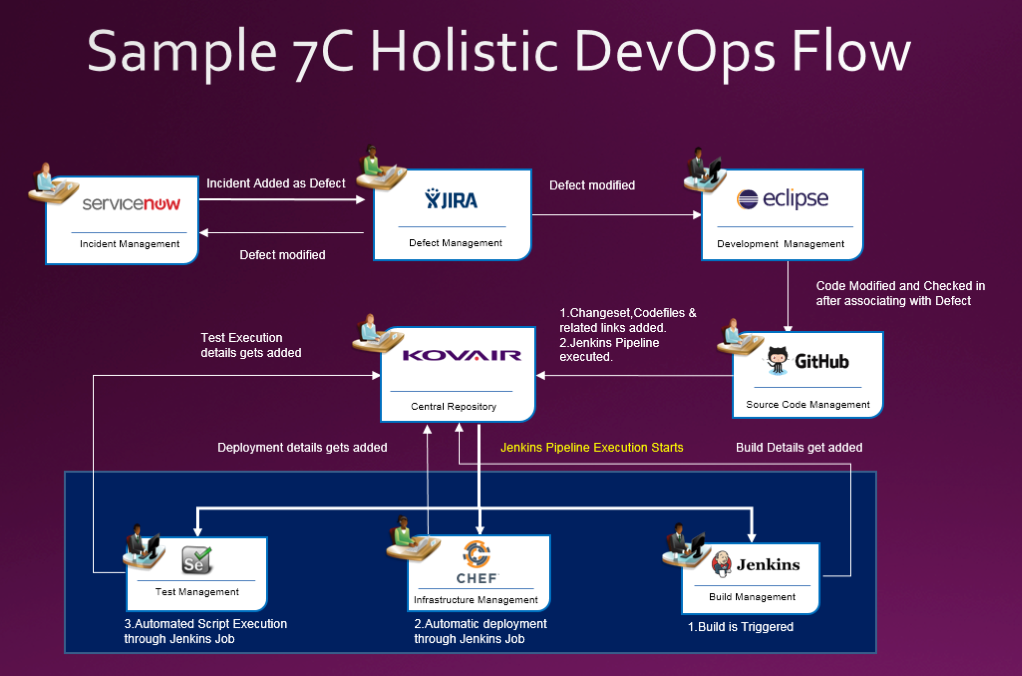
    Fig. 2 illustrates a sample DevOps flow where service team uses ServiceNow; software, product and project managers are using Jira for Agile management, developers are using Eclipse as their integrated development environment, GitHub is used for source code repository, QA team uses a test management tool for test and defect management, and finally the release team uses Chef and Jenkins to orchestrate build, release and deployment. In real-world examples, teams add more tools for code analysis, security and production monitoring. All such complex flows are supported within DevOps 7C holistic approach by utilizing the deep integration platform. The 7C approach is more productive as it allows faster detection, analysis and resolution of problems.

    Fig 2. Sample DevOps Flow with Deep Integration

    The 7C approach works well with both traditional waterfall software management as well as Agile software management—mainly because of better end-to-end visibility, efficiency and collaboration.

    To conclude, 7C approach of DevOps is the natural evolution of DevOps, empowering the team to achieve better efficiency and execute better. This empowers all the stakeholders in the organization by providing better end-to-end visibility and powerful means of collaboration. Involving all stakeholders also creates a better environment of trust and collaboration. With this 7C approach, DevOps is not limited to build and release but it has spanned across the entire spectrum of software development lifecycle. This is especially highly beneficial for large enterprises as it enables them to preserve their prior investments and enhance their existing flows. This gives them leverage to selectively try new tools and technology while preserving what is working well. This is a great approach to expedite the enterprise level digital transformation.

    About the Author / Devendra Joshi

    Devendra Joshi is Sr. Director, Customer Solutions and Products at Kovair. He is a software professional with over 20 years of experience in enterprise software, social media, healthcare, SaaS companies, and EDA. He has worked with startups and large enterprises in engineering management, and product and solutions management roles.