Author: Philippe Abdoulaye

  • TechRepublic’s Bombshell Survey: A DevOps Fiasco?

    TechRepublic’s Bombshell Survey: A DevOps Fiasco?

    This month, I chose to share the findings of a TechRepublic’s recent survey on DevOps not only because it’s a bombshell within the IT community, but because it brings out two eye-opening facts:

    1. Seventy-eight percent of organizations haven’t fully implemented DevOps because “they don’t get it”
    2. Only 22 percent of organizations have merged their teams for managing infrastructure, operations and development

    In other words, the message underneath is, “You must consider most DevOps success stories with a pinch of salt.”

    The big question is, Why are all these DevOps implementation failures happening? That’s where I bring the answers most experts, including renowned thought leaders, for some reason won’t give you.

    The findings of this vital survey shouldn’t leave you indifferent. Your company’s survival and growth depend on them. They’re recurrently raised in all the conferences and workshops I give. “We deployed the automation toolchain; honestly, I don’t see the business value,” or “Making the business, development, testing and operations work together is an impossible challenge,” is all I hear all the time. The last time I had to address these complaints was at the Econocom’s DevOps Seminar in Toulouse, France.

    The answers I provide result in the same reactions: Companies successfully change their DevOps vision and implementation approach.

    Believe it or not, that’s my six-year experience advising on DevOps worldwide, as well as the observations of an increasing number of reliable IT industry analysts including Joe McKendrick and Jason Bloomberg. The three fundamental failure factors of DevOps implementation are:

    1. Either a lack of or unclear business objectives.
    2. Widespread misconceptions of DevOps including among thought leaders.
    3. Conflicting interests of the DevOps tools business.

    Let me give you a few ideas that will either help you monetize your organization’s transition to DevOps or adjust your existing DevOps capability and make it profitable.

    Unclear Business Objectives Result in Irrelevant DevOps Capabilities

    Again, that’s my experience and the observations of many IT industry analysts, most DevOps initiatives are disconnected from any business objectives.

    In all the workshops I conduct, the question, “What’s your business goal?” gets the same blurry answers: “Adopting DevOps is a must,”  “We must automate our IT processes,”  “Making our IT agile will make our business competitive,” “Speeding up delivery is a competitive advantage our business lines will like,” and “Automating our IT processes will do good to the business.”

    What you must know is, these goals range from vague and fake to inappropriate and nonexistent. They primarily serve the IT department’s interests. Not the business.

    The fact is, there’s a significant gap between business line expectations and the DevOps benefits as imagined by your IT leader peers and their associated vendors. The business looks to meet the challenges of the disrupted markets created by Google, Amazon, Facebook and Apple (GAFA, in the rest of the article)—competition which includes continuous innovation, accelerated time-to-revenue, cost reduction, low prices and market responsiveness. And the only help DevOps experts offer is the acceleration of applications delivery and the automation of IT operations. Is it enough? The answer is clearly no; it’s a drop in the ocean.

    The GAFA are disrupting your company’s markets. The only chance to resist them is to adjust your business model to the new competitive constraints. Because they didn’t transform as their disrupted markets required, Nine West Holdings, the Bon-Ton Stores, Toys R Us, Remington, Southeastern Grocers and Tops Markets were all kicked out of business. Read what Business Insider’s Hailey Peterson said about it in a recent article.

    I encourage you to involve your business lines in your DevOps project and agree with them on a clear business objective. Then, implement DevOps to enable that objective. Otherwise, that’s wasted time and more importantly, wasted investment!

    The Secret of DevOps Has Always Been About How Well You Work, not Technology

    This is something I hope you won’t doubt: Most experts including renowned thought leaders play on words to present DevOps as close to either an agile software development framework or a continuous delivery infrastructure (CDI). Let’s say it straight: That vision, now adopted by CIOs, is erroneous and has been taking thousands of businesses into the wall.

    Adam Jacob’s article, “The Secret of DevOps, It’s Always Been About People, Not Technology,” provides from my perspective, the best definition of DevOps. It presents it primarily as, “… fundamentally about taking the behaviors and beliefs that draw us together as people, combining them with a deep understanding of our customers’ needs, and using that knowledge to ship better products to our customers.” But he makes it clear, “Tools matter. Make no mistake, trying to change the way you work without changing the mechanisms by which you do that work is a futile exercise in excruciating failure. But tools exist in service of the prime directive: building highly functioning, highly effective cross-functional teams, that attack your thorniest business problems as a unit, rather than as lone individuals or silos with competing incentives.”

    What’s interesting with Jacob’s big picture is, it’s definitely business-oriented and takes into account value creation drivers such as the human factor, values and behaviors, processes and practices, cross-functional collaboration and, of course, technology. Every qualified IT leader should understand these drivers as the fundamentals of their company’s survival and growth.

    So, shrinking DevOps to agile software development and Jenkins, Puppet and Docker, and thinking it will result in revenue doesn’t make sense. That’s the reason why the 78 percent of organizations in the TechRepublic’s survey failed!

    Would you agree that to set up a profitable business, the most important thing is to deploy Jenkins, Chef, Docker? I hope not!

    DevOps is about how well you mobilize your company’s assets— staff and skills, values and behaviors, processes and practices, tools and infrastructure—to make it competitive and wealthy. Adopting DevOps, particularly in today’s disrupted industry context, is primarily a business transformation effort. Nothing else!

    If you don’t want to be part of the 88 percent of organizations that proved unable to merge their team for managing infrastructure, operations and development, like Adam Jacob’s article suggests it, tackle DevOps primarily as an agile business operational model. Otherwise, get ready to be among the next GAFA victims!

    Preventing the Next DevOps Fiasco

    I’m afraid the conditions for the next DevOps fiasco are in place. They have a name: The incredible power of IT vendors.

    The incredible power of IT vendors relates to what Harvard’s strategist Michael Porter calls the “bargaining power of suppliers.” It’s the market or industry configuration where the domination of one company or a group of companies reaches a point where they can impose their views, products and services. IT vendors are exactly in that situation.

    IT tools have improved productivity so much over the last 30 years that companies have come to believe that they can fix every business problem including innovation, agility and profitability. IT vendors, using massive marketing hypes, are taking advantage of the situation to make millions of dollars. Dollars aren’t the problem; it’s the poor ROI their clients get.

    Will this TechRepublic’s survey help to prevent the next DevOps fiasco? Time will tell.

    Key Takeaways

    Your company’s priority is to survive the disrupted markets created by the GAFA. You won’t make it happen unless you definitely acknowledge that revenue, the essence of your business, is created as part of complex process that mobilizes across your company’s value chain, your staff and skills, values and behaviors, processes and practices and, of course, tools and infrastructure.

    If DevOps can’t help businesses with what matters right now—survive their industry disruptions— it’s definitely useless!

    As Chris Tozzi, suggests it, “The other main possibility for the post-DevOps world is that we’ll see DevOps extended into more and more parts of the business that are not directly related to the two core areas of DevOps practice, development and operations.”

    Here’s a resource that tells you all about how to implement DevOps as the catalyst of your business competitiveness: “How to Yield Business Benefits with DevOps.”
    — Philippe Abdoulaye

  • Econocom DevOps Summit’s Lessons: Severe Disconnect Between Expectations and Delivery

    Econocom DevOps Summit’s Lessons: Severe Disconnect Between Expectations and Delivery

    On March 15, I gave four keynote speeches on DevOps in Toulouse, France. As the main speaker of Econocom Club MEP 2018, an annual think tank summit organized by the European business-to-business digital services provider, I shared the day with 15 firms in industries as prestigious as financial services, energy, aerospace, aviation, and telecommunications and heard all about their implementation projects.

    The lessons learned from this year’s summit are troubling, they tell a story the vast majority of DevOps vendors aren’t prepared to hear: They miss their client expectations. There’s a severe disconnect between what’s expected and what’s delivered.

    Participant visions and approaches didn’t surprise me; they simply confirmed my point that DevOps is misunderstood. By stressing the implementation of Continuous Delivery (CD) toolchains—selling technology is more lucrative than transforming a business—IT service providers aren’t helping.

    What do these lessons tell, exactly? if you’re an open-minded leader who understands that a new IT service delivery paradigm more focused on business concerns is needed, this is for you.

    The Untold Frustration

    In his opening speech, facilitator Fabrice Berne was inspired to ask participants while they introduced themselves to share the purpose and challenges of their DevOps implementation project.

    What I heard didn’t surprise me; it was a mix of fascination and frustration—participants were at the same time excited to work on a DevOps project and frustrated because they weren’t getting the promised business benefits.

    “The reason is, you all tackled your DevOps project the wrong way,” I said. “You started by implementing the CD toolchain, thinking tools on their own will deliver the expected business benefits. That illusion is widespread in the IT community!”

    So, What is DevOps?

    As my claim turned the atmosphere icy, I added, “DevOps can’t be narrowed to these tools—not even to agile practices and automation. It’s more than that. DevOps seeks to make the business competitive, wealthy and healthy by continuously delivering high-quality software.” And concluding my introduction, I made it clear: “The fundamental question is, How is business value created? Many experts, particularly techies, struggle to answer it.

    “Let me say this straight: Most DevOps projects fail because certain experts erroneously spread the idea that the most important piece of DevOps is the CD infrastructure,” I said, adding, “The fact of the matter is these experts and the IT solution vendors they represent are creating confusion; through massive marketing hypes they force CIOs to address DevOps through the distorted lenses of the so-called DevOps tools.”

    The Inconsistent Disparate Visions

    The following chart results from a survey we conducted at ITaaSNow last year. It involved 2,681 businesses that were unhappy with their cloud and DevOps migration projects; we wanted to show how poor DevOps approaches lead businesses to failure:

    Figure 1 – Disparate and erroneous visions that cause implementation failure

    “As you can see, there’s no homogeneous perspective right now,” I told the audience. “It varies according to the business culture, objective and strategy or the DevOps architect’s understanding, experience and expertise. In most cases, these customized visions are incomplete and generate no business value at all.”

    I picked two failure causes in the chart to demonstrate my point.

    Starting with the notion that, “automation is the core of DevOps,” I argued, “DevOps primarily seeks to help generate business value. Generating business value is about identifying market and customer expectations, translating expectations into profitable service ideas, developing, deploying, promoting, selling them and continuously improving customer experience.

    “Where did techies get the idea that to make a business profitable the only thing to do is to implement Git, Jenkins, Cucumber and Chef into a CD toolchain?” I asked, somewhat ironically.

    Picking a second cause, “DevOps strategy should only stress software development activity,” I continued. “Thinking that isolatedly software development activities will generate business benefits without involving marketing, sales, testing and operations is a pure illusion. Once again, generating business value is a complex process that covers identifying market and customer expectations, translating expectations into profitable service ideas, developing, deploying, promoting, selling them, and continuously improving customer experience.

    “Where did solution vendors get the belief that, software development alone is enough to generate business value?,” I asked. “That’s another myth they nurture!”

    I then warned: “Make no mistake about it: All the visions represented on the chart are either incomplete or wrong. They do not reflect what DevOps is. You must acknowledge once and for all thatit is a business transformation effort, not only an IT capability implementation. Period.”

    The Contrast with the Founding Fathers’ Vision

    “Who better than its founders can provide the right vision and definition of DevOps?” I asked.

    Relying on Jesse Robins, John Allspaw and Paul Hammond’s vision as reported by Chef co-founder Adam Jacob in a memorable article, “The Secret of DevOps: It’s Always Been About People, Not Technology,” I unveiled what I consider the primary features of DevOps.

    In his article, Adam reminded us, “Becoming better at building and delivering software is the stake. It’s not an optional piece of their strategy: It’s the future of how their customers want to work with them. Software is table stakes for survival.”

    He added, “But the real answer lies in looking at what John, Paul, and Jesse were doing in 2009—not in the specific technical choices they made, but the style in which they worked, the essence of what they believed made them high functioning and successful. … Then the challenge begins: how to apply this new style to businesses trying to become better at building and delivering software.

    “DevOps is about bringing together all the people you need to build and run your business effectively, and empowering them to move as quickly as possible toward their goals. Tools matter. Make no mistake: Trying to change the way you work without changing the mechanisms by which you do that work is a futile exercise in excruciating failure.”

    He concluded, “Fundamentally, it is about taking the behaviors and beliefs that draw us together as people, combining them with a deep understanding of our customers’ needs, and using that knowledge to ship better products to our customers.”

    With Respect to Techies, DevOps is Primarily a Business Operational Model

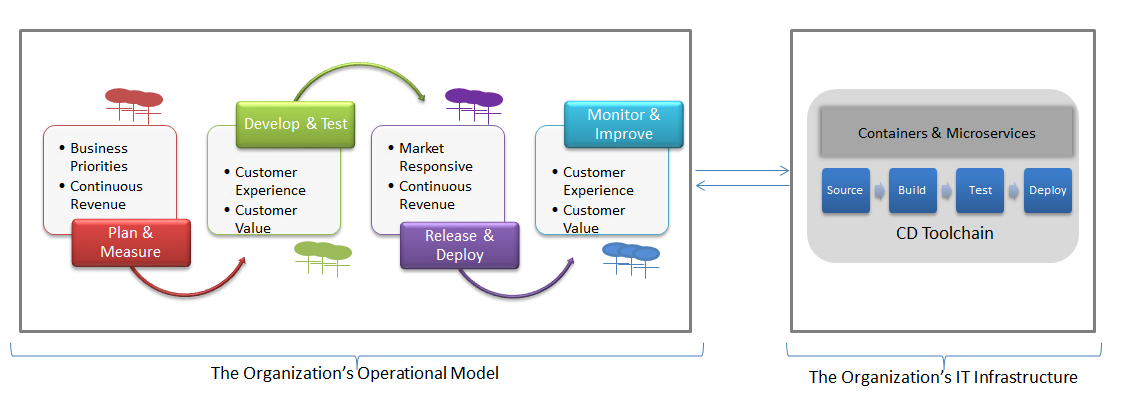
    “If you paid attention to what Adam Jacob reported about Jesse, John and Paul’s vision, you probably noticed that it emphasizes two fundamental elements of high-performing businesses: the well-known IT infrastructure and the unknown operational model,” I told the audience.

    Moving to the next slide, I provided evidences to my point, “As the picture shows, DevOps, according to its founding fathers, isn’t the CD platform, automation toolchain or the platform-as-a-service (PaaS) infrastructure solution vendors and certain consultants would like you to believe.”

    Figure 2 – The Founding Fathers’ Vision

    The slide seemed to clear up a doubt about what the audience had been hearing. I confirmed, “With all due respect to my fellow techies, as I’ve been implementing it, DevOps transcends software development issues; it’s a business operational model supporting your company’s competitiveness.”

    Figure 3 – DevOps as the Business Value Chain

    I told the audience I chose to represent it as a two-component system “because I wanted to make sure IT professionals and business leaders understand that implementing DevOps is primarily a business transformation effort for optimizing the organization’s operational model and IT infrastructure.” I added, “The operational model is the subset of interactions, staff and skills, processes and practices, values and beliefs, and tools that’s repeatedly mobilized across your organization to generate the expected business benefits. It’s where all its value propositions and competitive advantages—organizational agility, flexibility and velocity, innovation culture, more like it—are created. As (fellow speaker) Stephanie Carton puts it, the operational model is where DevOps culture is implemented.”

    Anticipating the audience’s reaction to that point, I said, “It doesn’t mean CD toolchains are useless or doesn’t bring value, without them we’re dead. The point here is, business benefits result from an optimized operational model enabled by a well-engineered CD toolchain.”

    I’m not the first one to go against the techie perspective of DevOps, I warned. “Ernest Mueller in his fantastic, “DevOps: It’s Not Chef and Puppet,” raised the red flag.” His message is clear: “If someone has a systems problem, and you say that the answer to that problem is Chef or Puppet, you understand neither the problem nor the tools.”

    The Near Future of DevOps

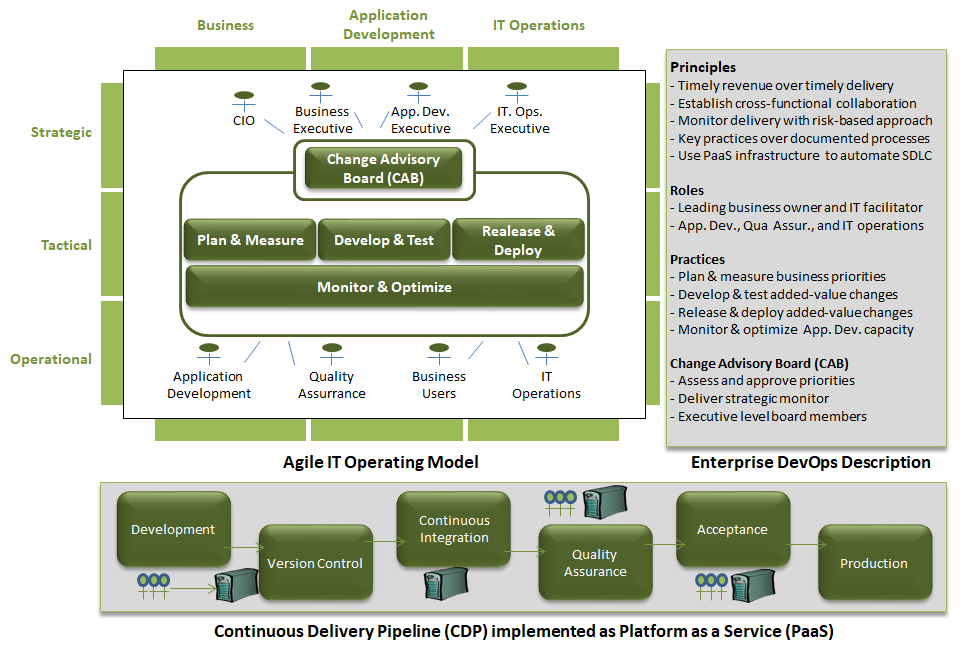
    In the first part of this article, I wanted to share with you the clarifications I made and more importantly, re-establish the truth on messages as erroneous as “DevOps means CD toolchain and Agile practices,” and “CD infrastructure or software development on its own creates business value.” They’re misleading CIOs and are taking hundreds of projects straight into the wall!

    Figure 4 – DevOps Big Picture

    In part 2 of this article, next month, I’ll tell you what we debated about the near future:

    • Why Agile and Lean practices will boost business competitiveness?
    • What is ITaaSNow DevOps Capability Maturity Model (CMM)? How does it enable continuous business performance improvement?
    • What is Artificial Intelligence for Operations (AIOps)? Why will it make DevOps the cornerstone of businesses’ digital strategy?

    Stay tuned!

    The Key Takeaways

    This what I wanted to tell you about DevOps as we discussed it. The key takeaways are:

    • DevOps isn’t narrowed to agile practices and CD toolchains. Don’t fall into the trap of certain solution vendors who tell you that Git, Jenkins, Cucumber, Chef, Containers and microservices will boost your business performance. It’s false; things aren’t that simplistic.
    • DevOps combines an optimized operational model and a CD platform to bring together marketing, sales, post sales, software development, testing and operations into an application delivery capability that boosts your organization’s competitiveness.
    • Starting the CD toolchain implementation without optimizing the operational model is the surest way to take your DevOps implementation project into the wall.
    • DevOps implementation is primarily a business transformation effort, not just an IT capability deployment effort.

    What matters isn’t applications and digital services delivery at the speed of light, but the timely delivery of added-value applications and digital services to the right market segments and business users.

    According to Econocom’s feedback, most participants are reviewing their DevOps implementation strategy; they will make their operational model optimization the priority. Mission accomplished!

    — Philippe Abdoulaye

  • Digital Business Revolution: Why DevOps is the New Enterprise Value Chain

    Digital Business Revolution: Why DevOps is the New Enterprise Value Chain

    Ongoing industry disruptions are forcing businesses to change their operational model; that’s the only way to avoid and survive digital bankruptcies.

    In North America, Sears Canada filed for bankruptcy, while Toys R Us and Weight Watchers were on the verge of it. In Europe, particularly, in France, banks including Societe Generale and leading retailers including Carrefour are anticipating it through ambitious and innovative digital transformation programs.

    The cheap access to innovative technologies enabled by cloud services providers including Amazon Web Services (AWS) has caused a proliferation of innovative tech startups and technology companies, making competition tougher for established businesses.

    The innovative digital products and services they deliver are slowly but surely substituting conventional ones. As an example, Weight Watchers’ weight-loss programs did not resist innovative wearable devices, such as the Fitbit Tracker, that helped millions around the world lose weight. Trackers measure data such as the number of steps walked, heart rate, quality of sleep, steps climbed and many other personal metrics involved in people’s health.

    Digital products and services are becoming customer consumption standards, accelerarated innovation life cycles are now the competitive advantage to have and DevOps in its entirety is the capability companies must equip themselves with to make substantial digital profits.

    In 1985, Harvard’s Strategy professor Michael Porter unveiled to the business world in his best-selling book, “Competitive Advantage,” the concept of value chain. It ‘s been revolutionizing business practices for more than 30 years, and inspired approaches as varied as Michael Hammer’s Process Reengineering, Toyota’s Lean Production, Total Quality Management (TQM) and even Software Capability Maturity Model (CMM).

    The value chain’s principle is the notion that in every single company there’s a subset of interactions, staff and skills, processes and practices and tools and infrastructure that repeatedly generates expected benefits. That subset is what’s meant by the value chain; to succeed, businesses must continuously optimize it.

    Today, software development is the foundation of digital products and services; it’s becoming the fundamental industrial activity. By providing the technological, organizational, and operational framework that will enable digital profits, DevOps is replacing the value chain as Porter designed it. It’s the competitive instrument businesses need to make big gains.

    This article, inspired from my next book, “The DevOps Revolution: The IT Organization of the Digital Age,” explains why DevOps is about to revolutionize the way companies tackle their digital business.

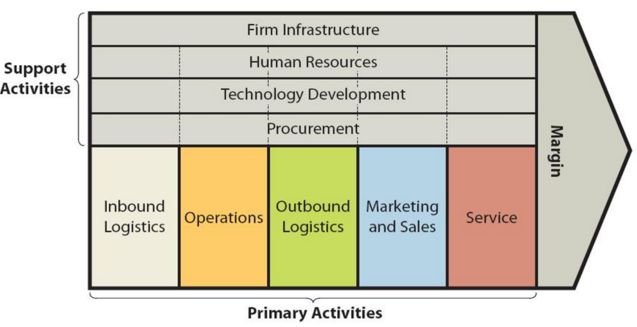
    Michael Porter’s Value Chain: Purpose, Foundations and Principles

    The value chain, through focusing companies on their added-value activities and resources, has been revolutionizing businesses’ ability to compete for 30+ years and made several thousands business leaders successful around the globe.

    Figure 1 – The Original Porter’s Value Chain

    What you must know is, the underneath principle is, only a subset of the company’s activities—Primary activities and Support activities—can repeatedly generate expected benefits. That subset is what’s meant by value chain.

    Let’s discuss them!

    Creating Value: The Primary Activities

    The objective of the primary activities is to create value. They include seven activity groups:

    • Inbound Logistics
    • Operations
    • Outbound Logistics
    • Marketing and and Sales
    • Services

    Inbound Logistics performs supply chain functions. It’s a group of key supply chain processes and associated experts, tools and infrastructure. The mission is to make sure the company gets on time the best material to manufacture top products and services.

    Operations refers to manufacturing functions. It puts together the company’s top experts, engineers and product managers to design, develop and test products and services. They take advantage of key processes and industry best practices to make the company’s products and services as innovative and profitable as possible.

    Outbound Logistics performs distributions functions. It’s a subset of the company’s top distribution partner relationships management (PRM) experts mobilized across the company using top distribution processes, practices and tools to make sure the company’s productions and services are properly distributed across its partner networks and make a profit.

    Marketing and Sales, as the names suggest, perform marketing and sales activities. It is a group of the company’s top marketers and salespersons mobilized through top marketing and sales processes and practices to make sure the business make profits.

    Services refers to post sales activities. It’s a group of the company’s best customer relationships management (CRM) experts and associated top processes, practices and tools mobilized to make sure customers have the best experience with the company’s productions and services.

    Making Value Creation Sustainable: Support Activities

    The primary activities do not generate value on their own; they need levers. Their purpose is to be the value chain’s support activities, making sure the company generates sustainable value. They include four activity groups:

    • Firm Infrastructure
    • Human Resources
    • Technology Development
    • Procurement

    Let’s how they enable value creation activities!

    Firm Infrastructure is a group of high-level executive experts appointed to guarantee the company’s infrastructure profitability. Such executive experts include chief information officers (CIOs),  chief technology officers (CTOs) and chief enterprise architects (CEAs), and they rely on top processes, practices and tools such as ITIL, IT Services Capability Maturity Model (CMM) and TOGAF to guarantee the company’s infrastructure profitability.

    Human Resources is a group of the company’s selected recruiting and human resource management experts and the associated top processes, practices and tools. Its mission is to not only make sure the company has the top experts it needs, but also get from them their maximum contribution.

    Technology Development relates to research and development (R & D) activities. It’s an elite of experts dedicated to monitoring markets trends and developing product ad service prototypes likely to create value for the company. They rely on extremely sophisticated product and service engineering processes, practices and infrastructure.

    Procurement relates to a selected group of the company’s investment decision experts. Relying on top financial processes, practices and tools, this group’s mission is to guarantee the maximum return on the company’s investments.

    Why DevOps is the New Value Chain

    Contrary to what many thought leaders, experts and solution vendors pretend, DevOps is unknown; it can’t be narrowed to the complex toolchains IT vendors have been selling to CIOs. Things aren’t that simplistic.

    DevOps According to Chef’s Adam Jacob’s Perspective

    Adam Jacob, co-founder and CTO of Chef, wrote a memorable, article about DevOps: “The Secret of DevOps: It’s Always Been About People, Not Technology.” Relying on his experience working with the inventors of DevOps—Jesse Robins, John Allspaw, Paul Hammond—he provides an unprecedented and accurate perspective of DevOps.

    He reminds this, “Becoming better at building and delivering software is the stake. It’s not an optional piece of their strategy: It’s the future of how their customers want to work with them. Software is table stakes for survival.”

    He adds, “But the real answer lies in looking at what John, Paul, and Jesse were doing in 2009—not in the specific technical choices they made, but the style in which they worked, the essence of what they believed made them high functioning and successful. … Then the challenge begins: how to apply this new style to businesses trying to become better at building and delivering software.”

    He proceeds, “DevOps is about bringing together all the people you need to build and run your business effectively, and empowering them to move as quickly as possible towards their goals. Tools matter. Make no mistake, trying to change the way you work without changing the mechanisms by which you do that work is a futile exercise in excruciating failure.”

    Then concludes, “Fundamentally DevOps is about taking the behaviors and beliefs that draw us together as people, combining them with a deep understanding of our customers’ needs, and using that knowledge to ship better products to our customers.”

    DevOps’ Fundamental Building Blocks

    What’s interesting in Adam’s rhetoric is, two groups of key words and sentences help to bring out two fundamental components of DevOps.

    People, customers, work, work style, beliefs, bringing together people, empowering people are part of the first group. It relates to what experienced and qualified business transformation experts refers to as operational model.

    Technology and tools—and make no mistake, tools matter—don’t the change the way you work without changing the mechanic underneath are all part of the second group. It relates to what experienced and qualified business transformation experts refer to as a technology platform, known by DevOps experts as continuous delivery (CD) platform.

    The following picture is a DevOps model derived from Adam’s perspective. It makes easy its understanding:

    Figure 2 – DevOps as the New Enterprise Value Chain

    As illustrated, DevOps can be modeled as two-components business capability including:

    • The operational model
    • The CD platform referred to in this article as DevOps automation toolchain

    Let’s see how these two components are making DevOps, the powerful business capability CIOs have been expecting!

    The DevOps Automation Toolchain

    The automation toolchain or CD platform is what many either refers to as or confuse with DevOps. It conceptually structures software deployment in four steps:

    • Source
    • Build
    • Test
    • Deploy

    Each stages uses one or more products as illustrated in the following table:

    Figure 3 – Automation Toolchain Features

    The Agile and Lean Operational Model

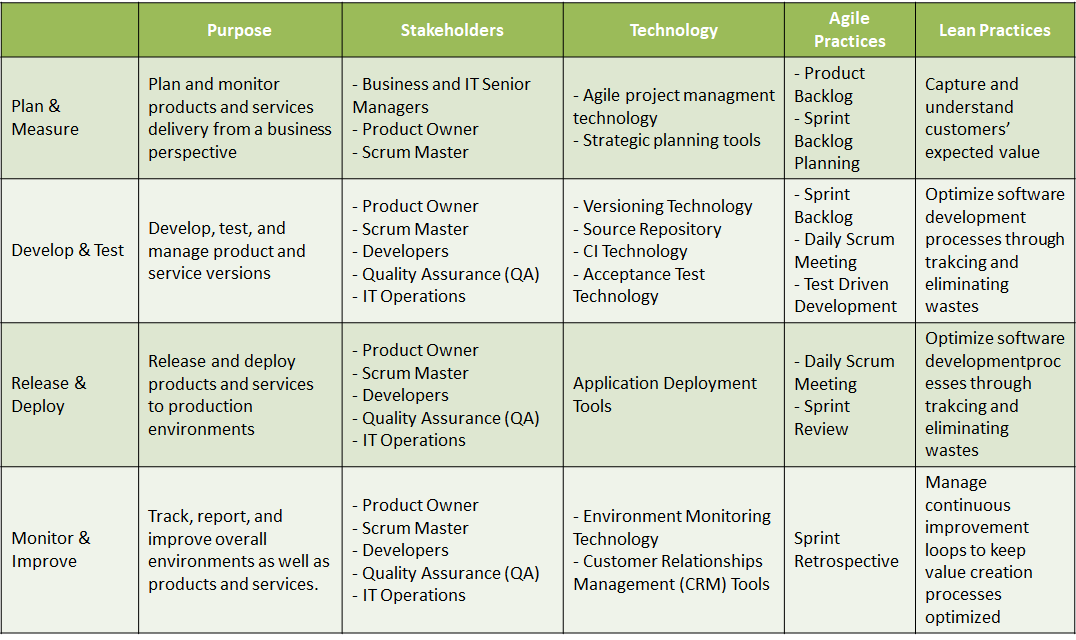
    The operational model is the poor relation of DevOps; it’s totally either unknown or ignored by 98 percent of business leaders and their CIO. It’s where agility, flexibility, responsiveness and even innovation culture are implemented. It organizes the application development effort in a four-step circular life cycle:

    • Plan & Measure
    • Develop & Test
    • Release & Deploy
    • Monitor & Improve

    Each stage mobilizes specific staff and skills, uses specific processes and practices, tools and infrastructure and, more importantly, specific Agile and Lean practices. The following table summarizes each stage:

    Figure 4 – DevOps Agile and Lean Operational Model Features

    Why DevOps is The New Enterprise Value Chain

    One of the problems with the value chain as Michael Porter thought it is, it has a compartmental vision of the business with two categories of activity divided each in several processes and associated staff, skills and tools.

    This perspective nurtures organizational silos and prevent cross-functional collaboration. It slows down problem-solving and decision-making and inhibits innovation culture.

    The value chain as Michael Porter thought it didn’t help Sears Canada to avoid digital bankruptcy, it didn’t prevent Toys R Us and Weight Watchers get on the verge of it.

    Where DevOps brings value and fills the gaps of today’s value chain is, it not only provides a business capability that’s easy to deploy but also an organizational, operational and technological framework embedding the Agile and Lean practices, as well as the automation toolchains companies need to survive their industry disruptions and make substantial digital profits.

    Key Takeaways

    Industry disruptions are a reality and properly transform the business is the only solution. Sears Canada, Weight Watchers and recently Toys R Us learned it the hard way.

    In 2018 make DevOps transformation your priority investment decision, I’m not talking about DevOps’ automation toolchain but DevOps a business capability which includes the Agile and Lean operational model and the automation toolchain.

    — Philippe Abdoulaye

  • Digital Transformation: How DevOps Could Have Revamped Toys R Us

    Digital Transformation: How DevOps Could Have Revamped Toys R Us

    The story you’re about to read and its recommendations are real; they contrast with what you have heard so far about digital transformation and DevOps implementation. Its objective is to convince you about that the time to go digital is now; it’s about transforming your business, not only IT; and to do it you’ll have to implement DevOps entirely.

    In September, Toys R Us, one of the world’s largest toys store chains, filed for bankruptcy protection. A better understanding of how disruption in the retail industry impacted the company would have helped to prevent its downfall and to reinvent its business model. For example, providing Toys 2.0 (a generic term referring to a new generation of toys built on cloud, mobility, IoT and AI technologies) gaming services could have helped the company survive.

    Shifting to Toys 2.0 demands a revolution in thinking, vision, practice and value that business leaders, CIOs and IT vendors haven’t done yet. They must forget the obsolete notion that technology and speed determine business success. Adopting paradigms that stress innovation and solve competitive constraints is the safest path toward fast and durable revenue.

    The biggest problem Toys R Us faced was the fact that consulting firms and IT vendors either didn’t understand the challenge as an industry disruption issue—or if they did, they improperly addressed it.

    Let’s clarify: To tackle your industry’s disruption, you must adapt your business model including the set of interactions, staff and skills, processes and practices, beliefs and values and infrastructure and tools used across your company to generate revenue. Industry disruption is the challenge, and DevOps through its many assets is the unique business capability companies need to quickly transform and win their digital battles.

    The problem, as Alan Shimel, founder, CEO and editor in chief of devopsy.kinsta.cloud, puts it:

    “While so many companies have already started to use DevOps or planning to use DevOps and related methodologies soon, there is only a small percentage of companies that are end-to-end DevOps. This means there is still tremendous opportunity in bringing DevOps to market.”

    How should have Toys R Us leveraged DevOps to tackle its industry’s disruption? Why did investing in that global digital e-commerce platform prove insufficient? How well did they transform their business model? How would have implementing DevOps 100 percent helped to overcome Amazon and Walmart competition?

    The principles, ideas, practices and solutions in this article are part of a case study we developed at ITaaSNow to see how to help companies facing similar challenges.

    What is DevOps?

    Alan, who is a major contributor to DevOps, is right: Only a small percentage of companies have fully adopted it. DevOps is much more than the automation toolchains consultants and vendors talk about. If they want to help lines of business survive and keep their job, CIOs must get a grasp of DevOps’ business facets.

    So, what is DevOps? Why do I think, it would have saved Toys R Us from digital downfall?

    DevOps Beyond the Operations Automation

    From my experience implementing it, DevOps is a business capability that seeks to optimize business operations (versus the sole IT operations). It provides companies with four competitive advantages needed to meet the digital business competitive challenges:

    1. Enterprise collaboration
    2. Business agility
    3. Short time-to-value
    4. Innovation culture
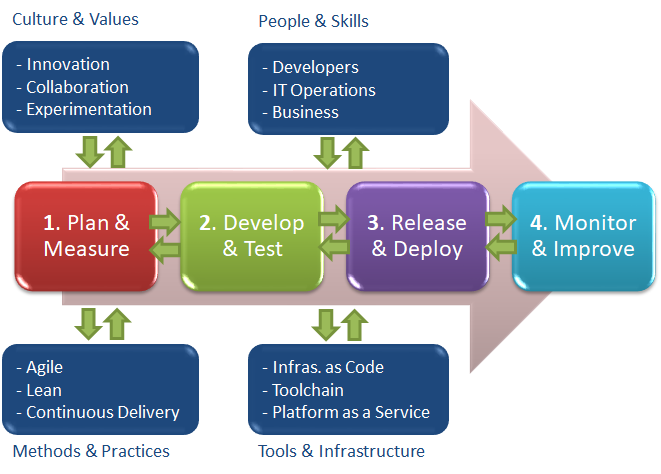
    Figure 1 – DevOps Overview

    As the picture shows, DevOps is a set of concepts aggregated around the notion of value stream to form a digital business management capability. It’s structured around four stages that format the company’s interactions and workflows into a powerful digital business management capability. These stages include:

    • Plan & Measure – addresses strategic watch, service prioritization and revenue generation through innovation portfolio management practices and infrastructure.
    • Develop & Test – takes advantage of agile and lean practices and infrastructure to ensure innovations design, development and testing.
    • Release & Deploy – leverages continuous delivery practices and infrastructure to timely deliver the right innovations to the right markets.
    • Monitor & Improve – stresses continuous improvement to guarantee not only premium customer experience but also customer value.

    Four business value catalysts are used to act as revenue generators:

    • Culture & Values
    • People & Skills
    • Methods & Practices
    • Tools & Infrastructure

    As you can see, DevOps transcends application development issues; it covers the entire business life cycle.

    DevOps Framework as a Facilitator of DevOps Implementation

    So, what is a DevOps Implementation framework?

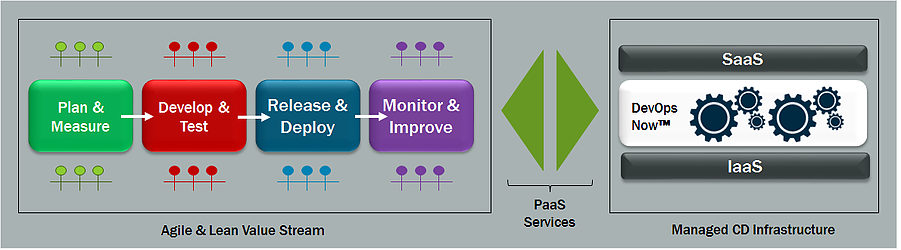
    Concretely speaking, it’s a bundled DevOps platform combining managed PaaS infrastructures and optimized value streams to help companies boost their digital business:

    Figure 2 – DevOps Implementation Framework

    The platform seeks to help businesses implement DevOps end to end and builds on three principles to guarantee digital profits:

    1. Innovation as the revenue driver – It’s the belief that business can resist the competition imposed by technology companies such as Apple, Google, Amazon and Facebook when they use innovation to keep customers loyal, attract new ones and generate revenue.
    2. Value stream agility as the foundation of market responsiveness – It’s the demonstrated notion that companies are market-responsive when they rely on agile and lean value streams.
    3. Managed cloud as the catalyst of business performance – It’s the proven idea that when companies are focused on their core business, they innovate and offer superior customer experience.

    The 5-Step Digital Transformation Blueprint

    The 5-Step Digital Transformation Blueprint makes DevOps implementation fast and easy. As illustrated, it’s a comprehensive business transformation framework I developed to help clients with their digital transformation initiative:

    Figure 3 – The 5-Step Digital Transformation Blueprint

    It’s an integrated and inclusive approach to business transformation that involves the company’s relevant contributors. It structures the transformation effort into a five-stage transformation journey:

    • Digital strategy: In this step, the transformation team uses tools like the SWOT analysis matrix to help business and IT executives understand the changes in the disrupting industry along with the impacts on the company’s business model.
    • Value stream: In this step, the transformation team uses tools such as the value stream mapping to identify the required changes and get business and IT executives agree on the company’s future value stream. Interactions, staff, skills, processes, practices and tools are at the heart of the discussions.
    • Digital platform: In this step, enterprise and solution architects work together to identify and implement the technology and tools selected to support activities in the value stream.
    • Digital organization: In this step, a panel of business and IT users at the operational and executive levels experiment the new digital business model under actual business conditions. The tested digital business model is then deployed as the new digital organization.
    • Digital business management: In this operation phase, the value stream and the digital infrastructure are extensively used to run the business.

    How Chief Digital Officers Set Up Top Digital Businesses

    It would be remiss on my part not to recommend the online digital transformation course that gives DevOps practitioners—executive and operational from both the business and IT—the insights about implementing DevOps as the foundation of digital business.

    “How Chief Digital Offers Set Up Top Digital Business: Establish DevOps as the Foundation of Your Digital Business” is a 15-module course that offers concise, practical and powerful tips to help practitioners learn and apply strategies and tactics to effectively plan, monitor, facilitate and lead business transformation including IT to digital.

    Analyzing Amazon and Walmart Disruptive Impacts to Spot Guidelines for Reinventing the Company

    Many bankruptcies happen because business leaders don’t take the time to understand their industry’s disruption and the impacts on their overall business.

    The reality on the ground is, industry analyses and competitive strategies are either overlooked or totally ignored. Understanding the toy industry’s disruptive effects would have helped to identify Toys R Us’s transformation as the safest solutions to avoid bankruptcy.

    DevOps implementation framework makes the difference, it sees DevOps as the foundation of digital business success. It considers industry and competitive analyses essential steps of the DevOps transformation initiative. Figure 4 outlines the outcomes that resulted from our industry analysis:

    Figure 4 – Toy Sector’s SWOT Analysis

    As illustrated, it was shown that Toys R Us should have exploited Amazon’s vulnerabilities and take advantage of the technological opportunities to reinvent itself as a Toys 2.0 gaming service provider. These vulnerabilities include little product differentiation while technological opportunities refer to the new toy generation built on cloud, mobile, IoT and AI technologies.

    The company’s strengths—reputation, longtime industry presence, brand equity—combined with the cost savings resulting from managed cloud adoption would have not only simplified its transformation but also challenged Amazon on costs.

    Changing the Value Stream to Establish Innovation and Invent the Company’s Digital Business Model

    Business leaders don’t take the right transformation decisions because they lack insights into the changing competitive environments. Aggressive marketing and sales campaigns supporting short-term financial gains. Toys R Us failed because it bet on its debt reimbursement at the expense of its business model reinvention.

    A DevOps implementation offers a value stream mapping framework that not only facilitates innovation culture implementation but also speeds up digital business models development.

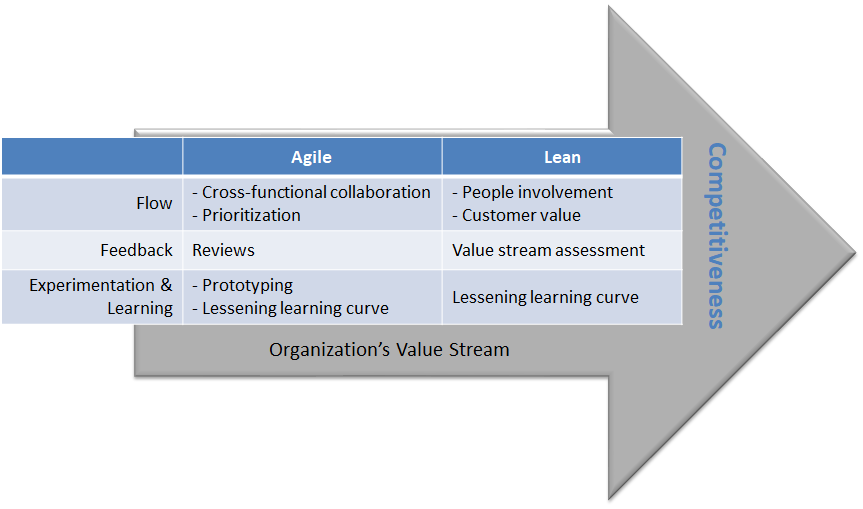
    Figure 5 – Value Stream Mapping, Agile, and Lean

    The objective of the value stream mapping I performed was to outline the features of work environments that take advantage of DevOps Three Ways to equip the company with the competitive advantages needed to resist Amazon and Walmart. The following lines summarize the outcomes.

    Implementing DevOps Flow Principle to Defeat Amazon and Walmart on Innovation: The value stream mapping recommended to leverage Agile and Lean principles to properly implement the flow principle and defeat Amazon on its little product differentiation. The Agile’s features to stress included collaboration and prioritization while focus on people engagement and customer value were the Lean’s benefits to emphasize. Their combination were likely to not only foster innovation culture but also accelerate time-to-market and time-to-value.

    Implementing DevOps Feedback Principle to Guarantee Superior Customer Experience: As to the feedback principles, the value stream mapping recommended to use Lean’s value stream assessment and Agile’s review mechanisms. The objective was to institutionalize continuous improvement practices as a means to ensure superior customer experience.

    Implementing DevOps Experimentation and Learning as the Foundation of the Innovation Capability: As to the experimentation and learning principle, the recommendation was to take advantage Agile’s prototyping and learning curve-lessening features to institutionalize innovation and risk-taking cultures. They were likely to not only help the company challenge its competitors on innovation but also ensure durable revenue and customer loyalty.

    Enabling the Value Streams with Managed PaaS Services

    Using technology ingeniously to boost business activities is clearly one of the keys to succeed in the digital business. Today’s DevOps-timid approach focused on speeding up IT operations alone not only is ineffective, but it also doesn’t make sense. It’s the entire value stream that needs optimization, not just IT.

    The findings of the digital platform assessment I performed, showed as illustrated, that the global e-commerce platform wasn’t enough to compete against Amazon and Walmart. The company was at the embryonic stage of digital transformation maturity practices:

    Figure 6 – Toys R Us Possibly at the Embryonic Stage of Digital Transformation Maturity

    The findings suggested that using technology to innovate or creating the operational conditions to cut cost, accelerate time-to-market and be responsive to market opportunities were either overlooked or improperly addressed.

    Using a digital platform engineering framework allowed me to design in a record time the following architecture:

    Figure 7 – Possible PaaS Platform for Toys R Us

    The digital platform would have built on two cloud services supporting the value stream: managed software as a service (SaaS) and platform as a service (PaaS). Let’s discuss them.

    How Managed SaaS Services Would Have Helped to Fix the Cost Leadership and Business Agility Issues

    SaaS services would have supported the Plan & Measure stage. In addition to supporting varied management activities, it would have provided two fundamental tools that possibly could have enabled the Toys 2.0 strategy: customer relationship management (CRM) and innovation management portfolio. CRM tracks, measures and improves customers’ experience, keeps them loyal and guarantees revenue. Innovation portfolio management identifies innovation ideas, supports their implementation into digital services and monitors generated value. It gives the company opportunities to disrupt and control its industry.

    The on-demand and metered billing features of SaaS services would have allowed Toys R Us to get the needed software in record time while enabling time-to-market, time-to-value and responsiveness competitive advantages.

    How a Managed PaaS Platform Could Have Helped to Address the Express Delivery Issue

    PaaS services would have supported activities covering the Develop & Test, Release & Deploy and Monitor & Improve stages. In addition to providing the technologies needed to implement Toys 2.0 gaming services, it would have built on microservices to set up the automation tool chain and accelerate innovations development and delivery.

    Wrapping Up

    The recent IT innovations are disrupting several industries and expanding the digital economy. To avoid troubles, businesses must urgently start their digital transformation. Toys R Us, Sears and many others learned it the hard way.

    It’s urgent to understand that the digital transformation of your business isn’t only about migrating your IT to the cloud, implementing automation tool chains or deploying artificial intelligence tools across the company. It’s primarily about transforming with a strategic mindset your company’s business model from the ground up.

    Digital transformation is a complex process that engages the entire company, and requires specific methodologies, practices and tools. I renew my recommendation to take the online course, “How Chief Digital Officers Course Set Top Digital Businesses“—you’ll get from it the practical vision, approach, processes, practices and tools that’ll help you create the conditions for successful digital business with DevOps.

    — Philippe Abdoulaye

  • Using DevOps to Be an Innovation Champion

    Using DevOps to Be an Innovation Champion

    Innovation, which increasingly is cited as the competitive advantage businesses need to meet their digital challenges, is widely misunderstood; it’s mistakenly reduced to the sophisticated features of a technology or a service.

    As a competitive matter, innovation is more than that; it’s primarily the process of translating ideas or inventions into high-value technology features or added-value services. In other words, to be called innovation, a technology or a service must satisfy a specific need and create value for customers.

    DevOps is very often seen as the perfect means to make an IT organization an innovation champion, it’s true. Yet, many CIOs and their solution vendors and consultants have failed to achieve that goal because they’ve oversimplified the process. DevOps is part of the process, not the process itself. DevOps isn’t the end but the means.

    In this article, I share two fantastic concepts—Innovation Virtuous Circle (IVC) and Value Stream—we leverage at ITaaSNow to enable DevOps and transform in a record time IT organizations into innovation champions.

    Define Your Strategy with the Innovation Virtuous Circle

    Making innovation your organization’s main competitive advantage isn’t as simplistic as investing in the most sophisticated technologies; it starts with defining your strategy, continues with implementing it throughout your IT organization’s value stream, and ends up with getting it adopted across your business.

    Improvisation and organizational transformation aren’t good friends. Rely on proven frameworks that safely guide the effort step by step; it’s the purpose of the IVC—it facilitates and accelerates the innovation strategy definition effort:

    The Innovation Virtuous Circle (IVC)

    The principle underneath the IVC is the notion that keeping customers loyal through innovation guarantees continuous revenue. The idea is, the more innovation, the more loyal customers and the more revenue.

    Put together your business and IT stakeholders to discuss the means by which customers will be kept loyal to ensure continuous revenue. Follow the steps suggested by the IVC:

    1. Clarify the agile processes and practices, the tools, skills and partners by which customer data will be captured and tracked for analytics purposes.
    2. Identify the agile analytics processes and practices, the tools, people, skills and partners that’ll help to spot innovative ideas, solutions and technologies.
    3. Clarify the agile processes and practices, the tools, skills and partners needed to ensure high frequency, high quality and speedy innovation delivery.
    4. Identify the agile processes and practices, the tools, people, skills and partners that’ll help to monitor customer satisfaction and improve customer experience.

    What you get out of this step is a comprehensive strategy including the targeted customers to keep loyal, the estimated expected revenue along with the organizational capability to achieve them.

    Reconfigure Your IT Value Stream with DevOps

    Once your innovation strategy is defined, the next step is to use the value stream framework to deploy it throughout your IT organization.

    The value stream represents the added-value interactions, people and skills, processes and practices and tools mobilized throughout your IT organization to deliver innovation:

    The Agile IT Value Stream

    It conceptually structures the IT organization’s value stream into a four-stage agile process. Each stage is associated with a specific goal and mobilizes specific elements of your innovation strategy.

    Again, put together your business and IT stakeholders to address the following:

    1. For Plan & Measure, discuss your future governance’s structure, members and roles, agenda along with the tools and infrastructure supporting your analytics-based innovations screening and prioritization and portfolio management processes.
    2. About Develop & Test, get a consensus on the staff to assign, the agile methodology along with the continuous testing and integration infrastructure that will support your innovation development processes.
    3. Regarding Release & Deploy, discuss the staff to assign, your release management and launching processes along with the continuous deployment infrastructure needed to support them.
    4. As for Monitor & Improve, discuss the staff to assign, your service continuous improvement processes, along with the analytics technologies intended to support them.

    What you get is a comprehensive and documented blueprint of your IT organization’s value stream transformed to DevOps. Use it as a baseline to hire the solution vendor and consulting firm that’ll concretely reconfigure your IT operational model to innovation.

     Wrapping up

    Using the concepts of IVC, Value Stream, and DevOps to establish IT operational models that boost innovation is a transformation approach we’ve been using to make businesses innovation champions.

    All of the companies that replicated the organizational transformation approach described in this article are:

    • Rolling out per year more than 20 services and products qualified as innovations
    • Either doubling or tripling their revenue
    • Keeping loyal 98 percent of their customers

    That’s the kind of contributions and impacts your business unit leaders expect from you as the CIO and your IT department.

    — Philippe Abdoulaye

  • Digital Business: Paving the Way for DevOps’ Second Act

    Digital Business: Paving the Way for DevOps’ Second Act

    DevOps is the buzzword of the moment. It’s at the heart of every strategy—not just CIOs’ IT transformation strategies but also IT vendors’ sales and marketing strategies. The question business unit leaders always ask is, “Is DevOps to improve IT or to boost the business?”

    The disconnect is so big between the concerns of today’s DevOps practitioners and business unit expectations on one side and digital competitive challenges on the other that the question is worth asking. Indeed, the proliferation of tech startups and digital services is making competition tougher and forcing business unit leaders to adopt innovation, velocity and timely revenue as their top competitive advantages, helping them to survive their industry disruption and then boost their digital growth.

    Let’s say it straight: The many DevOps and even cloud migration projects out there aren’t likely to help business units effectively address the digital economy’s challenges. Automating your application deployment processes with infrastructure as code and continuous delivery infrastructure on their own will never make your company an innovation champion or equip it with the fastest time-to-value in the world. That erroneous belief is nurtured within the IT community; it’s the tangible proof that IT still doesn’t understand the business. Period.

    Joe McKendrick, in his fantastic, “The Elusive Mystique of the Digital Enterprise,” and, “Cloud Computing’s Second Act is All Business,” offers insights likely to help business unit leaders remind their CIOs the business reality, “What matters is revenue.” IT innovation for the sake of innovation doesn’t make sense. And Adam Jacob, co-founder and CTO of IT automation company Chef, in a fantastic article, “The Secret of DevOps: It’s Always Been About People, Not Technology,” gives a DevOps vision that’s totally in line with business unit expectations more importantly to more effectively address digital competitive challenges.

    Adam Jacob’s System of Thought: The Foundations of DevOps’ Second Act

    Adam Jacob defines DevOps as:

    Fundamentally being about taking the behaviors and beliefs that draw us together as people, combining them with a deep understanding of our customers’ needs, and using that knowledge to ship better products to our customers.

    He adds:

    Notice that I don’t mention technology, which may be surprising coming from the CTO of a DevOps-focused company.

    He concludes:

    Tools matter. But tools exist in service of the prime directive: building highly functioning, highly effective cross-functional teams, that attack your thorniest business problems as a unit, rather than as lone individuals or silos with competing incentives.

    This perspective of DevOps unveils an authentic business thinking for IT that I turned into a digital business approach:

    adam-jacob-thought-v2

    It’s represented through the above virtuous circle of principles structured around customer:

    Customer is the source of digital wealth: This expresses the proven belief that being customer-focused increases service quality, keeps customers loyal and, in turn, increases his value of the money they spend to buy services. It prevents customer churn caused by changing consumption habits, whereby digital services are increasingly preferred to traditional services.

    People make, create and innovate: This principle translates the proven idea that giving staff skills, resources, authority, opportunity, motivation, and holding them responsible and accountable for outcomes of their actions, will contribute to their qualification and satisfaction and ultimately make them committed to the organization’s wealth. It creates work environments and work styles conducive to innovation.

    Behaviors and beliefs strengthen involvement and commitment: This principle highlights the demonstrated notion that sharing common beliefs, principles and values creates team spirit, which increases cross-functional collaboration and, in turn, accelerates problem-solving and decision-making. It contributes to the business agility.

    Product is the digital wealth driver:  It’s the now-acknowledged idea that to succeed in the rising digital economy, businesses must align their application delivery approach to the new product development (NPD) principles. Applications take value to customers. It helps to keep up with the fast-paced digital business environment.

    Velocity makes the business responsive to market opportunities: It’s the widely adopted notion that time-to-value is the essential revenue driver that will make businesses digitally wealthy. That principle is enabled by the continuous delivery infrastructure which automates—therefore accelerates—the application delivery processes chain.

    This unprecedented vision, dominant on the business side, contrasts with the technocentric approach promoted by the vast majority of IT vendors to increase their sales.

    Being honest to customers is telling them this: Implementing continuous delivery infrastructure is not implementing DevOps. It will never, on its own, make the business digitally competitive.

    I have no doubt that you’re convinced Adam Jacob, Joe McKendrick and even Ernest Mueller, author of “DevOps: It’s Not Chef and Puppet” are definitely right. The question you might be asking now, which may be provocative is, “Okay, that’s good! How do you implement all that?”

    Implementing DevOps’ Second Act Foundations into a Digital Business Capability

    The first step toward implementing DevOps is to admit that a new IT paradigm is needed, Adam articulates it that way:

    Leaders need to realize that implementing DevOps means changing the technology system as well as the cultural system. They must acknowledge that both are intertwined and, to be successful, both systems must evolve to drive velocity.

    It’s not different from the two-dimension IT advocated in my recent book, “Rethink Your IT with DevOps: The Complete Guide to Aligning Your IT to DevOps” and  in my online contents, “Become Digitally Savvy in Just Hours. Boost Your Digital Revenue Now“:

    two-dimension-it

    DevOps implementation is based on four principles that determines successful business transformation:

    Concerns have shifted from technology efficiency to business agility: Forget the outdated idea that IT tools on their own can help your business units succeed. What will make them digitally successful is the combination of technology efficiency and organizational flexibility and agility.

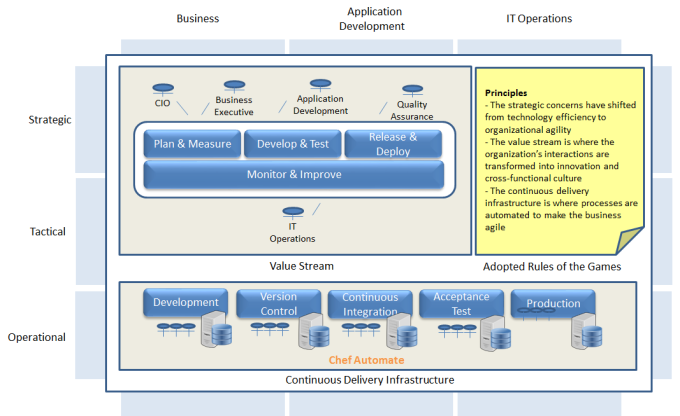
    See IT as a two-dimension asset: To win legitimacy among business units, offer a two-dimension vision of IT including the value stream and the continuous delivery infrastructure. Value stream is where value is created and the continuous delivery infrastructure is what enables business agility.

    The value stream is where the innovation and agility cultures are built: Transform your business organizational structure into an agile value stream through deploying agile practices and methodologies such as Scrum, Kanban and Exteme programming.

    The CD infrastructure is where fast time-to-value is enabled: Automate your applications delivery processes into an accelerated applications delivery chain using automation and continuous delivery tools such as Chef Automation, AWS CodePipeline and Apprenda.

    Summing It Up

    Experienced DevOps Strategists know that DevOps is the means to an end, and not the end itself. DevOps is an enabler to one or a combination of these business competitive advantages: short time-to-value, market responsiveness, innovation culture and many more.

    All the noise surrounding the so-called DevOps tools has to do with technology business—making money through selling IT tools—and absolutely not DevOps.

    DevOps isn’t a tool, it’s an IT approach stressing business competitiveness: shorter time-to-value, market responsiveness and innovation.

    — Philippe Abdoulaye

  • 3 AWS Design Patterns to Maximize DevOps Value

    3 AWS Design Patterns to Maximize DevOps Value

    Many business leaders are planning to make DevOps the cornerstone of their IT transformation strategy. But, as surprising as it might sound, skepticism abounds regarding how major vendors address the DevOps transformation challenges—they confuse DevOps with continuous delivery (CD) infrastructure.

    “We wanted DevOps and we got after a nine-month-long implementation a continuous delivery platform which speeds up IT operations without significant business value. How differently can you help?” the senior business executive of a major financial institution in New York sarcastically asked me during a conversation three months ago.

    The business executive is right: DevOps isn’t a technology as I’ve been implementing it, it’s primarily an accelerated application delivery approach implemented in the form of a technology-enabled application delivery operational model. Adam Jacob, CTO of Chef, substantiates that fact in “The Secret of DevOps: It’s Always Been About People, not Technology,” when he says, “DevOps is about bringing together all the people you need to build and run your business effectively, and empowering them to move as quickly as possible towards their goals.”

    Agile Admin’s Ernest Mueller in, “DevOps: It’s not Chef and Puppet,” confirms Adam’s point: “Chef and Puppet are individual tools that you can use to implement specific parts of an overall DevOps strategy if you want to use them—but that’s it. They are fine tools, but do not solve DevOps for you.”

    How can we implement DevOps in line with business leader expectations? Three Amazon Web Services (AWS) Design Patterns I developed can help to get the best of DevOps on AWS cloud: Software Organization Factory, Digital Organization Factory and CD Infrastructure Factory. This article discusses the Software Organization Factory.

    The Foundation of DevOps Value: Consequences to IT Service Delivery

    Before delving into these AWS design patterns, a quick reminder of what DevOps is, its value propositions and, more importantly, what changes are needed in how IT services are delivered.

    The Ignored DevOps Business Logic We All Must Consider

    The combined effect of cloud adoption and the rising digital economy is changing competitive environments; it forces business leaders to focus on innovation and market responsiveness as the competitive differentiators.

    The fact of the matter is, by facilitating access to technology, cloud accelerates entrance of several thousands of tech startups that take advantage of the recent technology innovations to substitute traditional products and services into digital. This creates a context where new entrants increasingly compete with established brands, forcing business leaders to seek value paradigms other than IT efficiency.

    The business executive argues, “In these new markets, our concern is to increase customer value by delivering the right services to the right segments at the right moment. You guys need to change the IT paradigm; IT alone does not create that kind of value.”

    Then, what should be changed in today’s IT approach?

    The Two Dimensions of Modern IT: The Operational Model and the Continuous Delivery  Infrastructure

    The new IT paradigm advocated in my recent book, “Rethink Your IT with DevOps: The Complete Guide to Aligning Your IT to DevOps,” is the idea that business value results from two dimensions: organizational agility and technology efficiency. In other words, it defines modern IT as a two-dimension asset including the operational model and the continuous delivery infrastructure.

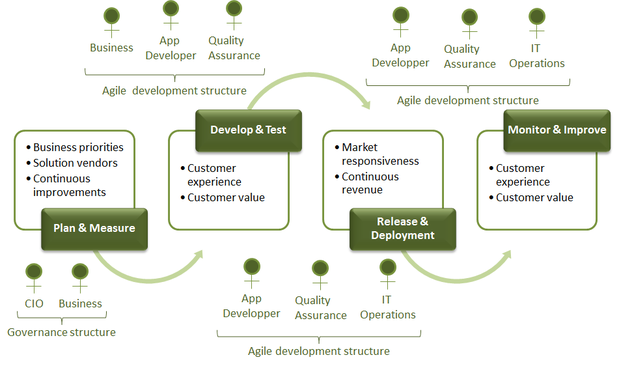
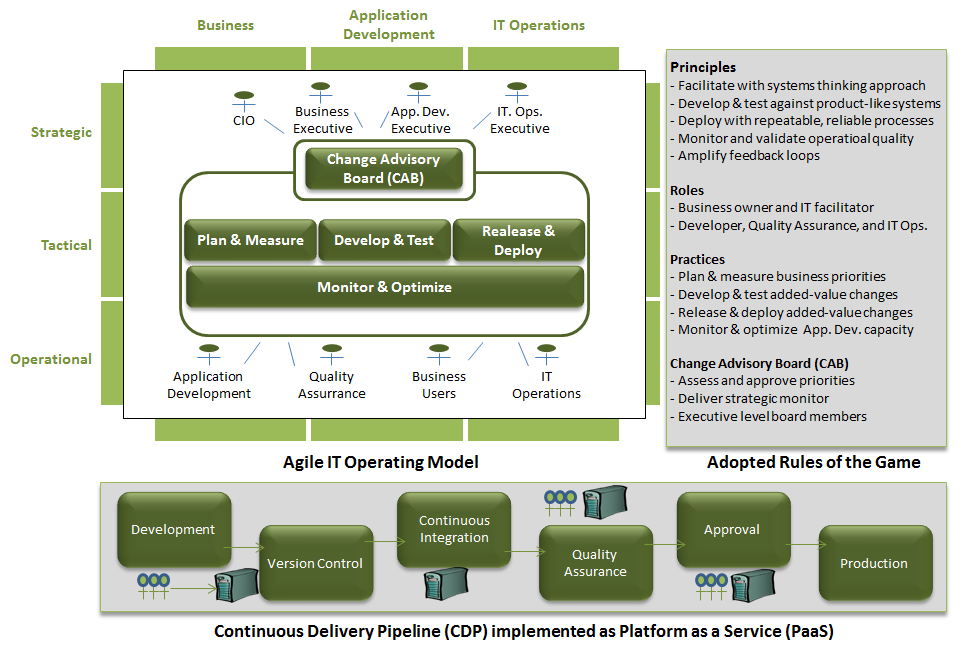
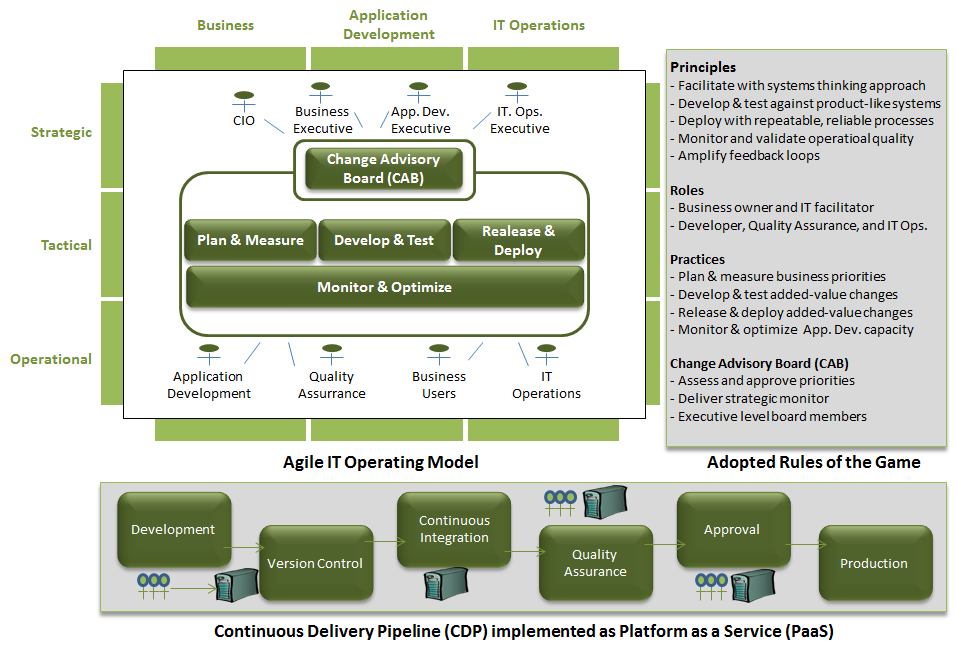
    The timely delivery of innovation transcends IT issues; it not only cuts across your sales, marketing, post sales, application development and  IT operations, but also demands concrete answers as to how to accelerate business prioritization, decision-making and problem solving. The operational model is where business and IT people, processes, practices and tools are combined to create agile and cross-functional environments. The following exhibit shows a typical DevOps operational model:

    Typical DevOps Operational Model
    Typical DevOps Operational Model

    Organizational flexibility for the sake of flexibility doesn’t make sense unless technology is leveraged to speed processes. This is where CD infrastructures come into play; throughout the delivery process, they build on IDEs to accelerate coding and testing, on versioning tools to convert software version into releases, on continuous integration (CI) tools to build releases and on delivery pipelines to ensure continuous delivery.

    So, what is DevOps?

    DevOps is a Technology-Enabled Application Delivery Model

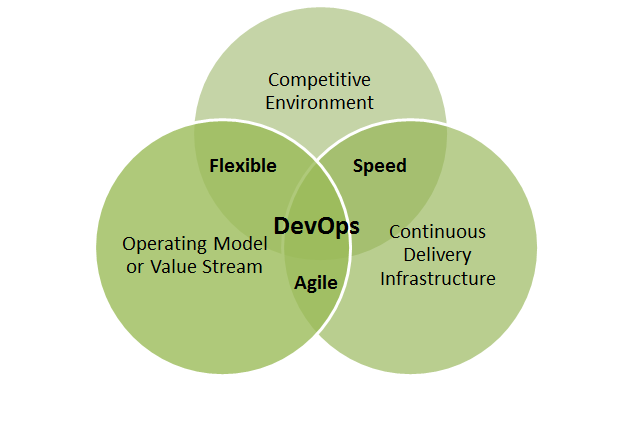
    DevOps is a combination of value, principles, processes and practices shared not only by developers and IT operations but also by the business. The goal is to help the organization deliver the right service to the right market segments at the right moment.

    DevOps from the Business Perspective
    DevOps from the Business Perspective

    As I’ve been implementing it, it’s a cross-functional application delivery model involving the business and IT and enabled by continuous delivery infrastructures.

    By enabling and automating agile practices, the continuous delivery infrastructure makes the operational model agile and provides the business with the flexibility and velocity needed to meet competitive challenges.

    Design Patterns as DevOps Implementation Engineering Framework

    As suggested by the business executive, today’s DevOps implementations struggle to deliver the promised business benefits. The reason is, the operational model dimension is ignored in favor of tools and infrastructure.

    Another reason is, DevOps is young and is still at the early stage of the technology maturity model; the expertise and engineering methodologies to implement it as what it is—a technology-enabled application delivery model—are lacking. That’s where DevOps transformation design patterns help.

    What are DevOps Transformation Design Patterns?

    In this article, the term DevOps transformation design patterns refers to general reusable architectures addressing specific DevOps strategy. They’re not necessarily implementable solutions, their primary goal is twofold:

    • Offer a neutral language for designing and implementing technology-enabled operational models
    • Offer an engineering approach that reduces design and implementation duration and effort

    They’re formalized architecture design and implementation best practices for DevOps and platform-as-a-service (PaaS) services.

    Design Pattern as DevOps Implementation Engineering Methodology

    To meet its goals—technology-enabled application delivery model—the design pattern is structured around four items including purpose,  principles, general solution and implementation techniques.

    Purpose: Clarifies the purpose of the design pattern along with the DevOps strategy to address.

    Principles: Are best practices formulated as rules and beliefs supposed to guarantee expected DevOps strategy benefits? They’re the determinants of the solutions to implement the DevOps strategy.

    General solution: Are blueprints resulting from the application of principles? They summarize the functional and technical architecture of the DevOps platform to implement.

    Implementation techniques: What are recommended technical approaches, solutions and tools to implement the general solutions?

    Why AWS? Why would it be the catalyst for DevOps value?

     AWS-ome Design Patterns That Will Change DevOps Implementation

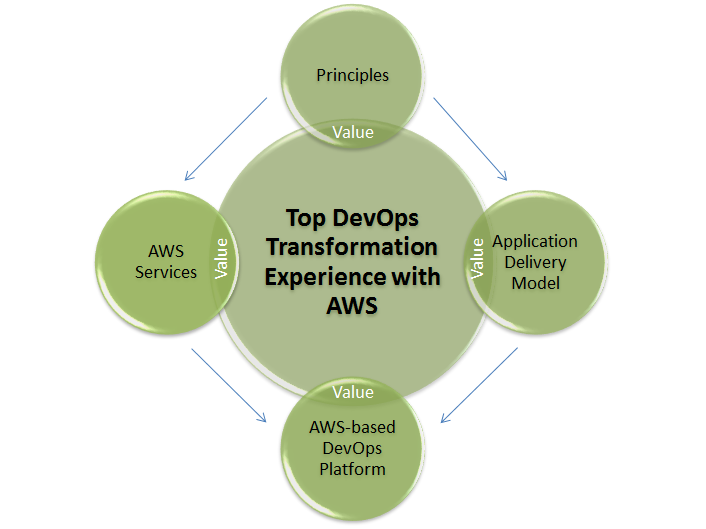
    AWS offers such a rich, varied and easy-to-implement services portfolio that it would be unfortunate not to take advantage of it to modernize IT. The rationale underpinning the value businesses can derive from their DevOps transformation experience with AWS is summarized in the following figure:

    Rationale of the DevOps Design Pattern
    Rationale of the DevOps Design Pattern

    It’s the belief that:

    • Certain principles determine the AWS services needed to deliver the application delivery model (ADM) architecture that guarantees value.
    • The implementation of the ADM using these AWS services results in AWS-based DevOps platforms that tangibly deliver expected benefits.

    The Four DevOps Principles that Yield AWS Value

    Let’s explore the principles I’ve been using to make CIOs happy with their AWS cloud:

    1. Think holistic, not only IT: Reminds that transformation isn’t only about IT but the entire organization’s value stream from marketing and sales to development and IT operations.
    2. Think cross-functional, not only IT: Reminds that the bottom line is to set up a cross-functional application development environments to accelerate business prioritization, problem-solving and decision-making, and meet time-to-value objectives. They’ll be the core value propositions of the DevOps platform.
    3. Make it agile, flexible, and speedy: Reminds that agility, flexibility and speed are the catalysts for competitiveness and business value. They’ll be part of the DevOps platform.
    4. Think PaaS: Reminds that AWS provides varied services for implementing state-of-the-art CD infrastructure.

    Let’s illustrate three AWSome design patterns that’ll change DevOps experience with AWS!

    Implement a Startup Mindset with the Software Organization Factory

    The purpose is to implement DevOps strategies focused on time-to-market and time-to-value. It’s adapted for tech startups.

    To implement the startup mindset, the DevOps four principles for AWS are implemented as follows:

    • Think holistic and cross-functional, not only IT: Relevant business and IT resources are put together in a single and dedicated service development team supported by appropriate Scrum and XP agile practices.
    • Make it agile, flexible and speedy: PaaS services building on agile practices and AWS infrastructure-as-code are provided to make application delivery processes agile, flexible and speedy.
    • Think PaaS:  AWS infrastructure as code and DevOps tools are combined to implement a CD infrastructure in the form of a PaaS platform.

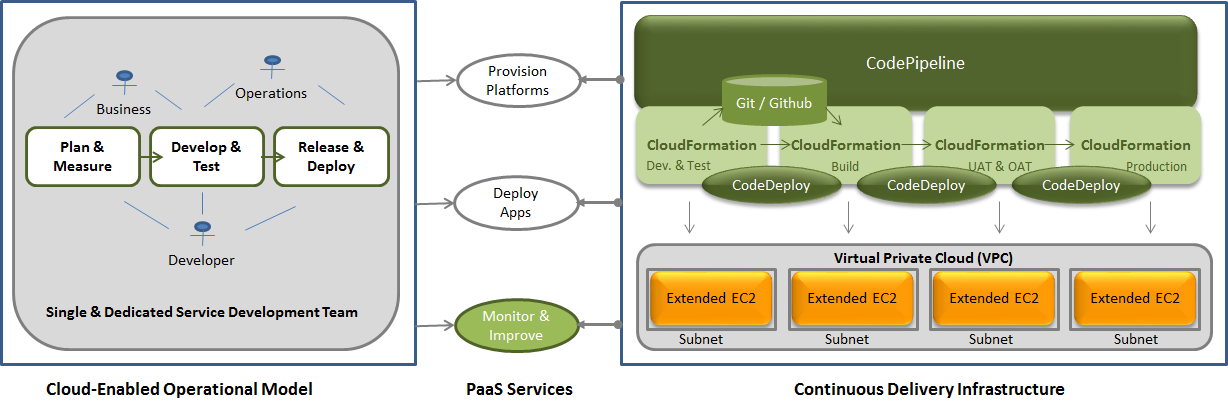
    The DevOps platform resulting from the principles application is illustrated below:

    Software Organization Factory
    Software Organization Factory

    The “Startup Mindset” platform is structured around three components including the cloud-enabled operational model, PaaS and the CD infrastructure.

    The operational model builds on a three-stage application delivery life cycle:

    •  Plan & measure: It mobilizes business users, development, QA and operations staff on business prioritization issues using agile practices such as Scrum product backlog planning or XP’s user stories.
    • Develop & Test: It mobilizes business users, development, QA and operations staff across the development life cycle using agile techniques such as Scrum iterations, XP’s test-driven development (TDD) and behavior-driven development (BDD).
    • Release & Deploy: It leverages continuous integration practices to build and test releases prior to deploying to production.
    • Monitor & Improve: It’s outsourced to keep the service development team on its core business: developing software.

    The CD infrastructure combines the followings services:

    • AWS CodePipeline and CodeDeploy to set up the delivery pipeline.
    • AWS infrastructure as code including CloudFormation, OpsWorks and Elastic Beanstalk to generate the CD infrastructure.

    Summing It Up

    The DevOps business benefits are real, yet, it’s young and is still at the early stage of the technology maturity model. The expertise and engineering methodologies needed to implement it as what it is—a technology-enabled application delivery environment—are lacking.

    DevOps design patterns such as the software organization factory fill the gaps of today’s transformation practices:

    • They provide the architect team and the executive team a neutral language to discuss the business, technological and technical challenges and solutions.
    • By pointing out the agile practices to leverage, they simplify and accelerate the design and deployment of the operational model.
    • By pointing out the AWS services and features to leverage they facilitate the design and implementation of the CD infrastructure.

    The DevOps implementation process described in this article is fully documented in my recent book, “Reinventing Your IT with DevOps: The Complete Guide to Aligning Your IT to DevOps.”
    In my next article I’ll tackle the Digital Organization and the CD infrastructure design patterns.

    — Philippe Abdoulaye

  • What Can Digital Transformation Do For You?

    What Can Digital Transformation Do For You?

    Contrary to what the massive articles around digital transformation suggest, your business lines’ primary concern isn’t the amazing technology innovations that pop up every day but how well they’re going to deal with your industry’s disruption. Something is sure, your IT organization’s digital transformation cannot be narrowed to technology changes; that’s a simplistic vision which ignores the disruptive impacts on businesses, particularly on the IT function.

    Howard King, writing in “What is Digital Transformation?” published in The Guardian, makes it clear, “Transformation is a whole scale change to the foundational components of a business: from its operating model to its infrastructure. What it sells, to whom and how it goes to market.” He’s right, the business-oriented vision of IT demands a transformation of your IT organization including its infrastructure, applications delivery approach and operating model, and DevOps increasingly is cited as the foundation of the new IT.

    This article shares my experience and lessons learned implementing DevOps as the foundation of digital IT organizations.

    Top Priority: Dealing with Your Industry Disruption

    The belief that implementing a continuous delivery infrastructure is all your business need to survive digital disruptions is a marketing hype DevOps practitioners have grown accustomed to. It’s a myth that prevents you from making informed digital transformation decisions. Emphasizing the technology at the expense of your industry’s disruption forces you to make technology change prematurely; your priority actually should be to figure out how to deal with the disruptions hitting your industry.

    Ask yourself this: What’s the interest in investing in scattered continuous delivery infrastructure implementations, when your favorite vendors and consultants aren’t able to clearly address these concerns:

    • How can you restructure your business value stream to make it lean and agile so that the right services are timely delivered to the right market segments?
    • How can you integrate DevOps, IT as a service, cloud, Internet of Things and big data into a coherent and consistent business capability so that the right services are timely delivered to the right market segments?
    • What’s the architecture of your future information system, including your virtual data center and application delivery infrastructure?
    • What will your role be as the CIO? How will the relationships with your business lines and vendors be managed?

    Make no mistake about it, these are your business line concerns of the moment. Unless you address them, Chef, Puppet, CodeDeploy or any other software application alone won’t help to keep up the pace imposed by Uber, Apple, Google and the like. You’ll need to bring together your business and IT staff in a lean and agile capability, which demands a re-engineering of your IT structure, processes, practices and governance.

    DevOps is the Foundation of Your Digital IT Organization

    Let’s remove the ambiguity: Infrastructure as code isn’t DevOps. The increasing confusion of DevOps with continuous delivery infrastructure is slowly but surely killing it—it’s even disqualifying it as a competitive advantage. That vision focused on tools has nothing to do with the logic underneath DevOps.

    As I’ve been making clients happy with it, DevOps is primarily an application delivery model that seeks to make businesses responsive to market opportunities through accelerating added-value applications delivery and with the goal of continuously generating value. It’s based on three principles helping businesses survive digital disruptions, then grow and prosper:

    • Using continuous delivering infrastructure to speed application delivery doesn’t make sense unless tangible business benefits are generated.
    • Applications are the means by which value is brought to customers and business benefits are brought in.
    • Agile principles across your software development life cycle makes your value stream lean and agile which in turn results in continuous value.
    DevOps Delivery Model - Philippe Abdoulaye
    DevOps Delivery Model – (Credit: Philippe Abdoulaye – ITaaS Now LLC)

    The delivery model uses three levers to implement the above principles and establish DevOps as the foundation of your digital IT, they include:

    • The rules of the game, which are agreed-upon principles, practices, roles and responsibilities and tools institutionalized to ensure agility and accelerated applications delivery;
    • The operating model, which is the lean and agile work environment resulting from the application of the rules of the game; and
    • The continuous delivery infrastructure, which is a platform that leverages infrastructure-as-code solutions to accelerate applications development and deployment.

    The Digital IT Organization: Approach, Principles, Tools

    Success in IT organization transformations often come more from a stream of small wins than from a one-time flood. That’s what I call incremental transformation, illustrated in the following digital five-stage transformation journey:

    The digital IT organization implementation process
    The transformation journey – (Credit: Philippe Abdoulaye – ITaaS Now LLC)

    The following recommendations definitely will make you instrumental to your IT transformation and help your business meet the digital economy’s competitive challenges.

    Strategize

    A CIO who’s expected to help business lines survive their industry’s disruption, grow and prosper first must clarify their business objectives; estimate potential gains, losses, and risks; and create a consensus on the DevOps delivery model to implement in terms of high-level architecture and implementation timing. That’s the purpose of the Strategize stage.

    Never skip this stage—it’s where the executive buy-in is obtained and the vision of the future IT capability is developed. Make sure the following is accomplished:

    • Creating an executive task force co-led by the CIO and a business representative;
    • Scheduling one to three workshops addressing your transformation business case, transformation road map, high-level blueprint of the future IT capability and the DevOps adoption plan;
    • Designating a project manager; and
    • Communication by task force members regarding the whys and wherefores of the transformation initiative.

    Plan

    Digital transformation involves many functions within your business in the form of a cross-functional team: the concerned business and IT staff. Your responsibility as the CIO is to bring the voice of the business across the transformation journey, from business objectives clarification, to design and implementation, to pilot experiment, to deployment.

    Again, do not overlook this stage—it’s about translating the effort into team structure, implementation schedules and operational and strategic reviews. It’s where the risks likely to hamper projected objectives are anticipated. Make sure workshops involving the business and IT are set up to address the following:

    • Team structure and roles and responsibilities;
    • Transformation road map steps translated into operational timelines associated along with expected outcomes; and
    • The project’s operational and strategic reviews, including a risk management plan.

    Design and Implementation

    The third stage is when the three dimensions of the digital IT organization are designed and implemented. They include the DevOps rules of the game, the operating model and the continuous delivery infrastructure.

    Never improvise this stage—use a proven approach to address the dimensions. Favor a collaborative approach that includes workshops or brainstorming sessions with the concerned business and IT staff.

    In the rules of the game brainstorming sessions, make sure the following is addressed:

    • Organization and operational dysfunctions preventing cross-functional collaboration, rapid problem-solving and decision-making;
    • Recommendations to the dysfunctions in terms of agile processes, practices, roles and responsibilities and tools;
    • Recommendations mapping to the appropriate DevOps principles, practices, roles and responsibilities and governance structure; and
    • The IT organization’s DevOps charter, thought to accelerate the rules of the game and the operating model adoption.

    In the continuous delivery infrastructure workshops make sure the following is addressed:

    • A delivery pipeline, including steps and for each of them what follows:
      • Required staff, skills and background
      • Implementation, testing and deployment agile processes and practices
      • Implementation, testing and deployment tools, such as Chef, Jenkins or CodePipeline

    Experiment

    For this stage, set up a pilot experiment involving, in a small-scale real-business setting, a panel of business and IT staff to evaluate the likelihood of the project benefits.

    Neither skip nor overlook that step, it’s where improvements are identified. Throughout the pilot project, make sure the following is in place:

    • Executive task force monitoring the pilot project through bi-weekly reviews;
    • Concerned business lines and IT business lines are involved;
    • Training campaigns are organized around the DevOps charter, the operating model and the continuous delivery infrastructure;
    • Strategic management tools, such as balanced scorecards to monitor progress, risks and achievements; and
    • Measurement of the impacts of the operating model and the continuous delivery infrastructure against the projected benefits.

    Deploy

    This final stage is a Go-No-Go milestone in which your task force, based on the pilot’s outcome, decides whether to deploy your digital IT capability at the scale of the company. Throughout the deployment:

    • Capitalize on the benefits generated by the pilot experiment to launch an information campaign emphasizing the benefits for the company and for the staff; and
    • Train business and IT staff on the DevOps charter, the operating model and the continuous delivery infrastructure.

    Wrapping up

    Today’s DevOps practices focused on continuous delivery infrastructure aren’t likely to help businesses grow and prosper in the digital economy. Thought leader Joe McKendrick in, “The road to digital bliss is paved with service thinking and DevOps,” confirms that fact.

    The approach discussed in this article are detailed in my recent book, written to help make IT leaders instrumental to their business digital transformation:

    Rethink Your IT with DevOps

    If you’re considering a DevOps-focused IT transformation, what will be your first steps? I’d love to hear your thoughts, let’s meet @TheFutureOfYourIT.

  • DevOps and ITaaS: Two Sides of the Same Coin

    DevOps and ITaaS: Two Sides of the Same Coin

    It seems IT practitioners haven’t realized yet the scale of digital disruption. Mired in the old IT thinking, they firmly believe that sophisticated tools are all businesses need to survive the ongoing digital disruption waves. Most of them warn, “Digital transformation is changing the way we do business, the way we deliver IT services must change, businesses need to adapt the way they work.” The problem is, there’s nothing new in what they offer to help businesses work the “right” way.

    Indeed, the same old IT thinking’s practices are still applied with the illusion that deployment automation and configuration management tools on their own will make businesses agile, responsive to market opportunities, and therefore in line with the digital economy’s competitive challenges. That belief misses the point for two reasons: First, it’s an incorrect understanding of what business agility is, and second, it’s a misunderstanding of the global competitive environment’s transformation.

    Turning your IT organization lean and agile is the competitive differentiator your business lines desperately have been calling for. Authentic DevOps implementation is the way to go. That’s the price to pay to keep up with the pace imposed by new leading-edge companies such as Google, Apple, Uber and the like.

    The changing competitive environment forces businesses to focus on innovation, market responsiveness and timely revenue

    A digital economy threatens the existence of all businesses. Yes, you read it right, their existence is at stake. And that fact is underestimated by IT vendors and consulting firms.

    As illustrated, we’re shifting from business environments where established businesses (incumbents) control a large percentage of market segments to competitive contexts where, attracted by the amazing digital opportunities and the adoption of cloud which significantly reduces infrastructure expenses, a growing number of startups disrupt entire industries:

    The changing competitive environment (Credit: Philippe Abdoulaye ITaaS Now LLC)
    The changing competitive environment (Credit: Philippe Abdoulaye ITaaS Now LLC)

    The proliferation of startups created by highly qualified unemployed seniors and creative entrepreneurs, coupled with the propagation of highly innovative digital services (e.g., Internet of Things [IoT] applications) substituting traditional services, have been disrupting the vast majority of industries.

    Several examples substantiate that fact: the taxi industry shaken by the emergence of technology-driven companies such as Uber, the banking industry facing new breed of competitors including PayPal, Google and Apple; and the healthcare industry increasingly disrupted by companies such as GlowCap.

    To grow and prosper in the digital era, your scale, brand equity or market capitalization aren’t enough anymore. To succeed, your business lines must be on top of the digital economy’s competitive standards: competitive innovation (the ability to continuously improve customer experience), market responsiveness (the ability to deliver added-value services to the right market segments at the right moment) and timely revenue (the ability to continuously increase customer value).

    The digital economy has taken IT to an inflection point—deploying sophisticated tools isn’t enough; being lean and agile is the way to go

    The obligation for business lines to focus on innovation, market responsiveness and timely revenue is unprecedented for techies; it forces them to think beyond tools and address issues as unusual as organizational and operational effectiveness.
    Indeed, innovation, market responsiveness and timely revenue assume greater cross-functional collaboration, IT focus on business priorities, organizational flexibility and accelerated time to market. Make no mistake, you’ll never achieve them by only deploying tools, but by also making your IT operating model flexible through proactively eliminating the organizational and operational dysfunctions that prevent cross-functional collaboration, fast problem-solving and decision-making.

    That’s what is meant by making the business agile.

    The new IT thinking is summarized in that simple  arithmetic: Digital Competitiveness = Lean and Agile Operating Model + Effective and Efficient Tools. Without the lean and agile operating model, innovation and timely revenue are wishful thinking. Without effective and efficient tools, innovation and market responsiveness are wishful thinking as well.

    The organizational and technological dimensions are complementary. Adam Jacob, Chef’s CTO, confirms that fact in a very informative article, “The Secret of DevOps: It’s Always Been About People, Not Technology.” This is where DevOps can help businesses succeed.

    DevOps is the IT asset businesses need to succeed in the digital economy

    Contrary to a now (unfortunately) established belief, DevOps isn’t a technology; Chef, Puppet, Jenkins, OpsWorks, alike aren’t DevOps, they’re only pieces of it. It’s important to be clear about it.

    As I’ve been implementing it, DevOps is a system of principles, practices, roles and responsibilities, governance structure and tools purposely arranged to establish cross-functional collaboration, enable accelerated applications delivery and, in turn, make the business responsive to market opportunities:

    DevOps Model (Credit: Philippe Abdoulaye ITaaS Now LLC)
    DevOps Model (Credit: Philippe Abdoulaye ITaaS Now LLC)

    As illustrated, DevOps as a business capability is made up of three components: the Rules of the Game, the IT Operating Model and the Continuous Delivery Pipeline (CDP). Let’s explore them.

    DevOps Rules of the Game create the conditions for lean and agile IT environments

    Rules of the Game are a fundamental dimension of DevOps: They enable the establishment of lean and agile environments. I refer to them as the DevOps non-technological piece.

    In practical terms, they’re a set of principles, practices, roles and responsibilities and tools institutionalized to ensure accelerated applications delivery.

    They serve as catalysts to specific organizational and operational effective practices. Let’s take the principle, “Facilitate with system thinking (involvement of all relevant stakeholders)”—it forces application development stakeholders to adopt a collaborative mindset, which in turn breaks down organizational silos to eliminate the impediments to operational flexibility and institutionalize cross-functional collaboration.

    They’re the poor cousin of today’s DevOps practices, which ignore them in favor of more technical and technology issues. That’s a terrible mistake that reduces DevOps influence vs. the digital economy’s challenges.

    The agile IT Operating Model establishes the lean and agile work environment

    The IT Operating Model reflects the interactions that take place across your application development value stream. In practical terms it represents the work environment derived from the application of DevOps’ rules of the game.

    I always remind my clients that DevOps’ rules of the game aren’t theories, they’re the foundations of a tangible strategic capability: the lean and agile IT  environment. They demand a thorough transformation of your application development work space to put together business, application development, and operations:

    The lean and agile IT work space illustrated (Credit: O.C. Tanner)
    The lean and agile IT work space for the digital era illustrated (Credit: O.C. Tanner)

    The picture illustrates what’s meant by lean and agile IT environment, it substantiates Adam Jacob’s point that “Fundamentally DevOps is about taking the behaviors and beliefs that draw us together as people, combining them with a deep understanding of our customers’ needs, and using that knowledge to ship better products to our customers.”

    The IT operating model is the poor cousin of today’s DevOps practices which ignore it in favor of more technical and technology issues. Once again, it’s a terrible mistake that reduces DevOps influence vs. the digital economy’s challenges.

    Make no mistake, technology matters, the CDP helps to meet digital technologies challenges

    The importance of the rules of the game and the resulting IT operating model don’t suggest at all that technology doesn’t matter. Make no mistake about it, the CDP is essential; I refer to it as the DevOps technological piece. Through deployment automation and configuration management tools, it significantly accelerates application development, testing, resources provisioning and deployment.

    However, one thing to be aware of is, digital economy raises technological challenges that transcend speedy delivery issues. They include:

    • The importance of IoT
    • The pivotal role of predictive analytics
    • The increasing importance of APIs

    As a matter of fact, IoT devices generate massive data and making use of it to generate revenue requires big data technologies to integrate, automate and analyze them.

    On the other hand, this ocean of IoT data has generated an API business; the idea is, to monetize their data and generate revenue, businesses must provide their customers and partners with APIs that easily give access to their systems.

    Implementing the CDP as part of PaaS cloud services can help to prosper in the digital economy; it allows businesses to benefit the cheap and on-demand computing, storage and network resources provided by the cloud.

    Takeaway

    In hindsight, with a business-oriented perspective, the ITaaS delivery model and DevOps follow the same goal: Provide business lines with the lean and agile IT environments they need to be flexible enough and responsive to meet the competitive challenges of digital economy:

    The ITaaS Delivery Model (Credit: Philippe Abdoulaye ITaaS Now LLC)
    The ITaaS Delivery Model (Credit: Philippe Abdoulaye ITaaS Now LLC)

    Like DevOps, the ITaaS delivery model (…) takes advantage of an agile IT operating model to help businesses succeed in the digital era. It implements consumer-provider relationships across the IT value stream to ensure organizational flexibility and operational agility.

    CIOs must realize that what matters to the business is to continuously generate revenue through improving customer experience and increasing customer value. Deploying applications at the speed of light for the sake of speed doesn’t make sense from a business perspective; as long as expected business benefits aren’t achieved, speed is a useless gadget.

    Implement DevOps as what it is: a three-dimension IT capability including rules of the game, IT operating model and, of course, continuous delivery pipeline.