Category: DevOps Practice

  • Dynatrace Adds Security Gates to Advance DevSecOps Adoption

    Dynatrace Adds Security Gates to Advance DevSecOps Adoption

    Dynatrace today added a security gates capability to its observability platform to make it easier to automatically embrace DevSecOps best practices within an application delivery pipeline.

    Steve Tack, senior vice president for product management at Dynatrace, said the security gates function much the same as the quality gates that Dynatrace previously added to that platform in that each release is now also automatically assessed to ensure only secure code is being deployed.

    The Dynatrace platform now uses a Davis artificial intelligence (AI) engine to scan for vulnerabilities in application workloads in real-time and then prioritizes them based on the risk they pose, noted Tack. The goal is to make it simpler for organizations to incorporate security reviews in application development processes in a way that doesn’t necessarily require developers to become security experts, he added.

    Instead, the core DevOps platforms should be capable of identifying issues that can be remediated before an application is ever deployed in a production environment, said Tack.

    Dynatrace earlier added an ability to automatically identify the software libraries and open source packages that present the greatest security risk. The security gates capability now extends the scope of that effort to include applications as they are constructed using custom code.

    In general, most organizations are looking for ways to embrace DevSecOps best practices. The challenge is achieving that goal without unduly slowing down the rate at which applications are developed. In fact, a recent survey commissioned by Dynatrace found, on average, organizations expect to increase the frequency of their software releases by 58% over the next two years. However, nearly a quarter (22%) of respondents admit they’re often under so much pressure to meet the demand for application deployments that they must sacrifice code quality, which broadly includes security issues.

    It’s not clear to what degree security reviews will automatically be included within a quality assurance process, but Tack said the goal should be to limit human involvement in the application deployment process as much as possible. The issue many development teams encounter today is that applications are being rejected by cybersecurity teams that are reviewing applications just before they are deployed, noted Tack. As a result, developers are racing to build applications faster only to see them rejected and returned to them at the last possible moment, he added.

    In the wake of a series of high-profile software supply chain breaches, the focus on DevSecOps has increased substantially within most organizations. It’s often not precisely clear who is responsible for application security, but as DevOps platforms continue to evolve, there may come a day when security issues are routinely addressed within every DevOps workflow.

    In the meantime, there needs to be a lot more focus on bridging the divide between DevOps and security teams. Given the chronic shortage of security professionals, there’s no doubt DevOps teams need to assume more responsibility for application security. The challenge and the opportunity is finding a way to achieve that goal with the least amount of friction possible.

  • Allstacks Adds Free Dashboard to Track Software Dev Benchmarks

    Allstacks Adds Free Dashboard to Track Software Dev Benchmarks

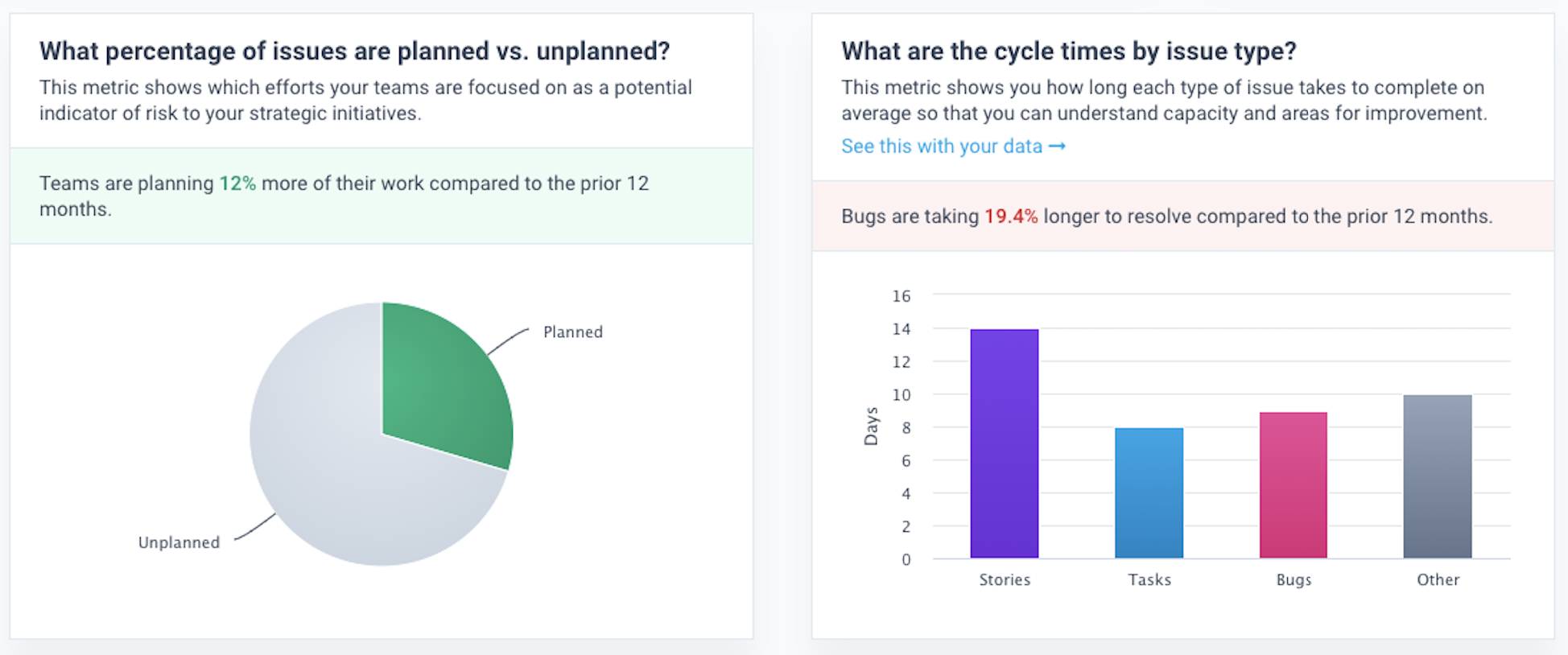
    Value stream intelligence platform provider Allstacks today added a free live dashboard populated with anonymized data that DevOps teams can use to benchmark their own progress.

    Hersh Tapadia, Allstacks co-founder and CEO, said the company is making this data available to make it easier for DevOps teams to uncover bottlenecks in their software development processes.

    As part of that effort, the dashboard includes pre-configured benchmarks for the following:

    How many days per week do benchmark teams write code?
    What percentage of issues are planned versus unplanned for benchmark teams?
    What are the cycle times per issue type for benchmark teams?
    What types of code do benchmark companies produce?
    What is the average commit size for benchmark customers?

    Allstacks

    Allstacks has committed to making 12 months of data publicly available on the dashboard and said it will update that data on an ongoing basis. Allstacks customers, however, can also access five years of data to compare historical trends.

    Tapadia said Allstacks plans to add additional benchmarks to a dashboard that can collect data via the various application programming interfaces (APIs) that most DevOps tools now routinely provide. The overall goal is to increase transparency into software development processes, he said.

    Allstacks’ value stream intelligence platform uses machine learning algorithms and artificial intelligence (AI) models to identify projects that are at risk of not meeting delivery goals. That data is then used to analyze the impact those missed deadlines are likely to have on various business objectives.

    Value stream management platforms automatically take technical metrics, gathered via a DevOps process, and match them to a set of key performance indicators (KPIs) defined by business leaders. The challenge many organizations still face is making sure they have the tools in place to collect the appropriate technical metrics and then define the KPIs that truly matter to the business. Once those metrics are gathered and KPIs established, organizations are then able to apply advanced analytics to the massive amounts of DevOps data they collect.

    The concept of value stream management traces its lineage back to lean manufacturing methods, which called for each step of a manufacturing process to be continuously measured. As software development has evolved from being a craft to a process that is highly automated using DevOps best practices, an appreciation for the value of monitoring the impact of missed software development deadlines on the business has grown as organizations realize how dependent they are on software.

    As a result, more organizations realize there is a clear disconnect between their business goals and development processes, noted Tapadia. Business leaders are especially anxious to understand how a software development project delay might impact future revenue projections. Rather than being a set of tools employed mainly by IT leaders to track software development projects, value stream management platforms make it possible for other stakeholders to track KPIs spanning multiple software development projects. It then becomes easier to make informed decisions about how to reassign resources across various projects as different bottlenecks are encountered.

    It may be a while before organizations achieve that level of transparency into their software development processes, but as software continues to ‘eat the world,’ it’s only a matter of time before value stream management becomes a required set of DevOps tools for every organization.

  • Grafana Labs Expands into Incident Management Realm

    Grafana Labs Expands into Incident Management Realm

    During its online ObservabilityCON 2021 conference, Grafana Labs this week previewed an incident management platform in addition to making available an on-premises edition of its distributed tracing tool.

    Tom Wilkie, vice president of product for Grafana Labs, said the Grafana OnCall incident management platform is a natural extension of the observability tools the company already provides using the widely employed open source Grafana dashboard. The platform, which is expected to be generally available in 2022, is based on software Grafana Labs gained by acquiring Amixr earlier this year.

    Grafana OnCall unifies all the alerts created by Grafana, Prometheus and the Alertmanager tool the Prometheus community created to streamline the number of alerts generated by the platform. The goal is to reduce the alert fatigue a DevOps team might experience when dealing with an IT issue that can be traced back to a single root cause, noted Wilkie.

    Grafana

    At the same time, Grafana Labs made Grafana Enterprise Traces available for on-premises IT environments. It is based on Grafana Tempo, a cloud service that makes it possible to store and then analyze distributed traces using inexpensive object storage resources. The latest version of the core open source Tempo project has also been updated to add service graphs and the ability to search recent traces.

    Grafana Labs this week also updated Loki, an open source log management platform, to add support for out-of-order log lines, custom log retention policies per log stream and per tenant and a deletion API that makes it easy to scrub log data. Version 2.4 of Loki also adds additional high-availability capabilities.

    Other updates to the Grafana Labs platform include support for recorded queries, a set of pre-built dashboards that enable users to quickly drill into their Prometheus metrics data, the ability to consume metrics from the AWS CloudWatch service provided by Amazon Web Services (AWS), improvements to its ability to monitor Kubernetes clusters and updates to the open source load testing tool the company gained by acquiring k6 last year.

    Grafana Labs is also committing to expanding its integration with Microsoft Azure cloud service alongside its integrations with AWS, noted Wilkie.

    While competition among providers of observability platforms is already fierce, Wilkie said an observability platform based on an open source dashboard that can already collect data from more than 100 sources provides a unique advantage. At the core of the Grafana Labs platform is a centralized framework for collecting data generated primarily by the open source Prometheus monitoring platform being developed under the auspices of the Cloud Native Computing Foundation (CNCF).

    While Prometheus is used most often in Kubernetes environments, it is starting to gain traction in monolithic application environments as well; it provides an open source approach to defining a de facto standard for collecting metrics and other data that can be consumed by an observability platform.

    It’s not clear yet to what degree IT teams are distinguishing between monitoring and observability. Monitoring focuses on predefined metrics to identify when a specific platform or application is performing within expectations. Observability combines metrics, logs and traces to instrument applications in a way that makes it simpler to troubleshoot issues without relying solely on a limited set of metrics that are pre-defined and monitor a specific process or function.

    Regardless of whether IT teams view observability as being distinct from monitoring, it’s clear that the ability to manage IT environments is improving at a rapid rate. The challenge, of course, is the IT environment itself is becoming more complex with each passing day.

  • The Need for Agile, Adaptable IT Infrastructure

    The Need for Agile, Adaptable IT Infrastructure

    Through the adoption of Agile concepts and new best practices such as automated testing, organizations can move beyond the innovation curve and bolster their IT infrastructure. In fact, the need to build agile and resilient IT infrastructure has become increasingly pertinent over the past 18 months. 

    From remote working and managing the diverse needs of employees in remote locations to the growing rates of cybercrime, the move from the physical world to the virtual one has seriously impacted the ability of organizations to operate. It comes as no surprise that business leaders are increasingly investing more in new tools and technologies to improve their IT infrastructure, transform operations and drive business value. 

    That said, it still remains relatively rare for enterprises to wholly adopt Agile approaches and techniques, despite the fact that doing so can help improve the efficiency at which goods and services hit the market. The fact is that many technology companies still do not use Agile as it is difficult to implement at scale. In addition, Agile transformation demands a cultural change, which can often take time. 

    Nevertheless, sooner or later, Agile IT will need to be implemented across businesses in various industry sectors, as well as across all branches of an organization. Our experience has been that Agile transformation will help your business grow and succeed. 

    What is Agile IT? 

    Agile is a philosophy—a mindset that can be applied to improve the provisioning, management and operation of digital infrastructure. Agile promotes business-led development, whereby a product owner and software development team collaborate as a single entity to deliver tasks that are prioritized based on business value. These tasks are also delivered over a short timeframe, such as via two-week sprints. 

    Essentially, your infrastructure is far more likely to be both secure and resilient if Agile concepts are implemented throughout the software engineering process. As a result, new digital products can be delivered to customers more quickly. For example, Agile ways of working include making small, iterative changes to deliver high-quality results with speed. You can also spin up infrastructure when needed, which keeps the cost of innovation down. 

    The Differences Between Agile and Traditional IT Infrastructure? 

    Infrastructure agility is best achieved using modern solutions such as cloud technology. This significantly differs from the traditional approach of having on-premises infrastructure, which cannot be scaled up or down as needed. In fact, on-premises solutions often require extensive upfront capital, while investing in cloud resources works on a pay-as-you-go model to deliver flexibility and elasticity for strategic needs. 

    The conflict between adaptive software methods and predictive methods is another significant difference between these approaches. Development teams follow a comprehensive plan in traditional waterfall approaches, and any changes must go through stringent change control management. Agile requirements, on the other hand, require flexibility, allowing teams to adjust to changes as soon as they occur. This method is suitable for smaller projects that must be performed quickly and efficiently. 

    Benefits of Implementing Flexible IT Infrastructure

    The advantages of having Agile IT infrastructure are numerous. In fact, the adoption of Agile methods not only promotes business growth but is also a great way to reduce costs and improve team performance. By working in sprints, teams can turn around features more often and nurture their value throughout the business. Agile transformation also enables organizations to offer new products or solutions to customers faster, gain early feedback and make changes if necessary, thus avoiding error from the very beginning. 

    Cost optimization is another benefit to consider. With Agile infrastructure housed in the public cloud, IT leaders can expand or decommission resources based on consumer demand. Cloud companies’ pay-as-you-go strategy also ensures that costs are kept to a minimum viable level. For example, maximum limitations can be set for the scaling out of resources. Most importantly, agile working methods eliminate the need for substantial upfront investments, resulting in a higher return on investment (ROI). 

    How to Achieve Agility

    The benefits of Agile transformation are clear; however, the journey to achieving this can take time. First and foremost, becoming Agile requires a clear understanding of what it means and why it is important for your business’ competitive context. Once the ‘what’ and ‘why’ are defined, the ‘how’ becomes easy. The three core steps to achieving this agility are: 

    1. Implementing new methods
      Instead of trying to rework existing IT management tasks and procedures, it is often better to think of new ones as part of the Agile journey. This will ensure that your system’s performance and availability are in line with your core goals. 
    2. Investing in the right tools
      Agile is all about delivering smaller outcomes quickly. To achieve this speed, automating key stages of the software development process is key. There are a host of tools available to undertake this automation, including hybrid cloud solutions that can seamlessly switch between the public and private cloud. A careful selection of the tools that best fit your needs and the correct implementation of these throughout the organization is paramount to achieving success. 
    3. Changing the culture
      To become an agile business, the entire organization requires a cultural change—from how the business discovers a problem to how that problem is resolved by technology teams and monitored in production to enable a faster feedback loop. At every stage of the process, team members need to perform tasks differently, which often requires training, buy-in from the wider team and a collaborative approach. 

    Investment in Agile IT is a smart decision for business leaders hoping to transform their operations, ensure resilience and drive business value. By choosing infrastructure that caters to these needs, you can save money and ensure confidence at critical moments. 

  • How Dispersed Can We Be?

    How Dispersed Can We Be?

    It is interesting to consider DevOps from the storage perspective. DevOps in general—and specifically newer development and deployment models—tried to pretend that long-term storage was not a necessary component of software delivery. In short, it appears that because there wasn’t a good answer to long-term state in stateless development models, the storage and databases that used state were hand-waved away. Which, of course, failed. Container deployment models did the same thing and failed just as miserably. Oh, containers didn’t fail, but the attempt to ignore persistent storage did; from the very beginning, it was clear that was going to happen. We were doing early container implementations and working through how to ensure that containers ABC had access to the same shared storage. That need never went away and was never going to. Apps can run without persistence, but business doesn’t run without persistent data.

    Checking out the wave of cool new products like, for example, Ionir (disclosure—I know more about them simply because I’m friends with their CMO. Other vendors likely have good solutions, too) makes me realize the answers that we needed were right in front of us. And not just the answer to persistent storage, but to storage portability, which has been a problem from the beginning of the cloud. Data gravity is the idea that data holds apps in place. Tools like Ionir reduce the gravity of data. A lot. They can’t get rid of data gravity, because some platforms charge for data storage, data ingress and egress, etc. but that becomes a TCO operations problem rather than a near-insurmountable tech problem.

    But just as interesting is this: What if the slow but steady increase in core Internet speeds will allow us to access data from anywhere? We could do that now, but performant applications struggle if you force them to leave cloud A and go to your data center or to cloud B to get a dataset. Yet we use APIs that do just that on a regular basis. What are Google Maps and Google Places if not simply big old honking databases? And yet we call out to them from just about every platform.

    So, it’s worth trying out and seeing if the idea of data gravity is maybe an obsolete idea for you. For some applications that really do need super-fast response times, the concept is still relevant. But for many applications? Where your app sits in relation to data may not be as important as you think. Write or grab an API wrapper for a critical dataset and throw a simple test app up on a different platform. See what you get. If it performs well, consider putting apps where it makes sense and using a wrapper API with secrets to grant access to data from any validated app.

    Some of you are doing this already. Not many, but it’s out there. Excellent job; keep rolling!

    Everyone else is kicking rear and taking names, with the world still online every day because of your collective work. So keep rocking it, but consider if you really need the application close to the data these days and, if you do, how data mobility tools might facilitate moving data to the app—something most of us would not have considered for large datasets before the last year or so.

  • Debunking 6 Stubborn Public Cloud Myths

    Debunking 6 Stubborn Public Cloud Myths

    A lot of enterprises migrate to the public cloud because they see everyone else doing it. And while you should stay up on the latest and greatest innovations—which often happen in the cloud—you need to be aware of the realities and understand different migration strategies. You need to know why you’re moving to the cloud. What’s your goal? And what outcomes are you seeking? Make sure you know what you’re getting your enterprise into before moving forward in your journey. Here are six stubborn myths that persist about the public cloud and the realities you’re facing.

    1. Cloud Technology is not a Project, it’s a Constant

    Be aware that while there is a starting point to becoming more cloud-native—the migration—there is no stopping point. The migration occurs, but the transformation, development, innovation and optimization is never over.

    There are endless applications and tools to consider; your organization will evolve over time, technology changes regularly and user preferences change even faster. Fueled by your new operating system, cloud computing puts you into continuous motion. While continuous motion is positive for outcomes, you need to be ready to ride the wave regardless of where it goes. Once you get on, success requires that you stay there.

    2. Flex-Agility is Necessary to Survival

    Flexibility + agility = flex-agility, and you need it in the cloud. Flex-agility enables enterprises to adapt to the risks and unknowns occurring in the world. The pandemic continues to highlight the need for flex-agility in business. Organizations further along in their cloud journeys were able to quickly establish remote workforces, adjust customer interactions, communicate completely and effectively and, ultimately, continue running. While the pandemic was unprecedented, more commonly, flex-agility is necessary in natural disasters like floods, hurricanes and tornadoes; after a ransomware or phishing attack; or when an employee’s device is lost, stolen or destroyed.

    3. You Still Have to Move Faster Than the Competition

    Gaining or maintaining your competitive edge in the cloud has a lot to do with speed. Whether it’s the dog-eat-dog nature of your industry, macroeconomics or a political environment, these are the things that speed up innovation. You might not have any control over these factors, but they’re shaping the way consumers interact with brands. Again, when you think about how digital transformation evolved during the pandemic, you saw winning businesses move the fastest. The cloud is an amazing opportunity to meet all the demands of your environment but if you’re not looking forward, forecasting trends and moving faster than the competition, you could fall behind.

    4. People are Riskier than Technology

    In many ways, technology is the easiest part of an enterprise cloud strategy. It’s people that introduce much of the risk involved. You may have a great strategy with clean processes and tactics, but if the execution is poor, the business can’t succeed. A recent survey revealed that 85% of organizations report deficits in cloud expertise, with the top three areas being cloud platforms, cloud-native engineering and security. While business owners acknowledge the importance of these skills, they’re still struggling to attract the caliber of talent necessary.

    In addition to partnering with cloud service experts to ensure a capable team, organizations are also reinventing their technical culture to work more like a startup. This can incentivize the cloud-capable with hybrid work environments, an emphasis on collaboration, use of the agile framework and fostering innovation.

    5. Cost-Savings is Not the Best Reason to Migrate

    Buy-in from executives is key for any enterprise transitioning to the cloud. Budget and resources are necessary to continue moving forward, but the business value of a cloud transformation isn’t entirely about cost savings. Really, it’s about repurposing dollars to achieve other things. At the end of the day, companies are focused on getting customers, keeping customers and growing customers, and that’s what the cloud helps to support.

    By innovating products and services in a cloud environment, an organization is able to give customers new experiences, sell them new things and delight them with helpful customer service and a solid user experience. The cloud isn’t a cost center, it’s a business enabler, and that’s what leadership needs to hear.

    6. Cloud Migration Isn’t Always the Right Answer

    Many enterprises believe that the process of moving to the cloud will solve all of their problems. Unfortunately, the cloud is just the most popular technology operating system platform available today. Sure, it can help you reach your goals with easy-to-use functionality, automated tools and modern business solutions, but it takes effort to use and apply those resources for success.

    For most organizations, moving to the cloud is the right answer, but it could be the wrong time. The organization might not know how it wants to use cloud functionality. Maybe outcomes haven’t been identified yet, the business strategy doesn’t have buy-in from leadership or technicians aren’t aware of the potential opportunities. Another issue stalling migration is internal expertise (or lack thereof). If your technicians aren’t cloud-savvy enough to handle all the moving parts, bring on a collaborative cloud advisor to ensure success.

  • Developer Familiarity is Key to Digital Success

    Developer Familiarity is Key to Digital Success

    For some time, the goal of digital transformation was to replace legacy systems. It became a battle between all that was new and shiny and that which was old, outdated and “had to go.” However, this philosophy has since shifted as companies realized two crucial facts.

    First, legacy systems are often too important to be phased out entirely for traditional organizations—given SQL’s flexibility and familiarity among developers, for example. As a result, many of these legacy applications and systems are instead being converted into virtual versions of their former selves.

    Also, while it’s not impossible for some organizations to reinvent themselves as greenfield businesses that rely entirely on new, cutting-edge technologies, that is a route that is usually resource-intensive and time-consuming for many companies, at least for the foreseeable future.

    Second, tossing out legacy systems disrupts existing skills—and not in a good way—especially given that 64% of digital architects report being locked into using them because they have invested heavily in the relevant skills. Furthermore, overtly focusing on new talent excludes many IT professionals with well-honed skills and considerable knowledge about business processes and systems relationships. And, at the same time, digital skills are expensive—not just to acquire but also to upskill. Even startups—which often have a literal “system blank check”—are facing skills constraints, and many are considering bringing more established skills into emerging tech environments.

    The Developer Skills Problem

    Digital transformation is now in the spotlight thanks to the COVID-19 pandemic, and project managers have consequently accrued valuable experience on what makes transformation projects successful. Recent surveys conducted by 451 Research revealed that 44% of companies are well into the execution stages of their transformation strategies and of that group, 66% are starting to see success. Another 10% declared their transformation projects to be a complete success.

    Archimedes said he could move the planet with a sufficiently large lever. For digital transformation goals, skills are that tectonic lever. According to a report from WorldSkills UK, 60% of businesses believe that their reliance on advanced digital skills will increase. Pressure relating to skills requirements is not going anywhere, and the competition between legacy and new technologies only compounds it further.

    As you might expect, developers are caught in the middle. As the world digitizes—witness the acceleration of digital projects over the past two years—developers have emerged as the heroes. Perhaps unsurprisingly, 92% of respondents to a Couchbase survey agreed with that statement. Around 63% also revealed that a proper development culture allowed them the flexibility to change their goals pertaining to digital transformation outcomes.

    Yet whenever digital projects get stuck, developers are often blamed for the delays. According to the same research, at least one-fifth of developers do not have the skills or access to technology that they need. Many also aren’t given the support or space to deliver and an astounding 49% say they are being asked to do too much in too little time.

    Digital transformation projects have been increasingly successful, and we can thank developers for much of that success. But those successes haven’t alleviated the pressures or problems surrounding skills, and many projects consequently still get stuck. Furthermore, a recent report by Gartner found that IT executives are struggling to source skills that enable cloud and edge adoption.

    Legacy is Not the Enemy

    If we combine these points (the need for continual support for legacy, emerging modernization demands, increasing developer skills shortages and the fate of established technology experts), they appear to be at odds with each other. Something must give, right?

    Not necessarily. There is growing acknowledgment that orphaning legacy skills is a mistake. Doing so can cannibalize skill sets and business knowledge that should be retained. There’s also the realization that we don’t need to juxtapose legacy and newer technologies. Modern systems can incorporate and even absorb legacy environments, coding languages and processes.

    Modern multi-model databases provide a good example. At a high level, we can group databases into relational (SQL) and non-relational (NoSQL) systems. SQL databases cannot provide the agility NoSQL systems are known for, yet it’s a technology approach that still delivers many benefits. Multi-model database systems, where a SQL developer can use SQL coding on a NoSQL system, accomplish both.

    A New Place for Established Developer Skills

    Creating this familiarity is essential for successful digital projects. Focusing exclusively on broad reskilling or continually hunting for new talent aren’t the only ways to meet the demands required by modern enterprises. Instead of asking if developers can go to the mountain, vendors should ask: Can we bring the mountain to the developers?

    Deploying new technologies that can leverage existing developer skills is becoming increasingly popular. Besides certain databases, we also see this with mainframes connected to web services via APIs and using microservices to accentuate specific parts of legacy environments.

    Consider Lehman’s famous laws of software evolution, among which are familiarity and organizational stability. Most modernization projects ignore these two laws in favor of brute force progress. But digital modernization is a journey, and every successful journey needs all hands on deck—not dead weight and stowaways. Providing developers that which they already know best in a new environment is the key to digital success.

  • Microsoft Expands Azure DevOps Portfolio

    Microsoft Expands Azure DevOps Portfolio

    Microsoft has made available a bevy of updates to its DevOps portfolio that, collectively, are intended to increase its share of a wave of applications that will be rolled out across the extended enterprise.

    Additions to the Microsoft DevOps portfolio were announced at the Microsoft Ignite 2021 conference and include DevOps Workflow Generator, a free tool designed to help DevOps teams visualize their toolchain, and updates to Azure Automanage, a framework for automating the management of virtual machines on Windows Server and, in preview, on Linux.

    At the same time, Microsoft has added support for open source OpenTelemetry agent software to Azure Monitor and made available a preview of Azure Chaos Studio, a service for testing application resiliency.

    Microsoft is also making available a preview of Windows Server 2022 that adds secure-code capabilities for workloads deployed on the platform. Microsoft also previewed updates to backed databases such as SQL Server 2022, Cosmos and its implementation of the Redis database created by Redis Labs.

    Finally, Microsoft has also made available a preview of integration between GitHub Actions for automating software development tasks and Azure Active Directory (Azure AD) using Open ID Connect, an authentication protocol advanced by the OpenID Consortium.

    Microsoft CEO Satya Nadella told conference attendees the next 10 years will witness more digitization than the previous four decades as IT shifts from an era defined by mobile and cloud computing to one defined by ubiquitous computing and ambient intelligence.

    Applications built in everything from procedural code to the Microsoft Power Fx, a low-code tool that Microsoft created using the programming language it originally built for users of the Microsoft Excel spreadsheet. Microsoft envisions those applications will primarily be built on its cloud and distributed everywhere. On the backend, a range of database and artificial intelligence (AI) services will be invoked primarily via application programming interfaces (APIs).

    Of course, every major cloud service provider has similar ambitions. Most organizations today are not standardizing on a single cloud. Rather, they are determining which class of workloads run best on which cloud computing platform regardless of whether that approach increases the total cost of IT. Each additional platform adopted typically requires IT teams to master separate tools. However, Microsoft is now also making a case for a cloud-native framework that can be deployed anywhere to build, deploy and manage applications.

    In the meantime, the number of workloads deployed on cloud services continues to grow. The market research firm Canalys reported worldwide spending on cloud infrastructure services reached $49.4 billion in the third quarter of 2021, a 35% increase. Microsoft currently trails Amazon Web Services (AWS) in overall market share but continues to steadily make gains. Microsoft and AWS collectively account for roughly half of all cloud infrastructure service consumption.

    DevOps best practices will need to evolve to meet the challenges of multi-cloud computing. In addition to cloud platforms and on-premises IT environments, applications are now starting to be deployed at the edge in greater numbers. DevOps teams need to be able to continuously deploy applications and their associated updates across a wide range of platforms. The challenge, of course, is that all those platforms have unique attributes that make truly automating the entire process on an end-to-end basis an elusive goal.

  • How Retailers Can Prosper in the Age of eBay and Prime

    How Retailers Can Prosper in the Age of eBay and Prime

    It feels like a long time since the beginning of the pandemic, where once malls and city centers were alive with the footfall of customers and any service could be found across a counter. The landscape of consumer services has now changed irreparably. Online marketplaces, which have increasingly dominated much of consumer purchasing habits since the 2000s, became increasingly monopolistic. Amazon, eBay and other e-commerce platforms are now a one-stop shop for pretty much everything—made possible by the creation of complex global supply chains and unmatched economies of scale, in combination with nationwide distribution centers and an army of delivery drivers. 

    But these tech-enabled big retailers cannot offer everything to a customer. In many cases, they lack the expertise that smaller, independent vendors can offer—and this is where an advantage can be found. 

    A USP for Specialists on Par With UPS

    Amazon, as large as they are, cannot offer someone to, say, fix your car or mow your lawn and eBay cannot offer a service to unblock your sink or walk your dog. These tasks require skills and services that are still vital in the post-internet age. On my last getaway, I experienced this when renting sports equipment from a waterfront shopkeeper at a remote beach resort. His experience and know-how was first-class. So, the challenge these specialists face is how to offer bespoke services to customers in a convenient, substantial and scalable way. 

    Technology Takes Services to Customers Like Never Before

    And now, prompted by the effects of the pandemic lockdown, an increasing number of retailers are realizing the benefits of augmenting their physical estate with services that bring the shop to the customer’s front door. This is where the rise of mobile retail services has taken hold, providing pre-booked services with minimal contact and disruption to the customer. There are multiple benefits to the customer: Professional services delivered at their convenience, backed up by digital communications to keep them looped in on slot times, stock levels and arrival expectations. 

    But Mobile Services Need to be Able to Service!

    From a retailer’s perspective, a move to mobile services can be as simple as procuring a fleet of vehicles and putting their experts on the road. But on the back end, they must ensure their software infrastructure is up to the challenge. When slots are promised and services are often vital for the customer, missing an appointment is not an option. 

    This means making sure they have a software system to match the end-to-end mobile customer journey and expectations. That means taking data and putting this journey together, from offering available slots online through to order processing, stocking vans, route optimization and last-mile delivery. 

    With a robust software system in place, scale and efficiencies can be quickly realized.

    Stores Need a Digital Makeover to Ensure Service Delivery

    Back in the physical store, manual spreadsheets and creaking retail platforms for ePOS, stock management and appointment bookings cannot provide the level of consistent service and support required by both employees and customers in today’s ultra-competitive retail environment.

    Retailers must augment colleagues’ personal expertise with digital means to ensure a more consistent and customer-centric shopping experience. Tablets and mobile devices should be on the shop floor to allow employees to quickly answer customer queries, check stock levels and even execute a purchase. 

    Even when employees are carrying out services on a customer’s equipment, they can use tablets to photograph or film work done and deliver this straight to the customer to ensure the highest possible standards of quality and safety. 

    This assisted selling model makes sure employees across the retail business, regardless of their location or skill level, have access to the information they need to ensure a customer-centric interaction.

    Adopting Online Innovation to Satisfy Customer Needs

    A recent PwC report underlines the vital role technology will play in driving a more customer-centric retail future as consumer expectations continue to rise. The report found that speed, convenience, knowledgeable help and friendly service are prioritized by consumers. These qualities were highlighted by nearly 80% of all survey respondents as being the most important elements to ensure a positive customer experience.  

    The report states: “Those who get it right prioritize technologies that foster or provide these benefits over adopting technology for the sake of being cutting edge.” It continues: “[C]ustomers expect technology to always work (and are unlikely to take note of new technology unless it malfunctions or interrupts the seamless, friendly experience). They want the design of websites and mobile apps to be elegant and user-friendly; they want automation to ease experience. But these advances are not meaningful if speed, convenience and the right information at the right time are lacking.”

    Retailers Can Keep Their Digital Hands on the Customer

    In a volatile post-pandemic world where more transactions will become digitized, specialist retailers still have an exciting opportunity to interact with a customer base that no longer frequents their stores on a daily basis. They can tap into ever-expanding technology to not only retain customers but truly grow and prosper in ways that were previously not feasible. To do this, they need to shed traditional practices and embrace the new dawn of the customer-focused digital age—in a way that Amazon and eBay can’t!

  • Driving Software Delivery Automation With AI/ML

    Driving Software Delivery Automation With AI/ML

    What if we could use an artificial intelligence (AI) engine to predict the next lines of software code to build? What if machine learning (ML) could trigger the creation of automated test cases to validate our solutions?

    Automation has been a focus for the information and communications technology (ICT) industry for years, and there are some lessons that could apply to the software developer community, too, as well as other verticals. Today, more streamlined execution of operational and software delivery processes, such as continuous integration, continuous delivery and continuous deployment (CI/CD) in app development, continue to drive new levels of cost reductions, allowing products to get to market and update faster. 

    However, with the increased amount of data comes more complex ecosystems and the need for the next level of automation. Hyperautomation, or the use of AI/ML to further streamline processes, could build on these CI/CD processes, revolutionize the way multiple industries deliver software and optimize operational processes.

    Today’s Network Complexities and Challenges

    In the telecommunications industry, disruptions from hyperscalers and other innovative players, as well as increasing levels of investment in 5G technology, are forcing the hand of communications service providers (CSPs). This is causing them to turn to automation to improve their levels of operational efficiency and innovation to keep up with the need to push frequent updates. 

    However, challenges remain in the form of:

    • Total cost of ownership and operating costs: With more frequent needs for upgrading existing networks, additional levels of automation including AI/ML and hyperautomation are required to manage and maintain today’s complex networks. 
    • Time to market: In an increasingly competitive market, the CSP’s ability to react to market needs and/or new marketing ideas and to rapidly launch those needs and ideas to their end users and enterprise customers is a key competitive differentiator. 
    • Customer experience: Digitalizing business processes, providing an increased level of self-service and seeking ways to optimize customers’ overall journey remains an important need.
    • Employee productivity: In an effort to increase revenue, more efficiently drive their networks and improve end user customer experience, CSPs also need to increase employee productivity. They can do this by engaging their employees to solve bigger problems. As a result, the simplest and most repetitive low-level tasks can be automated.

    The Power of AI and ML

    The automation journey started with breaking down complex processes into smaller parts and automating discrete parts using scripts, runbook automation (RBA) and/or robotic process automation (RPA). 

    With the introduction of AI emulating human intelligence through mechanical and computational processes and ML using algorithms that learn from data to make predictions and decisions, CSPs can now bring automation and hyperautomation to the next level. 

    The potential use cases for the delivery and maintenance of telco software solutions are unlimited, and many of these lessons can be applied to other sectors. Some examples include:

    Autonomous Fault and Anomaly Detection for Cloud-Native Solutions

    Today’s network solutions are deployed on containers and microservices. The identification of issues and assurance of service quality becomes increasingly challenging with thousands of workloads running in parallel. Container failure can cause severe service disruptions. In fact, a single service failure or abnormal behavior could have a butterfly effect on the overall system and negatively affect customer satisfaction. 

    A proactive, AI-based monitoring solution can continuously search for anomalous behavior in the environment. Different container metrics and logs can automatically analyze and detect problems proactively and help find the right corrective actions for the application workflows. This is based on identifying anomalies in the container orchestration metrics related to pods, workloads and namespace. These techniques enable a more reliable and predictable application runtime environment with higher service quality and faster identification and resolution of system faults and, ultimately, a better overall customer experience

    Machine Learning-Triggered Closed-Loop Automation

    Large clusters of compute, storage and networking resources are managed throughout a data center to enable the deployment of custom workloads. Due to the inherent nature of applications running on the virtualized and cloud infrastructure, there are usage highs and lows which need constant infrastructure component deployment or reconfiguration of the cluster to ensure cost-efficient service availability. 

    A machine learning-based solution can detect anomalies in the infrastructure. Specifically, with closed-loop automation, enterprises can bring in a layer of intelligence over the current setup to monitor application performance and infrastructure metrics and identify anomalies that require immediate system attention. If those are found, they can trigger the automated addition of capacity to the infrastructure. When anomalies have subsided and once the utilization is capable of being handled by the original capacity, the solution can consistently monitor metrics to roll back the virtual or cloud-native functions. This allows for an efficient and fully automated use of network capacity, minimizing human oversight.

    Smart Code Recommendations

    One of the most clear-cut ways tools can reduce the effort of software development for programmers is through code completion. AI-powered code completion is a convenient way to access descriptions of functions and their parameter lists. These solutions also speed up software development by reducing keyboard input and the necessity of name memorization. They also allow users to refer less frequently to external documentation, as interactive documentation appears dynamically in the form of tooltips. AI-powered code completion can also use an automatically generated in-memory database of classes, variable names and other constructs or references based on machine learning to open code repositories.

    AI-Driven Test Recommendation

    Significant time is spent understanding solution requirements and identifying critical scenarios for testing. This is usually followed by a manual test plan creation and execution. To solve this, AI/ML techniques can be applied to identify what tests will need to be done during each cycle of the software development stage, including automating the analysis of required documentation. This can be used to increase overall test-cycle time and improve productivity. 

    AI-Enabled Test Automation

    API testing is critical for validating application logic and needs to go beyond the GUI layer to validate the core of an application. This implies complexity because the protocols are usually difficult to understand, the API inventory is usually large and sequencing of the API calls is critical to a successful test specification and execution. With AI/ML and natural language processing techniques, the analysis of the solution test plan can be automated to obtain recommendations on what test frameworks to utilize, identify and suggest the parameters for each test case, identify the API call sequence and automate the development of test cases based on reusable functions. This can increase overall quality of service, simplify change management, improve the productivity of the testing team and offer more reliable test cases.

    Test Failure Analytics

    During execution of automated test cases, multiple failures can be observed in various logs. Manually analyzing the logs and correlating them with the application issues can be time-consuming. Also, the identification of unreliable tests impacting system stability is complex. 

    AI/ML techniques such as vectorization, K-means clustering or topic modeling can be applied to automate the collection of test logs across applications and label failures including the type of cluster failed tests. The test subject matter expert (SME) is provided with a failure analysis report summarizing issues and problems automatically from many logs across applications, simplifying the identification of issues in test automation areas or scripts. These techniques can significantly increase test productivity and overall troubleshooting time.

    Accelerated Root Cause Identification and Analysis (RCI&A)

    When a problem occurs in a telco network, it tends to cause a ripple effect, affecting other integrated services and creating an alert storm. In such scenarios, root cause identification can become complex and cumbersome. Event aggregation and synchronization are needed to reduce environment complexity and variance. 

    Machine learning weighted analysis techniques can be used to determine the influence individual IT metrics have in affecting the overall health and performance of hosted applications and services so that pinpointing the root cause of any service impact in real-time can become easier for the team operating the network. Efficient AI/ML techniques for accelerated RCI&A can lead to significant timeline reductions. 

    AI/ML Driving Operational Innovation and Market Agility

    In telco, there is great potential for AI/ML-driven use cases to further improve the cloud-native journey and enable an IT-like software life cycle management process for the solutions of the future.

    More broadly, highly automated and self-healing networks will drive higher levels of efficiency and customer satisfaction. This includes faster testing with less resources; more efficient utilization of network resources and cloud infrastructure; faster time-to-market with more software releases per year with similar capacity as well as an increased quality for faster and more agile monetization of the CSPs capabilities.