Category: Continuous Delivery

Continuous delivery is a software engineering discipline that allows organizations to consistently develop and release quality software at a rapid pace. It is achieved by automating the software development lifecycle, enabling tasks such as development, testing and release to occur concurrently and continuously.

  • Bringing Continuous Testing Into the Software Delivery Pipeline

    Bringing Continuous Testing Into the Software Delivery Pipeline

    For any highly competitive industry that relies on a smooth and stable user experience, it is vital that their development teams accelerate release cycles, lower operating costs and ultimately reduce risks. Continuous testing is one way companies can achieve these objectives.

    As a subset of software testing, continuous testing (CT) is valuable because it uncovers and addresses different problems at various stages of the development journey that other methods don’t. Most other testing methodologies require a large staff; CT doesn’t. CT leverages in-sprint automation, including end-to-end tests across the front and back end of the technology to cut costs and facilitate rapid delivery without adding more pressure on internal teams. Moreover, as part of a larger software delivery pipeline, CT is positioned closer to the beginning to execute tests early, often and comprehensively to realize cohesive release goals.

    CT introduces quality assurance with constant iterations of testing and actionable feedback at each stage of development to evaluate business risk coverage and ensure the best user experience and customer satisfaction. As the name implies, CT helps developers and product managers detect and fix critical bugs not only in the early stages of development, but continuously throughout the software development life cycle (SDLC), ensuring that errors in the code do not get unintentionally released into the wild.

    As software companies accelerate their release frequency, continuous testing sets a precedent for digital tools development and the quality assurance process.

    Benefits of Continuous Testing

    Continuous testing plays an integral role in the CI/CD pipeline, is part of the overall set of DevOps best practices and the information it provides is invaluable to development teams. The benefits of CT are also far-reaching, with positive impacts on the entire organization, including:

    Better Company-Wide Feedback

    Continuous testing facilitates feedback to all involved teams and stakeholders. For example, when a bug gets detected in code, ideally, the only team notified should be the team responsible for the part of the code with the bug. Without CT to automatically detect bugs and notify those responsible for fixing errors, triaging bugs could be a full team effort or, worse, a dedicated team’s main function. This approach is very inefficient and wastes the time of the engineers whose code is bug-free. The feedback provided from CT cuts down on these unproductive scenarios and allows stakeholders to make immediate and informed decisions.

    Higher Quality Code and User Experience

    A company that effectively uses CT should expect higher quality code and a more stable user experience. Stability measures application health and user experience; it is negatively affected by session-ending events like crashes. With CT, businesses will give their development teams better awareness of product quality and performance while also significantly improving overall business metrics by fixing broken apps faster.

    CT Breaks Down Siloed Teams

    Not only will CT enhance quality assurance, it similarly works to improve the development of digital tools through the breakdown of siloed teams. When teams become siloed, they inadvertently keep processes and knowledge to themselves, resist cross-functional collaboration and work in isolation toward their own goals. Predictably, separate groups fail to share insights or ideas, leading to stagnation and decreasing innovation. However, by leveraging CT, siloed teams can become more collaborative in development, testing and operations, increasing overall business efficiency.

    CT Enables Objective Evaluation

    Finally, CT enables an organization to pause and objectively assess if it is aligning efforts with its specific business goals. As mentioned before, CT uses automation to provide timely feedback on business risks, reducing the chances of a digital application or tool failing at launch. Likewise, dev teams and managers can more easily meet their business goals and optimize the value of a release. Additionally, objective assessments are helpful for critical decisions – as CT gives actionable data for decision-makers to support their choices.

    Today, consumers have come to expect error-free experiences within their software applications, with the most stable of these applications driving conversion, engagement and retention. Applying a continuous testing model to a software development pipeline will ultimately result in applications being delivered faster and at higher levels of quality than ever before, with an enhanced end-user experience. As companies combine agile development with continuous testing, they will optimize each aspect of the development life cycle and their larger business goals.

  • Survey Finds Biggest DevOps Obstacles are Organizational

    Survey Finds Biggest DevOps Obstacles are Organizational

    A survey of 600 IT professionals published this week by mabl, a provider of a test automation platform, finds the biggest barriers to adopting DevOps practices are more closely related to organizational issues rather than any technology.

    The survey identified non-technological issues as the main inhibitor to DevOps by a wide margin (82%). Only 11% of respondents said their organizations has fully implemented DevOps practices, while another 24% said they were most of the way toward achieving that goal.

    The top two barriers to adoption are slow processes and speed of adaptation (29%), followed by budget and funding (21%). Only 18% identified technology limitations as an issue.

    Nearly half of respondents (46%) said they have been able to implement continuous integration, while more than one-third (36%) said they have also been able to achieve continuous delivery. Just over a quarter (27%) said they have also achieved continuous deployment. However, only a third of respondents said they deploy new code at least once per week. Almost half still deploy less than once per month. The number of teams that deploy new code daily or multiple times a day (15%) is roughly equivalent to those that deploy code on a quarterly basis (16%).

    The most widely used DevOps tools are GitHub (34%) and Jenkins (33%), followed by GitLab (21%), Azure Pipelines (20%) and Bitbucket (19%).

    In terms of testing, the most widely automated tests are user interface (UI)/functional and unit tests at 42% each, followed by regression at 41% and integration at 35%, respectively. The most widely used functional testing tool is Selenium (41%), followed by Cypress at a distant second place (14%). The most widely employed tool for testing application programming interfaces (APIs) is Postman, followed by SoapUI (21%) and homegrown tools (17%).

    Dan Belcher, co-founder of mabl, said that while it’s clear most organizations still have a long way to go before they fully embrace DevOps best practices, it’s now more a question of degree rather than if. As organizations realize the extent to which they are dependent on software today, the focus on both quality and ensuring timely delivery will increase. The stakes involved in software delivery these days have never been higher, noted Belcher.

    Nevertheless, the survey makes it clear how resistant to change organizations are. Some organizations have been building software the same way for decades. The only thing more difficult than convincing IT and business leaders there is a fundamental need for change is driving that change all the way down to individual developers and IT operations teams.

    Competitive pressure, however, will inevitably force the issue. If rivals are delivering better application experiences that create a business advantage within the context of a digital business process, an organization will have to adapt. Otherwise, their fate will be, over time, to fade away or be acquired. Equating DevOps with that existential threat may be a challenge, but unless that connection is made it’s only a matter of time before organizations that aren’t embracing DevOps best practices will slide toward irrelevance.

  • The State of Continuous Delivery in 2021

    The State of Continuous Delivery in 2021

    One of the hallmarks of DevOps is to improve the delivery of software. Therefore, mature DevOps systems employ continuous delivery (CD), the process of releasing bite-sized software changes on a regular basis. Amid high demand for digital innovation, streamlining this release pipeline is becoming more and more crucial for enabling overall software fluidity.

    So, what is the state of CD among today’s development teams? The Continuous Delivery Foundation (CDF) recently released its 2021 State of Continuous Delivery Report, a study that helps establish baseline continuous delivery metrics. Below, we’ll review some key takeaways from the report and discover mean rates for things like deployment frequencies, recovery times and average lead time for code changes.

    Benefits of Continuous Delivery (CD)

    Before we look at the broad metrics surrounding CD adoption, let’s consider: what are the benefits of CD? A big net benefit of CD, the report noted, is that it helps realize feedback earlier in the software development cycle. A lean, CD-driven development approach could help quickly discover features that won’t succeed, which avoids wasting precious development resources.

    CD also increases overall delivery speed for small software chunks. In an era where microservices architecture is all the rage, this process is a necessity for continually initiating many disparate updates. For example, Netflix utilizes Spinnaker to deliver hundreds of microservices and thousands of daily deployments.

    With these results, organizations can reap increased responsiveness and agility. CD can enable fast feedback to changes, which can help businesses adapt to unforeseen conditions, such as zero-day exploits. An investment in CD can also bring net positives to developer team dynamics, according to the report.

    Continuous Delivery Statistics

    Software performance can be indicative of overall organizational performance. So, how should an organization measure its software delivery success? Well, the book Accelerate outlines four crucial metrics to watch: lead time for changes, deployment frequency, time to restore service and change failure rate. The CDF report establishes current industry averages for three of them.

    In terms of deployment frequency, the study found that the highest percentage of developers (31.3%) release once per week to once per month. A large percentage of developers, 27.3%, release every month to six months. Only 10.8% of developers are elite performers, releasing multiple times per day. This indicates that rapid release cycles are still maturing across organizations.

    The average lead time for changes is more variable than you might think. It takes 28.3% of developers one week to one month to go from committed code to running code successfully in production. For 27.3% of developers, this lead time is increased, from one month to six months. Only 5.74% of developers say it takes less than an hour, indicating that a truly on-demand delivery mechanism remains out of reach at most organizations.

    On the other hand, developers are much quicker to act when it comes to restoring services. The survey showed 34.4% of respondents said it takes them one hour to one day to respond to an unplanned outage. A significant number, 15%, respond to incidents in less than one hour. Still, about 50% of outliers are responding somewhere between one day and more than six months.

    Decreasing the mean time to recovery (MTTR) is imperative to respond to broken applications, quickly address security vulnerabilities, and meet evolving customer expectations. As a result, MTTR has become a de facto metric for Site Reliability Engineers (SREs) to watch closely.

    Factors That Affect Software Delivery

    Other factors may influence software delivery agility, such as industry type and programming language preferences. Out of the many industries attempting to refine their delivery models, the report highlighted retail as an industry that ranks high in both speed and stability metrics. Other sectors, such as financial services, government and energy ranked high on stability yet received only average scores for speed. Industries like telecommunications received poorer overall scores.

    Programming language choices may also dictate overall software delivery performance. The study found that shell scripting languages, Go, JavaScript, PHP and Scala were among the top five programming languages, based on the combined software delivery performance data for organizations using each language.

    DevOps Aims to Improve CD

    Continuous delivery is vital to responding quickly to changes and enabling iterative, progressive delivery of new features.

    Another facet of modern CD that can’t be understated is the widespread prevalence and reliance on open source tools. CDF open source packages like Jenkins, Jenkins X, Spinnaker and Ortelius remain vital to enabling CD processes for numerous developer teams.

    The 2021 State of Continuous Delivery Report provides a baseline of standard continuous delivery practices across companies and sectors. The findings are based on SlashData’s Developer Nation survey, which reached 19,000+ respondents from 155 countries from late 2020 to early 2021. One area where reporting is lacking is change failure rates, which we hope future studies will benchmark. For more insights, you can download the report here.

  • What Chaos Engineering Is (and Isn’t)

    What Chaos Engineering Is (and Isn’t)

    The birth of chaos engineering happened somewhat accidentally in 2008 when Netflix moved from the data center to the cloud. The move didn’t go as planned.

    The thinking at the time was that the data center locked Netflix into an architecture of single points of failure, like large databases and vertically scaled components. Moving to the cloud would necessitate horizontally scaled components, which would decrease the single points of failure. But the move to horizontally scaled cloud deployment practices did not produce the boost to uptime of the streaming service that they expected.

    The specific methods for making a system robust enough to handle instances disappearing was not important. It might even be different depending on the context of the system. The important thing was that it had to be done, because the streaming service was facing availability deficits due to the high frequency of instance instability events. In a way, Netflix had simply multiplied the single-point-of-failure effect.

    Enter Chaos Monkey. Chaos Monkey gave the company a way to proactively test everyone’s resilience to a failure, and do it during business hours so that people could respond to any potential fallout when they had the resources to do so, rather than at 3 a.m. when pagers typically go off.

    Then, Dec. 24, 2012, happened. Amazon Web Services (AWS) suffered a rolling outage of elastic load balancers (ELBs). These components connect requests and route traffic to the compute instances where services are deployed. As the ELBs went down, additional requests couldn’t be served. Since Netflix’s control plane ran on AWS, customers were not able to choose videos and start streaming them.

    To ensure that all of these teams had their services up to the task, an activity was created to take a region offline. Well, AWS wouldn’t allow Netflix to take a region offline (something about having other customers in the region) so, instead, Netflix simulated the activity; labeled “Chaos Kong.”

    Fast-forward to about 2015. Netflix had Chaos Kong working on large-scale vanishing regions and had introduced Chaos Monkey, which worked on small-scale vanishing instances.

    In these early days of chaos engineering at Netflix, it was not obvious what the discipline actually was. There were some catch phrases tossed around about “pulling out wires,” or “breaking things,” or “testing in production,” paired with many misconceptions about how to make services reliable, and very few examples of actual tools to help support that work.

    To formalize the discipline, I was given the task of developing a charter and roadmap for a chaos engineering team at Netflix in early 2015. I built and managed that team for three years. My co-author of “Chaos Engineering: System Resiliency in Practice,” Nora Jones, joined the chaos engineering team early on as an engineer and technical leader. She was responsible for significant architectural decisions about the tools we built as well as overseeing implementation.

    To start, I sat down with my teams to formally define chaos engineering. We specifically wanted clarity on:

    • What is the definition of Chaos Engineering?
    • What is the point of it?
    • How do I know when I’m doing it?
    • How can I improve my practice of it?

    We researched resilience engineering and other disciplines in order to come up with a definition and a blueprint for how others could also participate in chaos engineering. After about a month of working on a manifesto of sorts, we produced the Principles of Chaos Engineering. The discipline was officially formalized:

    “Chaos Engineering is the discipline of experimenting on a distributed system in order to build confidence in the system’s capability to withstand turbulent conditions in production.”

    This definition established that it is a form of experimentation, which sits apart from testing. It also mentions “turbulent conditions in production” to highlight that this isn’t about creating chaos. Chaos engineering is about making the chaos inherent in the system visible. The point of doing chaos engineering is to build confidence.

    The principles go on to describe a basic template for experimentation, which borrows heavily from Karl Popper’s principle of falsifiability. In this regard, chaos engineering is modeled very much as a science rather than a technique.

    What Chaos Engineering Is

    The principles define the discipline so that we know when we are doing chaos engineering, how to do it and how to do it well. The more common definition for chaos engineering today is, “The facilitation of experiments to uncover systemic weaknesses.”

    The steps of Chaos Engineering experimentation are as follows:

    1. Start by defining “steady state” as some measurable output of a system that indicates normal behavior.
    2. Hypothesize that this steady state will continue in both the control group and the experimental group.
    3. Introduce variables that reflect real-world events like servers that crash, hard drives that malfunction, network connections that are severed, etc.
    4. Try to disprove the hypothesis by looking for a difference in steady state between the control group and the experimental group.

    By design, there is great latitude in how to implement these experiments.

    Experimentation Versus Testing

    Testing, strictly speaking, does not create new knowledge. Testing requires that the engineer writing the test knows specific properties about the system that they are looking for in advance. Complex systems are opaque to that type of analysis—humans are simply not capable of understanding all of the potential side effects from all of the potential interactions of parts in a complex system. This leads us to one of the key properties of a test.

    Tests make an assertion, based on existing knowledge, and then running the test collapses the valence of that assertion, usually into either true or false. Tests are statements about known properties of the system.

    Experimentation, on the other hand, creates new knowledge. Experiments propose a hypothesis, and as long as the hypothesis is not disproven, confidence grows in that hypothesis. If it is disproven, then we learn something new. This kicks off an inquiry to figure out why our hypothesis is wrong. In a complex system, the reason why something happens is often not obvious. Experimentation either builds confidence, or it teaches us new properties about our own system. It is an exploration of the unknown.

    No amount of testing in practice can equal the insight gained from experimentation, because testing requires a human to come up with the assertions ahead of time. Experimentation formally introduces a way to discover new properties. It is entirely possible to translate newly discovered properties of a system into tests after they are discovered. It also helps to encode new assumptions about a system into new hypotheses, which creates something like a “regression experiment” that explores system changes over time. Because chaos engineering was born from complex system problems, it is essential that the discipline favors experimentation over testing.

    Verification Versus Validation

    Using definitions of verification and validation inspired by operations management and logistical planning, we can say that chaos engineering is strongly biased toward the former.

    Verification

    Verification of a complex system is a process of analyzing output at a system boundary. A homeowner can verify the quality of the water (output) coming from a sink’s faucet (system boundary) by testing it for contaminants without knowing anything about how plumbing or municipal water service (system parts) functions.

    Validation

    Validation of a complex system is a process of analyzing the parts of the system and building mental models that reflect the interaction of those parts. A homeowner can validate the quality of water by inspecting all of the pipes and infrastructure (system parts) involved in capturing, cleaning, and delivering water (mental model of functional parts) to a residential area and, eventually, to the house in question.

    Both of these practices are potentially useful, and both build confidence in the output of the system. As software engineers, we often feel a compulsion to dive into code and validate that it reflects our mental model of how it should be working. Contrary to this predilection, chaos engineering strongly prefers verification over validation. chaos engineering cares whether something works, not how.

    Note that in the plumbing metaphor we could validate all of the components that go into supplying clean drinking water, and yet still end up with contaminated water for some reason we did not expect. In a complex system, there are always unpredictable interactions. But if we verify that the water is clean at the tap, then we do not necessarily have to care about how it got that way. In most business cases, the output of the system is much more important than whether or not the implementation matches our mental model. Chaos engineering cares more about the business case and output than about the implementation or mental model of interacting parts.

    What Chaos Engineering Is Not

    There are two concepts that are often confused with chaos engineering, namely breaking stuff in production and anti-fragility.

    Breaking Stuff

    Occasionally, in blog posts or conference presentations, we hear chaos engineering described as “breaking stuff in production.” While this might sound cool, it doesn’t appeal to enterprises running at scale and other complex system operators who can most benefit from the practice.

    A better characterization would be “fixing stuff in production.” Breaking stuff is easy; the difficulty lies in mitigating blast radius, thinking critically about safety, determining if something is worth fixing, deciding whether you should invest in experimenting on it—the list goes on.

    Breaking stuff could be done in countless ways, with little time invested. The larger question here is, how do we reason about things that are already broken when we don’t even know they are broken?

    “Fixing stuff in production” does a much better job of capturing the value of chaos engineering, since the point of the whole practice is to proactively improve availability and security of a complex system. Chaos engineering is the only major discipline in software that focuses solely on proactively improving safety in complex systems.

    Anti-Fragility

    People familiar with the concept of anti-fragility, introduced by Nassim Taleb, often assume that chaos engineering is essentially the software version of the same thing. Taleb argues that words like “hormesis” are insufficient to capture the ability of complex systems to adapt, and so he invented the word “anti-fragile” as a way to refer to systems that get stronger when exposed to random stress.

    An important, critical distinction between chaos engineering and anti-fragility is that chaos engineering educates human operators about the chaos already inherent in the system so that they can be a more resilient team. Anti-fragility, by contrast, adds chaos to a system in hopes that it will grow stronger in response rather than succumbing to it.

    As a framework, anti-fragility puts forth guidance at odds with the scholarship of resilience engineering, human factors and safety systems research. For example, anti-fragility proposes that the first step in improving a system’s robustness is to hunt for weaknesses and remove them. This proposal seems intuitive, but resilience engineering tells us that hunting for what goes right in safety is much more informative than investigating what goes wrong.

    The next step in anti-fragility is to add redundancy. This also seems intuitive, but adding redundancy can cause failure just as easily as it can mitigate against it, and the literature in resilience engineering is rife with examples where redundancy actually contributes to safety failures. Perhaps the most famous example is the 1986 Challenger disaster. The redundancy of O-rings was one of three reasons that NASA approved the continuation of launches, even though damage to the primary O-ring was well known internally for over fifty of the prior launch missions over the span of five years.

    There are numerous other examples of divergence between these two schools of thought. Resilience engineering is an ongoing area of research with decades of support, whereas anti-fragility is a theory that exists largely outside of academia and peer review. It is easy to imagine how the two concepts become conflated, since both deal with chaos and complex systems, but the spirit of anti-fragility does not share the empiricism and fundamental grounding of chaos engineering. For these reasons, we should consider them to be different pursuits.

    A combination of real-world experience applying the original four principled steps to experimenting on systems at scale, paired with additional thoughtful introspection, led the chaos engineering team at Netflix to push the practice further than experimentation. These insights became the “Advanced Principles,” which guide teams through the maturity of their chaos engineering programs and help set a gold standard toward which we can aspire—we’ll cover these in a follow-up post.

  • Gotta Fix ‘Em All: AWS BugBust 2021

    Gotta Fix ‘Em All: AWS BugBust 2021

    Software bugs are vexing. Code reviews and error finding aren’t a particularly fun part of a developer’s job description. Finding bugs is tedious, time-consuming and hard on your eyes. Bugs not only wreak havoc on your code, they wreak havoc on your day. But what if bashing bugs could earn you a payoff greater than pride? That’s where AWS BugBust comes in.

    AWS BugBust is the world’s first global competition for Java and Python developers. The contest has two overall goals:

    1. Fix 1 million bugs and
    2. Reduce technical debt by over $100M, globally

    Code reviews and monitoring are common practice; some organizations even hold bug bashes where members come together to reveal bugs and fix them. However, fixing code is still an arduous process and there is more that could be done to make bug-bashing efforts fun and fast. AWS BugBust does both by adding in gamified points/competition/prize components!

    How does AWS BugBust work?

    The more bugs you fix, the more points you earn and the higher up in the leaderboard you get. Using Amazon’s CodeGuru, developers will compete to fix the most bugs (identified by CodeGuru Reviewer) and the most expensive lines of code (highlighted by CodeGuru Profiler). Amazon CodeGuru eases the pain of code review and error finding by automating the process. Using Machine Learning, Amazon CodeGuru will scan code quickly, identify errors and provide fix-it recommendations.

    Here is more info about the contest:

    How do you earn points?

    AWS BugBust uses Amazon CodeGuru Reviewer to analyze applications’ code to identify bugs and CodeGuru Profiler for performance issues. The bugs and profiling groups are available on the challenge dashboard and are available for participants to claim them, fix, and score points. Points are earned based on the severity of the bug (low, medium, and high)

    To score points, participants make code changes in their repositories, create a code review request, and trigger a code build. CodeGuru Reviewer will analyze the code changes as part of the build process and notify whether the code that was changed addressed the bug.

    The collective number of bugs fixed and dollars saved will be stored in the AWS Global BugJar. The totals for both metrics will show on the global leaderboard.

    Participants will receive digital badges and bespoke swag at three key milestones: 100, 2,000, 10,000 bugs fixed. Swag includes pins, t-shirts, BugJars, backpacks, and hoodies/jackets.

    When will AWS BugBust take place?

    The contest will launch Thursday, June 24. You can get started by setting up an AWS BugBust for your team.

    What’s the ultimate prize?

    The top ranking developers of the global leaderboard by the end of September 30, 2021 will receive an all-expense-paid trip to re:Invent 2021. AWS will also award the top 10 enterprises who collectively contribute the most bugs to the global BugJar through their private events with two tickets to re:Invent 2021 for their top BugBusting developers. If you’re a Java/Python developer, this competition will be like doing your job while enjoying a game-like atmosphere!

    Here are important rules:

    1. An AWS account is required to participate in the challenge (participants can create one at the beginning of the challenge or any time during the contest period).
    2. Customers who have their code bases in Java and/or Python and stored in supported GitHub, GitHub Enterprise, Bitbucket and AWS CodeCommit repositories are able to participate in the AWS BugBust.
    3. Challenge registration and console experience, overall, are much better on the desktop. Links in the console will direct to code repositories which are more easily accessible on the desktop, as well. Mobile placements will be considered for awareness, but desktop should be prioritized.

    AWS BugBust isn’t your grandma’s bug hunt. You now have machine learning capabilities on your side, including the ability to automatically find bugs for you and present the list of bugs to you – even before the challenge begins. You can make the arduous inspection process fun, win some prizes, be the hero at busting bugs and find them, starting June 24!

    We have also provided additional information about the AWS BugBust competition on devopsy.kinsta.cloud.

  • SREs Say AIOps Doesn’t Live Up to the Hype

    SREs Say AIOps Doesn’t Live Up to the Hype

    What can you expect when investing in artificial intelligence for IT operations (AIOps)? Real-time visibility across huge volumes of information. Lightning-fast event correlation and anomaly detection. Automated remediation and self-healing, without Ops personnel having to lift a finger.

    It all sounds amazing—at least, if you believe the marketing hype. But do those kinds of AIOps benefits actually translate to the real world? According to a recent survey of nearly 300 site reliability engineers (SREs), not so much.

    Among SREs surveyed—including engineers for some of the world’s largest, most innovative digital companies—just 12% use AIOps as a day-to-day part of their monitoring toolkit. Nearly 40% never use it at all.

    Why aren’t current AIOps solutions living up to the hype? And what can this gap tell us about the state of IT monitoring in general? Let’s take a closer look.

    Sprawling Complexity

    In theory, AIOps should be a perfect fit for SREs. These are, after all, the people with one foot in the world of operations, one in development, whose job is to make distributed software systems ultra-scalable and reliable. A solution that can turn mountains of data about those systems into actionable insights should be exactly what SREs need. And, in fact, 53% of SREs cite lack of unified visibility across the stack as their biggest cloud application monitoring challenge.

    And yet, if we gauge by utilization, today’s AIOps tools don’t seem to be delivering on that promise. Asked about the value of AIOps, just 7.5% of SREs, on average, view AIOps as “high-value”—even less than those SREs (9%) who perceive its value as low.

    Why is AIOps so slow to catch on? Ultimately, the barriers facing these tools are the same as those facing human engineers: massive and growing complexity in IT environments. As digital products become more dependent on third-party cloud services, as the number of things businesses want to track grows (from infrastructure to application to experience), the sheer volume, velocity and variety of monitoring data has exploded.

    Diverse Data Sources

    Compounding the problem, enterprises increasingly rely on multiple “same-service” providers for IT services. That is, they use multiple cloud providers, multiple DNS providers, multiple API providers, etc. There are sound business reasons for doing so, such as adding resiliency and drawing on different vendors’ strengths in different areas. But even when two providers are doing basically the same thing, they use different interfaces and instrumentation, and their data sources often employ different metrics, data structures, and taxonomies.

    Whether you’re asking a human being or an AI-driven tool to solve this problem, this heterogeneity makes it extremely difficult to visualize the complete picture across the infrastructure. It also creates gray areas around how best to take advantage of each vendor’s different rules and toolsets. All of which makes automating anything beyond the most superficial operations tasks hugely challenging, if it’s possible at all.

    Optimizing AIOps

    AIOps really is the solution to this problem—or at least, an important part of the solution. Machine learning is, after all, tailor-made to analyze large volumes of observational and engagement data and react in real-time, as well as to continually identify opportunities for improvement. But before we can get there, we need to change the way we think about AIOps.

    Don’t try to do everything at once.

    It would be great if we could deploy AIOps, let it learn about our environment and watch it magically start remediating issues on its own. But we’re not there yet. (And if a vendor tries to convince you we are, you should definitely be skeptical.) If we break down our expectations into smaller, more manageable chunks, however, AIOps can accomplish quite a lot.

    Event correlation, topology analytics and smart alerting, for example, are all areas where AIOps can provide significant value right now. For these more limited objectives, AIOps can absolutely reduce tedious manual effort for human operators, reduce mean time to repair, improve visibility and more, and digital businesses should be leaning on AIOps to do that.

    Invest in AI and ML training.

    Part of the reason adoption of AIOps tools remains sluggish stems from the fact that many teams still just don’t fully understand how they can use them. The more SREs are exposed to AI/ML training, the more opportunities they will identify for concrete, meaningful applications of AIOps. For example, only 27% of SREs said, “Experimenting or receiving training to expand knowledge or skills” was a major activity as part of their job.

    Embrace “Platform Ops.”

    The biggest step we can take is to rethink how we use AIOps within an organization. Today, AIOps tools—like SRE resources themselves—are often dedicated to a specific digital product or service. As a result, enterprises end up trying to apply their AIOps tools, and the SREs using them, to support everything associated with that product (DNS, API, CDN, cloud monitoring, etc). As IT environments continue to get even more complex, though, businesses will likely find that shifting to shared platform tools and teams yields better results.

    Instead of trying to apply AIOps across every part of a digital service, imagine applying it to one part of that service (for instance, focusing on just DNS, or just APIs). In this way, the AIOps tools, as well as the teams using them, gain in-depth expertise across all the different interfaces and instruments used for that function and get continually better at normalizing multi-provider data sources across them. At that point, this platform-specific AIOps capability can then be scaled and reused across the company—providing more advanced DNS AIOps (or API, or CDN, etc.) for multiple digital products and teams.

    Now, you’ve got an advanced, highly specialized toolset for optimizing an important platform function, regardless of which digital product happens to be using it. You’ve narrowed the scope of how you’re using a given AIOps implementation while going much deeper into that function than a more generic, broad-based implementation could achieve. All of a sudden, even more advanced automation and self-healing becomes possible. And the loftiest marketing claims of AIOps start to look less like hype and more like viable real-world outcomes for your business.

  • Plutora Dives Deeper into Value Stream Analytics Data

    Plutora Dives Deeper into Value Stream Analytics Data

    Plutora announced today it has extended the capabilities of its value stream management (VSM) platform to include a common object data model that more efficiently normalizes data collected from multiple DevOps tools and platforms.

    Jeff Keyes, vice president of product marketing and strategy for Plutora, said the goal is to expand the level of scale and depth at which the Plutora analytics engine embedded within the Plutora Platform can analyze flow metrics.

    VSM has emerged as a distinct DevOps discipline that provides a framework for enabling organizations to optimize workflow across DevOps environments in a way that allows them to accelerate application development. The core concept traces its lineage to lean manufacturing methods that continuously measure each step of a process to improve production.

    As organizations develop a deeper appreciation for their dependency on software, the level of interest in understanding how software is constructed has increased. Organizations, for example, want to better understand the impact of missed software development deadlines on revenue, which a business might not be able to generate as quickly as anticipated.

    Plutora is making a case for a dedicated analytics platform that pulls data from multiple platforms. Alternatively, more value stream analytics capabilities are now being embedded in everything from project management software to continuous integration. Plutora contends, however, that navigating multiple value stream dashboards surfaced by different tools that make up a DevOps workflow is not as simple or effective as relying on a single platform that collects data from every tool employed.

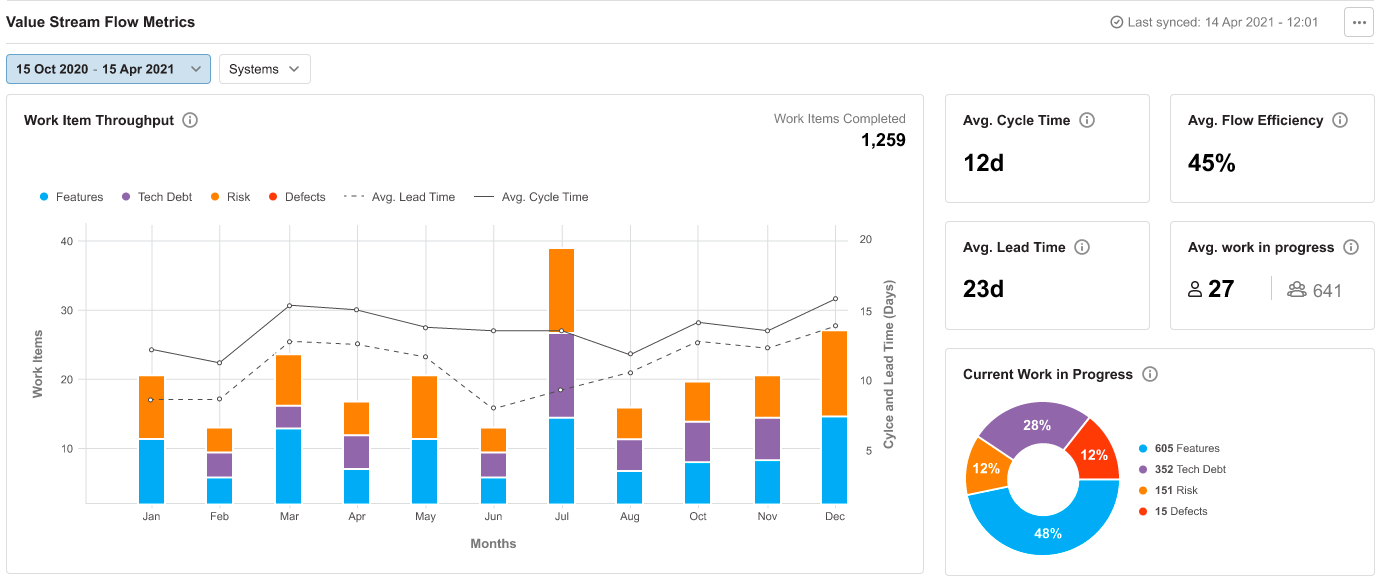
    Metrics that track lead and cycle times for projects as well as overall throughput become much easier to surface and comprehend, noted Keyes.

    One way or another, more transparency is coming to DevOps workflows. Historically, collecting this data has been challenging because it required DevOps teams to manually collect data from each tool being used. In effect, DevOps teams were wasting time copying and pasting data from one tool into an analytics application.

    As it becomes simpler to aggregate all that data, the data model provided by Plutora makes it simpler for multiple analytics tools to analyze the same data. A business user, for example, may prefer to analyze data using the Tableau analytics platform that is now owned by Salesforce.

    In general, analytics is being applied more widely across software development processes because organizations need to increase productivity while simultaneously reducing costs. It will be up to each organization to decide to what degree they may want to use that data to better train DevOps teams versus simply using it to remind those teams to stay focused on a specific set of key performance indicators (KPIs).

    In the meantime, the number of requests for reports being made to DevOps teams should decline as the process of collecting metrics becomes more automated. The challenge now will be making sure everyone reading those reports has the same firm understanding of what’s actually possible to achieve using not only the resources at hand, but also how any additional DevOps expertise might positively impact that equation.

  • GitLab Updates Approach to Integrating DevOps Workflows

    GitLab Updates Approach to Integrating DevOps Workflows

    GitLab today took the wraps off a major update to its continuous integration/continuous delivery (CI/CD) platform that embeds analytics tools in workflows to identify the root cause of inefficiencies, among other additional capabilities.

    David DeSanto, senior director for product management at GitLab, said that capability is part of an ongoing effort to include value stream analytics within the core GitLab 14 platform as an alternative to acquiring and deploying a separate platform. There are also additional charts and dashboards that enable DevOps teams to uncover bottlenecks over time.

    In addition, GitLab announced it is extending the security capabilities of the platform by adding integrations with open source Semgrep and Trivy vulnerability scanning tools as part of an effort to enable organizations to embrace DevSecOps best practices within workflows. GitLab has also added support for the fuzz testing tool it gained via the acquisitions of Fuzzit and Peach Tech to enable DevOps teams to test application security more thoroughly along with making available additional dashboards to track security metrics.

    As part of an effort to enable organizations to better secure their software supply chains, GitLab has also added support for immutable pipeline definitions that can’t be altered without specific levels of permissions being granted. That capability also enables DevOps teams to more easily achieve compliance with any number of regulatory frameworks, noted DeSanto.

    The company is also adding a pipeline editor that provides access to a visual tool for creating, managing and visualizing pipelines. That tool is designed to both make DevOps more accessible to novices and provide experienced DevOps teams with an alternative tool for managing pipelines in a way that doesn’t require them to write additional code.

    Finally, as part of its comprehensive approach to DevOps, GitLab is also making available agent software for Kubernetes clusters to eliminate the need for organizations to acquire a separate DevOps platform to build and deploy cloud-native applications based on microservices constructed using containers. The company now provides IT organizations with the option of crafting a GitOps workflow for Kubernetes using either an agentless or agent-based approach.

    Gitlab is betting that, as DevOps continues to evolve and mature, more organizations will prefer to replace the various tools they need to integrate themselves with a platform that lowers the total cost of DevOps. Gartner is forecasting that, by 2023, 40% of organizations will have switched from multiple point solutions to a DevOps value stream delivery platform to streamline application delivery, versus less than 10% using such a platform in 2020. Today, only 10% of organizations are employing such a platform, according to Gartner.

    There should also be many more organizations employing DevOps workflows to build applications. Organizations of all sizes now realize how dependent they are on software to drive a wide range of digital business transformation initiatives. The rate at which that software can now be securely developed and updated, in many cases, goes to the heart of their ability to compete. The issue is finding a way to achieve that goal without constructing a platform that ultimately takes time and resources away from building secure software.

  • How Containers Simplify DevOps Workflows and CI/CD Pipelines

    How Containers Simplify DevOps Workflows and CI/CD Pipelines

    DevOps enables organizations to capitalize on the flexibility of cloud resources in real-time, which is a huge game changer. Just as the adoption of Agile methodology can make a development team more responsive, DevOps revolutionizes implementation of IT objectives from end to end, from a waterfall-style process gating company productivity to a dynamic process that makes better-quality software fast and easy.

    Organizations have been taking advantage of increasingly flexible resources and moving away from conveyor belt-style project delivery with hardware and software resource planning, ordering and integration. DevOps provides a way to address the question, “If we can provision resources quickly and easily, how can we complete entire projects with similar responsiveness?”

    As DevOps lowers the wall between development and operations, staying sane and accountable doesn’t have to bog down processes. Structured communication still takes place, but in an iterative, incremental fashion, much like polishing a jewel.

    Instead of lofty goals set in the somewhat-distant future, practical solutions can be created, deployed and adjusted. The process gets applications in the hands of end users far sooner, smooths any rough edges using actual user feedback, and helps organizations not only become more responsive to changing needs but make much more efficient use of valuable software development and operations resources.

    Why Dev and Ops Teams Need to Collaborate

    It can be hard for an organization’s culture to adapt to this level of change. But both development and operations teams have some pain points that help motivate them to work together more dynamically.

    The development (Dev) side of the house wants to deliver more timely solutions, ensure greater acceptance of new applications and use its resources more efficiently. Operations (Ops) has challenges with hardware resource planning; they have maintenance and cost-reduction projects that are delayed. Ops also has insights into new features, efficiencies and integrations, but with no way to implement them.

    These and other pain points arise when traditional, waterfall-style processes constrain communication and implementation. Creating a new flow between the two teams helps to reduce these pain points.

    Rather than being tied to a specific technology, DevOps is a methodology aimed at making software development efficient. Containerization narrows the gap between development and IT Ops to a minimum. Containers are a great tool for enabling DevOps workflows and simplifying the development and delivery pipelines. Containers hold the code and dependencies required to run an application and reside in isolation. This enables teams to develop, test and deploy apps inside these closed environments. And this doesn’t affect different parts of the delivery, making the lives of testers and developers a lot easier.

    Enabling CI/CD

    DevOps has created a way to automate processes to build, test and code faster and more reliably. Continuous integration/continuous delivery (CI/CD) isn’t a novel concept, but tools like Jenkins have done much to define what a CI/CD pipeline should look like. While DevOps represents a cultural change in the organization, CI/CD is the core engine that drives the success of DevOps.

    With CI, teams must implement smaller changes more often, but they check the code with the version control repositories. Therefore, there is a lot more consistency in the building, packing and testing of apps, leading to better collaboration and software quality. CD begins where CI ends. Since teams work on several environments (prod, dev, test, etc.), the role of CD is to automate code deployment to these environments and execute service calls to databases and servers.

    The CI/CD concept isn’t entirely new, but it’s only now that we have the right tools to fully reap the benefits of CI/CD. Containers make it extremely easy to implement a CI/CD pipeline and enable a much more collaborative culture. Containers are very lightweight and can scale endlessly, run on any environment and are very flexible. It doesn’t get easier than this.

    Now, you can move code across containers–or container clusters, as is the case with Kubernetes–instead of moving code among various virtual machines (VMs) in different environments. VMs are static and leverage a monolithic application architecture, whereas containers use a distributed microservices model. This opens doors to new benefits when it comes to elasticity, high availability and resource use.

    As part of a DevOps team-oriented approach, team members can reach out to their peers and share innovation, feeding their knowledge and experiences into the evolving process. Development teams can put the new resources to use, taking advantages of technologies such as containers and Kubernetes to architect solutions. Working together, this cooperation lets Ops run with the solution, scale it, distribute and upgrade efficiently without delay.

    Putting it All Together

    DevOps has helped organizations reimagine their entire development lifecycle. And while DevOps brings cultural change, CI/CD is the core engine that makes DevOps successful. New tools like containers now make it easier for organizations to make the most of CI/CD. However, data storage must be taken into consideration, because it undergirds a dynamic DevOps environment. It also provides failover, disaster recovery and other essential availability and reliability features. Software-defined storage offers the flexibility that a dynamic DevOps environment needs. It’s a crucial element in the success of your DevOps program.

  • Report: The State of Cloud-Native Application Security

    Report: The State of Cloud-Native Application Security

    The cloud brings tremendous capabilities in terms of increased deployment fluidity and automation. Along with cloud adoption has come the use of cloud-native tools built specifically for developing applications for this domain. However, cloud-native tools carry some nuanced security concerns, such as misconfigurations, known vulnerabilities and leaked secrets. As such, 83% of organizations recognize security as very important to their cloud-native strategy, according to a recent report from Snyk.

    Snyk’s State of Cloud Native Application Security report surveyed hundreds of IT professionals on their cloud-native security concerns. Below, we’ll pick out the top takeaways from the report, identify the most common trouble areas for cloud-native application security and see if there’s a correlation between deployment automation and higher degrees of application security.

    The Move to Cloud-Native

    Teams are moving to cloud-native tech, empowering DevOps with software-driven architecture and infrastructure-as-code (IaC). In this new cloud-native paradigm, 58% of production workloads are deployed as containers, 21% now are serverless and 50% use some form of IaC within the deployment process.

    Organizations are moving to cloud-native technology for a variety of reasons. For one, containerized software affords increased speed — 68% of organizations moved to containers for increased deployment velocity, the study found. This is followed by ease of management (at 67%) and reduced cost (43%). There is also the security imperative for adopting cloud-native tools; 36% of respondents cited security as a primary reason for moving production applications to containers.

    Top Cloud-Native Security Concerns

    While cloud-native technologies such as containers, Kubernetes, serverless and IaC enable more rapid development, they also bring unique security issues. The report found that misconfigurations and known unpatched vulnerabilities are by far the most common type of incidents among cloud-native environments. In fact, 45% of organizations have experienced an incident arising from a misconfiguration, followed by 38% due to known unpatched vulnerabilities.

    Other common cloud-native security incidents include secrets leaks, failed audits and malware. Interestingly, the study also found that data leaks by insiders are more common within organizations with higher degrees of cloud-native adoption. According to the report, 38% of organizations with high cloud adoption have suffered data leaks by an insider, whereas the figure is cut in half, at 17%, within organizations with low cloud adoption. Secrets like API keys must be managed carefully, especially as cloud-native tools force more dependencies. “The need for effective management of these kinds of artifacts is a key differentiator from the more centralized pre-cloud era,” the report noted.

    Automating Security Testing

    End-to-end deployment automation shows promise, yet is still at an early stage of maturity for most development teams. Though 95% of organizations use some kind of deployment automation, only about one in three organizations have an entirely automated deployment pipeline.

    Organizations with increased deployment automation tend to embrace a higher degree of security testing, as well. Highly automated pipelines are twice as likely to use security testing throughout their development lifecycle, found the report. Since incidents most commonly arise from misconfigurations and known vulnerabilities, automated scanning could help identify many cloud-native issues, comparing production code against databases of known exploits.

    So, when does this security testing occur? More often than not, it happens within the CI/CD pipeline. Over 60% of organizations perform security testing within the CI system. This is opposed to testing source code repositories or local IDEs and CLI tools early on in the development process. In terms of testing frequency, there is a wide range of executions. For those groups with high deployment automation, 70% test security daily or more frequently. Automated security testing seems to be functioning well, as 72% of fully automated teams find and fix critical vulnerabilities in under one week.

    The report also exposed an interesting disconnect with regard to security testing ownership. Only a small percentage of security engineers (less than 10%) feel developers are responsible for the security of the cloud-native environment and applications, whereas 36% of developers stated they are responsible for security. These figures may demonstrate the security onus shifting left toward the development side. Or it could underline changing attitudes as full-cycle development becomes more realistic. Regardless, teams will have to find clarity on roles to avoid some difficult conversations!

    Cloud-Native Security

    With the shift toward cloud-native strategies, security standards are rising to respond to new issues like misconfigurations. To address mounting application threats, increased automation could help shift security left—this and other reports clearly demonstrate a correlation between fully automated deployment pipelines and an increased security testing regimen.

    As a result of cloud-native adoption, 58% of organizations have increased their security concerns since adopting cloud-native tools. Part of this involves moving to a zero-trust approach across all infrastructure, whether internal or external facing. The report revealed that 58% of organizations are increasingly concerned with misconfiguration, 52% are increasingly concerned with insecure APIs and 43% are increasingly concerned about known unpatched vulnerabilities, while 41% are concerned about secrets leaks. Hopefully, these benchmarks will help you see how your organization stacks up in comparison to others.

    Snyk’s State of Cloud Native Application Security report questioned 600 experts in development, security and operations on cloud-native adoption and security practices. For more insights, view the study in its entirety here.