Category: Continuous Delivery

Continuous delivery is a software engineering discipline that allows organizations to consistently develop and release quality software at a rapid pace. It is achieved by automating the software development lifecycle, enabling tasks such as development, testing and release to occur concurrently and continuously.

  • Report: Lots of Room for Continuous Delivery Improvement

    Report: Lots of Room for Continuous Delivery Improvement

    A report published by the Continuous Delivery (CD) Foundation suggests that, in terms of achieving that goal, most organizations still have a long way to go. Based on analysis of the Developer Nation survey data collected by SlashData, nearly two-thirds of developers said it takes at least one week to go from code committed to code successfully running in production. Only one in 10 developers are deploying code in a production environment multiple times per day.

    On the plus side, half of developers reported that they restore service from an unplanned outage in less than a day.

    The survey identified the top programming languages being employed as shell scripting languages, Go/Golang, JavaScript, PHP, Scala, Dart, C#, Ruby, Python and Java.

    Surprisingly, the vertical industry furthest along in terms of achieving continuous delivery is the retail sector that has embraced digital business transformation, while the furthest behind is the telecommunications sector.

    Tracy Miranda, executive director for the CD Foundation, noted that even after more than 10 years of advocacy, DevOps adoption of CD best practices remains nascent. Many organizations have adopted so-called continuous integration/continuous delivery (CI/CD) platforms, but they are mainly used to drive a set of CI best processes. CD, in comparison, has proven to be a more elusive goal to achieve mainly because each platform on which an application is deployed tends to have unique attributes. Automating the delivery of applications across multiple platforms has, as a result, been difficult to achieve and maintain, she noted.

    Nevertheless, with the arrival of cloud-native container-based applications destined to be deployed on Kubernetes clusters that expose a consistent set of application programming interfaces (APIs), the prospects for more widely achieving CD are improving. Each platform that has a Kubernetes cluster running will expose the same API to a CD platform.

    In the short term, however, Miranda noted that many IT professionals are still somewhat intimated by both Kubernetes and CD best practices. Too many organizations still tend to think of CD as a platform to acquire rather than a set of processes and skills to be defined and nurtured, she added.

    One way or another, however, the CD challenge will need to be addressed as more organizations realize how dependent they are on software to deliver a differentiated customer experience. The rate at which that customer experience improves will determine the level of customer affinity that organizations will be able to attain and retain. That’s doesn’t mean every organization has to be as proficient as, for example, Netflix when it comes to implementing DevOps best practices, Miranda added. However, she said, it’s already apparent most organizations will need to improve how they deliver software to drive multiple digital business transformation initiatives. The opportunity lies in reviewing those processes now with an eye toward creating a culture squarely focused on continually improving the customer experience, she said.

    It may still be a while before most organizations truly master CD, but, as is the case with most journeys, the most important thing is to simply take that first big step.

  • EP 10: Observability & Continuous Improvement

    EP 10: Observability & Continuous Improvement

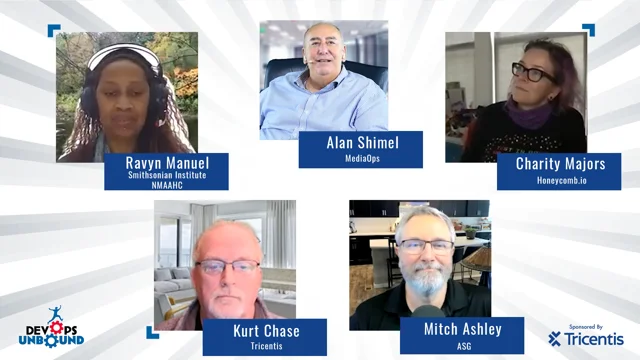
    Observability at enterprise scale brings with it additional application life cycle management requirements. Success requires knowing which changes result in improvements and which don’t produce positive results and how that information must make it back to the DevOps team through feedback loops. In this episode of DevOps Unbound, Alan Shimel and Mitch Ashley talk with Kurt Chase, senior director, global release management at Tricentis, Charity Majors, co-founder at Honeycomb and Ravyn Manuel, senior application manager at the Smithsonian as they discuss observability and continuous improvement. The video is below, followed by a transcript of the conversation.

    Alan Shimel: Hey, everyone. I’m Alan Shimel and welcome to another DevOps Unbound. We have a great panel in store for you today here on DevOps Unbound. Our topic is observability at a broad level. We’re going to jump into some of this. Let me first of all introduce you, though.

    First I want to introduce you, of course, to my cohost of DevOps Unbound. He’s the CEO of Accelerated Strategies Group, CTO here at MediaOps, my friend Mitchell Ashley. Hey, Mitch. Welcome.

    Mitch Ashley: Alan, thanks. Great to be here.

    Shimel: All righty. Let me introduce you to our panel for today. We have a great panel. I was so happy that this came together. First, coming at us from the mountains of Virginia by way of the Bronx, Ravyn Manuel. Ravyn, why don’t you introduce yourself and where you work?

    Ravyn Manuel: Absolutely. My name is Ravyn Manuel and I work for the National Museum of African American History and Culture, which is part of the Smithsonian. I am the Senior Applications Developer and DevOps Engineer. And thanks for not putting me in West Virginia. I appreciate that.

    [Laughter]

    Shimel: Okay. I don’t blame you. Next up we have the one and only Charity Majors, CTO and Co-founder at Honeycomb. Charity, a little bit about yourself, maybe introduce to the audience?

    Charity Majors: I am an ops nerd. I have been on call since I was 17 racking hardware. I no longer rack hardware anymore. Hardware doesn’t exist, as far as I’m concerned. Instead, I’m trying to save the world through better observability.

    Shimel: Excellent. And then, last but not least, we have Kurt Chase of Tricentis, Tricentis Releasing. Kurt, why don’t you introduce yourself?

    Kurt Chase: Hi, everyone. My name is Kurt Chase. I’m currently Head of Global Release Management at Tricentis, based in Northern California. Nice to join you all today.

    Shimel: Nice to have you here, Kurt. All right. So, team, panel, our topic this week is observability. And given that is the topic, I feel compelled to start with Charity because, Charity, in many ways you and the Honeycomb team are responsible for all this buzz around observability. Tell us about it.

    Majors: Yeah, a little bit. When we started the company a little over five years ago it was not a term that was really in use – used in tech. Now – which is not to say that we invented it. Far from it. But it has this long and impressive pedigree in mechanical engineering, specifically control theory. And in control theory observability is the mathematical tool of controllability.

    So, we started building this startup, Honeycomb, and we knew that what we were doing wasn’t monitoring. We knew that we weren’t reactively monitoring. We knew that we were – it was about instrumenting the code, getting at it from the inside. But for the first five, six months we couldn’t figure out what to call it. It was really hard to figure out how to talk about what we were doing. And then it was mid-July, midway through the first year when I remember Googling “What is the definition of observability?” And when I read it it’s all about “Can you understand what’s happening on the inside of the system just by looking at it from the outside with no prior knowledge?”

    And a lightbulb just started going off. It was like “Ding, ding, ding. That’s what we’re trying to build. That’s exactly –” if you translate that into software terms, what it means is can you explain any system state that – any state that your system can get into without shipping new code to handle that state because shipping that code to handle that state implies that you had prior knowledge. So, it’s all about the unknown unknowns instead of the known unknowns. So, yeah, that’s my story.

    Shimel: And you’re sticking with it. So –

    Majors: Yeah. I mean, it really encapsulates a lot of the problems that people are increasingly having, that there’s a lot that precedes from that definition of “unknown unknowns,” like you need to have high cardinality, high dimensionality, blah, blah, blah, all this stuff. But those are the things that speak to the problems of microservices and multiple storage systems, et cetera.

    Shimel: I get it. So, Ravyn, this is your life. How does this observability and what Charity has describe, the fact pattern or the problem pattern that she came to call observability, how does that in your life, day to day of what you’re doing, how does that kind of manifest itself?

    Manuel: Thanks, Charity, for actually providing a definition because I was like “Okay, are we supposed to define our own meaning of observability?” So, you’ve given a baseline. And I like that you said it’s not monitoring because I can actually feel the nuance. There’s a nuance between monitoring and observability. And it’s – what’s really interesting is that that’s a problem that I’m trying to solve today at work because we’ve got – and – because we’ve got the black boxes. So, you’ve got observability but when you have software there’s a lot of black boxes. You’re not supposed to be asking what’s going on inside the code because you’re not supposed to know what’s going on inside the code. But when you get a – you put a signal in – I was in the military, so I did electronic repair – so, you put the signal in and you don’t get the right signal out but you’ve got a black box. How do you know what went wrong there if you can’t actually observe what’s going on inside of there?

    It’s one thing to know the state of the software when you are the developer. So, as a developer, yes, I know. But when it comes to being the product owner or the project manager or a stakeholder and you’re trying to figure out what – “Why is this doing this?” or “This is not what I wanted,” actually is how that would come from that end, is “That’s not what I wanted.” So, how to get the stakeholders to get what they want when you can’t actually tell – I can’t tell what the code from my coworker is doing? So, in a way observability is a little bit – it is abstracted from monitoring because monitoring is telling you what it’s doing but it isn’t telling you the state. And so, it’s a problem that I’m trying to solve actually today.

    Chase: I was going to jump in here and say from my experience although monitoring, logging, reporting, alerting, they’re not observability, I think they are fundamental foundational pieces that you have to have in place. You can start observability without any of them, but I’ve found that the more you can get your monitoring and reporting and even get some alerting going, it allows you to then start observing the system. And for me, I know at Splunk and now here again at Tricentis I’m really trying to connect all the pieces because it’s not just about the applications, but I find that some of the DevOps engineers, they really help with observability, especially the ones that are super inquisitive, and they don’t just – when a result appears or something happens they don’t just take it at face value. They’re inquisitive. They dig in. They try and find the root cause.

    And I think that’s key with observability, is taking all the monitoring, reporting, alerting you have, taking the feedback from your customers, all of that comes together, I think, to really help you start to define those unknown unknowns that Charity brought up. I think it becomes very complicated. And then I think I’d love to talk about how AI and machine learning now can start to learn some of these things, because I think we get really good at repeatable incidences, observing those and then accounting for those in our systems, but it’s the unknown unknowns, how do we deal with those? That’s the real interesting part to me nowadays for sure.

    Majors: It is, I think, the interesting part. And I also think that AI ops is mostly bullshit and it will be for the foreseeable future.

    Chase: For a while. I agree, yeah.

    Majors: But I wanted to circle back to what you said about logging and everything, which is – so, there’s a technical definition for observability which has to do with high cardinality, all this stuff, and then there is just understanding your systems. And I absolutely agree: You need some alerting, you need some monitoring. I think there’s a question is – of – it log files? Is it metrics? That’s kind of irrelevant for just data. What’s important is can you understand what’s happening in your system when you need to understand it?

    And I do think it’s important to sort of differentiate the technical definition of observability from just the tendency that we have to, say, observing things because there’s a very rich and mature and well-established set of best practices for monitoring, which are in many cases completely mirror opposite from the best practices for observability.

    For example, with monitoring it’s like for years we’ve been saying, “You should not have to stare at graphs all day. The system should inform you when you need to – when there’s something wrong.” Super canonical best practice. With observability it’s exactly the opposite. It’s – we’re saying that most problems that happen are so subtle that you need to be looking for them. You don’t – you can’t page everyone at the threshold – you would drive them nuts if you were like “Oh, every little thing is going wrong. Bing, bing, bing.” You’re just – you would drive people nuts and they would quit. But when you’re an engineer, when you’re working on this endpoint or when you’re trying to solve this problem you should absolutely be looking through, asking questions, iterating on them, and looking for the trails in your observability tool at that very fine grain level.

    Chase: I agree.

    Shimel: So, I hear what all three of you said and it’s funny how everyone brings their own baggage to this issue.

    Majors: Oh, sorry.

    Shimel: No, no, it’s not – don’t be sorry. I love it. Here’s, I think, fundamentally – for those people out here who are watching this whole – I’ve got a lot of people out here who are DevOps people, who are ops folks, SREs, cyber folks, and their heads are spinning because I think there’s a little bit of what Kurt said to them, which is they don’t do – they do a shitty job monitoring, quite frankly. We don’t do a great job of it. People started throwing this AI ops word around, and there are a lot of companies raising a –

    Majors: Yeah, there are.

    Shimel: – crap ton of money around their AI ops stuff. And I never really understood what was real about it and many times it just sounded like another word for monitoring to me. But whatever. There is no AI in it.

    But – and now, look, over the last year, year and a half, two years we’ve seen observability come up here and they don’t get the difference. Ravyn, I think you do because quite frankly your black box analogy with electronic in the military, that is – you’ve got to figure out what the unknowns are from the unknowns. It’s not just getting all these signals that are known and then recognizing patterns and putting some automation behind it. That’s not observability. I’m sorry. Not in my mind, anyway.

    So, I think number one is we need to clearly define it. And Charity, you guys, you are a major kind of evangelist for this: “What is observability versus AI ops versus ALM,” which is before AI ops, and so forth. And there are SREs who are living this and DevOps teams who are living this every single day out here who haven’t got their heads around it. Ravyn, I always look to you as someone who gets it. Where do you fit on the – where do you kind of see it on the – let’s say there’s a scale of ALM, AI ops, blah, blah, blah, observability. What do you think?

    Manuel: I feel like I would be very – most close to observability because, again, all – anything with ops in it, when you start doing DevSecOps and DevOps, all of those ops just become marketing terms after a while. But observability is – because it’s not quite tangible it’s actually more real, because it’s real – because it speaks to exactly what’s coming, what’s going on when you’re trying to get continuous improvement, because you need metrics to show and prove that you’re doing continuous improvement. But how do you get there? What is it – what are the steps to get you there? How are you alerted that you are not improving or that you are going backwards?

    And so, when – I feel for me as far as observability I’m at the cusp, because I didn’t actually know that the word existed until I found out about the talk. I didn’t know that that had been defined. So, it’s really cool to know that I can now call it observability. It’s because it’s that thing that I can’t – there isn’t a tool to actually help me – actually help me know what it is that I’m looking at all the time. Not all the time. There are some tools that help me some of the time but not all the time. And it’s the times that I don’t know that’s when we are stuck, because it could be impacting the way – the system performance or the team’s performance.

    Shimel: Charity, I think you might have a customer there. It sounds like they need a tool.

    Majors: I feel like one of the key differentiators here between observability and AI ops and stuff is what it tries to center. With observability we are not – AI ops are like “Eh, we’ll tell you what to look at. You don’t need to understand your system. We’ll understand your system for you. We’ll tell you what to look at. We’ll tell you what it means. We’ll tell you what’s important.” With observability it’s the opposite. I think that we need to look to solutions that let computers do what computers are good at and let humans do what humans are good at. Computers are good at crunching lots of numbers but they can attach meaning to something. Only human beings can attach meaning to something. If I see a big old spike of red that could be good, that could be bad. You don’t know. There is no meaning until a human has attached them to it.

    And with AI ops, AI ops only really works if the corpus of data that you’re training it on doesn’t change. So, if you’re actually shipping software every day you’re fucking up your corpus. This – it’s kind of incompatible with modern software development. I have many thoughts and feelings on AI ops. God bless them, but mostly I think that what they’re trying to do is take the humans out of the driver’s seat. And I understand why, because the C-level, CTOs, CIOs, whatever – there’s something that kind of blew my mind when I realized it a couple years ago: They trust vendors over their own people. Their employees come and go; vendors are forever. So, whenever a vendor comes along it’s like you give them tens of millions of dollars; your people don’t have to hold all of the wisdom in their heads. You can replace them. They’re fungible. The tool will tell you; the tool will be the source of truth.

    And I just fundamentally reject – I’ve never seen that work well. I think it’s a shitty way to treat your people. And I would prefer to take the –

    Chase: And I would not agree with that statement, quite honestly. I’ve had leads that are –

    [Crosstalk]

    Shimel: All right. “Mr. Vice President, I’m talking.”

    [Laughter]

    Sorry.

    [Crosstalk]

    Majors: – and then using our tools to make them better, to impress them, to give them a better sense of where they sit in time and space in the history and what’s happened before and what they’re – they should be wearing grooves in the system as they wear – as they use it in the [inaudible].

    So, I think that it should – if you’re centering a person it’s observability and if you’re centering the – it’s AI ops. Sorry. Go ahead, Kurt.

    Shimel: It’s okay. Kurt, your turn.

    Chase: No, I was just – in my experience the leads, I’ve had – I’m a senior level director now; it was the same at Splunk – I did not encounter that where my leads trusted vendors more than myself or the people on my team. I was surprised to hear that, quite honestly, Charity. I have not experienced that.

    [Crosstalk]

    Majors: It’s not universal. But it’s – there – it exists quite a lot.

    Chase: Yeah, that’s too bad to hear that. That is seriously wrong and that’s going to go against everything we need to accomplish internally.

    Majors: Yeah.

    Chase: Yeah, if –

    Ashley: Have fun attracting great people with that mental model.

    Chase: Yeah, yeah, yeah. And the other thing – I’d love to hear your opinion on this, Charity – we have very complicated systems we’re running. The source code management, the build systems, the agents. I’ve found that it always is very helpful to distill it down into discrete parts, try not to blow the ocean at once. Let’s start with the source code management system. How are we observing that? What are we doing here? And would you suggest that’s a great way for people to get going? I mean, when you try and look at everything – you have to look at everything for sure, but to get started it seems like find some of the most important pieces. Source code management is a great one. The crown jewels. What’s your suggestion there for getting started and –?

    Majors: Source code management is important but it’s never – it’s almost – it shouldn’t almost ever be in the critical production path. And when people are rolling something out I always advise them to find something that’s – don’t waste your time instrumenting _____ observability, lights, and backwater to the system. Find the thing that you’re trying to understand and fix now. Find the thing that’s broken. Find the thing that’s causing you pain. Because it should be an order of magnitude better at answering your question, observability should, even than monitoring. I don’t think you can look someone in the eye and ask them to switch up what they’re doing and to use something else unless you can tell them it’s going to be an order of magnitude better than what they’ve got now because the costs of transition are so high.

    But with observability you should be able to go from instead of just the aggregate where it’s like “Well, I see a spike but I can’t tell you what it means or how they’re different from –” with observability you should be able to go exactly those rows, in which ways are those events different from all the baseline events, and very quickly go “Oh, I have a much richer view of my system now.” And if – once you’ve got that you should be able to explain way more about what’s going – so, we see this all the time when people are running out – when they’re rolling out Honeycomb. They start rolling – they roll it out to the service and they’re like “Oh, God, there are problems there. Did you know that this is broken? Oh, there –” and we’re like “Yeah, yeah, yeah, but you’re just picking up the rug. It’s been there – it’s been that way for as long as you know.” And they’ll pick up another service and the problems – I’m like “Yeah, but these problems have existed – you just had no idea because we were dealing with [inaudible].”

    So, I feel like the way to pick up momentum, the way to incentivize people to get excited about this is to look for the biggest pain point in your system and –

    Chase: That’s awesome.

    Majors: – then patch that with observability.

    Chase: That’s great advice. I agree.

    Manuel: Charity, a question. Does – can observability actually take in account process? Because you’re talking about if there’s something wrong in the system itself, but sometimes the thing that’s wrong with the system is the process.

    [Crosstalk]

    Majors: Well, everybody is not about process. And you’re totally right. That’s often – that is not something that you should ever ignore. A lot of the biggest problems are process problems. But observability is not the tool for that.

    Shimel: And that’s good to know too because quite frankly – and Mitchell knows this too – we live in a silver bullet world where people think the latest shiny trinket is the cure-all.

    [Crosstalk]

    Majors: – everything, you should –

    [Crosstalk]

    Shimel: No, observability, yeah, it’s not going to cure Covid either.

    Majors: No.

    Shimel: But –

    Chase: And that was the point I was trying to make initially. I think I said it wrong. It’s not that monitoring and reporting, logging aren’t foundational; they’re complementary. You kind of need them all. If you’re running modern stacks – I said that incorrectly at the start – it’s not foundational. There’s – you need them alongside each other.

    Shimel: They’re adjacent. They’re not –

    Chase: Yeah, absolutely. Absolutely.

    Shimel: They’re not – it’s not a pyramid per se.

    Chase: Right. Exactly.

    Shimel: I think it’s part of your stack horizontally.

    Chase: Yes. Yes. And I’ve found –

    Shimel: Can I – we haven’t’ – go ahead, Kurt, I’m sorry.

    Chase: I was going to say I’ve found with especially new individuals and new people to the DevOps team and the DevOps world, getting them involved in the monitoring and saying, “Hey, this is how we start monitoring,” that’s a great place to start. It’s almost entry level for observability, if you – I’d love your opinion on that, Charity, too.

    Majors: Well, I really think that everyone who writes and ships software should be on call for their code, no matter how –

    [Laughter]

    Chase: Yeah, me too.

    [Crosstalk]

    Majors: Software ownership. And so, yes, that’s very empowering, I think, to show them how to find the trail, the alert that’s paging them, trace it all the way to the system and fix it. That’s something that as engineers, we feed on that. That’s exciting to get to know how to run your ship better. Yes, absolutely.

    Shimel: Well, but – so, you know what? Mitchell and I started a company – or, were two cofounders of a company called StillSecure 20 years ago. And that was one of the things. Mitchell ran the engineering team and that was one of the things he instituted, I remember, was that every developer had to take a turn on the help support desk, level one, answer the phone. “Hello, Mr. Customer.”

    Majors: It builds empathy.

    Shimel: And try to explain it because they had to answer the alert. And even when they weren’t on that level one our escalation procedure was if it went to level two or three it was the developer who did the level two and three support.

    Majors: I will say that, yes, and I do think that every engineer should be on call for their work, but you have to couple that with it’s management’s job to make sure that that doesn’t suck, that it isn’t _____ for them, but it doesn’t just kill you with [inaudible]. It is management’s absolute fucking responsibility to make sure that they’re given the time to – away from project work to fix these problems so that they don’t recur, so that they get enough sleep. I think it’s reasonable to ask any engineer to be woken up two or three times a year for their code. That’s it. Because more than that, you’re burning people out hardcore.

    Manuel: Been there, done that.

    Shimel: You know, Charity, Ravyn –

    [Crosstalk]

    M : I have a question. I have a question I’d love to ask all of you. I’m thinking about observability has been elevated because of, in part, the world that we’re living in. Software architecture is changing. We’re dealing with microservices, all these much smaller things that are interconnected to make software. And at the same time as we’re changing the pace at which we release software, not only is it unknown unknowns, it’s like a river – Riven –

    Shimel: Ravyn.

    Ashley: – we’re in the river of the changing software. So, you’re trying to understand all of these things at the same time. It seems like it’s the right time for observability to be the thing to be working on because ops has to be elevated to the same level of the same kind of architecture and processes that we’re using across the – in the life cycle of software. Do you agree with that or not? It seems to me we’re in the right place, right time.

    Majors: Absolutely. I mean, I feel like the first wave of DevOps transformation was all about “Ops people, learn to write code.” And we’re all like “Eh, okay.” But I feel like the pendulum has swung. I think now it’s about “Okay, software engineers, your turn.”

    Ashley: You’ve got to do ops.

    Majors: I have to learn to write operable services and to learn to maintain them and get called for them and – because what microservices has done, all of that complexity and logic has to be bundled up in the app. The app.

    Manuel: Exactly.

    Majors: And now it’s like we’ve been thrown to the four directions of the map. And what that means is that so much of understanding and operating your application has been pushed into the realm of operations and systems. It used to be that if all else failed you could attach a debugger to your app and just step through, see what was happening. Well, you can’t do that anymore now because the process died and jumped to another service, and another service. And part – the way that we instrument for observability is all about packing up the context of the application and shipping it along with it from hot to hot, one event per request per service, so that you can slice and dice and reason about your systems in a way that you used to be able to.

    Ashley: Doing that really changes the design. I’m thinking about Alan’s story of what I did back at StillSecure. What prompted that was when a customer called in and said, “I’m sitting in – we’re using your project and this dialogue box popped up and it says ‘An unknown error occurred’ and that’s all it says. What do I do?” Well, nobody knows what to do with that. So, we all just said, “Look, everybody does support in that case. Everybody does ops.” And that changed: “Okay, we have to figure this out.” And suddenly that was the problem of “How do we make this easier to support and easier to resolve issues with?” So, it does affect behavior and design or product.

    Majors: Yeah, absolutely.

    Manuel: I think microservices is – will actually do good for observability because if you do microservices correctly then each service is atomic. It does one thing and one thing only. It does that thing good. So, if the unknown is not taken out of it because you know exactly what this thing is supposed to do –

    [Crosstalk]

    Majors: Oh, no, honey, the unknown is never taken out of it. The unknown is never –

    [Crosstalk]

    Manuel: In my ideal world it is.

    [Laughter]

    There are no more unknowns –

    Shimel: In Ravyn’s world, yeah.

    Manuel: – in Ravyn’s world. Exactly.

    Shimel: Yeah. But I’m going to tell you something. The flipside to this, though, too with microservices, and I think we’re starting to see this now, is can you have too many microservices running? Does it – is the complexity load in there such that observability almost becomes meaningless or impossible?

    [Crosstalk]

    Majors: I don’t know that complexity can every really be created – no, it typically is not meaningless. It’s your only hope to understand this shit if that’s what you’ve done to yourself. But complexity can only be moved around. It’s just a question of tradeoffs, like which set of tradeoffs – some folks have gone whole hog on microservices and then they’ve found the edges to those design _____. But –

    [Crosstalk]

    Chase: What I find – I was going to say what I find challenging is both at Splunk – Autodesk was interesting. So, to your point, Alan, we used to make engineers buy bagels. You break things; you have to buy bagels. And so, we had a lot of bagels brought in. But both at Splunk and here at Tricentis we have a world where we’re supporting large enterprise applications and delivery of enterprise apps. We’re also – obviously all the microservices – and trying to apply these techniques across the board is very interesting, very challenging.

    [Crosstalk]

    Majors: Oh, yeah. There’s no one-size-fits-all.

    Chase: There’s not. There’s not. And almost to the point you made, Ravyn, observability almost has to be customized for what you’re observing. It’s – I haven’t had a chance to run Honeycomb yet, but for me my experience has been there’s always those little idiosyncrasies about how we run our ops, how we –

    [Crosstalk]

    Majors: There’s no such thing as a perfect _____. No one else can do it for you. It can be – it can get you started. It can give you a boost. But at the end of the day somebody’s got to fucking understand your software and roll that into your instrumentation. Nobody else can do that for you, let alone _____.

    Chase: And that’s where with AI ops, I won’t say it’s complete shit. I think there is some value there. Some of it is just about automating common occurrences. And maybe that’s not valuable but –

    [Crosstalk]

    Majors: – it’s an AI but they’re just using that to make – to raise lots of _____.

    Chase: Oh, sure. Okay. Yeah.

    Manuel: Didn’t work.

    Majors: Like, “Oh, I have an AI too.”

    Shimel: No, but we – and you’re right, AI is a money term. But ML ops is something that’s caught on a bit, more than, I think, than AI ops. And I think that’s really at the heart of it, which was to recognize repeatable patterns or recognize patterns that we can respond to.

    [Crosstalk]

    Majors: Although, I would still challenge – I think in far too many cases people are reaching for the complicated solution instead of fixing it at the start. They’re like “Ooh, I’ve got 50 bazillion e-mails so I – and all of that disk space so I need AI to solve it” instead of turning off the fucking e-mails and setting up a different kind of alert or some automatic _____. Just – is this really a problem we need to solve? Or could we solve it better by just not having it?

    Shimel: There is that.

    Majors: Sorry. That’s my last bitch.

    Shimel: Do we need to solve every – and I think Ravyn – or, not Ravyn – Charity, you were getting at it before. Do we need to solve every problem?

    Majors: Is it the most important problem? Is this going to be the biggest bang for our buck?

    Shimel: Yep. I mean, we used to have a –

    [Crosstalk]

    Majors: – or the _____. Like, senior engineers write software but very senior engineers don’t need software.

    Shimel: Yeah, no, I mean, look, when Mitchell and I were doing the security company we had a product, “Vulnerability Assessment of Management.” VAMP. Internally we called it the Bad News Generator because that’s what it was.

    [Laughter]

    It was the Bad News Generator. And the problem was we would go to an organization like Ravyn’s and it would pop up a few thousand vulnerabilities, and the security or the ops people would be like “What am I going to do?” And “Don’t worry about 95 percent of them. Let’s just worry about the top five percent.” And it was like – it was employment insurance, was what it was, because there would always be more vulnerabilities for us to find next year.

    But that being said, it really was the case where you’re not going to fix everything. We don’t have the time to fix everything even if we wanted to.

    [Crosstalk]

    Majors: And it’s not really doing a great job of giving you differentiation, letting you know what’s really important and what’s just noise. So much of these tools, they just give you so much noise and it’s almost worse than nothing at all.

    Shimel: Well, that’s why with the Bad News Generator people used to – so, Mitchell got the lucky part of designing it. I had to go sell it. That was much harder.

    Ashley: I remember the –

    Shimel: Much harder.

    Ashley: – guy from the federal government called and said, “This thing is spamming everybody in the Defense Department.”

    Shimel: Yes, “We have all these vulnerabilities.”

    Ashley: “How do I turn it off?”

    Shimel: Because we had this automated workflow before we had terms like AI and ML. But it is hard.

    Hey, guys, we’re coming down the home stretch here. We probably only have five minutes or so left. I wanted to – let’s look forward now. I’m big into looking forward these days. I’m hoping we’re going to do conferences in person again; we’re going to – I don’t know if we’ll go back to our offices but…

    What’s next for observability? How does this continue to evolve?

    Majors: What’s next is I think really wrapping traces in as a first, best tool so that – right now too many people are like “I have one tool for metric, one tool for logs, one tool for servability, another tool for –” they’re spending just ____ data again, every time. And it’s worse than that because you can’t actually seamlessly break down a chain of events, so you’re just copy/pasting this idea into that tool or hoping despite – because it seems to line up timewise, it’s actually bees in the logs – you should be paying to store this data once and you should be able to flip back and forth between loads. Are you slicing and dicing? Are you doing aggregations at read time? Are you zooming in? Are you zooming out? Or are you slipping back so you can view it as a logger file by time?

    I think that observability tools like us and Lightstep – which are the only two observability tools out there by my technical definition – although, I will say I do think that this might be the year that that begins to change. I know that so many of the big players have been working as fast as they can for years on the back end. They’re trying to catch up to where we sit technically faster than we can get catch up to where they sit in terms of the business. So…

    Chase: And I –

    [Crosstalk]

    Manuel: I like that you said that. Sorry, Kurt. That –

    Chase: No, no, go ahead, Ravyn.

    Manuel: – Charity – I just wanted to say to Charity –

    Chase: No, no, Ravyn, go ahead.

    Manuel: – about tracing, because that’s actually the solution that I am actually looking for, that I’m looking for –

    [Crosstalk]

    Majors: It’s got a lot of rough edges.

    Manuel: – for organizations. Yes, to be able to follow –

    [Crosstalk]

    Majors: But there are lots of problems we can’t solve any other way.

    Manuel: Exactly. So, I feel good that I’m doing it inherently, like I know what I’m supposed to be doing.

    [Crosstalk]

    Majors: You’re on the right path.

    Manuel: I think I’ve actually found a way to do that. But yeah, tracing I also think is the way to go. That is the only way you’re going to be able to know, because it’s taking you from point A to point B to point C to point D and you’ll be able to see that all. And there will be no unknowns. [Laughs]

    Majors: Oh, honey. You keep saying that.

    [Crosstalk]

    Manuel: It’s my dream. That’s – let me live my little dream.

    [Laughter]

    Shimel: Kurt, what do you got?

    Chase: Yeah, well, where mind – excuse me – where my mind goes to in the future is what are we doing in the education system to really disseminate this information, how monitoring software is developed, how we monitor it. And then also “observability” is such a loaded term because I know at Splunk they would consider observability something much different, for running a SOC and things like that.

    [Crosstalk]

    Majors: Oh, no.

    Chase: So, I think it – I mean, at its core observability is what it is. But how it’s implemented for different disciplines and how they use it, I think companies would definitely take exceptions with some of the things we’ve said here –

    Majors: For sure.

    Chase: – and what observability means to them. And I would just say keep that in mind, that it is a huge field and I think we’re going to see further improvements. I love the tracing. And being able to have that in your tool set would be fantastic.

    Shimel: Charity, final thoughts before we wrap?

    Majors: Oh, I am just enjoying the fact that some people are so interested in this that they’ll show up and argue about it all the time. So…

    [Laughter]

    Shimel: It’s all good. Hey, you know what? It’s a living. Mitchell, as usual, I’m going to give you the last word.

    Ashley: Well, I’ve learned two things today. Don’t call my tool an observability tool or an AI tool unless it really meets the definition, or I’m going to get crucified.

    [Laughter]

    No. No, what – I mean, I love this conversation. I learned a ton. I always do when we have these – what’s so cool to me is that we’re talking about operations and we’re talking about this part of our world and we’re not talking about better ticketing systems. We’re talking about really meaty, interesting things that help us do our jobs better, do a better job for the company, for the customer. That’s exciting to me. It’s just really cool. I enjoy it very much.

    Shimel: Join us for our next show where we’ll be talking about better ticketing systems.

    [Laughter]

    No.

    Chase: And what argument did I miss? I was –

    [Crosstalk]

    Shimel: No, no, no, no. It’s all good. You know what? I enjoy having really bright, smart people who are willing to express their opinions. And when I knew we had this panel, it was the lineup, I knew there was going to be no shortage of opinions, nor any backing down. So –

    Ashley: We’re going to call the next one “The observability mix-up.”

    Shimel: Right.

    Majors: We’re going to have to call it “Observability AI.”

    Chase: I still want to see that sticker –

     Shimel: “AI Observability.” All right. Hey –

    Chase: We need to see the sticker Charity was holding up. We need to see that.

    Majors: Oh.

    Shimel: Oh, we never got to that. Yes.

    Chase: We have to see that.

    Majors: I’ve got a few of those. I’ve got “Release := deploy.”

    Shimel: You’ve got a lot of them here.

    Majors: I’ve got “Ship dangerously.”

    Chase: Yeah, I love that one.

    Majors: “Deploy on Fridays.”

    Shimel: You know what? You used to be able to get these things on conferences. Now we’re reduced to showing them on Zoom.

    Majors: Yeah, you have to.

    Chase: Yeah. Exactly.

    [Crosstalk]

    Majors: “Perhaps this is a good day to deploy.”

    Chase: Maybe.

    Shimel: Okay, yeah. Perhaps.

    Chase: It’s Friday. It’s not a good day.

    Manuel: No, Friday is not a good day.

    Chase: That’s the one, right there.

    Shimel: And there it is: “I deploy from Cron.”

    Ashley: That’s the one to end on right there.

    Shimel: That’s is. We’re going to wrap it. Hey, you’ve watched DevOps.com. It’s sponsored by Tricentis. Many thanks to them for sponsoring. Just wanted to quickly mention Kurt is from Tricentis. Charity is from Honeycomb, and it’s Honeycomb.io. Go check that out.

    Majors: We have a very generous ____ here.

    Shimel: A very free _____. Ravyn, you can start playing with it now and see if it’s something that gives you tracing and so forth. Mitchell, thanks for joining us.

    Ashley: You bet.

    Shimel: We are back – actually, we are back with a roundtable next, which will be open to the public. Looking forward to having you on for that. But until then, this is Alan Shimel for DevOps Unbound. Have a great day, everyone. We’ll see you soon.

    [End of Audio]
  • CircleCI Survey Shows the Need to Prioritize DevOps

    CircleCI Survey Shows the Need to Prioritize DevOps

    A CircleCI survey of 2,013 business leaders in the U.S. and UK published today finds nearly all respondents (97%) recognize that the success of their business within the next year depends on their software development teams. Despite those findings, well over one-third of respondents (39%) admit their organization is challenged when it comes to innovation and acquiring and maintaining developer skills.

    A full 89% of respondents said they also have a good understanding of how to measure the performance of their engineering teams. However, 40% of companies are still using antiquated metrics such as the number of lines of code written, while another 37% measure story points.

    More troubling still, less than one-third of respondents (30%) said they plan to make adoption of DevOps best practices a priority. On the plus side, only 15% of respondents said they are implementing a continuous integration/continuous delivery (CI/CD) platform for the first time.

    The CircleCI survey suggests that improvements in how software is delivered could be worth, on average, up to $126 million per year. Nearly two-thirds of respondents (65%) said their business is involved in digital business transformation initiatives of one kind or another. Another 20% said they have completed one.

    Jim Rose, CircleCI CEO, said it appears that while more organizations now realize how dependent they are on software, many of them have yet to address issues that fundamentally impact developer productivity. For example, more than half (52%) of respondents don’t allow their software developers to choose their own tools, noted Rose. While there is a clear need for a consistent approach to building and deploying applications, Rose noted that DevOps best practices should not require developers to employ a specific set of tools. Developers are only able to truly innovate when they are able to experiment with different tools, said Rose.

    In general, Rose said DevOps adoption tends to go through various cycles. Many organizations today are looking to reduce the number of tools that make up a toolchain. However, those efforts shouldn’t curtail the ability of developers to innovate. A CI/CD platform that provides the foundation for DevOps workflows needs to be easily extensible, noted Rose.

    It’s not clear to what degree adoption of DevOps best practices have stagnated, but the number of organizations that have implemented DevOps across their entire enterprise remains limited. Most organizations have individual teams that might have adopted DevOps to one degree or another. In many cases, those teams are using disparate tools and platforms.

    Most organizations clearly want to be able to build and deploy applications faster. The challenge isn’t so much mastering DevOps platforms as overcoming many of the cultural issues that conspire to limit DevOps adoption. In time, however, the need to rely more on digital processes will force the DevOps issue. As one organization makes advances—thanks in part to their ability to effectively employ DevOps processes—the more keen rival organizations will be to make sure they don’t lose ground. It may be a while before business executives connect the dots between their ability to compete and the degree to which organizations have mastered DevOps, but it’s increasingly apparent that day is not too far off.

  • Redefining Continuous Security for DevSecOps

    Redefining Continuous Security for DevSecOps

    In the mobile app development world, security often takes a backseat to developing features and delivering the app. In fact, the 2021 Verizon Mobile Security Index found that 45% of organizations sacrificed mobile security in order to “get the job done.”

    It really shouldn’t come as a surprise. Certainly, it seems counterintuitive that mobile app development organizations would spend so much time and money to create an exceptional Android or iOS app and then fail to protect it against rooting, jailbreaking, reversing, hacking and other kinds of malicious manipulation. But the average mobile developer releases 12 apps each year; a frenetic pace that requires development to take place in parallel, without ceasing. Schedules and budgets are tight, and competition is fierce. Coding security into an app is both expensive and time-consuming, increasing the risk of a delayed release or budget overages.

    In many organizations, if security is implemented into a mobile app at all, the process takes place during penetration testing. That’s too late, and it’s extremely inefficient. Waiting to implement security after development and delivery are essentially finished will anger developers because now, they have to dive back into their code to make complex changes to work they thought was finished. The code is no longer fresh, so it’s going to take more time than it would have if security implementation had taken place during the development process itself.

    But integrating security into the development process is no simple task either. Imagine two friends are spinning a couple of jump ropes. Jumping in the middle without stepping or tripping on either of the ropes while they are moving is difficult. Each time a security feature is introduced into a mobile app’s software development life cycle (SDLC), the person building the security could step on the rope. Building security features takes time, and they are hard to build and maintain.

    Our Oversimplified Model of DevSecOps

    To solve this problem, DevSecOps was introduced to resolve this conflict and overcome the challenge of integrating security into the mobile SDLC. The idea is that organizations can develop features and incorporate security simultaneously. So far, much of the emphasis in DevSecOps has been focused on the processes development, security and operations that teams use to build, protect and release apps. People have done heroic work creating cultures of security and secure coding practices, which has moved the industry forward toward more secure mobile apps for everyone.

    Let’s take the jump rope analogy a bit further. One friend holding the ropes is the development and engineering team, while the other is the ops/release team. The ropes each represent an iOS and an Android app. In most organizations, the ropes are moving at blazing speeds, as apps are churned out one after the other. Meanwhile, on the sidelines, there’s the security team, whose job is to make sure the ropes meet security objectives, jumping in where needed, all without stopping the ropes from spinning.

    The trouble is that each group has different skills and objectives. Developers aren’t typically security engineers, and security teams don’t typically have developers. Neither group has the resources or skills to meet the needs of the other, and whenever they try, one of them trips on the rope.

    Mobile DevSecOps, Meet Continuous Security

    The only way to keep the current breakneck pace of app releases going while simultaneously providing security is to introduce as much automation as possible. AI systems can fuse security to an app more cost-effectively and consistently, complete with validation that the features required have been implemented. It’s different from code scanning, which occurs after the app is built and leaves remediation to the dev team. I’m proposing that the implementation of security itself be automated.

    The growing threats to mobile apps are too significant for development teams to ignore, but so are the market pressures that force such short delivery timescales. The only way out of this dilemma is extensive automation. Otherwise, the dev and sec teams will keep continuously tripping on each other’s ropes.

  • Shoreline Platform Automates Repetitive IT Tasks

    Shoreline Platform Automates Repetitive IT Tasks

    Shoreline emerged from stealth today to make available a namesake incident automation platform that eliminates the need to manually perform the same repetitive tasks.

    Anurag Gupta, Shoreline CEO, said the platform is based on domain-specific language, dubbed Op, that provides a simple pipe delimited syntax to integrate real-time resources and metrics in a way that allows DevOps teams to invoke an orchestration engine to automate the execution of a task from the Linux command prompt. Op employs a syntax that is familiar to any IT professionals that currently use shell commands and scripting tools to resolve IT issues, said Gupta.

    That same Shoreline tool, however, can also be employed to create remediation loops that check for issues, collect diagnostics and apply repairs automatically in the background, he added.

    Shoreline

    Shoreline achieves that goal by first collecting metrics on a per-second basis via data collected from open source Prometheus monitoring software. Armed with that data, it then becomes possible to distribute queries to both collect data in real-time and run local loops in parallel to automate repairs, Gupta said.

    The platform employs the JAX and XLA frameworks for machine learning algorithms to reduce the amount of CPU resources required to compute metrics and create alarms. Wavelets are also employed to compress the input metric stream. Finally, queries are portioned across historical data stored in the S3 cloud storage service from Amazon Web Services (AWS) and real-time data collected from each node.

    All Shoreline components are designed to be fault-tolerant, added Gupta. Automation can still run locally to Shoreline backends, even when connectivity is lost. All processes have supervisors to restart when failing and reestablish connectivity.

    Finally, Shoreline provides controls to limit the scope of a manual operator action and automate executions in a given time period to help prevent any errors from cascading through an entire IT environment. That approach makes it possible to safely automate tasks in a way that makes it less likely outages will occur because, for example, a misconfiguration winds up being propagated across every system, noted Gupta.

    While IT environments are arguably more complex than ever, Gupta said it’s the repetitive tasks that take up so much of developers’ time. In the absence of any way to automate those tasks, an IT team will, over time, become increasingly burned out, which Gupta noted inevitably leads to mistakes being made.

    At the same time, Gupta noted the Shoreline platform makes it simpler to onboard new members of an IT team because much of the tribal knowledge that once had to be learned on the job has been captured within an automation platform.

    The arguments for automating IT have, of course, been growing louder and more frequent for nearly two decades. Most platforms that promise to automate IT have required a fair amount of expertise to implement and maintain. The Shoreline approach, in contrast, starts with a Linux prompt that many IT teams already routinely use to execute a range of tasks. The difference now is simply the level of scale at which those tasks can be performed with a minimum of programming skills.

  • From One-Click Deployment to One-Click Feedback

    From One-Click Deployment to One-Click Feedback

    What makes a group of individual contributors a team?

    You can look at today’s product development teams as an ensemble of craftspeople from different disciplines. Code builders, design artists, storytellers, and an orchestrator. Similar to an orchestra, their output is based on the ability of each and every one of them to work together in harmony, continuously and collaboratively.

    Let’s dig a bit deeper into today’s development methodology to see what this means in a practical sense.

    At a high level, we see three major steps: planning, development and release.

    1. Planning = Empower design craft
    2. Development = Empower code building craft
    3. Release = Optimize time-to-market (since there is no more time for nonsense!)

    Despite the fact that teams are supposed to work together and be very in tune with each other, when we look at the reality, it’s very different. We actually work in silos, nurturing black-box thinking. Instead of collaboration, often there are three separate units that comprise a whole, solely with interfacing endpoints.

    In such a configuration, it’s unavoidable that one unit’s priorities will be disruptive to another’s work, or flow. Without better integration of the actual collaborative parts of the work, in the form of frictionless and ongoing feedback throughout and during the end-to-end planning, development and release processes, eventually, your own unit’s priorities will take precedence over another’s.

    Engineering IRL

    A typical engineering process, whether it’s a new feature being developed, a bug fix or any other kind of collaborative work, usually looks like this:

    • A developer receives a design handoff and, from that moment on, is expected to deliver a working manifestation of the design specifications.
    • The developer gets to work (whether solo or on the dev team; independent of product or design, at this point) based on the specifications and starts writing the code.
    • Once completed, the code is deployed to a pre-release staging environment, where the designer actually experiences the result of their craft for the very first time.

    If you’ve been through similar processes, you’ll agree that, by this point, there is rarely time or tolerance in the process to iterate or provide feedback, nor correct much at all. More often than not, the mindset in fast-moving organizations is to stick with what we have ready to ship and just move forward. The actual “collaborative” part of the work is essentially bypassed. It’s really just a relay race of passing the baton downstream.

    But this engineering paradigm has its consequences. Ever tried to dissuade an artist from providing their feedback? Expect a pretty bad vibe in the room (or virtual room in today’s hybrid and remote team structure).

    This example, of course, is actually a virtual utopia of the development process. In reality, most organizations today have a far more destructive culture of continuous disruptions.

    Now, let’s spice up the scenario with some real-world interruptions that often break the ongoing individual flow.

    When a craftsperson is in the zone and creating, don’t interrupt! But what can you do when there are so many things happening in parallel? In small organizations that are just ramping up, most people are juggling much more work simultaneously.

    What often happens looks a lot like this:

    Jolene from sales requires a specific version for customizing a demo for a super important customer; Marko from support has opened 31 tickets you have yet to handle since it is a production issue that affects end users; your beloved single staging environment broke and you can’t review any new feature—oh, and don’t forget to attend the three meetings scheduled for today.

    Frustration, anyone? I like to call it the ‘multi-context bad habit.’

    Okay, I can already sense some eyebrows being raised, and I can almost hear you saying, “Yeah?! So what? We’ve always worked this way—what’s the issue??” Allow me to show you some numbers that may surprise you.

    “Finding flow is key, and interruptions are a drag. Minimal or no interruptions give developers an 82% chance of having a good day, but interruptions throughout the day decrease the chance of a good day to just 7%.”

    Eirini Kalliamvakou

    “Meetings are both awesome and terrible. Collaboration improves our work, but too many meetings can be a blocker; going from two to three meetings per day lowered the chances of making progress toward their goals by 60%.”

    Dr. Nicole Forsgren

    To summarize, these data points basically indicate that disruptions, interruptions and the “multi-context bad habit” ultimately have a tangible, detrimental impact on results and outcomes. They diminish successful outcomes and delivery times by orders of magnitude.

    Zero-Click Deployments as a Culture

    Fortunately, there are multiple practices and tools today that can be leveraged to dissipate the friction, break down the silos and improve the flow.

    This can be achieved by evolving from one-click deployment to zero-click deployments. Allow me to explain.

    Today, we have enough working examples that could (and should) be replicated more widely in engineering practices. Here are some examples.

    Preview Environments

    Preview environments (sometimes referred to as ephemeral or PR environments) provide, well, the opportunity to preview products. By allowing multiple stakeholders to review and experience the product throughout the development process, you shift-left the way you manage your development processes and are able to provide the relevant feedback and fixes earlier in the process. This basically means that for any PR you get a live environment that is shareable and independent from your staging environment. (I like to call this an in-development feedback loop).

    The JAMStack

    Another good example can be taken from JAMstack. When JAMstacking, consider using Netlify, Vercel or AWS Amplify to gain this capability for your team.

    Infrastructure-as-Code (IaC)

    If your project is non-JAMstack, you can consider building a similar preview environment through IaC solutions like Terraform or Pulumi. The downside here is that this comes with quite a bit of hassle, as you have to build automation for every single PR to have a dedicated shareable URL of the environment for review.

    This is great, though, because it democratizes the PR approval cycle by being more inclusive. Project managers, designers—practically anyone can review and approve the PR in development without having to wait until the end of the process to provide input. It’s easy to manage as it is isolated and independent of staging, which also provides always-on issue reproduction ability in the event that some kind of bug was discovered or tests need to be run during the development phase.

    But it also isn’t all roses and sunshine.

    There are some gaps and challenges that still need to be overcome for this to work. Some examples:

    How do we streamline feedback?

    Developers are used to getting comments from peers during code review in a language they can understand easily (for the most part) and quickly merge the input into their project. They don’t lose context by navigating away from the tool they’re working in (e.g. to Slack or Acme Corp. Task Manager), as it keeps them in their source code management environment (SCM). We need to think about how can we offer the same developer experience for everyone in the process to minimize PR turnover.

    How do we provide actionable and quality feedback?

    For example, UI and behavioral issue reporting are time-consuming, since you have to document and explain what, exactly, needs to be changed in order for it to be effective. Any wanted change likely involves the developer, which adds yet another disruption and interruption to their day.

    Taking Zero-Click Deployments to Single-Click Feedback

    If we want to optimize the developers’ flow, the next phase after simplifying the deployment aspects is to see how we add in the feedback layer in a way that isn’t intrusive.

    We need to now take this mindset and empower what I like to call one-click feedback.

    This isn’t a new concept, of course. Let’s take some inspiration from collaboration tools we all love like Figma, Miro and Notion.

    What’s magical about each and every one of these tools is the ability to provide contextual feedback. This is important as it enables contextual collaboration. Any user is basically one click away from sharing their feedback while remaining in-context, increasing the potential for feedback to be dealt with frictionlessly.

    This makes possible the following core values:

    1. Any person can easily point out something which requires the creator’s attention.
    2. The creator can instantly understand the feedback within the context of the project and what they are working on, and reply or tag another relevant peer for their point of view.
    3. The creator doesn’t leave their main work environment to prioritize the new task or give it the attention it requires. Just as designers do not leave Figma to apply feedback, PMs don’t need to leave Miro to apply theirs, and so on.

    These tools welcome feedback in an inclusive manner while enforcing a frictionless workflow. No one is messing with the creator’s flow as it is also happening asynchronously—no need for meetings, syncs or coordination of multiple stakeholders. This is also much more inclusive and relevant for today’s remote work culture, which requires investment in team communication through asynchronous channels and processes to be effective. (Here’s a great talk to watch on this topic; yes, the irony of interrupting your flow to watch this video is not lost. No, Really, Don’t Chuck Everything in Slack: Communications for Distributed Teams – from Florian Haas)

    Assuming you find some truth in this, I’d like to address the now apparent elephant in the room: Why don’t we introduce the same abilities for in-development collaboration?

    One-Click Feedback-as-Code

    We’re starting to see a trend where framework-coupled companies like Netlify and Vercel, for example, are adding collaboration aspects to their offering. Netlify, in fact, is acquiring a company, FeaturePeek, to embed collaboration features on top of their preview environments, and Next.js starting an early access rollout of their Next.js Live product.

    Imagine developers getting inclusive feedback during the PR approval cycle; not only comments about their code from peers but also UI, design and behavior comments with all of the needed assets and context to move forward without leaving their work environment! Such a shift will have a measurable impact on time-to-market, quality and velocity when employing such a workflow.

    The main premise here is that to achieve better metrics associated with flow (as noted above by Dr. Nicole Forsgren), we should not mess with the flow. The benefits of reducing the friction and interruptions in creators’ flow are exponential and will enable us to get closer to working in tune and in harmony (if we stick with the orchestral references) or simply more collaboratively, as a team where each individual is always maximizing the time they are able to be in creation mode, without silos or black boxes.

    What do you think? What’s your view of how teams should work together? How do you handle flow within your organization?

  • DevOps Database Platforms Slash DX Bottlenecks

    DevOps Database Platforms Slash DX Bottlenecks

    An enterprise with many databases and various data requirements for DevOps continuous delivery presents a problem. For example, test data provisioning is a challenge today, particularly in pre-release testing of database updates. Standard practices involve shared database environments that need to be maintained from one test to the next, slowing test cycles and generally not fitting into an automated CI pipeline. As I explained in A New DevOps Database Platform is Needed, at best, it makes things chaotic; at worst, problems with database integrations with DevOps is a gross impediment to overall organization agility—which undermines the very purpose that DevOps is meant to serve.

    A recent whitepaper, A New Kind of DevOps Database Platform, indicates that there are multiple reasons why a new kind of DevOps database platform is needed, which are:

    • Compatibility requirements
    • Integration with current CI/CD pipelines
    • Integration with portfolios of value stream management
    • Infrastructure cost efficiency
    • Productivity for developers, testers and operations
    • Security and governance
    • DevOps performance

    The paper explained that a DevOps database platform requires the following capabilities to satisfy these requirements.

    • Automated database provisioning: the ability to deploy a database using automated procedures.
    • Database cloning: writable database environments are delivered on demand, based on a built versioned image.
    • Distributed repository: database images can reside on Linux and Windows servers, as well as storage systems.
    • Simple declarative builds: a simple, predefined method to make the creation of versioned data images simple, while enabling user/group access controls, data masking and other data engineering functions.
    • Scalable data cloning: database clones are served on demand, with many simultaneous clones served from a single image.
    • Comprehensive database support: the repo supports all common relational, NoSQL, machine learning and file-based data stores.
    • Versioned databases: each image becomes a versioned, immutable DevOps artifact.
    • Deploys equally to all cloud environments: DevOps databases can be deployed and operated on any on-premises infrastructure or cloud.
    • Cross-platform:  DevOps databases can be deployed and operated on common operating system environments such as Windows and Linux.
    • Security features including access management, data masking and encryption: database images easily incorporate access control, data masking and synthetic test data via SQL scripts, batch files or command line tools.
    • Compatible with CI/CD platforms:  DevOps databases can be deployed and operated equally well in multiple CI/CD platform tools such as Azure DevOps, Jenkins and CloudBees.
    • Compatible with containers and container orchestrators: DevOps databases can be deployed and operated equally well in multiple container environments such as Docker, Kubernetes and Red Hat OpenShift.
    • Deliver writeable data at the speed of DevOps: Deliver writable databases in seconds.
    • API for easy integration with DevOps tools: An API is available to enable integration of the DevOps database control plane with other tools.
    • Audit logging: The DevOps database includes a complete audit log of operations.

    Transforming to the New Database DevOps Platform

    A DevOps database platform in an enterprise requires more than simply buying and installing software and telling everyone to use it. With multiple entrenched database platforms already in place, there are practical and political considerations that must be overcome. Introducing any change to a large group of applications in an enterprise can be chaotic, and will often be more costly and take too much time if the changes are not compelling.

    To be sufficiently compelling, the database DevOps platform needs to be affordable, easy to understand, easy to set up and use with a wide variety of CI/CD pipelines. The following will be sufficiently compelling benefits to drive adoption:

    • Versioned, secure database environments or images managed as a DevOps artifact.
    • Images can be built and managed by the DevOps team, without requiring new infrastructure.
    • Multi-DB and multi-TB data environments in seconds.
    • Database environments can be served on demand for a CI/CD pipeline.
    • Lower-level database environment infrastructure is streamlined, with a single VM capable of supporting many simultaneous database environments which drives an immediate cost savings and positive ROI.
    • Data security and governance benefits with versioned database environments, with built-in and auditable security policies.

    What This Means

    Digital transformation is imperative for modern enterprises and organizations to remain competitive. However, the transformations of many enterprises and organizations are seriously impeded by the challenges of integrating databases into their DevOps application pipelines and value streams. A new DevOps database platform can allow the databases to be treated like any other DevOps artifacts that are orchestrated and automated within the DevOps toolchains.

    Suggested resources for automating database environment delivery include Windocks, Cohesity and other storage appliances that provide virtualized (cloned) database environments that can be adapted for DevOps purposes. I want to particularly acknowledge input from Windocks, who has introduced a DevOps data repo that features database virtualization on standard Linux and Windows servers, for versioned data environments and CI pipelines and cloud-native support for data delivery for containers, Kubernetes and conventional instances.

  • Higher Mobile App Stability Begets Higher User Ratings

    Higher Mobile App Stability Begets Higher User Ratings

    In the competitive mobile market, application stability is imperative. Downtime leads to poor user experiences, which stunts growth and revenue. Apps that have poor stability suffer the consequences. In fact, new studies show that just a 1% lower stability ranking can lead to nearly a one-star drop in App Store ratings.

    Bugsnag recently released its 2021 Application Stability Index (ASI) report, Characteristics of Leading Mobile Apps. The study took 260 top-performing mobile apps across industries and reviewed each’s stability and end-user satisfaction. The study found that apps with solid stability tend to rank much higher in the App Store and maintain increased user engagement. The report also demonstrated that developers are pivoting to weekly releases to quickly address bugs, progressing from the bi-weekly standard for software updates.

    Below, I’ll review the specific details of the ASI and the report and consider how stability varies throughout industries. Hopefully, the results here will help other software teams benchmark their app’s performance and release cadence against top-performers within their sector.

    Stability = User Satisfaction

    When measuring uptime and availability, five nines, or 99.999% uptime, is the golden target for most teams. This report measured stability as the percentage of apps sessions that were crash-free. The median across market-leading apps was 99.80%.

    What’s interesting is that apps with more nines in their stability score achieve markedly higher App Store ratings. Apps that scored less than 99.00% had a median rating of 4.15, whereas apps with 99.99% to 100% measured uptime had a median rating of 4.70. The distribution of ratings was extremely wide for low-performing apps, compared to higher average scores for higher stability.

    What do these results say? Users expect uninterrupted sessions. Frequently occurring stability issues can damage the consumer’s opinion of an app, leading to dissatisfaction and harsh reviews. The more stable an app is, the better chance it has to drive consumer success.

    Stability by Industry

    The study also exposed stability differences between industries. B2B SaaS apps ranked relatively high, at 99.85%. This is likely because B2B software must meet service-level agreements (SLAs). Such services have fewer (yet more high-paying) customers to support, the report speculated. Mobile apps directly tied to the exchange of money, such as e-commerce (99.86%), travel and hospitality (99.90%) and financial and banking (99.85%) also ranked consistently high in stability.

    Coming in second were mobile apps in the business-to-consumer (B2C) (99.82%), consumer goods (99.80%) and health and wellness (99.78%) categories. Though these areas require decent availability to remain viable, they may not need such stringent SLAs. In such scenarios, non-stop availability isn’t as directly tied to end revenue.

    Lastly, apps with the worst stability were found in the mobile games (99.71%) and media and entertainment (99.65%) categories. Mobile gaming had the worst ratings of all industries; mean stability equated to over a full day of outage per year. Increased downtime in both categories is perhaps due to more problems with frequent media updates. These areas also tend to have a lower average revenue per user (ARPU), which may affect how teams value ongoing support.

    Deployment Frequencies

    According to the report, highly stable mobile apps tend to release at least once per week, replacing the bi-weekly norm for updates. Nearly all industries are pushing at least four releases per month, aside from consumer goods and travel and hospitality, at 2.5 and 4 respectively. E-commerce takes the cake with a mean of seven releases per month.

    Nowadays, progressive delivery is made possible due to increased emphasis on CI/CD. Therefore, rapid deployment frequencies are the norm. Releasing new versions more quickly can help appease users with new features. It’s also helpful to quickly patch bugs and decrease mean time to recovery (MTTR) for major incidents.

    Users Love Stable Apps

    Throughout the pandemic, digital reliance soared—84% of consumers said applications were a lifeline to normality, found a recent AppDynamics report. In this climate, mobile applications are critical to delivering valuable interactions.

    Yet, user expectations have evolved. Now, it’s readily apparent that stability directly impacts consumer confidence. The ASI findings behoove engineers to edge closer to the five-nines goal. The more nines you have, the better off you are.

    “The results of our second ASI report highlight the need for better proactive error monitoring and stability management to help engineering teams build healthier apps that deliver superior customer experiences,” said James Smith, SVP of the Bugsnag Product Group at SmartBear.

    It’s good to reiterate that this study examined a handful of leading apps from each industry. So, these scores shouldn’t be construed as inclusive of the entire app marketplace, only as benchmarks for the top mobile app performers.

  • Programmability is Key to Agile Transformation

    Programmability is Key to Agile Transformation

    Enterprise agility has rapidly become one of the most crucial variables for a business’s long-term resiliency. With the COVID-19 pandemic, never-ending disruptions to the global supply chain and nearly every industry’s typical processes flipped upside down, there has never been a more important time to prioritize agility than now.

    While the rewards of agility are high, organizations are struggling to implement key technologies and adhere to the methodologies that can get them there. In fact, the 14th Annual State of Agile Report notes that 59% of organizations are following agile principles, but only 4% of these organizations are getting the full benefit. But the ability to adapt quickly, seize new opportunities, and reduce costs is critical for survival in the ever-evolving and hypercompetitive digital age.

    Agility is about adapting quickly to changes and increasing productivity. Importantly, agile methodologies are not agile themselves and therefore will not magically transform enterprises into agile organizations. Instead, the focus needs to be on practicing the correct principles to become truly agile. With this in mind, let’s look at how two of these critical principles—programmability and observability—can increase productivity and allow for innovation across the business.

    Programmability

    Programmability describes the capability of hardware and software to change and accept a new set of instructions that alter its behavior. Let’s look at each of these two forms.

    One way programmability is used is to connect analog devices with software, for example, software-supported network routers. More recently, programmability has been extended to use networking to control the hardware involved and bridge with software systems. The rising popularity of infrastructure-as-a-service (IaaS) has increased the demand for programmability and brought concepts, such as infrastructure-as-code (IaC), into the realm of reality.

    The other use of programmability is to extend existing software capabilities. The two most widely known examples of this are application programming interfaces (APIs) and software development kits (SDKs). Using both approaches, a developer can extend the default capabilities of an existing program. The rebirth of APIs as business APIs has significantly extended the introduction of programmability into application software systems. The approach is particularly popular with application service providers since it enables end users to extend and customize the core capabilities provided by a product or service.

    Connecting Agility and Programmability

    So how are these two concepts connected? Agility requires a foundation and the right kind of environment to provide optimal results. Programmability is an enabler for creating an adequate path for agility. An organization with highly programmable components increases the ability to automate repeatable tasks. Let’s look at two scenarios: a business use case and a technical use case.

    Programmability in Business

    When a purchase order (PO) arrives, the customer care representative must verify the organization’s ability to fulfill the request and then create an order in the back-end customer relationship management (CRM) system. Traditionally, this process has required a good deal of manual effort: first, extract the PO data; then verify the details using other systems or spreadsheets and, finally, type the data into the CRM system.

    By contrast, consider a person working in a modern environment with high programmability. The PO can be received in an electronic format, such as JavaScript object notation (JSON), extensible markup language (XML) or electronic data interchange (EDI). Then it can be validated by connecting to other systems and reference data repositories, prompting the user to verify it and feed the data into the CRM system.

    Programmability in a Technical Environment

    In a typical technical use case, software developers will finish writing code; quality assurance (QA) engineers have to test the release; release engineers have to verify it and the DevSecOps team has to deploy the released artifacts. Similar to the business use case, this technical workflow has traditionally required extensive, tedious, manual work.

    However, the process becomes significantly more streamlined when the development organization makes the environment programmable. In this case, once developers commit the code, the automation flow will kick in, exert the committed code, run through the life cycle stages and deploy it into production.

    Through automation, which is enabled and extended by programmability, organizations can streamline their repeatable tasks and provide more time and space for users to work on essential or innovative tasks.

    Now, let’s look at the implementation details of the two use cases.

    Programmability in the Digital Supply Chain

    In the business use case, the automation of a workflow, such as PO processing, is treated as part of a modern digital supply chain initiative. The systems, messaging and data involved in such a flow are linked together using integration technologies.

    Integration approaches first involved point-to-point connections and then evolved to the use of centralized enterprise service buses (ESBs). More recent, modern approaches have centered around API-centric, integration microservices and integration platform-as-a-service (iPaaS) solutions that use decentralized models and cloud-native technologies.

    Now, organizations build or acquire digital platforms by combining APIs, integration and security technologies to create digital supply chain flows. Critical to the success of any digital supply chain is the ability to select systems with built-in API capabilities and enable existing systems to expose applications and services as APIs and make the entire enterprise programmable.

    Programmability in a Secured Software Supply Chain

    In the technical use case discussed earlier, DevSecOps automation provides the foundation for automating various aspects of the software life cycle. Here, development tools, testing tools and governance-related tools are all connected using a pipeline.

    IaC and automated build servers are two popular technologies used in automating such flow, which we call a secured software supply chain. Puppet, Chef and Ansible are widely adopted IaC scripting languages while Bamboo and Jenkins are popular build servers. However, as the DevOps space has evolved with cloud-native and decentralized technologies, GitHub and GitOps are also playing a vital role in building effective pipelines.

    Similar to the business use case, the components involved here need to connect to the build pipeline, and therefore the programmability of each element involved plays a significant role in automating the workflow. Furthermore, in order to build a comprehensive pipeline, the code quality, unit test, automated test, infrastructure provisioning, artifact building, dependency management and deployment tools involved have to connect using APIs and extend the required capabilities using IaC.

    Observability

    By analyzing both the business and technical use cases, we have a clear idea about the impact of automation and how it is enabled by programmability. However, we have missed one important element: observability. Let’s examine this here.

    The environment created by automation and programmability provides a good playground for teams to be practice being more agile, experiment with new ideas and take them to production rapidly. While agility increases, the responsibility of running healthy systems that provide a continuous digital experience is vital.

    Observability helps detect and predict issues using analytics, machine learning (ML) and artificial intelligence (AI). Modern cloud infrastructure provides a certain level of observability at the operational level. Meanwhile, some modern programming languages, such as BallerinaLang, have built-in support for application-level observability associated with the specific language. When working with languages that lack this functionality, developers will have to either use a third-party tracing library that is compatible with the programming model or directly insert observability instructions along with tracing and debugging instructions.

    Enterprises today are on a journey towards agility as they seek to optimize their digital strategies. However, organizational agility needs to catch up with project agility—and then, with each individual’s agility—to be more effective. This is the concept of “structured agility,” which is being fueled by “two-pizza teams” or self-organized teams.

    APIs are the foundation of programmability, which makes it possible to connect analog and digital systems, as well as extend software systems. Programmability increases the speed of delivery, enables an enterprise to become “composable” with high reusability and allows a flexible environment by opening it up for innovation—the core principles of agility.

  • Could Full-Stack Observability Help Lessen IT’s Burden?

    Could Full-Stack Observability Help Lessen IT’s Burden?

    The year 2020 was a landmark year for many reasons, other than the obvious. The IT world saw the first time that cloud service revenues dwarfed spending on data centers. Across the board, budgets have been increasing around cloud adoption. And in this ‘new normal,’ digital experiences are slated to remain just as crucial of a touchpoint as ever. In fact, new findings show that for 85% of users, digital applications are absolutely essential to their daily lives.

    Rising digital demands mean reliance on the cloud is here to stay. But if organizations don’t right-size their cloud workloads, expenses could get out of control. Plus, maintaining world-class user experiences requires a keen insight into the overall performance of apps, systems and solutions. If teams aren’t continually monitoring application performance and business KPIs, the bottom line could suffer.

    I recently met with Joe Byrne, AppDynamics Regional CTO, to discover what full-stack observability (FSO) means for today’s cloud-heavy applications. According to Byrne, DevOps and SRE teams should be maintaining a holistic view of the entire pulse of the application—including non-functional metrics (NFM) alongside traditional security and functional monitoring. Doing so could reduce time spent on root cause analysis and help ensure code is continually meeting business objectives.

    What is Full-Stack Observability (FSO)?

    In the classic definition, observability focuses on measuring the internal status of a system based on external outputs. Application performance monitoring (APM) typically tracks telemetry around logs, metrics and dependencies. IBM, for example, calls the observability trend “a natural evolution of APM data collection methods.”

    Full-stack observability (FSO), said Byrne, takes this one step further to track business-related key performance indicators (KPIs) alongside additional, more traditional software metrics. “FSO helps understand that software is performing optimally and that it is meeting business objectives,” said Byrne. In this way, FSO takes a holistic view to determine not only if an application is functionally sound but if it’s meeting its end goals.

    FSO would consider critical performance actions, such as user experience telemetry. For example, Byrne explains, an e-commerce website could find value in tracking performance levels such as login time, check out time and payment initiation. Tracking such metrics is necessary to pinpoint roadblocks and create actionable steps to remediate holes in the user journey, said Byrne. Increased visibility here could also help engineers quickly respond to issues to better optimize the user experience. In addition, aggregating information at a higher level—to view total products sold per day or total revenue per day, for instance—could inform overall progress.

    How FSO Could Reduce IT Stress

    “We’ve reached a point where people have moved away from brick and mortar and are going online,” said Byrne. These online spaces are more omnipresent — and valuable — than ever. The AppDynamics 2021 App Attention Index found that the average digital consumer uses 42 applications daily. Furthermore, 85% of people now say digital services are a critical part of how they get by in life.

    Mounting digital reliance has resulted in rising digital complexity. Therefore, said Byrne, companies have been moving to the cloud for the ease of scalability, elasticity and the capability of cloud functions. Cloud-native abilities like serverless, Kubernetes, identity and access management (IAM) and other add-on services are helpful perks to avoid reinventing the wheel.

    But of course, lifting and shifting all your current architecture to the cloud is costly; plus, it won’t necessarily eliminate application bugs. The user journey is increasingly vast, and broken touchpoints along the way could hinder performance. This is complicated by increasing third-party dependencies. Yet, more often than not, it is the application’s custom code that is having the issue, explained Byrne.

    Perhaps the most significant benefit of full-stack observability is a reduction of remediation time. “If you don’t have perspective, it can take a long time to run down an issue,” said Byrne. “The cost of finding a root cause can be so expensive.” Having a quick window into network, application and infrastructure hiccups is necessary to quickly address issues and save potentially lost revenue.

    Shifting Performance Monitoring Left

    An Amazon study found that every 100ms of latency costs companies a 1% loss in sales. Knowing the reality of high user expectations, software companies must be especially proactive in how they scale to meet the needs of consumers. As 72% of users believe application problems are the brand’s responsibility, the onus is on companies to avoid negative brand reputation.

    To spot performance hangups early on, Byrne encourages a shift-left attitude toward observability around business outcomes. To date, the shift-left mantra has focused more on code validation and security—necessary elements to rapidly deploy software updates. Now, adding performance testing could be the next iteration to further correlate each software push with end business outcomes.

    “You want to see and validate as much as possible before production,” said Byrne. “Performance testing is a key piece in the overall success of an application.”

    This could involve testing the load time for a specific endpoint—if a key action doesn’t meet a certain threshold, then it would not be promoted. Incorporating performance monitoring within a CI/CD process is a burgeoning practice also referred to as BizDevSecOps.

    There’s No Going Back

    The new normal is upon us, and it’s hard to imagine going back to any semblance of a world where there’s a decreased reliance on technology. From airline bookings to banking and grocery orders—software applications are now intrinsic to nearly every facet of modern life. To compete in such an economy, finely-tuned modular customer experiences that continually optimize business outcomes will truly set companies apart from the rest.

    In short, to maintain high software standards, it’s essential to break down operational silos and work together as a team—the DevOps creed. End-to-end ecosystem visibility could help enable that, ensuring, in Byrne’s words, that “applications perform in a way that meets the needs of the business.”