Author: Deborah Schalm

  • Aqua 3.0 Delivers Runtime Security for AWS Fargate and Azure Container Instances

    Aqua Security’s patent-pending MicroEnforcer™ architecture protects containers running on
    “zero infrastructure” container-as-a-service environments

    Boston, MA March 7, 2018 – Aqua Security, the market-leading platform provider for securing container-based and cloud-native applications, today announced the availability of version 3.0 of its platform, featuring a new, patent-pending technology that provides runtime security controls for  applications running on container-as-a-service (CaaS) environments such as Microsoft’s Azure Container Instances (ACI) and Amazon Web Services (AWS) Fargate. Aqua 3.0 also introduces extensive new Kubernetes-native controls that leverage recent releases of the popular orchestration software – separate announcement here.

    AWS Fargate and Microsoft ACI were both announced late last year, and offer a new breed of cloud-based services that enable users to run containers on demand, without requiring provisioning or management of VM instances. From a security standpoint, approaches that rely on host-level controls to secure the runtime environment are not effective for these containers, since the host is no longer a visible, manageable entity.

    Aqua’s new patent-pending MicroEnforcer™ technology solves this by inserting security controls into the container early in its development lifecycle. As the container image is built, the MicroEnforcer is embedded into it in a way that later allows it to monitor and control instantiated containers, including the ability to prevent specific unauthorized container activities.

    “There’s no doubt that containers are becoming easier to use and more pervasive, and while certain aspects of the technology stack are consolidating, options for deployment are becoming more varied and more flexible.” Said Amir Jerbi, Co-Founder and CTO at Aqua Security. “Cloud-native apps present an opportunity to provide much more granular security controls, and apply them uniformly regardless of where the application runs, and this has been one of our key benefits to enterprises moving workloads to hybrid cloud environments”.

    How Aqua MicroEnforcer works:

    • MicroEnforcer is added into the container image during build;
    • The secured image is saved in a private or public registry;
    • When the image is run in a CaaS environment, the container operates under the constraints of the image runtime policy, and reports back to the Aqua Command Center.


    Aqua MicroEnforcer secures containers wherever they run:

    • It identifies malicious activity, such as access to unauthorized networks or attempts to inject code into the container, and prevents these attempts at runtime;
    • It securely injects secrets into containers that are authorized to use them at runtime, leveraging existing enterprise secrets stores, including Hashicorp Vault, Cyberark Password Vault, AWS KMS and Azure Vault;
    • All alerts generated by MicroEnforcer are sent to the Aqua Command Center, which can also send them to SIEM and analytics tools such as Splunk, MicroFocus ArcSight or Sumologic.

    Aqua’s MicroEnforcer augments Aqua’s existing Enforcer, a “sidecar” container that provides security controls on containers running on defined hosts (VMs or bare metal servers running Linux or Windows 2016). The two mechanisms – Enforcer and MicroEnforcer – complement each other, allowing Aqua customers to manage deployments across multiple cloud technologies from a single console.

    Aqua’s platform is currently in use by dozens of Global 1000 customers, providing the most comprehensive full-lifecycle solution for securing container-based and cloud-native applications, running on-prem or in the cloud, and supporting both Linux and Windows runtime environments, as well as the recently announced public beta for Pivotal Cloud Foundry. The platform drives DevSecOps automation, and provides visibility and security for runtime applications, including both host-level and network-level controls.

    Aqua 3.0 is compatible with implementations of Kubernetes 1.8 or newer, and  is available to existing Aqua customers. For additional information:

    • Fargate Blog
    • ACI blog
    • Webinar: Securing containers in a CaaS world

    About Aqua Security

    Aqua Security enables enterprises to secure their container and cloud-native applications from development to production, accelerating application deployment and bridging the gap between DevOps and IT security. Aqua’s Container Security Platform provides full visibility into container activity, allowing organizations to detect and prevent suspicious activity and attacks in real time. Integrated with container lifecycle and orchestration tools, the Aqua platform provides transparent, automated security while helping to enforce policy and simplify regulatory compliance. Aqua was founded in 2015 and is backed by Lightspeed Venture Partners, Microsoft Ventures, TLV Partners, and IT security leaders, and is based in Israel and Boston, MA.  For more information, visit www.aquasec.com or follow us on twitter.com/AquaSecTeam.
  • Aqua 3.0 Introduces Native Kubernetes Security Controls and Automation

    Latest release builds on current Kubernetes capabilities to enhance security, further deepening Aqua’s cross-platform support for cloud-native application security

    Boston, MA – March 7, 2018 – Aqua Security, the market-leading platform provider for securing container-based and cloud-native applications, today announced the availability of version 3.0 of its platform featuring new security automation and controls for Kubernetes-based runtime environments. The new release also introduces more than 120 additional features, extending the capabilities of the company’s end-to-end container security platform to address the requirements of today’s multi-platform enterprise customers.

    “Kubernetes adoption has been increasing along with the maturity and enterprise-readiness of its features” noted Liz Rice, Technology Evangelist at Aqua Security. “With the enterprise security skill shortage, enterprises are looking for ways to leverage Kubernetes to automate deployments and accelerate application delivery without  compromising on security. That’s what Aqua 3.0 is all about”.

    Aqua 3.0 builds on current Kubernetes security capabilities, introduced in versions 1.8 and 1.9, to provide automated Kubernetes-native controls in several key areas:

    • Kubernetes-Native Role Based Access Controls: Aqua 3.0 enables customers to leverage Kubernetes webhook admission controller to create fine-grained user access control roles and policies, control access to kubectl commands, and assign them to specific services and nodes, or governed by Aqua’s scalable labeling scheme.
    • Kubernetes-Native Image Assurance Controls: In addition to its ability to block unapproved images from running at the individual host level, Aqua can now prevent Kubernetes from running unapproved images across entire clusters, providing a more efficient mechanism that scales across large deployments.
    • Kubernetes-Native Network Controls: Aqua’s container-level firewall now enables admins to control network traffic based on Kubernetes namespaces, clusters or deployments. This allows admins to enforce network segmentation for compliance purposes, as well as limit an attack’s “blast radius” across clusters and applications.
    • CIS Kubernetes Benchmark: Building upon Aqua’s open-source Kube-Bench, the tool widely used by the community to validate the security posture of Kubernetes deployments, Aqua now incorporates CIS Kubernetes benchmark checks alongside updated Docker CIS benchmark checks. Automated checks can run daily, providing a detailed report that can also be exported for compliance.
    • Auditing Kubernetes Events: Aqua’s event logging now includes Kubernetes-specific information, such as pod name, type, deployment and namespace data, providing additional visibility for compliance and forensics.

    Aqua’s platform is currently in use by dozens of Global 1000 customers, providing the most comprehensive full-lifecycle solution for securing container-based and cloud-native applications, running on-prem or in the cloud, and supporting both Linux and Windows runtime environments, and a recently announced public beta for Pivotal Cloud Foundry. The Aqua platform drives DevSecOps automation, and provides visibility and security for runtime applications, including both host-level and network-level controls.

    Aqua 3.0 is compatible with implementations of Kubernetes 1.8 or newer, and is available to existing Aqua customers. It is certified on popular Kubernetes-based deployments, including Google GKE, Azure AKS, Azure ACS, Amazon EKS, and RedHat Openshift, and is a Kubernetes Technology Partner. For additional information:

    • Blog
    • Website page
    • Webinar: Securing Enterprise Kubernetes 1.8-1.9 Deployments

    Aqua 3.0 also introduces many other new features, including malware scanning for images and hosts, vulnerability scanning for hosts, and enhanced support for network overlays Flannel, Calico, Weave and Contiv. Additionally with version 3.0, Aqua unveils its patent-pending MicroEnforcer technology for securing “zero infrastructure” container-as-a-service offerings, including AWS Fargate and Azure Container Instances (ACI) – For more details, please see our companion announcement here.

    About Aqua Security

    Aqua Security enables enterprises to secure their container and cloud-native applications from development to production, accelerating application deployment and bridging the gap between DevOps and IT security. Aqua’s Container Security Platform provides full visibility into container activity, allowing organizations to detect and prevent suspicious activity and attacks in real time. Integrated with container lifecycle and orchestration tools, the Aqua platform provides transparent, automated security while helping to enforce policy and simplify regulatory compliance. Aqua was founded in 2015 and is backed by Lightspeed Venture Partners, Microsoft Ventures, TLV Partners, and IT security leaders, and is based in Israel and Boston, MA.  For more information, visit www.aquasec.com or follow us on twitter.com/AquaSecTeam.
  • Instana Joins OpenTracing Specification Council

    Company Expands Partner Ecosystem To Increase Interoperability And Performance For Distributed Cloud and Container Native Applications

    San Francisco, CA, US and Solingen Germany – February 7, 2018 – Instana, the leader in APM solutions for monitoring dynamic containerized microservice applications, today announced the company has become a named member of the OpenTracing Specifications Committee, after many years as a contributor in the OpenTracing community. Furthering their dedication to the diversity of cloud, container and microservice technologies, the company also announced their Silver Membership at the Cloud Native Computing Foundation (CNCF), in addition to new technology partnerships with Docker, Red Hat and Amazon.

    “While Instana has been an active participant in OpenTracing workshops and projects for years, we wanted to emphasize our commitment to the OpenTracing standard by becoming a named member,” said Fabian Lange, Instana vice president of engineering. “I’m proud of the work we’ve done with OpenTracing projects over the years to help optimize the developer experience, and excited that we’re hosting the next specification work session this May.”

    As the leader in managing cloud-based containerized microservice applications, Instana’s APM solution discovers, monitor and traces applications across a large number of varied technology platforms.

    For tracing, Instana includes automatic tracing as well as support for OpenTracing, the leading open source methodology for collecting distributed timing data (a trace) from distributed microservice applications. This hybrid approach gives Instana’s users the flexibility to cover any type of application framework.

    Instana’s APM solution leverages automation and Artificial Intelligence (AI) to automatically monitor, visualize and understand microservice and application performance for complex dynamic applications under constant change. The solution correlates performance and tracing data to help guide users to potential problems and corrective actions.

    “OpenTracing represents a much better way for developers to capture contextual data connected to the specifics of the processing requests over traditional logging methods,” remarked Jeff Newton, DevOps Manager at iOffice. “Tracing is a much leaner method, and the fact that the context holds across distributed requests is much more powerful.”

    As more organizations increase their reliance on container and cloud-native technologies to deploy applications, the demand for monitoring solutions to operate natively in these environments is growing. By teaming with leading open source and cloud-native technology providers, Instana optimized the delivery of intelligent analysis to customers deploying containerized, orchestrated microservice architectures.

    Instana’s technology alliance announcements includes:

    • Named member of the OpenTracing Specification Committee
    • Silver Member of Cloud Native Computing Foundation
    • Membership in the Amazon Web Services Partner Network
    • Inclusion in Docker Store Marketplace
    • Certification in the Red Hat Tech Ready Partner Program

    “With the diversity of cloud, container and microservice technology platforms, it’s important to work with partners like CNCF, OpenTracing, Docker, Red Hat and Amazon to help ensure that our customers’ applications achieve their performance goals,” said Pete Abrams, Instana COO and co-founder. “Today’s complex applications demand seamless interoperability and a monitoring solution which automatically manages across all the technologies.”

    Instana’s APM solution, with OpenTracing Support, is available today. Learn more at www.instana.com.

  • Welcome to the CA Live Chat Series home page!

    As the popularity of DevOps grew, so did a common refrain: Continuous integration and continuous delivery create an environment to continuously introduce vulnerabilities into software. The idea was that the rapid speed of DevOps was in opposition to the concept of secure development. However, as time went on, it became apparent that a system that fosters collaboration and promotes automation creates continuous opportunities for integrating security testing into the development process.

    During this session Maria Laughlin, Vice President of engineering at CA Veracode, and Chris Eng, Vice President of research at CA Veracode, will provide their perspectives on how to build security into a company’s culture so that it permeates the development process. They will discuss the need for empathy and understanding between teams and offer practical advice on making security a part of the DevOps environment such that it becomes another element of quality.


    Welcome to the CA Live Chat Series home page!

    CA and devopsy.kinsta.cloud are proud to announce CA Live Chat, a series of webcast-like events which allow experts to host discussions on meaningful DevOps topics, from insights and outlooks to product demos. These events are typically highly interactive and thrive on attendee give-and-take. This fresh, new concept introduces a vibrant, well-trafficked YouTube Live channel of video-chats promoting DevOps and Continuous Delivery topics for the purpose of thought leadership. Please click on any of the on-demand sessions below and “stay tuned” for our exciting upcoming CA Live Chats!

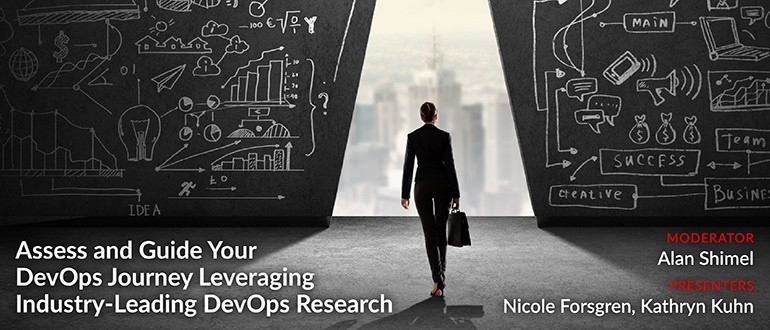
    Assess and Guide Your DevOps Journey Leveraging Industry-leading DevOps Research – Live Chat
    The DevOps Research & Assessment Group (DORA) is a group of the most preeminent researchers, scientists and experts in the DevOps community—and is the force behind the annual State of DevOps Report. CA has partnered with DORA to offer a unique assessment service for organizations in any stage of DevOps maturity. By leveraging DORA’s expertise and existing research—such as over 23,000 data points from over 2,000 companies worldwide—the assessment service can help you understand both the strengths and areas for improvement in your own DevOps programs.


    Better Training for Better Security
    In this session, Pete Chestna of Veracode talks to David Wayland from a Fortune 500 Financial Company about the recent CA Veracode/devopsy.kinsta.cloud DevSecOps survey. This lively discussion reveals what they have seen in the industry and their real world experience in implementing successful training programs. Your takeaways from this webinar will be solid recommendations for creating your own secure training initiative that leads to better engagement and better results.

    Implement a Best Practices Approach to Container Monitoring
    Listen to this conversation with Kieran Taylor, CA Technologies and Alan Shimel, devopsy.kinsta.cloud to understand:
    • What new monitoring, analytics and alerting techniques are best suited for containers.
    • Why an open data model is key to understanding and tracking microservice dependencies.
    • How to establish monitoring across the entire application lifecycle to increase development speed and quality.


    Is GDPR Getting Ready to Give Your Company the Left Hook?

    The General Data Protection Regulation (GDPR) introduces new and broad changes for data privacy for any company that retains EU customer data. Because so many companies are global, this regulation will most likely involve your company. GDPR gives EU citizens far more control on how you use their personal data. They can limit your use, be forgotten, and even seek damages if their data is misused or breached.

    Join CA Technologies’ Jeff Hughes, Sr. Principal Product Marketing Manager and devopsy.kinsta.cloud founder, Alan Shimel, as they discuss this upcoming legislation and how companies should go the distance by preparing for the May 2018 deadline! Jeff will provide concrete steps that you can take now to start or continue preparing for this new regulation. You’ll walk away with a knock-out action plan to start moving your testing and compliance teams in the right direction.


    Modern Application Monitoring is the DevOps X-Factor – Discover why!

    Just as we’re starting to get our heads around application containerization and orchestration and along comes serverless computing, service mesh architecture and hype-free Internet of Things use cases. Now DevOps practitioners need to elevate monitoring capabilities beyond relatively simple guarantees of technology uptime and application performance into the more challenging area of ensuring an optimum customer experience. An experience that fuses physical and digital, isn’t time bounded, and incorporates a complex series of customer journey touchpoints.

    Join a conversation with Pete Waterhouse, Senior Director of Product and Solutions Marketing at CA Technologies and devopsy.kinsta.cloud founder, Alan Shimel to understand:

    • What’s on the near-term biz-tech horizon (including containers, serverless, IoT) and how this will radically impact your monitoring strategies
    • How traditional practices in continuous delivery, testing and monitoring must evolve to support new digital models and the Internet of Things
    • The increased importance and benefit of application performance analytics across the DevOps toolchain

    Application Monitoring DevOps X-Factor


    Data Privacy – Why your company needs to pay attention to what’s behind the compliance curtain!

    Data Privacy has once again vaulted to the forefront with Facebook and other large companies grappling with data breaches and the use (or misuse) of personal data. We are charting new frontiers in data privacy and legislation alone will not mitigate the data challenges that lay ahead. Brand loyalty and brand trust can take years to build, but can be lost in an instant with one data privacy misstep. There are a number of regulatory challenges facing enterprises globally that need to be considered as well including The US Patriot Act and the upcoming GDPR requirements. Join us  learn from Alan Shimel of devopsy.kinsta.cloud and DevOps testing and compliance expert Jeff Hughes of CA Technologies on:

    • What is Data Privacy?
    • What are the penalties for non-compliance?
    • How can companies comply with data privacy laws?
    • What else can a company do beyond adhering to compliance regulations to protect data privacy?

    Enjoy a lively discussion with useful ideas that will help your teams exceed compliance regulations and preserve trust with your customers.


    Links to additional resources:

    Container Monitoring and Management eBook
    This eBook from The New Stack lays out the monitoring challenges confronting todays DevOps engineers, describing approaches to metric collection and visualization, the classes of modern monitoring, and importantly – how what methods work to tame complexity and ensure these dynamic application environments deliver on their promise.
    https://www.ca.com/content/dam/ca/us/files/ebook/container-monitoring-ebook.pdf

    The New Stack Makers Podcast: Future-Proof Docker with Modern Monitoring
    In this podcast, we discuss the complexities of monitoring microservice architectures and applications deployed to Docker. Sushil Kumar, SVP of Product Management at CA Technologies, describes the importance of employing an open, flexible monitoring data model for Docker.
    http://transform.ca.com/rs/117-QWV-692/images/CAtechnologies_Podcast.pdf

    The Total Economic Impact™ of Application Performance Management from CA Technologies
    A commissioned study conducted by Forrester Consulting on behalf of CA Technologies that examines the potential return on investment (ROI) that enterprises may realize by deploying CA Application Performance Management (APM).
    https://www.ca.com/content/dam/ca/us/files/industry-analyst-report/the-total-economic-impact-of-apm.pdf

    Try CA APM Today!
    Monitor application performance in minutes. No credit card required. It’s easy and free for 30 days.
    https://www.ca.com/us/trials/ca-application-performance-management.html?mrm=620656

    Contact – Becky Arenson
    Rebecca.arenson@ca.com

  • Liferay Launches WeDeploy, a Powerful Cloud Platform for Fast Deployment of Modern Apps

    Liferay Launches WeDeploy, a Powerful Cloud Platform for Fast Deployment of Modern Apps

    With comprehensive built-in tooling and microservices, WeDeploy eliminates backend bottlenecks and gets developers’ apps to market faster

    LOS ANGELES, Calif. – (October 9, 2017) – Liferay, Inc., which makes digital experience software for enterprises, today announced the immediate availability of WeDeploy, a new cloud platform giving developers the infrastructure, services and hosting capabilities required to quickly build, launch and scale their applications.

    “With WeDeploy, we’re releasing a platform designed from the ground up to meet developers’ needs for a powerful, intuitive application deployment solution – and one which we believe also empowers any business to get on the fast track toward meeting their digital transformation and customer engagement goals,” said Brian Chan, Chief Software Architect, Liferay.

    WeDeploy removes common backend obstacles so that application developers can focus time and resources on the differentiating features of their products. Businesses creating an application need a fast, reliable deployment method. WeDeploy provides easy application hosting through the cloud with just a few lines of code. By leveraging the Docker ecosystem, developers can use WeDeploy’s powerful hosting capabilities to deploy a fully customizable stack with a preferred runtime platform, application server or database.

    Additionally, WeDeploy meets the demands of modern apps for a robust infrastructure, significantly reducing time to market of apps. Through WeDeploy, developers have access to intuitive tools and out-of-the-box capabilities needed for today’s applications, such as GitHub integration, automatic traffic distribution, global DNS routing, application monitoring, log management, application health checks and secure data transfers. Moreover, by offering these services through a unified platform, WeDeploy saves businesses from the consistency issues they may face with multiple service providers.

    WeDeploy also acts as an all-in-one platform for prepackaged microservices including user authentication, real-time data and email. From third-party authentication through Facebook or Google to real-time content streaming and search capabilities, these plug-and-play services can be easily implemented with intuitive and versatile APIs.

    Liferay’s core enterprise solution – Liferay Digital Experience Platform – allows organizations to achieve digital transformation and provide better customer experiences, and WeDeploy is a natural extension of this vision. WeDeploy can serve to unify a business’s customer experiences across all touchpoints, delivering the real-time data needed to make those experiences consistent. WeDeploy’s advantages in the rapid development and deployment of new tools can also improve business operations and customer service, as well as add agility to the execution of a business’s overall digital strategy.

    “Our focus is always on improving experiences, whether it’s the experience of a single developer building an application, or making it quicker and easier for enterprises to execute an omnichannel strategy across every customer interaction,” Chan said.

    App developers ready to try WeDeploy can get started here: wedeploy.com

    About Liferay

    Liferay makes software that helps companies create digital experiences on web, mobile and connected devices. The Liferay platform is open source, which makes it more reliable, innovative and secure. Companies such as Carrefour, Coach, Danone, Fujitsu, Lufthansa Aviation Training, Siemens, Société Générale, VMware and the United Nations use Liferay. Learn more at liferay.com.

  • 5 C’s That Changed the Future – Webinar Series  CI, CD, Containers, Cloud & Culture

    5 C’s That Changed the Future – Webinar Series
    CI, CD, Containers, Cloud & Culture

    Join us for case studies of innovation and success with continuous integration (CI), continuous delivery (CD), containers, cloud (infrastructure & migration), and culture (the DevOps kind).

    If you’re on the same mission – to create sustainable systems that empower your business to deliver innovation faster and predictably – then you’ll gain incredible insights from this series. We’ll share the journeys of some very cool companies, joined by a few of the experts who are making it happen.

    Why 5 C’s?

    The consistent theme in these successes is DevOps – culture, process and technology. And when we looked at the results that had the most notable impact on the business, they related to implementations of some or all of the 5 C’s. Results such as:

    • 10x faster new product delivery.
    • Internal & client confidence in iterative development, driven by innovation in quality & feedback.
    • Modernized traditional apps by adding self-healing, auto-scaling, and rolling deployment capabilities.
    • Blameless culture, enabled by feedback and consistency across dev, test & prod environments.
    • Security integrated across the stack and not simply a checkbox.

    The series:

    • Tuesday, Oct. 3 – CI/CD, Containers & Culture
    • Tuesday, Dec. 5 – Cloud Infrastructure & Culture
    • Tuesday, May. 15 – Cloud Migration & Containers

    View On-Demand Webinar (Oct. 3):
    Faster Innovation with Confidence – How CI/CD & Containers Help Arrayent Go Faster

    View On-Demand Webinar (Dec. 5):
    Scaling Cloud Infrastructure for Millions of Devices

    View On-Demand Webinar (May 15)
    Cloud Migration: Solving for Growth with Containers & DevOps on AWS

  • Tasktop Connect Conference Rounds out Featured Speakers for Oct. 4 DevOps and Agile Transformation Event in Columbus, Ohio

    Features Gene Kim, IT Revolution; Robin Yeman, Lockheed Martin; Keith Pemberton, McKesson; Carmen DeArdo, Jim Korcykoski, Nationwide; and Mark Ford, TIAA

    VANCOUVER, BC, Sept. 14, 2017– Tasktop, the leader in DevOps Integration, today announced the full list of or speakers for its Tasktop Connect one-day conference in Columbus, Ohio, on October 4, 2017.
    Designed for anyone responsible for managing all or part of an enterprise DevOps transformation, Tasktop Connect will examine what makes the world’s largest DevOps and Agile transformations successful and will offer transferable, concrete steps organizations can take to realize that success.
    The event features experts like Gene Kim, author, researcher, founder of IT Revolution; Robin Yeman, Fellow at Lockheed Martin; Keith Pemberton, director, technology tools and services, McKesson; Carmen DeArdo, DevOps technology director for Nationwide Insurance; Jim Korcykoski, Enterprise CTO for Nationwide Insurance; Dr. Mik Kersten, CEO and co-founder of Tasktop; Mark Ford, lead developer at TIAA; and others.
    Tasktop Connect will provide attendees with actionable advice on the following topics:
    • Creating a powerful holistic approach to software development and delivery
    • Implementing successful Agile and DevOps transformations
    • Building modular toolchains that leverage best-of-breed products
    According to Kersten, “Connect aims to show what’s missing in software development and delivery processes. I encourage anyone involved in DevOps transformations to attend so they can obtain actionable advice from leaders of large, complex organizations that are currently implementing Agile or DevOps transformations.”

    The event includes educational sessions, time for valuable networking and a social evening that includes dinner and cocktails. Interested parties can register here.

    About Tasktop
    Over one million users employ Tasktop’s DevOps Integration technology to transform software development and delivery. Tasktop not only unifies the software development and delivery team, but also provides unprecedented visibility into the business critical processes of software delivery. Tasktop customers are the global leaders in financial services, insurance, government and manufacturing, and include 43 of the Fortune 100, 11 of the top banks in the world, six of the top six health plans and four of the top ten US insurance companies. Partners, including CA, HPE and IBM, rely on our independent, vendor-neutral role to connect their customers’ software delivery disciplines via OEM distributions of our products. For more information about Tasktop, please visit: http://tasktop.com

    ###

  • Instaclustr Launches Managed Open Source-as-a-Service Platform

    The platform provides managed and integrated Apache Cassandra, Apache Spark, Elasticsearch, Kibana, Lucene, and Zeppelin as 100% open source, zero lock-in solutions

    Redwood City, CA — September 11, 2017 — Instaclustr, offering scalable open source technologies delivered as completely managed solutions, today announced the launch of its Open Source-as-a-Service platform. This comprehensive platform offers customers across industries – and from startups to the enterprise – fully hosted and securely managed Apache Cassandra, Apache Spark, Elasticsearch, Kibana, Lucene, and Zeppelin. Each is delivered to customers in its 100% open source form, with absolutely no vendor or technical lock-in. The platform arrives as the company continues to deliver top-line growth in excess of 100% YoY, and has reached milestones of 10 million node hours and 1 petabyte of data under management.

    Instaclustr has always delivered managed open source solutions, operating an automated, proven management environment that customers trust to provide reliability at scale. Now, with the launch of its new platform, Instaclustr makes that commitment official by dedicating itself to deploying only 100% open source technologies. In an industry where, all too often, providers will deliver open source solutions repackaged into proprietary versions that promote vendor lock-in, Instaclustr is ensuring that every solution it provides will always consist of fully portable open source code.

    In proprietary lock-in situations, businesses find themselves held prisoner to price increases, have no ability to run the solutions themselves or modify code to fit specific cases, and face slower resolution of bugs and other issues. In contrast, Instaclustr’s new platform puts organizations in control and helps to de-risk an investment in open source technologies. Customers are empowered to utilize and customize its managed open source solutions however is optimal, while also providing the support and expertise required for businesses to fully focus on building their applications. This also means that customers receive all the benefits of true open source technology, including the ability to leverage the vast communities of developers and companies that use the exact same open source code base, and provide assurance and improvements much more rapidly than with proprietary products. At the same time, Instaclustr manages version control and patches to ensure that customers are always running the latest and most stable builds of open source solutions.

    Instaclustr’s Open Source-as-a-Service platform provides database, analytics, search, and messaging technologies recognized for their ability to deliver scalability, reliability, and performance. Each solution is backed by Instaclustr’s 100% uptime guarantee, and features expert support available 24/7. Instaclustr’s Open Source-as-a-Service platform includes:

    Apache Cassandra – Hosted and fully managed Apache Cassandra on AWS, Azure, GCP, and Softlayer. Features a continuous availability architecture that is failure-resistant by design, as well as the ability to scale easily and address workload increases in minutes not hours.

    Apache Spark – A cluster-computing framework that processes data in-memory, designed to deliver speed and performance.

    Elasticsearch with Elassandra – A fast, powerful indexing and querying capability leveraging Cassandra’s resilient and distributed architecture.

    Kibana – A powerful user interface offering developers the capabilities to explore, analyze, and visualize data via search.

    Lucene – A high-performance, multi-featured text search engine, designed for applications that require full-text search.

    Zeppelin – A web-based notebook providing powerful interactive data analytics.

    “The development of our Open Source-as-a-Service platform is the natural progression of Instaclustr,” said Peter Nichol, CEO, Instaclustr. “We’ve always maintained a commitment to empowering customers, providing much-needed hosting and management solutions that keep customers in control of their own destinies and their own core technology. With this release, we’re proud to formalize our commitment to 100% open source-only solutions. We have made it easier than ever to benefit from these powerful technologies delivered as a service, and without any of the strings attached found with proprietary solutions or commercial startups baking a single open source project.”

    “The open source technologies that we rely on Instaclustr to provide have proven tremendously advantageous time and time again, allowing us to concentrate internal resources on product development and other business needs,” said James Amos, Senior Managing Consultant – Digital Strategy & Interactive, IBM. “Instaclustr’s principles in providing services and solutions with complete transparency have yielded us all the pluses of open source, with no downtime, lock-in, or surprises.”

    About Instaclustr

    Instaclustr is the Open Source-as-a-Service company, delivering reliability at scale. We operate an automated, proven, and trusted managed environment, providing database, analytics, search, and messaging. We enable companies to focus internal development and operational resources on building cutting edge customer-facing applications.

  • Digital Defense, Inc. Named a 2018 TAG Cyber Distinguished Vendor

    San Antonio, TX – September 13, 2017 – Digital Defense, Inc, a security technology and services provider with proven success, is proud to announce its designation as a Distinguished Vendor in this year’s 2018 TAG Cyber Security Annual.

    Digital Defense becomes part of an extensive list of successful and tested cyber security vendors. With them they bring a robust range of security products and services. Each member of this list was hand-selected by Dr. Edward Amoroso, CEO of TAG Cyber, to assist with this year’s report, which was made available today for free download here.
    “Ed and his team at TAG have proven successful in their work for us,” said president & CEO Larry Hurtado. “Their ability to further enlighten IT professionals on the secret sauce behind our Frontline vulnerability management solution and complementary services has helped our business grow.”
    This year’s 2018 TAG Cyber Security Annual was developed to assist enterprise security teams as they modernize their cyber risk program via the following three steps: Exploding the flat perimeter enterprise into distributed workloads; Offloading the resultant applications and networks onto cloud-based, software-defined infrastructure; and then Reloading protections using the best available cyber security technologies.

    “The Digital Defense team has proven time and again that you don’t have to work in Silicon Valley to be a cyber success,” said Amoroso. “Their managed and on-demand SaaS risk assessment solutions, in addition to their security professional services are powerful tools.”
    Each year, TAG Cyber publishes its three-volume report to the community for download at no cost. In addition to the Javelin Networks website, the report is also available at https://www.tag-cyber.com/. Volume 2 of the report also includes an informative interview with Digital Defense president & CEO, Larry Hurtado.

    About Digital Defense
    Serving clients across numerous industries from small businesses to very large enterprises, Digital Defense’s innovative and leading edge technology helps organizations safeguard sensitive data and eases the burdens associated with information security. Frontline Vulnerability Manager™, the original Vulnerability Management as a Service (VMaaS) platform, delivers consistently accurate vulnerability scanning and penetration testing, while SecurED®, the company’s security awareness training promotes employees’ security-minded behavior. The Digital Defense Frontline suite of products, underpinned by patented technology and complemented with unparalleled service and support, are highly-regarded by industry experts, as illustrated by the company’s designation as Best Scan Engine by Frost & Sullivan, top 20 ranking (#16) in Cybersecurity Ventures’ list of the World’s 500 Hottest Cybersecurity Companies, five-star review in SC Magazine and inclusion in CRN’s MSP 500.
    Contact Digital Defense at 888-273-1412; visit www.digitaldefense.com, our blog, LinkedIn, or follow @Digital_Defense on Twitter.

    About TAG Cyber
    TAG Cyber provides Advanced Cyber Security Advisory, Training, Consulting, and Media Services for Global Enterprise and Federal Government Chief Information Security Officer (CISO) Teams. For more information, visit: https://www.tag-cyber.com/
    All trademarks are the properties of their respective owners.

  • The DevOps Institute is Proud to Partner with Pearson to Announce the New Continuous Delivery Architecture (CDA)℠ Certification Course

    The DevOps Institute is Proud to Partner with Pearson to Announce the New Continuous Delivery Architecture (CDA)℠ Certification Course

    Successful candidates of the new the DevOps Practitioner® role-based course will earn the Continuous Delivery Architect (CDA)℠ certification

    BOCA RATON, Fla. – September 7, 2017 – The DevOps Institute (DOI), the continuous learning community around emerging DevOps practices, training and certification, today announced it has launched a new competency-based certification: Continuous Delivery Architecture (CDA) in partnership with Pearson, the world’s learning company. Built upon the principles and practices of Pearson’s bestselling book “Continuous Delivery” by Jez Humble and David Farley and the “Continuous Delivery LiveLessons” video course by Jez Humble, the CDA course equips IT professionals with the broad-based competencies necessary to architect and orchestrate effective and efficient automated deployment pipelines. CDA is the newest certification in DOI’s DevOps Practitioner® series and will be delivered by DOI’s global channel of Registered Education Partners.

    “Through our lifelong learning partnership with the DevOps Institute, we’re harnessing the power of digital learning to equip IT professionals with the knowledge and skills they need to increase their employability in today’s highly competitive workforce,” said Chris Guzikowski, Executive Editor, Pearson.

    The course author is Marc Hornbeek, a well-respected IT professional and IEEE Engineer award recipient. While the core content is derived from Pearson’s “Continuous Delivery” book and video course, Hornbeek supplemented the concepts with emerging practices such as containers and microservices. The result is a proven set of practices that any Continuous Delivery Architect could apply to the automation of any deployment pipeline or automated toolchain.

    As part of the Pearson partnership, each learner will be provided digital access to the “Continuous Delivery” ebook and video LiveLessons. The course materials will also include practical artifacts, templates and lexicons collected by Mr. Hornbeek to assist learners post-class. The course culminates in a certification exam administered by PEOPLECERT, DOI’s examination partner. Successful exam candidates will be designated as “Continuous Delivery Architects” and will be issued a certificate and digital badge.

    “The purpose of this course and its associated exam is to impart comprehensive knowledge of Continuous Delivery vocabulary, principles, practices, automation and value,” said Hornbeek. “CDA is intended for development, quality assurance, security and operational professionals who are engaged in end-to-end DevOps software development from idea conception through live production operations.”

    The course will explore key Continuous Delivery Architecture topics, including

    ● Goals, history, terminology, and pipeline
    ● The importance, practices, and transformation of a DevOps collaborative culture
    ● Design practices, such as modular design and microservices
    ● Continuous Integration (CI), such as version control, builds, and remediation
    ● Tenets and best practices of Continuous Testing (CT)
    ● Continuous Delivery and Deployment (CD): packaging, containers, and release
    ● Continuous Monitoring (CM): monitoring and analysis infrastructure, process, and apps
    ● Infrastructure and tools: frameworks, tools, and infrastructure as code
    ● Security Assurance: DevSecOps
    ● The opportunity to hear and share real life scenarios

    This course will be particularly relevant to automation architects, release engineers, infrastructure teams, security professionals, quality assurance and other roles that contribute to the software delivery value stream.

    “By partnering with Pearson, we are able to leverage their extensive expertise in new learning tools and educational training materials,” said Jayne Groll, CEO of the DevOps Institute. “With this course, DevOps Institute candidates will be able to better understand tangible techniques for delivering high-quality software faster and more frequently.”

    For more information, visit: http://devopsinstitute.com/courses/#CDA or here for related video.

    About the Course Author
    Marc Hornbeek is a DevOps consultant with over 39-years experience architecting, designing, developing, and managing high-performance solutions for IT and engineering infrastructures. He is a regular speaker, blogger, and author of the DevOps Continuous Delivery Architecture (CDA) course and the DevOps Test Engineering (DTE) course. He is a 41-year member of the Institute of Electrical and Electronics Engineers (IEEE), and awarded “2016 Outstanding Engineer” by the IEEE Region 6 Western United States for his career contributions to the field of automation applied to networks, protocols, testing, labs, and DevOps.

    About Pearson
    Pearson is the world’s learning company, with expertise in educational courseware and assessment, and a range of teaching and learning services powered by technology. Our mission is to help people make progress through access to better learning. We believe that learning opens up opportunities, creating fulfilling careers and better lives. For more, visit www.pearson.com.

    Contact for Pearson
    Scott Overland, 202-909-4520
    scott.overland(at)pearson(dot)com

    About the DevOps Institute
    The DevOps Institute is the continuous learning community around emerging DevOps practices. Working with recognized thought leaders and strategic examination partner PEOPLECERT, the DevOps Institute is setting the quality standard for DevOps competency-based qualifications.

    Web | http://devopsinstitute.com/
    Twitter | @DEVOPSINST
    LinkedIn | /devops-institute
    Facebook | /DevOpsInstitute/
    YouTube | DevOps Institute
    Instagram | /devopsinstitute/

    Contact
    for DevOps Institute
    Manny Varela, 561-325-8101
    manny(at)devopsinstitute(dot)com