Tag: tools

  • DevOps in Legacy Systems: A Mission Impossible?

    DevOps in Legacy Systems: A Mission Impossible?

    The word “legacy” evokes mixed reactions from the IT and business crowds alike. For those who depend on legacy systems such as the zSeries and iSeries platforms, it is a way to deliver stable and reliable applications into production. Business stakeholders who may not know the intricacies of the technology often take a view of, “Why fix it when it ain’t broken?”

    mainframe

    On the other hand, for those who haven’t experienced the joys and pains of legacy systems , legacy world will continue to defy their logic and assumptions because their view of the world is shaped by the open system world which has completely different characteristics: being more malleable to change and easy to maintain etc. Hence there is this great divide between the legacy and new worlds. Add Agile and DevOps to the equation with the lofty goals of increased release frequency and reduced lead times, we end up with a divide that is too far to bridge.

    cobol code

    The likes of Gartner have come up with constructs such as two-speed delivery to help deal with this legacy challenge. In my view, there is a problem with the idea of dual-speed because it is based on a wrong analogy to start with — that of allowing vehicles to move at different speeds depending on whether you are on the motorway or a city road. That analogy works well for traffic management scenarios but not for complex IT architectures we see in the enterprise. The dependencies across the systems in the enterprise landscape are just too intricate and too tightly coupled to be defined using such a binary logic. In my experience, I find that many Agile and DevOps transformations hit the roadblock and never achieve the desired levels of productivity and effectiveness because of an oversimplified view of these complex dependencies across legacy and open systems.

    The three biggest challenges that prevent a legacy DevOps transformation are mindset problems, architectural constraints and tooling limitations.

    The Mindset Problem

    “There are no legacy systems, just legacy thinking.” That’s a great quote I heard recently from an engineer in a large organization trying to adopt DevOps at enterprise scale. The initial resistance from teams to move into DevOps ways is due to reluctance to change, emerging from an inertia of doing things a certain way for years if not decades. The mindset problem is as much a problem for those outside the legacy world as those inside. The “outsiders”—typically leadership, management team and consultants—tend to oversimplify the problem and, too often, rely on examples from the open systems world. This just alienates the incumbent legacy teams and makes them even more skeptical of DevOps driven change. The outsiders need to have a genuine appreciation of the challenges with legacy architecture and need to work in collaboration with the legacy teams if they really want to transform their organization.

    Architectural Constraints

    Legacy systems have certain characteristics such as being static, tightly coupled and monolithic blocks of procedural code. These systems were not built for the modern Agile workflows that focus on incremental and iterative deliveries. A significant majority of these systems are written to operate in batch mode.Testing the systems requires cycling through multiple business days, which simply limits the level of agility you want to introduce in the organization. I am currently working with a legacy engineering team in the financial services space where you have to cycle through a minimum of 20 business days to simulate even 70 percent of the test scenarios. However, there are a number of solution options to overcome the architectural challenges; they range from killing applications to migrating to modern platforms or re-engineering legacy code. Not surprisingly, the right approach depends very much on your context.

    Tooling

    Tooling in the legacy world to support a DevOps ways of delivery has always been a challenge. But it is fast changing now, thanks to a number of startups and even old-school IT product companies investing in this space. If you consider zSeries as an example, there are better IDEs (integrated development environments) such as RDz that can replace traditional code editors typically based on “green screens.” These IDEs provide great features such as better navigation, debugging, split views and searches on the legacy code. One of the CIOs I worked with made it clear to his team that he wanted to get rid of “green” screens from the IT floor. There are tools such as SmartBear Collaborator that support a great peer review experience and help bring one of the original XP practice of pair programming to the legacy world. There are tools such as endeavor from CA that promise automated build and deployments in the z-series world. Similarly, there are tools that support test automation of mainframe applications and tools for code coverage and code quality checks on legacy programming languages like COBOL. XATester looks like a promising tool for unit test automation from a Danish startup called Xact.

    While this write-up is not intended to be a compendium of all DevOps and engineering tools, the central message is that there are a number of DevOps tools emerging on the legacy landscape which can help your legacy delivery teams get on to the DevOps and Agile journey.

    What is more important is for organizations to realize that many of these legacy systems will remain part of their IT landscape for the next foreseeable future and it is time to invest in these core systems. They may not look as appealing as the digital platforms, but they are fundamental for businesses and you cannot ignore them on your DevOps journey. DevOps in the legacy world is not going to be smooth, but it is certainly not a mission impossible!

    — Aditya Vadaganadam

  • CD 101 Podcast: How to Build the Modern Software Factory with Agile Development and Continuous Delivery

    CD 101 Podcast: How to Build the Modern Software Factory with Agile Development and Continuous Delivery

    And now, for Episode 3 … you decide if it beats “Star Wars – Revenge of the Sith.”

    I think we accidentally just set the bar pretty low, but …

    … here we go. Let’s begin with a prerequisite pithy quote from an objective industry observer:

    “If agile software development was the opening act to a great performance, continuous delivery is the headliner,” according to Kurt Bittner of Forrester Research.

    Kurt explains this concept further by saying, “The pace at which consumers expect change is causing a crisis in application development and delivery … agile was a good start, but it wasn’t sufficient to drive better business results; continuous delivery forges the broken link in the value chain, connecting business strategy with business results.”

    So there, you have it.  At least according to Forrester, continuous delivery (CD) is one of the most important evolutions of agile methodology within the modern software factory. But, there’s more.

    Andrew Binstock from Dr. Dobbs fairly well echoes this sentiment, saying: “It’s becoming clear that agile alone is no longer sufficient to keep up with the demands of the present day … software complexity and the need for constant updates are making it difficult for leading edge organizations to keep up without moving beyond agile and embracing continuous delivery.”

    Episode 3 of our podcast series discusses the importance of Agile Transformation along WITH Continuous Delivery to automated some of the development, test, and release efforts to remove some of the bottlenecks downstream in the software development life cycle in the build, test and release phases.

    Lean Agile + CD can create these 1+1=3 types of results.

    Episode 3 of the Continuous Delivery 101 Podcast can be found by:

    • Listening to it on your computer on YouTube
    • Downloading it from iTunes store
    • Downloading the podcast from your Podcast App by searching for “Continuous Delivery 101 podcast”

    Thanks for listening!

    — Scott Edwards

  • DevOps is Dead! Long Live DevOps!

    DevOps is Dead! Long Live DevOps!

    Some are seekers on the quest for the one, true DevOps. They were misled. I’m here to say: Give it up. Whatever you find at the end of that journey isn’t it. That one true DevOps is dead. Dead and buried. The search is pointless or, kind of worse: The search misses the point altogether.

    DevOps began as a sort of a living philosophy: about inclusion rather than exclusion, raises up rather than chastises, increases resilience rather than assigns blame, makes smarter and more awesome rather than defines process and builds bunkers. At any rate, it was also deliberately never strictly defined.

    In 2010, it seemed largely about Application Release Automation (ARA), monitoring, configuration management and a lot of beginning discussion about culture and teams. By 2015, a lot of CI/CD, containers and APIs had been added. The dates are rough but my point is: That’s all still there but now DevOps discussions today also include service design and microservices. Oh, and the new shiny going by the term “serverless.” It is about all of IT as it is naturally adapting.

    And this emergent, inclusive content is possible because it’s always just people talking practices and sharing how to optimally do things. Infra as code, “cattle, not pets,” webscale, version and automate all the things, horses not just unicorns, etc. Lots of conversations, insights sharing, presenting.

    Good times.

    There are more DevOps Days naturally occurring globally this year in 2017 than ever before. Note I wrote “naturally”—DevOps was always an organic movement, a grouped (and, whoa, global) response to increased app release pressures and the desire to select for teamwork over turf wars.

    So we started with DevOpsDays and those blossomed all over. Then we got the Phoenix Project, the DevOps Enterprise Summit (now in US and EU formats!), and more great books including “Infrastructure as Code,” “System Reliability Engineering” and, finally, “The DevOps Handbook.” It’s all solid, informative stuff and I believe as a community we’re smarter, happier, and far more effective because of it.

    Even those naysayer analysts—you know who you are—have come around to accepting the DevOps goodness.

    DevOps lives when we continuously adapt to managing emergent properties spawning system-level feedback loops in our IT and across our businesses. To do better, faster, higher quality things to delight the customers.

    Any discussion of DevOps is truly about continual IT innovation adaptation because the rate of IT change is also changing. Fast and faster. All that means starting with the roots like CLAMS and moving forward with containers and embracing the journey to quickly delivering better customer experiences.

    So, the concept of DevOps is evolving, just as our understanding of what’s needed is evolving.

    — Christopher Little

  • Why Financial Companies Love Continuous Delivery

    Why Financial Companies Love Continuous Delivery

    The other day I was on the American Express website paying bills and browsing around the benefits and services afforded me when I ran across a “who we are” section. It read:

    “We’re a global services company that provides customers with access to products, insights and experiences that enrich lives and build business success.”

    Surprisingly, the term “financial” was missing from the description. This led me to wonder if other financial institutions are evolving how they think about themselves. Here are some other examples:

    • Bank of America: “Here to help connect you to what matters most.”
    • ING: “Empowering people to stay a step ahead in life and in business.”
    • MasterCard: “As a technology company, we connect individuals, businesses and organizations around the world, creating greater opportunities for all.”

    Financial Companies Love Their Customers

    My unscientific assessment of various financial services companies suggests that they are centered on delighting their customers. They are transforming who they are by altering their customer engagement models and essentially becoming better software companies. MasterCard has even reclassified itself as a “technology” company. These companies are transcending the role of transaction engine to offer seamless, intuitive digital experiences for their customers.

    And the proof is in the performance. According to Forrester’s Customer Experience (CX) Index, financial services firms, including retail banks, credit card companies, investment firms and auto and home insurers, are some of the top brands worldwide when it comes to CX.

    You might think that large financial institutions would be digital laggards because of legacy infrastructure, regulatory compliance pressures and overall risk-avoidance. But you’d be wrong.

    In another study, 81 percent of financial services firms said they are embracing digital to redefine their businesses, and 87 percent are on the DevOps bandwagon. Sixty-one percent even said they are disrupting their industry with advanced digital initiatives.

    To stay competitive and improve their customer experience aptitude, financial services firms are undergoing significant digital transformation.

    Getting the Pulse of Fintech Continuous Delivery Adoption

    But how progressive are these firms in terms of their application delivery practices? Working with CA, Gatepoint Research recently surveyed more than 100 IT executives from financial services companies to take the pulse of where they are in continuous delivery adoption. Results can be found in this report and infographic.

    First off, to see if these companies might be considered unicorns or stragglers, they were asked the total volume of monthly deployments in all environments. Forty percent fell at the low end with fewer than 50 deployments per month. Now, lower deployment numbers could mean that these are less agile organizations or that they have fewer applications in general. Somewhat correlative to lower deployment numbers, the survey found that 48 percent currently are not using an application release automation (ARA) solution. Without automation, it’s tough to scale release processes—particularly to keep up with agile development.

    Moving up the spectrum, 41 percent are moderately prolific at 50-500 deployments per month, and then 15 percent are what I would consider rock stars with more than 500 (7 percent of those over 1,000). Those doing hundreds of deployments a month often have agile development teams and more modular applications. They likely have continuous delivery practices in place that push more frequent, iterative deployments left, helping higher-quality applications to move through the pipeline to production.

    The primary application delivery goals for financial services firms for the next 12 months are to get better control of release processes, tools and environments; to reduce risk and failures; and to release applications more frequently. All of these needs typically stem from companies undergoing digital transformation—it feels more chaotic and disconnected, manual processes are breaking under the weight and there’s intense pressure to move faster.

    Compliance was not a top goal, and the majority (83 percent) claim that their current release process is adequate to meet regulatory requirements. However, they did acknowledge that they could improve in terms of knowledge safekeeping and auditability of the release process.

    The data certainly shows that financial services companies are adopting continuous delivery practices in some form and exploring solutions, including many open-source tools, to help them get the job done. They currently are focusing continuous delivery practices on tracking and reporting releases, planning and scheduling releases and automating test deployments. These practices ultimately help financial services companies to release high-quality applications anywhere at any time.

    How Continuous Delivery Helps Fintech Win

    Continuous delivery sits at the heart of many digital initiatives because of what it enables these companies to achieve for their customers:

    • Delivering features and updates that customers need when they need them
    • Delivering applications that meet performance and quality expectations of customers
    • Delivering secure, compliant applications (for external and internal customers)

    Continuous delivery enables continuous devotion to the customer experience.

    Continuous Release: Fast Customer Response

    With continuous delivery, you establish an application release workflow that automatically connects a developer’s update to parallel testing to staging and ultimately to production release. Because of the underlying end-to-end automation technology, these steps can happen quickly, seamlessly and with little to no manual intervention. Some might call it “push button release” or “zero-touch release.”

    It’s a controlled, tracked, governed, collaborative process. Application stakeholders stay aligned as application changes traverse the pipeline. Your customers can have access to fixes, updates and new innovations in days instead of weeks or months.

    Continuous Testing: Building in Quality

    In contrast to the significant time penalties and shortfalls that can happen with manual testing, in the continuous delivery pipeline, testing is shifting left and happening in parallel. Hand-offs and feedback loops are automated and efficient.

    Testing can happen earlier and without delay with the help of test environment simulation. Testing is on target through automatic test case creation, even from requirements. Testing is real-world with on-demand test data generation. And testing is rigorous with developers able to performance test apps at their end. The continuous testing that occurs as part of the process helps to build in quality and ensure top performance before reaching the customer.

    Continuous Compliance: Audit-Ready Processes

    Ensuring applications are compliant and secure is critical for your customers. It’s making sure customer information is safe and that application changes are tracked sufficiently for SOX or other reporting. It’s also about helping out those internal “customers” like auditors to prove compliancy and easily build reports.

    An automated continuous delivery pipeline can track releases, apply role-based governance, orchestrate proper data masking, deploy security policy updates and provide an audit trail for application releases—who did what, when and why. All this data can be collected and reported easily, which saves time and effort for auditors. You essentially stay compliant and secure all the time.

    Customer Satisfaction Through Automation

    Financial services companies are laser focused on using technology to delight and retain customers. And continuous delivery is the application delivery practice that’s underpinning these efforts. The companies that are exceptional at this, with thousands of deployments per month, are using automation tools such as Application Release Automation (ARA). These tools are the backbone of continuous delivery, providing the automated orchestration, governance, tracking and reporting for your pipeline—development through production.

    That’s why I’m not surprised that leading financial services companies make up a large portion of CA’s release automation customers, including Euroclear, GM Financial, ING, Jewelers Mutual and Western Union. Our customers put high value on delivering excellent customer experiences and are implementing modern software delivery methodologies, practices and associated tools to support their efforts. GM Financial recently said it is “the software company that does auto finance.”

    If you are serious about customer satisfaction and staying ahead of nimble competitive threats in the market, you must get serious about end-to-end automation. It’s time to truly embrace the practice of continuous delivery to be able to consistently release applications that are progressive, always compliant and completely customer-satisfying.

    — Patricia Johnson

  • Security @ the Speed of DevOps Survey: Efforts Still Lag

    Security @ the Speed of DevOps Survey: Efforts Still Lag

    Enterprises today are in a relentless race to digitize or die. If they don’t digitize business processes, services or internal workflows and their competitors do, they will be at a steep disadvantage—and perhaps soon an irrecoverable one.

    In more and more companies these efforts are being driven by DevOps. According to IDC, the vast majority of businesses today think—and rightly so—that it is essential for them to put into place the right resources and IT processes to support a digital business model. Unfortunately, about 75 percent of organizations don’t think that their IT organization is actually scalable enough to deliver and support a comprehensive digital business model.

    There are many reasons why so many organizations have a challenging time with their digital transformation efforts. Many of these are cultural: IT commands tightfisted control over all information technologies used throughout the organization, yet being unable to deliver the infrastructure and digital services enterprises need to succeed, for example. Or, others within the organization still are unable to see how rapidly the world is being changed by digital technologies and so aren’t taking the necessary steps.

    Another reason is security. That’s because this rapid digitization of business processes can have a profound impact on how enterprises secure their data, applications and software development and delivery. In devopsy.kinsta.cloud’s inaugural annual “Security @ the Speed of DevOps” survey, we queried 255 security IT decision makers within organizations currently practicing DevOps or that are on a path to DevOps adoption. The survey found that enterprises of all sizes are embracing DevOps, cloud, continuous integration and deployment. But in securing these processes, however, we found vast differences in maturity.

    When it comes to DevOps practices, larger companies are outperforming. For organizations with 5,000 to 9,999 employees, a full 90 percent have either adopted or started DevOps practices. However, only 38 percent of organizations with 500 or fewer employees have started DevOps or widely adopted such practices.

    As I wrote in our report on the survey, smaller organizations also have a way to go with automated security testing. Only 6.5 percent of those with fewer than 100 employees have automated large parts of their application security testing, while 29 percent have automated some of their application security testing. For firms with 5,000 to 10,000 employees, 38 percent have automated large parts of their testing, and nearly 50 percent some of their testing. For those with more than 10,000 employees, these figures are 20 percent and 48 percent, respectively.

    The challenge here, for many organizations, is the same with enterprise security in general: the view that security slows things down. For the business, it’s about getting more digital capabilities out as quickly as is possible. It’s the same for developers. Security too often is seen as standing in the way of this.

    When this conflict is experienced at DevOps speed, there is the risk not only of development slowing down but also security processes breaking. To succeed, enterprises can’t take the same approaches to security as they did in the past. They must find tools and processes that are designed for the highly automated and continuous world of DevOps.

    Have a look at our survey and report to see how enterprises are tackling this challenge today.

    — George V. Hulme

  • DevOps: State of the Art in 2017, and Why CDOs Should Care

    DevOps: State of the Art in 2017, and Why CDOs Should Care

    Nine years after the term “DevOps” was coined, the following two questions seem still open:

    From the perspective of the industrialization of work labor also in the software industry, the answer to the first question appears very clear to me: DevOps is the third (digital) revolution of software and IT services, where CI/CD was equivalent of the second industrial revolution as elaborated in more detail in this article. Chances are high that further transformation can be expected to merge it with the fourth industrial revolution, as stated here: “DevOps will underpin the 4th industrial revolution.” That is also why chief digital officers (CDOs) should be in contact with DevOps teams in their organizations.

    Now, I see two important things have happened end of 2016: First, the establishment of DevOps Express, as 14 leading enterprise vendors have recognized the importance of interoperability of their tools for leveraging DevOps stack. The demand for this—the second important thing—has been (in my opinion) totally confirmed by CA’s infographic going viral, which maps a broad selection of tools around the software development life cycle. Adding the lifecycle view has been definitely an improvement beyond an overview of tools as proposed in the Periodic Table from XebiaLabs. Still, we are not done. Let me explain why.

    The next challenge I see is there is yet no agreement within the community what is—or could be—a reference DevOps toolchain (meta) model or process (meta) model. Is it:

    • “Plan, Develop, Test, Release, Operate,” as suggested by CA, or maybe
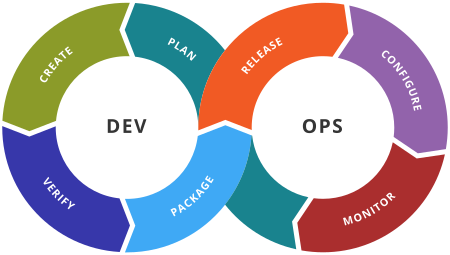
    • “Plan, Create, Verify, Package, Release, Configure, Monitor,” (Wikipedia) or
    • “Requirements, Development, Build, Testing, Deployment, Execution” (Len Bass et al.)?
    Source: Wikipedia, DevOps toolchain

    In the seminal book, “Continuous Delivery,” this life cycle was suggested as “Commit stage, automated acceptance testing, automated capacity testing, manual testing, release.” While we talk so much about culture in DevOps, we should recognize the need to align on a high-level view on the DevOps life cycle that is well-understood and accepted by most stakeholders.

    To have a track of all this and attract other collaborators, I have created an open format (SVG) infographic and published it as a GitHub project. Dear colleagues at the DevOps Express consortium, this is your call! Let’s join forces and accomplish this together.

    Next Steps

    After we will have (I hope so) a community-accepted DevOps meta-model toolchain setup and all important tools in place on the ecosystem, many more interesting questions will appear:

    • Which of these DevOps tools leverage open APIs to reduce risk of vendor lock-in?
    • Which tools belong to which generation of systems, leveraging optimization of human labor?

    Why DevOps is also CDO’s Business

    The fourth industrial revolution builds on digital process data, right? So if we aggregate all that data spread across and produced by the DevOps tools, we could get useful and holistic analytics and insights about IT in much faster time than we can imagine today.


    About the Author / Peter Muryshkin

    1Peter studied M.Sc. in Applied Computer Science and works in management consulting roles focusing on complex analysis and customer satisfaction, like IT Business Analyst and Change Manager. His current scientific research focus is digital transformation applied to the field of software engineering in large distributed organizations. Connect with him on LinkedIn.



  • F5 Networks’s State of Application Delivery, 2017

    F5 Networks’s State of Application Delivery, 2017

    For the last three years, F5 Networks has surveyed its users and presented the “State of Application Delivery” report. This year’s report is already a couple of weeks old, and I’ve had the opportunity to read through it. There is good information in there for “NetOps” people—those who are focused on the network but want DevOps-style management. The report discusses the trends and what its customers—which lean to the larger, more established organizations—are doing.

    DISCLOSURE: I’m a former F5 employee, and overall, I loved the company. Its upper management has managed to navigate bad times and thrive in good times, and the direction of the company was generally excellent while I was there. My reasons for leaving had nothing to do with top-level management or product. In short, I’m a fan of F5. Also, my wife is still an employee of the company and—worse than that—had a hand in creating both the survey and the resulting document. And Lori sometimes also writes for devopsy.kinsta.cloud. Thus, any criticisms I offer here I will have to be willing to defend on social media, at editorial meetings and at the dinner table.

    With all that said, since readers can download the report and form their own opinions, I’m comfortable writing about this report. And I’ll even risk doing battle over the steak fries for my loyal readers.

    F5 asked nearly 2,200 users of its gear from a variety of industries a series of questions regarding how they use application services—those things such as load balancing, web application firewalls or DDoS protection that exist for an application but aren’t part of it. Included also were DevOps questions and automation questions outside the realm of DevOps.

    While much of the report is of general interest for any IT practitioner, some of it is specifically of interest to DevOps practitioners. So, with the exception of a few sweeping statements, I’ll restrict myself to the DevOps-relevant portions of the report.

    Insider side note: Lori has mentioned F5 has a metric ton of data it was unable to squeeze into this report, and she would be talking about off-and-on for a while at her F5 blog. If this topic interests you, it might be worthwhile to follow her.

    The first thing to visit is the overall list of takeaways. The report offers four “Key Findings” and, interestingly enough, three of them are relevant to DevOps. When you dig into the fourth (security-related) key finding, you discover that it, too, is at least tangentially related to DevOps.

    While I don’t want to give away the entire report, I will mention the three items directly related to DevOps:

    1. Digital Economy drives application services adoption.
    2. Cloud is growing and skills are needed.
    3. Cost savings are the primary driver for DevOps in their survey base.

    An increase in application services that can be automated kind of strongly implies DevOps, while cloud and DevOps go hand in hand, and the last point explicitly is DevOps.

    The report is packed with information about what F5’s customers are doing, what’s important to them moving into 2017 and what they plan to implement soon. Overall, it is a great read, and might bolster your appeals for executive backing or increased funding.

    There are some oddities in the report, though. I’m not a fan of the editing; some sentences seem clunky (using the same word twice in a sentence with different assumed context, for example); and one list of percentages is for some reason organized least to greatest, while all others are organized greatest to least.

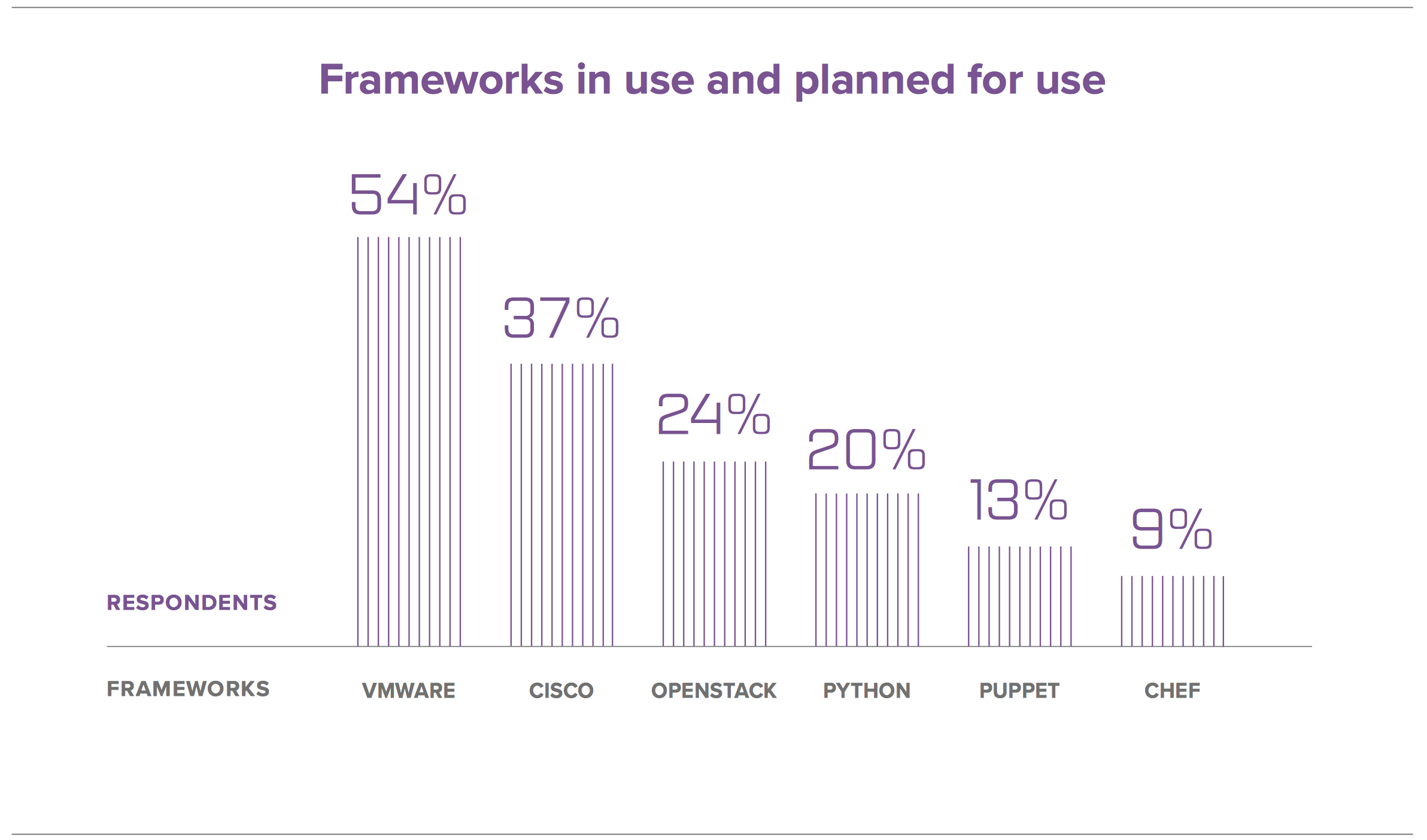
    While editing errors are distracting, the biggest issue I had with the report was the inclusion of Python as a “framework” (along with VMware, OpenStack, Puppet, Chef …). The assumption is made in the accompanying text that this indicates the level of homegrown automation, but since there are many ways to implement homegrown automation, this is at best a low point indicator of that. Overall, it feels out of place in the list:

    DevOpsTools
    DevOps tools as surveyed by F5 Networks.

    But honestly, there is enough other information about trends and number of these “frameworks” in use per org packed into this section that I’m willing to view inclusion of a language as a simple oversight that can be explained away because lots of organizations are using python for automation (I have, at more than one organization).

    The report also talks about the average application having double digits of application services deployed for it. This seems high to me, but it is data from a survey of F5’s customers, and if you’ve already paid for this bundle of services, perhaps you are more likely to make use of as many as possible. What this points to, for me, is an automation of the overall application environment. Considering the commentary F5 received in response to skills questions, it makes sense that automating solutions that can easily be automated would be an easy choice for their respondents.

    Note that in the graphic above, the company did not restrict users to “What frameworks are you using for network configuration?” It might be a reasonable assumption to think it did, as F5 is primarily a networking company (don’t tell the execs I said that—they seem to be repositioning as an application services company these days), but I asked, and the company put no limits on responses. That shows uptake of Puppet among its customers to be far smaller than I would have expected, personally, considering the core of its customer base should be Puppet’s sweet spot—traditional enterprises in a variety of industries.

    The weighting of respondents across roles might have some play in how these are ranked, though. There is a preponderance of networking and management types in the response list, with fewer security, dev, architecture and DevOps types. This could skew results, even if the organization list is relatively balanced across industries.

    Overall, take a look. It’s solid information, with some interpretation available and more commentary on verticals and use cases. It’s definitely a document worth having on hand when explaining the value of what you’re doing, or attempting to expand what you’re doing.

    — Don Macvittie

  • Predictable Progress: Tracking DevOps Maturity Metrics

    Predictable Progress: Tracking DevOps Maturity Metrics

    As DevOps methodologies continue to evolve, we’re naturally seeing an increased emphasis on the cultivation of related maturity metrics.

    For instance, in the 2016 State of DevOps Report, researchers with DORA took an initial stab at creating relevant ROI measurements.

    Similarly, a new report issued by researchers Coleman Parkes, sponsored by CA Technologies, offers additional evidence that as agile and DevOps processes continue to expand, today’s practitioners are increasingly employing metrics to optimize their efforts.

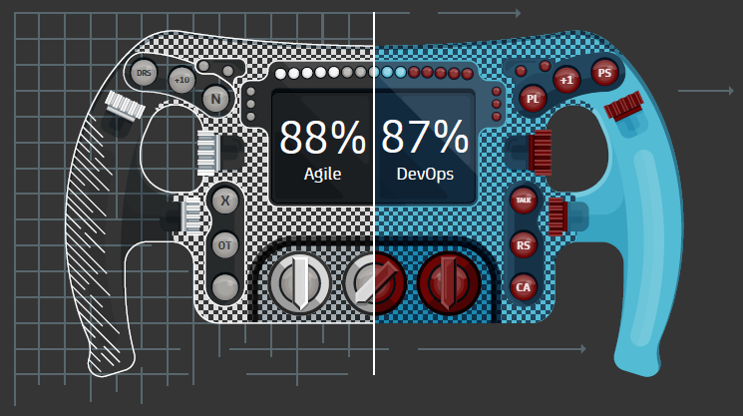
    The report, titled, “Accelerating Velocity and Customer Value with Agile and DevOps,” finds some form of adoption among nearly every enterprise, with 87 percent having adopted agile to some degree and 73 percent leveraging DevOps.

    Related to the overall maturity of these practices, those organizations that are moving to embrace the techniques most broadly are predictably seeing greater returns. Yet, despite the widespread adoption, only a third have deployed either practice widely, according to the research.

    Percentage of Advanced Adopters Reporting Improvements in Customer Experience


    Based on a survey of 1,770 senior business and IT executives, the study also closely investigates the specific KPIs that organizations are using to gauge how agile and DevOps initiatives are translating into customer interactions.

    Most notably, “advanced” agile and DevOps adopters have observed more than an 87 percent improvement in overall customer experience, compared to “basic” adopters.

    In terms of how those efforts are affecting business drivers, Coleman Parkes finds:

    • Advanced agile practitioners are experiencing a 40 percent improvement in time-to-decision, compared to 33 percent for basic users.
    • Advanced DevOps adopters have noted a 42 percent improvement in speed-to-market, compared to only 24 percent for basic practitioners.

    Key Performance-Invoking Indicators

    To that end, the research highlights specific KPIs that organizations are using to measure the impact the agile and DevOps practices are having on customers. In fact, the study finds that between two thirds and three quarters of all the organizations surveyed have established such measurements.

    At least half of these focus on business or customer-related metrics, reflecting how “critical software has become to businesses’ ability to achieve their core mission,” Coleman Parkes researchers note.

    Among the mostly widely invoked metrics, include:

    • Business growth (specifically revenue): over 73 percent
    • Operational or process efficiency: over 73 percent
    • Employee productivity: over 73 percent
    • Customer experience: over 71 percent
    • IT-related costs: over 71 percent
    • Speed-to-market: over 71 percent
    • Customer satisfaction (via NPS): over 70 percent
    • Time-to-decision: over 70 percent
    • Quality of development: over 70 percent
    • Employee retention: over 64 percent

    If increasing applications delivery speed and overall organizational velocity are, in fact, the primary goals of engaging agile and DevOps, the research bears out that the techniques are having the desired effect. After all, the survey finds that time-to-decision and speed-to-market are being accelerated among approximately a third of the organizations studied.

    Related to other notable KPIs, Coleman Parkes highlights that a full three-quarters of adopters have moved the needle on overall customer experience, along with employee recruitment and retention, a significant benefit that was also highlighted in the State of DevOps Report.

    Along with positively impacting customers, the reality is clearly that agile and DevOps are also making a big difference in allowing companies to improve the atmosphere for their workers—a huge benefit when you consider the shortage of talent in IT today, and how much it typically costs to attract new employees, just as DORA’s researchers noted.

    Other key findings by Coleman Parkes include “before and after” metrics that many organizations are observing related to their continued adoption and advancement of the involved methodologies themselves.

    I encourage you to download the entire report, and leverage it to measure how far you’ve come with Agile and DevOps transformation—and where you may need to re-examine your efforts.

    — Aruna Ravichandran

  • How Open Source Can Help Your CD Chain

    How Open Source Can Help Your CD Chain

    What can you do to make continuous delivery work better? Consider moving to open source software solutions. Here’s why.

    Many DevOps teams already may be using open-source platforms for reasons not related to continuous delivery. They might like the cost-efficiency or interoperability that usually come with open source. Or maybe they just like the open-source philosophy.

    Typically, however, open source is not viewed as a requirement for doing DevOps or achieving continuous delivery.

    How Open Source Speeds Continuous Delivery

    But maybe it should be. Consider the following ways in which open-source code can better facilitate a continuous delivery pipeline:

    • It’s easy to tweak. Because anyone can view and modify the source code of an open-source program, you can change it to work as efficiently as possible. Custom enhancements could make the open-source tools you use work more efficiently within your delivery chain.
    • No vendor lock-in. Most open-source tools and platforms are designed based on open standards. The threat of vendor lock-in is minimal. For that reason, adopting open source helps prevent surprises that could otherwise hold up your continuous delivery pipeline in the event that a vendor decided to stop supporting the tools you are using.
    • It’s well-known. Mainstream open-source tools are widely used. Chances are good that the people who are currently on your team, or will join it in the future, already know open-source tools. That’s an advantage for continuous delivery because it means you won’t have to spend time training staff—and risk introducing delays to your continuous delivery chain while the staff are being brought up to speed.
    • It gives you options. With open source, you usually have lots of implementation options. Want to deploy on Linux? There are about a dozen mainstream distributions you can choose. Want to run your cloud with OpenStack? There are lots of distributions of that, too. Having choice is a good thing for continuous delivery because it allows you to switch easily between different frameworks or tool implementations as your needs change. That agility prevents you from being locked into a specific solution.

    This is not to say that open source is a silver bullet. Achieving continuous delivery requires attention a lot of other factors; it’s not as simple as using a certain type of technology (if it were, everyone would be delivering continuously). But adopting open-source solutions when possible certainly can’t hurt—and it just might help as you seek to deliver software continuously.

    — Chris Tozzi

  • DevOps by the Book in 2017: Where we Really Stand

    DevOps by the Book in 2017: Where we Really Stand

    Now that the year-end prediction season is over, it’s time to focus squarely on the actual here and now—where the DevOps movement actually stands at the start of 2017.

    As we’ll need to wait another six months or so for the annual State of DevOps Report to emerge from the good folks over at DORA and IT Revolution, which forces us to take stock of the situation using other resources. In this case, I’ll point to the recently released book, “DevOps for Digital Leaders,” authored by my colleague Aruna Ravichandran along with co-authors Kieran Taylor and Peter Waterhouse.

    Register today for the upcoming webcast, “Chart a Winning Course: DevOps for Digital Leaders,” and enter the chance to win a free signed copy of the book [U.S. only].

    Why should you value this book over any of the other DevOps-related titles inundating the technology literature scene, in particular those issued by (gasp!) technology vendors? I’d cite two very specific reasons: real-world metrics and use cases.

    I often preview any comments I make in cross-functional meetings with the phrase “shameless marketing.” That is because I work in marketing. For 12-plus years prior and sometimes in between marketing gigs I’ve served as a journalist, wherein my job was to attempt to be as objective as possible. Today, I work for a vendor that would really like to sell you stuff.

    That said, this current career path does not preclude me from being able to see beyond my own not-so-secret agenda. While many onlookers understandably groan and roll their eyes at the manner in which DevOps has been co-opted by marketers as a means to advance products, this doesn’t mean we’re all full of it.

    Like myself, working at CA—in particular, leading marketing efforts that span a huge array of strategic technologies actively being leveraged by global enterprises to attack various elements of DevOps—has given Aruna and her partners tremendous insight into where many people stand in terms of maturity.

    To that end, this book is written around some fantastic stories about how some of these organizations are refining best practices and measuring real success in domains including continuous testing, release automation and shift-left monitoring. IMHO, these are some of the hottest areas of DevOps being advanced as we speak.

    In addition to these use cases and related practices, the book takes an up-close look at critical aspects of the DevOps build, test, deploy and manage stages, along with key processes related to tuning and continuous improvement. And it even goes so far as to talk about essential DevOps tooling. I hope people are ready to acknowledge that beyond culture and leadership, automation absolutely plays a significant role in all of this.

    Specific to metrics, one of the areas where the State of DevOps peeps attempted to break new ground in the 2016 report, there’s a lot to appreciate. The book takes a close look at how these same organizations are attempting to tie DevOps-driven change directly to ROI, including the all-important customer experience.

    Worth noting, in the coming days we’ll also see the release of a new report from Coleman Parkes that charts numerous KPIs being used to this same end, so stay tuned.

    So there you have it, the marketer has officially hijacked this blog space to do little more than market a book about DevOps written by marketers. But, the truth is that’s not all.

    If you really want to hear the best parts of this story, sign up for the upcoming devopsy.kinsta.cloud webcast, “Chart a Winning Course: DevOps for Digital Leaders,” in which Aruna and Alan Shimel will discuss the high points, with an emphasis on fielding questions from the audience live Q&A style.

    If you don’t have time to read the book—or, better yet, you want a preview to ensure that what I’ve written here is true—post up and ask your own questions. We’ll also be conducting live polls about DevOps maturity, audience use cases and the leading types of DevOps metrics.

    It’s worth noting that all proceeds from the print edition will go to Foundation for Excellence, which provides STEM scholarships to children in India. Order your own copy today (or download it for free).

    — Matt Hines