Tag: SaaS

  • Bridging the Gaps in SaaS to Meet Business Needs

    Bridging the Gaps in SaaS to Meet Business Needs

     Today, software as a service (SaaS) is a mainstream model for application consumption, with industry-specific and business process-focused offerings increasingly available. Flexibility, reduced time to market and cost benefits are the top advantages and selling points of SaaS offerings.

    SaaS-powered business processes allow businesses to provide feedback in real time, thus enabling a smooth change management process. The agility of such applications also generates higher user-community satisfaction and engagement. As a result, Gartner’s recent forecast predicts the SaaS market size will grow at a compound annual growth rate (CAGR) of 18 percent in the next four years, reaching $127.6 billion USD in 2021.

    Despite the apparent benefits, SaaS models carry their own set of disadvantages, especially when the application impacts key underlying business processes. These processes are typically unique to an organization and are seldom available out-of-the-box (OOB). The specific changes an organization needs often proves a solution inadequate and in need of major customization and permissible extensions.

    If the design of the solution is stretched too far from the originally intended logic of the software, it can cause major disruptions to future upgrades of the SaaS solution. An alternative to customization is simplifying business processes so they fit into OOB features. However, business users resist adopting a new simplified process, particularly when the process in question is a perceived differentiator. At the same time, it is not in the best interest of vendors to modify their design, catering to the requirements of just a few organizations.

    The Crucial Role of Architecture

    Business process architecture must be harmonized with solution architecture. That is why architecture plays an essential role in SaaS implementation. Business process architects need to quantify the criticality of business processes and leverage the insights to build consensus among stakeholders, which include business users, SaaS providers and IT departments. The solution architects, on the other hand, should ensure alignment between business process requirements, downstream enhancements to an offering’s capabilities and future readiness of IT to handle upgrades.

    Architects now empowered with business process and solution architecture should identify business KPIs that drive SaaS adoption and measure the impact on process performance. Gap and impact analyses tools can be used by architects to identify gaps between business requirements and OOB features of SaaS products. These analyses tools will result in a list of customizations, which need to be further evaluated.

    SaaS Evaluation Framework

    Each customization made to the SaaS application should be assessed on two dimensions:

    1. Potential business impact/criticality: When evaluating the potential business impact, architects should start by identifying sources of differentiation. Differentiation may arise from enhancement in customer-facing capabilities or improvement in operational efficiency—or both. Mapping measurable quantitative outcomes such as CSAT ratings, turnaround time, etc. can help define potential differentiation.
    2. Ease and cost of customization: Overall cost of ownership should serve as the primary way to evaluate the ease of customization, and right-size the trade-off between ease of implementing customizations with the ease of maintaining the solution. While the parameters to measure ease and cost of customization need to be defined, considerations include design types, the time and effort required for development, maintenance and upgrading activities (e.g. plug-in/script development).

    The above proposed assessment must also identify the following:

    1. Impact of not having requested features.
    2. Technical challenges in configuring/customizing the solution to meet each requirement.
    3. Ability to upgrade SaaS application without having to reapply customizations.
    4. List of actions to bridge identified gaps between proposed SaaS solution and existing process requirements.

    As displayed in the graphic above, customization needs to be treated differently based on which quadrant it gets mapped to.

    Appropriately Prioritizing Customizations

    Customizations that are easy to implement but don’t yield any measurable benefit to the business should be avoided as much as possible to eliminate risk, save effort and allow investments elsewhere.

    Similarly, customizations that are difficult to implement and carry no clear benefit or impact on outcomes, must be avoided. Instead, IT will have to convince the business to adopt OOB processes.

    On the other hand, critical customizations that are easy to implement and maintain should be shortlisted for further steps. Since there is a clear business case warranting customization, architects should ensure that the design approaches are recommended and supported by the vendor.

    Must-have business functions requiring difficult customization must be carefully examined. Consider the following questions: Will it still provide perceived time-to-market advantage? Will it increase overall cost of development and ownership? Will it impact scalability, upgradability and integration capability?

    In some cases, the SaaS provider may have feature enhancements in its pipeline that would help implement these must-have requirements. If so, the IT team should collaborate with the provider, influencing and defining upcoming product features.

    If that’s not an option, an alternative is to implement critical functions outside the SaaS solution and then connecting through well-designed back- and front-end integrations. For example, some SaaS providers allow customers to build composite apps on their platform as a service (PaaS). These apps can provide differentiated features without having to change the core SaaS solution. However, keep in mind that PaaS apps will need real-time integration with SaaS apps to achieve this.

    As explained above, not all business processes deem a customization of the SaaS solution. A structured framework should be used to classify which customizations will play a crucial role in any organization’s SaaS adoption journey.

    All customizations should be reviewed and approved by the program steering committee consisting of stakeholders from IT, business leadership and the SaaS provider. All parties involved need to have a clear understanding of why the customization is critical—that means business stakeholders need to provide justification for why a workaround or process change is not viable. Similarly, IT and the SaaS vendor need to articulate a plan of action and a road map for upgrades. In doing so, businesses will reap the full benefits of moving toward SaaS.

    — Monoj Baruah

  • Platform9 Presents Best Practices for Serverless Applications at O’Reilly Open Source Conference (OSCON), Google Cloud Next ‘18

    Using Fission, the open source Serverless framework on Kubernetes, experts highlight new approaches for composing serverless functions, and how to minimize the risk of Serverless application release with Canary deployments


    Sunnyvale, CA – July 11, 2018 – Platform9 (https://platform9.com/), the leader in SaaS-managed hybrid cloud, today announced it will present at two industry events in July: O’Reilly Open Source Conference (OSCON) and Google Cloud Next.


    1. Soam Vasani and Smruthi Venkatesh Present Serverless, Function-as-a-Service (FaaS), and Canary Deployments at OSCON 2018


    OSCON is back in Portland, bringing the best of open source innovation across a variety of technologies and projects – from AI, infrastructure, blockchain, edge computing, architecture, emerging languages, and more.


    Soam Vasani, software engineer at Platform9 and the creator of the open source Fission.io Serverless framework, will be presenting four different approaches to coordinating and composing serverless functions, and defining the underlying workflows. He will share examples and live demos for each approach and compare them with regard to expressiveness, performance, fault tolerance, and ease of doing upgrades and of monitoring the overall application’s performance.


    Smruthi Venkatesh, software engineer at Platform9, will explain how to do Canary deployments with the open source Fission Serverless framework, by routing partial traffic to different versions of functions. She will walk attendees through using service meshes to observe the behavior of these different versions. Attendees will learn how to make changes to functions and monitor the system. Venkatesh will also analyze the benefits of canary deployments to FaaS functions, outline the kinds of functions that this technique works well for, and discuss the limitations of the technique for certain kinds of functions.


    1. Platform9 Sponsors Google Cloud Next ’18, Presents Best Practices for Serverless Functions’ Orchestration


    Google Cloud Next ’18 is a three-day global exhibition of inspiration, innovation and education where attendees learn from one another on how the cloud can transform how they work and power everyone’s successes. The conference will be held July 24–26, 2018 at the Moscone Center in San Francisco.


    Soam Vasani and Madhura Maskasky, Platform9’s co-founder and VP of Product, will present a joint talk on “Function Composition in a Serverless World.” As serverless applications grow more complex, function composition, or the ability for functions to call each other, becomes important. Vasani and Maskasky will present key patterns for composing Serverless functions together to form large applications, their pros and cons, and discuss best practices for functions orchestration and serverless application design.


    Platform9 is also sponsoring Google Cloud Next. Stop by booth #W3319 for a demo of the industry’s only SaaS-managed hybrid cloud, to see how you can deliver a unified cloud experience with any infrastructure, for any application stack.


    Share This:

    Join @soamv at @oscon on July 18 at 11am PT as he presents four different approaches to compose #Serverless functions together https://conferences.oreilly.com/oscon/oscon-or/public/schedule/detail/67760 @fissionio @Platform9Sys #OSCON #opensource #FaaS #Kubernetes #cloud #devops


    Smruthi Venkatesh presents “Canary deployments and monitoring for #serverless apps” with @fissionio open source #FaaS at #OSCON July 18 at 5:05pm PT https://conferences.oreilly.com/oscon/oscon-or/public/schedule/detail/67774 @Platform9Sys #OSCON #Kubernetes #opensource #cloud


    .@soamv and @madhuramaskasky present “Function Composition in a #Serverless World” at #GoogleNext18 @googlecloud #FaaS #appdev


    Come by @Platform9Sys’ booth W3319 at #GoogleNext18 to see how you can deliver a unified #cloud experience with ANY infrastructure for ANY application stack with the industry’s only SaaS-managed #hybridcloud that JUST WORKS! @googlecloud #Kubernetes #openstack #Serverless #devops


    About Platform9

    Platform9 (platform9.com) delivers a SaaS-managed hybrid cloud solution. We help large enterprises drive digital transformation by taking advantage of a self-service, simple and unified experience for managing their infrastructure across complex hybrid environments and technologies – on premises, in the private/public cloud, containers, serverless applications, and more. Customers such as Cadence, Autodesk, Splunk, EBSCO, Bitly, LogMeIn and Aruba see upwards of 300 percent improvement in IT efficiency, 33 percent faster time to market, and 50-80 percent improvement in data center utilization and cost reduction. The company is headquartered in Sunnyvale, CA, and is backed by Redpoint Ventures, Menlo Ventures, Canvas Ventures and HPE.


    ###


    Media Contact:

    Jeremy Douglas

    Catapult PR-IR

    303-581-7760

    jdouglas@catapultpr-ir.com

  • HPE Extends IT Management Reach with OneSphere

    HPE Extends IT Management Reach with OneSphere

    Hewlett-Packard Enterprise (HPE) today extended OneSphere, the software-as-a-service (SaaS) platform for IT management, to include support for Microsoft Azure public clouds and the Kernel-based virtual machine (KVM) that serve as the foundation for OpenStack.

    At the same time, HPE announced an update to HPE OneView, a platform for managing IT that can be deployed on-premises or in a public cloud, which makes it easier to manage farms of virtual machines. In addition, version 4.1 of HPE OneView adds support for Microsoft Azure Log Analytics and VMware vRealize Orchestrator, as well as reference configurations for Chef automation software and architecture for Red Hat OpenShift Container Platform deployed on top of HPE Synergy, a software-defined infrastructure (SDI) platform.

    HPE today also revealed it has sold its one-millionth license for HPE OneView, which it launched four years ago. HPE OneSphere was launched as a suite of SaaS applications earlier this year.

    Paul Miller, vice president of marketing for the Software-Defined Cloud Group at HPE, said the bulk for the HPE OneView licenses HPE sold occurred in the last 12 months as organizations realize they need to modernize how IT is managed as they build, deploy and manage their own private clouds. A big reason for increased adoption of HPE OneView is preference for an open platform that is extensible using application programming interfaces (APIs), he said.

    Miller said HPE is a bifurcated approach to IT management to give IT organizations the ability to modernize IT in keeping with best DevOps practices, either by continuing to deploy an IT management platform themselves or shift to a cloud service.

    In general, Miller said increased diversity in IT environments requires a different approach to managing enterprise IT, which now spans multiple public clouds and on-premises IT environments consisting of both virtual machines and physical servers. There’s a lot more focus on creating a consistent approach to managing IT in way that is seamless across people and processes, said Miller.

    Making things even more challenging is the rise of containers, which today run primarily run on virtual machines but increasingly will show up on physical servers as well, once IT organizations master the skillsets needed to manage containers wherever they wind up being deployed, Miller said.

    Miller also noted that organizations are finding that complying with a wide variety of regulations, such as the General Data Protection Rule (GDPR), are also forcing organizations to revisit how IT is managed.

    Many IT organizations are at a crossroads when it comes to IT management. Taking advantage of SaaS applications is often an attractive option because the whole process of updating IT management frameworks is eliminated, along with the need to provision the hardware an IT management application requires. But many organizations still prefer to be able to customize their IT management frameworks in addition to contending with compliance rules that require them to deploy management software in a way they control directly.

    HPE clearly wants to remain relevant to IT organizations regardless of the IT management path chosen. The challenge facing those organizations now is making a decision that is likely to dictate how enterprise IT will be managed well into the next decade.

    — Mike Vizard

  • How DevOps is Vital for SaaS Entrepreneurs

    How DevOps is Vital for SaaS Entrepreneurs

    Software as a service (Saas) is widely regarded as the most lucrative and compelling of the three cloud business and operation models. This is because it transfers the most technical support expenses and can be sold directly to the customer. However, despite the inherent value of the business model, many entrepreneurs will be hard-pressed to take full advantage of it without some additional technical and cultural assistance.

    Integrating DevOps into the SaaS Product

    Successful integration of SaaS applications involves immersion at the highest level—either that or the product has to be manufactured using one strategy from the very start. The construction and sustenance of SaaS applications therefore, needs to be done with DevOps as the operating system, per se.

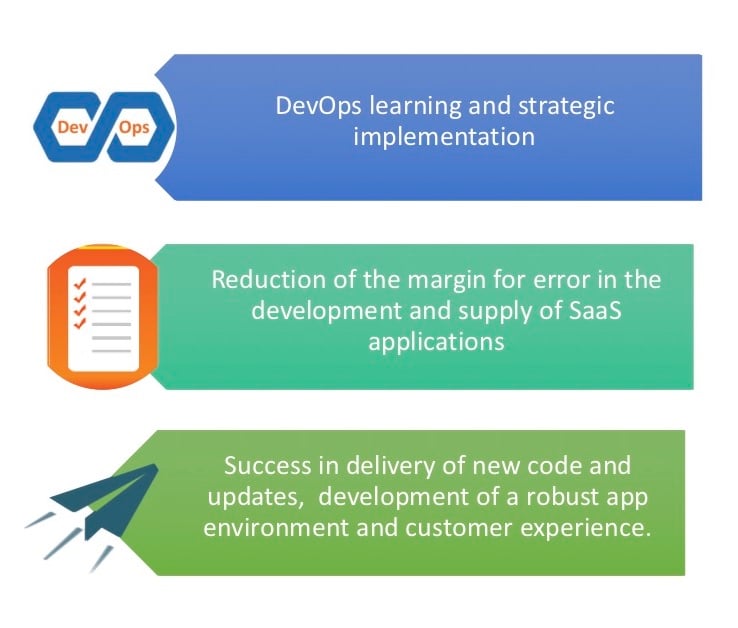
    In a broader sense, for a SaaS entrepreneur, success means the following:

    • Ability to deliver code much more reliably, and quickly.
    • A marvelous experience for customers.
    • A resilient, scalable application environment.

    All of the above is achievable by integrating DevOps throughout the developmental process, without which the construction of SaaS applications could become an operational nightmare. This is true for both grassroots SaaS entrepreneurs and cloud providers.

    Advantages of DevOps Automation

    For the modern SaaS entrepreneur whose entire business and operational foundation is the cloud, following are some of the advantages held by DevOps from a technical standpoint.

    • DevOps automation has the capacity to make continuous and uninterrupted delivery a possibility.
    • Automation itself has benefits in terms of numbers and innovations. A good example of this would be the LaserJet firmware team at Hewlett Packard. Simply via automation, the team was able to free more time for innovation and the development of new features by a margin of 700 percent.
    • Scalability of the SaaS applications, as well as any major software, can be ramped up to unprecedented levels of expansion via DevOps automation and back-end development.
    • Resiliency, which has always been an issue with cloud-based applications, can be ingrained into the developmental process itself, thus producing a final product that is resilient and dependable for the customer.
    • When integrated with the functionality and practicality of class-leading cloud computing services such as Amazon Web Services (AWS), the aforementioned scalability, resilience and uninterrupted delivery can be achieved with considerably more ease.

    Rapid Delivery of New Code

    The first advantage of DevOps automation toward SaaS entrepreneurs can actually be proven in a practical sense. Since continuous delivery spells the difference between application success and failure, it pays dividends to be free of interruptions and bugs, which can take away from the end user experience. This also will help you get a leg up against both the startup and established, enterprise-stage SaaS operator.

    With the automation of each environment build, from the development stage and QA to production, DevOps allows you to release new code as often as need be rather than adhering to scheduled and timed releases of code. In turn, this allows you to make vital decisions and resolve issues in real time, negating the need for a repair meet.

    According to the “State of DevOps Report” for 2015 by Puppet Labs, companies which utilize DevOps possess the capacity to launch code up to 30 times as often, and have lead times that are 200 times shorter. Not just that, but they have a failure recovery rate that is 168 times that of the average company that has yet to implement DevOps automation.

    Using DevOps to Provide a Better SaaS Experience

    SaaS entrepreneurs should begin their DevOps strategy by setting DevOps configuration needs for the particular application as it is being constructed. This would usually contain the provisioning regulations, including database instances, network addressing and the arrangement of software instances.

    The specific capabilities of a number of DevOps tools can and do vary here, which is why it is necessary to review the needs of the application against the work plan and the features of the project. This is to ensure that all the plans are headed in the correct direction.

    As most applications that have been deployed into the cloud are highly unlikely to have a DevOps model-based design element, it can be to the advantages of the SaaS entrepreneur to verify whether any DevOps tools under evaluation offer the capability to design a template. This is to describe deployment independently of the development process, which can be aligned with legacy applications.

    Aside from the value of DevOps in the development of SaaS applications that run on the very infrastructure the cloud provider offers, DevOps also can be utilized to assist with the migration of applications to other cloud computing models such as platform as a service (PaaS) and infrastructure as a service (IaaS). It also be used for the integration of several providers across a single cloud federation.

    Since SaaS is currently being used by the majority of enterprises (67 percent, according to a UBM survey), it makes sense to focus on DevOps practices for organizational success.

    Since SaaS has the lowest tolerance and margin for error, especially in the uber-competitive landscape that the modern SaaS entrepreneur has to operate in, using DevOps can potentially provide a significant advantage in terms of the following:

    • Major increments of cloud profitability and customer satisfaction.
    • The ability to deliver updates and new products at a much more rapid pace.
    • Fewer interruptions across the delivery channels due to the improved developmental process.

    With the cloud market as competitive as it is, it is necessary to have the best development and operations approach. Also important is the culture in which the applications potentially will take shape and the values that will be integrated and ingrained within them.

    In Conclusion

    It is said within the cloud-based entrepreneur community that although the SaaS environment has improved significantly over the past few years, it has by no means edged out the DevOps approach. The future of both the cloud and DevOps is entwined, and entrepreneurs should accept the fact that a year or two down the line, they will be synonymous with each other.

    This makes is absolutely vital to get the correct approach early on, and already have an infrastructure based on DevOps, so that competition in the future can be facilitated and made considerably easier, and customer experience can be harnessed for enterprise success.

    — Subramonian

  • SolarWinds Aims to Democratize Monitoring

    SolarWinds Aims to Democratize Monitoring

    In a move that has the potential to significantly expand the number of organizations embracing DevOps, SolarWinds announced it has expanded its IT management cloud service to include an integrated application and infrastructure monitoring offering dubbed AppOptics. Pricing for AppOptics starts at $7.50 per host per month.

    In addition, SolarWinds has updated Papertrail log management software to make searches faster and provide new visualization tools and the ability to resolve more complex problems such as application server errors and slow database queries. The company also updated Pingdom, a monitoring tool that can now provide views specific to a user, website or specific performance issues.

    Christoph Pfister, executive vice president of products for SolarWinds, says AppOptics should be make it much less expensive for organizations to embrace DevOps. Many organizations get caught up in a chicken-and-egg debate over whether to acquire tools before developing processes or vice versa. AppOptics renders that issue largely moot by making the cost of employing an integrated set of tools for monitoring infrastructure and applications nominal, says Pfister. That level of integration is now required to address digital business initiatives where the focus is more on the outcome than any one IT event, adds Pfister.

    Pfister says SolarWinds is the only provider of a software-as-a-service (SaaS)-based set of monitoring toils that support multiple programming languages, which he notes creates yet another opportunity for DevOps teams to reduce costs.

    AppOptics includes support for auto-instrumentation, distributed tracing and host agent software. That tracing software is based on technology SolarWinds gained when it acquired Librato. Adding instrumentation to any application can be accomplished using a single line of script, says Pfister. The host agent support is achieved using Snap and Telegraf plug-ins to monitor systems.

    By making it easier to add instrumentation, Pfister says SolarWinds expects the number of applications actively being monitored will increase substantially. Historically, only a small percentage of applications deployed in an enterprise are actively monitored. Pfister notes that a much higher percentage of new applications being developed are “systems of engagement,” which require much higher levels of instrumentation to gauge acceptance by end users, and not “systems of record.” Gartner says that only 5 percent of organizations today have implemented digital experience monitoring (DEM), a number it forecasts will rise to 30 percent by 2020.

    At a $7.50 per host per month price point, AppOptics should go a long way to commoditizing DevOps tools. That should not only spur more adoption, but also could force a wave of consolidation across a crowded category of monitoring tools as profit margins get squeezed. In many instances, it’s also likely that monitoring increasingly will be bundled with other tools and services as vendors aim to compensate for monitoring becoming a commodity by selling it alongside higher margin products and services.

    Long term, it’s apparent that cost is increasingly being removed as a factor in the DevOps equation. Not every organization is going to able to master every DevOps tool available. But when it comes to monitoring, going forward there should be no financial excuse for failing to have at the very least some minimal level of DevOps capability.

    — Mike Vizard

  • Cloud Services Demand Security Up the DevOps Stack

    Cloud Services Demand Security Up the DevOps Stack

    In the era of soaring use of public cloud by companies, software delivery is moving away from an on-premises install approach to a cloud-based subscription model through software as a service (SaaS).

    Customers expect a lot when it comes to SaaS products and services. Whether they are investing in SaaS-first offerings or shifting workloads to cloud-based providers, companies no longer have upfront costs for hardware and related software or a reliance on costly labor to install, manage and secure it. They expect software that is easy to launch, upgrades that are unobtrusive and feature-rich and limitless scaling to meet their changing business needs.

    When it comes to security, the cloud-based subscription model significantly changes the paradigm of how software security should be treated. Fortunately for many cloud providers, customers trust that a strong foundational security and privacy posture has been built into to the service by design. Preserving that trust requires a healthy tension of shared responsibility between the security teams demanding it and the cloud providers offering it. A new paradigm shift requires a deeper acknowledgement that an emphasis of the security problem “up the stack” to the application layer is needed.

    For security teams, ensuring the protection is built in from the beginning and moves dynamically in lockstep with the workloads requires a much closer partnership with application developers and DevOps teams. This ultimately leads to a richer understanding of the business applications by security teams, creating a more cooperative business-aware and security-minded culture. Getting there will help reduce the tension and improve the overall delivery of secure cloud services regardless of where you sit in the cloud provider/consumer ecosystem and ultimately enables value creation to the business. To get there, a strong partnership must be fostered.

    There are obstacles to moving up the stack. In most companies, the reality is that many security teams are not well-aligned to keep up with this change while the business continues to make cloud-based investments, making the problem worse. Security’s comfort zone seems very much still focused on perimeter defense, but this emphasis isn’t optimally aligned to a cloud-first future. Even when forward-leaning security shops realize a need to change, they often get pushback from app developer teams because security reviews can delay deployment and security tools create “noise” and false positives for app developers. Also, traditional security tools often do not work well in cloud environments.

    Interestingly enough, the No. 1 concern of app developers is preventing data breaches and cyberattacks, a survey of 500 developers and development managers by Veracode found. Less than one-quarter of developers said meeting customer or regulatory compliance is their top concern, while 21 percent said meeting budget and delivery schedules is their top concern, and 19.4 percent said delivering secure code to pass internal audits is a priority. Furthermore, app developers who work with security teams get “major and tangible business and technical benefit,” according to a survey of 150 security and app development pros conducted by Forrester Consulting. Almost all of the collaborators said that working together leads to major or moderate benefit in customer satisfaction.

    Respondents said the more frequently they collaborate, the better the results, “including improved customer satisfaction, business/IT alignment, quality and frequency of releases, and the rate of innovation at their firms.”

    By overcoming barriers to collaboration, app developers and security teams can leverage this knowledge to improve their approach and also come to the table with solutions aligned at moving up the stack. First, they can perform code analysis to uncover vulnerabilities early in the app development process. Second, they can work on stronger runtime protection once the SaaS application is deployed. Code analysis can be used to make runtime protection better, and runtime data can be used to improve code analysis. This creates a continuous improvement loop between the two and both teams can work on code analysis and runtime protection together.

    To achieve this continuous improvement loop, companies must work to break down traditional work silos that exist because of a mismatch in expectations. App developers, measured for speed, need to receive security information accurately, early and with sufficient context to correct problems during software development. Security pros can benefit by installing security tools in production that understand the security needs of their applications, as opposed to tools that require security pros to write rules, tune the tool and then deal with large number of alerts.

    The goal is to fix software mistakes, weaknesses and vulnerabilities at the beginning of the development process rather than after deployment, when liability, revenue and reputational risks are the greatest. It is also important to realize that achieving zero defects in source code is a noble but difficult-to-achieve goal. Instead of focusing on extremes, the goal should be to establish a continuous improvement logic in CI/CD (continuous integration/continuous deployment), where bugs are identified, some are fixed and the remainder have fast and accurate runtime protection.

    This shift in thinking and processes will give companies fewer security worries and enable them to more proactively embrace a SaaS-first mentality with higher confidence and trust levels. Companies will reap the financial benefits that come with strengthened industry reputations for rapid innovation capabilities and improved levels of software security.

    About the Authors

     Manish Gupta is founder and CEO of ShiftLeft Inc. He is a 20-year veteran of the security industry and has led product development, management and strategy at FireEye, Cisco Systems, Intel, McAfee and Redback Networks.


    Craig Rosen is vice president and CISO at AppDynamics. He has held leadership roles for more than two decades in the security industry, including at FireEye, Pacific Gas & Electric, TDI and CGI.
  • CA Technologies Extends DevOps Push

    CA Technologies Extends DevOps Push

    At its CA World 2017 conference this week, CA Technologies moved to tighten the integration between the various elements of its DevOps portfolio acquired over the last year and unveiled CA Digital Experience Insights, an analytics-infused monitoring tool delivered via a software-as-a-service (SaaS) model.

    The company also announced an instance of the CA Microservices Gateway that allows the API management platform to be deployed as a Docker container. Earlier this week, CA Technologies launched a beta release of Fastrack.io, a service for monitoring Kubernetes clusters based on machine learning algorithms and embedded in an instance of the open-source Prometheus container monitoring service.

    The company is also adding CA Virtual Test Data Manager, a tool that makes it simpler to create copies of large data sets for testing purposes, and CA Service Virtualization Community Edition and CodeSV, a plug-in that enables DevOps teams to invoke service virtualization from within their integrated development environment to mimic external services without having to connect to an actual instance of those services running in a production environment.

    Additionally, CA Technologies announced it has integrated CA Veracode security testing software with CA Automic IT automation platform, and announced general availability of BlazeMeter API Test, a SaaS-based API testing tool, and CA Continuous Delivery Director SaaS, a service that integrates the DevOps toolchain.

    Aruna Ravichandran, vice president of DevOps product and solutions marketing for CA Technologies, says each of these offerings are part of a larger company effort designed to enable organizations to set up their own software factories. Now that more organizations have come to realize their ability to differentiate themselves depends on custom software, many of them want to be able to acquire all the integrated DevOps tools required to achieve that goal from a single vendor, Ravichandran says.

    CA Technologies is making a concerted effort to link the need to create a software factory as a prerequisite for driving digital business transformation at scale. To achieve that goal, she says, control over IT operations is continuing to shift to the left as developers become more accountable for the entire application experience. Offerings such as CA Digital Experience Insights make it simpler for developers to holistically manage those end user experiences by infusing predictive analytics and machine learning algorithms coupled with improved data acquisition techniques in a single service, Ravichandran says.

    CA Technologies clearly wants to become a DevOps force to be reckoned with. In the last two years it has acquired Blazemeter, Automic, Veracode and Runscope. Prior to that, the company acquired Rally Software, Nolio, Grid Tools and Layer 7 Technologies. From here it’s likely CA Technologies will continue to expand its portfolio by acquiring companies while tightening the integration between the various code bases that make up its DevOps portfolio.

    The company’s stated goal is to provide a suite of DevOps tools and services that are too compelling to ignore without forcing IT organizations to consume a product or service they don’t want by maintaining open interfaces across the portfolio. The degree to which CA Technologies can succeed in that effort remains to be seen. But there’s no getting away from the fact that the company has now assembled a formidable DevOps arsenal of products and services.

    — Mike Vizard

  • SAP Adds SDK to ERP Cloud Service

    SAP Adds SDK to ERP Cloud Service

    When most IT organizations think about DevOps it’s usually within the context of custom application development. But thanks to the rise of application programming interfaces (APIs), packaged applications are now becoming a much bigger factor. SAP, for example, just made available a software development kit (SDK) for SAP S/4HANA Cloud, an instance of its ERP software hosted in the cloud.

    Christian Pedersen, chief product officer for SAP S/4HANA Cloud, says the company is encouraging developers to integrate SAP and custom applications. The company is unable to address every potential use case on its own, he says, and it doesn’t make much sense for developers to reinvent functionality that already is an API in a SAP packaged application. The goal should be to deliver a unified application experience made up of packaged and custom components that all are accessed via a common user interface experience.

    That approach, he says, will be critical as SAP continues to invest in advanced machine learning algorithms and digital assistants. Rather than having to develop those technologies themselves, Pedersen says it’s going to be a lot more practical for many developers to leverage capabilities that SAP will expose via APIs.

    SAP’s approach to custom applications is unique in that it makes available a separate SAP Cloud service based on the platform-as-a-service (PaaS) environment developed by the Cloud Foundry Foundation and the Kubernetes cluster platform now overseen by the Cloud Native Computing Foundation (CNCF). The best part about the SDK, says Pedersen, is that it includes sample code that developers can reuse in their applications. As far as DevOps is concerned, SAP is not driving any specific approach, preferring to work with a variety of continuous integration and continuous delivery (CI/CD) platforms.

    Some developers have historically viewed SAP and other providers of packaged applications warily. There is a tendency for vendors that sell packaged applications to continually expand the footprint of their software. SAP isn’t promising not to expand the footprint of its applications further, but, Pederson says, when it comes to crafting a unified application experience aimed at specific use cases, the developer community is essential.

    The biggest challenge associated with combining PaaS environments with software-as-a-service (SaaS) applications is getting the updates to the respective environments synchronized. DevOps teams don’t have any control over when a SaaS application provider chooses to roll out new capabilities. In many cases, the pace at which the SaaS application provider delivers those updates often sets the pace for the whole DevOps teams. In some cases, IT organizations will prefer to run applications on-premises just to exercise more control over the upgrade cycle.

    Whatever the approach, there’s clearly greater need for more DevOps sophistication now that packaged applications have essentially become back-end services that are invoked as a service via an API. The first order of business toward achieving that goal, however, may be informing the owners of those applications they are now part of a much larger ecosystem that needs to be considered every time anyone wants to update a module or add a new service.

    — Mike Vizard

  • Managing Complexity in Dev/Test Infrastructure Using Machine Learning

    Managing Complexity in Dev/Test Infrastructure Using Machine Learning

    Businesses are increasingly developing software solutions that can drive innovation and digital transformation. As the number of developers increases in the organization, the ratio of developers to IT also increases over time. The net result: more dynamic and complex dev/test infrastructure requirements and slower support from IT.

    Developers and testers often cannot get their hands on infrastructure environments in a timely manner to accelerate delivery of software applications to their customers. They have to deal with lack of timely support from IT and long waits for hardware resources and for provisioning and configuring of the environments.

    How does engineering IT manage this complexity and deliver more agility to their engineering stakeholders?

    Provide Self-Service Creation of Dev/Test Sandbox Clouds

    Engineering IT teams can increase the velocity of development and testing if they enable self-service ability for dev teams to quickly provision their own lab infrastructure and application stacks at a click of a button.

    Self-service, API-driven infrastructure is a fundamental requirement for enabling developers to write code (which can be done using their favorite programming language) and make RESTful API calls to the underlying programmable infrastructure. This allows them to dynamically and automatically manage initial deployments and configurations as well as manage ongoing, automated dynamic provisioning of infrastructure, autoscaling, monitoring and alerting.

    All this automation removes the confusion and error-prone manual steps for the entire application delivery process, including development, testing, staging and production deployments. This, in turn, accelerates software delivery and increases quality.

    Additionally, if self-service is available as a SaaS-based delivery model, it is easy to add more features and workflows very quickly without having IT doing a major upgrade.

    Breaking these silos improves collaboration between teams, accelerates velocity of software development, improves infrastructure utilization, increases overall operational efficiency and reduces costs.

    Eliminating Silos in the Dev/Test Infrastructure

    Silos are common in companies where various specialist teams (storage, networking, security) form fiefdoms around their respective functional areas. Silos impede velocity because they lead to complexity of operations, lack of consistency in the environment, and lack of automation.

    Automating across silos turns into to an exercise of custom scripts and lot of “glue and duct tape,” which makes maintenance and change management complex, slow and error-prone.

    Breaking these silos improves collaboration between teams, accelerates velocity of software development, improves infrastructure utilization, increases overall operational efficiency and reduces costs.

    A hyperconverged cloud design with a software-centric, scale-out architecture tightly integrates compute, storage, networking and virtualization resources and other technologies from scratch in a commodity hardware box supported by a single vendor. Also, companies can keep costs under control by leveraging scale-out cloud designs that make it easy to start small, grow based on demand, and stay close to the right size and customer demands.

    Additionally, development teams should have the ability to quickly deploy/clone/share complex multi-tiered application stacks between various teams and between development and testing, breaking the silos within the development organization.

    Automate Operations, Monitoring and Patching

    Engineering IT teams need to have complete visibility and control of their entire stack from the infrastructure up to applications. They need intelligent software to monitor the hardware and software stack, manage large-scale clusters and automatically handle routine but time-consuming and complex operations such as failure handling, patching, security updates and software upgrades.

    Running a service with traditional sysadmin teams who execute the above activities manually becomes expensive—especially if they operate in server, storage, networking and security silos—as the dev/test environments become more dynamic and the demand for more environments and projects grows.

    However, it is possible to use an intelligent private cloud platform that leverages hyperconverged scale-out designs, machine learning software and a SaaS-based operational console to reduce complexity and increase the agility of dev/test teams.

    Cloud-based monitoring and advanced analytics dramatically reduce the need for experts in different parts of the infrastructure, scale linearly as the size of the operation increases and cut operational complexity by 90 percent.

    Manage Resource Management Using Machine Learning

    Applying machine learning to infrastructure management means intelligent software could learn about operational patterns, anticipate capacity needs, raise alerts about security anomalies, self-monitor and self-heal your environment in the face of failures, intelligently apply security patches and automatically upgrade hardware and software systems without any downtime. The next generation of infrastructure management will be driven by advances in machine learning and artificial intelligence, where the infrastructure is able to basically “drive itself” with minimal user intervention.

    This will help engineering IT teams optimize resource usage and capacity based on current and future dev/test demand and also be able to better handle the availability and performance they can deliver to their engineering teams. A lot of efficient resource management comes down to capacity planning, utilization monitoring, right-sizing of workloads, demand forecasting and detecting zombie VMs and unused resources.

    Demand forecasting and capacity planning can be viewed as ensuring there is sufficient capacity and redundancy to serve projected future demand with the required availability. Capacity planning should consider organic growth, which stems from natural service adoption and usage by dev/test teams. Having intelligent predictive analytics and machine learning can help greatly with accurate forecasting, alerting and providing lead time for acquiring additional capacity.

    Better insights into how the infrastructure is performing can also help in fine-tuning performance of end user workloads. For example, an intelligent system that is monitoring a workload for storage performance might recommend using SSDs instead of spindles to increase the IOPS and improve workload responsiveness.

    An intelligent private cloud platform that uses hyperconverged scale-out designs, machine learning software, and a SaaS-based operational console can reduce complexity and increase the agility of dev/test teams.

    About the Author / Kamesh Pemmaraju

    Kamesh Pemmaraju leads product management, product marketing, and technology partnerships at ZeroStack. Kamesh is a seasoned product management/marketing leader with a strong engineering and consulting background. In his most recent product roles at Mirantis and Dell, he focused on delivering private and hybrid cloud solutions to enterprises. He holds a Master of Science in Computer Science from Indian Institute of Science. Connect with him on LinkedIn and Twitter.

  • User Identity in Focus as Cloud, Device Use Grows

    User Identity in Focus as Cloud, Device Use Grows

    Recently, I had the pleasure of attending SailPoint’s Navigate ’16 identity management conference. I’ve always been interested in the identity management aspect of security. Many of the first wave of identity management vendors launched around 1999, when I started covering information security as a full-time focus. These vendors dealt with all of the identity challenges that we deal with today—provisioning employees and partners to the resources they need efficiently and effectively, keeping systems secured by making certain people can only access the right data and resources, improving user experience through efforts such as single sign-on, managing privileged accounts, and all the other associated challenges.

    While much of identity management is the same, it’s also quite different in how the challenges have evolved. Today there are more systems with identities to manage. As the number of devices increase, that will grow exponentially over the years ahead. Plus, with agile development methods and approaches to IT management such as DevOps, technology development is moving much more quickly. Finally, IT has much less centralized control now over users than it did 16 years ago.

    Here’s how the rapid expansion of cloud and devices are creating a greater need for identity governance.

    Identity Management and Cloud Growth

    I thought managing identities was as complex as it was going to get when corporate LANs erupted into intranets and the web. At the time, re-tooling and scaling directories made for LANs/WANs to the web and web-based services was a challenge. But today, the burst of cloud-based systems, both private and public cloud and software as a service (SaaS), coupled with the many existing on-premises and web-based systems, have made identity management efforts more complex than ever.

    According to the most recent Bitglass Cloud Adoption Report, 48 percent of enterprises now use a cloud-based productivity suite, up from 28 percent in 2014. In EMEA, 59 percent are adopting cloud suites, as are 61 percent in APAC, compared to 48 percent in North America.

    There’s no doubt cloud-based services have increased the number and nature of how identities are created, managed, deleted and governed. And the security of these data and resourced likely comes down to how well identities are managed.

    The Long Shadow Within IT

    As I mentioned above, there is a lot less (like it or not) centralized control in enterprise technology today. More users are bringing their own devices, as we know, and more business managers and users are procuring their own cloud services, from storage and infrastructure to cloud platforms and SaaS applications.

    According to an CIO.com article published last year, CIOs vastly underestimate extent of shadow IT, analysis by Cisco Systems found the typical enterprise has up to 22 times more cloud services running than it believes. The CIOs surveyed estimated their enterprises were running about 51 cloud services. Reality? There were 730 cloud services running.

    I’ve always argued that Shadow IT should be embraced, not fought. It is a way to see what users need and the services they want to use, and it’s a way to engage with users. That’s not to say IT needs to—or should—let Shadow IT be a free-for-all. It shouldn’t. IT needs to manage the types of devices users can select, the services they can use and the data that can be used in those services, not to mention the regulatory and policy compliance checks. None of that goes away.

    But identity and access is a great way for CIOs and IT to help users safely embrace Shadow IT.

    The Challenge of Managing Device Identity

    It’s not just human identities and applications and services. There are more and more IoT devices whose “identity” and set of privileges must be managed as part of enterprise systems management, data, privacy, security and availability. Gartner expects there to be 21 billion connected Internet of Things (IoT) devices by 2020.

    Again, identity is central to managing access and the privileges IoT devices have, as well as auditing use and activity.

    Gartner agrees: “IAM leaders must reconsider how traditional approaches to cybersecurity and IAM work in a world where devices and services are so abundant, in so many different forms and positioned at so many different points within the IT ecosystem,” said Earl Perkins, research vice president at Gartner.

    Based on conversations at the show, it’s also top of mind with most CIOs.

    The Scale of Cloud Services Challenges Identity

    The dramatic growth of apps and cloud services are taking its toll. Years ago, securing apps meant throwing up some firewalls, setting up a virtual private network and providing access control to applications and networked resources. But with the explosion of apps, cloud services, devices and data, such approaches are antiquated. We didn’t know it then, but that was about as simple as security was going to get.

    All of this requires incredibly well-scaled identity management efforts. In addition to the traditional seasonal or event-driven surges in identity management issues, companies could see surges from devices or users accessing systems at all times and from anywhere. Scaling with this requires identity management and directories eventually to be in the cloud. While most enterprises are hybrid now—unless they formed in the past 10 years—there is plenty of legacy, on-premises and cloud needing management.

    However, in a decade, there will be many more large enterprises fully in the cloud, and identity management technology will follow.