Tag: PaaS

  • Digital Transformation: How DevOps Could Have Revamped Toys R Us

    Digital Transformation: How DevOps Could Have Revamped Toys R Us

    The story you’re about to read and its recommendations are real; they contrast with what you have heard so far about digital transformation and DevOps implementation. Its objective is to convince you about that the time to go digital is now; it’s about transforming your business, not only IT; and to do it you’ll have to implement DevOps entirely.

    In September, Toys R Us, one of the world’s largest toys store chains, filed for bankruptcy protection. A better understanding of how disruption in the retail industry impacted the company would have helped to prevent its downfall and to reinvent its business model. For example, providing Toys 2.0 (a generic term referring to a new generation of toys built on cloud, mobility, IoT and AI technologies) gaming services could have helped the company survive.

    Shifting to Toys 2.0 demands a revolution in thinking, vision, practice and value that business leaders, CIOs and IT vendors haven’t done yet. They must forget the obsolete notion that technology and speed determine business success. Adopting paradigms that stress innovation and solve competitive constraints is the safest path toward fast and durable revenue.

    The biggest problem Toys R Us faced was the fact that consulting firms and IT vendors either didn’t understand the challenge as an industry disruption issue—or if they did, they improperly addressed it.

    Let’s clarify: To tackle your industry’s disruption, you must adapt your business model including the set of interactions, staff and skills, processes and practices, beliefs and values and infrastructure and tools used across your company to generate revenue. Industry disruption is the challenge, and DevOps through its many assets is the unique business capability companies need to quickly transform and win their digital battles.

    The problem, as Alan Shimel, founder, CEO and editor in chief of devopsy.kinsta.cloud, puts it:

    “While so many companies have already started to use DevOps or planning to use DevOps and related methodologies soon, there is only a small percentage of companies that are end-to-end DevOps. This means there is still tremendous opportunity in bringing DevOps to market.”

    How should have Toys R Us leveraged DevOps to tackle its industry’s disruption? Why did investing in that global digital e-commerce platform prove insufficient? How well did they transform their business model? How would have implementing DevOps 100 percent helped to overcome Amazon and Walmart competition?

    The principles, ideas, practices and solutions in this article are part of a case study we developed at ITaaSNow to see how to help companies facing similar challenges.

    What is DevOps?

    Alan, who is a major contributor to DevOps, is right: Only a small percentage of companies have fully adopted it. DevOps is much more than the automation toolchains consultants and vendors talk about. If they want to help lines of business survive and keep their job, CIOs must get a grasp of DevOps’ business facets.

    So, what is DevOps? Why do I think, it would have saved Toys R Us from digital downfall?

    DevOps Beyond the Operations Automation

    From my experience implementing it, DevOps is a business capability that seeks to optimize business operations (versus the sole IT operations). It provides companies with four competitive advantages needed to meet the digital business competitive challenges:

    1. Enterprise collaboration
    2. Business agility
    3. Short time-to-value
    4. Innovation culture
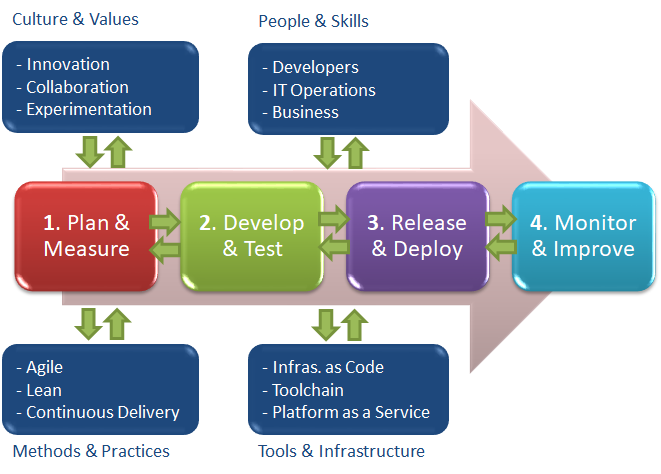
    Figure 1 – DevOps Overview

    As the picture shows, DevOps is a set of concepts aggregated around the notion of value stream to form a digital business management capability. It’s structured around four stages that format the company’s interactions and workflows into a powerful digital business management capability. These stages include:

    • Plan & Measure – addresses strategic watch, service prioritization and revenue generation through innovation portfolio management practices and infrastructure.
    • Develop & Test – takes advantage of agile and lean practices and infrastructure to ensure innovations design, development and testing.
    • Release & Deploy – leverages continuous delivery practices and infrastructure to timely deliver the right innovations to the right markets.
    • Monitor & Improve – stresses continuous improvement to guarantee not only premium customer experience but also customer value.

    Four business value catalysts are used to act as revenue generators:

    • Culture & Values
    • People & Skills
    • Methods & Practices
    • Tools & Infrastructure

    As you can see, DevOps transcends application development issues; it covers the entire business life cycle.

    DevOps Framework as a Facilitator of DevOps Implementation

    So, what is a DevOps Implementation framework?

    Concretely speaking, it’s a bundled DevOps platform combining managed PaaS infrastructures and optimized value streams to help companies boost their digital business:
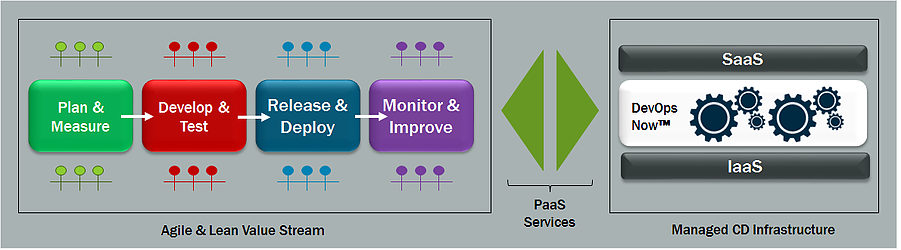
    Figure 2 – DevOps Implementation Framework

    The platform seeks to help businesses implement DevOps end to end and builds on three principles to guarantee digital profits:

    1. Innovation as the revenue driver – It’s the belief that business can resist the competition imposed by technology companies such as Apple, Google, Amazon and Facebook when they use innovation to keep customers loyal, attract new ones and generate revenue.
    2. Value stream agility as the foundation of market responsiveness – It’s the demonstrated notion that companies are market-responsive when they rely on agile and lean value streams.
    3. Managed cloud as the catalyst of business performance – It’s the proven idea that when companies are focused on their core business, they innovate and offer superior customer experience.

    The 5-Step Digital Transformation Blueprint

    The 5-Step Digital Transformation Blueprint makes DevOps implementation fast and easy. As illustrated, it’s a comprehensive business transformation framework I developed to help clients with their digital transformation initiative:

    Figure 3 – The 5-Step Digital Transformation Blueprint

    It’s an integrated and inclusive approach to business transformation that involves the company’s relevant contributors. It structures the transformation effort into a five-stage transformation journey:

    • Digital strategy: In this step, the transformation team uses tools like the SWOT analysis matrix to help business and IT executives understand the changes in the disrupting industry along with the impacts on the company’s business model.
    • Value stream: In this step, the transformation team uses tools such as the value stream mapping to identify the required changes and get business and IT executives agree on the company’s future value stream. Interactions, staff, skills, processes, practices and tools are at the heart of the discussions.
    • Digital platform: In this step, enterprise and solution architects work together to identify and implement the technology and tools selected to support activities in the value stream.
    • Digital organization: In this step, a panel of business and IT users at the operational and executive levels experiment the new digital business model under actual business conditions. The tested digital business model is then deployed as the new digital organization.
    • Digital business management: In this operation phase, the value stream and the digital infrastructure are extensively used to run the business.

    How Chief Digital Officers Set Up Top Digital Businesses

    It would be remiss on my part not to recommend the online digital transformation course that gives DevOps practitioners—executive and operational from both the business and IT—the insights about implementing DevOps as the foundation of digital business.

    “How Chief Digital Offers Set Up Top Digital Business: Establish DevOps as the Foundation of Your Digital Business” is a 15-module course that offers concise, practical and powerful tips to help practitioners learn and apply strategies and tactics to effectively plan, monitor, facilitate and lead business transformation including IT to digital.

    Analyzing Amazon and Walmart Disruptive Impacts to Spot Guidelines for Reinventing the Company

    Many bankruptcies happen because business leaders don’t take the time to understand their industry’s disruption and the impacts on their overall business.

    The reality on the ground is, industry analyses and competitive strategies are either overlooked or totally ignored. Understanding the toy industry’s disruptive effects would have helped to identify Toys R Us’s transformation as the safest solutions to avoid bankruptcy.

    DevOps implementation framework makes the difference, it sees DevOps as the foundation of digital business success. It considers industry and competitive analyses essential steps of the DevOps transformation initiative. Figure 4 outlines the outcomes that resulted from our industry analysis:

    Figure 4 – Toy Sector’s SWOT Analysis

    As illustrated, it was shown that Toys R Us should have exploited Amazon’s vulnerabilities and take advantage of the technological opportunities to reinvent itself as a Toys 2.0 gaming service provider. These vulnerabilities include little product differentiation while technological opportunities refer to the new toy generation built on cloud, mobile, IoT and AI technologies.

    The company’s strengths—reputation, longtime industry presence, brand equity—combined with the cost savings resulting from managed cloud adoption would have not only simplified its transformation but also challenged Amazon on costs.

    Changing the Value Stream to Establish Innovation and Invent the Company’s Digital Business Model

    Business leaders don’t take the right transformation decisions because they lack insights into the changing competitive environments. Aggressive marketing and sales campaigns supporting short-term financial gains. Toys R Us failed because it bet on its debt reimbursement at the expense of its business model reinvention.

    A DevOps implementation offers a value stream mapping framework that not only facilitates innovation culture implementation but also speeds up digital business models development.
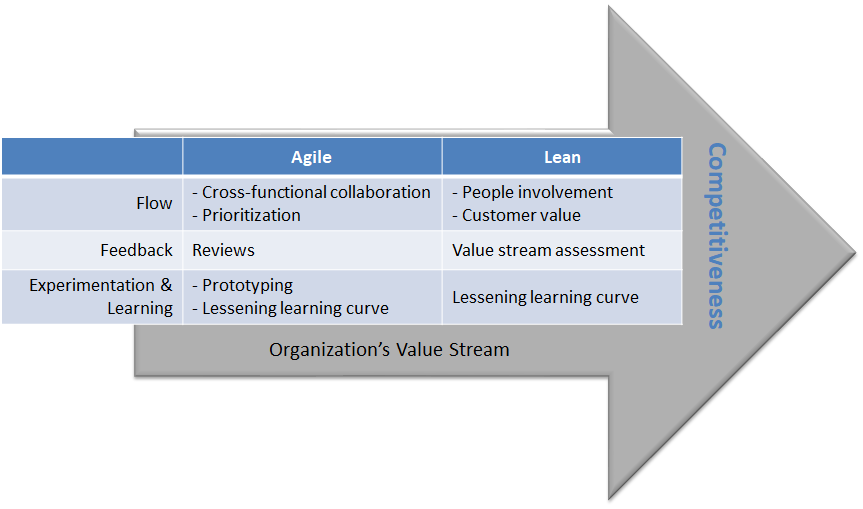
    Figure 5 – Value Stream Mapping, Agile, and Lean

    The objective of the value stream mapping I performed was to outline the features of work environments that take advantage of DevOps Three Ways to equip the company with the competitive advantages needed to resist Amazon and Walmart. The following lines summarize the outcomes.

    Implementing DevOps Flow Principle to Defeat Amazon and Walmart on Innovation: The value stream mapping recommended to leverage Agile and Lean principles to properly implement the flow principle and defeat Amazon on its little product differentiation. The Agile’s features to stress included collaboration and prioritization while focus on people engagement and customer value were the Lean’s benefits to emphasize. Their combination were likely to not only foster innovation culture but also accelerate time-to-market and time-to-value.

    Implementing DevOps Feedback Principle to Guarantee Superior Customer Experience: As to the feedback principles, the value stream mapping recommended to use Lean’s value stream assessment and Agile’s review mechanisms. The objective was to institutionalize continuous improvement practices as a means to ensure superior customer experience.

    Implementing DevOps Experimentation and Learning as the Foundation of the Innovation Capability: As to the experimentation and learning principle, the recommendation was to take advantage Agile’s prototyping and learning curve-lessening features to institutionalize innovation and risk-taking cultures. They were likely to not only help the company challenge its competitors on innovation but also ensure durable revenue and customer loyalty.

    Enabling the Value Streams with Managed PaaS Services

    Using technology ingeniously to boost business activities is clearly one of the keys to succeed in the digital business. Today’s DevOps-timid approach focused on speeding up IT operations alone not only is ineffective, but it also doesn’t make sense. It’s the entire value stream that needs optimization, not just IT.

    The findings of the digital platform assessment I performed, showed as illustrated, that the global e-commerce platform wasn’t enough to compete against Amazon and Walmart. The company was at the embryonic stage of digital transformation maturity practices:

    Figure 6 – Toys R Us Possibly at the Embryonic Stage of Digital Transformation Maturity

    The findings suggested that using technology to innovate or creating the operational conditions to cut cost, accelerate time-to-market and be responsive to market opportunities were either overlooked or improperly addressed.

    Using a digital platform engineering framework allowed me to design in a record time the following architecture:

    Figure 7 – Possible PaaS Platform for Toys R Us

    The digital platform would have built on two cloud services supporting the value stream: managed software as a service (SaaS) and platform as a service (PaaS). Let’s discuss them.

    How Managed SaaS Services Would Have Helped to Fix the Cost Leadership and Business Agility Issues

    SaaS services would have supported the Plan & Measure stage. In addition to supporting varied management activities, it would have provided two fundamental tools that possibly could have enabled the Toys 2.0 strategy: customer relationship management (CRM) and innovation management portfolio. CRM tracks, measures and improves customers’ experience, keeps them loyal and guarantees revenue. Innovation portfolio management identifies innovation ideas, supports their implementation into digital services and monitors generated value. It gives the company opportunities to disrupt and control its industry.

    The on-demand and metered billing features of SaaS services would have allowed Toys R Us to get the needed software in record time while enabling time-to-market, time-to-value and responsiveness competitive advantages.

    How a Managed PaaS Platform Could Have Helped to Address the Express Delivery Issue

    PaaS services would have supported activities covering the Develop & Test, Release & Deploy and Monitor & Improve stages. In addition to providing the technologies needed to implement Toys 2.0 gaming services, it would have built on microservices to set up the automation tool chain and accelerate innovations development and delivery.

    Wrapping Up

    The recent IT innovations are disrupting several industries and expanding the digital economy. To avoid troubles, businesses must urgently start their digital transformation. Toys R Us, Sears and many others learned it the hard way.

    It’s urgent to understand that the digital transformation of your business isn’t only about migrating your IT to the cloud, implementing automation tool chains or deploying artificial intelligence tools across the company. It’s primarily about transforming with a strategic mindset your company’s business model from the ground up.

    Digital transformation is a complex process that engages the entire company, and requires specific methodologies, practices and tools. I renew my recommendation to take the online course, “How Chief Digital Officers Course Set Top Digital Businesses“—you’ll get from it the practical vision, approach, processes, practices and tools that’ll help you create the conditions for successful digital business with DevOps.

    — Philippe Abdoulaye

  • SAP Adds SDK to ERP Cloud Service

    SAP Adds SDK to ERP Cloud Service

    When most IT organizations think about DevOps it’s usually within the context of custom application development. But thanks to the rise of application programming interfaces (APIs), packaged applications are now becoming a much bigger factor. SAP, for example, just made available a software development kit (SDK) for SAP S/4HANA Cloud, an instance of its ERP software hosted in the cloud.

    Christian Pedersen, chief product officer for SAP S/4HANA Cloud, says the company is encouraging developers to integrate SAP and custom applications. The company is unable to address every potential use case on its own, he says, and it doesn’t make much sense for developers to reinvent functionality that already is an API in a SAP packaged application. The goal should be to deliver a unified application experience made up of packaged and custom components that all are accessed via a common user interface experience.

    That approach, he says, will be critical as SAP continues to invest in advanced machine learning algorithms and digital assistants. Rather than having to develop those technologies themselves, Pedersen says it’s going to be a lot more practical for many developers to leverage capabilities that SAP will expose via APIs.

    SAP’s approach to custom applications is unique in that it makes available a separate SAP Cloud service based on the platform-as-a-service (PaaS) environment developed by the Cloud Foundry Foundation and the Kubernetes cluster platform now overseen by the Cloud Native Computing Foundation (CNCF). The best part about the SDK, says Pedersen, is that it includes sample code that developers can reuse in their applications. As far as DevOps is concerned, SAP is not driving any specific approach, preferring to work with a variety of continuous integration and continuous delivery (CI/CD) platforms.

    Some developers have historically viewed SAP and other providers of packaged applications warily. There is a tendency for vendors that sell packaged applications to continually expand the footprint of their software. SAP isn’t promising not to expand the footprint of its applications further, but, Pederson says, when it comes to crafting a unified application experience aimed at specific use cases, the developer community is essential.

    The biggest challenge associated with combining PaaS environments with software-as-a-service (SaaS) applications is getting the updates to the respective environments synchronized. DevOps teams don’t have any control over when a SaaS application provider chooses to roll out new capabilities. In many cases, the pace at which the SaaS application provider delivers those updates often sets the pace for the whole DevOps teams. In some cases, IT organizations will prefer to run applications on-premises just to exercise more control over the upgrade cycle.

    Whatever the approach, there’s clearly greater need for more DevOps sophistication now that packaged applications have essentially become back-end services that are invoked as a service via an API. The first order of business toward achieving that goal, however, may be informing the owners of those applications they are now part of a much larger ecosystem that needs to be considered every time anyone wants to update a module or add a new service.

    — Mike Vizard

  • Cloud Foundry Study Confirms Accelerated App Development

    Cloud Foundry Study Confirms Accelerated App Development

    When it comes to accelerating the development of applications, having a standard set of runtimes can make all the difference. A new study of 753 IT professionals conducted by ClearPath Strategies on behalf of the Cloud Foundry Foundation (CFF) finds a marked decrease in the time it takes organizations using the Cloud Foundry platform-as-a-service (PaaS) environment to develop code—just 18 percent need three months or longer, compared with 51 percent of respondents that don’t use the Cloud Foundry Application Runtime. And, according to the study, the 46 percent of responding companies that use the Cloud Foundry Application Runtime see application development times of less than a week, compared with only 16 percent of non-users.

    Abby Kearns, executive director for CFF, says use of Cloud Foundry Application Runtime has expanded considerably in the last year. Nearly half (45 percent) of the respondent have been using the PaaS environment in the last year. The survey also finds that more than half (51 percent) now have more than 10 developers employing Cloud Foundry Application Runtime, while 28 percent now have more than 50 developers.

    Kearns says those results are noteworthy because it shows that CF is now being used for a lot more than simple proof-of-concept projects. In fact, Kearns notes use of CF to develop a broader range of cloud-native application is increasing. The study finds half of Cloud Foundry users currently use containers, with another 35 percent evaluating or deploying containers.

    Kearns says there’s a high correlation between implementations of CF and adoption of DevOps processes. He notes that often organizations decide to implement CF to force the DevOps issue—a PaaS environment the size and scale of CF requires every process and function within an IT environment to participate in what has become a large-scale continuous application/continuous integration (CI/CD) platform operating at scale. Confronted with that requirement, Kearns says it’s not too long before the IT culture adjusts to that new reality by implementing a new organizational structure.

    CF is not the only PaaS game in town. But via CF distributions from Pivotal, IBM, SAP and others, use of CF has steadily grown, especially among larger enterprises that have the skills required to implement CF at scale. The survey finds that enterprise IT organizations with more than $1 billion in revenue account about half (49 percent) of all CF users. As deployments of the various elements of a PaaS environment becomes more automated, adoption of CF in small-to-medium enterprises should increase.

    In the meantime, IT organizations need think through the amount of time and money developers are wasting using alternative approaches. Not every IT organization appreciates the opinionated workflows that are baked into a PaaS environment. But given the length of time it takes to build applications using other platforms—as well the total cost of maintaining those environments—building and deploying applications at a higher level of PaaS abstraction is difficult to ignore. In fact, managing IT at a higher level of abstraction may eventually prove to be the difference between thriving and merely surviving.

    — Mike Vizard

  • Sprinting in a DevOps Marathon: Tips for Success

    Sprinting in a DevOps Marathon: Tips for Success

    Remember the good old days of 2007, when Heroku was the shiny toy everyone wanted? Thanks to Moore’s law and the evolution of tech, 2007 seems like a lifetime ago. In fact, 2015 seems like a lifetime ago, now that machine learning has advanced for artificial intelligence to “wake up”—but I digress.

    DevOps and building applications in a microservice architecture appears to be here to stay. Monolithic applications have been around since the advent of the “stack,” but thanks to DevOps, we can build faster and smarter with better quality and lower cost. Consequently, it’s dumbfounding why only .5 percent of engineers operate DevOps (according to Gene Kim). DevOps would unlock trillions of dollars if the other 99.5 percent made this adoption, thereby ushering in a new era of economic prosperity.

    If you’re part of the other 99.5 percent, let’s go through the considerations for DevOps adoption—it’s the wave of the future, so you better start now!

    The Road to DevOps Success

    Assess the competency and maturity of development practices and processes of your organization across the following parameters:

    • Culture (i.e. collaboration and standardization)
    • Design and architecture
    • Data analysis and management
    • Build, continuous integration and continuous deployment
    • Assessment and testing
    • Application deployment across environments (Dev, Test, Production)
    • Continuous delivery and application upgrades/updates

    Assessing the aforementioned practices and processes result in a baseline to compare against industry standards (see Puppet’s “2017 State of DevOps Report“) and identify areas of improvement. This may seem intuitive or obvious, but true agility through DevOps requires frequent evaluations as new tools, practices and methodologies become available (i.e., you’re not still using dial up now are you?).

    Enhance and Improve the Culture with Shared Values and Objectives

    Design, Dev, Operations, QA, Product and other applicable teams historically have operated independently of one another in “silos,” which is the antithesis of DevOps. The goal need not be pushing code, configuring applications or testing; the goal should be to deliver value to the customer. Unfortunately, the culture of most organizations inhibit teams from maximizing value because they’re removed from the customer and seldom listen to the sales team (which I emphatically state as a seasoned sales professional!).

    That said, this is the easiest thing to fix by implementing the following steps:

    • Introduce a feedback loop including customers, sales, marketing and customer support to introduce new ideas to product so value is maximized.
    • Clearly articulate goals to motivate product teams and get them excited about their work.
    • Institute a culture of continuous improvement by listening to developers, operations, design, product, etc.

    Base Decisions on Facts, not Conjecture

    Seldom do organizations correlate sales and customer satisfaction metrics with product investment and product operations. All too often, organizations let sales or product dictate the best direction for the company when they need to be evaluated in conjunction due to their impact on profitability (i.e., building products to drive sales or letting sales dictate what products to build). DevOps expedites the delivery of products, thereby aligning the objectives of product with the goals of the sales team. This enhanced agility makes it’s easier to incorporate feedback from sales to enhance products while enhancing sales by delivering value faster, lowering the sales cycle and fostering happier customers!

    Choose the Right Tools, not the Popular Ones

    Months ago, the Bluemeric team started an engagement with a Fortune 500 team that was beginning its journey into containers. Long story short, this client evaluated the container platforms based on name recognition, not on the relative strengths and weaknesses or how the PaaS will achieve the client’s goals with the least amount of effort. The client reviewed dozens of platforms and entertained 10 for a proof of concept, but only one (and a relatively unknown PaaS) was able to install on its infrastructure (AWS, Azure and Google), spin up a cluster, build the application and deploy the applications. The competitors had tens if not hundreds of millions of dollars in revenue and thousands of customers, but the one that got the job done wasn’t the first, second or even third choice. It was the lightweight PaaS that Bluemeric recommended, which promised simplicity, minimal effort and ease of use that doesn’t drown customers with unnecessary features—and which actually worked. Obviously, this isn’t limited to PaaS; it’s an example on why decisions to adopt tools, methodologies or vendors must have a thoughtful evaluation, free from outside opinions and bias.

    That being said, implementing and adopting DevOps is neither easy nor fast, but it will be a requirement for all businesses in the very near future. As noted earlier, Gene Kim discovered that .5 percent of all software engineers currently operate in a DevOps environment, which is astonishing when comparing profitability against those who aren’t practicing DevOps. Once the trend becomes mainstream in the world of finance, the other 99.5 percent of software engineers better catch up or face the consequences.

    — Gabriel Deupree

  • Should You Go ‘Serverless’? The Pros and Cons

    Should You Go ‘Serverless’? The Pros and Cons

    The popularity of the “serverless” term started to grow when Amazon launched AWS Lambda in 2014. Ever since, we’ve seen the term exponentially grow in use and reference, with more vendors entering the market with their own solutions (Azure recently went GA with Functions, for example).

    What is it all about and how does this new trend affect the way people write and deploy applications? Is “serverless” a paradigm shift or just a natural evolution of infrastructure as a service (IaaS) and platform as a service (PaaS)? In this post, I will discuss what “serverless” is and is not—and how it shapes up in comparison to existing PaaS solutions.

    What is ‘Serverless’?

    “Serverless” denotes a special kind of software architecture in which application logic is executed in an environment without visible processes, operating systems, servers or virtual machines. It’s worth mentioning that such an environment is actually running on the top of an operating system and uses physical servers or virtual machines, but the responsibility for provisioning and managing the infrastructure belongs entirely to the service provider. Therefore, a software developer focuses on writing code.

    In other words, a developer thinks in terms of services or functions that communicate with each other and with the external world. After implementing these services, developers using a traditional approach would combine them into a number of distributed processes when installing, running, monitoring and updating such processes for specific operating systems that are running on specific servers or virtual machines. In the “serverless” approach, a third-party service provider is responsible for everything from the processes to the operating systems to the servers.

    When a third-party service provider is responsible for the underlying IT infrastructure, a developer no longer is in charge of purchasing a dedicated server or virtual machine. At the same time, the service provider is free to decide how to efficiently utilize its infrastructure to serve requests from all of its clients. As a result, the service provider is not usually required to run a permanent workload for a specific client; instead, the software handles requests from all of the customers at the same time, spending just a limited time on handling each request from a specific customer. Therefore, such providers usually charge their customers based on the total number of requests, the frequency of requests over a specified period or the total time spent to serve all of the requests from a customer.

    The same approach works well for different types of loads because third-party service providers usually have elastic, scalable services. When customers start using a third-party service, the expected number of requests can be low and customers pay significantly less compared to purchasing, configuring and managing their own infrastructure on-premises or in the cloud. For a larger number of requests—either expected or unexpected load peaks—customers do not need to add servers to horizontally scale their application. Instead, a service provider does care about increased load. For sure, handling a bigger number of requests will cost more, but in most cases it is still more efficient than using a dedicated IT infrastructure.

    BaaS and FaaS

    Two approaches that often are mentioned together with serverless are backend as a service (BaaS) and function as a service (FaaS).

    BaaS

    The growing number of third-party services that implement required functionality, provide server-side logic and manage their internal states has led to applications that do not have application-specific, server-side logic and use third-party services for everything. In this respect,  such applications are serverless.

    Some examples of third-party services include identity and authentication as a service (Auth0, AWS Cognito), logging as a service (Loggly, Logsense, Amazon Elasticsearch Service) and analytics as a service (Amazon Kinesis, Keen IO).

    FaaS

    When an application still requires specific server-side logic, a developer can use a modern alternative to traditional architectures: FaaS. With this approach, a developer focuses on implementing short-living stateless functions that are triggered by events and can communicate with each other and the external world. A FaaS provider does the rest—provisioning as many instances of such functions as necessary to handle all of the requests, terminate instances that are no longer required, monitor all of them and provide identity and logging services. FaaS ideally fits with microservices architecture because the FaaS provides everything that an organization needs for running microservices.

    Auth0 Webtask, AWS Lambda, Google Cloud Functions and Azure Functions are examples of FaaS implementation. IronFunctions is an ambitious initiative from Iron.io that is targeted to run AWS Lambda functionality on the most popular cloud providers as well as on-premises.

    What is Not ‘Serverless’?

    The main difference between serverless and PaaS is that traditional PaaS providers such as Heroku or OpenShift usually lack the automatic scaling feature. A user of traditional PaaS has to specify the amount of resources—such as dynos for Heroku or gears for OpenShift—for the application. It still is possible to manually scale the application up or down by changing the number of assigned resources, but mostly this is the responsibility of a developer or system administrator.

    The second difference is that traditional PaaSes are designed for long-running server applications. With such a design, the application always should be running to serve incoming requests. If you bring the application down, it obviously will not serve the requests. With FaaS, your function starts to serve a request and terminates when the request is processed. Ideally, your functions should not consume provider resources when there are no incoming requests (see also “cold start” issue below).

    Traditional PaaS implementations are not “serverless” under the strict definition of this term because they do not have automated scaling and require that server-side applications are always running so that requests can be served. Traditional container management platforms are not “serverless” for the same reasons.

    Another way to know if a provider allows the serverless approach is to identify the border between two areas of responsibility: the provider’s consumer and the provider itself. In “serverless,” the border is between application code and how is this code is actually deployed and running on physical servers. In container platforms, a platform’s consumer is still responsible for working with the operating-system level to define things such as the processes that will run in which containers and how many containers of each kind will run.

    Nonetheless, there is an inherent similarity between containers and serverless. For example, Kubernetes—an open-source container orchestration platform—allows for the automated scaling of containers using application-provided metrics such as the number of concurrent requests. AWS Lambda actually runs a container for each function.

    In other words, containers and container orchestration may provide an efficient way to implement FaaS while FaaS provides an additional abstraction level that hides specific processes, operating systems and containers from developers and allows them to focus on code.

    The Benefits and Drawbacks of “Serverless”

    As we already mentioned, “serverless” has the following main benefits:

    • Reduced time to market and quicker software release.
    • Lower operational and development costs.
    • A smaller cost to scale – there is no need for developers to implement code to scale and administrators do not need to upgrade existing servers or add additional ones.
    • Works with agile development and allows developers to focus on code and to deliver faster.
    • Fits with microservices, which can be implemented as functions.
    • Reduces the complexity of software.
    • Simplifies packaging and deployment and requires no system administration.

    At the same time, “serverless” has the following drawbacks:

    • Serverless is not efficient for long-running applications. In certain cases, using long tasks can be much more expensive than, for example, running a workload on a dedicated server or virtual machine.
    • Vendor lock-in. Your application is completely dependent on a third-party provider. You do not have a full control of your application. Most likely, you cannot change your platform or provider without making significant changes to your application. Also, you are dependent on platform availability, and the platform’s API and costs can change. Needles to say, the existing FaaS implementations are not compatible with each other.
    • Serverless (and microservice) architectures introduce additional overhead for function/microservice calls. There are no “local” operations; you cannot assume that two communicating functions are located on the same server.
    • To utilize its resources more efficiently, a service provider may run software for several different customers on the same physical server (this is also known as “multitenancy”). Even if customers’ workloads are isolated in virtual machines or containers, there can be different bugs in the early stages of FaaS offerings. This can be a major security issue for your application if you work with sensitive data. Such potential bugs in a platform or failures in one customer’s code (a “noisy neighbor”) can affect the performance or availability of your application.
    • In practice, it takes some time for a scalable serverless platform to handle a first request by your function. This problem is know as “cold start”—a platform needs to initialize internal resources (AWS Lambda, for example, needs to start a container). The platform may also release such resources (such as stopping the container) if there have been no requests to your function for a long time. One option to avoid the cold start is to make sure your function remains in an active state by sending periodic requests to your function.
    • Some FaaS implementations—such as AWS Lambda—do not provide out-of-the-box tools to test functions locally (assuming that a developer will use the same cloud for testing). This is not an ideal decision, especially considering that you will pay for each function invocation. As a result, several third-party solutions are trying to fill this gap, enabling you to test functions locally.
    • Different FaaS implementations provide different methods for logging in functions. For example, AWS Lambda allows writing logs to AWS CloudWatch using the standard frameworks for the specific language (Log4j for Java, console methods for Node.js, logging module for Python). It is completely up to the developer how to implement more advanced logging.

    Summary

    Serverless architecture is a new approach to writing and deploying application that allows developers to focus on code. Such an approach can reduce time to market, operational costs and system complexity. While serverless leverages third-party services such as AWS Lambda to eliminate the requirement to set up and configure physical servers or virtual machines, it also locks in the application and its architecture to the specific service provider. In the future, we can expect more movement toward the unification of FaaS APIs or frameworks such as IronFunctions that will help to avoid vendor lock-in and enable us to run serverless applications on different cloud providers or even on-premises.

    — Asaf Yigal

  • Azure vs. AWS for the Enterprise

    Azure vs. AWS for the Enterprise

    In a previous post we discussed Azure & OpenStack, the less-explored hybrid cloud, and we thought we’d segue on the hybrid cloud theme, and follow up with an additional post focusing on a question we’re often asked …

    Azure or AWS?

    It’s one of the most common questions enterprise customers today face as they look to go to the cloud. According to this year’s Gartner’s Magic Quadrant report, the two cloud powerhouses are the clear market leaders, and as they each add new services to their arsenal and expand their service offerings, customers must decide which one is best-suited for their business needs. This, of course, is in the context of public cloud, whereas the question of OpenStack vs. VMware usually arises in the context of private cloud. And with reports popping up all the time that demonstrate growing numbers around every hybrid cloud mix-and-match scenario, many enterprises are debating on what to bet their cloud strategy.

    To begin this comparison, it’s important to understand how each has evolved. Azure was built as a holistic platform and has been geared toward the enterprise from the beginning. It began as a platform as a service (PaaS), making it easier for developers to build applications without worrying about the servers on which they’re running. In addition, part of the Azure approach always has been to think about how to integrate each service to the platform as a whole and support enterprises’ IT flexibility with keeping specific workloads on-premises while complementing their IT requirements with services running on the cloud.

    AWS, on the other hand, started scaling from the infrastructure from the beginning. Its approach has been to continually be ahead of the innovation curve and offer services that IT operations can easily comprehend and use to support their compute and storage requirements on demand.

    Market Share Comparison: The Path to Growth

    It’s not hard to see why both AWS and Azure have grown into their roles as the market leaders. Today more than 70 Amazon services can be utilized, including the basic compute, storage and network building blocks, as well as “up the stack” services such as database as a service and even frameworks to easily scale mobile applications, databases and more. AWS has a massive public cloud with the largest data centers in the world, and excels at allowing their customers to choose the building blocks they need to create a variety of service offerings.

    That said, Azure is growing as well, and quickly gaining ground on AWS. Microsoft has moved aggressively to match AWS by enhancing and building up its array of offerings. The company has been selling to the enterprise market for decades and, as a result, has garnered strong relationships with many large global organizations. These efforts and relationships seem to be paying off, as a recent survey of 100 CIOs by Morgan Stanley predicted that Azure would be the largest infrastructure-as-a-service (IaaS) vendor by 2019.

    Enterprise-Grade Product Capabilities

    AWS and Azure both provide comprehensive enterprise cloud services, and they both do it well. The core features of AWS include a large suite of infrastructure and application services that enable running nearly everything in the cloud, from traditional enterprise applications to large web-scale workloads. AWS is the clear winner these days in terms of the number of services it offers; the services are well-connected and provide full cloud capabilities for most enterprise needs.

    Azure is also fast closing the gaps with the enterprise cloud market, including with large-size virtual machines, StorSimple Virtual Array, itsNAS offering and the SQL Data Warehouse. In addition, with its recent announcement of Azure Stack, and via solutions such as Cloudify, Microsoft strengthens hybrid architecture and workload mobility between on-premises and public cloud workloads.

    Other factors that are driving enterprises to adopt Azure include the Azure Security Center (ASC), which provides a centralized view of security policies and configurations from multiple Azure subscriptions; the ability for customers to save time and effort through unified operations tools such as SQL Manager, Visual Studio and other such services; and seamless VM migration to migrate servers between disparate environments.

    Growth Strategies

    Microsoft also plans to invest heavily in cloud growth going forward, with a big push and investment in new features and infrastructure. Microsoft’s Intelligent Cloud unit continues to be the focal point of the company’s growth strategy, as the company claims that nearly 60 percent of Fortune 500 companies use at least three of Microsoft’s cloud offerings.

    Both AWS and Azure, in fact, are investing heavy capital expenditures on worldwide data centers and servers. AWS, for example, has just announced a new Asia Pacific region in Mumbai, India, with two availability zones. And with the introduction of new regions in the U.K., Microsoft has announced 34 Azure regions around the world, with 28 generally available today—more than any other major cloud provider. With certifications such as MCSE and many more, Microsoft has more certifications than any other cloud provider in the industry.

    Both AWS and Azure are poised to continue growing, and both companies have big futures in the cloud market. It’s clear, however, that in the cloud game today, Azure is narrowing the functional gap. Azure gives enterprises the ability to use existing Microsoft software licenses under the Enterprise Agreement (EA), giving enterprises better terms and packages. Microsoft enterprise users are potentially ‘power users,’ and prefer a DIY approach versus pre-packaged and opinionated options. This leaves the market open to more collaboration, such as through the use of Docker Swarm. With this type of approach, users have control over the way they run their apps on various platforms, with open-source orchestration to allow consistent management and control of their applications and services.

    — Sharone Zitzman

  • Jelastic PaaS Doubles CPU Power for the Same Price

    Jelastic Cloud hosting becomes more cost effective and optimized in terms of computing performance

    Palo Alto, Calif, (PRWEB) July 12, 2016

    Jelastic Cloud Platform for DevOps and hosting business is thrilled to announce that CPU power for all computing environments has been doubled, and the price for the resource unit stays the same.

    Each Jelastic cloudlet (dynamic and reserved) now has 2x more CPU power than before. A new Jelastic cloudlet size equals to 128 MiB RAM and 400 MHz of CPU.

    “We’ve decided to provide such bonus for developers after a deeper research of their applications needs. The increased cloudlet power makes Jelastic even more high performing and affordable. From now end users get twice more CPU resources and their invoices remain unchanged.” said Ruslan Synytsky, CEO of Jelastic.

    So, what does this mean for Jelastic PaaS users?

    The CPU performance of each container within Jelastic cloud environments is increased by 100%. A new cloudlet sizing became more suitable for a wider list of applications and workloads, including web and game projects, analytic servers and databases, builds and batch processing, and others.

    These changes will significantly speed up the cloud applications that intensively use CPU. Therefore, Jelastic Cloud hosting becomes even more cost effective and optimized in terms of computing performance.

    “Many web applications are not obviously CPU heavy, and therefore we found that customers would deploy them with quite minimal cloudlet limits.” said Damien Ransome, Service Director ofLayershift, a Jelastic Platinum partner offering service from the UK and USA. “Our tests revealed that increasing the peak CPU power often provides a substantial performance benefit. As we only charge for average CPU consumption over an hour, this throttling effect was not necessarily apparent to our customers – but just because you CAN run something on a slow CPU does not mean that you SHOULD! Doubling the CPU power offered per cloudlet ensures that all of our customers now benefit from this extra performance boost by default, and at no additional cost. Let’s be honest; who doesn’t want better performance for free?”

    All changes are applied automatically to the existing and newly created environments, so no manual steps are required to take advantage of these new extra-performance cloudlets.

    Full information about Jelastic resource consumption and pricing can be found in thedocumentation. And the current performance of containers in Jelastic can be checked by registering at one of cloud hosting service providers for free trial period.

    About Jelastic

    Jelastic is a DevOps PaaS and CaaS for business that can be deployed on bare metal hardware or any IaaS. The platform provides certified containers for Java, PHP, Ruby, Node.js, Python and .NET and the ability to use custom Docker containers. Jelastic offers agile deployment models without coding to proprietary APIs, flexible automatic scaling for stateless and stateful applications, collaboration, access control, monitoring, backup and disaster recovery, built-in billing and business analytics tools, while driving down TCO with high density and hardware utilization. For more information, visit us at http://www.jelastic.com

  • Financial Drivers for Cloud Migration in Enterprise

    Financial Drivers for Cloud Migration in Enterprise

    Clouds are a vast pool of usable and manageable virtualized means such as development platforms, hardware and services. These assets can be animatedly reconfigured to adjust to a flexible load, which helps in the optimal utilization of resources. Your enterprise breathes through IT—to keep your business moving forward, you must modernize and be more flexible to break the shackles of the orthodox technologies that are holding you back.

    The cloud’s pay-as-you-go business model enables enterprises to cut capital spending by leveraging the cloud service. It also offers several benefits required by the enterprise, including lower operating cost, no upfront investment, great scalability and much more.

    To gain the benefit of cloud computing and guard the current investment to the legacy system, companies are keen in migrating their legacy systems to the cloud. The cloud provides a cost-effective corridor to transforming legacy systems to more modern technologies. It offers modern efficient development structures, improved supervision of IT resource supply and demand and enhanced scalability, and it provides access to these assets from almost any part of the world. With this upgraded dexterity, you are able to respond more swiftly to the changes in the market, exploit newer business prospects, surge financial growth and drive innovation.

    However, to benefit from what the cloud could offer, you are required to spend money and time on launching your cloud and migrating data and applications to the newer environment.

    Migrating databases from on-premise machines to the cloud has a few crucial advantages: Cloud elasticity delivers instant flexibility in scaling up or down. And, the cloud model saves money by shifting companies from early heavy capital expenses (CapEx) of on-premise hardware to constant, known operational expenses (OpEx) on cloud facilities and more.

    Migration Ahoy

    But migrating live applications to the cloud is not an easy task. Listed below are few methods to migrate to the cloud.

    Rehost: This term refers to redistributing applications to a diverse hardware setting and changing the application’s structure configuration. Rehosting the application while making no changes to its construction can offer a faster migration to the cloud. The key benefit of infrastructure as a service (IaaS) is that the systems can be migrated by the teams quickly, with no modification to their architecture.

    Refactor: This term refers to applications run over the cloud provider’s infrastructure. The main benefit is combining innovation with awareness, as “backward-compatible” platform as a service (PaaS) means developers can reuse frameworks, languages and containers in which they have invested. Its biggest drawbacks include transitive risk, missing capabilities and lock-in framework.

    Revise: This method requires extending or modifying the present code base to assist the legacy transformation requirements, and then using the refactor or rehost options to position the cloud. This method enables enterprises to enhance the application to influence the cloud features of providers’ infrastructure. However, this method requires upfront development work, which needs upfront outlays to assemble a development team.

    Rebuild: This term refers to rebuilding the solution on PaaS, discarding code for the current application and restructuring the application. Though rebuilding involves dropping the familiarity of present code and frameworks, the benefit of rebuilding the application is admission to advanced and innovative features in the platform of the provider. They increase the productivity of the developer. Still, lock-in is a major drawback: Should the provider make a pricing or technical change, breaches the service level agreements or goes out of business, the customer is required to switch, possibly deserting some or almost all its application resources.

    Replace: This method requires discarding the present application and using the commercial software offered as a service. This method reduces or eliminates any investment in assembling a development team when there is a change in the business function. Issues may include issues in accessing the data, unpredictable data semantics and vendor lock-in.

    The Bottom Line

    Projects relating the migration be of any size entails careful planning. Evaluating its existing applications portfolio could help an organization understand the complexity, challenges and amount of effort required in migrating its databases to the cloud. Many tools assist application and database migrations, and each method differs in the amount of automation they provide and in the accurateness of the migrated system. Carrying out proofs of concept using these tools to understand their abilities will be constructive in the longer run for larger projects related to migration.

  • Jelastic Partners with Packet to Offer an All-Inclusive PaaS + CaaS Solution

    Jelastic announces a partnership with Packet, the leading bare metal cloud provider, to offer a turnkey package of software and infrastructure for hosting providers and ISVs

    Palo Alto, Calif. (PRWEB) May 25, 2016

    Jelastic, an advanced DevOps PaaS and CaaS with automation of DevOps processes and multi-cloud distribution, announced a partnership with Packet, the leading provider of bare metal cloud servers for developers in the US and Europe. The goal of the partnership is to offer an all-inclusive PaaS and CaaS solution for hosting service providers and ISVs.

    “Ease of use and speed of deployment getting a bare metal performance without limitation on the network level significantly simplifies the entry point for many service providers and ISVs that want to benefit from container automation. In combination with really attractive price, Jelastic solution on top of Packet infrastructure makes the move to the cloud and containers orchestration really smooth and cost-efficient,” said Ruslan Synytsky, Jelastic’s CEO.

    Jelastic and Packet have released special packages that enable service providers to offer container hosting solutions and generate superior ROI without significant infrastructure investments. Full production clusters start at just $12 per day, while a second offering targeted at the ISVs market and provides a turnkey private cloud package for DevOps teams for just $5 per day.

    The joint package provides the following options:

    Jelastic PaaS and CaaS platform

    • Automated continuous integration, delivery and upgrade processes
    • More than 50 certified containers out-of-the-box and support of custom Docker containers with full orchestration within self-service portals
    • Automatic vertical and horizontal scaling according to applications load
    • Multi-cloud and multi-region management of workloads distribution
    • Comprehensive billing engine, quotas and access control policies
    • Integration with WHMCS, Odin Service Automation and custom billing systems
    • Metering, monitoring and troubleshooting tools
    • 24×7 premium support and go-to-market services

    Packet bare metal infrastructure

    • Dedicated hardware servers, powered by All-SSD storage
    • Reliable SAN storage (PAYG)
    • Multi datacenter location – New York, Sunnyvale (California) and Amsterdam
    • Fully redundant network connection
    • Anycast for high availability across multiple locations
    • BYO IPs segment

    Built from the ground up to service DevOps forward organizations, Packet’s automation platform provisions powerful bare metal servers, elastic networking, and block storage in less than 10 minutes. Currently available in three strategic locations (New York, California and Amsterdam), all Packet services can be deployed and managed via API, portal, or dozens of integrations.

    “We’re thrilled to flex the muscles of our platform with Jelastic’s best-in-class private and cross-cloud management software.” said Zachary Smith, CEO of Packet. “Backed by our innovative global network, which offers native IPv6 support and the ability to announce your own IP space, our on-demand servers are a natural fit for Jelastic and its performance-oriented customers.”

    About Jelastic

    Jelastic is a DevOps PaaS and CaaS for business that can be deployed on bare metal hardware or any IaaS. ISVs, hosting service providers, systems integrators, outsourcing companies, DevOps teams and enterprises, can choose between Jelastic Public, Private, Hybrid and Multi-Cloud options. The platform provides certified containers for Java, PHP, Ruby, Node.js, Python and .NET and the ability to use custom Docker containers. For more information, visit us athttp://www.jelastic.com

    About Packet

    Packet provides a better internet by supercharging the container revolution with smart, API-driven bare metal and a never-congested network. The platform brings public cloud style automation to bare metal: deploy dedicated servers in just minutes; always available, and program against them via API, cloud-init, and dozens of integrations. Learn more at http://www.packet.net.

    For the original version on PRWeb visit:http://www.prweb.com/releases/2016/05/prweb13438101.htm

  • Iron.io Named an IDC Innovator in Platform as a Service (PaaS) Market

    SAN FRANCISCO, CA–(Marketwired – May 26, 2016) – Iron.io, a leading provider of enterprise-grade job processing solutions, has been named as an IDC Innovator in the IDC Innovators: Platform as a Service, 2016 (doc #US41166516, May 2016) report. Companies (under $50M) chosen as an IDC Innovator offer an innovative new technology, a groundbreaking approach to an existing issue, and/or an interesting new business model.

    “Iron.io has the future of computing in their crosshairs: hybrid cloud environments, microservices, containers enabling scale, continuous delivery, and API-driven workload management,” according to IDC’s press release1.

    For architects and developers alike, Iron.io’s event-driven job processing solution is backboned by the Ironworker platform. With IronMQ message queuing and IronCache key/value data store, both of which are managed with the IronDashboard, customers receive superior serverless computing for the modern enterprise.

    “We are honored to be named an IDC Innovator for Platform as a Service,” said Chad Arimura, co-founder and CEO of Iron.io. “By building the Iron.io platform from a microservices approach delivering components into individual functions, we are addressing the needs of our customers who require high-availability, agility and cloud growth.”

    “Iron.io offers a serverless platform for enterprises confronting the challenges of digital transformation,” said Larry Carvalho, IDC Research Manager, Platform as a Service. “Strengths of Iron.io included its microservices/microcontainer capabilities and asynchronous job-based processing, combined with the fact that it supports public, private and multitenant cloud environments.”

    About Iron.io
    Iron.io’s job processing platform delivers and processes hundreds of millions of messages and tasks every day. Its microservices architecture, delivered via Docker containers, enables the world’s most innovative companies to transform large data sets into job processing that drives their revenue. Its asynchronous workloads operate in public and private clouds, on-premises, or hybrid environments, meeting enterprise requirements for flexibility, control and security-friendly solutions. Iron.io is leveraged by some of the world’s most exciting companies such as Turner, Twitter, HotelTonight, Untappd and Google. Learn more atwww.iron.io or follow on Twitter @getiron.

    About IDC Innovator Research
    IDC Innovators reports present a set of vendors chosen by an IDC analyst within a specific market that offer an innovative new technology, a groundbreaking approach to an existing issue, and/or an interesting new business model. It is not an exhaustive evaluation of all companies in a segment or a comparative ranking of the companies. IDC INNOVATOR and IDC INNOVATORS are trademarks of International Data Group, Inc.

    1 International Data Corporation (2016). IDC Innovators for the 2016 Worldwide Platform as a Service Market [Press release]. Retrieved from http://www.idc.com/getdoc.jsp?containerId=prUS41288616

    CONTACT INFORMATION

    • Media Contact:
      Theresa Maloney
      Cogenta Communications
      415-225-5261
      Email Contact