The global DevOps platform market is projected to grow at a CAGR of 19.42% during the period 2016-2020.
PaaS is built where the entire IT environment is designed to support test and development processes. Instances of PaaS on public cloud include IBM Bluemix, CloudFoundry from Pivotal, and the Google App Engine whereas for PaaS on private cloud include hosted CloudFoundry. Cloud platform vendors usually offer automation and management tools to consolidate and integrate applications directly into their cloud platforms. As a result, IT organizations get better automation features in the same turnkey cloud platform. This has made PaaS essential for those organizations who approached DevOps and want to automate, test, and develop services.
According to the report, software development processes require standardized platforms to bridge the gap between software developers and operational teams. Earlier, software development processes were not subject to intermediary technologies (that help to synchronize the work of developers and IT administrators). DevOps is a solution that helps software developers to connect with the operational process, thus helping to speed up the software development process.
Further, the report states that Technical glitches during DevOps application deployment hinders the market growth.
Research and Markets
Laura Wood, Senior Manager press@researchandmarkets.com
For E.S.T Office Hours Call 1-917-300-0470
For U.S./CAN Toll Free Call 1-800-526-8630
For GMT Office Hours Call +353-1-416-8900
U.S. Fax: 646-607-1907
Fax (outside U.S.): +353-1-481-1716
Global commerce provider Integrates Platform.sh Into its New Enterprise Cloud Offering
Paris, France (PRWEB) April 12, 2016
Today, Platform.sh, the Continuous Delivery Platform-as-a-Service (PaaS) Cloud Hosting company, announced that Magento Commerce has chosen the company’s second generation PaaS for its newly launched Magento Enterprise Cloud Edition product. The flagship open-source Magento platform is already the worldwide leader in e-commerce, powering more than 250,000 sites globally and supporting over $50 billion in gross merchandise volume annually.
Magento wanted a strategic PaaS partner for their cloud offering and a solution that would help remove the traditional burden of managing multiple environments through the development and release management cycles. These capabilities allow businesses to reduce overall development costs and accelerate site development velocity, whilst at the same time de-risking a much higher rate of change to production services.
“It’s an incredible validation to our technology to see such a powerful force in the global eCommerce industry make such a steep change in their product portfolio to offer their customers greater business advantage,” said Fred Plais, CEO at Platform.sh. “This is exactly what we designed Platform.sh to do, something well beyond a public Platform-as-a-Service, and we’re excited that the impact will be so far-reaching”
Among the notable Platform.sh features which attracted Magento is the on-the-fly cloning technology which eliminates system administration chores and enables byte-for-byte copies of entire live sites, keeping the code, files, services and data in lockstep. Going beyond DevOps this “NoOps” approach maintains perfect consistency between branched environments, which in itself is valuable for live site support, but even more so for development teams, who now have on-demand access to perfectly consistent copies of production environments. This means every new feature can be developed and tested in parallel and in isolation in its own exact copy of the live system, removing end-of-sprint bottlenecks and giving CTO’s and CMO’s confidence that it will behave exactly as expected when it goes to production.
“With Platform.sh under the hood of Magento Cloud and our continuous deployment capabilities, CTOs and CMOs can really make a difference all year-long but especially during hot sales period when you really need that competitive edge, when everybody else is fighting for the same seasonal buck.” said Kieron Sambrook-Smith, Chief Commercial Officer at Platform.sh. “Whoever would have thought a PaaS provider could do that!”
Platform.sh accelerates many common development and deployment processes, resulting in:
Up to 90% reduction in support ticket volumes and SysAdmin / DevOps,
better developer productivity (over 20%),
dramatically improved approvals and User Acceptance Testing (UAT) – because each feature branch has its own URL to be circulated (40% faster),
new levels of Continuous Integration (CI) through end-to-end process automation, as many common testing and tracking tools are now able to initiate activity within any Platform.sh project, requesting instant copies of environments for various purposes through the API.
“We evaluated many PaaS providers for Magento Enterprise Cloud Edition, but Platform.sh was the obvious choice for us given their focus on the PHP community, background in eCommerce and the innovative continuous cloud integration tools provided by their PaaS,” said Peter Sheldon, Head of Strategy at Magento Commerce. “The speed and ease with which you are able to test features or even the entire application against new versions of common services is game changing, and the more components there are, or the bigger and more complex the project becomes, the value Platform.sh brings becomes exponentially greater.”
The Platform.sh PaaS has been designed with continuous delivery and 99.99% high availability in mind. Scaling compute and storage resource up or down is both quick and seamless, whilst making critical changes to stack and core application components goes unnoticed by the shopping customer. In fact, over the 4 day Black Friday weekend last November, we were able to announce that not a single Platform.sh customer experienced any application downtime whatsoever, despite all the usual problems (and 70% of those are online merchants). Which tends to show the values that Platform.sh delivers: superior control to stem revenue loss, and the ability to make real-time revenue optimisation changes during peak traffic periods. This fine-grained control affords online retailers enormous competitive advantage exactly when they need it.
About Platform.sh
Platform.sh is a ground-breaking hosting and development tool for web applications. It extends a branch-merge workflow to the whole infrastructure so that every new feature can be tested as if it were in production. Live sites scale effortlessly to serve the most demanding traffic. 24/7 follow-the-sun support combined with a unique, triple-redundant architecture based on micro-containers and an innovative cloud control technology allow the service to propose 99.99% SLAs on even the most complex use-cases. The company offers its services both directly to end-customers on it’s publichttps://platform.sh and through third parties. Based on Open Source technologies, Platform.sh is ideal for agile software development, continuous integration (CI) and continuous delivery (CD).
A VC backed startup based in Paris, France, the company has technical, support, and sales staff throughout Europe, the United States and Asia, and provides cloud services to thousands of companies in various areas including fashion, publishing, retail, travel, engineering and the public sector.
It seems IT practitioners haven’t realized yet the scale of digital disruption. Mired in the old IT thinking, they firmly believe that sophisticated tools are all businesses need to survive the ongoing digital disruption waves. Most of them warn, “Digital transformation is changing the way we do business, the way we deliver IT services must change, businesses need to adapt the way they work.” The problem is, there’s nothing new in what they offer to help businesses work the “right” way.
Indeed, the same old IT thinking’s practices are still applied with the illusion that deployment automation and configuration management tools on their own will make businesses agile, responsive to market opportunities, and therefore in line with the digital economy’s competitive challenges. That belief misses the point for two reasons: First, it’s an incorrect understanding of what business agility is, and second, it’s a misunderstanding of the global competitive environment’s transformation.
Turning your IT organization lean and agile is the competitive differentiator your business lines desperately have been calling for. Authentic DevOps implementation is the way to go. That’s the price to pay to keep up with the pace imposed by new leading-edge companies such as Google, Apple, Uber and the like.
The changing competitive environment forces businesses to focus on innovation, market responsiveness and timely revenue
A digital economy threatens the existence of all businesses. Yes, you read it right, their existence is at stake. And that fact is underestimated by IT vendors and consulting firms.
As illustrated, we’re shifting from business environments where established businesses (incumbents) control a large percentage of market segments to competitive contexts where, attracted by the amazing digital opportunities and the adoption of cloud which significantly reduces infrastructure expenses, a growing number of startups disrupt entire industries:
The proliferation of startups created by highly qualified unemployed seniors and creative entrepreneurs, coupled with the propagation of highly innovative digital services (e.g., Internet of Things [IoT] applications) substituting traditional services, have been disrupting the vast majority of industries.
Several examples substantiate that fact: the taxi industry shaken by the emergence of technology-driven companies such as Uber, the banking industry facing new breed of competitors including PayPal, Google and Apple; and the healthcare industry increasingly disrupted by companies such as GlowCap.
To grow and prosper in the digital era, your scale, brand equity or market capitalization aren’t enough anymore. To succeed, your business lines must be on top of the digital economy’s competitive standards: competitive innovation (the ability to continuously improve customer experience), market responsiveness (the ability to deliver added-value services to the right market segments at the right moment) and timely revenue (the ability to continuously increase customer value).
The digital economy has taken IT to an inflection point—deploying sophisticated tools isn’t enough; being lean and agile is the way to go
The obligation for business lines to focus on innovation, market responsiveness and timely revenue is unprecedented for techies; it forces them to think beyond tools and address issues as unusual as organizational and operational effectiveness.
Indeed, innovation, market responsiveness and timely revenue assume greater cross-functional collaboration, IT focus on business priorities, organizational flexibility and accelerated time to market. Make no mistake, you’ll never achieve them by only deploying tools, but by also making your IT operating model flexible through proactively eliminating the organizational and operational dysfunctions that prevent cross-functional collaboration, fast problem-solving and decision-making.
That’s what is meant by making the business agile.
The new IT thinking is summarized in that simple arithmetic: Digital Competitiveness = Lean and Agile Operating Model + Effective and Efficient Tools. Without the lean and agile operating model, innovation and timely revenue are wishful thinking. Without effective and efficient tools, innovation and market responsiveness are wishful thinking as well.
DevOps is the IT asset businesses need to succeed in the digital economy
Contrary to a now (unfortunately) established belief, DevOps isn’t a technology; Chef, Puppet, Jenkins, OpsWorks, alike aren’t DevOps, they’re only pieces of it. It’s important to be clear about it.
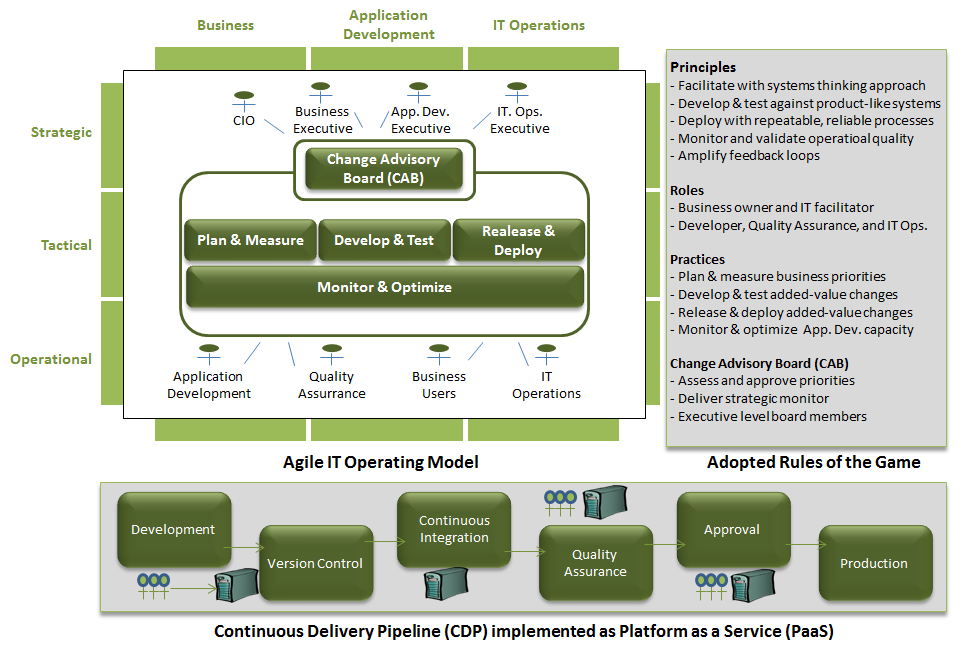
As I’ve been implementing it, DevOps is a system of principles, practices, roles and responsibilities, governance structure and tools purposely arranged to establish cross-functional collaboration, enable accelerated applications delivery and, in turn, make the business responsive to market opportunities:
As illustrated, DevOps as a business capability is made up of three components: the Rules of the Game, the IT Operating Model and the Continuous Delivery Pipeline (CDP). Let’s explore them.
DevOps Rules of the Game create the conditions for lean and agile IT environments
Rules of the Game are a fundamental dimension of DevOps: They enable the establishment of lean and agile environments. I refer to them as the DevOps non-technological piece.
In practical terms, they’re a set of principles, practices, roles and responsibilities and tools institutionalized to ensure accelerated applications delivery.
They serve as catalysts to specific organizational and operational effective practices. Let’s take the principle, “Facilitate with system thinking (involvement of all relevant stakeholders)”—it forces application development stakeholders to adopt a collaborative mindset, which in turn breaks down organizational silos to eliminate the impediments to operational flexibility and institutionalize cross-functional collaboration.
They’re the poor cousin of today’s DevOps practices, which ignore them in favor of more technical and technology issues. That’s a terrible mistake that reduces DevOps influence vs. the digital economy’s challenges.
The agile IT Operating Model establishes the lean and agile work environment
The IT Operating Model reflects the interactions that take place across your application development value stream. In practical terms it represents the work environment derived from the application of DevOps’ rules of the game.
I always remind my clients that DevOps’ rules of the game aren’t theories, they’re the foundations of a tangible strategic capability: the lean and agile IT environment. They demand a thorough transformation of your application development work space to put together business, application development, and operations:
The lean and agile IT work space for the digital era illustrated (Credit: O.C. Tanner)
The picture illustrates what’s meant by lean and agile IT environment, it substantiates Adam Jacob’s point that “Fundamentally DevOps is about taking the behaviors and beliefs that draw us together as people, combining them with a deep understanding of our customers’ needs, and using that knowledge to ship better products to our customers.”
The IT operating model is the poor cousin of today’s DevOps practices which ignore it in favor of more technical and technology issues. Once again, it’s a terrible mistake that reduces DevOps influence vs. the digital economy’s challenges.
Make no mistake, technology matters, the CDP helps to meet digital technologies challenges
The importance of the rules of the game and the resulting IT operating model don’t suggest at all that technology doesn’t matter. Make no mistake about it, the CDP is essential; I refer to it as the DevOps technological piece. Through deployment automation and configuration management tools, it significantly accelerates application development, testing, resources provisioning and deployment.
However, one thing to be aware of is, digital economy raises technological challenges that transcend speedy delivery issues. They include:
The importance of IoT
The pivotal role of predictive analytics
The increasing importance of APIs
As a matter of fact, IoT devices generate massive data and making use of it to generate revenue requires big data technologies to integrate, automate and analyze them.
On the other hand, this ocean of IoT data has generated an API business; the idea is, to monetize their data and generate revenue, businesses must provide their customers and partners with APIs that easily give access to their systems.
Implementing the CDP as part of PaaS cloud services can help to prosper in the digital economy; it allows businesses to benefit the cheap and on-demand computing, storage and network resources provided by the cloud.
Takeaway
In hindsight, with a business-oriented perspective, the ITaaS delivery model and DevOps follow the same goal: Provide business lines with the lean and agile IT environments they need to be flexible enough and responsive to meet the competitive challenges of digital economy:
Like DevOps, the ITaaS delivery model (…) takes advantage of an agile IT operating model to help businesses succeed in the digital era. It implements consumer-provider relationships across the IT value stream to ensure organizational flexibility and operational agility.
CIOs must realize that what matters to the business is to continuously generate revenue through improving customer experience and increasing customer value. Deploying applications at the speed of light for the sake of speed doesn’t make sense from a business perspective; as long as expected business benefits aren’t achieved, speed is a useless gadget.
Implement DevOps as what it is: a three-dimension IT capability including rules of the game, IT operating model and, of course, continuous delivery pipeline.
Jelastic and MoldData Cloud has partnered to enable DevOps with the containerized PaaS and meet the requirements of each specific business in the Republic of Moldova
Palo Alto, Calif (PRWEB) February 02, 2016
Jelastic, Inc., the first DevOps PaaS with native PHP 7 support within the cloud market today announced MoldData Cloud as their new partner, that is headquartered in the Republic of Moldova.
Dorian Bodiu, CTO of S.E. MoldData about their cooperation with Jelastic:
“We consider Jelastic as the best platform for us to satisfy the highest demands and needs of our customers. Jelastic is the production-ready solution with support of Docker containers technology, that enables DevOps to build, ship and run distributed applications anywhere. That is why this technology is taken as the main basis for the future business strategy of MoldData. From now MoldData will provide autoscaling feature, – the best argument for the customers who want to pay only for what they consume.”
Jelastic enables the DevOps teams to easily create, test and run their projects using the advanced and user-friendly cloud platform. Developers also get the full package of advantages from Docker containers, such as smart distribution of containers, automatic vertical and horizontal scaling, full isolation and security as well as high availability. Jelastic is designed to provide the absolute ease of use for developers to create, run and scale applications in the cloud environment.
“We are excited to expand Jelastic Ecosystem with MoldData Cloud, providing the ultimate containerized PaaS to web developers in the Republic of Moldova. Flexible pricing and high performance of MoldData Cloud in combination with Jelastic global technology provide new opportunities and high level of automation for DevOps teams within the local data center.” declared Ruslan Synytsky, Jelastic CEO
MoldData Cloud customers value the personalized approach, as well as the high level of service and the best pricing offering within the market. Company offers a lot of services, as Virtual servers, Virtual datacenter, Web projects consulting, Dedicated Servers, Domain registration, Managed hosting, Server Management, Support center and Backup. The location of MoldData Cloud data center will ensure providing services in accordance with national standards of data protection and security, and with 24/7 technical support. Among the chief goals of MoldData are: performance optimization of users` applications and providing the highly qualified services. They are working with each customer directly to identify the size and type of project, its needs and the potential growth in order to meet the requirements of each specific business.
With MoldData Cloud solution, developers can value all the benefits of DevOps PaaS, such as:
Automatic Horizontal and Vertical Scaling
High-Availability
Advanced Docker Support
Zero-code-changes
Clustered Solutions with Multi-Nodes
Application Lifecycle Management,
Custom and Jelastic SSL
SSH Access and open API
Marketplace (one-click installation of the most popular applications)
About Jelastic
Jelastic is an enterprise DevOps PaaS for containers deployed on bare metal hardware or any cloud IaaS. Jelastic customers and partners, such as ISVs, hosting service providers, systems integrators, outsourcing companies, DevOps teams and enterprises, can choose between Public, Private, Hybrid and Multi-Cloud options. The platform provides certified containers for Java, PHP, Ruby, Node.js, Python and .NET and the ability to use custom Docker containers. Jelastic offers agile deployment models without coding to proprietary APIs, flexible automatic scaling for stateless and stateful applications, collaboration, access control, monitoring, backup and disaster recovery, built-in billing and business analytics tools, while driving down TCO with high density and hardware utilization. Jelastic multi-cloud functionality enables customers to achieve high-availability through geo-distribution across different data centers or clouds, easily relocate the projects to the superior hardware with the help of live environment migration, choose between higher quality or more cost affordable hardware and host applications with the trusted cloud vendors. For more information, visit us at http://www.jelastic.com
We are very happy to announce that we have launched a new survey that will explore how the community feels about DevOps, ITOps and PaaS. The survey is another in the continuing surveys we are conducting to help all of us understand more about how DevOps is really influencing how development, Ops and IT are being changed.
This survey is sponsored by Apcera, makers of the Apcera Hybrid Cloud OS. The survey is only about 19 questions and shouldn’t take more than 5 minutes. It is aimed at understanding if there is a difference in opinion of who is leading innovation and where are the roadblocks to that innovation in organizations. It also seeks to understand what are organizations are thinking about containers and specifically are different parts of the IT team looking at containers differently. Finally, the survey tries to help us understand what are the attitudes towards PaaS.
As we always do we will release the survey findings when complete. You are helping not only your own organization but the entire DevOps community if you would take a few minutes to take the survey right now we would be very grateful. If there is something you think we got wrong on the survey or left out, please let us know by commenting here.
Chances are your organization has already moved some of its applications to the cloud. There, storage and computing capacity are provided as services, and everybody in your enterprise can access the apps and related data via the internet.
As we all know, the cloud enables organizations to scale up or down quickly according to their needs, while giving them tremendous flexibility in maintaining their computing environment. One advantage for using the cloud is that it helps reduce time-to-market and removes the need for upfront investments in infrastructure.
To help you simplify the process of moving apps, you should consider using an Application Release Automation (ARA) tool from a reputable vendor with experience in the cloud space.
Moving to the Cloud Involves Research and Difficult Decisions
The first decision is perhaps the hardest: determining which variant of the cloud is best for your apps and your organization. Private or public cloud? Factors you should consider are: data security, privacy, legal compliance, network latency, whether the organization has the in-house resources to create and maintain a private cloud, and which cloud flavor provides the best combination of flexibility, compliance and cost-effectiveness.
Then, you have to weigh up the pros and cons of using the different cloud flavors, principally these:
After the big decisions come the technical issues of how you are going to move your applications. Moving apps can be very difficult as many apps are complex and tied closely to the infrastructure landscape where they are deployed. Moving to a new landscape, such as the cloud, can be fraught with risks and challenges.
What are ARA Tools?
ARA tools focus on the modeling and deployment of custom application software releases and their associated configurations, often for Java Platform, Enterprise Edition (Java EE) and .NET applications. These tools, according to Gartner, offer versioning to enable best practices in moving related artifacts, applications, configurations and data together across the application life cycle. ARA tools support continuous release deployment. They often include workflow engines to assist in automating and tracking human activities.
Core activities include:
• Packaging — creating a collection of multiple configuration items that must be deployed at the same time
• Dependency Mapping — modeling full application dependencies between components of the application
• Software Deployment — using package contents to install applications and configure their operating environments
• Promotion — delivery of tested packages to an environment of higher criticality
• Compliance — documenting adherence to processes and validating deployed application configurations
At its simplest, an ARA tool helps developers to map application components and configurations to targets, such as binary code, connection configuration, database updates, queue definitions, and web service end-points. This helps to remove the coupling between the application and its host infrastructure.
First Step in Using an ARA Tool to Move Apps to the Cloud
Using a sophisticated ARA tool, you can install applications in a cloud environment automatically. Nearly all ARA tools will enable you to define the application in the tool, ideally specifying a package for each version of each application. Each package will contain all of the components to make an application run, as well as links to the environments where you want to deploy.
If you use a model-based ARA tool, you will be able to eliminate much of your ‘how’ issues as the tool will automate most of the steps involved.
Second Step
Next, you must decide whether you want to move an app all at once or piecemeal. To err on the side of caution, you would be better off taking baby steps so you can learn and document as you go. Ideally, you might start by just moving some specific aspects such as static web content and front-end web servers. A model-based ARA tool will help you move forward quite effortlessly, whether your targets are in an on-premise or cloud environment.
Interacting with your targets is easy, via SSH, WinRM, REST — in fact, you can choose pretty much any connection protocol. You won’t even need to define new workflows or steps for this, as the tool will take care of the changes and determine the new deployment plan. Of course, if you want to move the entire app to the cloud, ARA tools give you that option, too.
In general, ARA tools will enable you and your team to move apps to the cloud quickly and safely, with full audit trails.
Software deployment is often one of the sorest headache-inducing problems of moving operations to the cloud. However, if you use ARA tools, your problems should diminish if not disappear. Best of all: if you use a model-based ARA tool, you will be able to eliminate much of your ‘how’ issues as the tool will automate most of the steps involved.
About the Author/Tom Batchelor
Tom Batchelor is a sales engineer for XebiaLabs, a leading provider of automation software for DevOps and Continuous Delivery, helping companies to accelerate the delivery of new software.
One of my favourite blog posts about PaaS is James Urquhart’s ‘Is your PaaS composable or contextual? (Hint: the answer matters)’. In the post, James distinguishes two different types of PaaS: Contextual and Composable. He additionally implied a third type of PaaS (though he categorized it as “Composable”):
“Perhaps most importantly, however, there are open source “build” tool chains being deployed directly to infrastructure services that exhibit a purely composable approach toward delivering and operating applications. Combining GitHub with Jenkins with Gradle with AWS CloudFormation and Autoscaling and so on gives a fully automated, flexible “platform” for application development and operations — everything you want from a PaaS. The catch, of course, is that you’ll need to assemble and maintain that tool chain over time (rather than letting the PaaS vendor do it for you).”
The Whitebox PaaS:
When we started VisualOps, at first we didn’t realize that we were building a new type of PaaS or rather a customizable PaaS, this was partly due to our DevOps background. As James pointed out, the value of a classic “Contextual” PaaS can be achieved by using the DevOps tool chain. There is more transparency and control implied by ‘customizable’ over ‘composable’ as all aspects of the environment are within your control. Each building block’s entire make-up is determined by you rather than merely arranged. The Blackbox PaaS removes this ability to define your own rules.
Though currently this category of tool chain is mostly homegrown, the key point here is that PaaS does not have to be a Blackbox. A Whitebox PaaS exposes 100% native interface of the underlying infrastructure, giving ultimate control and transparency. Combining Infrastructure-as-Code and Configuration Management capability as a quick and easy way to build, automate and orchestrate applications. Compare the Whitebox PaaS with the Contextual PaaS and the advantage is clearly that the Whitebox PaaS poses no pre-determined constraints on the application, and as such your apps will be general-purpose and lock-in free.
Benefits:
A key benefit of this approach is that the Whitebox PaaS is capable of both deploying and managing itself. With aWhitebox PaaS service it is possible that the customer can click to deploy a private clone, and no management effort is required since the clone is supervised by the “origin”. This removes the “operation immaturity” stated by John E Vincent in his blog:
“To be clear while I feel that most organizations aren’t ready for the operational challenges of maintaining a PaaS, the job is made harder by the PaaS software. In both cases, the operational maturity of the products themselves simply isn’t there.”
A further value is that in the WhiteboxPaaS is not th eapplication runtime. Instead,your code will run in standalone infrastructures (VMs), and PaaS only needs to help automate and orchestrate the application. Thus, even if the PaaS is down, your application will still run un-impacted. This entirely side-steps the issue of ” their downtime [being] your downtime”, as well as the security concerns raised by the multi-tenancy of the public PaaS.
Objections:
There may be some concerns regarding the learning curve necessary and intrinsic complexity of the WhiteboxPaaS as it requires your involvement with the application setup and the system architecture. It is true that it is by no means the easiest option. However if you are looking from a business minded perspective, having this knowledge will give you a great competitive advantage. If you don’t know how to do this you may lose the opportunity to build a better, faster and more robust application. Moreover, if people use PaaS to achieve “NoOps”, then it would appear that the real meaning of ‘undifferentiated heavy lifting’ is the day-to-day operations necessary to keep your application running, rather than the knowledge it was built upon. In this context using a WhiteboxPaaS absolves you of all heavy lifting, yet still leaves you with the opportunity and ability to make improvements, it is ‘customizable’.
This is not to say that PaaS must always be Whitebox. James put it well: “it’s not an either/or choice, much like stability and resiliency”. Different types of PaaS serve different markets and different purposes. From our experience, we have seen some customers begin using a Blackbox PaaS such as Heroku and grow rapidly with it until they reach a point where they want or even need something more flexible and powerful, they then choose to migrate to AWS+Whitebox PaaS such as VisualOps. This progression allows you to concentrate your time and efforts wholly into your business itself at the beginning, then upgrade to a more proficient and flexible platform as your business grows.
About the Author Peng Zhao is the Founder and CEO of VisualOps. Previously, he initiated and led the IaaS projects for China Mobile as well as being both a manager and developer in a various companies, including Reuters and Platform Computing. He holds a MsC. from Univerisity College Dublin. His twitter handle is @gnepzhao
The numbers are in and it seems that growing demand for greater speed and more line-of-business control over application development has pushed platform as a service (PaaS) to a tipping point of ubiquity. Several recent surveys show the state of PaaS is in rapid growth mode as a number of application deployment trends have raised the bar for continuous delivery.
One of the surveys, conducted among 1,358 IT and business pros by GigaOm Research and North Bridge Venture partners, clearly illustrated the dramatic rise in PaaS usage with just 7 percent of respondents stating they used PaaS in 2011 and 41 percent saying they now use the technology. Within two years, the survey shows that number will rise to 62 percent. And that’s slightly more conservative than a different survey conducted by Vanson Bourne on behalf of Progress, which shows that 70 percent of 700 respondents are either already using PaaS solutions for application development or are planning to use them in the future.
The second survey points to increased pressure for even faster application delivery as a major driver of this push, with 85 percent of IT leaders reporting demand within their organizations to further reduce the time it takes to develop and deploy applications. That demand is coming from the top reaches of organizations and from the most important outside influencers—approximately 43 percent of respondents said rapid development was demanded by the C-suite, while 47 percent said the pressure was coming from existing customers or partners.
The push for faster development from business stakeholders is understandable given overall cloud trends. The GigaOm survey reports that 65 to 70 percent of respondents will move some or significant business application processing to the cloud in the next one to two years. This trend is led by front-office business functions, with 52 percent of sales and marketing moving significant portions of application load to the cloud 44 percent of customer service and 44 percent of business analytics.
This movement is led by a vanguard of those championing what executives at Progress are dubbing the DYOA movement—develop your own application—as many departments are increasingly trying to get what they need out of applications by developing their own.
“Departments are keen to develop their own bespoke applications for specific business functions rather than relying on developers to translate their business needs,” says Mark Troester, a product management leader for Progress, who explains this is in turn driving further PaaS uptick
Rob Walters, CTO of Engine Yard agrees that PaaS will not only be used to help speed up development in IT but to allow line of business some flexibility while metering the chaos that would come from a complete circumvention of the central development staff.
“Business managers commonly circumvent lengthy procurement processes and use the cloud to deploy new apps or launch time-sensitive campaigns faster. This can cause headaches for it departments that have to maintain security and regulatory compliance,” Walters says. “The most successful companies are finding ways to reap the benefits of the cloud-agility, efficiency and cost savings—while integrating security and governance best practices to ensure they’re driving business growth without undue risk.”
The process of how that happens on the development side is still up in the air and all over the map. Some organizations have developers distributed across department, others maintain a tighter centralized leash around projects.
However, what’s not in doubt is that it will take more than PaaS to speed up development. How organizations use these solutions within DevOps and continuous delivery models may prove the make-or-break element of how well the organization can successful deploy with speed and agility.
These days DevOps is being widely adopted by many IT organizations. Such IT organizations become more agile and reliable, deploying code more frequently with fewer bugs and failures. DevOps helps to get better IT performance and build additional competitive advantages, and companies with high-performing IT organizations are twice as likely to exceed their profitability, market share and productivity goals.
The adoption of DevOps is being driven by factors such as agile development methodology, significantly increased rate of production releases, wide choice of public and private cloud platforms, and a wide range of tools for data center automation and configuration management.
Today there are many different automation tools on the market that are used by DevOps teams for provisioning, orchestration and configuration management (Puppet, Chef, CFengine, bcfg2, Vagrant, Fai, Kickstart, Preseed, Cobbler), for build and deployment automation (Jenkins, Maven, Ant, Cruisecontrol, Capistrano), for infrastructure monitoring (Zabbix, Nagios) and application performance measurement (NewRelic, AppDynamics, DripStat).
However IT organizations still struggle with assisting both developers and administrators that prioritize two completely different goals – speed of application development and feature completion versus production stability and uptime. Automation tools vendors promote their products to solve the challenge of DevOps teams, but still very often fail to face the complexity of workflows for operations engineers, or application releases and deployment speeds desired by developers.
Another issue is that IT organizations with application release and deployment issues usually use some kind of automation, but they want to have more flexibility to manage their automation without the need to invoke everything manually at the command-line. Ideally, this automation should be available for developers in their development environments to give developers more control of the environment and understanding of the infrastructure usage.
These issues have driven the evolution of DevOps tools. Today, cloud platform vendors consolidate and integrate automation and management tools directly into their cloud platforms. As a result, IT organizations can get better automation features in the same turnkey cloud platform. We can claim that PaaS solutions will become the next generation of DevOps tools. Cloud platforms have already removed the need to worry about many aspects of provisioning and configuration management of virtual machines/containers. These cloud platforms solve it in a very efficient way, because they have more control of resources and events, they manage the whole cluster of resources and take into account different metrics and status indicators at the same time. As a result, these platforms provide significantly better density of resource, better utilization, smart distribution of the load across the cluster, automation of new release deployments, automation of scalability and maintenance, out-of-the-box high availability and fault tolerance features.
In fact, many IT organizations use automation tools such as Puppet and Chef to solve the challenges of template management, updating middleware stacks, application configuration management and zero-downtime deployment of new releases. However, the latest cloud solutions include more “native cloud” features designed to solve the same tasks. There are many examples of this trend for cloud platforms to evolve in this new, DevOps, direction, providing native automation features in popular cloud platforms.
Let’s take one of the visionaries in the cloud computing industry – Amazon Web Services. One of their cloud services, CloudFormation (http://aws.amazon.com/cloudformation/) allows developers and administrators to create and manage resources, middleware stacks and application templates. It helps to manage configurations and updates of already provisioned resources and applications. Literally, it‘s designed to solve the same tasks as Puppet and Chef. You can find many threaded discussions related to the comparison of CloudFormation vs Puppet/Chef. OpsWorks (http://aws.amazon.com/opsworks/) is another service for application management that simplifies application deployment and lifecycle management. It helps to define application topology, specification of package installations and software and resource configurations. In addition, this service includes automation for scaling based on time or load and allows scripting of these tasks.
Another good example of DevOps evolution is the new cloud services released by Google Cloud Platform. Recently this public cloud platform released several different features that help to solve similar tasks to those mentioned above – Replica Pool (https://developers.google.com/compute/docs/replica-pool/), Startup Scripts https://developers.google.com/compute/docs/howtos/startupscript and Cloud Deployment Manager https://developers.google.com/deployment-manager/. These natively integrated cloud tools provide the ability to create and manage sets of virtual machines (VMs) from common templates, resize, update, or delete them, define different configuration attributes such as base image, attached disk details, attached networking objects and scripts to be executed after the boot, install new software and updates, define environment/OS variables persistently available to VMs whenever it starts. In addition it provides the ability to easily declare, deploy, and maintain complex applications using a simple template mechanism. It provisions, scales, and monitors VMs and applications. Moreover, it can perform regular health checking and can restart or re-build sets of VMs that fail to respond appropriately. Recently announced Cloud Debugger and Cloud Trace (http://googlecloudplatform.blogspot.com/2014/06/enabling-developers-to-tame-production-systems-in-the-cloud.html?utm_source=feedburner&utm_medium=feed&utm_campaign=Feed%3A+ClPlBl+%28Cloud+Platform+Blog%29) allow developers simply setting a watchpoint on a line of code and to get a snapshot of all the local variables, parameters, instance variables and a full stack trace. It helps quickly identify and fix performance bottlenecks and enables engineers to compare performance from release to release with a detailed report. It works with zero setup uptime and no complex configuration, and is suitable for use in production. The tools described above cover a large breadth of DevOps tasks.
Docker (http://www.docker.com/) is another good example of a tightly integrated cloud automation mechanism and a further example of DevOps evolution. The promise and focus of this automation solution are to remove complexity of configuration and deployment into different environments. Many cloud vendors have announced integration with Docker. Many observers believe that Docker is still at an early stage and not yet production ready, but the product has generated lots of industry buzz and the technology seems to be significant.
In addition, there is something even bigger in the DevOps evolution – the open initiative for unification of cloud automation as Topology and Orchestration Specification for Cloud Applications (TOSCA) https://www.oasis-open.org/committees/tc_home.php?wg_abbrev=tosca. The goal of TOSCA is to enhance the portability of cloud applications and services, enabling the interoperable description of cloud services and relationships between parts of cloud services and operational behaviors. Examples are template configuration and provisioning, application deployment, software patches and updates, application scaling and maintenance, etc. In other words, it drives a unified standard for independent cloud platform vendors or cloud hosting service providers. As a result, it should simplify the work and tasks of DevOps teams by creating a vendor-neutral ecosystem enabling portable deployment to any compliant cloud platforms, smoother migration of existing applications to the cloud and the ability to build and run multi-cloud provider applications.
In conclusion, the future will bring more cloud native absorption of different automation features for DevOps needs. The evolution of cloud platforms in the DevOps direction is extremely beneficial for IT organizations because they do not need to manage and learn different tools and approaches for automation. This unneeded complexity will be replaced by seamless integration of different automation features inside the same cloud platform. It means in the near future very popular DevOps tools like Puppet and Chef will compete with built-in functionalities of cloud platforms.
However, during the evolution period, choosing the right cloud platform is critical. It should allow IT organizations to use multiple approaches – the old legacy automation methods and the new native features to give the maximum flexibility from built-in automation and an already collected knowledge base. Flexibility of choice is the key point in the DevOps evolution for IT organizations – the ability to use both worlds at the same time: the old automation tools and the next generation features of cloud platforms.
In addition, it makes sense to mention the importance of seamless integration between PaaS and IaaS for the evolution of DevOps. The public cloud platforms discussed above (AWS and Google Cloud) provide merged solutions today. The integration of both layers is very important for enterprises that heavily use private and hybrid clouds, as it replaces the unneeded maintenance complexity of two different solutions and removes extra overhead on integration of products from different vendors. In other words, merging PaaS and IaaS provides extreme flexibility of automation and ease of use in the same solution. Seamless cloud platforms provide the best combination of the automation features in the same turnkey cloud solution that help to drive innovation and maintain legacy apps.
The next generation of cloud platforms will establish a win-win relationship between the dev and ops departments, and when the outcome of dev and ops interactions is a win-win, IT organization performance wins as well.
About the Author
Ruslan Synyntsky, is founder and CTO of Jelastic. With over 15 years in the IT industry, Ruslan is an expert in large-scale distributed Java applications and enterprise platforms. Before founding Jelastic, he led engineering teams a and at the Space Agency, Ukrainet iQueLab, SolovatSoft, Datamesh.
Give me a platform. Let’s rock, let’s rock, today.
– Dewey Finn, School of Rock
The term Platform as a Service (PaaS) has become overloaded to define any ‘platform’ that provides ‘services’ to its users. The term PaaS is formally defined by NIST as:
“The capability provided to the consumer is to deploy onto the cloud infrastructure consumer-created or acquired applications created using programming languages, libraries, services, and tools supported by the provider. The consumer does not manage or control the underlying cloud infrastructure including network, servers, operating systems, or storage, but has control over the deployed applications and possibly configuration settings for the application-hosting environment.”
Like most terms in the IT industry (or to really generalize, the human communication medium known as language), PaaS is overloaded, overused and misunderstood. A quick web search or even a visit to the Wikipedia page on PaaS proves my point.
I prefer to look at such overloaded terms in context. In this post I am going to look at PaaS thru the lens of DevOps (no surprise to a reader of this website). I will explore what it means to an organization looking to adopt DevOps and leverage the services offered by utilizing a PaaS platform. I will explore and contrast a ‘build your own’ in-house platform as a Service or a subscription based commercial PaaS offered by a vendor. I will use PaaS offerings from IBM to illustrate my points. (Disclosure – IBM pays my mortgage).
Lets start.
Defining PaaS:
The most critical section of NISTs definition of PaaS, that differentiates PaaS from an ‘Infrastructure as a Service’ (IaaS) consumption model for cloud is:
“… The consumer does not manage or control the underlying cloud infrastructure including network, servers, operating systems, or storage, but has control over the deployed applications and possibly configuration settings for the application-hosting environment.”
This picture better illustrates the differences.
As you can see in this picture, what distinguishes the two cloud adoption models – IaaS and PaaS – is how much of the stack is managed by the user (or client) vs how much is managed by the Cloud Platform provider. What is important to highlight is two things:
Every capability in the stack is available as a managed service – this would be a shared, multi-tenant, service available to users, with the underlying implementation abstracted from the user
The Client/user only has to be concerned about managing their own applications, data and user access, leveraging the services available on the platform, which manages the rest
Platforms as a Service may be either public (IBM BlueMix, CloudFoundry from Pivotal, Google App Engine, etc) or private (hosted CloudFoundry; self built and hosted platform). Organizations may also build their own hosted and managed leveraging multiple technologies, self hosted on a private cloud. For a private instance of course, the organization hosting it in their own data center would be responsible for managing all the services hosted on the platform. Building a PaaS on an IBM PureApplication System, would be a good example.
DevOps and PaaS:
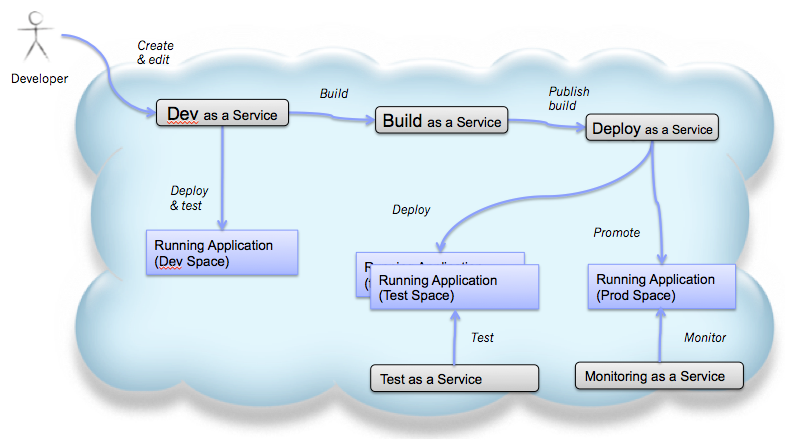
When one looks at DevOps on PaaS one has to look at the services that need to be hosted on the platform in order to implement a DevOps services platform. If one looks at a DevOps pipeline and the core components that make up a delivery pipeline up, each of the components need to be available as a service, in order to provide a complete ‘DevOps on PaaS’ solution. Namely:
Development tools as a service (and/or an ability to connect the services on the platform to a desktop IDE)
Build as a service
Deploy as a service
Test as a Service
Monitoring as a Service
These would be what one refers to ‘DevOps Services’.
In IBM’s new PaaS offering – Codename: BlueMix (in open beta), these DevOps are services are an inherent part of the platform. There services on Bluemix are:
Git hosting as a Service
Web based IDE
Agile planning & tracking, team collaboration as a Service (Jazz.net)
Mobile Quality Assurance (MQA) as a Service
Continuous Integration as a Service (Jenkins as a Service)
Deployment Automation as a Service (powered by UrbanCode Deploy)
Performance Monitoring as a Service
These capabilities working in concert, provide a Continuous Delivery Pipeline on IBM Codename: BlueMix.
DevOps as a Service (DaaS?)
So, to conclude. The value proposition for adopting a PaaS platform is self-evident. If you are an organization that delivers software, and is looking to adopt DevOps, a PaaS offering that includes DevOps services allows you to adopt DevOps at a very low cost of entry. You do not need to craft a Delivery Pipeline and implement the whole Continuous Delivery toolchain. Integrations, hosting, servicing – not your problem. Pay-as-you-go, and allow for scale. It is however, not a viable option for all organizations, as it is a drastic shift in corporate culture and potentially policies. Especially if you look at a public PaaS. If you are a born-on-the-web organization, or an enterprise with born-on-the-web applications, you should take a closer look. Check out Codename: BlueMix at www.bluemix.net.




 Tom Batchelor is a sales engineer for XebiaLabs, a leading provider of automation software for DevOps and Continuous Delivery, helping companies to accelerate the delivery of new software.