Tag: operations

  • Embracing a DevOps Culture, Part 2

    Embracing a DevOps Culture, Part 2

    In Part 1 of this series, we discussed the fact that more organizations are looking to embrace the “DevOps culture.” However, unlike ITIL, implementing DevOps into an organization does not happen overnight. DevOps is more a philosophy than a procedure, and choosing the right leadership team is as important as choosing the right tools.

    In Part 2 we look at other important elements of organizations successfully embracing the DevOps culture.

    Without Proper Collaboration, DevOps Initiatives Will Fail

    A good test to determine if your organization has truly embraced the DevOps culture is how well your IT department responds when a major incident occurs in the product environment. For example, an e-commerce company’s dramatically slow website, a hospital’s unresponsive electronic medical record (EMR) system, and a malfunctioning airline reservation system. In these chaotic situations, every minute counts and all Dev and Ops hands need to be on deck to keep your organization afloat.

    When incidents occur, it’s critical that your organization’s Dev and Ops teams work together to resolve the problem and restore failed service as quickly and efficiently as possible.

    Incident Response: The Critical Incident Team

    An international company with global operations may have network operations centers (NOCs) in the United States and the U.K. that support more than 50 mission-critical business applications, development centers in China and the United States and a service desk in the United States. When an incident occurs, the company’s service desk is flooded with alerts, ranging from various IT monitoring tools and customer phone calls to open tickets from online users and inquiries from stakeholders. When that happens, the only concern of the service desk is to fix the issue—not tracking down a department head on the other side of the world that may be responsible for the problem.

    DevOps should enable an organization to assemble its critical incident team in only a few minutes. The Ops team should know exactly what team(s) to contact for a given incident, and who from those teams is assigned to application support. They should know who is on call based on the time zone and day of the week, and have the correct phone numbers easily accessible.

    Next, the team should review the technical details of the issue provided by the incident manager. The universally used DevOps toolset enables everyone to speak the same language, quickly identify the root cause, put a remediation plan together to have approved by the emergency cab, deploy the fix, test it out and confirm service is back up and running.

    IT Communication: The Glue That Holds Dev and Ops

    To be successful, organizations need to be able to respond as quickly as possible during a major IT incident to limit the negative impact on the business. This is achieved when Dev and Ops works together to create a central communication and collaboration center to ensure proper communication with key stakeholders.

    An organization’s ability to effectively mitigate the impact of an IT issue relies heavily on its ability to access and communicate critical information, and to ensure the right people can analyze it and initiate the appropriate actions to keep the business running smoothly. The communication hub equipped with an IT communication solution will facilitate:

    • Reaching out to the right on-call people among all the different teams: infrastructure, server, system administration, middleware, network, DBA, QA, support team, service desk and the application developers.
    • Because emails don’t wake up people, they will be able to leverage the IT communication solution to reach out to people via multiple channels until they respond (voice, SMS, email, push notification app, paging, etc.), or automatically escalate to the next resolver on the on-call list.
    • Providing the right information so the IT resolvers start investigating the issue, identify the root cause and put a resolution plan together without wasting time.
    • Get people to collaborate together using the same telecommunication and collaboration tools whatever the time zone and wherever they may be located.
    • Contacting a third-party vendor in case the problem is not attributable to the company but caused by an external piece of software.
    • Informing the other departments if the business impact grows so big that it affects the company profitability or reputation, such as a cyberattack leading to a data breach for instance. The CEO, legal and marketing may need to be informed to anticipate the consequences.
    • Informing end users or customers to limit the number of incoming calls into the help desk.

    The benefits of quick collaboration and not just handoff between the teams don’t even have to be demonstrated. Removing the broken pathways, obsolete delivery methods and redundant platforms will improve significantly the organization’s ability to communicate during critical moments. Becoming more efficient and removing the time wasted will automatically have a huge impact on the mean time to know (MTTK) and, in turn, on the mean to resolve (MTTR), hence minimizing the disastrous impacts on the business and keeping the company’s execs sleep at night.

    DevOps Culture Can Happen

    Embracing a DevOps culture is not a Big Bang change that happens overnight. This is a journey that will be more or less difficult to pursue based on the existing culture and the history and maturity of the IT organization. Even more importantly, it will depend on the level of commitment from upper management to introduce a new culture. Leaders need to embark on this journey keeping in mind that not only will it require new common tools and new common processes, but also they’ll need to convince people of the value of such transformation. To achieve this goal, management should consider IT communication as a key element, which will be the glue that binds Dev and Ops together. And because there always will be room for continuous improvement, the road to DevOps will have no end.

    About the Author/Vincent Geffray

    vgVincent Geffray is Senior Director of Product Marketing at Everbridge with focus on IT Service Alerting & Communications Automation and IoT.

    He has more than 14 years of experience in the information technology business, designing, promoting and selling Enterprise IT Operations Management solutions, including Critical Communications, Application Performance Management, IT Process and Workload Automation. He also has international experience as he started his career in Europe. Vincent holds a Master of Science (Mechanical Engineering and Computer Science) and executive certificates from the MIT – Sloan School of Management.

    Vincent’s LinkedIn: www.linkedin.com/in/vgeffray

    Vincent’s Twitter: @vgeffray


  • Balance: The Key to Successful DevOps

    Balance: The Key to Successful DevOps

    In the realm of IT buzzwords, DevOps is in a league of its own. The pervasiveness of the word is matched only by the variety of its definitions. Over time, much like the parable of The Blind Men and the Elephant, it has slowly taken shape out of the void, albeit in a backwards fashion. Associated terms such continuous delivery, integrated quality assurance and deployment automation have helped backlight the beast’s silhouette, but there is much more to discover.

    Generally, DevOps is defined by how it is used rather than what it is. This is helpful for those already familiar with the amorphous nature of the movement, but can be a confusing introduction for the uninitiated. To achieve a better understanding, it is important to grasp the underlying need driving the shift to a DevOps model.

    Currently, the world of IT is barreling toward a future dominated by increasingly specialized and inherently complex automated solutions. Software is taking a front row seat in ways never before possible. (Insert here)-as-a-service offerings and the demand for instantaneous and consistent deployment turnaround is at an all-time high. The days/weeks required to shuffle a solution between development and engineering is a luxury that most companies can no longer afford and is less tolerated by customers. This level of expectation is something that the traditional IT org chart was not designed to cope with. Tech companies everywhere have felt the strain of this increasing momentum, with many at a loss of how to handle it. Demanding that teams work harder, faster, longer will only get so far. And inevitably, increased intensity results in a rise in mistakes and an inferior product.

    Balance: Dev’s Yin to Ops’ Yang

    Clearly, change was and is needed. The path from development to operations needs to be streamlined at a fundamental level. However, dissolving the barriers between two longstanding departments is not without its perils. As any IT veteran will tell you, development and operations each have their own cultures, quirks and personalities. But the differences in each help create the perfect balance.

    In its purest form, development is the trailblazer, forging into uncharted territory and unearthing hidden gems. Ever the innovator, Dev values progress and change above all. This constant forward momentum is Dev’s greatest asset as well as its Achilles’ heel. The habitual urge to tinker, tweak and create can lead to frivolous or wasted effort. The results of this misguided effort can be seen in retrograde patch releases, hotfixes and other “band-aid” measures needed to undo the damage.

    On the other end of the spectrum, the operations mantra can be summarized with the idiom, “If it ain’t broke, don’t fix it.” Pragmatic to the core, stability and consistency are the guiding forces behind Ops. Change requests are usually met with a Treebeard-esque, “Don’t be hasty.” Taken to the extreme, this mindset can quickly lead to an environment running outdated, unpatched software and end-of-life hardware.

    On the surface, the differences between these two groups appear to be on the verge of irreconcilability. However, in this diversity the beauty of DevOps emerges as the strengths of each team balances out the weaknesses of their counterpart. Development is free to innovate and create knowing that their efforts will be guided by feedback from operations. Like stabilizers on a rocket, operations is able to focus on maintaining a reliable infrastructure with development providing the forward momentum. Working in unison, this duo forms a unit far greater than the sum of its parts. And with it, a company is left with an agile and stable launch pad from which to tackle the latest wave of IT challenges.

    Admittedly, the combining of development and operations into a single cohesive unit is just a piece of the entire DevOps puzzle. However, it is an important piece that is frequently overlooked. Understanding the forces and motivations at work within your teams is a pivotal step on the road to a successful DevOps transition.

    About the Author / Jared Perry

    Jared PerryJared Perry is a cloud engineer at iland, where he is responsible for maintaining the virtual infrastructure and a number of disaster recovery solutions. He holds a Bachelor of Applied Science in technology management and a Bachelor of Science in IT administration and management from Texas A&M University.

  • Does the Future of DevOps Lie in NoOps?

    Does the Future of DevOps Lie in NoOps?

    Why DevOps is more a bi-directional rather than a simple top-down approach

    DevOps is one of those buzzwords that nearly everyone wants to discuss these days. However, it often is interpreted as an extension of Development’s influence to the detriment of Operations teams.

    So much has changed in the past few years that it is conceivable we will see another major shakeup: Could Operations teams disappear altogether? Or to put it another way, is “NoOps” the future of IT? While DevOps promotes faster delivery of new digital services and a blurring of the lines between Dev and Ops, in reality, is Dev consuming Ops entirely?

    Before DevOps was called DevOps, the two disciplines were growing further apart. Agility has been driven by Developers since the turn of the century, with the famous Manifesto for Agile Development. Meanwhile, Operations formalized repositories of good practices into frameworks such as ITIL or COBIT, which were implemented by most large companies in the mid-90s. Those two approaches seem to oppose, as DevOps advocates the acceleration and multiplication of changes and ITIL tends to monitor and control them.

    NoOps, or the End of Operations?

    If you believe everything you read, then Operations is a dying art. But in practice, Development does not want to be involved with infrastructure, while few organizations would trust developers to manage their data centers, whether physical, virtual or cloud. So breathe easy: DevOps does not mean the end of Operations teams.

    On the contrary, Operations remains essential throughout the DevOps approach. Production infrastructure is a complex and delicate stack of technologies, often with a discreet mix of modern architecture and historical applications. It often is impossible for Development to replicate these types of environments. And that is why an application successfully tested in a qualification environment often does not work properly in production. However, it is crucial to validate new developments in a representative replica of the production environment.

    So is DevOps doomed to constant failure because of lack of continuity between qualification platforms and production systems? Well, this is probably the case if we merely consider DevOps as a simple top-down approach from Development to Operations. Focusing on producing changes at a higher frequency only shifts and grows a bottleneck that sits in production, without producing the added value expected by the company. As a consequence, DevOps must also be seen as a bottom-up process. In other words, if we consider DevOps, we must also take very serious look at “OpsDev” (OK, it doesn’t flow off the tongue, but you see my point!).

    DevOps or OpsDev?

    For a successful DevOps approach in practice, Development must position itself as a consumer of turnkey infrastructure environments. Operations then adopts an OpsDev approach and provides infrastructure on demand for all steps of continuous integration, from compilation to qualification, through unit testing.

    If DevOps is a radical change in how Development works, OpsDev would also revolutionizing common Operations practices. It comes with more agile “declarative” infrastructures (described and built from source code), an even more sophisticated level of automation and the ability to provide self-service infrastructure for developers.

    The adoption of DevOps does not mean that Operations will disappear or will be replaced by Development, but rather the emergence of bi-directional agility that needs to be supported by more sophisticated automation. In fact, DevOps implies OpsDev rather than NoOps. Finally, whatever you consider your release process under the ITIL or DevOps angle, isn’t the end goal exactly the same: delivering zero-default service to customers?

  • The New Age of “Operations” in a DevOps Enterprise

    The New Age of “Operations” in a DevOps Enterprise

    My encounters with commercial clients in the DevOps space have been exciting, curious, political, and challenging. What most don’t realize is that DevOps is not just about infusing tool automation into a delivery pipeline, but it also has to do with re-mobilizing and challenging the status quo when it comes to “who does what”. As teams become more tightly integrated, functional lines blur, and uncertainty may set in.

    I find more and more, that clients and colleagues want to know:

    • What happens to the operations/run tower people if tools like UrbanCode Deploy automate the promotion of applications and releases to run-time environments?
    • What happens to our system administrators and “build out” teams, if tools like Chef, Puppet, Vagrant and pattern-based provisioning systems like IBM Cloud Orchestrator and UrbanCode Deploy with Patterns can perform solution stack build outs with minimal custom network, hardware, software, and middleware configurations?
    • If developers can provision and deploy their own apps, what do the sys admins do?
    • Will Operations Staff be replaced by tool automation?

     The truth is, now, more than ever, a savvy, astute, and innovative operations staff is essential to successfully execute effective DevOps within the enterprise.

     As development and test teams are being empowered to deploy their own applications with tool automation, Operations will need to shift the focus to enabling and empowering these teams with standardized, reusable automation assets. Design, development, maintenance and management of these automation assets will be the core foundation of DevOps success within the enterprise. A corollary to this is a set of standards and policies must be clearly defined and adopted as a framework for implementation.

    Standardization is paramount to making DevOps successful on a wide scale in the enterprise. If we were to think of our applications as a “solution stack” of network, hardware/virtual machine, operating system, middleware, and custom application components, standardized assets in each of the solution layers would enable faster assembly, development, test and delivery of a solution.

    When it comes to effectively enabling the enterprise for DevOps, you must become a hater of snowflakes. Snowflakes can be elegant, but they are unique and difficult to automate with tools. Examine applications and systems for uniqueness…and ask, can it be standardized? Typically, snowflakes occur higher up on the solution stack at the Application or Middleware layers. Network teams are not likely to implement new security policies for each application. However, moving up to OS and middleware, uniqueness is more likely to occur (OS release versions, MW versions and packages and so on).

    Once opportunities have been identified for standardized assets, operations teams must mobilize to enable the enterprise for automation:

    • Encapsulate enterprise policies in standardized automation assets (which can be reused across the enterprise).
    • Centrally manage and maintain automation assets within the enterprise (to maintain standard and policy compliance).
    • Evangelize, encourage, and incentivize the use of automation assets in delivery of applications.
    • Provide a continuous delivery pipeline tool set (preferable, as a service) providing an infrastructure to enable the automation assets for development and test teams

    Automation assets can occur at every layer in the solution stack, providing an opportunity for the new Operations team to inject enterprise influence and compliance at every level. This approach ensures standards and compliance, but also relieves application development and test teams from worrying about whether their application violates any corporate policies.

    Examples of automation assets and some enabling technologies are shown below, but this is obviously not an all-inclusive list (even a hardened shell script can be an asset). The point is, for each layer in the solution stack, assets and corresponding enabling technologies can be chosen to invest in. Some technologies can address multiple layers in the solution stack.

     img

    There is clearly a lot of good, solid, critically important work for the new age Operations team to manage and maintain. Interfacing with enterprise architecture and corporate standards groups are essential. However, the focus remains largely around empowering and enabling delivery using standardized assets.

    You can also watch this short video that I recorded recently. Please do share your feedback on this blog and how you see the evolving role of IT Operations in a DevOps Era.

    https://www.youtube.com/watch?v=TRlbiPcFOxc

    img2

    About the author

    Andrea Martinez is the DevOps Solution Leader for Cloud Services in IBM. Andrea’s mission is focused on delivery of DevOps solutions in cloud and traditionally hosted environments. Andrea has lead the solution architecture, implementation and initial adoption of one of IBM’s first DevOps Deployment Offerings. As a member of the IBM Academy of Technology, and a certified Thought Leader in application architecture, Andrea is keenly interested in enabling and empowering practitioners with innovation and technology to deliver solutions faster.

    Connect with Andrea LinkedIn | Twitter

  • The DevOps Equation: Agility + Empathy = Quality

    The DevOps Equation: Agility + Empathy = Quality

    I had the chance to catch up with Jeff Sussna (@JeffSussna), founder and principal of Ingineering.IT, ahead of his keynote address on continuous design, scheduled for DevOps Days Atlanta, April 26-27.  He discussed the importance of designing for service, responding to the unexpected, and the importance of building empathy across teams.  

    Derek Weeks (@weekstweets): Today I’m really happy that we have Jeff Sussna joining us for the latest in this series. Jeff, why don’t you introduce yourself?

    Sussna: Sure. Thanks for having me. I’m an independent consultant. I’ve been around, since rocks were young or the 80s, whichever is older. My particular background is that I have built systems and led organizations across the entire development, QA and operations spectrum. So, I’m a little unique in that respect.

    My current focus is on helping IT organizations and digital businesses really bring together their ops and design thinking so they can not only go faster and not only be more resilient, but provide more customer value at the same time.

    Weeks: Let’s talk about that a little. How is continuous design—a subject you have written a lot about—coming into play? How can it help us be more resilient.

    Sussna: Just to explain a little about what we mean by continuous design. It’s basically bringing together the entire organization and a unifying design in operations. It’s taking what we are doing in DevOps and expanding it to include product, design and support. It lets the whole organization really have an agile conversation with a market and with its customers.

    The issue that we face is that we live in a service world now. The point is no longer delivering products like cars coming off an assembly line. It’s much more about responding to our customers and having relationships with them. This is happening in a world that is more and more complex while less and less is in your control. We can’t figure everything out in advance. We have to have the ability to respond to the unexpected. We have to be able to do that at every level.


    “This is happening in a world that is more and more complex, while less and less is in your control.”


    I will give you a couple of examples of things that are perfect illustrations of this:

    I recently wished a friend of mine happy birthday. The reason I did that was that because there was a notice on my calendar that said it was her birthday. It was wrong. It wasn’t her birthday. I had no idea where that notice came from. Did it come from Skype? Did it come from LinkedIn? Did it come from email? I had no idea.

    We face that in IT, too. Systems are becoming more complex. We develop microservices. We use public and private clouds at multiple levels. We’re no longer in a situation where we can control things. We have to be able to respond and respond at all levels.


    When we make design and operations unified and continuous, we are able to say, “Where did we think we were going? Where would we need to go? and what do we do next?”


    What I talk about in my book, in my workshops, and all my work is that this needs to happen at every level. It’s not just a matter of designing for failure inside the data center or inside the infrastructure. We also have to do it at other levels.

    Here is another example:

    I was trying to get paid recently by a large enterprise client in Europe. They were trying to wire money internationally and my bank wasn’t really set up for it and they were having problems. They just kind of gave up. I kept getting these messages saying, “Sorry, we tried paying you and it didn’t work.” That was the end of it.

    I started to get frustrated and my client within the enterprise started to get frustrated to the point where they sent a scathing email to our AP department which they CC’d me on, saying, “Why can’t we take the lead to get his guy paid?”

    That’s an approach that is based on resilience in the sense of assuming that something can go wrong and figuring out what he can do to fix it when it can go wrong. As opposed to the traditional approach where we’ve been trained to push certain buttons and take certain actions. If those actions don’t work the way they are supposed to, well, I guess that is someone else’s problem.


    https://www.youtube.com/watch?v=ISSMHmwIMtA


    Weeks: This brings to light some recent conversations I was having with Paula Thrasher at CSRA. She was talking about developing systems and how to make them more resilient. She is using pictures as part of her conversations with people to help visual their work. What work steps are there? What work is flowing? What is communicating with what?

    Are you taking similar approaches with continuous design in how you work with clients to pursue it?

    Sussna: Well, I try to introduce them to the principles and I also try to introduce them to a set of practices which actually comes out of Mark Burgess‘s work on promise theory. It is really a conceptual model for how we think about success and failure and how do we think about service. For example, Amazon helps you get everything you need in your life from shaving cream to batteries to snow tires to books as quickly and easily as possible. In order to keep that promise they make a whole variety of other promises. Some of which filter all the way down to a promise to be able to go over and make a change to production as quickly as possible.

    Once you take that mindset. The interesting thing about a promise and the reason we use that word is because it is very intuitive. We all know what a promise is. We all make promises to each other every day. On the other hand, when we think about it in terms of service, IT, or whatever it may seem a little odd. The thing about promises is that on the one hand we are making commitments to do things and on the other hand promises sometimes get broken. That is actually good because it forces us to think. If I promised to pay my vendor. What do i do if I’m not succeeding in paying my vendor?


    The thing about promises is that on the one hand we are making commitments to do things and on the other hand promises sometimes get broken. That is actually good because it forces us to think.


    It’s sort of flipping our mind. Again, we are doing this in DevOps world where you start thinking about things like mean time to repair (MTTR) instead of mean time between failure (MTBF). We shift from how do we create a situation to how do we create a situation from where nothing will ever break—which becomes less and less possible. When then need to shift to a situation where we can respond more and more quickly.

    We go to executives and say, “We don’t want to worry about how often stuff breaks anymore,” and they freak out. We have to teach them and we have to teach ourselves that we can’t prevent things from breaking. Instead, let’s be able to fix them so quickly that maybe no one notices. My focus is on really helping people shift their mindset from thinking about ourselves to thinking about who we are helping. And from thinking about what we are doing to thinking about how well it succeeds and how well it overcomes problems.


    We have to teach them and we have to teach ourselves that we can’t prevent things from breaking. Instead let’s be able to fix them so quickly that maybe no one notices.


    Weeks: You talked about delivering on promises as quickly as possible. How does continuous design account for doing things as quickly as possible but making sure the quality is there at the same time?

    Sussna: In two ways—one way is that when you do things in small increments you are able to find problems more quickly. This is classic; it comes out of lean. It comes out of integration. It’s pretty basic stuff for our community now that it’s much easier to find and fix a bug five minutes after you change a code than five weeks after you change the code.

    When you put things like Linux, agile, DevOps, and design all together, they all focus on incremental feedback loops where you discover the gap between what you think you’re accomplishing and what you’re actually accomplishing very quickly. Secondly, when you take this all to the way to the marketplace and you make it part of the relationship with your customer, you can reduce a tremendous amount of waste.

    The way to think about continuous design is: it’s all about steering. Think about a boat and you’re trying to sail across a bay. You can’t just point the boat at the other side and say go because the winds are changing and you’re going to be able to respond to things that you can’t predict. If you sail for 20 minutes then discover you had pointed in the wrong direction, you’re going to be way off-course. You’re then going to generate a tremendous amount of energy getting back on course.

    What continuous design says is just an extension of continuous integration and continuous delivery taken all the way though the business. When we steer continuously we steer efficiently.


    What continuous design is really just an extension of continuous integration and continuous delivery taken all the way though the business. When we steer continuously we steer efficiently.


    Weeks: I know you’re going to be keynoting DevOps Days Atlanta coming up in April. Chris Corriere, one of the guys on the organizing committee, tells me that you’re leading a full day workshop on continuous design before that. Maybe you could tell some of the people that are attending DevOps Days Atlanta why they should be there a day earlier for your workshop and what things you’re going to address during that time.

    Sussna: To some degree what I am going to address is everything we have been talking about for the last 10 minutes or so—relative to DevOps. I think the key thing is, and we need to think about it. We need to think about more than just going fast. One of the big misunderstandings that I see with DevOps is this notion that it is primarily about delivering application changes to production faster. That’s only half of it. We really need to think about from the perspective of providing service.


     One of the big misunderstandings that I see with DevOps is this notion that it is primarily about delivering application changes to production faster. That’s only half of it. We really need to think about from the perspective of providing service.


    You know what we are talking about is essentially developers and operations people providing better service to each other. As a result, they can deliver better service to the business.

    Where we talk about microservices. You know that word service is in there for a reason. If all you do is you kind of shatter your organization and shatter your architecture into a bunch of little pieces, you still have to figure out how those pieces come back together into something coherent. The answer to that is taking a really deep service-oriented approach. That is very much what my workshop is about. What does that word even mean and how do we do it?

    Weeks: You mentioned thinking about interactions as delivering better service to one another within the organization. How does empathy come into your thinking around DevOps and Continuous Design?

    Sussna: I’d like to say agility plus empathy equals quality. What I mean by that, in particularly empathy, I think it’s important to take a minute and clarify. When we talk about empathy we are not talking about wallowing in someone else’s pain. We’re not even necessarily talking about things on an emotion or feeling level. It’s very simply the ability to see things as if from an other’s perspective. I will give you a prime example of where that comes into play and how it’s important and how it helps.


    Agility + Empathy = Quality


    When I work with clients, I tend to look at their process using their organization from the product beginning to the support end. Often times I see support getting the short end of the stick. I see places where they get phone calls from customers with features that they don’t even know exist yet. They sometimes get talked down to by development or product or even operations. They say things like, “Well you’re just supposed to support the stuff. You’re the young people. You’re the less experienced people.”

    When we have the ability to see things from their perspective, we can think about how support is actually experiencing our delivery process. If we don’t think about them when we go through the process of delivering new features, they will be lost. Them being lost will show when customers call for help. That will significantly affect customer satisfaction and then even beyond.

    The reason we need to empathize with support is so we can empathize with the customer. Often times when we build things and we don’t think about the notion that our customers might have trouble with it. On the one hand we have the illusion that if we design it and we build it really well, they won’t have trouble. We can’t perfectly predict who they are, what they need or what they will encounter. There’s an inevitability to the idea that they are going to need some amount of help.

    Weeks: I think that is probably the best description of empathy within a DevOps environment that I have heard anyone talk about. Jeff it has been a great conversation. Thank you very much. I really appreciate it and we look forward to seeing you at DevOps Days Atlanta coming up.

    Sussna: Thanks. It has been great talking to you and I am really looking forward to the conference. It will be fun.

    If you want to learn more about continuous design from Jeff, be sure to join us at DevOps Days Atlanta. I will also be at the event giving an Ignite Talk, titled, “Real Heroes Draw Pictures,” focusing on lessons learned from the 31 DevOps and continuous delivery reference architectures I assembled.

  • Embracing a DevOps Culture, Part 1

    Embracing a DevOps Culture, Part 1

    DevOps is popular right now. So it should come as no surprise that organizations across all industries are eager to embrace the “DevOps culture.” However, unlike ITIL, implementing DevOps into an organization does not happen overnight.

    Compared to companies such as Netflix or Amazon, most organizations do not have thousands of application deployments per day. In fact, it’s usually newer companies that are able to fully embrace DevOps, since all of their business operations rely on IT already.

    DevOps Philosophy > Procedure

    There are many articles out there that try to define DevOps, but DevOps is more of a philosophy than a procedure. If you polled 100 organizations on their experiences implementing a DevOps strategy within their existing business processes, you’d likely get 100 different answers.

    An organization’s journey toward DevOps is usually unique, since there are so many different factors that influence a DevOps integration. These include the size and age of the company, what industry it’s in (banking/finance, retail, health care, e-commerce, education, public services), how sophisticated its technology is, the nature of its IT (data center or SaaS), organizational structure (siloed or integrated), development methodology (agile or waterfall), the nature of its mission-critical applications (Web 2.0, virtualized, client-server … ) and more. For most companies that exist outside of the startup ecosystem and rely on Web 2.0 and agile application development, Dev and Ops just don’t get along.

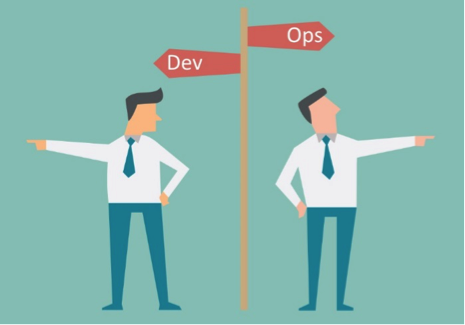
    pic01

    Dev vs. Ops

    Trying to collaborate with Dev and Ops can feel like trying to mix oil and vinegar if the goals of each department are not aligned. As a result, IT’s ability to deliver maximum business value is greatly reduced. To efficiently drive the business forward, Dev and Ops must get along.

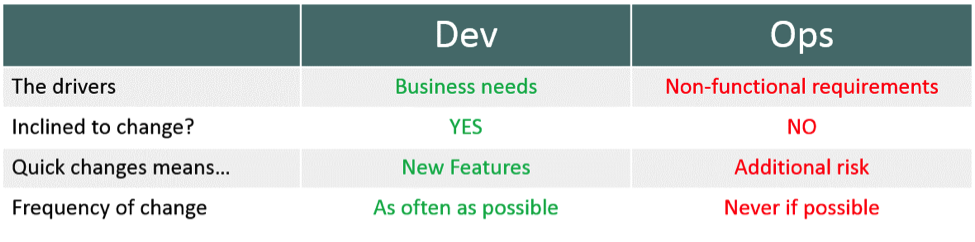
    Most often, the conflict between Dev and Ops is because the focus of one department is at odds with the focus of the other, which creates tension when it comes time to collaborate with one another. While Development is focused on continuously delivering new products and/or features to meet business needs, IT Operations strives to preserve the availability and the stability of IT services and the IT cost-efficiency.

    pic02

    DevOps Can’t Be Limited by Tools

    First, for a seamless collaboration to occur between Dev and Ops, both departments must use compatible tools. Mismatched toolsets create bottlenecks, misunderstanding and miscommunications, which result in so much wasted time that the implementation process ends up hurting the business.

    Next, processes must align; compatible toolsets with conflicting processes are useless. For example, it’s not unusual to find the service desk is using a ticketing system which is separate from the application development tools used to manage product defects and enhancements.

    Developers tend to rely on toolsets that are optimized for rapid development to provide fast feedback on code changes, to automate build creation and for application release deployments. In addition, the Dev team may be unaware of the runtime environment, which makes it difficult to adjust the code accordingly, whereas Operations uses solutions on the target runtime environment, where stability and performance outstrip flexibility requirements.

    Since the integration process is unique to each organization, it’s key to find tools that are the right fit for your new processes and employees. Just because a team uses the latest application release automation tools to consistently drive repeatable deployments of application into production, does not mean they have adopted DevOps.

    In fact, version control, application release automation and application auto-discovery of business transactions are all tools that help developers meet their objectives, but may not address the other portion of the equation: Operations.

    At the end of the day, one of the most important decisions is choosing the right leadership team across your business—from your C-level executive team to the heads of your Dev and Ops teams. The integration process for DevOps can be difficult; to merge two separate departments and processes together to drive collaboration, both the Dev and Ops team need leaders with clear vision of the bigger picture and what’s needed from everyone to drive the company’s forward.

    About the Author/Vincent Geffray

    vinnyVincent Geffray is Senior Director of Product Marketing at Everbridge with focus on IT Service Alerting & Communications Automation and IoT.
    He has more than 14 years of experience in the information technology business, designing, promoting and selling Enterprise IT Operations Management solutions, including Critical Communications, Application Performance Management, IT Process and Workload Automation. He also has international experience, as he started his career in Europe. Vincent holds a Master of Science (Mechanical Engineering and Computer Science) and executive certificates from the MIT – Sloan School of Management.

    Vincent’s LinkedIn: www.linkedin.com/in/vgeffray

    Vincent’s Twitter: @vgeffray

  • An Engineering Think Tank to Change the World

    An Engineering Think Tank to Change the World

    In his famous book “Mythical Man Month,” Fred Brooks says, “Techniques proven and routine in other engineering disciplines are considered radical innovations in software engineering.”

    While being very fond of engineering on the big scale, such as building millions of high-end and yet individually configured cars or double-deck aircraft or space ships, for example, I have always asked myself, why the most promising industry—software engineering—is so often not capable of doing engineering on that scale, too? Or, why are so many big enterprise IT projects painful in so many ways?

    With these questions that nobody seemed to be really interested in on my mind, one day I met some higher corporate management, who wondered why the IT department would be so reluctant to follow their lean transformation advice and instead talked about some agile and continuous integration thingy.

    From that moment, I understood that everything necessary to radically upgrade software engineering was already there! The  biggest problem was that we do not communicate enough—and furthermore, there is no holistic view on the complete IT value chain.

    By that I mean we need to create awareness for the value chain, starting with digitized formal models of business processes and written business requirements.

    That was how the following chart came to existence, and I still love it. Apparently, most awesome things happen on the borders of separated knowledge domains; you need just to talk to colleagues from departments you’d never talk to! What if we would mix knowledge from big industry, best available process improvement and quality assurance methodology, and apply all this to how we design, build and deliver software?pic1

    At first I thought I had found a new perspective on DevOps, but now I believe there could be more to it. Well, now the door to the radical innovation is open! Just imagine: What if we would apply the Internet of Things approach to our industry? Maybe we could close the loop of process improvement in software development and test, moving it to real time and running optimization not by ambiguous frameworks but by hard facts coming from virtual sensors, with unprecedented levels of transparency?

    This was how a couple of friends and I came to the idea of our foundation we call SIGSPL (Special Interest Group for Software Production Lines). This public organization is a non-profit think tank, built around three generic domains—Labor Automation, Analysis and Advanced Visualization—which we consider to be the three pillars of the upcoming convergent software engineering in the post DevOps era. pic3

    We are sure this sort of thing inevitably will happen, but our mission is to catalyze these processes to make radical innovation happen intentionally and faster, so we all can build information technology that rocks!

    We are a small team of six with some infrastructure, publications at our blog and a well-established yet growing knowledge base. We would like to reach out to more like-minded people to let this idea grow and change the world. Our plan is to foster further exchange and discussions between DevOps experts and other specialists “unexpected” in this context, such as production lines and supply chain management experts, Six Sigma Black Belts, 3D artists, hackers, venture capitalists and many, many others.

    Our proof that we are not ponding to nowhere is our magic triangle diagram, showing some well-known tools we map to the three generic domains, which are also of high interest for venture capital. Our question to the world is, What would appear in the middle of this triangle in, say, five years?

    pic4


    About the Author/Peter Muryshkin

    1Peter studied M.Sc. in Applied Computer Science and works in management consulting roles focusing on complex analysis and customer satisfaction, including IT Business Analyst and Change Manager. His current scientific research focus is digital transformation applied to the field of software engineering in large distributed organizations.


    LinkedIn: https://de.linkedin.com/in/muryshkin
    Team blog:
    http://sigspl.org/blog/

  • The Difference Between DevOps and Anarchy

    The Difference Between DevOps and Anarchy

    DevOps is about being more efficient. It’s about breaking down silos and removing traditional business obstacles that get in the way of just getting things done. It’s about enabling teams and individuals to collaborate more seamlessly.

    None of that, however, means that DevOps is about turning your IT into some sort of “Wild West” anarchy, where anyone and everyone can just push code to production. That would be insanity.

    One of the primary catalysts that started the DevOps movement was the frustration of developers trying to deal with an operational bottleneck. As developers evolved from the old-school Waterfall development method to the much faster-paced Agile, developers were able create better software more quickly. That simply resulted in a “hurry up and wait” scenario, though, because the Operations and IT infrastructure side of the house couldn’t keep up.

    Fast forward a bit and DevOps was born. Since its inception, however, there has been confusion about what exactly DevOps is or isn’t. That might be a function—at least in part—of the fact that there was no “inception” of DevOps; nobody developed a thing and then rolled it out to the world with the announcement, “This is DevOps.” DevOps was an evolution that occurred organically and out of necessity. It meant different things to different organizations and was implemented in ways that were largely subjective and often not called anything in particular. Organizations were simply struggling to address challenges and coming up with solutions that worked.

    Suppressing the Anarchy

    Although traditional IT operations were the roadblock that sparked the DevOps movement, DevOps doesn’t mean developers get to simply do their own thing. I’ve worked in the trenches as an IT admin at a dotcom startup—I’ve experienced firsthand the disastrous fallout of a developer pushing untested code onto a production server, and I’ve witnessed the wrath of executive leadership when that happens and the proverbial “stuff” hits the fan. It’s not pretty.

    No, DevOps does not mean eliminating Operations from the equation and functioning as an IT anarchy. You’ll note that DevOps is a very obvious portmanteau of developers and operations—implying that operations is half of the DevOps solution. DevOps is about developers working more closely and cooperatively with Operations—not developers bypassing IT Operations.

    There are two components to successful DevOps: culture and continuousness. First, organizations need to shed the traditional mindset of separate siloed teams and departments and let individuals focus on working together in whatever way makes the most sense for efficiency and effectiveness. Empowering individuals to do what’s necessary to collaborate and get things done is a big part of DevOps.

    The other component is continuousness. When developers adopted Agile and started producing code faster, they discovered that Operations was a bottleneck. When developers and Operations started working together more seamlessly, new bottlenecks were identified, and solutions were developed to automate as much of those tasks and processes as possible.

    The ultimate goal of DevOps is continuous delivery—to continuously deliver new solutions and features. Rather than a lawless void where developers just push code out onto production servers willy-nilly, organizations adopt continuous development, continuous testing, continuous deployment, continuous monitoring and other tools that enable their teams and those developing solutions to do so with as little friction as possible.

  • Will Microservices Make the ‘Ops’ in ‘DevOps’ Obsolete?

    Will Microservices Make the ‘Ops’ in ‘DevOps’ Obsolete?

    DevOps is a portmanteau of “developers” and “operations.” The concept of DevOps is about shifting IT culture in a way that enables developers and operations to work together more seamlessly. As more and more elements of DevOps become automated and leverage microservices such as container platforms, though, the operations side of that equation plays a diminished role.

    Microservices and Automating Ops

    What you’re left with essentially is developers with the processes and tools to automate the infrastructure back end. Technologies such as containers and services such as AWS Lambda simplify greatly the process of programmatically generating, modifying and maintaining the underlying infrastructure.

    AWS Lambda seems to be a step toward removing the Ops from DevOps. It creates a system for use and runs code via APIs. The instance is spun up, the code is run and the instance is spun back down. AWS Lambda can decrease provisioning time and enable developers to be even more efficient than working with traditional virtual machines in partnership with operations.

    Container technologies such as Docker allow applications to be broken down into very granular elements—many of which can be leveraged repeatedly. The ability to reuse containerized functions across different apps and to drive that process through APIs enable substantially greater automation.

    With each step forward in the evolution of DevOps, organizations find new bottlenecks or roadblocks, and then look for or develop solutions to address them. In this API-based, automated future, the APIs themselves become a challenge. Organizations have to find ways to effectively manage and update a rapidly growing library of APIs.

    Ops Will Live On

    If you work in operations, or aspire to someday work in operations, don’t fret: Operations still will exist on some level.

    The role played by operations will simply evolve. “Operations is not going away, but the job is definitely changing,” says Shannon Williams, VP of Sales and Marketing at Rancher Labs. “Automation and microservices are technologies that are enabling operations teams to spend less time ‘firefighting’ to maintain configurations, etc., and more time on bigger-picture issues that will help improve performance and resiliency, [and] help bring down costs for the business.”

    That’s a step in the right direction. In this future scenario—next-gen data center—those in operations will be able to invest their time in more valuable endeavors. They will be able to automate routine, mundane infrastructure tasks and focus on incorporating new technologies that enable the organization to derive greater value from DevOps and IT in general.

    “What is going away is the time spent arguing about what went wrong, not operations itself,” Williams suggests. “Given the additional time that automation will free up for Ops, they can start to find ways to improve their specific business unit. They can now be focusing on optimizing for performance, costs, etc.”

    Evolution of DevOps

    I have pointed out before that every roadblock in DevOps is actually an opportunity. As DevOps principles are applied in new areas, and new tools are developed to automate more tasks, it just accelerates everything to the next bottleneck. Rinse and repeat.

    To some extent, the infrastructure side of IT and DevOps are two of those roadblocks. That’s why tools are emerging to allow many components of infrastructure to be automated, freeing the operations team to focus its efforts on whatever the next roadblock is.

  • Boston DevOps Leader Pete Cheslock Talks Accomplishments

    Boston DevOps Leader Pete Cheslock Talks Accomplishments

    Pete Cheslock began his leadership role in DevOps in 2009 at cloud-based email archiving company Sonian. The company was founded by friends and former colleagues of his, who called Cheslock for help when they got funding for the Sonian venture. He filled in wherever they needed him—as did everyone else in the first few years of the 10- to 20-person startup.

    “As we grew, I saw a need for leadership for Sonian’s five-person operations team. I went to our VP of Engineering about the need for ownership of operations and said I’d love to be the one to give it a shot,” says Cheslock.

    Sonian was an early user of Amazon Web Services, deploying production code with customers by 2008. Sonian had been named an AWS Startup Challenge finalist, but despite its forward-thinking approach to the cloud and infrastructure as code, many of its processes were immature.

    “The application had scaling issues and we were spending an inordinate amount of time on reactive measures, dealing with application downtime and using short-term fixes for continuing issues when I took over,” says Cheslock. The young DevOps shop wasn’t able to make headway in innovative, future-looking projects.

    Smothering Fires, Forging Ahead

    Cheslock transitioned its team into two groups—a proactive group for innovative projects with a view to tomorrow, and a reactive team to get the worst recurring fires under control. Cheslock added himself to the latter group while remaining head of Operations. “While we attacked the hairiest issues, the proactive group worked on tooling that we needed in support of CD (continuous development) and CI (continuous integration), which made deployments much easier,” says Cheslock.

    It had been taking the Sonian team about a week to deploy software for all its customer environments. The process of deployment affected much of the software stack; it required testing as well as completing and checking off several items on a lengthy deployment list.

    Cheslock directed the proactive team to automate much of that checklist. Soon, they had reduced deployment time to 20 customer environments in just three hours, from five three-hour periods over five days.

    Weeding Out Costly Cloud Issues

    Cheslock and Sonian next began to work on cost issues. “We built an application to analyze our Amazon usage and correlate it with our Chef server, which was our single source of truth for all instances,” says Cheslock. The app revealed unused and abandoned servers that had been used for development and testing, which were still running and costing the company money.

    “We found occasional spot instances where we could pay fractions of the retail price for batch workloads to cover these. We leveraged the Amazon Marketplace to make better purchases of infrastructure to save money,” says Cheslock.

    Cheslock was able to shrink 800 instances on a single AWS cloud with a monthly spend of $450,000 down to 400 instances across four public cloud environments with a much smaller price tag of $200,000 a month. He accomplished this in three months, even as Sonian’s cloud operations team doubled.

    Now senior director of Operations and Support at Threat Stack, Cheslock is nurturing DevOps methodologies and seeing continued growth and success there.

    BosOps

    A few years ago, Cheslock and a few friends started a Boston-area technical operations meetup called BosOps, inviting people who managed operations at various companies to get together regularly to discuss their challenges and offer support.

    “As BosOps grew, we wanted to reach a broader audience and started pulling in more people in operations or DevOps roles to gather on a quarterly basis,” says Cheslock.

    Currently, BosOps has about 150 participants, who also participate in online chats using the free tier of Slack.com, a popular team-working messaging app among DevOps folk. “It’s great for people who are new to Boston,” says Cheslock.

    BosOps helps by quickly connecting a professional network for people who are new to the industry or to the area, enabling them to meet like-minded people and to secure a better foothold—perhaps even find a job they like more than their current position.