Tag: operations

  • Introducing DevOps Express!

    Introducing DevOps Express!

    The DevOps Institute (DOI) is proud to join industry leaders as a founding member of the DevOps Express. The DevOps Express is a bold initiative between tool providers and others to create a solutions-oriented approach that will make enterprise DevOps adoption easier using popular technologies spanning multiple solution components. Working together, DevOps Express members have committed to improving interoperability within the DevOps stack, and creating a framework for industry partners to develop reference architectures that will be better integrated with better support.

    The 14 founding members of DevOps Express include vendors spanning multiple solution categories in the software delivery process, as well as service organizations providing consulting, training and professional services:

    • CloudBees
    • Sonatype
    • Atlassian
    • BlazeMeter
    • CA Technologies
    • Chef
    • DevOps Institute (DOI)
    • GitHub
    • Infostretch
    • JFrog
    • Puppet
    • Sauce Labs
    • SOASTA
    • SonarSource

    DOI is honored to be a part of this important and innovative program. We believe this initiative represents the industry’s commitment to “walking the DevOps walk” by agreeing to collaborate, align and integrate for the betterment of the market. We are excited that major industry partners are unifying to give enterprises potential starting points for creating a DevOps stack, while also increasing quality and lowering risk. As knowledge, best practices, architectures and models emerge from the work of DevOps Express, DOI will ensure that these are available to the DevOps learning community and embedded into DOI courses, articles and future member benefits.

    The DevOps Express is leaving the station, and DOI is on board! Read the press release for more information about this historic initiative.

  • DevOpsDays and Diogenes: Thoughts from a First-Timer

    DevOpsDays and Diogenes: Thoughts from a First-Timer

    I went seeking honesty at a DevOps conference and met Diogenes.

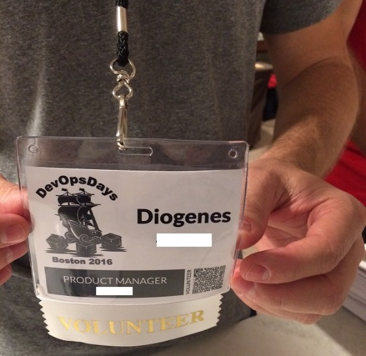
    Diogenes of Sinope was a controversial figure in ancient Athens who was known for walking around the famed ancient city—some say in the nude— during daytime with a lamp in his hand. He parried inquisitors who questioned his strange habit of using a lamp by day by insisting that he was looking for an honest man. At the recent DevOpsDays Boston, I actually met Diogenes. True story. See picture below. (Thankfully, he was wearing clothes.) But, as you probably guessed, this was not the man with the lamp, but rather one of the many conference organizers looking to help less-acquainted individuals find their way around the many meetings and speakers that filled the two-day conclave. Indeed, my Diogenes was instrumental in organizing the conversations and lectures that proved both honest and helpful.  Rather than a self-congratulatory summit, the two-day meeting was an honest conversation highlighting the advantages as well as many of the stresses befalling organizations that have adopted DevOps.

    DiogenesI found the most honest discussions were a floor up and a bit removed from the topics discussed in the main ballroom. These discussions were given the informal title of “Open Spaces” and were run in a typical un-conference format. These conversations were the real opportunities to learn about the stresses of implementing the modern portmanteau of DevOps.

    Tensions Between Dev and Ops: Why Can’t We All Get Along?

    One of the most interesting discussions in the Open Spaces looked at the dynamics between Devs and Ops. Like with any two groups that need to work together to accomplish larger organizational goals (think Sales and Marketing or Design and Engineering), there are inherent tensions that need to be overcome. The tensions between Dev and Ops are based on the different mission each pursues. Dev is striving to get software out the door as quickly as possible and push software updates forward. Ops is guided by the need to keep the ship as steady as possible, which often means limiting updates, as every update opens the door to potential bugs and deployment challenges. Starting with this premise of conflicting motivations, issues of trust and respect further complicate the relationship as each sees the other as trying to control the process.

    Yet, participants in this Open Spaces discussion were hopeful that tensions could be dissolved if management played an active role in creating cross-functional teams and managing workloads better. It was suggested that by essentially seeding Ops with Devs and vice versa, a greater community of understanding could be created. By promoting this cross-pollination, there would be greater understanding on both sides the implications (from the Dev side) of pushing software over the wall to Ops too quickly. From the Ops side, there would be greater understanding that 100 percent uptime is incompatible with dynamic product cycles that encourage innovation. A common and acceptable level of uptime needs to be agreed upon by both sides.

    For example, creating demos and code walk-throughs so both Dev and Ops can comment on potential problems and issues allows both Dev and Ops to see issues at the beginning rather than at the time of deployment.

    Blameless Post-Mortems in DevOps: Can They Exist?

    Another fascinating discussion in the Open Spaces focused on blameless post-mortems. Postmortems first and foremost suffer from an image problem. I believe it starts with the root word “mort” and it doesn’t get much better. To be clear, there was a lot of back and forth during this Open Space about the difference between a “postmortem” and a “retrospective.” Retrospectives are usually a weekly or bi-weekly event that bring to light the multiple root causes that are leading to defects or causing success through a review of RCA. In typical DevOps, one-week sprints are followed by a retrospective. Usually, the more data you can bring to a retrospective, the better. Post-mortems, on the other hand, result from an incendiary incident that was unexpected and undesired.

    Since post-mortems inevitably occur due to human oversight or lack of planning, there is no amount of thinking or planning that can prevent a crisis and thus prevent a post-mortem. As such, effective management will make post-mortems as painless as possible. The goal is to have blameless post-mortems balanced with accountability. According to one participant,

    “No one wants central casting to send in a screaming manager in a time of crisis who is only interested in assigning blame. That doesn’t help anything.”

    Importantly, you cannot fire yourself out of a post-mortem. Post-mortems are a necessary instrument to get at the root causes of issues. And while several different events can cause one issue, the post-mortem will at least begin to look at the process which caused the chaos. By not making the goal of post-mortems to find a scapegoat, the participants in one of these sessions can actually work on effective problem-solving.

    The goal of post-mortems needs to be effective problem-solving with the intent of committing the lessons learned to an actual document. It is not enough to let the lessons learned remain as an informal corpus that lives only in the heads of the engineers involved. Instead, documentation is required and it has to be in accessible place. Furthermore, it needs to be summarized and presented to management in either a lunch-and-learn or seminar so that the lessons learned then become actionable.

    Furthermore—and this was perhaps the most interesting part of the discussion on post-mortems—effective post-mortems are about getting Dev and Ops out of silos. There is no automation tool that will make Dev and Ops work together. Dev and Ops cannot just be about finding another automation tool. Instead, management needs to step in to help the process. Management needs to take engineers out of their silos and get them to work together if post-mortems are going to be really effective.

    Are You Feeling the Burnout Yet?

    After so many hours of interesting discussion in the DevOpsDays Open Spaces, I too was beginning to tire a bit. So perhaps it was well-planned to move on to a discussion on avoiding burnout.

    The artifacts of burnout are seen throughout the DevOps world as engineers constantly change jobs. This might be the phenomena of the “shiny orb,” where engineers always feel that there is a better, higher-paying job on the other side of the fence. However, as much as that might be true, it is equally the case that engineers are trying to escape burnout.

    According to the kanban methodology, which is woven into DevOps, you only pick up work as you can process it. Yet, DevOps practitioners often pick up work because they want to feel like they are team players or invincible or because they underestimate the work’s demands. They also fear the “imposter syndrome,” whereby colleagues seem less genuine if they don’t accept a piece of work offered to them. Inevitably, because the work is more than the engineer can handle, he or she becomes overwhelmed and is too proud to reach out for help.

    In a well-managed workplace, admitting overwork would not be an admission of failure. Instead, there would be a supportive culture to help the engineer or better mentoring on how to get through a challenging issue. “One-on-ones,” where the manager and individual contributor sit down together, would effectively solve the issue.

    But given the idiosyncrasies of workplaces, good management is not a given and engineers are often left to find their own coping techniques to help avoid burnout. The participants in this particular Open Space came up with the following gems:

    • Brain dumping. Empty your brain by putting all the thoughts and tasks that remain on your list and in your brain at the end of the day onto post-it notes. This helps avoid burnout because you are able to clear your brain prior to leaving work.
    • Create a Slack-based or bullet journal as a way to write yourself notes and create a list of priorities.
    • Follow the Pomodoro technique. Take a five-minute break every 25 minutes and a 15-minute break every two hours to better monitor how much time you are devoting to an issue and also to ensure you don’t forget to get a bit of movement into your day.
    • Learn how to say ‘no’ to requests. It’s a very simple word, but uttering ‘no’ once in a while will ensure that you mark boundaries and don’t take on more responsibility than you can handle.
    • Enlist management to make them aware of time you are spending beyond the normal working day and try to figure out ways to better manage the schedule and avoid burnout.

    The participants of this Open Space left with some new techniques to consider in avoiding engineer burnout. Hopefully, they will be implemented to practical advantage.

    Conclusion

    My first DevOpsDays conference was a true eye-opener.  I was lucky to get my education among such thoughtful and well-spoken individuals. I look forward to future opportunities to learn at the foot of Diogenes.

    About the Author / Orlee Berlove

    orlee_berloveOrlee Berlove is the Marketing director at OnPage Corporation located in Waltham, Massachusetts. OnPage is a cloud base incident alert and management system that elevates notifications so they continue to “ALERT-UNTIL-READ” so it’s not confused with email, SMS or phone calls. Incidents can be programmed to arrive to the person On-Call and can be escalated if they are not attended to promptly. Follow OnPage on Twitter and LinkedIn.

  • DevOps: Achieving Process Without Too Much ‘Process’

    DevOps: Achieving Process Without Too Much ‘Process’

    While there’s no fundamental conflict between IT service management (ITSM) and DevOps, DevOps does bring new and different techniques for getting work done and interacting with the rest of the organization.

    ITSM people who are used to frameworks such as ITIL and COBIT tend to regard the IT department as a “service provider” and the rest of the organization as “the customer.” But DevOps has come from web-scale organizations “where IT is the business,” and that means the prevailing view is more like the Toyota Production System mentality, wherein the aim is to move things along a production line with maximum speed and maximum quality, says Matt Hooper, product evangelist at LANDESK.

    DevOps thus has already broken down some of the barriers between “IT” and “business”—practitioners realize they have to determine what the business needs, and then provide it. But Agile or Agile-like practices also are part of this approach, so there’s lots of experimentation, learning and redeployment in “lots of tiny little steps,” and, consequently, there’s not much risk of going very far wrong with any of them.

    An issue is that this conflicts with ITSM’s view of life cycles, partly because the whole idea is to merge development and operations—for instance, by automatically spinning up software-defined infrastructure as needed.

    What’s needed, Hooper suggests, is “service management with a digital mindset” rather than ITIL’s “human mindset.” It’s all about feedback, he says, but for ITSM and DevOps to sit comfortably together there must be a realization that feedback can come from humans or systems.

    And even though the command and control mindset tried to avoid failures, systems still failed. So a better approach is to accept that “stuff breaks” and make small changes at a time, respond to issues as they arise and keep learning. In the longer term, this will lead to more durable systems, he says.

    It’s a myth that you’ll be able to stop bad things happening, because people and systems aren’t perfect. DevOps, in contrast, accepts that things will go wrong but aims to respond quickly—for example, by keeping developers close to operations so they can see problems occurring, realize what mistakes they made, and put them right.

    “That’s challenging to a traditional ITSM person,” Hooper says. It is important to accept that failure is an option, even though massive failure isn’t.

    (Before you ask, he accepts that certain systems need to be extremely reliable. But others provide room for a somewhat experimental approach, in which case DevOps helps avoid overengineering.)

    While some ITIL practitioners see value in DevOps’ continuous deployment approach, their premise is still that IT is a “service provider” rather than a “partner,” but the business side of the organization wants the latter. You don’t get home from a business trip and tell your spouse you were 99.98 percent faithful while you were away, he observes, and that sort of SLA-based thinking works against becoming a learning organization, achieving good demand management and so on.

    ITIL v2 served a good purpose, but ITIL v3 arrived too late, Hooper suggests. The growing influence of the Lean movement means systems are going through rapid change cycles, and too much “process” leads to waste and lower performance. DevOps and software-defined technologies provide ways to better handle rapid change—infrastructure can be spun up and back down in seconds, providing opportunities for self-healing systems with better scalability and reliability.

    Where ITIL focuses on meetings and human processes, DevOps prefers to use analytics to determine the right time to release and then whether then release was successful. “The feedback loop is an essential part of DevOps strategy,” just as it is with ITIL, but ITIL has a more human-centric idea of feedback.

    “ITSMers tend to hide in the back closet” waiting for the business to tell them what to do, but DevOps takes a more active approach, he suggests.

  • Putting Ops Back in DevOps

    Putting Ops Back in DevOps

    What Agile means to your typical operations staff member is, “More junk coming faster that I will get blamed for when it breaks.” There always is tension between development and operations when something goes south. Developers are sure the code worked on their machine; therefore, if it does not work in some other environment, operations must have changed something that made it break. Operations sees the same code perform differently on the same machine with the same config, which means if something broke, the most recent change must have caused it … i.e. the code did it. The finger-pointing squabbles are epic (no pun intended). So how do we get Ops folks interested in DevOps without promising them only a quantum order of magnitude more problems—and delivered faster?

    The problem is exacerbated when the topic of DevOps comes up, as it is most often a developer doing the talking. And the topics under conversation are things every developer would have substantial interest in and pretty much nothing that would interest the operations part of the equation. Many Ops folks feel as though they have been dragged into this DevOps phenomenon by osmosis, without their consent, and now they are supposed to be reaping huge benefits from it (by magic, as near as anyone can tell). Developers working faster is traditionally not something Ops folks look forward to; rather, it may be their worst nightmare. So, if the advocates of DevOps all tend to be developers, how do we get operations folks to become our evangelists as well?

    QA Impacts on Evangelism

    It begins with quality—not the ethereal concept of quality, but rather the specific responsibility for who owns it. Finger-pointing be gone; developers now own QA. If the software development lifecycle (SDLC) environment is broken, developers own it. Ops can sit back, toast marshmallows and enjoy the show. Developers should be including whatever configuration file changes their application needs as part of the deployable package. So nothing is done manually anymore. This means no one could forget something, as machines do not forget; they do what we tell them. If by chance, some random operations staffer decides to doink with a config variable, the deployment software should simply overwrite the manual change with what is in the deployable package created by the developer. Even malicious changes can be overwritten, so now, all change is included in the development class environment in the one and only deployable package. That is the only package that moves forward.

    If developers own the QA, there is now a shift in the force: The operations team has a new role, one of coach and adviser, instead of doer. The software now is the doer, the developers are the packager and the operations staff are the witnesses of how it works. If it breaks, we all know who must fix it (and who is to blame). But once blame has been permanently affixed, something else changes, namely the culture. Now that the operations team does not take the blame, it remains interested in seeing its operations run without error. This allows operations to take an active “helping” interest in getting things fixed faster. It does not really matter who is to blame, once that argument has been settled; now it only matters if they can make something work. Harmony between factions begins to emerge.

    Scalability Impacts on Evangelism

    It continues with scale. Self-service is the nirvana of your average operations staffer. If the responsibility for provisioning can be moved into a push-button self-serve automation, nirvana will have been achieved. Imagine the offload of repetitious work tasks that consume the life of your average operations staffer. Instead of setting up (and taking down) environment after environment of one class or another for one application or another, requesters can all do it themselves with the push of a button. Even the accounting or financial impact is something the accounting team can guide the user on; operations does not have to worry about the cost of its operations anymore (or, at least, worry less). If too many environments are being provisioned, the accounting team has the power to change the rules and keep it from happening automatically without operations having to be the bad guy.

    At this point, Ops can resume a focus on something it tends to enjoy more: monitoring. Ops staffers enjoy being able to provide real-time reporting on where things stand at any point in time. It is even more rewarding to provide more meaningful information such as who is using this application, what users are doing with it and when are they performing that activity. To monitor that kind of information, operations must partner with developers at the outset of a project to determine what kind of application logs are needed later for monitoring. Without the daily barrage of mundane provisioning tasks, an operations engineer is free to focus on more rewarding (translate: higher skill-level) tasks. The days of changing tapes for the backup may have reached their end (or pick your similar set of mundane tasks which DevOps automation can fully eliminate).

    And Speaking of Monitoring

    It merges into the future. How do you create an operations staffer as a DevOps evangelist? Start by exploring potential that only DevOps can enable. All those nagging alerts that are created when an environment goes down while a deployment is made … all of that could be turned off by the DevOps automation, then turned back on when the deployment is completed. Again, it all would be machine-driven, with no human mistakes anymore, ever. This will begin to cut down “noise” in monitoring/alerting systems into only useful information. However, integrating monitoring systems into the normal DevOps continuum extends beyond just an on- and off-switch.

    Forward-thinking organizations begin to consider testing and monitoring as two parts of the same evaluation discipline. When a test is needed and when a monitoring characteristic is needed now can be determined in total rather than just in a development capacity or operations capacity. A holistic view of what can and what should be evaluated about an application, and how that will be achieved, brings the operations team to the table with the development and testing teams to plot holistic solutions that will live on beyond the development project timelines. Examining monitoring relative to version-controlled artifacts allows for organizational constructs within the monitoring discipline that never were possible before DevOps enabled them.

    The Masters of Hardware Abstraction

    Containers, or similar types of technologies, abstract an application from the hardware details it runs on top of. Technology such as this is a trend in DevOps that greatly simplifies the world of hardware from your average application developer. So who will retain the knowledge about the jungle that lives and breathes underneath? Ops has an extended role in understanding what lives underneath the abstraction layer that lives on top. Over time, only Ops will understand these particulars. They will become the only in-house experts about which cloud provider to use, which sets of physical hardware performs best and under what conditions.

    It is this kind on unique expertise that makes an operations engineer extremely valuable (translate: pricey). It is the kind of knowledge careers are made upon. It is ageism-neutral. Older employees do this today, and they will continue doing this in the future; the only difference will be fewer and fewer people will know how it is done. If the domain of application development is the province of our youth, then the domain of hardware abstraction is easily the province of our more experienced employees. These realities create personal value for our operations teams, and they are only possible in a post-DevOps embrace.

    Impacts to the Bottom Line

    The adoption of DevOps by the Ops portion of the equation is critical to overall success. Passive-aggressive resistance by operations staffers can delay or destroy altogether the value of DevOps. Overcoming this is a first step. But creating operations evangelists goes an order of magnitude further: With active operations staffers becoming internal DevOps evangelists, the entire operations team can begin to look forward at what DevOps will ultimately enable for them. The value they will carry back into development efforts becomes substantial and the entire company benefits. Careers can emerge that were not possible before it—and, just as importantly, so can profits.

    To continue the conversation, feel free to contact me.

  • Let’s Talk About Ops: An ITSM Crowd Special

    Let’s Talk About Ops: An ITSM Crowd Special

    The ITSM Crowd is a regular hangout hosted by DevOps training provider ITSM Zone that covers many different IT and management topics. On Aug. 11, host Claire Agutter was joined by IT Skeptic Rob England and James Gander from Gander Service Management to take a deeper dive into the impact that DevOps is having on operational roles.

    Gander comes from an operational background and wanted to discuss how the role of ops is changing, and England works with many clients who are evolving to work in more agile ways, embracing DevOps principles.

    DevOps Needs Ops

    All agreed that DevOps doesn’t mean No-Ops.  The traditional “build” and “run” phases are no longer clearly demarcated. Dev will work with Ops to improve and fix live services, and Ops will provide Dev with feedback that will help them to improve.

    Ops also needs to embrace the role of “toolsmith” or “toolmaker.” It can support Dev by creating environments that make it easy for Dev to do its job. This could include providing fast, automated access to virtual servers or providing input on monitoring and event management.

    Elements of Ops such as the service desk are essential and will never disappear. Customers always will need to be able to contact IT, so this part of the operational role will be present in some form, perhaps moving toward a greater focus on self-service.

    Ops Processes Won’t Disappear

    Traditional operations processes also still have a place. Change management, for example, is still essential, but it needs to “get out of the way” and enable change to happen, rather than acting as a barrier.

    Ops staff need to treat DevOps as an opportunity to learn and improve, not as something to be resisted. There are many great blogs to get started with, and this is an exciting time to be working in IT.

    You can view the video here, and I’d love to get your feedback and comments on how you think DevOps is changing the role of operations.


  • The ‘Continuous’ Illusion

    The ‘Continuous’ Illusion

    Continuous delivery is an illusion. That doesn’t make it insubstantial—illusions can have a tremendous impact. Like the first motion picture: the locomotive felt so real to first audiences that they fell from their chairs, screaming. But of course, the locomotive was an illusion, merely rushing past on screen.

    A good magician, like a good inventor, will tell you that the secret to a powerful illusion is hard work on top of a good idea. Indeed, good magicians and inspired technologists have a lot in common. Each is always on the hunt for the next big insight, the transformative angle, building on existing industry techniques to create something even greater. But each knows the secret to truly wowing their audience, whether for a one-night-only show, or an ongoing relationship. What really gets the job done is the vast, complicated, hard-won machinery ticking away behind the scenes.

    Today’s No. 1 magic trick for making great applications, a directive now pervasive across every industry, is continuous delivery. Right now, continuous delivery provides that wow. It takes app updates from a customer stumbling block to a seamless benefit. It takes feature delivery from “maybe in a year” to “is tomorrow soon enough?” It allows Dev teams to wave their magic wands and transform the impossible into the effortless.

    And, of course, continuous delivery is an illusion. Remember that movie locomotive, leaping out of the screen? Every instant of its motion was its own little frame of celluloid. And the true magic was the process that bound each and every frame together, delivering them onto the screen with perfect timing.

    Continuous delivery is the very same sort of illusion. The steady stream of new features, new capabilities and bug fixes must be created one by one by a vast army of talented developers—not unlike the thousands of talented stencilers who first brought color to motion pictures. And the true heart of the process is the automated systems that support this army, and which ensure the coordinated delivery of its products to the end user.

    The heart of continuous delivery is the machinery of automated testing and deployment. The approach behind continuous delivery encourages teams to produce software in short cycles, ensuring that the software can be reliably released at any time. For these releases to be reliable, continuous testing is integrated into the software delivery pipeline, for immediate feedback on any bugs an update would generate. Then, when a proposed change has passed the automated tests, it is deployed to production automatically. This software development life cycle (SDLC) allows companies to achieve the business goal of truly responsive development. The team sees an opportunity, confirms the solution and then delivers that solution to customers extremely rapidly.

    Each stage of continuous delivery—develop, test, deploy—has its own technical challenges, but the testing step in particular poses a unique bottleneck.

    In the development stage, developers primarily require code. Code is relatively lightweight, and can be managed through industry-standard tools such as Github. Developers need their laptops, but in general code management poses a limited operations support challenge.

    The deployment stage can be more challenging for ops. The newest version of the code must be deployed to a wide population of final platforms, which may vary in hardware, software, location, permissions and so on. However, the target systems are at least those in ordinary use. The server the new page runs on or the smartphone that installs the application update are pre-existing systems, and they are managed by their users. So Ops teams are not required to support specialized hardware to deploy. Furthermore, in the past few years a number of innovative technologies, such as Ansible and Docker, have emerged to simplify this process further.

    Testing, on the other hand, combines the challenges of both of these stages. Continuous testing requires dedicated resources for developers and QA. But these resources are full-scale application environments, including not just code but data, operating systems and even appropriate hardware. And because best practices encourage developers to write new tests for all new code, the amount of regression testing required for every code change can only grow. That means that testing must grow ever more parallel, or suffer increasing delays—and any delay in testing can undermine overall continuous delivery.

    To preserve the Continuous Illusion, a development team needs on-demand access to scalable testing environments, including their data. Data in particular is often overlooked in test environment creation, but it must be delivered to every test instance. That means test data management (TDM) is an inescapable part of any successful continuous strategy.

    TDM is relatively self-explanatory: it refers to the process of creating, managing and delivering production (or production-like) data to non-production data environments. Every organization does some TDM, though many do not consider it a separate practice. But to achieve the sort of seamless efficiency that can support the Continuous Illusion, teams must adopt a modern TDM practice.

    Legacy TDM relies on multi-stage, manual delivery chains. Developers and testers file tickets, and then they wait. Storage admins, DBAs, backup admins, security personnel and other staff each have to spend a huge portion of their time servicing the ever-growing stream of tickets, handing off environment creation from one function to another. Meanwhile, developers and testers are left in the lurch, and continuous delivery grinds to a halt.

    Once, this process might have been unfortunate but necessary, imposed by technological restrictions. But modern solutions can tackle these challenges and overcome them. Too often, teams with poor TDM have simply neglected to implement the solutions that they need.

    The most effective TDM practices will use a data management solution on par with other continuous delivery pipeline tools. The TDM solution will be able to stand up data environments in minutes and at massively parallel scale. It will rely on production data and automatic security, rather than synthetic data generation or data subsets (both of which requires substantial upfront planning and cannot hit the full suite of edge cases). It will integrate readily with existing continuous delivery workflow tools, allowing data to be automatically provided whenever a test job runs.

    There are some solutions in the market today that meet these criteria. Adopting one can represent your opportunity to tighten test cycles and deliver code faster—regardless of how fast your software timelines are today.

    To deliver the Continuous Illusion, every component of the continuous delivery pipeline must be operating at peak efficiency. A powerful TDM solution is a key requirement for allowing your customers to sit back, relax, and enjoy the magic of your product.

    About the Author / Louis Evans

    Louis Evans HeadshotLouis Evans is a DevOps evangelist with Delphix. He’s excited about the potential for superior TDM to enhance overall software quality. He is a huge Alan Turing fan, and partial to a well-placed semicolon.

  • Why Your Organization Needs DevOps

    Why Your Organization Needs DevOps

    The recently released fifth annual “State of DevOps Report” by Puppet has once again brought with it fresh insights into what drives high-performance teams. The report, which comes at a time when DevOps has ceased to be a buzzword, provides proof of why more and more businesses across the world are adopting DevOps to improve their organization’s performance, revenues and profitability. DevOps has truly come of age and this year’s “State of DevOps Report” clears any doubts fence-sitters may have about the effectiveness of the DevOps approach.

    The 2016 report reasserts that unparalleled IT and organizational performance is a result of a team effort spanning development and operations. The report also highlights the importance of improving the entire product life cycle—from initial product planning, to quality and security assurance, to customer feedback—to speed up delivery while improving quality, security and business outcomes. You can read the full report here.

    In today’s competitive business environment, DevOps has emerged as a vital solution that helps organizations meet ever-growing industry demands. The “2016 State of DevOps Report” helps us understand how the practices associated with DevOps affect IT performance and organizational performance. Let us examine the findings of the report to ascertain how DevOps can benefit your organization.

    Why Does Your Organization Need DevOps?

    The “2016 State of DevOps Report” makes it plain and simple that companies that incorporate DevOps practices get more done. According to the report, high-performing IT organizations deploy 200 times more frequently than low performers, with 2,555 times faster lead times. They have 24 times faster recovery times and three times lower change failure rates. High-performing IT teams spend 50 percent less time remediating security issues and they spend 22 percent less time on unplanned work and rework, the report states.

    Performance

    If we boil down the report findings into actual benefits of adopting DevOps, we could say that DevOps enables continuous software delivery with less complex problems to fix and faster resolution of problems. This essentially means that you can deploy faster and more effectively in more stable operating environments and add value rather than just fixing or maintaining.

    DevOps can revolutionize the performance levels of organizations and allow them to deploy at a rate never seen before. It has certainly enabled organizations such as Etsy, Netflix, Facebook, Amazon, Twitter and Google deploy hundreds and thousands of code per day while delivering world-class stability, reliability and security. You can find out how different organizations have implemented DevOps to their benefit in this YouTube video.

    Security

    Higher performance is not the only payoff in the DevOps culture. Organizations that adopt DevOps practices are known to have better information security. The “2016 State of DevOps Report” clearly states that organizations that integrate information security objectives into daily work spend 50 percent less time remediating security issues than low performers. This has a positive impact on IT performance and security outcomes.

    Any organization, irrespective of size, can employ DevOps to achieve high performance levels and meet business goals while cutting down on costs related to fixes and remediation security issues.

    How DevOps Transforms Teams

    Consider this scenario: In an organization that does not apply the DevOps methodology, the development team writes code and develops a product, which is then sent to the testing team that verifies if the code meets the requirements. The operations team steps in to run the product only after this process is complete. The DevOps philosophy was created to break the silos that teams operate in and effect better collaboration and performance.

    The culture shift DevOps brings about in organizations is substantial, and since culture is a key factor responsible for a company’s performance, application of the DevOps philosophy provides measurable and non-measurable results. A few of them are:

    Employee Engagement

    DevOps is neither a method nor a tool, it’s a culture! In organizations that observe the DevOps culture, the development and operations teams work outside silos, releasing products faster, thereby increasing operational efficiency. This is made possible by the operations team giving the developers constant feedback about the code and troubleshooting problems with the user experience in mind. This continuous learning and delivery practice allows cross-functional teams collaborate as one team with one goal, thus facilitating higher performance levels. The improved organizational culture and enhanced employee engagement can help organizations not only in retaining great talent but also in recruitment.

    Organizational Success

    The “2016 State of DevOps Report” effectively explores the relationship between employee engagement and organizational success and goes on to show that there is a strong correlation between these two factors. The report states that employees in high-performing organizations are more than twice as likely to recommend their organization to a friend as a great place to work.

    Organizations can greatly benefit from adopting the DevOps culture. The “2016 State of DevOps Report” shows that high-performing organizations are widening their lead against lower-performing organizations. This can be attributed to the increased productivity and creativity of highly engaged employees that helps them provide better experiences to customers.

    Organizations can achieve great business results by reinvesting the human time, creativity and energy saved by reducing rework and downtime through DevOps. Herein lies the ROI of DevOps—the competitive advantage that organizations get by investing in a philosophy that positively affects bottom-line results!

    About the Author/ Pallavi Poojary

    Pallavi Poojary1Pallavi Poojaryis a writer with Edureka, an online learning company with more than 250,000 learners spread across the globe. She writes on hot technologies and skills that are in demand today, including DevOps, Big Data and Project Management, to name a few. She is a believer in transformation of careers through learning

  • REP SPOTLIGHT: Glenfis AG

    REP SPOTLIGHT: Glenfis AG

    1. Tell us a little about your organization: Based in Zurich, we offer consulting and training services since almost 20 years. We see ourselves as an independent enabler for the digital transformation, helping our customers getting fit for the digital age. To this end, we use the ‘Glenfis Principle’ – a holistic approach that, alongside theoretical knowledge, attaches particular importance to the mediation of practical skills (competence), which can be used to successfully and lastingly deploy this knowledge in the company or organisation (Implementation).
    2. What other topics do you teach or consult on? Topics include:
      – Cloud & Sourcing
      – Lean, Agile & DevOps
      – Value Chain Service Models
      – Training and Awareness (Cloud, ISO, ITIL, Cobit, Security, Agile, DevOps)
      – Security & Cyber Resilience
      – Change Enablement
    3. What type of interest in DevOps are you seeing in your region? As everywhere the interest of DevOps is rapidly growing, in Switzerland this in not different. For many it’s really to understand in a first step what DevOps is about and why it is relevant for them. In Switzerland we deal a lot with financial institutes with a high level of legacy and regulations, the question is often how to apply DevOps practices in such an environment.
    4. How do you think that DevOps contributes to the business’ value stream? DevOps is all about getting faster and better and this is how it positively influences the value stream. And DevOps does it in a holistic way by looking at the value stream end-to-end, from idealization to $$$.
    5. What topic area in DevOps excites you the most? Dev’s and Ops’ finally talking to each other!
    6. Why should enterprises and individuals consider formal DevOps Training? Before starting any change initiative, it is paramount that everybody gets a common understanding. This is especially true for DevOps, as it includes a wide range of Agile, Lean and ITSM practices. A training or special awareness sessions definitely facilitates this.
  • DevOps Matchmaking: APM + CI = A Perfect Marriage

    DevOps Matchmaking: APM + CI = A Perfect Marriage

    As anyone who has ever been set up on blind dates by friends can attest, finding the right match in today’s world is a tricky feat.

    There’s a lot of evidence suggesting that the frantic pace of life makes such matchmaking more difficult than ever. That said, when the right set of complimentary traits exist and there’s a willingness to find common ground, things can work out.

    Spike Jonzian-notions of artificial intelligence aside, certain technological partnerships are increasingly being perceived as “a perfect marriage” within the context of DevOps automation.

    Register today for the upcoming webcast: “Using APM to Turbocharge Continuous Integration”

    These technological matrimonies closely support the underlying tenets of DevOps methodology—collaboration, experimentation and increased velocity. In fact, it’s easy to wonder why no one ever conjoined them before. But we were using traditional waterfall development and operations and so couldn’t conceive of such a thing. On the other hand, emerging availability of tooling supporting new integrated workflows represents a significant catalyst.

    Finding the Perfect Fit

    One such DevOps confederation getting a lot of attention is the matchmaking of continuous integration (CI) and application performance management (APM) technologies. Tying together these once-disparate systems makes a lot of sense, despite the fact that few tools would seemingly appeal to more (traditionally) polarized constituencies.

    Continuous integration has been a staple of the development community for many years. It emerged as teams evolved the practice of long build times into more frequent check-ins to deliver code and look for potential errors more quickly. Today, with the rise of CI tools such as the Cloudbees Jenkins platform, some development teams are touting tens of thousands of builds per day.

    On the other end of the spectrum, squarely on the turf of IT operations, APM has been evolving rapidly over the past few years as organizations have sought to improve use experience and applications reliability via dedicated monitoring. Enabling this ability to identify and address emerging issues has resulted in APM becoming the fastest-growing segment in the IT ops management market, according to Gartner.

    DevOps matchmaking factors in when you bring these tools together to create an automated workflow that spans their respective use cases. A cross-functional team can leverage APM-level monitoring and KPIs within the domain of CI and testing to identify potential performance obstacles introduced in new code. Doing so then rather than waiting to respond later in the applications life cycle benefits everyone.

    Reaping the Benefits

    For example, say an e-commerce applications developer has implemented a new inventory search functionality—something considered a key differentiator by business management. The developer knows this feature could rely heavily on some back-end database system and wants to ensure it’s tested properly, even as the code is being introduced.

    Integrating APM and CI allows the entire team to monitor the process and test various conditions related to the update, tracking multiple builds and looking out for related performance issues. Such integration also allows for centralized tracking of other key attributes such as build number, status and build date, to further ease management.

    Most importantly, by tying these two critical aspects of the applications delivery life cycle together, the collaboration and feedback loops required to truly embrace DevOps methodology become ever more valuable as these core Dev and Ops functions become intrinsically linked.

    If this type of DevOps advancement gets your heart pumping, you’re not alone. Later this month, we’ll host a webcast here on devopsy.kinsta.cloud featuring experts from CA Technologies and Cloudbees. They’ll be discussing the benefits of matchmaking with APM + CI integration. They’ll also detail real-world benefits organizations leveraging integration of our respective technologies (CA APM and Cloudbees Jenkins) enjoy.

    We obviously feel that this is a DevOps tooling marriage that will mature, change and stand the test of time. We’d love to garner your questions and feedback on the topic.

    Which is all good, because thankfully there’s no such thing as Tinder for DevOps … yet.

  • ‘DevOps is a Lifestyle, Not a Title’

    ‘DevOps is a Lifestyle, Not a Title’

    “DevOps is a lifestyle, not a title.” This is a quote from Ron Melanson, of Amazon, and I hope he won’t mind me sharing it here. It struck a chord with me, and this blog explains why.

    I have spoken about DevOps on a few occasions. Some audiences are not from a development background, so I explain the “why” of DevOps to them to help set context.

    Chances are you are past the “why” stage and into the “how” stage. Even so, it is always useful to think about the “why” part, or even to revisit it—it is important to make sure you really are getting what you want from the DevOps journey.

    In my DevOps presentations I vary between the transactional aspects of the “why” and the emotive aspects of the “why.” The transactional aspects are what the tooling can help with, and so that matters to a degree. However, since emotions influence us the most, especially from a lifestyle perspective, it is the emotional aspects that I want to focus on here.

    The picture below captures, for me, the essence of why people care about DevOps: they want to be happy at work, and to sleep soundly at night. If you are not where you want to be with respect to those things, then you need to change the way you lead your life.

    The DevOps lifestyle is a virtuous cycle
    The DevOps lifestyle is a virtuous cycle

    I highlight the “change the way you lead your life” aspect to illustrate contrasts among the differing approaches to DevOps that I have witnessed.

    Now that DevOps has grabbed the popular imagination, it is quite common to see job advertisements for people to be part of a DevOps team.

    One ex-colleague of mine, hired to lead a DevOps team, expressed some concern about whether that notion actually made sense. He saw his team off in a corner focused on tooling and processes, i.e. the transactional, while everyone else in the organization seemed to be doing what they always did.

    When his team suggested a change to a process, or tried to explain how a tool could be adopted, they often were at a disadvantage. The people in development and operations, whose working practices would be affected, had not actually bought into the whole idea in practice, and/or simply did not have the bandwidth to think about it.

    Consequently, with little or no time to pay attention to what the DevOps team were doing, there was no engagement from the people for whose supposed benefit the DevOps team was laboring. Thus, there was no driver for changes in behavior. They were all missing the emotive “why” part.

    The challenge my colleague faced is common. Hiring someone to do DevOps does allow you to focus on getting people with the skills and experience for the transactional and technical aspects of DevOps. That is necessary, but it is far from sufficient.

    If the benefits are to accrue to the people working in development and operations—and, indeed, the wider company and business they serve—then it is those people who have to own the idea, top to bottom.

    Owning the idea means rethinking what you are doing, and why—in other words, changing your lifestyle. At least at work, anyway.