Tag: generative AI

  • 4 Things to Consider When Integrating Generative AI

    4 Things to Consider When Integrating Generative AI

    Generative AI has emerged as one of the most influential innovations of the past two decades. ChatGPT gained 100 million users in record time, and new generative AI-powered point solutions emerge every day.

    Considering the current state of VC funding, the surge of investment dollars in AI companies is remarkable. Microsoft’s $13 billion investment in OpenAI and AWS’ $4 billion investment in Anthropic (who themselves just raised a $850 million Series C round) demonstrate the tremendous excitement around Generative AI and how it will shape the future of tech.

    As newer companies like Adept and Cohere are emerging, existing SaaS companies are integrating generative AI capabilities into their products and services. However, in the race to join the hype, many companies are building first and strategizing later. Before diving headfirst into building a generative AI solution, companies should carefully consider a few crucial factors, including model selection, usage tracking, monetization and customer transparency.

    1. AI Model Selection: To Build or to Buy?

    Companies must first consider whether to build a generative AI model from scratch, or whether to use a pre-existing model from one of the major AI vendors. This decision depends on the level of customization and control desired, as well as the resources and expertise available.

    Building a from-scratch model is likely infeasible due to the inaccessibility of the necessary hardware. The GPUs needed for cutting-edge model training and inference are currently only built by NVIDIA, and there is stiff competition and long lead times for any company looking to acquire the product. What’s more, large cloud and AI companies like OpenAI, Google, Meta and Tesla already have built systems with up to 100,000 of these chips. New companies looking to enter the scene would face a steep climb to assemble the infrastructure needed to even begin to compete with the current classes of models.

    Small or new companies do not have the funding or time to invest in building their own infrastructure or generative AI models, so a key business decision is to select the best vendor and model for the use case. While ChatGPT is the most well-known, there are other specialized models that can be better suited for certain use cases. For example, OpenAI’s DALL-E is built for image generation, while Anthropic’s Claude 2 is built to perform better with specialized tasks such as legal and math and to handle long-form inputs.

    Regardless of the AI vendor you choose, you will be charged based on your usage with them, which, by extension, is your customers’ usage. Tracking this usage is critical to your generative AI solution becoming profitable.

    2. Metering AI Service Usage: The Key to Success

    Implementing usage metering for generative AI services is crucial at both the individual user level and at the global or system-wide level. This is because usage tracking is valuable to all business functions and is a critical element of any modern PLG strategy.

    For example, customer-facing teams can leverage usage data to proactively track account health and to contextually recommend new solutions and approaches. Usage history provides valuable intelligence to account teams for up-selling, cross-selling, and contract renewal. Product teams can identify usage patterns and customer segments, as well as areas of friction or improvement for new feature development.

    Usage data also plays a major role in developing pricing plans that align with customer expectations and overall market trends. It can be used to inform pricing plan development and optimization to ensure the rates are sensible for the level of consumption and value being realized. Without tracking usage, this becomes a guessing game or a futile exercise in “gut feel.”

    Usage data is imperative to calculating your internal costs. Vendors commonly charge according to a usage-based model for these generative services–per word, per token or per generation are some common models. In any case, having accurate, granular usage data is a must-have for calculating internal costs and, in turn, customer-facing pricing.

    3. Monetizing Generative AI Services: Usage-Based Pricing Strategy

    In the rush to beat competitors to market and offer generative AI services to customers, do not neglect to lay the groundwork for monetization from day zero. It is much easier and more efficient to build with monetization in mind from the start than it is to backtrack and try to monetize a service once it has been offered, particularly when usage-based pricing is involved.

    Usage-based pricing has emerged as the optimal pricing strategy in the AI domain. This is because service usage varies over time for each customer. These services are priced by the vendors according to a usage-based pricing model. Since the backend costs of the service are elastic, the frontend, customer-facing pricing should also be elastic.

    As a roadmap to monetization, follow these steps:

    -Meter service usage to understand segments and patterns

    -Calculate internal costs of usage using vendor pricing

    -Using the information from steps 1 and 2, build customer-facing pricing

    -Track revenue and margins and continue to iterate with pricing as needed

    4. Customer Transparency: On-Demand Access to Usage and Billing Data

    Prioritizing transparency and clear communication with customers is non-negotiable. Ensuring that usage and billing data can be seen at any point in the billing cycle helps foster trust between the company and its users and eliminates billing surprises when the invoice is delivered.

    Adopting Transparent Communication Builds Trust With Customers

    Invest in creating a customer-facing application, portal or experience that allows for on-demand access to usage and billing data. The beauty of combining this level of visibility with usage-based pricing is that customers are empowered to pay for only what they use while viewing usage statistics on demand and modulating usage as needed in real-time to keep the spend within an acceptable range.

    In practice, usage data is available on a per-query level from the vendor’s APIs. For example, for any generation action, OpenAI will show the precise number of tokens consumed for both the prompt and response, as well as all details around the model type and context needed to identify the per-token rate from the vendor pricing. It is important to collect this data and build a user-friendly way to display it back to customers in an app, portal, or website that allows for on-demand access and browsing.

    Conclusion

    While planning to build a product with generative AI, take all of the above factors into account. Do not make the mistake of racing to deliver a technology solution without also considering the business implications and monetization strategy. With all the hype, excitement and investment around generative AI in 2023, it is akin to a modern-day gold rush. Don’t show up to the gold rush without a shovel.

  • Observe Inc. Brings Generative AI to Observability

    Observe Inc. Brings Generative AI to Observability

    Observe, Inc. today revamped the Hubble user interface to its observability platform that has been infused with generative artificial intelligence (AI).

    Fresh from raising an additional $50 million in funding, Observe CEO Jeremy Burton said as the company’s software-as-a-service (SaaS) platform continues to be infused with AI using multiple large language models (LLMs), it’s becoming apparent that observability is rapidly becoming democratized.

    Most IT organizations still rely primarily on legacy monitoring tools to track a set of predefined metrics. Observability platforms have arisen to aggregate metrics, logs and traces to enable DevOps teams to launch queries and surface the root cause of performance issues or IT incidents. The challenge is that most observability platforms have required IT teams to master a proprietary query language such as Observe’s RegEx.

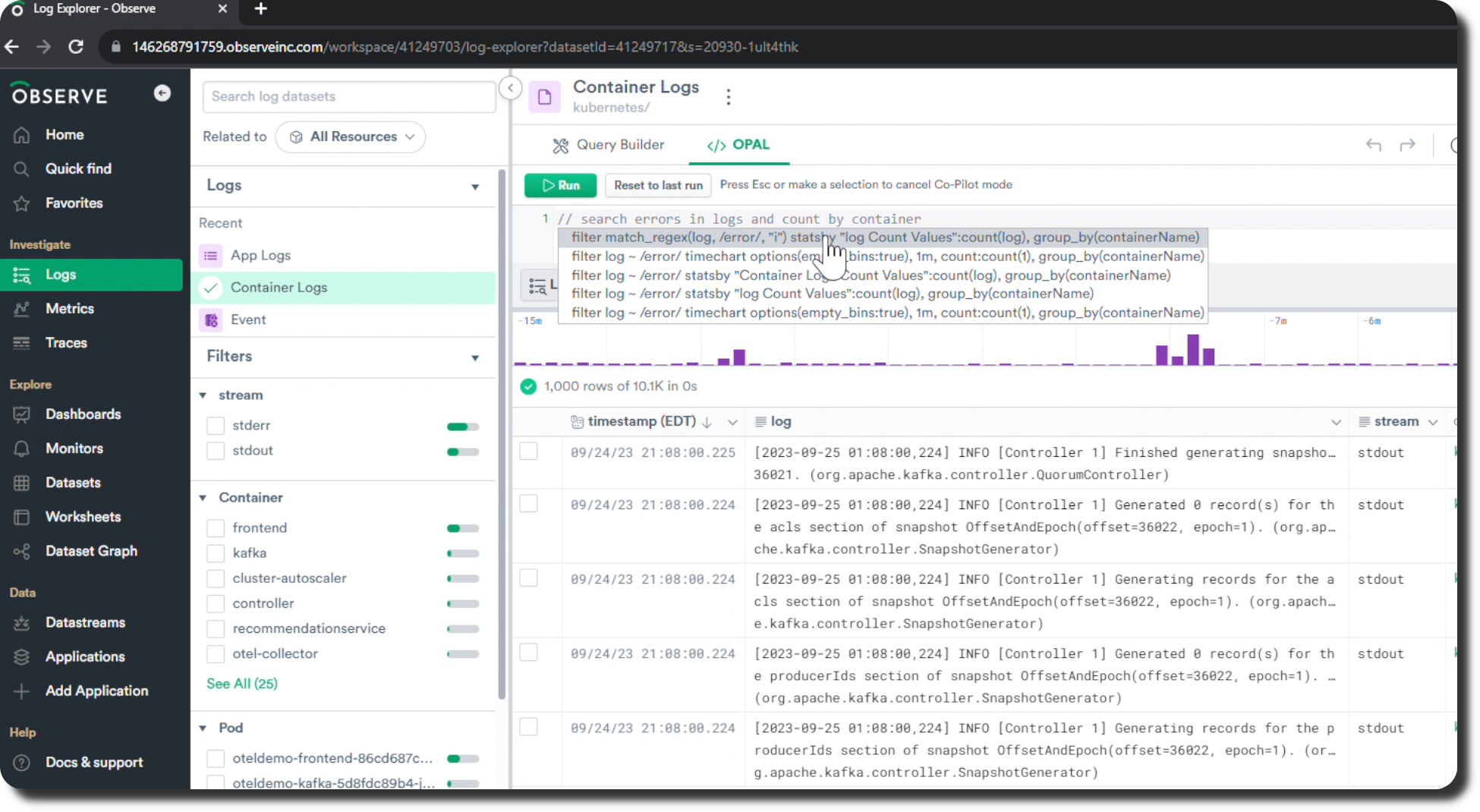
    However, with the rise of generative AI tools, it is now possible for IT professionals of all skill levels to employ a natural language chatbot to generate a RedEx query, noted Burton. A RegEx generation tool also parses data to add structure to logs on-the-fly, and there is also an OPAL Co-Pilot that generates OPAL code in response to natural language inputs.

    Observe

    The Hubble interface furthers those capabilities by simplifying the onboarding experience anytime there is a new member added to an IT team, he added. Hubble also expands the range of data access options available, including a public application programming interface (API), a command line interface (CLI), export to CSV and data sharing to the Snowflake cloud platform.

    IT teams are also coping with an explosion of telemetry data generated by modern distributed applications based on microservices architectures. Legacy observability and monitoring tools were not designed for these data volumes, so when there is an incident, the mean-time-to-resolution (MTTR) is increasingly extended. In contrast, the Observe platform now features a ‘Live’ mode that enables data to be queried in 20 seconds or less from when it was created.

    Other capabilities include an assistant embedded in Slack to help users troubleshoot issues and summarize threads for incident response.

    While it’s still early days as far as the adoption of observability platforms are concerned, there is already no shortage of options. The pending acquisition of Splunk by Cisco next year will cause more organizations to reevaluate their IT management options, so the pace at which organizations are transitioning to cloud-hosted observability platforms should increase, noted Burton. Even after the merger is completed, it might be several more months before Cisco integrates its AppDynamics platform with the observability platforms that Splunk added to its IT operational analytics platform, he added.

    In the meantime, IT environments are only going to become more complex. It won’t be feasible for most IT teams to manage highly distributed computing environments without some help from AI. The challenge, as always, will be finding the budget dollars needed to deploy an observability platform before the number of increased IT incidents makes the need for one painfully obvious.

  • JFrog swampUP: Addressing the Advent of AI

    JFrog swampUP: Addressing the Advent of AI

    At JFrog SwampUp 2023, the buzz with all about AI, especially with JFrog’s announcement of Machine Learning (ML) Model Management capabilities. These conversations around AI and ML reflected these technologies’ growing influence and importance in the DevOps world. How much of the generative AI conversation is just hype, though? And what does that mean for AI and ML as a whole? Alan Shimel, CEO of Techstrong Group, and I sat down with Stephen Chin, VP of DevRel at JFrog, to find out.

    As far as Chin is concerned, even as more companies create and leverage AI models, these models must be managed like any other software component. Chin said JFrog Artifactory acts as a staging ground to operationalize models using DevSecOps best practices. Algorithms and models will continue to grow in size and complexity, and they will require robust processes around deployment and management – just like any other software artifact. The key, Chin said, is to think of ML as just another development language and leverage tools that standardize and streamline working with it. Compared to traditional enterprise applications, though, DevOps workflows for AI/ML are still relatively immature, but Chin said JFrog’s new model management capabilities aim to provide that missing automation and governance using DevSecOps best practices for governance, security, and licensing compliance.

    Additionally, Chin noted that AI/ML have become essential for development teams to keep up with the explosive demand for code. At this point, AI has become table stakes. In the AI arms race, the winners are those who understand AI has become a vital development tool to enhance productivity. In terms of job security, the losers are the ones who can’t keep up with the volume of code. According to Chin, you are out of the running if you don’t embrace AI.

    Looking ahead, AI will not make developers obsolete, though – quite the opposite. Given the quasi-unlimited appetite for new code, Chin emphasized that developers who embrace AI will have more work than ever. One way to think of it is that AI provides a new form of “outsourcing” to boost human productivity, much like previous waves of innovation in computer science.

    When it comes to security, there are still challenges that need to be addressed; code generated by today’s AI solutions still has significant drawbacks like potential data bias, lack of explainability and simple errors. In the long term, though, Chin believes AI itself will provide the solution to secure an exponentially growing codebase, given its superior scale. Just as AI will make individual developers more productive, it can also supercharge security teams – but it can also empower bad actors. The key will be continuing to democratize the benefits to even the playing field. AI promises to be a transformative technology on the scale of the Bronze Age or Quantum computing, Chin said, but the path forward will require humans and machines working together to ensure it’s used for good.

    It’s clear that the pace of innovation in AI and ML is rapidly accelerating. As these technologies become further democratized and integrated into developer workflows, they promise to transform how software is built and secured, Chin said. Companies must take advantage of this technology innovation by providing the pipelines and governance for this software revolution, he added. Chin believes the future will likely see a more symbiotic relationship between humans and AI assistants collaborating to generate, refine and safeguard code. By proactively shaping the responsible use of these technologies, it’s possible to maximize the benefits while minimizing the risks. While this journey has only just begun, the destination is an exciting new era of human potential unlocked by AI, Chin said.

  • CloudBees CEO: State of Software Development is a Disaster

    CloudBees CEO: State of Software Development is a Disaster

    CloudBees CEO Anuj Kapur told attendees at a DevOps World event today that with developers spending only 30% of their time writing code the current state of software development in enterprise IT organizations is a disaster.

    After more than 14 years of effort, the promise of DevOps—in terms of being able to accelerate the rate at which applications are being deployed—remains largely academic, said Kapur. In fact, the effort to shift more responsibility for application security further left toward developers has only increased the amount of cognitive load and reduced the amount of time available to write code, he noted.

    However, with the rise of generative artificial intelligence (AI), an inflection point that will dramatically increase the velocity at which applications are being built and deployed has arrived, said Kapur. The challenge will be achieving that goal without increasing the cognitive load on developers. That cognitive overload results in 70% of developers’ time not being productive within organizations that often hire thousands of developers, he noted.

    Despite all the DevOps issues that need to be addressed, AI advances promise improvement. The overall DevOps market is still relatively young, given the current level of adoption, said Kapur. “We continue to believe the market is early,” he said.

    Today, CloudBees took the wraps off the first major update to the open source Jenkins continuous integration/continuous delivery (CI/CD) platform to have been made in the past several years. At the same time, the company also unveiled a DevSecOps platform based on Kubernetes that is optimized for building and deploying cloud-native applications based on portable Tekton pipelines. That latter platform provides the foundation through which CloudBees will, in the months ahead, apply generative AI to software engineering to, for example, create unit tests on the fly and automate rollbacks.

    In addition, DevSecOps capabilities will be extended all the way out to the integrated development environments (IDE) to reduce the cognitive load of developers.

    The overall goal is to reduce the number of manual processes that create bottlenecks that make it challenging to manage DevOps at scale.

    Criticism of the level of developer productivity enabled by DevOps compared to other development approaches needs to be tempered, said Tapabrata Pal, vice president of architecture for Fidelity Investments, because it still represents a significant advance. There is still clearly too much toil, but the issues that impede the pace at which developers can effectively write code tend to be more cultural than technical, he added.

    Organizations are not inclined to automatically trust the code created by developers, so consequently, there is still a lot of friction in the DevOps process, noted Pal.

    In theory, advances in AI should reduce that friction, but it’s still early days in terms of the large language models (LLMs) that drive generative AI platforms and their ability to create reliable code, he added. That should improve as LLMs are specifically trained using high-quality code, but in the meantime, the pace at which substandard code might be generated could overwhelm DevOps processes until AI is applied there as well, said Pal.

    Thomas Haver, master software engineer for M&T Bank, added that while assisted AI technologies will have a major impact, it’s not reasonable to expect large organizations to absorb them overnight. Patience will be required to ensure advances are made in ways that are both secure and sustainable, he added. In some cases, organizations may opt to build their own LLMs to achieve that goal, noted Haver. “You should not expect to change on a dime,” he said. “It will take time to see the fruits of our labor.”

    While many DevOps challenges need to be resolved, the benefits continue to outweigh the cost and effort required to succeed. The hope is that, with the help of AI, the return on those investments will continue to accrue.

  • Will ChatGPT Replace Human Software Developers? Probably Not

    Will ChatGPT Replace Human Software Developers? Probably Not

    Since the release of ChatGPT, there has been a great deal of hype around generative AI and how companies can leverage it to cut costs and democratize software and application development. Naturally, with discussions of cost-cutting and democratization come whispers about what will happen to software developers.

    This is a real and valid concern, but software developers’ skills, expertise and creativity are still very much needed.

    While generative AI and AI code generation tools like ChatGPT have shown some promise and potential benefits, they are still in their infancy—like many other innovative technological advancements. We also don’t know what scenarios they may present down the road or their true abilities when the technology matures. For instance, how will it integrate with other technologies? We don’t know what will happen when a ChatGPT-generated line of code breaks or needs to be changed. We don’t know if it can provide a novel solution to a unique problem or what security threats it will present.

    Given these unknowns, technology executives should think twice about replacing experienced and creative technology talent, such as software developers, with AI code generators.

    Will ChatGPT create novel code to solve a unique problem never encountered before? Probably not.

    A Tale as Old as Time (Or at Least a Decade)

    The technology industry has been searching for and developing new ways to make certain software development tasks much easier and more streamlined for years. One example of this is low-code/no-code.

    The notion of simplifying application development and replacing software developers with laypeople (citizen developers) has been around for more than a decade now, as low-code and no-code solutions have grown more popular. These solutions have promised that companies don’t need technical talent to get their software and app projects off the ground.

    However, if you look at the impact of these solutions today, their use can result in large amounts of technical debt and almost always require the skill of experienced software developers.

    The reason? Building complex software and applications is extremely difficult; it’s an art.

    Low-code and no-code solutions have their rightful place and can make things easier if a company is looking to launch a simple app or static web page. These solutions can increase the pace of development and time-to-market and enable everyday people without any development skills to facilitate them. However, they are not actually a complete solution and often overlook aspects of development that a human software developer would typically address. Without a skilled expert involved, low-code/no-code platforms often can’t solve a unique problem a company has.

    So, how does this relate to AI code generators like ChatGPT? Here’s how.

    A Similar Situation—With One Key Difference

    When thinking about their place in the development process, AI code generators are not that different from low-code or no-code solutions. The thinking is that they will also enable non-technical individuals to create software and applications with ease.

    Yet, there is one key difference—they promise expertise, too. But is the expertise coming from the AI code generator or the person piloting it? The answer is simple; it is not from the code generator.

    There have been examples of companies and individuals that have tried using ChatGPT to build code, and they have appeared to be successful. However, without the input of the individuals using it, it never would have been able to create the code on its own unprompted.

    This means that the expertise of skilled, human software developers is still very much needed, especially when building intricate software and apps that require complex functionality such as optical character recognition (OCR), internet-of-things (IoT) connectivity and more.

    A Future With Software Developers

    Because of the expertise still required to create elaborate and innovative software and applications, AI code generators will not replace software developers anytime soon, if ever.

    The technology used in these tools is still in its infancy, presenting many lingering questions and potential challenges. We will see this confirmed by the trials and tribulations experienced by the few companies and executives attempting to replace software development teams with tools such as ChatGPT.

    Knowing AI code generators follow a similar path as low-code and now-code solutions, companies and executives should use them as developer enablement tools. These tools should complement the work of software developers by empowering them to focus on the complex tasks software and apps today require.

  • Survey Surfaces Spike in Generative AI Usage Across IT

    Survey Surfaces Spike in Generative AI Usage Across IT

    A survey of 800 DevOps and application security operations (SecOps) leaders published today found nearly all (97%) are making use of generative artificial intelligence (AI).

    Conducted by the market research firm Sago on behalf of Sonatype, the survey found that beyond writing code, a full 45% of the 400 security operations professionals have already embedded generative AI into their workflows compared to 31% of the 400 DevOps professionals.

    Security operations teams also reported greater time savings than their DevOps counterparts, with 57% saying generative AI saves them at least six hours a week compared to only 31% of DevOps respondents that saw the same benefit.

    The top benefits cited by security operations teams is increased productivity (21%) and faster issue identification/resolution (16%) compared to faster software development (16%) and more secure software (15%) cited by DevOps professionals.

    It’s still early days as far as embedding generative AI in workflows is concerned, but it’s clear the ability to write code faster is trumping concerns about the increased number of vulnerabilities that might find their way into application environments. The most widely used generative AI platforms are trained on a massive corpus of data that includes code of varying quality. As such, a lot of the code generated by a general-purpose AI platform will likely have as many errors, including vulnerabilities, as the code used to train it.

    The level of faith organizations will place in that code will be heavily influenced by use cases. A script used to automate DevOps workflows that are not externally facing may be one example of where a general-purpose AI platform can boost productivity. In other instances, code that contains vulnerabilities that find their way into a web application might be much more problematic.
    Despite those concerns, however, the survey finds nearly three-quarters (75%) of all respondents feel pressure to use generative AI.

    There are, of course, already large language models trained on code that has been vetted by software engineers. In the months ahead, the code generated by AI platforms specifically designed for that purpose should significantly improve.

    Sonatype CTO Brian Fox said it’s only a matter of time before IT organizations focus more on ensuring the generative AI platforms are tuned for specific tasks. In the meantime, however, application security may get worse before it gets better, with more than three-quarters of DevOps respondents noting that generative AI will result in more vulnerabilities in open source code. Only 58% of security operations professionals are similarly concerned.

    It will be up to the engineers that make up these teams to bring discipline to code quality practices and make sure the code running in a production environment is of high quality, regardless of how it was created, noted Fox. For the moment, the issue is that AI augmentation is now occurring at a faster pace than the AI advances that should one-day help DevOps teams cope with increasingly larger codebases, he noted.

    Survey respondents are also concerned about who might own the code generated by AI. A total of 40% said developers or the organizations they work for should own the copyright for AI-generated output, and most of them agreed developers should be compensated for the code they wrote if it’s used in open source artifacts in LLMs (DevOps 93% versus SecOps 88%). A total of 42% of DevOps respondents and 40% of SecOps respondents said a lack of regulation could deter developers from contributing to open source projects.

    DevOps and SecOps leads both want more regulation: Asked who they believe is responsible for regulating the use of generative AI, 59% of DevOps leads and 78% of SecOps leads said both the government and individual companies should be responsible for regulation.

    At this point, the proverbial generative AI genie is out of the bottle, so there is no going back. The issue that remains to be seen is how DevOps and security operating teams will adjust to that new reality.

  • Despite Concerns, AI Increasingly Used to Build Software

    Despite Concerns, AI Increasingly Used to Build Software

    A survey of 1,001 senior technology executives, developers, and security and operations professionals published this week by GitLab finds 67% are working for organizations already using artificial intelligence (AI) to build software, with 60% of those respondents reporting their organizations use it every day. A full 90% said their organizations are either already using or plan to use AI to build software.

    More than half (51%) have already identified productivity as a key benefit, but 32% are also “very” or “extremely” concerned about introducing AI into the software development life cycle (SDLC).

    Those concerns included AI-generated code introducing security vulnerabilities (39%) and whether that code may not be subject to the same level of copyright protection as human-generated code (48%). A full 95% of senior technology executives said they prioritized privacy and intellectual property protection when selecting an AI tool.

    Most organizations will continue to move forward with AI, but nearly two-thirds of respondents (65%) who use or are planning to use AI for software development said their organization hired or will hire new talent to manage its implementation.

    A full 81% cited a need for training to successfully use AI in their daily work, with 75% of respondents saying their organization provides training and resources for using AI. However, a roughly equal percentage also said they are finding resources on their own.

    David DeSanto, chief product officer for GitLab, said it’s already clear that AI will have a major impact on productivity simply because 75% of a developer’s time is typically spent on activities that have nothing to do with writing actual code.

    Less clear is the amount of expertise required to use AI to build software. In some cases, development teams may need to master, for example, prompt engineering to automate DevOps workflows at scale, but in many more instances, it’s likely the DevOps platform will automatically execute the commands required.

    Regardless of approach, it’s clear that as the amount of code being created by developers starts to steadily increase, the need to leverage AI to manage DevOps workflows will become more acute. The challenge is the pace at which developers can leverage AI to write code is, for the moment, exceeding the pace at which it is being embedded into DevOps platforms.

    In addition, organizations must determine whether to converge DevOps workflows with the machine learning operations (MLOps) workflows used to build AI models that are integrated into applications. As more MLOps capabilities are added to the GitLab platform, it will become easier to achieve that goal and enable data scientists to work more collaboratively with DevOps professionals, noted DeSanto. Today, a cultural divide between two distinct IT cultures is slowing down the pace of AI innovation.

    One way or another, DevOps workflows are about to be transformed. The challenge now is determining which tasks and bottlenecks are likely to be eliminated by AI to enable DevOps teams to focus on managing applications at an unprecedented scale.

  • Steady On. We Still Have a Job to Do

    Steady On. We Still Have a Job to Do

    It is all the rage to talk about how significantly large language models (LLMs) and generative AI will change every niche and corner of IT. And change IT it will. But the hype cycle is at its highest right now, and I’d caution against getting too worked up about it. We’re in for a few interesting years, and the spaces I cover (DevOps and security—with a more application-centric perspective but with ops experience) are definitely going to benefit from the various AI bits being worked in. All testing—including AppSec, but all testing—will benefit both in test generation and results analysis/filtering. In fact, I’ll go ahead and say that the question in testing will no longer be, “How much time to we have to devote to it?” and will rapidly become “How many systems’ resources do we have to dedicate to it?” It will still be a long process—AI isn’t speeding up the cumulative time it takes to run thorough testing (be it functional or security). It will make that the bottleneck though, because test generation will at least be LLM-assisted, and will eventually become completely generative AI-created while at the same time, results will get more and more filtering and analysis. A minor result here plus a minor result there will automatically be detected as an extended vulnerability. There are a ton of other possibilities, but these two seem pretty obvious when I look across the testing technology space. More testing and better results analysis are on the horizon—without requiring more staff. Of course, you can do so much more, which would require the organization to add staff to follow up on results, but that’s nothing new; testing finds issues that are interruptive and take man-hours to fix—we all know of bits in the application portfolio that we should probably fix but that aren’t high enough priority to do so, for example. But fixing is different than finding. I have seen demos in security scanners that offer auto-fix options for developers. Run the test during CI, create a ticket and let the developer see suggested code rework right in the IDE. It is early days for this, but if you look, you can find vendors doing it. And that’s really rather cool.

    But we’ve all heard the “this changes everything” storyline over and over. 4GLs, XML, Java and JavaScript were all going to eliminate developers. In fact, they all created more developers. AI has a better chance of actually removing parts of our workload than any of these technologies did, but we’re still in “watch and wait” mode. It seems obvious that grunt coding will fall to LLMs … And aside from keeping staff trained to manage source, that is a good thing. We use open source, modules and libraries to do much the same thing today. I see this as equivalent to entry-level writing jobs. We’ll have to transform from the current model, but the current entry level development model wasn’t ideal anyway, so lets make a better one. Testing capabilities will be greatly enhanced, but testing of all kinds was so far behind new code generation at most orgs that the impact will be all positive as testing catches up. AI-based test generation today can generate thousands of permutations for a given piece of code, and analyze the results to just have analysts look at the truly disconcerting or confusing test results. And the question will become, “How many servers do we want to dedicate to run this?” Which is different, but just means we have more tests running to make a more solid and/or secure product and environment.

    So, in summary, is change coming? Yes. And that is not significantly different than the last couple decades where change has become IT’s constant companion. For most of you, the way you do your job today is not the same as the way you did it even two years ago. ML/GAI/LLMs are just another iteration. The apps still have to be built, deployed and maintained. So until HAL comes along, keep kicking it. You’re keeping it together, and who knows what the future brings.