DevOps principles are built on an effective, continuous cycle of improvements—key factors that help drive digital transformation for companies large and small. Inserting this agile mindset into culture and operations, however, can be challenging, as the approach sometimes conflicts with the more the methodical ways of IT. So how can people, process and technology be brought together for business success in this new paradigm?
People and Process
Digital transformation first must be defined. It’s a ubiquitous app or service that can be consumed from anywhere on any device at any time. Digital transformation aims to reduce the consumption barrier, which enables businesses to profit from every possible engagement while leveraging data-driven models.
A DevOps culture supporting such digital transformation is about agility, availability and scalability with continuous integration and continuous delivery of services. These strategies require new technology skillsets, which begs the age-old question: build or buy?
This question leads to more questions, which IT organizations struggle to answer. Should they “buy” new talent and build the capabilities with the existing team? Should they buy new talent and implode the existing team? Or, should they build up the existing team and enable them to bridge the gap from traditional ops into a DevOps culture?
Organizations often overlook one of the most important considerations. Putting top engineers with topnotch development skills together does not always produce a successful team. DevOps calls for collaboration and cooperation, so organizations must pay attention to soft skills. People collaborating across traditional boundaries and silos are at the center of digital transformation. Progress only happens when the organization is moving forward as a whole with the same end goal and execution in mind.
Digital transformation is a function of speed to market, and that’s where traditional IT and DevOps processes clash. IT follows the doctrine of trust but verify, a methodical process filled with rigor and discipline. On the other hand, DevOps’s modus operandi is continuous integration and continuous delivery while failing fast if needed, trying anything and everything to iterate and get as many data points as possible, as fast as possible.
Blending these cultures and processes is a matter of stepping back and realizing they are actually more similar than different. Striking a process balance between IT Ops and DevOps empowers organizations to deal with the volume, variety, and velocity of change involved in digital transformation.
Normalize the Right Technology
Making the right technology choices means finding the right signal in the noise of all the possibilities. From programming languages to the automation engine, infrastructure services (virtual machines, cloud instances, containers and microservices, serverless) and more, when creating a DevOps culture, people will gravitate to solutions that are biased toward what they know best.
The number of choices turns into an endless buffet with a tendency to overindulge, which creates bloat and starts accruing tech debt. Shouldering too much technology and being half-baked into “best-in-breed” solutions are not enough.
Disruptive technologies surpass the bounds of “good enough.” The wrong technology choice will put an organization behind in a world that’s disrupted constantly. The organization may get disrupted into nonexistence. Choose the technology that will best enable normal consumption of services while you scale services, become more agile, and expand availability. That’s what digital transformation done right accomplishes.
Customer-centric
A transformative DevOps culture keeps the customer as the focal point. Some organizations view this as “the customer is always right.” That’s one way to look at it, but sometimes the customer doesn’t know what “right” is. It’s up to the organizations to demonstrate good and great.
That means being less feature-centric and more solutions-centric—actually solving the customers’ pain points. Don’t get stuck in the “easy” to implement. Don’t assume your use case is the right use case without being certain of how customers would leverage and utilize the end results of the transformation. Remember, the goal is to reduce the barriers to consume for consumers.
One of those barriers is having a bad experience with an application or a service. Users want it now and are willing to pay if the service is excellent, always available as needed, and easy. We’ve seen this with rideshare applications, Netflix and Amazon.
Yet, the SolarWinds Digital Experience Monitoring Survey shows that 40 percent of respondents are suffering digital experience issues that negatively affect their businesses. They also report a lack of visibility into customer experience. Forty-four percent say end users are first to discover an issue, and 25 percent of those surveyed say they are the last to know.
Best Practices
Digital experience monitoring (DEM) tools help solve these problems. For example, when implemented as part of a rigor and discipline approach, the survey shows that 59 percent received fewer support tickets, 44 percent improved brand image, and 33 percent gained a better ability to retain customers. Among those who reported that DEM has driven increased revenue, 15 percent of revenue increase can be attributed to DEM.
Observability and Control
At the same time, a certain level of observability and control must be integrated into a successful DevOps strategy for digital transformation efforts. Observability is a measure of how well internal states of a system can be inferred from knowledge of its external outputs.
Depending on who you ask, observability can mean logging for one IT professional, metrics for another, or tracing for a DevOps engineer. Despite these shades of grey, the reality is that application stacks are evolving with so much velocity, variety and volume that such that a combination of all three (metrics, logs, and traces) are needed to build a viable observability protocol.
To achieve this level of observability—and, as a result, control—you must have a powerful integrated full-stack monitoring platform that enables analysis of key performance metrics, events and logs,and application code traces. This approach to monitoring as a discipline enables developers, DevOps engineers and IT professionals to better manage, optimize and troubleshoot the full stack at every layer—from the infrastructure services and application to the end-user experience—from a single dashboard.
With observability and controllability enabled, you can successfully and continually integrate and deliver the applications and services enabled by your digital transformation.
Digital transformation (DX) continues to be top of mind for leaders who are working to find new ways to improve their business outcomes and take full advantage of the new technologies and techniques that are now available. One topic continues to be consistent with these thoughts: DevOps.
DevOps is enabling business leaders to look at new opportunities in their market with more confidence. This is in large part due to the noticeable improvements in their company’s ability to deliver to the growing and dynamic needs of the market. New software and features can be delivered more quickly, providing exciting new opportunities.
The skills and tools necessary for DevOps are rapidly being adopted. According to a recent survey by IDC and NetApp, 38 percent of organizations are adding new DevOps skills into existing organizations as part of their IT investment and integration strategy for DX. They are applying these techniques to fulfill some of the early results that DevOps promises as well as providing a foundation for continued improvement.
DevOps and DX
While not every organization will develop the capabilities to achieve a true DevOps implementation, the following can be applied universally to support a successful DX.
Don’t Isolate the Legacy
There is a natural desire to put heavy focus on the newer modes of working exclusively. IT leaders will become very engaged in the evaluation and implementation of new tools, changes in culture, increased rate of deployments and outages and all of the meetings and planning involved.
Successful organizations work to modernize and evolve to improve processes universally. They apply new learning and new models to the entire environment, not just the innovation areas. This is not to say that more traditional applications will require a value stream that represents the next-generation applications being developed. On the contrary, those applications tend to not change very often. The intent should be to apply technologies such as configuration management, cloud and code management to these segments of the environment to deliver a more stable, predictable and self-service environment. This helps bring the entire organization up and provides a more effective working environment.
Fortunately, the latest generation of data center technology available consistently delivers APIs and SDKs that enable new and diverse capabilities. Vendors also are delivering native integrations that support control through common tools. IT organizations now have more flexibility in both their tool choices and the outcomes those tools deliver. Infrastructure investments are supporting the next generation of demands while still delivering the resiliency and features that have become critical to managing more traditional application types.
Change the Way You Measure
It is common for organizations adopting DevOps to experience a noticeable uptick in the frequency and severity of incidents, as we have seen reported in the “State of DevOps” report. If measurement of success continues to be defined by mean time to resolution and mean time between failures, it is now more than MTTR and MTBF.
Leaders have a tendency to focus on the negative, because it needs to be “fixed.” What went wrong? How can we keep it from happening again? A shift needs to occur as DevOps is implemented to help facilitate DX.
If this shift does not occur, organizations will likely begin to feel resistance to the critical changes being applied. Team members may also be less likely to explore to new ideas or to “touch that fragile system” in the value stream.
A stronger understanding and focus on what is working needs to become front of mind. How quickly can we confidently deploy a new feature? How much growth have we been able to support? How much sooner are we identifying bugs and potential issues? By exploring areas that are working, it is possible to apply these gains in other areas of the business.
Move the Whole Organization Forward
Tools may be critically important in the adoption of DevOps, but there is no substitute for the application of good leadership. Companies on their DX journey will need to re-evaluate elements of their business that may have been originally considered separate to the transition. Skills applied to the innovation segment of the transformation should be considered for application in the more steady-state elements of the business. This effort will increase the effectiveness of the organization as a whole, while also making it better-equipped to address the next phase of transformation.
The most important digital trends for C-level business leaders to consider in 2018 relate to digital transformation, artificial intelligence (AI), internet of things (IoT), General Data Protection Regulation (GDPR) compliance and cybersecurity. Read on for insights and predictions about why these topics will matter so much to C-suites in 2018.
Prediction 1: Digital Transformation—All Aboard!
As one of the armaments of business innovation and disruption, digital transformation has become such a buzzword that it turns people off. But in 2018, fates likely will be sealed. A company has either transformed, is on its way to doing so, is actively planning its transformation or has decided not to get on that train. That last group won’t be invited to the AI party and are making themselves targets for disruption. According to Forrester, more than 60 percent of executives believe they are behind in their digital transformation. That’s OK, as long as they keep moving. CEOs need to fund this expensive endeavor from the outset and not try to make it pay for itself. Nickel-and-diming digital transformation could be the last mistake a CEO makes.
Prediction 2: By 2020, AI Will Be a Game-Changer
Every so often a technology comes along that has the potential to completely change everything around it. The last such technology was cloud computing. And like cloud, which had several precursors, AI has been around for a long time. AI and machine learning/deep learning are catching up to the initial promise, and that will become more evident as the next few years unfold.
The best options for near-term success with AI are business intelligence and decision support. Some enterprises are using machine learning/deep learning to plumb big data—especially unstructured data such as text and video—to drive new forms of data analytics.
Even so, many companies will strike out with AI/machine learning largely because it’s no paint-by-numbers endeavor. Companies need talented people who know how to harness this technology, but those people are scarce and don’t come cheap. Companies need businesspeople actively making sure that the technology serves the business need, potentially in charge of the project. And companies need the right data. An AI-based decision-support system, a common application of the technology, is fueled by quality data. Do you have it? This HBR.org article, “A Survey of 3,000 Executives Reveals How Businesses Succeed with AI,” will help get your organization oriented toward AI success.
AI is likely to be a largely experimental for the next year to two years as organizations give it a shakedown cruise. But early adopters have had some success, and many see potential for AI to deliver revenue growth.
Ultimately, AI and machine learning/deep learning will be looked upon as major advances with far-reaching effects, much like cloud computing and the internet. In 2018, it may not seem that way as enterprises experimenting with it feel the pain of separating the hype from the reality, adjusting business processes to make it work, cultural resistance from tech teams and a lack of available talent. Stick with it to reap eventual rewards.
Prediction 3: IoT—A Thousand Points of Entry?
Enterprise implementations of IoT functionality are very popular these days. But security vulnerabilities and issues are both inherent and legion with this technology. It simply hasn’t been thought through. In 2018, the disregard for IoT security solutions will come home to roost for several major corporations. Until the security issues are resolved, IoT will begin to be seen by some, at least, as a promising technology that’s not ready for prime time.
Prediction 4: The GDPR Powder Keg
By the end of 2018, some companies will be getting out of European markets, while others will look for a means of circumventing the EU’s GDPR. Still others will be scrambling to comply. And a last group will be doing what they’re doing now: taking the risk that the cost of the penalty is less than the cost of compliance. Forrester predicts that 80 percent of firms will not fully comply with GDPR. The unfortunate part is that, while a company may be able to ride out a steep fine on non-compliance, damage to its brand may be irreparable or very slow to heal.
Companies also can’t just throw money at GDPR—it probably will require new companywide policies and a shift in cultural thinking about personally identifiable data and the individuals behind them. Some companies are going to find it very difficult to make that cultural change.
Prediction 5: Cybersecurity Needs New Thinking
Customer experience and security are at odds with each other. Passwords don’t work. Biometrics aren’t completely safe. Security awareness is treated as an afterthought. Security breaches are an everyday headline. What’s it going to take to make society wake up? There is a huge need for a new type of user authentication system, as just one example. There are significant opportunities for those that can deliver new technologies, new products and new solutions. We need to think differently about cybersecurity. We need to teach it in schools. In 2018, we will hit bottom. It will become apparent to all of society that our security measures are antiquated and have no hope of meeting the rising threat from many quarters. As the digital world continues to assimilate more and more of our previous analog way of life at a rapid clip, security has trailed far behind. Cybersecurity desperately needs innovation.
Digital transformation is the underlying theme of many of the 2018 and beyond IT predictions made recently by analyst firms Forrester, Gartner and IDC. Technologies such as cloud, AI, data analytics, big data, blockchain, IoT, conversational interfaces, DevOps and cybersecurity will also force CIOs to perform a juggling act. The rapid evolution of these technologies combined with the business opportunities they unlock will create a pressure cooker for CIOs, become an everyday topic of discussion for C-suites and possibly even a preoccupation of boards of directors.
We’ve analyzed the predictions by the three research firms and have gathered the key themes as the seven most pressing issues for the C-suite next year and beyond:
1. CIOs are at a Crossroads, Representing Both Challenge and Opportunity
Forrester believes that CEOs will make digital business a top priority in 2018 and CIOs will lead the digital transformation at most companies. In a November report, “CIOs Make the Chief Digital Officer Obsolete,” Forrester summed up: “In 2018, boardroom discussions will focus on digital. Key questions will revolve around platform-based business models, new partnership ecosystems, and new ways to organize for success. CIOs will build new skills and competencies to help drive this change.”
The challenges for CIOs during this period will demand that they step up, expanding their digital skill sets and employing technologies with both eyes focused on business value. Forrester predicts that CIOs will need to orchestrate the underlying technologies and supplier relationships for companies to manage their platform-based business approach. CIOs would also be smart to leverage cloud computing and open source software, and build on containers, APIs and microservices.
CIOs also may need to develop new leadership skills to direct their company’s digital transformation. That includes displaying a laser-like customer focus, attracting the necessary talent, restructuring their organizations and developing the culture required to deliver tangible business results. Doing so, Forrester said, “will present CIOs with the opportunity of a lifetime, allowing them to demonstrate the level of trust and performance that their senior peers and boards require, and positioning them as leaders of the digital transformation — even the enterprise.”
IDC’s November “Worldwide CIO Agenda 2018 Predictions” offers predictions that dovetail with Forrester’s view:
By 2020, 60 percent of CIOs will implement an IT business model and culture that shifts focus from IT projects to digitally oriented products.
By 2020, 60 percent of the CIOs who have crossed the digital divide will prevail in C-suite turmoil in competition to become digital business leaders for their enterprises.
Advice to CIOs: Find a leadership coach. Choose one or two lieutenants you trust to delegate important roles to. Find a senior product manager-type person in your company to help you become more knowledgeable about generating business value. Make a point to talk to your CEO about the advantages of digital transformation. Develop a plan for adopting a new digital governance model. What should your digital platform look like?
2. Digital Transformation Becomes Real for Most Companies in 2019-2020
We’ve been hearing for a couple of years that companies are digitally transforming their businesses. The truth is that those companies represent the leading edge and they are a small minority. Most CIOs are still stuck doing more with less, the hangover from the last recession. CEOs: Your CIO needs more budget to position your company for digital success over the next few years. IDC predicted that “through 2019, 75 percent of CEOs and their enterprises will fail to meet all their digital objectives, dragged down by conflicting digital transformation imperatives, ineffective technology innovation, cloud infrastructure transition and underfunded end-of-life core systems.”
That’s a lot of failure. CEOs and CIOs are going to need to work together to make digital transformation a reality. It’s not just about updating your technology, it’s about business innovation.
Key points on digital transformation from IDC’s CIO 2018 predictions:
By 2019, 60 percent of CIOs will complete infrastructure and application replatforming using cloud, mobile and DevOps, clearing the deck for accelerated enterprise digital transformation.
By 2019, 60 percent of IT organizations will have deployed digital transformation platforms supporting new customer- and ecosystem-facing business models.
By the end of 2019, digital transformation spending is expected to reach $1.7 trillion worldwide.
3. AI is No Panacea
Forrester named one of its 2018 prediction reports “The Honeymoon for AI Is Over.” Conventional analytics are undergoing full disruption, largely because AI is perceived to be the solution to both programming analytics and solving the big data riddle. And while it’s likely that AI/machine learning will be able to help with both problems, you can’t just snap your fingers and make it so. Harnessing AI successfully requires specialized engineering talent, quality data, objective planning and some trial and error. According to a Forrester survey, 70 percent of respondents say their firms will have implemented AI in the next 12 months. They chose decision management as their most important use. One of the key points to remember is that the decision-making abilities of it machine learning tool can’t over calm a lack of quality data. Forrester warns: “Don’t be fooled by vendor claims that more intuitive human-to-machine interfaces are [a magic potion] that reduces the need for data and metadata management and curation.”
Quick AI predictions from IDC:
By 2019, 40 percent of digital transformation initiatives will be supported by cognitive/AI capabilities, providing timely critical insights for new operating and monetization models.
By 2020, 85 percent of new operation-based technical hires will be screened for analytical and artificial intelligence skills, enabling the development of data-centric digital transformation projects without hiring new data-centric talent.
4. One-Third of Enterprises will Abandon Big Data Repositories in 2018
Has your company built a large data lake that hasn’t delivered any significant business value? Well, 2018 may be the year when you rethink that decision, according to Forrester.
On the other hand, Forrester believes that AI will be able to resolve the longstanding issue of the boundary between structured and unstructured data because of vendors including Digital Reasoning, Expert Systems and Stratifyd.
As you make your move to digital transformation, having more actionable data based on your pool of big data, especially unstructured text data, could deliver book valuable business insights. This might not be the best time to give up on big data. Especially if you’re actively engaged with AI.
5. Blockchain: Confusing, Skills Gap, Steeped in Hype—but Full of Potential
Blockchain will begin to show next year just how difficult it will be to employ but, at the same time, that it’s worth exploring.
“By the year 2020, the banking industry will derive $1 billion of business value from the use of blockchain-based crypto-currencies,” states Gartner’s October “Top Strategic Predictions for 2018 and Beyond.” “When compared to the estimated $7.6 trillion that is the industry gross output of the world’s banking industry, $1 billion may not seem like much. However, the value is more about the tacit endorsement of crypto-currency as a legitimate option by the banking industry.” Cryptocurrency is just one application of blockchain.
Advice: Build your blockchain ecosystem early, Forrester recommends in its 2018 prediction report, “Be Ready to Face the Realities Behind the Blockchain Hype.” “The blockchain terminology will remain confusing,” Forrester noted. “The term ‘blockchain-inspired’ is already a common descriptor for software that has some of the characteristics of blockchain or reflects some of the principles of the blockchain network, but isn’t a blockchain in the true sense.” There is a growing skills gap pertaining to software engineers and security professionals who have experience with blockchain. It’s a nascent technology; make sure your team sets realistic goals.
6. IoT Hits Prime Time, but it Might Not Be Ready
By 2020, IoT technology will be in 95 percent of new product electronics designs, Gartner said. IoT’s growth is very rapid, even for the computer industry. But that growth comes at a cost. The technology has not overcome what many believe to be rampant security vulnerabilities. “Through 2022, half of all IoT security budgets will be spent on fault remediation, recalls and safety failures rather than protection,” Gartner predicted.
Forrester is far more positive about the business advantages of IoT in its report, “IoT Moves from Experimentation to Business Scale.” Its predictions are also more detailed in the several areas where IoT might gain traction in 2018. But the security issues are not lost on Forrester, either. The research firm predicted: “IoT will be at the center of broader and more damaging cyberattacks. The Mirai botnet was a harbinger of future IoT security-related attacks and breaches. … Most firms still haven’t shown a consistent commitment to mitigating IoT-specific threat vectors.”
Advice: IoT is an accident waiting to happen. For B2C companies, the consumer backlash could be fierce if there is a major incident. Make 2018 be the year that you start plugging up those IoT security vulnerabilities and protection gaps.
7. Most Companies Won’t Comply with GDPR in 2018
The European Union’s General Data Protection Regulation (GDPR) takes effect May 25, 2018. Forrester predicted in its November report, “A Year of Reckoning,” that 80 percent of companies will fail to comply with the GDPR. Perhaps more to the point, Forrester additionally predicts that 50 percent of those non-compliant firms will do so intentionally, “meaning they have weighed the cost and risk, and are taking the path that presents the best position for their companies.” The other half of the 80 percent will try to comply but will fail.
Advice: It seems likely that some large company will be made an example of. You don’t want that to be your company.
Takeaways
Those are the standout IT-related issues for the C-suite in 2018 and beyond. If you weren’t tuned in to some of them, knowing is half the battle right? Well, probably not. These are tough challenges. Each organization has its own strengths and weaknesses. But generally speaking, if you parse this list by investing time and budget on the first four while minimizing the potential downsides of last three, you’ll be doing very well.
The story you’re about to read and its recommendations are real; they contrast with what you have heard so far about digital transformation and DevOps implementation. Its objective is to convince you about that the time to go digital is now; it’s about transforming your business, not only IT; and to do it you’ll have to implement DevOps entirely.
In September, Toys R Us, one of the world’s largest toys store chains, filed for bankruptcy protection. A better understanding of how disruption in the retail industry impacted the company would have helped to prevent its downfall and to reinvent its business model. For example, providing Toys 2.0 (a generic term referring to a new generation of toys built on cloud, mobility, IoT and AI technologies) gaming services could have helped the company survive.
Shifting to Toys 2.0 demands a revolution in thinking, vision, practice and value that business leaders, CIOs and IT vendors haven’t done yet. They must forget the obsolete notion that technology and speed determine business success. Adopting paradigms that stress innovation and solve competitive constraints is the safest path toward fast and durable revenue.
The biggest problem Toys R Us faced was the fact that consulting firms and IT vendors either didn’t understand the challenge as an industry disruption issue—or if they did, they improperly addressed it.
Let’s clarify: To tackle your industry’s disruption, you must adapt your business model including the set of interactions, staff and skills, processes and practices, beliefs and values and infrastructure and tools used across your company to generate revenue. Industry disruption is the challenge, and DevOps through its many assets is the unique business capability companies need to quickly transform and win their digital battles.
The problem, as Alan Shimel, founder, CEO and editor in chief of devopsy.kinsta.cloud, puts it:
“While so many companies have already started to use DevOps or planning to use DevOps and related methodologies soon, there is only a small percentage of companies that are end-to-end DevOps. This means there is still tremendous opportunity in bringing DevOps to market.”
How should have Toys R Us leveraged DevOps to tackle its industry’s disruption? Why did investing in that global digital e-commerce platform prove insufficient? How well did they transform their business model? How would have implementing DevOps 100 percent helped to overcome Amazon and Walmart competition?
The principles, ideas, practices and solutions in this article are part of a case study we developed at ITaaSNow to see how to help companies facing similar challenges.
What is DevOps?
Alan, who is a major contributor to DevOps, is right: Only a small percentage of companies have fully adopted it. DevOps is much more than the automation toolchains consultants and vendors talk about. If they want to help lines of business survive and keep their job, CIOs must get a grasp of DevOps’ business facets.
So, what is DevOps? Why do I think, it would have saved Toys R Us from digital downfall?
DevOps Beyond the Operations Automation
From my experience implementing it, DevOps is a business capability that seeks to optimize business operations (versus the sole IT operations). It provides companies with four competitive advantages needed to meet the digital business competitive challenges:
Enterprise collaboration
Business agility
Short time-to-value
Innovation culture
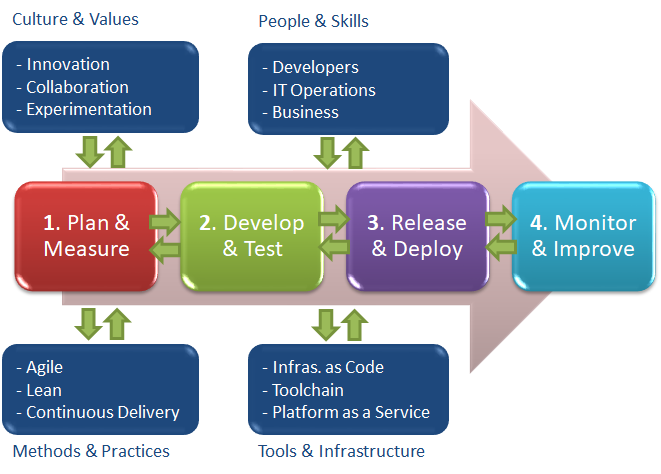
Figure 1 – DevOps Overview
As the picture shows, DevOps is a set of concepts aggregated around the notion of value stream to form a digital business management capability. It’s structured around four stages that format the company’s interactions and workflows into a powerful digital business management capability. These stages include:
Plan & Measure – addresses strategic watch, service prioritization and revenue generation through innovation portfolio management practices and infrastructure.
Develop & Test – takes advantage of agile and lean practices and infrastructure to ensure innovations design, development and testing.
Release & Deploy – leverages continuous delivery practices and infrastructure to timely deliver the right innovations to the right markets.
Monitor & Improve – stresses continuous improvement to guarantee not only premium customer experience but also customer value.
Four business value catalysts are used to act as revenue generators:
Culture & Values
People & Skills
Methods & Practices
Tools & Infrastructure
As you can see, DevOps transcends application development issues; it covers the entire business life cycle.
DevOps Framework as a Facilitator of DevOps Implementation
So, what is a DevOps Implementation framework?
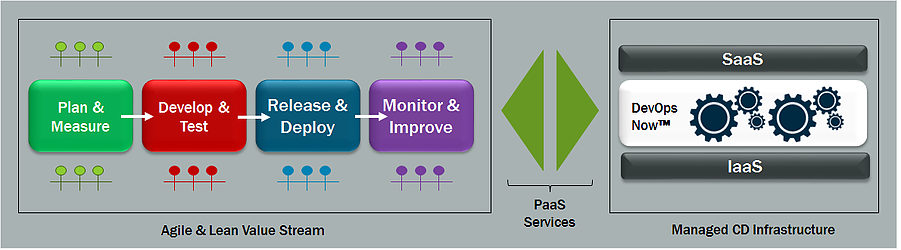
Concretely speaking, it’s a bundled DevOps platform combining managed PaaS infrastructures and optimized value streams to help companies boost their digital business:
Figure 2 – DevOps Implementation Framework
The platform seeks to help businesses implement DevOps end to end and builds on three principles to guarantee digital profits:
Innovation as the revenue driver – It’s the belief that business can resist the competition imposed by technology companies such as Apple, Google, Amazon and Facebook when they use innovation to keep customers loyal, attract new ones and generate revenue.
Value stream agility as the foundation of market responsiveness – It’s the demonstrated notion that companies are market-responsive when they rely on agile and lean value streams.
Managed cloud as the catalyst of business performance – It’s the proven idea that when companies are focused on their core business, they innovate and offer superior customer experience.
The 5-Step Digital Transformation Blueprint
The 5-Step Digital Transformation Blueprint makes DevOps implementation fast and easy. As illustrated, it’s a comprehensive business transformation framework I developed to help clients with their digital transformation initiative:
Figure 3 – The 5-Step Digital Transformation Blueprint
It’s an integrated and inclusive approach to business transformation that involves the company’s relevant contributors. It structures the transformation effort into a five-stage transformation journey:
Digital strategy: In this step, the transformation team uses tools like the SWOT analysis matrix to help business and IT executives understand the changes in the disrupting industry along with the impacts on the company’s business model.
Value stream: In this step, the transformation team uses tools such as the value stream mapping to identify the required changes and get business and IT executives agree on the company’s future value stream. Interactions, staff, skills, processes, practices and tools are at the heart of the discussions.
Digital platform: In this step, enterprise and solution architects work together to identify and implement the technology and tools selected to support activities in the value stream.
Digital organization: In this step, a panel of business and IT users at the operational and executive levels experiment the new digital business model under actual business conditions. The tested digital business model is then deployed as the new digital organization.
Digital business management: In this operation phase, the value stream and the digital infrastructure are extensively used to run the business.
How Chief Digital Officers Set Up Top Digital Businesses
It would be remiss on my part not to recommend the online digital transformation course that gives DevOps practitioners—executive and operational from both the business and IT—the insights about implementing DevOps as the foundation of digital business.
Analyzing Amazon and Walmart Disruptive Impacts to Spot Guidelines for Reinventing the Company
Many bankruptcies happen because business leaders don’t take the time to understand their industry’s disruption and the impacts on their overall business.
The reality on the ground is, industry analyses and competitive strategies are either overlooked or totally ignored. Understanding the toy industry’s disruptive effects would have helped to identify Toys R Us’s transformation as the safest solutions to avoid bankruptcy.
DevOps implementation framework makes the difference, it sees DevOps as the foundation of digital business success. It considers industry and competitive analyses essential steps of the DevOps transformation initiative. Figure 4 outlines the outcomes that resulted from our industry analysis:
Figure 4 – Toy Sector’s SWOT Analysis
As illustrated, it was shown that Toys R Us should have exploited Amazon’s vulnerabilities and take advantage of the technological opportunities to reinvent itself as a Toys 2.0 gaming service provider. These vulnerabilities include little product differentiation while technological opportunities refer to the new toy generation built on cloud, mobile, IoT and AI technologies.
The company’s strengths—reputation, longtime industry presence, brand equity—combined with the cost savings resulting from managed cloud adoption would have not only simplified its transformation but also challenged Amazon on costs.
Changing the Value Stream to Establish Innovation and Invent the Company’s Digital Business Model
Business leaders don’t take the right transformation decisions because they lack insights into the changing competitive environments. Aggressive marketing and sales campaigns supporting short-term financial gains. Toys R Us failed because it bet on its debt reimbursement at the expense of its business model reinvention.
A DevOps implementation offers a value stream mapping framework that not only facilitates innovation culture implementation but also speeds up digital business models development.
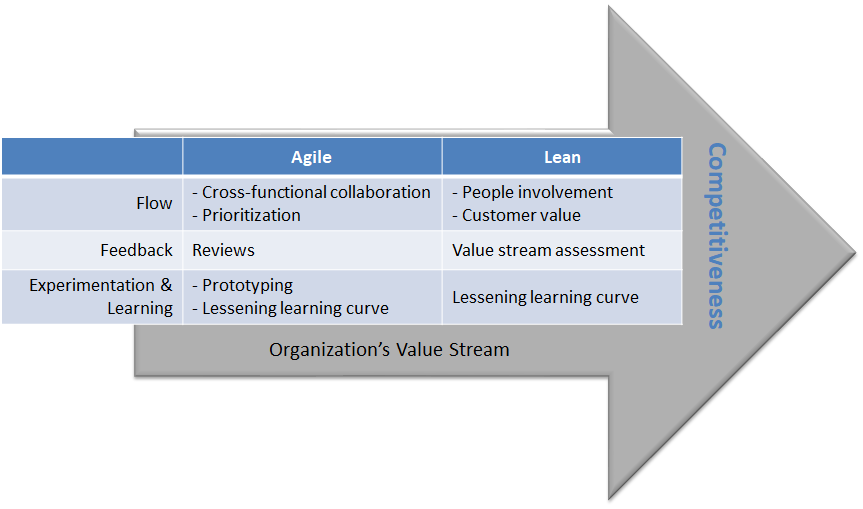
Figure 5 – Value Stream Mapping, Agile, and Lean
The objective of the value stream mapping I performed was to outline the features of work environments that take advantage of DevOps Three Ways to equip the company with the competitive advantages needed to resist Amazon and Walmart. The following lines summarize the outcomes.
Implementing DevOps Flow Principle to Defeat Amazon and Walmart on Innovation: The value stream mapping recommended to leverage Agile and Lean principles to properly implement the flow principle and defeat Amazon on its little product differentiation. The Agile’s features to stress included collaboration and prioritization while focus on people engagement and customer value were the Lean’s benefits to emphasize. Their combination were likely to not only foster innovation culture but also accelerate time-to-market and time-to-value.
Implementing DevOps Feedback Principle to Guarantee Superior Customer Experience: As to the feedback principles, the value stream mapping recommended to use Lean’s value stream assessment and Agile’s review mechanisms. The objective was to institutionalize continuous improvement practices as a means to ensure superior customer experience.
Implementing DevOps Experimentation and Learning as the Foundation of the Innovation Capability: As to the experimentation and learning principle, the recommendation was to take advantage Agile’s prototyping and learning curve-lessening features to institutionalize innovation and risk-taking cultures. They were likely to not only help the company challenge its competitors on innovation but also ensure durable revenue and customer loyalty.
Enabling the Value Streams with Managed PaaS Services
Using technology ingeniously to boost business activities is clearly one of the keys to succeed in the digital business. Today’s DevOps-timid approach focused on speeding up IT operations alone not only is ineffective, but it also doesn’t make sense. It’s the entire value stream that needs optimization, not just IT.
The findings of the digital platform assessment I performed, showed as illustrated, that the global e-commerce platform wasn’t enough to compete against Amazon and Walmart. The company was at the embryonic stage of digital transformation maturity practices:
Figure 6 – Toys R Us Possibly at the Embryonic Stage of Digital Transformation Maturity
The findings suggested that using technology to innovate or creating the operational conditions to cut cost, accelerate time-to-market and be responsive to market opportunities were either overlooked or improperly addressed.
Using a digital platform engineering framework allowed me to design in a record time the following architecture:
Figure 7 – Possible PaaS Platform for Toys R Us
The digital platform would have built on two cloud services supporting the value stream: managed software as a service (SaaS) and platform as a service (PaaS). Let’s discuss them.
How Managed SaaS Services Would Have Helped to Fix the Cost Leadership and Business Agility Issues
SaaS services would have supported the Plan & Measure stage. In addition to supporting varied management activities, it would have provided two fundamental tools that possibly could have enabled the Toys 2.0 strategy: customer relationship management (CRM) and innovation management portfolio. CRM tracks, measures and improves customers’ experience, keeps them loyal and guarantees revenue. Innovation portfolio management identifies innovation ideas, supports their implementation into digital services and monitors generated value. It gives the company opportunities to disrupt and control its industry.
The on-demand and metered billing features of SaaS services would have allowed Toys R Us to get the needed software in record time while enabling time-to-market, time-to-value and responsiveness competitive advantages.
How a Managed PaaS Platform Could Have Helped to Address the Express Delivery Issue
PaaS services would have supported activities covering the Develop & Test, Release & Deploy and Monitor & Improve stages. In addition to providing the technologies needed to implement Toys 2.0 gaming services, it would have built on microservices to set up the automation tool chain and accelerate innovations development and delivery.
Wrapping Up
The recent IT innovations are disrupting several industries and expanding the digital economy. To avoid troubles, businesses must urgently start their digital transformation. Toys R Us, Sears and many others learned it the hard way.
It’s urgent to understand that the digital transformation of your business isn’t only about migrating your IT to the cloud, implementing automation tool chains or deploying artificial intelligence tools across the company. It’s primarily about transforming with a strategic mindset your company’s business model from the ground up.
Digital transformation is a complex process that engages the entire company, and requires specific methodologies, practices and tools. I renew my recommendation to take the online course, “How Chief Digital Officers Course Set Top Digital Businesses“—you’ll get from it the practical vision, approach, processes, practices and tools that’ll help you create the conditions for successful digital business with DevOps.
Digital transformation is one of the hottest buzzwords in the technology industry today. While it tends to be overused, the term does represent a widespread, ongoing movement that will set a standard for the next generation of enterprises.
Digital transformation is all about keeping up with the pace of innovation and using technology to achieve business goals. A key differentiator in the age of digital transformation is customer experience. Consumers are increasingly engaging with brands on digital platforms, whether it be a website, social media profile or mobile app. The foundation of all these platforms is, of course, software.
Agile software delivery is key because it helps organizations innovate faster and gets new software in the hands of consumers sooner. This requires new, more productive ways of working for enterprise IT teams. Development teams have already undergone several “transformations” in recent years, from the siloed waterfall approach to agile methodology and now DevOps. Software is the true differentiator in the age of digital transformation, and many companies are using DevOps to ensure their software meets the standard.
Here are a few best practices for using DevOps to keep up with the pace of digital transformation:
Automate wherever possible. We no longer collect the work of multiple engineers over multiple sprints into a release. To out-innovate the competition in the digital transformation era, a team must release the work of a single engineer as soon as it is ready. This is usually accomplished through a CI/CD pipeline directly from the source repository through automated testing and then deployment into production, preferably without any human intervention. Choosing the right tools for your IT environment will cut costs, time and room for error.
Align the goals of development and security. DevOps isn’t limited to just the development and operations teams. Without security, all progress made in the digital transformation era is at risk to cybercriminals. The accelerating software development life cycle means little time for security analysis or penetration testing when the release candidate is ready to deploy. To ensure a piece of software is secure before pushing it to market, security standards must be included in the definition of “done.” Preventative scanning will not only train developers to write secure code, but will allow the software to pass the assurance tests included in any good CI/CD pipeline.
Measure ROI. Measuring the impact of DevOps can be extremely difficult and up to interpretation because of the focus on culture and processes. However, it’s important for DevOps teams to gain continued executive buy-in and dedicated resources by proving their value. The value of DevOps is determined in terms of achieving improved business outcomes. There are specific questions to ask to help determine ROI: How long does it take to release a code change? How long does it take for a product to reach a customer’s hands? The ability to continually deliver quality software faster results in a positive customer experience, ultimately improving brand reputation and revenue.
While keeping up with the competition is necessary in the digital transformation era, putting customer experience first is how the true leaders succeed. By shortening the software development cycle, DevOps speeds the pace of innovation for an organization and helps earn customer trust and retention. Implementing these best practices can help a business use DevOps to place software and customer engagement at the heart of its digital transformation.
The term digital transformation is probably one of the most overused, if not abused, terms in the tech/DevOps world today. Everyone is doing it, but what is it? Is it a synonym for adopting DevOps? What are its effects on you, your job and organization? What does it mean for software development and deployment? So many questions. Actually, they’re only a few minutes’ worth of questions in our new survey, Digital Transformation and Your Organization.
These surveys really help us understand where the market is, what our readers and community members are dealing with and what we can do to serve them better. You helping us by taking the survey allows us to help you—not only you, but the wider community as well. Your opinion is important and it counts. So please take a few minutes and help us. Take this survey now.
You still here? OK, if our words didn’t persuade you, let me go one better: We are willing to pay you to take this survey. We will give one in every 10 people who take the survey a $50 Amazon gift card. To be eligible for the gift card, you need to enter your email address in the optional last question of the survey. Otherwise, we don’t know who to send it to. So that is another reason to take the survey.
We will make the report of the survey findings available as well, and everyone who registers will receive a copy. The survey is open to anyone, so please feel free to share the link with your colleagues.
Beyond taking the survey, I don’t want to minimize the importance of digital transformation. While for some—especially in our DevOps audience—digital transformation means DevOps transformation, that is not its only use or meaning. For many businesses, just adopting a digital footprint, using the internet as an active part of their business or adopting modern methods, software, Agile methodologies, etc., opens up unimagined new ways of business. At the end of the day, digital transformation may, in fact, be one of the biggest agents of change in our world over the last 20 years.
We’re looking forward to analyzing the responses and seeing your digital transformation experiences. Please help us help you by taking the survey.
Some say microservices architecture is proof that SOA is still alive. I contend that microservices architecture replaces SOA due to deficiencies in how SOA has been implemented as well as the original intent.
In the mid-1990s there was a surge of investment for implementing enterprise applications to replace the aging homegrown legacy applications. These new applications managed complex activities around accounting, supply chain, human resource and manufacturing. They also were easy to integrate with other facets of the business, including existing legacy applications that were not going away and new and emerging web applications for customer and internal use.
Out of necessity, there was a rise in the number of point-to-point integrations occurring. Over time, the web of point-to-point integrations became so complex to manage that even small changes resulted in major failures. To correct this problem, a category of software emerged to make integration easier by simplifying the control plane that focused on cataloging the endpoints, fostering connections and marshalling the data. These control planes were identified as enterprise application integration (EAI). Early EAI products did not inspect or act on the data.
Somewhere along the line, vendors became aware that there was another underlying issue: The old system and the new system used different vocabularies and message structures. Initially, the consumer of the EAI tool output did the translation itself, but then vendors saw an opportunity to increase the capabilities of the EAI tooling to also become a data plane. So, then, the EAI tooling would also handle mapping and translation.
Now, if your source systems never change, the value of an intelligent middleware that acted as a control and data plane seems both logical and of great value. However, when the source systems change, middleware comprised of dynamic routing and mappings from the source to the target becomes a considerable limitation. Any change to the source requires comprehensive regression testing on the entire system, and you must hope you have an example of every permutation of every message that may ever be delivered as input to ensure the change does not introduce future problems.
Having been an integration consultant during this era, I can attest to weekly failures due to message combinations that no one had ever conceived of during testing.
So, what does any of this have to do with SOA and microservices?
The above approach I just described evolved with the products that acted as a control and data plane morphing into the enterprise service bus (ESB). The ESB became the cornerstone of the SOA strategy and together they formed the strategy for modernizing legacy systems. Hence, SOA, as it was ultimately delivered, ended up being an expensive mapping exercise from legacy data structures and messages to a newly appointed business language, also called the canonical representation. In some cases, these new SOA services would derive these new business data structures by querying and massaging data from multiple legacy systems, while in other cases, new business logic would be made available via the bus expanding the ecosystem of available capabilities.
With SOA, the canonical message became the product of innovation and, hence, ultimately its downfall. Perhaps unfairly so, but, SOA never fostered continued modernization of the legacy systems into re-platformed and redeveloped services. It was about exposing the systems of record, both data and process, for inclusion into business processes, facilitating minimal changes to the legacy systems all handled through intelligent pipes.
While digital transformation may be a popular concept that every business is now chasing, SOA’s failure demonstrates that simply exposing the existing systems was not enough to become the agile business we strive to be. Indeed, the systems of record that are brittle, burdened with technical debt and developed in a monolithic fashion were already impairing businesses’ ability to compete long before Uber and Airbnb came into existence. The appearance of these businesses just increased the urgency to address the legacy issue.
Enter microservices architectures. First, I’ll reiterate my favorite soapbox topic: Putting a legacy app inside a Docker container does not in and of itself define a microservice. A microservice follows specific tenets of design. One of these tenets—and one that is very relevant to this discussion—is smart endpoints and dumb pipes. I find this design principle very interesting, considering what I’ve stated above about SOA. For me, it’s clearly a rebellion against SOA strategies.
Also, I believe microservices approaches legacy modernization from a slightly different perspective. Microservices architectures by nature focus less on tooling (they’re polyglots by design) and more on the contextual bindings to business domains. Additionally, as someone eloquently stated on Twitter (which I cannot find now and so will paraphrase here), a microservice should be designed to be easily deleted without impacting the operations of the system. I believe the statement illustrates that a well-designed microservice isn’t intertwined with other services nor does it share intimacy of design.
Some will debate—present company included—that this is what SOA was supposed to deliver. Unfortunately, this was not how it got implemented. So, this time we reduce the scope. Instead of a SOA service that represents the entire business domain, we deliver smaller, more well-focused entities representing subsets of the business domain. Subsequently, these services are designed to operate more independently, allowing them to better align with greater use of agile techniques.
In microservices, architecture agility is the product of innovation. Ultimately, the improvements in speed, cost and quality are why microservices will succeed where SOA has failed.
In today’s digital world, it’s not about the big eating the small. It’s the fast that beat the slow and the nimble that outmaneuver companies constrained by old systems and business models.
What’s more, the finish line is always moving. The rapid pace of innovation and disruption means businesses must continuously transform themselves to stay ahead of competitors.
The takeaway for CIOs: Speed and agility are the name of the game.
IT must respond faster than ever to shifting business needs. To succeed at digital transformation, companies must rethink how they design, build, deploy and source enterprise applications. They must adopt new approaches that accelerate delivery and anticipate, even bake in, ongoing changes.
It’s time to update the IT playbook. Here are five best practices from digital leaders that are breaking with the past to deliver a successful future.
Accelerate and Iterate Software Delivery
Digital leaders outpace their rivals by adopting methodologies and mindsets that shorten software delivery cycles. They’re also really, really good at rapid, iterative change.
Shift to Speedier Methodologies
Digital leaders rely on Agile development methods—short sprints, scrum teams and user feedback loops—to accelerate the design and development of new applications. With its emphasis on rapid iteration and continuous improvement, Agile methodologies are a proven way for companies to churn out new innovations quickly. Studies show Agile approaches average 50 percent faster time-to-market than waterfall ones.
DevOps is also a catalyst for speed. Automation and tighter collaboration between development and operations make it easier to put new code into production. Led by such companies as Facebook, Google and Amazon, the world is moving away from “that 10-year-old solution everyone’s afraid to touch” to flexible platforms that are updated multiple times a day.
Adopt an Agile Mindset
Of course, being agile requires more than just new methodologies. It also demands a willingness to take risks, learn on the fly and adjust continuously. Digital leaders don’t just respond to change; they embrace and design for change.
Digital leaders test and then invest. They fail fast and then swiftly course-correct. The most successful experiment rapidly and incrementally so if they do stumble, they fall from the first floor, not the 10th. Digital leaders also think big. They don’t just digitize current processes. They completely re-imagine business models and technology systems—as Pitney Bowes did with its transformation into a digital commerce powerhouse or as GE did with its launch of the Predix industrial IoT platform.
Adopt New Application Architectures and Infrastructure
Digital leaders are building in flexibility with new application architectures and deployment models. They’re leaving legacy systems behind as they take to the cloud with microservices-based solutions.
Move to Microservices
Monolithic applications are hard to change, costly to maintain and ill-suited to today’s dynamic business environment. That’s why digital leaders are moving to an agile, microservices-driven architecture. Converts include Netflix, eBay, Amazon, Twitter, Gilt, Liberty Mutual and the UK Government Digital Service, to name just a few.
Assembling applications from small modular services—each a self-contained building block—allows digital leaders to transform quickly and at scale. They can mix and match services to fast-track new digital offerings and processes. They can tweak and scale services to adapt to changing business models and customer expectations. And they can push innovation across the enterprise by reusing services—all without adding armies of developers or getting locked into any one technology.
Step Up Cloud Migration
The cloud is increasingly the preferred foundation for digital transformation. Digital leaders gain speed and agility by plugging into on-demand services and computing resources. They short-circuit long design and procurement cycles; focus on innovation, not infrastructure; and deliver differentiated capabilities and customer experiences at a fraction of the time and cost.
Digital leaders are betting big on the cloud. According to IDC, at least half of IT spending will be cloud-based by 2018, reaching 60 percent of IT infrastructure spending and 60 percent to 70 percent of software, services and technology spending by 2020. Organizations across industries—such as Nike, Xerox, General Mills, Liberty Mutual, and the U.S. federal government—have migrated mission-critical workloads to the cloud to support new, more digital ways of doing business.
Use Novel, Unexpected Sources of Innovation
Digital leaders rely on open-source innovators and third-party collaborators to shorten development cycles. They’ve also abandoned long RFPs in favor of shorter, more effective proofs of concept (POCs).
Embrace Open Tech with Open Arms
Open technologies—including open source, open standards and open APIs—dominate the digital landscape. According to a study by North Bridge and Black Duck, open source software makes up more than 50 percent of the typical enterprise and application stack. Digital leaders including Ticketmaster, Box, eBay and Goldman Sachs rely on open-source software to speed solution delivery and draft off the innovations of millions of developers worldwide.
Digital leaders also innovate openly with others. They hold hackathons. They crowdsource. They co-create with customers and partners. They also contribute back to the community with projects such as Walmart Labs, Ericsson’s open-source hub and GE’s Industrial Dojo for the Cloud Foundry ecosystem.
Say RIP to RFPs
Digital leaders have pulled the plug on massive RFPs for complex, multiyear development projects. Instead, they favor faster, more flexible procurement processes that reward innovation and accelerate vendor selection. They conduct POC tests to evaluate alternative technologies. They use iterative prototyping to refine requirements and determine the best solution for the job. They keep their options open with shorter timelines and smaller deliverables.
Digital success calls for a more collaborative relationship with technology providers. It’s the whiteboard sessions, technical conversations and joint problem-solving that yield breakthrough results. That’s why progressive companies now approach the RFP like a “request for partnership.”
Integrate Data and Systems in Transformative Ways
Digital leaders use open platforms and APIs to integrate information, people and processes across their extended value chain. These connections lay the foundation for faster business flows and new digital products and services.
Connect Quickly with APIs
APIs (application programming interfaces) enable diverse applications to connect and share data. Digital leaders use API-led integration to combine services and expose information in ways that deliver unprecedented customer and business value. Within days and without lots of coding, they can roll out service innovations, revamp internal processes, enliven customer interactions, extend their digital reach and enable entirely new business models.
This year, 2017, has been dubbed the year of the API economy. ProgrammableWeb lists more than 17,700 APIs and hundreds of digital leaders are opening up their APIs so others can easily integrate and innovate with their technologies. API marketplaces from Mastercard, ADP, Ford and FedEx are just a few examples.
Achieve Digital Flow
Silos slow the flow of business. Disconnected processes, departmental barriers and gaps in information all impede speed and agility.
Digital leaders excel at silo-busting. They integrate disparate systems. They connect processes from end to end, across all customer touchpoints and organizational boundaries. They use open platforms to ensure that information—structured data and unstructured content—flows to the right person, at the right time, in the right context.
The seamless integration of information, people and processes allows digital leaders to be much more nimble and responsive. They can also leverage these connections to make huge improvements in customer experience—such as the bank that slashed loan origination steps by 70 percent or the insurer that processes claims 25 percent faster.
Bring Business and IT Closer Together
Digital leaders treat digital transformation as a partnership between business and IT, with a shared focus on meaningful outcomes and better experiences for customers and employees.
Engage and Empower Users
Digital leaders put people—customers, citizens, employees and partners—at center of their transformation efforts. They prioritize design thinking, a user-centric approach that shifts the focus from adding features to adding value. They take advantage of platform tooling to involve users in solution design and invest in dedicated UX teams to deliver better experiences faster. Capital One, for instance, regularly solicits customer input at its three innovation labs. Other proponents of design thinking include Citrix, Airbnb, BMW, DHL and Procter & Gamble.
Another winning strategy is to empower users with self-service tools that add business agility. Examples include self-service analytics for rapid decision-making and process services that make it easy for users to modify workflows as business needs change.
Take a More Strategic Role
Now that every company is a software company, IT is increasingly strategic to the enterprise. Successful CIOs have seized this opportunity and are making the most of it.
Forward-thinking IT leaders have recast IT in the role of business partner and change agent for digital transformation. They look for ways to drive growth, deepen customer engagement and shorten time to market. They help colleagues understand and realize the value of digital initiatives. They build bridges and buy-in by adopting a service mindset—what one CIO calls “ego-free IT.” The new measures of success aren’t IT-specific metrics; they’re meaningful business outcomes such as dollars saved, customers added and market share gained.
Conclusion
Every digital transformation is different. But the underlying challenge is the same. How can IT accelerate the pace of delivery and change simultaneously? By following the lead of digital trailblazers, any organization can gain the speed and agility needed to compete in a digital-first world—and win.
About the Author / Chris Wiborg
Chris Wiborg is Vice President of Product Marketing at Alfresco Software. In his role, Chris is responsible for setting and executing the go-to-market strategy for Alfresco’s Digital Business Platform. Connect with him on Twitter and Linkedin.
My conversations about innovation and the enterprise have afforded me an intimate understanding of the technological challenges companies are facing. Chief among these concerns, regardless of industry or sector, is digital transformation.
Just the other day, a C-level financial executive came to me seeking guidance on this topic. He said his company was on a mission to become a lean, mean, digital machine, and was currently leading four or five initiatives to modernize operations and convert systems from legacy to new. “We’re moving everything to the cloud, we’re building new apps, and our teams are working toward agile methodologies,” he said, “I’m proud of my teams for all the hard work they’ve put in—in fact, they’re worn out from all their efforts! But honestly, I feel like all this work hasn’t paid off. We’re not seeing the dramatic progress that was promised. What are we doing wrong?”
He’s not alone in his frustration. I’ve seen many organizations get excited about these kinds of changes, high on the notion that once they’ve knocked out a few initiatives, they will have conquered digital transformation and secured the future of their business through technological fortification. But I reminded him not to get too distracted by all of the technology jibber-jabber, and instead make sure to keep the big picture in mind: Digital transformation is, first and foremost, a fundamental shift in your business model.
It isn’t simply about switching from outdated technologies to newer, slicker solutions. It’s not about transitioning to the cloud or performing a complete upheaval of legacy systems or processes. And it definitely can’t be accomplished in a few steps or one fell swoop. In reality, digital transformation is a journey that requires a road map and strategic planning to ensure all of your initiatives support the greater movement toward agile, streamlined and more efficient, and directly address and impact your business needs and objectives.
To this end, I posed a critical scenario to this financial executive: Consider an industry competitor who is smaller, newer, more agile and less bound by the market. If this player were to become super successful, how would your company respond? And which parts of your business specifically would be responsive? His reply was that his company is adopting ideas from new-entry players, primarily online-only banks. He’s building a new mobile platform and revamping his web properties to make banking more efficient for his customers.
While these efforts certainly have value and no doubt will improve how he does business, it’s not enough to constitute a digital transformation. These changes won’t be enough to drive the fundamental shift that needs to happen. It’s more of a blended approach, which won’t be enough. Hybrid models can allow companies to survive—but not thrive.
We can draw similarities to the evolution of automotive technology. While internal combustion engine (ICE) cars have long dominated the market, about a decade ago electric vehicles gained real popularity as a superior alternative. However, there have been real obstacles in the way of pure electric vehicles going mainstream. For one thing, we have so much invested in the infrastructure to support ICE cars and very little in the way of making electric cars practical. While charging stations are expanding and becoming more common, we don’t have nearly enough to make pure electric travel the practical choice—for now.
What has been our interim solution? Hybrid vehicles. In response to the electric contender, we’ve developed a number of vehicles that bridge the divide between infrastructure and efficiency needs. We created ICE-electric hybrids to harness the beauty of electric without having to sacrifice on practicality as the infrastructure works to catch up.
So this is what our financial executive is actually doing: he’s going the hybrid route by borrowing some of the nice, fancy features from the new entry companies while keeping an entire foot of his company in the traditional ICE world. And though the hybrid movement has been serving us reasonably well with cars, it’s not a good approach when it comes to a technology strategy. In the world of enterprise tech, bi-modal IT is like a hybrid vehicle. Sure, it allows companies to say, “We’re getting more electric!” But if they make the mistake of designating a hybrid operating model as their end goal, they’ll be stuck with split IT personalities and bifurcated cultures.
Organizations can get by on a hybrid approach, but only for so long. They may be able to modernize in part and reap some of the benefits of better technology, but it just gets too expensive to be sustainable. Hybrid necessitates investing in both types of infrastructure—legacy and new, gas stations and charging stations—to keep services running. In the long run, this holds companies back from truly taking advantage of all the benefits of electric, and they need to build transition technologies between ICE and electric components to make them run as smoothly and efficiently as possible.
“Okay, so hybrid’s not the way to go. What do I do instead?” the financial executive asked. My answer is to create a space expressly for innovation. You should compile whatever resources you can to create an entirely independent division of your company (or even a separate company) that makes room for innovation. This arm would be free from the constraints of legacy systems, free to ignore the norms of its parent, and free to create its own rules and business model. Using our example from the automotive industry, you can think of it as akin to General Motors creating an entire, standalone electric division, rather than simply converting Chevy models into electric versions.
While your organization may be in survival mode in the near term, you can’t lose sight of the pure electric play. Think about the inevitability of the electric car age: Battery prices will continue to plummet, driving ranges will increase, charging stations will multiply and the auto industry itself is investing in both EV and air pollution standards. We’re not putting all of our money on oil anymore.
So as you move forward on your digital transformation journey, be mindful of your true end goal: to have your business thrive through this technology cycle and the next (and hopefully the one after that, too). Going hybrid is a necessarily survival mechanism, but only as long as it builds momentum and helps drive you toward success.
About the Author / Abbas Haider Ali
Abbas Haider Ali brings over 16 years of experience in networking, cloud services, software, and cloud communications. As CTO of xMatters, he is responsible for evangelizing the adoption of communications-enabled business processes, and has worked closely with more than 400 global enterprises and IT organizations to create a vision for adopting intelligent communication strategies across business scenarios. Abbas holds a BASc in Computer Engineering from the University of Toronto.











 Chris Wiborg is Vice President of Product Marketing at
 Abbas Haider Ali brings over 16 years of experience in networking, cloud services, software, and cloud communications. As CTO of xMatters, he is responsible for evangelizing the adoption of communications-enabled business processes, and has worked closely with more than 400 global enterprises and IT organizations to create a vision for adopting intelligent communication strategies across business scenarios. Abbas holds a BASc in Computer Engineering from the University of Toronto.