A survey from IT World Canada (ITWC) apparently shows that CIOs are preferred by their companies to shepherd the digital transformation process in part because of their knowledge of legacy systems. The fifth annual CanadianCIO Census concludes that CIOs are “able to bridge in-place technologies required to run the business, while increasingly guiding their companies on how to grow and transform the business using digital technologies.”
Going hand in hand with that notion is the survey’s finding that the rise of the chief digital officer is a myth.
There are other interesting takeaways from the survey, which was completed by 164 IT leaders, mostly CIOs, in April:
The 2017-2018 time frame is shaping up to be a growth year with nearly half of respondents expecting to add IT staff this year, and only 7 percent expecting to decrease staff. Increased IT budgets are also the trend for 2018, with 57 percent of the respondents reporting that they expect an increased IT budget. Some 11 percent expect an increase of more than 15 percent.
Although the No. 1 concern of respondents is data security/data privacy, the more significant bit of data may be that the third-highest concern is business innovation, which rose significantly in priority over last year’s survey. Canadian CIOs also seem less enthralled with some of the latest technologies that some of their U.S. counterparts ballyhoo. Social media, artificial intelligence, blockchain and even internet of things rated lowest in terms of “benefits realized to date from investment” in these technologies.
The picture that emerges from the survey is a strong tension between opposing forces faced by IT executives. Cloud services, though heavily embraced and widely successful, still haven’t brought down the price of keeping the lights on sufficiently to divert enough IT budget to digital transformation and business innovation projects. The transition of funding toward digital business is inevitable in some companies, and senior IT leaders need to avoid being run over by that freight train. If IT budgets grow year over year, investment in digital transformation should be stepped up significantly, too. Find ways to automate processes that were more labor-intensive before.
Analysis
Although the survey finds that the CIO is the de facto digital transformation technology leader, I’m not sure you can draw that as a hard conclusion from a survey of 164 mostly CIOs. CIOs are a logical choice for this role, assuming they possess strong technical acumen, in-depth knowledge of the systems in place and up-to-date insights on the latest tools and services at their disposal. Many CIOs have shrewdly focused on the business innovation end of things—in other words, what you can do with a digitally transformed enterprise. And in the long run, that may be the smarter position for a CIO to take.
No CIO should assume they are in the driver seat on digital transformation. On the other hand, grooming and selecting a lieutenant to execute on the digital plumbing while you plan and implement your first digital business wins may be the better approach for some CIOs.
With the threat from agile startups disrupting markets across the globe, large enterprises are increasingly focused on moving to a more agile approach to business. Most organizations already have begun the digital transformation (DX) journey, but the fact that this transformation is still in its infancy and not completely finalized for many demonstrates the fluid and evolving nature of DX. Multiple IT technologies, processes, applications, systems and protocols need to be adopted and updated on a regular basis for businesses to keep abreast of changes. This does, of course, result in significant disruption for all involved.
With this in mind, DevOps principles are beginning to have much greater impact, with the true value of this methodology being identified through a new approach. As development velocity increases, and the scale of the enterprise also increases, businesses will develop a much greater reliance on DevOps principles to rein in the chaos associated with continuous development that’s being spurred on by the pace of digital service development and increased automation.
The key to managing and minimizing the resulting chaos is close collaboration and communication between the IT team members responsible for service development and delivery. Without this, the need for a continuous delivery pipeline operating at speed and scale, will quickly get out of control.
The DevOps Chaos Theory
To understand the challenges in this new business environment, it is useful to look at this at a more granular level, through the framework of the DevOps Chaos Theory.
The pace of innovation is measured as the Velocity (V), or the number of new software releases deployed in a production environment in a defined time period. The Scale (S) factor is measured as the overall number of IT staff involved in service delivery and management in production environments, such as DevOps, SecOps, QA, system architects, DBAs, NetOps and help desk. Interaction between these team members brings the potential for miscommunication, which will increase the overall chaos. The maximum number of interactions between these IT members is S * (S – 1)/ 2, and for high-scale organizations it approaches S2/2. Based on these considerations, a logical hypothesis would identify the system-level Chaos (C) in production environments as C = K * V * S2. K is the normalization factor that may change based on the overall adoption of DX in a specific industry and the effectiveness of collaboration and communication between the IT team members.
Minimizing Disruption
Collaboration between departments within the business is important to ensure the chaos is controlled. There is no doubt that automation tools play an important role in continuous delivery and allowing organizations to operate at the speed and scale they need to. However, enterprises must identify the level of constraint placed upon the IT operations team. This is crucial to establish what changes need to be made and what service performance management technology must be introduced, to prevent operations from becoming a bottleneck to the continuous service delivery cycle inherent to DX.
Key performance indicators (KPIs) are critical when it comes to service delivery, particularly when you consider that this combines the entire stack into a single system. This stack is comprised of physical, virtual, wired and wireless layers of compute, storage and networking infrastructure and application that run at the top of the stack to deliver services consumed by end users. Using a variety of network, infrastructure and application performance management tools will obscure the system-level view across all the layers of the service stack and their interdependencies. Monitoring system-level KPIs requires access to reliable data sources, such as network traffic. An effective instrumentation of these data sources will play a key role in proactively identifying the root cause of service issues and thus reining in chaos.
Enterprises must be able to effectively analyze the monitored data to gain insight into all the infrastructure subsystems and applications interdependencies to establish a comprehensive view of their services, accessing both real-time and historic information. In addition, effective management at a human level also should form an important part of a company’s DX strategy, if chaos is to be mitigated and crisis averted.
More and more companies are realizing that DX offers a wealth of opportunity, but it’s crucial to understand that harnessing these opportunities requires strategy and forethought. Monitoring and managing systems will be vital, as will DevOps principles, as more processes are automated and data plays an increasingly central role to any company.
About the Author / Michael Segal
Michael Segal is vice president of strategy at NetScout. His product management experience spans across 10 years at Cisco Systems, where he managed all aspects of product line life cycles for several successful product lines. Michael’s technical areas of expertise include SaaS/cloud, virtualization, mobile IP, security, IP networking, Wi-Fi/wireless, VoIP and remote access. Michael holds patents in areas of networking and wireless mobility. Connect with him on LinkedIn and Twitter.
A report published today from Forbes Insights with BMC Software, Inc. found that new digital business initiatives and the further embracing of new technologies are challenging enterprise cybersecurity teams. The good news is that digital transformation is spreading security responsibilities beyond cybersecurity teams.
The survey consisted of 308 C-level executives, VPs, and SVPs in North America and Europe fielded in the fall of 2016. All respondents represented companies with at least $100 million in annual revenue; 26% were from companies with revenue between $1 billion and $5 billion; 24% had revenue of $5 billion or more.
One highlight from the report won’t be a surprise to devopsy.kinsta.cloud readers, as they’ve seen firsthand for years the continued blending of development teams, operations teams, and security teams – a slim majority, 52%, of respondents indicated that accountability for security breaches has increased for operations teams.
As we’ve covered, enterprises are moving swiftly in their digital transformation efforts, the survey found that that 69% of senior security and IT executives say digital transformation is forcing fundamental changes to existing cybersecurity strategies. And, of course, as always, financial and customer information, brand reputation, intellectual property, and employee information are all critical assets to protect. However, more executive leadership is waking to the dangers posed by public clouds – with 65% of respondents saying that that public clouds have the biggest security implications.
According to the survey, as “digital transformation pushes IT and security leaders to reevaluate their cybersecurity strategies, it is also impacting overall enterprise spending priorities. Seventy-four percent of CIOs and CSOs say security was a higher priority in 2016 than in the previous year,” the report said. And “a decisive 82% of executives plan to invest more in security in the coming year, recognizing that company boards are more willing to increase in security investments if proposals come with solid business cases,” it said.
Here are the key report takeaways, according to the report authors:
69% of senior executives say digital transformation is forcing fundamental changes to security strategies
64% will boost spending to protect against known security threats
43% will make timely patching and remediation a higher priority in 2017
68% plan to enhance incident response capabilities in the next 12 months
Operations teams are seeing heightened accountability for security breaches
72% believe line-of-business managers must take a greater role in developing security strategies
Nearly half of enterprises will combine security and operations personnel into teams for fortifying mission-critical applications
The study concluded with the following leadership cybersecurity action plan (with more details in the report). Enterprises need to:
Create a modern cybersecurity strategy backed by a solid business model.
Redouble efforts to secure mission-critical assets.
Improve organizational effectiveness by investigating new reporting structures.
Develop an enterprise-wide culture of security.
Shift thinking from safeguarding applications to securing the data itself.
Last year in the story It’s Time to Couple Security, Business Leadership we covered how crucial it is for executive leadership to back enterprise cybersecurity efforts, because how unpopular necessary security decisions can be at times, such as slowing the release of a new service, requiring more tests or through suggesting alternative ways of doing things that may mitigate risks.
It’s good to see more enterprise executive leadership coming to the same understanding.
For a number of years now, the enterprise has been well underway in their digital transformation efforts, as they use data analytics, mobile, cloud services, IoT and other technologies to transform their organizations. But while some companies have embraced digital transformation, others have lagged. They’ll be playing catch-up in 2017, while their counterparts will be busy improving and accelerating processes where they can and building upon what has been achieved.
Based on my interviews in recent months with CIOs, chief digital marketers and chief digital officers, here are a number of big trends in digital transformation that I see in the year ahead:
Some CIOs continue to struggle to shake role as IT plumbers
As enterprise digital transformation continues, even accelerates, those CIOs who focused on keeping the lights on through ensuring the infrastructure and services were in place to keep data available rather that on driving digital initiatives forward will continue to see their relevance diminish.
Those who will lead forward with increased relevance will be the CIOs who focus on new ways for their organization to better support the business with the technologies they need to succeed and partner with the business units, rather than just provide the technological infrastructure for them to do it themselves.
Business alignment with IT remains a challenge
If you are a reader of devopsy.kinsta.cloud, you know alignment between the business and DevOps is crucial for enterprise success. In other words, IT leadership must deliver the technology the business actually needs and wants. Seems obvious and straightforward. And it is. It’s just proven to be a not very easy thing to accomplish.
According to the Deloitte 2016 – 2017 Global CIO Survey, the “business expectations of IT and IT capabilities are out of sync in several areas, including customer focus, technology-enabled business growth, and business innovation. For example, even though 57 percent of the CIOs surveyed said that customers were their organization’s top business priority, less than half were involved in delivering customer experience (45 percent) or working on customer acquisition, retention and loyalty (44 percent).”
That’s interesting enough. But the survey results got even more dismal: “Even though 78 percent of CIOs said that strategic alignment of IT activities with business strategy was critical to their success, only 5 percent said it was a leading-class capability in their IT organization.”
CIOs that want to not only thrive but—at the very least—survive are going to need to close this alignment gap.
Bimodal IT gains more traction
The concept of bimodal IT is a controversial one. Essentially, bimodal IT is a descriptor from the research firm Gartner that remarks how IT organizations have a need for both agile delivery of technology services and traditional delivery modes. In the Gartner model, so-called Mode 2 teams are focused on DevOps and agile delivery methods, while Mode 1 teams focus on delivering the more established applications in traditional and more predictable ways. A brief explanation of these terms from Gartner is available here.
Also, according to Gartner, nearly 40 percent of CIOs are currently practicing bimodal, with the majority of CIOs saying they will embrace bimodal sometime in the next three years. This signals to me that the proof of bimodal success is coming in and more enterprises will continue to follow.
The trend toward Citizen Developers increases
More enterprises in the year ahead will embrace the so-called citizen developer to provide some of the apps enterprises need. According to the QuickBase State of Citizen Development Report, 75 percent of those enterprises surveyed said that they develop more than three-fourths of the app and leave the “last mile” to the citizen developer. And, not surprisingly, most (65 percent) are building apps to get work done, while 42 percent build apps to run the business and 27 percent build apps targeting customers.
“These citizen developers can go a long way to help clear the application backlog. Per the report, 29 percent have seen a 2X or more increase in application development speeds. Over three-quarters or 76 percent of respondents cited operational efficiencies as the primary reason for using the platform. And a whopping 62 percent of Citizen Developers responded that it takes less than two weeks for them to complete an application, on average,” QuickBase’s John Carione wrote in this blog.
With increased demand for more mobile and web-based apps, and the ease with which many of these apps can be started using low-code and even no-code platforms, I fully expect more enterprises to find ways to encourage citizen development within their organizations.
CMOs, others outside traditional IT, continue to drive more IT budget
This trend has been underway for some time now, and I fully expect it to not just continue but accelerate. As was discussed in Sarah White’s story, “As CMOs Start to Outspend CIOs, Collaboration Remains Key,” “marketing has a growing influence on technology spending, with CMOs slated to spend more than CIOs by the year 2017. In fact, companies reported that 25 percent of their annual budget was spent on digital marketing efforts in 2014; and out of those companies, 51 percent plan to increase digital marketing budgets in 2015.”
As that continues, that means marketing is going to have a larger say in what technology services and platforms get investment in the year ahead. CIOs in organizations where the chief marketing officer is getting more and more budget will need to partner to stay relevant.
Digital transformation accelerates
According to this Digital Transformation Survey, a surprising 70 percent of c-suite respondents believe they are ahead, or way ahead, of others in their digital transformation initiatives. Compare that to only 30 percent of those in the line-of-business and other employees who believe the same.
For whatever reason, those in the c-suite are suffering from some form of cognitive disconnect when it comes to their digital transformation efforts. In the year ahead I think more c-level executives will see the reality of their digital transformation efforts and get to work on mobile and IoT and putting data analytics to better work.
Enterprises have been busy in their digital transformation efforts for a number of years. They’ve been using data and software in efforts to renew and attempt to rejuvenate entire lines of their business, from streamlining deeply entrenched processes to creating entirely new business models. Interestingly, while many developers and IT leaders believe their efforts are mediocre and lagging their contemporaries, the C-suite seams convinced their digital transformation efforts are going great. That’s according to a recently released survey by QuickBase.
According to the Digital Transformation Survey, a surprising 70 percent of c-suite respondents believe they are ahead, or way ahead, of others in their digital transformation initiatives. Compare that to only 30 percent of those in the line of business and other employees who believe the same.
Such a wide discrepancy among top executives and line-of-business employees isn’t unusual. When it comes to IT security, for instance, c-level executives are not always in sync with their security teams regarding how mature their cybersecurity efforts are. This older, but relevant, story details what I mean. In the story, “Are you an IT security leader – really,” research revealed that of the more than 9,600 business and technology executives from around the world who took part in the survey, 43 percent believed their organizations are IT security leaders. However, when those responses were vetted for such leadership indicators as reporting structure, strategy, ability to respond to a breach and more, less than 5 percent of respondents actually made the cut.
However, in that survey—much like the recently released QuickBase survey—front-line practitioners were much less confident in the maturity of their program.
There have been signs of this discrepancy in digital transformation efforts in other surveys, such as, “The Persistence of Enterprise Tech Failure Rates,” and, “Developers Cite Startling Lack of Digital Leadership.” In the latter story, 40 percent of developers surveyed said that they have experienced failed development efforts due to lack of funding, and a third reported being concerned that current projects could be pulled for budgetary reasons.
Interestingly, it’s not c-level execs who typically are calling the shots when it comes to the digital transformation efforts in their enterprise. According to the survey, 47 percent said corporate IT was in charge of digital transformation, while the rest identified operations (30 percent) and line of business IT (21 percent) as the digital transformation leaders. Also, according to the QuickBase report, two-thirds of respondents said traditional IT app developers developed the digital transformation applications, while working with business users and managers occurred only 33 percent of the time. Not surprisingly, non- technical business users developed apps on their own less frequently.
Interestingly, the study found the barriers to adoption are lack of budget, management resistance and then lack of IT staff.
That lack of IT staff, the report concludes, is a reason why enterprises need to embrace their citizen developers. “Citizen developers, those in the line of business or operations who have the power to help transform their organizations from the bottoms up. These are the people who are closest to the work, but are often passed over in favor of more traditional IT leadership,” the report states.
The survey did show, disappointingly, that only 23 percent of non-IT staff in operations are developing the apps they need to make digital transformation in their departments a reality. But as we coveredpreviously, the reality is that citizen developers can be the factor that help enterprises drive their digital transformation efforts swiftly and further forward.
Another persistent challenge is the lack of the skills enterprises need when it comes to digital transformation. Salesforce’s “State of IT” report, which we recently covered here, found that the IT skills demand gap is only getting worse. And as enterprises accelerate their digital transformation efforts, and invest more in mobile, data analytics and IoT, there will certainly be even less IT talent to go around. Roughly 30 percent of those in the report said their enterprises are having a very challenging time keeping the necessary IT skills sharp. Also, 72 percent said that IT skills development and training will be absolutely critical, or very important, for their team in the next five to eight years.
When it comes to leading successful digital transformation efforts, there’s no doubt that citizen developers are critical for enterprises to get done what they need to get done. Likewise, there’s also little doubt that the c-suite also needs to get a real realistic view of the work ahead regarding their organization’s digital transformation efforts.
Contrary to what the massive articles around digital transformation suggest, your business lines’ primary concern isn’t the amazing technology innovations that pop up every day but how well they’re going to deal with your industry’s disruption. Something is sure, your IT organization’s digital transformation cannot be narrowed to technology changes; that’s a simplistic vision which ignores the disruptive impacts on businesses, particularly on the IT function.
Howard King, writing in “What is Digital Transformation?” published in The Guardian, makes it clear, “Transformation is a whole scale change to the foundational components of a business: from its operating model to its infrastructure. What it sells, to whom and how it goes to market.” He’s right, the business-oriented vision of IT demands a transformation of your IT organization including its infrastructure, applications delivery approach and operating model, and DevOps increasingly is cited as the foundation of the new IT.
This article shares my experience and lessons learned implementing DevOps as the foundation of digital IT organizations.
Top Priority: Dealing with Your Industry Disruption
The belief that implementing a continuous delivery infrastructure is all your business need to survive digital disruptions is a marketing hype DevOps practitioners have grown accustomed to. It’s a myth that prevents you from making informed digital transformation decisions. Emphasizing the technology at the expense of your industry’s disruption forces you to make technology change prematurely; your priority actually should be to figure out how to deal with the disruptions hitting your industry.
Ask yourself this: What’s the interest in investing in scattered continuous delivery infrastructure implementations, when your favorite vendors and consultants aren’t able to clearly address these concerns:
How can you restructure your business value stream to make it lean and agile so that the right services are timely delivered to the right market segments?
How can you integrate DevOps, IT as a service, cloud, Internet of Things and big data into a coherent and consistent business capability so that the right services are timely delivered to the right market segments?
What’s the architecture of your future information system, including your virtual data center and application delivery infrastructure?
What will your role be as the CIO? How will the relationships with your business lines and vendors be managed?
Make no mistake about it, these are your business line concerns of the moment. Unless you address them, Chef, Puppet, CodeDeploy or any other software application alone won’t help to keep up the pace imposed by Uber, Apple, Google and the like. You’ll need to bring together your business and IT staff in a lean and agile capability, which demands a re-engineering of your IT structure, processes, practices and governance.
DevOps is the Foundation of Your Digital IT Organization
Let’s remove the ambiguity: Infrastructure as code isn’t DevOps. The increasing confusion of DevOps with continuous delivery infrastructure is slowly but surely killing it—it’s even disqualifying it as a competitive advantage. That vision focused on tools has nothing to do with the logic underneath DevOps.
As I’ve been making clients happy with it, DevOps is primarily an application delivery model that seeks to make businesses responsive to market opportunities through accelerating added-value applications delivery and with the goal of continuously generating value. It’s based on three principles helping businesses survive digital disruptions, then grow and prosper:
Using continuous delivering infrastructure to speed application delivery doesn’t make sense unless tangible business benefits are generated.
Applications are the means by which value is brought to customers and business benefits are brought in.
Agile principles across your software development life cycle makes your value stream lean and agile which in turn results in continuous value.
The delivery model uses three levers to implement the above principles and establish DevOps as the foundation of your digital IT, they include:
The rules of the game, which are agreed-upon principles, practices, roles and responsibilities and tools institutionalized to ensure agility and accelerated applications delivery;
The operating model, which is the lean and agile work environment resulting from the application of the rules of the game; and
The continuous delivery infrastructure, which is a platform that leverages infrastructure-as-code solutions to accelerate applications development and deployment.
The Digital IT Organization: Approach, Principles, Tools
Success in IT organization transformations often come more from a stream of small wins than from a one-time flood. That’s what I call incremental transformation, illustrated in the following digital five-stage transformation journey:
The following recommendations definitely will make you instrumental to your IT transformation and help your business meet the digital economy’s competitive challenges.
Strategize
A CIO who’s expected to help business lines survive their industry’s disruption, grow and prosper first must clarify their business objectives; estimate potential gains, losses, and risks; and create a consensus on the DevOps delivery model to implement in terms of high-level architecture and implementation timing. That’s the purpose of the Strategize stage.
Never skip this stage—it’s where the executive buy-in is obtained and the vision of the future IT capability is developed. Make sure the following is accomplished:
Creating an executive task force co-led by the CIO and a business representative;
Scheduling one to three workshops addressing your transformation business case, transformation road map, high-level blueprint of the future IT capability and the DevOps adoption plan;
Designating a project manager; and
Communication by task force members regarding the whys and wherefores of the transformation initiative.
Plan
Digital transformation involves many functions within your business in the form of a cross-functional team: the concerned business and IT staff. Your responsibility as the CIO is to bring the voice of the business across the transformation journey, from business objectives clarification, to design and implementation, to pilot experiment, to deployment.
Again, do not overlook this stage—it’s about translating the effort into team structure, implementation schedules and operational and strategic reviews. It’s where the risks likely to hamper projected objectives are anticipated. Make sure workshops involving the business and IT are set up to address the following:
Team structure and roles and responsibilities;
Transformation road map steps translated into operational timelines associated along with expected outcomes; and
The project’s operational and strategic reviews, including a risk management plan.
Design and Implementation
The third stage is when the three dimensions of the digital IT organization are designed and implemented. They include the DevOps rules of the game, the operating model and the continuous delivery infrastructure.
Never improvise this stage—use a proven approach to address the dimensions. Favor a collaborative approach that includes workshops or brainstorming sessions with the concerned business and IT staff.
In the rules of the game brainstorming sessions, make sure the following is addressed:
Organization and operational dysfunctions preventing cross-functional collaboration, rapid problem-solving and decision-making;
Recommendations to the dysfunctions in terms of agile processes, practices, roles and responsibilities and tools;
Recommendations mapping to the appropriate DevOps principles, practices, roles and responsibilities and governance structure; and
The IT organization’s DevOps charter, thought to accelerate the rules of the game and the operating model adoption.
In the continuous delivery infrastructure workshops make sure the following is addressed:
A delivery pipeline, including steps and for each of them what follows:
Required staff, skills and background
Implementation, testing and deployment agile processes and practices
Implementation, testing and deployment tools, such as Chef, Jenkins or CodePipeline
Experiment
For this stage, set up a pilot experiment involving, in a small-scale real-business setting, a panel of business and IT staff to evaluate the likelihood of the project benefits.
Neither skip nor overlook that step, it’s where improvements are identified. Throughout the pilot project, make sure the following is in place:
Executive task force monitoring the pilot project through bi-weekly reviews;
Concerned business lines and IT business lines are involved;
Training campaigns are organized around the DevOps charter, the operating model and the continuous delivery infrastructure;
Strategic management tools, such as balanced scorecards to monitor progress, risks and achievements; and
Measurement of the impacts of the operating model and the continuous delivery infrastructure against the projected benefits.
Deploy
This final stage is a Go-No-Go milestone in which your task force, based on the pilot’s outcome, decides whether to deploy your digital IT capability at the scale of the company. Throughout the deployment:
Capitalize on the benefits generated by the pilot experiment to launch an information campaign emphasizing the benefits for the company and for the staff; and
Train business and IT staff on the DevOps charter, the operating model and the continuous delivery infrastructure.
Wrapping up
Today’s DevOps practices focused on continuous delivery infrastructure aren’t likely to help businesses grow and prosper in the digital economy. Thought leader Joe McKendrick in, “The road to digital bliss is paved with service thinking and DevOps,” confirms that fact.
The approach discussed in this article are detailed in my recent book, written to help make IT leaders instrumental to their business digital transformation:
If you’re considering a DevOps-focused IT transformation, what will be your first steps? I’d love to hear your thoughts, let’s meet @TheFutureOfYourIT.
It seems IT practitioners haven’t realized yet the scale of digital disruption. Mired in the old IT thinking, they firmly believe that sophisticated tools are all businesses need to survive the ongoing digital disruption waves. Most of them warn, “Digital transformation is changing the way we do business, the way we deliver IT services must change, businesses need to adapt the way they work.” The problem is, there’s nothing new in what they offer to help businesses work the “right” way.
Indeed, the same old IT thinking’s practices are still applied with the illusion that deployment automation and configuration management tools on their own will make businesses agile, responsive to market opportunities, and therefore in line with the digital economy’s competitive challenges. That belief misses the point for two reasons: First, it’s an incorrect understanding of what business agility is, and second, it’s a misunderstanding of the global competitive environment’s transformation.
Turning your IT organization lean and agile is the competitive differentiator your business lines desperately have been calling for. Authentic DevOps implementation is the way to go. That’s the price to pay to keep up with the pace imposed by new leading-edge companies such as Google, Apple, Uber and the like.
The changing competitive environment forces businesses to focus on innovation, market responsiveness and timely revenue
A digital economy threatens the existence of all businesses. Yes, you read it right, their existence is at stake. And that fact is underestimated by IT vendors and consulting firms.
As illustrated, we’re shifting from business environments where established businesses (incumbents) control a large percentage of market segments to competitive contexts where, attracted by the amazing digital opportunities and the adoption of cloud which significantly reduces infrastructure expenses, a growing number of startups disrupt entire industries:
The proliferation of startups created by highly qualified unemployed seniors and creative entrepreneurs, coupled with the propagation of highly innovative digital services (e.g., Internet of Things [IoT] applications) substituting traditional services, have been disrupting the vast majority of industries.
Several examples substantiate that fact: the taxi industry shaken by the emergence of technology-driven companies such as Uber, the banking industry facing new breed of competitors including PayPal, Google and Apple; and the healthcare industry increasingly disrupted by companies such as GlowCap.
To grow and prosper in the digital era, your scale, brand equity or market capitalization aren’t enough anymore. To succeed, your business lines must be on top of the digital economy’s competitive standards: competitive innovation (the ability to continuously improve customer experience), market responsiveness (the ability to deliver added-value services to the right market segments at the right moment) and timely revenue (the ability to continuously increase customer value).
The digital economy has taken IT to an inflection point—deploying sophisticated tools isn’t enough; being lean and agile is the way to go
The obligation for business lines to focus on innovation, market responsiveness and timely revenue is unprecedented for techies; it forces them to think beyond tools and address issues as unusual as organizational and operational effectiveness.
Indeed, innovation, market responsiveness and timely revenue assume greater cross-functional collaboration, IT focus on business priorities, organizational flexibility and accelerated time to market. Make no mistake, you’ll never achieve them by only deploying tools, but by also making your IT operating model flexible through proactively eliminating the organizational and operational dysfunctions that prevent cross-functional collaboration, fast problem-solving and decision-making.
That’s what is meant by making the business agile.
The new IT thinking is summarized in that simple arithmetic: Digital Competitiveness = Lean and Agile Operating Model + Effective and Efficient Tools. Without the lean and agile operating model, innovation and timely revenue are wishful thinking. Without effective and efficient tools, innovation and market responsiveness are wishful thinking as well.
DevOps is the IT asset businesses need to succeed in the digital economy
Contrary to a now (unfortunately) established belief, DevOps isn’t a technology; Chef, Puppet, Jenkins, OpsWorks, alike aren’t DevOps, they’re only pieces of it. It’s important to be clear about it.
As I’ve been implementing it, DevOps is a system of principles, practices, roles and responsibilities, governance structure and tools purposely arranged to establish cross-functional collaboration, enable accelerated applications delivery and, in turn, make the business responsive to market opportunities:
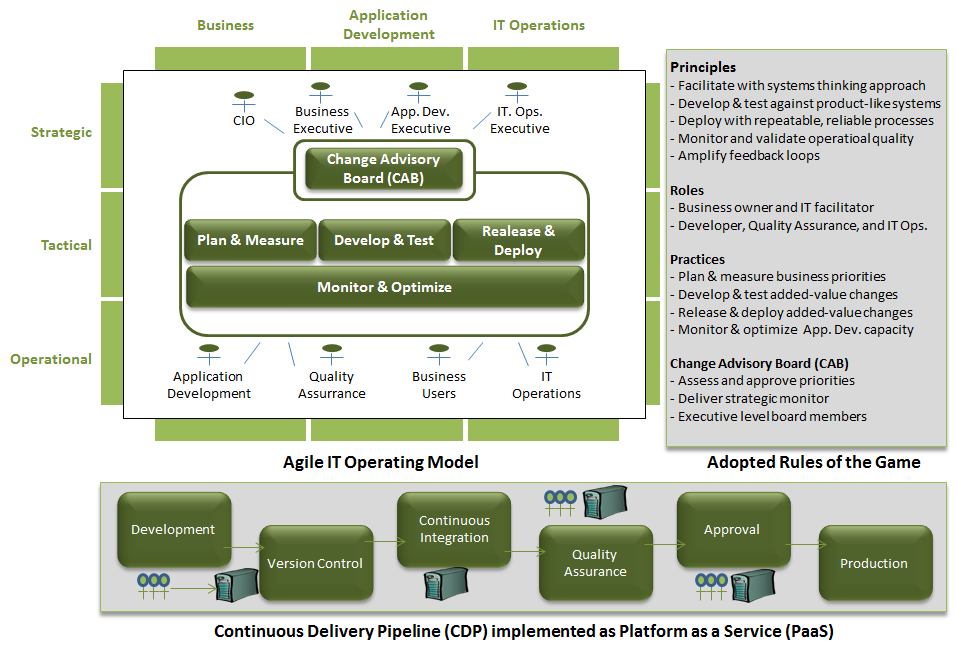
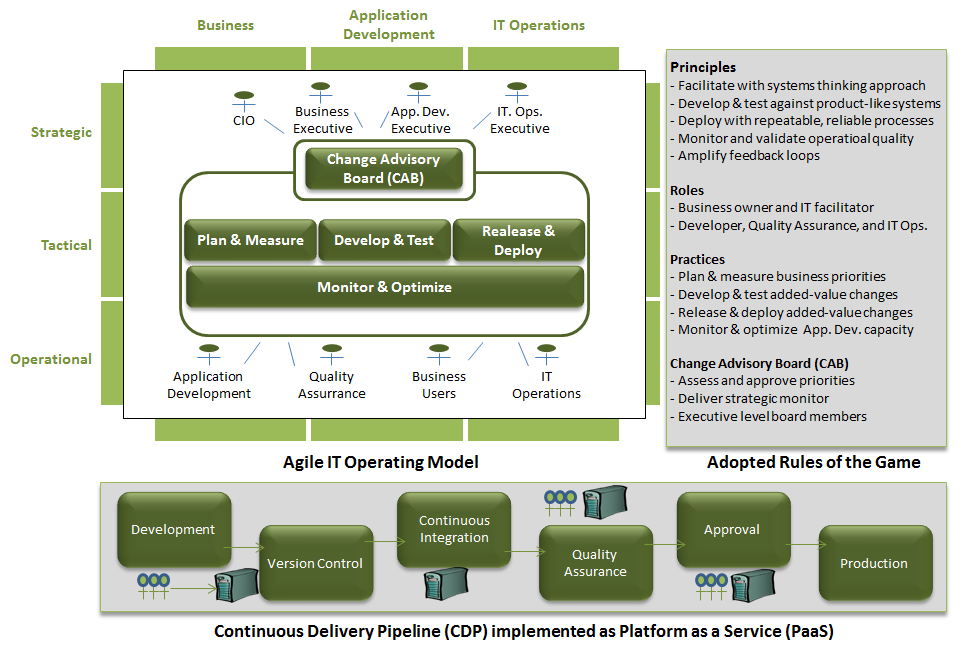
As illustrated, DevOps as a business capability is made up of three components: the Rules of the Game, the IT Operating Model and the Continuous Delivery Pipeline (CDP). Let’s explore them.
DevOps Rules of the Game create the conditions for lean and agile IT environments
Rules of the Game are a fundamental dimension of DevOps: They enable the establishment of lean and agile environments. I refer to them as the DevOps non-technological piece.
In practical terms, they’re a set of principles, practices, roles and responsibilities and tools institutionalized to ensure accelerated applications delivery.
They serve as catalysts to specific organizational and operational effective practices. Let’s take the principle, “Facilitate with system thinking (involvement of all relevant stakeholders)”—it forces application development stakeholders to adopt a collaborative mindset, which in turn breaks down organizational silos to eliminate the impediments to operational flexibility and institutionalize cross-functional collaboration.
They’re the poor cousin of today’s DevOps practices, which ignore them in favor of more technical and technology issues. That’s a terrible mistake that reduces DevOps influence vs. the digital economy’s challenges.
The agile IT Operating Model establishes the lean and agile work environment
The IT Operating Model reflects the interactions that take place across your application development value stream. In practical terms it represents the work environment derived from the application of DevOps’ rules of the game.
I always remind my clients that DevOps’ rules of the game aren’t theories, they’re the foundations of a tangible strategic capability: the lean and agile IT environment. They demand a thorough transformation of your application development work space to put together business, application development, and operations:
The lean and agile IT work space for the digital era illustrated (Credit: O.C. Tanner)
The picture illustrates what’s meant by lean and agile IT environment, it substantiates Adam Jacob’s point that “Fundamentally DevOps is about taking the behaviors and beliefs that draw us together as people, combining them with a deep understanding of our customers’ needs, and using that knowledge to ship better products to our customers.”
The IT operating model is the poor cousin of today’s DevOps practices which ignore it in favor of more technical and technology issues. Once again, it’s a terrible mistake that reduces DevOps influence vs. the digital economy’s challenges.
Make no mistake, technology matters, the CDP helps to meet digital technologies challenges
The importance of the rules of the game and the resulting IT operating model don’t suggest at all that technology doesn’t matter. Make no mistake about it, the CDP is essential; I refer to it as the DevOps technological piece. Through deployment automation and configuration management tools, it significantly accelerates application development, testing, resources provisioning and deployment.
However, one thing to be aware of is, digital economy raises technological challenges that transcend speedy delivery issues. They include:
The importance of IoT
The pivotal role of predictive analytics
The increasing importance of APIs
As a matter of fact, IoT devices generate massive data and making use of it to generate revenue requires big data technologies to integrate, automate and analyze them.
On the other hand, this ocean of IoT data has generated an API business; the idea is, to monetize their data and generate revenue, businesses must provide their customers and partners with APIs that easily give access to their systems.
Implementing the CDP as part of PaaS cloud services can help to prosper in the digital economy; it allows businesses to benefit the cheap and on-demand computing, storage and network resources provided by the cloud.
Takeaway
In hindsight, with a business-oriented perspective, the ITaaS delivery model and DevOps follow the same goal: Provide business lines with the lean and agile IT environments they need to be flexible enough and responsive to meet the competitive challenges of digital economy:
Like DevOps, the ITaaS delivery model (…) takes advantage of an agile IT operating model to help businesses succeed in the digital era. It implements consumer-provider relationships across the IT value stream to ensure organizational flexibility and operational agility.
CIOs must realize that what matters to the business is to continuously generate revenue through improving customer experience and increasing customer value. Deploying applications at the speed of light for the sake of speed doesn’t make sense from a business perspective; as long as expected business benefits aren’t achieved, speed is a useless gadget.
Implement DevOps as what it is: a three-dimension IT capability including rules of the game, IT operating model and, of course, continuous delivery pipeline.
While the advancement of DevOps methodology remains fairly nascent for many organizations, an ever-expanding class of leading practitioners are evolving a wide range of related best practices.
Beyond the well-worn concept of “unicorns” – the scant few organizations that stand as mythical examples of DevOps nirvana – this broader set of early adopters have begun to pull back the curtain on their efforts, lending further detail to the strategies that have bred this current model for success.
Last week, industry analysts Freeform Dynamics published valuable research that highlights the ongoing work of such DevOps innovators, dubbed as “Digital Disrupters” for their accomplishments in pursuing larger digital transformation. The report “Exploiting the Software Advantage” – sponsored by CA Technologies, outlines a critical set of initiatives crucial to navigating the DevOps landscape.
What are the specific hallmarks of those organizations leading the charge? Where are others struggling to catch-up? Many of the Freeform Dynamics survey results, based on 1442 respondents, reaffirm widespread DevOps observations, while other findings serve to shed new light, including:
Everyone builds software: Perception is, in fact, reality and to deeply engrain digital transformation, Digital Disruptors are increasingly identifying with this mantra. While 95% of leaders have committed to becoming more app-centric, only 51% of mainstream organizations have adopted this persona. Similarly, 84% of Disruptors directly identify as “software companies”, regardless of industry, compared to 40% among the masses.
Transformation is required: This point may seem obvious, but it certainly bears repeating. A whopping 92% of leaders have actively moved to break down traditional silos between Dev and Ops, with 51% of those organizations having already completed this work. By comparison, only 18% of mainstream organizations claim to have done the same, supported by 59% who at least share this more collaborative DevOps vision.
Commitment is critical: This may also seem like a no-brainer, but the numbers bear out this requirement. Some 77% of Disruptors have agile development methodologies in place, with 70% having “broadly” implemented DevOps activities. For mainstream organizations, these metrics rate at only 31% and 21%, respectively; leaders are going all-in and appreciating the benefits, and those that follow will need to do the same.
Experimentation is omnipresent: To garner the benefits of continuous delivery, embracing trial and error is a must. Among Disruptors, 93% recognized the need to “experiment and fail quickly on the road to success”, compared to only 58% of mainstream organizations. Some 95% of leaders have already shifted from fixed product cycles to continuous innovation, while only 56% of the mainstream have made this leap.
APIs are everywhere: Ubiquitous integration, both in-house and in connecting to third parties, has only increased emphasis on the API. Disruptors are resoundingly focused on API management, with 68% using APIs to integrate third party services into their applications, and 66% to offer external access to systems and data. Mainstream peers compare at only 26% and 24%, respectively, denoting a sizable API management gap.
These are only a handful of the most dramatic and obvious areas where DevOps advocates have clearly re-architected their approach, separating themselves from those organizations that have yet to go all-in; it doesn’t stop there.
As highlighted in the research, other areas of differentiation and dichotomy include cross-functional alignment, emphasis on digital channels, use of digital to drive core business efficiency, and even funding of digital investments.
Beyond these key philosophical milestones that litter the pathway to DevOps success, the survey also highlights the vast array of strategic goals that these organizations have sought to accomplish. The results spotlight the massive range of significant business benefits that practitioners believe DevOps can deliver.
Leading use cases include:
Improved customer satisfaction (49%)
Better workforce productivity (44%)
Improved customer experience (41%)
Improved competitive differentiation (38%)
Better agility / speed-to-market (37%)
Opening up of new markets (35%)
Creation of new business models (30%)
Creation of new routes to market (26%)
If one were to take those outcomes out of context, unrelated to the impact of DevOps, it’s fair to say that they read like a generic list of leading business initiatives – further underlining the movement’s overall relevance.
That’s not to say this is all accomplished easily. Report respondents detail hard won victories that required significant time and investment to achieve all this DevOps-driven advancement. After all, the notion of “disruption” doesn’t exactly evoke images of ease or comfort.
Click here to read the report for yourself – there’s a lot more to be considered. Namely, how well your organization measures up in affecting digital transformation in its own right, and where it can take steps to move forward.


 Michael Segal is vice president of strategy at NetScout. His product management experience spans across 10 years at Cisco Systems, where he managed all aspects of product line life cycles for several successful product lines. Michael’s technical areas of expertise include SaaS/cloud, virtualization, mobile IP, security, IP networking, Wi-Fi/wireless, VoIP and remote access. Michael holds patents in areas of networking and wireless mobility. Connect with him on