IDG and Insight Datalink recently conducted a survey into how companies were doing on their digital transformation journey. Like so much in technology these days, it is easy to feel as though you’ll be left behind if you aren’t well on your way with digital transformation.
You’re not.
Who Are You People, Anyway?
The survey had decent industry distribution and was focused on director level and above in larger organizations, with more than a third of respondents in financial services or high tech. So in short, a third of respondents are the very organizations most motivated to implement a digital transformation project.
Nearly Half of Respondents Haven’t Even Started
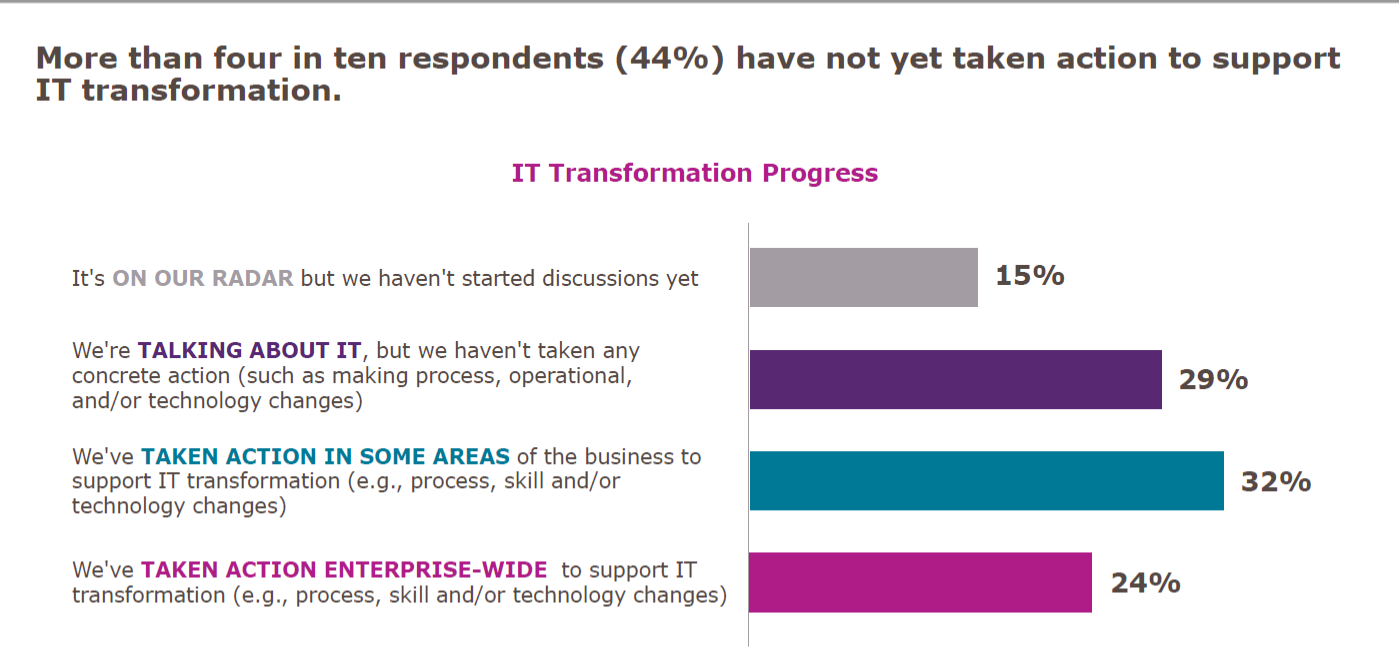
Let’s get the easy one out of the way first: The survey showed that a significant proportion of companies had done nothing more than talk about digital transformation.
Adding up “It’s on our radar” and “We’re talking about it,” we get to 44 percent of respondents who haven’t even started. In fact, due to the nature of digital transformation, I would argue that less than 1 in 4 are actually doing it. Then there is the 24 percent who are undertaking enterprise-wide transformation: You can convert projects, but that isn’t transforming the way you do business. It is a start, so I admit this is well and truly a debatable statement, but true transformation is cross-app, cross-team, agile and locale-mobile.
Why So Small?
Since we frequently hear about digital transformation and how important it is, “Why are the numbers so low?” is a valid question. The truth is that transformation of complex infrastructures is difficult. There just isn’t any way to get around that fact. When there is a mainframe with heaps of data and a midtier that often has replication of mainframe functionality on it, then separate apps that are doing web-based transactions in (insert language here, but normally Java in the above environment), there are many parts that are complex, and something as simple as moving and/or rationalizing data stores can be majorly complex.
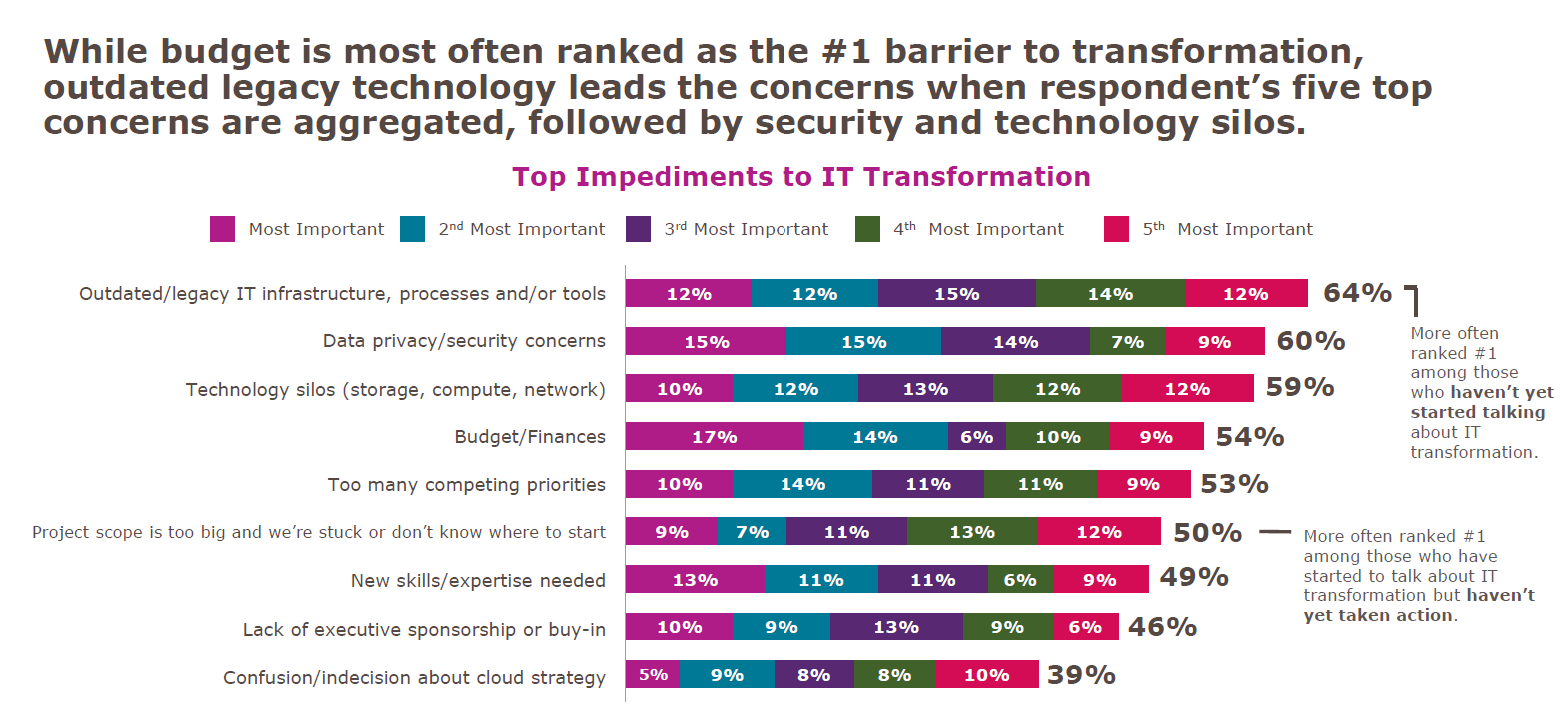
But I won’t go on and on here, I’ll simply show you what IDG found.
Looking at mainframe toolsets in particular, there have been massive steps forward over the last several years to make them more compatible with modern development and deployment practices. But making use of those changes often requires updating systems that are not otherwise broken. And there is always the risk that such updates will break something. The more research an organization does into modernization tools, the more comfortable they are that there is a valid path—but that doesn’t make it easy when it is added work.
Data privacy also ranks high, and that is because IT has been dealing with locking down data in a data center for ages. Additionally, some spectacular configuration mistakes in public cloud datastores have made us all gun-shy. There are solutions to data security in public cloud from a variety of companies, but that doesn’t change that we’ve all followed “due to bucket misconfiguration” stories while cringing.
Technology silos are a fact of IT. There can be some breaking down of those silos, but they are unlikely to disappear completely. The EMC specialist or Cisco specialist are unlikely candidates for elimination in the quest for reduced silos. (I just picked two roles whose knowledge sometimes astounds me—both for the depth these people can have, and for the requirement that they need that depth.) Working your network and storage teams into the digital transformation without undermining the thing that makes them valuable—their silo-specific knowledge and insight—is a challenge that can be achieved, but not by “breaking silos”; more like, “increasing communications between silos while reducing silo behavior.”
If You Dive Like That, You’ll Stall!
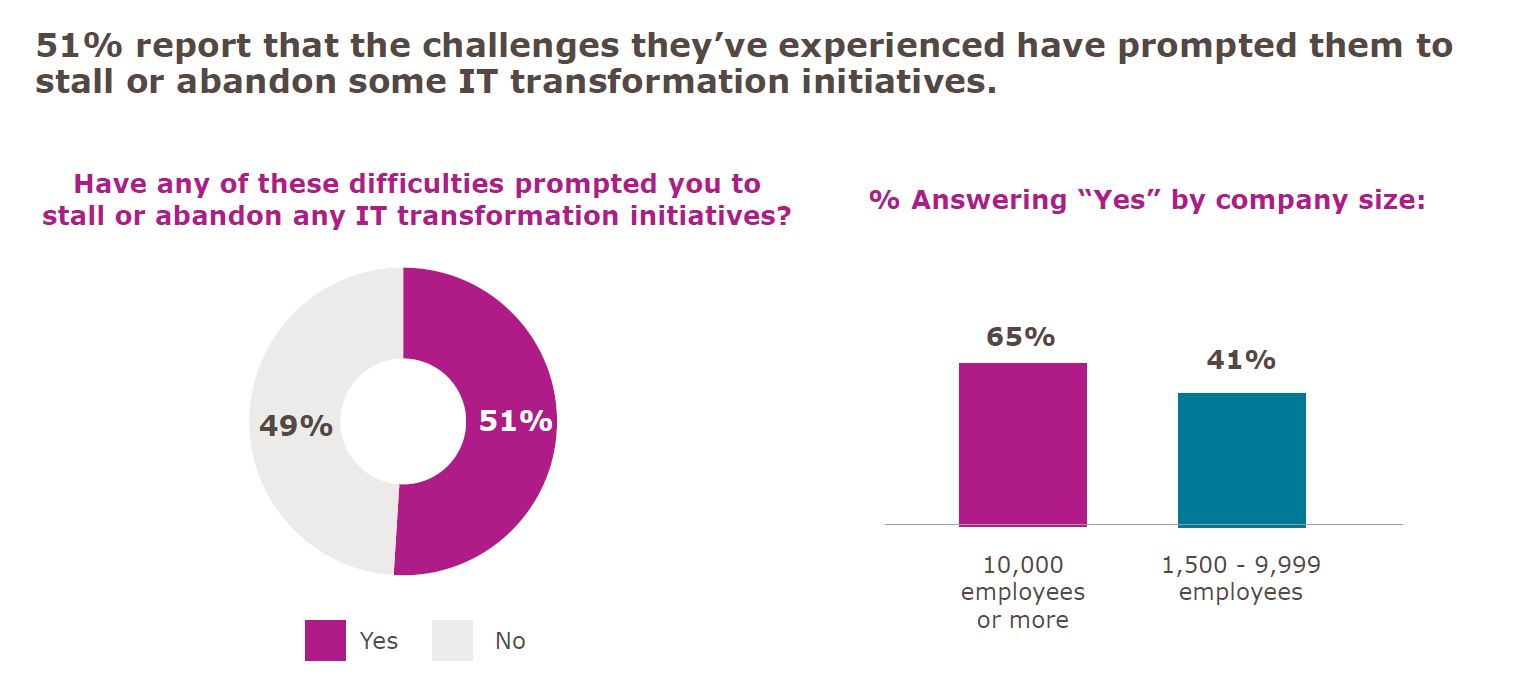
The last point in this survey that I’d like to address is the “Stalled Digital Transformation Initiatives” slide. (There is a ton of good data in this survey, but these three fit together really well, so I pulled them out.) The fact is that if you are attempting to transform a complex system, you will have wins and losses. Some things will work out better than you planned, while others will not work out as you had hoped at all. I believe that, due to the question’s wording, that is what we are seeing here:
Yes, 51 percent would be appalling in any other context, but the question was, “Have any of these difficulties prompted you to stall or abandon any IT transformation initiatives?”
Any is a big word. In fact, any is the largest word in that question. If it were worded with “your” instead of “any,” I will guess the positive answers would be a limit approaching zero.
If you pronounce a large reorganization and implementation of a slew of new processes, statements such as “that doesn’t fit our infrastructure” are going to shake out. That doesn’t spell doom and gloom for digital transformation; it is simply another obstacle to overcome. Dropping it for now, while focusing on the more viable portions of the plan is common sense, unless whatever isn’t working is core to the transformation. Then it still causes you to stall while figuring it out.
Honorable Mention
On average, respondents said they expected more than one-third of their digital transformation activities to be conducted by third parties. That’s a big chunk. Not “off-shoring” big, but still a large portion of work they expect to outsource to get the job done.
So. Much. Typing.
Okay, I’m about to shut up now. The takeaway is pretty straightforward. Contrary to hype, you’re not behind on your digital transformation. It’s a tough job, and knowing what you hope to get out of it before starting will help you to continue when things get rough. And they will get rough. The word “transformation” should tell you that. But keep going: There is better/faster/smarter/more mobile out there if you can stay on track, and because they are complex systems getting complex modifications, slow and steady does indeed win the race.
And just remember, you’re responsible for those horribly complex, hard-to-transform systems doing what they do. Every day. Making them better and easier to manage is a no-brainer, but so is taking a moment to bask in the idea that you’re keeping things running in an environment that is complex.
We’re well past software “eating the world.” According to Tricentis CEO Sandeep Johri, software has become irreversibly intertwined with the world. You can’t find a modern enterprise that doesn’t depend on software, or a business transaction that doesn’t require software at some point in the end-to-end process. In the new world of digital business, companies that deliver differentiating customer/user experiences through software have the clear competitive advantage. Those that cannot are living on borrowed time.
In response, every CIO is now focused on digital transformation initiatives that ensure the company is disrupting, not disrupted. From an IT perspective, this requires faster delivery of innovative software and greater agility—the ability to pivot as soon as you identify a new opportunity or challenge.
Everyone agrees that this is a priority. Developers are producing software faster than ever before, and Ops can now deliver applications in a matter of seconds. So, what’s holding us back? Testing.
When Johri talks to CIOs about how their digital transformation is progressing, the same basic story always emerges: Organizations transform Dev and Ops, but then testing cannot keep pace … and they get stuck. The tools and processes architected for traditional months-long release schedules simply don’t fit modern delivery cadences, which require immediate quality feedback with each new build. It’s a sad but simple fact: If you have a slow testing process standing between highly accelerated development and operations processes, there’s just no way that you can achieve the desired delivery speed.
Many companies have already recognized this—and they’ve galvanized their digital transformation initiatives by modernizing their testing. By re-examining and re-inventing software testing across their organization, they went beyond removing the “testing bottleneck”—they’re also driving the positive user experiences that can now make or break a business.
Many of these distinguished quality leaders joined thousands of software testing professionals from around the world at Accelerate 2018 in Vienna, Austria. This year, the conference theme was “Digital Transformation Requires Continuous Testing.” To ensure that the conference thoroughly covered both the digital transformation and continuous testing sides of that topic—as well as the core intersection between them—we invited CIOs as well as quality leaders to share their perspectives. Here are some of the key insights that are most pertinent for executives leading digital transformation initiatives.
Archaic Testing Approaches Can Cause a ‘Brain Drain’
Merck sought out top development talent to advance their digital transformation initiatives. When those developers started quitting, (now retired) Merck CIO Clark Golestani wanted to know why. He learned that the No. 1 reason for these developers leaving the company was the company’s testing practices. Developers were “fed up” because the company was still using traditional testing practices within Agile development processes—and developers believed it was undermining their hard work and dedication.
That’s the precise moment that Merck launched its testing transformation. Ultimately, the testing organization changed the way testing was done, dramatically reducing attrition and enabling faster delivery with superior levels of quality. According to Golestani: “If it weren’t for the testing organization driving that change, they would have been an inhibitor. We would have never been able to release the types of products we do, and the technology would never work the way that it needs to. It’s absolutely essential.”
Agile, DevOps, Cloud and Testing are Inextricably Linked
Agile, DevOps, cloud and testing transformation are all interlinked as part of a broader digital transformation. Andy Sturrock, CIO of one of the world’s largest energy companies, stated: “All of these things are self-reinforcing. You certainly don’t get the full benefit of one without doing the rest.”
He explained the Ops team used to be the primary bottleneck to moving applications to production (just getting servers provisioned could take weeks or months). Now, the cloud relieves that bottleneck—and that places a lot more pressure on the “apps” team, which tends to emerge as the new bottleneck. “You can write code as fast as you want, but if you can’t test it, you’re not going to get into production quickly,” he said. “Testing has to become automated, and the role of the tester must evolve.”
When Software Runs Your Business, Software Testing Becomes a Business Issue
According to Golestani, nearly $1 billion US in revenue passes through Merck’s SAP instance each week. Consider that this instance is updated at least four times a year, and more than a thousand changes are made each time. Manual testing is simply not an option. No amount of manual testing can thoroughly de-risk the core business processes, given the frequency of updates, scope of changes and breadth of functionality that’s impacted. Extreme test automation is the only way to achieve the required business risk coverage with the necessary speed.
Due to the nature of Merck’s business, lives also are at stake. Merck ships billions of medicines and hundreds of millions of vaccines each day. The company’s continued focus on digitizing the business means that software runs everything from the shop floor to the way that they interface with customers and educate 4 million healthcare practitioners. As Golestani explained, “When the software driving all this fails, nothing ships, manufacturing shuts down, research shuts down … and people die.”
It’s Not Easy, but Transforming Enterprise Testing Pays Off—Significantly
Global 2000 organizations that want to implement continuous testing—the extreme test automation required for DevOps—need to overcome challenges such as:
Highly complex application architectures (e.g., processes that cross browsers + APIs + mobile + SAP + other packaged apps + custom Java/.NET apps + mainframes).
Different application types, planning cycles, development methodologies and tools existing in parallel.
Deeply ingrained quality processes across different groups and projects.
Scarce test automation resources.
“Bloated” test suites that delay the process while providing limited business value.
There is no silver bullet. Transformations take time and they must involve all of the people, processes and technologies associated with your application delivery pipeline.
Nevertheless, you can rest assured that your efforts will pay off. Consider just a few examples of how organizations that committed to transforming testing are now growing the business and enhancing the customer/user experience:
Duke Energy achieved a $9 million cost savings during the first year of its testing transformation—and it also reduced testing time by ~ 85 percent. This enables the company to more rapidly deliver software that transforms the customer experience, modernizes its energy grid and creates a smarter energy future.
SPAR accelerated time to market 3X, enabling the company to expand its online presence across Europe, deliver more customized shopping experiences and provide seamless “omnichannel” experiences across the customer journey.
EdgeVerve now releases 30 percent more new functionality in cycles that are 60 percent shorter with 50 percent fewer escaped defects. This enables the company to help its global banking clients onboard, sell, service and engage customers with flawless personalized experiences.
ExxonMobil saved $140 million in cost avoidance and increased productivity 3X. This enables the company’s IT department to take on more projects and complete them faster—which in turn helps the company boost sales and increase customer loyalty.
Vantiv (now Worldpay) transitioned from eight-week testing cycles to daily testing, which has been critical for enabling rapid growth and agility during the recent Vantiv-Worldpay merger.
Continuous testing was once just an aspiration. Now, the drive toward digital transformation has made continuous testing a business imperative. Organizations such as these are paving the path forward, demonstrating that continuous testing can—and must—become a reality in enterprise organizations.
As digital technology continues to disrupt and transform businesses across industries and around the world, the ability to deliver high-quality software rapidly will make the difference between survival and extinction for many companies. DevOps seeks to change the dynamics in which operations and development teams interact. Ultimately, successful adoption of DevOps and the process of continuous delivery are likely to determine whether an organization thrives or fails in the digital age.
To build a sustainable DevOps culture and achieve true DevOps success, organizations need to consider the DevOps Trinity—people, processes and tools—and understand how to connect all three:
People and Culture
The core tenet of DevOps is a culture of collaboration and shared goals, which eliminates finger-pointing and promotes teamwork, with everyone working together in support of the same outcome—reliable software quickly delivered to production. In essence, the goal is to enable the different stakeholders in the software development and delivery process to reach the mutual understanding and empathy needed to drive alignment on shared goals. To achieve this change, teams need to have trust, honesty and responsibility.
Process and Practices
DevOps aims to achieve predictable, efficient, secure and sustainable operational processes. Using a DevOps approach, simple processes become increasingly programmable and dynamic. Automation supports this objective by using technology to streamline the steps within the process.
Tools and Technologies
Some categories are more essential in a DevOps toolchain than others, especially continuous integration (build) and infrastructure as code (configure) tools. The common elements of the toolchain include applications for coding, building, testing, packaging, releasing, configuring and monitoring. Often, rather than a single tool, there are sets of tools (or toolchains) of multiple tools, that make up the process.
A sustainable DevOps organization cannot be achieved without all three components of the DevOps Trinity.
For those looking to learn more about people, processes and technology needed for successful DevOps implementation, join us in San Francisco Sept. 16-19 for DevOps World | Jenkins World. With this year’s conference theme “TRANSFORM,” attendees will learn how organizations are transforming software delivery, adopting DevOps and returning business value to their organization from DevOps initiatives.
Don’t miss Viktor at DevOps World | Jenkins World! Be sure to register today for 20 percent off your registration using the special devopsy.kinsta.cloud code just for our readers: JWDEVOPSCUST
To succeed with their digital transformation initiatives, companies need to use data to the full extent of their capability. Having the right data and applying it to the right problems can help companies gain new insights, create new models and disrupt stagnant processes. No argument there.
The problem is, not everyone is putting their data in a position to succeed. According to analyst reports, many IT departments are behind the curve in developing processes to integrate their data, leaving them at a disadvantage when it comes to supporting their organization’s digital transformation efforts.
Why is this happening? How big is the issue? And what can companies do about it?
An Explosion of Data
The why is easy to answer. Data is running wild, and society hasn’t fully figured out how to rein it in. There have been shifts in the way data is being created and consumed, forcing companies to rethink the way they integrate it and manage it on a broad scale.
On the creation side, business data volumes are exploding, doubling nearly every year, according to some estimates. Data integration has evolved from an environment where traditional endpoints remained static to one of modern endpoints that are dynamic and constantly changing. Plus, the technology landscape itself is undergoing continuous transformation, with the regular emergence of new applications and business models.
Data consumption is changing, too. Companies are reacting by trying to adapt integrations quickly, make changes and fixes as fast as possible, keep data secure and stable, and give more users access to the technology to avoid IT bottlenecks.
To manage these more complex, data-driven processes, many organizations are still trying to handle integration projects by writing custom code. This is typically done to meet development efforts triggered by an immediate business need. The benefits can seem enticing: The staff can get started right away, there are no new development tools to bring on, and deployment is simple.
But there are hidden costs to doing custom data integration. The inability to reuse code forces developers to rewrite integrations over and over. Brittle code can create a maintenance overload. When developers leave, the organization’s knowledge base breaks down. And custom work tends to address one set of business parameters, creating a lack of standardization and further duplication of work and planning.
The Benefits of Hybrid Integration
Using a hybrid integration model, organizations can leverage an assortment of tools to support today’s level of pervasive integration, spanning deployment models, diverse endpoints, integration domains and constituent users of integration technology. These hybrid platforms tend to include more enterprise-focused competencies ranging from prebuilt workflow templates, connectors, and automated management and maintenance capabilities.
How equipped are today’s organizations in data integration? According to a Gartner report released earlier this year, “IT organizations struggle to meet the challenge of pervasive integration for digital business transformation.”
In its report, “Use the Integration Maturity Model to Assess and Improve Your Integration Competency,” Gartner outlined a “five-level integration maturity model based on more than 20 years of analysis of the integration technology market and organizations’ approaches to integration. Each level is characterized by the degree of mastery of integration challenges in terms of awareness, organizational settings, technology platform use, methodology, approach and sourcing policy.” The firm estimated that 55 percent of Gartner clients (including SMBs and large enterprises) are in the “Getting Started” phase at either level 1 (ad hoc) or level 2 (enlightened) and less than 5 percent of Gartner clients (including SMBs and large enterprises) are in the “Staying-on-Top” phase, at level 5 (plug and play).
How can your organization evaluate and improve its integration maturity? How can you help move the needle?
Here are a few tips to position your company better to handle data-related challenges.
Traditional point-to-point integration solutions typically fail due to integration complexity, error handling, divergent practices and change management. Take the time to evaluate and understand the total cost of managing and maintaining custom coded data and application integrations before you commit your highly specialized resources to the projects.
Evaluate the benefits of implementing a unified approach for converged data and application integration using a truly hybrid data integration platform that provides reusable integration templates that can be configured and deployed for ad-hoc and enterprise data hub use cases alike.
Look to the future and choose a platform that supports a variety of integration management and deployment options, and avoid cloud lock-in with iPaaS-only providers.
Conclusion
Integrating data isn’t easy. Data is coming from more places and used in more ways by more people than ever before. Organizations that develop strong data integration capabilities will do a better job leveraging the data they need to drive transformation projects forward in a positive way.
A few years back companies used innovation and digital transformation mostly to differentiate themselves and to stay competitive. The drastic growth in digital and cloud computing over the last couple of years have changed this mindset.
Today, organizations have to be innovative and leverage the latest technologies just to sustain and stay in business. Enterprises that implement online retail business, online banking and several other online services aren’t considering those channels simply as another route to increase their revenue—they have realized that online services are fast becoming their primary revenue channel. According to Forrester’s Report, “The Digital Business Imperative,” data analyzed just for three months showed that 84 percent of U.S. banking customers had used online banking for their transactions and 43 percent of the customers had used a mobile phone for these activities.
Organizations are working at a very fast pace reviewing and analyzing their processes to seize opportunities for digital transformation. It is important to understand that to realize digital transformation, companies may need to completely re-engineer their current processes to make use of technologies such as the internet of things (IoT), big data analytics and artificial intelligence instead of doing patchwork on existing processes to adapt to digital technologies. It is also important for senior IT executives to consider digital initiatives in tandem with their cloud strategy instead of treating them in isolation. There is absolutely no doubt that the scale, speed and massive infrastructure requirements such as compute power, storage and other associated platforms to support these technologies are best provided by the cloud. The question to ask is, “Are we going to develop and host the infrastructure we need to support digital, or are we going to leverage the constantly improving robust infrastructure and services that cloud providers are offering?”
Organizations that plan for massive growth and transformation are usually the ones that invest considerably in technology to support innovative ideas. Advancements in the digital space help fuel innovation, but without a solid cloud strategy accompanied by agile development processes, ideas are likely to remain simply as ideas on paper and will take forever to get materialized into products or solutions that provide value. In today’s context, digital and cloud are almost inseparable due to the robust infrastructure, services and tools available on the cloud to support digital initiatives. All leading cloud providers offer competing solutions and services to help organizations move forward with their digital initiatives at a rapid pace.
In my previous article, “Transforming with the Cloud: If Not Now, When?” I touched upon some of the key areas that organizations should be considering with regards to transforming their businesses with the cloud. I have attempted to structure this article in a similar fashion, with the focus being on the role played by cloud to support some of the key digital technologies such as artificial intelligence, big data and analytics and IoT. The idea is to provide a very high-level overview of the digital landscape and how the leading cloud providers are helping enterprises with their digital initiatives.
Artificial Intelligence
The digital revolution, which centered around mass production of computers and communication devices, has changed the way businesses have operated over the last several decades, resulting in constant improvements ranging from generating new ideas for products and services to innovative product designs to improving the customer experience. At present, the world is going through another, possibly even stronger wave of revolution. It is the use of artificial intelligence to perform complex cognitive tasks to solve business problems in ways that previously were either highly complicated or extremely resource-intensive. Most organizations deal with business propositions that yield small to medium value and require a high volume of human work, such as reviewing large numbers of documents such as RFPs to understand requirements and estimate costs versus returns to determine whether to proceed with those proposals. AI is proving to be the best alternative to handle cases such as these that are currently being dealt by human beings, but the volume of work involved challenges businesses on the feasibility of continuing those without AI.
AI systems try to mimic the human brain, which uses patterns to generate perceptions, and logic to drive the structured approach of analyzing a situation from a rational perspective. AI systems process large volumes of data that could come in from various sources such as sensors, online applications, textual data from social media and the like. AI processes the data using perception to analyze patterns and incorporates machine learning to utilize structured evaluation methods and rational decision-making, not only to extract pieces of meaningful information, but also to assemble such pieces of information to make valuable decisions.
Cloud plays a significant role in enhancing the power of applications that incorporate AI. Almost all major players in the cloud business have developed AI services that use powerful cognitive engines to process structured data such as relational databases and unstructured data from NoSQL databases, sensors and other technologies that get uploaded to the cloud. The robust pattern-matching algorithms and the powerful logic component built into these cognitive engines are highly sophisticated. Data and compute power are the two most critical requirements to make these engines effective. The engines predict more accurately with larger datasets. AI applications such as image recognition, video analytics, natural language processing and speech recognition leverage machine learning using highly sophisticated neural networks that perform detection and prediction from large volumes of data. Parallel processing with the use of graphics processing units (GPUs) make these data processing and computations faster. Building and implementing such robust GPU-based parallel processing engines on-premises would be a very expensive and resource-intensive initiative. Cloud addresses this problem by providing APIs to access several machine learning services such as video analytics, speech recognition, process automation, vision detection and natural language processing. Behind these APIs are complex infrastructures that combine the power of clusters of GPU-based compute engines, neural networks and data lakes.
Amazon’s AWS Marketplace offers machine learning and AI software solutions from several major software vendors to help AWS customers increase the efficiency and productivity of their businesses. AWS’ artificial intelligence solutions offer several pretrained services that can be utilized by developers to add intelligence to their applications via simple API calls. Advanced deep learning functionalities are provided by Amazon Lex, which chatbots could incorporate for automatic speech recognition and natural language processing abilities. Similarly, AWS provides Amazon Polly to build applications that can convert text into speech delivered in natural sounding male or female voices. Amazon Rekognition, meanwhile, uses technology to analyze billions of images, so applications can be developed to search images, detect and compare faces, objects and scenes.
Google Cloud also offers competing products and services to support their customers’ AI initiatives. Google Cloud Natural Language provides powerful machine learning models that analyze text to provide meaningful insight such as customer sentiments about a product via conversations on social media. Google provides Cloud Speech-to-Text, a service that understands about 120 languages and converts audio to text. Similarly, Cloud Text-to-Speech can convert text to natural-sounding speech in 30 different voices and in several languages. Google also provides products such as Cloud AutoML, a suite of machine learning products, and Cloud Machine Learning (ML), a managed service that can be leveraged by developers and data scientists to build powerful machine learning models.
Microsoft Azure provides the infrastructure, tools and services to build smart applications with data that can live in the cloud, on-premises or on edge devices. Several products and tools are available via marketplace, and Azure provides sophisticated AI services to integrate the tools to develop intelligent business applications. Powerful chatbots could be developed by integrating Azure Bot Service, language understanding and external systems such as Office 365 and Dynamics CRM to streamline and automate common activities. Another example is an automated failure detection system for assembly lines built based on Azure’s image classification system using a convolutional neural network to help improve the identification of faulty electronic components. Azure also provides Visual Studio Code Tools to build, test and deploy AI solutions. The powerful AI Toolkit for IoT Edge from Azure enables IoT devices with AI that runs locally through pre-built deep learning models. Last but not least, Azure’s Machine Learning Studio helps develop and manage predictive-analytics solutions.
Big Data and Analytics
With the growth of internet, cloud and social media, there has also been an exponential growth of data across the world. According to statistics on big data generation in the last five years, the average volume of data created in the world every day is about 2.3 trillion Gigabytes. When the nature of the data was more structured and organized, companies relied on data warehouses and BI applications to help make important data-driven business decisions. Traditional data warehouses were built based on relational databases that could be queried using SQL; the data could be extracted, transformed and loaded from one or more data sources via ETL jobs that ran up to several times a day. This overall approach has proved to be ineffective when it comes to handling and modifying continuous streams of real-time data flowing in from multiple dissimilar sources such as social media, IoT, the public web and relational databases. Big data analytics, which helps examine large structured and unstructured data sets, has become a major enabler for enterprises to make critical business decisions by providing insight and knowledge with data mining, predictive analytics and forecasting. As big data processing evolved, the concept of data lakes came into existence. A data lake is a centralized repository that allows the storing of structured and unstructured data as is and enables the use of a variety of tools and approaches to answer business questions.
The ability of the cloud to scale vertically and horizontally makes it the ideal platform for big data hosting and analytics. With vertical scaling, it is possible to increase the capacity of a server by adding resources as needed by the applications. Horizontal scaling allows expanding hardware as the processing requirements increase. Hadoop, which leads the big data revolution, is designed as a distributed system so that it can take advantage of scaling. Parallel processing is an important part of its design so that the system can process several independent small tasks such as serving data stores and file systems, processing streaming data and handling queries in tandem. Cloud-based systems offer high bandwidth, enormous amounts of memory and scalable processing power to help big data applications with improved real-time processing and analysis of streaming data. Cloud undoubtedly is an obvious choice for applications running large workloads and storing enormous volumes of data. Cloud providers offer highly scalable database services coupled with tools and services to support information-management, business intelligence and analytics.
All major cloud service providers offer competitive and comprehensive tools and approaches to process big data at the volume and velocity that your business demands, while at the same time being conscious to reduce the associated operational costs. To perform faster and efficient transfer of petabytes of data to the cloud, AWS provides solutions that employ different techniques such as network multiplexing, reduced storage footprint via data deduplication and compression and advanced data replication. AWS offers services including Amazon Elastic Compute Cloud (EC2) and Simple Storage Service (S3) to provide the elasticity needed for your data lake along with your choice of database products, ETL and reporting tools via AMS Marketplace solutions. Similarly, with Microsoft Azure HDInsight, solutions can be developed using open-source frameworks such as Hadoop, Spark and Hive to analyze streaming or historical data. To process large volumes of data, HDInsight offers a broad range of cost-effective solutions for ETL and data warehousing. Azure HDInsight offers specific cluster types such as Apache Hadoop, Apache Spark, R Server and Apache HBase, with cluster customization capabilities such as adding components, utilities and languages.
Internet of Things
IoT is the concept of connecting devices such as security sensors, surveillance cameras, smartphones, smart watches and other wearables and even household appliances such as washing machines, refrigerators and several others that have the ability to communicate and transfer data over the network without direct human interaction. This disruption in technology has not only empowered individuals and families with greater control of their household systems and appliances, but enabled organizations with data that provide greater insight into critical areas of business interest, opening the doors for innovative products, solutions and new business opportunities.
The rate of adoption of IoT by businesses is growing exponentially as the number of connected devices continues to increase. As per Gartner’s recent study, businesses could already be using as many as 3.1 billion IoT devices today, and by 2020 this number is likely to rise to about 7.6 billion. According to an article in Forbes, IoT will have an impact in all industries, from manufacturing to logistics to health care. We are not too far from the days where nearly everything in the world will be connected. IoT is at present playing a dominant role in optimizing production, managing supply chains, tracking assets, making financial decisions and improving the customer experience. Digital transformation of the fitness industry has been remarkable. Wearable devices with built-in sensors can constantly collect data on physical activities such as distance travelled, calories burnt and sleep patterns to provide detailed analyses and insight for continuous health care. IoT applications are designed to use data from connected devices, and the sophisticated tools available in the cloud let you visualize, explore and build complex analytics. In complex IoT applications that use several devices, it is important to understand the state of the devices and to frequently communicate to the application components that leverage those devices. It is also essential to ensure secure identity and access between devices and applications.
As with any revolution in technology, IoT also has its associated challenges. With more devices being connected to the internet, the volume of data generated is also immense, which in turn puts significant pressure on the internet. So there obviously is a need to support infrastructure that can transmit and store this data more efficiently. Due to the vast number of connected devices, and with that number constantly increasing, there is a push toward making these “edge” devices intelligent to perform some degree of processing and then send the results to the servers rather than sending massive amounts of data to central servers to perform all the processing. For example, surveillance cameras in the past would send all the videos to the central recording device, which in turn would record only when it detects motion. Consider the scenario where hundreds of high-definition surveillance cameras are sending video feeds constantly to the central server—the impact this could have on the network is unimaginable. It should also be noted that as the physical distance between the devices and the server increases, network transmission latency increases. With edge computing, the video cameras are smart enough to sense motion and they send videos to the cloud-based central recording system only whenever they detect motion. This drastically reduces the volume of data that is transmitted over the network and makes it a more efficient system. Cloud and IoT complement each other—connected devices generate huge amounts of data and cloud provides the infrastructure to store, process and analyze the data. It is also interesting to note that IoT is an important data source for big data analytics.
Cloud IoT Core service, built by Google Cloud Platform (GCP) partners, offers connectivity to devices by providing the necessary hardware, software and solutions. These services include secure connection of devices (via identity and authentication) over industry standard protocols including MQTT and HTTP. Cloud IoT Core also allows remote controlling of devices from the cloud by maintaining a logical configuration of the devices. Since this IoT service is serverless, there is no need for upfront software installation and the horizontal scaling of the GCP can instantly be leveraged when required. A host of tools such as Dataflow, BigQuery, Bigtable and Data Studio are available to help with data analytics and insights.
Microsoft provides services for IoT via the Azure IoT Hub. Features offered by the Azure IoT Hub include ensuring bi-directional communication with billions of IoT devices, establishing device-specific access control, secure and scalable provisioning of devices and integration between cloud and edge to distribute intelligence across devices. Azure IoT Edge provides features for optimized performance of the edge and cloud such as ensuring the lowest latency between edge devices and the cloud. IoT Edge helps control IoT costs by reducing the volume of data transferred from the edge devices to the cloud. It leverages services such as Azure Stream Analytics to process data at the edge and transmit only the bare minimum data that is needed by the cloud for further analysis.
Amazon provides a fleet of services such as AWS IoT Core, AWS IoT Device Management, AWS IoT Analytics and several others to support IoT initiatives. For easy deployment, programming and management, Amazon offers the FreeRTOS lightweight operating system for small edge devices. The AWS Greengrass software further enhances the power of edge devices by offering local compute, secure messaging and data caching. AWS IoT Analytics, a fully managed service, provides all the capabilities required to run complex analytics on IoT data to obtain insights and to build machine learning use cases.
Taking Everything Into Account
Technology is certainly a major driver in any business today and companies that struggle to integrate technology effectively will eventually find it difficult to sustain or do well in their marketplace. Connected devices, social media and massive volumes of several forms of structured and unstructured data feeds have paved the way to further leverage technology and transform businesses. This “digital transformation,” which includes use of artificial intelligence, big data analytics and IoT, is fast becoming a key requirement for organizations to be innovative and competitive. Digital has opened doors for better analytics and decision-making, leading enterprises to explore, analyze and obtain new insights and ideas on growing their businesses.
With cloud reaching a high level of maturity with regards to services, tools and security, it has become the ideal platform for digital technologies. All leading cloud providers have comprehensive and competitive solutions, tools and associated services to address even the most complex digital transformation initiatives for their customers. Furthermore, the horizontal and vertical scaling of infrastructure offered by the cloud makes it highly suitable for the compute requirements demanded by digital technologies.
Escaping from or ignoring the digital revolution will be disastrous to organizations as well as individuals. Humans and businesses are generating trillions of gigabytes of data every day. Whether we have realized it or not, digital is transforming our lives. It is important for organizations to get on board soon and devise a digital strategy that works together with their cloud initiatives and strategy.
A sure sign of a company’s successful digital transformation is when it can leverage data to optimize every area within the enterprise. As Forrester puts it, for a company to realize the return on investment (ROI) of a digital investment, “benefits from digital investments need to be aligned with the business requirements for a specific value chain stage.” All along, data-driven insights need to be tied to measurable gains and real-world business key performance indicators (KPIs).
The reality, however, is that data-centric principles are easier to apply in some areas of the business than others. The ethos has certainly taken hold in the development world—with its whole culture around DevOps, continuous delivery (CD), continuous integration (CI) and related agile methodologies that emphasize constant, data-driven experimentation and frequent reassessment and adaptation of plans.
Unfortunately, too many companies drop the innovative mindset once things progress to production and customer rollout phases. In doing so, they fail to spread the ROI from digital investments more fully across the organization. In other words, they fail to mount a genuine digital transformation.
True digital transformation requires companies apply a stronger, more agile approach to product adjustments across the value chain. Nowhere is this more critical than the need to embrace “full-stack experimentation” to realize business value from the world of data-based product development and testing.
The Limits of A/B Testing
Especially in an era when the customer experience sits at the center of the value proposition for most industries, the ability to fine-tune everything about how we bring products and services to market—and how our customers use and feel about those products and services—is mission-critical, especially in the quest for true digital transformation.
Unfortunately, no matter how agile and data-driven the development phase may initially be, we lose visibility, insight and, most importantly, revenue whenever we fail to infuse those same values into the later stages of production, QA and analysis around how customers are actually using what they buy.
Perhaps the biggest sign of this is the over-reliance of marketing teams on signals from basic A/B testing.
Industrywide, A/B testing is the most common approach to experimentation, but it’s far from ideal. A/B testing is typically used by marketing teams to test front-end changes at the user interface-level. It’s limited in its efficacy, as it does not take into consideration the deeper statistical nuances and resultant effects across the application stack—for instance, swapping out code to roll out an entirely new feature to a small set of users and measuring the results of that single deployment across both business and system metrics.
Worse yet is the false sense of security that can come from the narrow scope of A/B testing. Any outcome can be easily misunderstood as the only improvement possible. That leaves countless other variables and opportunities for ROI unexamined. If Plato remarked, “The unexamined life is not worth living,” what does that say about the unexamined product development process? How do we know if it’s worth building?
A Better Way
While A/B testing is still appropriate for some limited uses, leading-edge companies are learning to expand inquiry across the “full stack” of their applications. Full-stack experimentation differs from traditional A/B testing in scope, purpose and the potential impact on a business. It examines not just user interfaces but also execution logic, technical services, APIs and the data infrastructure underlying it all. This fosters a market-driven approach that brings more insight and less guesswork to decision-making.
To be clear, full-stack experimentation does not optimize part of a product or feature; it is about optimizing the process around experimentation and allowing development to more directly support and inform the evolution of the business. In this way, full-stack experimentation helps gain deeper value from the organization’s use of agile, DevOps and CI/CD so we can garner critical insights into how a product or feature is actually used by customers. More importantly, it measures the impact of every release on important key business metrics—which may be radically different from the developer’s intent.
Full-stack experimentation unlocks value across the entire data ecosystem. It involves collaboration among the key stakeholders involved in the development of a product or application, from engineers to product managers, as opposed to primarily marketers. You can use full-stack experimentation to answer deeper questions and test deeper assumptions. For instance, does adding the ability to tag friends in a photo increase their likelihood of posting photos in the future? Does this result in more sessions per user and does that ultimately impact the ad revenue generated per user?
Delivering Digital Transformation to More Companies
The benefits of full-stack experimentation are well-known among organizations with the resources to build and manage this in-house. Microsoft, Etsy and Netflix, for instance, test everything from multiple angles, sometimes running 50 tests a day or more on a single feature. These companies have powerful instrumentation to capture and analyze the multitude of variables and metrics—including those that may have been unanticipated. This surfaces valuable insights to be quickly spotted and harnessed for value.
Fortunately, modern software-as-a-service (SaaS) solutions are increasingly saving companies from having to create their own in-house, custom-built systems to get the benefits of full-stack experimentation. Unified platforms now exist that help engineering and product teams accelerate the pace of product delivery and make data-driven decisions without investing valuable development resources to build the tools themselves. Critically, these platforms have robust feature flagging and extensive experimentation capabilities that allow testing to happen well into production and rollout to customers—with strategic and incremental tests to examine and adjust logic, APIs, UX or other elements across the entire application ecosystem.
On a tactical level, these new platforms make experimentation processes simpler and more accessible to more companies. But the bigger picture is that these new options for full-stack experimentation effectively remove the friction that exists in achieving true digital transformation—allowing more companies to completely revolutionize how they do business.
The question of whether to move to the cloud is no longer relevant for most organizations. Migrating workloads to the cloud has already become an inevitable requirement for a vast majority of companies regardless of their sizes, and if your organization isn’t doing that already, then it is simply the question of when and how you’ll consider doing so.
The agility, redundancy and elasticity with regards to scaling compute resources present a compelling need to move to the cloud sooner than later, let alone other factors such as reduced overall capital expenses associated with managing a robust on-premises infrastructure. The finance sector is usually a little behind in embracing major changes in IT operations because of their strict regulatory compliance requirements and the complexity in their application portfolio as a result of several mergers and acquisitions. These restrictions are quite common, especially with insurance companies, but surprisingly there are several major insurance companies that have made significant investments to modernize their traditional applications and migrate them to the cloud for efficiency, agility and cost reasons.
To effectively support the business that constantly strives to be highly competitive and to reduce the time-to-market, most applications development efforts are planned in an Agile fashion with short sprints that produce usable deliverables within a few weeks. When development teams go Agile, it is important that all other associated services operate in a similar manner. Without agility in infrastructure provisioning and other support services, it is simply impossible for the development teams to be successful in producing deliverables at high velocity. A commonly heard complaint from most of the application development teams is about the delays from infrastructure teams on provisioning servers. Provisioning a virtual machine (VM) takes more than three weeks in many companies, even today. This is due to a variety of factors such as work backlog, complexity in approval processes, compliance requirements, lack of automation and several others that are organization-specific. IaaS and PaaS offerings from cloud leaders such as Microsoft Azure and AWS address these issues to a great extent. Even if companies are not ready to migrate their existing applications to the cloud, they should seriously consider IaaS and PaaS from well-established cloud providers for new applications being developed.
There are several factors that could influence IT leaders’ decisions on their strategy regarding cloud and some of the areas that certainly cannot be overlooked are discussed here. The purpose of this article is to provide a general high-level overview, especially for companies that have been hesitating to migrate their workloads to the cloud. It should be noted that we are barely scratching the tip of the iceberg in this discussion.
Complexities in the Application Stack and Infrastructure
It is not uncommon for organizations to be overwhelmed by complexities and issues with their current infrastructure setup and get bogged down dealing with their day-to-day operational challenges. Due to these ongoing issues, one might develop a false notion on the actual effort involved in migrating to the cloud and may even wonder whether it is an achievable target state. It is important to map out the current infrastructure that supports the business applications and have a clear view of the complexities, dependencies and licenses that are in play. The application servers, database servers, storage arrays, enterprise messaging bus, document management systems and several other key components that work together to power your key business applications need to be taken into consideration. This will not only help decide the right applications that are suitable for the cloud, but will also help pick the right cloud provider to suit your needs. You can notice the convergence of IaaS and PaaS as it is becoming difficult to separate one from the other. Most leading providers are offering these services as a package.
It is better to categorize your applications based on their level of complexity and shape up your cloud strategy accordingly. Standalone applications that simply require a web server, application server and database server are ideal candidates for your first phase of migration efforts. You can ensure that with the right architecture on the cloud, there will be better availability, load balancing and performance and less maintenance overhead for your standalone applications.
Amazon Elastic Compute Cloud (EC2) provides availability of 99.99 percent and its auto-scaling feature allows automatic scaling of the fleet up or down depending on the needs to maximize performance and minimize cost. Similarly, Microsoft Azure offers VM Scale Sets that can be configured for your applications to scale automatically. If the requirement is to develop brand new applications for the cloud, the options are endless. As an example, .net based web applications to be hosted on Azure can be developed to be run as Docker containers.
Containers and the management of a cluster of container nodes have come a long way since their inception. Docker Swarm and Kubernetes have drastically simplified the management, load balancing and scaling of containerized applications. Containers are not only for your new applications; they also come in as a great solution for modernizing your legacy/traditional applications and migrating them to the cloud.
Storage
Identity and access control used to be prevalent challenges in the past, but cloud providers have greatly simplified identity management services such as application authentication, user management and single sign-on by providing rich features to support the information security and compliance requirements of organizations. Microsoft Azure offers Azure Active Directory and provides a few different protocols such as WS-Federation, SAML-P and OpenID Connect to authenticate the user. It also supports multi-factor authentication. For brand new applications that are developed using Visual Studio 2017, it is extremely simple to integrate the application for authentication and authorization workflows on Azure AD using the above protocols.
Databases play a vital role in the decision-making process when it comes to migrating to the cloud. Senior IT managers are usually highly concerned about the security of data while technical personnel are worried about ensuring storage, performance, recoverability and availability. Application developers and DBAs end up spending a great deal of time fixing code or other application configuration parameters even when databases are simply migrated from one server to another within the same data center. Cloud solutions address such concerns. Microsoft Azure, for instance lets you migrate your native on-premises SQL databases to Azure SQL Database Managed Instance by providing the native virtual network (VNET) support. You don’t have to change your applications as a result of this migration. The Managed Instance offered by Azure is quite promising and it is certainly a great solution for migrating large numbers of on-premises SQL Server databases to Azure. Similarly, managed database services are offered by AWS for both relational (RDS) and NoSQL (DynamoDB) databases. Amazon EC2 service is integrated with Amazon RDS and Amazon VPC to provide a complete, secure solution for computing, query processing and cloud storage including, but not limited to, a wide range high-performance web applications, DB servers and batch processing needs.
Disaster Recovery
Cloud providers offer data centers in several regions around the world. It requires a major investment for any organization, both financially and operationally, to match the redundancy and recoverability provided by major cloud providers. Even organizations that have a highly virtualized infrastructure setup have physical infrastructure for some of their mission-critical applications. The reasons for having such a setup could be argued, but the costs associated with setting up a disaster recovery environment for such infrastructure would be significant. To ensure comparable performance and capacity, the disaster recovery environment is typically a replica of the production environment that is underutilized most of the time, consuming significant investment.
Planning for setting up a disaster recovery site involves considering several factors such as, ensuring compute capacity and scalability (servers and storage), networking (bandwidth, load balancers, switches, routers), identity management (directory services, authentication, authorization), facility to host the DR site (location, floor space, power, air conditioning) and operational aspects (personnel, monitoring, alerting, break-fixing, hot-hands support). Cloud providers give you the option to choose the location of your DR site anywhere in the world. Depending on the contract you have with your cloud provider, you could either quickly deploy compute resources on your DR site on the cloud or utilize the necessary automated processes to switch over to an already running replica of your application environment on the cloud DR site.
There are numerous features that AWS offers to address each of the above-mentioned aspects that need to be considered for setting up a disaster recovery site. Amazon Machine Images (AMIs), for example, lets you preconfigure images with the operating system and your application stacks. It is also possible to configure your own AMIs to allow the recovery process to launch these images automatically in the event of a disaster, saving a significant amount of time.
Microsoft also provides highly dependable DR alternatives on Azure. You can use Azure as your secondary site for DR purposes or completely eliminate the need for data centers by picking different Azure regions as primary and secondary sites. Azure offers the Active-Passive and Active-Active topologies. In case of the active-passive topology, all user traffic flows to the primary region while preparing the secondary region to take over at any point since the database runs in both regions with a synchronization mechanism implemented between the regions. Active-active topology ensures running of cloud services and databases on both the primary and secondary regions and user traffic goes to both the regions. In the event of a failure at primary, all the user traffic will be directed to the secondary by simply disabling the DNS at the primary region. Auto-scaling features of Azure will allow the scaling up of compute resources in the secondary region as needed.
DevOpsMaturity
Any discussion on migrating to the cloud would be incomplete without highlighting the significance of a solid DevOps practice to complement the cloud strategy. From a technical standpoint, companies that settled on Linux environments used to have a slight edge over those that went the Microsoft route, especially with regards to implementing open source solutions and technologies that support DevOps and cloud initiatives. This is highly arguable now as Microsoft has not only opened its gates wide for several major open source tools but also allowed for better integration of several leading open source products such as Docker, Jenkins and Puppet with ALM tools such as Microsoft TFS 2017.
Depending on the goals of an organization with regards to its cloud strategy, the level of maturity required from a DevOps perspective needs to be analyzed. DevOps can be looked at from infrastructure as well as applications development perspectives. If your goal is to use cloud services only for IaaS, it will be extremely valuable to develop strong, infrastructure-focused DevOps capability, practices, processes, tools and automation. Through proper scripting and integration with IT services management (ITSM) tools such as Service Now, the entire process—from requesting infrastructure through having them provisioned with all the patches, hardening, etc.—can be fully automated by leveraging tools such as Chef or scripting via PowerShell. Features such as metered billing and quotas that are already offered by cloud providers can be leveraged and integrated with organization units’ budgets, approvals and other processes to establish a well-managed, fully automated infrastructure provisioning process.
Organizations considering leveraging the cloud for applications development are definitely at an advantage compared to those considering development on-premise. Microsoft, for example, offers IaaS at a highly competitive price and provides Visual Studio Team Services (VSTS), a cloud version of Team Foundation Services (TFS), on Azure. The PaaS services offered by Azure are also quite extensive, along with integration with a variety of open source tools. With this combination, developers have a complete, end-to-end solution to address all their requirements without losing time in waiting for environments to be set up. DevOps can play a significant role here. With a fully integrated continuous integration (CI) framework, the developers could commit code to a managed Git repository on the cloud, and automated continuous integration can be kicked off via VSTS, which handles the build, automated testing, code quality control, building container images, automated spinning up of infrastructure needed for an environment and deploying code or containers on the environment following a fully integrated change control process and quality gates. Developers can focus fully on developing code and enjoy the freedom of being able to deploy code on a transient environment on the fly to test their code before it goes through other phases of testing. In highly competitive business environments, this provides the ability to perform multiple production deployments in a single day if need be.
Organizations with a high level of maturity in DevOps are the ones most likely to leverage cloud to its fullest potential. Similarly, those that are striving to attain this level of maturity are likely to get there sooner by moving to the cloud. Developing the expertise, building the process framework, and implementing the right DevOps tools will make it easier to solidify your cloud strategy.
Compliance & Security
Several organizations have refrained from migrating to the cloud mainly due to the strict compliance and security requirements that are mandated by the industry. Companies that are still hesitating to embrace the cloud are those that are skeptical about the security of their data on the cloud. Irrespective of the cloud provider or the strict SLAs and contractual terms that you may have with them, you are still accountable for the data that you own. So, it is extremely important to understand more about the security setup and the features offered by your cloud provider to secure your valuable data on the cloud.
As the owner of your organization’s data, you have to know where your data is going to physically reside, what kind of encryption will be applied to your data at rest and in transit, who will physically have access to your data, how your data will be segregated from other tenants’ in a multi-tenanted environment, what recovery processes exist, what the regulatory compliance certifications that the provider has obtained are and answers to many more questions. Security experts highly recommend classifying your data based on risk levels and devising a strategy accordingly. You may decide to host your most critical data on-premises and use the cloud for other types of data.
Microsoft offers a very comprehensive checklist and reports to help you assess the risk to your organization in moving to the cloud. Both AWS and Microsoft are certified by almost all major regulatory bodies with regards to data security and compliance. However, as outlined earlier, while your provider can take the responsibility to host your data in the most secure manner, you as the owner of the data will still be accountable for its integrity and security. So, this is an area that requires thorough analysis before you decide on your workloads that need to migrate to the cloud.
To Make the Long Story Short …
While savings on capital expenses is a given, this is not the prime motivator for most organizations to migrate to the cloud. As stated in the Gartner report, “Cloud Computing Primer for 2018,” the role played by cloud in this decade is way beyond simply setting expectations and providing a platform for better economic models. Digital initiatives such as artificial intelligence (AI), internet of things (IoT) and several other technological innovations and disruptions are fueled by digital platforms that cloud offers. Agility, scalability and flexibility, on the other hand, are certainly some of the key drivers that would encourage companies to migrate to the cloud. Furthermore, reducing your time to market can be better accomplished by moving your development workloads to the cloud. The combination of IaaS, PaaS and a solid DevOps practice to automate deployment of infrastructure and application stack makes cloud far more superior to running applications development on-premises. Companies that haven’t invested much in DevOps should seriously consider doing so before it is too late.
Containers, the tools and practices to orchestrate, load balance and scale microservices add a completely different dimension to how cloud services could be further leveraged. They help ensure seamless, defect-free, repeatable deployments, and with the necessary automation to spin up transient environments, it is difficult to match the benefits of using containers on a fully automated IaaS in an on-premises setup.
The auto-scaling features offered by cloud providers make cloud a far more superior alternative compared to hosting internally. The elasticity provided by cloud helps with scaling compute power, storage, load balancing and several other infrastructure services as needed, without having to make massive hardware investments.
Cloud providers offer solid disaster recovery options and support. Implementing an active-passive or active-active primary and secondary sites is a lot more straightforward and easier to set up on AWS or Azure than doing it on-premises.
Compliance and security are also important factors that could drive the cloud strategy. It is important for decision makers to evaluate the risk factors and then decide on the type of data that could reside on the cloud as opposed to staying internally.
NetworkComputing provides interesting statistics on public, private, and hybrid IaaS adoption in their article, “IaaS Cloud Adoption Trends.” The article further refers to research from Interop ITX and InformationWeek on how organizations are moving and managing workloads to the cloud. Per their findings, several companies are expected to deliver over half (67 percent) of their IT and business services through the cloud in the next year. Of all the companies they surveyed, 31 percent plan to allocate over 50 percent of their budget to cloud initiatives.
With a clear strategy, budgets, categorization of applications, prioritization and staff with the right expertise, you can be sure that your journey in moving your workloads to the cloud will be a pleasant one.
I had the chance recently to sit down with Chip Childers, CTO of the Cloud Foundry Foundation. One of Chip’s roles is working with companies digitally transforming their business, from legacy to a more DevOps-centric technology and culture. Here’s what he had to say.
Swapnil Bhartiya: What are the greatest challenges facing those deploying DevOps? Where do companies usually go wrong?
Chip Childers: In transitioning to a more modern, DevOps-driven approach, companies with a legacy infrastructure may encounter a number of challenges, both technological and cultural. There are risks both in inertia and in impatience—attempting to modernize too quickly can lead to technical disruption or even outages, and can also create cultural friction within an organization. However, a failure to modernize at a steady rate can lead to an organization being left behind as competitors choose DevOps and digitize more rapidly.
Chip Childers, CTO, Cloud Foundry Foundation
Ultimately, you can’t buy DevOps. It’s not something that is a tool or a product, even with plenty of companies trying to sell it to you. It is about a cultural shift, and it requires implementing the technologies, tools and products that are actually a fit, in the context of that culture, between new processes and existing systems.
Bhartiya: Why is DevOps a good fit for automation? What are the specific challenges in such deployment?
Childers: DevOps is fundamentally about the culture, process and tools working together to achieve a better “flow” through the business. Getting changes deployed quickly, with high quality and with as little effort as possible naturally leads to automation. That said, there are risks in automating too much too quickly, or attempting to automate more nuanced tasks. Certain tasks require more adaptable approaches or are more error-prone, so attempting to automate those can create challenges rather than generating benefits.
Bhartiya: How should companies approach DevOps deployment to avoid the pitfalls and leverage the benefits?
Childers: Start with people and culture. Get everyone talking and understanding each other. Ensure that everyone involved really knows what the business is about and how they fit into it. Establishing shared understanding and trust among traditionally siloed roles is the hardest and most important step to take. Beyond that, it would be impossible to provide a blanket approach for all companies, since every business is in a different chapter of its journey. For example, a small startup with brand new applications and infrastructure can be a lot more ambitious in its approach to DevOps than an enterprise with an existing, older infrastructure. One thing that is important for all companies to understand about DevOps is that no matter where they fall on that spectrum, they have to have a realistic approach based on their own resources, teams and technology stack.
Bhartiya: Rather than being in opposition, DevOps and Agile are often touted as being complementary. How do companies use these two together for the best results?
Childers: Both are fundamentally about achieving a better, more incremental and responsive approach to technology changes. Agile is about the development process of getting ideas manufactured into software, and DevOps is about being nimble with both deployment and changes to IT environments. Specifically for software, DevOps essentially extends agile software development methodologies into the realms of operations and infrastructure.
Mindless testing, whether it is manually or automatically executed, can cover only a very narrow scope of possible bugs: the ones you’ve already thought of. Exploratory testing however, endeavors to think outside that scope. Thoughtful testers look at a problem from all angles, weighing factors such as feature usage, psychology, user stories and more. Their goal is to chart the uncharted territory of an application.
The faster our development cycles become, the more thoughtful our testing should be. It’s only through techniques such as exploratory testing that we’ll be able to get there.
Continuous testing is the process of executing automated tests to obtain rapid feedback on the business risks associated with a software release. Where does that leave exploratory testing? It’s not automated, but it’s certainly critical for determining whether a release candidate has an acceptable level of risk.
Test automation is perfect for repeatedly checking whether incremental application changes break your existing functionality. However, where test automation falls short is in helping you determine whether new functionality truly meets expectations. Does it address the business needs behind the user story? Does it do so in a way that’s easy to use, resource-efficient, reliable and consistent with the rest of your application?
Exploratory testing promotes the creative, critical testing required to answer these questions. Obviously, it doesn’t make sense to repeat the same exploratory tests continuously across and beyond a sprint, but exploratory testing can be a continuous part of each delivery cycle.
Exploratory Testing in Action
Here are a few ways teams embed exploratory testing throughout their process.
Perform Ad Hoc Exploratory Testing as Each User Story is Implemented
This is the exploratory testing equivalent of peer code review. When a developer completes a user story, they sit down with a tester. The tester starts testing while providing a running commentary on what they are doing and why. Next, the developer takes control, explaining how they would test the software given their knowledge of the implementation details and challenges. The developer gains a user- and business-focused perspective of the functionality, and the tester learns about the inherent technical risks.
Another tactic is to have the developer and a tester separately test the same feature simultaneously, then discuss their findings at the end of the session. Often, this turns testing into a competition, where each participant tries to uncover the most or “best” issues in the allotted time.
Align Exploratory Testing Sessions with Full Regression Testing
It’s simply not possible to perform exploratory testing or full regression testing on every code commit. That’s what smoke testing is for. Instead, many teams run full regression testing and session-based exploratory testing in parallel a few times per week, whenever they’ve implemented new functionality that a user could feasibly exercise.
For optimal results, these sessions should be lightly planned and tightly timeboxed, include diverse perspectives and really take the six thinking hats theory seriously.
Host Blitz Exploratory Sessions for Critical Functionality
The best way to uncover user experience issues before users do is to get a broad array of feedback prior to release. One way is to host “blitz” exploratory testing sessions. When you’re wrapping up work on critical new functionality, invite people from a variety of backgrounds and teams to participate in a short timeboxed session. Incentives can help drive participation, maximize results and make testing fun.
Using test automation to continuously check the integrity of existing functionality is certainly critical. However, if you’re not also making exploratory testing a continuous part of your process, how will you know if the new functionality meets expectations?
The goal of continuous testing is to understand whether a release candidate has an acceptable level of risk. Exploratory testing is perfectly suited for helping you answer that critical question.
Safety, security and controls are the foundations upon which 135-year-old ExxonMobil is built. As such, quality has become a key component in delivering software. The company is currently undergoing a shift from traditional project management organizations and support organizations to product teams, which has highlighted the need for testing early in the development cycle and to combine new development with ongoing maintenance.
Testing, the team “in the middle,” has become an integral component of the ExxonMobil development life cycle as “Quality Engineering.”
To do this, ExxonMobil started with the basic idea—quality control manages risk—and then explored what is tracked today and whether quality is being measured. Another key activity was to remove the roadblock to continuous testing.
Ann Lewis from ExxonMobil discusses in this video how the Quality Engineering team has created the expectation that testing is a part of everyone’s mindset, as well as the company’s view that continuous testing and deployment can only be accomplished through model-based testing and that managing quality reduces overall cost of ownership.
The full transcript of her discussion is below:
“At ExxonMobil, we have presence in six continents, so that means we get to deal with a lot of people. There’s over 72,000 employees plus another 20 percent contract staff, and that’s a problem. Guess what they want to do? Manual testing. Yeah, because they’re not gonna give it up. We have been on an adventure this last year that I’m gonna talk about and explain to you how we help train these 72,000 plus people that there’s a better way to do it.
“In addition to the numbers of people that we have, the upstream, I always … Well, someone referred to it about sticking a straw in the ground. Yeah, it was actually somebody from Tricentis. Yeah. I was just like, ‘There’s a little bit more to it than that.’ No, we do produce all of the product from under the ground. We get it out, and then we send it downstream to our refineries so they can do something with it like sell it. We also have a chemical company, that … I think right now are second or third to DuPont. We have a lot of product and a lot of things to do with it. That’s a problem, too. Because when it comes to the applications that test, that need to be tested, we have something like 5,000 applications that run our business all technologies. We’ll talk a little bit about that as we go through, too.
“The title is The Middle Child Rises. Why did I choose this? Because in the world of Dev and Ops, test is in the middle.
“We have a few other friends in the middle, and they are a little bit like a middle child, so we’ll talk about that. For today, your takeaways are that our organizational design has shifted. We’re going to explain why and how that happened. We will explain that Tosca is strategic for ExxonMobil and we will explain why that is.
“Tosca is an enabler to speedy delivery.
“You’ve heard about that this morning from many of our Tricentis friends, and it is true and I’m here to share that story. We now have within ExxonMobil, a quality philosophy, yeah, and it’s a lot more than just testing. Yes indeed, it is. We’re going to take a look at what we did and have a lot of fun stories in between.
“Being the middle child, you really didn’t get as much attention. How many are middle children, by the way? A few, okay. Do you have babies in here? Yeah, yeah, you kind of get away with everything, don’t you? The oldest, I have a favorite, I know. Oh, there’s another one out there of my fave, okay, cool.
“It’s very interesting in family relationships how these children get along. The oldest kind of sets the stage for everybody. That middle one comes along and it’s like, ‘Oh, it’s the second kid.’ The third one comes along and it’s like, ‘Oh, it’s the baby, it’s the baby,’ and the middle child just kind of sneaks through, okay? They don’t get quite as much attention. We’re going to talk about the middle child as they relate to testing.
“Typically, it’s the middle child that ended up with rules. That oldest child was all about, if you just tell them once, they usually would stop doing it. That’s the case I had. Then the second one was born, that turned out to be the baby, but I swear he’s got components of being the baby and the middle child. It was like, ‘Adam, we have rules in this household. Yes, we have rules.’ He was like, ‘I just don’t get the same respect as that older sister, Jessica.’
“Now within the corporate world, these middle children, you can think of them as being security and controls, data migration, data conversion. It’s like, ‘Oh, yeah, we forgot about you.’ Last but not least, testing. How many times has it been when suddenly that project shows up, ‘Oh, yeah, I think I might need to engage your team to help me organize my testing.’ Yes, yes, those of us that live in the testing world.
“The big deal right now, though, is that these middle children, our testing organizations, our quality assurance organizations, are becoming the key enabler, like we heard this morning, 50 percent of our problem is with testing. Oh, I could do that but I can’t get testers. I could do that but, ugh, we’ve got to do the testing. It takes so long.
“According to the World Quality Report, the reliance on manual testing is the top technical challenge in app development.
“How many of you knew about the World Quality Report? Yes? Yes? Good, good, good. We’re all the same kind of people, yeah. I like that.
“Businesses see test automation as a way to address one of their top challenges to delivering better software faster, by adopting Agile, DevOps and continuous delivery practices to shorten delivery cycles.” – Forrester
“By 2020, DevOps initiatives will cause 50% of enterprises to implement continuous testing using frameworks.” – Gartner
“The need to support faster time to market with higher quality is driving the demand for effective functional test automation tools. This is why we’re here. Tricentis Tosca, it is a framework. Yay! It’s not scripting. Boo!
“Tricentis Tosca will address that top technical challenge of delivering software faster.
“The need to support faster time to market with higher quality. It’s higher quality in the form of risk coverage. That is what we do with Tricentis Tosca. That is what we do with Tricentis Tosca.
From a framework perspective, the last year and a half we have been on a mission to explain the difference on automation tools. We have gone from record and replay, to test automation from a framework perspective using scripting, such as with the Hewlett-Packard products and Selenium. It is programming, it takes developer time to do automation when you’re talking about some of these historical tools. We have now moved into model-based, and I hope everyone in here has been to at least some of the Tricentis’ demos on what model-based is. I’m not going to go into detail here, but I will tell you that it has taken our automation from a 40-hour event down to a 8 to 16-hour event. No joke.
“I have been able to take Tricentis Tosca and put it into non-developer, normal people’s hands.
“I actually sat down with one of the Tricentis’ architects and did automation myself. I said, ‘Oh my gosh, I haven’t touched a keyboard to do anything technical in so long,’ and I actually did it. That is key, that is significant. That has been the story that has been going on with ExxonMobil for the past year and a half.
“It has become strategic for us. It’s automated screen scanning, it’s lower maintenance, it’s targeted testing. I’m doing it in half of the time, if not less. It’s faster, it’s easier to support, it’s talking about prevention versus detection. We have created a road map.
“What you’re seeing in our colorful TFS diagrams on the top, yes, we are doing our monitoring in TFS. You’re seeing a migration and better put a re-engineering of our existing scripts into Tosca. Re-engineering because for the last two years that I’ve been in this job, people kept telling me, ‘Ann, did you know that those existing Hewlett-Packard scripts really don’t test anything?’ ‘Well, gee, I don’t think I knew that.’ ‘Well, gee willikers, let’s see if it’s really true.’ Lord, have mercy. Twenty percent of those Hewlett-Packard scripts that were driven by the business to automate didn’t test anything. Well okay, they tested something but it wasn’t worthwhile.
“All of these little blue dots on your right beyond the solid blue vertical line are things that don’t really matter because we didn’t do a risk analysis. When I talk about re-engineering, we’re not just taking what we had and push it into Tosca, which you can do, by the way, there’s a tool for that. It’s up to you to use it, I’m not going to say anything. All I’m telling you is all our experience has been it made no sense.
“What we have found is when we sit down with our subject matter experts and we had this really cool dialogue like, ‘What do you do all day long?’ ‘Oh, I use VA-01 and NM-16 all day long.’ I said, ‘Cool. And so what happens when one of them doesn’t work? Dead in the water. You’re in customer service, aren’t you?’ ‘Yeah.’ ‘How many sales? Millions of dollars of sales do you do every day?’ ‘Well … ‘ This is the user, I mean they are totally into explaining to us what they do. Through this dialogue, this interview, we find out that they’re going to cost us $1 million a day, an hour, I don’t know what the big number is but it’s a big number, when it comes to customer-facing transactions. Therefore, those transactions are the ones that we want to automate.
“Now if I find out, no offense to anybody in controllers, that at the end of the month they have a report that they need to generate, ‘I’ve got some time to fix that one, okay?’ ‘How often do you do this? Monthly? Okay, that’s a one. What happens if it doesn’t work?’ ‘Well, I just did last month’s report and … ‘ ‘That’s a one.’ Low priority, move on.
“We have been re-engineering all of our existing tests.
“This word crypt is an ugly word. I actually I know the person who named our existing automations. Critical Integrated Process Testing. We don’t say that word anymore, by the way.
“The middle child has risen. This is my team. When I joined the group in February of 2015, we had about 25 people. About 25 people. Within ExxonMobil, I think there might have been seven of us. Then, we had some offshore group that did all of those monthly executions of those Hewlett-Packard scripts.
“Today, I have Vulcar over automation, he’s based in Hamburg. I have Cathy in Houston for functional testing and Santa Juan for functional testing, basically split between the two regions. They’re what we call test leads. They do a lot of the coordination of our testing activities. I have Aaron in Houston for performance testing. I have Jay, he is Doctor Jay, he is the man that knows everything about testing and everybody loves Doctor Jay. We have Suzanne right there, one of my oldest children. I didn’t say that, did I? I meant oldest child. Anyway, the other thing that was really funny about these pictures, they kept saying, ‘Oh, I want mine to be skinny.’ I want mine to be really upfront. We had a whole dialog on how the pictures turned out. It was pretty fun. Guess what? There’s close to 150 people now. That’s a signal that over this past year and a half, two years of getting this team put together, the emphasis that ExxonMobil has put on quality. One of the ways to get to quality was through testing.
“We are everywhere. I’m going to go into a little bit more detail now about organization because it’s good to understand where you are located. I was talking about being on the six continents. We have now placed people in region, so that when a person has a question on, ‘I want to automate, should I automate?’ We’ve got people in those locations to help with that. You will see we are using architects.
“Within the Tricentis nomenclature, you have architects, automation specialists and automation engineers. It is a tiering of skillset.
“We have found that the architects become those go-to people, when it comes to, ‘Should I be automating this or should I not and how do I go about it?’ Yes, we are using some offshore resources in India. Yes, we have people in Auckland. Yes, Bangkok, and that’s actually one of our ExxonMobil business support centers in Bangkok. Then, you can see Houston, Vienna, New York and Curitiba, Brazil.
“Organizationally, what we have found is that when it comes to implementing automation and doing it in a … I’ll call it conscientious and disciplined way, you’ve got to have a structure. Don’t think that you can just, I’ll say, run into doing automation. There needs to be a structure upfront to help you manage this work, because once one customer comes, you’re going to get five more. The enthusiasm level that we have experienced is unbelievable. We’re almost on tilt. But through this concerted effort of having an organization to help support it through a governance and then program management. Again, you can see this partnership that we have with Tricentis. Highly recommended when it’s time to get started.
“Successful team composition. It’s typically one architect to one engineer to 10 specialists and then you ramp up or ramp down, based upon if you’re working on systems of engagement. The shiny coin fun stuff, mobile, gooey, or your systems of record. They’re a little bit of a worn coin, all right? I’m sure some of you have systems that are quite old. We have ones that are really old so our financial system is still in IMS in PO1. Yes, rock on! That’s what I grew up with. Yeah, give me some JCL, too.
“See, geek, we’re all geeks, I know. It’s like once you join the world of IT, you’re just like into it. Nobody really understands what you talk about, unless you’re with people that are like you. Uh-huh (affirmative), all in the family, totally all in the family.
“Okay. We also have an immersion program. We have, again, the process of getting somebody into you’re approved, we think you can handle the work, all right? Going through automation specialists and all the way up to graduation. Again, working with Tricentis, we have come up with again, a disciplined process. You need this when you get started because they will come in out of the woodwork, I want to automate. I talked to you two years ago about automating those processes at the refinery and you said that no machine could do what you could do. I don’t say that, but that’s what I’m thinking when they come to me two years later with, ‘I think I want to do automation.’ I’m like, ‘Cool, let’s get into it.’
“We have a quality manifesto. Yes, we do. We will create forward-looking, value for our customers and for our organizations through quality approaches. Quality engineering is a team responsibility. I’ve got a great team, but we’re just here. We’re the messengers, we’re the trainers, we’re the coaches. Everybody that we work to, we talk about quality.
“How did you get to work today? Did you think about a safe way to get to work today with all of the rain? Yes. That’s a quality decision right there. Little things that we teach when we’re starting to push the quality manifesto out. You have to understand business function risk. Again, what do you do all day? What happens if it doesn’t work? Oh, really bad things happen, or maybe not so bad and a month in close, we’ve got a whole month to worry about it. Yeah, we can always close the books this month of last months’ numbers. I actually have a degree in accounting, I can talk about them.
“Including quality checks throughout the delivery life cycle. Quality gates. That’s another item that we have built into our system delivery life cycle. Starting to talk about at the moment requirements are written down, let’s start talking about what you’re going to test, based upon those requirements. We have built these quality gates, these questions throughout system delivery life cycle.
“What has happened? Our organizational design has shifted.
“Tosca is strategic for ExxonMobil. Tosca is an enabler to speedy delivery.
“Test automation brings value. We’re actually connecting the automation into total cost of ownership, as a way to reduce application total cost of ownership. We have a quality philosophy now and we’re just pretty darn excited about what we did. It took the rise of the middle child in order to make it happen. Thank you so much.”