Many established enterprises are stuck in reverse. Dragged down by legacy IT systems and sclerotic software workstreams, these businesses simply cannot adapt and get up to speed in the continuously changing, high-velocity global marketplace of the 21st century. Delta Airlines’ recent technology crash, for example, dramatically illustrates how aging and inflexible IT systems can cripple a company in 2016 and lead to millions of dollars in lost revenue, as well as the dissipation of a hard-won reputation among customers.
But an increasing number of organizations are accelerating their cultural transformations to become software-led companies that can consistently deliver new products and services as a result of automated and collaborative workflows. Alaska Airlines, which focuses relentlessly on measuring the innovation velocity of its business, is a powerful case in point.
This is DevOps at work, and it’s how IT must operate to be the business engine of our quicksilver digital economy.
Measuring the return on investment (ROI) from DevOps is critical to convince organizations falling behind that they can still shift course, transform and head to the IT future. Measuring DevOps ROI is also essential for companies that are embracing the industry’s forward movement, so they know if they’re on the right track and can keep turbo-charging their DevOps efforts.
The most proactive approach for measuring DevOps ROI is to gauge the impact of products and services on customers. But, to get there, we must also assess and analyze the efficiency and effectiveness of the software development process.
Which brings us to the one metric that’s truly relevant in business today—velocity. Without velocity, you can’t quickly recognize and remediate problems. More significantly, you’ll fall behind in the marketplace because you can’t innovate fast enough to keep pace with competitors and customer demand.
Enter DevOps: The culture of innovating at velocity.
Of course, that’s easy to say, difficult to measure. The real ROI of DevOps is how rapidly you can ship your new ideas to customers—and, importantly, understand if those ideas meet customer needs.
Many may look at cost savings and headcount as their first DevOps metrics. These are important barometers but don’t measure long-term value back to the business. Two places to start for value-oriented metrics are time to delivery and quality of release.
Measuring time to delivery shows how long it takes to get new product from code checking to production. Ideally, you want to see your time to delivery drop from months to weeks to days, and then literally to hours and minutes.
Quality of release reveals how many bugs and errors are found in each iteration of the product. Companies should look to remedy these immediately and to develop a pre-production environment and workflow of automated testing for issues.
It’s equally important to measure how rapidly you can get feedback from customers and incorporate that into the next development cycle. Development teams must get clear, direct and actionable feedback about whether their products are moving the business forward. For example, did the two-week sprint to build a new landing page for a bank’s website increase customers’ online banking sessions? Did it generate more cross-sell for the bank’s product portfolio? How soon can we see an uptick in customer satisfaction? This is significant information, and the question is, how fast do the developers respond to this feedback?
The bottom line is that DevOps metrics should always connect back to the business; they need to show a measurable improvement in the customer or staff experience. This could be more quality touchpoints with customers, an improved customer satisfaction score (such as a Net Promoter Score) or increased customer activity in areas such as online billing or account management.
“Delivering on the final product is key,” says Adam Mikeal, director of Information Technology at the College of Architecture, Texas A&M University. “Your job’s not done if the customer can’t accomplish what they want. If the customer can’t do it, it doesn’t matter if your section of the code was good. The customer experience is all that matters.”
Another important part of this equation is measuring your team’s efficiency on the road to velocity. To truly ship ideas at speed, and positively impact your business and its customers, you also need to understand how smoothly your teams are working—in addition to how quickly they’re delivering.
Banks Cash In on DevOps
Westpac Bank in New Zealand fully grasps this imperative, for example, and it enacted DevOps practices to deploy a new pricing engine for mortgages in just three months—from concept to customer. In the past, this project would have taken Westpac 18 months.
Additionally, Westpac measures how well it’s using resources—for every $1 spent on a problem, how much is chewed up by politics and how much actually goes to solving the problem? Before adopting DevOps practices, Westpac was delivering a return of about 20 cents to 22 cents. Now, that number is just shy of 40 cents. That’s a near-2x increase in the value delivery. Westpac’s goal is 3x. In addition, Westpac has increased the amount of work its development teams accomplish by more than 40 percent over the previous year.
Like Westpac, Standard Bank in South Africa has boosted efficiency, thanks to a thriving DevOps culture. The cost of production at Standard, for example, has dropped from about $4,000 to $700—a 300 percent improvement.
The goal for companies in every industry and economic sector around the world today is clear: Accelerate your business so that you create and provide greater—and faster,—value for the customer. But, to drive a robust ROI on this journey, it’s crucial that you carefully measure the true velocity of your organization, whether you’re just beginning with DevOps or you’re well along in the transformation.
Two technology innovations of the past decade have fundamentally changed how IT works and given rise to the “DevOps” phenomenon. Before we dive into what DevOps is and how IT organizations should adopt this culture, let’s review what gave rise to it in the first place.
Pull from Agile Development
The last decade has seen many organizations abandon the traditional “waterfall” software development process in favor of “agile” development. Agile is all about small, specific user-centric stories, described by a product owner and delivered in short sprints of two to four weeks by small, focused development teams.
Agile development led to the emergence of more frequent code drops from software engineers, which needed to be deployed more quickly. No longer was it okay to take days or weeks to deploy a new software version; developers working in two-week sprint cycles want deployment to work within minutes with a high degree of predictability.
Enabled by the Cloud
Before the cloud came along, access to infrastructure required human interaction and manual operations. Processes typically could not be automated effectively. This meant that operations were slow and error-prone and created a huge point of friction in the software development life cycle.
Around the same time that developers were adopting agile development, the cloud became real, and infrastructure could be orchestrated effectively using APIs to provision everything from machines and networks to storage, routing policies and firewalls.
DevOps: Closed Loop Automation Between Development and IT
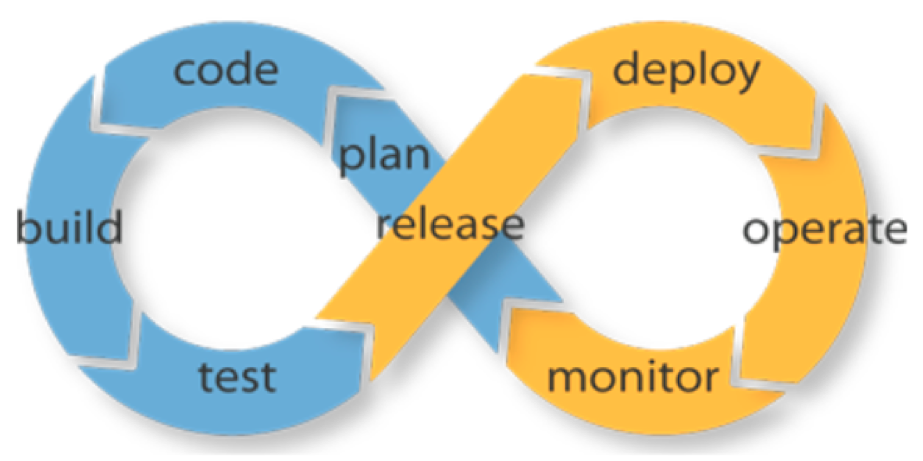
Agile development and cloud computing created the perfect storm in which DevOps was born: this new way of doing IT is all about ensuring closed loops, with 100 percent automation.
Figure 1: DevOps is about ensuring a closed-loop, fully automated workflow between software development and deployment.
In the simplest terms, this meant that each of the steps outlined in Figure 1 need to be fully automated, and integrated with preceding and following steps. Doing this ensures software can be developed faster, deployed quickly, and iterated upon more rapidly.
Benefits
Done right, DevOps leads to a virtuous cycle of greater productivity across development and IT, greater agility in bringing new experiences to market and greater impact on the business.
Adopting DevOps: You Can Phase It In
Organizations looking to adopt DevOps should do so in phases and define metrics for each phase. Here’s a typical phased approach that you can use as a baseline and customize to your organization’s unique needs.
Phase 1: Adopt Agile Development and Cloud Computing
Agile development and cloud computing are profound technology shifts and create the underlying culture in which DevOps can thrive. So, the first step is to ensure organizational buy-in for both of these trends:
Agile development can be adopted in stages. The most important is to agree that software will be built and shipped in short, two-to-four-week sprint cycles, and with a focus on user stories.
Cloud computing can be adopted no matter what your IT infrastructure looks like today. Use hybrid cloud platforms such as OpenStack to provide programmatic access to a VMware or Linux environment, or use a public cloud platform such as Amazon Web Services.
Phase 2: Commit to a CI/CD Workflow
Continuous integration (CI) systems such as Jenkins or TeamCity provide a way to pipeline and integrate the various steps in a DevOps workflow. The choice of system doesn’t matter as much as ensuring that all steps of the workflow will be integrated (eventually) into this workflow.
Many organizations tend to have some manual steps in the packaging and deployment of their software, especially for getting it into production. This often reflects underlying assumptions about manual oversight and intervention, and it breaks the closed-loop philosophy of DevOps.
To succeed with DevOps, you need to fully automate the software packaging and deployment process. In addition, ensure that production builds are deployed in the exact same manner as developer builds, using identical environments.
Cloud technologies such as orchestration (OpenStack HEAT or AWS CloudFormations) and configuration management tools such as Ansible, Puppet or Chef can be used to implement this phase.
Once software deployment has been automated, the next phase is to automate the validation process for new software releases. If you’re like most organizations, testing involves several rounds of back and forth with QA teams and product managers, and it often takes weeks to resolve the last few bugs in each release. To reach the next level of DevOps automation, this process has to be completely lights-out and automated.
This requires a fully automated software test suite, across the back-end and front-end, so that product managers have confidence in the quality of the software being released. Once implemented, you finally have a closed loop between the critical elements of the DevOps life cycle. While release to production may still require someone to approve it or “push a button,” this is a very respectable state in the DevOps journey.
Phase 5: Continuous Deployment
To get to the most advanced DevOps phase, you need to automate the “go live” process for software releases. This in turn will allow you to take even smaller, more frequent code drops and push them into production.
The most advanced software teams in the world now operate this way, and the organizational implications can be transformative: Developers come into work feeling that they can implement a feature and have it go live immediately, and product managers can make commitments to the business with the confidence they can deliver, because they have this incredibly efficient software delivery machine backing them. Most importantly for you, IT is no longer seen as a cost center; it’s seen as the fundamental enabler for business productivity and time-to-value.
Closing Thoughts
Getting to Phase 5 represents the state-of-the-art in the industry today. However, another significant breakthrough promises to raise the bar even higher.
In each of the prior phases, the DevOps workflow is integrating software development with IT operations; but there is nothing influencing software architecture to take operations into account.
In other words, we’re still bolting IT operations automation onto software development.
This is about to change. We’re on the cusp of a new era in software: instead of bolting operations onto the software development process as an afterthought, a new framework promises to bring development and operations together by design. With declarative, infrastructure-agnostic constructs to describe how applications are composed, interact and managed, Kubernetes promises to increase the operability of modern software systems by an order of magnitude.
Everyone interested in the DevOps journey should be learning about Kubernetes and evaluating how it will improve your software development and operations workflows.
About the Author / Sirish Raghuram
Sirish Raghuram is co-founder & CEO of Platform9. As CEO, Sirish quarterbacks the team at Platform9 in realizing the company’s vision, which, on a given day, can range from strategy and road map to shipping code and running tests. Before co-founding Platform9, Sirish was an early engineer at VMware, where he held technical and management leadership roles and helped ship multiple vSphere products. Sirish’s work was reflected in several patents, VMworld talks and internal product innovations within VMware Engineering. Sirish has a B.E. in Computer Science from the University of Pune, India. Connect with him on LinkedIn.
Dyn’s DNS servers suffered a major DDoS attack last week, slowing a host of major websites. Does the drive for DevOps automation increase the risk of similar attacks? Maybe, but it doesn’t have to.
As almost every geek knows by now, a DDoS attack on Oct. 21 overwhelmed Dyn’s DNS servers, and websites that depended on those servers slowed to a crawl. The attack was made possible because a large number of Internet of Things (IoT) devices were compromised using Mirai, a malware tool that breaks into devices using default access credentials.
While it’s not yet clear exactly why so many IoT devices were configured with default login credentials, it’s likely that at least part of the reason included the following factors:
IoT devices are so numerous that securing them all is very difficult, especially when they are configured with weak security out of the box.
The need to give multiple users access to the devices encouraged installers and service providers to keep the default credentials in place. For example, if you have a smart thermostat that is installed by a contractor, managed by a utility company and owned by a homeowner, each of those parties could potentially need access to the device. Sticking with default login credentials is a lazy but effective means of providing it to all of them.
In certain ways, the shift to DevOps makes challenges like these more common. Consider the following:
DevOps encourages the use of microservices. That means more services and logins to manage. It increases the risk that some services will not be secured properly because default login credentials will remain in place.
Under DevOps, the entire software delivery team is supposed to have access to all platforms and resources that are part of the delivery chain. That’s different from waterfall development, in which developers only had to be able to access developer tools; IT ops only needed to access management tools; and so on. The need for broader access could encourage teams to take the easy way out by using default logins—or even just sharing login information, which is risky even if the credentials are not the product defaults.
A shorter way of saying this is that to increase agility, DevOps increases complexity. Greater complexity translates to more potential security risks.
Conclusion
The Dyn attack was not a DevOps problem, and none of the above means that securing a DevOps environment is not possible. It is, but it takes more work.
Still, the Dyn outage is a reminder of just how badly things can go if developers and admins make mistakes such as relying on default login credentials. This challenge will become more difficult, not easier, as DevOps continues to reshape the way software is written and deployed.
As companies such as Amazon and Google rapidly innovate to deliver new services, traditional service providers recognize that change is necessary to keep up with shifting customer expectations. Given the pace at which technology continues to morph, creating better, faster and more innovative solutions is a necessity, and if this isn’t achieved, even longtime customers will eventually look elsewhere.
For younger businesses, taking a collaborative approach to IT and product development often comes naturally as it’s built into the company’s DNA. However, for more established service providers, adapting to this new way of doing business can prove challenging. Traditional service providers have spent years perfecting their technology and require multiple layers of review prior to rollout. While these checks and balances are in place to ensure a level of quality customers have relied on for years and expect to receive from traditional providers, it also can hinder their ability to react quickly to client demands. However, the adoption of the principles embedded in DevOps can allow traditional service providers to work more like a startup by accessing their technology and human skills in a new way, while also continuing to deliver products which meet the expectations of their established customers.
Now the question is, how can traditional services providers successfully implement this DevOps approach? While it can (and has been) done successfully, there are five critical steps that need to be taken into account:
1)Establish a clear goal. The most important step is the first: Management must have a clear understanding of what they are looking to accomplish with the DevOps transition. Service providers have a long legacy of well-defined, reliable services, so all changes must complement their current product offerings and live up to the quality their customer base has come to expect. If an overall goal is not defined, customers will be left confused and disappointed, and ultimately, there will be no impact on the bottom line.
2) Set a timeline. While creating an unrealistic timeline is never advised, it is critical to set an aggressive, pragmatic and adjustable one. As mentioned above, without aggressively pushing forward, an organization will find itself continuously playing catch up to its competitors. The timeline is meant to push an initiative forward even when there are setbacks or changes that need to be made along the way. The right timing is a balancing act: too fast and you have a poorly crafted product rollout; too slow and you are stuck behind the competition. The key metric to measure progress is the degree of evolution to the DevOps model within key stakeholder organizations. If solutions are delayed due to existing processes, then either the scope of the team needs to be adjusted to encompass those processes or the goal needs to be changed so they are no longer an issue.
3) Collect necessary resources. Typically, the biggest gap that needs to be filled to move forward is with human resources. For many established companies, having design and architecture skills—core capabilities needed to develop a new product—hasn’t been a priority. Creating the right team that consists of new talent that have these missing skills, along with the addition of current employees who have a more intimate understanding of the company and customer, is a critical aspect in making sure this more collaborative and innovative approach to solution development and delivery works. And it doesn’t stop once the team is created, it is important to continue to foster an environment that encourages the new team to work together and promote their process within the broader organization.
4) Create benchmarks. To ensure the established timeline is being met and that there is an opportunity to change course if necessary, it is important to set clear deliverables at various stages of the process. These benchmarks must look to what people are doing today, not just the end goal. Initial measures should focus on the pace at which progress is being made, and later, focus on the end products being delivered.
5) Get the entire company on board. Changing an embedded philosophy isn’t easy, especially one that has worked well for so long. No matter the organization there is almost always resistance on some level when fundamental changes are being made. It is up to leadership and the DevOps team(s) to demonstrate internally and externally that the changes being made are not just for the sake of change, but in the end will benefit the entire company, as well as the customer.
While taking a deeper look at an organization’s “people, process, technology and information” and moving to a new mindset doesn’t happen overnight or come without its hiccups, the status quo is no longer sufficient to compete. The reality is, a more collaborative and faster delivery model is necessary to be successful in tomorrow’s marketplace.
About the Author / Tim Pearson
Tim Pearson is the director of product line management at Ciena. In his role, Tim leverages DevOps practices to break barriers in network delivery to meet the demands of mobile, VR and video applications. Driven by challenge and fueled by deep industry knowledge, he has built a reputation for developing innovative business and product strategies to drive growth and open new markets. Tim holds a Bachelor degree in Electrical Engineering from Memorial University, a Masters degree in Management Science from the University of Waterloo and an MBA from the MIT Sloan School of Management. Connect with him on LinkedIn and Twitter.
Many have asked me what I’m looking forward to at DevOps Enterprise Summit 2016 in San Francisco—it is the third year of our conference, and I think it will be our best conference yet! Here are three of the things I’m looking forward to most:
Where Are They Now?
First off, we will have seven speakers back to present for the third time at the conference. Having this pattern of repeat speakers is a bit unusual for a conference, but I love that we’re following these leaders on their continuing journey. For me, it’s almost as if we have front row seats of an unfolding documentary of the ongoing transformations that they are helping drive in their large, complex organization.
Why do I think this is important? My belief is that in the DevOps Enterprise community, many of us are on a common journey, increasingly being asked to help elevate the state of the practice for the entire technology organization, often involving thousands of engineers. To see the journey unfolding for other pioneering leaders is often a glimpse into our own future.
Jason Cox, who is giving the closing keynote about the DevOps journey at Disney. (So stick around!)
Each of these leaders will recap on their DevOps journey so far, whether and how their roles have changed, the new challenges that have emerged since last year, and what they’ve done to overcome those challenges.
We’ll also be hearing from four people who have had a tremendous influence on the entire DevOps community: John Allspaw, CTO at Etsy; Mark Imbriaco, who led the Ops organizations at 37signals, Heroku, GitHub, LivingSocial and DigitalOcean; Adrian Cockcroft, who led the migration of Netflix into the public clouds; and Michael Nygard, author of the seminal book “Release It!”
Transformations from Different Industry Verticals
We always want to hear about DevOps transformations at all stages of the journey—I’m particularly looking forward to three of them that that are outstanding on their own merits, but are also interesting because of the industry they operate in: airline, hospitality and insurance. These are three industry verticals that we don’t typically associate with DevOps.
Susanna Brown and Ben Chan will talk about how DevOps is changing how American Airlines works (and doing it in the middle of its merger and integration with US Airways), Matt O’Keefe will talk about speed becoming the prime directive at Hyatt Hotels and Resorts, and Opal Perry will talk about her efforts to transform culture at Allstate Insurance (which, like Nationwide Insurance, operates in an industry famous for its centuries-old, risk-averse traditions and decision-making styles).
I’m also excited about another conference first for us, which is the joint presentation from Suzette Johnson and Robin Yemen, from Northrop Grumman and Lockheed Martin, respectively. I met Johnson at an Agile conference for the Federal Government community, and I was so inspired by the work that they’ve done within their firms and the broader community at large to improve outcomes for federal programs—both civilian and military.
New Session Format: DevOps Workshops
As adult learners—and this is especially true for leaders—we tend to learn more effectively from observation, experimentation and group exercises and group learning, as opposed to didactic lectures and descriptions of theory.
I’ve observed that the DevOps Enterprise community is truly a group of people who are helping each other. To help further enable the spontaneous and serendipitous interactions that make great communities great, we are adding a set of sessions called DevOps Workshops.
These are 60-minute sessions that run alongside the conference talks, and each workshop will focus on one of the community’s top problem areas:
How can we better lead change in our organizations?
What are the modern architectural and technical practices that every leader in our organization needs to know?
How do we design our organization to best enable DevOps outcomes?
What are ways that we can more effectively bridge the information security and compliance gap?
Each of these workshops will have a 10-minute introduction, which will be followed by 45 minutes of small-group discussions. And to help ensure that each small group achieves its learning objective, as well as to ensure open and healthy dialogue, we have decided to have trained facilitators use the Lean Coffee format.
Lean Coffee helps achieve this through a democratic selection of topics and rigorously enforced time-boxing of each topic. I’ve always been amazed at how effective this technique is at creating good outcomes.
(Why Lean Coffee? In my personal experience, all it takes is a bad facilitator or one person who loves hearing themselves talk to ruin the small-group session for everyone. I can’t think of a better mechanism than Lean Coffee to neutralize these risks.)
In addition to the amazing lineup of repeat speakers, expert talks, and new stories, my hope is that these DevOps Workshops will be of tremendous value and create fantastic learning and networking opportunities for all attendees. The collaboration and relationships that result from each of the DevOps Enterprise Summits never ceases to amaze me, so we’d like to give attendees a variety of opportunities to engage with our speakers and with each other throughout all three days.
I’m looking forward to the best DevOps Enterprise Summit ever! I hope to see you there!
What can data scientists learn from DevOps? A lot, actually. By applying DevOps principles to the world of big data, you get DataOps, which streamlines data analytics.
If you’re reading this site, you’re probably already familiar with DevOps. The DevOps philosophy emphasizes continuous collaboration between software developers (the “dev” people) and system admins (the operations, or “ops,” folks)—as well as everyone in between, such as software testers.
It’s possible to apply similar ideas to the world of big data and data analytics. There, as in the world of software development and delivery, different teams traditionally have worked in isolation from one another. Those teams include storage admins, who keep data storage systems running; data analysts, who write and execute programs for interpreting large volumes of data; data quality specialists, who ensure data consistency; and data security teams, which protect data from attackers.
As DevOps professionals know, keeping different teams isolated from one another is not efficient. It limits collaboration and maximizes confusion when problems occur.
The data world, therefore, has much to gain by ending this isolation between teams and adopting a DataOps workflow. This will keep data operations flowing smoothly and provide continuous insight into the data that organizations collect.
DataOps is not a brand new concept. People like Andy Palmer have been writing about it for a little while now. But the term and the idea have yet to gain nearly as wide a following as DevOps. (There is not yet even a Wikipedia entry for DataOps—and you know an idea is still in its infancy when no one has taken the time to write about it on Wikipedia.)
Making DevOps Bigger
Meanwhile, from the DevOps perspective, the growth of interest in DataOps is significant because it exemplifies the broad applicability of DevOps principles. So far, the DevOps conversation has focused on the relatively narrow context of software development and delivery. But it can extend much further, too. DataOps is a start.
So, if you’re a data analyst, storage admin, data security professional or someone who works with data in any other capacity, it will be worth your while to borrow some ideas from your DevOps brethren. And if you work in software development, testing or delivery, it may be worth your time to educate your data friends on DevOps principles. It will make their workflows more efficient, while introducing DevOps to a wider audience.
Almost every product we buy or use today goes through some form of extensive testing before it’s released on the market; typically, these tests are designed to replicate the worst-case scenarios that a product may encounter under real-world conditions.
Automobiles, for example, go through extensive hot and cold weather testing in remote locations, and are driven over obstacle-laden tracks designed to push the limits of their durability. Even seemingly mundane objects such as children’s toys are exposed to abusive simulations to ensure that they don’t harbor any potentially hidden and harmful effects.
On the current landscape, applications are the face of your business, often serving as the battleground where consumer loyalty is won or lost. Given this reality, it seems crazy to think that any applications are released having only been exposed to a minimum of tests. Yet, in the name of getting to market quickly, that’s far too often the case.
As disciplines including agile and continuous delivery continue to increase the speed at which development teams can release software, it’s easy to put the crunch on testing in the rush to get an update released. But that’s a costly mistake in the long run, as research has shown that it is 50 percent less expensive to find an error in testing than to address the same error once it has reached production, and more than 90 percent cheaper when addressed in the development/coding phase.
Given the dramatic cost savings of addressing errors in development, clearly the goal of any organization focused on continuous delivery should be to shift testing left so a greater number of defects are found early in the development process. This is what we refer to as continuous testing, and it’s a huge part of the reason why I am so excited about CA’s acquisition of BlazeMeter.
Performance load testing should be a core element of any continuous testing strategy because it is a critical factor in determining system reliability. Similar to the worst-case scenario testing that consumer products undergo, performance testing can quickly uncover applications defects that might otherwise go unnoticed. After all, the manner in which a system operates with a few hundred concurrent users may be very different than how it runs with thousands of users.
BlazeMeter enables today’s development, operations and DevOps teams to conduct this critical performance testing earlier in the development process, saving countless hours and resources. The company is also competing—and winning—in a highly competitive marketplace where it has been pitted against much larger, more entrenched competitors.
Part of the reason BlazeMeter is winning is its focus on offering a SaaS-based solution that is highly cost-effective and easy to engage. Using this model, customers can try out the testing software with a few clicks, and then quickly move forward to broadly adopt the system. Another catalyst to its success: BlazeMeter was built using open source tools, such as Apache JMeter, used widely in the development community for performance and load testing. As a result, BlazeMeter can easily run and analyze JMeter and other open source-based load tests—such as Selenium, Gatling and Locust—within a commercial-grade performance testing system.
This combination of a SaaS delivery model and incorporation of open-source tools, augmenting strong performance testing functionality, make BlazeMeter very complementary to CA’s existing continuous delivery solutions, including its CA Service Virtualization, CA Test Data Manager, CA Agile Requirements Designer and CA Release Automation products.
At CA, we’re committed to providing the most comprehensive, integrated and open continuous delivery ecosystem, allowing our customers to release swiftly, test agilely and constantly increase reliably. The addition of BlazeMeter will further enable customers test continuously, thereby increasing agility and the overall quality of their software, to ensure that applications don’t break down on the side of the virtual road.
Chances are that your company is embracing DevOps to make sure you can get fresh, new digital capabilities to your customers ASAP. That’s because in today’s market, you either have to be first—or quickly close any gaps between you and your more digitally innovative competitors.
But when it comes to getting new capabilities into the hands of your own employees, things probably move much slower. That’s because your internally facing apps have to clear a hurdle that your customer-facing apps don’t: administration of access privileges that often are poorly defined and inadequately automated.
That’s a problem. People can’t be productive if they don’t have access rights for the IT resources they need, when they need them. The growing Millennial workforce is going to be especially unhappy if IT is slow to meet their digital needs. And from a security perspective, slow administration of access privileges is also a problem—because your company must be able to automatically and immediately revoke employee access privileges the moment they’re fired or they quit.
This automated, accelerated management of internal users’ access rights is the missing “last mile” for DevOps. And it’s something you have to address if you’re going to fulfill the needs of the business with the same excellence as you fulfill the expectations of your customers.
What Makes the Last Mile So Tough?
If you bank with Chase or ride with Uber, your access to your personal data is gated by your personal login. But, as a customer, you essentially use the same app as everyone else.
Application privileges within your own company are entirely different for two reasons:
Privileges for your internal workforce are much more complex than for customers. Salespeople have sales apps. Your finance department uses finance systems. Your service reps may be allowed to see RMA numbers, but not SSNs. So you must quickly give each person access to only the resources appropriate to their specific role and responsibilities—or risk consequences that include lost productivity, security breaches, compliance failures and excess software licensing costs.
Management of internal privileges is an ongoing activity. Productivity, security and compliance demand that you provision each user account for each application with the right privileges at the right time. Privileges must be immediately and appropriately modified every time an employee is promoted or transferred. Privileges must be terminated immediately when someone leaves your company. Privileges may also have to be temporarily modified in real time due to session context—such as use of non-secure public WiFi or an access attempt from a questionable location or at a questionable time.
Simply put, for internally facing apps, getting code onto a production server isn’t enough. You also need to automate and accelerate management of the “last mile” between servers and employees.
What Are ‘Last-Mile’ DevOps Requirements?
DevOps toolchains automate and monitor the software life cycle from design and development through testing and deployment on a production server. What’s missing is automated provisioning and governance of the “last mile” between the server and the individual worker.
These tasks include:
Capture of current user role/responsibility profiles from HR
Provisioning of application-specific accounts with profile-appropriate privileges and controls
Self-service inputs from authorized LOB managers
Detection of session context (network connection, time of day, location, etc.)
Real-time modification of privileges based on that session context
Automated revocation of access privileges upon termination, transfer, etc.
Employee self-service for permitted optional applications and services
Monitoring and reporting on employee account activities and events
Your team probably performs many of these “last mile” tasks manually. Some may also be automated using homegrown scripts. Excessive dependency on scripts is a bad practice, though. Scripts usually are poorly understood by anyone but the original writer—which makes them difficult to maintain and update over time. They also don’t typically integrate well with DevOps, HR systems or other key pieces of the app delivery puzzle. This lack of integration slows your processes down and opens the door for human error.
Automation of last-mile DevOps makes much more sense. Automation speeds processes, reduces cost and optimizes accuracy. Integrated automation also gives you a dependable, centralized point-of-control for defining and editing policies—as well as for capturing the event logs necessary for compliance and security reporting. The right automation solution will also integrate with the rest of your operations environment (including directories, VDI, and mobile management tools) to ensure secure, reliable application access.
Why is ‘Last-Mile’ DevOps Important?
Most business leaders already understand why rapid rollout of customer-facing applications is so important. Unfortunately, many fail to recognize the importance of being just as fast and accurate when it comes to supporting their own workforce.
The truth, however, is that automation of last-mile DevOps benefits your business in several important ways:
Improved employee productivity and engagement. Your workforce will be much more productive and more engaged when everyone has immediate access to the digital tools they need. That improved employee performance will benefit your customers as well.
Higher IT efficiency. The sooner you automate the many everyday service provisioning tasks that your skilled IT staff now performs manually, the sooner they can to shift their precious time and energy from routine work to higher-value projects.
Enhanced security and compliance. Well-defined access policies, diligent enforcement of those policies with rules-based automation and centralized logging of access provisioning activities all reduce your IT-related risks—as does immediate, automatic and complete revocation of all access privileges the moment any employee or contractor is terminated.
Reduced “Shadow IT.” When IT is more responsive to people’s needs, they are far less inclined to turn to alternative digital resources that aren’t properly monitored, governed or secured.
Greater business agility. M&A, reorgs and other organizational moves are chronically bottlenecked by manual execution of mass changes to the workforce’s digital access privileges. Rules-based automation of last-mile DevOps eliminates this agility-killing process friction.
The bottom line: To achieve true digital agility, your company must automate the “last-mile” tasks that give your people access to the IT resources they need—when they need them.
About the Author / Stacy Leidwinger
Stacy is the VP of Products at RES where she is responsible for defining overall product direction, roadmap and positioning, to drive product excellence, company growth and customer success in the areas of end user computing and security. Her background is in both product marketing and product management helping to positioning B2B software companies for growth and market leadership. Prior to RES, Stacy led the product management team at Directworks, a cloud-based sourcing and supplier management solution. Before Directworks, she managed the roadmap, product positioning, and go-to-market strategy for Vivisimo, an enterprise search solution, which was acquired by IBM. While at IBM, Stacy was responsible for the integration of Vivisimo’s product line into IBM’s big data portfolio. Connect with her on LinkedIn / Twitter.
Many business leaders are planning to make DevOps the cornerstone of their IT transformation strategy. But, as surprising as it might sound, skepticism abounds regarding how major vendors address the DevOps transformation challenges—they confuse DevOps with continuous delivery (CD) infrastructure.
“We wanted DevOps and we got after a nine-month-long implementation a continuous delivery platform which speeds up IT operations without significant business value. How differently can you help?” the senior business executive of a major financial institution in New York sarcastically asked me during a conversation three months ago.
The business executive is right: DevOps isn’t a technology as I’ve been implementing it, it’s primarily an accelerated application delivery approach implemented in the form of a technology-enabled application delivery operational model. Adam Jacob, CTO of Chef, substantiates that fact in “The Secret of DevOps: It’s Always Been About People, not Technology,” when he says, “DevOps is about bringing together all the people you need to build and run your business effectively, and empowering them to move as quickly as possible towards their goals.”
Agile Admin’s Ernest Mueller in, “DevOps: It’s not Chef and Puppet,” confirms Adam’s point: “Chef and Puppet are individual tools that you can use to implement specific parts of an overall DevOps strategy if you want to use them—but that’s it. They are fine tools, but do not solve DevOps for you.”
How can we implement DevOps in line with business leader expectations? Three Amazon Web Services (AWS) Design Patterns I developed can help to get the best of DevOps on AWS cloud: Software Organization Factory, Digital Organization Factory and CD Infrastructure Factory. This article discusses the Software Organization Factory.
The Foundation of DevOps Value: Consequences to IT Service Delivery
Before delving into these AWS design patterns, a quick reminder of what DevOps is, its value propositions and, more importantly, what changes are needed in how IT services are delivered.
The Ignored DevOps Business Logic We All Must Consider
The combined effect of cloud adoption and the rising digital economy is changing competitive environments; it forces business leaders to focus on innovation and market responsiveness as the competitive differentiators.
The fact of the matter is, by facilitating access to technology, cloud accelerates entrance of several thousands of tech startups that take advantage of the recent technology innovations to substitute traditional products and services into digital. This creates a context where new entrants increasingly compete with established brands, forcing business leaders to seek value paradigms other than IT efficiency.
The business executive argues, “In these new markets, our concern is to increase customer value by delivering the right services to the right segments at the right moment. You guys need to change the IT paradigm; IT alone does not create that kind of value.”
Then, what should be changed in today’s IT approach?
The Two Dimensions of Modern IT: The Operational Model and the Continuous Delivery Infrastructure
The new IT paradigm advocated in my recent book, “Rethink Your IT with DevOps: The Complete Guide to Aligning Your IT to DevOps,” is the idea that business value results from two dimensions: organizational agility and technology efficiency. In other words, it defines modern IT as a two-dimension asset including the operational model and the continuous delivery infrastructure.
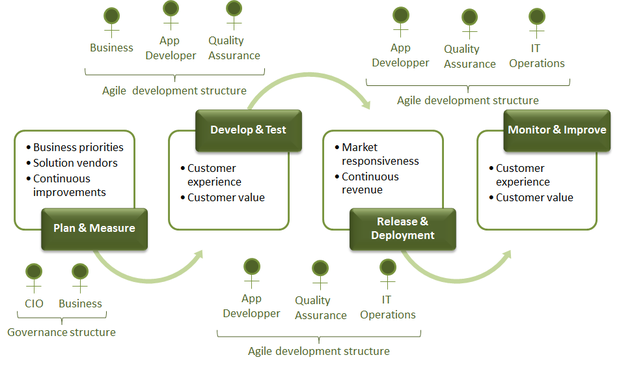
The timely delivery of innovation transcends IT issues; it not only cuts across your sales, marketing, post sales, application development and IT operations, but also demands concrete answers as to how to accelerate business prioritization, decision-making and problem solving. The operational model is where business and IT people, processes, practices and tools are combined to create agile and cross-functional environments. The following exhibit shows a typical DevOps operational model:
Typical DevOps Operational Model
Organizational flexibility for the sake of flexibility doesn’t make sense unless technology is leveraged to speed processes. This is where CD infrastructures come into play; throughout the delivery process, they build on IDEs to accelerate coding and testing, on versioning tools to convert software version into releases, on continuous integration (CI) tools to build releases and on delivery pipelines to ensure continuous delivery.
So, what is DevOps?
DevOps is a Technology-Enabled Application Delivery Model
DevOps is a combination of value, principles, processes and practices shared not only by developers and IT operations but also by the business. The goal is to help the organization deliver the right service to the right market segments at the right moment.
DevOps from the Business Perspective
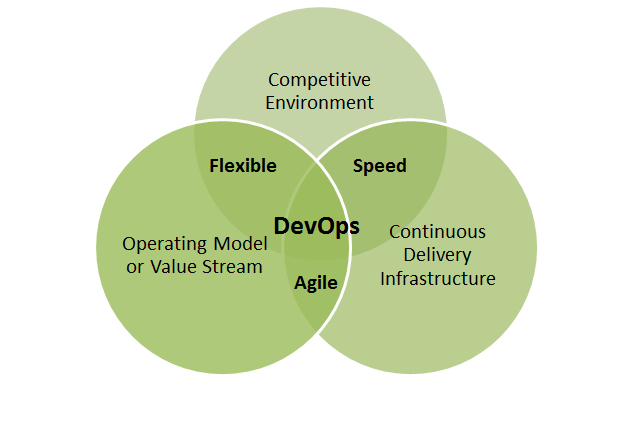
As I’ve been implementing it, it’s a cross-functional application delivery model involving the business and IT and enabled by continuous delivery infrastructures.
By enabling and automating agile practices, the continuous delivery infrastructure makes the operational model agile and provides the business with the flexibility and velocity needed to meet competitive challenges.
Design Patterns as DevOps Implementation Engineering Framework
As suggested by the business executive, today’s DevOps implementations struggle to deliver the promised business benefits. The reason is, the operational model dimension is ignored in favor of tools and infrastructure.
Another reason is, DevOps is young and is still at the early stage of the technology maturity model; the expertise and engineering methodologies to implement it as what it is—a technology-enabled application delivery model—are lacking. That’s where DevOps transformation design patterns help.
What are DevOps Transformation Design Patterns?
In this article, the term DevOps transformation design patterns refers to general reusable architectures addressing specific DevOps strategy. They’re not necessarily implementable solutions, their primary goal is twofold:
Offer a neutral language for designing and implementing technology-enabled operational models
Offer an engineering approach that reduces design and implementation duration and effort
They’re formalized architecture design and implementation best practices for DevOps and platform-as-a-service (PaaS) services.
Design Pattern as DevOps Implementation Engineering Methodology
To meet its goals—technology-enabled application delivery model—the design pattern is structured around four items including purpose, principles, general solution and implementation techniques.
Purpose: Clarifies the purpose of the design pattern along with the DevOps strategy to address.
Principles: Are best practices formulated as rules and beliefs supposed to guarantee expected DevOps strategy benefits? They’re the determinants of the solutions to implement the DevOps strategy.
General solution: Are blueprints resulting from the application of principles? They summarize the functional and technical architecture of the DevOps platform to implement.
Implementation techniques: What are recommended technical approaches, solutions and tools to implement the general solutions?
Why AWS? Why would it be the catalyst for DevOps value?
AWS-ome Design Patterns That Will Change DevOps Implementation
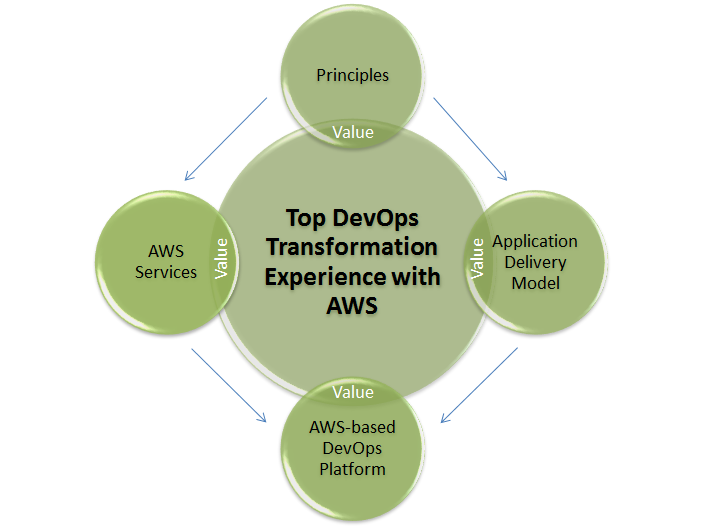
AWS offers such a rich, varied and easy-to-implement services portfolio that it would be unfortunate not to take advantage of it to modernize IT. The rationale underpinning the value businesses can derive from their DevOps transformation experience with AWS is summarized in the following figure:
Rationale of the DevOps Design Pattern
It’s the belief that:
Certain principles determine the AWS services needed to deliver the application delivery model (ADM) architecture that guarantees value.
The implementation of the ADM using these AWS services results in AWS-based DevOps platforms that tangibly deliver expected benefits.
The Four DevOps Principles that Yield AWS Value
Let’s explore the principles I’ve been using to make CIOs happy with their AWS cloud:
Think holistic, not only IT: Reminds that transformation isn’t only about IT but the entire organization’s value stream from marketing and sales to development and IT operations.
Think cross-functional, not only IT: Reminds that the bottom line is to set up a cross-functional application development environments to accelerate business prioritization, problem-solving and decision-making, and meet time-to-value objectives. They’ll be the core value propositions of the DevOps platform.
Make it agile, flexible, and speedy: Reminds that agility, flexibility and speed are the catalysts for competitiveness and business value. They’ll be part of the DevOps platform.
Think PaaS: Reminds that AWS provides varied services for implementing state-of-the-art CD infrastructure.
Let’s illustrate three AWSome design patterns that’ll change DevOps experience with AWS!
Implement a Startup Mindset with the Software Organization Factory
The purpose is to implement DevOps strategies focused on time-to-market and time-to-value. It’s adapted for tech startups.
To implement the startup mindset, the DevOps four principles for AWS are implemented as follows:
Think holistic and cross-functional, not only IT: Relevant business and IT resources are put together in a single and dedicated service development team supported by appropriate Scrum and XP agile practices.
Make it agile, flexible and speedy: PaaS services building on agile practices and AWS infrastructure-as-code are provided to make application delivery processes agile, flexible and speedy.
Think PaaS: AWS infrastructure as code and DevOps tools are combined to implement a CD infrastructure in the form of a PaaS platform.
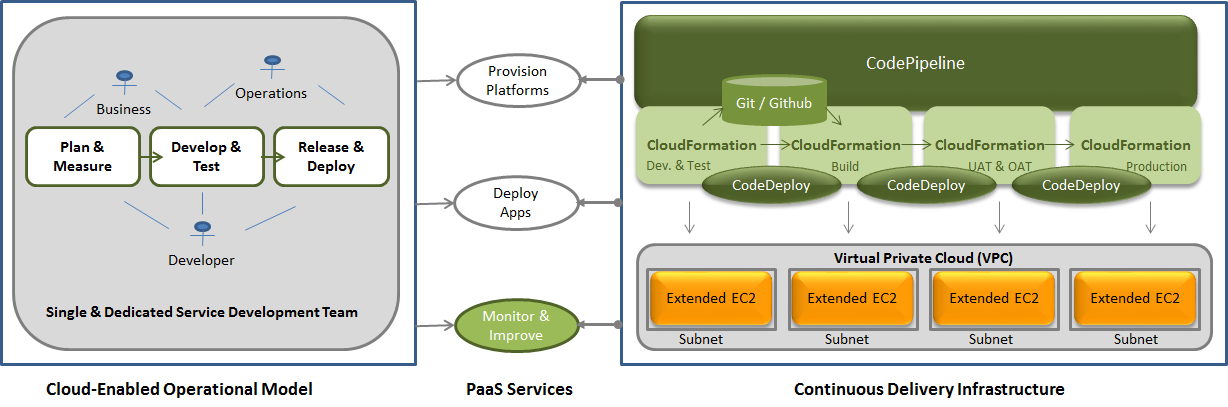
The DevOps platform resulting from the principles application is illustrated below:
Software Organization Factory
The “Startup Mindset” platform is structured around three components including the cloud-enabled operational model, PaaS and the CD infrastructure.
The operational model builds on a three-stage application delivery life cycle:
Plan & measure: It mobilizes business users, development, QA and operations staff on business prioritization issues using agile practices such as Scrum product backlog planning or XP’s user stories.
Develop & Test: It mobilizes business users, development, QA and operations staff across the development life cycle using agile techniques such as Scrum iterations, XP’s test-driven development (TDD) and behavior-driven development (BDD).
Release & Deploy: It leverages continuous integration practices to build and test releases prior to deploying to production.
Monitor & Improve: It’s outsourced to keep the service development team on its core business: developing software.
The CD infrastructure combines the followings services:
AWS CodePipeline and CodeDeploy to set up the delivery pipeline.
AWS infrastructure as code including CloudFormation, OpsWorks and Elastic Beanstalk to generate the CD infrastructure.
Summing It Up
The DevOps business benefits are real, yet, it’s young and is still at the early stage of the technology maturity model. The expertise and engineering methodologies needed to implement it as what it is—a technology-enabled application delivery environment—are lacking.
DevOps design patterns such as the software organization factory fill the gaps of today’s transformation practices:
They provide the architect team and the executive team a neutral language to discuss the business, technological and technical challenges and solutions.
By pointing out the agile practices to leverage, they simplify and accelerate the design and deployment of the operational model.
By pointing out the AWS services and features to leverage they facilitate the design and implementation of the CD infrastructure.
Whenever you hear the words “the network’s slow today,” or, even worse, “the network’s down,” you know somebody miscalculated. It may have been the person who decided to buy the wrong hardware, or maybe the one who signed up the wrong telecom provider.
Often, that slowdown or outage was the result of somebody underestimating server demand or overestimating the amount of redundancy built into the network setup. It’s always tricky finding the right level of redundancy that will keep users from waiting for their data without overspending on cloud capacity.
A common mistake IT managers make when switching from in-house infrastructure to cloud infrastructure is failing to take advantage of the flexible, affordable, redundant capacity offered by Amazon Web Services, Microsoft Azure and other cloud providers. That’s the conclusion of Yan Cui in a April 20, 2015, post on his “The Burning Monk” blog.
Cui points out that latency is inevitable because things go wrong—and usually, those things are beyond your control. That’s why you have to design your applications with latency in mind. Too often developers work inside a bubble, where all hardware and network parameters are geared to the tasks at hand. In the real world, hardware, networks and software break. If your app isn’t designed to accommodate such failures, you’re leaving your users in the lurch.
Get Real: Inject Latency in Your Test Environment
To model app performance in real-world settings, it isn’t enough to test servers and databases under anticipated loads. You have to take the extra step of mimicking the glitches that are as inevitable as they are unpredictable. Cui proposes injecting random latency delays on every request. He even provides a simple PostSharp attribute that automates the process.
Cui applies the concept of error-planning even further by introducing errors in the mechanism used to throttle requests to prevent bad guys from spamming their servers using such tools as Charles and Fiddler, or any of the spammers’ own bots. By making the errors visible in the dev environment, designers can anticipate them and engineer ways to handle the throttling errors “gracefully.” Once again, a PostSharp attribute is applied to randomly inject throttling errors; Cui states that the same approach can be used to plan for and respond automatically to session expiration, state out-of-sync, and other service-specific errors.
These and other error-detection and -correction methods fall under the umbrella of Design for Failure, a principle championed by Simon Wardley as a key characteristic of next-generation tech companies.
Simon Wardley’s Design for Failure contrasts the development approaches of traditional shops and those he identifies as “next generation.” Source: The Burning Monk
Cui explains how modeling latency and other errors within the development process has been applied by Netflix’s use of Chaos Monkey and Chaos Gorilla, as well as the mechanism Uber devised to allow its client applications to fail over seamlessly in response to a data-center outage.
Learn How to Combat Latency from the experts: Gamers
Nowhere does server performance matter more than in the world of online games, where one-microsecond hiccup can spell the difference between winner and loser, champion and chump. In an April 17 article on Venture Beat, Cedexis’s Pete Masden explains that a 500-millisecond network delay makes an online gamer twice as likely to walk away, while a 2-second delay in load time leads to abandonment rates as high as 87 percent.
Addressing latency begins by measuring it, according to Masden. That’s why we added native monitoring to Morpheus when we built the cloud management platform. Being able to see the status of all your organization’s apps and business services at a glance isn’t just a nice convenience—it’s a competitive advantage. To be able to glance the status of all your organization’s apps and business services, group databases, app servers, messaging queues and web servers by system dependency and impact to view an overall status as well as each app’s current state is crucial to knowing what’s happening in your organization.
One approach to cloud-server latency is to create separate instance, which is common for failover but less so for addressing regional network demand. Rather than the traditional active-passive model, however, Masden recommends an active-active approach when implementing multiple redundant instances to ensure all servers are up to date and optimized. Atop the multiple instances runs the global traffic analyzer to ensure no single instance becomes overly congested.
Is ‘Zero-Latency Computing’ Even Possible? Why not?
If you think network latency is a problem now, just wait until such technologies as 5G, the internet of things (IoT), virtual reality (VR) and robotics go mainstream. Equipment and bandwidth upgrades, and more sophisticated software-defined networking won’t be sufficient to address tomorrow’s application-performance needs. That’s the conclusion of Nitin Serro in a Sept. 29 post on the Channel Partners blog. Serro identifies three technologies as key to meeting future performance requirements: network functions virtualization infrastructures (NFVi), fog computing and zero-latency computing.
The applications made possible by 5G and related technologies come close to eliminating latency by shifting more intelligence directly to the network, not merely by providing faster speeds. Source: GSMA Intelligence, via The Unwired People
While NFVi and fog computing focus primarily on the network and data layers (compute, storage and network infrastructure), zero-latency computing targets the application layer, where information has to be exchanged in real time between diverse components, most of which link directly to users. According to Serro, nothing short of an entire re-invention of the network infrastructure—from backbone to edge—will prevent today’s bottlenecks from becoming tomorrow’s blockages.
Move the Network Intelligence Closer to the Data
The network-capacity challenge we now face is unprecedented, according to Silicon Republic’s John Kennedy, who writes in an Oct. 3 post that even the much-touted 5G network will come out of the gate hobbled by the need to accommodate its many predecessors. Rather than the “step change” in network speed that most analysts expect, 5G will deliver a tremendous boost to network intelligence. This may be the technology’s greatest asset: a smarter network means the data doesn’t have as far to travel.
From an application-design perspective, latency can be traced to three sources: the need to link to legacy infrastructure, the need to link to third parties via APIs and the innate unpredictability of the internet itself. Marqeta’s Dave Matter examines these situations from a payment-processing perspective in a Sept. 13 post on App Developer Magazine.
As with the network infrastructure itself, the solution to application latency is to move more of the intelligence into the app itself and then rely on open APIs to link data sources in real time in an environment that’s closer to users. Once again, the data and associated analytics tools have less distance to travel, and much less latency to deal with. Ultimately, the solution to latency—in hardware and in software—will be fewer, shorter trips.

 Sirish Raghuram is co-founder & CEO of Platform9. As CEO, Sirish quarterbacks the team at Platform9 in realizing the company’s vision, which, on a given day, can range from strategy and road map to shipping code and running tests. Before co-founding Platform9, Sirish was an early engineer at VMware, where he held technical and management leadership roles and helped ship multiple vSphere products. Sirish’s work was reflected in several patents, VMworld talks and internal product innovations within VMware Engineering. Sirish has a B.E. in Computer Science from the University of Pune, India. Connect with him on

 Tim Pearson is the director of product line management at Ciena. In his role, Tim leverages DevOps practices to break barriers in network delivery to meet the demands of mobile, VR and video applications. Driven by challenge and fueled by deep industry knowledge, he has built a reputation for developing innovative business and product strategies to drive growth and open new markets. Tim holds a Bachelor degree in Electrical Engineering from Memorial University, a Masters degree in Management Science from the University of Waterloo and an MBA from the MIT Sloan School of Management. Connect with him on




 Stacy is the VP of Products at RES where she is responsible for defining overall product direction, roadmap and positioning, to drive product excellence, company growth and customer success in the areas of end user computing and security. Her background is in both product marketing and product management helping to positioning B2B software companies for growth and market leadership. Prior to RES, Stacy led the product management team at Directworks, a cloud-based sourcing and supplier management solution. Before Directworks, she managed the roadmap, product positioning, and go-to-market strategy for Vivisimo, an enterprise search solution, which was acquired by IBM. While at IBM, Stacy was responsible for the integration of Vivisimo’s product line into IBM’s big data portfolio. Connect with her on