
RECORDING
SLIDES
[slideshare id=74997589&doc=electriccloudslides-170413192924]

Gene Kim, Jez Humble and other experts say that understanding and improving your value stream is really what it takes to bring your software delivery organization to the next level. While almost every IT organization has this goal, actually knowing how to make it happen can be paralyzing, because it seems like such a daunting undertaking when trying to connect all of your systems tools and processes.
Recently, we participated in an innovative approach that proved that you can take concrete and measurable steps and see real outcomes in only two days.
Nationwide constantly strives to innovate and bring real change to its IT organization. The insurance and financial services company has zeroed in on improving its value stream. To begin the initiative, Nationwide developed a two-day workshop where the right disciplines would come together and determine the best way to make this happen. But the real innovation in this idea was that the organizers did not just talk about what to do. Instead, the end goal was to come up with at least one key metric the team could show to the Nationwide CIO by the conclusion of the workshop. This approach made the effort real, concrete and focused. While it was difficult, it worked.
Here are nine important lessons learned:
Lesson 1: Start with one artifact—specifically, defects. Measuring cycle time is extremely difficult because there are so many moving parts. To have a tangible outcome, start with defects because they tend to be the most well-understood artifacts and have relatively defined workflows and processes that people know and understand.
Lesson 2: Commit to having a real metric based on real data. All too often organizations take the “boil the ocean” approach. When asked what metric they want to start with, the answer is typically, “Everything.” That is precisely the wrong approach. Aiming for everything is likely to get you nothing. Focus on a tiny amount to start. First understand, then improve, your software delivery value stream. Not only should you start small, but for IT value streams, start specifically with a certain artifact (see Lesson 1). And chose only one metric for that artifact, because less is truly more in this case.
Lesson 3: Without a multi-disciplinary approach, you will fail. This part is extremely difficult. To be successful you will need the following mix of skills:
Some people might start by asking, “Don’t we need a data scientist?” After all, that is a title of authority when it comes to metrics. If you have a data scientist on staff, by all means, get them involved. But if you don’t, you can rely on someone with database skills—primarily, skills around writing advanced SQL (as old fashioned as that may seem). Most of this work will not require advanced data scientist skills.
But the real challenge is to get all of those disciplines in the same room at the same time. This is no easy feat. Leadership must provide the necessary resources to ensure that each one of the roles is represented. Because if any of these roles are left out, you will not succeed.
Lesson 4: Work in parallel. The process and domain experts can work on identifying the artifacts that must be used and manually identifying and mapping where the artifact originates, what systems touch the artifact when, and all the requisite status changes and their meanings. That work will inform the data warehouse team and report writers, but the data and report writers are actually faced with a very different problem: They must determine how to get the data, regardless of the identified artifact, and transform the raw data into a usable format that report writers and BI analysts can work with in their visualization tools. By having both teams work in parallel, with identified checkpoints along the way, you will be more efficient when it comes to the three required deliverables.
Lesson 5: There are always three required deliverables for each value stream cycle metric you are interested in.
Lesson 6: Work both forward and backward. It is always easier to get started when you know where you want to end up. In this lesson, identifying the end goal is key. Once you have identified the “end” then you can go to the beginning and determine if the end goal is actually reachable. You also can identify any holes that exist between the beginning and your end goal. In this use case, the backward story looks like this:
Lesson 7: Invite outsiders to participate. It’s difficult to see the forest for the trees in your own organization. You need outsiders who are willing to ask the questions, probe in challenging areas, push the boundaries—people who have a different point of view because they are not in the game. This does not mean outsiders should be the workshop facilitators. They could be, but it is more important for them to actually participate in the sessions and help define and create the deliverables.
Lesson 8: Hold the workshop in a different space than you work in every day. Don’t use the conference room that you typically use. Bring the team to a completely different environment—one that inspires creative thought and innovation. It may seem like a fluffy requirement, but you will learn through workshop participant feedback that location has a major impact when it comes to productivity and focus.
Lesson 9: Get executive leadership buy-in. The executive VP was genuinely impressed with what the team accomplished in only two days. And the positive feedback and kudos the team received has probably fueled their innovation engines for months to come. To feel a sense of accomplishment and be recognized by the executives in your organization has significant morale impact.
Improving your value stream is no small feat. But by designing and executing on a workshop like this, you will see benefits and clear wins immediately. By the end of our two days, we had a prototype of defect cycle time and a defined repeatable process. Equally as important, the people involved were given the opportunity to fail fast and pivot where needed, which inspired innovative thinking and creativity. And, being able to present to the CIO real progress with real results in two days’ time fueled institutional buy in and momentum to drive a long-term value stream improvement program.
 Nicole Bryan is Vice President of Product Management at Tasktop Technologies. Nicole has extensive experience in software and product development, focused primarily on bringing data visualization and human considerations to the forefront of Application Lifecycle Management. Most recently, she served as director of product management at Borland Software/Micro Focus, where she was responsible for creating a new Agile development management tool. Prior to Borland, she was a director at the New York Stock Exchange (NYSE) Regulatory Division, where she managed some of the first Agile project teams at the NYSE, and VP of engineering at OneHarbor (purchased by National City Investments). Nicole holds a Master of Science in Computer Science from DePaul University. She is passionate about improving how software is created and delivered – making the experience enjoyable, fun and yes, even delightful.

Following the formal acquisition of Veracode by CA Technologies, a much bigger effort to make security a more integrated element of DevOps has kicked off in earnest.
Veracode recently unfurled an update to its application security platform aimed specifically at developers that provides security findings as each application module is scanned. Tim Jarrett, senior director of enterprise security strategy for Veracode, says the idea is to provide developers with that information from static analysis delivered via the Veracode platform as early in the application development lifecycle process as possible.
Other new capabilities include support for custom cleansing functions to automate remediating issues involving common known vulnerabilities and an auto-scan capability that gets implemented any time a file is saved.
Also with this release, Veracode is adding support for the Perl programming language that is still widely used for building web applications.
Jarrett notes that organizations these days are holding developers more accountable for security issues that are easier to fix during the application development process. Addressing those same issues after an application is deployed in production not only exposes organizations to security threats, but can be much more expensive to fix.
The challenge is that most organizations have yet to solve the riddle for getting developers to address security issues earlier in the application development cycle. Jarrett says far too many developers are conditioned to view IT security has being someone else’s job inside the organization. Veracode is trying to make it simple to address security issues using tools that make the process as frictionless as, say, relying on a spell checker to publish a higher-quality document.
Obviously, there will never be perfect security. But far too many of the issues that IT security teams regularly deal with relate to known exploits. At a time when cybercriminals are making use of a variety of automated tools to discover those exploits, most IT security teams are outgunned. Worse yet, many IT organizations can’t even find qualified cybersecurity professionals to hire in the first place.
On the plus side, however, as DevOps processes mature, many developers are now assuming complete responsibility for the maintenance of the code they write, including all security issues. This not only leads to higher-quality applications, it also results in those developers being more vigilant when it comes to address security issues they would otherwise need to address themselves once an application is deployed in production. In some quarters, this earlier focus on security in the application development and deployment process is referred to as DevSecOps. As a discipline within most IT organizations, however, DevSecOps remains relatively nascent.
Of course, regulatory bodies are increasingly treating organizations that fall prey to security attacks less like victims. Instead, they are holding them accountable for ignoring best security practices by assessing fines for losing control over sensitive data. As those fines increase the blame for incurring those fines eventually cascades back to the developer. Given that changing climate, it might not be too long before developers recognize that embracing DevSecOps is in their own best interests.

AppDynamics, fresh off its acquisition by Cisco Systems, this week moved to extend the reach of its monitoring services all the way out to individual developers.
The spring 2017 edition of the AppDynamics service now includes a developer toolkit intended to make it simpler for developers to track the performance of their code without having to get that data from an IT operations team.
Matt Chotin, senior director of Developer Initiatives for AppDynamics, said the goal is to respond to the needs of developers who, in the age of DevOps, increasingly are being held accountable for the performance of their applications end to end. The toolkit enables those developers to directly invoke application programming interfaces (APIs) exposed by AppDynamics.
The toolkit also provides additional AppDynamics support for the Go programming language, the Xamarin framework used to develop mobile applications and a plugin for Android applications. Now also available are dashboards for tracking individual session and crash alerts and reports that make it possible for developers to discover the root cause of a potential issue much closer to the time it occurs.
But Chotin said the most unique attribute of the AppDynamics release is that developers can apply diagnostics to business transactions in two modes. One mode enables developers to examine code in pre-production and production environment, while another—a Live Mode—can be used against live application data.
In addition to extending its reach out to developers, AppDynamics is making it easier for IT organizations to deploy its agent software. A new Universal Agent makes it simpler for the AppDyamics controllers to distribute those agents. Chotin said AppDynamics is also working on developing lighter-weight agents that would be used to provide better support for containerized applications.
Finally, AppDyanmics is also simplifying its software licensing model in a way that enables sharing subscriptions.
While AppDynamics has developed an extensive following among IT operations teams, reaching out to developers represents a new frontier. As responsibility for application performance shifts in the age of DevOps, Chotin said AppDynamics is discovering the developers want to be able to access directly the metrics that apply specifically to their code. Instead of being presented with information about every application running in the environment, developers want to be able to zone in on any and all issues affecting their specific code, he said.
Obviously, not every IT organization is implementing DevOps processes to the same level of zeal. In many cases, IT operations teams are still mainly held responsible for application performance. But as the line between those IT operations teams and developers continue to blur, any move to embed instrumentation functions deeper into the application code base stands to benefit everyone. Of course, not every developer might be excited about being required to do that initially. But once they discover that the time between when there’s an issue and they can go back to writing code starts to drop, AppDynamics is betting that many of them are likely to insist on that level of instrumentation being available.

Splunk Vice President of IT Markets and Chief Technology Advocate Andi Mann sees DevOps moving from an artisanal approach to an IT factory.
This represents a reversal: Historically, developers operated in a factory-like environment, passing chunks of work down the line, but that caused problems because “different managers owned different sections of the production line.”
Agile and DevOps were a response to that issue, he said, resulting in “the artisan developer … the full-stack developer.”‘
The trend is now flowing in the opposite direction, with Splunk customers wanting to see “the whole flow.” Furthermore, enterprise DevOps is too big for an artisanal approach.
“I worry about that [reversal],” he said, but technology can help artisanal quality within an IT factory. Collaboration tools such as permanent video links between different locations enable specialists to work together and understand each others’ work.
“That’s a different kind of factory,” said Mann, in which development, security, QA, operations and other staff do not need physical proximity to work closely together. This is particularly important for large enterprises, he observed, as you cannot pack 1,500 developers into a small space.
One example he cites to show this approach can work is a telco with its developers spread across multiple locations in Sydney and Singapore using DevOps practices to achieve continuous delivery. Another is one of the largest UK retailers getting weekly releases from developers in London and Mumbai, with QA work done at another location in India.
“Executives I talk to are very heavily committed to improving cycle time,” said Mann. But they are also concerned with quality (e.g., problems should be detected and fixed before they reach the user, and the percentage of changes sent for rework should be minimized) and business impact. Executives want to link DevOps to their own KPIs: “Are they moving the needle on my business requirements” such as shareholder value and reputation?
“You get the changes you drive by your measures,” he said, so it is up to managers to make sure their measures make sense in the broader context. It may be time for a balanced scorecard to be applied to DevOps, with metrics in all three areas, he suggested.
These metrics could include code coverage, error rates, customer complaints or trouble tickets raised, plus business impact measures such as click-through rates, cart abandonment, subscriptions cancelled, open rates (for mobile apps) and customer sentiment.
Mann noted executive demand for the adoption of DevOps, even where “they don’t even know what they’re talking about.” He feels it is really about a desire for visibility into the development pipeline, and “that’s really challenging.”
Part of the problem seems to come from the tension between traditional IT (especially “ITIL-owned shops”) and new-generation executives with titles such as head of digital.
Slavish adherence to ITIL practices won’t allow the required speed, may not achieve the expected level of compliance and business goals probably won’t be met, he suggested.
“ITIL came out of a fear of failure,” but failure is no longer catastrophic. “If you’re not failing, you’re not trying, you’re not innovating.” What’s important is to fail fast, fail small, and fail cheap—and DevOps allows IT to fail in low-impact ways. Even when an organization is making significant changes to software, the effects of failure can be contained through measures such as canary releases (where the new versions are initially made available to a small subset of users).
Furthermore, customers are getting used to the idea that technology isn’t and doesn’t need to be perfect, largely because of their experiences with speech recognition services such as Siri, he said.

Many studies have shown the significant value that DevOps can bring to a software organization. However, organizations on their own DevOps journey need more than general industry studies or case studies. Any practitioner needs to be able to show the value—specific to their organization—that the changes to people, process and tooling made in the name of DevOps are having meaningful results.
Measuring the success of a DevOps practice or project is critical to securing and maintaining support for similar projects in the future.
In a previous blog, I talked about some of the pitfalls that come from focusing on the wrong DevOps metrics and outlined a few general guidelines around what makes a good metric. Here I’ll expand on that theme and discuss more specifically what types of metrics can help you show progress within your organization.
To review, in the previous blog we looked at the characteristics of a good metric. Specifically, good metrics should be obtainable, reviewable, incorruptible and actionable. With those as general guidelines, it’s helpful to consider the three core components of successful DevOps implementation to help us determine where to look at measurements.
DevOps is built around people, process and technology. But it doesn’t make sense to measure the components of DevOps; instead, we need to think about the goal, or outcome that each of these achieves. For example:
Together, all three of these should lead to significant customer and business value.
Notice how certain words above are in bold? That’s not an accident. These four key areas are the foundation of a successful DevOps practice—and therefore an excellent place to focus your measurement efforts. The figure below illustrates how these four areas fit together, and provides a few examples of the types of things that can be measure in each area.
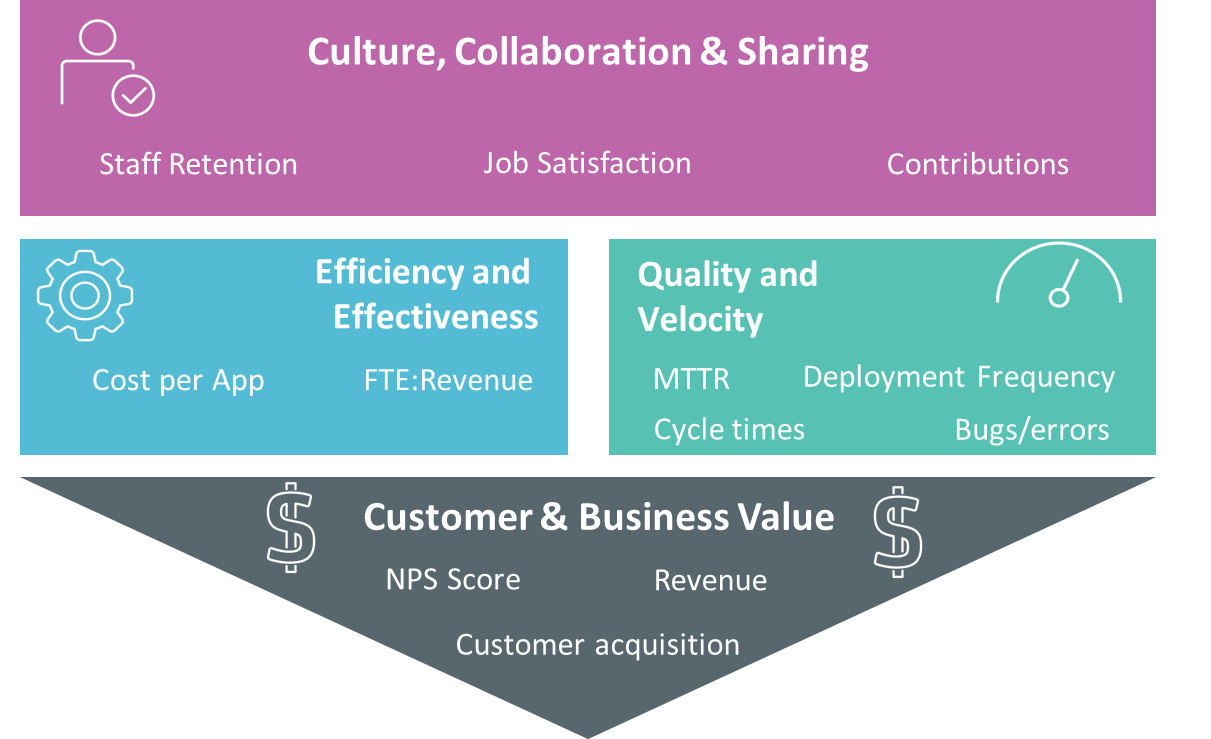
Of course, it’s important to consider your own organization when considering what metrics to focus on, as well as the guidelines mentioned previously. For example, in some organizations people-related metrics could be difficult to obtain on a regular basis. That’s not to say they’re not important—it’s been shown that DevOps can have a meaningful impact on employee satisfaction—but these metrics may not be the primary focus for some groups.
DevOps has a wide range of benefits and I’ve seen organizations often have their own primary motivation, whether it is costs, velocity, competition or something else. It’s best to focus on metrics that are aligned to your organization’s primary objectives.
Metrics matter only if what you’re measuring matters to your organization.
If you are interested in learning more about DevOps metrics, the book “DevOps for Digital Leaders” explores this topic in more detail.
In my next blog, I’ll delve into what to do with the metrics, once you’ve gathered and analyzed them. Because even the best metrics are only as good as what you—and your organization—can learn from them.

Many organizations still face challenges in their Devops adoption journey enterprise-wide, especially when there is no standardization in tools, non-repeatable processes and adhoc practices and culture barriers. Here are some of the challenges in standardization and possible solutions to achieve standardization in DevOps as part of DevOps transformation journey.
A survey conducted within multiple customer teams revealed they face challenges in standardization of tools and streamlining the process gaps due to lack of end-to-end orchestration, manual intervention, legacy practices, inconsistent environments, longer provisioning time and several other factors. Taken together, they necessitate standardization in DevOps across the enterprise to make it repeatable, predictable and consistent.
DevOps adoption framework (DAF) is a comprehensive framework for due-diligence, tools support and solution accelerators to create systematic and well planned-out transition road map and implement a continuous delivery toolchain and overcome the common challenges in DevOps implementation.
Tools selection should be based on the requirements and what best suits the need, decided based on various factors discussed in the attached whitepaper, and using one of the methodologies such as points given for out of box features and different factors/constraints.
DAAS (DevOps as a service) is an automation platform, which serves as a central platform to drive standardization across tool use, provisioning infrastructure, toolchain, managing the life cycle of VMs, bringing in central authority and governance, defining the KPI, monitoring and measuring the metrics, monitoring end-to-end pipeline giving real time analytics, providing self-service capabilities across multiple teams, bringing in audit and compliance, continuous improvement and drive consolidation and standardization.
The critical success factors for enabling DevOps adoption across enterprise needs focus on central DevOps team driving DevOps adoption with governance enabled with DevOps adoption framework and consolidation of the processes, standardization on metrics and tools, enabled with a DevOps automation platform.
For a deeper look at the survey, download the white paper here.
 Lavanya Subbarayalu is Senior Architect working with Technology Office in HCL Technologies. She has expertise in Azure, DevOps consulting & Microsoft technologies. She is associated with DevOps COE, working on design and Development of DevOps solutions and consulting tools. Connect with her on LinkedIn.
Scrum.org, which is dedicated to improving the profession of software delivery, and the DevOps Institute, which is dedicated to fostering a community around emerging practices in Continuous Delivery and DevOps, today announced an alliance that seeks to build a bridge from agile to DevOps. It will include scrum teams, agile practices and DevOps. I think this partnership could have huge implications for both the Agile/Scrum and DevOps communities.
 Let me say from the outset that I am a co-founder of the DevOps Institute, so feel free to take what I am saying (or writing) with a grain of salt. I also have been involved in the formation of this partnership since its initiation. From then until now, I remain convinced that this is a critical step in making software development and delivery better for us all.
My fellow co-founder at the DevOps Institute, Jayne Groll, perhaps says it better: “There is an inherent organic relationship between Scrum and DevOps. By demonstrating how to improve the collaboration, integration and communication between IT’s roles, frameworks, practices and automation, we pave the way for end-to-end organizational agility and a faster flow from idea to value.”
While formulating this partnership, I have had the chance to meet and work with some incredible people over at Scrum.org. One of them is Dave West, CEO of Scrum.org. When I first met Dave (you can hear a podcast of that here), he was just formulating his ideas around Agile/Scrum and DevOps being intrinsically linked. Since then, Dave has seen a clear path for this linking and has embraced and enunciated it well. “Scrum without DevOps is impossible to scale. Work needs to flow seamlessly from the Scrum team to production and back again,” Dave says. “It is funny that great Scrum teams have to do DevOps to be great and great DevOps teams use an agile approach like Scrum to enable better collaboration.”
For me, the real value of this partnership is, as Dave so eloquently states: “I am always shocked that the DevOps community are often seen as different from the agile and Scrum communities, when the reality is that agile and DevOps encourage breaking down those barriers to deliver customer value.”
At the end of the day that is really what this is all about. The partnership is not just about Scrum.org and the DOI as institutions & organizations—the partnership really has to be about the community of IT professionals who adhere to and practice Agile/Scrum and DevOps.
As I like to tell people, there is only one truth. There is not a separate set of facts that apply to Agile/Scrum and another set that apply to DevOps. There is not a separate truth that applies to enterprises and another truth that applies only to startups. There is only one truth. If it is truth, it is true. I look forward to this partnership illuminating and standardizing on this one truth.
By the way, this alliance is just the beginning. I believe that this “one truth” philosophy applies beyond Scrum and DevOps. I think it also applies to ITSM, security and other IT disciplines. Bringing together a common set of best practices and way of doing things across these is inevitable.
We have crossed a boundary in IT. As I write this, I am at the InfoSec World conference in Orlando. My friend Rich Mogull is delivering a keynote where he is talking about how infrastructure as a service, software as a service and the new reality of ubiquitous, safer endpoints and connectivity are changing the mission of the security professional. These same factors are changing the mission of the Agile/Scrum developer and the DevOps team member. It is a great time to be in IT.
But it also calls for forward-thinking organizations to recognize, adopt, adapt and evolve. I think this is a great opportunity for organizations like Scrum.org and the DevOps Institute to help lay out a path for common learning and uniting communities. That is what really gets me so excited about this partnership.
So what are ways for you to find out more and be involved in this? Well, it starts April 26 in Dallas at the DevOps Connect conference. Dave and Jayne will be delivering a joint keynote and a full afternoon workshop. These sessions will be listed under the “ScrumOps” moniker. If you are in Dallas or can get there to attend DevOps Connect, please do so.
Dave’s blog lists some other ways this partnership will work together:
So stay tuned for more info on this partnership in the coming weeks and months. In the meantime, today is the first day of Scrum/DevOps working together in ScrumOps.

I spend virtually all day, every day, speaking with IT leaders who recognize that their bottom line ultimately rests on their ability to accelerate the delivery of innovative software. That’s why they’ve invested so much in digital transformation initiatives—including hiring the best and brightest developers, scaling Agile, driving DevOps adoption, automating the continuous delivery pipeline, and all the other components involved in moving from ideation to delivery as rapidly as possible.
In most cases, this investment has exposed opportunities to optimize culture, process, and tooling—but not yet delivered the level of acceleration and flexibility that IT leaders expect. I’m frequently asked: “Now what? I think we’re ‘doing’ DevOps. But what else is needed to deliver on faster innovation?”
Something as unsexy as “transform testing” is not what people expect to hear. As someone who’s been in the software testing industry since 2003, I know that software testing is typically seen as a necessary evil, not a strategic advantage. However, I’ve also witnessed how it can be a secret weapon for surging ahead of the competition.
The dirty little secret in the IT industry is that despite all the advancements in software development, software testing remains dominated by yesterday’s application lifecycle management (ALM) tools and manual testing—and they simply don’t meet the needs of today’s accelerated development processes. Transforming testing for the modern era represents a tremendous opportunity. It’s a low-hanging fruit that can help you increase acceleration, reduce risk and cut costs.
Agile and DevOps initiatives aim to accelerate the process of delivering working software to the end user. However, even organizations that have adopted Agile and DevOps report dismal test automation rates: less than 20 percent for end-to-end testing. This means that after the rest of your software delivery pipeline is automated and optimized, an outdated testing process eventually emerges as the bottleneck. By transforming testing, you can increase your throughput significantly. I’ve witnessed many companies increase time to market by 55 percent by modernizing their testing process.
Now that software is the primary interface to the business, a software failure is a business failure. Yet, with today’s compressed and continuous delivery cycles, it’s simply impossible to test everything before every release—even if testing is automated. By aligning testing with your top business risks, you can automatically assess the overall impact to the core user experience and instantly determine if the release candidate has an acceptable level of business risk. This is critical for stopping high-risk software from impacting your prospects, customers, and partners.
Companies still relying on traditional quality processes and platforms are usually covering only about 10 percent of their top business risks with their current test suite. A goal of 80 percent is typically achievable with about three months of effort.
There are hard costs associated with trying to retrofit outdated testing processes and tools into modern delivery processes. Many organizations try to bridge the testing gap by throwing an abundance of manual testers at the problem, typically through a global system integrator. By the most recent estimates, this approach consumes approximately 35 percent of an average IT budget—a total of $30+ billion per year, globally.
A way to help testers achieve high test automation rates allows you to reallocate a large portion of that testing spend toward creative tasks which advance competitive differentiation. Many enterprises that transitioned manual testers into “scriptless” (non-technical) test automation have slashed testing costs—and eliminated one of the most significant constraints to achieving faster time to market.
Analysts at Forrester (e.g., Diego Lo Giudice) and Gartner (e.g., Joachim Herschmann and Thomas Murphy) have spent years advocating that transforming testing is a business imperative. If you’d like to get their perspective, I encourage you to review some of their latest research:
 Sandeep Johri, CEO of Tricentis, has more than 25 years of experience as a technology executive and serial entrepreneur—including roles at Hewlett-Packard, Appcelerator, Oblix (acquired by Oracle), Blue Lane Technologies (acquired by VMware), and numerous other startups in Silicon Valley and India. Johri earned an MBA from Stanford University, a Master’s degree in Industrial Engineering from Wayne State University, Detroit, and a Bachelor’s degree in Mechanical Engineering from Pune University, India. Connect with him on Twitter.

Continuous delivery (CD) is increasingly becoming the norm in software development, with companies releasing updates more and more frequently. Those that aren’t are exploring how they can catch up. But in all of this push to DevOps and CD, it’s vital not to forget the database. Changes to applications or web services often require changes to the database, which means companies need an end-to-end process that spans both application and database development if they want to successfully embrace CD.
However, many companies still work in silos, with applications and databases developed separately. So while the ability to deploy application changes across environments is relatively common, supporting databases in a truly elastic environment remains a major challenge for organizations.
To find out the current state of database DevOps, and how it can be included in CD, Redgate surveyed 1,000 SQL Server professionals across the world. While we found companies were keen on implementing DevOps, with 80 percent saying they will have adopted it within the next two years, only 20 percent are currently applying DevOps practices such as version control, continuous integration or automated deployment to their databases.
This isn’t because companies don’t recognize the need for database DevOps—37 percent said they are deploying database changes either more than once a week or daily, demonstrating a requirement for automation. Indeed, the main driver for adopting DevOps in this area is to increase the speed of database changes (cited by 26 percent of respondents), followed by freeing up developers for more added value work (17 percent).
Companies also recognize the drawbacks of continuing traditional, siloed database development practices—26 percent said it increased the risk of failed deployments or downtime when introducing changes. This was followed by slow development and deployment cycles and an inability to respond quickly to changing business requirements (both 18 percent). Sixteen percent also cited poor visibility of the change management process as another issue. This shows the vital importance of fast, successful database changes and deployments to business today.
For companies with 5,001-10,000 employees, slow development and release cycles were seen to be more of a drawback than application downtime, while for organizations with more than 10,000 employees, the inability to respond quickly to changing business requirements was deemed to be a slightly more significant downside.
As well as understanding the business need, the survey showed that organizations are now better structured to enable continuous delivery for database changes. The old picture of companies made up of silos of developers and database administrators that don’t work together, for example, is far from the truth. Seventy-five percent of companies had teams that included developers who were working across databases and applications, with just 25 percent having dedicated database developers. In 60 percent of companies, developers were responsible for building database deployment scripts. Fifty-eight percent of companies said the integration between the two was either good (38 percent) or great (20 percent), meaning teams work together on a planned or ad hoc basis. Just 12 percent classed integration as poor, with DBAs working in silos.
However, the research highlights two challenges to overcome:
Different processes and tools—Despite the levels of integration within organizations, there is still a gap between how companies operate and automate when it comes to applications and databases. For example, while 81 percent of respondents use version control for their applications, just 58 percent apply it to database development. Thirty-nine percent use continuous integration for applications, yet only 20 percent apply the same practice to their database. Clearly, there is still more that can be done to bring the two together through common practices and the use of third party tools.
The skills gap—The greatest obstacle to moving to an overall DevOps way of working was a perceived lack of appropriate skills (cited by 21 percent of respondents), ahead of a lack of alignment between the development and operations teams (20 percent). Only 9 percent said that their executive leadership didn’t support the shift.
When it came to integrating database changes into the DevOps process, consistency was top of the list of obstacles, with 32 percent believing that synchronizing application and database changes would be the biggest challenge, followed by overcoming different approaches to application and database development (25 percent). Perhaps unsurprisingly, 19 percent also mentioned preserving and protecting business critical data as the largest obstacle to overcome.
The good news is that many companies are confident they can quickly overcome the process and skills challenges. When asked how long they estimated it would take their organization to move from traditional database development practices to a fully automated process for deploying database changes, more than half (51 percent) said it could be done within a year, with 20 percent believing it could be achieved in six months.
Digging down into the data, those that have already adopted DevOps in other processes are much more confident the switch can be achieved quickly. Sixty-eight percent of this group cite 0 to 12 months as the time it would take to move to a fully automated database development process, compared to 28 percent of those who had no plans to adopt DevOps practices. In fact, 43 percent of this latter group cited more than two years as their estimate.
Our research shows that organizations recognize the potential of applying DevOps to the database to gain all of the advantages CD brings. They see that it speeds up software development, frees developers to do more value-added work and increases the rate at which database changes are delivered.
At a time when organizations need to operate in a faster, more seamless manner to thrive in ever more competitive markets, introducing DevOps and CD to the database can transform their development process. To read more about the research and the “State of Database DevOps,” download the full management report.
 Matt Hilbert is a technology writer at Redgate Software with 20 years’ experience working for lots of the world’s biggest tech companies – and many of the smallest. He has a particular fascination for emerging technologies and is on a continuing mission to decompile, untangle, and explain techspeak to a wider audience, and excite people about the endless possibilities technology offers.