Tag: Chef

  • DevOps Connect: Rugged DevOps @Infosecurity Europe

    DevOps Connect: Rugged DevOps @Infosecurity Europe

    We have assembled another top flight list of speakers for our DevOps Connect event @Infosecurity Europe.  While pre-registration is sold out, if you are one of the 15,000+ attendees of Infosecurity Europe, you can still come to DevOps Connect on a first come, first serve basis.  Details and schedule are below:

    When: Thursday 4th June, Olympia London
    Time: 9.00 – 17.00

    Agenda for DevOps Connect:Rugged DevOps

    • 8:30am to 9:00am
      Meet and Greet
    • 9:00am to 9:10am
      Introductions – Alan Shimel and Wai Man Yau

    • 9:10am to 9:50am
      Joshua Corman, CTO, Sonatype and Rugged (Keynote)
      Dr. StrangeOps: How I Came to Embrace Rugged DevOps & SW Supply Chains

    • 9:50am to 10:30am
      Gareth Rushgrove, Puppet Labs
      Maintaining Control While Letting Go

    • 10:30am to 11:00am
      Florin Coada, Technical Specialist Graduate in Application Security at IBM
      Security at Speed; Best Practices for a Secure DevOps Implementation

    • 11:00am to 11:30am
      Helen Beal, Head of DevOps at Ranger4 Limited
      The DevOps Toolkit

    • 11:30am to 12:00pm
      Justin Arbuckle, Vice President, EMEA & Chief Enterprise Architect at Chef (formerly Opscode)
      A Manifesto for high velocity compliance

    • 12:00pm to 1:00pm
      Lunch Break

    • 1:00pm to 1:30pm
      Wai Man Yau, Sonatype EMEA
      Real World Customer Stories from the Software Supply Chain

    • 1:30pm to 2:00pm
      Stephen de Vries, CTO Continuum Security
      Automating Security Tests for Continuous Integration

    • 2:00pm to 2:30pm
      Elizabeth Lawler, CEO and CoFounder , Co-Founder Conjur Inc
      SecDevOps 2.0- Managing your Robot Army

    • 2:30pm to 3:00pm
      Marc Hornbeek, Senior Solutions Architect at Spirent Communications
      Case study – DevOps Cost-Effectively Secured Quality and Time-to-Market for a Complex Hardware/Software Network Product

    • 3:00pm to 3:30pm
      Jonathan Fletcher, Enterprise Architect – Technology & Platform (DevOps) Lead
      DevOps:  How the Industrial Revolution Got Us Here

    • 3:30pm to 4:00pm
      Benjamin Wootten, Co-Founder at Contino
      Transforming to Devops in the Enterprise

    • 4:00pm to 4:10pm
      Thank you and closing – Alan Shimel and Wai Man Yau

    If you are in London during these dates you can still register for Infosecurity Europe for free and attend DevOps Connect. Hope to see you there.

  • DevOps Leadership Series: Security at Velocity

    DevOps Leadership Series: Security at Velocity

    If it does not fit, it does not get done.  For many DevOps practices, application security falls into the “does not get done” bucket.  That’s because for many DevOps-centric organizations, application security has historically been done somewhere else, by someone else, who is slow.

    Go faster.  Shift left.  Remove complexity. Reduce rework.  All mantras of DevOps practices.  And while DevOps practices have changed dramatically in recent years, many experts will tell you that application security has not changed enough.

    In this installment of the DevOps Leadership Series, you will hear Chris Corriere (DevOps Engineer, Autotrader) and Mitchell Ashley (VP Information Technology, CableLabs) share perspectives on the state of DevOps and security. It is about security at velocity.

    But is going faster and automating resulting in better security? There are still security pros who are uncomfortable with that premise. Nevertheless, that is where this is headed. The security community has to come to the mountain, otherwise the mountain is coming to them.

    First, listen to Chris’ Corriere of Autotrader tell us his perspective that security can move at DevOps speed, as long as you take a diversified approach:

    https://youtu.be/8DdfHkAK1Fk


    Then hear from Mitchell Ashley, VP of IT at CableLabs as he remarks on the evolution of security from a validation role (at the right) to an integrated, ingrained role that has shifted left:

    https://www.youtube.com/watch?v=pg_m7dYqUPU

    This is the third in our series of interviews from this event. Stay tuned as the actual sessions from DevOps Connect will be posted shortly.

    NOTE: If you have missed any of the other videos from this series, you can find them here.  (We’re up to 15 so far).

  • DevOps Leadership Series: Software Supply Chains

    DevOps Leadership Series: Software Supply Chains

    We kicked off this series on Monday with Gene Kim (@RealGeneKim) sharing his views on the big theme for DevOps in 2015: proving that DevOps is applicable for large organizations.

    Another theme that arose often during our recent “DevOps: Wine-ing, Not Whining” event was the importance of software supply chains.  Every software development organization has a software supply chain, and DevOps leaders are now applying principles from lean manufacturing, Deming, and Toyota supply chain management to improve their operations.

    They are applying software supply chain management principles help:

    • choose higher quality parts (e.g., software binaries, containers, microservices)
    • select higher quality suppliers (e.g., fewer defects, faster MTTR records),  and
    • improve traceability (e.g.., identifying defects or known vulnerabilities to expedite break/fix)

    Today, we will hear from Jez Humble (Chef), Julie Tsai (Retail Giant) and Nick Galbreath (Signal Sciences) as they discuss on importance of software supply chains and DevOps.  Then after watching the videos, you can learn more about the sea change in software supply chain automation in these two blogs from Mike Hansen (Software Supply Chain Automation) and Ericka Chickowski (Security, DevOps and the shift to a software supply chain).

    Here are today’s short videos from our 2015 DevOps Leadership Series:


    [youtube http://www.youtube.com/watch?v=4L4nrNpdTM4]


    [youtube http://www.youtube.com/watch?v=UEkVYJ1T2NY]
    [youtube http://www.youtube.com/watch?v=nTv8Yx0CpfY]

    NOTE: If you have missed any of the other videos from this series, you can find them here.  (We’re up to 15 so far).

  • DevOps Leadership Series 2015

    DevOps Leadership Series 2015

    We recently hosted the 2nd annual “DevOps: Wine-ing, Not Whining” event in San Francisco to bring together a number of thought leaders and leading practitioners in the DevOps field.  We traded stories from the trenches, formed new insights, and offered visions of the future.

    This week, I’ll be sharing videos captured from the event that highlight key themes from our conversations. We call it the DevOps Leadership Series.

    Screen Shot 2015-05-15 at 11.19.59 AM

    You’ll get to hear:

    In the next few weeks, I’ll be on the west coast at the Velocity Conference and on the east coast covering DevOps Days DC.  I’ll be capturing more insight from DevOps thought leaders at these events.  If you are planning to attend one of these events, let’s capture your DevOps perspective for the series.  To participate, please leave a comment below or catch me on @weekstweets.

    Today, we’ll start the series with Gene Kim on important themes for DevOps in 2015:

    [youtube http://www.youtube.com/watch?v=0IXrnhcRNUk]


    PART 2 of the series is now available at: 

    https://devopsy.kinsta.cloud/2015/05/19/devops-leadership-series-software-supply-chains/

  • 31 Reference Architectures for DevOps and Continuous Delivery

    31 Reference Architectures for DevOps and Continuous Delivery

    At QCon London, David Farley (@davefarley77) told the audience that “continuous delivery changes the economics of software delivery”.  I could not agree more.

    If you have been drawn to the evangelists like David Farley, Jez Humble, and Gene Kim, you’ll know that high performance IT organizations are seeing a massive payoff in their continuous delivery investments.  Industry leaders big and small are sharing noticeable results:

    • 8x more frequent production deployments
    • 50% lower change failure rates
    • 12x faster service restoration times when something went wrong

    5 Principles

    How are they achieving these results?  They are following a few key principles that David and Jez outlined in their seminal book, Continuous Delivery (highly recommended).  The principles outlined in their book and in David’s QCon presentation are as follows:

    • Deliver fast
    • Automate almost everything
    • Keep everything in version control
    • Build quality In
    • Empower the team 

    Reference Architectures for DevOps and Continuous Delivery

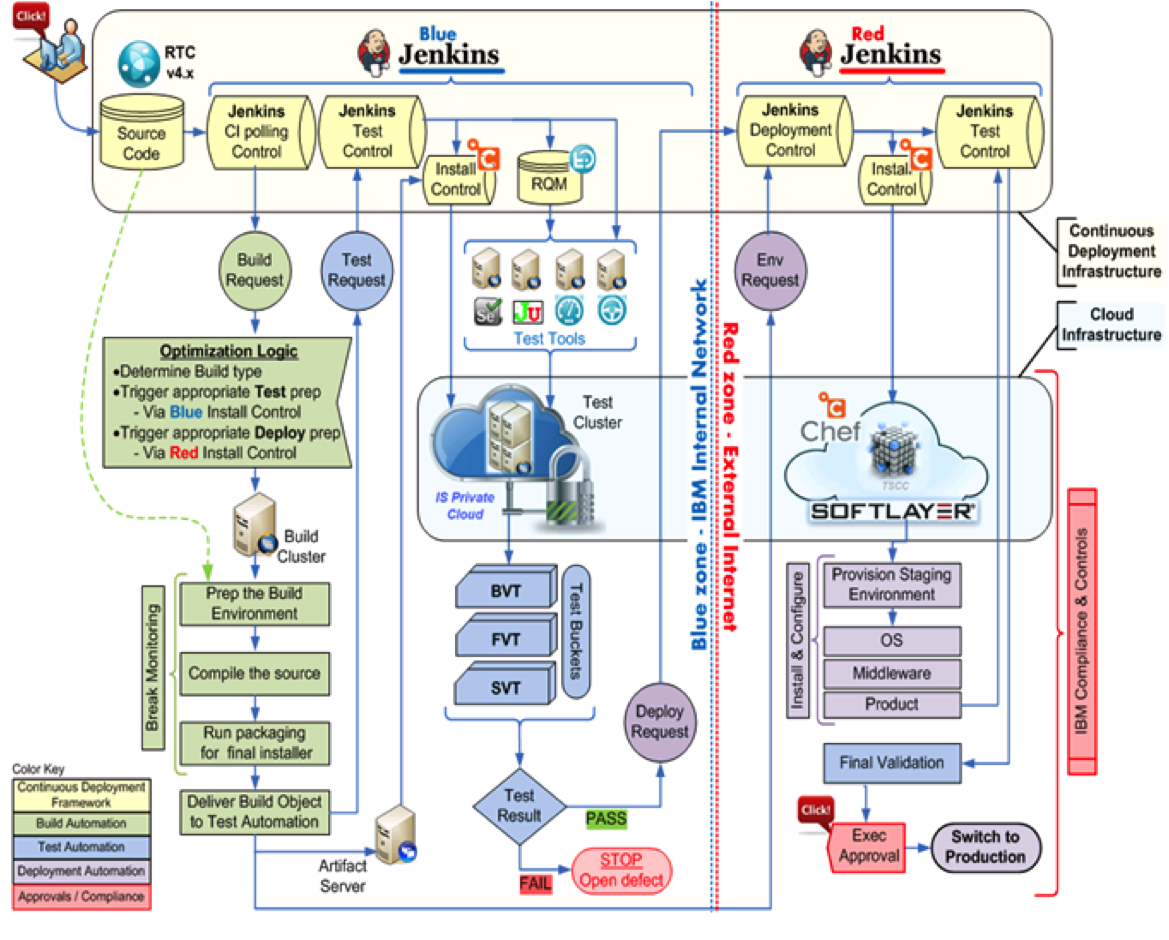
    In their book, they also provide insight to continuous delivery tool chains and processes which highlight build tools, CI platforms, testing suites, artifact repositories, and many other components. There are numerous examples of reference architectures available, and each of them vary in levels of detail, tools highlighted, and processes followed.  Yet, there is a constant theme among the tool sets: Jenkins, Maven, Nexus, Subversion, Git, Docker, Puppet/Chef, Rundeck, and Sonar seem to show up time and again.

    To help you along your continuous delivery and DevOps journey, I have compiled a set of 31 reference architectures created by users across the continuous delivery and DevOps communities.

     CD and DevOps tool chain

    Each architecture is accompanied by a link to the original presentation or blog where the architecture was referenced to ensure you have access to the full context of the discussion. You can also freely download the presentation from SlideShare where we now have over 7,000 views.

    Offer to help others: If you have a reference architecture to share, please consider posting a link to it in the comments section below.  I am sure others would love to see it and learn from it.

  • Chef defines the DevOps workflow with Chef Delivery

    Chef defines the DevOps workflow with Chef Delivery

    At ChefCon today Chef made a major announcement unveiling Chef Delivery a “new DevOps workflow product that for the first time enables the continuous delivery of infrastructure, runtime environments – including containers – and applications.”  Chef has examined the use success patterns of many of its thousands of customers to distill what they believe is the formula for success in a DevOps environment.

    alex ethierI had a chance to speak with Alex Ethier, VP of Product and Jay Wampold, VP of Marketing at Chef about Delivery. They were both really jazzed as they think this is a real game changer for not only Chef but the entire DevOps market.  Chef is already a leader in the DevOps community with a rapidly growing base of customers in the Global 2000 and a dominant adoption position among AWS customers. Delivery will extend the Chef platform into the entirety of the DevOps workflow.

    Chef believes this is the time to expand the Chef platform to the entire DevOps workflow. Just about every analyst firm and survey data indicates that DevOps is on the way to wide spread adoption among IT teams of all sizes. While DevOps is about cultural change, once the organization recognizes the advantages to a DevOps culture, tools that leverage this culture are sure to expand their footprint.

    I asked Alex and Jay if Delivery would bring Chef into competition with other DevOps tool vendors. For instance Jenkins and CloudBees in the CD and CI area would seem to be square in the cross hairs of Delivery. While on its surface this would seem to be the case, Delivery is actually a platform that is designed to leverage APIs and open source to to work with a large ecosystem of 3rd parties including Jenkins, CloudBees and other players in the DevOps ecosystem.  I am still not 100% sure where the cooperation will end and the competition will begin, but I guess we will have to wait and see how that shakes out.

    Based on Chef’s customer experience research they think this is what the flow of DevOps looks like:

    chef pic
    DevOps lifecycle step by step

    Some steps are and will remain manual. Chef is seeking to play in the automated areas. Yes this is an ambitious move by Chef. If they succeed they will leverage their already dominant position in the DevOps configuration management field into becoming a dominant player in the entire DevOps life cycle.

    Powering this life cycle is the fact that with the move to the cloud today’s enterprises are moving from static systems to rapidly changing services. This is putting new pressures on IT departments to perform in a “high velocity IT” manner. The key to all of this is of course automation. Under it all Delivery seeks to automate CI, CD and continuous testing.

    Chef’s CTO, Adam Jacob had this to say about Chef Delivery, ““The tools we use reinforce the behavior; the behavior reinforces the tool. Thus, if you want to change your behavior, change your tools.”

    Other highlights of Chef Delivery from the Chef press release are:

    • Robust Pipeline: Chef Delivery provides a shared pipeline and proven workflow for software development that safely takes code from a developer’s or operations engineer’s workstation through build, test, and production.
    • Platform for Collaboration:  Each step of the Delivery pipeline incorporates automated testing to provide developers, operations engineers, compliance and security officers, and IT architects rapid feedback on proposed changes. The common workflow allows personnel of each IT discipline to work together with full visibility into the flow of changes through the pipeline. Policies can be easily applied at each step to ensure maximum change control and governance.
    • Sophisticated Analytics: Chef Delivery provides metrics for all stages of your development pipeline. With full audit capabilities, you can track both pipeline performance and activity, manage permissions and access comprehensive change history from easy to use dashboards.
    • Scalable Architecture: Chef Delivery was designed from the ground up for performance and scalability. Its architecture is fully integrated with the Chef Server and designed to meet the demands of the largest and most complex enterprise IT environments.
    • Full Ecosystem Integration: Chef Delivery integrates with an extensive array of operating systems and runtime environments, including public cloud platforms such as Amazon Web Services and Microsoft Azure, as well as runtime environments such as Docker containers.
    • Availability: Chef Delivery is currently available through an invitation program
    • Pricing: Chef Delivery will be sold in 2015 on a subscription basis.

    This could indeed be a real game changer for already high flying Chef.  While at ChefCon today I intend to ask many of the partners and vendors exhibiting here how they view Delivery and what kind of integrations we can expect to see from them for it.

    One thing for sure is the DevOps tools market is evolving and maturing rapidly.  Tool vendors will have to move quickly to allow high performing IT teams to move at the speed of DevOps.

  • Chef  best practices

    Chef best practices

    Chef Best practices 

    This article is the II part covering Chef. Please refer to Automation, Provisioning & Configuration Management (CHEF) for an introduction.

    As a matter of fact, Chef is truly an astounding tool. It keeps the cooking metaphor actively going.

    Following is the list of best practices that I would like to cover in the article:

    • Project creation and “readme driven development”
    • A sane build system with Rake
    • Continuous integration with Travis
    • TDD with Chefspec
    • Workflow with Spork
    • Verification with Minitest

    Getting Started:

    1). First and prime important step is to create a new Project. In this section everything should be source controlled. Here in the example a Github repo has been created for all the codes and for the verification or to see step to step process of the development as well as mistakes, they can be easily viewed from the commit history. Follow all the steps and do same for your project:

    git init
    

    Second objective is to perform a Source Code Management. By running the following command you can make use of git flow to manage your features by selecting all the default settings and if you aren’t using it, then its time you should start working on it.

    git flow init

    Using Readme Driven Development is top best practice that can be started by README.md file. This practice is really important as it helps you to focus your mind and cause you think like a user.

    Here Rake is being used for an already build system. Following is the list of tasks that are to be considered:

    • Rake check: This is responsible for checking all other dependencies.
    • Rake build: The main aim of rake build is to manage and run the test suites.
    • Rake start: It acts as an envelope for vagrant up.

    2). Another best practice is to Set up a Ruby version for the project. This is done by creating two version files: .rvmrc and .rbenv.

    After Ruby files have been created, next step is to create a Gemfile. The main aim of creating this file is to set up all the project dependencies.

    Below is the example with the commands that will help you in creating a Gemfile:

    source "http://rubygems.org"

    ruby ‘1.9.3’

    gem ‘rake’, ‘10.0.4’

    After creation, installation of these dependencies is the essential key step which is possible with below mentioned instruction:

    bundle install

    Creating a new Rakefile is also necessary. It contains a placeholder task per those that have already been defined in our Readme file.

    By making use of Rake for setting up a build system helps in automating some common tasks.

    3). Continuous Integration with Travis is another elite practice.

    But before we proceed further, it’s important to create a link between the repository and the Travis. It is an essential step in the cases where users have already created a repository for the code as part of the series.

    After link is made, you can configure Travis by creating a new Travis file i.e; .travis.yml in the root of the project directory.

    Configuring Travis helps in eliminating development gem dependencies so as to pace things up and tests on the CI server. Furthermore, it also tests the master as well as the development branches.

    Updating your Gemfile is also important in order to ensure that any future development related Gems are correctly excluded. Add this to your Gemfile:

    group :development do

    end

    After Travis is configured, you can update your README.md by adding the Travis notifications to indicate the status of the build.

    4). Another best practice is to perform TDD using Chefspec to “spec” out the cookbook.

    First step is to add chefspec to your Gemfile by updating the file and by all means also do bundle update.

    After updating is done you can Automate Chefspec Cookbook Creation. As per the Chefspec documentation, you are capable of creating a cookbook and on the other hand use another command to create the spec directory.

    According to user or your varying needs you may even wish to create a new_cookbook.

    For example: To build up a new rake task: new_cookbook below are the instructions to be followed

    desc "Creates a new cookbook."
     task :new_cookbook, :name do |t, args|
     sh "bundle exec knife cookbook create #{args.name}"
     sh "bundle exec knife cookbook create_specs #{args.name}"
     end

    As soon as you generate new cookbook you can also create your sample Cookbook

    rake new_cookbook motd

    At this point you have a new blank cookbook and can run the basic tests with rspec cookbooks. You can even add a rake task and upgrade the build tasks for the usage. At last you can add the spec for the motd cookbook in the motd/spec/default_spec.rb file by creating a Failing Spec. By executing the rake, build should be able to show “this now fails”. Thereafter you are required to implement the cookbook.

    Make your Spec Pass and the templates/default/motd.tail.erb file:

    Finally test driven cookbook is made and as Travis file is already referencing the build tasks, when we push this code up, CI will run this test and verify your work.

    5).Working with Spork is another practice in Chef. This tool helps in collaborative cookbook development. It also helps single developer to control and place things in order when it comes to bumping versions.

    So to test this out, initially we will install knife-spork and will do a small edit to your motd cookbook to use its features. First step is to always update your Gemfile by adding the spork gem to the Gemfile. This is not required by the CI server and is put under the development block:

    Following example exemplify the instruction:

    group :development do
     gem "knife-spork", "~> 1.0.17"
     end

    After updating, next step is to configure your Spork by creating a config/spork-config.yml file to put in the default configuration. Though there is a little issue of having lots of configurations in various places and is consolidated over a period of time.

    Configure your Spork using following instructions:

    mkdir config
     touch spork-config.yml

    Running the rake build task shows that our test has failed and can be set right just by updating the template. The moment you complete your updates and the test pass, we should bump the version number of the cookbook by bundle exec knife spork bump motd patch. And finally you will make use of the upload feature so as to upload it to the chef server “freezing” it at the same time.

    Another great feature of spork is the spork promote command that allows you to constrain a specific version of a cookbook to a specific environment. A use case could be:

    • Cookbook 2.0 is being verified on your development environment.
    • Cookbook 1.9 is in production environment.
    • When things looks good can be rolled out to production.

    6). Last but not the least is to set up the mini test suite to verify your cookbooks on a real server. This is done by placing your files in the right place and adding default to your existing cookbook:

    mkdir -p cookbooks/motd/files/default/tests/minitest
     touch cookbooks/motd/files/default/tests/minitest/default_test.rb

    There is also another option available with you in order to avoid the above mentioned action. You can simply modify the new_cookbook rake task to make this part of the cookbook buildout. Last stage comes with deploying the Cookbook and testing it. This helps you in building up a cookbooks that actually works when used on the servers. They also act as a safety net as they run whenever the server is provisioned.

    Conclusion:

    Above mentioned are the best practices of Chef that will help you in building cookbooks in a true, test-driven way. Implementing all these will help in saving you from all key headaches by keeping your custom cookbook changes in new cookbooks and without problems be able to create targeted pull requests to share back with the community.

    I expect you’ll be smart enough to take away some good practices here.

    Happy Chefing!

  • Automation, Provisioning & Configuration Management (CHEF)

    Automation, Provisioning & Configuration Management (CHEF)

    Introduction

    Chef is an influential configuration management and automation platform that transmutes the complex infrastructure and helps you in describing your infrastructure with code, by bringing your servers and services to life. Since your infrastructure is controlled and managed with code, it can be automated, tested and reproduced with efficiency and ease.

    Chef automates the applications configuration, deployment and management throughout your network regardless of its size, even if you’re operating in the cloud, on-premises or on hybrid.

    Chef is constructed around easy concepts: achieving the desired state, centralized modeling of IT infrastructure and resources primitives that serve as the building blocks. Chef’s biggest asset is that it saves the time in setting up virtual servers and other tasks. Through a multi part series I will be covering best practices in Automation, Provisioning & Configuration Management with CHEF.

    Why Chef?

    Being a system administrator is alternately inspiring as well as tedious, on the other hand is the thought to bring the best to your organization goes hand-in-hand with the idea that you require help to keep it all running. It is exceptional that a single individual is familiar about each and every complex problem and its essential solutions. Same goes with the tools also. Chef provides you with a framework which helps in evading these worn-tools problems. It even improves infrastructure management that can help you to solve every complicated problem.

    There are numerous reasons to use Chef:

    1). Chef immensely decreases the amount of documentation you ought to write.

    2). Chef doesn’t change the scalability of the Bash.

    3). Chef comes up with terrific technical approaches.

    4). Chef is a tool that grows with you.

    5). Chef can help you in holding back and stop you from reinventing the wheel.

    What are the fundamental principles?

    The main principle of Chef is to make users know best about their environment, what should be done and how it should be maintained. Chef-client does not come up with any assumptions. Only the individuals i.e. you and your team members on the ground is capable of understanding the technical as well the human problems which includes audit trails, skill levels and other internal issues that are unique to your organization and what are the required solutions to solve these problem plus whether any single technical solution is feasible.

    Main components of Chef

    Chef environment is typically made up of three components:

    1. Chef Server
    2. Workstation
    3. Chef Nodes

    Chef Server:

    The Chef server is the brains of the operation which acts as a hub to store configuration data that is available to every node and also administer access rights. It preserves all the information regarding your infrastructure. All the client nodes are registered within the server.

    The Chef Server stores and holds all the cookbooks, recipes and metadata that illustrates each and every registered node which is being managed by the chef-client and the policies that are applied to nodes. Clients communicates with the server in order to get the correct configuration details from the server such as recipes, templates, file distributions and apply it to the nodes. This type of flexible and scalable approach distributes the configuration effort throughout the organization.

    Workstation:

    Workstation is the development machine from where users run all configuration related tasks which includes creation of cookbooks and recipes, updating chef-repo, interacting with the single Chef server and many more. Workstation is the place where user will spend most of their time with Chef and will do most of their work that includes:

    • Development of the cookbooks and the recipes
    • Retaining the chef-repo synchronization with version source control
    • Making the use of knife to upload items from the chef-repo to the Chef server
    • Configuring organizational policies i.e. defining roles as well as environments and ensuring that critical data is stored in data bags
    • Communicating with the nodes whenever needed, such as carrying out a bootstrap operation

    Chef Nodes:

    A node can be a physical, virtual or cloud machine that contain the chef-client which performs all the infrastructure automation. Nodes are the computers that we manage using chef and it act as server in our infrastructure.

    chef-fig1 Fig:1

    How Chef Works?

    As already mentioned above, Chef converts infrastructure into code and make your infrastructure easily versionable, testable and repeatable as the application code.

    Chef is totally dependent and certain about the reusable definitions named recipes to automate infrastructure tasks. Recipes make use of the building blocks called resources. These resources explain a certain pieces of infrastructure like a file, a template or a package to be installed. You can make use of these resources whenever required or even built up your own so as to manage and accomplish unique configurations and legacy systems. Together, Recipes are fully responsible for describing what your infrastructure comprises of and how each portion of your infrastructure should be deployed, configured and managed.

    The Chef server holds up all the recipes as well as other configuration data. Now the Chef client is installed on all the nodes in your network. As explained before these nodes can be a physical server, a virtual server or a container instance. The Chef client at regular intervals polls the Chef server for the most recent recipes and examines whether the nodes is in compliance with the policy defined by these recipes. If a situation arises where a node is outdated then the Chef client runs them on the node so as to bring it up to date.

    chef-fig2

    Fig 2

    Conclusion:

    Through Chef you will be able to:

    • Manage servers by writing recipes.
    • Integrate tightly with applications, databases and more.
    • Configure applications that require knowledge about your entire infrastructure
    • Create perfect clones of QA environments, pre-production environments, partner preview environments and more.

    Chef is evolving fast and taking your first steps with Chef can be a little bit daunting. Chef comes up with new concepts to learn and best practices to understand. Chef provides you help with the infrastructure management and solves complicated problems.

  • Chef and Microsoft Cooking Up Something Big

    Chef and Microsoft Cooking Up Something Big

    Chef and Microsoft today announced a major upgrade to their partnership. After twelve months of work integrating Chef, it is thoroughly integrated not only into the Azure stack, but into the Windows stack as well . This will empower enterprises to work in Azure/hybrid cloud environments using Chef’s best in class capabilities to collaborate on rapidly delivering high-quality software and services.

    I had a chance to speak with Ken Cheney, VP of biz dev and Jay Wampold, VP of marketing at Chef. Both Ken and Jay are really pumped by this new chapter in the Chef-Microsoft relationship. Both companies are putting a lot of skin (and cash) into taking this combination to market.

    Cheney tells me that Microsoft in what some may think of as very un-Microsoft like fashion has really opened up the code for Chef, allowing them to hook in to Windows, Azure and Linux on Azure in ways that are unlike anything else done before.

    Microsoft sees Chef being a big driver in helping companies moving their computing to the Azure Cloud. “Microsoft is excited to extend our work with Chef to help customers rapidly move their workloads into the Azure cloud,” said Jason Zander, Corporate Vice President, Microsoft Azure. “Through this collaboration, we are not only enabling faster time to innovation in the cloud, but we are also underscoring Microsoft’s commitment to providing a first-class cloud experience for our customers regardless of whether they are using Windows or Linux.”

    Of course few organizations are up and moving their entire IT systems to the cloud. In the overwhelming majority of cases it is a hybrid cloud situation. But with Chef’s integration into Windows servers as well as Azure you can have one tool for both environments.

    Besides the nuts and bolts of engineering work, the partnership is also dedicating significant resources to bringing this joint solution to market. From the press release:

    Chef will deliver hundreds of hours of DevOps education in Microsoft’s expansive ecosystem across industry events, digital channels, and community meetups. Chef will work with Microsoft to enable their field sales organization to support customers embracing automation, DevOps practices, and Microsoft Azure. Microsoft users interested in Chef and DevOps can already access a wealth of content, new online training tutorial on the Windows platform and a webinar series on Automating Azure with Chef.

    The first webinar in the series is 0n March 19th with Microsoft’s Kundana Palagiri and Chef’s Steven Murawski. This webinar will demonstrate real-world use cases, providing attendees with a step-by-step guide to achieving the benefits of Chef within Microsoft environments. You can register here.

    This clearly establishes Chef as the tool of choice for the Microsoft market. Interestingly, Cheney and Wampold shared with me a metric that something like 70% of AWS customers are using Chef as well.  I haven’t verified this myself, but assuming they are correct, this and the Microsoft relationship would seem to give them a dominant position in the cloud.

    As I discussed with Cheney, starting a partnership with Microsoft does not guarantee a successful relationship with Microsoft. Navigating a company with as complex an organization as Microsoft is not easy. However, the fact that Microsoft is devoting substantial resources in both cash and personnel bodes well for the future of this one. Also Microsoft under Satya Nadella is very focused on the cloud/Azure (as they should be). They are also very interested in fostering more DevOps patterns in the Microsoft world. The Chef partnership helps on both of these.

    Chef is riding the wave of cloud, DevOps and automation. According to Wampold, they saw an almost 200% increase in revenue last year. ChefConf 2015  in Santa Clara also promises to be the biggest, best one yet. We will try to cover it live here on devopsy.kinsta.cloud.

  • 11 DevOps start-ups funded for a busy 2015

    11 DevOps start-ups funded for a busy 2015


     Slides

    [seoslides embed_id=”4b8ee43e173e” script_src=”https://devopsy.kinsta.cloud/embed-script/11-devops-start-ups-funded-busy-2015/title/” overview_src=”https://devopsy.kinsta.cloud/slides/11-devops-start-ups-funded-busy-2015/” site_src=”https://devopsy.kinsta.cloud” site_title=”devopsy.kinsta.cloud” title=”11 DevOps start-ups funded for a busy 2015″ /]
    Advance slides with arrow buttons or touchscreen