Tag: automation

  • Synopsys Report Shows DevSecOps Progress

    Synopsys Report Shows DevSecOps Progress

    A report based on analysis of the software security initiatives of 130 organizations conducted by Synopsys, a provider of static application security testing (SAST) and software composition analysis tools, suggests progress in terms of DevSecOps adoption is being made but there is still a long journey ahead.

    According to the survey results, 121 organizations now ensure host and network security basics are in place, with 73 organizations also monitoring application input.

    However, only 39 organizations said they define secure deployment parameters and configurations, followed by 36 that said they were ensuring cloud security basics and 33 that said they were protecting code integrity. Only 32 had embraced application containers, while 22 employ orchestration for containers and virtualized environments, according to the Synopsys report.

    Using code protection (13), attaching bills of material to application inventory (12) and using application behavior monitoring and diagnostics (7) were even farther down the list.

    Michael Ware, senior director of technology at Synopsys, said the results of the report are an encouraging sign as more software security teams increasingly report into a technology group or CTO rather than an IT security team or chief information security officer (CISO). As the responsibility for application security continues to shift left, IT teams are being reorganized accordingly, he noted.

    More IT organizations are also embedding security reviews within their continuous integration/continuous delivery (CI/CD) platforms as they replace high-friction, out-of-band security tasks with ones that are automatically triggered by events in the CI/CD pipeline, added Ware. That approach also enables organizations to overcome a chronic shortage of cybersecurity personnel that has now become a longstanding issue for most organizations, he noted.

    Longer-term, security will become deeper ingrained in the entire mindset of not just IT teams but also entire organizations, noted Ware. As part of an effort to make the entire organization more resilient to change, organizations are making a more concerted effort to address security issues at all levels of the organization.

    Less clear at the moment is to what degree DevSecOps will be achieved by automating tasks rather than melding workflows. DevOps and cybersecurity teams have distinctly different cultures. As cybersecurity tasks shift left, many DevOps teams will seek to ruthlessly automate those tasks in much the same way they have automated other IT management tasks. In fact, there may come a day when security issues are addressed as a subset of the overall quality assurance process, Ware noted.

    In the meantime, it’s clear much more needs to be done before applications can be considered fundamentally secure. Security issues that stemming from relying on tools to automate the configuration of cloud infrastructure are rampant. DevOps teams clearly need to take more responsibility for security, but cybersecurity teams still need to be able to verify the right policies are being employed. As long as humans write code, there will always be plenty of opportunity for error. The DevSecOps challenge now is to eliminate as many opportunities for that human error to occur as possible.

  • PagerDuty Applies AIOps to IT Incident Management

    PagerDuty Applies AIOps to IT Incident Management

    PagerDuty, at its online Summit20 conference today, unveiled a bevy of updates that apply machine learning algorithms across a wide range of workflows across the PagerDuty incident response platform.

    In addition, PagerDuty today announced it will acquire Rundeck, a provider of an IT automation platform that auto-remediates incidents by enabling playbooks to automatically execute whenever there is an issue, for $100 million.

    Jonathan Rende, senior vice president of products for PagerDuty, said the overall goal is to make IT teams more efficient by applying AIOps at a time when organizations are trying to reduce to the total cost of managing increasingly complex IT environments.

    At the same time, Rende said PagerDuty is also moving to reduce the fatigue that inevitably ensues when trying to determine the relationship between the thousands of alerts that all the elements of an IT environment can now generate. The goal is to provide IT teams with more context and actionable intelligence, said Rende.

    As part of that effort, PagerDuty is now integrating change events that occur in code repositories via new integrations with GitHub, Puppet and Evolven. The bulk of IT incidents stem from changes made to the IT environment so via these integrations it will become easier to identify the most likely root cause of an issue, said Rende.

    PagerDuty has also added new capabilities to its Service Directory that employs machine learning algorithms to dynamically surface dependencies between people, changes, incidents and services in real-time. As IT environments become more complex thanks to the rise of microservices, he said it’s now more critical than ever to track relationships across workflows spanning multiple IT teams. The challenge is that existing manual processes can keep pace with the rate of change now occurring in IT environments, Rende added.

    PagerDuty is also moving to reduce the number of alerts that are generated by enabling the PagerDuty Event Intelligence module to surface recommendations generated by machine learning algorithms that suggest ways to group alerts to better streamline incident responses. In addition, IT teams can now pause alerts if they decide to allow systems to auto-remediate before they decide to intervene.

    The company is also extending the reach of an application programming interface (API) for analytics it created to enable IT teams to launch queries against the data collected by PagerDuty. In addition, PagerDuty is making available an Analytics Maturity Model that provides access to benchmark data from more than 13,300 customers to both compare their efforts with other IT teams and discover additional best practices.

    PagerDuty today also announced one-click integration with the Zoom video platform to enhance collaboration, as well as extending its existing integration with Microsoft Teams to include a similar one-click capability.

    Finally, PagerDuty also launched an instance of its platform for customer service teams that also provides enhanced integrations with Zendesk and Salesforce Service Cloud. With more organizations dependent on digital business processes to survive, Rende said the need to automate customer service processes has never been more pressing.

    At the same time, IT teams are struggling to keep pace with the rate of tickets being generated by employees who are now working from home. Put it all together and it becomes abundantly clear that continuing to rely on legacy approaches to IT incident management will simply not suffice.

  • xMatters Streamlines Incident Management

    xMatters Streamlines Incident Management

    xMatters today announced it has expanded the capabilities of its incident management platform to better address the requirements of more complex IT environments.

    New capabilities include an Incident Console to better visualize and triage incidents, automate responses, improve collaboration and access to richer analytics to optimize response times. Incident metrics are now also automatically collected from integrated systems and surfaced along with the notification to improve resolution times.

    IT teams can also use a Flow Designer tool to automatically keep related systems current with one another, including issue tracking systems, service desks and status pages.

    xMatters CEO Troy McAlpin said the updates are part of an effort to unify IT incident management at a time when the adoption of new applications and systems to enable organizations to have employees working from home has increased.

    A survey of 300 IT leaders and business professionals published today by xMatters revealed nearly three-quarters of respondents (72.3%) now spend at least half of their time resolving incidents, with more than a quarter (27.3%) of those respondents saying they their team spends at least 80% of that time resolving incidents. A total of 43% of respondents said their organization still relies on less sophisticated processes to manage IT incidents, such as alerts, email, paging, conference bridges and physical outreach.

    IT incidents are also starting to have a bigger impact on the business, noted McAlpin. The survey finds 20% of companies with 1,001-5,000 employees are budgeting more than $10 million on digital transformation initiatives. Each IT incident involving those applications now typically involves not just employees but also end customers, he noted.

    As IT becomes more complex, he said, the need to modernize IT environments has become crucial. One of the many reasons IT organizations find it difficult to automate IT management is there are still many unique platforms running isolated applications. IT teams would be well-advised to ask themselves if these unique instances of a platform are truly warranted. If not, that application workload should be retired or shifted to a platform that is more easily automated.

    Longer-term, McAlpin said artificial intelligence (AI) will increasingly be employed across IT operations, otherwise known as AIOps. Those advances won’t replace the need for humans to manage IT, but it will allow IT teams to better automate responses to routine incidents that today require too much time.

    Even as IT becomes more complex, the simple truth is most organizations are not looking to expand the overall size of the IT department. In fact, in the wake of the economic downturn brought on by the COVID-19 pandemic, there are many organizations that need to reduce the size of their IT organizations. Regardless of motivation, there are a host of mind-numbing tasks that IT teams are asked to perform every day that, in keeping with best DevOps practices, should be ruthlessly automated.

  • 3 Steps for Organizational Agility in the COVID-19 Era

    3 Steps for Organizational Agility in the COVID-19 Era

    While COVID-19 forced a fundamental shift in the way we work nearly overnight, many companies have been able to continue operations with minimal disruption, effectively transitioning to a remote workforce with speed and agility. These organizations that were further along in their digital transformation journeys before the start of the pandemic faced minimal disruption in the transition to remote work, allowing them to maintain operations during a very critical time.

    As we enter the next chapter of work, the trend of “working from anywhere” will continue as the status quo. But how can companies completely overhaul their processes in a way that lets employees remain productive, while still giving them the ability to connect and collaborate? While there’s no one-size-fits-all approach to managing this shift, it’s clear that mastering both speed and agility will be key.

    Achieving Agility

    To help achieve both during this critical time, organizations must take three key steps: automating workflows, enabling citizen development to build low-code and no-code applications and investing in centers of excellence.

    Automating Business Critical Digital Workflows

    Think about all of the business-critical processes that span today’s organizations—communications that are routed around in email and tracked in spreadsheets—each of these processes are digital workflows that can be automated. In fact, today’s workers spend over 30% of their days squandered in redundant or administrative tasks that can easily be automated.

    Automating these workflows is the catalyst that starts the change in making organizations more agile. When done right, automating and digitizing workflows will fundamentally improve business operations and boost speed and productivity. And by incorporating advanced automation and machine learning into workflows, companies can also improve decision-making speed and effectiveness—meaning employee time is spent on strategic tasks that create value for the company.

    Digitizing internal business operations also means IT leaders can spend less time thinking about yesterday’s problems and more time focused on solving tomorrow’s challenges. The COVID-19 crisis is pushing IT leaders to prioritize productivity, shift resources to innovation and increase the speed at which companies operate—all of which require creating great experiences for workers. Automating workflow digitization can drive efficiency and productivity, as well as create an environment for better decision-making.

    Fueling Innovation With Citizen Developers

    The COVID-19 pandemic is pushing organizations to be more agile, creating more demand for citizen programming. With low-code and no-code platforms that generate code automatically with point-and-click or visual interfaces, non-technical employees are boosting productivity throughout the organization by creating applications that simplify employee workflows across departments.

    While the idea of unlocking employee productivity with low-code/no-code tools is not new, the pandemic has illuminated the value of these tools with companies racing to come up with quick, digital solutions that help navigate remote work needs and remain agile. Before the pandemic, the Achilles’ heel of low-code/no-code projects was they lacked the right organizational setup to make them successful. But now IT leaders recognize the need to expedite the app development process and are embracing low-code efforts to digitally transform at a much faster rate.

    In action, citizen development enables organizations to transform existing applications while creating new ones. It empowers end users to create customizations and configuration changes on their own, while letting developers and other IT leaders work on more complex applications and stay focused on keeping operations up and running.

    After all, to remain agile during this rapidly evolving landscape, companies must be able to create, deploy and scale apps quickly to respond to employee and business needs. For example, the city of Los Angeles doubled down on low coding to build a portal that supports drive-through COVID-19 testing—in less than 48 hours. The app gives individuals the option to easily conduct drive-through testing so they don’t have to wait in line and risk exposure. After launching the app, 50,000+ tests were booked in a couple of weeks with 1.5 million visitors, and the app has scaled to serve 25 locations throughout the county.

    Low-code applications such as this one are truly becoming the saving grace to help organizations and individuals as they continue to navigate new challenges and uncertainty, enabling an amazing “force multiplier” impact on businesses and ultimately allowing them to be more agile during this critical time.

    Scaling Delivery With a Center of Excellence

    The final step in achieving organizational agility is creating a center of excellence to help continue digitizing business workflows. A center of excellence brings together business and IT teams for strategy, business engagement and delivery and innovation to help organizations reach value, speed and agility much faster. A center of excellence also removes the organizational silos that can crop up in the transition to remote work by eliminating barriers and consolidating workflows.

    Furthermore, a center of excellence can provide best practices and no-code tools to empower citizen developers while allowing developers themselves to tackle more complex issues for the business. After all, having a center of excellence means citizen developers can easily access the information required to build low-code apps and developers have a streamlined way to deliver software updates more rapidly to different lines of business.

    When done right, the payoff is significant. Successful centers of excellence are able to realize—and accelerate—time to value across the enterprise, empowering teams to be more productive, innovative and agile in everything they do.

    The Agility Bottom Line

    The COVID-19 pandemic has given many businesses the rare opportunity to pressure test their digital transformation progress and overall organizational agility. Work is never returning to the way it once was, and businesses that are changing their operations to be more agile will adapt faster to this environment.

    Delivering speed and agility at scale has never been more important, but getting there doesn’t happen overnight. By doubling down on automating workflows, driving innovation with citizen developers and scaling delivery with centers of excellence, organizations can take the fast path to speed and agility at scale.


  • Survey Surfaces Impact of COVID-19 on DevOps Teams

    Survey Surfaces Impact of COVID-19 on DevOps Teams

    A survey of 500 IT and engineering professionals across software and finance industries published today by Harness, a provider of continuous integration/continuous delivery (CI/CD) platform, suggests there is significant room to improve application development processes now that most DevOps teams are working from home due to the COVID-19 pandemic.

    The survey finds only 43% of developers said development velocity has increased since COVID-19, while just over half (52%) said they are happier in their roles since the pandemic began. Ravi Lachhman, a developer evangelist for Harness, said as velocity increases so does the need to automate DevOps processes across a distributed application development team. The level of automation achieved, in turn, has a direct impact on developer satisfaction.

    Despite any productivity concerns, however, nearly three-fourths of developers (74%) said their organization plans to keep a remote or distributed workforce following the pandemic. That compares to only 2% who said their teams were fully remote prior to the pandemic.

    On the plus side, developers are overwhelmingly satisfied (94%) with their employer’s investment in employee growth and development, and two-thirds (66%) said they value their companies even more than they did before the crisis. However, only a little more than half, (52%) said it was unlikely they would change jobs within the next year. Among developers who make less than $75,000, 54% said they are at least somewhat likely to change jobs, compared to 46% of those making more than that.

    Compensation was the most-cited priority for switching jobs. Over a third (35%) said that if they were to look for a new employer, their top priority would be better pay. That compares to 27% who would prioritize more opportunities for career and professional growth and 20% who would switch for the ability to work remotely. Another 13% would leave for better benefits, while 5% cited shorter hours.

    Almost two-thirds (60%) anticipated that further salary cuts or layoffs for their development teams are at least somewhat likely. So far, 28% of developers reported there have been layoffs at their organizations, with 22% saying those layoffs included members of their teams. Only 29% of developers said they have seen an increase in developer onboarding since the pandemic began, compared to 42% who saw a decrease. Another 29% saw no change.

    Nearly two-thirds of respondents who earn $150,000 or more are happier in their roles since COVID-19 began (64%), while 44% of those who make $75,000 or less are happier.

    Among developers over the age of 55, almost three-quarters (70%) said they are either less happy or their happiness has not changed. Interestingly, that compared with 43% of millennials. The report also noted both men and women feel they are compensated fairly, at 81% and 82%, respectively.

    The so-called “new normal” that DevOps teams are adjusting to is clearly taking a toll. For the most part, the transition to working from home full-time has not been as disruptive as many initially feared. However, it’s also clear many organizations will need to revisit how their DevOps workflows are constructed to accommodate the fact that most DevOps teams won’t be returning to an office anytime soon.

  • Automation: The Human-Free Zone Approach to Software

    Automation: The Human-Free Zone Approach to Software

    Humans hate repetitive manual tasks. We suck at them—we make mistakes, lose concentration, get bored. Throughout history, humans have instinctually developed automation to keep us away from the hazard-prone, tedious work of these tasks.

    In software, we use configuration management, deployment tools and lean/agile processes born out of factories and the automation principles established there to automate the software factory. Utilizing automation reduces software errors and increases reliability and productivity by allowing the work performed to scale to hundreds and even thousands of systems.

    As we’ve written scripts and functions to help ourselves, we’ve had to implement access control, least privilege, two-person rule and other security principles to secure against the human threat and to prevent catastrophic loss through either a malicious actor, leaked credentials or other type of compromise. And this problem gets more complex and difficult the more automation is involved. However, what if we harness the power of automation to solve our security risks—to remove the human threat mostly or entirely from production by enforcing a single path to production via CI/CD pipelines, building and deploying signed artifacts and system hardening including explicit removal of human/remote access?

    With this, we can validate the chain of custody on all changes to the system while also proving that outside actors cannot make unauthorized changes. This is what we’re looking for when we talk about DevSecOps.

    Automation to the Rescue

    Here are the processes humans should be fully or at least partially removed from to optimize software effectiveness, security and efficiency:

    • Code and pipeline.
    • Artifact deployment.
    • Automated access.

    Code and Pipeline (partial human interaction)

    Let’s start on the left, with our code and pipeline. The rules here are simple and familiar. We start with source code management and the two-person rule. No one individual can write and commit code without approval from someone else. Implementing the two-person rule as well as securing production access ensures that access control happens solely within the pipeline and we have full enforcement of the two-person rule. We can have a full team review along with static code analysis, but the core rule is that no one person has the power to write and commit code, ensuring that a single human cannot be responsible for making a change.

    The code repository is watched by our pipeline with the task of testing, building and verifying a versioned artifact. This artifact is everything in our code at a moment in time. When we think about rollback scenarios, we’re thinking about deploying the previous artifact. This artifact is checksummed so we can attest to its integrity at any point, and we can validate the checksum by pulling the code and building it ourselves.

    Artifact Deployment

    And we need an artifact for not just our application code from development, but also based on what the infrastructure looks like from Operations. This is part of the promise of DevSecOps: Ops writes code that gets checked into repositories just like Development. This allows us to pair our application artifact with our operations artifact. These artifacts together are what we deploy—the system at a moment in time and the application at a moment in time. So, at this point, we’ve established that two humans (at least) have looked at the source code and, once committed, that our pipeline has picked up those changes, performed static code analysis on it and created signed artifacts, ready to be deployed to a test environment. Now that we have our artifacts, we need to deploy them.

    Again, the goal is to not use humans, so after our artifacts are built we must test deployment. The way we ensure security is having the pipeline push the artifacts to a secured artifact store and our systems pull from there as we approve environments to receive the update. This accomplishes two important things: First, by having a push from our pipeline, we again maintain that chain of custody tracing back to source control. Second, we limit which environments are updated by having those systems subscribe to the appropriate artifact stores. The only work humans do here is performing testing and deciding when to promote. The automation actually takes care of the actual promotion work. Now finally, we have the ability to run our artifacts in production.

    Automated Access

    The idea of a continuous delivery pipeline isn’t new and is practiced by many teams today. What we’re going to add to this is a production system that does not have inbound access.

    Because in this design systems pull from the artifact store, the only rule needed is outbound from production to the artifact store. This means you can disable remote management entirely, trusting fully in the chain of custody established in the pipeline. This trust, along with ensuring remote management is disabled, establishes the human-free pipeline. We have shifted user access focus into source code repositories and into the management of the CI/CD pipeline. We have visibility into every stage of the process and eliminated the need for users to have login credentials to production systems. The credential management is also a function of pipeline management, drastically reducing its complexity.

    This is what it means to practice DevSecOps—understanding how automation actually enables the security team to reduce the complexity of our security model and gets security out of the role of blocker and into enabling the business.

  • Puppet Brings Orchestration to IT Automation

    Puppet Brings Orchestration to IT Automation

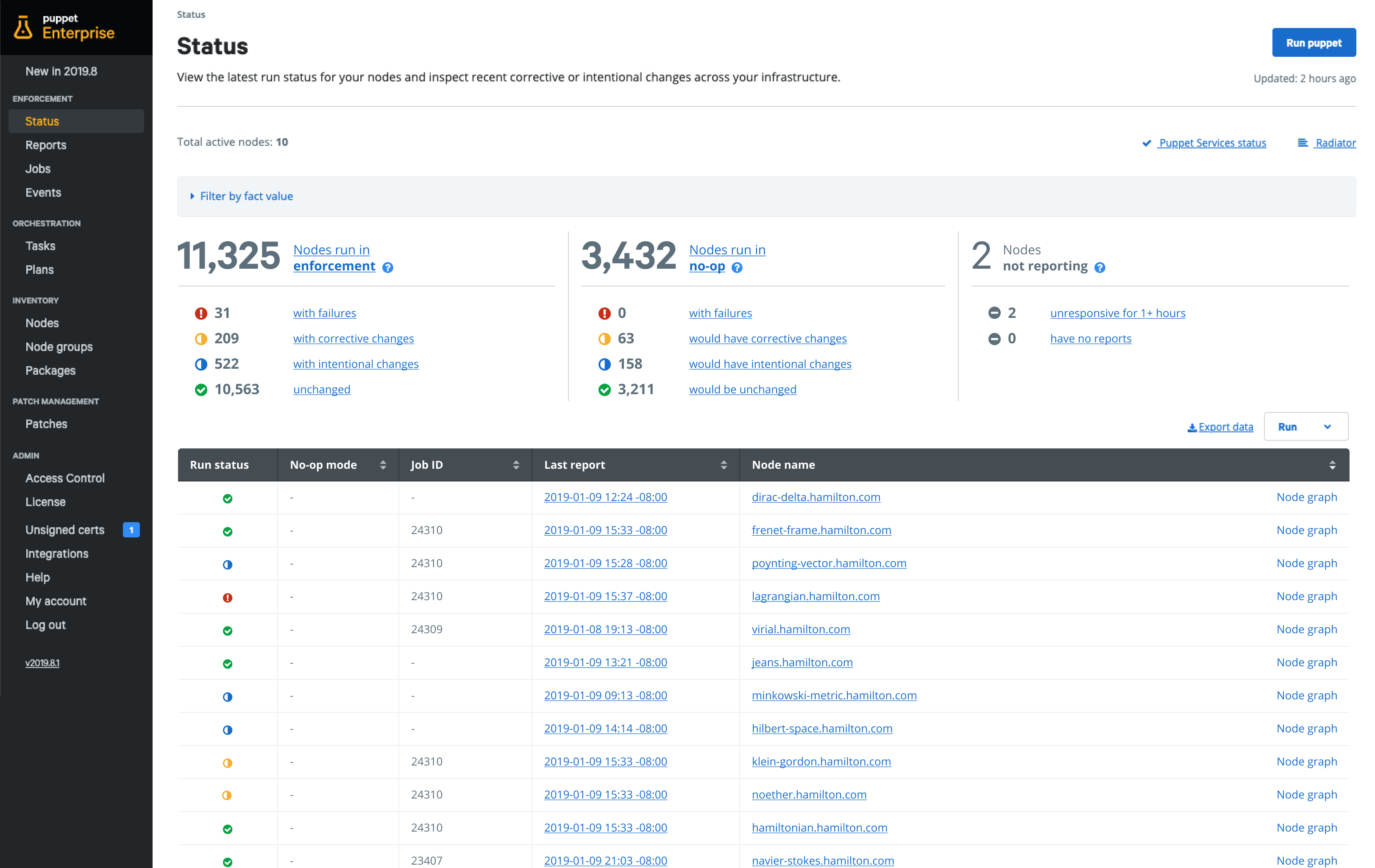
    Puppet today unveiled its summer release of Puppet Enterprise that promises to make it easier for DevOps teams to construct automated workflows within a Puppet console.

    DevOps teams can now mix and match thousands of declarative state-based modules available on Puppet Forge repository to compose and orchestrate workflows.

    At the same time, Puppet has added out-of-the-box guided patch management workflows that replace standalone patch management tools with orchestrated workflows. That capability is based on a Relay tool that Puppet launched earlier this year.

    Finally, Puppet is now also including an upgrade pre-check module that assesses and identifies potential risks along with surfacing what changes should be made before running an upgrade.

    Puppet CTO Deepak Giridharagopal said in the wake of the economic downturn brought on by the COVID-19 pandemic, more IT teams will need to rely heavily on automation. Most IT teams either will remain the same size or be downsized. The IT environment, however, will continue to grow more complex. The only way to enable IT teams to do more with less is to automate more rote tasks, he said.

    Automation is not likely to replace the need for IT administrators, added Giridharagopal. Rather, investments in automation will augment those teams in a way that enables IT teams to scale.

    In fact, Giridharagopal said, resistance to IT automation is declining as IT teams continue to appreciate the scope of the challenge they now face as IT environments not only continue to expand but also become more heterogeneous. Most business leaders now expect smaller IT teams to be able to automate a wide range of tasks as part of their overall strategy, he noted.

    Longer-term, Giridharagopal said IT organizations will also discover that many rote tasks will be performed more consistently once automated. Patches, for example, are not always applied as quickly or as often as they should be simply because there isn’t enough time for the IT team to manually install them.

    The latest update to Puppet Enterprise comes on the heels of a $40 million investment made in Puppet led by BlackRock, a private equity firm. As more IT teams recognize the need to automate tasks, competition to automate those tasks has intensified among providers of frameworks.

    It’s not clear how deeply and how many IT tasks can be automated. The more standardized an IT environment is, the easier it becomes to automate. Additionally, the amount of time an IT organization devotes to writing scripts to automate tasks should be reduced sharply. Instead, IT teams will increasingly employ a mix of modules that already exist to address a broad range of use cases. The challenge going forward isn’t so much finding the right IT automation tool, but rather constructing an IT environment that lends itself to being automated.

  • Has the Pandemic Made DevOps Tougher or Easier?

    Has the Pandemic Made DevOps Tougher or Easier?

    How has COVID-19 impacted the way DevOps professionals approach their work?

    The current, unpredictable economic climate as a result of the global COVID-19 pandemic has exposed a glaring need for organizations to be able to do more with less. They have fewer resources and even less margin of error now to maintain customer relationships, keep up the pace of innovation and stay ahead of competitors. This global crisis has shifted more end users toward digital services, increasing the pressure further on organizations to deliver robust digital services to both their customers and employees. Meeting that need in a short amount of time is, suffice it to say, extremely challenging.

    All of this has shaken up norms for DevOps professionals and created an even greater need to accelerate continuous automation, break down silos between teams and cultivate greater cross-team collaboration, to help their organizations continue business as usual—in other words, a greater need for DevOps, period.

    Let’s take a look at how today’s new normal has in some ways made DevOps transformations easier and more widely accepted, and in other ways made DevOps more complicated—and what leadership can do about it.

    Improved Trust and Collaboration Among IT Teams

    Trust and collaboration form the base of true DevOps cultures. Anything an organization can do to make collaborating easier and eliminate unfair advantages between teams makes DevOps easier to facilitate. If half your team is working in the office and half is working remotely, that is not an even playing field; there are advantages to sharing an office and being able to communicate in-person that those who work remotely don’t have.

    It’s also a matter of trust. Trust is not always assumed for employees working remotely. People in the office might feel skeptical that those at home just aren’t working as hard as they are. The advantage of everyone having to work remotely for the last several months is that we’re now all on a level playing field; we’ve all been in the same work-from-home boat. That has eliminated unfair advantages and helped boost trust among team members.

    The more you trust each other, the easier it is to collaborate and delegate work, which removes some of the typical hurdles for DevOps projects.

    Increased Use of Automation

    Alongside trust and collaboration, automation is another key pillar of DevOps. In the past, teams may have been skeptical about automating their work, figuring it was just easier to do it themselves.

    But, the massive spike in demand for IT services this year put a lot of pressure on traditional IT teams to get services up and running, provision machines and troubleshoot access problems, among other things. The only way to scale up to meet these demands without being overworked was to adopt continuous automation.

    Now automation skeptics have seen for themselves the value of automating tasks to make work more manageable during unexpected digital activity peaks.

    Growing DevOps Skills Gaps Around Automation, Kubernetes

    The good news is, DevOps projects have been excelling in the new normal thanks to these accelerations in collaboration, trust and automation. But the flip side of more automation is a greater need to pick up new skills for making automation work.

    Those working remotely without kids to look after might find more free time to spend on leveling up their automation skills, such as learning Python and other new script languages. But those who have to pull double-duty between their own job and other household tasks demanding immediate attention—such as homeschooling and looking after young children—might be less likely to have that opportunity. This could put many people at a long-term disadvantage as skills gaps continue to grow around automation. We may be looking at the possibility of certain demographics of employees (i.e. those who aren’t currently raising families or school-aged children) having more access to skills and educational opportunities than those who do.

    This is also an issue with Kubernetes. Enterprise adoption of Kubernetes is growing rapidly as the container platform of choice for managing dynamic multi-cloud environments. But adoption is moving so quickly that even the teams who work with Kubernetes can find themselves behind the curve before they know it. This Kubernetes education gap is getting bigger every day, and the people who may have time now to keep themselves informed about Kubernetes will be at a greater advantage than those who just don’t have the time for after-work training.

    The Role for DevOps Leaders in This Moment

    For all the instability going on today, DevOps projects seem to generally be in a good spot, thanks to growing trust and collaboration between teams and a greater acceptance of the need for continuous automation. But as we start returning to normalcy and heading back to the office, leaders must not allow their teams to lapse back into old habits.

    Leadership will need to come up with new rules of engagement for working in the office to eliminate unfair advantages that used to exist. For example, at my company, we’ve established that once offices are fully reopened, meetings will only be held in-person if everyone invited is present. If one person invited to the meeting is remote, then everyone will join remotely. Organizations should look to adopt similar rules, as the transition from working virtually to in-office is going to be a long and challenging one, with not everyone returning all at once.

    In addition, organizations and leadership teams need to dedicate more official work time to training and educating employees on new tech such as automation and Kubernetes to even the playing field, develop more highly skilled teams and close these skills gaps. Team leaders must ensure that everyone is on the same page and that it’s not just those who had the most free time while quarantining who are coming out ahead.

    The behaviors we’ve picked up during social distancing—new opportunities for continuous learning, wider adoption of automation, elimination of unfair advantages for remote workers—are making DevOps better. But these are practices we have to continue carrying forward in the new normal and beyond.

  • Keysight Technologies Jumps into App Testing by Acquiring Eggplant

    Keysight Technologies Jumps into App Testing by Acquiring Eggplant

    Keysight Technologies, a provider of tools to test and measure embedded systems and mobile computing devices, has acquired Eggplant, a provider of a platform that automates application testing, for $330 million.

    Dr. John Bates, CEO of Eggplant, said the acquisition enables Keysight to expand the scope of its testing portfolio beyond hardware. Keysight traces its lineage back to Agilent Technologies, which it spun out of in 2014. Agilent was spun out of Hewlett-Packard in 1999. Keysight retains the test and measurement portfolio that began with HP back in 1939.

    Bates said Eggplant, which has annual revenues of $38 million, will operate for now as an independent arm of Keysight. Over time, however, there should be increased opportunities to converge testing of applications software running on embedded systems that increasingly are being deployed at the network edge, he noted.

    Eggplant’s Digital Automation Intelligence (DAI) platform is designed to automate the entire testing lifecycle process as part of a larger best DevOps practice. The rate at which application tests can be built and run winds up being a bottleneck as applications are being built. The DAI platform is designed to automate the creation of UI tests and then launch them against application code to eliminate as much testing friction as possible. IT teams can also track user behavior to create user journeys based on their interactions with applications and store tests created using modeling tools provided by Eggplant in its cloud service.

    Eggplant has been investing in deep learning algorithms that, for example, automatically identify and classify user interface (UI) elements such as buttons and text fields across any platform and then generate all the automation assets needed to instantly run an automated test.

    With the rise of DevOps, there’s now more application code to be tested than ever. As such, testing backlogs within many IT organizations are growing. The challenge is finding a way to thoroughly test applications without resulting in missed deployment deadlines. When those deadlines are in danger of being blown, testing typically is the first thing to be scaled back. Of course, when an application has to be rolled back, the primary reason often is because a key component was not tested properly.

    Bates noted testing becomes even more complicated as organizations embrace microservices. The level of dependency between microservices spanning multiple platforms makes testing even more challenging, he said, adding IT organizations will need to rely on automated testing platforms to test applications at levels of unprecedented scale.

    It’s not clear to what degree the COVID-19 pandemic may have accelerated demand for applications based on emerging 5G wireless services. Some organizations are forging ahead while others may be delaying initiatives as they cope with the economic impact of the pandemic. One way or another, a raft of applications running on a wide variety of edge computing platforms will need to be tested. Chances are good a much larger percentage of those applications soon will be tested by machines rather than humans that can’t scale to meet the challenge.

  • VMware’s Blue Medora Buy Advances AIOps

    VMware’s Blue Medora Buy Advances AIOps

    VMware has announced it will acquire Blue Medora, a provider of a service for integrating data collected by IT monitoring tools, to expand its efforts to advance the adoption of artificial intelligence to automate IT operations (AIOps).

    Roy Ritthaler, vice president of cloud management for VMware, said Blue Medora provides VMware with a software-as-a-service (SaaS) platform that is employed to inform VMware vRealize, an IT automation suite that is now being used by more than 400 customers.

    The data Blue Medora collects will also be employed within Project Magna, a research and development initiative that applies machine learning algorithms and other forms of artificial intelligence (AI) to automate IT operations, he said. Project Magna is based on a reinforcement learning engine that automates the tuning of multiple sub-components of the overall IT environment, resulting in what VMware calls “self-driving data centers.”

    Ritthaler said the goal is not to replace IT professionals as much as it is to eliminate rote tasks while making it easier to manage increasingly complex IT environments at scale. It then will become feasible for a smaller number of IT professionals to manage hybrid cloud computing environments, he noted.

    Blue Medora’s True Visibility Suite provides VMware with visibility not just into IT infrastructure but also all the way up the application stack.

    Ritthaler said it’s only a matter of time before most management frameworks are accessed as service, given all the data that needs to be collected and then analyzed to surface meaningful insights. It’s not clear how roles with IT organizations will evolve once those insights are surfaced regularly. Most enterprise IT organizations today rely on multiple specialists to optimize all the components that make up the IT environment. In theory, AIOps will make it possible for IT generalists to manage an IT environment without having to rely on so many specialists.

    AIOps undoubtedly will also have a profound impact on DevOps processes. As more IT operations become automated, the amount of time and effort spent managing IT infrastructure should decline.

    Interest in IT automation is on the rise in the wake of the COVID-19 pandemic. With many IT professionals working from home as much as possible, organizations are looking to automate rote IT processes to make them easier to manage remotely. In many cases, achieving that goal will require IT teams to rely more on tools that are accessed as a cloud service.

    Regardless of the path forward, it’s apparent the management of IT is about to be utterly transformed.

    It’s not that IT organizations will suddenly have a greater appreciation of IT automation. However, the pandemic has added more urgency to an IT transition that was already underway prior to the pandemic. The issue now is not so much whether to embrace IT automation as it is determining what can be automated for a consistent outcome across IT environments that frequently are made up of a diverse yet not especially well-integrated range of platforms.