Siemens this week moved to substantially accelerate its transition into becoming a software company by acquiring Mendix, a provider of low-code application development tools, for $730 million in cash.
Mendix CEO Derek Roos said Mendix will operate as a business unit of Siemens, which has poured more than $10 billion over the last decade to software development as part of an ongoing digital transformation to a multibillion-dollar conglomerate.
Siemens over the last year determined that Mendix was now a strategic component of that initiative, Roos said, as more applications are shifted to and developed in the cloud. Many Siemens employees already use Mendix tools to develop custom applications with limited to no programming skills. That capability is especially critical in line of business (LOB) organizations that are starting to deploy their internet of things (IoT) applications, he noted. Mendix also recently revealed it is starting to infuse its low-code application development platform with artificial intelligence (AI) capabilities.
Roos said the $730 million investment Siemens is making to acquire Mendix is larger than all the venture capital investments made in rival companies delivering low-code platforms combined. As low-code tools have gained mainstream adoption, however, Mendix increasingly finds itself competing directly with larger rivals such as Microsoft and Salesforce, he noted.
The Siemens decision to acquire Mendix comes at a time when archrival GE is throttling back on digital process transformation efforts. Roos said GE’s decision is unique to structural issues within GE versus being a decision that reflects loss of faith in digital process transformation driven by custom application development. Software is now the fastest growing segment of the Siemens conglomerate, he said.
A recent survey conducted by Mendix in collaboration with ASUG, an end user association for organizations that have deployed software from SAP, finds 64 percent of respondents are experiencing increased demand for custom applications within their organizations. The primary problem is that same survey finds the average custom application development backlog is 24 months. Primary issues cited by survey respondents include high development costs (50 percent), difficulty integrating with existing systems (47 percent) and lack of skilled development resources (45 percent).
Of course, as Siemens becomes a larger software force, some organizations will start will take into consideration how much they may compete with the company before selecting an application development platform. Mendix is betting that as application development expands well beyond internal IT organizations, its status as an independent business unit of Siemens will provide enough distance between Mendix and Siemens business units that a Mendix customer might compete against.
In the meantime, organizations that are embracing low-code platforms are simultaneously increasing their investments in DevOps processes. As the number of applications being developed using low-code tools increases, there is a corresponding increase in application release management that requires them to modernize those processes. As Mendix plays the role in enabling applications that can be deployed from the cloud to the network edge, it’s now only a matter of time before the Mendix low-code platform becomes a more significant element of a larger set of DevOps processes driving digital process transformation projects as unprecedented levels of scale.
Accenture plans to infuse greater amounts of artificial intelligence into application development testing following its acquisition of Real Time Analytics Platform Inc., which provides tools that make use of machine learning algorithms, neural networks and natural language processing (NLP) to analyze every stage of the software development life cycle.
Kishore Durg, senior managing director and growth and strategy lead for Accenture Technology, the IT services arm of Accenture, will incorporate the AI technologies developed by Real Rime Analytics Platform into the Accenture Touchless Testing Platform, which is a suite of open source and proprietary testing tools that Accenture has infused with advanced analytics and cognitive computing technologies.
Durg said Accenture is committed to automating application testing using AI technologies to help organizations increase the productivity of application development teams. At a time when organizations are investing in a broad range of digital transformation projects, the rate at which applications can be built, tested and deployed has become a critical issue.
Most organizations on their own won’t be able to aggregate enough data to drive machine learning algorithms and neural networks to drive a meaningful AI model. Those models require access to massive amounts of data to be trained to identify potential issues within any application. Because of the size and scope of the projects Accenture works on, organizations that employ its service can benefit from all the data that Accenture can bring to bear to train AI models, Durg noted.
The quality of the data used to train those AI models is also as important as the amount of data, added Durg. Accenture has the resources required to cleanse data before it gets fed into an AI model, as well the expertise needed to eliminate any biases that might get built into any algorithm being applied to that data, he said.
As AI continues to evolve, it won’t be long before every application incorporates some form of an AI model. Each of those models not only needs to be trained, but they also need to be updated continually—and eventually replaced by more sophisticated models as more data becomes available. In effect, that requirement will create a need to extend DevOps processes to how AI models are incorporated within an application.
At the same time, it’s clear that large swaths of DevOps processes involving, for example, application testing can be increasingly automated using a variety of machine learning and network networks, also known as deep learning algorithms.
In theory, that should accelerate the rate at which applications are developed and deployed, while testing processes that are augmented by AI technologies should result in applications that are more secure, as many more vulnerabilities will be discovered long before an application gets deployed in a production environment.
In fact, the inclusion of advanced algorithms across a DevOps toolchain might accelerate adoption of DevOps processes. After all, most IT organizations today have embraced DevOps unevenly largely because of the complexity involved. AI technologies one day soon may eliminate that issue altogether.
Compuware is extending its ongoing campaign to bring DevOps processes to the mainframe by acquiring XaTester, a provider of tools for creating unit tests for both batch and CICS-based programs written in COBOL, PL/I and Assembler.
In addition, Compuware announced it has formed an alliance with Parasoft, a provider of tools for testing application programming interface (API) calls between mainframe and non-mainframe systems.
Finally, Compuware revealed it has added support for automated unit testing for the IBM Management System (IMS), a hierarchical database that is used to run both transaction and batch-oriented applications.
Compuware CEO Chris O’Malley said all these new capabilities will expand the reach and scope of Topaz for Total Test platform that makes it possible to apply DevOps practices to both new and legacy applications being developed and deployed on IBM mainframe platforms.
Despite being more than five decades old, O’Malley noted that mainframes are still widely employed to process both transaction and batch-oriented applications at a level of scale other platforms still can’t match. The challenge now is to integrate the wealth of applications running on IBM mainframes within the context of a modern application development process, he said. That requires putting new application development and deployment tools in place that are optimized for DevOps versus traditional waterfall approaches still widely used in mainframe environments.
CICS and IMS applications are at the heart of some of the fastest transaction processing applications running in the enterprise. Rather than rewrite those applications, O’Malley said organizations that have invested in mainframes want to be able to expose those applications as a service using APIs. Testing those integrations requires mainframe teams to adopt frameworks that enable them to become more agile, he noted—for example, organizations integrating applications need to be able to easily engage in A/B testing to be able optimize performance.
As the lines between mainframes and distributed computing systems continues to blur, most organizations are working toward having one team support both platforms. As part of that effort organizations are introducing DevOps practices that have proven themselves on distributed computing platforms to mainframes. That approach helps mitigate a mainframe skills shortage that is occurring as more IT professionals with mainframe skills leave the workforce.
It may take a little extra effort to get IT staffs managing mainframes to part ways with legacy approaches to building and deploying applications that have clearly stood the test of time. But as more organizations embrace digital process transformation the rate of change in mainframe environments clearly need to accelerate, O’Malley said.
In fact, IT professionals with mainframe skills that are also literate when it comes to DevOps just might find themselves among the most sought-after people in enterprise IT. After all, the number of IT professionals that can play both side of the mainframe and distributed systems ball are very few indeed.
Hewlett-Packard Enterprise (HPE) today moved to bring storage further into the realm of DevOps by integrating its 3PAR storage systems with VMware vRealize Orchestration software, open source Kubernetes container orchestration software and the Red Hat OpenShift platform-as-a-service (PaaS) environment built on top of Kubernetes. HPE 3PAR storage systems already support Docker containers and the DC/OS private cloud platform from Mesosphere.
In addition, HPE is making available pre-built blueprints for Chef, Puppet and Ansible automation frameworks, as well as software development kits written in Ruby and Python that can be used to create custom integrations.
Finally, HPE announced that HPE InfoSight, a cloud-based service that employs machine learning algorithms to predict when a drive might be about to fail or when application performance might be adversely impacted by I/O contention. HPE gained the core technology for that service when it acquired Nimble Storage last year.
Vish Mulchand, senior director of product management and marketing for HPE Storage, said machine learning algorithms and other forms of artificial intelligence (AI) will soon be playing a much larger DevOps role. Research indicates that more than half of all support issues involve storage systems, and AI technologies will be able to identify most of those issues long before they impact applications, he says.
Mulchand notes HPE has been adding integrations with various DevOps and container technologies to make it easier to scale applications as needed. The goal, he says, is to make storage management a more natural extension of any set of DevOps processes.
In general, providers of storage systems have been investing heavily in automation frameworks designed to make it easier for storage administrators to manage ever increasing amounts of data. The next challenge facing IT organizations is to be able to provision storage resources in a way that doesn’t hamper the rate at which those applications might be deployed.
It’s not clear to what degree storage administrators will be subsumed into DevOps teams. In most cases, storage administrators are looking to make available a pre-determined set of storage resources available to developers on a self-service basis. The amount of those resources is determined by the characteristics of the application, which storage administrators can gain earlier access into by participating in the DevOps process.
Going forward, Mulchand says HPE expects competition between storage vendors increasingly will be defined by the quality of experience they provide IT organizations rather than the performance of the storage systems. Every storage vendor has embraced Flash storage systems that can address the performance requirements of just about any type of application workload, he says, so making it easier to access those storage resources and make sure they are constantly available is the next major opportunity.
As more automation gets introduced into IT environments, there’s no doubt the role of the average storage administrator will change. Rather than manually provisioning resources, storage administrators will be able to develop policies for classes of applications that are automatically implemented whenever storage systems need to be provisioned. As storage administrators learn the characteristics of those application in a production environment, those policies will be further fine-tuned. The good news is that storage itself no longer needs to be seen as a bottleneck from either a performance or DevOps perspective.
CloudBees has moved to bring some order to the potential DevOps chaos via an update to CloudBees DevOptics, a monitoring tool for tracking stages of the software delivery process in real time.
The update to the software-as-a-service (SaaS) application adds capabilities that identify everything from potential bottlenecks to periods of inactivity that might be better allocated to maintenance activities.
Michael Baldani, product marketing manager for CloudBees, said CloudBees DevOptics makes it possible to create benchmarks that track DevOps performance across the entire software delivery life cycle, including deployment frequencies, lead time to committing code into production environment, mean time to recover from failures and change failure rates. The “2017 State of DevOps Report” identifies these four most important metrics for a DevOps team to track.
Armed with those insights, a DevOps team is capable of drilling down into a specific issue to make more informed decisions concerning how best to optimize processes, said Baldani, noting that longer term, CloudBees DevOptics also sets the stage for eventually applying machine learning algorithms to processes.
The rate at which organizations have been making the transition to DevOps has been uneven at best. Much of that issue can be traced back to a lack of visibility into how specific processes are being employed, Baldani said. The analytics capabilities provided via CloudBees DevOptics should help organizations accelerate the transition to DevOps by enabling organizations to more easily identify areas where they need to optimize DevOps best practices, he said.
Traditional enterprise IT organizations are still wedded to legacy approaches to software development largely because of inertia. CloudBees DevOptics provides an analytics application that, in addition to helping optimize DevOps processes, provides access to dashboards through which a DevOps process can be shown conclusively to be more efficient than, for example, an existing waterfall approach.
Most organizations are embracing DevOps from the bottom up as individual teams launch various application development projects. As those teams start to deliver applications faster, it’s usually not too long before senior managers want to replicate that success across the rest of the organization. CloudBees DevOptics provides a mechanism through which the best practices implemented by various teams can be captured to facilitate sharing them with other teams. The biggest challenge facing most organizations today is not so much being convinced they can benefit from DevOps, but rather how precisely to go about it.
It may take a while longer for DevOps processes to become the most widely used approach to developing software in the enterprise. But as more organizations continue to appreciate how dependent they are on software to manage increasingly digital processes, the need to accelerate the rate at which software is being developed becomes more apparent. CloudBees is betting that access to real-time analytics will be a major factor in any decision to standardize on a continuous integration/continuous deployment (CI/CD) platform by providing visibility into how software development ultimately impacts the business. After all, it’s now only a matter of time before some new or existing rival leverages software to create a competitive edge. In fact, it’s already been proven time and again that the rate at which organizations can create and deliver quality applications is critical to the overall customer experience.
Once SUSE completes a separation from Micro Focus sometime next year, the goal for the again independent company will be to drive continued investments in a range of open source technologies that collectively advance DevOps.
Michael Miller, president of strategy, alliances and marketing for SUSE, said the acquisition by EQT, a private investment firm, is part of a three-to-five-year plan to invest in technologies that complement existing SUSE products and services. Core products and services are centered around a distribution of Linux, the OpenStack cloud management framework, the Cloud Foundry platform-as-a-service (PaaS) environment and Kubernetes container orchestration software, he said.
As part of that strategy, Miller said that may mean acquiring complementary open source or proprietary security and management technologies. Any proprietary technology that SUSE would acquire would be turned into an open source project later, he said.
Because it has been operating as an independent business unit, no one should expect to see any significant changes to the overall SUSE strategy beyond making additional investments in products and services or how the company will be going to market in 2019, he noted.
At the core of its strategy is a portfolio of open source PaaS and container-as-as-service (CaaS) environments that organizations of all sizes are employing to drive digital process transformation using custom applications that have now easier to deploy and maintain, Miller said.
Unlike many other investments involving private equity firms, EQT’s decision to acquire the company is being driven by a desire to invest for the long term rather than sell assets off in a piecemeal fashion, Miller noted. Micro Focus this week agreed to sell SUSE to EQT for $2.54 billion in part to help pay for the software assets it gained following a $8.8 billion merger with the software business unit of Hewlett-Packard Enterprise (HPE). The company has been part of Attachmate, which Micro Focus acquired in 2014. Earlier this year, Micro Focus CEO Chris Hsu was replaced by Stephen Murdoch, who was COO of Micro Focus.
Once the deal closes, SUSE will become an independent company for the first time since 2003, when it was acquired by Novell. Attachmate acquired Novell in 2010.
It remains to be seen whether SUSE will be spun out as public company or sold off to yet another vendor. For now, however, it may end up with more resources to combat its rivals, including Red Hat, than it would have had as a unit of Micro Focus.
In the meantime, the company—much like Red Hat—should continue to benefit from the massive amounts of research and development being poured into projects such as Kubernetes and OpenStack. At the same time, it continues to invest in Linux. The company recently released SUSE Linux Enterprise 15, SUSE Manager 3.2 and SUSE Linux Enterprise High Performance Computing 15 as part of an effort to drive a multimodal IT strategy around a common code base that includes MicroOS, which is optimized for containers and makes use of the same code base as SUSE Enterprise Linux.
While Red Hat may be the dominant provider of open source operating systems, SUSE has not given up. Meanwhile, the battle for control over open source PaaS and CaaS environments is still in its early stages. In fact, DevOps teams distributed across the enterprise most likely will determine the ultimate victor.
DevOps has transformed from a mere idea on paper to the way processes function in the face of an immediate requirement. Development and Operations together make for one of the most successful collaborations today.
As per a research report, people have now begun to understand what DevOps is. When asked how familiar they were with DevOps, 84 percent of respondents said that they well-versed with the concept, in comparison with 60 percent who agreed to the same the previous year.
DevOps is writing the success stories of the world’s business giants. Facebook, Google, Twitter and Amazon are all working the “DevOps way.” All falls in place when these companies develop, test and successfully deploy code in a matter of one to 23,000 minutes per day. We agree that’s insane!
How Have We Benefited from DevOps Adoption?
To sum up the benefits of DevOps adoption in a nutshell, users see:
Drastic reduction in lead times—With the pressure to deliver software faster and meet the challenges of the growing market, there is always a need to look at progressive ways of getting the job done, DevOps became the solution. As per statistics, practitioners believe this to be the top benefit of DevOps in 2018. Sixty-nine percent of respondents agreed to this benefit, as compared to 39 percent in 2017.
Increased ability to release new features with improved reliability stability and security—The need to improve the user experience and keep the customer equipped with the necessary tools to meet the challenges of a growing business made IT personnel realize that it is always essential to introduce new features into the deployment process. DevOps made it easy. Figures tell us that the implementation of DevOps led to 73 percent of people believing in its benefit of enhanced user experience, this year.
Enhanced IT and Organizational Productivity, Higher Profitability, Revenue and Market Shares—Now with the best process having so much to offer, all businesses have gained a lot in terms of savings and earnings. DevOps drives revenue: 26 percent of people reported an increase in revenue in the year 2018 as compared with 20 percent in 2017.
Why No DevOps?
Although we’ve seen a major shift in trend from being skeptical about DevOps and its implementation to becoming “pro-DevOps,” over the years, not all of us are up for this big business move. The reasons being many.
Listed below are the most commonly given reasons by industrialists around the world:
Other technology and business priorities—With newer technologies being developed every few weeks, companies are confused over which technology will give their business the required leverage. This leaves them to either becoming very choosy or just ignoring the prospects of adopting a technology at all. Some business owners think about fund allocations. They want to invest their hard-earned money into something they see as more viable or something that convinces them about profits. When it comes to innovative ideas such as DevOps, they think these things may not bring them immediate results or they’re not as important as the “conceived” business priorities. As per a study conducted in February 2018, as much as 38 percent of the sample population opted out of DevOps for the above reason.
Lack of resources—Most organizations lack the required resources in terms of personnel, tools and persons with expertise. This discourages organizations from taking up such practices. While it is great to have a workforce with work experience for the dev and ops teams individually, it is crucial to have employees with DevOps experience on board. Similarly, lacking the right tools can have your organizations whimpering in the wake of a growing market despite having an able workforce. Statistics show that 34 percent of people hesitate to adopt DevOps for the given reason.
Lack of cooperation between development and operations—Whenever there is a mention of DevOps, there is also a mention of the cultural indifference of Dev and Ops teams. Each team has their unique work culture and when they come together on common ground, they cannot help but fall apart. Most organizations do not encourage the DevOps practice on account of this cultural disparity.A significant 22 percent of the industries under this research shun the idea of DevOps owing to this disparity.
‘We don’t see the value’—It is likely for some business to say this. It is difficult to assess the value of the process from an outsider point of view. If someone has heard about DevOps but don’t how it will profit their businesses, then it is difficult for them to adopt it. As per statistics as small as 6 percent of the sample population did not adopt DevOps for this reason.
On an End Note
Organizations have been opting for DevOps after seeing its contributions to the industry. This year has most businesses functioning with major dependence on the skill and agility of the DevOps processes, and this has been proven through the success of their business. We hope the remaining number of entrepreneurs come to realize the importance of DevOps for their business and implement its benefits to build their success and keep up with the challenges of the fast-growing market.
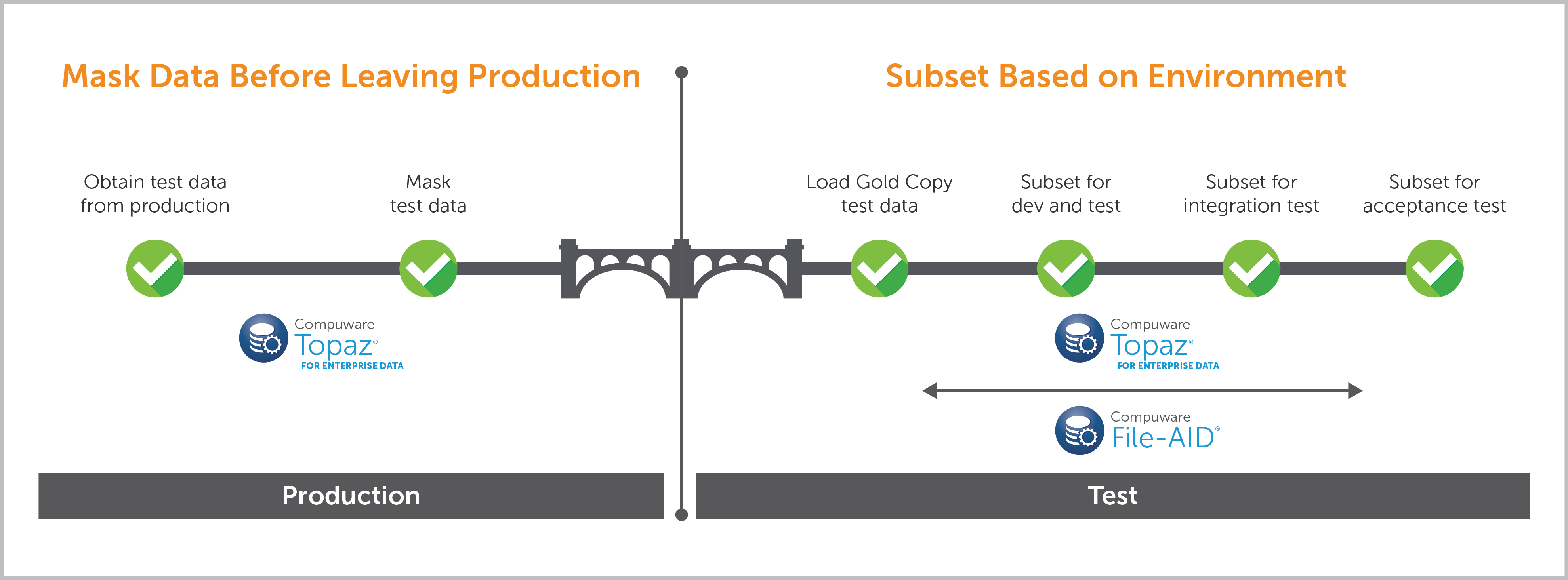
Compuware has advanced its campaign to erase the DevOps divide between mainframes and distributed systems via an update to Topaz for Enterprise Data that makes it easier to generate data from mainframe applications for testing purposes without compromising the security of some of the most sensitive data in the enterprise.
Company CEO Chris O’Malley said Topaz for Enterprise Data now includes a data masking capability that preserves essential data relationships and characteristics without letting developers see the data being copied.
Designed to be compatible with Eclipse integrated development environments (IDEs), Topaz for Enterprise Data also automates the extract, transform and load (ETL) process by enabling developers to convert file types.
O’Malley noted that, at a time when compliance regulations such as the European Union’s General Data Protection Rule (GDPR) are becoming more stringent, it has become more important for organizations to be able to demonstrate that personally identifiable information (PII) has not been exposed during any point in the application development cycle. That’s especially important when it comes to mainframe data, which typically is used to drive transaction processing applications.
In general, O’Malley said the historic divide between mainframes and distributed systems is narrowing as organizations embrace DevOps processes. Instead of proponents of these platforms battling within organizations for control over specific classes of workloads, there’s more awareness of the need to leverage both platforms to drive a new generation of digital business applications, O’Malley said.
The challenge is that most mainframe applications are built and updated using waterfall methodologies. Compuware has been developing a series of DevOps tools for mainframe environments that are intended to modernize those processes. As the IT organizations that have mainframes adopt those tools, it becomes easier to federate application development and deployment across mainframes and distributed systems, O’Malley said.
Of course, this all assumes various teams within the IT organization can lay aside historic animosities. The shift to DevOps has always required as much process and cultural change as it does new technologies. But in the case of IT organizations that have mainframe teams, that shift may take years. The good news is a that a new generation of IT professionals doesn’t have much history with infighting within internal IT organizations. The simple fact is there are classes of workloads that run better on mainframes, O’Malley noted, but that doesn’t mean every workload running on mainframe is ideally suited for that platform—or conversely, that every workload running on a distributed system is ideally suited for that platform.
Arguably, the rise of DevOps processes might create an opportunity to revisit many platform decisions that were made in the heat of a larger argument. In the meantime, it’s clear that applications integration spanning multiple platforms is the new order of the day. The question now is how best to go about achieving that goal in a way that erases the divide existing between all the platforms that now make up the extended enterprise.
Big news in the world of continuous testing today as continuous testing market leader Tricentis announced it is merging with QASymphony. Tricentis, a leader of continuous testing, is adding QASymphony’s leading testing automation platform to the mix. The full text of the press release is below.
With the worldwide testing market pegged at more than $34 billion, this is a big move in a very big market. Tricentis raised $165 million last year from Insight Venture Partners and has put this money to good use: The QASymphony merger is Tricentis’ latest move. Previously, it acquired Q-Up, in June, and last year acquired Flood IO.
Tricentis’ merger with QASymphony is happening at a time when continuous testing is becoming one of the hottest areas in DevOps. The demand for automated, continuous testing is driving a revolution in the QA market as companies recognize that quality is as important as speed when it comes to deploying new apps. It is a key cog in the modern software factory.
I had a chance to sit down and speak with Tricentis CEO, Sandeep Johri, about today’s announcement, the testing market and what the future may hold. Sandeep, who has previous experience at HP and other large providers, has a great vision of the market and where it is heading as well as the details that escape many “professional manager” CEOs. His hand is firmly on the wheel as he drives Tricentis forward in this space.
Have a listen to our conversation below, and stay tuned—we will update and continue this breaking story as more details emerge.
Tricentis and QASymphony Merge to Drive Innovation in Continuous Testing for Enterprise DevOps
Next Gen platform disrupts the $34B testing services spend and transforms software testing for DevOps
Mountain View, CA— June 20, 2018 — Tricentis and QASymphony announced their agreement to merge under the name of Tricentis. Tricentis’ market-leading Continuous Testing platform has earned the company unanimous “leader” recognition among the top industry analysts. QASymphony is recognized as the industry’s leading test management solution. The combined solution represents the most modern platform for transforming software testing to keep pace with digital transformation.
“Tricentis and QASymphony are both recognized for their innovative testing solutions,” explained Sandeep Johri, CEO of Tricentis. “Tricentis is known for helping enterprises transform testing from a burdensome manual process that delays software delivery into an automated, continuous process that drives ‘quality at speed.’ The addition of QASymphony’s test management solution strengthens our leadership position and builds on our momentum replacing legacy testing tools.”
“Today’s CIOs are responsible for ramping up innovation through accelerated software delivery,” explained Barry Libenson, Global Chief Information Officer at Experian. “Amid this demand for rapid innovation, CIOs are recognizing that software testing often delays their digital transformation goals. In fact, testing is now commonly cited as the #1 bottleneck to delivery speed. When testing lags behind development, the organization is forced to delay their innovation and that’s no longer an option. It’s inevitable that software testing must be transformed to keep pace with Agile development and DevOps.”
“Global 2000 organizations remain locked into legacy testing platforms that were designed decades ago to enable manual testing processes,” explained Dave Keil, CEO of QASymphony. “Scaled agile and enterprise DevOps initiatives have changed the game. Yet, legacy testing technologies such as those by HPE (now Micro Focus) and CA are throttling speed and innovation. QASymphony has experienced triple-digit growth over the past year—allowing us to aggressively invest in our technology, infrastructure and people to meet the emerging needs of our customers.”
QASymphony’s 100+ employees will be joining Tricentis’ 450+ employees. Sandeep Johri will lead the organization as CEO and Dave Keil will assume the role of COO. The combined company will have a global presence with offices in the US, EMEA and Asia. The transaction is expected to close within 90 days. EMBARGO UNTIL WEDNESDAY, JUNE 20, 2018 @ 8:00 AM ET USA
The integration will reflect the commitment to innovation and customer success that both companies share—to learn more, register for the upcoming webinar. Additionally, the company will be showcasing the roadmap and solution at Accelerate 2018 in Vienna.
DevOps Impact
The market for software testing (recently estimated at $34 billion)1 has reached an inflection point. DevOps adoption is rising rapidly, and both Gartner and Forrester report that transforming testing is a primary factor for DevOps success.2 Yet, software testing remains a predominantly manual activity that delays releases and consumes 30-40 percent of an organization’s application budget3,4 Tricentis Continuous Testing solutions accelerate delivery and free up significant budget that can be reallocated to underfunded innovation initiatives.
Gartner’s Joachim Herschmann and Thomas Murphy report: “As DevOps principles gain significant traction in enterprises, testing and QA is no longer a stage in delivery but an integral DevOps activity that exists in various forms through all areas. Automation has become an indispensable element in these efforts, and there has been renewed focus on software test automation tools as part of a larger toolchain that enables DevOps.”5
About Tricentis
With the industry’s No. 1 Continuous Testing platform, Tricentis is recognized for reinventing software testing for DevOps. Through risk-based testing, scriptless end-to-end test automation, and the industry’s most extensive technology support, Tricentis breaks through the barriers experienced with conventional software testing methods. Our innovative technologies simplify testing for even the most complex enterprise applications—transforming testing from a roadblock to a catalyst for innovation. The result is accelerated software delivery speed, improved cost efficiency, and reduced business risk.
Tricentis is the only vendor to achieve “leader” status in all three top analyst reports (i.e., the “Triple Crown.”) This honor is based on our technical leadership, innovation, and a Global 2000 customer base of 800+ companies, including global enterprises such as Allianz, ANZ Bank, Experian, First Data, HSBC, Lexmark, Merck, Sentry Insurance, Starbucks, Telstra, UBS, Vantiv (now WorldPay), Vodafone, and Whole Foods. These customers rely on Tricentis to achieve and sustain test automation rates of over 90 percent—increasing risk coverage while accelerating testing to keep pace with Agile and DevOps. EMBARGO UNTIL WEDNESDAY, JUNE 20, 2018 @ 8:00 AM ET USA
Tricentis has a global presence in Austria, Australia, Belgium, Denmark, Germany, India, Netherlands, Singapore, Switzerland, Poland, United States and the UK. To learn more, visit https://www.tricentis.com or follow us on LinkedIn, Twitter, and Facebook.
About QASymphony
QASymphony accelerates digital transformation with software testing solutions that help enterprises prioritize quality, develop reliable software and increase speed to market. The qTest platform streamlines software testing in agile and DevOps environments and centralizes testing efforts across the enterprise. By taking a strategic approach to quality, QASymphony enables enterprises to develop higher-quality software, faster, to better support new business models and customer experiences.
The qTest platform streamlines development workflows by seamlessly integrating testing with leading automation, development and delivery tools including Atlassian’s Jira, CA Agile Central, Github, Selenium, Cucumber, Jenkins and many more. QASymphony is trusted by leading enterprises including Forcepoint, PFSweb, Cisco, Samsung, Verizon and Office Depot.
The Oracle platform-as-a-service (PaaS) environment has also been expanded to include Oracle Mobile Cloud Enterprise, Oracle Data Integration Platform Cloud and Oracle API Platform Cloud alongside existing continuous integration and continuous deployment (CI/CD) cloud service. Oracle also revealed today that later this year it will also add blockchain, security and management and support for additional database workloads, including OLTP and NoSQL, that expand on existing Oracle Database, Oracle Autonomous Data Warehouse Cloud, Oracle Analytics Cloud, Oracle Integration Cloud and Oracle Visual Builder services.
Siddhartha Agarwal, vice president of product management and strategy at Oracle, said via the cloud service, Oracle plans to automate DevOps processes to the point where organizations will be able to allocate most of their time and effort to building applications. Today, developers are spending as much as 50 percent to 60 percent of their time on DevOps processes rather than writing application code, he said, and the Oracle Cloud platform automates a broad range of operational functions including tuning, patching, backups and upgrades.
Oracle Cloud Platform is designed to be an infinitely elastic autonomous cloud service that can both anticipate application requirements and dynamically adjust to changing workload conditions. Over time, the platform also will be able to increasingly provide recommendations based on the characteristics of the application workloads being built and deployed, Agarwal said.
The Oracle API Platform Cloud service, for example, already continuously learns about usage patterns to recommend allocation limits, configurations and policies using predictive algorithms, he said.
Meanwhile, the Oracle Cloud Mobile Enterprise service provides access to machine learning algorithms that make it much easier to incorporate chatbots into mobile applications, Agarwal said. Machine learning algorithms are now also relied on to create Big Data lakes and the data pipelines needed to make that data available to application developers.
Those services are all extensions of an Oracle Developer Cloud service for building applications that supports build frameworks such as Maven, Ant, Gradle, npm, Grunt, Gulp and Bower, as well as command line interfaces for Docker, Kubernetes and Terraform. Frameworks such as JUnit and Selenium for both logic and UI testing are also included.
Agarwal said one of the primary reasons DevOps process have not been as widely adopted across the enterprise is that it’s simply too complicated for most IT organizations to set up and then continuously manage all the underlying infrastructure required. By moving more of the responsibility for the operations side of the DevOps equation on to an autonomous cloud service managed by Oracle, he said, it becomes simpler for enterprise IT organizations to focus their energy on application development processes.
It may take some time for enterprise IT organizations to get comfortable with ceding that level of control to a cloud service provider. But whatever DevOps path they choose, it’s apparent that machine learning algorithms coupled with other AI advances are about to automate broad swaths of the DevOps universe.