Category: News

  • Oracle Advances AI Effort to Automate DevOps

    Oracle Advances AI Effort to Automate DevOps

    Oracle today announced the general availability of an expanded Oracle Cloud Platform service that promises to automate most back-end DevOps processes by relying on a combination of machine learning algorithms and other forms of artificial intelligence (AI).

    The Oracle platform-as-a-service (PaaS) environment has also been expanded to include Oracle Mobile Cloud Enterprise, Oracle Data Integration Platform Cloud and Oracle API Platform Cloud alongside existing continuous integration and continuous deployment (CI/CD) cloud service. Oracle also revealed today that later this year it will also add blockchain, security and management and support for additional database workloads, including OLTP and NoSQL, that expand on existing Oracle Database, Oracle Autonomous Data Warehouse Cloud, Oracle Analytics Cloud, Oracle Integration Cloud and Oracle Visual Builder services.

    Siddhartha Agarwal, vice president of product management and strategy at Oracle, said via the cloud service, Oracle plans to automate DevOps processes to the point where organizations will be able to allocate most of their time and effort to building applications. Today, developers are spending as much as 50 percent to 60 percent of their time on DevOps processes rather than writing application code, he said, and the Oracle Cloud platform automates a broad range of operational functions including tuning, patching, backups and upgrades.

    Oracle Cloud Platform is designed to be an infinitely elastic autonomous cloud service that can both anticipate application requirements and dynamically adjust to changing workload conditions. Over time, the platform also will be able to increasingly provide recommendations based on the characteristics of the application workloads being built and deployed, Agarwal said.

    The Oracle API Platform Cloud service, for example, already continuously learns about usage patterns to recommend allocation limits, configurations and policies using predictive algorithms, he said.

    Meanwhile, the Oracle Cloud Mobile Enterprise service provides access to machine learning algorithms that make it much easier to incorporate chatbots into mobile applications, Agarwal said. Machine learning algorithms are now also relied on to create Big Data lakes and the data pipelines needed to make that data available to application developers.

    Those services are all extensions of an Oracle Developer Cloud service for building applications that supports build frameworks such as Maven, Ant, Gradle, npm, Grunt, Gulp and Bower, as well as command line interfaces for Docker, Kubernetes and Terraform. Frameworks such as JUnit and Selenium for both logic and UI testing are also included.

    Agarwal said one of the primary reasons DevOps process have not been as widely adopted across the enterprise is that it’s simply too complicated for most IT organizations to set up and then continuously manage all the underlying infrastructure required. By moving more of the responsibility for the operations side of the DevOps equation on to an autonomous cloud service managed by Oracle, he said, it becomes simpler for enterprise IT organizations to focus their energy on application development processes.

    It may take some time for enterprise IT organizations to get comfortable with ceding that level of control to a cloud service provider. But whatever DevOps path they choose, it’s apparent that machine learning algorithms coupled with other AI advances are about to automate broad swaths of the DevOps universe.

    — Mike Vizard

  • CA, IBM Partner to Drive DevOps on the Mainframe

    CA, IBM Partner to Drive DevOps on the Mainframe

    CA Technologies and IBM announced today at the Built to Change Summit they are combining their tools and platforms to bring DevOps process to mainframe environments.

    The two companies are extending their existing relationship to include a partnership to jointly develop and sell new services for IBM’s Cloud Managed Services on z Systems (zCloud). Included in that effort is CA Brightside, a platform for bringing DevOps processes to mainframes using existing open source tools and frameworks such as Jenkins, Gradle and IntelliJ via a command line interface and CA Mainframe Resource Intelligence, a software-as-a-service (SaaS) application for monitoring consumption of mainframe resources.

    Other managed services will be based on CA Service Virtualization software for rapidly testing and modifying applications in place; CA Mainframe Operational Intelligence to monitor applications; and CA Data Content Discovery to find, classify and protect data.

    The services are available today to all IBM Managed Cloud Services for z Systems clients in North America and will then be rolled out globally throughout the rest of 2018.

    Greg Lotko, general manager for mainframe at CA Technologies, said that although CA Technologies competes with IBM when it comes mainframe software, it has a vested interest in making sure mainframes stay relevant at a time when organizations are looking to replace less agile forms of application development that use waterfall and ITIL processes with DevOps methodologies that speed application development. From a practical perspective, end customers are demanding that CA Technologies and IBM work more closely together, he said.

    Barry Becker, vice president of hybrid cloud services for IBM, added that as the line between mainframes and distributed applications continues to blur, it’s clear organizations want to be able to treat mainframes as back-end platforms that make a wide variety of enterprise data available to those applications. That need is driving many those organizations to extend DevOps processes to mainframes.

    Historically, competition for control over application workloads within internal IT organizations between mainframe advocates and proponents of distributed computing  has tended to be fierce. But Becker said that as digital business transformation gains traction, there’s now a greater appreciation for the need to leverage transaction processing and big data applications that are widely deployed on mainframes. Not only is it not practical to rewrite all those applications, he noted, applications running on mainframes are more secure. The creates the need to extend out to the mainframe the DevOps processes that are being used to build distributed applications, he said.

    Zealotry that tends to focus on the merits of one platform above all others is usually counterproductive. The rise of DevOps presents organizations with an opportunity to bridge a divide within their organizations that, in some cases, is decades old. Of course, mainframe proponents are not likely to abandon waterfall and IT methodologies overnight. But DevOps processes can mainframe environments a lot more agile at a time when senior business and IT leaders are now judging the merits of one platform versus another increasingly on how flexible it allows the business to become.

    — Mike Vizard

  • Microsoft Snaps Up GitHub for $7.5 Billion

    Microsoft Snaps Up GitHub for $7.5 Billion

    Recognizing the role GitHub plays in the larger developer and DevOps ecosystems, Microsoft is acquiring the software development platform for a cool $7.5 billion, the two companies have announced.

    GitHub, the world’s leading software development platform, has more than 28 million users who “learn, share and collaborate to create the future,” according to the press release announcing the acquisition.

    “Developers are the builders of this new era, writing the world’s code. And GitHub is their home,” wrote Microsoft CEO Satya Nadella in a blog post. He noted Microsoft is the most active organization on GitHub, with more than 2 million commits made to projects.

    “Microsoft has been a developer-focused company from the very first product we created to the platforms and tools we offer today. Building technology so that others can build technology is core to our mission to empower every person and every organization on the planet to achieve more,” he wrote.

    GitHub CEO Chris Wanstrath was quick to point out the irony of Microsoft, once a bastion of proprietary software and apps, purchasing a repository for open source code.

    “When GitHub first launched ten years ago, I could have never imagined this headline,” he wrote in his blog. “Git was a powerful but niche tool, clouds were just things in the sky, and Microsoft was a very different company. Open source and business, people said at the time, mixed as well as oil and water.”

    That said, there is a certain synergy between the two companies, he noted. “We both believe that software development needs to become easier, more accessible, more intelligent, and more open, so more people can become developers and existing developers can spend more time focusing on the unique problems they’re trying to solve.”

    Under the terms of the agreement, Microsoft will acquire GitHub for $7.5 billion in Microsoft stock. The acquisition is expected to close by the end of the calendar year.

    Keep checking devopsy.kinsta.cloud for updates on analysis on Microsoft’s purchase of GitHub and its potential impact on the DevOps community at large.

    — Charlene O’Hanlon

  • ChefConf 2018: Chef Grows Beyond Infrastructure to Apps

    ChefConf 2018: Chef Grows Beyond Infrastructure to Apps

    chefconf keynoteHere I am in Chicagoland for my third ChefConf. I caught the keynotes today with Nathan Harvey, Barry Crist, Adam Jacob, Corie Scobie and more. The big news at this year’s event is that Chef is focused on more than just infrastructure and compliance—Chef is bringing automation to apps and the entire software delivery life cycle.

    I spoke with Chef CEO Barry Crist about this and he said there is a sea change taking place with software is delivered. Chef has seen this wave coming and, over the last few years, has been retooling its offerings to match this. Today, Chef Automate and Chef Habitat represent the heart of Chef’s arsenal in its mission to offer the premier platform to automate the software development, deployment and security life cycle.

    I personally have seen this shift over the last few years. I think back to when we launched devopsy.kinsta.cloud. Chef was already a popular solution within the DevOps community; however, most people will tell you that they used Chef for configuration management. It was great to be able to make sure that as you spun up new instances in the cloud, your infrastructure was configured exactly as you wanted. By automating and using a Chef-type of solution, you could spin up new instances at-will and their configuration would be exactly the same or exactly as you desired.

    At the time, that was pretty cutting-edge. People were writing Chef recipes for all kinds of tasks—again, usually around configuring infrastructure.  With the advent of microservices, containers, Docker and Kubernetes, this type of automated deployment has become commonplace. But the need to automate, especially with security and compliance and app deployment, is perhaps an even bigger mission.

    Crist acknowledged these facts during his keynote. In speaking about Habitat, Crist noted that not only did many of Chef’s customers not understand the real story behind Habitat, but that half of Chef’s own employees didn’t, either. One person who did was Julian Dunn, director of product marketing, who I interviewed on DevOps Chats about Habitat when it first launched. Tony Bradley wrote that it could be a game changer back then, as well.

    Habitat has come a long way since then and still has a ways to go to grow into its ambitious potential, but it is very functional right now. Chef has several clients here at ChefConf talking about their Habitat deployments and plans. Chef now tags Habitat with Automate Any App Anywhere – Build, Deploy, Manage.

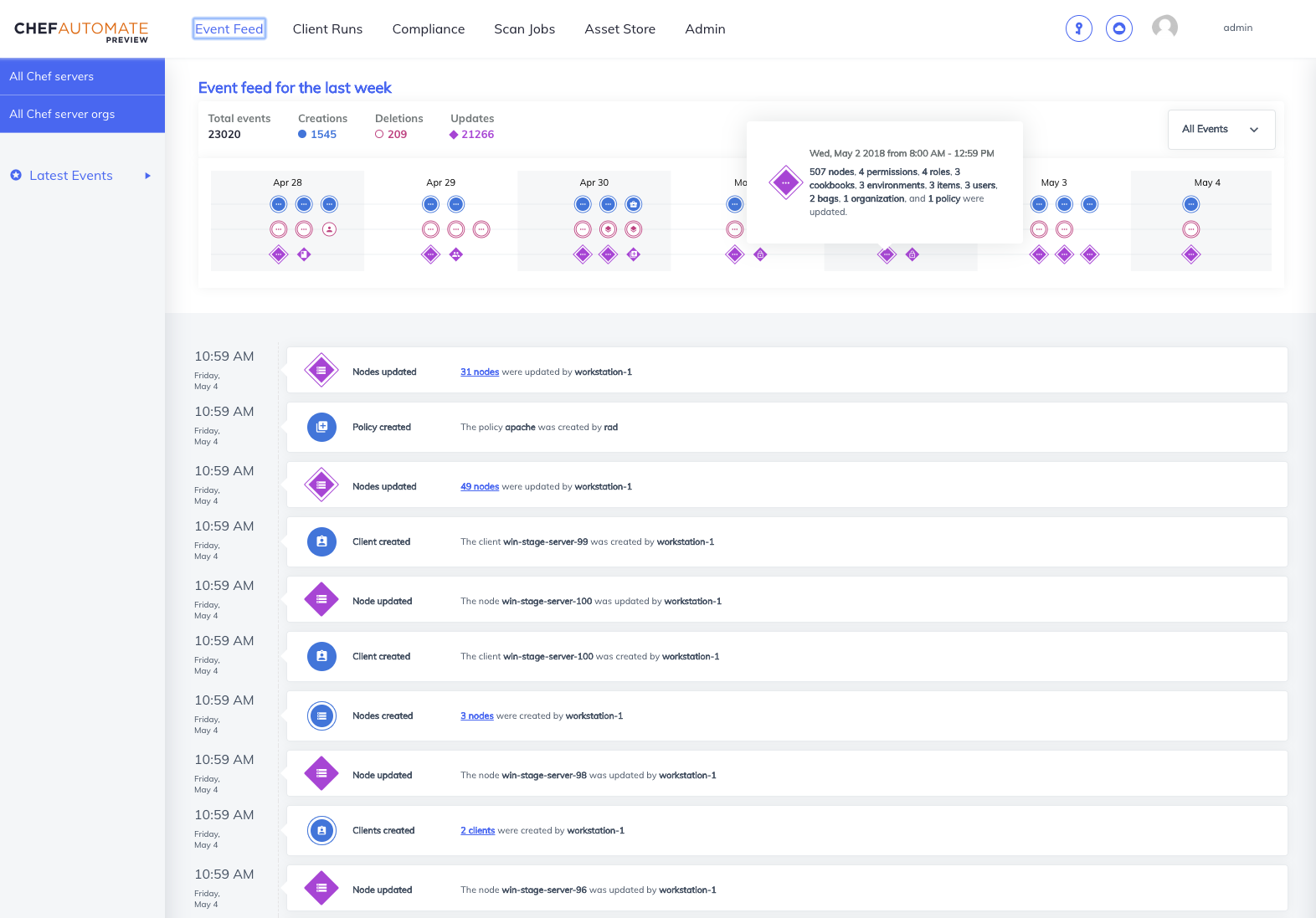
    Perhaps further along than Habitat, however, is Chef Automate. In fact, Chef Automate 2.0 was announced ChefConf, and it seems to be an almost complete rewrite of the program, as it is now built on Microsoft Go. Here is Chef’s take on Automate 2.0:

    Chef Automate has been rebuilt from the ground up to provide performance, scale and advanced analytics required by enterprises using DevOps at scale to meet the demands of post-digital transformation. Chef Automate now provides a single control plane for infrastructure and compliance automation to enable a closed-loop ‘detect, correct, automate’ process to make infrastructure effortless.

    New features include:

    • Enhanced operational visibility and debugging – New tools and visualizations, including a streaming event feed, trend graphs and a rich query language, help users analyze infrastructure and compliance automation data from a unified dashboard.
    • Compliance scanning and reporting in any environment – Integration with cloud compliance capabilities of InSpec 2 enhances scanning, which can now be used to evaluate cloud configurations (AWS, Azure, Google Cloud) via APIs for compliance on either an ad-hoc or ongoing basis. Chef Automate 2 also supports scanning of Cisco IOS equipment as a significant start on extending modern compliance capabilities to network devices.
    • Re-architected for speed and flexibility – A Go-based microservices architecture, with a modern, performant web UI atop a REST API, enables Automate 2 to support tens of thousands of nodes from a single installation. In-place upgrades with automatic data migration from Chef Automate 1 ensure that customers retain all historical information.

    Additionally, Chef has released something called Chef Workstation. From the release:

    Chef Workstation enables DevOps teams and practitioners to complete ad-hoc DevOps tasks using all of the familiar Chef capabilities, without agents. This provides a simple and effective way to use Chef to complete tasks and then seamlessly scale those tasks through Chef Automate.

    Capabilities include:

    • New standard desktop/laptop experience for Chef – Includes a new ‘target mode’ for executing Chef recipes or entire cookbooks remotely and Introduces ‘chef’ command as the single point of entry.
    • Foundation for a better workstation experience – Bundling all the tooling previously included in the ChefDK provides an improved user experience and cohesion between tools to deliver a seamless experience for any infrastructure automation task.

    Finally, new enhancements to Inspec, Chef’s compliance and security solution, were announced. Besides security and compliance being built into most everything Chef does, Inspec now sports:

    • Cloud configuration compliance – Verify AWS and Microsoft Azure policies, with Google Cloud Platform support in beta. More than 10 new AWS resources bring it to CIS Level 1 benchmark completeness.
    • Improved out-of-the-box experience – More than 30 new resources, including support for Cisco IOS network devices as agentless targets, are built in.
    • Drastically improved performance – Users now see up to 90 percent performance gains on Windows and 30 percent on Linux/Unix.

    I will report more as it comes here in Chicago and ChefConf 2018.

    — Alan Shimel

  • Chef Embraces Microservices to Advance IT Automation

    Chef Embraces Microservices to Advance IT Automation

    Chef at the ChefConf 2018 conference today unveiled a series of DevOps offerings, including a revamped version of Chef Automate that has been rewritten using the Go programing language to improve performance and scalability. Now based on a microservices architecture, Chef Automate 2.0 a new user interface based on a REST application programming interface (API) that also serves to enhance integration. There also are a variety of visibility and debugging tools built into the platform, including a streaming event feed, trend graphs and a query language.

    Chef Automate

    At the same time, Chef unveiled Chef Workstation, which enables members of a DevOps team to take advantage of IT automation capabilities on a local PC without having to load any agents.

    Chef also updated its Habitat application release management software to include support for Kubernetes Operator for Habitat and the Open Service Broker originally developed by the Cloud Foundry Foundation, the ability to export to Azure Container Service (AKS), a Helm chart exporter for Kubernetes clusters and integration with operational analytics software from Splunk. Habitat also is now available in an on-premises edition as well as as a software-as-service (SaaS) application.

    Finally, Chef updated InSpec, the company’s compliance automation tool. The latest version can now verify Amazon Web Services (AWS) and Microsoft Azure policies, while support for the Google Cloud Platform support is in beta. InSpec also now has built-in support for more than 30 new resources, including Cisco IOS network devices as agentless targets.

    Chef is touting InSpec performance gains of 90 percent on Windows and 30 percent on Linux systems.

    Julian Dunn, director of product marketing for Chef, said as more companies transition to emerging technologies such as containers and Kubernetes, the need to rely on IT automation frameworks increases. In fact, while container use is widespread, more than half (51 percent) of 347 application and operations professionals surveyed by Dimensional Research on behalf of Chef said they have fewer than 10 percent of their production applications deployed using containers. Dunn said that survey also finds that adoption of DevOps practices in general are still limited—just over half the respondents (53 percent) said they are using both infrastructure and app automation for DevOps.

    However, 46 percent survey respondents said by 2020 they will have more than a quarter of their applications containerized, while 45 percent said at least a quarter of their application deployments will be based on microservices. That accelerated rate of transition will require IT organizations to rely more on IT automation frameworks to implement DevOps processes, Dunn noted.

    Further complication matters, Dunn said organizations are trying to lift and shift existing applications into multiple public clouds while continuing to develop new applications faster than ever to drive various digital business transformation initiatives.

    There’s no doubt that IT organizations are relying more on IT automation frameworks more than ever. The question is, Which one will they use? There are now more IT automation framework choices than ever. Chef is betting that a comprehensive approach based on a modern microservices architecture spanning both IT management and compliance ultimately will win the day.

    — Mike Vizard

  • AppDynamics Taps into SAP Applications

    AppDynamics Taps into SAP Applications

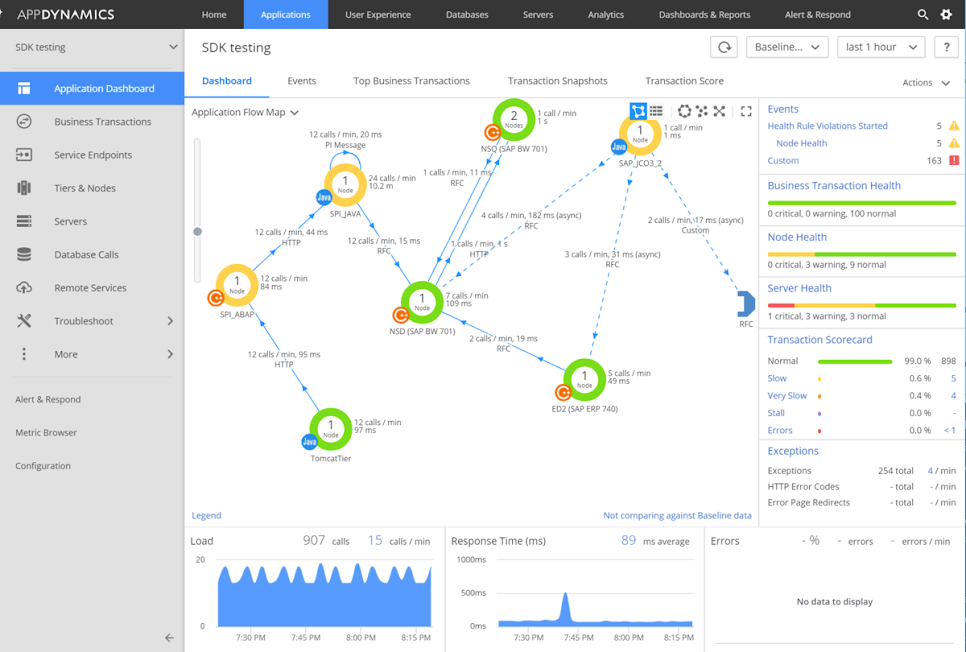
    Application performance management (APM) is starting to be  employed more widely as more organizations embrace digital business transformation. As the number of digital business processes spanning multiple applications increases, so does the need to understand what’s occurring inside both greenfield and legacy applications. In fact, at the heart of many of those digital business processes are enterprise resource planning (ERP) and customer relationship management (CRM) applications from SAP. To make it possible to gain insights into those applications AppDynamics, a unit of Cisco Systems, announced today it is making available AppDynamics for SAP.

    Jonah Kowall, vice president of market development and insights at AppDynamics, said his company is now able to support ABAP, the proprietary language SAP developed to build its applications. That language also has been employed extensively by IT organizations to customize those applications.

    SAP currently is trying to transition its customers to building custom applications on a cloud framework based on the Cloud Foundry platform-as-a-service (PaaS) environment. Most of those applications are be written in Java or the new Jakarta platform that replaces Java. SAP has also provided a software development kit and application programming interfaces (APIs) for tapping into S/4 HANA ERP applications.

    But there is a massive installed based of ABAP applications running in enterprise IT environments. Much of that code is now being integrated with other applications as part of a larger digital business transformation initiative.

    Kowall said those extensions are now driving organizations to apply an agent for the AppDynamics APM to custom applications written in ABAP. Historically, enterprise IT organizations only applied APM to their most critical applications. But as organizations move to digitize business processes, they now need to able to track transactions spanning multiple applications. Given the reliance many organizations have on SAP applications, it’s inevitable those transactions will involve SAP applications that were customized using ABAP.

    In addition, Kowall noted that being able to discover precisely where those custom applications are involved in any transaction is pivotal when it comes to upgrading to the SAP S/4 HANA applications, which are based on the SAP in-memory database, or lifting and shifting a legacy SAP application into the cloud.

    Kowall said organizations that have used ABAP to customize SAP applications now will have visibility down to the code level, including queries being made to the underlying database. From a DevOps perspective, that capability will go a long way to breaking down yet another silo in the enterprise. AppDynamics expects the first order of business for many organizations will be simply to create a performance baseline for their ABAP applications, which in many cases are likely to be an eye-opening experience, he said.

    The focus on digital business transformation is likely to spur adoption of DevOps processes over a much broader swath of the enterprise. Rather than simply apply DevOps processes to new applications, many organizations soon will extend DevOps into the realm of legacy application environments as well. That may take some time to play out, given the scope of the cultural changes involved. But at this point, those changes are now all but inevitable.

    — Mike Vizard

  • Red Hat Aims to Push IT Management to the Cloud

    Red Hat Aims to Push IT Management to the Cloud

    Red Hat at the Red Hat Summit 2018 conference this week showed a technology preview of an instance of Red Hat Insights, a predictive analytics IT management application capable of identifying operations issues before they become a problem, running as a software-as-a-service (SaaS) application.

    The instance of Red Hat Insights will be extended to apply analytics to any infrastructure platform. Red Hat plans to eventually make the rest of its IT management portfolio available as a cloud service.

    Joe Fitzgerald, vice president and general manager for management at Red Hat, said the goal is to enable management of virtual machines, container, infrastructure-as-a-service and physical servers all from a single pane of glass.

    Cost analytics also will be embedded in those services, adds Fitzgerald. Cost is now a much bigger issue because cloud service providers bill customers based on actual consumption. Previously, a virtual machine left running on an on-premises server might result in someone being yelled at, but no additional cost, notes Fitzgerald. Now, however, if an IT organization doesn’t turn off those virtual machines, it will end up paying more.

    Fitzgerald noted that management of IT operations is becoming increasingly automated. Red Hat is now adding integrations with the agentless Ansible framework it acquired in 2015 at rate of 50 a week. There already  are 1,600 integrations with Ansible. He said the fact that Ansible presents IT operations teams with a declarative approach to automating IT using YAML files makes IT automation much more accessible. Other frameworks require IT operations teams to learn how to program, which becomes a significant barrier to adoption, but YAML files allow IT operations teams to make use of familiar shell scripts.

    Many organizations now are moving up the IT management curve as applications become more distributed, Fitzgerald said. Every platform they have comes with its own management tools. But the need for a control plane through which multiple platforms can be centrally managed is now becoming more evident, he said, especially as IT organizations realize they will be running many different types of platforms for many years to come.

    Other benefits to shifting IT management into the cloud is that the move eliminates the need to deploy a local server just to run IT management software and all updates to the IT management platform are provided by the applications provider.

    Obviously, Red Hat is not the only IT vendor building a centralized, cloud-based approach to managing distributed computing environments. But as Ansible becomes more widely adopted, the opportunity arises for Red Hat to engage in a broader IT management conversation with IT organizations.

    Most enterprise IT organizations are rapidly approaching something of an IT management crisis. Each platform adopted creates yet another silo that makes adopting integrated DevOps processes even more challenging. While most organizations are not likely to abandon the management tools from the vendors that built those platforms, IT organizations are demanding thet underlying infrastructure exposes an application programming interface (API). In fact, it’s the proliferation of all that software-defined infrastructure that now makes it feasible to centralize the management of IT in the cloud.

    — Mike Vizard

  • Microservices Momentum Accelerates

    Microservices Momentum Accelerates

    A global survey of 353 application development professionals conducted by Dimensional Research on behalf of LightStep, a provider of application performance management (APM) tools, finds a full 86 percent of respondents expect microservices to be the default architecture within five years.

    A total of 60 percent of respondents said they already have microservices in production or deployed as part of a pilot, and 92 percent said they expect to grow their use in the coming year.

    Top reasons cited for employing microservices are agility (82 percent) and scalability (78 percent).

    The downside of increased reliance of microservices is the need to manage them all. The survey finds 99 percent report challenges in using them. More than half (56 percent) reported that each additional microservice increases operational challenges, and 87 percent of those that have deployed microservices in a production environment reported they are generating more application data.

    To make matters more challenging, a full 98 percent of respondents said they have trouble identifying the root cause of performance issues associated with microservices. More than three-quarters (76 percent) said it also takes longer to resolve issues. In fact, 73 percent said it is more difficult to troubleshoot application performance problems compared to a traditional monolithic application.

    Not surprisingly, just less than three-quarters (74 percent) said they plan to increase investments in microservice performance management tools in the next year.

    LightStep CEO Ben Sigelman said that while microservices come in many forms, advances in how software is developed is clearly coming at a cost. Not only is software becoming more challenging to manage, APM tools are now a prerequisite. Historically, IT organizations only monitored their most mission-critical applications. But the level of dependency each microservice has on others requires a more holistic approach to APM, Sigelman said, noting that IT teams now need to be able to see well beyond the border of any one microservice.

    Challenges associated with managing microservices are not likely to deter organizations from eventually adopting them. The level of agility and resilience inherently built into in a microservices-based application are too high to ignore. But the rate at which they are employed might be impacted. There’s usually a direct relationship between the availability of tooling and expertise and the rate at which any emerging technology gets deployed in a production environment. The good news is advances in machine learning algorithms and other forms of artificial intelligence (AI) should make it easier to manage microservices in the years ahead.

    In the meantime, IT organizations can take some comfort in the fact that developers are being held more accountable for the microservices they build. That level of accountability tends to vary widely by organization. But the end result is generally higher levels of software quality because developers increasingly realize they can’t throw code over the proverbial IT operations wall without it coming back to them. The challenge now is to bridge the historic divide between developers and IT operations teams in a way that works best for everyone concerned.

    — Mike Vizard

  • Oracle Adds Low-Code Tool to Autonomous Platform

    Oracle Adds Low-Code Tool to Autonomous Platform

    Oracle this week extended the scope of the cloud services it manages on behalf of customers to include a low-code application development platform based on the company’s Visual Builder development tools.

    Jeff Price, vice president of product Management at Oracle, said Oracle Autonomous Visual Builder (VB) Cloud makes it possible to employ a tool based on JavaScript to build applications that might be written, for example, in Java or, going forward, Jakarta EE. Autonomous Visual Builder Cloud is available via a managed service that can easily integrated with a variety of back-end services managed by Oracle or running on-premises.

    To complement that effort, Oracle also announced the availability of Oracle Autonomous Analytics Cloud and Oracle Autonomous Integration Cloud. Oracle Autonomous Visual Builder comes with tools for accessing back-end services, while Oracle Autonomous Integration Cloud provides a raft of additional connectors for accessing a wide variety of other Oracle and third-party services, Price said.

    Oracle also committed to delivering additional autonomous services later this year to address mobile and chatbots, data integration, blockchain, security and management and additional database workloads such as online transaction processing (OLTP). Those services will complement existing Oracle autonomous database and platform-as-a-service (PaaS) environments.

    Price said interest in low-code development tools is accelerating as organizations look to extend business processes that have been automated using either packaged applications running on-premises or in a software-as-a-service (SaaS) application. Rather than trying to achieve that goal using low-level application programming interfaces (APIs) that are fragile, Price said low-code tools such as Oracle VB make it simpler for even citizen developers to construct applications leveraging code developed by professional developers.

    Organizations need to decide for themselves when to customize those application environments versus taking advantage of them in a turnkey manner, Price said. Organizations tend to heavily customize customer experience and customer relationship management (CRM) applications, while relying on best practices that have been coded into enterprise resource planning (ERP) applications. Oracle is changing the way it supports those applications—base-level support for these applications is now free, but Oracle will continue to charge for premium services.

    The need to customize applications at scale is driving many more traditional enterprise IT organizations to adopt DevOps processes that now need to span multiple IT environments, Price said. He added Oracle now provides integration with multiple continuous integration/continuous deployment (CI/CD) platforms to facilitate that transition.

    As Oracle assumes more responsibility for managing the underlying platforms, organizations in theory should be able to devote more resources to developing applications. To achieve that goal, however, many of them will need to figure out how to extend their DevOps processes to include Oracle as a managed service provider.

    Oracle also provides access to unmanaged infrastructure-as-a-service (IaaS) and (PaaS) services in much the same way Amazon Web Services (AWS) and Microsoft do. Oracle has been late to the cloud game, but this week announced a slew of new cloud customers, including Atomitech Inc., Edith Cowan University, Future Robot, Barrick Gold Corporation, C’s NEXT, Colegio de Bachilleres, Contribute NV, DP World Ltd., Dubai Airport Freezone Authority, Emirates Flight Catering, Hytera Communications Ltd., Ildong Pharmaceutical Co. Ltd., Konyang University, Land O’Lakes Inc., Leshan City Commercial Bank, McDermott, MCore Group, New Hope Liuhe Co. Ltd., Promata, Stallion Oilfield, Ornua Co-Operative, RecVue, Saga d.o.o Beograd, TCI, TaskUs, University of Wisconsin Hospital and Clinics Authority, and Zeneral Heatpump Industry Co. Ltd. All told, Oracle claims to be processing 55 billion transactions a day on its cloud.

    It may take a while for Oracle to catch up to AWS. But if it doesn’t achieve that goal it won’t be for a lack of development tools.

    — Mike Vizard

  • Rackspace Aims to Push VMware Everywhere

    Rackspace Aims to Push VMware Everywhere

    Rackspace is expanding its efforts to provide managed services for private clouds based on VMware that can now be deployed anywhere.

    Peter FitzGibbon, vice president and general manager of VMware at Rackspace, said Rackspace Private Cloud Everywhere, powered by VMware, is making an effort to provide infrastructure services that enable IT organizations to devote more resources to building applications. As part of the effort, Rackspace is making the managed services it provides a natural extension of an organization’s DevOps processes.

    Previously, Rackspace provided support for VMware in data centers it owns. Now Rackspace will manage instances of VMware deployed anywhere, including public clouds such as Amazon Web Services (AWS), FitzGibbon said.

    FitzGibbon noted Rackspace already has more than 70,000 VMware virtual machines under management—a number the company expects to expand significantly as more instances of VMware are deployed on the cloud in addition to on-premises IT environments.

    Longer term, FitzGibbon said IT organizations should also expect to see Rackspace extend the reach of the managed services it provides for VMware to include storage and network virtualization, as well as Pivotal Container Service, an instance of a container platform developed jointly by Pivotal and its sister company VMware.

    FitzGibbon said most organizations are on a multiyear journey when it comes to making the transition to the cloud. Most are still analyzing which classes of workloads make the most sense to deploy on a public cloud. Also slowing that transition are new data sovereignty requirements that force organizations to rethink where data is hosted around the world, he said.

    As they make that transition, many of those organizations are concluding they don’t want to manage the underlying infrastructure that is now distributed across multiple data centers. Instead, they want to reallocate their own limited resources to developing software faster, FitzGibbon said.

    FitzGibbon also noted that taking advantage of advanced cloud capabilities such as cloud bursting or moving workloads back and forth between environments requires a level of expertise many organizations don’t have in place today.

    As more organizations realize they need to become software companies to remain competitive, many are rethinking how IT infrastructure is managed within the context of a integrated DevOps processes. As part of that transition, many are starting to evaluate how much of the management of IT infrastructure they can outsource within the context of those DevOps processes. Rackspace is essentially making the case for retraining the existing IT staff focused on IT infrastructure to focus more on managing applications rather than physical and virtual infrastructure.

    Naturally, that level of cultural IT transformation inside any organization will take time to achieve. Not every organization is comfortable giving up control over its IT infrastructure. Others will prefer to collaboratively manage IT infrastructure with a service provider. Just as significantly, not every member of the IT staff managing infrastructure wants to be retrained.

    Nevertheless, as the sheer volume of IT infrastructure that needs to be managed becomes more distributed, it’s unlikely most IT organizations will be able to manage all those systems on their own.

    — Mike Vizard