Category: News

  • OpsRamp Extends AIOps Visibility

    OpsRamp Extends AIOps Visibility

    OpsRamp has advanced its case for AIOps via a Fall update to its software-as-a-service (SaaS) applications that adds a Topology Explorer alongside an enhanced set of Service Maps.

    In addition, OpsRamp added a cloud database monitoring capabilities for relational databases deployed on public clouds including Amazon Web Services (AWS), Microsoft Azure and Google Cloud Platform (GCP).

    Mahesh Ramachandran, vice president of product management for OpsRamp, said the Topology Explorer makes it possible to automate network and application discovery to accelerate impact analysis and troubleshooting. An existing Service Map capability, meanwhile, has been enhanced to allow DevOps teams to invoke visualizations within an alert to better prioritize responses.

    OpsRamp has also added a pause capability for alerts, intended to be used during maintenance windows to prevent alert floods. Alert filters now include text-based search that, when combined with the AI Inference Engine, helps resolve issues faster. DevOps teams also can create policies to notify them of alert state changes.

    Finally, OpsRamp has added reporting tools that enable DevOps teams to determine not just the amount of resources being consumed on a public cloud, but also which public cloud or on-premises environment is generating the most trouble for the IT organization.

    In general, Ramachandran said most organizations have very little way in the way of tools that enable them to realistically compare how one platform performs over another when running specific classes of workloads. By leveraging the machine learning algorithms that OpsRamp includes in its SaaS applications, enough data becomes available to provide DevOps teams with actionable insights, he said.
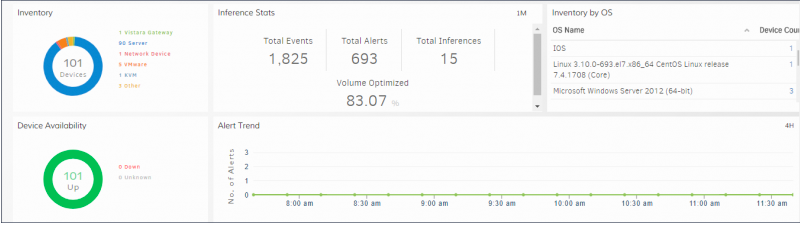
    AI tools typically require access to massive amounts of data. By making available IT operations tools available as a cloud service, OpsRamp is trying to make it practical for DevOps teams to employ AI on both tactical and strategic levels without requiring an IT team to acquire special data science skills, Ramachandran said, adding such an approach also provides the added benefit of making it possible to holistically manage IT silos across multiple classes of infrastructure and applications.

    IT organizations are still in the early stages of coming to terms with AIOps and its potential impact on DevOps processes. Many of the manual processes that tend to inhibit widespread adoption of DevOps are clearly going to be automated. In fact, many of those tasks will be accomplished using voice commands that bots will be able to understand. In other cases, the bots will inform DevOps teams when an issue needs to be addressed long before they would otherwise be aware of it. Less clear is how job roles within DevOps teams will evolve as it becomes easier to manage applications and infrastructure comprehensively.

    Of course, the rate that transition will occur will vary widely by organization. But rather than debating the right approach to automation, it’s becoming increasingly apparent that many of those decisions will be made by machines. The unspoken assumption being made is that humans responsible for managing IT will be comfortable that the right decisions are being made on their behalf.

    — Mike Vizard

  • Atlassian Acquires OpsGenie to Automate Incident Management

    Atlassian Acquires OpsGenie to Automate Incident Management

    Atlassian this week announced its plans to acquire OpsGenie as part of an effort to apply DevOps principles to incident management. The announcement was made at the Altassian Summit Europe 2018 conference.

    Atlassian plans to integrate OpsGenie, which provides incident alerting and communications software, with its Jira service desk software to enable organizations to automate responses to a major incident such as a site outage using a Jira Ops incident management command center unveiled this week.

    Jens Schumacher, head of software teams for Atlassian, said that while most organizations today have processes in place to respond to minor incidents, very few have incident management processes in place to deal with significant catastrophic events. OpsGenie already has been adopted by more than 3,000 customers to enable organizations to put together a set of structure processes to recover as quickly as possible.

    Schumacher said a more structured approach to recovery is now required because so much more of a modern organization’s ability to drive revenue is tied to the availability of IT. Whenever there is a significant amount of downtime, the urgency attached to recovery process is now much greater. The combination of OpsGenie and Jira, available now via an early access program, makes it possible to predefine a structured set of workflow processes to be followed in the event of an emergency, he said, adding that by defining those processes within a common framework, IT organizations also will be able to significantly reduce the number of point products they need to navigate during a crisis.

    The combination of the two products will also aid in applying forensics to discover the root cause of any outage, Schumacher said.

    Incident management within IT environments over the last few years has been evolving into a science. There are several dedicated incident management platforms that mange everything from who needs to be alerted in what order to providing detailed instructions bringing applications back online. The challenge many organizations wrestle with today is that all the silos of IT make it difficult to approach incident management comprehensively.

    But as it becomes easier for finance officers to draw a straight line between IT downtime and lost revenues, interest in more structured approaches to recovery is on the rise. In fact, regardless of whether the root cause of an issue is a cybersecurity breach or a geological event, the recovery process is usually consistent. Incident management platforms provide the means to capture those processes in a way that creates institutional memory. Access to those best practices is often critical, because organizations can never be sure which members of the IT staff will be available during a crisis. If the one person who knows how to provision a storage system is unavailable, there should be enough information in an incident management system to enable another member of the IT team to accomplish that task.

    As is often the case when it comes to IT, the tools at hand only enables the battle to be joined. It’s the quality of the processes attached to those tools that decides whether the battle will be won or lost.

    — Mike Vizard

  • DevOps Dozen 2018 – Nominations Are Now Open

    DevOps Dozen 2018 – Nominations Are Now Open

    The DevOps Dozen awards are back and now open for nominations. This fourth annual DevOps Dozen honors the best of the best—the leaders and innovators in the DevOps community. This year’s awards will include 12 categories, with a winner chosen from each. The top four to six nominees in each category will become finalists, who will be selected based upon the number of nominations they received. You can nominate up to two entrants in each category; however, you can make only one nomination per person. In addition, everyone nominating will be required to provide their name and email address; while that won’t thwart any ballot-stuffing, we hope people will be trustworthy during the nomination process. The winners will be selected by our panel of judges.

    Last day to submit your nominations for the DevOps Dozen 2018 awards is Oct 10, 2018. Here’s where to vote: https://www.surveymonkey.com/r/devopsdozen

    Who are the judges? This was tough. We couldn’t have anyone who might be eligible for an award. That disqualifies vendors, practitioners and many others. However, I think we have four great judges:

    1. Alan Shimel, founder and editor in chief, devopsy.kinsta.cloud
    2. George Hulme, longtime tech journalist and editor at devopsy.kinsta.cloud and Security Boulevard
    3. Jayne Groll, CEO and co-founder of the DevOps Institute
    4. Helen Beal, DevOpsologist at Ranger4.

    So what are the dozen categories for the DevOps Dozen this year? That you can get on the site itself, but here they are as well:

    [su_custom_gallery source=”media: 125437,125438,125439,125440,125441,125442,125443,125444,125445,125446,125447,125448,” link=”custom” target=”blank” width=”400″ height=”200″]

    Thank you again for your enthusiastic response to last year’s awards. The full list of 2017 finalists and winners are available to view here.

    There are so many great companies and people involved in DevOps that it’s always difficult to pick the winners. We know some worthy choices will not be voted tops in their category; however, acknowledging them in our awards process helps show how important they are in the DevOps space.

    As stated earlier, the top four to six nominees in each category will be designated as finalists, who then can submit a presentation on why they deserve the award to judges@devops.com. Finalists will be announced the second week of November and the winners, who will be chosen by our panel of judges, will be announced in December.

    If you have questions, send them to DD@devops.com. Voting for finalist nominees is open for three weeks, so don’t waste any time—nominate your favorites today. Good luck to everyone vying to be one of the DevOps Dozen 2018!

    — Alan Shimel

  • Moogsoft Extends AI Reach into IT Operations

    Moogsoft Extends AI Reach into IT Operations

    Moogsoft, at a Moogsoft 2018 AIOps Symposium last week, extended the reach of its IT operations analytics software out to where applications are deployed, rather than requiring data to be moved into a Big Data platform.

    Will Cappelli, CTO and vice president of product strategy for Moogsoft, said Moogsoft Observe, available in beta, discovers anomalies by applying algorithms where data is generated, versus requiring IT organizations go to the trouble and expense of moving massive amounts of data into a central data lake.

    Moogsoft Observe ingests time-series and metrics data in real-time and then applies artificial intelligence (AI) to detect incidents at the source of the problem. The single-agent technology can deployed anywhere, including cloud instances and on-premises systems and applications running containers and virtual machines.

    Cappelli noted Moogsoft Observe doesn’t require data scientists to configure it. IT generalists can employ Moogsoft Observe on their own without having to rely on a centrally managed IT operations analytics platform managed by someone else. Moogsoft claims this approach reduces the time to detect a problem by up to 60 percent while cutting nearly 90 percent of the storage and communication costs.

    Analytics generated by Moogsoft Observe can then be stored in the Moogsoft AIOps platform to enable IT organizations to run additional analysis against data collected from multiple data sources.

    Moogsoft also announced that version 7.0 of the Moogsoft AIOps platform will be available this October. This update adds Vertex Entropy and Situation Topology Visualization, algorithms that enable IT teams to visualize the root cause of an issue via a system topology map. That capability makes it possible to apply algorithms capable of generating contextual analysis that pinpoints the source of issues rather than generating a series of probabilities based on when a set of events occurred, said Cappelli.

    Advances in how AI can be applied to automate IT operations are now coming at a rapid rate. Those advances increasingly are becoming affordable for the average IT organization to employ. Most IT teams spend more time trying to determine the source of problem than they do fixing it once the root cause is discovered. AI technologies promise to eliminate many of the rote tasks that IT administrators are required to manually perform time and again, which will make it simpler to manage IT at scale. It also means more IT teams can expect to not have work as many odd hours of the day because fewer things are likely to go wrong. There may never be a perfect IT environment. But IT environments should be a lot more predictably reliable.

    Of course, the rise of AI undoubtedly will have a significant impact on the IT staff. Many IT administrators will need to be retrained as more processes become automated. It’s not likely the need for IT administrators will go away anytime soon. But as some tasks become automated, many entry-level IT roles will change dramatically or, in some cases, be eliminated. At this point, those changes are now all but inevitable.

    — Mike Vizard

  • VMware Looks to ‘Ruthlessly’ Automate IT

    VMware Looks to ‘Ruthlessly’ Automate IT

    VMware, at VMworld 2018 this week, advanced an ambitious campaign to automate IT management by announcing a deal to acquire CloudHealth Technologies and then previewing a Project Magna initiative that employs machine learning algorithms and other forms of artificial intelligence (AI) to create what VMware describes as self-driven data centers.

    VMware CEO Pat Gelsinger told conference attendees that, as part of achieving that goal in the era of the cloud, every aspect of IT now needs to be automated.

    “The rule of the cloud is to ruthlessly automate everything,” he said.

    Project Magna represents an effort to centralize AI research and development to enable IT organizations to reallocate resources to building applications by eliminating many of the manual tasks that conspire to make IT inflexible.

    At the same time, increased levels of automation will serve to reduce the cost of labor associated with managing IT, which remains the single highest cost within most IT budgets. Without increased levels of automation, those costs inevitably will rise as IT organizations embrace not only public clouds but also emerging new platforms such as Kubernetes.

    Gelsinger this week made it clear VMware views being able to automate the management of Kubernetes as an opportunity to expand the reach and scope of its management offerings.

    The addition of CloudHealth Technologies to the VMware portfolio adds a cloud operations platform that spans Amazon Web Services (AWS), Microsoft Azure and Google Cloud Platform (GCP). Once the acquisition is formally closed, VMware has pledged to integrate its cloud automation services, Secure State and Wavefront cloud services with the CloudHealth platform. The CloudHealth platform will be rebranded VMware Cloud Operations. Those moves come on the heels of a significant expansion of the portfolio of DevOps tools the company also announced this week.

    VMware also revealed its is working on the Dimension project with Dell EMC and Lenovo, which will create a hyperconverged architecture optimized for deployment at the network edge. Project Dimension will make use of VMware NSX network virtualization software and the software-defined wide area networking (SD-WAN) platform gained by the company’s acquisition of VeloCloud to connect servers running at the network edge. That initiative complements the existing Pulse project for managing internet of things (IoT) devices, for which VMware announced REST application programming interface (API) support and which will be available as an on-premises or a software-as-a-service (SaaS) application.

    VMware this week also unveiled updates to updates to its vRealize automation portfolio that enable organizations to rightsize workflows and automate host-based placement of those workloads. The core vRealize Automation platform also sports a new user interface and integration with open source Ansible Tower automation software and integration with Pivotal Container Service (PKS), an instance of Kubernetes. Version 7.5 of vRealize Automation 7.5 also features enhanced AWS and Azure support.

    It’s unclear to what degree increased automation will transform how IT is managed within the context of modern DevOps processes. But the one thing that is clear is the economics of IT are being altered. Via automation VMware is sharply reducing the need for IT specialists in favor of “super” administrators capable of managing compute, storage, networking and security at unprecedented levels of scale in a much more integrated fashion. How much of that will be accomplished by AI is still anyone’s guess. But it’s already clear the job of the average IT administrator will soon be transformed utterly.

    — Mike Vizard

  • Mirantis Modeling Tool Extends SDI Scope and Reach

    Mirantis Modeling Tool Extends SDI Scope and Reach

    Mirantis has added a modeling tool to its portfolio that enables users to allocate IT infrastructure that has been distributed across multiple data centers to a common set of workloads.

    Company CEO Adrian Ionel said the latest edition of the Mirantis Cloud Platform (MCP) for building provide clouds on OpenStack or Kubernetes platforms now includes a Mirantis Infrastructure Model Designer tool that makes it possible to manage IT infrastructure residing in multiple data centers as though they were one logical resource. In effect, slices of distributed data centers can be allocated to run specific classes of application workloads, he said.

    The Mirantis tool is based on open source software spanning Cookiecutter, Reclass and Salt projects that Mirantis is employing to enable users to apply management templates across multiple distributed data centers. The goal is to make it possible for IT organizations to employ a software-defined framework that makes it easier to not only manage distributed IT environments, but also change the configuration of those environments as the nature of application workloads change over time, Ionel said.

    The Mirantis modeling tool provides a declarative approach to managing software-defined infrastructure that doesn’t require IT operations teams to learn how to program, he added.

    Ionel said that as IT organizations invest in IT infrastructure, they need to deploy multiple classes of application workloads on the same systems. Each of those application workloads has distinctly different attributes and requirements. For example, a big data application running on Hadoop today has different infrastructure requirements than an analytics application infused with machine learning data that might be deployed tomorrow. That said, most IT organizations won’t be able to replace IT infrastructure as application workloads evolve, he said, noting the Mirantis tool provides a means to easily reconfigure IT infrastructure from a central location without requiring IT personnel to be present in each local data center.

    Virtualization of servers and now storage and networks is a concept that has now permeated data centers for decades. Mirantis is effectively taking that concept to its next logical conclusion by making it possible to maximize utilization of data centers. In fact, Ionel noted, templates can be configured to prioritize the running of different workloads on the same infrastructure.

    As software-defined infrastructure (SDI) continues to mature, it’s becoming apparent that data centers soon will be managed at much higher levels of abstractions than they typically are today. Instead of trying to navigate individual compute, storage and networking silos, IT organizations will be able to manage data center resources on demand. The implications of the level of automation go well beyond simply enabling IT organizations to be more agile—the entire organizational structure of IT organizations will need to evolve.

    Obviously, organizations that have embraced DevOps are further down than the SDI path than most. But as SDI continues to be able to automate IT infrastructure at levels of unprecedented scale, it’s clear there’s still a long road ahead in terms of how just how extended those DevOps processes can become.

    — Mike Vizard

  • VMware Extends DevOps Reach via SaaS Apps

    VMware Extends DevOps Reach via SaaS Apps

    VMware, at the VMworld 2018 conference today, announced it will be delving deeper in the realm of DevOps with the launch of a continuous delivery pipeline dubbed Code Stream.

    In addition, VMware announced Cloud Assembly, a set of declarative tools that enable IT organizations to spin up a cloud in as little as 10 minutes by managing infrastructure as code, and Service Broker, a catalog through which services residing on multiple clouds can be published, governed and secured.

    Milin Desai, vice president and general manager for the Cloud Services Business Unit of VMware, said these offerings extend the reach of VMware’s Cloud Automation Services that are all invoked as software-as-a-service (SaaS) applications.

    VMware also today announced a beta release of Secure State, a set of tools for tracking security alerts across Amazon Web Services (AWS) and Microsoft Azure that also can be used to investigate when changes to those environments were made. Secure Slate is based on the technology the company gained by acquiring CloudCoreo earlier this year. What’s more, VMware is updating the Wavefront by VMware monitoring service to add support for deeper support for containerized workloads running on Pivotal Kubernetes Service (PKS). Wavefront also now supports the Amazon Lambda serverless computing framework made available by Amazon Web Services (AWS).

    Code Stream is designed to track code across multiple platforms and comes with pre-built plug-ins for Wavefront, Harbor, Nexus, Pivotal Kubernetes Service (PKS), Ansible and Slack. VMware is also committed to providing integrations with continuous integration/continuous deployment (CI/CD) platforms such as Jenkins, Desai said.

    VMware has previously made extensive investments in software-defined data centers (SDDCs) based on a layer of management software deployed on top of VMware vSphere. As part of that effort, VMware today announced version 6.7 of VMware vSphere, which adds tools for verifying the state of a virtual machine, and a new Platinum edition of the platform that includes VMware AppDefense, to secure application workloads running on VMware vSphere.

    Beyond the virtual machine level, the scope of VMware’s DevOps portfolio has been limited. By adding a range of DevOps tools that are made available as SaaS applications, VMware now can provide tools spanning just about everything, from cloud orchestration to code delivery, Desai said.

    The expanded push into DevOps comes at a time when VMware is also extending the scope of its alliance with AWS. The company earlier this week announced it has lowered the cost of entry of VMware for AWS by 50 percent for a limited time and is making available a three-node configuration option. Previously, VMware required customers to set up a minimum four-node configuration. VMware will enable IT organizations to configure a three-host software-defined data center (SDDC) for the cost of two hosts.

    The company is further helping to reduce costs by make it possible for IT organizations to also specify the number of processor core counts for Oracle and Microsoft applications running on AWS, along with new options for deploying NSX network virtualization software.

    It’s unclear to what degree VMware will be able to leverage its historic strengths in server virtualization to become a significant force in the realm of DevOps. The acquisition of Wavefront in last year was clearly a significant step in that direction. But the individuals with an IT organization who decide what virtual machines to employ are not necessarily the same individuals selecting DevOps tools. VMware is clearly hoping that as more IT organizations embrace DevOps processes spanning multiple clouds, many more of them will view the company’s growing portfolio of SaaS applications as a natural extension.

    — Mike Vizard

  • Netifi Rises to Microservices Integration Challenge

    Netifi Rises to Microservices Integration Challenge

    Netifi this week launched an integration platform based on the open source RSocket communications protocol to replace HTTP ad REST application programming interfaces (APIs) as the mechanism for connecting microservices. RSocket was originally created by Netflix and is now being strengthened via contributions from Netifi, Facebook and Pivotal Software for use within enterprise IT organizations.

    Fresh off raising $2 million in seed funding, Netifi is also committing to support a community edition of RSocket later this year.

    Company CEO Robert Roeser said the Netifi platform is designed to make it easier to build microservices and interconnect them. Most of those microservices are being built using Docker containers, but Roeser said that, as part of a polyglot approach to integration, Netifi is leveraging RSocket to connect microservices built using a variety of runtimes as well as provide access to legacy monolithic applications. The Netifi platform can be deployed on-premises, in a public cloud or in a hybrid fashion.

    Roeser said RSocket was born of necessity at Netflix because the number of microservices that needed to be interconnected at scale was simply too complex a task using HTTP and REST APIs. Soon after, Facebook also started employing RSocket and now Netifi and Pivotal are making contributions designed to make Rocket more accessible for traditional enterprise developers. In the case of Netifi, that means providing mechanisms to both discover and advertise microservices and provide a layer of abstraction that shields developers from the underlying complexity of the network underlay, he said.

    As applications based on microservices become more widely distributed, enterprise organizations tend to become more intimidated by the challenges associated with managing them at scale. Traditional enterprise IT organizations don’t have access to a small army of software engineers to solve the problem. As a result, many of them retreat to building monolithic applications in which all the services that need to be accessed are baked into the application itself. They typically sacrifice scale and flexibility in favor of a construct that is both familiar and easier for them to navigate, Roeser said.

    The challenge Netifi and other supporters of RSocket will face is the considerable amount of inertia surrounding REST APIs and HTTP. Several generations of developers now consider REST APIs to be the default mechanism for connecting various applications together. The issue many of them will need to wrestle with is the extent to which the rise of microservices breaks that integration construct. A shift away from REST APIs also could have significant implications regarding how services are exposed externally, how pipelines are constructed within DevOps environments and other factors.

    It remains to be seen whether integration platforms based on RSocket or some other approach ultimately makes microservices more accessible to enterprise IT organizations. But significant resources now are being poured in to solve the problem, many of which leverage contributions of companies, such as Netflix and Facebook, that already rely on thousands of microservices to deliver a broad range of cloud-native applications.

    — Mike Vizard

  • OverOps Brings Machine Learning to DevOps

    OverOps Brings Machine Learning to DevOps

    OverOps has launched a namesake platform employing machine learning algorithms to capture data from an IT environment that identify potential issues before a DevOps team decides to promote an application into production.

    Company CTO Tal Weiss said the OverOps Platform is unique in that, rather than relying on log data, it combines static and dynamic analysis of code as it executes to detect issue. That data then can be accessed either via dashboards or shared with other tools via an open application programming interface (API). The dashboards included with the OverOps Platform are based on open source project Grafana software.

    That approach makes it possible to advance usage of artificial intelligence (AI) within IT operations without necessarily requiring that every tool in a DevOps pipeline be upgraded to include support for machine learning algorithms, Weiss said.

    OverOps also includes in the platform access to an AWS Lambda-based framework or separate on-premises serverless computing framework to enable DevOps teams to also create their own custom functions and workflows.

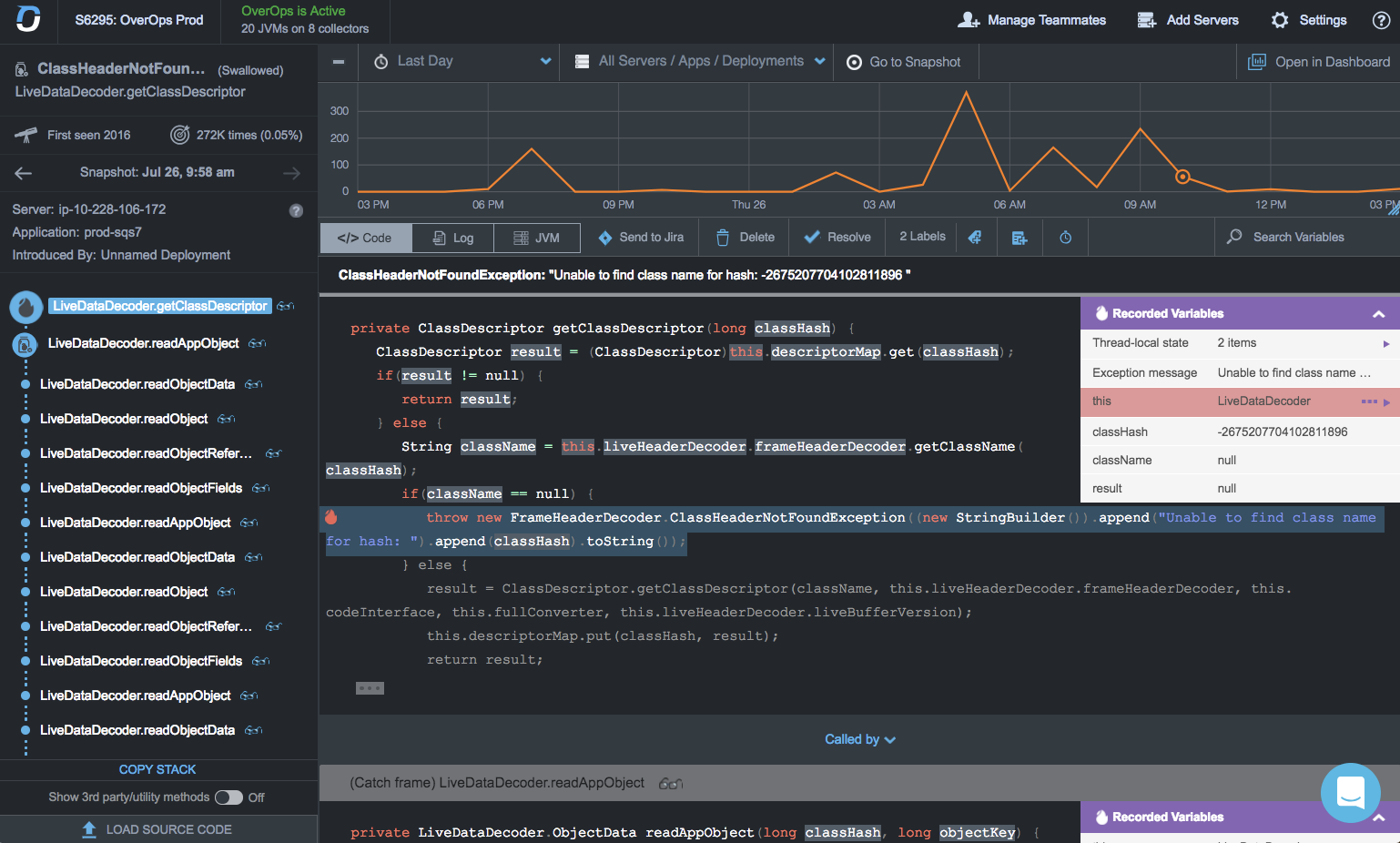
    Weiss said OverOps is designed to capture machine data about every error and exception at the moment they occur, including details such as the value of all variables across the execution stack, the frequency and failure rate of each error, the classification of new and reintroduced errors and the associated release numbers for each event. Log data is, by comparison, relatively shallow in that it is challenging to determine precise root cause analysis when trying to troubleshoot an issue, he said, noting the OverOps Platform offers visibility into the uncaught and swallowed exceptions that would otherwise be unavailable in log files.

    DevOps teams spend an inordinate amount of time analyzing log files in the hopes of discovering an anomaly. But as IT environments continue to scale out, the practicality of analyzing millions, possibly even billions, of log files becomes impractical. OverOps is making the case for employing machine learning algorithms to analyze events before the log file is even created, which eliminates the need to find some way to store log files before they can be analyzed.

    There’s naturally a lot of trepidation when it comes to anything to do with machine learning algorithms and other form of AI to manage IT. But as the complexity of IT environments continues to increase, it’s clear DevOps teams will need to rely more on AI to mange IT at levels of scale that were once considered unimaginable. For example, while microservices based on containers may accelerate the rate at which applications can be developed and updated, they also can introduce a phenomenal amount of operational complexity. Most DevOps professionals would rather automate as much as possible the manual labor associated with operations, especially if that leads to more certainty about the quality of the software being promoted into a production environment.

    Of course, while making use of machine learning algorithms to analyze code represents a step forward in terms of automation, it’s still a very long way from eliminating the need for DevOps teams altogether.

    — Mike Vizard

  • A Right DevOps Approach: Assess Organizational Readiness

    A Right DevOps Approach: Assess Organizational Readiness

    Driving business in this fast-paced world is maddening as owners have to remember customer preferences, beat market competition and similarly cater to different things within the organization’s radius.

    How a business owner manages all this defines the business success, which is gauged through outcomes in the form of smart products, point-on services and almost-immediate feedback. Bank applications, the best smartphones and interactive technology are all proof of this.

    But what is it that stands at the heart of it all?

    The Right DevOps Approach

    When enough is done and businesses still find that there’s a missing piece that will complete “the successful business picture,” they go back to figuring out what and how they can fix the problem. They never come to realize that they will have to consider revamping their organizational structure to meet the growing demands of their influential business.

    How, then, do you assess your approach to DevOps?

    While most believe that it’s a technological approach that they should incorporate in their business, it’s more of a cultural approach. To implement DevOps into your existing organizational structure, you first must look at its current state of readiness.

    Doing this is important, as it helps decision-makers understand how they can embed the smart collaboration after a thorough consideration of the challenges that stand in the way of DevOps implementation. Once the initial assessment is done, business owners need to ask themselves three questions before assessing DevOps readiness:

    1. Is there a Management-Employee Agreement? A successful DevOps process not only relies on collaboration between Development and Operations, but also needs a top-down (management-employee) agreement. Once that’s in place, the company is already halfway through the success road.
    2. Is there a Plan in Place? Many firms just barge into technology like it’s all they need to reach their finish line. Stop! Wait! Think! Owners need to have a detailed strategy, equipped with process tools and goals clearly outlined and best practices chalked out. Once this is done, the culturally different teams need to collaborate and work ways to learn and equip themselves with the technologies and practices of each other’s processes. With all this in place, organizations will be ready to take the DevOps jump.
    3. Is the Organization Ready to Tread the Ocean? Now that the plan is in place, what’s next? Organizations, as mentioned earlier, are in hot pursuit to experiment with what they’ve learnt new. Anything new is fancy, but humbleness is the key! Starting small will set the new cultural shift to completely settle in its new mold. To run the boat in big waters, you first need to test it in small water. Similarly, to test the success of DevOps for a big business project, you first want to test its adaptability to a smaller one. Once you’ve cut off from the harbor, you are all set to wade the ocean.

    Conclusion

    Most business players underestimate the ability of DevOps with whatever industry rumors they hear and some of their own pre-conceived notions. Some other think that they know it all, but what matters is having a strategic approach to first considering DevOps and its tools, and then adapting it accordingly.

    Once the DevOps automation is in place, organizations will be busy reaping the benefits of its successful implementation.

    — Veritis