Author: Veritis

  • 5 Mistakes to Avoid When Chasing DevOps Transformation

    5 Mistakes to Avoid When Chasing DevOps Transformation

    In less than a decade, DevOps has become a buzzword of the IT industry, and enterprises are already reaping its benefits.

    But the implementation part still remains a question for many firms, considering the key mistakes that many organizations report in their very approach to DevOps. Most firms are also unsure about what outcomes they want to see from the process.

    Wondering if you’re making the same mistakes? Here are the five most common mistakes that can be included as part of a checklist to successful DevOps implementation.

    Misaligned Focus

    While automation and tools are the elements that steer DevOps, most firms believe that DevOps is all about tooling and automation. In reality, tools are mere enablers and automation takes off the burden of manual work. This collaboration helps firms to realign focus, eliminate process repetition and effectively manage the available software.

    Ultimately, the value of tools lies in what people achieve through them and hence, firms should focus on utilization to achieve expected goals.

    Faster = More Value

    Time-to-market is another key aspect of DevOps that needs a different viewpoint. In general, most firms think of DevOps as a process to increases the pace of the software process.

    But it has to be understood that DevOps takes a lean movement. By developing software on an exponential pace, DevOps process lets you have products delivered more frequently.

    The lean manufacturing process achieves success in software delivery by breaking the chunks of code into manageable units, which naturally results in continuous delivery. Moreover, if you need to alter one component, you can do it simultaneously without impacting the other. This allows you to deliver at optimum speed and still maintain business agility.

    Lack of Continuous Improvement

    As you learn more and get better, you’ll find better ways to improve or cut down steps that add no value. But this will require some amount of effort and investment.

    DevOps delivery pipeline consists of feedback loops, which allow you to inspect, reflect and decide if you are going in the right direction. The faster you improve, the sooner you benefit from the improvements in the process.

    It’s just not about reviewing the process twice a year or every quarter. Continuous improvement demands that every individual part of the DevOps process should get better all the time.

    Dishonesty About Your Progress

    It is important to be clear about goals and timelines as an individual contributor in the software development process. A delay from an individual contributor can lead to a delay on everyone’s part in the process. This also adds to the lack of trust on a team’s potential.

    Whether it is about building features or changing processes, make realistic estimates. It is important to break your tasks into smaller pieces, making it easier for estimates.

    Change Comes Easy

    Change is a part of the growth process and it’s inevitable. But most people fail to adapt to change and continue with familiar patterns, especially when change is difficult.

    It is important to keep adapting to changing trends in the industry, processes and technological advancements including the software delivery lifecycle to evolve and grow, even when it is tough. Increased success will always bring more willingness to change.

    Conclusion

    DevOps is a process that drives innovation and business growth at a faster rate, provided you keep a check on the pain points that hinder the successful DevOps implementation.

    — Veritis

  • 7 Ways to Introduce DevOps in Your Work Culture

    7 Ways to Introduce DevOps in Your Work Culture

    As many industries are going through a wave of digital transformation, a number of key technologies and principles are being deployed to business advantage. One such principle is DevOps.

    This collaborative principle is proving to be extremely helpful for businesses in their pursuit of customer satisfaction and beating their competition.

    The DevOps trend is growing, as cloud providers including AWS, Azure and Google Cloud are moving faster in upgrading their DevOps services and tools to address business needs.

    According to a Google Cloud and Harvard Business Review Analytic Services report, “two-third of companies that use DevOps have seen benefits impacting their bottom line, including productivity (67 percent), increased speed to market (70 percent), innovation (66 percent), customer relevance (67 percent) and product/service quality (64 percent).”

    While most companies are already reaping the benefits of DevOps practices, some organizations are still doing their homework. Here are seven tips to help you understand how your organization can use DevOps to its advantage:

    Begin with a Small Project

    It’s always best to start with a small project before you start engaging DevOps practices on a large scale. A pilot project will enable you to understand the core capabilities of the DevOps process and how you can map them to your business objectives.

    Utilizing Open Source Tools

    Using open source tools will keep you in touch with current trends and practices. Open source tools are easily available and easy to integrate. You can use these to enhance your DevOps experimentation.

    Introducing Security

    The DevOps process faces a threat in terms of security, which can be disruptive to an organization’s reputation. Hence, it is advisable for organizations to introduce security at the early stages of the DevOps process. Additionally, it saves a lot of time and resources, which are very crucial aspects of the DevOps process. The concept of DevSecOps is a wiser approach as it includes security all through the software development lifecycle (SDLC) process.

    Make the Most of DevOps Best Practices

    Looking for a process that drastically improves productivity and reduces time to market? DevOps best practices are designed to increase the pace of software development. With practices spanning site reliability engineering (SRE), end-to-end automation, continuous integration, testing and delivery, proactive monitoring and more, your team will be able to utilize their time effectively and devote their attention to other important business-driving processes.

    Enhance Team Skills

    The key to bringing out effective production results is having a skilled team that is equipped with the necessary training. Therefore, it is essential for organizations to provide their employees with a proper understanding of the organization goals in general and the processes employees are part of. According to the report, three-quarters of the best DevOps teams said they provide hands-on learning experiences with code labs and projects exercises.

    Avoid the Blame Game

    DevOps aims to bring about an increased pace of operations and fast learning, among employees. But most of the time for any new process to fall in place, individuals involved have to experience failure. And with the failure of the first project often comes the blame game. However, organizations need to understand that failure is the initial step to achieving future success. Moreover, firms should adopt the policy of “fail and adjust sooner.” The experience of learning from mistakes will take you farther along in your DevOps journey.

    A DevOps-Friendly Environment

    A DevOps-supportive culture is incomplete without the above exercises. Hence, it is essential that organizations bring about an environment that provides room for shared goals, improved transparency and making growth-driven decisions.

    So, industry change-makers: Are you ready for your DevOps experience?

    — Veritis

  • Enhance DevOps Experience with AWS Smart Tools

    Enhance DevOps Experience with AWS Smart Tools

    DevOps has become the champion of business operations by fostering collaboration between disparate teams, providing a common work framework and paving way for continuous delivery that greatly boosted software development.

    Amazon Web Services (AWS) has become a leading provider of DevOps tools and services and has been instrumental in taking this experience to a higher level.

    So how does AWS elevate the DevOps experience?

    Automation

    DevOps not only eliminates the cultural disparities between two different environments but also eases the software development process by automating its tasks. This has made maintaining and looking after large-scale complex environments easier.

    Earlier, implementing automation in cloud environments was a painstaking process and was similar to implementation/usage in physical or virtual infrastructures. Today, however, leading cloud services providers offer DevOps automation tools as a part of their feature package, making automation a breeze.

    Continuous Integration and Delivery

    AWS CI/CD tools make building, testing and deploying application source—or just securely storing it—simple and organized.

    Continuous Integration and Delivery with AWS DevOps

    • AWS CodePipeline: This is a continuous integration/delivery tool that builds, tests and deploys code in the event of a code change. AWS CodePipeline helps developers introduce code quickly and reliably into the software life cycle.
    • AWS CodeBuild: AWS CodeBuild is a fully managed build service that compiles source code, runs tests and produces deployable software packages that are ready for use. CodeBuild is expandable and processes multiple builds simultaneously, propelling the purpose of continuous integration and delivery.
    • AWS CodeDeploy: AWS CodeDeploy automates code deployments to instances or on-premises servers. This tool helps users to release new features rapidly, avoid downtime during application deployment and manages updates easily.

      Special Features:

      • Automatic deployment
      • Integration with third-party tools
      • Centralized management
      • Integration with other AWS services
    • AWS CodeStar: AWS CodeStar helps users to rapidly develop, build and deploy applications while providing them with a common interface for managing software development activities. It allows users to set up their continuous delivery tool-chain in minutes for faster code release.

    Microservices

    Microservices allows users to build and deploy microservices architecture with the help of containers or serverless computing.

    • Amazon Elastic Container Service: Amazon EC2 services enables users to manage large groups of containerized applications with the help of Docker containers.
    • AWS Lambda: AWS Lambda relieves users from the burden of constantly administering and managing the system while running code for virtually any type of application or back-end service. This Amazon service just requires developers to upload code after, which the system takes care of running and scaling code with high availability.

    Platform as a Service

    • AWS Elastic Beanstalk: AWS Elastic Beanstalk is used to deploy and scale web applications and services developed with Docker, Java and Python on servers such as Nginx. All users have to do is upload the code and the service will handle deployment, including capacity provisioning, load balancing, auto-scaling and app health monitoring.Special Features:
      • Quick Deployment
      • Integration with other AWS Services
      • Application Health Monitoring
      • Easy Access to Application and System Logs
      • Customized Software and Applications

    Infrastructure as Code

    • Chef: This is an infrastructure automation framework that enables easy configuration, deploying and management of servers and applications on a cloud, physical or virtual environment. It sets up the infrastructure by using recipes.
    • Puppet: It can be tedious to tend to each server individually should you need to make configuration and content changes to multiple servers. In such a scenario, Puppet helps to set up each server as an agent that relays information to the AWS Puppet Master Machine about any changes to be executed on that server, paving way for uniformity across all servers.
    • Ansible: Ansible is another configuration management, software provisioning and application deployment tool. Designed for multi-tier deployments, Ansible enables continuous delivery. It designs your IT infrastructure by describing how all your systems can work as a network.

    Amazon Web Services has a number of DevOps tools, all designed to help professionals work more efficiently in the AWS cloud environment. Are you using the AWS tools? If so, what are your thoughts about them? Let us know your thoughts in the comments section below.

    — Veritis

  • DevSecOps Implementation Process and Road Map – Security at Every Step

    DevSecOps Implementation Process and Road Map – Security at Every Step

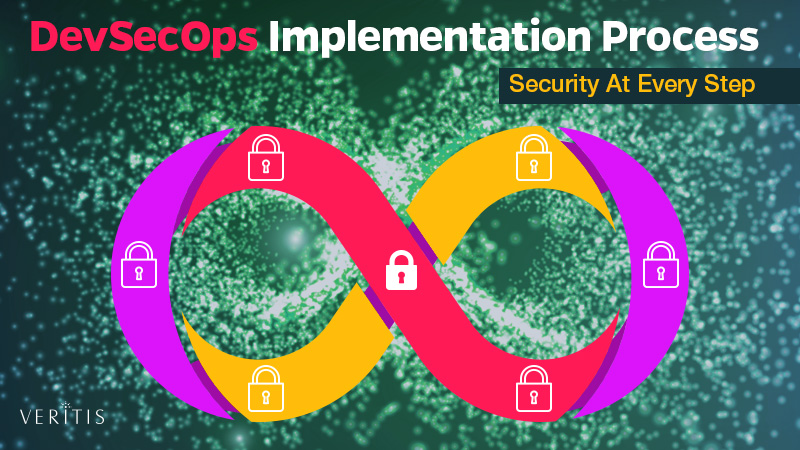
    DevSecOps is changing our perspective toward security and is equipping us to deal with its challenges in an intelligible manner. The systematic approach of DevSecOps helps us add value to our business processes while ensuring security.

    Here’s a summary of the key inputs and a recipe for a successful software development project. Implementing DevSecOps with the primary goal of enhancing security requires a step-by-step procedure.

    It requires the unification of culturally disparate teams of Security, Operations, Development and Test for the sole purpose of building a product marked by quality and backed by security.

    The DevSecOps process will require effective planning, design and release, which will be put together with a collaborative toolchain of technologies to bring about a common goal.

    Furthermore, as organizations continue to rely on automated delivery, avenues are created for testing opportunities beyond traditional bugs. In-house experts will be able to identify potential loopholes, design errors and even code weak spots.

    Being able to identify weak spots and flaws well in advance helps organizations maintain a competitive front in the market and trustworthiness before its target audience.

    DevSecOps Implementation Process and Road Map

    DevSecOps Implementation Process and Roadmap

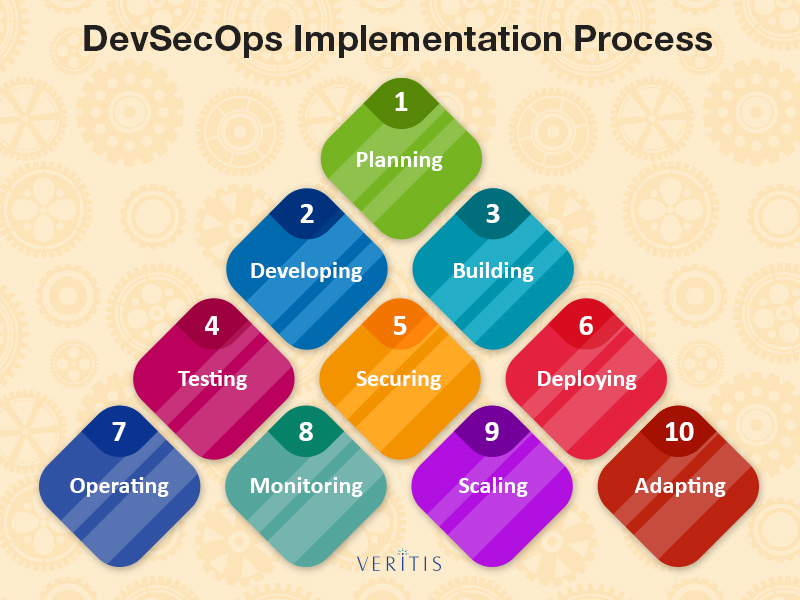
    1) Planning: Planning is the first approach to any task at hand and the core focus of DevSecOps—security—begins from here. In the planning stage, DevSecOps professionals must go beyond creating feature-based descriptions. The focus should also be on security and performance, acceptance test criteria, application interface and functionality and threat-defense models.

    Tech terminology: Acceptance Test Criteria is used by DevSecOps professionals to understand user preferences and behavior to a software application behavior.

    2) Developing: Developers should approach DevSecOps with a “how to do it” approach, rather than a “what to do” approach. It is important for developers to bring together available resources for guidance, have reliable practices and a code review system in place for themselves and for others in the team to follow.

    3) Building: Automated build tools can uplift the whole DevSecOps implementation process tremendously. These tools ensure test-driven development, standards for release artifact generation and utilize tools to ensure the design aspect is in alignment with the team’s coding and security standards through statistic code analysis.

    They can also be used to identify vulnerable libraries being used in your application and replace them with new ones.

    4) Testing: Automated testing in DevSecOps should utilize strong testing practices including front-end, back-end, API, database and passive security testing.

    Tech Terminology: Passive Security Testing is a developmental stage testing where security testing is not conducted directly on the target.

    5) Securing: Traditional testing methods always remain in place in DevSecOps exercise. However, somewhere down the line, there is a tendency to identify issues toward the end of the development process.

    Through advanced practices such as security scanning, we tend to become more aware of the issues and can determine if the threat is a serious one or not.

    6) Deploying: Automated provisioning and deployment can fast-track the development process while making it a more consistent one. Infrastructure-as-code tools can perform the aforementioned audit properties and configurations and ensure secure configurations across the IT infrastructure.

    7) Operating: Regular monitoring and upgrades are the Operations team’s important tasks. DevSecOps teams ensure to deploy infrastructure-as-a-code tools to update and secure the entire organization’s infrastructure in a quick and efficient manner with no scope for human error. Operations personnel have to be especially watchful of zero-day vulnerabilities.

    Tech Terminology: Zero-Day vulnerabilities are a software breach that remains unknown to software productions personnel and can eat away at a computer program and other components such as a network.

    8) Monitoring: Constantly keeping a watch for irregularities in security can save an organization from a breach. Hence, it is essential to implement a strong continuous monitoring program with real-time to keep a track of system performance and identify any exploits in their early stages.

    9) Scaling: Gone are the days when organizations spent precious hours and money on the maintenance of large data centers. With the introduction of virtualization solutions and the cloud, organizations can scale their IT infrastructure or replace it in the event of a threat, which would be impossible to do with a traditional data center.

    10) Adapting: Continuous improvement is key to any organization’s growth. An organization will only be able to achieve the desired growth of it evolves in its practices including DevSecOps practices—security, functionality and performance. Therefore, an organization should adapt to continuous improvement and external changing trends.

    The DevSecOps is in itself a process of innovation that substantially adds value to an organization.

    Point to Remember: Security is everyone’s responsibility.

    — Veritis

  • Applying DevSecOps to Address Cloud Security Challenges

    Applying DevSecOps to Address Cloud Security Challenges

    Driven by the encouragement from 2018 progress, cloud technology is poised to be even bigger in 2019. However, one major hurdle continues to haunt the cloud trend: security.

    An overwhelming number of firms in the IT industry are preparing for cloud adoption, yet security continues to be a big question for many of them. Early DevOps adopters faced a similar challenge in their early stages of DevOps implementation. They relied on a wide variety of DevOps tools to address their issue completely.

    Today, however, DevSecOps is making a big difference in the IT industry, including security and ensuring a seamless software development life cycle (SDLC).

    Breaking the regular trend of having security as a separate process, DevSecOps calls for security integration across all stages of the software process chain, addressing security concerns at the very first instance of every stage.

    The same DevSecOps now comes as a savior for cloud, too.

    Applying DevSecOps to Cloud

    Last year saw the cloud market taking a new position in the IT industry, driven by the wide penetration of leading cloud computing service providers: Amazon Web Services (AWS), Microsoft Azure, Google Cloud Platform (GCP), Oracle Cloud and IBM Cloud, among others.

    To stay relevant in today’s market, many IT firms have begun their efforts to achieve high and highly scalable performance with all-round digital transformation.

    Yet, security limitations associated with cloud continues to be a concern many of these organizations. DevSecOps principles can help. Many research reports show that the majority of firms working on the cloud have high reliability on DevSecOps tools and principles for improved agility and high reliability.

    DevSecOps approach to cloud security requires detailed planning that might even demand cultural change in an IT environment, especially for security automation and configuration of cloud assets.

    The planning requires security teams to:

    • Collaborate with development teams as they move code to cloud alongside close monitoring of quality in the production cycle.
    • Work with the quality analysis and development teams in deciding qualifier and parameter aspects required for code promotion.

    Overall, DevSecOps principles offer security advantage along with software agility and high reliability across the life cycle.

    Implementing DevSecOps in Cloud

    Following six factors decide the success of DevSecOps implementation in a cloud environment:

    DevSecOps implementation in Cloud environment

    1. Code Analysis – Continuous improvements to software mean revisiting code, which also reflects in code analysis, quality assurance and delivery cycles.
    2. Automated Testing – Automated testing minimizes efforts and also saves time. As a key aspect of DevSecOps process, automated testing makes the testing process easier through easy execution of repeatable cases.
    3. Change Management – Linking teams and making them aware of each other’s operations, wherever required, is an important aspect of change management. Keeping developers informed about security-related activities helps in timely address of existing and possible vulnerabilities.
    4. Compliance Monitoring – Compliance continues to play a key role in an organization’s growth path as part of corporate governance. Regulations help in the creation of code and also in modifying the source code. This helps in real time at times of audit.
    5. Threat Investigation –  Threat investigation is important to defining the security readiness of any organization. It’s important for organizations to have a close and continuous watch on discovering possible threats, regular security scans and code reviews to address security challenges.
    6. Personnel Training – Holding hands-on training sessions and certification courses build the company’s strength, equipping teams with appropriate domain knowledge.

    The above-mentioned six steps act as building blocks for implementing DevSecOps strategy in cloud. What’s next? The implementation part: Get DevSecOps to cloud.

    — Veritis

  • 7 DevOps Lessons in 2018: The Path to DevOps Success in 2019

    7 DevOps Lessons in 2018: The Path to DevOps Success in 2019

    We all learn from mistakes, right? But it would be better if we learned faster and didn’t repeat them in our future exercises. And this is exactly what we will discuss here in this blog.

    For a while now, we’ve been overwhelmed by the idea of the DevOps principle. We love how the collaboration between development and operations provides room for automation, continuous integration/delivery and enhanced time-to-market.

    But what about the tiny shortcomings we overlook in the process of continuous delivery?

    Listed below are some of the don’ts—or, rather, lessons learned from our DevOps implementation in 2018:

    Gauging Employee Capacity Over DevOps Delivery

    When Carmen DeArdo, Tasktop’s senior value stream management strategist, posed two questions to a crowd of 200 people, they had no answer to give. What were the questions, you might ask?

    • How many treat their delivery pipeline tooling as an integrated product with a product owner and an architect?
    • How many have any measure of how long it takes for them to deliver a feature or defect?

    Companies treat their delivery pipeline tooling as different components along the delivery chain. And, when it comes to measuring time taken, all that matters is getting the product to the finish line.

    These components are important if companies need to avoid obvious mistakes on the path to success. Consider the above questions the next time you set out on your DevOps mission. Within this aspect, measuring team happiness is as important as an integrated delivery pipeline tooling, and time is taken to introduce a feature.

    Companies need to strike a balance between managing work and achieving team happiness. This is important if the company has a long-term vision. Unhappy employees burdened with work don’t deliver the expected results. A sustainable pace helps companies ensure that employees don’t succumb to pressure.

    Revise the Management Strategy

    Organizations need to encourage their managers in a way that they are not put off by the DevOps process but rather motivated to build and maintain their team.

    Most organizations emphasize giving managers incentives to deliver expected results, maintain quality, expand team size, set immediate goals and rake larger profits. However, this strategy could backfire when applied to a DevOps implementation.

    Companies instead should encourage their managers to create an environment where the teams grow and become flexible, not only contributing to that process but also adding value to other processes, hence, the organization’s overall success. This thought process will lead to a chain of positive outcomes.

    Upskilled and Cross-Skilled

    Gone are the days when specializing in a particular skill was rewarding! The competitive market is looking for a workforce that is upskilled and cross-skilled. In short, employees need to be a package of multiple skills, with an emphasis on soft skills.

    Being multi-skilled not only supports transformational goals but also supports an organization’s goals. When the lack of new skills becomes a constraint, companies must invest in hiring individuals to propel transformation, which is equivalent to investing in automation.

    Automation ≠ DevOps Success

    Somewhere between adopting the DevOps culture and being DevOps-equipped, professionals have shifted from the purpose of DevOps to automation.

    In the process, people have lost control over the overall management of DevOps. Either professionals are in a situation in which the code is not built in the intended way or that the automated part is managed but the steps required for automation are not.

    Organizations instead should refocus their attention on the scalable nature of DevOps, building a new, fully automated process rather than automating an end-to-end process over time, as it is difficult and also time-consuming. Hence, automation does not equal the DevOps mission accomplished!

    From Idea to Blackboard

    DevOps once was more an idea of a team discussion rather than full-fledged process. But we saw 2018 transform DevOps from a mere idea to a part and parcel of everyday business—so much that it defines the way businesses plan their finances, regulations and organizational strategy as a whole.

    Additionally, DevOps experts in 2018 emphasized the need for value delivery than just focusing on details of technical practices. This can be achieved by constructing a managerial framework that bridges the gaps between business and technology.

    Relieve Your DevOps of Old Tech

    Last year also witnessed DevOps professionals moving toward new technology such as containers, Kubernetes and serverless. Why? It’s obviousthese technologies enable DevOps to deliver its promises. Trying to innovate the DevOps process or even innovate its end product with old technology will only take you backwards in the DevOps process.

    In 2019, we should realize that holding on to old technology will mean limiting your organization’s capabilities and impact.

    Identifying the Right DevOps Adoption Patterns

    While there are several DevOps adoption patterns out there, some organizations choose a central DevOps team enabling standard CI/CD tooling. The approach is in sync with DevOps thought leaders’ approach of reducing global complexity.

    However, this approach fails at catering to the needs of different teams. With the focus only on addressing CI/CD tooling, many centralized teams struggle with adoption.

    In another approach, companies seek to engage ambitious and autonomous tools to use DevOps tools and practices.

    This approach tends to match the common DevOps belief, ‘First prove that new work methods fit the enterprise, then spread.’ However, these teams are only successful in delivering projects with high levels of automation involved but have quickly failed to convert team-level experience to company-level.

    A 2019 DevOps adoption approach should focus on having high levels of team autonomy and reducing global complexity.

    Here are some tips to help you achieve this:

    • The central architecture team collect and share recommendations about languages, libraries and tools.
    • Teams consider these recommendations and experiment to see if there’s an opportunity for greater gain.
    • If things aren’t working, teams can change change and undo dead-end technology decisions/ideas.

    Now that we are ready with our lessons, it’s time to go live! Are you ready for your DevOps 2019 showdown?

    — Veritis

  • Revolutionize Software Delivery with DevOps and AWS

    Revolutionize Software Delivery with DevOps and AWS

    Technology is constantly evolving—every time we think we’ve got a complete hand-holding experience on some technological aspect, there emerges a better innovation.

    When the DevOps solution emerged, organizations were more than happy to incorporate its principles. But somewhere down the line, there came DevSecOps. Innovation is an upward curve that doesn’t see a decline but rather starts another journey of its own.

    And that is what most DevOps consulting service providers are striving to produce—innovation. Ever thought about getting a cloud service to operate and innovate a DevOps process? Well, that’s exactly what AWS does to innovate the DevOps process and services. Plus there’s more. That’s Innovation + Benefits!

    Benefits the Team ‘DevOps AWS’ Can Offer

    Automate – Automation is vital to the DevOps process and more so with the DevOps processes for cloud instances. It can drastically reduce developers and operators work hours dedicated to creating bug reports, generating scripts for specific functions, performing calculations and testing code. AWS helps automate DevOps approach including software testing, adding innovation, besides accuracy, consistency and repeatability. It’s human to err but it is technology that removes any scope for error.

    Scale – AWS was designed for scaling operations. AWS brings scalability to operations allowing you to do as many things as your businesses require. It facilitates easily availability of resources to fulfill the requirement at hand. The best example of this is handling traffic spikes and downtimes without the need for manual monitoring.

    Collaborate Better – Collaboration is at the very heart of the DevOps process. The unification was essential to make the development process a systematic and organized one. AWS can quickly accelerate this process and make it the way it’s intended to be. It unifies automation and enhanced operations to deliver the promises of DevOps. Gone are the days when different departments would wait on each other for communication; this paves way for improved software delivery.

    Deliver Quality with Performance – DevOps as a working principle and AWS suite of services are individual names of efficiency. So when they come together, it’s a powerful combination of quality, performance and remarkable output. Even before the output is out, developers and operators are rewarded with automated testing, continuous delivery and better infrastructure to work with. The entire process is knitted to facilitate a smooth DevOps process.

    Secure – Just as we discussed earlier, security has definitely become a part of DevOps. With AWS automation and managed cloud computing, it becomes easier to introduce updates and deploy them frequently. In turn, it makes easy to track changes in the code and ensure that security measures are enough and running correctly.

    Some DevOps-AWS combination services that enhance the DevOps process for cloud computing:

    AWS CloudFormation: DevOps-for-cloud professionals need to create and release cloud instances/services faster than general DevOps professionals. AWS CloudFormation increases the pace of creating cloud instances by creating templates of AWS resources such as EC2 instances and ECS containers to let you construct the entire setup without much manual intervention.

    AWS EC2: AWS EC2 brings security and management features to your DevOps process, making it a more the DevOps AWS duo a more desirable combination to work with. It can run containers in EC2 instances.

    AWS CloudWatch: This is an AWS monitoring tool that helps you track every AWS resource. Additionally, it enables DevOps experts to use third-party monitoring tools.

    AWS CodePipeline: This service is a popular AWS feature that eases the management of continuous integration and continuous delivery tools. It allows you to integrate tools such as CodeDeploy, GitHub and Jenkins so that you can visually control the flow of apps from scratch to the end.

    Not a service or tool but the next on the list is more like a functionality feature:

    AWS Instances
    AWS creates and adds new instances to its list. The flexibility to customize along with these instances makes it easy to use AWS DevOps together.

    Conclusion

    If DevOps is a solution, then AWS further enhances that solution to make businesses deliver their best. No wonder our world is being dictated by speed and quality!

    — Veritis

  • 10 Years of DevOps—Transition, Growth and the Future of AIOps

    10 Years of DevOps—Transition, Growth and the Future of AIOps

    When software development became a cumbersome task of repetitive coding, testing and glitches, organizations had to come up with a solution.

    The solution? An organized approach that would not only eliminate the endless cycle of repetitive tasks but also would establish proper coordination and execution in the software development life cycle (SDLC).

    That very systematic approach with fewer glitches, more production and exemplary coordination today is called DevOps.

    But where did this wonderful process start? How did it make its pathway into our the cycle of IT industry?

    The Beginning

    It all began one day when Andrew Clay Shafer scheduled a session, “Agile Infrastructure,” at the Agile Conference in Toronto.

    However, the DevOps model back then didn’t seem to make much of a difference to those associated with software development. As a result, Shafer closed the session. But something struck developer Patrick Debois that day, who was presenting a paper on “Agile Infrastructure and Operations” in the same vicinity. Shafer’s theme seemed to draw his attention and he went straight to meet Shafer.

    A long talk in the hallway that day ignited the fire of DevOps, which started with Shafer and Patrick three months after their first meeting.

    Together, they started the Agile Systems Group, with an aim to foster greater collaboration between developers and operators.

    Today, the DevOps process continues to survive on the principles of increased collaboration and automation to build, test and release software faster.

    Mobile Device and DevOps Adoption

    Over the years, DevOps began to grow and pick up fame. And with the emergence of mobile phones, the trend picked up rampant speed.

    According to a market intelligence company App Annie, global economic activity concerning mobile applications will be worth USD $6.3 trillion by 2021, five times 2016’s revenue.

    Creating software for mobile devices requires an elevated software development approach. Now, organizations have to deliver new, high-quality software to customers as soon as possible to remain atop the competitive market.

    In this new approach, organizations need to focus on two prime factors: agility and adaptability. While the former defines the ability to code and recode, the other marks DevOps’ ability to include changes along the SDLC.

    Companies are constantly working on getting these qualities into their workflows to promote DevOps concepts of continuous delivery, continuous integration and eliminating bugs to allow users to enjoy a hassle-free software experience.

    DevOps Over the Past 18 Months

    According to Gartner, about two-thirds of organizations were using DevOps to support the certain business process by the end of 2017, which Forrester termed as the “Year of DevOps.”

    Forrester awarded the term to DevOps owing to increasing clients’ questions and discussions around, “How do I implement DevOps at scale?” rather than just, “What is DevOps?”

    Going by DevOps’ potential to support modern business processes, more and more companies are adopting DevOps, leading to a steady rise in the trend.

    As DevOps continues to be successful within and across the organization, the IT industry will continue to see what it looks like to be “DevOps successful.”

    The Emergence of DevSecOps

    While DevOps continued to change the software industry, however, security within the process still remained an unanswered question.

    In 2012, Gartner analysts Neil MacDonald and Cameron Haight introduced the concept of DevSecOps. This meant security’s introduction right from the beginning and continuing throughout SDLC.

    Security’s entry into the model made DevOps a more alluring practice. Six years out, DevSecOps has been a much-discussed concept across seminars, conferences and written content.

    But it is still a question whether organizations are implementing DevSecOps considering the time constraint, the need for accelerated delivery and the understanding of security’s importance in the cycle.

    For many organizations, security is still not a part of their production cycle. But, it is essential for any organization to consider security if they want to remain in the competitive market and importantly at the top.

    Negligence in this area may cost them bankruptcy or even elimination from the industry. According to the “Global State of Digital Trust Survey and Index,” one-third of British customers stopped using an organization’s services owing to a security breach.

    10 Years of DevOps: What’s Next?

    The emergence of AI and automation have made some waves in the IT industry, and DevOps is no exception.

    DevOps holds high predictions for the future. In the years to come, AI and automation will change the software development process. Apps will be self-written and coded. Tasks such as integration, security, testing and deploying will be dictated by AI, data and machine learning in the all-new AIOps.

    A data-driven approach will have software dynamically adapt its behavior on the basis of what is in its environment, much like other AI-driven technology including Apple’s Siri and Alexa.

    Moreover, this significant shift from programmed to non-programmed apps will call for improved security and functionality management and allow developers to focus on value-addition activity.

    DevOps is evolving. How about your organization?

    — Veritis

  • A Right DevOps Approach: Assess Organizational Readiness

    A Right DevOps Approach: Assess Organizational Readiness

    Driving business in this fast-paced world is maddening as owners have to remember customer preferences, beat market competition and similarly cater to different things within the organization’s radius.

    How a business owner manages all this defines the business success, which is gauged through outcomes in the form of smart products, point-on services and almost-immediate feedback. Bank applications, the best smartphones and interactive technology are all proof of this.

    But what is it that stands at the heart of it all?

    The Right DevOps Approach

    When enough is done and businesses still find that there’s a missing piece that will complete “the successful business picture,” they go back to figuring out what and how they can fix the problem. They never come to realize that they will have to consider revamping their organizational structure to meet the growing demands of their influential business.

    How, then, do you assess your approach to DevOps?

    While most believe that it’s a technological approach that they should incorporate in their business, it’s more of a cultural approach. To implement DevOps into your existing organizational structure, you first must look at its current state of readiness.

    Doing this is important, as it helps decision-makers understand how they can embed the smart collaboration after a thorough consideration of the challenges that stand in the way of DevOps implementation. Once the initial assessment is done, business owners need to ask themselves three questions before assessing DevOps readiness:

    1. Is there a Management-Employee Agreement? A successful DevOps process not only relies on collaboration between Development and Operations, but also needs a top-down (management-employee) agreement. Once that’s in place, the company is already halfway through the success road.
    2. Is there a Plan in Place? Many firms just barge into technology like it’s all they need to reach their finish line. Stop! Wait! Think! Owners need to have a detailed strategy, equipped with process tools and goals clearly outlined and best practices chalked out. Once this is done, the culturally different teams need to collaborate and work ways to learn and equip themselves with the technologies and practices of each other’s processes. With all this in place, organizations will be ready to take the DevOps jump.
    3. Is the Organization Ready to Tread the Ocean? Now that the plan is in place, what’s next? Organizations, as mentioned earlier, are in hot pursuit to experiment with what they’ve learnt new. Anything new is fancy, but humbleness is the key! Starting small will set the new cultural shift to completely settle in its new mold. To run the boat in big waters, you first need to test it in small water. Similarly, to test the success of DevOps for a big business project, you first want to test its adaptability to a smaller one. Once you’ve cut off from the harbor, you are all set to wade the ocean.

    Conclusion

    Most business players underestimate the ability of DevOps with whatever industry rumors they hear and some of their own pre-conceived notions. Some other think that they know it all, but what matters is having a strategic approach to first considering DevOps and its tools, and then adapting it accordingly.

    Once the DevOps automation is in place, organizations will be busy reaping the benefits of its successful implementation.

    — Veritis

  • DevOps Adoption: The Driving Force of the Industry

    DevOps Adoption: The Driving Force of the Industry

    DevOps has transformed from a mere idea on paper to the way processes function in the face of an immediate requirement. Development and Operations together make for one of the most successful collaborations today.

    As per a research report, people have now begun to understand what DevOps is. When asked how familiar they were with DevOps, 84 percent of respondents said that they well-versed with the concept, in comparison with 60 percent who agreed to the same the previous year.

    DevOps is writing the success stories of the world’s business giants. Facebook, Google, Twitter and Amazon are all working the “DevOps way.” All falls in place when these companies develop, test and successfully deploy code in a matter of one to 23,000 minutes per day. We agree that’s insane!

    How Have We Benefited from DevOps Adoption?

    To sum up the benefits of DevOps adoption in a nutshell, users see:

    • Drastic reduction in lead times—With the pressure to deliver software faster and meet the challenges of the growing market, there is always a need to look at progressive ways of getting the job done, DevOps became the solution. As per statistics, practitioners believe this to be the top benefit of DevOps in 2018. Sixty-nine percent of respondents agreed to this benefit, as compared to 39 percent in 2017.
    • Increased ability to release new features with improved reliability stability and security—The need to improve the user experience and keep the customer equipped with the necessary tools to meet the challenges of a growing business made IT personnel realize that it is always essential to introduce new features into the deployment process. DevOps made it easy. Figures tell us that the implementation of DevOps led to 73 percent of people believing in its benefit of enhanced user experience, this year.
    • Enhanced IT and Organizational Productivity, Higher Profitability, Revenue and Market Shares—Now with the best process having so much to offer, all businesses have gained a lot in terms of savings and earnings. DevOps drives revenue: 26 percent of people reported an increase in revenue in the year 2018 as compared with 20 percent in 2017.

    Why No DevOps?

    Although we’ve seen a major shift in trend from being skeptical about DevOps and its implementation to becoming “pro-DevOps,” over the years, not all of us are up for this big business move. The reasons being many.

    Listed below are the most commonly given reasons by industrialists around the world:

    • Other technology and business priorities—With newer technologies being developed every few weeks, companies are confused over which technology will give their business the required leverage. This leaves them to either becoming very choosy or just ignoring the prospects of adopting a technology at all. Some business owners think about fund allocations. They want to invest their hard-earned money into something they see as more viable or something that convinces them about profits. When it comes to innovative ideas such as DevOps, they think these things may not bring them immediate results or they’re not as important as the “conceived” business priorities. As per a study conducted in February 2018, as much as 38 percent of the sample population opted out of DevOps for the above reason.
    • Lack of resources—Most organizations lack the required resources in terms of personnel, tools and persons with expertise. This discourages organizations from taking up such practices. While it is great to have a workforce with work experience for the dev and ops teams individually, it is crucial to have employees with DevOps experience on board. Similarly, lacking the right tools can have your organizations whimpering in the wake of a growing market despite having an able workforce. Statistics show that 34 percent of people hesitate to adopt DevOps for the given reason.
    • Lack of cooperation between development and operations—Whenever there is a mention of DevOps, there is also a mention of the cultural indifference of Dev and Ops teams. Each team has their unique work culture and when they come together on common ground, they cannot help but fall apart. Most organizations do not encourage the DevOps practice on account of this cultural disparity.A significant 22 percent of the industries under this research shun the idea of DevOps owing to this disparity.
    • ‘We don’t see the value’—It is likely for some business to say this. It is difficult to assess the value of the process from an outsider point of view. If someone has heard about DevOps but don’t how it will profit their businesses, then it is difficult for them to adopt it. As per statistics as small as 6 percent of the sample population did not adopt DevOps for this reason.

    On an End Note

    Organizations have been opting for DevOps after seeing its contributions to the industry. This year has most businesses functioning with major dependence on the skill and agility of the DevOps processes, and this has been proven through the success of their business. We hope the remaining number of entrepreneurs come to realize the importance of DevOps for their business and implement its benefits to build their success and keep up with the challenges of the fast-growing market.

    — Veritis