Category: Events
-
Webinar: Top 5 Things You Need To Know When Selecting a DevOps Release Management Solution
[seoslides embed_id=”cfdee7b6fc5f” script_src=”https://devopsy.kinsta.cloud/embed-script/webinar-62316-deliverbetterapps2-top-5-things-need-know-selecting-devops-release-management-solution/16715/” overview_src=”https://devopsy.kinsta.cloud/slides/webinar-62316-deliverbetterapps2-top-5-things-need-know-selecting-devops-release-management-solution/” site_src=”https://devopsy.kinsta.cloud” site_title=”devopsy.kinsta.cloud” title=”Webinar: 6/23/16 DeliverBetterApps2 Top 5 Things You Need To Know When Selecting a DevOps Release Management Solution” /] -

DevOps Matchmaking: APM + CI = A Perfect Marriage
As anyone who has ever been set up on blind dates by friends can attest, finding the right match in today’s world is a tricky feat.
There’s a lot of evidence suggesting that the frantic pace of life makes such matchmaking more difficult than ever. That said, when the right set of complimentary traits exist and there’s a willingness to find common ground, things can work out.
Spike Jonzian-notions of artificial intelligence aside, certain technological partnerships are increasingly being perceived as “a perfect marriage” within the context of DevOps automation.
Register today for the upcoming webcast: “Using APM to Turbocharge Continuous Integration”
These technological matrimonies closely support the underlying tenets of DevOps methodology—collaboration, experimentation and increased velocity. In fact, it’s easy to wonder why no one ever conjoined them before. But we were using traditional waterfall development and operations and so couldn’t conceive of such a thing. On the other hand, emerging availability of tooling supporting new integrated workflows represents a significant catalyst.
Finding the Perfect Fit
One such DevOps confederation getting a lot of attention is the matchmaking of continuous integration (CI) and application performance management (APM) technologies. Tying together these once-disparate systems makes a lot of sense, despite the fact that few tools would seemingly appeal to more (traditionally) polarized constituencies.
Continuous integration has been a staple of the development community for many years. It emerged as teams evolved the practice of long build times into more frequent check-ins to deliver code and look for potential errors more quickly. Today, with the rise of CI tools such as the Cloudbees Jenkins platform, some development teams are touting tens of thousands of builds per day.
On the other end of the spectrum, squarely on the turf of IT operations, APM has been evolving rapidly over the past few years as organizations have sought to improve use experience and applications reliability via dedicated monitoring. Enabling this ability to identify and address emerging issues has resulted in APM becoming the fastest-growing segment in the IT ops management market, according to Gartner.
DevOps matchmaking factors in when you bring these tools together to create an automated workflow that spans their respective use cases. A cross-functional team can leverage APM-level monitoring and KPIs within the domain of CI and testing to identify potential performance obstacles introduced in new code. Doing so then rather than waiting to respond later in the applications life cycle benefits everyone.
Reaping the Benefits
For example, say an e-commerce applications developer has implemented a new inventory search functionality—something considered a key differentiator by business management. The developer knows this feature could rely heavily on some back-end database system and wants to ensure it’s tested properly, even as the code is being introduced.
Integrating APM and CI allows the entire team to monitor the process and test various conditions related to the update, tracking multiple builds and looking out for related performance issues. Such integration also allows for centralized tracking of other key attributes such as build number, status and build date, to further ease management.
Most importantly, by tying these two critical aspects of the applications delivery life cycle together, the collaboration and feedback loops required to truly embrace DevOps methodology become ever more valuable as these core Dev and Ops functions become intrinsically linked.
If this type of DevOps advancement gets your heart pumping, you’re not alone. Later this month, we’ll host a webcast here on devopsy.kinsta.cloud featuring experts from CA Technologies and Cloudbees. They’ll be discussing the benefits of matchmaking with APM + CI integration. They’ll also detail real-world benefits organizations leveraging integration of our respective technologies (CA APM and Cloudbees Jenkins) enjoy.
We obviously feel that this is a DevOps tooling marriage that will mature, change and stand the test of time. We’d love to garner your questions and feedback on the topic.
Which is all good, because thankfully there’s no such thing as Tinder for DevOps … yet.
-

Webinar: The Unrealized Role of Monitoring & Alerting
RECORDING
SLIDES
[seoslides embed_id=”da32ce018c0f” script_src=”https://devopsy.kinsta.cloud/embed-script/unrealized-role-monitoring-alerting/16263/” overview_src=”https://devopsy.kinsta.cloud/slides/unrealized-role-monitoring-alerting/” site_src=”https://devopsy.kinsta.cloud” site_title=”devopsy.kinsta.cloud” title=”The Unrealized Role of Monitoring & Alerting” /] -

DevOpsDays Silicon Valley is Coming!
DevOpsDays Silicon Valley is coming, so mark your calendar! DevOpsDays events are a global phenomenon, bringing together practitioners across roles for two days of scheduled presentations and networking in a community-organized event. You won’t want to miss this year’s conference!
The 7th annual DevOpsDays Silicon Valley is scheduled for June 24-25 at the world-famous Computer History Museum. Silicon Valley is the oldest of the U.S. events and was originally the third DevOps Days ever. The conference, which started in 2010 as a low-key event hosted on the campus of LinkedIn, has grown into a major event.
This year’s lineup includes talks from a variety of perspectives including security! Jennifer Davis, co-author of “Effective DevOps,” will open the conference up with “Devops is for Everyone.”
DevOpsDays Lineup
Here is the 2016 speaker lineup:
Keynotes:
- Troubleshooting Troubleshooters: Debug Your Colleagues for Fun and Profit, by Bethanye McKinney Blount, CEO/Co-Founder
- From Divided to United – Aligning Technology & Business Teams, by Dominica DeGrandis, Director, Learning & Development
- Cost versus Performance: Analytics for Walking the Tightrope, by Elizabeth (Betsy) Nichols, Chief Data Scientist
- The Future of Automation, by Adam Jacob, CTO and Founder of Chef
Presentations:
- Behind Closed Doors: Managing Passwords in a Dangerous World, by Noah Kantrowitz
- At the Intersection of Happy and Healthy: DevOps Meets IoT, by Gail Ferreira
- Heresy in the Church of Docker, by Corey Quinn
- DevOps Army of N – Recovering From Being a Human SPOF, by Jonathan Disher
- (Parental) Leave Actually, by Dave Dash, Nicole Grinstead, Melissa Sandgren
- How to Onboard Entry-Level Talent to a DevOps Culture, by Angel Tian and Sophia Castellarin
- Autoscaling Containers … with Math, by Allan Espinosa
- How I Learned to Change My Mind and Became a Better Engineer, by Ramin Khatibi
- Removing the Stigma of P0w3rship, by Ed Anderson
Ignites Include:
- How Do You Measure Availability? Performance and Availability and SLMs, oh my! by Warren Turkal
- Feature Feature, by Linda Goldstein
- The Elements of Developer Experience (DX) Design, by Stephen Boak
- Reflections of an Operations Burnout, by Jamie Dahl
- Breaking Brooks’ Law with DevOps, by Jason Yee
- A DevOps Team is a Daft Idea and You Should Feel Bad! by Caedman Oakley
- How Can You Scale It If You Don’t Trust It? by David Blank-Edelman
- From WWW to GGG, by Anne Ahola Ward
- How I Learned to Stop Worrying and Love the Protocol, by Pete Sclafani
Following the inspiring talks, each afternoon is dedicated to Open Space, where the agenda is dedicated to small-group, participant-led discussions chosen on the fly. This is the chance to dive into specific topics, ask for help, discuss what you’ve done, find like-minds or just be a fly on the wall and take it all in.
If you are in the San Francisco Bay/Silicon Valley area, get your tickets for the June 24th and 25th DevOpsDays Silicon Valley ($199) before they sell out. We also have a limited number of education tickets for faculty, staff and students ($100). If you live elsewhere, be sure to keep an eye on the main DevOpsDays site for upcoming events. Also, check out DevOpsDays Silicon Valley recorded talks from 2015.
About the Author / Damon Edwards
 Damon Edwards is the co-founder and managing partner of the DTO Solutions, a DevOps and automation engineering consultancy whose clients include leading SaaS, e-commerce, gaming, and financial services companies. Damon Edwards is also the co-founder and vice president of SimplifyOps, a provider of support and services for the users of the Rundeck open source project. Damon has spent over 14 years working on both the technology and business ends of IT operations. Damon is also a frequent conference speaker and writer who focuses on DevOps and operations improvement topics. Damon is active in the international DevOps community, including co-organizing the DevOps Days conference series, co-hosting the DevOps Cafe podcast, and a co-author of the DevOps Cookbook from IT Revolution Press.
 -

Webinar: Leading Change at DevOps Enterprise Summit London
RECORDING
SLIDES
[seoslides embed_id=”4176627f1cb3″ script_src=”https://devopsy.kinsta.cloud/embed-script/leading-change-devops-enterprise-summit-london/15912/” overview_src=”https://devopsy.kinsta.cloud/slides/leading-change-devops-enterprise-summit-london/” site_src=”https://devopsy.kinsta.cloud” site_title=”devopsy.kinsta.cloud” title=”Leading Change at DevOps Enterprise Summit London” /] -

New Faces Of Devops
RECORDING
SLIDES
[seoslides embed_id=”77abd5e6ff38″ script_src=”https://devopsy.kinsta.cloud/embed-script/new-faces-devops/15682/” overview_src=”https://devopsy.kinsta.cloud/slides/new-faces-devops/” site_src=”https://devopsy.kinsta.cloud” site_title=”devopsy.kinsta.cloud” title=”New Faces of DevOps” /] -
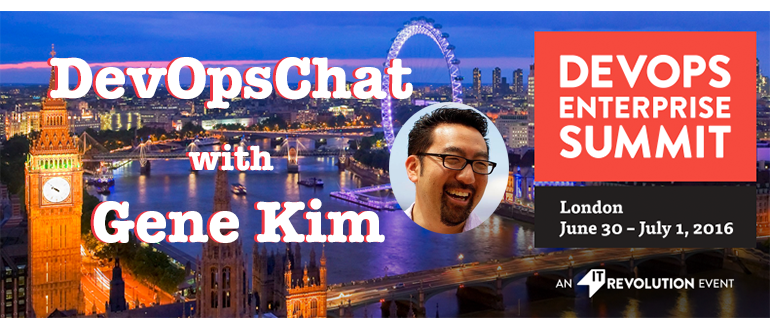
DevOps Chat: Gene Kim, DevOps Enterprise Summit London 2016
I recently had a chance to sit down with author and researcher Gene Kim about the upcoming DevOps Enterprise Summit in London (DOES). This is the first DOES out of the US and Gene and team are planning to make it a great success. Below is the audio of our conversation and below that is a the transcript of the conversation.
Of course if you are thinking about attending DOES London, you can also attend next week’s DevOps Connect: CD Summit/Jenkins Days and receive a full credit towards a DOES London ticket. A great 2 for 1 sale. BTW, Gene mentions the DevOps Enterprise YouTube channel in our discussion. Here is the link for it: https://www.youtube.com/channel/UCkyYEVVmT9vQ4yPBR4ciFUA
Enjoy!
Alan Shimel: Hi, this is Alan Shimel, devopsy.kinsta.cloud here for a special DevOps chat with Gene Kim, bestselling author, researcher and DevOps personality. Hi, Gene. How are you?
Gene Kim: Doing great, Alan. Oh, my goodness. How about a researcher who loves studying high performing technology organizations.
Alan Shimel: Okay. Hi, I’m here with Gene Kim, a researcher who loves studying high performing technology associations and writes a good book.
Gene Kim: Ah, love it. So much better.
Alan Shimel: All kidding aside, Gene, it’s a pleasure to have you on our show again. And we’re here to talk about the upcoming DevOps Enterprise Summit, London for 2016.
Gene Kim: I love it. In fact, this has been so fun. It’s our first year in London and so it’s been amazing. Sort of tapping you know the network to find great DevOps transformation stories in large complex organizations. But you know after just a lot of hard work on behalf of the entire programming committee, you know I think it’s shaping up to be just a fantastic conference.
Alan Shimel: Yeah. I mean I had a look earlier today at the speakers announced and you know part of me was really happy that I knew a lot of the names of who are these speakers and part of me was really happy that I didn’t know a lot of the names, right. Because you always want to hear new stories and from new people. So I think there’s something for everyone there. But Gene, you know what I’ve had the pleasure and honor of being on a program committee with you for the RSA Rugged DevOps event we do every year and so forth. But a lot of our listeners may not really understand what goes on behind the scenes and how do you get great speakers. Would you give our listeners just a little bit of like pull back the curtain a bit and talk to us about how you always come up with great speakers?
Gene Kim: Yeah. You know in fact, so let me first acknowledge the amazing programming committee that we have. One of them is Owen Gartner who is part of the DevOps initiative at Barclays Capital. Ben Grinnell, he’s at North Highlands Consulting Firm. There’s Marco Swindell from Accenture. There’s Benjamin Wootton from Sendachi Consulting. And then two committee members from the U.S. DevOps Enterprise Summit, which is Damon Edwards and John Willis, who are both a part of the DevOps movement from the very beginning. So the job of the programming committee is really to shape and to kind of form the vision of the conference and shape the talks to help achieve those objectives. And I think what’s been different about the DevOps Enterprise Summit is that you know we really aim to create a vendor neutral conference that really focuses on the technology leaders who are driving DevOps transformations in large complex organizations.
And so it means that with some rare exceptions, you don’t have a lot of the speakers from the DevOps community speaking because they’re not you know in large complex organizations. And so you know the challenge really was to find these amazing stories out there of people driving these audacious transformations in you know very conservative organizations. And you know for that you need people who aren’t just well networked in the industry and in the local market. And so you know we spent, my goodness, five, six weeks just you know scouring our rolodexes, brainstorming about all these – this is where we’ve heard about DevOps transformations going on and then actively reached out and you know vetted them just to gain some assurance that you know they weren’t just talking a good game, but they actually had _____ to show for it.
So you know as a first year conference, you know there was just a tremendous amount of work that went into that.
Alan Shimel: Sure. And Gene, you know to me it’s obvious why London, right. You know when we look at our own Google Analytics here at devopsy.kinsta.cloud, London is the second biggest city from an audience perspective for us. But I’m curious, why did you pick London?
Gene Kim: You know it was because that was actually one of the feedbacks that we got from our speakers and attendees, that you know because we’ve had the DevOps Enterprise Summit now going into the third year in San Francisco on the West Coast of the United States, that is a very long way to travel from people in the UK or from the European continents. So you know the ask was, hey, can you hold it somewhere in the European Union, whether it’s in the UK or in the EU. And so we were actually considering London, the Netherlands and there might have been a couple other options, but ultimately we decided to do it in London just because that’s where our network was. And when I say the network, that’s where the program committee was and that’s where I think our network was strongest. Which was very important because I think it gave us the best chance for succeeding and generating you know the right programming, the right speakers and so forth, the right transformation stories.
Alan Shimel: And you know what, I’ll reiterate it. London is a fantastic town. The DevOps scene there is just happening. Not to date myself and sound all groovy, but it’s a happening scene and it’s a vibrant dynamic DevOps community as well. So I think you couldn’t have picked a better place to do it in, Gene.
Gene Kim: You know it’s just a huge center of economic activity. You have a huge financial services industry. You have basically every type of you know industry vertical that are operating, you know in and around London. So, yeah, I agree, it was a great – and also where so much of the progressive DevOps activity is going on within government agencies. Like the UK.gov, the UK Digital Services, all that pioneered inside the UK government.
Alan Shimel: Absolutely. You’re a hundred percent right there, Gene. So, Gene, listeners who are listening to this, maybe they haven’t quite decided if they want to go to does London or not. Give me right now, have all the speakers been released or announced at this point or no?
Gene Kim: No. And we’re about 60 percent announced.
Alan Shimel: Right.
Gene Kim: But I can certainly share with you the talks that I’m super excited about.
Alan Shimel: Go ahead.
Gene Kim: You know one of them is Ron van Kemenade. You know so he is famous for his work at ING as the Global CIO. And so many of us in the DevOps community were aware of the ING DevOps Days that was held in 2011. In fact, that was probably the event that kicked off the first Target DevOps Days and the first DevOps Days at Capital One. You know it was such a novel concept. And so Ron van Kemenade as the CIO, will be talking about you know their journey when ING back in 2011 was very much like Parts Unlimited and the Phoenix Project. You know it was certainly very different from the organization they’ve become where they’ve created a world class technology organization that is widely admired. And so I’m excited that he’ll be talking about his role as the technology leader and to tell the whole inside story of how that transformation happened. And I’m particularly excited that I’ve asked him to share you know in his mind, what does it mean to be a technology leader. You know it’s not about picking Cassandra over Redis, versus Zookeeper, versus NoSQL, versus you know MySQL, right.
So what does it mean? I think that’s not well understood and certainly not well understood by me. You know there’s a talk from Robin Hughes from LV. So that’s the Liverpool Victoria Insurance Company. So multibillion pound turnover company. So again, an organization that’s been around for over a century and you know this is just a phenomenal DevOps transformation that was really driven by the operations team. And Robin Hughes will be telling the story about how they transformed one of the largest business applications inside their portfolio and enabled developer productivity. So I think that’s great. Anthony Collard, he’s the Deputy Director at HMRC. So that’s the Majesty’s Revenue Collection. So in the US we would call it the IRS, Internal Revenue Services. And you know they have over 60 scrum teams now working to help make life better for tax payers. Whether it’s the people at home or within businesses. And it’s just an incredible story about genuine innovation and creation of phenomenal efficiencies that you know haven’t been typically associated with the way government operates.
In fact, I was so inspired by it, I actually wanted to voluntarily pay UK taxes just to reward these amazing efforts.
Alan Shimel: Don’t count me in on that one, Gene. Thanks. But it’s good for you. Let me also just throw a couple of other names that I recognize and got me all excited. One is actually a friend of mine that I’ve worked with, Jonathan Fletcher over at Hiscox.
Gene Kim: Right.
Alan Shimel: I don’t know how much you know about Jonathan, but he’s brilliant. He’s not the – I don’t want to say the suit, but he’s not the title who leads the entire DevOps transformation there. But that person relies on Jonathan to make it happen. ‘Cause I’ve looked at that organization. This guy, I love listening to him talk about what they’ve done there.
Gene Kim: And it’s another phenomenal story. Another insurance company.
Alan Shimel: Yep.
Gene Kim: And I think what makes them so remarkable, so obviously they’re a multibillion British pound turnover company. But again, over 100 years old. And yet they’re growing at 30 percent in certain market segments.
Alan Shimel: Yes.
Gene Kim: When that’s happening its putting tremendous pressure on the technology organization, you know for them to deliver what the organization needs. And so here’s an incredible effort initiative, where they – and this one is driven by kind of an operations platform and architecture that is enabling development teams to respond quickly to the market and scale with demand. Yeah.
Alan Shimel: Yeah.
Gene Kim: I love that Hiscox story.
Alan Shimel: Yeah. No. The thing about Hiscox is you know though they’re UK based most of their business is on the continent. You know they have a large presence for instance in the Caribbean as well as the Western U.S. So this is a global organization dealing with regulations and I mean its insurance. I don’t want to tell well, too much on them and Fletcher, Jonathan is a tremendous, tremendous talent. I’m sure it’s gonna translate into a great presentation. Another one Gene, that I wanted to highlight if you don’t mind me stealing a little bit from you, is Gareth Rushgrove, you know who’s at Puppet now. But you know Gareth, besides curating the DevOps weekly newsletter, you know he has a great security background like we do, Gene. And I can listen to him all day.
Gene Kim: Yeah. And what’s great is that maybe not so well known is that he was part of the early UK.gov effort.
Alan Shimel: Yes.
Gene Kim: Where he had to deal with all of the regulatory and compliance bodies inside you know a very powerful central government, as well as the intelligence agencies. And so the fact that he was able to span those boundaries and earn the trust of those agencies and essentially help define kind of the next generation of security standards and strategies, is just a really inspiring one. It’s just a really neat guy.
Alan Shimel: Yeah. He’s a rock star. I just wanted to mention two others Gene and they’re from DevOps San Francisco who are I guess coming over to London. And that’s Jason Cox from Disney and Rosalind Radcliffe from IBM. Just two brilliant people and I just appreciate brilliance. So you know looking forward —
Gene Kim: I love them both.
Alan Shimel: I’m sorry what, Gene?
Gene Kim: What I love about the conferences if you take a look, this is like a great cross section across you know almost every industry vertical. So you’ve got Unilever from you know the consumer goods on the financial services. You have Barclays from _____ –
Gene Kim: – insurance companies. You’ve got Pearson Publishers. News UK is another publisher. Thomas Cook Group does retailing and travel services.
Alan Shimel: Yes.
Gene Kim: Zurich Insurance. You know actually I never realized we have so many insurance companies. So we have 26 speakers announced. You know I’ll tell you another part of the programming committee is that a lot of these we handpicked from people from our own investigation. But then we also had I think it was about 80 submissions through our call for presenters. And so you can imagine how challenging it is when you have only 25 speaking slots, of which over half had already been taken.
Alan Shimel: Yeah.
Gene Kim: You can imagine the vigorous debate about you know which talks really need to be a part of the programming. And I just very much appreciate you know the candor and the fact that everyone had the best interest I think for the attendees in mind as we were trying to figure out how do we create the best program for the technology leadership community around DevOps.
Alan Shimel: Yeah. And debate is a kind word. Gene, let me –
Gene Kim: Yeah.
Alan Shimel: – pivot a little bit ’cause we’re running low on time. So we’ve got this great lineup of speakers. We’ve hit a bunch of them and there’s more yet. But okay, if they attend DevOps Enterprise London, what are they taking out of it. Give me three bullet points. What are the three lessons? What are the three most important things they’re taking out of their attendance at this event?
Gene Kim: Yeah. I think the most important thing is that they are going to hear transformation stories of organizations that look like them. So I think in the DevOps community we’re very used to hearing stories from you know Google, Amazon, Facebook, Etsy, Netflix and so forth. But if you’re in a large insurance company that’s been around for over a hundred years or a government agency that’s been around for five hundred years, you know they don’t relate very well to those unicorns. So to hear how those same type of technology transformations have occurred in large complex organizations, that is the mission of the conference is to share 30 minute experience reports where each speaker shares what business problem were they trying to solve, where did they start and why. What did they do and what were their outcomes and what do they still not know how to do and what are they looking for help with. So, yeah, I think what I’ve heard over and over again is that you know these stories, when you go to this conference you’re surrounded with people just like us, right. Or rather just like me.
I think the second thing that they’ll hear is that they’re achieving the same sort of outcomes you know in these large complex organizations that we’ve only typically seen in the unicorn organizations. But there’s an element to me that has a tremendous amount of significance and meaning is that each one of these leaders, even though they were given some degree of air cover, I mean it’s as much true for the London conference as for the two previous conferences in the U.S. Each one of these leaders I think wildly exceeded the air cover they were given. Essentially putting themselves into some degree of personal jeopardy. And so when you ask why would they do that? What you see that each one of these speakers have in common is that if they have a sense of utter clarity and conviction that the capabilities that they’re creating for their organization are needed in order to win in the marketplace, let alone survive in the marketplace. So there’s kind of this other dimension of just the hero nature of these stories that I just find so inspiring. And it’s been an honor to help chronicle.
Alan Shimel: Excellent.
Gene Kim: Oh, and I guess the third dimension is like to see the value they’re creating. And I would suspect that in the London conference it’s going to very much match the U.S. conferences, where we’ve observed that one out of four of the speakers at the DevOps Enterprise has gotten promoted in the last three years. Many of them more than twice.
Alan Shimel: What a great metric.
Gene Kim: Yeah. This is a reflection of you know I think the value that they’re creating is being recognized by their organizations and they’re being asked increasingly to try to replicate that across a broader portion of the organization and help elevate the state of the practice.
Alan Shimel: Fantastic. Well, if that’s not enough to get them to attend to DevOps Enterprise, London, Gene, I don’t know what is. But we’re almost at the end of our time here and we’re gonna have to wrap up. I just want to quickly mention for our devopsy.kinsta.cloud audience, that we will be out there and working with Robin and Todd and the team on setting up an interview area where we’ll be doing interviews with many of these speakers when they come off stage. And much like we did in San Francisco last year and also just hearing some great insights and stories from these folks.
Gene Kim: Yeah. By the way, I’m hoping you’ll post in the show notes, I actually love the devopsy.kinsta.cloud interviews that you did. And so we have them all on the YouTube channel, where you can actually see all of your interviews Alan.
Alan Shimel: Yep.
Gene Kim: As well as all the DevOps Enterprise talks from the years past.
Alan Shimel: Absolutely.
Gene Kim: So I think it’s just a phenomenal resource for anyone who’s interested in this topic.
Alan Shimel: And that’s the DevOps Enterprise Summit YouTube channel.
Gene Kim: Correct. Yes. And the link will be in the show notes.
Alan Shimel: Fantastic. I’ll put it in there. And I’ve actually featured many of them over the months on devopsy.kinsta.cloud. You can find articles and embeds and links to it as well. But Gene, let me let you go because I probably took up more time than I was supposed to. I apologize. We’re really looking forward to a smashing DevOps Enterprise Summit in London.
-

Webinar: Modernizing Database Development with Datical and Toad
RECORDING
SLIDES
[seoslides embed_id=”20a53f1b2885″ script_src=”https://devopsy.kinsta.cloud/embed-script/modernizing-database-development-datical-toad/15380/” overview_src=”https://devopsy.kinsta.cloud/slides/modernizing-database-development-datical-toad/” site_src=”https://devopsy.kinsta.cloud” site_title=”devopsy.kinsta.cloud” title=”Modernizing Database Development with Datical and Toad” /]
-

What to Expect: DevOps Enterprise Summit London
After the success of the first two years of the U.S. DevOps Enterprise Summit, people have been asking us to host a similar conference in other locations, specifically in Europe. This summer, we’re hosting our first DevOps Enterprise Summit in London!
This conference is for technology leaders who are driving transformations in large, complex organizations. These are successful enterprises that have been around for decades (and, in some cases, for centuries!), with thousands (or tens of thousands) of employees, and billions of dollars in annual revenue. These are organizations with massive and complex daily operations, and all the resulting processes and bureaucracies that come with it. In many ways, these complex operations and bureaucracies are the very things that create the worst-case conditions for DevOps transformations!
We’ve heard amazing case studies from Barclays Capital, GE Capital, Disney, Marks & Spencer, Bank of America, Capital One, Telstra and many more, where leaders have created amazing DevOps outcomes that are more typically associated with organizations such as Google, Amazon, Facebook and so forth.
For this inaugural year of DevOps Enterprise Summit London, we’ll be bringing some of our “greatest hits” from the United States, but the rest of the programming will feature DevOps transformations in organizations residing in the U.K. and continental Europe. (And we’re still holding the DevOps Enterprise Summit in San Francisco, so feel free to join us there as well!)
New World and Old World DevOps
The speakers at DevOps Enterprise are pioneering the practices of how large, complex organizations transform and deliver software. It’s my belief that these principles are universal, regardless of what continent or country the organization resides in.
One of the biggest surprises from co-authoring “The Phoenix Project” has been how many people have told me that the book describes their organization, seemingly independent of company size, industry vertical, for-profit or nonprofit or the continent they’re writing from. This validates that the problems that result when Dev and Ops can’t get along are universal.
The good news is that the DevOps solutions we deploy to fix the problems also have lots of commonalities!
It’s always inspiring to hear how these leaders have overcome the challenges they faced. I see our speakers as genuine heroes who have put themselves in personal jeopardy, often risking their careers and livelihoods, to achieve something they believe is genuinely important. They possessed the clarity and conviction that the capabilities they were creating for their organizations were needed to win in the marketplace—or maybe even just to survive.
I think one of the interesting statistics is that more than 25 percent of DevOps Enterprise speakers have been promoted in the last two years—some more than once! It’s a fantastic testament that the organization values the contributions they have made, and their risk-taking and heroism paid off.
The DevOps Movement Matures
Every year at the DevOps Enterprise Summit, I have asked all speakers to share what problems they didn’t know how to fix or the problems that they were looking for help on. What I’ve found is that the answers have evolved. From year to year, we are seeing trends on the obstacles facing the DevOps Enterprise community.
In 2014, attendees’ stated problems were about needing better strategies and tactics for creating automated tests for legacy applications, as well as the culture and leadership aspects during transformation, information security and compliance practices and identifying metrics to best improve performance with DevOps initiatives.
In 2015, the problems were focused on people and organizational design. Examples included the need for effective strategies and methods for leading change in large organizations. Speakers and attendees also wanted to know what the organization charts looked like for organizations successfully adopting DevOps. What were the respective roles and responsibilities, and how had they changed from more traditional IT organizations?
Now, as we approach DevOps Enterprise Summit 2016, we are seeking to address the next phase of challenges facing the community: What are the modern architectural and technical practices that every technology leader needs to know about? What are the technology practices for managing infrastructure, environments and automated testing? And what are the transition patterns to get there?
From the HR perspective, how do you go about reskilling the workforce and employing these new design patterns? Lastly, we are seeing compliance and security discussed more often, including: What are concrete ways for DevOps to bridge the information security and compliance gap to show auditors and regulators that effective controls exist to prevent, detect and correct problems?
The programming committee always invites a handful of speakers to return from year to year. While to some this might appear redundant, it’s actually quite fascinating to witness their journeys unfold. It’s like an episode of, “Where Are They Now,” and the speakers never cease to amaze!
Solving Problems Together
As a vendor-neutral conference, DevOps Enterprise Summit curates stories that are from the enterprise point-of-view. Most of the presentations follow a very specific “experience report” structure—speakers describe their organization and their industry, the business problem they faced, where they started their transformation, what they did and the business outcomes. It’s a simple format but very powerful because it helps other people facing the same problems learn how other people solved the problem, and it often reveals practices that can be used in other contexts.
I’m so excited to share some of the initial speakers we have slated for DOES London:
- Chris Jackson, Director of Cloud Product Engineering at Pearson
- Robin Hughes, Head of Development Services at LV=
- Justin Dean, SVP, Platform and Technical Operations at Ticketmaster
- Jeremy Waite, Chief Digital Strategist at Salesforce
- Gareth Rushgrove, Senior Software Engineer at Puppet Labs, Inc; ex-UK GDS
- Antony Collard, Deputy Director at HMRC
- Finbarr Joy, Group CTO at Lebara
- Amy Philipps, Head of Test at Songkick
- Jason Cox, Director, Systems Engineering at The Walt Disney Company
- Rosalind Radcliffe, Distinguished Engineer, Chief Architect for DevOps for Enterprise System at IBM
What also amazes me about DevOps Enterprise is the concentration of talent in the technology leaders who attend—they’re all people who are passionate about technology and helping teams win, and willing to do disruptive things to get there.
Ross Clanton from Target (a large U.S. retailer) told me he valued being surrounded by people who were not only trying to solve the same problems that he was facing, but were the best in the game—and there’s a huge intrinsic value of being surrounded by those kind of people. I can definitely relate; I learn something in every one of my interactions at the conference, and I have no doubt that the practices this group is pioneering will be commonplace within a generation.
Like in any aspect of life, peers are important. As Buzz Aldrin said, “Show me your friends, and I will show you your future.”
DOES is a unique opportunity to meet some very talented and inspirational new friends who can help shape your career path. We hope you’ll join us in London.
DevOps Enterprise Summit London
June 30 & July 1, 2016
225 Edgware Road, London, UK
Early Bird £600 +VAT (ends May 2)
DevOps Enterprise Summit San Francisco
November 7–9, 2016
Hilton San Francisco Union Square
333 O’Farrell Street, San Francisco, CA
Early Bird $1,450 (ends May 16)
Check out videos from previous DevOps Enterprise Summits on YouTube. -
Submit your proposal for DevOps Enterprise Summit San Francisco!
The theme for this year’s #DOES16 San Francisco conference is Leading Change.
We want to hear stories from the leaders of large, complex organizations implementing DevOps principles and practices.
The submission deadline is midnight PDT, May 2, 2016.
All submissions will be notified by June 17, 2016.
Get details >>>


This year’s programming will be based on a series of survey questions about the biggest issues IT professionals continue to work with. Several universal topics emerged, and we will be selecting talks that address them:
People and Culture: We’re interested in the strategies and methods you employed to successfully lead change and to enable DevOps outcomes in large organizations. How did your approach to leadership and organizational design differ from those used in more traditional IT organizations? How is the workforce different, both for employees as well as contractors and outsourcers? And what have been your results?
Process and Technology: We are interested in the practices you have adopted to integrate change into your workforce and build on changing relationships with your vendors. What are modern architectural and technical practices that every technology leader needs to know about?
Compliance and Security: We’re interested in concrete ways you have helped DevOps bridge the information security and compliance gap, showing auditors and regulators that effective controls exist to prevent, detect, and correct problems.
Submit your proposal >>>For the full news release, click here.
EARLY BIRD TICKETS ON SALE NOW!
If you missed the Blind Bird tickets, don’t fret.
We are offering a discounted Early Bird rate for $1,450 (ends May 16). That’s a savings of more than 25% off the full-price ticket.
We encourage you to act quickly as the past two years have sold out.
