Category: Blogs

  • Do You Need a Cloud AI Engineer?

    Do You Need a Cloud AI Engineer?

    For all the technological advancements we are witnessing in AI and machine learning, the practical benefits remain elusive in the non-tech business world, frustrating decision-makers as AI investment climbs. For example, over the past several years, many Fortune 500 companies have invested in strong data science teams and AI labs, but still struggle when it comes to producing and scaling their models. Moreover, a recent report by Algorithmia found that, while enterprise budgets for AI and ML are rapidly increasing for 83% of organizations studied, deployment challenges persist.

    These deployment issues often begin when leadership fails to exert enough upfront engineering focus to ensure their proof of concepts (POCs) are “real-world ready.” The challenges are compounded when businesses put these models into action using insufficient, outdated or cobbled-together IT infrastructures. This combination results in POCs that either fall apart under real-world conditions or are rife with inefficiencies. Fortunately, cloud tech today provides the opportunity to overcome these challenges.

    Businesses can enable development, experimentation and scaling of data science and AI solutions with more flexibility and speed than ever through cloud platforms. A design-led AI project that uses the tools available in the cloud can help organizations create business impact and realize ROI much faster.  So while the role of data scientist may have been the ‘sexiest job’ in recent years, we may be seeing a new ‘sexiest job’ title emerging: the cloud AI engineer.

    Why do we need a Cloud AI Engineer?

    Traditionally, a successful AI project in the cloud requires a team with different skills and titles, including data scientists, big data engineers, cloud engineers and full stack developers. This has led businesses to look at ways to merge these specialties into one specific title. Enter the cloud AI engineer who, theoretically, would be able to cover all these duties — including knowledge of and experience with the tools and accelerators that cloud platforms now offer, as well as demonstrated aptitude for fast-paced development in AutoML. These are skills and tasks previously spread out across other areas and roles within the organization.

    What is the Job Description?

    So what would this job actually look like? The cloud AI engineers of the future will focus on the deployment of AI and ML models at scale in the cloud, and on integrating them with existing products and IT systems. Additionally, cloud AI engineers would need knowledge of the different types of machine-learning algorithms; familiarity with frameworks like Tensorflow and PyTorch; hands-on experience with data processing; analysis and feature selection using analytic tools and ETL/ELT frameworks (Apache Spark, Hive, Amazon, Athena, etc.); and model deployment experience on cloud platforms like AWS, Azure or Google Cloud.

    Obviously, tackling all of these would be a huge undertaking for one individual; given the vast workloads on both the cloud and engineering fronts, it isn’t possible to replace these workers and their skills with just a handful of cloud AI engineers. Instead, cloud AI engineers will sit between the two disciplines and the workforces and will serve as a key bridge to easily deploy models and integrate them with enterprise systems and tools for consumption.

    Where are We Going to Find Cloud AI Engineers?

    Given that cloud AI engineers will have a robust level of responsibility, they will quickly become some of the most sought-after team members — but that also means talent for the role will likely be in short supply.

    Additionally, individuals with this broad skill set will not appear overnight — at least not en masse. Therefore, to build the cloud architecture capable of delivering the real-world AI results that businesses need today, tech companies need to find ways to break down the internal divides between data scientists and cloud engineers so that they can cross-train, learn and develop skills in each area. If this is done correctly, not only will tech companies have a more well-rounded workforce, but they will be able to deliver the practical AI success that non-tech businesses are looking for today.

    Despite excitement about AI and its benefits, operational challenges remain. By focusing on the cloud and building up specialists in this space, AI can begin to drive the practical results the business world needs far more quickly.

  • Unified Enterprise DevOps Platforms Eliminate Bottlenecks

    Unified Enterprise DevOps Platforms Eliminate Bottlenecks

    Nearly all enterprise digital transformation projects include moving software to DevOps processes and platforms. The effort, cost and time it takes to be successful with these transformations depend on a lot of factors, but one thing stands out: as indicated in my white paper Unified Enterprise DevOps Platform Why? How? And What?, “An enterprise with many variations of DevOps platforms and tools is at best chaotic, and at worst, is a gross impediment to overall organization agility – undermining the very purpose that DevOps is meant to serve.”

    In my recent blog Why a Unified Enterprise DevOps Platform is Necessary, I indicated that “The aggregate set of platforms and tools is like a Frankenstein’s monster, with many incompatible parts resulting in an awkward looking product that is hard to control, replicate and evolve.”

    Success with DevOps requires frictionless interplay between the people, processes and technologies that need to cooperate for continuous deliveries to happen effectively. The existence of different DevOps solutions creates organizational barriers to unification, because different groups become dependent on their local variations.

    A Unified Enterprise DevOps Platform Accelerates Time-to-Value

    Culture barriers, process problems and DevOps platform “wars” all are factors impacting the progress of digital transformations. A unified enterprise DevOps platform would accelerate time-to-value, and realize efficient, safe operation for digitally transforming enterprises and organizations.

    The following are general requirements for a unified enterprise DevOps platform.

    ● A new, unified approach that supports end-to-end capabilities for continuous delivery of software, as a managed service, for multiple streams of pipelines.
    ● Unified metrics that show business value, costs of the value stream and timing for end-to-end continuous delivery flow across multiple pipelines.
    ● Unified capabilities including visibility, orchestration, integration, security, governance, traceability and management of flow for application value streams across multiple pipelines.
    ● Capabilities to unify continuous testing/QA, troubleshooting and debugging.
    ● A new, unified approach to simplify and accelerate toolchains that support new cloud-native and cloud-adapted applications, infrastructures, machine learning, commercial off-the-shelf and open source software.

    A DevOps Platform Blueprint

    In my SlideShare DevOps-as-a-Service Values, I described a four-layer blueprint for a unified enterprise DevOps platform that satisfies these general requirements. The main elements in the blueprint are:

    ● Stakeholders – There are three types of stakeholders: business, appdev users and DevOps admin teams.
    ● Service access layer – Consists of portals and APIs for business, appdev and DevOps administration users and access security.
    ● Service layer – consists of user services and DevOps admin services.

      • User Services include things that appdev users need to perform their application development and testing work. This includes capabilities for no-code automation and orchestration, repos for code, artifacts and data, multi-CI/CD pipelines and sandboxes, test data, configuration, continuous testing/QA, service level objectives (SLOs) for business and appdev users and troubleshooting and debugging.
      • DevOps admin services include things that a DevOps team needs to administer and manage the platform. This includes capabilities for platform administration, the ability to import pipelines into the unified platform, integration with enterprise service catalogs, integration with enterprise issues and change request systems, SLOs for DevOps administrators and capabilities to implement governance policies-as-code.

    ● Resources layer – includes resources that the services need to run including application stacks, infrastructure resources, tools, infrastructure code and topology data.

    One of the most important benefits of a unified platform is the ability to unify SLOs for each class of stakeholders. The SLOs need to be chosen to best fit the requirements of each application.

    Business value can be demonstrated by the following SLOs:

    ● Productivity metrics.
    ● ROI data tracking.
    ● Agility of services – Lead time for changes and frequency of releases.
    ● Reliability of services – Change failure rate; time to restore services.
    ● Governance compliance and security.

    Appdev user value can be demonstrated by the following SLOs:

    ● Platform availability.
    ● Service response time.
    ● User experience scores.
    ● Change request response time.

    DaaS team value can be demonstrated by the following SLOs:

    ● Scope of applications – number of apps supported, number of users per month.
    ● Number of requests served per month.

    Without a unified enterprise DevOps platform, all these SLOs would have to be implemented multiple times, once for each type of DevOps platform.

    To realize DevOps-as-a-Service for enterprises with multiple related pipelines, each pipeline needs to be configured to work within a unified model where common tools process each application and microservice continuous delivery task in parallel. Unified control and monitor points are needed – and should be exposed by the unified platform – to realize SLOs in a unified way. Without a unified platform, all of these SLOs will need to be implemented separately, for each platform, and then another system will be needed to aggregate them into a common view.

    The SLOs will indicate where the biggest bottlenecks are for a particular pipeline. In many enterprise pipelines, the biggest bottleneck is testing, troubleshooting test failures and debugging to resolve the failures. It is a myth that continuous testing is just the execution of automated tests. The whole range of “testing things” includes test planning, test resource scheduling, test design, test implementation, test environment management, test execution, test results reporting, test result analysis, troubleshooting, debugging, fix retest and test management, and all can be sources of bottlenecks. These “testing things” are all sources of bottlenecks for every stage of a DevOps pipeline, for all Three Ways of DevOps. Without a Unified enterprise DevOps platform, all these testing things must be addressed separately, in accordance with the different pipeline platforms.

    Testing, troubleshooting and debugging tasks are a major source of bottlenecks for most DevOps value streams. A unified platform improves continuous testing/QA, troubleshooting and debugging as follows:

    ● Continuous testing/QA – Orchestration of test environments, execution of tests and reporting test verdicts is unified.
    ● Troubleshooting – Failures are displayed in a consistent format, including trends correlated to pipeline and application log data, to simplify analysis of test failures.
    ● Debugging – Causes of failure can be isolated with intelligent analysis of troubleshooting results, and the platform can quickly install the fixes and orchestrate the test environment to verify the fix is working.

    These testing, troubleshooting and debugging advantages have a major impact on the ability to accelerate digital transformations.

    What This Means

    Digital transformation of many enterprises and organizations are being seriously impeded by having too many DevOps platforms and tools. A unified enterprise DevOps platform resolves the technical problems of broken, leaky, “Frankenstein” toolchains and processes. Enlightened leaders that understand the importance and the broad impacts of unified enterprise DevOps platform are wise to recognize the sense of urgency surrounding a migration to a unified platform, and take action to stop the proliferation of too many platforms.

    To realize a unified enterprise DevOps platform in an enterprise takes more than simply buying and installing a new platform and telling everyone to start using it in place of what they are used to. With multiple entrenched DevOps platforms in place, there are practical and political considerations that must be overcome. Introducing any changes across a large group of applications in an enterprise can be chaotic, and will often be more costly and take too much time if the changes are not well-coordinated in accordance with a carefully crafted strategy and implementation roadmap that leaders and team members are aligned with.

  • Survey Shows Mounting DevOps Frustration and Costs

    Survey Shows Mounting DevOps Frustration and Costs

    A survey of 400 developers and DevOps team members in the U.S. and Europe found, on average, 15 hours a week are being spent managing tasks such as debugging pipelines and waiting for tests and builds to complete.

    Conducted by the market research firm Vanson Bourne on behalf of Garden, a provider of a platform for automating application development and deployment tasks in Kubernetes environments, the survey finds more than three-quarters of respondents (76%) said the time spent on these and other manual DevOps tasks is generally being wasted.

    Garden CEO Jon Edvald said, all told, 39% of a 40-hour workweek is typically devoted to these tasks. When the number of developers and DevOps specialists that are employed today are factored into that equation along with their salaries, as much as $61 billion is being wasted on these tasks in the U.S. alone, he noted.

    The top sources of DevOps frustration cited by survey respondents are waiting for pipelines to run (76%), waiting for builds and tests (74%) and setting up, maintaining and debugging pipelines/automation (71%). In fact, only 11% of all respondents are completely happy with their development setups and workflows.

    Those hidden costs may even increase as organizations bring on additional DevOps expertise. A full 83% of respondents said their organizations are planning to hire more staff or increase their use of freelancers/outsourcing into DevOps roles in 2021. Three quarters (75%) said DevOps budgets have increased or will increase compared to 2020.

    In addition, the adoption of more complex platforms, such as Kubernetes, may also conspire to increase costs, noted Edvald. Respondents at organizations not yet using Kubernetes spend an average of 14.3 hours per week on low-level DevOps tasks, as compared to 16.5 hours a week for those who are already using Kubernetes. Nearly two-thirds of respondents (62%) said their organizations are already using Kubernetes, while 31% are currently evaluating it, to varying degrees. A full 95% of respondents using Kubernetes have faced challenges after rolling it out, including training and onboarding (37%) or complexity of setup/configuration (35%).

    Of course, not all the time that might be saved is going to be applied to tasks that increase overall productivity; nearly half of respondents (49%) said if they had it, they would spend more time developing new products and services.

    Specifically, 46% said they would improve speed and delivery of existing products and services, while 44% said they would focus on improving security for existing products and services.

    Edvald said the survey makes it clear there’s still plenty of opportunity to automate repetitive DevOps tasks. Organizations are spending too much time on the care and feeding of DevOps platforms that takes time away from building and deploying applications, noted Edvald.

    Less clear is when organizations will reach some type of DevOps breaking point. Garden is betting that the transition to cloud-native applications based on microservices will eventually force the DevOps automation issue. However, in organizations that only know the DevOps processes they have used for years, change may be a long time in coming.

  • Survey Finds Digital Transformation Outcomes in Doubt

    Survey Finds Digital Transformation Outcomes in Doubt

    The COVID-19 pandemic forced organizations, both large and small, to either launch or accelerate digital business transformation initiatives that, to varying degrees, depend on their level of DevOps acumen to succeed. Value stream management platform provider Digital.ai today published the results of a survey of 200 IT decision makers, 200 security decision makers and 200 business executives in organizations with at least 500 employees which suggests that, while there’s a lot of confidence in those initiatives, the business outcomes those efforts are intended to enable are still very much in doubt.

    The survey finds 95% of respondents believe their digital transformation initiatives are going well, with 22% reporting they have been completed. Just under a third (32%), however, said they still have a lot to accomplish. Just under half (49%) said they have yet to see the results they expected. In fact, more than half of respondents (56%) also noted they are concerned about the return on investment (ROI) of those initiatives.

    Overall, the survey suggest optimism continues to prevail. A full 92% of respondents said they are creating new value for the business, with 93% claiming the business as a whole remains competitive. However, more than half (57%) are concerned that business, IT and security goals might be misaligned. More than half (54%) are concerned about meeting customer needs. Nearly two-thirds are concerned about software vulnerabilities.

    More challenging still, 94% of respondents need software development and delivery to be better aligned to business objectives. Only 54% claim to be strategically aligned. Almost every respondent (99%) needs more visibility into business planning processes, with just over a third (34%) noting they are not especially good at attaining that visibility.

    Not surprisingly, a full 91% said they still need more time to work on their digital business transformation initiatives.

    Derek Langone, head of strategic transformation for Digital.ai., said the survey makes it apparent there is a much greater need for a set of key performance indicators (KPIs) for IT teams that are tied to specific business objectives. As organization of all sizes realize how dependent they have become on software, any delay can have a major impact on revenue and profitability projections, noted Langone.

    Of course, not every digital business transformation project is going to succeed, no matter how optimistic business and IT leaders may be. Many initiatives were hastily conceived during the early days of the pandemic. Others were simply accelerated without enough due diligence. Digital.ai is making a case for a value stream management (VSM) platform that enables organizations to first understand the true status of these projects by synthesizing all the data residing in various DevOps platforms, and then assessing the impact any delays might have on the business.

    It’s not quite clear how many organizations have managed to get as far as they have without at least some VSM platform equivalent. However, as software development continues to become more complex, it’s also apparent that without a VSM capability, the odds various digital business transformation initiatives currently underway will eventually be derailed are substantially higher than many IT and business professionals would like to admit.

  • 1Password Extends Encryption to Automate Secrets Management

    1Password Extends Encryption to Automate Secrets Management

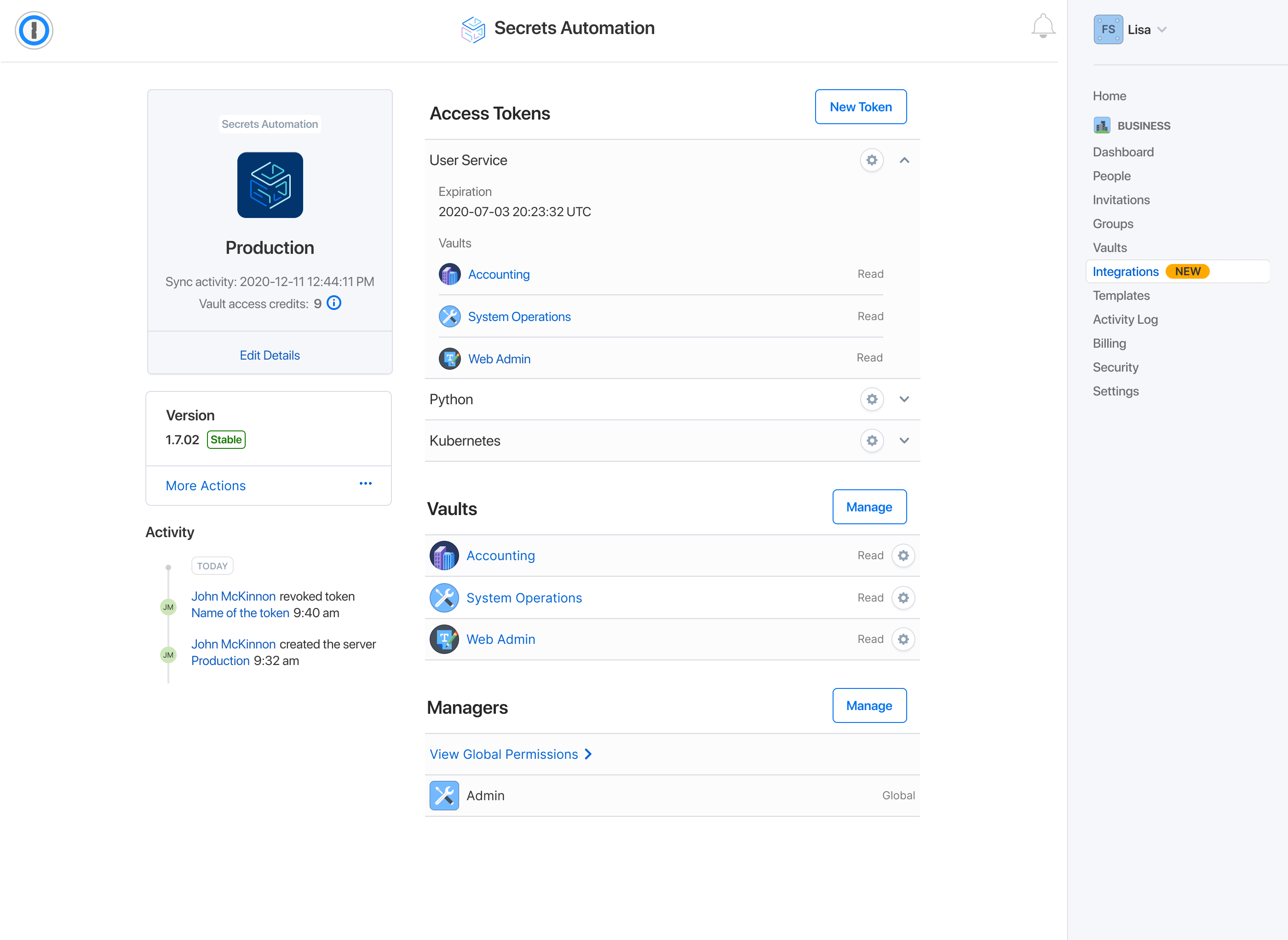
    1Password this week added a Secrets Automation platform to its offerings that enables IT organizations to more easily encrypt, manage and orchestrate credentials, application programming interface (API) tokens, keys and certificates.

    In addition, the company revealed it has acquired SecretHub, a provider of a separate secrets management tool. Terms of the acquisition were not disclosed.

    Carson Brown, senior product manager for 1Password, said the SecretHub team will now focus on the development of the 1Password Secrets Automation platform based on encryption technology previously created by 1Password.

    Finally, 1Password this week also announced an alliance with GitHub under which it will, at some future date, enable DevOps teams to employ SecretsHub to encrypt secrets used to access the source code repository. 1Password already provides integrations with HashiCorp Vault, Terraform, Kubernetes and Ansible, in addition to client libraries written in Go, Node and Python.

    The 1Password platform for managing and securing passwords is already in use by more than 80,000 businesses worldwide. The Secrets Automation platform now extends the reach of the company’s core encryption technology into the realm of DevSecOps best practices, said Brown.

    It’s still early in the cycle of DevSecOps best practices adoption, but it’s clear an initial focus will be secrets management. In the wake of recent high-profile breaches involving software supply chains, there’s now increased scrutiny of secrets management. Cybercriminals have become more adept at scanning for secrets left exposed as plain text. The challenge organizations face is that developers, while building applications, tend to copy secrets for the sake of convenience, which they often forget to delete after an application is deployed in a production environment.

    In response, many IT teams vacillate between overly restrictive and overly permissive access controls that are rarely implemented consistently.

    Of course, it’s now also only a matter of time before auditors start citing all those unencrypted secrets as compliance violations, Brown noted. A set of DevSecOps best practices based on automatic encryption of secrets eliminates those compliance concerns in a way that is transparent to application developers, noted Brown.

    It’s not immediately clear whether it will be DevOps teams that lead the charge to automate the encryption of secrets, or whether cybersecurity teams will take the lead. Regardless of which team assumes responsibility, the number of secrets that need to be tracked keeps expanding as the number of platforms employed increases. Manually keeping track of all those secrets is no longer feasible. Centralizing secrets management is the first step toward regaining control over an IT environment, said Brown.

    Secrets management may not always be the first thing that comes to mind when organizations begin their DevSecOps journey. As it turns out, however, securing secrets may very well turn out to be the first order of business as senior business and IT leaders review their entire software supply chain. After all, once it becomes apparent just how dependent organizations are on software, they quickly realize how much of their intellectual property is one compromised credential away from being stolen.

  • Is Open Source More Secure Than Closed Source?

    Is Open Source More Secure Than Closed Source?

    There’s no getting around the fact that security is one of the most essential factors in day-to-day operations for most software developers. From proprietary code to sensitive customer data and everything in between, there are hundreds – if not thousands – of crisis scenarios that can result from gaps in security.

    Data security is an issue that every company faces, no matter how large or small. Developers look for security solutions that follow today’s data and application security best practices in order to reduce risk and provide the most secure experience possible to the end user.

    A common debate among both users and developers is whether open source software is more or less secure than closed source alternatives. While there are a variety of different schools of thought as to what makes for a truly secure environment, there is good reason to believe that open source software is the superior option for those looking to prioritize security.

    While open source code may not be inherently more secure than its closed source brethren, here are a few reasons why it almost certainly can be — so long as you take the right approach.

    Open Source Offers True Transparency

    Both well-established tech giants and up-and-coming startups work with some of the brightest minds in the development community to bring valuable proprietary software products and services to market. At the end of the day, however, users have no choice but to trust what a vendor says about how a particular piece of software actually “works.” Since you can’t see the code itself, there’s no way to really verify whether or not what you’re being told – about features, functionality and security – is accurate.

    This can be problematic for a host of reasons—not least of which being the threat of potential security flaws. A company might boast about its commitment to user security and privacy through savvy public relations and product marketing efforts. But, by no means does this provide the user with anything more than lip service if the code doesn’t measure up; even if it’s rock-solid, the question of “How truly secure is this?” can never be answered with confidence.

    Open source software offers greater transparency to the teams that use it; visibility into both the code itself and how it is maintained. Giving organizations access to the source code allows them the opportunity to evaluate the security of the code for themselves. Additionally, users have more visibility into how and what changes are made to the code base, including the pre-release review process, how often dependencies are updated and how developers and organizations respond to security vulnerabilities.  As a result, open source software users have a more complete picture of the overall security of the software they’re using.

    Open Source Encourages Community Input

    Another major benefit is found in the communities which drive the growth and development of open source software. The vast majority of open source software is backed by communities of forward-thinking developers, many of whom use the same software they build and maintain as a primary means of communicating with team members. Open source developers and the communities around the software value users’ input to a significant degree, and many user suggestions end up getting incorporated into new versions. The community involvement and investment ultimately leads to many more responsible vulnerability disclosures than would likely occur if the software was closed source.

    When vulnerability reports do occur, they tend to be more detailed because the code is open source; often, they even come with code suggestions for how to remedy a given issue. This is incredibly helpful and can dramatically speed up patching the vulnerability, as it allows developers to move faster without spinning wheels and getting stuck in the diagnostic process.

    Faster Security Updates

    Within the framework of closed source software, users are at the mercy of the companies behind those products or services when it comes to receiving software updates―open source tends to be a different story. Fully open source projects even allow users and developers to take things into their own hands and contribute feedback and fixes, should they choose to do so.

    More often than not, updates and fixes for high-profile closed source applications involve a great deal of complex planning. If it’s not in the budget, for example, users may not see a new update for weeks, months, or even longer—security flaws or not.

    In most circumstances, open source tends to move faster than closed source when it comes to iterating and releasing new versions. This is true for a handful of reasons, including the fact that open source software tends to have more eyes on the source code at any given time, as well as a community-driven interest in bettering the product whenever possible. If a significant security flaw is uncovered, users may even choose to fix the code themselves, resulting in a level of control that can never be achieved in a closed source environment.

    Open Source Offers Flexibility, Collaboration and Enhanced Security

    An open source methodology, in and of itself, is no guarantee of security, but it does offer teams greater insight and control over the software they rely on. And as open core and source-available software are more broadly adopted, they offer a wealth of opportunities to build incredibly secure environments without sacrificing usability for end users or support from official maintainers.

  • 4 Ways SASE Fuels DevOps Productivity

    4 Ways SASE Fuels DevOps Productivity

    Many enterprises are adopting secure access service edge (SASE) solutions as part of their digital transformation efforts. SASE, in a nutshell, merges together SD-WAN and security stacks to deliver secure networking and improved WAN performance, making it a logical choice for cloud-enabled businesses going through the throes of digital transformation. However, SASE offers other benefits, which may be of particular interest to DevOps teams.

    Let’s take a look at four ways SASE can enhance the productivity of DevOps teams.

    Reducing Collaboration Challenges

    SASE reduces the challenges associated with team collaboration. SASE, by design, integrates WAN optimization with cybersecurity. Today’s DevOps teams need to work together, despite being physically separated, and must have reliable, secure connectivity amongst the team. “DevOps are all about time-to-market, and DevOps teams are looking for ways to shorten their  CI/CD cycles. A critical part of that process is reducing their dependency on the networking and the security teams,” said Boaz Avigad, director of product marketing, CATO Networks. “Since SASE solutions already provide optimized performance and robust security, DevOps [teams] are free from waiting for infrastructure teams to provision the necessary resources. SASE provides DevOps the control and operational cadence they need without compromising performance or security.”

    SASE Improves Networking

    SASE improves overall network performance with integrated load balancing and failover capabilities. DevOps teams cannot afford to lose connectivity, especially when rolling out new iterations of software or resolving bugs. “For DevOps teams, fast and reliable application performance is critical,” said Avigad. “SASE architectures free DevOps [teams] from worrying about the infrastructure by connecting all the company’s edges, data centers, mobile users and cloud resources, with the same self-healing, secure and fully optimized global network. Should a line fail or a route become congested, SASE automatically switches to an alternate path.”

    Better Security Built In

    SASE helps to secure DevOps projects with native cybersecurity capabilities. When properly implemented, SASE integrates numerous security technologies directly into the network stack. “DevOps teams worry about information interception and protecting their applications from threats. All security services share a single, unified context, improving insight and closing the gaps in legacy security architectures; gaps attackers often exploit,” said Avigad. “SASE not only includes NGFW, IPS, SWG, AV and MDR services, it also converges them together into a single-pass architecture.”

    SASE Removes DevSecOps Burdens

    SASE secures internal applications, along with the interactions with those applications, which in turn helps to reduce the burdens on DevSecOps team members. Applications that run over SASE/SD-WANs are further secured by zero-trust network access (ZTNA) and software-defined perimeter (SDP), technologies that help to keep all interactions between an endpoint and an application secure. “Many proprietary applications are too sensitive to run over the public internet. SASE protects those applications by obfuscating traffic, protecting all entry points with a NGFW and restricting access with its zero-trust architecture,” said Avigad. “All internal application traffic is also continuously inspected for threats.”

    Adopting SASE for DevOps teams is beginning to make a lot of sense. The technology addresses many of the pain points that DevOps teams experience as businesses drive toward digital transformation. What’s more, the security benefits offered bring forth additional productivity, while also unifying the security stack. 

  • Agile Divide Between IT and Business Is Narrowing

    Agile Divide Between IT and Business Is Narrowing

    A global survey of 1,350 business and IT executives conducted by Jigsaw Research on behalf of NTT Ltd., a provider of IT services, suggests organizations are a lot more agile in the wake of the COVID-19 pandemic, but there’s still a significant gap in terms of prioritizing agility.

    A full 89% of business and IT leaders agree COVID-19 has caused significant changes to their operating processes, with 87% also agreeing it has accelerated their digital transformation strategy. A third of respondents (33%) also noted they pivoted their technology focus to take advantage of a market opportunity or scale their operations.

    However, well over a third of operational executives identified speed and agility as a core component of technology strategy, while only just over half of IT executives agreed (53%).

    Overall, the survey found there is a consensus IT remains a key enabler of business efficiency. A total of 91.4% respondents agreed that enabling business efficiency is a key driver for their technology strategy, with 92% of IT respondents saying their overall technology strategy is aligned either fully or partially with the organization’s business strategy needs.

    However, there’s a significant divide in terms of the importance of IT’s role in driving business efficiency. A technology strategy that drives business efficiency opportunities is seen as being most crucial by 70% of operations teams, yet only 48% of IT teams said the same.

    Sanjay Lakhani, a principal consultant for NTT and head of the IT service management (ITSM) practice for the Americas region said that while the alignment between business operations and IT is not as close as it could be, a lot of improvement has been made. Prior to the COVID-19 pandemic, the divide between IT and the rest of the business was generally wider, noted Lakhani.

    Now that more organizations are realizing how dependent they are on software, there’s a lot more focus on application development with business units, he added. There’s also more pressure on IT operations teams, which are being asked to keep pace with the rate at which digital business transformation initiatives have accelerated, added Lakhani.

    Unfortunately, the survey also highlighted an emerging technology gap. The survey found 92% of business and IT leaders agreed emerging technology is crucial for their technology strategy, but only two-fifths (41%) believed they have the technology to meet their organization’s immediate objectives. Those result suggest a significant transition is underway, both in terms of how software is constructed and the type of IT infrastructure required.

    In the meantime, it remains to be seen to what degree the COVID-19 pandemic has fundamentally altered the DNA of IT operations teams, but it’s apparent enterprise IT will never be the same. Most IT teams have embraced, to varying degrees, agile application development methodologies along with DevOps best practices. The challenge now is aligning the operational cadence IT teams follow with that of the rest of the business in the wake of the pandemic.

  • What Amazon’s New CEO Means for IT’s Future

    What Amazon’s New CEO Means for IT’s Future

    Amazon is placing its bets on the future of cloud. The announcement that CEO Jeff Bezos will be stepping down and passing the torch to Amazon Web Services (AWS) leader Andy Jassy at the start of Q3 2021 signals a major shift in the future of technology – and not only for organizations specializing in IT, storage and web hosting. Rather, the growth of AWS signals a multi-industry-wide demand for cloud services as the new normal for conducting business – and those that continue to rely on legacy technologies could soon see their businesses falter in the shadows of competitors in the near future. However, every company’s individual systems are entirely unique, and modernization doesn’t happen with a one-size-fits-all approach. So why should organizations invest in new technologies – and how?

    Setting Sights on the Cloud

    The pandemic has made painfully clear the need for organizations to get away from their aging legacy systems and to embrace the cloud for a variety of reasons. First, COVID-19 has forced almost all businesses, across all industries, to embrace more distributed networks – requiring business-critical systems and functions to be accessed from countless different sources at any given moment. This can prove a major pain point for organizations with IT infrastructures that are prone to difficulties and outages. These shortcomings can have a detrimental impact on customers and citizens, as well. In light of major IT outages in states like New Jersey, California and Oregon, it’s clear that pursuing a more modern approach to IT systems is no longer just an option – it should be the only option. This is because, in addition to the benefits for users and enhanced business function, there are added benefits for the company itself and the world at large.

    Shifting systems away from data centers requires significantly less energy to power – and as data centers are responsible for as much greenhouse gas emissions as the airline industry, the environmental impact coupled with operational cost savings enable businesses to meet customer demands for greener practices while reducing overall operational costs. What’s more, this change to cloud services will allow for horizontal scalability within organizations, ensuring that businesses are able to meet demands for their offerings in real-time.

    The Sky is the Limit: Strategies for Improving IT Infrastructure

    If your organization is relying on a mainframe, it won’t be able to reap the many benefits that cloud infrastructure has to offer – and organizations that shy away from making these vital updates run the risk of running their business offline entirely. As a result, the time to act is now – but in the rush to get IT departments in order, it’s vital that organizations choose a modernization strategy that is best suited to their unique business. For most organizations, a modernization journey begins with one of the four following approaches:

    • System Replacement: Sometimes, organizations aim to expedite their modernization journeys by doing away with their aging legacy systems entirely. Through a system replacement, organizations purchase off-the-shelf solutions from third-party vendors and conduct business via the new software while their existing infrastructure and applications are taken out of service. While this approach enables a speedier shift toward the cloud, it should be noted that these solutions aren’t tailored to a specific company’s needs or functions, and that these solutions can be especially costly.
    • Rewriting: In an effort to retain key legacy knowledge while enabling better business function, some organizations pursue a rewrite of their existing systems within a more modern environment. Through this approach, a team of professional developers work to manually recreate the system and its applications – which often results in an extended timeline for modernization, exorbitant costs and an especially high risk of complete project failure.
    • Automated Refactoring: Through looping in a team of IT experts, this strategy enables an organization to migrate their legacy system’s procedural code bases into object-oriented languages within modern environments that are more appropriate for today’s business demands. Using specialized and automated tools designed for the project at hand, this modernization strategy ensures that an organization has a system designed for its unique business cases and an immediate pathway to the cloud.
    • Rehosting: To help companies maintain their legacy information, many organizations pursue rehosting as part of their modernization strategy. In this approach, a company’s existing legacy codebase is transferred away from their mainframe and their unchanged procedural code bases, data and other core functions into a new computing environment that is more suitable for current needs. This fast-paced process helps to set organizations on track toward the cloud as quickly as possible.

    Aiming for the Cloud(s)

    Amazon’s shift in leadership is a testament to the growth potential and overall importance of the cloud – not only for companies that manage web services, but for all industries around the world. However, by proactively taking the steps to move away from legacy systems and pursue a cloud-first approach to business, organizations will be better positioned to maintain their revenue streams, improve scalability, drive customer satisfaction, reduce operational costs and even protect themselves from potential disasters down the line. By setting and sticking to a set strategy and timeline for modernization, companies can ensure the success of their most mission-critical applications and functions to ensure their continued success and survival in a world or rapidly changing business demands.

    The sky is the limit – are you ready to aim for the cloud(s)?