Category: Blogs

  • Making Blockchain-Based App Dev More Accessible

    Making Blockchain-Based App Dev More Accessible

    Blockchain has many potential uses cases outside of cryptocurrency. Established sectors such as financial, automotive, supply chain, and mobility could soon move to adopt decentralized applications and distributed ledgers. The technology has even been hailed as the ideal foundation to maintain a connected economy once humans go interplanetary.

    Recently, spectators note a swelling interest in decentralized, peer-to-peer, autonomous development approaches. Eyeing the excitement around cryptocurrency and blockchain, many developers are eager to start experimenting with their own blockchain-based applications. This incoming disruption could remove the middle man and give power back to people, says blockchain and cryptocurrency entrepreneur Max Kordek.

    However, building your own blockchain from scratch is incredibly difficult. So, I recently met with Max Kordek, co-founder, Lisk, to understand how to make blockchain-based app development more accessible. According to Kordek, there are many benefits to creating your own blockchain, but simplifying the creation process will be necessary to empower new startups and enable this new paradigm to flourish.

    Potential Use Cases

    The decentralized, tamper-proof nature of blockchain has disruptive potential to remove central authority and give more data control to the collective hive. “For me, it’s all about removing the middle man,” said Kordek. “It gives power back to the people.” Cryptocurrency is obviously the most widespread use case; Bitcoin is proof that a blockchain-based system can see mass adoption. But there are many other use cases outside of cryptocurrency where similar record-keeping is important.

    For example, the automotive industry could link data across manufacturers or share data between vehicles. NFTs are using blockchain to represent one-of-a-kind digital art objects. The airline industry is looking to blockchain to synchronize partner ecosystems. Blockchain is also transforming online gaming by substantiating in-game value systems.

    From insurance to supply chains to transportation, most industries hold a potential blockchain use case. But blockchain isn’t constrained to only terrestrial scenarios. Information systems engineers foresee blockchain powering future in-space economies. With significant funding going toward asteroid mining and Mars missions, an interplanetary humanity seems inevitable. Compared to Bitcoin, “Ethereum is a better choice for the interplanetary economy,” said David Vandervort. Gathering transactions in blocks and pinging satellites could enable monetary transactions from planet to planet. “An interplanetary financial system would have to be built on blockchain technology,” Kordek said.

    There is ripe potential in countless areas. But who will be leading this shift? According to Kordek, we may see corporations augmenting existing structures with blockchain. However, established enterprises will find it challenging to unshackle themselves from legacy systems. Instead, new startups are more likely to have a bigger say in the blockchain revolution. “It’s much more realistic that an entirely new startup adopts blockchain and structures their entire business around blockchain,” said Kordek.

    The State of Blockchain Development

    After Bitcoin was established, other developers forked the project and changed parameters to introduce new cryptocurrencies, such as Litecoin and Dogecoin. Eventually, Ethereum came along, which was unique as it enabled developers to build apps with smart contracts. However, “the developer ecosystem was horrible at the beginning,” explained Kordek. “It was the wild west of development.” To this day, it’s still very complicated to develop on Ethereum, he added. Plus, since it is open source and immutable, it’s vulnerable to security threats. “It’s like the biggest bounty program in the world—if there’s one bug, contracts are drained.” Ethereum also has scalability issues — it can only run 30 transactions per second, equating to 1 million transactions per day.

    For these reasons, it may be better to build your own blockchain. However, doing so is a difficult task. From a research perspective, this requires a lot of theoretical knowledge, Kordek explained. Blockchain also introduces new maintenance concerns—since the infrastructure is always on, it is unstoppable, making patching a bug or pushing an update tenuous at best. If hundreds of millions of dollars are dependent upon a stable network, one mistake could have drastic repercussions. The high development and QA roadblocks make prototyping blockchain-based systems from scratch challenging. “Experimentation is essential to bring an industry forward,” said Kordek. “It’s important we simplify blockchain development so more experimentation can happen.”

    Open-Source SDKs Make Blockchain More Usable

    So, how do we make blockchain more accessible so that experimentation can occur? Well, a lot of progress has already been made via ready-made open source language-specific SDKs. For example, there’s Polkadot (Rust), Cosmos (Go) and Lisk (JavaScript). Kordek is an advocate for language-specific libraries that fit a team’s programming preferences. Out of these, he favors JavaScript, as it’s generally easier to learn and already supports many web-based interfaces.

    These projects are not about the smart contracts themselves; they’re about improving your own blockchain creation process. According to Kordek, going down this route grants more control in the early days. If something is broken, you can fix and push and update. If tokens are hacked, you could roll back and adjust things, he said.

    As companies get bigger and bigger, the technology could have a centralizing effect. “How can we somehow bring power back to people?” asks Kordek. Blockchain is one profound answer, empowering new entrants to alleviate problems across industries — it could even help us boldly go where no one has gone before.

  • Report: Lots of Room for Continuous Delivery Improvement

    Report: Lots of Room for Continuous Delivery Improvement

    A report published by the Continuous Delivery (CD) Foundation suggests that, in terms of achieving that goal, most organizations still have a long way to go. Based on analysis of the Developer Nation survey data collected by SlashData, nearly two-thirds of developers said it takes at least one week to go from code committed to code successfully running in production. Only one in 10 developers are deploying code in a production environment multiple times per day.

    On the plus side, half of developers reported that they restore service from an unplanned outage in less than a day.

    The survey identified the top programming languages being employed as shell scripting languages, Go/Golang, JavaScript, PHP, Scala, Dart, C#, Ruby, Python and Java.

    Surprisingly, the vertical industry furthest along in terms of achieving continuous delivery is the retail sector that has embraced digital business transformation, while the furthest behind is the telecommunications sector.

    Tracy Miranda, executive director for the CD Foundation, noted that even after more than 10 years of advocacy, DevOps adoption of CD best practices remains nascent. Many organizations have adopted so-called continuous integration/continuous delivery (CI/CD) platforms, but they are mainly used to drive a set of CI best processes. CD, in comparison, has proven to be a more elusive goal to achieve mainly because each platform on which an application is deployed tends to have unique attributes. Automating the delivery of applications across multiple platforms has, as a result, been difficult to achieve and maintain, she noted.

    Nevertheless, with the arrival of cloud-native container-based applications destined to be deployed on Kubernetes clusters that expose a consistent set of application programming interfaces (APIs), the prospects for more widely achieving CD are improving. Each platform that has a Kubernetes cluster running will expose the same API to a CD platform.

    In the short term, however, Miranda noted that many IT professionals are still somewhat intimated by both Kubernetes and CD best practices. Too many organizations still tend to think of CD as a platform to acquire rather than a set of processes and skills to be defined and nurtured, she added.

    One way or another, however, the CD challenge will need to be addressed as more organizations realize how dependent they are on software to deliver a differentiated customer experience. The rate at which that customer experience improves will determine the level of customer affinity that organizations will be able to attain and retain. That’s doesn’t mean every organization has to be as proficient as, for example, Netflix when it comes to implementing DevOps best practices, Miranda added. However, she said, it’s already apparent most organizations will need to improve how they deliver software to drive multiple digital business transformation initiatives. The opportunity lies in reviewing those processes now with an eye toward creating a culture squarely focused on continually improving the customer experience, she said.

    It may still be a while before most organizations truly master CD, but, as is the case with most journeys, the most important thing is to simply take that first big step.

  • Mark Your Calendars and Meet the Best in Tech at Cloud-Native Days with Kubernetes

    Mark Your Calendars and Meet the Best in Tech at Cloud-Native Days with Kubernetes

    After over a year of dreaded isolation, many of us are ready to return to the networking and social atmosphere of pre-COVID life. While physical proximity continues to be a struggle, virtual proximity through events like virtual summits and teleconference meetings, is getting increasingly more helpful amidst the transition.

    Here are the top 10 reasons why Cloud-Native Days with Kubernetes is a must-attend event:

    1. Cloud-Native Days with Kubernetes is a continuation of the virtual social interaction we’ve seen throughout the last year but offers attendees more than just a chance to talk with session leaders and speakers. 
    2. Sessions will be geared toward practitioners, managers and C-level executives, and led by industry thought leaders and doers in the cloud-native space, allowing attendees an opportunity to meet and network with experts in the cloud-native field. 
    3. At the end of this two day virtual summit, attendees will walk away with a better understanding of cloud native and its impact on the IT landscape.
    4. Cloud-Native Days is hardly short of talent with over 50 speakers holding featured, insight and spotlight sessions. 
    5. Attendees will have networking access to a variety of speakers through keynote sessions at Cloud-Native Days, but catching keynote speakers Tracy Miranda and Rosalind Radcliffe’s sessions will certainly be a highlight of the virtual summit. 
    6. Not only will attendees be able to network with speakers, by means of networking, attendees will have the opportunity to forge collaboration. Keynote speaker Tracy Miranda has some valuable words to share regarding projects born from collaboration. She says, “We had this idea that Continuous Delivery is bigger than just one project, and we should be working together to make things inter-operable and better for everybody. Then as we went around talking to people for that idea— when it resonated with other people— they really became fans, and they would be like, “How can we help? What can we do? This is how we build up on it.” So find that core set of folks who will be enthusiastic, and will get you through the honeymoon period.” 
    7. Learn from the best of the best in the cloud-native space. With cloud-native technologies becoming an integral part of IT environments, it’s incredibly valuable to learn from industry specialists changing the IT world as we know it. 
    8. Listen to the best of the best at Cloud-Native Days. It’s always important to listen. But when listening means driving ideas forward, opening your ears can be the most beneficial tool to be better than we were yesterday. 
    9. Get real-world insight into topics like: trends and best practices in the cloud-native space, addressing Kubernetes complexities, tackling cloud-native security from the onset, etc.
    10. Have fun while learning new things! Who says networking and learning can’t be fun? With so many exciting people, sessions and topics, attendees have a lot to look forward to at Cloud-Native Days with Kubernetes.

    Networking isn’t just about linking on LinkedIn anymore. Collaboration doesn’t come from a request, it comes from interaction, engagement and communication. Find all three and start collaborating at Cloud-Native Days with Kubernetes, Aug. 4 and 5 at 9 a.m. (ET). 

    Now mark your calendars and meet the best of the best in tech! Register today.

  • EP 13: Observability and Performance Testing

    EP 13: Observability and Performance Testing

    In this episode of DevOps Unbound, Alan Shimel is joined by Christine Yen of Honeycomb, Paul Bruce of Tricentis and Mitch Ashley from ASG/MediaOps to discuss how to effectively test the performance of your applications and how bringing observability into testing environments helps DevOps teams identify and resolve issues early in the SDLC. The video is below, followed by a transcript of the conversation.


    Alan Shimel: Hey, everyone. I’m Alan Shimel, CEO of MediaOps, Editor-in-chief of DevOps.com, Security Boulevard, Container Journal, and you’re watching DevOps Unbound. DevOps Unbound is a biweekly video series where we have some of the leading lights in our community talk about topics of interest around DevOps. We’re lucky enough to be sponsored, DevOps Unbound, by our friends at Tricentis, so many thanks to Tricentis for their sponsorships. But this is a media ops event.

    Let me introduce you to today’s panel and then we’re going to jump into our topic. Let me first introduce the guy with all the robots in his background there: Paul Bruce, with a 404 shirt. Paul, welcome. Why don’t you introduce yourself to our audience?

    Paul Bruce: Sure. Thanks, Alan. So, my name is Paul Bruce, as you said. I’m on the nerdy side. I’m a performance and reliability geek. That’s just a place of complexity that I love to – it’s just what – it’s just my bag; it’s just what I like to do. On the other side I’m a community organizer. I work with DevOpsDays Boston and the Boston DevOps Meetup. I am hosting an event along with Liz Fong-Jones this year called o11yfest around observability, a vendor-neutral and also – community-focused but also the open telemetry project-focused two-day event. It’s half days so that we don’t burn people out. And I work with the Tricentis team since the NeoLoad acquisition – again, performance reliability. I was with Neotys and NeoLoad for years now. I really loved that team. And I love my new one, the broader one at Tricentis. So, that’s me.

    Shimel: Very cool. Thanks, Paul. And then, joining Paul today is – we’re very lucky to have her – someone I’ve had the pleasure of interviewing more than several times now over this past year of Covid but hopefully soon to see in person, my friend Christine Yen. Christine is CEO of Honeycomb. Christine, welcome.

    Christine Yen: Hello. It’s wonderful to be here. Alan, you shared my title, but my background is as a product engineer. Honeycomb, for anyone who isn’t familiar, is a tool who – a tool for observability. And I love working on it and I love talking about this topic because even though I tend more towards the software engineering side I have done my fair share of breaking production, and so this topic is near and dear to my heart for software engineers to do that less and find out what their code really did more quickly.

    Shimel: Very cool. Thanks, Christine. It’s great to have you here. And then last but not least is my cohost of DevOps Unbound. We’ve worked together for probably longer than either of us want to admit, but it’s hard to believe we’re both only 25. But CTO here at MediaOps, CEO of the Accelerated Strategies Group, Mitch Ashley. Hey, Mitch. Welcome.

    Mitch Ashley: Thank you, Alan. But the best 25 – this year again. Twenty-five again, right?

    Shimel: Yeah, 25 again again.

    Ashley: Good to be here.

    Shimel: Anyway – yep. Thanks, Mitch. So, today’s show, really, we’re going to explore the intersection – or maybe it’s a border between performance, performance testing, and observability. What – how do they play with each other nicely? What is the interaction? What is the relationship? And for those in our audience, you may be looking at it and saying, “Well, observability is kind of almost post-deployment. Hopefully we’re doing some performance testing pre-deployment and then post-deployment.” But how – I don’t know if I see a nexus right away but there’s – in my mind anyway there’s an obvious nexus. There’s an obvious connection.

    So, let’s talk about it at a high level. How is observability and performance testing connected? And how can they – how can we get a one plus one equals five or four out of performance testing and observability? Christine, if it’s okay, I’m going to ask you to kick off with that and kind of lay out the framework, the ground rules, the – and we’ll all jump from there.

    Yen: Well, laying out the framework and ground rules is a little bit of a big ask for early in the morning, but I’ll do what I can.

    Shimel: Okay. I’m sure you’ll do great.

    Yen: I’m wearing the wrong shirt for this. I often – I think I’ve come on one of these interviews with my “test in production” shirt, but it’s a phrase that too many folks – it can be interpreted in many ways. What does testing in production mean? There is a version of it that means, well, I’m not going to run tests beforehand; I’m just going to see what breaks in production and try to fix it after it’s impacted users. Obviously, that’s not what any of us mean. And there’s a version of it that means, hey, look, when you write preproduction tests, when you write any sort of tests, what you’re trying to do is you’re trying to compare actuals versus expected. You’re trying to form a hypothesis, observe reality, and then think about that difference. Isn’t that really just a different phrasing of what we’re trying to do when we’re looking at production, where we’re using our logging or monitoring or observability tools to see what actually happened when our code is in production?

    And so, I love – I think it’s a huge intersection, a huge overlap between things like performance testing and observability because we are all using the same skill set, we’re all using the same brain sequence, but there’s – people seem to think that observability is – can be more exciting because it’s incidents and downtime and alarms are going off. I don’t think it is. I think it’s all the same. It’s just at different points in the development life cycle. It’s on different timelines. It’s with a different level of urgency. But it’s the same thing we’re all just trying to do to come up with hypotheses, validate them, and learn.

    Ashley: I really like, Christine, the way you kind of intersected them together because the environment that we’re doing all of this has changed substantially. It wasn’t that long ago where it was kind of a static flow of writing codes, we’d test it, we’d CI/CD, we’d test it, we’d deploy it into production. And DevOps helped speed that up with automation and tools, and of course tools of automation for testing. But now the software stack is fluid. The infrastructure is fluid. The code is fluid because we may have introduced three new changes to containers, for example, in a cloud-native application since we’ve really had an opportunity to go and debug or determine what the source of that was. We also have dynamic applications that start up and go away, and those things may be long gone by the time we actually look at them. So, I think this key to observability is also giving you insight into an environment that may not exist at the time that happened, and so you need that information to be able to understand “This is really something I need to fix, address” – a bug, a feature, whatever it might be.

    Bruce: Yeah, and I think there’s a lot of intersection between putting pressure on systems, whether that’s through actual users and risking revenues and all sorts of things or doing prerelease type testing or testing in production. There’s a – performance is about how does this system perform to expectations? And there are a number of different people with a number of different expectations. There’s the technical expectation, maybe articulated – hopefully articulated in something as legitimate as an SLO or an – and then measuring them with SLIs and stuff. But there’s also user expectation. There’s the CEO expectation. There’s B2B. If you’re in some kind of regulated industry and that SLA is actually part of a legal requirement that becomes really important. Like, we saw that unemployment sites – I don’t mean to pick on that kind of work, but that was a mess. Same thing with various different – trying to get the vaccines scheduled and stuff. And it’s like why are we still suffering from these systems that are out there and they’re good enough maybe for the day to day but have never been exercised, have never been – the concept of that being – that scaling has never really come about for that system.

    Okay, well, what about systems that do by default have scalability as a first class citizen? Going back to some of the stuff that Christine said – and actually, Christine, I love – your cofounder Charity has a phrase and I’m going to butcher it, but “It’s never not a good idea to have your glasses on when you go driving.” That idea that if you can’t see what’s going on that’s a big problem.

    So, a lot of people traditionally would have used something like “Let’s just throw all our APM tools at production.” And that’s great. But going back to that original thing where I was saying pressure on systems really shows us how well we’re doing engineering, the impact of that pressure matters too. So, as a performance engineer, performance and reliability engineer, I’m constantly not just trying to – as my French team would say – make load on a system, put load, put pressure on a system, but I also care deeply about being able to measure the impact of that.

    I’ll pause there because we probably some other questions. But there’s more to go into about that. It’s not an either-or. And it’s not about just production or preproduction. It’s about what’s not a good idea to have visibility. Isn’t it a good idea to have visibility on a thing, whether it’s putting pressure before release and having visibility or doing that in production? We’ve got a lot of customers who do testing – who do load testing in production on production systems. This is not an impossible thing, folks, you know?

    Shimel: So, let me try to put this in some kind of context that we can jump on. So, here’s what I say Christine saying, which is – and maybe I’m taking it up a couple notches, getting out of the SLO woods – at the end of the day what do we all want? We all want our apps, our infrastructure to run better. We want to have good predictability, visibility into how things are performing. And whether that is an aspect of performance testing, or you want to call it performance monitoring, or do you want to call it observability, at the end of the day the aim is the same, which is let’s understand how our stuff is running and make sure it’s running the way we think it should be running. So, at a very high level it’s almost equating performance or observability – I mean, it’s all with the same goal, which is let’s make sure our stuff’s running good, as the best we can.

    In my mind – and Christine, I’ll defer to you – certainly over the last year, year and a half, maybe two even, observability has taken on – as it’s become more hyped and a real word, a real thing out there, has taken on almost an even bigger mission than that, where it just doesn’t equate with – the goal may be “Hey, let’s make sure things are running the best we can make them run and how we expect them to run,” but there – observability has a whole uber mission of things that people want to do with it or use it for. Paul, you mentioned APM. Kind of observability subsumed APM, AI ops, all of these things. But yet, wait, there’s more. Observability does more than that. It’s become this whole big thing out there. And maybe it – maybe that’s right, maybe that’s wrong. I’m not here to judge.

    But that, I think, is really the crux of this. Yeah, we all have the same goals. Is observability – part of what observability does helping the performance engineer? Absolutely. Is there more to observability? I think so. Christine, you’re the observability expert. I’m going to ask you.

    Yen: You know when you say a word enough times and it starts to lose its meaning and you’re like “This is starting to sound funny”?

    Shimel: Yeah.

    Yen: We – I think you’re – there’s – we are definitely approaching that with observability a little bit. And whenever I get to that point I like to pause and remind folks “Let’s look at the – let’s take a deep breath and look at the English word we are using to describe this. It’s not a bucket full of buzzwords. It’s not a bucket full of types of data. It is an ability to see. And it’s the ability to see into our production systems. What do you want to do with that? What can you do with that if you have an improved ability to see?”

    Okay, well, now we have the laundry list of all the things that we can do once we have the ability to see into these systems that, as Mitchell mentioned, are so different than they were five or ten years ago.

    Shimel: Oh, yeah.

    Yen: And that to me is – that zooming out behavior is what re-centers me when it feels like we’re trying to do all the things. And you’re like “Well, it kind of makes sense. I want to have my glasses on when I’m driving.”

    Shimel: Yeah. Paul?

    Bruce: Christine, you’re definitely right about a buzzword merry-go-round. I have experienced that with “DevOps.” I have experienced that with – oh, man, I can’t believe I’m saying it again but I’ve got to because people will know – “shift left.” These terms that just get all the things. And we go at these things, these different terms, we latch onto them, we try to make it our own. Oh, man, vendors love to do that. We’ll take a word and we’ll make it ours and we’ll try to align it to our product strategy. And at the end of the day it’s like there’s 150,000 different versions of this thing, which as a performance guy I’m kind of like “Well, it’s not bad to have a big sample set,” but the sample set of what’s going on in the delivery chain from good idea to working software that’s making you money is not just in production.

    Let’s take an example of Nike, for instance. This is a known thing that they ship the watch, the watch that you open up on Christmas Day, and you go to connect to the internet and because the servers were swamped you don’t have a good Christmas experience. That’s not the only – I’m just picking on… But that kind of situation is a situation where there’s a lot of stuff you can do to prevent obvious faults from getting to the point where that’s the bad experience. And you also need visibility on the day where your production is having problems. And it’s not just the day; it’s every day. Every day you have a certain un-zero amount of events and issues in your production systems. How do you address those things? Well, there are plenty of situations where if you’re only thinking about observability as it only applies to production – which, by the way, production is where – what makes you money. If code is not sitting in production doing something useful for people you are not making money off of it necessarily. And production isn’t just out for consumers. It could be all the different constituents in your larger organization. So, even private systems are production. And so, if something is not out there then it’s not making money.

    So, is that the only place where we should pay attention, where we should have good visibility on logs, traces, and metrics, on understanding how the business is impacted, long and complicated queues and delays in these systems? No. I mean, yes, in our edge and final production systems, yes, of course we will want that because we don’t want to be in a bad situation not having the right visibility into problems when they’re happening in production. But how do you think problems come about in production? Well, there’s the emergent ones that we can’t possibly know about. Ooh, there’s just so much time in the day. But then there’s a whole bunch of other stuff. Every line of code is not just an asset; it’s a liability. So, as you’re constantly shipping these things out there’s plenty of things you can do to prevent obvious – and I mean dumb and stupid and obvious things from getting out there, causing toil, waste, risk, and loss of brand, revenue, and all that stuff.

    So, I think the observability for me is not just in production. It’s really useful to have classic monitoring in preproduction environments except for that it’s super expensive. Oops. And then, observability, pieces of observability, which Christine would probably be better to go into, all those things that you can do and what you get out of that, and now we can have use cases, that also applies to preproduction situations. That’s why I’m so excited about that open telemetry project and the community over there, this notion of being able to emit information from your systems, to either build it in directly from your systems or put it on sort of after the fact, sort of replacing some of the obvious early agent type stuff that monitoring used to be the only thing that could do. That open telemetry stuff now makes it a standard that we can all benefit from no matter which environment. How about all environments? That would be super nice. And to get tracing and traceability from – all the way from the Web app that somebody is touching all the way down to the database and the 30 different APIs that it touches.

    That’s really useful, not only to firefight in production but to see “Am I risking dependencies? Am I go wildly off my architecture diagrams?” You know what I mean? Those things slide. Your conceived architecture diagram is never what’s actually running in production. So, to actually be able to have visibility on that is really important.

    Ashley: Well, you know, Paul, the lines between production and, let’s say, tests are blurred, to use a phrase – are really kind of blurred, and oftentimes when we adopt whatever new technologies or approaches we’ll attempt to do what we used to do just using a new technology to do it. So, we’ll test the way we used to. And just what sort of clicked with me with cloud early on was how Netflix was doing their rolling upgrades and being able to flip back and forth. The same is really true for testing and performance testing because your availability to resources generally is not an issue, or not the issue it would be normally in an environment where you’re not in the cloud or at least partially in the cloud. So, there’s a lot of things you can do not just in your current testing environment but to set a pretty elaborate – with resources to do different load tests, performance test scenarios, in addition to what you experience in production.

    And I think one of the points that you made is salient, is if you’re paying attention to this you now understand your systems, your applications, your environment enough to identify “Well, we may be able to handle the number of unemployment claims we’re getting today but I know when we reach the next peak these are the three things it’s going to impact. I know those are the things we have to go adjust or fix or whatever it might be.” Because you’ve already instrumented it well enough and you have the information through observability to be able to do that. So, I think that’s a different mindset of how we think about performance testing.

    Shimel: Yeah. So, I tell you, I think one of the big breakthroughs of DevOps has been to create our “testing environments” to be more lifelike, to be more real lifelike. I mean, because prior to DevOps, the world I grew up in, the classic thing is the developer developed, gave it to the ops guy, the ops guy puts it up and says, “Wait a second, this stuff don’t run.” And he says, “Hey, developer, this doesn’t run.” And the developer says, “I don’t know, dude. It ran on my machine.” And so, there was that disconnect between what the developer wrote and ran it on or they tested it on versus the real life production environment. And one of the great things about cloud and virtualization and all of this stuff is that we can theoretically really duplicate our production environments and test environments and we can increase loads and we can do all those things theoretically so that there’s no or less surprises when we go live in production. And that – look, that’s – thank you, DevOps. That’s part of what this whole DevOps thing, I think, was.

    But I don’t know, is – Christine, is that really – does that dog hunt or is that just DevOps urban myth? You know?

    Yen: I think you’re on – right on the ball. I mean, when Charity and I started Honeycomb she came right – that story you told, I was that dev; she was that ops. I did the whole “It works on my machine; I don’t know what you’re talking about.” And when we started Honeycomb we thought honestly we were going to be talking to more of the Charities of the world. We were like “Oh, this is a tool for ops people. They’re the ones who understand the pain.” And as Honeycomb grew and as observability grew it became more and more obvious: “No, this is for the Christines of the world too.” This is for the people who need to understand what happens beyond that testing environment. This is – the boundaries are blurring or – I like to think of it as dev and production are coming closer together because there are more and more things we just can’t test in a test environment. As good as we make the test environment, we just can’t.

    Shimel: I totally agree.

    Yen: And there are so many things that can be learned – the same – by thinking of production as part of the development environment. With feature flags we can start to take code that is really not quite ready for production but test it out in a safe way and learn from it. And that’s so cool. It’s – there’s so much for developers to be able to learn when everyone kind of gets over this mindset of “Well, there’s a wall between development and production.” There isn’t. There shouldn’t be between people or the software. And that’s where all the exciting parts live.

    Shimel: I don’t disagree. I don’t disagree.

    Bruce: So, Alan, one thing that you said – you painted sort of the stage so that we could have part of this conversation. I’m not a big fan of setting up huge staging environments. In classic world it was like, okay, well, here’s production and it uses 36 Oracle back-ends and – if we were going to run a proper performance test of course we needed 36 on our side. And before the cloud that was incredibly expensive and you’d fax your IT person and they’d get back six months later with the right hardware. And I think there’s a myth that, well, yeah, you need to be realistic at some point, especially when you’re putting pressure on a system, to answer the final question, which is – what? – is it ready enough for me to be – what? – confident enough that this thing is going to transition like we talk about in standards, the transition process, that that’s actually going to go smoothly? And not in a waterfall way, just in a – to get away from this notion of “It worked on my machine” and now the ops person is putting out fires and doesn’t know how to operate the thing.

    But I’m not a big fan on spending a ton of money on this staging system which ultimately even if – even if at a very root level it’s exactly the same as the production system there’s always that jerk in the corner going “Yeah, but it’s not production.” And it’s like “Okay, you have a point but you don’t know what goes on.” And the point is I think almost like a – I’m going to do my idiot thing and pull in a mathematical and then probably get it wrong, a mathematical concept of the limit. You remember limits? And the idea is we need to be able to express are we talking about the very ends of things? No, it’s a continuum.

    So, there’s a lot of companies that I work with that actually do have requirements, that they go through a particular amount of testing and particular things before they can transition this to production. They don’t have the luxury of treating production like a dev system. There is a ton of people in the world, and it’s not their dysfunction – that’s not a dysfunction, just because the unicorns can fart rainbows and sneeze glitter and launch whatever they want. I see that happening in Boston all the time in some of the startups, and they do actually put themselves at risk. And even when you don’t do that, when you have an extreme amount of maturity and you’re working with relatively complicated technologies like Kafka things can go wrong pretty quickly. And the question is do you have the people and the process and the technology and the knowledge and the experience and the expertise to handle those when those things do come up in real time?

    How do you get there? How do you get to people who know how to use your monitoring and observability tools really effectively? How do you know what those systems, how close to your perceived architecture versus your actual in production, how do you know how much delta there is there? How often do you exercise the process of disaster recovery is one of those other classic questions you might ask yourself.

    And it gets back to who would be involved when there is a firefight or a last-minute thing like what we’ve done with some of the companies that I worked with very closely through the NeoLoad side of things, is when the education system, when colleges shut down and they finally said, “We are shutting our doors to the people that are paying us money,” that was a scary and real and significant flag for the rest of our US education system to go “Holy crap. We’re going – we have to provide virtual not as a stopgap for the past few months but this is going to be a serious reality for us for the next year.”

    And so, a lot of the vendors that help the education system have the right platforms in place. They go “Holy crap. We really need to test for 10X the size that we’ve ever tested before.” So, they’re testing in production on nights and weekends in various different places and doing it at a smaller pace. But who do they have on the call? Not just the Ghostbusters, but the devs, the ops. There’s people from infrastructure, the DBA teams. They have 20-plus people white-knuckled on the call, like [makes quivering sound] – white-knuckled on the call, and that’s a lot of money. And by the way, you’re asking them to do from 10:00 PM to 2:00 AM to 3:00 AM work. And so, they’re not going to be available for all those fancy meetings, architecture meetings that they should be stakeholders at.

    So, when you get to the point where you’re doing those massive things sometimes it’s necessary to go massive. But the vast majority of the exercises, you go to the gym – not so much me, but you go to the gym to exercise. You go and you get on your bike and that’s an exercise. You don’t expect to run a race without exercising first, without knowing that path a little bit before you just run a 5K race. So, why would you expect to do that with your systems and your teams?

    And that’s where some of the testing, the lower order performance testing comes into play. It’s systematizing the stuff, making a process that can be executed and re-executed no matter which environment it’s pointing to. And the telemetry that you’re getting out of it aligns in each of those environments. If all of a sudden we have really great telemetry in a pre-prod environment but we don’t have it in prod that would be a big problem. Why was it put in here and it’s not represented in production? What if we need that? Or vice-versa: We’re only doing things in production, and so now there’s only – there’s stuff that’s only in production that has no representation of how it would show up in lower environments.

    So, keeping those things in synchronous but also keeping the process and the exercised skills in place is why this isn’t just a big environment at the end kind of a situation.

    Shimel: Again, I think “Thank you, DevOps” where we have been able to say, okay, not only do we need those or can we use those testing dev environments, but as Christine said, with things like feature flags and some of the other technologies, processes that we use, it is possible to continue that – the feedback loops and iterations in real time while using the – while in production. And that again is one of the things that allows us to continually update, continually iterate, continually – and feedback loops was kind of an original concept as part of this DevOps thing. We’re going to have those feedback loops and we’re going to iterate and reiterate.

    But where we’ve gone with observability with that and with performance testing and these things with that have really just opened the floodgates in how we do these things now. I mean, just think about how – when I first started DevOps.com eight years ago, I mean, there were the unicorns who were updating multiple times a day. But for many people in the world, for many organizations in the world, look, moving from once a year to twice a year, twice a year to quarterly, quarterly to monthly was huge. It was huge. It’s not so huge anymore. It’s common for people to be updating their code daily or more than once a day now.

    I saw – I did an interview this week, a recent survey of developers who they claim that they have sped up their deployments by over 100 percent in the last year and a half. That was – something like 70 percent of developers said that. Think about it. I mean, that’s – a billion here, a billion there, you’re talking real money. Seventy percent of developers say they’re going 100 percent faster. Wow. Wow. What a golden great time to be living. And it’s because of things like observability, DevOps, our better performance testing. Anyway.

    Guys, we’re coming up on our time limit here. I wanted to kind of – let’s wrap it up. Let’s – what advice – for our folks listening in, watching in here, what can we give them? What can we tell them about this nexus of observability and performance that will make their life better? Paul, I’m going to – if you don’t mind, I’m going to put you on the hot seat and ask you to go first.

    Bruce: Sure. Well, there’s a couple things I’ve been working on for a while and then there’s a couple things that I just want to give a shout out to. I’ll start with – Christine doesn’t get to do the pitch thing but I do. Honeycomb is awesome. You see that thing in play and it’s awesome because the team behind it is awesome. You know what I mean? It’s kind of the Conway’s law situation where – the version of it I hear most is the systems are a result of the teams that build them. So, definitely check that out.

    Same thing with some of the other tools around there. But don’t get too bought up into the whole observability – don’t just Google “observability” and look at the first one because most people are paying through the nose for SEO placement there. Really actually look at what’s available, and then also dig into the team, the blog, the spirit behind that thing.

    The second thing I’d suggest is we just released – I was one of the members of a working group for a standard on DevOps principles and practices that applies to highly regulated industries. It’s IEEE 2675-2021, which we’re hoping to get adopted in ISO so it’s global as well. And what it does is really align what is – how are each of the important processes that can be applied continuously through many different life cycles as they’re going along? You know, that DevOps eternity symbol means we’re all going to be stuck in hell forever, that thing is happening, all the things are happening all the time but there are precise things that need to go on in highly regulated industries, and even not. So, we’ve been working on that for four years. And you can reach out to me on LinkedIn, on Twitter – although LinkedIn is probably a better way to go – if you want to know more about that.

    But essentially it’s a body of work that a lot of people have been putting time and effort into to really say, “Hey, look, this is not about what DevOps is. This is about how to do this in these complicated situations.” And you know me; as a performance geek I tried to – I was involved in QM/QA, verification, validation, risk management process, those kind of things. And I tried to make sure that evidence-based decisions, that – which is a hook to basically say visibility, telemetry, the proper SLOs in place, those are definitely in the standard along with other things.

    So, definitely check those two things out: Honeycomb and the IEEE 2675.

    Shimel: Excellent, Paul. Christine.

    Yen: Thank you for that plug, Paul. The one piece of advice I’d like folks to internalize, we’ve talked quite a bit about – or, I’ve talked a bit about developers in production and developers in observability. An asterisk there is that that is not – the practice – the muscles and the practices should transfer well but there are a lot of things in the DevOps world in production that are, well, in some cases outright hostile to developers and in many cases just kind of scary and unfamiliar. And so, if this is something that’s interesting to you, if you’re like “Ah, yes, I would also like to bring development and production closer together,” take a step back and look for things like that. Do your production tools primarily talk about AWS instances and CPU and memory use? Those may be things that might scare your developers off. How can you make the vocabulary that your production tools talk about more familiar to developers? How can you help them bring the concepts and nouns that they’re used to in testing – customer ID or endpoint or logic, something that feels more familiar to the developer world, how can you have that exist in your production tooling as well so that developers can show up and be like “Oh – oh, this isn’t so different”?

    I think that there’s a lot of things that are encoded in certain practices because we assume that a certain persona is the one using them. And those walls are blurring – or those walls are coming down; those edges are blurring. There’s a little bit of work left to do to facilitate it.

    Shimel: Absolutely. Hey, Mitchell, you want to bring it home?

    Ashley: Yeah, I’m going to wrap it up this way because there’s some great practical advice – and by the way, both companies have fantastic products, so please check them out. I think we have this mental model, this habit of thinking of things in one state. Matter has four states – well, five states if you count Higgs boson – Bose higgson. It’s not just solid. It is also fluid. I mean, think of our systems. Don’t think of it as software tools, all the layers of it. Combined together they operate more like a fluid, in a state that’s changing, constantly moving. Things are happening. And that causes you to rethink developers and production, doing production – doing performance testing in a production environment. And the flow of software through that DevOps tool chain is really part of that – the fluidity of that state.

    So, I think we like to think things – of things like “Let’s make everything a solid so it doesn’t change, so we can look at it, observe it, do something with it.” It’s not really that way. That’s not the world we live in today. But if you think about it as something that’s under constant change like a fluid, then I think we have a much better chance of figuring out better ways, whether it’s through technology, new paradigms, new ways of working, of how to make our software the best it can absolutely be.

    Shimel: And at the end of the day that’s what we all strive for. Right?

    All right. What a great way to end this, then. This is a wrap. I think it’s episode 13 of DevOps Unbound. But it’s a wrap on whatever number this was because it’s fluid anyway. It’s a wrap on this episode of DevOps Unbound. Many thanks to Tricentis for sponsoring us on DevOps Unbound. We will be back in two weeks with another great episode. Stay tuned. We also have a big roundtable coming up this month; check that out.

    Paul, hey man, congratulations on joining the Tricentis team as part of the acquisition there.

    Bruce: Thank you.

    Shimel: Christine, they’ve all said great things about Honeycomb, but well deserved. Say hello to Charity for us as well.

    Yen: I will. Thank you.

    Shimel: Keep doing what you’re doing. I hope to see you all soon or a couple months from now in person. Maybe we will do a live DevOps Unbound at some time somewhere. But until then, this is Alan Shimel for MediaOps. You’ve just watched DevOps Unbound.

    [End of Audio]

  • How to Build an Options-Based Observability Strategy

    How to Build an Options-Based Observability Strategy

    The global pandemic forced companies to accelerate their digital transformations, pushing them toward new technologies and architectures as they struggled to adapt to a changing world. Companies wanted fast development and deployment and were happy to trade off efficiency, reliability and sometimes, security, to pursue their goals. Now that the pandemic is receding in many parts of the world, the priorities are rebalancing as companies grapple with choices they made under fire.

    Observability has emerged as a way for enterprises to better understand sprawling infrastructure and application environments. According to Gartner, “Observability enables organizations to reduce the time it takes to identify the root cause of performance-impacting problems. In particular, and in contrast to traditional monitoring, operators can freely interrogate data post-hoc without the need to pre-program dashboards.”

    This sounds promising and the market responded quickly, but predictably. Large and monolithic monitoring platforms embraced the term and added new features, making them even larger and more monolithic. These monolithic platforms represent a failed choice-based strategy. They assume that all observability data is collected, centralized, integrated and only analyzed by a single tool. Enterprises following a choice-based observability strategy find themselves locked-in to multi-year investments without the flexibility to react to evolving technologies.

    While this has been good for vendors in the incumbent monitoring space, end users haven’t benefited from these enormous platform deployments because the choice-based strategy is built on the faulty assumption that a single pane of glass serves all of your monitoring and observability audiences, from SREs to DevOps and SecOps.

    A choice-based strategy also forces customers into limited options in the future as technology continues to evolve and requirements change. Defaulting to choice-based strategies also leaves little leverage for contract negotiations, data integrations and data access.

    Infrastructure and operations teams need to take a different approach to their observability strategy. Instead of focusing on buying products and making choices, teams need to shift their thinking to creating options. The choices you make today limit your options tomorrow. Tomorrow is unpredictable and uncertain. Taking an options-based approach allows you to be flexible and adaptable today and into the future.

    An options-based observability strategy is built on three pillars:

    • Establishing your observability strategy principles
    • Building composable environments
    • Staging your commitments

    Let’s look at each of these.

    Establish the Principles of Your Observability Strategy

    When asked about their observability strategy, many often leap into detailed plans covering every imaginable use case. They talk about the current state of their infrastructure and how things will be at the end of three or five years, including the skills and functions they’ll need in that time. If you’ve read the above, you’ll recognize this as a choice-based strategy: All the choices they need to make over the next several years are already laid out. This leaves little room for adaptation and options as the world evolves around you.

    Instead, think of your observability strategy as a single principle, or a collection of principles, guiding your observability strategy. Let’s say your core principle is that observability is a key enabler of operational efficiency across SREs and DevOps. We can build on that operational efficiency principle to define what key elements of our strategy has to include:

    • Data sources have utility-like accessibility; always on and available across tools.
    • Metrics are primarily driven by total cost of ownership and optimization.
    • Governance is centralized to the team distributing data to downstream systems.

    These elements are different if your core principle is something like customer intimacy or risk management.

    With principles and strategy in hand, we can focus on the next phase: Composing the observability environment.

    Compose your observability environment

    In an options-based strategy, the key success factor is avoiding large ecosystems that limit flexibility. Many vendors take a “give us everything” approach to observability. These approaches appear to start and end at the destination platform, but they begin even earlier, at data origination. It’s common to see agents only sending data to one destination, limiting the usefulness of the data by locking it into a silo.

    Staying modular means selecting tooling that abstracts the data sources from destinations and puts the power back into your hands. By using an abstraction like an observability pipeline, you can send data from one source to multiple destinations, while managing that data in any way you see fit. For example, this is where your centralized governance can occur.

    When new tools are introduced, upgraded or deprecated, an observability pipeline insulates the rest of your environment and users from those changes. A modular approach also gives you more power in contract negotiations with your other vendors because you’re less reliant on one vendor for all of your observability needs.

    Stage Your Commitments

    A choice-based observability strategy is a large commitment, often taking years. Once you start, stopping becomes impossible. That’s simply unacceptable in today’s environment of uncertainty. Choice-based strategies limit your ability to test, experiment, and learn. At the same time, our infrastructure is critical and it must be reliable.

    An options-preserving approach may involve experimenting with freemium products; only paying once the product’s value has been proven. Cloud-based options are another consideration since they are commonly subscription-based and offer easy try-before-you-buy purchasing styles. Even better, cloud-based options don’t require using your own infrastructure to test new options.

    Every IT team feels the need to react and respond to demands from the business. That urgency to make choices, to solve the immediate problem, can have long-term implications for future flexibility and agility. By structuring your observability strategy around a long-term vision based on preserving options, your team can remain adaptable as technologies and business requirements evolve.

  • Multi-Cloud Is Not About Lift and Shift

    Multi-Cloud Is Not About Lift and Shift

    Multi-cloud is often framed from the perspective of “lift and shift.” In other words, an organization takes a computing environment previously running on one cloud and transfers it over to a different service provider. Cloud migration may make sense for cost savings or performance benefits and such a shift may be necessary when migrating on-premises data centers to a public cloud.

    In theory, lift and shift sounds like it would empower cloud consumers with more choice in the marketplace. However, according to John Gentry, CTO of Virtana, lift and shift is quite rare in practice; it may not be the true driver behind multi-cloud strategies. Moving resources between clouds can result in costly egress fees. Plus, culturally-ingrained cloud preferences become challenging to shake. Unique configurations and add-on software-as-a-service (SaaS) make each cloud more nuanced, requiring new skills and procedures with every migration.

    Instead, Gentry advocates for a “fit-for-purpose cloud” strategy. This attitude is less about moving similar workloads between clouds but, instead, pairing particular types of workloads with the appropriate cloud types. According to Gentry, using multiple clouds simultaneously could still help organizations strategically align their digital resources and reduce dependency on a single cloud service provider (CSP). But, the real value of a hybrid multi-cloud setup lies in matching computing environments to different business layers.

    Fit-For-Purpose Cloud

    At first glance, the ability to move between clouds appears to be driving a new multi-cloud economy where cloud strategists can swiftly migrate resources and optimize intercloud utilization. However, when organizations attempt to shift, they usually experience many hidden costs, Gentry warned. These often pop up around data egress. Or, new data storage costs may take a surprising toll, Gentry added. “A lot of companies look at it from a computing perspective and they don’t account for the storage footprint.”

    DevOps in the cloud also introduces new responsibilities and processes that may differ between clouds, continued Gentry. From unique storage operations to managing the life cycle of a virtual machine, each cloud carries unique configuration methods. This makes it more difficult to abandon established procedures in favor of a different computing arrangement.

    Nevertheless, Gentry recognizes that we’re starting to see a maturing effect of the multi-cloud concept, especially among large enterprises. “Companies have a multi-cloud strategy—it’s less about moving between clouds than about picking a cloud that has specific advantages for a given workload,” he said. In a fit-for-purpose cloud approach, different workloads correspond to different layers of the business. For example, an organization may require a local data center or private cloud for high-security data. Certain applications may benefit from a distributed global public cloud, whereas other workloads could reap performance benefits and cost savings from a cloud-adjacent edge model. “These specific areas may not have anything to do with one another other than supporting the overall business,” explained Gentry.

    Matching Cloud Types to Business Units

    So how do we match the workload at hand to the ideal computing arrangement? Gentry identified three emerging cloud types:

    • Private cloud: A private core for particular functions that can’t be replatformed or rearchitected. Business areas such as financial records or patient care hold sensitive data that must be stored properly to meet regulations and SLAs.
    • Public cloud: End customer-facing, where sensitive data is not an issue. Public distributed cloud is ideal for delivering a highly available front end for customer-facing digital experiences.
    • Cloud adjacent/edge: When an environment is kept in a cloud adjacent facility with relatively local geographies. This may sit alongside the public cloud or connect to a front end in a cloud.

    For example, Gentry described how a large health care company uses a hybrid multi-cloud setup to support various business divisions. The organization is keeping traditional patient care workloads exclusively on-premises; due to regulatory reasons, it will never see the inside of a cloud. Yet, they are simultaneously building the next generation of applications in a public cloud, using Google Cloud to scale a clinical trial division. Simultaneously they began using Microsoft Azure for their back office. This scenario highlights one peculiar advantage of late-stage cloud adoption, noted Gentry: “They had the advantage of being able to take a more thoughtful approach.”

    Gentry described another case of an organization performing genomic sequencing. For data-heavy applications like this, where there is a high dependency on input and output, syncing with a public cloud could be extremely costly and introduce latency. For them, the most cost-effective method was to use a cloud-adjacent or edge model alongside a public cloud.

    How to Leverage Fit-For-Purpose Cloud

    One situation that may warrant cloud migration is a complete replatforming, noted Gentry. He described one early cloud adopter that rushed into AWS, only to find it wasn’t cost-effective for their needs. Architects then had to make tough decisions to determine what would be repatriated back to local data centers and what should remain in the cloud. “Their only motive going from cloud to cloud was, ‘We made a bad choice and we want to move.’”

    Clearly, to match cloud use with business requirements, you must choose the appropriate cloud. AWS is widely adopted for elastic computing and offers a wide product catalog. GCP is offering feature innovation and cost reduction to compete and is going after un- and under-penetrated regions. Azure, on the other hand, will offer licensing advantages if you are a Microsoft shop.

    Secondly, to unite IT around a hybrid multi-cloud strategy, you must remove the adversarial state between traditional ops and cloud ops. Classic ops is typically very safety-oriented, using a slow approach with endless tests in pre-production. Traditional ops may produce yearly updates. This is directly opposed to the new cloud ops approach, which emphasizes agility, speed and constant deployment. “They sit in different silos,” Gentry explained.

    To solve this dilemma, companies must share technical skillsets between the three main cloud types. “DevOps must become a continuum for all types,” Gentry said. In addition to cultural change, DevOps tools must evolve to monitor workloads across a hybrid multi-cloud estate. This will require integration to tie together tools and deeper observability.

  • Cycloid Tool Can Reverse Engineer Provisioned IaC

    Cycloid Tool Can Reverse Engineer Provisioned IaC

    Cycloid this week unveiled a tool that makes it possible to reverse engineer code used to manually provision cloud infrastructure. The Infra Import tool is part of an effort to create a more consistent and reliable version of that code using open source Terraform software.

    Benjamin Brial, Cycloid CEO, said Infra Import is based on Cycloid’s open source TerraCognita software, which enables IT teams to reverse engineer infrastructure-as-code (IaC) created using open source Terraform tools.

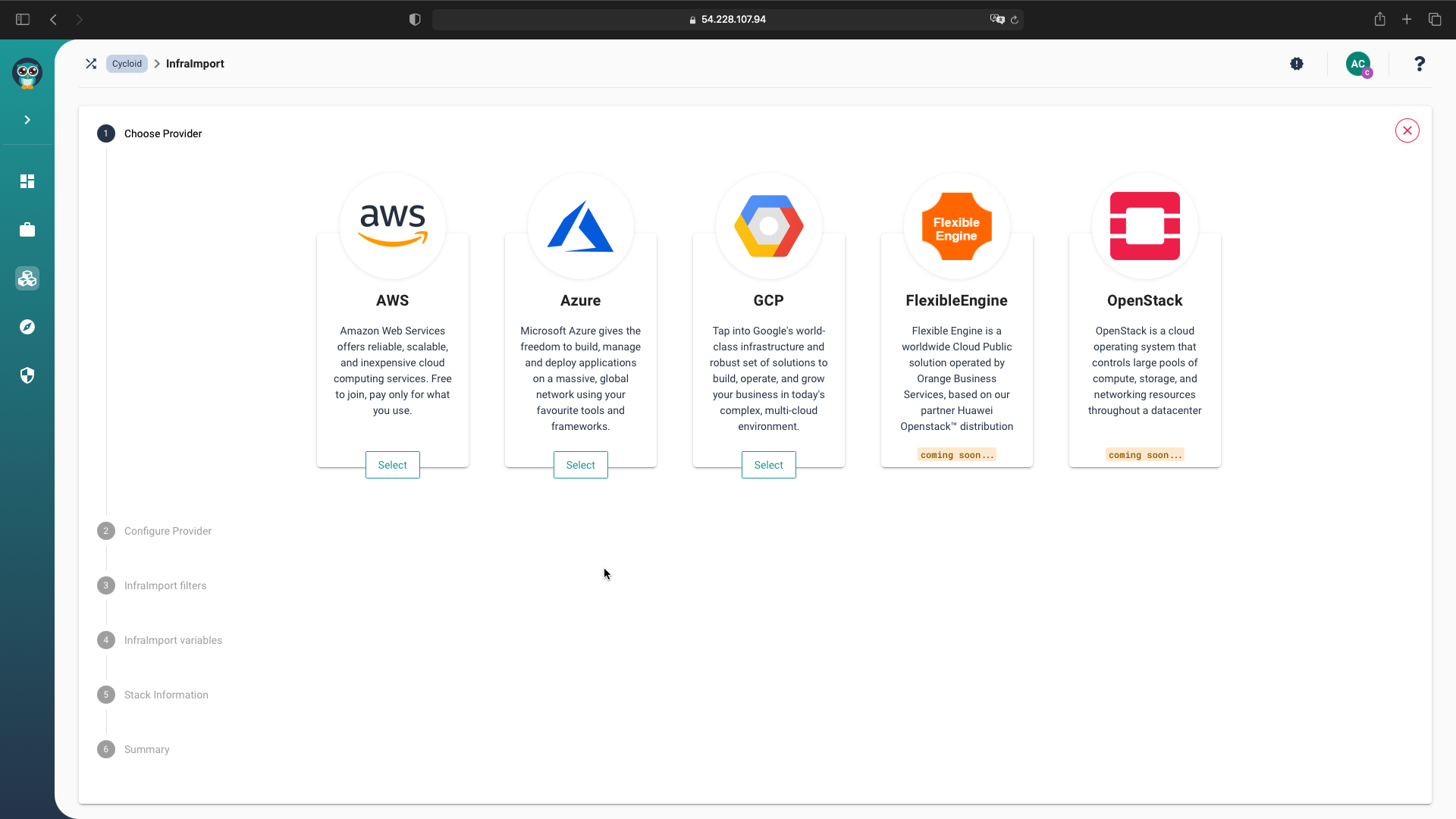
    Infra Import extends that capability to cloud platforms such as Amazon Web Services (AWS), Microsoft Azure, Google Cloud Platform or an IT environment employing the open source OpenStack cloud platform that may have been manually provisioned. IT teams can then create a configuration based on that Terraform code that could be employed across multiple clouds.

    Infra Import is designed to connect to a cloud provider and then automatically reverse engineer Terraform files and IaC stacks based on the existing deployment. It also ensures that the latest edition of Terraform is being used to create that configuration code, noted Brial. That capability eliminates the need for DevOps teams to keep track of what version of Terraform might need to be updated as new versions of the IaC tool become available.

    Just as significantly, Infra Import also makes it a lot easier to onboard new members to a DevOps teams because the tools uses valid secure configurations they know can be relied on. Misconfiguration of cloud services is one of the biggest security issues that IT teams today are wrestling with, simply because most developers lack the security expertise required to configure cloud services properly.

    Cycloid is in the process of rolling out a comprehensive suite of management tools that complement a lightweight framework it created to make DevOps best practices more accessible. The challenge is many IT organizations have already manually provisioned cloud infrastructure in a way that is, at the very least, often suboptimal if not downright insecure.

    Misconfigurations are rife across cloud computing environments, but most organizations are not prepared to manually address the issue. Automating the reverse engineering of those configurations is the first step toward enabling IT teams to address the problem at scale.

    It’s not clear to what degree configuration concerns have impacted the number of applications that would otherwise have been deployed in the cloud. Security is always listed as the top concern IT leaders have when employing cloud platforms. The issue, however, is not the security of the platforms themselves but rather the processes employed to deploy applications on the platforms. Cloud service providers have promoted a shared responsibility model for security under which developers are accountable for both securely configuring services and ensuring the overall security of the software environment. The trouble is, not every developer understands the implications of that shared responsibility model much less how to actually secure an application workload.

    It’s not likely security concerns will slow down the rate at which applications are deployed in the cloud. However, as more cloud security issues are encountered, more scrutiny will be applied.

  • EP 12: DevOps Unicorns

    EP 12: DevOps Unicorns

    What should you look for when choosing a DevOps vendor? What criteria are others in your industry using to inform their decisions? How do you choose a vendor that is a good fit for your organization? And how do you know if you made the right choice? In this episode of DevOps Unbound, host Alan Shimel welcomes Larry Maccherone of Comcast, John Willis of Red Hat, Ravyn Manuel of the Smithsonian, Garima Bajpai of Capital Carbon Consulting and Mitch Ashley of Accelerated Strategies Group for a panel on DevOps unicorns. The video is below, followed by a transcript of the conversation.

    Alan Shimel: Hello, everyone. Welcome to another edition of DevOps Unbound, where we talk about DevOps, hence the title. Thanks for joining us. This episode is titled DevOps Unicorns: The Quest for End-to-End DevOps.

    You know, I’ve been in IT 30-plus years and there’s always been this tension or this pendulum that swings between the one throat to choke versus the best of breed solutions in any area. Today it’s DevOps and software delivery and deployment. But in anything, in the security world, in everything, in hosting, in infrastructure it’s always been a common theme. But it’s really, really becoming acute within the DevOps sector now. And we’ve assembled what we think is a great panel to discuss this issue. Let me introduce you to them and we will go from there.

    First of all I want to welcome, well, to a panel for the first time in a long time, my friend Larry Maccherone. Larry, welcome to DevOps Unbound. Give people a little background, if you don’t mind.

    Larry Maccherone: Sure. Thanks for having me here, Alan. First of all I want to say so I launched the Dev PsychOps Transformation Program at Comcast and grew that for five years. And I’m a developer at heart, though, so I was sort of the ideal person to take what was actually becoming more common outside of big enterprises, Dev PsychOps, and try to actually do a diverse approach inside of a large enterprise like Comcast. And so all of my experience is around that recently, the last five years or so, around that.

    Shimel: Excellent. Next let me introduce you, she’s a repeat visitor to DevOps Unbound. Garima, if I mess up your last name I apologize in advance, but Garima Bajpai. Close?

    Garima Bajpai: Almost. Yeah. So I’m Garima Bajpai. I’m based in _____, Canada and I’m the founder for the DevOps Community of Practice here in Canada, which has three chapters: Toronto, Ottawa, and Edmonton. I’m also the organizer of the DevOps Summit in Canada, which happens in November 8th and 9th. And I’m also associated with organizations like DevOps Institute as an ambassador, as well as CD Foundation as an ambassador.

    Shimel: Fantastic. And, Garima, I apologize on your last name. My bad. I’m trying to read it and the monitor’s too far away from me without my glasses. But thank you for correcting me, and welcome.

    Next up, another good friend of mine, my actually business partner on Digital Anarchist. And though that’s not his full-time gig these days; he’s very busy with his red hat career. The one and only Botchagalupe, John Willis. John, welcome.

    John Willis: Thank you, sir. Thank you, Alan. Hey, yeah, John Willis, Botchagalupe on Twitter. My current day job is in a team called Global Transformation Office at Red Hat. I’m sort of blessed to be on a team with Andrew Clay Shafer; Kevin Behr, the co-author of The Phoenix Project; and Jabe Bloom. Just quickly, you know, I’ve been in the industry for 40-plus years, 10 or 11 startups, 12 books, if somebody’s counting. Probably the most notable is the co-author of DevOps Handbook.

    Also was involved in basically the starting and building of the original DevOps Days. Was the only American at first DevOps Days and Damon Edwards and I created the first DevOps Days event in the USA.

    Shimel: Yep. And that’s only a partial list, John. Thanks for joining us today, man.

    And then I want to introduce – she’s off-camera right now, but hopefully when you’re watching this at least you’ll get to see her picture, but she was having some video difficulties, but happy to have her on audio, my friend, Ravyn Manuel. Ravyn, welcome. And if you wouldn’t mind, give people a little background.

    Ravyn Manuel: Thank you, Alan. I do appreciate being on your show. It is awesome. It makes me laugh. I am the senior application developer for the National Museum of African-American History and Culture. And I’m also the DevOps engineer for that particular unit. As a developer I implement some of the hands-on interactive that you play with in the museum, and as a DevOps engineer I am in charge of just about everything that’s DevOps, from the cloud solutions and how we – from the application development side, how we’re using cloud and the tools and writing strategies and keeping my leadership informed of all the good things that are out there.

    Shimel: Fantastic. Ravyn, welcome and thanks for joining us today.

    Last but not least, my co-host here on DevOps Unbound, Mitch Ashley. Hey, Mitchell, welcome. You want to just introduce yourself?

    Mitchell Ashley: Great. Great to be here. Man, what a panel. I am so excited to be with these folks on today. Yeah, I head up Accelerated Strategies Group, analysts from focusing on, of course, DevOps and digital transformation, full cybersecurity and cloud. And I also serve as CTO with MediaOps, so heading up the platform strategy and technology, so we used to deliver programs like this.

    Like John, I think we’ve been probably in the industry about the same amount of time and have zero books to my credits, so he’s made a lot more progress in those areas, but also a startup person and run a lot of software projects, product, as well as IT groups, as well as on the vendor side. So this will be a fun discussion.

    Shimel: Absolutely. I should mention DevOps Unbound is sponsored by our friends at Tricentis. To give you an idea of what a great sponsor they are, they don’t even have anyone on our panel today. But they do enable this show to go forward every other week, so many, many thanks to Tricentis.

    So, John, I laid it out, right, it’s the one throat to choke versus best of breed, how many vendors can we support, how do I package solutions that are more than just point solutions, or maybe I just want point solutions. What’s the answer here, John?

    Willis: The answer is, Alan, I would say if I had the right answer I’d be on a Grady-White right now in the Gulf of Mexico.

    Shimel: Exactly. And I’d be right with you.

    Willis: But no, I think this is a great panel. I agree with Mitch; I’m excited about just the discussions we can all have. I think the question – you know, I was thinking just that sort of Chinese curse translation, “May you live in interesting times,” right? And that’s clearly where we are right now. And I think your question starts with a shift, right? Like there was this – talking about you, Mitchell, some of us have been here forever, and like back in the day there was this question of one throat to choke versus should I do an ELA with computer associates versus piecemeal things, right? And probably less than one-percent of the enterprises were do-it-yourselfs.

    Now today you will find probably – I’m just going to swag the number, but it’s probably north of 10, maybe 15-percent, maybe even higher of companies that are now being challenged to do it yourself. You know, Kubernetes is a great example. That’s a can opener for companies to make a decision of are my vendors keeping up with what comes from basically sort of upstream technology that I should build myself.

    So I think that’s the sort of question we move into, is more about do you build internally to solve your problems, to keep up with the changes in the market and the technology, or do you try to find a pair of vendors or a single vendor – and there really is very few single vendors that can give you the whole scope of what’s going on in modern technology today. But I think that’s the question that I think we’ll have fun just talking about today. _____.

    Shimel: I don’t disagree. Panel?

    Manuel: So, Alan, this is Ravyn. I agree with you, John. I think one of the things – because that’s a struggle for me and my organization, is we need help with implementing DevOps, but I think the vendors are very tool-focused and the tools are like the third priority in the stack of there. And what I’ve been doing when I’m building the strategy for how we’re going to implement DevOps, I looked, and we’re talking about tools. I look at the standards, because if they’re making standards and the tool has to follow that standard then it’s plug-and-play, you don’t get – like if Docker decides that they’re going to go out of business then you can have another container-type technology to do that.

    So when we are looking at benders we actually kind of do a piecemeal, because we’re really unicorns. We’re not a software company, we don’t have software products; we have digital products, and they’re all one-offs. And so it really just depends on what fits for us. So we don’t really go for the one vendor solution; we actually go for who can help us get to where we need based on our business problem.

    Bajpai: Excellent. And I wanted to add a few things, because when we drill deeper into this conversation we will find out that there are two sides of this coin. One part is where an organization from a maturity perspective is. And the second thing is what are the vendors and key capabilities you’re looking at. But if you look at both sides of the coin there are three things which are needed to calibrate these DevOps tools in the overall context. The first thing, and this is – I want to reiterate the fact, because I come from a very large complex organization background, that it is very essential to have an enterprise architecture view. So I would suggest and recommend that before even, you know, taking this approach of single vendor or multivendor discussion, we need to kind of break down what are the key capabilities which are needed. So whether it’s a single vendor which can provide you that enterprise IT architecture capability, or it will be your organization who will be doing it. So that’s essential.

    The second thing I think which is also essential is orchestration layer. You know, you will have to have that governance of total cost of ownership, compliance, security, identity access management, and that orchestration layer has to be there to stitch all you calibrated DevOps tools. So it’s a question of whether you want to kind of build it in house in that organization or you kind of have a vendor-centric approach where this capability should be or could be brought in.

    So these are like two things, and then you start calibrating these DevOps tools. So you don’t have to look at the foundation aspects of compliance, security, governance, total cost of ownership, and the job becomes much more easier. The question is that, you know, how to bring these DevOps tools and enable business value.

    Maccherone: So I want to riff off of that orchestration layer idea, but I want to backtrack a little bit on sort of the – we have a binary sort of difference here between unicorn and best of breed. But I think within the unicorn bucket there’s really two major flavors of unicorn that are wildly different, and so I want to sort of bring that out. You have these Frankenstein vendors that are piecing together acquisitions into this monster and those are not pleasant experiences. The only benefit you get out of one vendor in that case is really the contracting benefit of having a single master service level agreement. You’re not getting an integrated product that really allows you to actually smoothly do the workflow, insist in the workflow that developers are using to produce value for your company.

    And then you have this other class of unicorns in the DevOps world, but less so in the security world, and I’ll talk about that in a second, which have taken a marketplace approach. And this is not a DevOps vendor, but I think the first vendor to really pull off this marketplace approach was Atlassian. You know, they had one product that was really great, but they said, “Okay, plug into this product” and they created APIs and they created toolkits and they created a whole community. Most of those people did it for free and they just sort of did it for themselves and then they shared it with the community. But some of those people became vendors and sold their product in the Atlassian marketplace, and then Atlassian acquired those. They were already pre-integrated with Atlassian’s other offerings when they got acquired, and so their acquisition unicorn approach doesn’t look like a Frankenstein’s Monster in the end, because they were built with the APIs of the vendor in place.

    And I think Github is definitely taking that marketplace approach and pulling it off really well, even into the security space. And so I think that kind of unicorn – and Github to a lesser degree, that kind of unicorn doesn’t suffer from that Frankenstein Monster’s sort of problem. No one in the security space has really pulled off the marketplace approach yet, though. We have some Frankensteins and Frankenstein Monsters over there, but we don’t have a full sort of marketplace approach. And I’m waiting for somebody to do that. I think that’s going to be the big win, somebody _____.

    Willis: I’d like to do a whole podcast on that, because that’s all I’ve been thinking about right now, is what is the end-to-end on security. But like if I got into it now it would take up way too much time. So I did want to comment on some of the things. You know, the first, Ravyn, I think the interestingly about standards, I agree, right? The problem we have right now is figuring out which standards are actually going to last, are malleable. I mean that’s one of the things I’ve really been working hard on and looking at like OSCAL versus OVAL versus S-CAT versus, you know, just NIST _____ – in order for – I mean there’s just so many things and they all sort of have a little bit of different approach.

    So I agree, the question we have to deal with now in these sort of, you know, may we live in interesting times is it’s like picking sort of an early vendor, like I like this vendor technology, but are they going to be around? Are they going to be acquired by a company that I don’t really want to do business with? I think the standards is just it’s such complicated.

    Just the other thing I wanted to say is I think that for vendors, you know, and I’m not _____ ’cause I work for Red Hat. Because I will say right now the thing that like in the grand scheme of technology, if you’re going to go all in a vendor, look around. You know, I’m going to say this. I’d love to be corrected and I’m not saying, you know, Red Hat because I work at Red Hat. Anybody that knows me, I’m not a shill for any vendor I’ve ever worked for. But it’s VMware and Red Hat, right? They can keep up with – because you’ve got to – in this world you have to have people on staff, their full-time job are contributors to an open source project.

    And if you think about what’s going on with like Kubernetes and clusters and server list, you know, you think of the two companies that are positioned really well at that sort of scale version to be able to keep up with the complexity and change of technology because they’ve put the resources in. I mean a longer list that you can probably make after that. And I’m not including the cloud providers either, ’cause that’s a different story.

    But anyway, those are the two comments I wanted to make on some of the things people talked about.

    Ashley: I just wanted to jump in. What’s fascinating about this conversation is how diverse and complex it is. There are a lot of aspects to consider, whether it’s an enterprise architecture like Garima is talking about, John’s talking about, who are the vendors that can pull it off. Larry is too, if you’re talking about this sort of roll-up strategy, but retro-ally integrated strategy.

    I think another dimension to consider is every organization has a DNA about how they think and operate when it comes to vendors and software and tools. And while I’m not always an advocate of go with the flow, sometimes when you’re thinking about how do we have something adopted, think about how the organization operates. If you are kind of a large tool vendor, let’s work with, you know, Red Hat or VMware or Broadcom or whoever might be – think about that. That’s oftentimes, you know, save yourself some brain cells and live a little longer.

    There’s also the innovation curve, and some of the best ways to ride the innovation curve is the open source route and the vendors that are built around that kind of a strategy. There’s combinations of all those.

    So I guess the thing I would add to the consideration of the conversation here is think about how you match up your strategy with the DNA of the organization so you can accomplish as much without killing as few brain cells as possible.

    Bajpai: And thank you, Mitch, for bringing up this point of DNA of an organization. I think that this is a pathway of dialogue which we are having. I do believe that the mindset is shifting, and even I see in large legacy enterprises that they have started to realize that, you know, this vendor-based approach is something that needs to shift, and they need to bring people as partners in this context. Because when you think about DevOps it’s basically exploring your opportunities, breaking the barrier for, you know, your technology onboarding, the gaps – the alignment and outcome gaps you have created in the past.

    I think this is the opportunity where the organizations can shift and bring more access to innovation through these partners. So I truly believe that there are softer aspects of this conversation as well which we need to kind of consider that traditionally how contracts are _____, you know, how we look at these DevOps tools from a vendor perspective, how can we bring them as partners, what we need to change if we start doing that.

    It’s not kind of done overnight, right? So we have to kind of set what kind of modeling practices we need to bring in. And this opens up another door of possibilities. And probably during this conversation we will have some opportunity to discuss these SLA constraints which we have built in the organizations which steer us to a specific vendor or steer us to like a specific window through which we can outsource a lot of capabilities and just, you know, a choke the throat approach, right?

    So let’s maybe in the upcoming discussions we also can bring these points and highlight.

    Shimel: Ravyn, I know Smithsonian is sort of quasi-government, or it’s not true government. But to Garima’s point about SLA and being able to only deal with chosen vendors like that, it is; it is a real governor on your ability to choose best of breed, on your ability to have choice in how you want to do things. Interested in your experiences around that.

    Manuel: It’s been difficult. I’ve been listening to this conversation and it just hit – I don’t know why it just hit me, but the vendors – and I love Red Hat, so I’m not trying to talk Red Hat or anything, and open-ship. But when you get a vendor that you have worked with and you trust, and Smithsonian, we use Red Hat a lot in our OCIO. Red Hat is doing open shift and Kubernetes and they are driving their tools to these specific tools. And for me, as a unit within the Smithsonian, I may not want to use open shift and I may not want to use Kubernetes, but I don’t actually have a choice, right? Because that vendor is a great vendor and they’ve got great tools, but they have chosen for me what I am going to be using, and that makes it really hard for me to say “Does that really fit what I really need? Is that too much?”

    Because I can tell you that a lot of the vendors that I talk to, they’re expecting us to use this like suite of products, and it’s too much for what we want to do, and so I’m left with I either go with this vendor and overspend and use tools that I don’t really need, or I have to do it myself because I can’t really find somebody that can customize that for me. So it’s a challenge.

    Shimel: Yeah, it sounds like it.

    Willis: You know, one of the things I struggle with, you know, I sort of love committees and hate committees, right? Because like I so – HashiCorp has this cluster manager called Nomad, and I’ve actually seen people use it effectively with like incredibly less toil, 80-percent of the features of it, but it’s never going to get any escape velocity. It hasn’t and it won’t.

    And I fear for our industry that we’re like so focused on there’s just only one way to do cluster management today where like – so to Ravyn’s point, like whether it’s Red Hat or whatever, it seems like you’re not even able to explore possible emerging containerized cluster management solutions because all of the oxygen in our industry right now is consumed by Kubernetes.

    Manuel: Amen.

    Shimel: Thoughts on that? I’d like to jump in with some thoughts on that. I mean this is sort of a dream/nightmare scenario. Right? I’ll take it – let’s take it off Kubernetes, let’s go back to PC operating systems. It was great that we had only Windows to develop on, and this way if you were an inept developer you only had to worry about developing on Windows. You had one operating system, you could make your app on it and it worked and you got 90-percent market share with it. What a fantastic thing for app developers. Of course, it gave Microsoft the inside track on Office and everything they did. And from a security point of view what a big, fat juicy payload that was, right, to go attack.

    So then we started seeing, for as long as I’m in IT, “This is going to be the year of the Linux desktop.” Right? How long have we heard that? And so, you know, and then of course Mac resurfaced.

    But this is we strive for some uniformity. We strive for Kubernetes to be the standard, ’cause it’s open source and it’s run by a foundation, and we want a standard. But then we chafe that, “Hey, we all can’t fit into that same standard. We want to be our own unicorn.” And that’s really what we’re talking about here today. If you go back to early, John, you sold the company to Docker before Kubernetes dominance, right? And there were several cluster management solutions vying. Right? There was Mesosphere and Rancher out there _____.

    Willis: Mesosphere and _____, yeah. [Laughs]

    Shimel: You remember. Yeah, _____ of these, exactly. So, you know, this is – but this is the world we – you know, to quote Hyman Roth in the Godfather II, “This is the world we chose to live in,” right? We strive for these single kind of standards that one-size-fits-all. And maybe that’s a huge mistake; I don’t know. Maybe it is a mistake. Larry, what do you think?

    Maccherone: Yeah, I do see that problem, John, you’re sort of focused on here, that sometimes the de facto standard is not the best technical choice. You can go all the way back to Betamax versus VHS, for those of you who are old enough to remember that, right? VHS won out, but Betamax was considered by everyone to be a superior technology. Why?

    You know, so I think if you’re going to take a best-of-breed approach you’re going to have to – when you have a true de facto standard like Kubernetes you don’t have to isolate yourself from it, but when you’re making a bet on which one is going to win out – and John is really good at this; John talks about this all the time. John sort of like doesn’t want to put his chips down on something that’s not going to survive long-term, so he wants to think about what’s going to survive.

    So in order to hedge your bet there I think you need this orchestration layer that was talked about earlier. You need to sort of isolate the tool vendor from the way it’s consumed to a certain degree, so you can plug-and-play a little bit as time goes on. And this is what we did at Comcast, we built a layer between all of the tool vendors for security tools, because they don’t have a good unicorn solution there. There is no good unicorn solution there anyway, even if I wanted to. And so we had more than one vendor in every tool category competing internally, and sometimes we had three tool vendors. But from the developer’s perspective it was really easy for them to switch out from one to the other, and they got the same feedback channels, they got the same visualization, it aggregated and scored the same way across all these different vendors.

    I think that orchestration layer is really key when you have a best-of-breed approach, and I think you have to build it yourself. I don’t think you can buy it today. I really don’t think you can do that.

    Willis: I’ll try to shut up quickly. I just want to make a comment. I think there’s two books that help us understand our world. One is Guns, Germs, and Steel by Jared Diamond, which actually shows you why we get into these predicaments. If you haven’t read it, it’s a fabulous book. And then Start With Why by Simon Sinek is the sort of anti-pattern to that, which I would say like there’s clusters – atomic computed things like sort of serverless or functions or containers will be around for 10, 15 years. Clusters of those things will be around for 10 years. So if you think in those terms instead of thinking about Kubernetes and Docker – and Docker is already slowly dying, then you get that sort of start with why isolation against these sort of Guns, Germs, and Steel trends.

    Bajpai: Right. Then I also wanted to kind of bring another aspect of this, which is connected, but I think companies might start looking at it from a scaling perspective. We talk about a lot of tools and how to calibrate these tools in our DevOps pipeline. Of course when you have a large organization you have multiple product lines, and these product lines will choose to be flexible, so they need to have that flexibility to deploy their DevOps pipeline in the way they choose. And that’s the whole power of DevOps, right?

    But I also feel that the conversation in this discussion is leading us to a point where we start looking at our technical oversight committee from a governance perspective, where we can stitch the dots, we can actually lay that common foundation which is required in order for people not to kind of rewind the _____ over and over again. So I think that’s the key here.

    And of course when we talk about a specific random _____ with huge capabilities it has pros and cons, right? So one pro would be like they can mutually enforce new capabilities. So when they bring one feature in one product it’s mutually enforcing another product, which is a beautiful advantage they bring in. But that also limits our possibility to look beyond what the vendor is bringing in. So we are kind of essentially not exploiting our own innovation cycles to introduce more capabilities around how we want to experiment, how we want to kind of build innovative new features into that life cycle.

    So these are kind of good considerations to look at and I truly believe that the technical oversight committee is something that you will see in large organizations a wave kind of starts in a bigger way when it comes to DevOps.

    Ashley: And there’s interesting too, when you think about different sizes of companies that are in the market for technologies, you know, Larry mentioned what he did at Comcast or what he was part of that was created as sort of an architecture where tools can be plugged in, unplugged, replaced, etcetera. It sounds simple, but I know that they have an architecture to do that. And some organizations have the wherewithal to create those things. What we see in the data, looking at the market, is in the small business, the kind of sub-200 people or so companies, they have really good high-performance teams that can work to create software or set up their own environments, kind of create a very productive setup for themselves, tool chains, etcetera.

    Then on the high end or the large end, the enterprises, you know, they have a lot of resources available to them that they can potentially marshal to figure out how to do some of those things. The mid-tier market, the medium-sized company is often where they’re most challenged to – they want to do what the enterprise can do, but they just don’t have the resources. They don’t have the money or the vendor relationships across the board to do all those things and they’re expected to deliver at almost an enterprise-class level, but they don’t have all of the resources to be able to do that. And that’s often where somebody – the non-Frankenstein vendors that do a good job of kind of delivering a suite of solutions can work in those situations. Not that they can’t work in the others; they can, too.

    But depending where you are in that kind of a company, that size of a company, makes a big difference on what strategy you can take.

    Maccherone: I think that’s a great point and my recent experience last five years has really been enterprise. But prior to that I was talking to lots of companies, and you’re right, the mid-sized companies are the ones that are sort of in that no-man’s land sometimes, where they need some standardization, they need some consistency, but they don’t have the wherewithal to put it all together. And a vendor unicorn approach might actually be better in those circumstances.

    Shimel: Hey, guys, I want to – Ravyn, I’m going to let you in a second. John, the name of the first book that you mentioned – I want to put these books in the notes somewhere.

    Willis: Oh yeah. I did a presentation with Josh Corman way back with Guns, Germs, and Steel. Anyway, it’s an amazing book about how civilizations move from sort of – you know, how they go from sort of agriculture and they move into these clusters. If you can see the forest beyond the trees you can see how we get into these like Kubernetes is the only word we can use. Anyway, Jared Diamond, Guns, Germs, and Steel, it’s incredible.

    Shimel: All right, we’ll try to get it in there. Ravyn, did you want to say something and I cut you off?

    Manuel: No, I don’t think that was me.

    Shimel: Garima?

    Bajpai: Yeah. I wanted to actually enhance what Larry was saying about midsized companies. This is totally based on my experience and exposure with the Canada DevOps Community of Practice. We are seeing more and more of these midsized companies, not only the consulting companies, as well as the companies who want to build a DevOps capability coming to the community of practice and starting to steer this discussion of evaluation and assessment of tools. And I’m also seeing that the winter side. You know, specifically we are talking about tier two companies here. The winters and coming and exposing the tool capabilities in the community of practice, and they want some support and help for us to kind of steer this conversation “Is this a good tool? Is this a good capability where they are in their context?”

    And it’s a very interesting discussion because the technical side is one side of the story. I would also like to kind of emphasize the fact that the questions we ask these vendors and these companies are like, “Okay, do you have a product owner for this product?” Because essentially, you know, what it means is that how accountability is built in a specific tool perspective. I also kind of ensure that we ask them what kind of themes they have, like what kind of cross-functional themes they have, so that we do not miss out on the point of interoperability, integration, automation, all these like are important points.

    So I just wanted to mention that how we take that approach from the community of practice perspective when we’re asked to kind of assess.

    Willis: You know, I totally agree with all of that. One of the things I was thinking about, I’ve had this luxury of being involved in these different communities. Like I’m in Alan’s community, you know, so I’ve gotten hooked into usually what’s interesting and going on in Alan’s world, which is a pretty big world. I’ve been hooked into Gene’s world pretty heavily, you know, DevOps Enterprise Forum/Committee. And then, you know, I’m one of the co-founders and advisors for the DevOps Days.

    And one of the things that I get to see is true leaders. And I don’t want to put all this sort of weight and gravity on like you have to have a great leader to be successful, but like as I think about the people – Larry is a great example. Like, you know, you can talk all day long about what Comcast does. I’ve seen Larry in action. Like that’s the kind of guy you want in your enterprise.

    Courtney Kissler now, you know, was at Nike and now she’s moved on to a startup. Ross Clanton now at American Airlines, Heather Mickman. I mean I can go on on the list, but these are people that impact change in larger organizations that where it’s incredibly hard. And there’s just something about that.

    Maccherone: There is an immune system at large enterprises, though, that makes it hard for someone like me to actually be hired and be successful. You know, the idea of disruptive change is not something that enterprises are sort of seeking out ever. And so if you’re sort of like grassroots and you’re sort of like ground up and you get a few pilots going, that’s easy; there’s not a lot of resistance. It’s when you get enough momentum that somebody feels like their domain is threatened that you get the political pushback in an enterprise. And, you know, that’s really hard to overcome. Companies have to be very conscious about that. And Comcast has done a great job of that for me in the past, but I see it in the nature of the enterprise immune system essentially.

    Ashley: We probably could take any one of those last three comments and turn that into a whole other dialogue. Maybe we can get some help from the folks in the production department for pulling us back together.

    Alan, do you want to close this out?

    Shimel: One thing’s for sure, is we’ve got a lot more to talk about on this subject. I’d love to – I invite you all back to continue the conversation. But for now, Ravyn, I appreciate you soldiering through this on audio only. If we do it again we’ll make sure to get that video working. Garima, always a pleasure to have you on here; you bring so much. Larry and John, what can I say, it’s a pleasure to see you guys. I can’t wait till we can see each other in person. I know a lot of us have gotten our shots; it won’t be long. But thank you so much for adding so much. Mitchell, fantastic job.

    Most of all, hey, thank you people that are watching this, because that’s why we do this, is for you guys to get something out of it, join in the conversation, let us hear what you’re thinking. Many thanks to Tricentis for sponsoring DevOps Unbound.

    Until next time, though, this is Alan Shimel, Media Ops for DevOps Unbound. Have a great day, everyone. Bye-bye.

    [End of Audio]

  • How No-Code Will Transform DevOps

    How No-Code Will Transform DevOps

    In the years that low- and no-code development tools have been available, the movement has been slow to gather pace. Until recently, the vast majority of app and workflow development has remained firmly in the hands of professional coders.

    That is about to change—and fast. Gartner forecasts that the global low-code development technologies market is on track to reach $13.8 billion in 2021, an increase of nearly 23% over 2020. Other research suggests that 20% of all workers use no-code tools today, including 56% of coders. And 71% of those who use no-code tools within IT adopted them within the last year.

    No-code development is reaching a tipping point, and this trickle of adoption has turned into a torrent, driving more and more business demand daily.

    Drivers for the No-Code Movement

    The reason for this acceleration is simple: Digital transformation requires speed. If businesses are to digitize the full universe of processes across all departments, then they need tools that can be adopted quickly and with little ramp-up time.

    No-code tools are an ideal solution to this problem, and not just for a short-term fix. If the investment is seen solely as a short-term fix to immediate problems, it’s very likely that a company’s digital transformation efforts will continue to die on the vine. Digital transformation is not a “one-and-done” process; it’s only the start of a new business strategy based on continual innovation, where new apps and tools are built and rebuilt, time and again, to keep up with changing market dynamics and customer/employee requirements.

    The long-term trend of digital transformation has been accelerated by two shorter-term trends. First, obviously, is the COVID-19 pandemic. The social distancing measures used to control the virus meant that businesses had to create new apps and workflows (in hours or days) if they were to survive. No-code tools played an important role in helping businesses adapt at a breakneck pace, and gave them a taste of just what’s possible with intuitive app and workflow development.

    Second, a shortage of skilled developers. The population of 24 million global developers accounts for just 1% of the overall workforce, leaving businesses short-handed and looking for ways of empowering non-coders to take control of app development for themselves. As well as plugging skills gaps, no-code also meets demand from employees for more autonomy and more control over their operations, projects and workflows.

    Unlocking Innovation

    The net result of these drivers is that no-code is now a bona fide movement, and technology companies large and small are taking advantage of market innovations to transform what it means to build websites, software applications, workflows and mobile apps.

    The impact on enterprises will be profound. As Accenture highlighted in its 2021 Technology Vision, no-code is part of the broader democratization of IT, where the ability to create technology solutions to address business challenges is extended to everyone in the organization. This trend will unleash a wave of “grassroots innovation” that will help companies reinvent themselves in the years ahead. Those that fail to take this opportunity now may struggle to keep up with more inventive and agile competitors later.

    What No-Code Means for Developers

    For developers, this trend will undoubtedly lead to many questions. What is the role of the professionally trained coder in a no-code world? Will DevOps become extinct as “citizen developers” take over? Far from causing detrimental effects, no-code and low-code will likely prove to be hugely beneficial overall. Here are four key reasons why:

    Reduced workload/stress. With no-code-based roles, organizations are able to expand their technical capabilities without needing to hire more developers or coders. What’s more, by spreading basic app and workload development tasks across the organization, developers’ time is freed up. For teams that are already understaffed and under pressure, this can make a huge difference in the workplace experience and enable developers to spend more time focused on delivering high-quality software.

    A more strategic role in the enterprise. With tactical software development carried out within business units, developers can spend more of their time focused on the ‘next big thing,’ whether that’s mixed reality, quantum computing or AI. Developers and the wider IT team can act as “futurologists”, assessing new tools for the best fit within the business and guiding purchasing decisions to ensure the best possible outcomes.

    Accelerated innovation. For more complex software development that requires coding expertise, developers can leverage the speed of no-code to spin up proofs-of-concept and test them before investing time and resources on full-scale development. In fact, research suggests that many developers are already taking this approach, with 38% stating that they use no-code for prototyping a new product.

    New roles and opportunities. No-code will have a deep and broad impact on the enterprise, changing how work is done and creating new roles in the process. Many of these roles will provide new career paths and opportunities for developers, such as no-code consulting (helping businesses find the optimum no-code framework and tools for their needs) and roles that revolve around optimizing processes, building solutions and discovering ways to easily automate and streamline the day-to-day work within their organizations.

    DevOps teams, long the drivers of digital transformation, are now finally feeling the effects of those efforts. A new world of work is emerging where everyone is a technologist; using intuitive tools to rapidly build solutions to their business needs as they arise. This approach will free developers from their traditional role as gatekeepers of innovation, allowing them to focus on strategic technology decisions and channeling their specialist skills to areas where they will make the most impact.

    The rise of no-code is good news for everyone. It accelerates digital transformation and unlocks the innovation potential of all employees. And it’s great for developers, too; making their work more interesting, less stressful and with new career paths and opportunities for development. No-code can provide a growth driver to all enterprises, and arm early adopters with a significant competitive advantage.