Category: Blogs

  • Logz.io Allies with Microsoft on Open Source Observability

    Logz.io Allies with Microsoft on Open Source Observability

    Logz.io this week announced an alliance with Microsoft that enables DevOps teams to deploy its observability platform—based on open source platforms such as ElasticSearch, Logstash, Kibana (ELK), Prometheus and Jaeger—on the Azure public cloud.

    Jonah Kowall, Logz.io’s CTO, said the multi-year effort enables those teams to deploy the Logz.io platform via the Azure Console with the click of a button. The Azure platform has a data collection capability that aggregates operating system events in a way that makes it simpler for the Prometheus monitoring solution to consume, he added.

    DevOps teams, however, will still have to collect data from the applications they instrument on the Azure platform, he added.

    Logz.io integrates multiple open source monitoring tools based on metrics, logs and traces within a single observability platform that otherwise would require considerable time and effort from internal IT teams on their own.

    Interest in observability is rising as organizations attempt to provide internal IT teams with more context when troubleshooting issues. Whenever there is an IT issue, most teams convene a “war room” where they attempt to discover the root cause of an issue by comparing analytics generated by a wide range of monitoring tools. Observability platforms promise to enable a DevOps team to replace many of those tools in a way that provides more context by integrating log data, metrics and distributed traces within a single platform.

    In many instances, existing application performance management (APM) platforms are being transformed into observability platforms by adding tools to monitor IT infrastructure. Conversely, platforms for managing IT infrastructure are adding support for tools to monitor applications. Elsewhere, a range of startups have emerged to offer observability platforms they have developed from the ground up.

    Regardless of the platform employed, the rise of microservices-based applications within many organizations is forcing the observability issue. The dependencies that exist within microservices-based applications are too complex to manage without a platform that provides some level of increased observability. Of course, most existing monolithic applications are not being retired any time soon, so the need for an observability framework for both legacy and modern cloud-native applications has only become more pressing.

    The Logz.io platform can, of course, be deployed on other cloud platforms as well as within on-premises IT environments. As hybrid cloud computing continues to evolve, it is apparent that observability platforms will need to extend their reach from the cloud to the network edge. Over time, artificial intelligence (AI) capabilities will be added to make it easier to, for example, streamline the number of alerts that are generated across complex IT environments.

    In the meantime, the most important thing with regard to observability may be simply getting started. Most IT teams start to analyze logs before moving on to metrics and then traces using the open source Jaeger agent software. After all, the only thing more difficult to instrument than an application before it is deployed is, arguably, one that is already running in a production environment.

  • Learning from Loris Degioanni: Cloud-Native Days with Kubernetes Virtual Summit

    Learning from Loris Degioanni: Cloud-Native Days with Kubernetes Virtual Summit

    Keeping up with information can be challenging. With all these changes, you’re probably left wondering, “who can guide me through all this information?” Fortunately, Cloud-Native Days with Kubernetes is focused on giving attendees the tools they need to become proficient in cloud-native technologies. At the virtual summit, attendees can tune into our expert-led featured sessions and learn how to leverage cloud native technologies to move faster and more securely.

    Cloud-native technologies are quickly becoming an integral part of IT environments as organizations continuously accelerate their development efforts to meet business demands. Because of this, it’s incredibly valuable to learn from industry specialists changing the IT world as we know it. And who better to learn from than the industry thought leaders and doers in the cloud-native space? Through sessions touching on topics like security and observability, our featured tech titans will give you a better understanding of cloud native and its impact on the IT landscape.

    Today, the CI/CD pipeline is mainly built on open source tools – Kubernetes, Jenkins, GitLab, etc. Security has traditionally been closed, but it’s now clear the pace of innovation cannot be constrained by proprietary development models. Keynote speaker Loris Degioanni, CTO and founder of Sysdig, will discuss key practices needed for a secure cloud and container environment, including: what is required to increase security, visibility and simplicity in the cloud, lessons learned from major attacks like Kaseya and SolarWinds, ways to leverage Secure DevOps to not only ‘shift left,’ but also ‘roll right’ for detection and response, and how open source is the key ingredient to see all your signals in a constantly changing landscape.

    In his article, “Open Source is Taking Over Security,” published last year on The New Stack, Loris Degioanni elaborates on this idea that open source is essential to maintaining high security, stating, “I argue that, despite having lower penetration of open source, security is the industry that benefits the most from an open source approach. I also argue that open source will gradually take over and become the standard way to do security.” To understand this further, Loris breaks it up into a few key questions: Why is open source the best way to do security? and, Will open source become the standard way to do security?

    Let’s start with the most important question: Why is open source the best way to do security? Loris is adamant that open source is the key ingredient to security because of one thing – speed of innovation. Loris points out that the rise of widely adopted and open computing platforms like Kubernetes have had a big impact on how distributed, coordinated ecosystems can beat out a ‘behind closed doors’ single vendor 100% of the time. Loris writes, “On one hand, Kubernetes and cloud native have such a fast innovation pace that it’s hard for a vendor to keep up by itself. On the other hand, thanks to Kubernetes, for the first time we have a completely open platform to run our applications, where security can be natively integrated rather than being bolted on top.” 

    Open source also increases the speed of innovation because it empowers end users to work with vendors. Any user, regardless of size and level of sophistication, Loris says, can provide feedback in a tight loop and they can also contribute. So why is this relevant to security? As Loris explains, “The intrinsically fragmented nature of vulnerabilities and threats makes this bazaar-oriented approach to contributing very effective.”

    This brings us to Loris’s second question: will open source become the standard way to do security? Not only does Loris say yes, open source will become the standard way to do security, but in fact there is no escaping this. Using a metaphor of bad guys vs. good guys to describe cybersecurity battles, Loris says, “the army of the bad guys is big, smart, and aggressive. And the deck is stacked in their favor.” 

    So how do the good guys win in this scenario? Loris says the best chance at this is, “working together, as a team, leveraging each other’s strength, making sure that no energy is wasted.” Rather than having competing standards upheld by a variety of vendors, Loris is adamant that “a much better approach consists of leveraging a common set of standards that are deeply integrated in the platform, owned by the community, driven by consensus, on top of which all of the players can confidently innovate.”

    Much like Loris’s approach to open source, innovation and security are also valuable key practices at Cloud-Native Days with Kubernetes. Life moves fast. Innovation cannot afford to be slowed down, especially now. So begin your cloud-native information journey by tuning into our expert-led sessions, gathering your questions and learning from our talented speakers August 4 and 5 at 9 a.m. ET.

  • EP 11: Unburdening Developers

    EP 11: Unburdening Developers

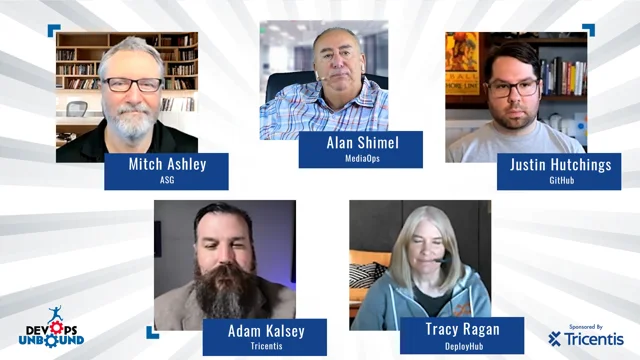
    Every app development need seems to ultimately fall to developers to fulfill. Build in security. Shift testing left. Provide users cooler, more customized experiences at cloud speed and scale. And do it all faster, of course. How do we accommodate the rising expectations without burning out developers? What can other team members do to lighten the load and allow developers to focus on the creative work they require to thrive? In this episode of DevOps Unbound, hosts Alan Shimel and Mitchell Ashley are joined by panelists Adam Kalsey of Tricentis, Tracy Ragan of DeployHub and Justin Hutchings of GitHub to talk about unburdening developers. The video is below, followed by the transcript.

    Alan Shimel: Hey, everyone. Welcome to another episode of “DevOps Unbound,” sponsored by our friends at Tricentis. We have a good, nice topic I want to talk to today, and you know, I refer to it as the straw on the camel’s back, but it’s about the ever-increasing load that developers seem to be taking on with technologies and frameworks such as DevOps and Agile and so forth that we’re seeing out here. And we’ve got a great panel to explore this. Let me introduce you to them before we go any further.

    Let me first of all introduce you to my friend Justin Hutchings. Justin is with GitHub and he’s gonna tell you a little bit about himself. Justin, welcome.

    Justin Hutchings: Thanks, Alan. Yeah, I’m Justin Hutchings. I’m a director of product here at GitHub. I work on some of our security features for developers, you know, whether that’s things like static analysis, security testing, or supply chain kind of features for developers in opensource and the enterprise. Glad to be here.

    Shimel: Nice to have you here, Justin. Welcome. Secondly, she’s a frequent guest here on “DevOps Unbound” and other MediaOps videos, my friend Tracy Ragan, CEO of DeployHub. Tracy, welcome, maybe a little bit about DeployHub and you for the audience.

    Tracy Ragan: Absolutely. Thank you, Alan, and thank you, Tricentis, for having these and always welcoming me on these panels. I like doing them. So yeah, I’m Tracy Ragan, CEO of DeployHub. DeployHub is a hub of metadata for deploying and configuring microservices. So we do automated configuration management so you know what your blast radius looks like for a microservice before you deploy. I’m also on the board of the CD Foundation, and you might see me oftentimes evangelizing around microservice usage.

    Shimel: Yes, we do. And then – welcome, Tracy. And then last but not least as a panel member today is Adam Kalsey. Is that pronounced right, Adam?

    Adam Kalsey: It is, absolutely, yes.

    Shimel: And Adam’s with Tricentis, but why don’t you tell us a little bit, Adam?

    Kalsey: Yeah, so I lead developer relations at Tricentis, and we make software to help people make better software, to test it and make sure they have higher-quality software. And my role is to help make developers more awesome by helping them make better software.

    Shimel: Thank you and welcome. And then last but certainly not least is my cohost for “DevOps Unbound,” Mitch Ashley, CEO of Accelerated Strategies Group, CTO here at MediaOps. Mitchell, welcome. Great to have you on.

    Mitch Ashley: Always good to be here, and having been part of many development teams, I’m excited to talk about this great topic.

    Shimel: Great. Let’s dive into it, guys. You know, when I started DevOps.com about eight years ago, there was this constant push and pull. Was DevOps too developer-centric? It was all about the developers, the ops said. This DevOps thing is just – it’s all about the developers; we’re not getting our fair share. And you spoke to developers and it was, “You know what? DevOps is too ops-centric. It’s not about the ops. It can’t be everything ops. It’s got to be about developers.” And so there was this, you know, friction about was it too developer-centric or not.

    Over the years, though, what I’ve seen is an increasing amount of responsibility seems to have shifted left, as we say, right? And we shift left, and when we shift it left, we’re primarily – we’re shifting it to the developers. So things like testing, for instance, right, have become – developers are probably more involved in testing, or at least kicking off testing and this stuff, than they ever were. Security – certainly the whole rise of the DevSecOps movement has been about shifting security left, and in fact many of the most successful security companies in the DevSecOps space have become successful by making security tools for developers. We’re making testing tools for developers. We’re making tools to look at your blast radius for microservices for developers. Developers are deploying, right, as part of their DevOps focus.

    When is enough? When do we break the developers’ back? Not to mention the developers are the highest-paid people in the food chain, right? So by giving them everything, are we giving them nothing, right? Are we stunting their productivity? Adam, being that you’re the new guy here and you actually are in charge of developer relations at Tricentis, we’re gonna ask you to kick it off. Are we putting too much on the backs of our developers?

    Kalsey: I don’t think so. I think that the promise here is that we make things easier for the developers. I mean, sure, you have more tasks. There’s more things that you’re responsible for. But the overall effort and the amount of work that has to be done ends up shrinking. If you don’t find out about a bug in your software or a security problem or such until you’re in production and customers are using it, now all of a sudden you’ve got way more work to do. It’s harder. It’s more expensive. It’s more difficult. There’s more involved in doing that. And so by moving a lot of these things forward, we’re letting the developers be more proactive in taking care of them. We’re helping them get things fixed sooner. We’re reducing the amount of toil that developers have to do. Yes, there’s more upfront work, but that long-term toil starts to fade away and disappear.

    Shimel: Fair enough. I don’t know if you – you know, I don’t know if I’ve ever heard someone say developers are – you know, it’s making it easier or less for them. Justin, what do you think?

    Hutchings: You know, I’ve talked to a lot of companies that are the early stages of their DevOps transformation, and I think one of the most common mistakes that these companies make is they fail to recognize that adopting DevOps requires both technical changes as well as cultural changes. You can’t just get rid of the testers and say engineering owns tests and expect the same velocity. You’ve got to build out the infrastructure to support that, you have to do the training, and you also have to recognize your throughput is going to be less while you’re paying down that sort of debt on getting that infrastructure and getting the automation and getting all of those things.

    Companies that fail at the DevOps transformation, they go through sort of the motions without understanding the culture and talking about it. You know, years ago when I worked at Microsoft, the Windows team sort of famously had a one-to-one ratio between engineers and – software development engineers and test. These were folks that wrote test automation. And there was a big layoff, thousands of testers got laid off, and they said, “We don’t need them anymore. We have observability tools. This will be great.” And that was the most naïve statement I had ever heard, and it took a year for the organization to fully rebound, to figure out what the right set of responsibilities were for engineering, and how to support those folks effectively on it.

    Shimel: Fair. Tracy, in your roles, both at DeployHub and CDF, you’re dealing with both constituencies here, right, the traditional DevOps teams. But let’s face it: You’ve got dev and you’ve got ops in there, and you deal with both. What’s your take from the battlefront?

    Ragan: Oh, my goodness. I could write like a 20-page blog on this. I guess that wouldn’t be a blog. It would be a research project. [Laughter]

     Shimel: Or a book.

    [Crosstalk]

    Ragan: Yes! So I think that in my discussions with folks over the last six months, eight months, I am seeing a lot of SREs really stressed out. So I don’t know if it’s the development teams that are really taking the brunt of this, but if we think about our history and how we got here, we’ve always had somebody really important on a development team who always worked in hand with the operations side of the house to find out what happened, to help with the deployments. Even if they’re sitting there watching the operation first and hit the button, they’re the person that’s always taken this responsibility. And I think the DevOps movement was an effort to push more operations tasks to that trusted partner on the development team, and now that role has turned into an SRE.

    I would say five years ago we wouldn’t have seen this kind of stress, but because we’re going through this massive tsunami moving from monolithic to microservices, and we’re in a transition phase, we are putting a lot – what I see is we’re putting a lot more stress on the SRE role. Developers are going to the SRE, operations are going to the SRE, and the SRE is just trying to keep up with the underlying technology that’s wobbling and moving. You know, they’re trying to figure out how to stand up environments easier. They’re trying to implement Terraform or Rancher. They’re doing everything that they can right now to try to keep up, but they may be underwater for a bit longer.

    So when we think about where the stress point is right now, I think that developers have pretty much automated a lot. You know, we have tools like Tricentis to really improve the testing, but now we’re int his weird phase where we have these SREs that are trying to straddle both worlds. And they’re struggling.

    Shimel: Justin, you know, in your role there – and, guys, I don’t mean to call. If you want to say something, feel free to obviously jump on. But, Justin, I’m wondering – you know, GitHub has sort of a unique view with this.

    Hutchings: We’ve been trying to push folks towards more automation, more DevOps, you know, DevSecOps with all the security features we have. You know, again I think culture is the key. I look at anytime you have an unfunded mandate, you know, it’s gonna fail. A lot of times organizations will say we’re going to microservices or they’ll say we’re gonna adopt all these security tools, and then they don’t think about how that actually gets done and they don’t recognize the sort of pain and training and all of the things that have to happen to get folks there.

    You know, and I think there’s been a lot of advancement here. You look at the state of observability. You look at the state of CI/CD. Things are getting better, but I think, you know, we in the industry that sort of work int his space sometimes paint such a rosy picture that our customers aren’t prepared for the hardness of the journey that lies in front of them. And they’re looking at how do I get to the magical garden of DevSecOps, and the magic garden is there, but it is not a free entry, you know?

    Ashley: You know, Justin, to what you were saying, I think along with culture, part of is a role change that’s happening across the whole organization, right? A couple things are happening. We’re doing not just automation that the developers are doing, clearly SREs. Other test automation, infrastructure as code, you know, those are all development that’s happening to support those. It doesn’t say that every person is an expert developer, but there’s some development, scripting, other kinds of skills that come with it.

    So I don’t know if we’re so much loading it on the developer as much as we’re elevating our level of automation and kind of interconnected of the process, and we’re helping people evolve and growing their strengths – let’s put it that way – to also include some software development, or more closely working with people that can. I think that’s part of that cultural change, too.

    [Crosstalk]

    Kalsey: One of the things that’s actually happening there is as things become more development-centric and, oh, now it’s Toad and now it’s – the teams are making exactly the wrong lesson out of this and they’re learning the wrong thing out of it. You know, one of the things that Justin said earlier is, “Well, we got rid of all the software testers because the developers are doing the testing now,” and that’s one of the dumbest things that you can do as an organization, is say, “Well, now that my developers can do this, let’s get rid of all the experts.” And instead of saying, “What is the new role of this expert and how does their role change?” whether, okay, now they learn to code so that they can expose more of this as code, or do they become consultants to the developers and help them do this right and help them understand how to do this right? Could I remove a lot of those pieces of toil and a lot of that extra stuff from them and let them focus on the things that they’re good at – writing the code, building the code, thinking through the problems – and let me focus on the things that I’m good at – thinking about the infrastructure, designing the infrastructure, designing test plans, thinking about the non-happy path?

    And so companies – I talk to companies all the time that say, “Well, we’ve moved – all our developers are doing the testing now, so we got rid of our QA department!” And that is – that’s just frankly dumb. Don’t do that.

    Ragan: I think it was an outcome of the Agile movement, right? Because we started preaching this idea of bringing everybody into the same room together to do these tasks. So we broke up our testing departments and we spread them out across all of the teams, as well as some of the operations, which is how the SRE title came about. So, you know, first we siloed and then we tried not to silo. But ultimately it is how do you come up with a strong automation standard across the organization? And how are you gonna implement it? If there’s a testing team that has a group of people and each one is assigned to an application team, or if you have a siloed testing team and a siloed operation team, ultimately we’re still pushing the same product through the lifecycle. So how well do we do that? And maybe Agile confused things for us for a while and kind of broke things up and disrupted what we were doing. So now the task is how do we move forward with where we’re at to make it continue to be easier to get things across the pipeline?

    And I have to say that one of the biggest challenges I hear from people is that continuous integration works well; continuous delivery from dev, test, through prod doesn’t work so well.

    Hutchings: Yeah, and I think, you know, what you hit on there, Tracy, is really important because, you know, when you have an organization where the engineers are the only thing and engineers are undifferentiated and treated as some sort of fungible resource, I think things fall apart. You know, what I’ve seen in successful organizations is they have some subject matter experts, whether that’s SRE or a data team or an infra team, that are building out things that make the rest of the organization able to scale. And that’s a really good, healthy blend where you’ve got experts that you can lean on, but then engineers are empowered to do sort of the last-mile delivery there.

    Kalsey: Yeah. When a company says they’re gonna create a cross-functional team and then they eliminate most of the functions, that’s a problem. I mean, you don’t say I’m gonna have a cross-functional team, so we’re going to bring product managers and designers in and, oh, by – now we just don’t need product managers and designers. So why do we do that with operations, with testing, with all of these other things that are important for software creation? You know, eliminating those and just saying, “Well, the developers will do it,” of course that makes for a lot more work for the developer. The way that this needs to work is keep those cross-functional teams and change their role and bring them further – bring them earlier into the developer cycle. Have them involved in design. Have them involved in figuring out what the product is going to do and how it’s going to do it, not just let’s get rid of them. The options aren’t they happen at the very end of the process or we don’t have them at all. It’s let’s bring them up further along in this process.

    Shimel: You know, part of it, though – and I don’t know if anyone wants to admit it – is that there’s sort of this bias that everyone else on the IT team aspires to be a developer ’cause that is the ultimate kind of thing. So, for instance, it was this way certainly in testing, that being a tester was a waystation on the way to being a full-blown developer, right? Or maybe a developer who wasn’t that good, well, he could do testing, right, and that testing in and of itself wasn’t a “profession.” It was really just like a junior developer did testing. And, you know, security people, well, they were always the rebels, right? Half of them didn’t have formal training. But you know, operations, the SRE folks, right, how much of a developer heritage or pedigree is there in what you need to be able to do from an SRE perspective? And so when we put together these “cross-functional” teams, it’s almost with the idea that, well, you’re all gonna be developers now, right? You’re gonna reach your lifelong ambition by being in this DevOps team as part of a developer. And we lose out on the professional tester, on the professional SRE, on the professional security person, right, in this rush to all be developers. What do you think about this?

    Ashley: Well, I think we did this to ourselves in the DevOps movement. You know, I remember when I first wrote my first article on DevOps.com about what is DevOps and I was sort of grappling with it myself, the mantra was, “We don’t need operations, we don’t need test, we just need developers. Code or developers writing code will eat the world.” And it wasn’t outsiders that said that; we said that, or subsets of us said that. And I think we recognized after we got into it, no, as Adam points out, those are exceptional skills. Frankly some of the worst testers I’ve worked with were developers. They were terrible at testing their own stuff. They were great developers, right? But some of it is elevating maybe too much the role of the developer to be the rockstar beyond the platform, if you will – and there are fantastic developers. I don’t mean there aren’t. But there are amazing, amazing test people.

    And so let me put it to you this way. When I was running product development at StillSecure with you, who did I listen to? The testers. I listened to them and I asked them, “What problems are we finding?” and I could tell if we were ready to ship, not just by the numbers but by their opinion. And that’s why I really relied on, because they saw it from a different perspective than a developer does. So that’s my opinion about it. Now feel free to disagree. Anybody can take me on and say I’m full of baloney.

    Hutchings: So I was gonna say, Mitch, you know, have folks heard the story about – what is it – the IBM Black Team that they developed back in the ’80s for testing where they – basically testing was a sort of poorly-regarded function in the organization? And they ended up creating sort of a hit squad that famously would go and just destroy people’s code. And they created a culture around that, and they created sort of an ethos of that being a special place to work. And I think that’s something we need to find with our developers. Like, if we only celebrate the developers that make the shiny features, we’re not gonna be in a good state. We’ve got to celebrate the developers that can destroy other people’s code with tests or can build something that scales really well or that build great observability things. Like, it can’t all be how many features did you ship; it has to be how much you contributed to the whole.

    Ragan: Yeah, and I – you know, I think, Justin, that the cultural discussion is one that any team that’s going through this experience right now that we’re describing, that the developers do feel burdened in some way, they should be looking at how they have built that team. And kind of each role should be a specialist role, and they all have to be an equal role. And if you don’t have that, you really haven’t created an Agile team and that team’s not gonna become a high-performance computing team, because it is about equality on the team and the ability for every single person to stand up – tester, the SRE, the junior developer – and be able to communicate problems as they see them in an equitable way and not feel that they are being judged.

    And I have learned that from working in an opensource community. I’m really amazed how well the opensource communities work together, ’cause you have people with all kinds of different backgrounds, and it fascinates me to see how much they can accomplish and how well they accomplish it when they’re not all working for the same company and they’re there because they want to be. So how do you create that opensource kind of nurturing culture within a particular team if it’s built especially around Agile, where we’ve taken operations and testing and developers and, you know, other specialists and put them on the team – documentation, requirements gathering – and how do you make it an equal team? That I think is the challenge to keep the burden off of the developers’ backs.

    Shimel: You know, and that – paradoxically, that’s also the big attraction to like cloud-native communities, to these opensource communities, because I think people recognize the – and I don’t mean it in a bad way – the kumbaya kind of spirit that these opensource communities foster. GitHub, quite frankly, Justin, right, if you look at the history of GitHub, that’s probably been one of the huge drivers of 52 or whatever it is million accounts on GitHub, is that sense of community, right? How do you build that sense of community interdisciplinary across your teams within an organization? Adam, you know, though the role says DevRel, it’s really TeamRel, right? And you know, it’s got to be part of your mantra there, part of your job description, isn’t it?

    Kalsey: Yeah. One of the things that is interesting about when you look at opensource is the person who wrote the documentation is a hero, because nobody wanted to write the documentation. The person who wrote the tests is a hero because, wow, they’re writing the tests, and that was a lot of work and I didn’t want to do that amount of work. But then when we go into a company we say, “Well, we’re gonna hire a couple of QA people to do the testing because they’re cheaper than the developers.” And, well, yeah, maybe if you’re hiring bad QA people they’re cheaper than the developers, but if you’re hiring good testers, they’re as expensive or more expensive than the developers.

    And so in the opensource world we look at it and we go, “These people are peers and equals,” and then we come into a company and we say, “They’re second-class citizens, and we’re gonna hire a couple of tech writers ’cause they’re a lot cheaper than having the developers write the documentation, or we’re gonna hire some testers, or we’re gonna hire some ops people ’cause the person to watch the dashboard is way cheaper than having a developer do it.” And we’ve seen it happen with the SRE role where, when we elevate that and that becomes part of the development team, the other – SREs are expensive and hard to find. That same sort of thing I think needs to happen in other roles on a development team in order for them to stop being that second-class – and also to stop having developers be the ones that have to do all of this work. If you look at it and say, “Well, the test writer or the doc writer is a cheaper person and we’ll just hire a couple of them,” it’s more likely to fall on the developer to do the hard work than to hire the good people and have them do the hard work.

    Shimel: Fair enough. Mitch, what do you think on that?

    Ashley: You know, it’s a really good point, and I think part of what you’re saying, Adam, is it’s a specialty. You think differently to be a fantastic tester, not just testing but the whole test strategy and how to do all the different kinds of testing that’s involved, and then of course how do you automate that and do you do that yourself? Do you work with part of the dev team to do that? Same thing for SRE, right? It takes a different – someone who thinks about it differently. And it’s sort of that cognitive diversity of teams that we value from a diversity standpoint. We value that also because those roles also require specialty skills. You know, someone who’s designing – and, Tracy, you could explain this better than I could, but someone who’s designing a cloud-native architecture and thinking about the microservices and what’s gonna constitute a microservice, how we’re gonna communicate between them and how we’re gonna secure them, that’s a different kind of thinker than how do I break all that stuff. That’s really nice that you did that, but watch how fast I can break that. That’s fun, and that’s where people really enjoy working together. But I think that’s part of where you’re elevating, too, Adam, is you’ve got to value all the skills, and they may be expensive, they may be not quite as much, but they’re needed. They’re part of the process.

    Shimel: Interesting. You know, Justin, we’re talking about testers. We’re talking about SREs. We’re talking about developers. Once again, no one’s talking security. Are we just sentenced to be forever the outsiders here? What’s it gonna take?

    Hutchings: Most of the security people that I talk to take that as a challenge, you know? We obviously want developers to go and embrace security as part of, you know, their everyday job descriptions, but folks in AppSec and especially in the security research community, they’ve always felt like kind of scrappy outsiders that are going to shine a light on things that other people didn’t notice. And so I think even when we have very security-minded, security-motivated engineering teams, security is a discipline that’s got to stand apart, because we want to have that sort of trusted auditor role or that, you know, lookout for – whether it’s bug bounty reports or stack analysis findings that no one looked at. Like, someone’s got to be watching those, ’cause developers, especially in the world of microservices, they might work on a thing, finish it, and then go somewhere else. But the security world changes all the time. If you walk away from that microservice and all of a sudden we learn about a new category of security problems and no one’s watching it, well, that’s a problem now. And so security has a really special role in terms of being the stewards of all the things, even when they’re not directly accountable for the functionality of it. And I think that’s a special thing that we should celebrate.

    Shimel: Okay, we’re special. But you know, as special as we are, yet we’re still seeing security tools for developers, right? That is a bona fide trend in our industry, and at the same time we’re also seeing – when we talk about the load on developers, we’re still seeing an extreme need for more security people, right? We just can’t produce enough qualified security folks, it seems. If that’s the facts, right, there’s no getting around it. What else is there to do but put this load on the developers? How else do we deal with it, automation? I don’t know.

    Hutchings: You’re absolutely right, and I think the key for tool spenders like GitHub is to figure out how to give developers enough information that they can be successful but not overwhelm them, because security tools, you know, there’s a risk of false positives. If you give them too many, they will ignore them. And so, like, as a tool vendor, I have to be extremely careful to make sure that I don’t burn out developers on the things I think are important, ’cause they might not find them as important as I do.

    Kalsey: The other thing those vendors have to do is make less work, eliminate work for the developer, not cause more, not give them more things to pay attention to, more work to do, more administration to do, but look for ways that you can remove that work through the tools.

    Ragan: Yeah, so we have a challenge facing us when it comes to automation right now, and the challenge has to do with these imperative pipelines that we’ve been running for the last ten years. Sometimes you have a Jenkinsfile that is pretty complicated, and we’ve been running them, we copy them, and we use them. It’s imperative.

    The problem with it is because it’s imperative. We are seeing a shift now to moving away from these imperative pipelines to where it’s more declarative and event-driven, which means that it should be easier then to take these older – if you had a purely declarative pipeline based on events, think about how easy it would be to say, “Okay, we’ve decided on this set of security requirements to add to sort of the workflow steps for the testing workflow, for the development workflow, and we’re gonna plug those events in.” The reason why we don’t do that now is because it’s too hard. [Laughter] It’s just hard, because we have to take these old imperative pipelines and try to modernize them. And without having that declarative framework, these kinds of tools, even adding continuous testing, even adding continuous deployments all the way to production, it’s hard and it takes a lot of work, and you have to change the tires as you’re going down the freeway in an imperative model. The faster we can get to an event-driven process in our CD pipeline where we can declare them and we can automatically generate what we need to do in a workflow, the sooner we’ll be alleviating some of the pain that the developers might be seeing, the sooner we can bring in better testing, the sooner we can bring in the DevSecOps conversation, and in our case automated configuration management.

    This has always been a problem for any of the tools in the CD pipeline to start being plugged in, because the imperative pipelines that we are dealing with on a daily basis, nobody wants to touch them. So we’re gonna have to disrupt that first, and when that gets disrupted and people start moving to something more declarative, we are gonna see an increase in adding all of this kind of automation into the CD pipeline.

    Ashley: I’m curious, Tracy. Is it the complexity of the pipelines that – the way they’re defined, is that why people don’t watch to touch them, or –

    Ragan: It’s the number.

    Ashley: The number, okay.

    Ragan: You’ve got – literally I’ve seen people with thousands and thousands of workflows ’cause they’re running one for every single application version. And to look in that and say, “Oh, we’re gonna change all of these,” because it’s not templated so you can’t just change it in one place and it’s just gonna trickle down, because they’re all these very statically scripted processes. And for whatever reason on the distributed side of the house – when I say distributed, I’m talking about everything except the mainframe – we have relied on heavily scripted processes, and we’ve scripted ourselves into a box that we cannot – we’re not Agile. We cannot easily update these pipelines to include security in them.

    We talk about it at the CD Foundation often, trying to elevate security as a first-class citizen in the CD pipeline. But that means that everybody’s got to start updating all those CD pipelines, and they’re not templated. They’re all statically scripted so you have to address one at a time. And as I think Justin might’ve said, you’ve got to plan to pay for that. So we’re in a box, we’re in a corner, and we have to somehow get ourselves out of that corner in order to alleviate these kinds of problems. And being Agile at the CD pipeline level means that we’re gonna have to dump these imperative processes.

    Hutchings: And I think you’re exactly right there, Tracy. One of the challenges we also see with security is this desire to start slow so that you don’t overwhelm people with too much, and if you don’t have a centralized control plane that everyone pulls from, you know, as you start to introduce these security tools, you can’t dial up the difficult level as you go. You have to hit those distributed CI pipelines every single time you want to go and update the difficulty, and that’s not tenable. I mean, you know, there are services out there – I think GitHub with Actions is doing a pretty okay job with allowing some centralized management, but it’s a spot that we all have to invest in because, you know, that control plane for specialists like security to go and help inject things is just not as mature as it needs to be.

    Ragan: And the CD Foundation has started an events working group to start having this discussion. Right now they’re talking about just vocabulary, but I believe that will grow into a bigger project in the future so that we can start thinking about how you can have that event-driven process so that you can dial it as you need to, right, as oppose to having them statically scripted in all of these imperative pipeline processes.

    Shimel: So, guys, we’re running low on time. Just one other topic I wanted to bring up. You know, in looking at this problem, though, I’m reminded of when I read The Goal, right, which is kind of the book upon which Gene Kim based his Phoenix Project on. The Goal is about more manufacturing; The Phoenix Project was IT. But really it talks about bottlenecks, resource constraints. And the story of The Goal – and I forgot if it was the first rule, the second rule, whatever it was – is as soon as you fix one or get rid of one problem, the next problem down the line shows itself that maybe you didn’t see because the problem in front of it was hiding it camouflaging it. In trying to make life easier for our developers or take the strain off of that point, are we really just going through this goal process of discovering the next bottleneck? And maybe that’s what – maybe that’s the secret to life. Life is just about going from one bottleneck to the next, right, and discovering what’s downstream from there. There’s something Zen about that. But is that what we are sentenced to for sure, or is there a way out of that?

    Kalsey: I like to say that when designing large-scale distributed systems you can’t remove your scalability or your failover problems; you just move them to a different part of the stack. And we do that a lot with development teams as well, is we don’t remove the problem; we just move it to a different part of the process and move it around.

    I think one of the ways out of that is one of the tenets of Agile is let the teams make the decisions. Hand them the problem and let them decide how to organize, how to do these things, how to make stuff work. You know, if management is pushing down on development and saying, “You’re now going to be the testers,” of course we’re causing more work and more problems and more things for them, and they’re going to become the bottleneck. But if we let the teams figure out – they’re the ones close to the work, doing the work. Let them make the decisions about how we’re gonna do this and what they need to make it happen.

    Shimel: Fair enough. All right –

    Hutchings: Yeah, I was gonna say I like the term incrementally correct. You know, Alan, your thinking about bottlenecks is absolutely true. I don’t think there’s ever a world where we will get to 100 percent panacea, but we can hope to get a little bit better all the time, and that’s the journey that we’re all on, right?

    Ragan: And failing fast.

    Shimel: _____ continuous improvement, and failing fast – like get to know –

    Ragan: And allow your developers to fail and not – or your testers or your security. It’s okay to fail, because then you learn what you need to do. Failing fast is part of the learning process.

    Shimel: Fantastic. All right, guys, we are out of time. I want to thank all three of you for joining Mitchell and I on this episode of ” DevOps Unbound.” Thanks to Tricentis for sponsoring ” DevOps Unbound,” as always. We will be back in – not next week, the week after with a new, fresh episode, as well as check out – we’ll have a new ” DevOps Unbound Roundtable” open to the public for questions, and you can find out about that at DevOpsUnbound.com or on our Digital Anarchist site or DevOps.com frankly. Look under – it’ll be under webinars and you’ll find the Roundtable there.

    Until then, though, Tracy Ragan, as always, it’s a pleasure to have you on. You bring such enlightenment to the whole discussion. Thank you.

    Ragan: Thank you, Alan.

    Shimel: Thank you. Justin, again, always nice to have you on one of our panels and discussions here. Many thanks for coming. And, Adam, thank you and good luck in – you know, I know you’re relatively new in your position there at Tricentis but it looks like they made a hell of a hire. Good luck, and come back and visit us again.

    Kalsey: Would love to. Thanks a lot.

    Shimel: All right. Mitch, you want to take us home?

    Ashley: I just wanted to thank our panel as well, and I love the incremental progress idea, and it’s always getting outside perspectives sometimes, too, that’s helpful. So I think we’re here to help each other in this process and not one of us has the answers.

    Shimel: Right on. All right, this Alan Shimel for “DevOps Unbound.” We’ll see you on the next show. Bye-bye, everyone.

    [Outro music playing]

  • 5 Ways to Reduce DevOps Toil

    5 Ways to Reduce DevOps Toil

    Over the last several years, DevOps has become a bit of a buzzword. It has become simultaneously a practice, a culture, a team, a job title and a vendor product. You can hire some DevOps, buy some DevOps, adopt DevOps and sprinkle a little bit of DevOps on top for good measure.

    But, at its core, DevOps is about service ownership: having a single team with end-to-end ownership of software running in production. You should not have one team building software and another team deploying and operating it. That’s slow. DevOps is literally combining development and operations into a single consolidated team. DevOps means embracing the mantra of “you build it, you own it.”

    The primary benefit of DevOps is increased speed and agility of engineering teams. With DevOps, exactly one team is responsible for a given piece of production software. There are no handoffs or knowledge silos. Practices like continuous delivery can emerge. Features can be put in front of your customers’ eyes with a shorter turnaround time. A secondary benefit is increased reliability and security. With “you build it, you own it,” it is no longer someone else’s job to ensure that software is correct or performant or reliable or secure. These responsibilities are “shifted left” onto exactly one team.

    So, where do things go off the rails?

    Service ownership and DevOps mean giving teams the agency to make whatever changes are necessary to their software. That can and will come at the expense of product functionality at times. So, the first place things go off the rails is when there is not a healthy balance between product needs and engineering needs. If teams are constantly working on new features but do not have the capacity to fix operational issues that are affecting them, product quality will eventually suffer. Ultimately, product-engineering imbalance generally comes from misaligned incentives or poorly defined goals from management.

    The second place where things go off the rails is insufficient training. Especially with organizations early in their journey to adopting DevOps, which may have separate development and operations teams, there is a lot of training on new technologies and processes. Developers need to learn about observability, responding to incidents and debugging production applications. Operators and sysadmins need to learn about coding and the principles of software design. These are new skills for both camps and investment in training and mentorship is required.

    What are some best practices for keeping DevOps on track?

    There are lots of these best practices. It really depends on your starting point as an engineering organization, but here are five important ones:

    1. Track Service Ownership

    If DevOps is about “you build it, you own it,” you need an authoritative list of a) what’s running in production and b) which team owns it. If a piece of software goes down, you do not want to find out that the last person to work on it was the intern who left three years ago. Many folks start tracking this kind of information in spreadsheets or wikis, but keeping the data up-to-date becomes challenging. SaaS service catalogs have emerged as the easiest way to automatically keep this data accurate, complete and consistent.

    2. Adopt Continuous Integration, Continuous Delivery and Feature Flags

    Committing small changes multiple times per day is superior to release trains where one large change is committed on an infrequent basis. CI/CD allows for new features and improvements to be tested faster and put in front of customers more quickly. Feature flag tools let you easily test new functionality and product hypotheses for different segments of customers.

    3. Embrace Incident Management

    Software breaks sometimes. Having a robust process for how to triage and respond to both alerts and incidents is important. Within the context of DevOps, the team that owns a piece of software should be responsible for being on-call to respond to associated incidents. If the software breaks or behaves in some unexpected way, the team is expected to fix it. The team is also responsible for identifying what happened and investing in ways to ensure the same error does not occur again.

    4. Treat Everything as Code, Then Automate all the Things

    Applications and microservices? That’s code. Infrastructure? That’s code, too. Security policies? Also code. Deployments? You guessed it–code.

    Treating everything as code allows for processes like “code review” to emerge beyond just your applications. You can have multiple eyes on every change, which catches bugs sooner and spreads knowledge to others. As well, version control systems (like Git) are a natural audit log, allowing anyone to see what was changed, when, and by whom.

    With everything defined as code, the next step is to invest in automation. How many steps does it take for a developer to deploy new code to production? Or to spin up new infrastructure? Or to hook up monitoring or error tracking tools?

    Your goal should be “one step:” run a command. It can be a shell script, a Slack bot or a button with a nice web UI. But it should always be one step. If there are more, you’re now in “manual steps” territory, and that’s brittle. You have no guarantees that successive individuals will run whatever sequence of steps in the same order, which can lead to divergence in how various parts of production are set up.

    Another example is maintaining a list of a) what’s running in production and b) who owns it. Manually keeping that list up-to-date is impossible as the size of your production infrastructure or engineering team scales. You’re better off investing in service catalog tooling that can automatically integrate and capture this information.

    5. Invest in Reducing Toil

    Service ownership and DevOps are two-way streets between management and their engineering teams. On one hand, consolidated ownership will lead to faster delivery and more reliable software. That’s good for management. But, on the other hand, teams require actual empowerment and agency to make decisions about their software. Part of that is having capacity on their roadmaps to make improvements to issues that are causing toil.

    For example, if a particular service is paging a lot or experiencing load issues, service ownership means giving the owning team the time to make any necessary changes. That will come at the short-term expense of new production functionality.

    There’s no free lunch on this last point. Engineering management can’t just combine dev and ops responsibilities and magically expect results. Service ownership is a two-way street. Otherwise, toil will kill your teams in the long term.

  • 12 Ways to Bake Security Into a DevOps Transformation

    12 Ways to Bake Security Into a DevOps Transformation

    Security has become an integral part of any DevOps transformation. According to the Upskilling 2021: Enterprise DevOps Skills Report, DevSecOps achieved a must-have percentage vote of 56% in the automation tool category. Security not only protects the business and its customers, but it enables companies to enforce internal and external policies. 

    While considering how to bake security practices into a DevOps transformation, I asked several speakers and sponsors for the upcoming SKILup Day as well as several DevOps Institute Ambassadors to weigh in with their thoughts. Here’s what they shared: 

    Sponsor, Kendall Miller, president, Fairwinds

    “A DevOps transformation is about building great tooling so that developers can own their services all the way into production. The addition of security is the same thing; it’s building great tooling so that developers can also own the security posture of their services all the way through to production. This transformation is about enabling developers to understand security concerns at the application level. Service ownership is still service ownership—ownership of the operational and security pieces.”

    Sponsor, Guy Eisenkot, VP of product, Bridgecrew by Prisma Cloud

    “The key to a strong DevOps transformation that keeps security at the forefront is selecting and leveraging tools and processes that lend themselves to automation for your specific stack. For AppSec and cloud security alike, automation is the name of the game. But automation is only as strong as the processes it can fit into and the feedback it provides. 

    Security feedback will be futile if it’s not actionable and not given at the right time or in the right place. When undergoing a DevOps transformation, it’s important to keep that in mind when implementing tools and processes. It’s also important that the feedback surfaced is actionable and useful so that engineers can actually learn from and implement secure coding practices.”

    Sponsor, Rob Cuddy, global application security evangelist, HCL Software DevOps

    “The best place to start is with design and make sure that your epics, stories, hill statements and use cases all have security elements as part of them.  A great idea here is making ‘misuse cases’ or adversarial use cases and then testing against them.  For example–a misuse case might read, ‘As a bad actor, I can use a malformed URL to gain unauthorized access to a web server,’ or ‘As a bad actor, I can impersonate an endpoint in a transaction and both send and receive data while impersonating without the other parties’ knowledge.’

    It is also vital to have great SCA–software composition analysis. You cannot secure what you don’t know you have, and this includes open source and third-party tools. In a lot of cases, simple code sharing can inadvertently cause dozens of new dependencies to be added in, and those dependencies can add new vulnerabilities.

    It is important to have security aspects tested and validated throughout a pipeline, but particularly at any points in the pipeline where other checks are also being made. A great place to combine this is in QA and wherever functional testing is being done.  Leveraging interactive security testing (IAST) in an environment like this allows for monitoring to occur and for vulnerabilities to be found while application capabilities are being tested.  This greatly reduces the appearance of false positives and provides real-time information about the security posture of applications.”

    Sponsor, Yasser Fuentes, cloud workload security technical product manager, Bitdefender

    “In short, security should not just be considered at the CI, dev and test phases or limited to vulnerability assessments, since most of the vulnerability scanners and assessment tools DevOps teams use today to go over their CI/CD pipelines rely on either known vulnerabilities, signatures and known attack techniques. As a recommendation, we should emphasize the importance of incorporating tools or solutions which allow developers to identify potential threats and security flaws at the runtime level and which provide visibility beyond the typical anti-malware alerts to suspicious and potentially anomalous process-related behavior.” 

    Sponsor, Joni Klippert, co-founder and CEO, StackHawk 

    “To bake security practices into a DevOps transformation, teams need to reimagine how security plays in the software development life cycle. For many organizations today, security testing blocks applications from being shipped into production or tries to play catch-up once software is released. But it doesn’t have to be that way. 

    Security can (and should) live throughout the pre-production phases of software development. Modern security tools automate security testing in the IDE or CI/CD pipeline, alerting engineers if they have introduced a vulnerability or a vulnerable dependency.

    Making security just another type of test that is run in pre-production means teams can find vulnerabilities faster, remediate on the fly and, most importantly, get back to feature development. Baking security into the DevOps pipeline is what all teams should aim for!”

    Stephen Walters, sales engineer, Everbridge

    “The exact same way that any other practice has become baked in as part of DevOps—by following the CALMS principles. Implementing a culture of inclusion and acceptance; integrating automation into security testing, monitoring, builds and repository management; ensuring the flow and feedback of security into delivery and support is performed in a lean way, adding value and not waste; measuring security as a business value through the use of scorecards and as a success criterion for the business; sharing concerns, lessons learned, new practices and techniques.”

    Dheeraj Nayal, global community ambassador & region head – Asia Pacific, Middle East and Africa region, DevOps Institute

    “A proactive approach is the best method for building in the essentials of DevSecOps. This can be achieved by following some best practices.

    1. Teams should be aligned and in-sync
      The first and foremost step in implementing a DevSecOps culture is to train your teams that security is a shared duty of teams from all three systems. Once development and operations units take on the distributed responsibility of guarding code and infrastructure, DevSecOps becomes a routine part of the development cycle.  
    2. Keep the code simple
      Complicated code can carry more security vulnerabilities. And simple code is more comfortable to collaborate on. All your developers should be capable of looking at each other’s code and know what is happening.
    3. Testing
       SAST (static application security testing) is a key security tool that checks security issues regularly and earlier in the development process which enables it to address the issues more efficiently.
    4. Deployment
      To expedite product delivery and add flexibility to the development process, automated deployments are great. One can review properties across the IT infrastructure and implement secure configurations in a system employing an infrastructure-as-code tool.   
    5. Operations
      Operations teams must collude with security practitioners. They are accountable for controlling infrastructure and network arrangements. Operations and security teams unite to set up manual and automated security tests to warrant compliance with network configurations.”

    Peter Maddison, founder, Xodiac Inc.

    “Two main places: within platform engineering to enable the collection of the data you will need for creating visibility, feedback and learning. Next, it is important to engage the security and compliance teams to determine where you can integrate into existing standards or where modifications might be required.”

    Mark Peters, technical lead, Novetta

    “Security practices can be baked in through the standard DevOps approach, through people, processes or technology. Baking in practices with people means getting folks on the ground with your team who can advocate for security. This can happen through having your security experts spend time with the teams, assigning security to be responsible for teams, or even by selecting champions within those teams who regularly interact with security. The first agile principle, after all, is ‘people over process.’

    That component does not allow one to ignore the process.  Building the correct process implies using test-driven development at the start. Every delivery should be tested and those tests should include security testing. Some common security testing, such as code quality, now occurs so frequently many no longer consider it a separate security practice; merely a routine part of development.

    Finally, one can bake processes in through technology. Many security tools allow shortcutting through metrics, logs and traces relayed on the dashboard. These tools evaluate and highlight where security challenges occur. Tools allow integration through infrastructure and maintaining awareness of what functions occur and when. One of the old military strategies uses the OODA loop by John Boyd: observe, orient, decide and act. Just as with intelligence systems in the military, better awareness of your system through dashboards allows one to observe functions within the network, orient against possible problems, decide on a solution and act before those problems ever reach critical mass.”

    Supratip Banerjee, solutions architect, Principal Global Services

    “There are a few ways we can bake security into DevOps:

    1. Security as a mindset: There is a thought process that security in the development process might slow it down. But we must educate teams that the time and effort it takes to fix a security flaw early in the process is lower than doing it later.
    2. Platforms/environment: Proper configuration/sanitation of deployment platforms/environments is extremely important. Infrastructure-as-code (IaC), configuration-as-code, compliance/policy-as-code, secrets management, etc. can help with the process. Increased use of containers and cloud platforms can keep it clean as underlying infrastructures are managed by the provider.
    3. Automation: Include a lot of automation testing in the CI/CD pipeline. Also add static code analysis, third-party testing, AVA testing, code vulnerability checking, container security, intrusion detection and prevention, APM, etc. as automated processes. Make change management, auditing, etc. regular and as self-operating as possible.
    4. Secure architecture: Make sure security is enabled at the time of the software architecture/design phase. An architecture risk assessment must be a mandatory process to catch any design vulnerabilities before development starts.
    5. Culture of curiosity: Create a culture that emphasizes the importance of security, so everyone is interested and ready to discover if anything goes wrong with security in their system.”

    Amiran Alavidze, director of security and risk management, Tasktop

    “DevSecOps is about culture and enablement and making software delivery teams autonomous and efficient. Training and awareness is a core component of that enablement. This also includes focusing on tools that are developer-friendly and automated so that critical security controls are an inseparable part of how things are done, and allows development teams to take on all the responsibility, without a cognitive overhead of expert-level understanding of the security domain.”

    Sharath Dodda, IT development manager, TD

    “By engaging security early in DevOps with as much automation as possible. All the scans that are possible and relevant should be done well in advance in the pipeline, so that the artifact is cleared of all the findings.”

    Learn more about DevSecOps and similar topics, by registering for an upcoming SKILup Day. Or, start your upskilling journey by learning more about the benefits of DevOps Institute membership. 

  • EP 10: Observability & Continuous Improvement

    EP 10: Observability & Continuous Improvement

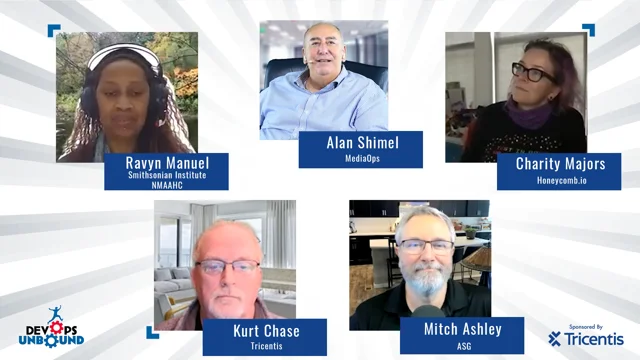
    Observability at enterprise scale brings with it additional application life cycle management requirements. Success requires knowing which changes result in improvements and which don’t produce positive results and how that information must make it back to the DevOps team through feedback loops. In this episode of DevOps Unbound, Alan Shimel and Mitch Ashley talk with Kurt Chase, senior director, global release management at Tricentis, Charity Majors, co-founder at Honeycomb and Ravyn Manuel, senior application manager at the Smithsonian as they discuss observability and continuous improvement. The video is below, followed by a transcript of the conversation.

    Alan Shimel: Hey, everyone. I’m Alan Shimel and welcome to another DevOps Unbound. We have a great panel in store for you today here on DevOps Unbound. Our topic is observability at a broad level. We’re going to jump into some of this. Let me first of all introduce you, though.

    First I want to introduce you, of course, to my cohost of DevOps Unbound. He’s the CEO of Accelerated Strategies Group, CTO here at MediaOps, my friend Mitchell Ashley. Hey, Mitch. Welcome.

    Mitch Ashley: Alan, thanks. Great to be here.

    Shimel: All righty. Let me introduce you to our panel for today. We have a great panel. I was so happy that this came together. First, coming at us from the mountains of Virginia by way of the Bronx, Ravyn Manuel. Ravyn, why don’t you introduce yourself and where you work?

    Ravyn Manuel: Absolutely. My name is Ravyn Manuel and I work for the National Museum of African American History and Culture, which is part of the Smithsonian. I am the Senior Applications Developer and DevOps Engineer. And thanks for not putting me in West Virginia. I appreciate that.

    [Laughter]

    Shimel: Okay. I don’t blame you. Next up we have the one and only Charity Majors, CTO and Co-founder at Honeycomb. Charity, a little bit about yourself, maybe introduce to the audience?

    Charity Majors: I am an ops nerd. I have been on call since I was 17 racking hardware. I no longer rack hardware anymore. Hardware doesn’t exist, as far as I’m concerned. Instead, I’m trying to save the world through better observability.

    Shimel: Excellent. And then, last but not least, we have Kurt Chase of Tricentis, Tricentis Releasing. Kurt, why don’t you introduce yourself?

    Kurt Chase: Hi, everyone. My name is Kurt Chase. I’m currently Head of Global Release Management at Tricentis, based in Northern California. Nice to join you all today.

    Shimel: Nice to have you here, Kurt. All right. So, team, panel, our topic this week is observability. And given that is the topic, I feel compelled to start with Charity because, Charity, in many ways you and the Honeycomb team are responsible for all this buzz around observability. Tell us about it.

    Majors: Yeah, a little bit. When we started the company a little over five years ago it was not a term that was really in use – used in tech. Now – which is not to say that we invented it. Far from it. But it has this long and impressive pedigree in mechanical engineering, specifically control theory. And in control theory observability is the mathematical tool of controllability.

    So, we started building this startup, Honeycomb, and we knew that what we were doing wasn’t monitoring. We knew that we weren’t reactively monitoring. We knew that we were – it was about instrumenting the code, getting at it from the inside. But for the first five, six months we couldn’t figure out what to call it. It was really hard to figure out how to talk about what we were doing. And then it was mid-July, midway through the first year when I remember Googling “What is the definition of observability?” And when I read it it’s all about “Can you understand what’s happening on the inside of the system just by looking at it from the outside with no prior knowledge?”

    And a lightbulb just started going off. It was like “Ding, ding, ding. That’s what we’re trying to build. That’s exactly –” if you translate that into software terms, what it means is can you explain any system state that – any state that your system can get into without shipping new code to handle that state because shipping that code to handle that state implies that you had prior knowledge. So, it’s all about the unknown unknowns instead of the known unknowns. So, yeah, that’s my story.

    Shimel: And you’re sticking with it. So –

    Majors: Yeah. I mean, it really encapsulates a lot of the problems that people are increasingly having, that there’s a lot that precedes from that definition of “unknown unknowns,” like you need to have high cardinality, high dimensionality, blah, blah, blah, all this stuff. But those are the things that speak to the problems of microservices and multiple storage systems, et cetera.

    Shimel: I get it. So, Ravyn, this is your life. How does this observability and what Charity has describe, the fact pattern or the problem pattern that she came to call observability, how does that in your life, day to day of what you’re doing, how does that kind of manifest itself?

    Manuel: Thanks, Charity, for actually providing a definition because I was like “Okay, are we supposed to define our own meaning of observability?” So, you’ve given a baseline. And I like that you said it’s not monitoring because I can actually feel the nuance. There’s a nuance between monitoring and observability. And it’s – what’s really interesting is that that’s a problem that I’m trying to solve today at work because we’ve got – and – because we’ve got the black boxes. So, you’ve got observability but when you have software there’s a lot of black boxes. You’re not supposed to be asking what’s going on inside the code because you’re not supposed to know what’s going on inside the code. But when you get a – you put a signal in – I was in the military, so I did electronic repair – so, you put the signal in and you don’t get the right signal out but you’ve got a black box. How do you know what went wrong there if you can’t actually observe what’s going on inside of there?

    It’s one thing to know the state of the software when you are the developer. So, as a developer, yes, I know. But when it comes to being the product owner or the project manager or a stakeholder and you’re trying to figure out what – “Why is this doing this?” or “This is not what I wanted,” actually is how that would come from that end, is “That’s not what I wanted.” So, how to get the stakeholders to get what they want when you can’t actually tell – I can’t tell what the code from my coworker is doing? So, in a way observability is a little bit – it is abstracted from monitoring because monitoring is telling you what it’s doing but it isn’t telling you the state. And so, it’s a problem that I’m trying to solve actually today.

    Chase: I was going to jump in here and say from my experience although monitoring, logging, reporting, alerting, they’re not observability, I think they are fundamental foundational pieces that you have to have in place. You can start observability without any of them, but I’ve found that the more you can get your monitoring and reporting and even get some alerting going, it allows you to then start observing the system. And for me, I know at Splunk and now here again at Tricentis I’m really trying to connect all the pieces because it’s not just about the applications, but I find that some of the DevOps engineers, they really help with observability, especially the ones that are super inquisitive, and they don’t just – when a result appears or something happens they don’t just take it at face value. They’re inquisitive. They dig in. They try and find the root cause.

    And I think that’s key with observability, is taking all the monitoring, reporting, alerting you have, taking the feedback from your customers, all of that comes together, I think, to really help you start to define those unknown unknowns that Charity brought up. I think it becomes very complicated. And then I think I’d love to talk about how AI and machine learning now can start to learn some of these things, because I think we get really good at repeatable incidences, observing those and then accounting for those in our systems, but it’s the unknown unknowns, how do we deal with those? That’s the real interesting part to me nowadays for sure.

    Majors: It is, I think, the interesting part. And I also think that AI ops is mostly bullshit and it will be for the foreseeable future.

    Chase: For a while. I agree, yeah.

    Majors: But I wanted to circle back to what you said about logging and everything, which is – so, there’s a technical definition for observability which has to do with high cardinality, all this stuff, and then there is just understanding your systems. And I absolutely agree: You need some alerting, you need some monitoring. I think there’s a question is – of – it log files? Is it metrics? That’s kind of irrelevant for just data. What’s important is can you understand what’s happening in your system when you need to understand it?

    And I do think it’s important to sort of differentiate the technical definition of observability from just the tendency that we have to, say, observing things because there’s a very rich and mature and well-established set of best practices for monitoring, which are in many cases completely mirror opposite from the best practices for observability.

    For example, with monitoring it’s like for years we’ve been saying, “You should not have to stare at graphs all day. The system should inform you when you need to – when there’s something wrong.” Super canonical best practice. With observability it’s exactly the opposite. It’s – we’re saying that most problems that happen are so subtle that you need to be looking for them. You don’t – you can’t page everyone at the threshold – you would drive them nuts if you were like “Oh, every little thing is going wrong. Bing, bing, bing.” You’re just – you would drive people nuts and they would quit. But when you’re an engineer, when you’re working on this endpoint or when you’re trying to solve this problem you should absolutely be looking through, asking questions, iterating on them, and looking for the trails in your observability tool at that very fine grain level.

    Chase: I agree.

    Shimel: So, I hear what all three of you said and it’s funny how everyone brings their own baggage to this issue.

    Majors: Oh, sorry.

    Shimel: No, no, it’s not – don’t be sorry. I love it. Here’s, I think, fundamentally – for those people out here who are watching this whole – I’ve got a lot of people out here who are DevOps people, who are ops folks, SREs, cyber folks, and their heads are spinning because I think there’s a little bit of what Kurt said to them, which is they don’t do – they do a shitty job monitoring, quite frankly. We don’t do a great job of it. People started throwing this AI ops word around, and there are a lot of companies raising a –

    Majors: Yeah, there are.

    Shimel: – crap ton of money around their AI ops stuff. And I never really understood what was real about it and many times it just sounded like another word for monitoring to me. But whatever. There is no AI in it.

    But – and now, look, over the last year, year and a half, two years we’ve seen observability come up here and they don’t get the difference. Ravyn, I think you do because quite frankly your black box analogy with electronic in the military, that is – you’ve got to figure out what the unknowns are from the unknowns. It’s not just getting all these signals that are known and then recognizing patterns and putting some automation behind it. That’s not observability. I’m sorry. Not in my mind, anyway.

    So, I think number one is we need to clearly define it. And Charity, you guys, you are a major kind of evangelist for this: “What is observability versus AI ops versus ALM,” which is before AI ops, and so forth. And there are SREs who are living this and DevOps teams who are living this every single day out here who haven’t got their heads around it. Ravyn, I always look to you as someone who gets it. Where do you fit on the – where do you kind of see it on the – let’s say there’s a scale of ALM, AI ops, blah, blah, blah, observability. What do you think?

    Manuel: I feel like I would be very – most close to observability because, again, all – anything with ops in it, when you start doing DevSecOps and DevOps, all of those ops just become marketing terms after a while. But observability is – because it’s not quite tangible it’s actually more real, because it’s real – because it speaks to exactly what’s coming, what’s going on when you’re trying to get continuous improvement, because you need metrics to show and prove that you’re doing continuous improvement. But how do you get there? What is it – what are the steps to get you there? How are you alerted that you are not improving or that you are going backwards?

    And so, when – I feel for me as far as observability I’m at the cusp, because I didn’t actually know that the word existed until I found out about the talk. I didn’t know that that had been defined. So, it’s really cool to know that I can now call it observability. It’s because it’s that thing that I can’t – there isn’t a tool to actually help me – actually help me know what it is that I’m looking at all the time. Not all the time. There are some tools that help me some of the time but not all the time. And it’s the times that I don’t know that’s when we are stuck, because it could be impacting the way – the system performance or the team’s performance.

    Shimel: Charity, I think you might have a customer there. It sounds like they need a tool.

    Majors: I feel like one of the key differentiators here between observability and AI ops and stuff is what it tries to center. With observability we are not – AI ops are like “Eh, we’ll tell you what to look at. You don’t need to understand your system. We’ll understand your system for you. We’ll tell you what to look at. We’ll tell you what it means. We’ll tell you what’s important.” With observability it’s the opposite. I think that we need to look to solutions that let computers do what computers are good at and let humans do what humans are good at. Computers are good at crunching lots of numbers but they can attach meaning to something. Only human beings can attach meaning to something. If I see a big old spike of red that could be good, that could be bad. You don’t know. There is no meaning until a human has attached them to it.

    And with AI ops, AI ops only really works if the corpus of data that you’re training it on doesn’t change. So, if you’re actually shipping software every day you’re fucking up your corpus. This – it’s kind of incompatible with modern software development. I have many thoughts and feelings on AI ops. God bless them, but mostly I think that what they’re trying to do is take the humans out of the driver’s seat. And I understand why, because the C-level, CTOs, CIOs, whatever – there’s something that kind of blew my mind when I realized it a couple years ago: They trust vendors over their own people. Their employees come and go; vendors are forever. So, whenever a vendor comes along it’s like you give them tens of millions of dollars; your people don’t have to hold all of the wisdom in their heads. You can replace them. They’re fungible. The tool will tell you; the tool will be the source of truth.

    And I just fundamentally reject – I’ve never seen that work well. I think it’s a shitty way to treat your people. And I would prefer to take the –

    Chase: And I would not agree with that statement, quite honestly. I’ve had leads that are –

    [Crosstalk]

    Shimel: All right. “Mr. Vice President, I’m talking.”

    [Laughter]

    Sorry.

    [Crosstalk]

    Majors: – and then using our tools to make them better, to impress them, to give them a better sense of where they sit in time and space in the history and what’s happened before and what they’re – they should be wearing grooves in the system as they wear – as they use it in the [inaudible].

    So, I think that it should – if you’re centering a person it’s observability and if you’re centering the – it’s AI ops. Sorry. Go ahead, Kurt.

    Shimel: It’s okay. Kurt, your turn.

    Chase: No, I was just – in my experience the leads, I’ve had – I’m a senior level director now; it was the same at Splunk – I did not encounter that where my leads trusted vendors more than myself or the people on my team. I was surprised to hear that, quite honestly, Charity. I have not experienced that.

    [Crosstalk]

    Majors: It’s not universal. But it’s – there – it exists quite a lot.

    Chase: Yeah, that’s too bad to hear that. That is seriously wrong and that’s going to go against everything we need to accomplish internally.

    Majors: Yeah.

    Chase: Yeah, if –

    Ashley: Have fun attracting great people with that mental model.

    Chase: Yeah, yeah, yeah. And the other thing – I’d love to hear your opinion on this, Charity – we have very complicated systems we’re running. The source code management, the build systems, the agents. I’ve found that it always is very helpful to distill it down into discrete parts, try not to blow the ocean at once. Let’s start with the source code management system. How are we observing that? What are we doing here? And would you suggest that’s a great way for people to get going? I mean, when you try and look at everything – you have to look at everything for sure, but to get started it seems like find some of the most important pieces. Source code management is a great one. The crown jewels. What’s your suggestion there for getting started and –?

    Majors: Source code management is important but it’s never – it’s almost – it shouldn’t almost ever be in the critical production path. And when people are rolling something out I always advise them to find something that’s – don’t waste your time instrumenting _____ observability, lights, and backwater to the system. Find the thing that you’re trying to understand and fix now. Find the thing that’s broken. Find the thing that’s causing you pain. Because it should be an order of magnitude better at answering your question, observability should, even than monitoring. I don’t think you can look someone in the eye and ask them to switch up what they’re doing and to use something else unless you can tell them it’s going to be an order of magnitude better than what they’ve got now because the costs of transition are so high.

    But with observability you should be able to go from instead of just the aggregate where it’s like “Well, I see a spike but I can’t tell you what it means or how they’re different from –” with observability you should be able to go exactly those rows, in which ways are those events different from all the baseline events, and very quickly go “Oh, I have a much richer view of my system now.” And if – once you’ve got that you should be able to explain way more about what’s going – so, we see this all the time when people are running out – when they’re rolling out Honeycomb. They start rolling – they roll it out to the service and they’re like “Oh, God, there are problems there. Did you know that this is broken? Oh, there –” and we’re like “Yeah, yeah, yeah, but you’re just picking up the rug. It’s been there – it’s been that way for as long as you know.” And they’ll pick up another service and the problems – I’m like “Yeah, but these problems have existed – you just had no idea because we were dealing with [inaudible].”

    So, I feel like the way to pick up momentum, the way to incentivize people to get excited about this is to look for the biggest pain point in your system and –

    Chase: That’s awesome.

    Majors: – then patch that with observability.

    Chase: That’s great advice. I agree.

    Manuel: Charity, a question. Does – can observability actually take in account process? Because you’re talking about if there’s something wrong in the system itself, but sometimes the thing that’s wrong with the system is the process.

    [Crosstalk]

    Majors: Well, everybody is not about process. And you’re totally right. That’s often – that is not something that you should ever ignore. A lot of the biggest problems are process problems. But observability is not the tool for that.

    Shimel: And that’s good to know too because quite frankly – and Mitchell knows this too – we live in a silver bullet world where people think the latest shiny trinket is the cure-all.

    [Crosstalk]

    Majors: – everything, you should –

    [Crosstalk]

    Shimel: No, observability, yeah, it’s not going to cure Covid either.

    Majors: No.

    Shimel: But –

    Chase: And that was the point I was trying to make initially. I think I said it wrong. It’s not that monitoring and reporting, logging aren’t foundational; they’re complementary. You kind of need them all. If you’re running modern stacks – I said that incorrectly at the start – it’s not foundational. There’s – you need them alongside each other.

    Shimel: They’re adjacent. They’re not –

    Chase: Yeah, absolutely. Absolutely.

    Shimel: They’re not – it’s not a pyramid per se.

    Chase: Right. Exactly.

    Shimel: I think it’s part of your stack horizontally.

    Chase: Yes. Yes. And I’ve found –

    Shimel: Can I – we haven’t’ – go ahead, Kurt, I’m sorry.

    Chase: I was going to say I’ve found with especially new individuals and new people to the DevOps team and the DevOps world, getting them involved in the monitoring and saying, “Hey, this is how we start monitoring,” that’s a great place to start. It’s almost entry level for observability, if you – I’d love your opinion on that, Charity, too.

    Majors: Well, I really think that everyone who writes and ships software should be on call for their code, no matter how –

    [Laughter]

    Chase: Yeah, me too.

    [Crosstalk]

    Majors: Software ownership. And so, yes, that’s very empowering, I think, to show them how to find the trail, the alert that’s paging them, trace it all the way to the system and fix it. That’s something that as engineers, we feed on that. That’s exciting to get to know how to run your ship better. Yes, absolutely.

    Shimel: Well, but – so, you know what? Mitchell and I started a company – or, were two cofounders of a company called StillSecure 20 years ago. And that was one of the things. Mitchell ran the engineering team and that was one of the things he instituted, I remember, was that every developer had to take a turn on the help support desk, level one, answer the phone. “Hello, Mr. Customer.”

    Majors: It builds empathy.

    Shimel: And try to explain it because they had to answer the alert. And even when they weren’t on that level one our escalation procedure was if it went to level two or three it was the developer who did the level two and three support.

    Majors: I will say that, yes, and I do think that every engineer should be on call for their work, but you have to couple that with it’s management’s job to make sure that that doesn’t suck, that it isn’t _____ for them, but it doesn’t just kill you with [inaudible]. It is management’s absolute fucking responsibility to make sure that they’re given the time to – away from project work to fix these problems so that they don’t recur, so that they get enough sleep. I think it’s reasonable to ask any engineer to be woken up two or three times a year for their code. That’s it. Because more than that, you’re burning people out hardcore.

    Manuel: Been there, done that.

    Shimel: You know, Charity, Ravyn –

    [Crosstalk]

    M : I have a question. I have a question I’d love to ask all of you. I’m thinking about observability has been elevated because of, in part, the world that we’re living in. Software architecture is changing. We’re dealing with microservices, all these much smaller things that are interconnected to make software. And at the same time as we’re changing the pace at which we release software, not only is it unknown unknowns, it’s like a river – Riven –

    Shimel: Ravyn.

    Ashley: – we’re in the river of the changing software. So, you’re trying to understand all of these things at the same time. It seems like it’s the right time for observability to be the thing to be working on because ops has to be elevated to the same level of the same kind of architecture and processes that we’re using across the – in the life cycle of software. Do you agree with that or not? It seems to me we’re in the right place, right time.

    Majors: Absolutely. I mean, I feel like the first wave of DevOps transformation was all about “Ops people, learn to write code.” And we’re all like “Eh, okay.” But I feel like the pendulum has swung. I think now it’s about “Okay, software engineers, your turn.”

    Ashley: You’ve got to do ops.

    Majors: I have to learn to write operable services and to learn to maintain them and get called for them and – because what microservices has done, all of that complexity and logic has to be bundled up in the app. The app.

    Manuel: Exactly.

    Majors: And now it’s like we’ve been thrown to the four directions of the map. And what that means is that so much of understanding and operating your application has been pushed into the realm of operations and systems. It used to be that if all else failed you could attach a debugger to your app and just step through, see what was happening. Well, you can’t do that anymore now because the process died and jumped to another service, and another service. And part – the way that we instrument for observability is all about packing up the context of the application and shipping it along with it from hot to hot, one event per request per service, so that you can slice and dice and reason about your systems in a way that you used to be able to.

    Ashley: Doing that really changes the design. I’m thinking about Alan’s story of what I did back at StillSecure. What prompted that was when a customer called in and said, “I’m sitting in – we’re using your project and this dialogue box popped up and it says ‘An unknown error occurred’ and that’s all it says. What do I do?” Well, nobody knows what to do with that. So, we all just said, “Look, everybody does support in that case. Everybody does ops.” And that changed: “Okay, we have to figure this out.” And suddenly that was the problem of “How do we make this easier to support and easier to resolve issues with?” So, it does affect behavior and design or product.

    Majors: Yeah, absolutely.

    Manuel: I think microservices is – will actually do good for observability because if you do microservices correctly then each service is atomic. It does one thing and one thing only. It does that thing good. So, if the unknown is not taken out of it because you know exactly what this thing is supposed to do –

    [Crosstalk]

    Majors: Oh, no, honey, the unknown is never taken out of it. The unknown is never –

    [Crosstalk]

    Manuel: In my ideal world it is.

    [Laughter]

    There are no more unknowns –

    Shimel: In Ravyn’s world, yeah.

    Manuel: – in Ravyn’s world. Exactly.

    Shimel: Yeah. But I’m going to tell you something. The flipside to this, though, too with microservices, and I think we’re starting to see this now, is can you have too many microservices running? Does it – is the complexity load in there such that observability almost becomes meaningless or impossible?

    [Crosstalk]

    Majors: I don’t know that complexity can every really be created – no, it typically is not meaningless. It’s your only hope to understand this shit if that’s what you’ve done to yourself. But complexity can only be moved around. It’s just a question of tradeoffs, like which set of tradeoffs – some folks have gone whole hog on microservices and then they’ve found the edges to those design _____. But –

    [Crosstalk]

    Chase: What I find – I was going to say what I find challenging is both at Splunk – Autodesk was interesting. So, to your point, Alan, we used to make engineers buy bagels. You break things; you have to buy bagels. And so, we had a lot of bagels brought in. But both at Splunk and here at Tricentis we have a world where we’re supporting large enterprise applications and delivery of enterprise apps. We’re also – obviously all the microservices – and trying to apply these techniques across the board is very interesting, very challenging.

    [Crosstalk]

    Majors: Oh, yeah. There’s no one-size-fits-all.

    Chase: There’s not. There’s not. And almost to the point you made, Ravyn, observability almost has to be customized for what you’re observing. It’s – I haven’t had a chance to run Honeycomb yet, but for me my experience has been there’s always those little idiosyncrasies about how we run our ops, how we –

    [Crosstalk]

    Majors: There’s no such thing as a perfect _____. No one else can do it for you. It can be – it can get you started. It can give you a boost. But at the end of the day somebody’s got to fucking understand your software and roll that into your instrumentation. Nobody else can do that for you, let alone _____.

    Chase: And that’s where with AI ops, I won’t say it’s complete shit. I think there is some value there. Some of it is just about automating common occurrences. And maybe that’s not valuable but –

    [Crosstalk]

    Majors: – it’s an AI but they’re just using that to make – to raise lots of _____.

    Chase: Oh, sure. Okay. Yeah.

    Manuel: Didn’t work.

    Majors: Like, “Oh, I have an AI too.”

    Shimel: No, but we – and you’re right, AI is a money term. But ML ops is something that’s caught on a bit, more than, I think, than AI ops. And I think that’s really at the heart of it, which was to recognize repeatable patterns or recognize patterns that we can respond to.

    [Crosstalk]

    Majors: Although, I would still challenge – I think in far too many cases people are reaching for the complicated solution instead of fixing it at the start. They’re like “Ooh, I’ve got 50 bazillion e-mails so I – and all of that disk space so I need AI to solve it” instead of turning off the fucking e-mails and setting up a different kind of alert or some automatic _____. Just – is this really a problem we need to solve? Or could we solve it better by just not having it?

    Shimel: There is that.

    Majors: Sorry. That’s my last bitch.

    Shimel: Do we need to solve every – and I think Ravyn – or, not Ravyn – Charity, you were getting at it before. Do we need to solve every problem?

    Majors: Is it the most important problem? Is this going to be the biggest bang for our buck?

    Shimel: Yep. I mean, we used to have a –

    [Crosstalk]

    Majors: – or the _____. Like, senior engineers write software but very senior engineers don’t need software.

    Shimel: Yeah, no, I mean, look, when Mitchell and I were doing the security company we had a product, “Vulnerability Assessment of Management.” VAMP. Internally we called it the Bad News Generator because that’s what it was.

    [Laughter]

    It was the Bad News Generator. And the problem was we would go to an organization like Ravyn’s and it would pop up a few thousand vulnerabilities, and the security or the ops people would be like “What am I going to do?” And “Don’t worry about 95 percent of them. Let’s just worry about the top five percent.” And it was like – it was employment insurance, was what it was, because there would always be more vulnerabilities for us to find next year.

    But that being said, it really was the case where you’re not going to fix everything. We don’t have the time to fix everything even if we wanted to.

    [Crosstalk]

    Majors: And it’s not really doing a great job of giving you differentiation, letting you know what’s really important and what’s just noise. So much of these tools, they just give you so much noise and it’s almost worse than nothing at all.

    Shimel: Well, that’s why with the Bad News Generator people used to – so, Mitchell got the lucky part of designing it. I had to go sell it. That was much harder.

    Ashley: I remember the –

    Shimel: Much harder.

    Ashley: – guy from the federal government called and said, “This thing is spamming everybody in the Defense Department.”

    Shimel: Yes, “We have all these vulnerabilities.”

    Ashley: “How do I turn it off?”

    Shimel: Because we had this automated workflow before we had terms like AI and ML. But it is hard.

    Hey, guys, we’re coming down the home stretch here. We probably only have five minutes or so left. I wanted to – let’s look forward now. I’m big into looking forward these days. I’m hoping we’re going to do conferences in person again; we’re going to – I don’t know if we’ll go back to our offices but…

    What’s next for observability? How does this continue to evolve?

    Majors: What’s next is I think really wrapping traces in as a first, best tool so that – right now too many people are like “I have one tool for metric, one tool for logs, one tool for servability, another tool for –” they’re spending just ____ data again, every time. And it’s worse than that because you can’t actually seamlessly break down a chain of events, so you’re just copy/pasting this idea into that tool or hoping despite – because it seems to line up timewise, it’s actually bees in the logs – you should be paying to store this data once and you should be able to flip back and forth between loads. Are you slicing and dicing? Are you doing aggregations at read time? Are you zooming in? Are you zooming out? Or are you slipping back so you can view it as a logger file by time?

    I think that observability tools like us and Lightstep – which are the only two observability tools out there by my technical definition – although, I will say I do think that this might be the year that that begins to change. I know that so many of the big players have been working as fast as they can for years on the back end. They’re trying to catch up to where we sit technically faster than we can get catch up to where they sit in terms of the business. So…

    Chase: And I –

    [Crosstalk]

    Manuel: I like that you said that. Sorry, Kurt. That –

    Chase: No, no, go ahead, Ravyn.

    Manuel: – Charity – I just wanted to say to Charity –

    Chase: No, no, Ravyn, go ahead.

    Manuel: – about tracing, because that’s actually the solution that I am actually looking for, that I’m looking for –

    [Crosstalk]

    Majors: It’s got a lot of rough edges.

    Manuel: – for organizations. Yes, to be able to follow –

    [Crosstalk]

    Majors: But there are lots of problems we can’t solve any other way.

    Manuel: Exactly. So, I feel good that I’m doing it inherently, like I know what I’m supposed to be doing.

    [Crosstalk]

    Majors: You’re on the right path.

    Manuel: I think I’ve actually found a way to do that. But yeah, tracing I also think is the way to go. That is the only way you’re going to be able to know, because it’s taking you from point A to point B to point C to point D and you’ll be able to see that all. And there will be no unknowns. [Laughs]

    Majors: Oh, honey. You keep saying that.

    [Crosstalk]

    Manuel: It’s my dream. That’s – let me live my little dream.

    [Laughter]

    Shimel: Kurt, what do you got?

    Chase: Yeah, well, where mind – excuse me – where my mind goes to in the future is what are we doing in the education system to really disseminate this information, how monitoring software is developed, how we monitor it. And then also “observability” is such a loaded term because I know at Splunk they would consider observability something much different, for running a SOC and things like that.

    [Crosstalk]

    Majors: Oh, no.

    Chase: So, I think it – I mean, at its core observability is what it is. But how it’s implemented for different disciplines and how they use it, I think companies would definitely take exceptions with some of the things we’ve said here –

    Majors: For sure.

    Chase: – and what observability means to them. And I would just say keep that in mind, that it is a huge field and I think we’re going to see further improvements. I love the tracing. And being able to have that in your tool set would be fantastic.

    Shimel: Charity, final thoughts before we wrap?

    Majors: Oh, I am just enjoying the fact that some people are so interested in this that they’ll show up and argue about it all the time. So…

    [Laughter]

    Shimel: It’s all good. Hey, you know what? It’s a living. Mitchell, as usual, I’m going to give you the last word.

    Ashley: Well, I’ve learned two things today. Don’t call my tool an observability tool or an AI tool unless it really meets the definition, or I’m going to get crucified.

    [Laughter]

    No. No, what – I mean, I love this conversation. I learned a ton. I always do when we have these – what’s so cool to me is that we’re talking about operations and we’re talking about this part of our world and we’re not talking about better ticketing systems. We’re talking about really meaty, interesting things that help us do our jobs better, do a better job for the company, for the customer. That’s exciting to me. It’s just really cool. I enjoy it very much.

    Shimel: Join us for our next show where we’ll be talking about better ticketing systems.

    [Laughter]

    No.

    Chase: And what argument did I miss? I was –

    [Crosstalk]

    Shimel: No, no, no, no. It’s all good. You know what? I enjoy having really bright, smart people who are willing to express their opinions. And when I knew we had this panel, it was the lineup, I knew there was going to be no shortage of opinions, nor any backing down. So –

    Ashley: We’re going to call the next one “The observability mix-up.”

    Shimel: Right.

    Majors: We’re going to have to call it “Observability AI.”

    Chase: I still want to see that sticker –

     Shimel: “AI Observability.” All right. Hey –

    Chase: We need to see the sticker Charity was holding up. We need to see that.

    Majors: Oh.

    Shimel: Oh, we never got to that. Yes.

    Chase: We have to see that.

    Majors: I’ve got a few of those. I’ve got “Release := deploy.”

    Shimel: You’ve got a lot of them here.

    Majors: I’ve got “Ship dangerously.”

    Chase: Yeah, I love that one.

    Majors: “Deploy on Fridays.”

    Shimel: You know what? You used to be able to get these things on conferences. Now we’re reduced to showing them on Zoom.

    Majors: Yeah, you have to.

    Chase: Yeah. Exactly.

    [Crosstalk]

    Majors: “Perhaps this is a good day to deploy.”

    Chase: Maybe.

    Shimel: Okay, yeah. Perhaps.

    Chase: It’s Friday. It’s not a good day.

    Manuel: No, Friday is not a good day.

    Chase: That’s the one, right there.

    Shimel: And there it is: “I deploy from Cron.”

    Ashley: That’s the one to end on right there.

    Shimel: That’s is. We’re going to wrap it. Hey, you’ve watched DevOps.com. It’s sponsored by Tricentis. Many thanks to them for sponsoring. Just wanted to quickly mention Kurt is from Tricentis. Charity is from Honeycomb, and it’s Honeycomb.io. Go check that out.

    Majors: We have a very generous ____ here.

    Shimel: A very free _____. Ravyn, you can start playing with it now and see if it’s something that gives you tracing and so forth. Mitchell, thanks for joining us.

    Ashley: You bet.

    Shimel: We are back – actually, we are back with a roundtable next, which will be open to the public. Looking forward to having you on for that. But until then, this is Alan Shimel for DevOps Unbound. Have a great day, everyone. We’ll see you soon.

    [End of Audio]

  • WhiteSource Tool Automatically Fixes Code Vulnerabilities

    WhiteSource Tool Automatically Fixes Code Vulnerabilities

    WhiteSource today announced that it has developed the first-ever tool that automatically remediates vulnerabilities discovered in custom code.

    Rami Sass, WhiteSource CEO, said WhiteSource Cure surfaces recommendations for fixing security vulnerabilities in code that developers can then apply with a click of a button. WhiteSource has a long history of providing tools that discover vulnerabilities in open source software that it tracks via a database it manages, but Sass said customers are making it clear they need a way to automatically remediate those issues in a way that doesn’t adversely impact developer productivity.

    The average developer spends, on average, half a day fixing a single vulnerability, so the impact security issues are having on the rate applications are being developed is significant, added Sass. WhiteSource Cure gives each developer the equivalent of their own personal security expert, noted Sass.

    Developers can either apply the remediation suggested by WhiteSource Cure—that manifests itself as a pull request in a DevOps pipeline—or they can fine-tune it as they see fit, said Sass.

    WhiteSource

    WhiteSource Cure arrived as friction and tensions between developers and cybersecurity teams rise in the wake of a series of high-profile attacks against software supply chains. As a result, organizations are instituting more thorough security reviews of application development projects. The concern is those reviews will dramatically reduce the rate at which applications are being delivered.

    Of course, many organizations are looking to shift responsibility for application security further left toward developers to minimize the number of vulnerabilities that might need to be remediated either just before an application is deployed in an on-premises IT environment or, worse yet, after it is deployed. Trying to achieve that goal within the context of DevSecOps best practices, however, is challenging. Organizations first have to acquire vulnerability scanning tools that developers will actually use, and then provide developers with the training required to identify various classes of vulnerabilities.

    The other big challenge is the time it takes to train developers to recognize vulnerabilities. WhiteSource Cure eliminates the need for developers to become security experts, said Sass. In addition to a commercial offering, WhiteSource is also making available a Community Edition of WhiteSource Cure for open source projects that will forever be available for free to developers working on those projects.

    Sass said that rather than relying on machine learning algorithms and other forms of artificial intelligence (AI) to build WhiteSource Cure, the team that developed the tool found that more traditional approaches to software composition analysis (SCA) provided more reliable results.

    It’s unclear whether the ability to automatically remediate known vulnerabilities in code will render much of the DevSecOps debate moot. However, it’s clear that the simplest path forward toward achieving DevSecOps is, as always, to automate as much of the remediation process as possible. The challenge will be waiting to see how much confidence developers and cybersecurity teams will have in the recommendations generated.

  • CircleCI Survey Shows the Need to Prioritize DevOps

    CircleCI Survey Shows the Need to Prioritize DevOps

    A CircleCI survey of 2,013 business leaders in the U.S. and UK published today finds nearly all respondents (97%) recognize that the success of their business within the next year depends on their software development teams. Despite those findings, well over one-third of respondents (39%) admit their organization is challenged when it comes to innovation and acquiring and maintaining developer skills.

    A full 89% of respondents said they also have a good understanding of how to measure the performance of their engineering teams. However, 40% of companies are still using antiquated metrics such as the number of lines of code written, while another 37% measure story points.

    More troubling still, less than one-third of respondents (30%) said they plan to make adoption of DevOps best practices a priority. On the plus side, only 15% of respondents said they are implementing a continuous integration/continuous delivery (CI/CD) platform for the first time.

    The CircleCI survey suggests that improvements in how software is delivered could be worth, on average, up to $126 million per year. Nearly two-thirds of respondents (65%) said their business is involved in digital business transformation initiatives of one kind or another. Another 20% said they have completed one.

    Jim Rose, CircleCI CEO, said it appears that while more organizations now realize how dependent they are on software, many of them have yet to address issues that fundamentally impact developer productivity. For example, more than half (52%) of respondents don’t allow their software developers to choose their own tools, noted Rose. While there is a clear need for a consistent approach to building and deploying applications, Rose noted that DevOps best practices should not require developers to employ a specific set of tools. Developers are only able to truly innovate when they are able to experiment with different tools, said Rose.

    In general, Rose said DevOps adoption tends to go through various cycles. Many organizations today are looking to reduce the number of tools that make up a toolchain. However, those efforts shouldn’t curtail the ability of developers to innovate. A CI/CD platform that provides the foundation for DevOps workflows needs to be easily extensible, noted Rose.

    It’s not clear to what degree adoption of DevOps best practices have stagnated, but the number of organizations that have implemented DevOps across their entire enterprise remains limited. Most organizations have individual teams that might have adopted DevOps to one degree or another. In many cases, those teams are using disparate tools and platforms.

    Most organizations clearly want to be able to build and deploy applications faster. The challenge isn’t so much mastering DevOps platforms as overcoming many of the cultural issues that conspire to limit DevOps adoption. In time, however, the need to rely more on digital processes will force the DevOps issue. As one organization makes advances—thanks in part to their ability to effectively employ DevOps processes—the more keen rival organizations will be to make sure they don’t lose ground. It may be a while before business executives connect the dots between their ability to compete and the degree to which organizations have mastered DevOps, but it’s increasingly apparent that day is not too far off.

  • JFrog, Vdoo Securing SecOps

    JFrog, Vdoo Securing SecOps

    Earlier this summer, JFrog acquired Vdoo to deliver end-to-end continuous security from development to device—is this what DevSecOps looks like? JFrog CEO Shlomi Ben Hami and Natenel Davidi, CEO of Vdoo, speak with Alan Shimel about what the acquisition means and how this will change the way organizations approach DevSecOps. The video is below, followed by a transcript.

    Announcer: This is Digital Anarchist.

    Alan Shimel: Hey, everyone. Thanks for joining us here on a special segment of Tech Strong TV. I am really happy to be joined by two gentlemen, one coming to us all the way from Israel, Netanel Davidi from a company called Vdoo, and for those who don’t know, Vdoo is a Hebrew word meaning we understand. What?

    Netanel Davidi: Making sure.

    Shimel: Making sure. And then my second guest needs no introduction to our audience, it’s my friend, Shlomi Ben Hami. Shlomi, of course, is CEO and one of the Co-founders of JFrog, and he’s coming to us, I’m gonna assume, from the swamp in Silicon Valley today?

    Shlomi Ben Haim: You are correct. Great to see you again.

    Shimel: Shlomi, welcome. Good to see you, my friend. It looks like you’ve been in the sun a little—a little tanned. I’m glad to see they’re letting you out a little bit.

    But guys, we’ve got some big news to break today. Nati, you’re a new person—okay, I was gonna say, who wants to break the big news, but up to you, Shlomi.

    Ben Haim: Yes, I think I’ll go first and obviously, Nati—

    Davidi: Okay.

    Ben Haim: – will have far more information to share with all of you. Nati Davidi and the Vdoo team are joining JFrog. We are announcing the acquisition of this wonderful company that will complete our SecOps solution, not just for the DevOps and SecOps pipeline, but all the way to the edge, whatever the edge is, whether it’s a device, a data center, or any other destination.

    And Alan, you’ve heard me so many times saying that DevOps without security is half-baked and crippled, so the solution that we are now building together will take us another leap forward toward our vision of liquid software, and becoming the company behind all the software updates in the world. So ,we are obviously very, very excited to join Nati and the team to the JFrog family.

    Shimel: Congratulations. Thank you, Shlomi. Nati, as we say here in Boca Raton, mazel tov to you and the whole Vdoo team. So, tell our audience—and our audience, Nati, you should know is a very cyber savvy audince. Let’s hear a little bit about the Vdoo story. We know JFrog, but give us a little of the Vdoo story.

    Davidi: Sure. So, it all started almost four years ago when we were an initial team of people coming from endpoint security and a space of software vulnerability expert mitigation. Our previous company, we dealt with it as part of Palo Alto Network, they acquired my previous company, Cyvera, and another part of the group coming from embedded security and the space of reverse engineering and vulnerability research. And we joined together to cope with what we believed three or four years ago to be the biggest problem today in the security space, which is the connected device and embedded systems.

    We call it that way more technically because, clearly, there are very many other good companies out there doing more network security for IoT. We claimed and are still claiming that you need to take care of the source of the problem, which are the manufacturers and the creators of such devices, of such embedded systems, and for that, we established Vdoo.

    So, we did initially, we focused on that, and very quickly, we came up with a platform for product security, focused specifically on embedded systems and IoT, that allows developers and product security stakeholders to analyze automatically any kind of connected device. But when I say analyze, it’s not from the network point of view, but rather analyze the software stack in order to identify any security issue, any of the main buckets like third party issues, issues with your own code, the first party proprietary cloud that you are writing, issues with whatever in between, productization issues, configuration issues, hardening issues, architectural issues, things around cryptography, around how you keep your keys, how you configure things.

    So, we said we want to be the first player that allows everything, truly everything. Look at all of the aspects of security clearly, of course, supply chains, threats within it, and say to the manufacturers of devices, “Take this, and this will be your product security officer in a box, and a product security team in a box.” And it worked well.

    Now, the interesting thing is that, in order to do it, we had only one applicable approach—analyzing binaries. Why? Because in the embedded space, everything is around binaries. You have images of real time operating systems, third party compiled binaries and files and packages that you cannot really see into them what’s going on. You get them in the form of drivers from Qualcomm or AUTOSAR, whatever known library, and the manufacturers need to look into those, and they don’t have the source code. They have to be able to analyze them.

    So, we focused on binaries, and with that, again, we came with the platform and very quickly without even us knowing, our customers started to use us for purposes other than embedded security analysis. They started to analyze web applications, mobile applications, containers. Because when dealing with embedded, which is considered to be the most complicated and advanced or difficult things to analyze automatically, doing the rest is usually more about gaining more data but not developing more technology.

    So, we adapted, and we allowed our customers to analyze the applications that are talking with the devices and the web services that are talking with the devices. And we added more and more capabilities, and by then, we said, “Wait, why focus in on embedded systems if, through the binary analysis approach, we can serve the entire industry, we can provide security for whatever software artifact is out there.”

    And the next thought was, we just need to find the right partner who will deal with binaries. [Laughter] And the answer was, there is one such pioneer, which is known to everyone, which is JFrog.

    So, I asked Shlomi kindly to meet, to consider collaboration, so we can enjoy the many thousands of customers and huge community of JFrog and tell them, “No, use us to analyze your repository on top of Xray. Xray brings great capabilities, we enhance it with more capabilities for zero day analysis, configuration analysis. So, let’s do it together.”

    And that’s how our discussion started and today, we see where it is going and we are very, very excited about it.

    Shimel: What a great story. So, did you get the space two floors from them in order to meet, or were you already there? [Laughter] I’m kidding, I’m kidding.

    Seriously, I mean, my background is—look, I cofounded a company that really pioneered what we used call NAC, right, Network Access Control, and we did it for the U.S. government, for the DoD, right? So, this was not embedded systems, these were every endpoint network device coming on via, you know, 2.1x, we would test configuration vulnerability, et cetera. I know what a tough job that is.

    Once you go into the world of embedded systems, though, it’s like—anything goes, right? As you said, you’ve got Qualcomm drivers, there so much black box stuff. Knowing what’s secure and not is—I can’t even imagine, you know, how you do that. But now, once you’re taking binaries and artifacts, you’re right, there is only one company for you to go to, you know, it’s this man’s company. So, what a great match.

    Shlomi, he mentioned, Nati mentioned Xray. Xray’s a good product. But it’s a very specific product, right? If you’re downloading an artifact from the repository, it’s gonna check that as you’re doing it. This, of course, opens a whole different world of checking downloads and components and so forth. What’s the plan?

    Ben Haim: So, I’ll first start by saying, Alan, that I’m sitting here thinking that this would be probably the only interview in the world that you will have two CEOs that are so excited about binaries. [Laughter]

    Shimel: Yeah. [Laughter]

    Ben Haim: I’m enjoying it.

    Shimel: I think you’re right—you’re right, you win that.

    Ben Haim: So, listen—when we started, we built Artifactory to be the universal repository for all types of artifacts. And very fast, we identified the software package, the binary, as the first level citizen in your DevOps pipeline. There is no other asset that is more important. And why? Not because JFrog thinks so, but because of the fact that this is what you bring from outside, this is what you build inside the organization. This is what you test, this is what you promote, this is what you deploy, and this is the incremental update that you want to see at the end of the day on the edge.

    Now, with this in mind and the liquid software vision to be the company that changed the way software is being updated in the world, it was clear to us that SecOps cannot end on securing your repository. That’s great, that’s a great value. Xray can give you the composition analysis, the dependencies graph, secure your binaries—that’s great.

    But what happens when the Product Manager needs to take a binary? This is where the trust is broken. And we can—you know, every SecOps company, and you met all of them and you know all of them, Alan—every SecOps company will tell you, “We want to kind of build the bridge between developers and security guys.” It will not happen because you don’t use the same currency.

    And when it comes to binaries, both Vdoo and JFrog speak the same language, identify the same pains, and take it very seriously, not just on the development side or then on the testing side or then for the Product Manager side—all the way, all the way to the update, all the way to the deployment to production. So, obviously, we were very excited about what Vdoo had to offer, and it was again, just like everything else in JFrog, a binary question—are we competing or buying?

    And I’m very happy and very pleased to get to this moment now, speaking with you, knowing that the Vdoo guys are joining JFrog. Now, why this is so important from a culture point of view—and Alan, you know me well. You know how culture and the synergy is also about the people. We are bringing approximately 100 people that thinks and program and build their products like hackers. They know how the threat looks like. We are joining them through our hundreds of people that think like developers. What are the chances that this will not bring a better solution, a better blend to the market?

    Shimel: Sure.

    Ben Haim: And with that, I’m taking the next leap forward to fulfill the liquid software vision.

    Shimel: Agreed, agreed. And you know, frankly, it couldn’t come at a better time, right? Because wherever you are in the world today, and look, I’ve been in security 25 years—never has security gotten the attention, real attention, everyone always gave lip service, but real attention now. Whether it’s the supply chain or the ransomware or the whatever the attack du jour is, we are recognizing that cyber, cyber security represents probably one of the most serious threats to our continued transformation, right?

    And we saw this past year, unfortunately, without digital transformation and the move to a connected world software, where would we be, right? We would be in a lot worse shape than we were. And cyber security is the biggest threat to this. We need—we need to stop taking and do more doing, right, when it comes to building more secure software, right? And if people are building software like Shlomi and the team say, liquid software, right, without versions, it’s gotta be secure. And not only, it has to be secure, people have to be confident that it’s secure, right? Because that’s the biggest inhibitor—that’s the inhibitor, the lack of confidence.

    Davidi: And you can see this coming clearly, finally, from the regulators starting to draft bills around it, and you see demand from the end users—not necessarily consumers, but everyone, hospitals, manufacturers, they start to telling, “you want to buy from you, I want your software to be secure.” This is a demand, this is a requirement for RFPs, for RFIs. We see it everywhere. So, this is going to be a boon, because so far, the cyber security space was highly focused on the after the fact security, on the enterprise, care about, take care of it from the very beginning all the way to the network. And this is the only—

    Shimel: No, this builds up material, right, Nati? I’m sure you’re familiar, right? And there’s EEO, the bills of material order. Look, if this thing—you know, why did it take so long? I don’t know, but if this thing catches on that you need to have a bill of material for every software out there, for every app out there, people will, you know—go ahead.

    Ben Haim: I will just add to it, Alan, it also makes sense the way it happened. Look at the digital transformation. We are now facing the second wave of it, and we started to realize, everyone, every organization started to realize that being fast is not good enough. But you have to be fast first ________.

    Shimel: Yeah.

    Ben Haim: And then to build the security solution around it. So, developers delivered. They started to be faster than the security team, and now, security is catching up. But if you look at 99.9 security companies, they are not selling value, they are selling fear. They are telling you what will happen, what will happen if you will not do that. And developers hate that. Developers want to build, they want to have the freedom of choice and to be faster. And the security tools that are not focusing on the right pain have to be sold as fear and not as value. And this is the change that JFrog and Vdoo will bring to the market. Putting ________ aside, we focus on the community pain, as we did with Artifactory, as we did with Xray, as we announced just three weeks ago at swampUP with JFrog distribution. How can you distribute if it’s not secure all the way to the edge?

    Shimel: Okay. We’re running low on time, but let me bring together a little—I need some nuts and bolts, here.

    So, the deal was announced on Tuesday, today’s Thursday. Is it closed yet, was it—without getting into, I know you’re not gonna discuss the particulars, but is the deal closed? If not, when is it supposed to close? When are the Vdoo people, when are these hackers joining the developers, chocolate and peanut butter? When are we gonna see it?

    Ben Haim: Yeah, we hear this question again and again, first from our team, what are the first signs that we would like to see and what are our other plans?

    So, obviously, the definitive agreement is signed, and the closing is supposed to be in the next few weeks. We already have both sides, teams standing ready to merge the products, and the first step will be merging the infrastructure, making sure that this wonderful research that Vdoo is leading with vulnerabilities and database is also merging to Xray so our users can start enjoying that. We are thinking about the product philosophy, the hybrid cloud and on prem—all cloud, all regions, cloud native ready, the unified solution that will be scalable for our users. We have over 6,000 customers that are waiting for something like that.

    So, obviously, we will take the first leap and merge the assets and the low hanging fruit into Xray. And then, during 2022, we will build a unified platform that will include Vdoo’s capabilities into the JFrog platform.

    Shimel: Excellent. Excellent. Nati, just a question for you. I mean, obviously, all the people at Vdoo will stay on at JFrog. For people who may be very familiar with JFrog but have not heard of Vdoo, what’s the Vdoo website?

    Davidi: It’s Vdoo, V-D-O-O dot com.

    Shimel: Excellent. Alright. You can go find out more about it there. As I said in the beginning, Nati—congratulations, mazel tov on…you know, I learned from a mentor once, it’s kinda like a boat. The best two days are the day you start the company and the day you sell your company, so congratulations on that, it’s a beautiful thing.

    Congratulations to you, my friend, Shlomi, right? This is a piece of the puzzle that was missing and it’s important, and it’s gonna be more important every day going forward, so—good stuff.

    Ben Haim: It’s important, it’s a very, very exciting market for us. It’s increasing our addressable markets, and more than everything, we’re bringing over almost 100 people that have the same DNA and the green blood just like JFrog.

    Shimel: Look, getting 100 security experts at a shot—that alone might be worth it, because they’re hard to come by, my friend. Alright, Nati, congratulations. Shlomi Ben Haim, CEO—thank you, as always, my friend.

    This is Alan Shimel, we’re on Tech Strong TV. We’re gonna take a break. We’ll be back in a moment.

    [End of Audio]