NVIDIA has announced its intention to acquire Arm from SoftBank for $40 billion as part of an effort to create a juggernaut that will build processors optimized for artificial intelligence (AI) applications that span edge computing deployment to the cloud.
Under the terms of the proposed deal, Arm will operate as a subsidiary of NVIDIA and will continue to headquartered in Cambridge, UK. NVIDIA will pay to SoftBank a total of $21.5 billion in NVIDIA common stock and $12 billion in cash, which includes $2 billion payable at signing. SoftBank will retain a 10% stake in NVIDIA.
NVIDIA CEO Jensen Huang during a conference call also committed to licensing the software NVIDIA uses to make graphical processor units (GPUs) using the same licensing model Arm has employed to encourage manufacturing partners to create processors based on its designs. In theory, that approach could substantially lower the cost of GPUs once the deal closes.
However, because of all the regulatory approvals required, Huang said NVIDIA could not commit to a timeframe for the close of the deal. Previously, Huang noted it took NVIDIA a year to close the acquisition of Mellanox, a provider of storage and networking infrastructure.
In addition to providing processors that drive gaming and CAD/CAM applications, GPUs from NVIDIA are widely employed to train AI models more efficiently than x86 processors from Intel or AMD. Processors from Intel are used more often to run the inference engines for an AI model once it is deployed. With the acquisition of ARM, NVIDIA gains access to processor technology that is emerging as a rival architecture for deploying AI models on a wide range of server and mobile computing platforms. Currently, Arm is best known for providing processors for mobile computing devices such as smartphones, which eventually will also be infused with a wide variety of machine and deep learning algorithms.
In the meantime, many organizations continue to struggle with implementing AI. It typically takes a team of data scientists six months or more to build an AI model. Once that model is built, it then needs to be incorporated into an application as part of a DevOps workflow. In the meantime, business assumptions may change, rendering the AI model irrelevant. That requires the data science team to build a new AI model. In addition, as new data sources become available, AI models need to be updated. Most organizations are just now defining the processes for building and deploying those models, otherwise known as machine learning operations (MLOps), using many of the principles that were first defined by DevOps teams.
Once those MLOps processes are defined, of course, IT teams then need to meld MLOps and DevOps workflows to keep applications that are updated more frequently synchronized with the AI model on which those applications increasingly depend.
At this point, it’s clear every application will incorporate some level of AI. However, the speed at which AI might become pervasive is not likely to be all that fast anytime soon.
The COVID-19 push to cloud migration, unfortunately, is riddled with myths. Here are some worth busting
With a substantial increase in the number of businesses now operating from their employees’ homes, and organization leaders realizing that their office buildings are now somewhat unnecessary until a vaccination against the coronavirus is widely distributed, the cloud has played an increasingly important role in IT operations.
For many, migrating to the cloud has had to happen quickly and at a large scale to cope with the increased pressure on IT infrastructure during the pandemic. At such a turbulent and challenging time, it’s never been more important for businesses to ensure they have the correct IT infrastructure in place.
As more businesses of different shapes and sizes begin to use cloud computing technology, the realization that greater flexibility, efficiency and scalability can be achieved is being understood by the majority. However, there are still a significant number of enterprises that have misconceptions about how cloud technology can enhance or replace their current IT environment. The outsourcing of IT infrastructure to a dedicated provider can make it difficult for organizations to understand where and how their operations are running and can become a breeding ground for misunderstanding and myths.
To help clear up some of these myths, I’ve put together a guide to support organizations in the decision-making process and help them understand whether moving to the cloud is the right option for their business.
Myth 1: Companies should hold tight and do nothing in the wake of COVID-19 as moving IT operations to the cloud is too risky
This is absolutely not true. While it might seem scary to overhaul IT operations at such an uncertain time and invest in cloud computing technology, there is no doubt that it will be worth it in the long run. Business leaders and IT directors are understandably apprehensive about buying into a cloud migration platform when their budgets are already strapped and the future of their business is uncertain, however, our own research has proven migrating to the cloud can have significant financial benefits.
Our recent Forrester Consulting TEI (Total Economic Impact) study examined the potential return on investment enterprises may realize by deploying hybrid infrastructure optimization solutions for both the public and private cloud platforms, and found those that have already deployed a cloud migration service have seen a 145% return on investment across a three-year period. Businesses shouldn’t fear that moving into the cloud will have a negative impact to their company economics even though things are difficult in a post-COVID environment, as in fact, deploying a cloud migration strategy will have the opposite result.
Our Current State of Hybrid Cloud and IT report found that companies that decided to halt their cloud migration altogether as a result of the pandemic are 2.5 times more likely to experience detrimental outages that can hurt company KPIs, as opposed to those that have continued their journey to the cloud over the last four months.
Myth 2: Cloud migration has to be a quick, ‘one and done’ process if organizations are to cope with the infrastructure demands that remote working practices create
The term “one and done” cannot be applied when migrating to the cloud. The fact is that cloud migration is a process, and being able to scale up accordingly first requires the right technologies in place. While the pandemic has exacerbated some significant IT challenges across businesses, it has placed a greater focus on ensuring employees can effectively work from home instead of a faster migration to the cloud, which has, understandably, been put on the backburner. For some organizations, remote working has never been part of their practices, but with government guidelines and lockdown restrictions, working side by side has not been an effective way to continue to keep employees safe.
The immediacy of the shift to remote working has meant ensuring operations could continue as a priority focus for businesses. But as we begin to settle into the “new normal” and most employees are now accustomed to working from their home, vision can be turned to a digital transformation process and ensuring the correct technologies are in place for companies to thrive.
Myth 3: Halting your cloud migration during COVID-19 will save you time and money and won’t impact your IT systems’ performance
This is in fact an untrue statement, as businesses that have halted their cloud migration journey because of the pandemic have already experienced significant issues in their IT systems. Our report, which was conducted to better understand how businesses were coping with their migration strategies during the pandemic, has revealed that more than three-quarters (77%) of respondents have reported a lack of access to the correct tools. In addition, 81% of those surveyed have said they have spent more time working across multiple systems to create a single report on IT bandwidth and resources, increasing the amount of time spent on a singular task.
There is no doubt that deciding to halt a cloud migration strategy because of the pandemic will have impacted organizations’ information technology systems. But that’s not to say it’s too late. Businesses can get back on track and ensure the move to the cloud is just as effective in post-COVID operations.
Myth 4: COVID-19 has made system transparency and measuring performance more complicated than ever before, especially when factoring in cloud migration
Measuring performance and system transparency post-COVID can only seem complicated if the appropriate resources aren’t put in place. If businesses and IT decision-makers ensure the correct technologies are readily available and accessible, measuring the performance of a cloud migration strategy should be relatively simple.
Our survey reveals that access to the correct tools and support services has a direct correlation to business cloud performance. More than three-quarters of those who experienced performance issues during the beginning of the pandemic also say they lack sufficient access to tools. However, companies that had already begun (or actually completed) their migration process at the onset of global lockdowns experienced fewer IT outages. In fact, for more than half of businesses, having impacted access to the correct support services has created a significant hurdle to overcome at a time when they’re already trying to cope with a number of challenges. Comparing this to those that maintained good performance, just under half said access to either type was not an issue.
As with most things at the moment, apprehension in investment is unsurprising. For businesses, attempting to get sales, productivity and efficiency back on track is the most critical post-COVID action. But, beginning to understand how a digital transformation and cloud migration strategy should be adopted or continue at this time is crucial for survival.
Lenovo today announced a bevy of updates to its server portfolio that expand the number of options organizations have when it comes to bundling stacks of software with Lenovo hyperconverged infrastructure (HCI) platforms to reduce the total cost of on-premises IT.
For example, Lenovo in collaboration with Nutanix and AMD, today launched a Lenovo ThinkAgile HX HCI based on AMD EPYC processors, which promises to reduce by 50% the number of servers required to run the Nutanix HCI software stack.
Lenovo in collaboration with Microsoft today also unveiled Lenovo ThinkAgile MX Azure Stack HCI Edge appliance based on Azure Stack HCI software. That platform runs the same software stack on-premises that Microsoft employs in its Azure cloud to simplify hybrid cloud computing environments.
Finally, Lenovo in collaboration with VMware added a Lenovo ThinkAgile VX HCI offering that comes bundled with SAP HANA databases running on top of VMware vSphere.
Kamran Amini, vice president and general manager of server, storage and software-defined infrastructure for the Lenovo Data Center Group, said rather than optimizing HCI infrastructure for one single platform such as VMware, the Lenovo portfolio is designed to provide IT organizations with the flexibility to enable organizations to deploy stacks of Nutanix, Microsoft, Kubernetes or VMware software as they best see fit.
The economic downturn brought on by the COVID-19 pandemic has been especially challenging for providers of IT infrastructure platforms deployed in local data centers that many IT teams have been not been able to visit in recent months. However, those IT teams have been relying more on the ability to manage Lenovo servers remotely rather than attempting to migrate existing application workloads to the cloud overnight, he noted.
It’s too early to say what the impact COVID-19 will have had on IT strategies. While many new applications are being deployed in the cloud, there is still a plethora of performance, security and compliance requirements that make it preferable to deploy some classes of workloads in on-premises IT environments. After more than a decade of having public clouds available as an option, the bulk of application workloads in the enterprise continue to run in on-premises IT environments. If it remains relatively simple to remotely manage those systems from home, the pressure to lift and shift workloads to the cloud becomes less intense.
Amini said the COVID-19 pandemic essentially served as a wake-up call for organizations to modernize IT management processes using platforms that are designed to be managed from anywhere.
Now that it’s apparent many IT teams will be working remotely a lot more often, many organizations are revisiting their IT strategies. There’s no doubt public clouds will play a larger role in IT going forward. However, the future of IT in general and cloud computing in particular will be, if anything, more hybrid than ever.
Continuous transformation in IT operations is more than just an industry buzzphrase. In fact, continuous transformation is a critical survival tool for any cloud and IT solution landscapes today. To achieve continuous transformation, innovation must continue well beyond a migration to the cloud. This continuous innovation during day-to-day IT operations is the most critical aspect to achieving month-over-month best-in-class operational benefits.
Simply “lifting and shifting” systems to the cloud without modernizing precludes most of the key benefits that your systems can potentially deliver over the long term. For example, some of the outcomes of this approach, including bug fixes and other common errors, cause downtime and delays that businesses cannot afford in these highly competitive environments. In addition, unplanned downtime and disruptions impact revenue and can damage brand reputations, both of which detract from a business’s ability to compete and win in their market.
Proactive vs. Reactive
To stay ahead of the pack, companies must shift from a reactive to a very proactive posture. Error prevention is far more effective than fixing errors and resolving issues as they happen. To this end, companies should be leaning on service providers that proactively cover the entire application and infrastructure landscape, end to end, through customized, out-of-the-box solutions. For example, proactivity is rapidly enhanced by including predictive analytics and other fault-finding algorithms in software, such as:
Analytical anomaly detection.
Cloud-enhanced and optimized monitoring templates.
Self-healing automated reaction, from disk extensions, cluster and scaling groups to ensure an issue does not result in downtime, simply a post-event investigation.
A company’s IT needs are also continually changing as business landscapes evolve. For example, being on the cloud and using service level agreement (SLA) measurement has now advanced to become mission-critical in two areas: bottom-up technical SLAs (as per usual) and now, more importantly, top-down business transactional SLAs.
Here are some ways IT could streamline its operations and deliver the most value back to the business:
Operations Analytics – An operations analytics tool allows for capacity planning, monitoring usage trends and patterns over time. Should deviations from the anticipated usage occur, IT teams can react immediately, implementing remedies before the situation escalates to an incident. This early intervention could be done either manually or automated. Automated scripts, triggered by predictive alarms, can restart services and adjust virtual resource allocation or any other remedial action necessary.
Predictive Analytics – Future planning is essential to successful business operations. Predictive analytics improves on this by using precursor and antecedent information to predict system failure with an associated confidence level. IT teams know when resources operate outside their anticipated range and how likely they are to fail within the next period. System failure is usually associated with a surge in user activity. This is not easily predicted, driving the need for advanced predictive analytics. Armed with this information, IT teams can carry out preventative maintenance on data centers and associated systems, such as that done for manufacturing machines in industrial applications.
Automated Self-Healing Systems – By combining artificial intelligence and machine learning, digital innovation has made it possible for business systems to self-heal. Advanced, automated software packages monitor business systems, finding errors and fixing them without human intervention. These systems address performance variations and restore outages as well.
Through self-learning algorithms, the software learns and understands the normal business operations and its reactions to irregularities and errors. Using this information, the software reacts appropriately when it detects errors, automatically restoring the business system to normal operations. These automated, exponential self-healing packs utilize innovative, continual logic learning as part of their standard software package. These systems also resolve issues in a fraction of the time it takes through traditional manual intervention. Typically, the end user doesn’t even realize that an error has occurred, improving the user experience dramatically.
The implementation of self-healing systems is relatively quick and can be done in as little as four weeks. As a result, IT teams will have access to advanced troubleshooting and automated diagnostic, enabling fast, root-cause analysis of any errors that occur—implementing the solution through guided prompts, documents the resolution for future reference. And, if the same error occurs again, the solution will automatically be executed.
Automated self-healing systems offer a range of benefits, including business and IT cost reduction, decreasing unplanned downtime and risk-free digital footprint expansion for continuous transformation. IT professionals can work strategically, delegating mundane and repetitive tasks to automated processes, freeing time and resources to carry out more advanced tasks aligned to business goals.
Volterra announced today it has updated a service mesh it makes available via a software-as-a-service (SaaS) platform to include the ability to automatically discover all the application programming interfaces (APIs) in an application using machine learning algorithms, then automatically apply all the whitelist policies that apply to those APIs.
Service meshes add a programmable layer of abstraction above a proxy server that makes it easier for IT teams to provision networking and security services on demand. The challenge is service meshes tend to be complex to deploy and between the service mesh itself and the underlying proxy server software also consume a significant amount of resources.
Company CEO Ankur Singla said Volterra addresses that issue by making VoltMesh available as a service that DevOps teams can invoke remotely to simplify the provisioning of network services without having to deploy and maintain a service mesh on their own. Volterra claims VoltMesh has already been embraced by more than 50 enterprise IT organizations and service providers. VoltMesh can also be globally extended to clusters across multiple cloud providers via an application delivery network (ADN) that the company also manages.
Singla said VoltMesh is shifting control over networking and security services left toward DevOps teams by employing a network fabric delivered as a service that eliminates the need to deploy separate load balancers, API gateways and web application firewalls for each cluster. That network fabric also provides DevOps teams with a zero-trust architecture for networking services that better ensures application security because it is managed by Volterra, added Singla.
In general, service meshes are emerging as a critical linchpin in the convergence of network operations and DevOps processes. Most DevOps teams can provision virtual machines in a matter of minutes. However, outside of a public cloud it can still take days or sometimes weeks to provision networking and security services. Service meshes provide a mechanism for programmatically exposing networking and security services to APIs without requiring networking staff to manually provision each individual appliance, router and switch using command-line interfaces (CLIs) that are unique to each device.
It’s too early to say to what degree IT organizations may decide to rely more on external networking services. However, more organizations are showing a marked preference for devoting more of their limited resources to developing and deploying applications. Everything required to run those applications simply becomes yet another cloud service that can be programmatically invoked.
Naturally, the implications of that transition for network operations teams could be profound. Many organizations have “sunk costs” in enterprise networks measured in multiple millions of dollars. However, at a time when DevOps teams are being challenged to deliver applications faster than ever, tolerance of rigid networking services is declining. Many DevOps teams will simply opt to rely on external networking services in much the same way they opt to employ virtual machines in the cloud versus waiting for internal IT teams to make resources available in a local data center. When it comes to traditional approaches to networking, time and patience are running out.
True serverless helps alleviate some of the administration and management issues related to FaaS
Creating distributed applications demands a thorough understanding of cloud infrastructures and architectures. Engineers must address complex operational issues, including provisioning, configuration and how their code will behave over a distributed architecture.
The current standard is to architect programs into microservices, before deploying to cloud hardware. Docker and similar technologies ensure that the microservices are strongly isolated in-terms of access, dependencies, and the potential overcommit of resources.
However, containerization is an imperfect solution that masks rather than addresses the core problems of running cloud applications. As an application scales, scripting architectures and defining how different containers communicate with one another becomes exponentially complex. The solution—orchestration technologies such as Kuberenetes—adds yet another layer to an already bloated stack ill-designed for the needs of distributed computing.
These problems were, in theory, to be alleviated by the concept of serverless—not the removal of servers, but rather the removal of their administration. However, since its emergence in the early part of the last decade, the term has become conflated with function as a service (FaaS).
FaaS tools such as AWS Lambda break code into computational event-driven units, which only run when called. The event-driven logic scales quickly, efficiently and dynamically, driving down costs as the provider takes care of all server updates and administration, while developers only pay for what is used.
However, functions run on their own custom framework and are limited in memory and execution time, rendering FaaS an inappropriate approach for scaling an entire application. Regularly scheduled database tasks, CPU-bound processes and long-running persistent connections to a server are examples of common patterns that map poorly onto FaaS.
Serverless Is More Than Just FaaS
A platform that looks after the infrastructure of an entire application (as opposed to specific functions) is the logical evolution of FaaS, and represents a truly serverless paradigm. Serverless, in this sense, takes the dynamic scaling properties of FaaS, but without fragmenting the application.
Rather than simply linking together different components of a larger system, a serverless platform ensures long-running processes and fast discovery, enabling services to communicate and cooperate with one another quickly and reliably. Arbitrarily large memory capacity and unbounded execution time are underpinned by predictable execution and robustness guarantees well beyond the layered stack approach of FaaS. Developers can altogether ignore the management and configuration of servers, treating computation in purely algorithmic or data terms.
Whereas containerization and FaaS solve pieces of the distributed computing puzzle, they also introduce new issues as the user must engineer their own infrastructure stack to carry out even basic tasks. By contrast, serverless could reduce an application engineered with Chef, Docker, Kubernetes, the JVM and Akka to a single abstraction. It allows for programs to be easily scaled up and down, harnessing almost limitless computing power, without compromising runtime.
HashiCorp today announced it has added a Business tier to the HashiCorp Terraform Cloud that expands the managed service in a way that provides advanced security, compliance and governance capabilities along with the ability to execute multiple runs concurrently and take advantage of more flexible service level agreement (SLA) options.
Meghan Liese, director of product marketing for HashiCorp, said this new tier addresses the requirements for enterprise IT organizations that are looking for a way to enable teams of developers to more securely provision IT infrastructure using open source Terraform tools.
For example, the Business tier of the service provides integration with single sign-on tools provided by Okta, while auditing of logs is provided via integration with tools from Splunk. This tier also provides access to private networks with fixed IP addresses as well as self-hosted agents to interact with other management planes if required.
HashiCorp reported that since launching a managed service last year for IT organizations that don’t want to provision the servers, it is now adding more than 5,000 new users per month, with 500,000 runs to provisioning infrastructure executed monthly.
The other two existing levels of services provided by HashiCorp are free instances aimed at individual developers and a Team and Governance services that can be employed to create teams that manage and govern reusable instances of configurations.
Liese said HashiCorp launched the Business tier in part to respond to the needs of enterprise IT organizations looking to automate the provisioning of IT infrastructure at scale. While there is a lot of free-rein usage of open source Terraform tools, Liese said enterprise IT organizations need to ensure security and meet compliance requirements.
Those same enterprise IT teams also tend to provision IT infrastructure concurrently, which, Liese noted, means waiting for one configuration to be completed before another is launched isn’t practical.
Terraform has gained a lot of traction among individual developers who have shown a tendency to prefer open source tools to provision IT infrastructure. That momentum has enabled HashiCorp to provide IT organizations with both commercial support for instances of Terraform they deploy and manage as well as via a service through which instances of Terraform are managed and updated by HashiCorp.
Regardless of the path chosen, the number of IT teams provisioning IT infrastructure as code has increased substantially. Less clear is to what degree that provisioning is being done by developers versus IT operations staff who have mastered Terraform. At a time when many organizations are unable to add more IT personnel, the need to automate the provisioning of IT infrastructure has never been more acute.
Of course, there are still more than a few IT teams who prefer to rely on IT administrators to provision IT infrastructure using legacy tools. However, as the pressure to become more agile continues to steadily increase, it’s now only a matter of time before the manual workflows constructed using those tools are rendered obsolete.
Nutanix today announced that Nutanix Clusters are now available on bare-metal instances of the Amazon Elastic Compute Cloud (Amazon EC2) provided by Amazon Web Services (AWS).
Manoj Agarwal, senior vice president of engineering for Nutanix, said Nutanix Clusters on AWS will provide IT organizations with access to hyperconverged infrastructure (HCI) capabilities based on Nutanix virtual machine that AWS doesn’t provide today on a public cloud.
IT organizations that already have Nutanix clusters deployed in on-premises IT environment will not have to refactor them to lift and shift them into a public cloud, he said, noting IT teams will also be able to provision Nutanix Clusters on AWS using the same Nutanix Prism management tools they currently employ in on-premises IT environments.
IT teams will also be able to employ on AWS add-on tools from Nutanix such as Files to manage unstructured data, Calm to orchestrate applications and Era to manage databases.
Agarwal declined to reveal whether Nutanix plans to support other public clouds. However, deploying HCI software on multiple clouds will provide IT organizations with the opportunity to deploy workloads without having to be concerned about being locked into a specific cloud service, he said.
In the wake of the economic downturn brought on by the COVID-19 pandemic, IT teams are under even greater pressure to reduce total costs. Many IT teams prior to the pandemic managed cloud and on-premises IT environments in isolation. As part of the effort to reduce the total cost of IT, more organizations are now looking to embrace a heterogeneous hybrid cloud strategy that would enable them to manage multiple platforms via a common management plane. IT teams may not dynamically move workloads between clouds, but they will eventually move toward a common management framework that enables workloads to be more easily managed independent of the underlying IT infrastructure.
Nutanix, of course, is not the only provider of an IT platform aiming to become the provider of that management plane. Rather than rely on separate compute and storage services, Nutanix is making the case for an HCI platform that converges the management of compute, storage and networking.
Of course, providers of cloud service are simultaneously making available on-premises instances of cloud platforms they will manage on behalf of customers. The Nutanix approach enables IT teams to automate the building and managing of their own hybrid cloud computing environments without having to cede control to a cloud service provider, noted Agarwal.
It’s still early days as far as hybrid cloud computing is concerned, but it’s clear that the pace at which IT teams are moving toward them will accelerate in the wake of the downturn. The issue now is determining how best to achieve that hybrid cloud goal given the relative maturity of the management frameworks that would be used to manage multiple platforms. Regardless of the path selected, however, there will eventually be one IT team to rule them all.
VMware has updated its desktop and application virtualization platform to make it easier for IT teams to support end users who need to regularly shift between working in the office and from home.
The latest version of VMware Horizon adds support for an instant clone capability that rapidly provisions personalized virtual desktops and applications enabled by the VMware vSphere platform.
VMware Horizon is also now available on the Google Cloud VMware Engine service as well as on-premises servers from Dell EMC, a sister company of VMware. It is also committing to adding support for Microsoft Azure in addition to existing support for Amazon Web Services (AWS).
VMware is also adding REST application programming interfaces (APIs) to make the platform more programmatically extensible.
The company has also optimized audio and video support for Microsoft Teams and is making it possible to publish Linux applications on the platform.
Finally, VMware has launched a beta of VMware Workspace ONE Proximity, which leverages Bluetooth Low Energy (BLE) beacons to give employees insight into how to better maintain social distancing in the workplace. A forthcoming Workspace ONE Campus will also enable employees to leverage that same beacon infrastructure to book meeting rooms and determine how best to optimally move about a larger work environment.
Jeff McGrath, senior director for VMware End User Computing, said interest in hybrid cloud implementations of VMware Horizon has risen sharply. IT teams want to be able to drive application traffic to on-premises servers to minimize latency whenever employees are in the office. When those same employees are at home, however, it may make more sense to drive that traffic to a cloud-based instance of VMware Horizon. As employees move between environments, McGrath said VMware Horizon makes it possible to maintain a consistent digital workspace experience for end users.
Interest in virtual desktops has been rising since Microsoft changed Windows licensing terms in advance of launching its own Windows Virtual Desktop (WVD) service. The VMware Horizon platform is significantly more robust in terms of both the hybrid cloud computing scenarios it supports and the management tools provided to IT teams, said McGrath.
In the wake of the COVID-19 pandemic, it remains to be seen how many desktops will shift into the cloud. Most IT organizations were simply content to provide access to desktops applications over a virtual private network (VPN) when the pandemic first hit. Now that it appears more employees will be working from home on a semi-permanent basis, many IT organizations are revisiting their entire IT strategies.
Of course, there is no shortage of options when it comes to desktop and application virtualization. VMware is betting a large installed base of IT organizations that have already standardized on VMware vSphere in both on-premises and now cloud computing platforms will result in more enterprise IT organizations embracing VMware Horizon. Regardless of the outcome, the one thing that is clear is virtual desktops in the age of COVID-19 are now well on their way to becoming the preferred default option for many organizations.
Serverless is the paradigm shift that allows engineers to innovate and move faster
DevOps has been around for more than 10 years and it’s still misunderstood by many companies. You can’t buy “a DevOps,” but DevOps is critical to your business. In some ways, serverless is similar: a name that markets well but creates confusion and misunderstanding in the industry.
Like DevOps, serverless is a game-changer. Some say that DevOps is no longer required, this is not true. Serverless has enabled Fortune 100 global insurance company Liberty Mutual to scale the advanced DevOps practices required for a modern enterprise with a global reach. Serverless has been the paradigm shift that enables acceleration.
Liberty Mutual started its cloud journey around 10 years ago, the same time the DevOps discussion started within the engineering teams. Two very important concepts came around over the next few years: For cloud, we should build a foundation on cloud-native, not just “someone else’s data center.” And for DevOps, we should think about CALMS (Culture, Automation, Lean, Measurement, Sharing) as opposed to writing scripts. Both of these concepts started a collision course that would eventually result in launching in a serverless-first strategy for our organization.
One of the key concepts of the cloud strategy is infrastructure as code. Back in 2015, it was a pretty tall order to teach 1,000-plus software engineers how to provision secure and resilient infrastructure using YAML. Of course, some teams will excel, but it was a very steep learning curve for many. Then adding on more advanced requirements such as secure by design, chaos testing, resiliency, observability, performance optimization … phew! However, once teams evolved to creating serverless systems, something really interesting happened: Teams started to create self-healing workloads, blue-green deploys, hit high DORA metrics (throughput and stability) and deliver exceptional business value at low compute costs.
Serverless Considerations
For any business starting its serverless journey, the following principles should be considered. These key building blocks will help teams anchor by focusing on business outcomes and addressing customer needs. Enable teams to explore cloud technologies but help them avoid being lost in it—inertia can kill an organization.
Team Outcomes Are Measured in Business Outcomes
Product thinking, North Star metrics and impact mapping are extremely useful to help teams focus on clear outcomes. What is the most important feature we can deliver next? Yes, it is that simple.
Code Is a Liability
For 40 years, we have known that you cannot measure engineering success by lines of code written. Yet, we sometimes have a sense of pride at the high LOC (Lines of Code) counts. Encourage engineers to create systems with as little code as possible. Managed infrastructure that is event-driven and correctly decomposed will not need as much code. This is a fact. You can’t code your way out of complexity—be pragmatic.
Serverless Is a Spectrum
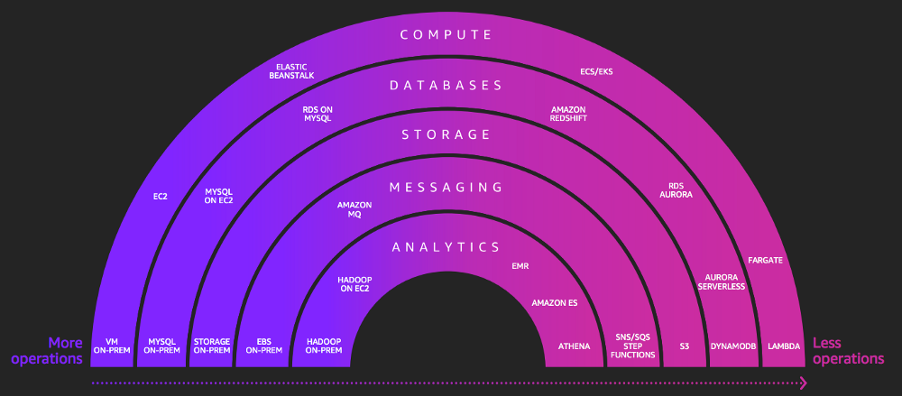
Start with serverless first [Fig. 1] and then work your way back to IaaS (infrastructure as a service). Insist on high engineering standards. Measurement is difficult in modern software development—it should be based around trends, not absolutes. The “four key metrics” from DORA (deployment frequency, lead time, MTTR and change fail rate) are fantastic indicators. A serverless team with minimal hand-offs can perform very well.
Fig. 1 Serverless is an Operational Construct – from AWS re:Invent 2018 presentation
Clearly, such a strategy requires lots of building blocks in place. You have committed to DevOps; serverless can help scale the advanced practices, but let’s make it real! Here are some key building blocks that you may find useful:
Public Cloud Strategy: Absolute clarity is required on the move to public cloud. This is a transformation and many traditional functions must (effectively) reinvent themselves—security, infrastructure, procurement, engineering, etc. Alignment at the initial stages is critical. What is your collective opinion on cloud-native? If you are a startup, then only serverless-first will give you the velocity you need.
Pipelines: The “pipeline to production” becomes a business-critical capability. Many critical controls must be reimagined in this new world and a low-friction environment is required for teams to move fast safely and securely. Investment in this area is important; otherwise, you will frustrate your engineers.
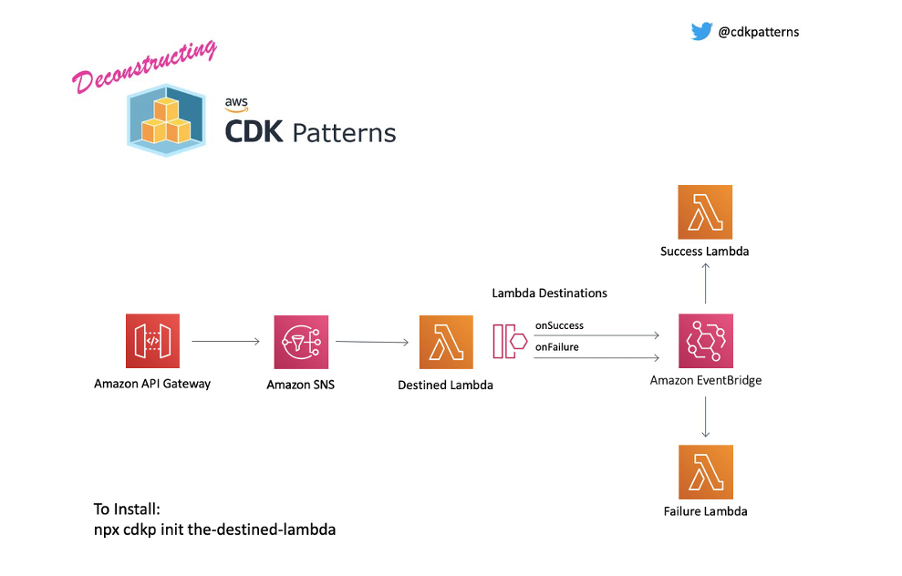
Patterns: You are now moving toward a commodity platform that welcomes standardized. You will start to notice that many teams are creating the same boilerplate components. Do you have an effective reuse strategy? If it’s too heavy, you will slow everyone down, but if it’s too light, you will create mass duplication. Approaches such as AWS CDK (Cloud Development Kit) and some of the scaffolding approaches available today to enable the creation of “building block patterns” to create components quickly. This is well demonstrated in cdkpatterns.com, which is an open source library of cloud patterns. Liberty Mutual has deployed hundreds of applications using such patterns [Fig 2].
Fig. 2 CDK pattern from cdkpatterns.com
Well-Architected: Finally, in this environment, architecture must happen within the teams. But you still need architects. The AWS Well-Architected Framework provides a very clean approach with five pillars of non-functional requirements that prompt teams around concerns that must be addressed. It’s not a checklist; more like a set of challenges. You’ll find that teams can self-assess, but require an architect to coach through some of the more advanced areas.
Finally, imagine well-architected constructs that are available in your code building blocks and comply with your pipeline controls. This is how DevOps can scale in a serverless environment: You bake the quality controls into the engineering environment.
Fig. 3 – Lambda Power Tuner from Alex Casalboni
After engineers go on this journey, they have power tools at their disposal. They can create world-class systems quickly that run at a low cost. But, be warned, once you set your teams off on this journey, there is no turning back. It is a relentless journey of optimization and improvement; that may be an overhead for companies that do not regard engineering as a differentiating capability.
For the serverless journey, the most important piece of the puzzle is to ensure your engineering teams understand your core business. Create cross-functional teams that are chasing a business KPI. Engineers are engaged when they have a powerful environment that allows them to solve business problems quickly. There is no business-IT divide; you end up with technology teams innovating to meet the company vision. Liberty Mutual has not only observed many of the benefits mentioned here, but also improved engagement from our engineering community. Serverless is the paradigm shift that allows engineers to innovate and move at a pace that has never been possible before.