Category: Infrastructure/Networking

  • Cisco Revamps Portfolio at the Network Edge

    Cisco Revamps Portfolio at the Network Edge

    Cisco today announced a series of Catalyst offerings that combine the functionality of a secure software-defined wide area network (SD-WAN) and a router in a single platform.

    Archana Khetan, senior director of product management for enterprise routing and SD-WAN infrastructure within the Intent Based Networking Group at Cisco, said the Catalyst 8000 series is made up of both physical devices and virtual appliances that eliminate the need for organizations to deploy separate SD-WAN and routers at the network edge.

    The high end of the Catalyst 8500 platform line is based on a third-generation Quantum Flow Processor, a proprietary ASIC that Cisco employs in its networking equipment. It is designed for data center, colocation and aggregation sites and, for the first time for Cisco, integrates 40G and 100G Ethernet ports.

    The Catalyst 8300 Series Edge Platforms are designed for branch offices that are transitioning from relying solely on routers to embracing SD-WANs. In addition to providing 4X better performance than legacy Cisco routers, the Catalysts 8300 series is designed to allow organizations to insert modules that are compatible with existing Cisco’s ISR 4400 routers. Compute and switching capabilities can also be added via a UCS-E Series blades and UADP-based switch modules can be added to create a software-defined branch office capable of running microservices-based applications based on containers on x86 processors. Cisco also unveiled today a Catalyst Cellular Gateway, for organizations that want to connect branch offices over 4G LTE wireless networks with support for 5G networks planned.

    Finally, Cisco has added Catalyst 8000V Edge Software, which enables IT teams to deploy Cisco networking software on a public cloud. While most public clouds already provide networking services, Catalyst 8000V Edge Software provides more advanced networking and security capabilities that can be managed as an extension of an existing enterprise network, said Khetan.

    Each member of the Catalyst 8000 series has been integrated with Cisco Umbrella to provide a means of managing networking and security policies via the cloud, while Cisco SD-WAN Cloud OnRamp integrates with cloud services from Amazon Web Services (AWS), Google and Microsoft to provide visibility into those environments.

    In addition, each platform provides access to a programmable application programming interface (API) library as part of Cisco’s ongoing effort to meld network operations and DevOps workflows.

    While Cisco remains the dominant provider of networking equipment in the enterprise, the rise of SD-WAN platforms that essentially replace routers in branch offices has created a slew of competitors that are gaining footholds in branch offices at the expense of Cisco. With the launch of the Catalyst 8000 series, Cisco is aiming to bridge the gap between routers and SD-WAN appliances within a single platform that promises to be easier to manage via the cloud.

    It’s not clear to what degree that approach will resonate with enterprise IT environments, but it’s clear Cisco is now more than ready to strike back.

  • Cisco Expands Effort to Meld DevOps, NetOps

    Cisco Expands Effort to Meld DevOps, NetOps

    Cisco Systems has accelerated its efforts to converge network operations (NetOps) by adding support for Terraform tools for managing infrastructure-as-code as well as expanding its support for the Ansible IT automation framework.

    In addition, Cisco has improved and standardized the application programming interfaces (APIs) it makes available for its Application Centric Infrastructure (ACI) framework for virtualizing network services and is expanding the free code samples, boot camps and certifications its makes available via its DevNet Express training program.

    Yousuf Khan, vice president of technical marketing and solutions engineering, said Cisco is moving toward embracing open source automation tools that are being widely employed to automate the management of IT infrastructure. That transition is being driven by DevOps teams, many of which have assumed control over IT infrastructure budgets as network operations are more integrated within DevOps processes, he said.

    To increase its appeal, Cisco is making available Terraform Providers for Cisco ACI alongside Ansible and Cisco ACI Multi-Site Orchestration (MSO) to enable IT teams to automate network management using declarative tools, Khan added. Ansible can now be applied to invoke Cisco Data Center Network Manager (DCNM) alongside the other network services Cisco has already made accessible via Ansible.

    Terraform is widely employed to programmatically configure cloud infrastructure, which Cisco is now embracing to enable IT teams to apply to network and server infrastructure. Ansible, meanwhile, is being embraced by multiple providers of IT infrastructure as IT teams look to standardize on a single automation framework. That approach eliminates the need to master multiple proprietary IT automation frameworks for each platform employed.

    Cisco has spent the last few years encouraging network administrators to abandon command-line interfaces (CLIs) employed to program individual routers and switches in favor of a software-defined network architecture based on graphical tools that enables NetOps teams to more flexibly manage network infrastructure using virtual overlays enable by its ACI framework. Now ACI is being made accessible to Terraform and Ansible as more IT organizations adopt both tools as de facto open source tools for managing heterogeneous IT infrastructure environments. That effort will make it easier for DevOps teams to employ GitOps processes to deploy applications on Cisco infrastructure from whichever continuous integration/continuous delivery (CI/CD) platform they employ, Khan said.

    Ultimately, he noted, the goal is to make the networks more agile. IT teams in on-premises environments today can provision a virtual machine in minutes but are still required to wait weeks for network services to be provisioned. The goal is to apply a more cloud-like operating model to a hybrid IT environment.

    Each IT organization will need to decide to what degree they will want to meld their network operations and DevOps teams. While the tools to manage network services are becoming available, the cultural divide between most network operations and DevOps teams is still wide. The rate at which that divide is narrowing, however, is finally starting to accelerate as business leaders continue to demand higher levels of agility.

  • Equinix Adds Automated Bare-Metal Server Service

    Equinix Adds Automated Bare-Metal Server Service

    Equinix, a provider of hosted IT services, added an Equinix Metal offering that allows IT teams to automate the deployment of bare-metal servers.

    Interest in deploying bare-metal servers is increasing due to the rise of both artificial intelligence (AI) applications that are compute-intensive and Kubernetes clusters that, in many cases, don’t require the overhead created by a virtual machine. However, it is more difficult to automate the provisioning of bare-metal servers compared to provisioning virtual machines.

    To address that challenge, Equinix earlier this year acquired Packet, provider of an IT automation framework for bare-metal servers that now drives the Equinix Metal service. As part of that service, the framework has been integrated with Equinix Fabric, formerly known as Equinix Cloud Exchange Fabric, to gain access to a software-defined interconnection service spanning 237 data centers deployed near major internet exchanges across 46 geographies.

    Jacob Smith, vice president of bare-metal strategy and marketing for Equinix, said those servers are available either on-demand or as reserved instances that can be spun up in less than 15 minutes, similar to the way IT organizations provision cloud resources. The servers can be provisioned via application programming interfaces (APIs) common libraries or employ any one of several tools that they already use to manage infrastructure-as-code, he noted.

    As applications become more distributed, latency issues that arise because of network physics are becoming more challenging. Many IT teams are now trying to deploy applications closer to where data is created and consumed. Equinix Metal enables IT teams to achieve that goal in an IT environment that also gives them their own private internet managed by Equinix, said Smith.

    At the same, Equinix Metal reduces the time it takes IT teams to deploy bare-metal servers in a rival co-location facility to minutes from days, via an automated service, he added. Not many IT organizations are interested in dispatching IT personnel to physically provision servers in the wake of the COVID-19 pandemic. The health risks involved in traveling to a co-location facility to configure hardware are deemed too high.

    In the meantime, as more application workloads find their way to the edge, the physical locations of servers start to matter a lot more. It may now only be a matter of time before IT teams rediscover the merits of hosting services that can provide as much flexibility as a cloud service provider with far less adverse impact on application performance.

    Of course, that also means many existing DevOps processes will need to be extended to include not just a local data center or cloud service, but also a network of data centers that are being managed by someone else on their behalf.

  • Netlify Extends JAMstack Reach to Edge Computing

    Netlify Extends JAMstack Reach to Edge Computing

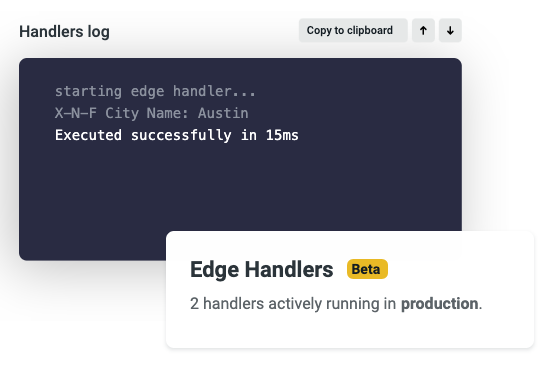
    Netlify, at its JAMSTACK CONF VIRTUAL event today, announced Netlify Edge Handlers, which make it possible to extend a Git-based workflow to edge computing applications.

    Company CEO Matt Biilmann said Netlify Edge Handlers, available in beta, puts the primitives in place for deploying serverless web applications based on a JAMstack software architecture that employs JavaScript, application programming interfaces (APIs) and markup languages, otherwise known as JAM, to isolate front- and back-end components of an application.

    A Git-based approach will also enable DevOps teams to extend workflows to edge computing applications that can be deployed on any number of platforms, he said. As an extension of a Netlify platform written in a modern Rust programming language, Netlify Edge Handlers makes it possible to build and launch web applications and websites based on a JAMstack architecture from within a continuous integration/continuous delivery (CI/CD) environment.

    Prior to the availability of Netlify Edge Handlers, building and deploying web applications on edge computing platforms required extensive coordination across teams, the creation of detailed edge logic with many dependencies and deviation from standard web development best practices, Biilmann said. Now, developers can write simple JavaScript that builds and deploys to the network edge in a way that enables simplified A/B testing, custom authentication and API aggregation, he noted.

    Developers also can build and manage edge logic from preview to production, including deploying those applications via the existing Netlify multi-cloud network.

    More application code is being pushed out to the edge because many organizations are now processing and analyzing data closer to where it is created and consumed, as part of their digital business transformation initiatives. Web applications that execute closest on a node to the user eliminate or reduce roundtrip request and response flows with the client.

    Biilmann also noted that because those applications are employing a platform developed using Rust, they are also inherently more secure.

    There may come a day when there are more application workloads collectively running at the edge than there are on cloud computing platforms. However, if that goal is ever to be achieved, it needs to become easier for developers to build those applications. Given the fact those applications are also likely to be targeted by cybercriminals, it’s critical to ensure those applications are as secure as possible.

    In the wake of the economic downturn brought on by the COVID-19 pandemic, many organizations have accelerated digital business transformation initiatives, many of which depend on edge computing platforms. The only way to achieve that goal, however, is to make it possible to build these applications using JavaScript tools that most developers of web applications have already mastered. Otherwise, organizations will need to invest in training developers to master another framework for deploying edge computing applications. That would require time they might not have.

    Regardless of the path forward, a massive wave of edge computing applications soon will stretch the boundaries and limitations of whatever DevOps processes organizations have in place today.

  • Cloudflare Expands Range of CDN Alternatives to the Public Cloud

    Cloudflare Expands Range of CDN Alternatives to the Public Cloud

    Cloudflare, a provider of a content delivery network (CDN) based on more than 200 data centers, this week announced it has made available a Durable Objects capability in beta that makes it possible to run stateful applications across a distributed serverless Cloudflare Workers service.

    Company CEO Matthew Prince said Durable Objects provide a truly unified approach to managing storage and state that ensures low application latency across the CDN service.

    Cloudflare this week also launched API Shield, which employs client certificate-based identity and strict schema-based validation using hosted public key infrastructure (PKI) that only allows application programming interfaces (APIs) with known behavior and identities to access the CDN service.

    The company also added a Cron Triggers tool that enables IT teams to schedule jobs on Worker nodes rather than always having to make HTTP requests.

    Finally, Cloudflare this week added a free Cloudflare Web Analytics tool and a free Cloudflare Radar tool that allows IT teams to view global traffic and security trends across the internet as they happen using data gathered from a network that touches more than 25 million internet properties in more than 100 countries.

    As applications become more distributed than ever thanks to the rise of edge computing, there is a growing need to deploy stateful applications that process data closer to where it is generated and consumed. Rather than IT teams having to manually deploy those edge computing platforms, Cloudflare has been making a case for a serverless computing platform that enables IT teams to leverage platforms it manages on their behalf.

    A Durable Object, in the case of Cloudflare, is an instance of a class that can be written in any programming language. Each object has a unique identifier and exists in only one location. Any Worker running anywhere in the world that knows the object’s ID can send messages to it. Durable Objects can have persistent state stored on disk. Each object can also maintain a consistent copy of the state in memory to eliminate latency. The in-memory object will be shut down when idle and can be re-created later on-demand.

    The Cron Trigger tools provide IT teams with more control over how they consume capacity on the Cloudflare CDN, added Prince.

    The Cloudflare CDN ultimately provides a lower-cost alternative to cloud services for deploying edge computing applications that gives IT teams more control over where and when application workloads run, Prince said.

    In the age of COVID-19, the days when IT organizations dispatched IT staff to physically install and update physical infrastructure may be coming to an end. There’s no real need to incur the cost or put IT staff at risk of contracting the virus. The issue now is determining whether to employ a cloud service provider or rely on any one of several CDN options that have historically been employed to optimize web applications.

    Regardless of the path chosen, the ability to remotely deploy any type of application on IT infrastructure resources has never been greater or easier.

  • VMware Embraces SmartNICs to Extend Virtualization

    VMware Embraces SmartNICs to Extend Virtualization

    VMware, as part of a bevy of updates to its portfolio announced today at its online VMworld 2020 conference, previewed its Project Monterey initiative to provide IT teams with composable infrastructure.

    At the core of that effort will be support for smart network integration cards (NICs) within VMware Cloud Foundation, the suite of software through which VMware bundles its vSphere, vSAN and NSX platforms. SmartNICs make it possible to offload network and storage I/O function from a virtual server by enabling its ESXi hypervisor to run on a SmartNIC.

    VMware also revealed plans to rearchitect VMware Cloud Foundation to enable disaggregation via SmartNICs that can be plugged into either a bare-metal server or a server running virtual machines from VMware. That capability will make it possible for applications to invoke bare-metal servers via an application programming interface (API) and will also enable VMware to extend its management framework to bare-metal servers that have SmartNICs installed.

    The decoupling of networking, storage and security functions will also allow IT teams to patch and update IT infrastructure independently from the server running VMware vSphere.

    VMware also noted that via Project Monterey each SmartNIC will be capable of running a stateful firewall along with other security software. IT teams will be able to enhance security by deploying thousands of firewalls on SmartNIC across the extended enterprise.

    There is no timetable for when Project Monterey will be available. Chris Wolf, vice president for the Advanced Technology Group in the Office of the CTO at VMware, said SmartNICs will play a major role in enabling IT organizations to compose IT infrastructure either using graphical tools employed by IT administrators or via APIs programmatically invoked by DevOps teams.

    Separately, VMware today also announced plans to update to its Virtual Cloud Network, a platform through which it bundles VMware NSX, VMware SD-WAN by Velocloud and VMware vRealize Network Insight in a single offering.

    VMware is committing to bringing more automation, making available predictive analytics enabled by machine learning algorithms, increased virtual networking scale enabled by VMware NSX-T 3.1. VMware will double the scale of NSX Federation, add advanced routing and multicast capabilities based on APIs and add support for configuration tools based on open source Terraform tools.

    Version 6.0 of vRealize Network Insight 6.0 will add assurance and verification capabilities as well as expanded support for VMware SD-WANs. VMware Edge Network Intelligence, meanwhile, adds a tool that applies artificial intelligence (AI) to optimize network performance.

    VMware also announced that its Virtual Cloud Network platform can now support Kubernetes clusters.

    In addition, VMware announced that VMware vRealize AI Cloud, a cloud service for optimizing application performance using machine learning algorithms, formerly known as Project Magma, is now available and that CloudHealth by VMware services has been extended to add support for Oracle Cloud Infrastructure along with tools for analyzing the security of workloads deployed on Google Cloud.

    Finally, VMware is making a series of other security updates, including providing access to VMware NSX Advanced Threat Prevention, which combines NSX Distributed IDS/IPS with malware detection software and network traffic analysis (NTA) technologies acquired from Lastline Inc.

    VMware is also committing to reselling a secure web gateway from Menlo Security as part of the VMware SD-WAN portfolio and formed an alliance with Zscaler to manage security as a service.

    Finally, VMware today launched VMware Carbon Black Cloud Workload, which combines vulnerability reporting with workload hardening software for both legacy platform and microservices-based applications deployed on Kubernetes clusters.

    VMware now has one of the broadest portfolios of offerings of any enterprise IT vendor. It’s not clear to what degree IT organizations are consuming all that software on top of VMware vSphere. However, for IT teams looking to reduce the number of vendors they need to engage VMware has become a compelling option.

  • Preparing for Digital Life After COVID-19 

    Preparing for Digital Life After COVID-19 

    The shift to a digitally dependent remote workforce across numerous industries was instantaneous for organizations after the COVID-19 pandemic spread, and after months of adapting, this way of life has become “a new normal.” IT professionals are facing unprecedented pressure to meet the increased demands they are experiencing now and preparing for the changes that will continue after the pandemic, such as enabling remote employees and driving the business. This presents an immense opportunity for these professionals to make a change.

    In recent months, limits to digital transformation and what organizations are capable of have been tested and surpassed. IT professionals have searched for tools, visibility and insights to help them manage the new challenges so the technology being used by organizations continues to perform well. This means expectations moving forward have been set even higher for the level of performance these professionals provide. If limits can be exceeded and issues solved as they arise, what does this mean post-COVID-19?

    Agents of Transformation

    We call the professionals who are navigating these digital changes and inspiring innovation Agents of Transformation. As the leaders of the IT industry, these technologists are identifying what tools are needed not only for their efforts, but also for the organizations they support to provide a tighter interlock between IT and business leaders. Our recent special COVID-19 research report showed how the pandemic has changed the industry long-term.

    According to the report, 79% of the 1,000 IT professionals we surveyed believe the pandemic will separate the strong from the weak in tech teams worldwide. Even if organizations find themselves surviving the digital transformation changes they’re making during the pandemic, it is crucial they also plan for the future so they do not fall behind with any additional new curveballs. As documented in the chart below, the key areas these Agents of Transformation think will change in business practices are risk and disaster planning, the continued use of remote working tools and flexible resourcing.

    Planning for Changes in Business Practices

    COVID-19 brought a lot of unexpected challenges that forced organization leaders to adapt. It is crucial organizations determine what their plans are moving forward and how they will be implemented. Once organizations know what their ideal digital journey looks like, they can begin to fill in the missing pieces such as how it could be impacted by outside forces like COVID-19 and how they can navigate these changes. Digital transformation will continue to play a key role in a post-COVID world with potential challenges including:

    •       Delivering positive experiences at an increased capacity.
    •       Lack of visibility into the performance of technologies.
    •       Managing mean time to repair (MTTR).

    Continued Use of Remote Working Tools and Technologies

    Even as health risks decrease and more employees are allowed to return to work, survey respondents expect tools and technologies for remote working are here to stay. To be successful moving forward in a world now dependent on digital transformation, organizations should figure out what their digital needs are, whether to efficiently manage increased traffic on their applications or support space for storing the influx of data. It is also important that an organization’s plans for a digital journey focus on things such as collaboration, clear goals and objectives and autonomy.

    Keeping the above in mind, one way to prepare for shifting digital goals is by embracing risk and experimentation. Applying scalable cloud instances alongside microservices allows IT teams to quickly test agile new features with a small group of users, then scale out as needed. The future is uncertain, but with digital transformation continuing to grow, organizations should use this time to push new features for their applications that can address current and potential future bottlenecks. For example, if an organization noticed COVID-19 led to larger issues in their applications, they could use this time to research and try new tools that can address the smaller challenges, allowing for more time to focus on tackling the prominent challenges.

    Jump-starting Your Digital Today

    Organizations can jumpstart their digital transformation by adopting tools such as cloud monitoring, microservices and application performance management (APM). By identifying and preventing issues before the end user experience is diminished, organizations can reduce customer support issues and ensure continued brand loyalty.

    Tools such as APM can accurately monitor and manage application technology stacks, from the user experience to network performance. These tools can help address surges in demand or shifts in resource allocations, especially as user behaviors change throughout the pandemic. While IT professionals often struggle to manage and scale services, it is possible to do this without sacrificing the user experience.

    Cloud monitoring can help organizations prepare for traffic surges during and after the pandemic, through scalable cloud instances that offer additional capacity for IT resources. Many on-premises resources that are bound to offices or other physical locations are currently underutilized due to remote work. As a result, 74% of technologists surveyed said that digital transformation projects which would normally take more than a year to be approved are now moving forward within a matter of weeks. To keep up with this growing adoption, cloud monitoring provides IT professionals with real-time visibility and insights. Implementing microservices can also support organizations to develop, test and deploy new features at an extraordinary rate, resulting in improvements in security, speed and productivity.

    Now that these changes are more familiar to end users, expectations will remain high moving forward. The organizations that successfully tackle challenges during the pandemic will be far more resilient. Internal processes have been a longtime barrier for companies to transform. Our current situation has broken down some old barriers and allowed for rapid changes in styles of work, which is likely to continue in some fashion post-pandemic. Businesses will see the value and become less risk-averse, empowering their IT teams to push the envelope for their ongoing transformations.

    Whether it is through utilizing tools such as APM, cloud monitoring and microservices, disaster planning or managing the complexity of cloud and on-premises assets, technologists have never had a bigger opportunity to lead their businesses through change or bring closer alignment of IT to the business.

  • The Benefits of an IaC Approach to Storage

    The Benefits of an IaC Approach to Storage

    Adopting an IaC approach to storage offers freedom from storage infrastructure considerations

    Today’s multicloud world allows you to move applications and/or functions between clouds depending on your needs, but it also puts you in the position of having to understand the different storage requirements of each cloud provider. These providers have their own unique storage offerings and parameters, which differ not only from each other but also from storage being used in private cloud deployments.

    Infrastructure as code (IaC) can be invaluable in navigating this multicloud environment. Over the past couple of years, IaC has become well-known in application development as a type of IT infrastructure that can be managed and provisioned automatically using a common template.

    The same basic principle can be applied to the way you approach storage across clouds. With IaC, your applications can consume storage in a consistent manner across all environments and providers so you don’t have to worry about the specific infrastructure aspects of each cloud platform. It offers an abstraction layer that essentially eliminates inconsistencies in the ways various providers handle storage while gaining a consistent set of interfaces that help you manage applications across clouds.

    IaC and Storage

    Here are three ways IaC can help you leverage different clouds to your advantage, regardless of their storage requirements.

    Freedom to Move

    One of the things that make multicloud environments so great is being able to take advantage of the unique benefits of different clouds, particularly as your needs and business requirements change. For example, it may be more cost-effective to host certain functionality in one cloud over another during peak hours, and then move that functionality back to a different cloud in off-peak times.

    With an IaC approach, you can have greater application portability so you can move applications across clouds or regions. You won’t be encumbered by specific infrastructure components or physical locations. You can transfer workloads as necessary. The abstraction layer can enable you to manage those workloads in the same way across all clouds.

    You can also protect your data by automatically replicating copies of object data across multiple clouds. If one copy is compromised, the data will continue to be available in other locations. You’ll have the resiliency to keep your applications running without interruption.

    Freedom to Keep Your Data Close

    Data gravity can improve performance by decreasing latency. This is especially important for applications that need fast access to data or depend on large data sets. The closer the data is to the application, the better that application can perform.

    To maintain performance, you must be able to move your data along with your applications. The abstraction layer enables you to do this because it removes the barriers and various data parameters that exist between different cloud providers. You can migrate your application’s data along with the application itself.

    Freedom to Scale

    You may be employing a number of different size workloads and storage types for various applications–traditional file storage for smaller workloads or object or block storage for larger and growing datasets, for example. Regardless of what you have today, you’ll want the freedom to scale out your storage as business needs change. The abstraction layer enables you to embrace a diversity of workloads without worrying about whether they’ll be supported in a particular cloud environment. You can also repatriate your applications back on-premises if the costs of using a public cloud become too exorbitant or if your security or performance needs change.

    Yet you can’t put a price on flexibility, which is instrumental to modern agile software development. You need the flexibility to move between clouds with ease. Adopting an IaC approach will give you the freedom to let go of storage infrastructure considerations and focus your energy on developing the best applications possible.

  • Harmonizing Real-Time on Edge Platforms

    Harmonizing Real-Time on Edge Platforms

    Edge computing platforms sit at the boundary between the real-time world and the digital enterprise. Uninterrupted, uncorrupted data from the edge is a must if analytics in the cloud drive reliable business decisions. What’s the best approach: using Linux, an RTOS (real-time operating system), a hypervisor or something else for edge platforms?  Let’s talk about harmonizing real-time on edge platforms and introduce a new foundation project in the Linux Foundation’s LF Edge family.

    Real-Time and Deterministic

    Real-time only means events are captured, tagged and processed as they unfold in the real world. That cadence can be seconds, milliseconds or microseconds depending on how many events and how often they occur and how tasks and algorithms stay in control. Three operating system characteristics determine how well real-time execution keeps pace: prioritization, interrupt response time and context switch time.

    Prioritization ensures that tasks receive resources when needed. Tasks at a lower priority should pre-empt when a higher priority task requests service. A task refusing to yield to pre-emption can throw off the prioritization scheme, causing missed deadlines.

    Interrupt response time measures the latency from the time an event requests service via a hardware interrupt to when the handler task executes. Real-time hardware platforms often place high-priority events on hardware interrupts for fastest pre-emption.

    Context switch time is softer scheduling at work. It measures the time for a change in processing control from one execution entity to another, swapping out resources including registers, cache and memory as needed.

    Deterministic means there are no surprises in behavior. The faster real-time events happen, and the harder a system works, the more likely non-determinism surfaces. One venture into virtual memory paging or a burst of networking activity can show up at an inopportune time, even though under most conditions real-time performance is adequate.

    ‘Hard’ vs. ‘Soft’ Real-Time

    That’s why most people think of real-time as “hard” with a fast, deterministic operating system. RTOS platforms optimize the kernel and only build things in around it that are necessary, providing rigorous and sometimes mathematically proven scheduling for many tasks.

    “Soft” real-time is more forgiving. On a fast processor, interrupt response time is tiny compared to the execution window. A system that isn’t deterministic can, if there is enough margin in context switch time, keep up with real-time events on a slower scale. Linux, while not deterministic, can handle some real-time needs through minimizing packages and tuning the kernel for better prioritization.

    Linux also benefits from lighter context switching. Originally, execution entities in Linux were resource-heavy processes. Now, threads can handle tasks with far less switching overhead. POSIX threads standardized the approach with portability between Linux and RTOS environments.

    How fast are threads? According to a recent synthetic thread benchmark by Eli Bendersky, switching on server-class platforms with enough memory, cache and storage can be in the range of 2 microseconds with 10,000 threads under ideal conditions. Eli pointed out his test environment has more RAM than many edge hardware platforms provide, but most edge applications won’t need that many threads, either.

    So, the line for soft real-time has moved down into new territory, making the trade-off between hard and soft a bit blurrier.

    Hypervisors and Orchestration

    If your DevOps team commits to an RTOS, you may give up some familiar functionality and have a learning curve to deal with, but you get assured hard real-time performance. If you go with Linux, you get the tools and coding practices you’re used to, but soft real-time performance can be an issue as code piles up.

    The leaders in RTOS platforms with enterprise networking noticed this, too. Recently they’ve turned to hypervisors in a bare-metal approach. A hypervisor can capture the benefits of environments working together, so teams are not forced into an either/or operating system choice. This is especially important if the edge application requires some form of certification, such as in medical, industrial or defense applications. Certified code can be compartmentalized on an RTOS, while Linux runs alongside.

    Linux providers are turning more toward orchestration layers and containers. It’s an application focus speeding up deployment, with more scalability and less hardware dependence. It also brings the edge into the enterprise faster with the same application deployment strategy anywhere. More code means more determinism risk.

    Convergence is a faint hope on this landscape with competing objectives, but a new approach offers a path for software reuse and rapid deployment.

    Harmonizing the Edge

    The Linux Foundation is active across the spectrum of IoT development, from the Zephyr open source RTOS to various embedded Linux projects. One of the newest projects in the LF Edge initiative is a foundation targeting a blend of deployment models in a consistent, open approach.

    Project EVE (short for Edge Virtualization Engine) supports containers, clusters, virtual machines and unikernels simultaneously. It’s a slim bare-metal runtime offering hardware root of trust, device resource management and software update and patch functions. EVE can host any combination of apps in virtual machines or containers, including running an RTOS with its application in a virtual machine. It can even assign CPU and GPU cores to specific applications for enhanced determinism.

    On the EVE road map is support for the ACRN hypervisor (another LF Edge project) and shrinking the EVE runtime for smaller embedded-class edge platforms. These efforts are essential where real-time requirements become harder and a hypervisor plus an RTOS makes sense. For softer real-time environments, EVE is adding support for Kubernetes K3S, Docker Compose, VPNs for public clouds and mesh networking for data flow between edge platforms.

    While the project is still young, EVE holds great promise for DevOps teams working the edge. We’d look forward to seeing some benchmarking on a real-time scale; it likely handles soft real-time needs as well as Linux today. By harmonizing a range of diverse approaches into one foundation, EVE is creating a space for real-time on edge platforms no matter which development perspective teams come from.

  • NGINX Expands Portfolio to Include Service Mesh

    NGINX Expands Portfolio to Include Service Mesh

    NGINX at its online Sprint conference today launched a bevy of offerings including a service mesh as part of an expanded effort to meld network and security operations within the context of a larger DevOps workflow.

    Rob Whiteley, chief marketing officer for the subsidiary of F5 Networks, said NGINX Service Mesh 1.0 provides an easier alternative to deploy a service mesh based on the open source NGINX proxy server software already widely employed in enterprise IT environments. That lighter-weight service mesh is also integrated with the NGNIX ingress controller to enable it to be employed across microservices spanning both legacy virtual machine environments and Kubernetes clusters, he said.

    In general, Whiteley noted, most organizations will not need a service mesh unless they are looking to integrate more than a thousand microservices. If an organization only has hundreds of microservices, an ingress controller should suffice, and anything involving less than a hundred microservices can be handled by proxy software.

    NGINX Service Mesh 1.0 will be offered by NGINIX and F5 Networks will continue to offer a service mesh based on the Istio project for Kubernetes environments that relies on Envoy proxy software, which is not as lightweight as the NGINX platform, noted Whiteley. DevOps teams will have to decide which service mesh to deploy.

    In the meantime, NGINX is also updating its NGINX Controller to add support richer analytics, a declarative application programming interface (API) for continuous integration/continuous delivery (CI/CD) integration, role-based access controls and enhancements to the developer portal for API management.

    NGINX is also driving tighter integration between Controller and NGINX App Protect, a web application firewall that will inherit the API, analytics and self-service capabilities of Controller. NGINIX App Protect is also now being integrated with NGINX Ingress Controller for Kubernetes. The Controller App Security tool that enables those integrations is in private beta now, with general availability expected by end of 2020.

    Finally, NGINX is now leveraging services made available by F5 Networks via software-as-a-service (SaaS) platforms in the form of NGINX Analytics Cloud, which replaces NGINX Amplify. That capability will be available in the first quarter of 2021.

    In general, Whiteley said NGINX is trying to serve the needs of traditional network operation teams that want to provide self-service capabilities to development teams as well as via programmatic interfaces to DevOps teams. In many cases, enterprise IT organizations are employing both approaches to expose network services, noted Whiteley.

    Of course, the issue that ultimately might drive the convergence of NetOps and DevOps is the rise of the service mesh. In addition to integrating microservices, the service mesh provides developers with a consistent set of interfaces for invoking network and security services spanning a dizzying array of servers and appliances. As that transition occurs, IT teams will become much more agile than they are today. The challenge, of course, will be melding network operations and DevOps cultures that today don’t have all that much in common.