Category: DevSecOps

  • Cycode Leverages eBPF to Secure CI/CD Pipelines

    Cycode Leverages eBPF to Secure CI/CD Pipelines

    Cycode today added a Cimon extension to its application security platform that uses extended Berkeley Packet Filtering (eBPF) to thwart cyberattacks against continuous integration/continuous delivery (CI/CD) pipelines.

    Alex Ilgayev, head of security research for Cycode, said Cimon uses eBPF to inspect network connections, running processes and file modifications within a pipeline to learn standard behaviors. Armed with those insights, Cimon will then surface any anomaly in real-time, he added.

    DevOps teams can then craft and embed security and compliance rules within their pipelines based on the severity of the anomalies discovered, said Ilgayev.

    eBPF makes it possible to run sandbox programs at the kernel level without adversely impacting performance. In effect, eBPF bridges the boundary between kernel and user space by enabling developers to combine and apply logic across multiple subsystems that, historically, were completely independent of one another. That approach enables, for example, a security tool to scale to the point where it can identify threats at much higher levels of throughput to improve overall scale at a time when the volume of cybersecurity attacks continues to increase.

    Cycode is taking advantage of eBPF to enable DevOps teams to not only defend against known attacks involving malicious package installation, typosquatting, repojacking, dependency confusion, dependency hijacking and other types of dependency attacks but also zero-day threats, noted Ilgayev.

    Cycode provides a platform for mapping metadata and events using graph technology that makes it simpler for application development and cybersecurity to consolidate alerts generated by their DevSevOps tools. Most recently, Cycode added a Cycode Application Security Orchestration and Correlation (ASOC) module that will automatically discover all the tools that make up a DevSecOps workflow without requiring any integration effort.

    The approach enables the Cycode platform to discover, for example, dependency issues that would otherwise be missed by software composition analysis (SCA) or static application security testing tools (SAST).

    While a lot of progress has been made in terms of adopting DevSecOps best practices, many organizations are still struggling with securing their software supply chains. Most of the members of a DevOps team have limited cybersecurity expertise, so they need the help of a cybersecurity professional to determine what specific actions are required to remediate a vulnerability. Cybersecurity professionals, conversely, don’t have a lot of application development expertise.

    As the number of regulations specifically focused on application security steadily increase, every organization that builds software will soon need to embrace DevSecOps to better secure software supply chains. Unfortunately, developers have too often viewed cybersecurity as an obstacle to deployment while cybersecurity teams have historically considered developers to be a primary cause of the breaches they are expected to clean up. The first step toward bridging that divide is, of course, to realize that application developers and cybersecurity teams need to be invested in each other’s success.

  • Snyk to Add ASPM Platform via Enso Security Acquisition

    Snyk to Add ASPM Platform via Enso Security Acquisition

    Snyk this week announced it plans to acquire Enso Security, a provider of an application security posture management (ASPM) solution that tracks events and analyzes metadata collected from DevOps and security tools.

    At the same time, Snyk revealed it has added a DeepCode AI Fix tool that creates validated fixes for code written by either humans or machines and an Insights tool that helps organizations better prioritize remediation efforts based on the risk to the business. DeepCode AI Fix extends the capabilities of a generative artificial intelligence (AI) capability based on large language models (LLMs) that Snyk gained with the acquisition of DeepCode in 2020.

    Manoj Nair, chief product officer for Snyk, said all of these initiatives represent an effort to extend the reach of Snyk’s portfolio to address a wider range of issues within the context of a larger DevSecOps workflow as well as give developers tools that enable them to write more secure code.

    The acquisition of Enso Security is expected to close this quarter. The company has been making a case for an ASPM platform that eliminates the need to manually collect cybersecurity data from the various tools and platforms that a DevOps team may be using.

    Despite innumerable cybersecurity concerns, the rate at which applications are being deployed and updated continues to accelerate. The Enso platform makes it possible for cybersecurity teams to keep pace with those projects by discovering issues before an application is deployed in a production environment.

    The challenge, of course, is that most development teams are not going to be able to address every issue before an application needs to be deployed. In addition to knowing who is developing what application code, cybersecurity teams need to also prioritize potential issues versus rather than just sharing a list of potential issues that have been discovered. Enso Security’s ASPM platform provides visibility into events so that it’s simpler for cybersecurity teams to trace issues back to individual developers or the AI platform that generated them.

    That latter issue is becoming more significant as more development teams rely on general-purpose generative AI platforms to write code, noted Nair. Those platforms are writing that code based on samples collected across the internet, many of which are deeply flawed from a cybersecurity perspective, he added.

    The Enso platform is intended to enable cybersecurity teams to have the most impact on an application development project without being forced to interrogate every developer to determine what’s occurring in any application environment. In fact, one of the reasons developers resent those conversations is they know all the relevant data has already been entered into a system—cybersecurity professionals just need to access it.

    There’s still a lot of work to be done when it comes to bridging the historic divide between cybersecurity professionals and application developers. However, the more data that can be seamlessly shared between these teams, the simpler it becomes for organizations to embrace DevSecOps best practices.

  • Atlassian Advances DevSecOps via Jira Integrations

    Atlassian Advances DevSecOps via Jira Integrations

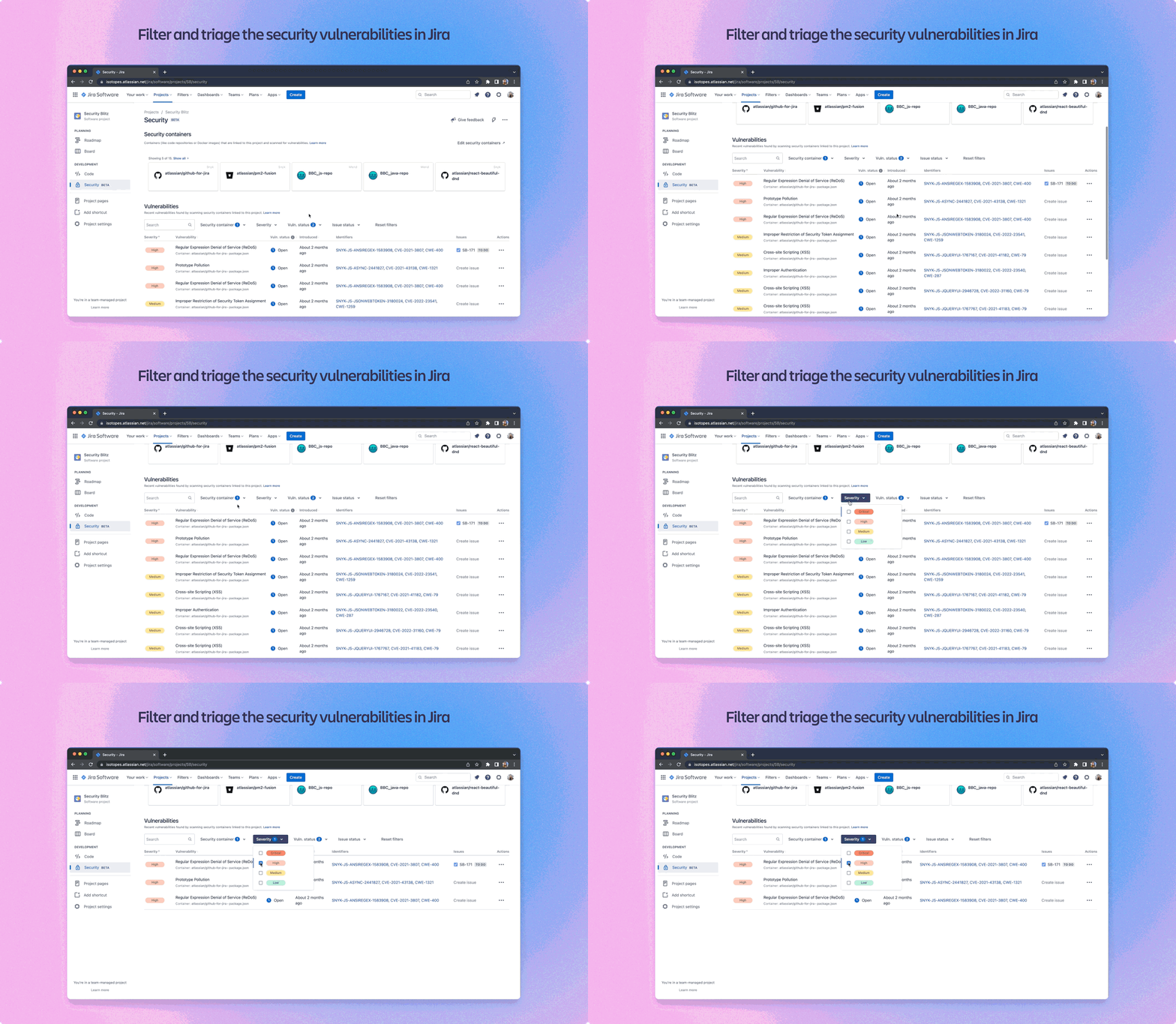
    Atlassian announced today it has allied with Snyk, Mend, Lacework, Stackhawk and JFrog to make it simpler to aggregate vulnerability data within the Jira project management software that many organizations rely on to manage application development and deployment efforts.

    Andrew Pankevicius, a senior product manager for Atlassian, said the collaborations will make it easier to prioritize a list of vulnerabilities that need to be addressed and for DevOps teams to automatically assign that work to a continuous integration/continuous delivery (CI/CD) pipeline. Atlassian provides those third-party integrations via an Open DevOps initiative.

    These capabilities, accessible via the Security Tab in Jira, will make it simpler for DevOps teams to manage output from the multiple application security tools that have become part of a larger DevSecOps workflow, noted Pankevicius.

    These additions to the Atlassian portfolio are arriving at a time when there is a lot more focus on securing software supply chains in the wake of a series of high-profile breaches. Those breaches have led to a wave of legislative proposals in the U.S. and Europe that will soon require organizations to embrace DevOps best practices to address increased potential liability that might stem from an application breach.

    For example, a proposed Cyber Resilience Act being negotiated by the member states of the European Union seeks to require organizations that sell internet-connected hardware platforms to ensure that their devices—and the software that runs on them—comply with cybersecurity best practices.

    In the U.S., meanwhile, a National Cybersecurity Strategy proposal put forward by the Biden administration seeks to hold organizations that collect data or build software more accountable for breaches.

    While both proposals are a long way from becoming the law of the land anytime soon, they are indicative of changing attitudes. Governments around the world are concluding the only way to ensure better cybersecurity is to require it. Previous suggestions made by government agencies are going to soon give way to actual mandates. As such, DevOps teams would be well-advised to get ahead of this sea change by implementing the tools and processes that inevitably will be required. As a result, many organizations are now embracing DevSecOps best practices that shift more responsibility for application security further left toward developers.

    The challenge is finding the right set of cybersecurity tools that surface vulnerabilities as code is being developed to make sure context isn’t lost, said Pankevicius. Historically, cybersecurity teams have discovered vulnerabilities long after an application has been deployed in a production environment. By then, however, most developers have moved on to other projects, so remembering how a specific piece of code was developed and by whom can be a significant challenge, he noted.

    There’s no doubt that when it comes to application security, a lot of progress has been made, but there is still much work to be done. The issue now is finding the best way to organize those efforts at a time when more applications are being simultaneously developed within organizations than ever.

  • DigiCert Allies With ReversingLabs to Secure Software Supply Chains

    DigiCert Allies With ReversingLabs to Secure Software Supply Chains

    DigiCert today announced it has allied with ReversingLabs to integrate binary analysis and threat detection capabilities with a code signing service it provides.

    Deepika Chauhan, chief product officer for DigiCert, said the addition of these capabilities to the DigiCert Software Trust Manager service would make it simpler for organizations to operationalize a methodology for securing their software supply chains. The capabilities are designed to be embedded within continuous integration/continuous delivery (CI/CD) pipelines.

    In addition to being a certificate authority, DigiCert’s Software Trust Manager service automates code signing workflows. ReversingLabs, meanwhile, just added the ability to detect secrets exposed in application binaries to its Software Supply Chain Security (SSCS) platform. Those capabilities can identify secrets inadvertently left in applications as plain text, can identify secrets that can be discovered because of weak cryptography and also includes scripts that scan for malware and can generate software bills of materials (SBOMs).

    Chauhan said when combined with DigiCert Software Trust Manager, it becomes possible for the two companies to provide a comprehensive approach to detecting malware, software tampering, inclusion of secrets and certificate misconfigurations in any type of software.

    A recent ReversingLabs survey found 87% of respondents detected significant risks in their software supply chain in the last year, with software containing vulnerabilities (82%) followed by secrets leaked through source code (55%), malicious code (52%) and suspicious code (46%) posing the most serious risk to the business.

    A full 88% said software supply chain security is an enterprise-wide risk, but only 60% said their software supply chain defenses were up to the task. Nearly two-thirds (65%) of respondents, however, acknowledged their organization’s software supply chain security program wasn’t as mature as it should be. As a result, 80% are currently focused on improving security for the software supply chain, with 96% noting a more comprehensive approach to software supply chain security that detects more than vulnerabilities is needed.

    It’s not entirely clear just yet whether development teams or cybersecurity teams will be taking the lead in terms of driving the adoption of DevSecOps best practices to secure software supply chains. It is clear that securing software supply chains in the wake of a series of high-profile breaches is a much higher priority.

    Erik Thoen, director of product management for ReversingLabs, said as a result, it’s only a matter of time before development teams and cybersecurity professionals are forced to work more closely together than they have in the past.

    In the longer term, a wave of legislation in the U.S. and Europe will soon require organizations to embrace DevOps best practices to address increased potential liability that might stem from an application breach. A proposed Cyber Resilience Act currently being negotiated by the member states of the European Union seeks to require organizations that sell internet-connected hardware platforms to ensure both their devices and their software comply with cybersecurity best practices. In the U.S., meanwhile, a National Cybersecurity Strategy proposal put forward by the Biden administration seeks to hold organizations that collect data or build software more accountable for breaches.

    While both proposals are a long way from becoming law, it’s clear governments around the world are concluding the only way to ensure better cybersecurity is to require it.

  • Friend or Foe? ChatGPT’s Impact on Open Source Software

    Friend or Foe? ChatGPT’s Impact on Open Source Software

    OpenAI’s ChatGPT took the world by storm, amassing 100 million users in the first two months after its public launch. The continued interest in the tool has created a buzz among developers, especially those in the open source community. But this begs the question: How will ChatGPT impact open source software?

    Amid the excitement and promise that ChatGPT holds, many wonder whether the open source community, just like any other organization, should fear or embrace the technology. Certain concerns for open source contributors and developers are sparking debate as questions surrounding the origin of generated source code surface, and the possible ethical and legal implications are discussed. While valid, developers should not fear or stray away from using ChatGPT but rather shift their focus to understanding how to embrace it for positive outcomes.

    The Top Three Open Source ChatGPT Concerns

    Collaboration between contributors is the cornerstone of open source projects, which some fear will be disrupted with the increased use of AI-based tools. However, the level of synergy within the community cannot be easily taken away or replaced by tools. Instead, ChatGPT or other AI-based tools, including GitHub Copilot, allow developers to produce code more quickly and more efficiently.

    As developers increasingly use AI tooling to assist with new or enhanced code, project collaboration and oversight will help improve the AI-generated code.

    Debunking and navigating the top concerns will be imperative to take full advantage of the technology’s promise and potential.

    Validity. While the creation of code by ChatGPT has generated excitement among developers, critics argue that—without context—the validity of code can be questioned. Some open source developers worry that teams will begin to rely entirely on ChatGPT to generate code, but this concern fails to consider the humans involved in the process—today and far into the future.

    Developers don’t take ChatGPT’s output as the final word; rather, they use it as a baseline and jumping-off point to streamline their code. In fact, code is rarely created from scratch anymore. Developers rely on others’ source code. For example, code from Stack Overflow, GitHub and thousands of open source libraries that are available on public registries like npm, Maven, Nuget and PyPI. Bringing ChatGPT into the fold will not significantly change how developers source their code, but will improve development velocity, saving valuable time and associated cost.

    Training Data. Machine learning (ML) and deep learning (DL) model training must be fair, robust and explainable to avoid biases. If the data is wrong, the results will be as well. Garbage in, garbage out. Coming from ML/DL models, the code ChatGPT returns in response to prompts could raise concerns surrounding its accuracy. Like any other source (Stack Overflow, GitHub, etc.), ChatGPT’s code outputs are not guaranteed to be perfect, and developers must be mindful of this.

    However, there are more benefits of ChatGPT-trained models concerning code outputs. ChatGPT can also explain new or existing code, it can also effectively provide unit tests for code, which will help with writing better software faster.

    Ownership. Questions of ownership have surfaced regarding the use and distribution of the code that the AI tool generates. While the code that ChatGPT generates is the result of ML/DL inference from many sources, it’s the developer’s responsibility to use that code ethically and safely. It should be treated as any other public data or open source software, as not a final product and must be used in the context of your requirements. It’s also important to carefully review any code generated by ChatGPT and ensure that it doesn’t introduce vulnerabilities.

    Similar to GitHub Copilot, ChatGPT is trained by millions of lines of open source software. Code posted in prompts is likely to make it to models, too. Unlike copyrighted pieces of art and writing, the code that ChatGPT outputs should not be considered in a final state and should not be used in a way that is subject to licensing restrictions or legal implications that have dominated the conversations around its use.

    Ownership closely relates to the ethical dilemma of using AI-generated text, code and more. To address that, there are new tools that help detect whether AI generated the content and how much, which will be useful for educators concerned with students overusing the tool. This emerging area of checks and balances exemplifies the constantly evolving and improving technologies that allow humans, and in the case of open source, contributing developers to improve their craft and produce better open source software.

    ChatGPT’s Impact on Open Source Talent

    Discussions about whether ChatGPT will require new skills for existing positions or new jobs with specialized experts are ongoing. While new and exciting, ChatGPT won’t immediately create new or different jobs. Like any new tool introduced to developers, it takes time for developers to become familiar with the technology and understand how to use it best. ChatGPT is no different. For example, consider the previous push to use low-code/no-code technology. While this great technology is used to speed up the creation of apps and improve the usability for non-developers, it has taken time for organizations to properly use low-code/no-code technology. A similar perspective and trajectory will extend to the use of ChatGPT for all software development, including open source projects.

    In the coming weeks and months, it will be essential to encourage the open source community to embrace ChatGPT and explore its possibilities. Technology has already proven to be an effective educational tool. Consider asking ChatGPT for book recommendations about programming languages and coding; it delivers short descriptions for each book. Or, prompt it for the top takeaways from one specific book. By doing this, individuals can make learning so much easier. By learning from other developers and sharing resources, including results from ChatGPT, the community roots of open source will keep thriving.

    Human Involvement is Always Needed

    The public’s reaction to ChatGPT may be novel, but the idea behind the tool’s relationship to open source is not. Analyzing how ChatGPT works within the open source community reveals that it will be useful because it enhances the capabilities of developers, it doesn’t replace them.

    Whether it’s reviewing code, pair programming or learning from fellow developers, humans will not be replaced by generative AI, only enhanced. Leveraging the tool will decrease the time and effort needed to complete tasks, increasing developer quality and efficiency. The use of ChatGPT does not create new positions or overhaul current skill sets; it makes them better and empowers developers to expand their opportunities and enhance their abilities.

    Soon, ChatGPT and other AI tools will be standard practice within the open source community—or until a new technology is created and shakes up software development once again.

  • Checkmarx Brings Generative AI to SAST and IaC Security Tools

    Checkmarx Brings Generative AI to SAST and IaC Security Tools

    Under an early access program, Checkmarx today made available query builder and guided automation tools that take advantage of OpenAI’s generative artificial intelligence (AI) technologies to make it simpler for developers to resolve application security issues.

    AI Guided Remediation surfaces actionable remediation recommendations for vulnerability issues such as misconfigurations directly from within integrated development environments (IDEs).

    Meanwhile, AI Query Builder makes it possible to use natural language text to create a query for both the Checkmarx static application security testing (SAST) and the infrastructure-as-code (IaC) security tool that creates rules for scanning code. Those rules can be easily fine-tuned or modified and queries for other use cases can easily be added.

    In addition to reducing the amount of time it takes to create a query by 65%, that approach also dramatically reduces the number of false positive alerts that arise based on rules created by a security administrator.

    Checkmarx CEO Sandeep Johri said these additions to the Checkmarx One Application Security Platform are aimed at improving the application security experience for developers. Most developers don’t want to be inundated by alerts that lack any real context, nor do they want to be bothered with remediation details.

    It’s not likely developers will be interested in how AI could help them write more secure code from the start, but the faster a reliable fix is surfaced, the sooner developers can return to writing code, noted Johri.

    In the longer term, Checkmarx will add support for multiple large language models (LLMs) beyond those provided by OpenAI to provide other AI capabilities that are based on more domain security knowledge, said Johri.

    However, despite these advances, vulnerability remediation will not become fully automated using AI any time soon, he added. Instead, it will become much simpler to identify code that has either inadvertently or deliberately introduced a vulnerability, said Johri.

    In fact, generative AI tools such as GitHub Copilot can themselves introduce vulnerabilities into code. As a general-purpose AI platform, the recommendations surfaced are based on a mix of instances of clean and flawed code, Johri noted. There will also be instances where cybercriminals attempt to subvert an LLM that creates code by injecting snippets loaded with malware into the samples used to train a generative AI model.

    On the plus side, however, generative AI tools should narrow the divide that currently exists between application developers and cybersecurity teams as more issues are discovered and remediated before applications are deployed in a production environment. The challenge has aways been surfacing application security issues at the time developers are writing code rather than sending them a list of vulnerabilities to address weeks (sometimes even months) after a developer has moved on to another project.

    Naturally, there is a lot of trepidation when it comes to all things generative AI; one area of certainty is that the benefits far outweigh the risks—especially when it comes to developing secure-by-default applications.

  • I Guess This is Growing Up: Devs and CISA’s Secure-by-Design Guidelines

    I Guess This is Growing Up: Devs and CISA’s Secure-by-Design Guidelines

    With the downward pressure of a global recession, inflation and general post-pandemic turbulence underpinning disruption to multiple facets of life, it seems only fair that we in the IT, software and security industry would eventually feel the winds of change, too. We have rolled with the punches of escalating cybercrime and data breaches; the collective, fragmented sheriffs of a digital Wild West, and it’s high time we updated our strategy for safeguarding software against bad actors who seek to do widespread harm.

    The recently released National Cybersecurity Strategy signals the need for a seismic cultural shift for most companies and their developers and DevOps teams. The most glaring recommendation comes in the form of security accountability that falls primarily on software vendors. This is a positive step, though it is sure to cause teething problems, especially as many organizations struggle to accurately assess their security maturity across the board, particularly among the development cohort.

    Since CISA Director Jen Easterly’s trailblazing speech on secure design principles, we have eagerly awaited formal guidelines on how, exactly, organizations can approach this significant restructuring of software development as we know it. Thanks to a collaborative effort between the cybersecurity authorities of seven countries, we have a rather comprehensive overview of how to drive down vulnerabilities in software.

    This should be cause for celebration, but understandably, there is hesitation about how this will impact innovation, feature delivery and, ultimately, the bottom line as the pressure of security stewardship mounts for vendors. We’ve grown accustomed to dealing with cumbersome tooling that is ill-fitted with developer workflows, overwhelming them with a list of fixes in an information avalanche. Add SCA and SAST scanning, and you’ve got thousands of identified issues in a codebase that are just not practical to solve. 

    Despite this, in terms of our collective attitude towards code-level security, is it time we grew up and faced the music?

    Security Commitment and Transparency Boost Our Potential

    Back in March, the White House announced that one of its top priorities in the National Cybersecurity Strategy was to shake things up and start holding entities liable for sloppy software security measures:

    “Companies that make software must have the freedom to innovate, but they must also be held liable when they fail to live up to the duty of care they owe consumers, businesses or critical infrastructure providers,” the White House noted in the strategy.

    In the era of “speed at all costs” software development, my opinion may be unpopular, but I truly stand behind the idea that coding with security front-of-mind from the beginning is the only way we safely create our digital future. We were already facing insurmountable challenges with data breaches, nation-state attacks and infrastructure disruption, and that was before code-capable AI tools hit the mainstream. Until every person touching code cares more about the security implications of their actions, we will continue to see cybersecurity issues surge at a rapid rate.

    I know this is easier said than done. I have a lot of empathy for those standing at the bottom of this steep mountain trying to change the conversation around security accountability and enable developers in their organizations to share responsibility. To adequately fulfill key secure-by-design principles in software development, it is going to require precision training that establishes a basic skillset before deep-diving into more advanced security architecture methods. Developer-led threat modeling is a golden opportunity for the AppSec and development teams to work together toward a common goal and explore access control and insecure design pitfalls that plague less mature organizations.

    Still, the core issue has always revolved around a lack of ownership for security (until something goes wrong—then it’s the AppSec team left holding the bag) coupled with a low appetite for best practices to be established and executed across every part of the SDLC. The truth is, it was never acceptable for developers to start coding with so little security expertise, nor for us to focus on speed and functionality at the expense of safety and quality. Yet, here we are, and this is our crucible moment to accept shorter-term pain for longer-term ongoing success.

    We should want to create the most secure, robust software possible, and the “radical transparency” called for by Jen Easterly is a boon to vendors and clients alike. It is definitely a mark of value to showcase the company’s security prowess; brand trust and reputation are everything in this hyper-competitive landscape.

    Developers Need Guidance and Support to Thrive in a Secure-by-Default Environment

    The CISA guidelines pay particular attention to open-source and third-party components, both of which are widely used in most software development projects. It is imperative that developers are sufficiently security-aware to navigate potential inherent bugs with any preexisting code they use. However, in addition, they must be able to apply working knowledge of security fundamentals in the languages and frameworks they actively write in every day. Annual compliance videos played at 2x speed won’t cut it; they need training and a tech stack that is hyper-relevant, easy to access without context-switching from their workspace and that ultimately drives them to apply secure coding best practices as second nature.

    They cannot do this alone, and they can’t be expected to upskill in their own time. The cultural shift required to make the development team a fundamental cog in a thriving security program takes courage, time and commitment. But the reward is cohesion between AppSec and developers that would have been virtually impossible a decade ago and software that stands above those who are, in one way or another, happy to let security slide despite the risks.

    I guess this is what growing up looks like for all of us in the software industry, and it’s crucial if we want to stop the same old vulnerabilities that have plagued us for so long that they are old enough to drink.

  • GitLab Adds More AI and Cybersecurity Capabilities to CI/CD Platform

    GitLab Adds More AI and Cybersecurity Capabilities to CI/CD Platform

    GitLab this week delivered an update to its continuous integration/continuous delivery (CI/CD) platform that adds additional generative artificial intelligence (AI) and cybersecurity capabilities.

    The GitLab 16 release included cybersecurity capabilities such as centralized policy management, expanded compliance reports and controls, compliance dashboards and default Level 3 attestation for the supply-chain levels for software artifacts (SLSA) framework.

    At the same time, GitLab this week also made available an emergency patch for two modules that have a path traversal flaw, tracked as CVE-2023-2825, that could allow unauthenticated users to read arbitrary files on the server under certain circumstances.

    In terms of generative AI, GitLab 16 added a value stream forecasting capability that automatically generates workflow summaries for senior managers. GitLab is also adding a code refactoring capability and the ability to automatically resolve vulnerabilities to an update to GitLab 16. Previously, GitLab made available a ‘suggested reviewers’ features, an ‘explain this code’ and an ‘explain this vulnerability’ capability that are all enabled by large language models (LLMs) developed by Google. GitLab has also partnered with Oracle to provide additional AI capabilities enabled by machine learning algorithms. In 2021, GitLab acquired UnReview, a provider of a tool that uses AI to identify which expert code reviewers to assign to a project based on the quality of their previous efforts and current workloads.

    David DeSanto, chief product officer at GitLab, said with 10 AI capabilities GitLab is providing more of these types of capabilities than any other DevOps platform provider. In addition, those capabilities are distributed across the entire software development life cycle rather than being focused solely on making developers more productive, he noted.

    That’s critical, because if AI capabilities are only focused on developer productivity, an imbalance is created; DevOps workflows will not be able to absorb the increased amount of code that will soon be moving simultaneously through pipelines, DeSanto added.

    AI will also further fuel adoption of platform engineering as a means for centralizing DevOps management. It’s becoming more apparent that infusing these types of capabilities into DevOps platforms built and maintained by an internal IT team is going to be a major challenge, he added.

    There is no doubt that generative AI capabilities will soon become widely integrated across DevOps workflows. That will enable developers to build more secure code faster while at the same time making it simpler for software engineers to maintain large codebases. Just about every job function imaginable will be impacted to varying degrees. In the case of DevOps teams, the ultimate impact should involve less drudgery as many of the manual tasks that conspire to make managing DevOps workflows tedious are eliminated. In fact, AI may ultimately make DevOps, as a methodology for managing IT, more accessible to a much wider range of organizations.

    As AI advances, there should still be plenty of demand for human expertise. For better or worse, the nature of the expertise required, however, will undoubtedly be at a much higher level than it has previously been as more low-level tasks are automated. The challenge is determining how and where to refocus the efforts of the DevOps teams to add higher value.

  • AWS Identity and Access Management (IAM) Roles and How to use Them

    AWS Identity and Access Management (IAM) Roles and How to use Them

    Amazon Web Services relies on the AWS IAM service to govern who is authenticated and authorized to use AWS resources. It plays a hugely significant role in AWS security–and so do its various identities. Let’s look in more detail at IAM roles and how they work.

    What is the Purpose of IAM?

    When you create an AWS account, it has a single sign-on (SSO) identity called the AWS account root user, which has complete access to AWS services and resources. To avoid potentially disastrous issues arising from this kind of unfettered access, IAM allows shared access to the AWS account via identities.

    Based on the security-first model, AWS restricts all actions for all identities by default–apart from the root user. This restriction enables us to manage granular access for identities following the principle of least privilege, so permissions are granted only as required to execute daily tasks.

    What are IAM Roles?

    AWS users, federated identities and AWS roles are the three major categories of AWS Identities. IAM roles are conceptually similar to AWS users, but whereas a user is uniquely associated with a principal(users/apps/etc.), a role can be assumed by anyone who needs it.

    Rather than passwords or access keys, temporary security credentials are provided to whoever assumes the role. This eliminates the overhead of managing users and their long-lived credentials.

    Any of the following entities can assume a role to use its permissions:
    ● AWS user from the same account
    ● AWS user from a different account
    ● AWS service
    ● Federated identity

    Structure of an IAM Role

    The two essential aspects of an IAM role are the trust policy (who can assume the IAM role) and the permission policy (what the role permits the user to do).

    Trust policies use specified conditions to define and control which principals can assume the role. They prevent the misuse of IAM roles by unauthorized or unintended entities.

    Permission policies define what the principals assuming the role are allowed to do.

    Types of IAM Roles

    AWS IAM roles fall into one of the following major categories based on their trust policies:
    ● Service role
    ● Service-linked role
    ● Web Identity role
    ● SAML 2.0 federation role
    ● Custom IAM role

    Service Roles
    AWS services are the trusted entity type for these roles, which are created to allow AWS services to perform actions on the user’s behalf. They do this by inheriting the permissions assigned to the service role.

    You might wonder why AWS services need permission to access each other. It’s because, by default, even AWS services have no access to the resources in the AWS account. However, service roles allow AWS services to access resources based on their requirements.

    Most AWS services rely on service roles for optimal functioning. For example, they allow Cloudformation to create and delete resources on the user’s behalf based on a YAML or JSON file. The Amazon EC2 IAM role is a special type of service role. EC2 relies on an instance profile as a container for an IAM role, which is then assumed by the applications running within the EC2 instance to perform actions the role allows.

    Service-Linked Roles
    A service-linked role is a unique kind of IAM role linked to an AWS service. It simplifies the process of setting up a service by automatically adding all the required permissions for a service to perform actions on the user’s behalf. It is predefined by the service. Most service-linked roles do not permit changes to trust or permission policies.

    Web Identity Roles
    A user assumes a web identity role when they log in to AWS using an identity provider (IdP) such as Amazon and Facebook. Users do not have an identity within AWS itself; in exchange for an authentication token, they get temporary security credentials in AWS that map to an IAM role that is authorized to use the resources in the AWS account.

    SAML 2.0 Federation Roles
    These roles are assumed by users who are included in an external user directory, typically within organizations. This enables federated single sign-on (SSO), so that organizations can give users access to the AWS console and CLI without having to create a separate IAM user for each person. An organization that manages its employees in Microsoft Azure Active Directory could connect to AWS directly and give its users access to the AWS console and CLI based on the permissions provided to the SAML 2.0 federation role.

    Custom IAM role
    Custom IAM roles do not fit any of the other categories and support scenarios other than the ones listed above.

    What is the Time Limit for Assuming a Role?

    An entity can assume a role for as long as the IAM role’s session duration property dictates. For example, if the session duration for a role is set at 12 hours, the temporary credentials will expire 12 hours after they are issued.

    If you assume the role using the assume-role* command, you can specify a value for the session duration using the duration-seconds flag, ranging from 15 minutes to the maximum session duration permitted for the role. The default duration is one hour, but it can be extended to up to 12 hours. The session duration can be adjusted by editing the role.

    What About Role Chaining?

    One role can assume another role in a process known as role chaining. Role chaining cannot extend beyond an hour on the user session; it doesn’t follow the role’s maximum session duration field.

    And Cross-Account Access?

    IAM roles are often leveraged to enable cross-account access – the process of leveraging a principal in one account for access to resources in a different account. Organizations often maintain multiple AWS accounts to segregate environments such as development, staging, test, UAT, and production, and they grant identities from one account permission to access resources in another.

    This could be to process data in the production account and then anonymize and copy it to the UAT account, so that the frequency and attributes of data are the same. This keeps the UAT environment as close to the production environment as possible.

    How do IAM Roles Differ From Resource-Based Policies?

    Both identity-based policies and resource-based policies are permission policies, but identity-based policies are attached to identities such as users, roles, or groups, and resource-based policies are attached to resources such as S3, Amazon SQS queues, or VPC endpoints.

    Identity-based policies specify the actions the identity can take and on which resources, whereas resource-based policies determine who is allowed to access the resource to which they are linked and specify the actions they can perform. Resource-based policies must be inline and not managed. This list provides details of which resources support resource-based policies.

    Where both identity and resource-based policies are present, AWS evaluates them together. An action is permitted if it is allowed in either or both policies. If either policy contains an explicit DENY, it overrides the ALLOW.

    You can provide cross-account access using just the resources policy rather than using a role as a proxy. This is achieved by attaching a resource-based policy on the resource you want to share. This resource policy comprises all the principals allowed to access this resource, in contrast with an identity-based policy, which specifies the resources a principal has access to.

    Using a resource-based policy for cross-account access rather than roles has advantages.

    When a user assumes a role, they cede the permissions they have in the trusted account so that they can secure permissions in the trusting account (account with shared resources). With a resource-based policy, the user keeps their permissions in the trusted account, and they also secure access to the shared resources in the trusting account. The principal can access both accounts.

    AWS IAM Roles Anywhere

    AWS IAM Roles Anywhere is a kind of service role that permits on-prem machines or workloads external to AWS (such as servers, containers, and applications) to access resources on AWS by acquiring temporary security credentials. This completely eliminates the headache of managing long-term credentials.

    Workloads are required to have X.509 certificates issued by a certificate authority, which must be registered with IAM Roles Anywhere as a trust anchor. Though a relatively recent use case, it marks a move toward minimizing the usage of long-term credentials.

    Benefits of Using IAM Roles

    ● No management of long-term security credentials
    ● Support for Single Sign-on (SSO) using SAML 2.0
    ● Support for web identity federation, allowing users to log in via popular external identity providers (IdPs), such as Amazon, Facebook, and Google
    ● Enhanced security posture because you don’t have to rotate and replace short-term credentials (An expiry is already associated with them).
    ● Support for use cases such as cross-account access, Identity federation, AWS IAM Roles Anywhere

    Key Takeaways

    IAM roles are key pillars supporting, not just the IAM service, but the entire authentication and authorization flow. Their value extends beyond applications such as cross-account access, AWS IAM Roles Anywhere, and identity federation, being important for enhancing any organization’s security posture substantially. When used to their full potential, they can be extremely useful in IAM.