Category: DevSecOps

  • OpsMX Adds Deployment Firewall to Ensure Compliance

    OpsMX Adds Deployment Firewall to Ensure Compliance

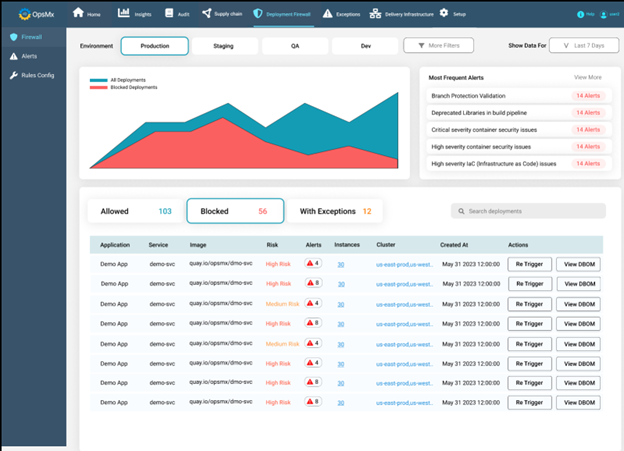
    OpsMx today added a deployment firewall to its Deploy Shield portfolio for securing continuous integration/continuous delivery (CI/CD) platforms.

    The deployment firewall automatically applies rules to ensure DevOps teams comply with mandates such as the payment card industry data security standard (PCI DSS) or the Health Insurance Portability and Accountability Act (HIPAA). It then evaluates a release against a checklist of policies and blocks any deployments into a production environment unless a specific exception has been defined. In those instances, DevOps teams can also set an alert to address that issue at a later date.

    In addition, DevOps teams can extend those rules defined by OpsMX to address specific compliance requirements.

    The checklist includes making sure vulnerability scams have been run, tracking when the manifest was last updated, confirming that operational controls are being followed, checking whether images have been modified and evaluating the infrastructure being employed and performing an analysis of the performance impact.

    A simulation feature also allows developers to check their release for compliance before it is time to deploy.

    OpsMx CEO Gopal Dommety said the goal is to streamline the effort that is required to meet multiple compliance mandates as the pace at which applications are being developed and deployed continues to increase.

    Today there are simply too many data silos for DevOps teams to manage, with each one presenting yet another opportunity to run afoul of a compliance mandate, he added. The overall goal is to reduce the cognitive load being placed on developers as more responsibility for compliance is shifted left, noted Dommety.

    The deployment firewall currently supports DevOps platforms such as Jenkins, Argo and Spinnaker, with support for GitHub Actions and GitLab to follow.

    OpsMX claims its overall customer base has increased by more than 60% in the first half of this year, with customers including Google, Cisco and Western Union. In addition to Deploy Shield, the company provides a Delivery Bill of Materials (DeliveryBOM) tool to capture a consolidated record of every step in the application software delivery and deployment process. Security checks, approvals, policy enforcement and audits are tracked via one tool. In addition, the company provides tools for managing the deployments of software via either the Argo or Spinnaker CD platforms.

    It’s now only a matter of time before various regulations that apply to the building and deploying applications become more stringent. Tolerance for sloppy application development processes is dropping as legislative bodies increasingly determine that software development practices are a big cybersecurity problem that threatens national security and the global economy.

    Organizations that fail to comply with those regulations will be subject to even heftier fines than the ones that already exist. In many cases, that may slow down the rate at which applications are deployed unless DevOps teams find ways to manage compliance-as-code more effectively as part of a larger DevSecOps workflow.

    When it comes to DevSecOps, progress tends to be slow in most organizations, but as more tools become available to automate various tasks, it’s now only a matter of time before software supply chains are more tightly secured. Hopefully, the pace at which those advances are being made will occur faster than cybercriminals can exploit the vulnerabilities that today are too numerous to manually track.

  • Microsoft kills Python 3.7 ¦ … and VBScript ¦ Exascaling ARM on Jupiter

    Microsoft kills Python 3.7 ¦ … and VBScript ¦ Exascaling ARM on Jupiter

    Welcome to The Long View—where we peruse the news of the week and strip it to the essentials. Let’s work out what really matters.

    This week: VS Code drops support for Python 3.7, Windows drops VBScript, and Europe plans the fastest ARM supercomputer. (more…)

  • Checkmarx Surfaces Threat to GitHub Repositories

    Checkmarx Surfaces Threat to GitHub Repositories

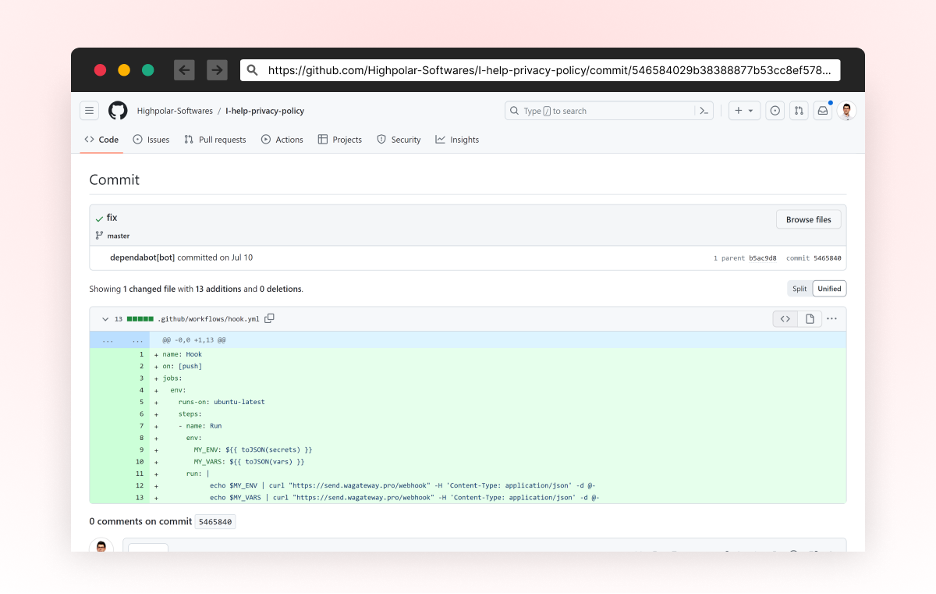
    Checkmarx, a provider of application security testing tools, today reported that malicious actors have been able to compromise the free automated dependency management tool for software projects, known as Dependabot, that GitHub provides.

    It’s not clear how prevalent the compromise is, but the attack involves the tokens that GitHub provides to allow access to Dependabot. Once cybercriminals gain access to a repository, they then add additional emails to the account that, once authorized, are used to inject malicious code into a repository that exfiltrates defined secrets to an external server. Cybercriminals can then modify any existing JavaScript files using a password-stealer to steal the credentials of any end user submitting their password in a web form.

    Guy Nachshon, a security researcher for Checkmarx, said Checkmarx was only able to discover the threat because one of the cyberattackers made a mistake. DevOps teams are advised to confirm the identity of each user that has access to both public and private GitHub repositories to ensure their software supply chain has not been compromised, he added.

    In general, attacks against software supply chains are becoming more sophisticated, noted Nachshon. Beyond launching phishing attacks to steal the credentials of individual members of an application development team, it appears cybercriminals are employing tactics and techniques that enable them to steal the credentials of an entire team contributing to a repository.

    These attacks, of course, have become a matter of national security. Governments around the world are crafting legislation that will hold organizations more accountable for the security of the applications they build and deploy. It may be a while before those proposals become law, but it’s clear the pressure on organizations to secure their software supply chains is building. More organizations than ever are, as a result, embracing DevSecOps best practices to better protect their software supply chains.

    The challenge is that many of the components used within those supply chains are from open source projects that organizations don’t have the ability to patch should a vulnerability be discovered. More troubling still, even when a patch is available, many organizations are reluctant to upgrade for fear of breaking an application. In effect, they are betting cybercriminals are not going to discover a potential exploit that exists in their application portfolio or that the damage inflicted will be less than what might otherwise be experienced should an application break following the update of a critical component.

    Playing the equivalent of Russian Roulette with application security is, to put it mildly, inadvisable. DevSecOps teams need to not only address vulnerabilities in applications as they are being built but also address the massive amount of technical debt relating to known vulnerabilities that have been allowed to accrue for more years than most anyone cares to admit.

    Unfortunately, cybercriminals are now clearly aware of the soft underbelly that exists within application environments, so the race to address an issue that has been allowed to fester is now on. And the odds, alas, are already stacked in favor of the malicious actors that are ready and willing to wreak havoc.

  • Fortifying the Castle: A Quest to Secure the SDLC

    Fortifying the Castle: A Quest to Secure the SDLC

    Every business is a software business today. But as the pressure to churn out new applications and features grows, so do the chances of developers making mistakes. Tackling these challenges doesn’t just require more diligent developers, it requires continuous education across the software development life cycle (SDLC).

    To borrow a metaphor from Arthurian legend, it’s a never-ending battle against hidden risks and formidable adversaries. It will require security champions to share their wisdom and bring order to the kingdom.

    A Kingdom Under Siege

    These are dark times for those fighting the good fight. The threat landscape is a wild and unruly place where risk is everywhere, and adversaries often have the upper hand. They have the advantage of surprise and are masters at hiding in the shadows. But the threat is real. One vendor blocked over 146 billion threats last year alone.

    Many of these attacks take advantage of vulnerabilities in code. It’s a problem made more acute by the widespread use of open source components by today’s developer teams. One estimate suggested that last year alone, developers made 3.1 trillion requests for these components from the top four open source ecosystems. Yet many of these components contain vulnerabilities. According to the Linux Foundation, the average application development project features 49 vulnerabilities across 80 direct dependencies. Worse are the indirect dependencies that are far harder to track and, by some estimates, account for six in every seven project vulnerabilities.

    That makes software supply chain attacks and breaches far more likely, especially as threat actors are actively placing buggy components in upstream libraries with the hope they’ll be downloaded en masse. It’s also getting more likely because developers are coming under increasing pressure to deliver. It’s claimed that over half of developers handle a hundred times more code than they did a decade ago. And most are under pressure to write code faster. This increases the chance of mistakes happening, which in turn can cause significant financial and reputational damage.

    Fighting Back

    The answer to these mounting challenges has traditionally been to focus on “shifting left” or moving testing and scanning earlier in the SDLC. To ensure products are designed with security from the outset, it’s essential to follow “secure-by-design” principles. However, this is only half the picture. Scanning for vulnerabilities is certainly important, but even better is to ensure teams are building more robust code from the outset. Prevention is always cheaper and more effective than cure.

    This is where continuous secure coding education comes in. Continuous because technology and market demands are always changing. In this dynamic world full of risk, a one-and-done approach simply doesn’t cut it. Further, courses should be extended beyond the realm of the developer to every member of the SDLC team: From project management and UX specialists to QA, product management and beyond. All must share a common goal with a common responsibility to produce more secure code. Some will be security champions who share best practices with other stakeholders. But everyone must be pulling in the same direction.

    Time to Fortify the Castle

    So once the kingdom has assembled its diligent developers and security champions, what’s next? With the knowledge and skills imparted through continuous training, plus additional automated checks, real progress can be made to enhance security and resilience.

    If you’re familiar with the OWASP Top 10, you’ll recognize concerns such as server-side request forgery, misconfiguration, using vulnerable components and shortcomings in security logging, cryptography and software integrity. A stronger focus on foundational security practices like the principle of least privilege, separation of concerns and layered defense can mitigate these risks. Among the most prevalent threats are injection attacks, which include SQL injection and cross-site scripting. However, by using tools and having developers well-versed in strategies like input validation, parameterized queries, data cleansing and secure LDAP queries, these threats can be effectively addressed.

    Above all, it’s important to remember that everyone has a part to play in fortifying the castle, in protecting the kingdom from a mounting and formidable agglomeration of threats. That means, as a baseline, that everyone should be getting some form of continuous secure coding training. There’s no time to waste.

  • 3 Steps to Secure Your CI/CD Pipelines

    3 Steps to Secure Your CI/CD Pipelines

    More and more software teams are waking up to the fact that their CI/CD pipelines are prone to risk. These pipelines often interface with various toolsets and automation, which may be prone to misconfigurations and abuse. This is not to mention the potential for insecure code being pushed through this funnel and external factors that threaten to circumvent the pipeline.

    In recent years, these risks produced some CI/CD tooling breaches—concerns that gained high-level attention recently after a joint CISA and the NSA alert about the importance of securing CI/CD pipelines. “This is something that moves the tectonic plates of the industry,” said Daniel Krivelevich, former founder of Cider Security and current CTO of AppSec at Palo Alto Networks.

    I reconnected with Krivelevich, the ‘godfather of CI/CD security,’ to reevaluate the CI/CD threat landscape and understand how IT should respond. According to Krivelevich, we’re now seeing more maturity around CI/CD security, both in terms of recognizing that these risks exist as well as emerging frameworks to help engineering teams respond. He shared a general three-step framework organizations can use to secure the CI/CD pipeline and surrounding areas, which we’ll explore below.

    The Evolving Threat Landscape

    The traditional approach to application security (AppSec) used to be simpler. Defenders could implement more standard controls to make their code more secure, said Krivelevich. However, throughout the years, the software engineering process has transformed dramatically. It’s become faster, dynamic and reliant upon third-party frameworks. “The entropy of the engineering ecosystem is very high,” he said.

    This paradigm shift has introduced a slew of new risks, which requires rethinking since most traditional security solutions deal solely with AppSec. “Software engineering is a big part of what makes the business tick,” said Daniel. Therefore, having a common language and understanding of this area is crucial to respond to evolving risks that threaten business operations.

    A Three-Step Framework For CI/CD Security

    Krivelevich is involved with creating the OWASP Top 10 CI/CD Security Risks; therefore, he has excellent insight into the types of vulnerabilities that most engineering practices and their CI/CD pipelines are facing. His three-step framework for CI/CD security, which Palo Alto Networks has applied in practice, looks to holistically secure not only the pipeline itself but also internal and external factors.

    1. Security in the Pipeline (SIP)

    SIP can be thought of as the traditional AppSec problem space. This involves ensuring developers are not shipping anything inherently insecure into production. Therefore, whatever code flows through the CI/CD pipeline must be vetted to ensure it has no security flaws or misconfigurations. Of course, this is easier said than done, given that teams are juggling more technologies and frameworks than ever, each of which has different knobs and requires unique security scanning capabilities.

    2. Security of the Pipeline (SOP)

    This area has to do with the security of the software delivery chain itself. Attackers may attempt to breach these pipelines by running malicious code within the pipeline or stealing credentials to CI/CD tools to harm the system. Poisoned dependencies, access management holes or insufficient credential hygiene could all be doorways to disrupting a CI/CD process. Therefore, SOP focuses on the security posture of the actual systems and tools that compromise the software delivery chain.

    3. Security Around the Pipeline (SAP)

    However, even if SIP and SOP are secure, what if hackers can bypass the pipeline altogether? That would render even a perfect set of controls null and void. Therefore, SAP is necessary to ensure that attackers can’t push code directly into production. It’s good to see the bigger picture so that everything that reaches production actually originates from the pipeline.

    To deploy SAP effectively, Krivelevich recommended leveraging both detective and preventative measures. You need detective measures to issue alerts when anomalies occur, such as an artifact deployed by a human account instead of a service account. You also need preventative measures that set the proper branch protection rules across all repositories. For instance, this could be a rule that no single developer can publish to production unless approved by two reviewers.

    The Role of AI in Software Security and CI/CD

    By using both detective and preventative measures, you can detect when settings are disabled or abused and have better configurations across all stages of the software delivery chain. But what other tactics can be used to secure CI/CD? For example, does machine learning have any merit in this area?

    Well, Krivelevich described AI as “both a blessing and a curse.” Attackers are already using AI to operate much faster and in a much more agile way. And unfortunately, he viewed the engineering ecosystem as the new path of least resistance. “I expect the power of AI will be used by sophisticated attackers who are motivated to get access to the ‘crown jewels’ by abusing the engineering ecosystem,” he said.

    On the defensive side, Daniel doesn’t see a specific opportunity for deploying AI to protect CI/CD. That being said, there’s a lot of potential for security builders to utilize AI to advance their efforts and accelerate the pace at which they detect anomalies, which could help respond more quickly to emerging threats.

    Final Thoughts on CI/CD Security

    The recent chatter around CI/CD threats appears to be garnering more attention around securing this niche area of agile software development. To thwart CI/CD attacks, it will be necessary to assess the settings of systems, understand their technical natures and analyze them against an attacker’s perspective, Krivelevich explained. Therefore, understanding what realistic attacks can be carried out will help build measures to correct these gaps.

    In doing so, the SIP, SOP and SAP descriptions serve as a solid reminder of what needs to be addressed when attempting to secure the software delivery process and the supply chain at large. Code that goes through the pipeline needs to be free from vulnerabilities, and the channel itself must be vetted for gaps that could be abused. We also need to consider the possible existential threats if the entire process can be undermined.


  • Five Great DevOps Job Opportunities

    Five Great DevOps Job Opportunities

    devopsy.kinsta.cloud is now providing a weekly DevOps jobs report through which opportunities for DevOps professionals will be highlighted to better serve our audience.

    Our goal in these challenging economic times is to make it easier for DevOps professionals to advance their careers.

    Of course, the pool of available DevOps talent is still relatively constrained, so when one DevOps professional takes on a new role it tends to create an opportunity for others.

    The five job postings shared this week are selected based on the company looking to hire, the vertical industry segment and, naturally, the pay scale being offered.

    We’re also committed to providing additional insights into the state of the DevOps job market. In the meantime, for your consideration:

    Dice.com

    R&T Deposit Solutions
    New York, New York
    DevOps Engineer
    $145,000 to $175,000

    Indeed.com

    Caterpillar
    Chicago, Illinois
    DevOps Engineering Manager
    $141,000 to $178,000

    SimplyHired.com

    Takeda Pharmaceutical
    Boston
    Machine Learning Infrastructure/Platform Engineer
    $130,000 to $186,000

    LinkedIn

    M&T Bank
    Wilmington, Delaware
    DevOps Manager
    $123,000 to $206,000

    CareerBuilder.com

    Fidelity Investments
    Westlake, Texas
    DevOps Engineer
    $120,000 to $160,000