Category: DevOps Toolbox

  • SRE vs. DevOps — a False Distinction?

    SRE vs. DevOps — a False Distinction?

    Just a few days before he died at the beginning of the 1990s, a wise man taught us that “the show must go on.” Freddie Mercury’s parting words have long provided the guiding light for many, if not all, ops teams. In their eyes, the production environment should be exposed to minimum risk, even at the expense of new features and problem resolution.

    About 10 years ago, Google decided to change its approach to production management. It took the company only a few years to realize that while R&D focused on creating new features and pushing them to production, the Operations group was trying to keep production as stable as possible—the two teams were pulling in opposite directions. This tension arose due to the groups’ different backgrounds, skill sets, incentives and metrics by which they were measured.

    Trying to bridge this gap between the two groups, one of Google’s ops leaders, Ben Treynor, thought of an innovative solution. Instead of having an Ops team built solely from system administrators, software engineers—with an R&D background and mentality—could enrich the way the team worked with the development group, change its goals and help with automating solutions.

    Site Reliability Engineering, or SRE

    And so, the Site Reliability Engineering position was created. According to Google, SRE engineers are responsible for the stability of the production environment, but at the same time are committed to new features and operational improvement. Google decided its SRE teams should be composed of 50 percent software engineers and 50 percent system administrators. The engineers were driven to use software as a way of solving problems and perfecting what had historically been solved by hand. They integrated easily with the development team, and encouraged code quality improvements and automation testing.

    Understanding the value of SRE, several organizations of various sizes decided to embrace its principles. Some, such as Dropbox, Netflix and Github, are well-known for being at the forefront of technology leadership.

    Wait, Isn’t That DevOps?

    DevOps is a more recent movement, designed to help organizations’ IT department move in agile and performant ways. It builds a healthy working relationship between the Operations staff and Dev team, allowing each to see how their work influences and affects the other. By combining knowledge and effort, DevOps should produce a more robust, reliable, agile product.

    Both SRE and DevOps are methodologies addressing organizations’ needs for production operation management. But the differences between the two doctrines are quite significant: While DevOps raise problems and dispatch them to Dev to solve, the SRE approach is to find problems and solve some of them themselves. While DevOps teams would usually choose the more conservative approach, leaving the production environment untouched unless absolutely necessary, SREs are more confident in their ability to maintain a stable production environment and push for rapid changes and software updates. Not unlike the DevOps team, SREs also thrive on a stable production environment, but one of the SRE team’s goals is to improve performance and operational efficiency.

    Google tried a few approaches to implementing the SRE process before finding the one that suited them best. One of these approaches attempted to tie the number of permitted releases to the product’s stability. The principle underlying this process is that new releases are green-lighted based on current product performance.

    For each service, the SRE team sets a service-level agreement (SLA) that defines how reliable the system needs to be to end users. If the team agrees on a 99.9 percent SLA, that gives them an error budget of 0.1 percent. An error budget is exactly what the name suggests: the maximum allowable threshold for errors and outages. Here’s the interesting thing: the development team can “spend” this error budget in any way they like. If the product is currently running flawlessly, with few or no errors, they can launch whatever they want, whenever they want. Conversely, if they have met or exceeded the error budget, and are operating at or below the defined SLA, all new releases are frozen until they reduce the number of errors to a level that allows the launch to proceed. This process ensures that both the SREs and developers have a strong incentive to minimize the number of errors in production.

    Another interesting approach recommended by Treynor, which is more related to SRE professionalism and efficiency, is allowing SREs to move between projects. Moreover, he suggests allowing SRE engineers to move to development, and even the other way around. As the work done by both teams is similar, these transitions help the Ops team gain better and deeper knowledge of the product and code, and bring the Dev teams into the production space to help them understand its challenges. This strongly promotes a team atmosphere, rather than one in which an individual feels that “I’m on the SRE team for this product.” As part of this approach, Treynor had Dev teams handle 5 percent of the operations workload. This, according to many organizations, adds to the SRE team’s motivation and effectiveness.

    Riddles in the Dark

    Well, SRE seems perfect. As already stated, several large-scale organizations have chosen to move some of their production operations from old Ops to SRE. However, there are still a few questions that need to be asked:

    Is the position of SysAdmin (production/ops) no longer relevant for SysAdmins?

    Historically, almost all system administrators have come into their roles through tech support and similar work, or even just running Linux on their desktops and then transitioning into server work. It should be pretty clear that the same path is not available into SRE. To retain their positions, SysAdmins should now be more code-oriented, have better technological knowledge and be receptive to new methods of conducting the work they already do.

    Can an SRE team prevent production incidents?

    One of the strengths of a professional site reliability engineer is the ability to handle the growth of production load and traffic in-house. Monitoring and analyzing processes and logs with platforms such as the ELK Stack is part of the day-to-day workload, and the team should be able to identify problems as they occur, and even foresee risks to software stability. The power of this position—based on the skill set it requires—lies in developing solutions for these problems and risks. As Ciara, a software engineer in Google’s cloud storage SRE team, described it in a “Life in Google” post, “We solve cooler problems in cooler ways.”

    Are we doing DevOps or are we doing SRE?

    This question is usually asked by people trying to position themselves in the Operations world. According to many companies that implemented SRE in a slightly different way than Google, you don’t have to decide. At Reddit, ops engineers work on reducing toil, improving deployment and scaling processes, but they are referred to as “DevOps.”

    At Logz.io, we bridge the gap between developers and production through the use of automated monitoring and performance stress-testing. And we personally refer to it as “DevOps” rather than “SRE.”

    So, is it Just a Question of Context?

    In her blog, Charity Majors talks about SRE and DevOps being two different operational approaches that any organization can choose to work by, but insists on emphasizing that there is no “correct” approach. Although Google and Dropbox have decided on SRE, this does not mean the rest of the world should do so as well. What fits Google’s needs and organizational philosophy does not necessarily work for other orgs—at any scale. Moreover, Charity believes that DevOps, having grown and evolved within a broader variety of software organizations, is the more flexible, collaborative and adaptable approach, and will work better for most software organizations at all stages of development.

    On the other hand, SoundCloud senior engineer, Matthias Rampke issued a series of tweets on how SRE and DevOps were basically the same, with only one difference—high management support. Though in contradiction to her blog, Charity lent weight to this opinion during an AskMeAnything event that revolved around DevOps and SRE. She shared a story about a friend who was hiring for a startup, which, as an experiment, posted the exact same job description twice, the only difference being that one listing was titled “DevOps engineer,” and the other “SRE.” At the time of relating the story, DevOps was winning by 10 percent or 20 percent. However, all this means is that the job title is irrelevant, and naming an SRE team does not magically bestow qualities upon it. Rather than focusing on the title, organizations must focus on the work being done.

    To summarize, we can quote Matt Simmons, a technologist with many insights into this topic, who says, “Not every infrastructure needs an SRE, but every infrastructure could use an administrator who acted more like one.”

    — Asaf Yigal

  • ChatOps: Has the Fat Lady Already Sung?

    ChatOps: Has the Fat Lady Already Sung?

    One of the sometimes unsung stars of the DevOps scene is ChatOps. I have heard lots of folks use the term, but what does it really mean to you? ChatOps is a phenomenon that started, perhaps not surprisingly, inside of GitHub. It was only natural that developers leveraging the repository to share and build better code would eventually start collaborating in ways that other messaging options just couldn’t provide.

    Whether ChatOps in GitHub is something that gave rise to the growing enterprise collaboration and chat  product/services market is open for debate. There is no doubt, however, that the 30 (give or take) cloud-based messaging and chat platforms out there today are looking to make their mark in the world of developers, engineers, admins, DevOps and IT professionals. Some of the larger players in the space have already launched features designed specifically to appeal to this set of users, with Atlassian HipChat and Slack among the leaders. But they are not alone. I thought it would be worth the effort to take a look at some of the players and up and comers in the space.

    HipChat has been a strong proponent of ChatOps for a time now. The company has consistently been tagged as a leader and boasts product integrations with many different tools and services. For example, a Puppet integration brings the power of ChatOps to joint HipChat/Puppet DevOps customers. Slack has made strides as well. Integrations with incident management and response providers including VictorOps and PagerDuty are only a few examples of how Slack has given teams the ability to collaborate on and fix problems with just a few clicks.

    Despite the millions of users already using Slack, HipChat, Microsoft Teams, Facebook Workplace and other apps in the market, there is still no definitive proof of whether any of the competitors have won the hearts and minds of the IT professional. In fact, we are seeing many of general IT publications writing about several of these tools because many of their users are in that category. The original ChatOps tool that was brought to life in GitHub, for all we know, may still be king among the IT audience.

    Will the Jury Reach a Verdict?

    There are two things that are certain in the market: The jury hasn’t yet decided if there is a ChatOps winner among the numerous options, and developers and other IT professionals may want to consider other options before reaching a decision. Unfortunately, for as much as the true IT practitioners despise marketing, there simply has been no way to avoid the  buzz that the aforementioned providers have created. Chances are, if you are searching for a solution, one of the biggies is going to pop up in the top of your browser and potentially block you from finding all options available.

    The Choice Gets Tougher

    The foundational similarity between top platforms is that they use cloud-based applications to connect teams in efficient, collaborative and transparent ways. Mobile workflows and the growth of BYOD has increased the popularity of enterprise messaging and chat platforms as they create ways for employees to quickly reach one another on their own terms. Yet even so, enterprise messaging vendors are learning that  to be effective, they must also provide users with agility, security and the ability to execute on change.

    Options to Consider

    The past couple ​of year​s​ have highlighted just how competitive this space is, and how quickly it is moving. If you work in an environment that leverages ChatOps or are considering ChatOps options, the list below presents a few of the lesser-known or up-and-coming platforms out there with the potential to become your ChatOps solution. That is not to say that the big guys such as HipChat or Slack are not worthy. On the contrary; they are great solutions. But some of these others might be worth looking into:

    Newcomer Flock entered the U.S. market in September 2016. With an eye on the developer community, the startup worked quickly to open its API to developers and has started adding integrations with partners such as PagerDuty, Bitbucket and Appsignal. Flock’s biggest differentiator is that it allows developers to build bots, widgets and apps on its framework using Java and Node.js SDKs, which easily feed into Flock’s Appstore for distribution. Flock allows developers  to spin up applications in just days. For developer teams stretched on time and budget, they’ll find the application has GitHub integration, engages quickly after being turned on and offers low costs for its paid version.

    Ryver, founded in 2015, provides all-in-one team collaboration, from chats, posts and files to the option to invite as many team members and guests as needed. Additionally, Ryver has a broad range of functionality that offers the ability to share long-form posts or threaded discussion, and integrates with the likes of Google Docs, Dropbox, Asana, Jira, Twitter and Facebook, among others. Ryver recently rolled out its “Global search” bar, which allows a keyword search to locate multiple matches across conversations and solves email’s common problem of archiving data.

    Third, there’s ChatWork, known as a group app for global teams. ChatWork is available in five languages and says it supports 124,000 customers in 205 countries. Last month, ChatWork announced new features to connect multiple chat platforms through the ChatWork desktop app as well as a new screenshot feature. The multichat and chat service integration features allow users to be logged into multiple ChatWork accounts without having to change browsers or log in and out repeatedly. This comes in handy when using multiple ChatWork accounts, such as personal and business accounts at the same time. It also allows teams that use Gmail, Outlook or Skype to use these services together from a single area within the desktop app.

    eXo Platform began as an open-source project in 2002 focused on implementing the industry’s first Java portlet container. The project grew into a company in 2003, to start working with its first customer, the U.S. Department of Defense. Today, eXo is an all-in-one open-source digital collaboration platform that provides knowledge, document and content management, social engagement and project collaboration tools integrated into your business’s applications. It is full-featured and extensible, and has a great design. eXo helps companies connect their employees, customers and developers through social, collaborative and content-driven intranets, websites and dashboards.

    Assembla is a set of cloud-based task and code management tools for software developers. Created in 2005, Assembla hosts more than 100,000 commercial and open-source projects and is used by more than 800,000 users in 100+ countries. With Assembla, software engineering teams can manage tasks, teams and code in one place with SVN, Perforce, Git repos, cardwall view of tickets for drag and drop planning, wikis and more. Integrations include Slack, Github and Zapier.

    Finally, there’s Salesforce company Quip. Quip was founded in 2012 by Facebook and Google alumni and combines documents, spreadsheets and chat into one experience. With Quip, enterprises can manage projects, finalize budget plans, share meeting notes and stay connected. Quip is used by thousands of the world’s most well-known and innovative companies, including Facebook, NewRelic, Quora, and Pinterest.

    As you can see, there are lots of choices out there if you have not already settled on Slack or HipChat, or if you want to see if something else is better for your situation. If you haven’t heard the singing, there is still time to check them out.

    — Alan Shimel

  • Get Your DevOps Right With These 7 Technologies

    Get Your DevOps Right With These 7 Technologies

    Editors’ Note: As with all of our contributed articles, the views expressed in this article are of the author, not devopsy.kinsta.cloud. Due to its vendor-agnostic stance, devopsy.kinsta.cloud does not endorse any particular technology.

    There was a time when the operations team and the developers regularly were at each other’s throats. The developers were never satisfied with production code updates and the server administrators chafed at developers piling up the serve requests and circumventing the processes.

    However, the battle lines have been somewhat erased since the advent of DevOps. IT teams adopting DevOps can move rapidly from concept to production to enhance the business impact, quality and velocity of the application delivery. Many organizations are shifting to DevOps because of its high efficiency and the number of people taking DevOps training are also increasing due to numerous job opportunities in this field.

    DevOps Technologies to Know

    A number of technologies have emerged to help in the shift to DevOps, providing services ranging from the configuration management to application portability. Following is a list of seven technologies worth noting.

    Splunk

    Splunk is used for detecting and fixing issues across the life cycle of an application in real time. It allows the developers to see data from the production environments, eliminating the need to access production machines. Splunk enables DevOps processes including continuous integration and deployment.

    The Splunk platform is used for DevOps to:

    • Provide end-to-end visibility across each and every component of the DevOps tool chain.
    • Utilize the objective metrics to make sure the code meets the quality SLAs and is operational.
    • Correlate the business metrics with changes in code to obtain new business insights.

    ScriptRock GuardRail

    ScriptRock Guardrail is designed to rapidly pinpoint the differences in configurations on desktops and servers, comparing the states between systems and over time. ScriptRock Guardrail shows what has changed, helping simplify diagnostics and decreasing downtime.

    Developers who work with agile methodologies are accustomed to a test-first way of working with the unit tests, making sure that everything works as planned. As continuous delivery becomes more prevalent, the DevOps and Ops teams need to take a similar approach. This is where the ScriptRock GuardRail comes into its own, providing you the tools to construct and build infrastructure level unit tests and view the results visually, thus making it very easy to rapidly drill into the real problem and get your services running.

    ScriptRock GuardRail focuses on addressing the key prerequisites to any DevOps, and, more precisely, initiative and automation. They are described below.

    • Visibility: The GuardRail platform delivers visual configurations showing differences between like devices, configuration drift monitoring and automated visualization and scanning of network device and server configurations.
    • Accountability: Users can curate and filter configurations to generate policies that can be utilized to ratify the configurations on a continuous or ad hoc basis.
    • Automation: All the policies can be exported to Windows PowerShell DSC, Docker, Ansible, Puppet and Chef.

    ScriptRock GuardRail works with any automation tool and can be delivered as single-tenant SaaS, multitenant SaaS or a virtual appliance on-premises.

    SaltStack

    The SaltStack Enterprise Software helps DevOps organizations by organizing the systematic motion of code into production by maintaining the complicated infrastructures refined for optimal application delivery and business service. While DevOps is not a tool, it requires a tool-centric approach to enable continuous delivery. SaltStack helps to configure as well as quickly deploy the dynamic applications and general-purpose infrastructure they run on. DevOps is gaining wide popularity around the world because of the tools like SaltStack that enhances its efficiency.

    SaltStack is a cloud infrastructure tool and delivers the systems management for application configuration, cloud building, server provisioning and data automation. It is an event-driven tool and can automate the tasks within DevOps workflow and makes the operations highly approachable for the developers. SaltStack provides a common language and common way to manage the servers and thus helps to bridge the gap between Devs and Ops.

    Puppet

    Automation is the foundation for many DevOps practices. It is the key to continuous delivery and faster deployments. Automation imposes consistency across the production, testing and development environments. It makes sure users can rapidly orchestrate the changes throughout the infrastructure: container and cloud deployments, virtual machines and bare-metal servers.

    No matter where it runs, Puppet provides a standard way of operating as well as delivering a software. Users define what they want their infrastructure and apps to look like utilizing an easy-to-read common language. From there, they can enforce, test and share the changes they want to make across their data center. Reporting and visibility is available at every step of the way to help prove compliance and make decisions.

    The Puppet Enterprise enables users to test changes before deploying them to production. With Puppet Enterprise, the infrastructure is defined as code, which enables users to adopt the best practices of agile development including automated deployment and testing, and deliver the software more reliably. This is because the configurations are consistently promoted, shared and tested across all environments, from Dev laptops through test to production.

    Atlas

    Atlas was the first commercial product released by HashiCorp, provider of open-source tools that enable the efficient deployment of software-defined applications and data centers. Atlas provides visibility into the infrastructure, including virtual machines, containers and servers, in addition to service discovery and configuration management. Building on the popular open-source projects of HashiCorp such as Terraform, Consul, Serf, Packer and Vagrant, the closed-source proprietary Atlas enables DevOps across different cloud services, which include OpenStack, Azure, Google Compute Engine and AWS, and provides a dashboard for maintaining, deploying and developing applications.

    Many engineers are shifting to Atlas today for their organizations’ customer engagement platforms. Atlas brings it in one place and enables the companies to handle end-to-end starting from configuration management to container deployments across various cloud environments. Every open-source tool is fine alone, but the capability to handle and orchestrate them as a whole is extremely powerful.

    Chef

    Chef is a cloud infrastructure and systems framework that automates the management, deploying and building of the infrastructure via repeatable, short scripts known as “recipes.” But the actual strength of Chef lies in its utilization of the pluggable configuration modules(also known as cookbooks), about 2,000 of which are available through Chef community. Facebook, the high-profile user of Chef, recently open-sourced few of its own Chef cookbooks, which include its Grocery Delivery and Taste Tester testing framework, which watches a source code repository such as Git and keeps the local Chef server in sync.

    The complex tasks are automated by Chef that are otherwise resource- and time-intensive. But, more importantly, Chef allows users to focus their efforts on improving and innovating the quality of their services. It also opens the door to more efficiency and collaboration across the organization.

    Docker

    Through its containerization technology, Docker brings portability to the applications wherein the applications run in self-contained units that can be moved across the platforms. It consists of Docker Hub, a cloud service for workflow automation and application-sharing and Docker Engine, which is a lightweight packaging and runtime tool.

    Docker has revolutionized the containerization of applications enabling DevOps to package any kind of application in a lightweight environment. The packaging is done in a way as easy as installing a mobile app. Docker is considered as the most popular DevOps tool. By using docker, the developers can containerize their apps and can run them anywhere. Built on top of Linux containers, docker is a powerful ecosystem where DevOps can use many apps (available on Docker Hub) to the maximum advantage.

    About the Author / Savaram Ravindra

    Ravindra was born and raised in Hyderabad, India, popularly known as the ‘City of Pearls’. He is presently working as a Content Writer at Appmajix Technologies. His previous professional experience includes Programmer Analyst at Cognizant Technology Solutions. He holds a Masters degree in Nanotechnology from VIT University. He enjoys spending time with his friends. He can be contacted at savaramravindra4@gmail.com. Connect with him also on Twitter and LinkedIn.

  • How Much QA is Enough in Software Development?

    How Much QA is Enough in Software Development?

    People working in quality assurance as testers, managers or engineers know what it’s like having to justify their existence; it’s been part of the job for many years. QA experts have had to fight the perception that what they do is a bottleneck, overkill and it slows everyone down.

    Finally, however, QA is getting the attention that it deserves. Companies are gradually investing more in QA skills and tools. This began with the onset of Agile and DevOps—methodologies which have now infiltrated mainstream software development practices everywhere. Since those practices focus on speed, efficiency and quality, engineering leaders have grown to understand that great products are not achievable without adequate QA checks and balances. Another risk is the unflinching nature of high user expectations: Thanks to social media, one user complaint can quickly escalate into others across the web, creating an uncomfortable perception problem for the software provider.

    Robust testing practices can prevent egregious flaws in the software that result in poor user experience and performance—or, worse, a breach. True, testing can sometimes get in the way of speed. Yet no matter how fast you release a product, if it doesn’t work well, no one’s going to buy it, much less use it.

    Nevertheless, we can continually improve the QA practice to fit into modern development teams’ workflow. Testers need to work with developers and master automated testing, while developers need to sometimes engage in testing; everyone should think about the appropriate level and amount of testing. You can have too much of a good thing.

    The Right QA Balance

    The below ideas can help your organization reduce conflict between QA aficionados and those who would rather code and release as fast as possible.

    1: Assess, analyze and report. Developers and testers alike are highly technical; they like numbers. Therefore, the more that the QA team can quantify the risk of an application, provide evidence as to the effectiveness of current QA practices and use metrics to show the need for more QA resources when warranted, the faster that everyone will get on board.

    There are plenty of tools that can deliver common quality metrics such as total number of defects, defect leakage, test coverage, test pass/fail rates, test completion rates, code coverage and application uptime. It’s important to share and discuss these metrics throughout the development team and with product and business managers. What constitutes high quality for the development team may not be the case with executives who are closer to the end user/customer.

    2: The gut check. After metrics, take into consideration the comfort level of your team and company concerning product flaws. In regulated spaces, or for applications that collect sensitive private data, the tolerance for bad code and security gaps is usually low. Gather feedback from different perspectives and roles in the organization for a balanced perspective on the QA practice and areas for improvement.

    3: Get people involved. Quality assurance is no longer a separate activity from development; especially when you are practicing Agile and DevOps, the responsibility for quality is shared. Therefore, developers, business analysts and operations managers all should be doing their work with an eye to quality, delivering feedback regularly to the QA team. Provide opportunities and incentives for any team member to attend events and training related to software quality.

    4: Streamline testing. Test automation tools are helping product teams be more comprehensive in testing, by automating low-risk test cases so that testers can focus their exploratory and manual methods on high-risk or new features. This is a positive development, although testers must take time to learn how to use the tools. Some other ways that can help teams be more efficient in testing include:

    • Conducting more testing early in the sprint. This avoids the 11th hour disaster of finding a major flaw right before the release deadline.
    • Per Agile methods, dividing development tasks into smaller chunks with team members from different disciplines to ensure testing is being done all the time and with visibility by all.
    • Using test driven development (TDD) or behavioral driven development (BDD), which requires that QA, developers and business stakeholders meet at the beginning of a project to agree upon requirements and test cases. Developers then write code against the test, until it passes. New tools are helping bridge the gap by writing requirements and user stories in plain English.
    • Outsourcing part of the testing load during a major project, which can help increase coverage and reduce stress on your team. However, understand that too much outsourcing will undermine any efforts to develop QA as an internal best practice and “mindset” for software teams.

    If your team is committed to QA as a best practice, not an afterthought, those at the top will need to invest properly in the right tools, training and people to get results. Misconceptions about QA still exist; contrary to the view of some DevOps experts, we can’t (and shouldn’t) automate every test. As well, even though developers are now testing the code they write, you still need experienced testers on your team. With the pace of innovation and the high stakes in the marketplace, organizations need more—not fewer—people engaged in testing.

    For testers who love their job, as many of them do, it’s an exciting time to be in the field. Companies increasingly are seeing the value of QA and testers continually are gaining more tools and tactics to excel at helping their organizations produce really great software.

    About the Author / Kyle McMeekin

    Kyle McMeekin is Senior Sales Engineer at QASymphony. Prior to QASymphony, he was a programmer analyst at Cognizant Technology Solutions. Connect with him on LinkedIn.

  • DevOps: Here’s How to Slack Securely

    DevOps: Here’s How to Slack Securely

    With 1.7 million daily active users, it’s clear Slack has come to dominate the team chat world, especially in the tech industry. This, however, means that a fair amount of security is required to ensure that strategic assets remain safe.

    From a security perspective, Slack has done a solid job of keeping its assets on lock, going so far as to score Geoff Belknap from Palantir in 2016 as its chief security officer. The company is also transparent about its approach to security and has dedicated a whole section of its website to it, including interviews with Belknap and others that delve into Slack’s precautions and philosophy around security.

    The company has also certified many of its products to meet strict compliance regulations including FINRA, HIPAA and SOC 2 and 3, which makes it a no-brainer for small teams and enterprises alike.

    So, it’s perfectly possible for companies of all shapes and sizes to lean on Slack for team chat and ops without worrying too much about security. However, no one’s perfect, and Slack’s ubiquity and popularity mean it will always be a target for cybercriminals looking to steal information—that’s basically the nature of being a cloud-based application.

    While, there’s no need to run scared, you do need to be smart about how you use this valuable tool. Here are a few tips for running Slack securely at your organization.

    Use Slack for SecOps

    Slack can be easily used for distributed security alerting, which means every member of your organization can play a role in keeping the business secure.

    Your security operations likely include members of the DevOps team as well as dedicated security folks, and Slack can help all team members integrate security into their workflows seamlessly. DevOps folks may not frequently log in to Threat Stack platform directly. However, any relevant alerts or notifications can be sent to them immediately via Slack, where they can be reviewed and the determination can be made whether further action is needed—all without having to step outside the daily workflow. This means security tasks don’t pose an extra headache, but are just a natural part of the way the company’s operations run.

    Require Two-Factor Authentication

    Slack’s built-in security precautions won’t do you much good unless you actually put them into practice. One great example is two-factor authentication (2FA). It’s up to team owners and admins to require this of their users (otherwise, it will be optional, and most users won’t bother). It is highly advisable you take advantage of this feature, which makes it much more difficult for hackers to tap into your organization’s Slack channels.

    Set Up User Provisioning and Deprovisioning

    Security-minded organizations need to be conscious of and work around insider threats. This also includes employees who have left the company, whether on their own terms or due to an incident.

    To ensure that you do not have any “lurkers” who might be able to take advantage of company information shared on Slack after they have left the company, it’s a good idea to plan ahead for user provisioning and deprovisioning.

    In fact, this should be built into your process for onboarding and offboarding employees, just like it would be for email or any other company asset. If possible, automate the process, so that the moment someone leaves the company, they no longer have access to Slack. To get started, here’s Slack’s guide to provisioning and deprovisioning users.

    Don’t Share Secrets

    Slack is a great place to have secure conversations, which unfortunately can lull some users into a false sense of complete security. “Secure” doesn’t mean you should treat it like it’s watertight; in other words, Slack should never be used to share secrets such as passwords, sensitive customer data or valuable corporate IP—basically, anything that could be considered highly confidential. A good rule of thumb is this: If a piece of information could be dangerous in a hacker’s hands, it doesn’t belong on Slack. Instead, it’s a good idea to use encrypted communication channels, like PGP-enabled email.

    Educate Users

    None of the tips above will do your organization any good if no one knows about them. So make sure that you regularly educate your users about steps they need to take to stay secure while using Slack (such as never sharing passwords there). You should hold user security training whenever new employees come on board, and also make sure to do a refresher now and again with the entire company.

    Additionally, if you change up security protocols around tools like Slack, make sure employees are given a heads up and reminded when new measures go into effect so they know what to expect. Remember: The best offense is a good defense.

    Don’t Slack on Security

    Slack is a great platform with all kinds of benefits for teams. As long as you take the right security precautions, there’s no reason why it can’t be used to its full potential on your team, whether you’re a small shop or a multinational enterprise. As with any other tool, the shared responsibility model is key. Take responsibility for your half of the security equation, and you should be well on your way to a secure Slack implementation.

    — Pete Cheslock

  • Site Reliability Engineering: How to Make the Operations Side of DevOps Actually Work

    Site Reliability Engineering: How to Make the Operations Side of DevOps Actually Work

    The DevOps movement often has been accused of focusing too much on the first half (Development) and not enough on the second half (Operations). Certainly there has been more attention paid to deployment of payloads than to operating running systems, leading to the dismissal of the handover between Dev and Ops as “throwing it over the wall.”.

    Lately, we have seen the emergence of a new focus on the stability and reliability of the systems that are the targets of those deployments, with the creation of the new practice of site reliability engineering (SRE). This has been a welcome addition to the IT toolbox, but it can still seem to put all the onus on Ops teams to catch whatever comes over the wall.

    The Problem with Site Reliability Engineering = IT Infrastructure

    In SRE, the IT infrastructure is expected to be highly automatic and self-healing in the face of any events. Here is the problem: That approach works well for foreseeable events, but less well for the unforeseen ones. Because of that factor, it works well in environments that run few types of individual workload types, but do so at very large scale. If you’re thinking that sounds like Google and Facebook, you’d be right.

    What this amounts to is massive engineering of the infrastructure to withstand known or foreseeable problems. However, typical enterprise IT environments are not like that. A large bank might have thousands of applications, each of which must accommodate changes on a pace that is dictated from outside the IT environment. Applying assumptions from one environment to the other is asking for trouble.

    To illustrate this, let’s look at an example from outside IT. Recently was the anniversary of the sinking of the Titanic, on April 15, 1912. The RMS Titanic itself embodies the principles of SRE, engineered to prevent or survive all manner of emergencies. The ship was equipped with state-of-the-art everything to transport its passengers in comfort and safety across the Atlantic.

    As we all know, that plan did not quite work out. A combination of unexpected changes in the environment (more icebergs than normal), business imperatives to maintain speed and mishandled warnings about the ice from other ships led the Titanic to disaster.

    While the consequences of an IT failure are rarely quite as dramatic as the sinking of an ocean liner, many of the same factors apply. IT administrators may believe that in the worst case their backups and disaster recovery plans will be sufficient to handle any problems, but these plans are designed around known and foreseeable problems. Unexpected circumstances can easily lead to cascading failures, which is why it is critical to be ready for the unexpected when it—inevitably— occurs.

    The Problem with Traditional IT Ops = Static Models

    The key flaw in IT Ops is reliance on static models of the world. These models come in many shapes – the CMDB is the “model” that many think of first, but static rulesets are also a model. The most dangerous models, though, are the ones that are invisible: namely, the filters that are put in place to determine which alerts and events are even worth considering.

    This is the flaw that ultimately sank the Titanic: The crew were unable to correctly priorities events and react to them in time to avoid failure. It is also the flaw that causes countless much more minor issues every day in data centers everywhere: the filesystem that filled up with logs, taking down the database that the critical business application relied on—and the filter that had not forwarded that alert because it usually was harmless. Or the loss of one leg of the redundant network link, which was ignored because the other leg was still up, so there was still a link—until that one failed too, and an entire site went dark.

    The key factor is that the filters were not wrong to suppress those alerts. By definition, informational or warning alerts are not the same as major or critical ones, and most of the time they can be safely ignored, to be dealt with later.

    Every now and then, though, a pattern of those alerts, if understood correctly, can identify a future problem in the making. These developing issues could be nipped in the bud, if only Ops teams had enough hours in the day to look at them and review them. But, of course, they don’t—every Ops team I have ever met is drowning in issues, and behind those there is a long and lengthening to-do list.

    What Can DevOps Do to Make Operations Better

    New approaches are emerging to make the principles behind SRE more widely accessible and applicable. In particular, more dynamic noise reduction and correlation is now possible, to sift those important alerts from the constant background noise and put them together into a picture of what is really happening. The key factor is to be able to do this in real-time and without a human having to plan out laboriously what are all the possible scenarios that they might need to know about in the future.

    Gartner has called this new approach Algorithmic IT Operations, or AIOps. The idea is to bring together all possible sources of events, whether those are alerts from the compute or network infrastructure, transaction slowdowns reported by an APM tool, automated deployments being run from a CI/CD toolchain, or anything else the might conceivably be relevant. All of this information then can be sifted by algorithms to understand what is actually important to Ops and brought to the attention of the right specialists who can work on the issues and get them solved fast. Part of that process is also the integration with systems of record (which generally means IT service management), and with automation and orchestration tools that can accelerate remediation activities.

    This is how we can get the Ops side of DevOps to where they need to be to be able to accommodate the ever-accelerating pace of change—whether from Dev teams wanting to run ever more frequent deployments, or from business users needing help with their own goals—or from the next unexpected issue to come down the line.

    — Dominic Wellington

  • The Postman Delivers More

    The Postman Delivers More

    Most of us use Postman during API development. The company claims 3 million users, and as one of them, that number doesn’t raise my eyebrows any. But if you are like me, you’ve figured out collections, how to back up your data and perhaps looked at tests, but not done much more. As a tool for API development, Postman is powerful and useful, but that means many of us don’t look very far beyond how quick and easy it is to set up an out-of-browser test environment to evaluate request/response.

    We use collections to separate projects, but really only as a way to group calls together and keep a single copy of each call close to hand while the history list scrolls through multiple copies.

    But for DevOps, there’s more. And they’ve just added to it again.

    Packing in the Features

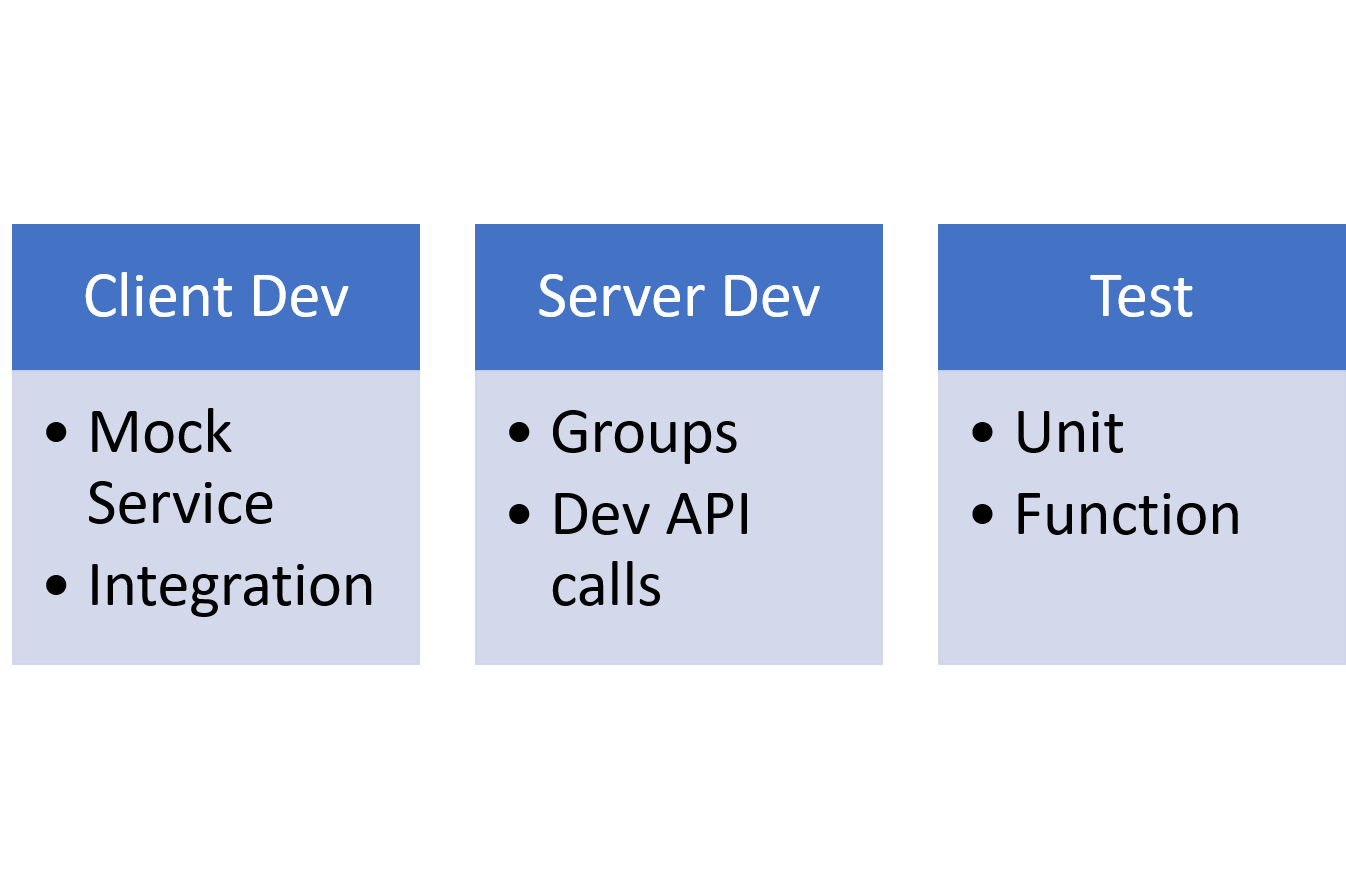
    Groups can be used for grouping calls with tests, for example, and a command line tool can perform automated testing. If, like us, you use Postman to test as the API is developed, and use groups to keep those calls pulled together in one place, then testing from the source that already contains your entire API makes sense.

    And as of this week, Postman also includes the server side. Postman Mock service allows you to mock up the API calls and specify a valid return value. That means client-side developers can use Postman Mock for testing their app/page, while server-side developers are using the original Post

    man to develop the APIs that Mock emulates and testing is running tests from the real-world APIs that already are in Postman for development purposes.


    Dev, DevOps, Testing and Ops: Something for Everyone

    So a quick diagram shows that the entire development process has a bit of Postman in it if that’s your tool of choice:

    While all assist with agile development, for DevOps, the pieces that are the most beneficial are Test combined with Groups and the new Mock service. As long as the Mock service is configured for a group of calls, test can call them and the logged output can reflect that the test succeeded but ran through the mock service. Once the service is completed and the group is directed to point at the server, testing will run tests against the real API. Using Newman, the command line tool, these tests then can be integrated with your build toolset.

    The Mock service can take imports from SOAPui, if you are converting from SOAP calls or use SOAPui for REST and are moving to Postman. I’m told the Postman toolset also supports SOAP calls, but truth in writing, I’ve never even looked to see how that would be done. I’ve used both tools, but never on the same project.

    There’s a Cost, but There’s Also Value

    This next bit sounds a bit salesy, and I try not to do that. But for the price, there aren’t a lot of value-add tools out there that deliver this kind of value. Lori and I are talking about going Pro, as we both use Postman in projects. And considering we’re regular users, I figured if we didn’t know about most of these features, many of you wouldn’t, either.

    Mock is part of Postman’s Pro package, along with sharable team collections, and API documentation tools. That means it will cost you a little bit of money, but if you’re on a team and have been cobbling together a way to share collections, team collections and associated collaboration tools are worth the price—particularly since built-in auditing will show all of the changes made to Postman collection items. That means fixing a change-based error on the Postman side is easier.

    As of this writing, the cost for Postman Pro was $8 per user per month. My guess is sharing groups (or worse, each team member re-creating/maintaining them) costs more than that per month in many cases. Consider that documentation can be generated and shared to a private URL and the fact that Mock service enables parallel development, and $8 sure seems like a steal. Finally, Pro offers API monitoring, so performance and uptime can be tracked to better adjust to the realities of production. There’s more (such as integrations with some great Dev/Ops/DevOps tools), but I’ll stop.

    Summary

    Design, Development (both client and server, in parallel), Test, Monitoring … as long as you can get it deployed, Postman can help with the rest. Postman Pro has a reasonable price for the functionality it offers, and the introduction of the mock service makes agile development, tight timelines and consistent “start to deployment” testing easier. I’d venture to say it is worth taking a look at. And if you’re developing APIs without it, pop out and get the free version, you’ll quickly find why so many of us use it.

    You can find out more about the various editions of postman on Postman’s Product page.

    — Don Macvittie

  • AppDynamics Extends Performance Monitoring Reach to Developers

    AppDynamics Extends Performance Monitoring Reach to Developers

    AppDynamics, fresh off its acquisition by Cisco Systems, this week moved to extend the reach of its monitoring services all the way out to individual developers.

    The spring 2017 edition of the AppDynamics service now includes a developer toolkit intended to make it simpler for developers to track the performance of their code without having to get that data from an IT operations team.

    Matt Chotin, senior director of Developer Initiatives for AppDynamics, said the goal is to respond to the needs of developers who, in the age of DevOps, increasingly are being held accountable for the performance of their applications end to end. The toolkit enables those developers to directly invoke application programming interfaces (APIs) exposed by AppDynamics.

    The toolkit also provides additional AppDynamics support for the Go programming language, the Xamarin framework used to develop mobile applications and a plugin for Android applications. Now also available are dashboards for tracking individual session and crash alerts and reports that make it possible for developers to discover the root cause of a potential issue much closer to the time it occurs.

    But Chotin said the most unique attribute of the AppDynamics release is that developers can apply diagnostics to business transactions in two modes. One mode enables developers to examine code in pre-production and production environment, while another—a Live Mode—can be used against live application data.

    In addition to extending its reach out to developers, AppDynamics is making it easier for IT organizations to deploy its agent software. A new Universal Agent makes it simpler for the AppDyamics controllers to distribute those agents. Chotin said AppDynamics is also working on developing lighter-weight agents that would be used to provide better support for containerized applications.

    Finally, AppDyanmics is also simplifying its software licensing model in a way that enables sharing subscriptions.

    While AppDynamics has developed an extensive following among IT operations teams, reaching out to developers represents a new frontier. As responsibility for application performance shifts in the age of DevOps, Chotin said AppDynamics is discovering the developers want to be able to access directly the metrics that apply specifically to their code. Instead of being presented with information about every application running in the environment, developers want to be able to zone in on any and all issues affecting their specific code, he said.

    Obviously, not every IT organization is implementing DevOps processes to the same level of zeal. In many cases, IT operations teams are still mainly held responsible for application performance. But as the line between those IT operations teams and developers continue to blur, any move to embed instrumentation functions deeper into the application code base stands to benefit everyone. Of course, not every developer might be excited about being required to do that initially. But once they discover that the time between when there’s an issue and they can go back to writing code starts to drop, AppDynamics is betting that many of them are likely to insist on that level of instrumentation being available.

    — Mike Vizard

  • Testing: Your Secret Weapon for DevOps Success

    Testing: Your Secret Weapon for DevOps Success

    I spend virtually all day, every day, speaking with IT leaders who recognize that their bottom line ultimately rests on their ability to accelerate the delivery of innovative software. That’s why they’ve invested so much in digital transformation initiatives—including hiring the best and brightest developers, scaling Agile, driving DevOps adoption, automating the continuous delivery pipeline, and all the other components involved in moving from ideation to delivery as rapidly as possible.

    In most cases, this investment has exposed opportunities to optimize culture, process, and tooling—but not yet delivered the level of acceleration and flexibility that IT leaders expect. I’m frequently asked: “Now what? I think we’re ‘doing’ DevOps. But what else is needed to deliver on faster innovation?”

    Something as unsexy as “transform testing” is not what people expect to hear. As someone who’s been in the software testing industry since 2003, I know that software testing is typically seen as a necessary evil, not a strategic advantage. However, I’ve also witnessed how it can be a secret weapon for surging ahead of the competition.  

    The dirty little secret in the IT industry is that despite all the advancements in software development, software testing remains dominated by yesterday’s application lifecycle management (ALM) tools and manual testing—and they simply don’t meet the needs of today’s accelerated development processes. Transforming testing for the modern era represents a tremendous opportunity. It’s a low-hanging fruit that can help you increase acceleration, reduce risk and cut costs.

    Boost Acceleration

    Agile and DevOps initiatives aim to accelerate the process of delivering working software to the end user. However, even organizations that have adopted Agile and DevOps report dismal test automation rates: less than 20 percent for end-to-end testing. This means that after the rest of your software delivery pipeline is automated and optimized, an outdated testing process eventually emerges as the bottleneck. By transforming testing, you can increase your throughput significantly. I’ve witnessed many companies increase time to market by 55 percent by modernizing their testing process.

    Reduce Risk

    Now that software is the primary interface to the business, a software failure is a business failure. Yet, with today’s compressed and continuous delivery cycles, it’s simply impossible to test everything before every release—even if testing is automated. By aligning testing with your top business risks, you can automatically assess the overall impact to the core user experience and instantly determine if the release candidate has an acceptable level of business risk. This is critical for stopping high-risk software from impacting your prospects, customers, and partners.

    Companies still relying on traditional quality processes and platforms are usually covering only about 10 percent of their top business risks with their current test suite. A goal of 80 percent is typically achievable with about three months of effort.

    Cut Testing Costs

    There are hard costs associated with trying to retrofit outdated testing processes and tools into modern delivery processes. Many organizations try to bridge the testing gap by throwing an abundance of manual testers at the problem, typically through a global system integrator. By the most recent estimates, this approach consumes approximately 35 percent of an average IT budget—a total of $30+ billion per year, globally.

    A way to help testers achieve high test automation rates allows you to reallocate a large portion of that testing spend toward creative tasks which advance competitive differentiation. Many enterprises that transitioned manual testers into “scriptless” (non-technical) test automation have slashed testing costs—and eliminated one of the most significant constraints to achieving faster time to market.

    Get the Analysts’ Perspective

    Analysts at Forrester (e.g., Diego Lo Giudice) and Gartner (e.g., Joachim Herschmann and Thomas Murphy) have spent years advocating that transforming testing is a business imperative. If you’d like to get their perspective, I encourage you to review some of their latest research:


    About the Author / Sandeep Johri

    Sandeep Johri, CEO of Tricentis, has more than 25 years of experience as a technology executive and serial entrepreneur—including roles at Hewlett-Packard, Appcelerator, Oblix (acquired by Oracle), Blue Lane Technologies (acquired by VMware), and numerous other startups in Silicon Valley and India. Johri earned an MBA from Stanford University, a Master’s degree in Industrial Engineering from Wayne State University, Detroit, and a Bachelor’s degree in Mechanical Engineering from Pune University, India. Connect with him on Twitter.
  • DevOps Chat: The Evolution of APM with Jonah Kowall, AppDynamics

    DevOps Chat: The Evolution of APM with Jonah Kowall, AppDynamics

    In this DevOps Chat we speak with Jonah Kowall, VP of Market Developments and Insights at AppDynamics. Of course prior to that Jonah was a VP of Research IT Operations at Gartner. Jonah actually gave us a great overview of the evolution of APM  and how the market has evolved. He also tells where we might be heading now.

    It is not often you can get the lay of the land from an expert like Kowall, so I highly recommend you give this a listen.

    As usual, immediately below is the streaming audio of our discussion and below that is the transcript of our conversation.

    Streaming Audio

    Transcript of the Conversation

    Alan Shimel:                Hi, everyone. Alan Shimel, devopsy.kinsta.cloud here for another DevOps Chat. Our guest on this episode of DevOps Chat is Jonah Kowall of App Dynamics. Jonah, welcome to DevOps Chat.

    Jonah Kowall:             Thanks, Alan. Happy to be here—great to speak with you and everyone else listening.

    Alan Shimel:                Thank you. So Jonah, before we jump into App Dynamics, you have a—you’ve had a bit of a career already. Why don’t you share with our audience a little bit about kinda your journey to how you got here today?

    Jonah Kowall:             Yeah, definitely. Well, I always knew I wanted to be a technologist and, for many years, I worked at about six or seven different startups. I co-founded one of the first content filtering companies back in the early 2000s and, you know, got acquired a couple of times.

    And I kinda shifted careers a few years ago, about seven years ago, and moved into the analyst world and kinda moved away from running ops and security and infrastructure and application performance and decided to take the analyst path, and did that for about four years, which was very interesting and different, learned a lot of new skills, a lot of new muscles were built.

    And I joined App Dynamics a little bit over two years ago, and I work with our       co-founder and CTO running product strategy. I do a little bit of marketing, but quite a bit of product management and kind of looking into where we’re going as a company to solve the next generation of problems that we’re starting to see in our customer base.

    So that’s a little summary of where I came from and however you’d like to take it is great.

    Alan Shimel:                Sure. I guess the real question is, do you know where you’re going, but we’ll come back to that in a second.

    Jonah, as I spoke to you offline about, I wanted to talk to you a little bit about what I have seen, you know, as an observer of the market at devopsy.kinsta.cloud. In terms of the evolution of what used to be just a few years ago, a very kinda stable space called APM, right? We had, the APM space had a handful of players—App Dynamics was certainly one of them—who were, by the way, all doing pretty well, it seemed.

    And what we’ve seen in the last few years is, you know, in the—first of all, more people joining the fray, but more than that, in the race to distinguish one from the other, many players within this space are kinda rephrasing their mission, their—not running away from APM, but their APM plus, maybe. And so we’ve seen, you know, alphabet soups of ARAs and a whole bunch of different combinations.

    What’s your take on that, Jonah?

    Jonah Kowall:             So, when you look back—and, you know, when I started at Gartner, there was a lot of confusion around application performance and application monitoring. And there was like a general belief that anything that monitored some kind of application or even monitored the network and tried to extract application information was, in fact, APM.

    And what I kind of tried to do in my time at Gartner, and I think it sort of changed some things, was really focus APM on instrumentation of applications. So, how do we see the code, how do we get inside the application, how do we trace from end to end and really provide that visibility and the diagnostic capabilities that are really gonna be needed in today’s applications, which are incredibly complex and diverse, and consist of a lot of new technologies?

    So, building that kind of visibility is really hard to do. I mean, if an APM company—and there are plenty of them that have started over the last couple years—they have many, many years before their instrumentation becomes decent, if they’re even going down that path. And the ability to extract information from a running application, without breaking it, is very, very difficult to solve. It takes a lot of time, a lot of experimentation, a lot of work with customers.

    And so this market is very hard to enter into and compete with the three leaders in the space. It’s just a big challenge, and you’re looking at five to six years before these things mature, if they continue to pursue them. So what you’re kind of seeing, and what you alluded to, is that companies are trying to take a different angle and avoiding the deep instrumentation and just trying to provide SVKs and tools for developers to build those, you know, that visibility. But it’s a big challenge, because in enterprise and packaged applications, those products don’t work, and that’s really the challenge that I continually see out there when I observe the industry.

    Alan Shimel:                Got it. So, you know, certain—I’m sorry, Jonah, I have a little tickle. App Dynamics, you know, in, let’s call it an immature industry, rapidly become an 800 pound gorilla, and I think we’ve all seen the proof of that in recent news around acquisitions and so forth. But I’m not gonna go there, Jonah—suffice to say, App Dynamics is a market leader in its space.

    How does this evolution, if you will, changing dynamics, you know, you said you’re working on future problems—how do you think this plays into the future of App Dynamics?

    Jonah Kowall:             Yeah. Well, I think that applications and technologies will continue to evolve, and you know, we’re already starting to see a lot of new application paradigms that we’re gonna have to shift a lot of our core technology to support and to essentially leapfrog what the rest of the market is able to do, and we’re hard at work doing that.

    But aside from the deep, you know, introspection of software, there is also a big push for us to really understand the business, because today’s enterprises, regardless of what they do, whether it’s extracting natural resources from the earth or building cars or providing mortgages—these companies are all software companies, and their businesses depend and are driven by their software. And our goal is really to understand the business execution and the user experience of those transactions that are critical. And, in kind of taking that to the next level is really, how do we look at the outcome of software and of these business transactions as they come together.

    So, our vision is not only to increase our capabilities of the core of what we do in APM, but also to really provide a lens into the business that really provides that IT business alignment that everyone talks about and everyone struggles with today. So we really see that as the differentiator in these large enterprises that are really challenged with a lot of legacy and a huge amount of demand to change their businesses.

    Alan Shimel:                Got it. Got it, got it. So, Jonah, let me pivot a little bit to, there was another area I wanted to touch on with you, and that is this whole area of containers, micro-services—but containerization. Virtually every call, every briefing that I’m on, somehow or another containers make their way into the conversation. How big a focus is it over in the, in terms of product and in terms of the strategy at App Dynamics?

    Jonah Kowall:             Yeah, I mean, micro-services and containers are definitely the peak hype, let’s say, of the day—there’s no question about that. And they provide a lot of benefit, but a lot of people really feel that containers and micro-services are the answer to every problem. And this is something that we’ve seen over and over in our industry where, you know, there’s a new kind of angle to an existing set of technologies that we feel is really gonna make the biggest difference. And although containers and micro-services are both important paradigms, they’re not the answer to everything.

    Our customers are clearly retooling some of their applications around a micro-services architecture, and they’re definitely running workloads on containers, and these things are important for us to support, but are they more important than, you know, building core functionality to support new languages and new frameworks and really helping our customers with their more core business problems. It’s hard to say. I mean, both are clearly critical, but a lot of it is hype, and you know, the hype obviously fades as people become disillusioned with the fact that containers and micro-services don’t solve all your problems. They create a lot of new problems, and that’s just the reality of technology.

    So, as an industry, we’re very over rotated to containers, micro-services, and public cloud, and you know, we’ll soon realize those aren’t the answer to all of our problems—and oftentimes, they create new problems, as well. So, you know, I think it continues to be a cycle and, you know, I really think the evolution of cloud into a decentralized model will be a pretty interesting trend over the next, you know, 5 to 10 years as well.

    Alan Shimel:                Got it. I think we’ve barely scratched the surface. You know, Jonah, I was on a call previous to this and it was around software defined storage and networking and stuff, and it just—listening to it, I had such a déjà vu of sitting back in on the VMware stuff, you know, back in, I guess mid-2005, around then.

    Jonah Kowall:             Yep.

    Alan Shimel:                It just seems to promise so much change for us here; it’s crazy.

    Jonah Kowall:             [Laughter] It always does, and you know, it comes with challenges, always, and people become kind of disillusioned, but there are benefits to those that embrace it, do it well, and you know, have the types of problems that those technologies can solve.

    Alan Shimel:                Yep. Excellent. Well, Jonah, we’re just about up on our time. I’m gonna give you a surprise question here, if you don’t mind—if you can’t answer, that’s okay.

    Jonah Kowall:             Sure.

    Alan Shimel:                But I usually ask, the last question I always ask my guest is—recommend one book to our audience that you really think they should read to help them with their careers.

    Jonah Kowall:             That is an interesting one. I actually tend to, I do a lot of traveling. I actually flew over 200,000 miles in 2016.

    Alan Shimel:                Wow.

    Jonah Kowall:             So, when I actually get to read, I tend to read lighter materials, or I read very deep, technical materials that kind of help with some of the product work that I’m doing. So a lot of the books I read tend to not be too inspirational, but I do really enjoy participating in some of the open Slack communities. I enjoy reading a lot of blogs and other content that tends to be fresher.

    Alan Shimel:                Mm-hmm.

    Jonah Kowall:             You know, I read probably about 500 blogs in my RSS feed regularly, so that tends to really be how I get information, and I do really enjoy reading some of the Google Scholar, if you set some interesting alerts up, you can get some great research papers coming out from universities that are very interesting and forthcoming, just kind of highlighting some of the next generation thinking from the educational institutions all over the world.

    So that really tends to be more what I tend to read versus, you know, something that’s more career focused, I would say, or inspirational in that manner. So sorry I don’t have the best answer, but that’s what I tend to do.

    Alan Shimel:                No, no—that’s fine, and that works for us. Well, Jonah, I think we—well, we are out of time, but I want to thank you for joining us today on DevOps Chat, and I look forward to perhaps having you on again in the future.

    Jonah Kowall:             Sounds great. Thanks for your time, Alan, and thanks, everyone, for tuning in

    Alan Shimel:                Thank you. Jonah Kowall, App Dynamics, our guest today on DevOps Chat. 

                                        This is Alan Shimel for devopsy.kinsta.cloud, and we hope to see you soon on another DevOps Chat.

    — Alan Shimel