Category: DevOps Toolbox

  • Riverbed Aims to Unify App, Network Performance Management

    Riverbed Aims to Unify App, Network Performance Management

    Much of the initial focus on DevOps has been on accelerating the rate at which applications are built and deployed. But once those applications are deployed, it’s not too long before the focus shifts to the quality of the end-user experience. Aiming to make it easier to determine what the quality of that experience really is, Riverbed Technology has launched a Digital Experience Management initiative based on the SteelCentral management platform.

    Erik Hille, director of product marketing for Riverbed, says the latest release of SteelCentral provides tighter integration between SteelCentral Portal and the SteelCentral Aternity end-user monitoring tool and SteelCentral AppInternals, an application performance management (APM) platform. The goal, says Hille, is to make it easier for an organization to holistically manage individual end-user experience by correlating information at the device, network and application levels. As part of that effort, Riverbed also has integrated the workflow between SteelCentral Aternity and AppInternals to create an integrated monitoring system.

    Hille says IT operations teams can use a comprehensive approach to managing digital experiences that can be set up in fewer than 10 days. Once in place, IT operations teams can more quickly identify the root cause of any issue by correlating application, device and networking data through a single pane of glass. In addition, Riverbed is employing REST APIs to make it possible to consume alerts generated by collaboration tools such as Slack and HipChat. IT operations teams can not only automatically open incident management tickets, but also collect additional metrics via those APIs.

    Riverbed is also providing integration between NetProfiler, a network performance monitoring tool, and NetIM, a network device management tool, to provide more visibility into how network infrastructure impacts network performance.

    Hille notes that most IT operations teams are swiveling between different sets of tools to correlate the same information. The problem is that as more organizations strive to become a digital business, any performance issue has a direct impact on customer satisfaction and the amount of revenue being generated. Faced with that increased business pressure, Hille says IT organizations need to re-evaluate legacy approaches to IT operations based on silos. The goal should be to implement a more proactive approach to IT focused on proactively preventing issues from occurring or escalating, versus merely reacting to isolated events as they occur.

    One of the few things in DevOps that developers and IT professionals can agree on is that whenever there’s an issue, it’s the fault of the network guy. That’s not always true, but it does take networking professionals a long time to prove their innocence. Until then, there’s a tendency to assume their guilty until proven otherwise. Obviously, that kind of bias isn’t in keeping with the whole spirit of integrated DevOps. A more comprehensive approach to application and networking performance management should go a long way toward reducing the amount of finger-pointing inside any organization.

    There will never be a perfect IT environment. The goal is to discover issues before the end-user notices—and, failing that, resolve that issue in as little time as possible. Any argument about what exactly happened to cause the problem can occur at a later date and time.

    — Mike Vizard

  • Cisco Looks to Bridge Gap Between Networking and DevOps

    Cisco Looks to Bridge Gap Between Networking and DevOps

    Networking in the enterprise has always stood apart. It might take two minutes or less to spin up a virtual machine, but it can take two weeks to set up the network connections. To help bridge some of the gaps between networking and the rest of the DevOps team, Cisco Systems this week unveiled a series of intelligent switches that promise to do just that.

    Via a Cisco intent-driven networking initiative, it soon will be possible to describe a business outcome that will be automatically enabled at the networking level, says Kiran Ghodgaonkar, senior marketing manager for Cisco. To achieve that goal, Cisco is moving to unify networking on an end-to-end basis, which Ghodgaonkar says primarily will require building a common controller that can be implemented at both the edge of the network and in the data center.

    The first concrete step in achieving that goal is a set of Catalyst 9000 switches running an IOS XE operating system, which Cisco has imbued with machine learning algorithms. Over time, those algorithms will be deployed across both legacy networking infrastructures when appropriate, as well as any new networking and security equipment Cisco brings to market in the future. Once in place, IOS XE will make it easier to implement policies in software that spans everything from prioritizing traffic to implementing security polices.

    This latest Cisco initiative follows the rollout a Tetration analytics platform based on an instance of Apache Spark and Cisco’s acquisition of AppDynamics, provider of an application performance management service delivered via the cloud. Ghodgaonkar says Cisco is aiming to combine analytics and machine learning algorithms to simplify network management in a way that furthers DevOps integration. Right now, however, the biggest impedance to achieving that goal, says Ghodgaonkar, is the fact that 80 percent to 90 percent of networking tasks still require manual intervention. Because of that issue alone, many organizations have experienced limited success in terms of integrating server, storage and networking management, despite the rise of software-defined networking (SDN) in the data center. In fact, to get past that issue, many organizations make investments in pre-integrated systems such as the Cisco Unified Computing System (UCS) platform. But the number of organizations willing to make that kind in forklift investment in IT infrastructure is not all that high when compared to the size of the overall IT market.

    The biggest DevOps issue IT organizations now face, says Ghodgaonkar, is that as various elements of the IT organization invest in automation, silos of automation are created. Cisco says it has developed open application programming interfaces (API) will provide interoperability between its technologies and the rest of the IT environment to help break down those silos.

    It’s still a little unclear these days just how much networking and IT operations can get automated. The good news is that, given the state of network management inside most organizations, things can only improve. The real issue (as any existing DevOps team already knows) may not be so much the technology as it is the culture differences spanning the compute, storage and networking teams.

    — Mike Vizard

  • BMC Pushes Automation to the DevOps Left

    BMC Pushes Automation to the DevOps Left

    Much of the inherent conflict that exists between developers and IT operations teams often comes down to how IT automation processes are implemented. IT operations teams generally have their own preferred tools for automating operations while developers have another. To resolve that issue, BMC Software unveiled Control-M Workbench, a set of development tools that extends an application programming interface (API) to allow developers to embed instructions for automating infrastructure using BMC Control-M automation platform.

    Gur Steif, president for digital automation at BMC Software, says Control-M Workbench moves the responsibility for automating the IT infrastructure resources that their application consumes, including the ability to code, debug and test workflows. The IT operations team can then more easily deploy that application in a production environment, he says.

    In effect, BMC Software is enabling IT organizations to put the control of how jobs are executed in a production environment in the hands of developers by moving that function further to the left of the DevOps life cycle. Control-M Workbench represents the first time BMC is venturing beyond its traditional IT operations base to create a tool that will primarily be employed by developers.

    Steif says the goal is to enable IT operations teams to manage much higher volumes of application rollouts. In return for spending a few minutes on installing Control-M Workbench, IT organizations can deliver application 20 percent faster, while running jobs using 50 percent fewer full-time employees. In addition, Stief says production incidents can be reduced by up to 25 percent and batch processing failure rate can drop by as much as 80 percent.

    Control-M Workbench is clearly part of a trend to give developers more control over and responsibility for IT operations. A recent survey of 650 IT decision makers conducted by BMC finds 94 percent of IT decision makers expect automation to spread into all other areas of business by 2020.

    In addition, the survey notes that 73 percent of IT decision makers believe businesses that do not embrace IT automation to achieve the larger digital business strategy within the next five years will cease to exist in 10 years. The top three areas of investment priority in the next 24 months to achieve those goals are containerization, workload automation/scheduling and DevOps. Almost 9 in 10 (89 percent) respondents concur that IT automation needs to achieve their desired digital business objectives.

    However, there are considerable obstacles that need to be overcome, including lack of budget (67 percent), skills (44 percent) and time (51 perent). In fact, 42 percent of the respondents concede that when it comes to digital business initiatives there are conflicting objectives between business units and CIOs that can get in the way of crafting a comprehensive IT strategy.

    DevOps, of course, is more about people and processes than it is technology. Then again, DevOps isn’t going to be willed into existence without providing the tools needed to change the processes. Given the chicken-and-egg relationship between processes and tools, it becomes incumbent on the IT leadership to serve as the catalyst for bringing it all together.

    — Mike Vizard

  • APIs: Automation is Great. So is Usability

    APIs: Automation is Great. So is Usability

    Many developers are not so great at documentation. Ask anyone who’s been thrown into a large code base. Changes aren’t documented well, tribal knowledge thrives in the code comments, and anyone who says, “I’m confused, what does this chunk of spaghetti code mean?” is often treated with annoyance or even disdain.

    That is something that DevOps doesn’t change. And there are, as with so many things in IT right now, complicating factors. First is APIs. In almost every shop, developers are responsible for the public-facing APIs. The same developers who don’t comment well are now documenting public-facing APIs. The other complicating factor is DevOps documentation mechanisms. Automated systems generate API documentation from developer comments. Again, the same developers that often don’t document their code well enough to efficiently on-board new developers.

    Those of us who have used more than a couple of APIs know the problem intimately. Dozens, or hundreds, or thousands of us have to search for what the allowable values for a parameter or JSON field are in an API call are because far too often that is not well-documented.

    The whole system grew naturally. APIs are the realm of developers; documentation was painful to get created because it required tech writers that were advanced enough to understand the purpose and function of the API; and development of documentation delayed API deployment—all are issues that lent themselves to automated generation and the developer in the code was best-situated to document it. In the API economy, and in light of both agile and DevOps, it just made sense to use generated documentation for this part of the project.

    But we’ve got enough experience now to know that “good enough” isn’t. Far too often users are left to figure out the details, and quite often, those users don’t bother. That’s not a benefit in the API economy; it’s a risk.

    Get Help With Your APIs

    And it’s pretty easily resolvable. Get someone not knee deep in the code to try and use your API as documented. Get their recommendations on usability, and fix the issues they find. I’ve used APIs that have a dozen JSON base parameters, none of which are documented as to what’s allowed or not. I’ve used APIs where the JSON field was text, but the values were from a specialized list that was not made public and users had to hunt for allowed values. We’ve all been through it, and it is a massive waste of time.

    If you have a customer base, use Alpha/Beta users to help with this process. Early access is generally people who know the project/product, so feedback will be more focused, but as outsiders they do not share in tribal knowledge. Without tribal knowledge, they will have solid input to improve API usability.

    And in the end, an API is a consumable that you want customers to use. Telling them how to do so is important. And the current trendy way of doing so is not good enough. So make certain your process is good enough, or accept user loss as a consequence.

    For those with established products/projects, do not wag your head and assume you have it covered. Some very cool, long-lived APIs have entire sets of JSON input values that are not well-documented. They were important enough to make them parameters (or return values for that matter), yet you didn’t document them well? Please, ask new users if they agree with your assessment of your API.

    Don’t have time/man hours/whatever to address documentation shortcomings in your API? Then don’t publish an API. The only thing worse than saying, “You can’t integrate via API with our system,” is saying, “You can integrate with our system via API,” then not documenting it well enough to do so.

    So keep the automation. But follow the new mantra:

    Now that you have generated documentation, check that you have usable documentation.

    And keep kicking it. APIs are the hard part, telling people how to use them is comparatively easy, so take the time to make your development efforts worthwhile.

    — Don Macvittie

  • Managing Complexity in Dev/Test Infrastructure Using Machine Learning

    Managing Complexity in Dev/Test Infrastructure Using Machine Learning

    Businesses are increasingly developing software solutions that can drive innovation and digital transformation. As the number of developers increases in the organization, the ratio of developers to IT also increases over time. The net result: more dynamic and complex dev/test infrastructure requirements and slower support from IT.

    Developers and testers often cannot get their hands on infrastructure environments in a timely manner to accelerate delivery of software applications to their customers. They have to deal with lack of timely support from IT and long waits for hardware resources and for provisioning and configuring of the environments.

    How does engineering IT manage this complexity and deliver more agility to their engineering stakeholders?

    Provide Self-Service Creation of Dev/Test Sandbox Clouds

    Engineering IT teams can increase the velocity of development and testing if they enable self-service ability for dev teams to quickly provision their own lab infrastructure and application stacks at a click of a button.

    Self-service, API-driven infrastructure is a fundamental requirement for enabling developers to write code (which can be done using their favorite programming language) and make RESTful API calls to the underlying programmable infrastructure. This allows them to dynamically and automatically manage initial deployments and configurations as well as manage ongoing, automated dynamic provisioning of infrastructure, autoscaling, monitoring and alerting.

    All this automation removes the confusion and error-prone manual steps for the entire application delivery process, including development, testing, staging and production deployments. This, in turn, accelerates software delivery and increases quality.

    Additionally, if self-service is available as a SaaS-based delivery model, it is easy to add more features and workflows very quickly without having IT doing a major upgrade.

    Breaking these silos improves collaboration between teams, accelerates velocity of software development, improves infrastructure utilization, increases overall operational efficiency and reduces costs.

    Eliminating Silos in the Dev/Test Infrastructure

    Silos are common in companies where various specialist teams (storage, networking, security) form fiefdoms around their respective functional areas. Silos impede velocity because they lead to complexity of operations, lack of consistency in the environment, and lack of automation.

    Automating across silos turns into to an exercise of custom scripts and lot of “glue and duct tape,” which makes maintenance and change management complex, slow and error-prone.

    Breaking these silos improves collaboration between teams, accelerates velocity of software development, improves infrastructure utilization, increases overall operational efficiency and reduces costs.

    A hyperconverged cloud design with a software-centric, scale-out architecture tightly integrates compute, storage, networking and virtualization resources and other technologies from scratch in a commodity hardware box supported by a single vendor. Also, companies can keep costs under control by leveraging scale-out cloud designs that make it easy to start small, grow based on demand, and stay close to the right size and customer demands.

    Additionally, development teams should have the ability to quickly deploy/clone/share complex multi-tiered application stacks between various teams and between development and testing, breaking the silos within the development organization.

    Automate Operations, Monitoring and Patching

    Engineering IT teams need to have complete visibility and control of their entire stack from the infrastructure up to applications. They need intelligent software to monitor the hardware and software stack, manage large-scale clusters and automatically handle routine but time-consuming and complex operations such as failure handling, patching, security updates and software upgrades.

    Running a service with traditional sysadmin teams who execute the above activities manually becomes expensive—especially if they operate in server, storage, networking and security silos—as the dev/test environments become more dynamic and the demand for more environments and projects grows.

    However, it is possible to use an intelligent private cloud platform that leverages hyperconverged scale-out designs, machine learning software and a SaaS-based operational console to reduce complexity and increase the agility of dev/test teams.

    Cloud-based monitoring and advanced analytics dramatically reduce the need for experts in different parts of the infrastructure, scale linearly as the size of the operation increases and cut operational complexity by 90 percent.

    Manage Resource Management Using Machine Learning

    Applying machine learning to infrastructure management means intelligent software could learn about operational patterns, anticipate capacity needs, raise alerts about security anomalies, self-monitor and self-heal your environment in the face of failures, intelligently apply security patches and automatically upgrade hardware and software systems without any downtime. The next generation of infrastructure management will be driven by advances in machine learning and artificial intelligence, where the infrastructure is able to basically “drive itself” with minimal user intervention.

    This will help engineering IT teams optimize resource usage and capacity based on current and future dev/test demand and also be able to better handle the availability and performance they can deliver to their engineering teams. A lot of efficient resource management comes down to capacity planning, utilization monitoring, right-sizing of workloads, demand forecasting and detecting zombie VMs and unused resources.

    Demand forecasting and capacity planning can be viewed as ensuring there is sufficient capacity and redundancy to serve projected future demand with the required availability. Capacity planning should consider organic growth, which stems from natural service adoption and usage by dev/test teams. Having intelligent predictive analytics and machine learning can help greatly with accurate forecasting, alerting and providing lead time for acquiring additional capacity.

    Better insights into how the infrastructure is performing can also help in fine-tuning performance of end user workloads. For example, an intelligent system that is monitoring a workload for storage performance might recommend using SSDs instead of spindles to increase the IOPS and improve workload responsiveness.

    An intelligent private cloud platform that uses hyperconverged scale-out designs, machine learning software, and a SaaS-based operational console can reduce complexity and increase the agility of dev/test teams.

    About the Author / Kamesh Pemmaraju

    Kamesh Pemmaraju leads product management, product marketing, and technology partnerships at ZeroStack. Kamesh is a seasoned product management/marketing leader with a strong engineering and consulting background. In his most recent product roles at Mirantis and Dell, he focused on delivering private and hybrid cloud solutions to enterprises. He holds a Master of Science in Computer Science from Indian Institute of Science. Connect with him on LinkedIn and Twitter.

  • Tailoring Enterprise Collaboration: Strategies for Success

    Tailoring Enterprise Collaboration: Strategies for Success

    In the age of SCRUM, Agile and DevOps, developers collaborate with their peers and colleagues more than ever before. Many developers already use a variety of collaboration tools on a daily basis, such as a team messaging application, an online discussion forum, or an open code repository.

    But while developers love to collaborate, it can be easy for them to forget that not everyone collaborates the same way. By focusing solely on collaboration products and solutions that work well for their development teams, developers are missing the opportunity to provide tailor-made collaboration capabilities to the applications they’re building, or to their entire company or organization. When it comes to developing collaboration capabilities for their organization, developers often fall short of business expectations, as their own personal needs differ from their constituents.

    Tailor-Made Collaboration

    Here are three recommendations on how to tailor a collaboration solution that will fit well for an entire organization:

    Beware of the “One Size Fits All” Approach

    Today’s array of collaboration tools is more sophisticated than many developers realize. In fact, incorrect assumptions about which platforms are “best of breed” result in rolling out collaboration technology that may have technical but not business, appeal. As many developers hold the keys to the platforms that are eventually put into practice within their organization, this leaves executives at the hands of those who often see collaboration platforms as group chat spaces and wikis for sharing code.

    However, other lines of business don’t only collaborate with chats or wikis. A business with thousands of employees located around the world cannot only use general correspondence streams to acquire the information they need to successfully do their jobs. It is unrealistic to expect that messaging platforms alone can support groups of people across departments who do not necessarily understand one another. For instance, IT and Marketing departments’ daily operations are far from the same—so then why would a “one size fits all” approach for workplace teamwork be successful?

    Developers must look beyond topline technologies and examine a full range of collaboration solutions that can also provide centralized repositories for information, customized landing pages and unified communication capabilities.

    Identify and Understand Communication Gaps in Business Processes

    As departments differ, mindsets across organizations vary as well. The developer creating the back end of the platform operates in a unique workflow and framework from those utilizing the platform. It is, therefore, critical to demonstrate a clear integration between different levels of the organization to create a unified understanding of how people work.

    Individuals who rely on each other to accomplish tasks need to interact in a variety of ways, including through a centrally located platform to converse on ideas and join forces on project development. To create useful online spaces, developers should attend meetings with other teams to truly understand their needs. By doing so, they will gain perspective on how their peers operate in the workplace, and develop a platform that is increasingly applicable and effective.

    Build a Plan for Scale and Growth

    By better understanding business needs, developers can predict the appropriate scaling requirements for their collaboration solution. Scaling a collaboration solution may involve setting up workspaces and areas for mass access to thousands or tens of thousands of people, but many of the leading tools cannot scale past several thousand users. For global businesses with multiple constituents and varying workflows, messaging-based approaches may not suffice on their own, as they are not scalable methods to distribute content to a high volume of people.

    Ultimately, enterprise collaboration work patterns are shifting toward more speed, and developers are at the heart of the transition. However, being overly reliant on the technical appeal of specific collaboration tools will not lead to the best outcomes for the business.  Developers need to design and build collaboration solutions that not only assist their colleagues to communicate, but also help drive collaboration that impacts business outcomes at scale. By understanding the nature of the way an organization needs to collaborate, developers can provide solutions that directly contribute to increased revenue, empowering them as strategic partners in organizational change.

    About the Author / Stephen Hamrick

    Stephen Hamrick is VP Product Management, Collaboration Software at SAP. Based in Palo Alto, California, Steve leads the product management, user experience, and documentation teams for enterprise social software products at SAP. He has spent the last 20 years of his career in the enterprise software technology industry, focused primarily on collaboration and social software. Connect with him on LinkedIn and Twitter.

  • DevOps 2.0 for Digital Transformation

    DevOps 2.0 for Digital Transformation

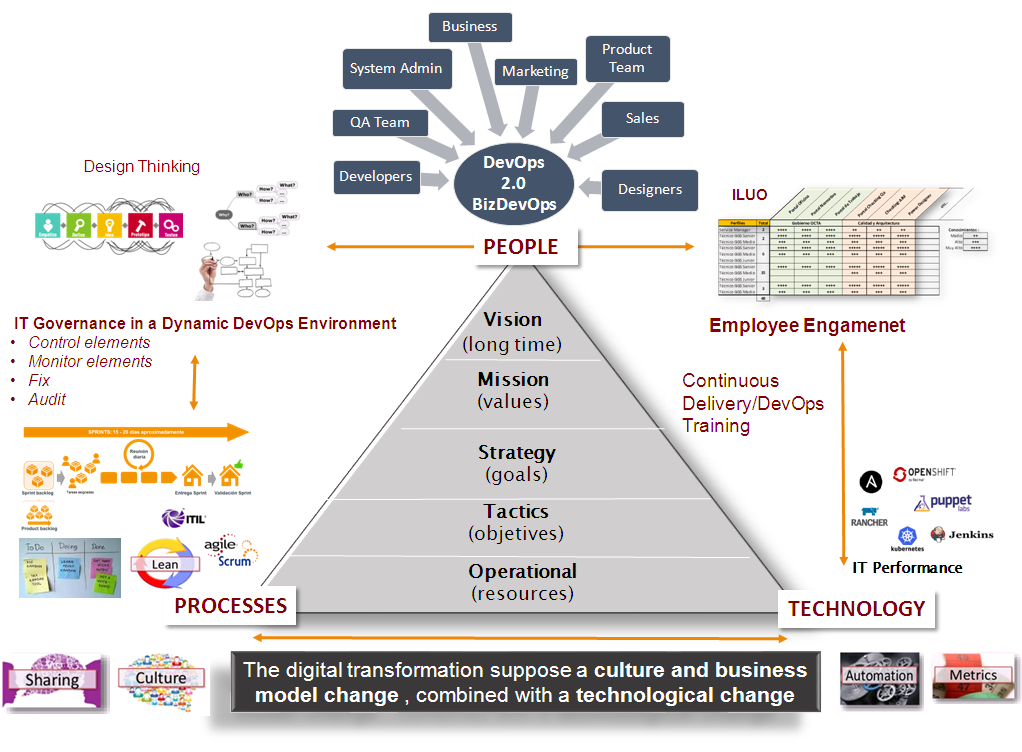
    We already know that DevOps is a culture, a movement, a philosophy of software development and delivery. It focuses on the communication, collaboration and continuous integration of the entire organization—a new conception of software development whose adoption is not easy. It aims to streamline software delivery by removing barriers between developers and IT operations teams. It also aims to reduce the inefficiencies of processes, adopting new tools, and even proposing changes in business architecture.

    Agile practices allow development teams to deliver iteratively more frequently, among other things. In DevOps, the entire process cycle is automated to achieve continuous integration and continuous deployments (CI/CD). The test and safety teams are involved from start to finish following an end-to-end strategy. At the same time, with the principles of Lean, we have removed from the whole process what does not add value. Thus, it is getting more productivity, maximum value and improvement in the time to market.

    Talking about DevOps is thinking about techniques, patterns and good practices. It will help us to provide our organization with an efficient software architecture—an architecture based on microservices, with everything-as-a-service mentality (XaaS). We are talking about container, automation, elasticity, self-scaling, infrastructure such as code, monitoring, configuration management, self-sustaining and adaptable systems and ecosystem, all of which allow us to deliver value with fast, reliable and frequent developments, not to mention zero downtime and, of course, the ability to undo the changes.

    How Do We Prepare to Meet User Expectations?

    DevOps aims to help an organization to produce software products and services quickly. But end users are becoming more and more demanding. We must use techniques that allow us to make faster, functional deliveries to the production environment, mitigating the risk involved.

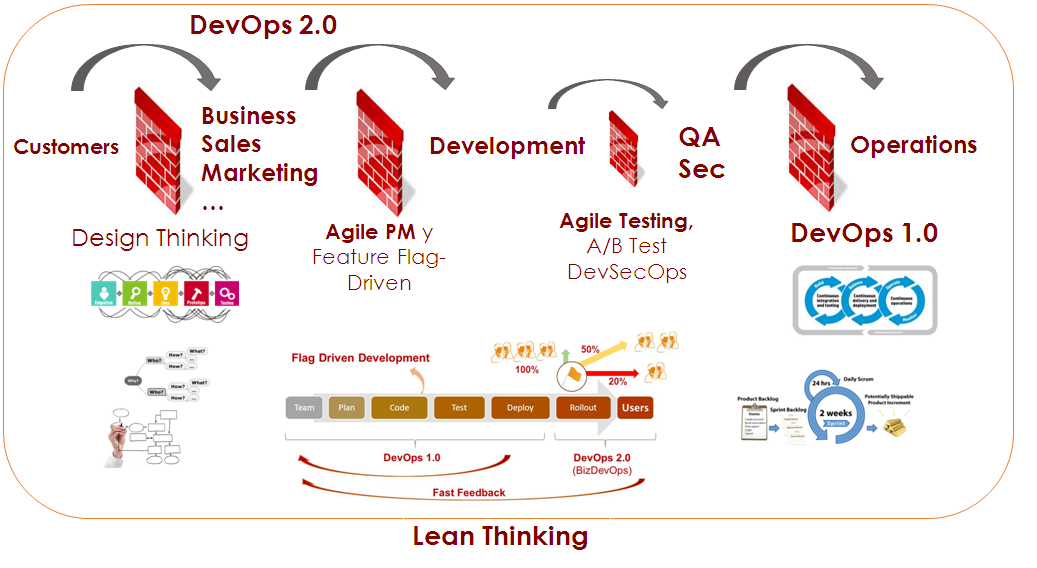
    At present, we face users with greater technological knowledge and greater expectations in the dynamic and interactive experience than we used to some years ago. This has evolved and given rise new one called DevOps 2.0 or BizDevOps (business, development and operations).

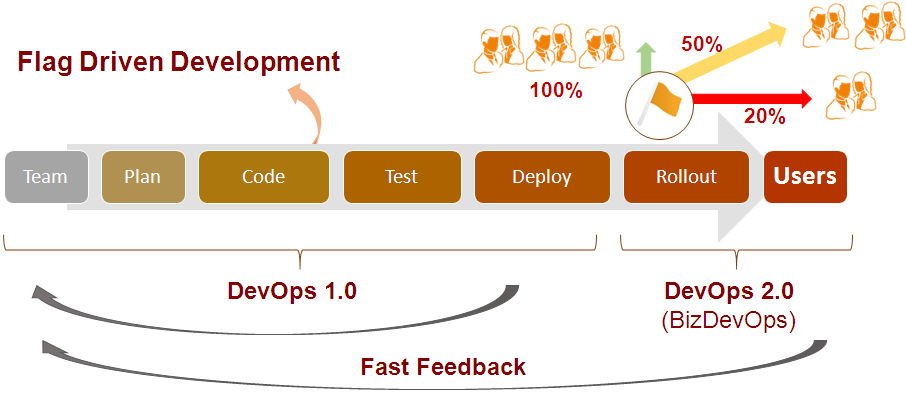
    DevOps 1.0, as the origin of the movement, was focused on operations teams giving continuous feedback to development teams as well as to SQA teams. However, DevOps 2.0 is now focused on extending the benefits of feedback to the entire organization (marketing, sales, product, etc.). This is what will allow a greater adaptation to the IT boom and the digital transformation (IoT, intelligent platforms, big data, etc.). Additional benefit of DevOps 2.0 is faster continuous software deliveries, without compromising the stability of systems in production.

    Toggling Features or Feature Flags

    At this point, the key is to use techniques that helps to decouple the software delivery of new functionalities. In other words, it is about making these new functionalities available to the end user based on business rules instead of the operation teams. The idea would be that, for instance, marketing and sales department can decide, using “flags,” when to release or enable a new functionality to the end user. It will allow us to deploy new functionalities to the production environment more frequently without enabling them to the end user. This removes the “fear” generated by the daily deployment processes in production environments. This is what is known, in DevOps 2.0, as the rollout.

    Using this simple best practice for development, called Flag Driven Development, we do not make available the new functionality to 100 percent of users. It will be delivery in stages, starting with 1 percent of users, then with 10 percent, then with 30 percent, etc. with the ability to quickly enable or disable the functionality when something does not work as expected. In addition, it allows us to make available different versions of a functionality for different types of users (customer segmentation). There are several SaaS models and open-source solutions we can use to implement this type of techniques like Feature flags, toggles or controls.

    What are the Benefits of DevOps 2.0 Techniques?

    The use of this type of techniques during the development process provides these benefits:

    • Quick scaling
    • Stability of the system
    • Integrity of the applications is not compromised.

    This way we succeed in reducing the risk associated to each new delivery of functionality, in any productive environment. Business stakeholders can control when new features are available to end users, who continuously demand new changes and improvements.

    For organizations, DevOps 2.0 will bring DevOps power to non-technical teams such as marketing, design, sales and business. Now all teams will have the skills and responsibilities that are required in a DevOps culture. It enhances the confidence, communication and feedback that is needed from all teams in a DevOps strategy.

    Therefore, one of the major pillars of the DevOps 2.0 approach is the ability to control, through a control panel interface, the launch of new features of applications in production environments. This process would be launched in a controlled way by both technical and non-technical people. Also, the process will be separate from the development and continuous deployment.

    At the same time, this type of coding techniques will allow to perform real-time analytics, making changes to the functionalities of a system that may also impact in the application performance monitoring (APM) tools. This makes it possible to determine when a particular functionality is degrading the global system performance and needs to be disabled quickly, as well as identify which functionalities are improving the end user experience (UI/UX).

    There are a lot of articles about these “Fast Feedback” practices. I hope this article help you better understand the potential impact of DevOps on your organization.

    About the Author / Jesús Pérez Franco

    Jesús Pérez Franco is an Operations Manager at Gfi Spain. His big passions are Agile Development and DevOps Continuos Delivery (Continuous Integration, Deployment, QA Automation and Infrastructure as Code, etc.). Connect with him on Twitter and LinkedIn.

  • Feature Branching vs. Feature Flags: What’s the Right Tool for the Job?

    Feature Branching vs. Feature Flags: What’s the Right Tool for the Job?

    A dev team’s branch management strategy can have a significant impact on the rate at which it can release high-quality software. In this article we’ll explore the pros and cons of several different approaches for enabling multiple concurrent streams of dev work in the same codebase. We’ll see that two major factors—the cost of merge conflicts and the ability to release streams of work independently—are often in tension, but that Feature Flags provide a way to resolve that tension.

    Merge Conflicts

    New products start off as a small codebase, usually only being worked on by a handful of developers. This situation doesn’t call for much formal process. However, even when a team consists of just two devs, it’s still preferable to avoid working on the same files at the same time to avoid merge conflicts.

    Unfortunately, even when we’re trying to avoid stepping on each other’s toes, it’s still pretty common for work streams that seem unrelated to end up touching the same files. Sometimes it’s these unexpected merge conflicts that can cause the most pain—any iOS developer who’s been around the block a few times probably has acquired some scar tissue from an epic three-way XIB merge in their past. In this article we’ll explore some different ways to deal with the challenge of merge conflicts when multiple developers are working on the same codebase.

    Some people might argue that merge conflicts aren’t that big a deal these days and mostly are solved if you just use modern tools such as Git. This is unfortunately not true. Git certainly makes creating branches trivial, but it does not always make merging parallel changes within those branches trivial. It has some powerful features to automatically merge changes when possible. These automatic merge heuristics can feel almost magical at times, but they are not actually magical. If you make parallel changes that affect a large XML file—for example, a XIB or an IDE project file—Git likely will not be able to merge those without human assistance.

    Most importantly, Git cannot automatically resolve semantic conflicts. For example, imagine that in one branch Alice renames a method and in another branch Bob adds a new usage of that method. When those two branches are merged, Git will do nothing to help resolve the fact that Bob’s branch is calling a method using the old name. Bob’s code is calling a method that no longer exists. In fact, Git will not give Alice or Bob any clue that there is a conflict, since these semantic conflicts aren’t detectable by our current set of tools.

    We’ll only find semantic conflicts when we try to compile our merged codebase, and even then only a subset of them. If the codebase is in a dynamically typed language such as javascript, we might not find out until our users start reporting app crashes in production.

    Beyond the productivity hit of having to manually resolve these inevitable merge conflicts, the spectre of introducing a conflict can have a more pernicious, long-term effect on a codebase. A developer who sees an opportunity to incrementally improve the quality of the codebase is slightly disincentivized to do so if they sense that it could lead to a merge conflict.

    The calculus for whether the effort of making a small improvement is worth the investment gets shifted as the cost of that change becomes higher. This introduces a subtle drag working against the internal quality of a codebase over time. What’s more, the type of small but broad refactorings that can gradually improve a codebase—or stop it gradually degrading—are exactly the type of changes that often lead to a merge conflict. In my opinion, this is the true hidden cost of branch-based development—it disincentivizes the sort of “boy scout rule” improvements that can prevent areas of a codebase from gradually degrading into no-go zones.

    So, having established that merge conflicts are a Bad Thing, let’s look at how we might avoid them.

    Working Directly on Master

    A small team starting out on a new app might initially try to mitigate the risk of a big unexpected merge conflict by having all devs push frequently to a shared master branch—one of the central tenets of continuous integration. When everyone is frequently synchronizing their changes in a shared master branch, an unexpected merge conflict is revealed earlier and is easier to deal with.
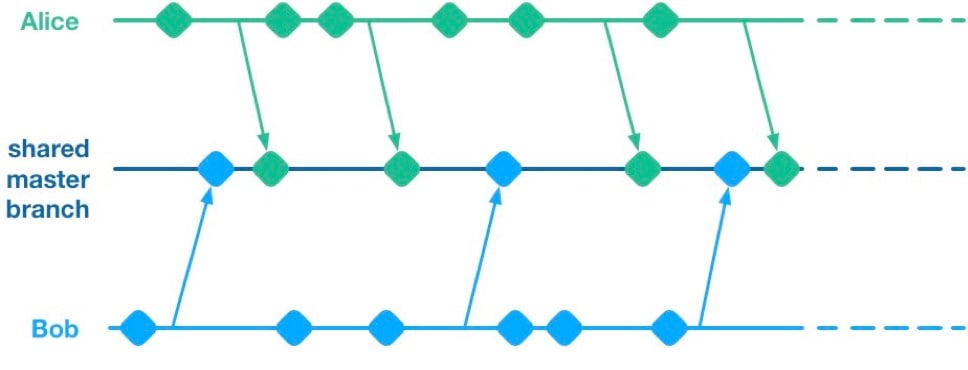
    Unfortunately, having multiple streams of work landing on a shared master branch comes with a big drawback: If any of the streams of work are not ready for release, then nothing on the shared branch can be released. Let’s see why using a hypothetical example.

    Alice and Bob are a two-dev team working on a mobile app. They have two streams of work in progress. Bob is working on a big overhaul of how user preferences work, while Alice is finishing off a critical new feature for the app which the big bosses have decreed must be pushed to the app store by the end of the week. This team is trying to avoid big merge conflicts by frequently pushing their code changes to a shared master branch as they go.

    On Thursday, Alice is wrapping up her changes and doing some testing. While giving the app a general run-through she notices that the user preferences section is crashing. She asks Bob if he knows why. Bob explains that he’s in the middle of overhauling that area of the code. It’s taken a little longer than he expected and it might be buggy for a while. Alice gives Bob a look. She explains to him that her feature has to get to the app store this week. Bob gulps. Over the course of two long days Bob and Alice are able to roll back Bob’s changes, some of which had gotten tangled up with changes that Alice had been making as part of her new feature. They manage to ship to the app store by Saturday, and a crisis is averted.

    We see here that because Alice and Bob were both committing to a shared branch, their independent streams of work became entangled. Alice could not release her changes without Bob’s and vice versa. This is the huge drawback of working on a shared branch—although we will discover later on that there are ways to mitigate this.

    Feature Branches

    To avoid this issue of coupled work streams, dev teams very often will move away from pushing in-progress code onto a shared branch. Some teams will opt to continue working on master on their local machines but only push to the team’s shared repo once the work is complete. Other teams will opt to use Feature Branches, maintaining separate streams of work on isolated branches and only merging them into master once they’re complete.

    As an aside, it’s interesting to note that when using a distributed source control system like Git, these two approaches are essentially equivalent; the only difference is whether the unmerged in-progress changes are visible in a remote feature branch or hidden on a dev’s local master. As such, I’ll talk about both variants as Feature Branching.
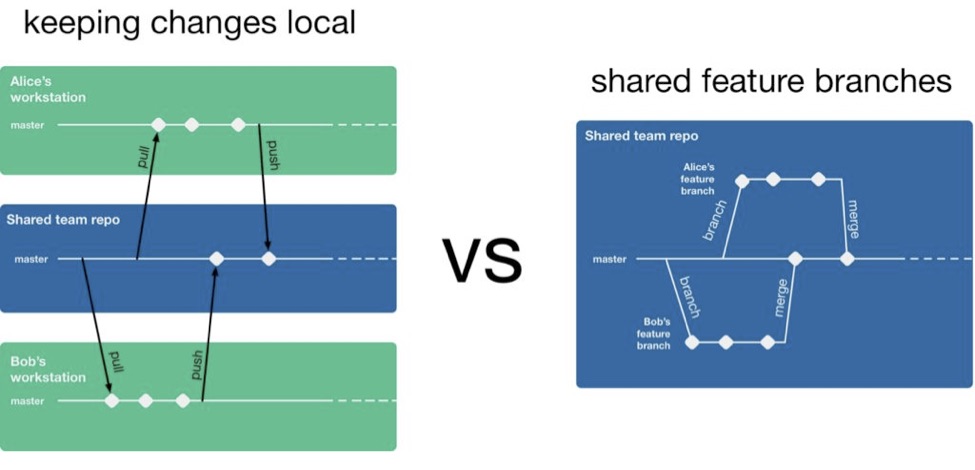
    So, if a team is using feature branching, then all their problems are solved, right? Unfortunately not. We’ve now re-introduced the risk of painful merges. Work that is being done on a feature branch is not integrated with other changes until it is merged to a shared master branch. Whenever two streams of work both touch the same files, either inadvertently or intentionally, there is a latent merge conflict which continues to grow in size until one of those stream’s branch lands on master. Some teams will try to mitigate this issue by frequently merging changes from master back into in-flight feature branches.
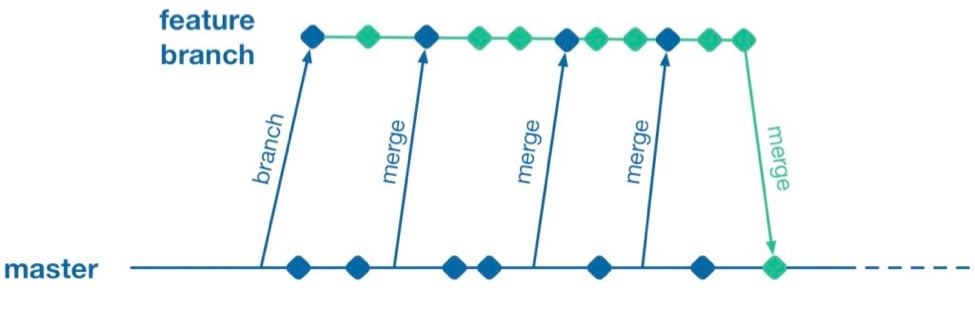
    However, this does not help when parallel changes are occurring on isolated branches. Alice’s branch will only see Bob’s changes when his feature branch lands on master. The latent merge conflict between these parallel changes is now waiting for Alice the next time she merges from master.
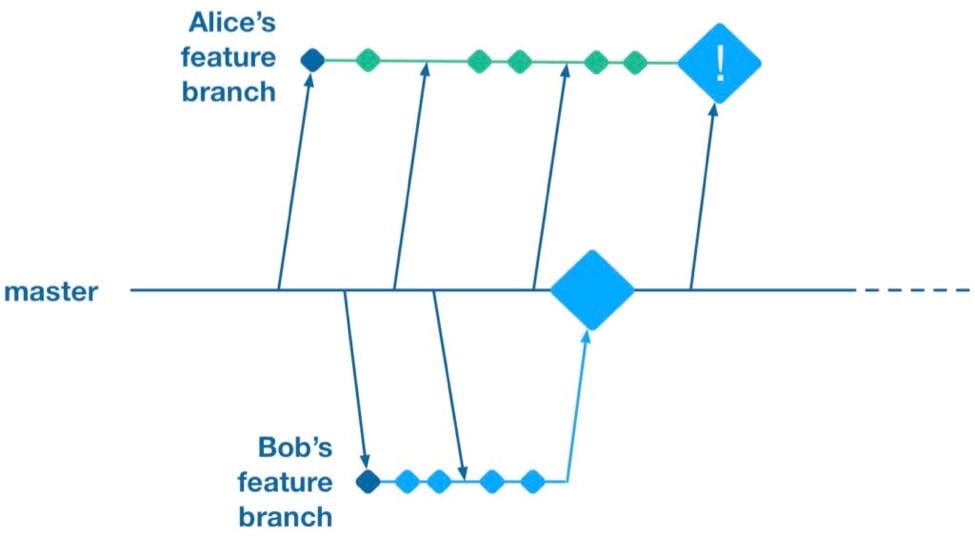
    (Thanks to Martin Fowler’s feature branch writeup for inspiring the above illustration)

    Some teams attempt to solve this problem by “cross-merging”—pulling work on one feature branch across into another feature branch to break down the size of latent merge conflicts between those branches.
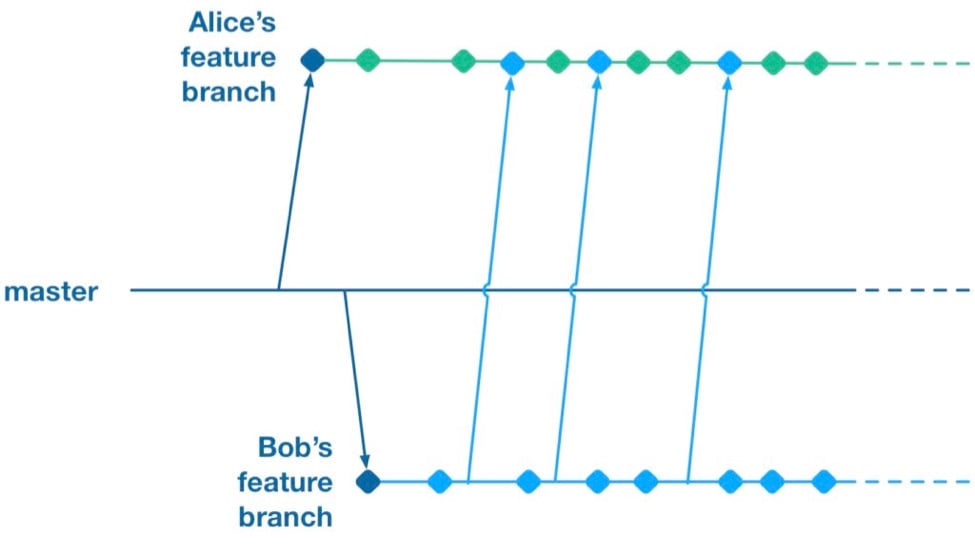
    However, as soon as you merge two feature branches together you’ve essentially created a shared branch of in-progress work, and are back to the same problem as teams who are pushing in-progress changes to a shared master: Code changes from both work streams are now intermingled. Your features are now coupled together and cannot be released independently.

    To summarize, feature branches allow teams to decouple streams of work such that they can be released independently. However, they introduce a risk of large merge conflicts when parallel feature branches contain large sets of changes. Remerging from master into feature branches only helps once parallel work has already landed, and cross-merging between branches couples features together in the same way as working on a shared master.

    Feature Flags

    What alternative does a team have if they want to avoid the merge conflict risks Feature Branches introduce? They could go back to frequently integrating changes on trunk, but we established that this has the major drawback that formerly independent streams of work are now coupled together and cannot be released independently. This is where a technique called feature flags (aka feature toggle, bits or flippers) can help.

    A feature flag is a way to isolate work-in-progress code by placing it behind a “flag” or “toggle.” The work-in-progress code will only be exercised if the flag is flipped on. Otherwise, it will sit within the codebase as “latent code.” Here’s a sketch of how a basic feature flag might be used:

    if( featureFlags.isOn(“my-new-feature”) ){
    showNewFeatureInUI();
    }

    Unless the my-new-feature flag has been configured as “on,” the new feature will not be exposed within the app’s UI. This means the app can be released even if the code implementing new feature is totally bug-ridden, as long as that feature’s flag is flipped off.

    By using feature flags, in-progress changes can be pushed into a shared branch without blocking release from that branch. If Bob is halfway through his feature and Alice wants to push a release of her feature, the team can do that by creating a release where Alice’s completed feature is flipped on while Bob’s half-finished feature is flipped off. We get the benefit of continuous integration of developer work streams (reduced risk from merge conflicts) while still keeping release of those work streams decoupled.

    This technique is not particularly new. It is part of a family of techniques sometimes referred to as trunk-based development (you can tell the technique is not new because the name uses trunk rather than the mastermoniker, which is more common today due to git’s predominance). Flickr, Etsy, Github and Facebook are some better-known proponents of the technique. Facebook’s use of feature flags is one of the key enablers for its famous ability to deploy facebook.com from a shared branch twice daily.

    Drawbacks of Feature Flags

    As with the other approaches discussed so far, feature flags have their share of drawbacks. They introduce a fair amount of noise into a codebase as we now need to explicitly implement some sort of branching logic for any incomplete feature. This noise can lead to some messy code over time unless care is taken to retire old feature flags once they are no longer necessary. Testers can take a while to get comfortable with feature-flagged apps—the idea of shipping unfinished, untested code to the app store takes a while to get used to. If the flags can be controlled remotely at run time, then teams need to understand that the new configuration of flags must be tested before being applied to apps deployed to end users.

    Finally, certain types of changes are particularly hard to protect via feature flags—broad but shallow changes that touch a lot of files can be a challenge. Happily, feature flagging is not an all-or-nothing approach; feature branches can still be used for a change that would be particularly fiddly to implement behind a flag.

    Succeeding with Feature Flags

    When a team starts to adopt feature flagging they will usually run afoul of some of the challenges discussed above, and eventually figure out ways to mitigate them. Here are some of those techniques for working successfully in a feature-flagged codebase.

    Expire Your Flags

    A lot of teams get a bit flag-happy when they first start using the approach. They tend to introduce a lot of flags, but not take the time to retire the flags once they not longer need to control whether a feature is on or off. Make sure to take the time to retire old flags—they introduce design drag in your codebase and confusion when managing flags. Some teams take quite aggressive approaches ensure old flags are expired, such as setting “timebombs” when they create a flag, or having it throw an exception if it’s still in use after a certain period of time. Other techniques include adding a flag removal task to the team’s backlog at the time the flag is created as a reminder.

    Flags Aren’t a Silver Bullet

    It doesn’t always make sense to use a feature flag for a new stream of work. Flags lend themselves best to a new feature or alternative feature where access to the feature can be controlled from a single point in the code—often by showing or hiding a button or changing what happens when you tap some part of the UI. Other types of work, such as internal refactoring, is hard to protect behind a flag. For that type of work, consider using a feature branch, ideally breaking the work down into smaller chunks that can be implemented incrementally in a series of branches rather than one long-lived branch. This will reduce the risk of a large merge conflict growing over time.

    Summary

    Feature flagging and feature branches are both ways to decouple parallel code changes and allow teams to release changes with less coordination overhead. Feature branches are easy to get started with, but can lead to painful merge conflicts. This risk of merge conflicts tends to disincentivize making incremental improvements to a codebase, and can lead to areas of the codebase becoming “no go” zones. Feature flags allow teams to practice true continuous integration and totally decouple code changes from feature release, at the cost of some complexity in implementing each flag.

    Feature flags are not a silver bullet and aren’t always the right choice, but it’s easy for a team to experiment with the approach. You can get started simply with a single hard-coded if/else statement, see how it goes and take it from there.

    About the Author / Pete Hodgson

    Pete Hodgson is a consultant to Rollout.io, a software engineer and an architect. His clients range from early-stage San Francisco startups to Fortune 50 enterprises, focused on enabling continuous delivery of software at a sustainable pace via practices like test automation, feature flags, trunk-based development and DevOps. Pete is a frequent podcast panelist, regular conference speaker in the US and Europe, and a contributing author.

  • Best Practices for Internal Communication in DevOps

    Best Practices for Internal Communication in DevOps

    DevOps has become a widely popular method of collaboration in the IT world. The combination of development, operations and quality assurance, DevOps requires every project have clear communication channels between development teams and individuals. In this article, we’re going to explore some of the best practices for internal communication within the DevOps structure.

    Software development is the game that runs on invention and communication. Therefore, communication methods and channels play a significant role in project success. Better communication between managers, engineers, developers and testers leads to better performance and more satisfying results. Each practice presented can help improve communication within teams and make your work more synchronized and efficient.

    Digital Communication Channels

    Scott W. Ambler notes in his communication diagram, e-mail communication is noted as more effective than any other documentation options, including paper memos, audio tapes and others. E-mail is the best way to share official documents and company memos, making it more suitable for external communication in the DevOps project. But while most individuals today are able to access their e-mail on their smartphones, and e-mail enables users to send large attachments and contact several team members at once, DevOps teams tend to rely on more interactive communication channels.

    Depending on the project needs and the preferences of team members, internal communication can be either through project collaboration apps, an intranet or even the usual communication apps or social media. Since Ambler’s diagram shows that video conversation is by far the most effective form of project communication (aside from face-to-face meetings), most project managers rely on apps with video-calling and videoconferencing functionality.

    Regular Meetings

    Regular meetings are the backbone of the DevOps communication. They can be organized in-person or through videoconferencing apps. Same as with the Agile Project Management structure, the DevOps team should meet at least twice a week. Preferably, the meetings should occur on a daily basis. The Monday or morning meeting can be used for assigning tasks to each team member and the Friday or end-of-day meeting can be used for assessing completed work and for future planning.

    Building Soft Skills

    Unfortunately, HR practices in many industries rely on stereotypes. One of the most prominent stereotypes about IT professionals is their lack of interpersonal skills. Although some engineers and developers fall into this generalization, their knowledge and interests go far beyond IT and technology topics. Still, even the most talkative and assertive members of the development team need to work on their soft skills to improve the team’s communication.

    Improved soft skills enable team members to collaborate more effectively and to develop strong working relationships. The first task of every manager is to find the soft skills already present in your team. This will give the team the chance to find the best opportunities for further development. After the initial skill appraisal, manager can enroll members in courses for assertive communication, negotiation and conflict-solving, depending on their needs and current capabilities.

    Importance of Time Management

    The whole DevOps paradigm strongly relies on effective time management. The implementation of the DevOps model often changes the whole development process and wipes out all the previous scheduling and time-management patterns. A good manager needs to motivate his or her team to change their long-held habits and pace their daily routines so they can keep up with the new organizational patterns.

    We already mentioned how regular meetings are essential for successful DevOps implementation. When organizing the meeting, schedule managers need to leave enough working time so each team member can effectively work on their tasks. Too many interruptions can break up the work process make it difficult for employees to focus. Effective time management relies on both team and individual needs and gives your team the flexibility to work as efficiently as possible.

    Use of Data Insights

    Internal communication on DevOps projects needs to be smart. It needs to be specific, measurable, attainable, realistic and timely, and one of the ways to achieve this is to use accumulated data from current and previous projects. The thorough analysis of accumulated data can give managers more details on:

    • The average number of working hours the team will need to release a new app, make various updates or make patches;
    • How to make the team’s communication more efficient;
    • Identifying the areas where the development strategy is losing its momentum; and
    • Understanding how each task influences the project delivery.

    Constant adaptation and changes in work processes is the base for successful DevOps implementation. This ideal can be achieved only through effective communication between team members. Communication also requires time, so the only way to ensure effective DevOps work is to combine strategic skills, process development, excellent time management and smart data insights.

    About the Author / Nate Vickrey

    Nate Vickrey is a business consultant and an online author. He is mostly engaged in finding the best solutions and latest trends regarding company management and culture. Nate is also the executive editor at one Bizzmark Blog. You can follow Nate’s work on his Twitter page.

  • 5 Team Skills That Make DevOps a Success

    5 Team Skills That Make DevOps a Success

    When starting their DevOps journey, your team will discover it needs to develop some new skills. Most likely the team is good at typing code and solving issues, but what about the soft skills?

    Many teams have to learn how to deal with issues themselves—as self-supporting teams, there is no longer a manager who will help them out and tell them what to do.

    During the Phoenix Project DevOps business simulation, the majority of teams discover collaboration and communication are skills they lack. I am often surprised how few people can really facilitate standups, retrospectives, Andon-sessions and other communication methods.

    Here are the five team skills that participants recognize as core skills they learn (or could learn) during the simulation.

    The Standup

    The standup is a very powerful way to share knowledge about certain issues. The team will stand together for a short time and discuss an issue that blocks the flow, needs clarification or needs to be high priority. So, who should initiate this standup and who should lead it? I’ve noticed a lot of participants find it very difficult to manage this standup initally, but after a few times the team discovers the key elements of a successful standup:

    • Chose a facilitator. Someone who is leading this session. It doesn’t matter who (it doesn’t have to be a manager).
    • Share the focus: What are we going to talk about?
    • Keep it short (time is ticking).
    • Make sure we all understand the outcome.
    • The importance of listening and engagement.

    Facilitating a Retrospective Session

    DevOps is also about continuous learning and experimenting. One of the important steps in this process is retrospective. This activity explores the past round of work and reviews what went OK and what needs to be improved. Again, during the simulations I discovered that not many participants know how to execute this activity. After being shown the right example, the team often can perform this activity themselves. This is what teams learned during the simulation:

    • Someone from the team must facilitate this process.
    • Make sure the improvement is supported and understood by the whole team.
    • Test the improvement before to applying it.
    • Record the discoveries—this becomes part of the visual management system and part of the team backlog of improvement needs.
    • This team skill is one of the skills that more than one team member should be able to execute.

    Managing the KanBan

    During a project, teams sometimes will have standup moments to discuss the work visualized on their KanBan. Work will move from backlog to doing and done, and new priorities will change the order of work. During the simulation participants will take the lead in this process, but some don’t find this easy. After the sessions they discover:

    • Use standups to discuss the changes on the KanBan, make sure the team is fully involved when moving notes around.
    • Challenge participants to share their thoughts. Saying “yes” doesn’t always mean “yes.”
    • Errors are made, but that doesn’t mean somebody has failed and should be punished. Keep the session safe and open.
    • The KanBan is a form of visual management system (VMS). The VMS is not the goal—it is an instrument and must help the team to visualize flow, limit work in progress, drive productivity through an awareness of what people are working on and continuously improve the process.
    • Make sure at the end of the session, all participants know what’s agreed.

    Managing an ‘Andon’ Session

    ‘Andon’ is a very powerful instrument to explore a situation that stopped the flow. As soon as the flow stops, someone “pulls the rope” and the team “swarms around” to investigate the error and try to continue the flow as quickly as possible. This session should be led by a team member; it doesn’t matter who. During this session, the team discovers the following learning:

    • Make sure the session is short and focused on fixing this blockage and restarting the flow.
    • Make sure we are not blaming each other; it should be about exploring what stopped the flow, fixing it and agreeing how to prevent it from happening again.
    • Make sure the whole teams swarms around and participates.
    • Create a safe environment.

    Collaboration

    Doing the work is not always easy. Sometimes we don’t know what to do. Sometimes we need help, and sometimes we are not happy with the actions of a team member. This is what collaboration is all about.

    One of the first aspects of collaboration is helping each other. But, this is not always effective. Sometimes it’s even disruptive or we just take some work from somebody else if we think he is too busy. Here’s what participants learned about collaboration during the simulation:

    • We have to avoid “compensational behavior.” This is about taking other people’s work with the intention to help the other. Sometimes this person doesn’t know you took the work and he or she does it again, creating unnecessary double work.
    • Collaboration is about shared goals and shared processes. We should all know what we are doing and how.
    • It’s also about clear roles and responsibilities. If you know what your colleague is doing, you know what you have to do. And the other way around.
    • You must have an open team culture in which it is also safe to say you don’t know and to ask for help.
    • Collaboration is fun, and it gives energy if we as a team achieves something.

    Conclusion

    I have visited many global DevOps conferences in the previous years and have listened to numerous speakers declaring, “It’s all about people.” And they were right. Unfortunately, the audience often did not get many useful answers.

    A high-performing collaborative team needs team players who know how to deal with the collaboration and communication issues themselves without needing management intervention.

    Teams will have to go through the stages made famous by Bruce Wayne Tuckman (Forming, Storming, Norming, Performing and Adjourning) to become an effective, collaborative team.

    Continuous learning is a key success factor and a critical competency for any DevOps team. Why not start this learning journey in a safe and challenging environment?

    A simulation such as the Phoenix Project is a very powerful instrument to teach teams how to collaborate and become high-performing. The environment is safe and feels like the real work environment. Participating in this simulation with an actual team allows you to capture and agree on actions to takeaway. Outcomes can easily be transferred to day-to-day work.

    I wish you a lot of soft skills.

    About the Author / Jan Schilt

    Jan Schilt is owner of GamingWorks. His background is Human Resource Development (MSc). Within GamingWorks he is responsible for Business Simulation design, Facilitation and Train the Trainer. He is also an expert in developing learning activities related to organizational change. He builds all the simulations and has delivered more than 300 workshops worldwide.