Category: Doin’ DevOps

  • I Can’t Go to That DevOps Conference

    I Can’t Go to That DevOps Conference

    Last year, I was able to attend 18 DevOps conferences. I saw some awesome presentations, met incredible people and expanded my knowledge of the latest practices at each conference. While my role as the DevOps Advocate for Sonatype enables me to get out to all of these conferences, not everyone has the time, the budget, or the approval to get to even one event a year.

    DevOps for the Masses

    This is what led me and my colleague, Mark Miller, to found the All Day DevOps conference last year. Our dream was to build a DevOps conference for the masses. We decided to offer 57 online sessions over 15 hours and 15 times zones, and registration would be free. Our initial goal was to see if we could find 1,000 people to attend (because that sounded like a big number at the time), but the idea of a free online event caught a viral wind and we ended up having over 13,500 people register to attend.

    Every session delivered during the conference was shared by a DevOps practitioner. We had a simple rule for the conference and that was: no vendor pitches.

    Team Time

    People also told us that they valued having the chance to talk to other attendees they met at DevOps conferences, so we set up a free Slack channel for All Day DevOps. By the time conference was over, we recorded more than 10,000 conversations between the speakers, attendees and organizers.One of the things that fascinated us most about the conference was that organizations such as Accenture, Capital One, Ericsson, Oracle, Target, Telstra and many others had more than 20 employees attending the event. A few of these had hundreds. None of them needed to approve expenses for travel, hotels or conference fees. They just watched and joined in the conversations from their homes or offices.

    Here are some of the folks who spoke at last year’s event across our CI/CD, Modern Infrastructure and Automated Security tracks. This year, we have also added a DevOps in Government track to the agenda.

    The event was so successful, we set it on the schedule again. All Day DevOps 2017 will take place Oct. 24. It’s online, it’s free and this year’s event will run for 24 hours. Therefore, no matter where you live, if you have an internet connection, you will be able to tune in to join us.

    A Few Things to Know

    1. You can register for free at www.AllDaydevopsy.kinsta.cloud. Invite your entire DevOps team to join. Everyone registering will have free access to all 57 recorded sessions from 2016.

    2. The CFP is open through May 31. If you have a story to share, we want to hear from you. Remember, no vendor pitches are permitted.

    3. All Day DevOps is a community event. Last year more than 40 DevOps meetups and software companies helped us spread the word. For those that helped, we added their logo to the site. Same applies to this year. Apply to be a supporter here.

    Please join us for this year’s event!

    Finally, a big thank you goes out to devopsy.kinsta.cloud, which helped us promote last year’s event to all of their readers. We are excited to have them helping us to promote the 2017 conference as well!

    — Derek E. Weeks

  • SauceCon Speaker Profile: Angie Jones, LexisNexis

    SauceCon Speaker Profile: Angie Jones, LexisNexis

    Automated tests are an important part of continuous integration, but if they’re not reliable, they can cause more problems than they solve.

    This problem is not new to Angie Jones, who works as a consultant automation engineer advising scrum teams on automation strategies and developing automation frameworks for countless software products.

    Jones currently works for LexisNexis, an information provider for legal and regulatory businesses. LexisNexis recently began embracing agile and test automation companywide, and she was brought aboard to help the company master the change. She is consulting with multiple teams to help define their automation strategy, building automation frameworks and training their testers on automation techniques.

    The biggest challenge so far has been finding different implementation strategies for different teams. “Automation strategies are not one-size-fits-all and should be customized for a given context,” she says.

    Jones will bring her expertise to the upcoming SauceCon event and plans to present a talk titled, “The Build That Cried Broken: Building Trust in Your Continuous Integration Tests.” Her presentation will focus on automated tests that are part of a continuous integration process. These tests aren’t run privately on someone’s local machine, and the person running them simply gives a final verdict to the team and spares everyone the glitches and hiccups. In CI, the unreliability of these tests are exposed for all to see, and they are detrimental to the process.

    In her talk, Jones will share how her team managed to turn their CI builds from an untrustworthy mess to a credible source of information. Since this isn’t a quick fix with a lot of cultural and mindset changes, she will discuss that as well.

    She is very excited to give this talk at SauceCon because “people attending this conference are the ones who are invested in ensuring that they get CI right, and I want them to know that automated tests don’t have to be their downfall. Besides that, it’s a really fun talk that I think everyone will enjoy,” she says.

    As a Master Inventor, Jones is known for her innovative and out-of-the-box thinking style which has resulted in 22 patented inventions in the United States and China. Angie shares her wealth of knowledge by blogging at angiejones.tech, speaking and teaching internationally at software conferences, serving as an adjunct college professor of Computer Programming and teaching tech workshops to young girls through TechGirlz and Black Girls Code. When she is not inventing something or helping people with test automation, she is reading urban fiction or soul line dancing!

    Join her and other presenters at SauceCon, the first-ever Sauce Labs user conference. SauceCon is a three-day event filled with training, workshops, best practices and visionary content from the leading minds in automated testing. For more on upcoming SauceCon presentations or to register, visit the SauceCon website.

    About the Author / Elizabeth Hechtel

    Elizabeth is a passionate tech writer at TestObject. As a Junior Marketing Manager she is focusing on delivering the best quality content on mobile testing. Personally, she loves learning new languages and reading up on recent advancement of modern technology.

  • SauceCon Speaker Profile: Adam Carmi, CTO of Applitools

    SauceCon Speaker Profile: Adam Carmi, CTO of Applitools

    Carmi to present a live coding session on testing responsive sites 

    Testing responsive sites and applications can be quite a challenge for development teams. We are fortunate to have Adam Carmi, CTO of Applitools, presenting a session at SauceCon on “Advanced Test Automation Techniques for Responsive Apps and Sites.”

    During Adam’s presentation, the audience will participate in a live coding session to learn how to effectively design responsive page objects, implement generic tests that work for all the layouts of their apps, control the browser’s viewport size to accurately target layout transition points, incorporate layout-specific assertions in their tests, and visually validate the correctness of their app’s layout​.

    Adam is passionate about everything related to software development and testing and is excited to share his knowledge with (and also learn from) similarly passionate practitioners.

    As CTO and co-founder at Applitools, a cloud service for automated visual testing, Adam spends most of his time developing image processing algorithms. However, he loves testing of all sorts, from designing the product to maximize testability to unit and API testing and, of course, automated visual testing.

    Adam regularly speaks about software testing at conferences around the world and organizes the Israeli Selenium Meetup group. He loves to ski and tries to stand on his hands as much as he can! When not working, he enjoys working out, watching movies and playing video games with his two children.

    SauceCon, the first-ever Sauce Labs user conference, is a three-day event filled with training, workshops, best practices and visionary content from the leading minds in automated testing. For more on upcoming SauceCon presentations or to register, visit the SauceCon website.

    About the Author / Rebecca Cramer

    Rebecca Cramer is a writer and communications strategist specializing in technology. With more than 20 years of experience across disciplines including marketing, internal and executive communications at companies such as Dell and Quest Software, Rebecca is passionate about creating and sharing good content of all kinds. In her spare time, she enjoys spending time at the beach and hiking in her native Southern California.

  • Is Site Reliability Engineering the True ‘Ops’ in DevOps?

    Is Site Reliability Engineering the True ‘Ops’ in DevOps?

    I recently had the privilege of attending the SRECon conference in San Francisco. It’s in its third year and 650 attendees gathered to learn and share their experiences, insights and site reliability engineering (SRE) practices.

    Most SRECon attendees either identified as SREs or were there to learn more about this new role and approach. While there was strong representation from the “unicorn” community (Google, Shopify, Twitter, Netflix and Linkedin), enterprises such as Capital One and Comcast were among the many exhibitors actively seeking to recruit SRE talent. The conference spirit was infused with enthusiasm, a willingness to share, innovative thinking and grassroots advice. It reminded me very much of my first DevOps Days in 2012. There is no doubt that interest in SRE is rapidly growing and worthy of attention by enterprise IT.

    The practice of site reliability engineering was born out of the book by the same name from Google. Interestingly, the SRE movement emerged separately from the DevOps movement—although there is little doubt that they are part of the same IT spectrum with similar customer value-driven goals. DevOps focuses on engineering continuous delivery to the point of  deployment; SRE focuses on engineering continuous operations at the point of customer consumption. Both domains rely on sharing, culture, metrics and automation. Both require human and automated resources to ensure a seamless value stream and exceptional customer experience.

    The role of the SRE is rapidly gaining momentum. Part systems administrator, part second tier support and part developer, SREs are encouraged to be inquisitive, to acquire new skills, to ask questions, to solve problems and to embrace automation. I asked several of the exhibitors what types of skills they were looking for in new SREs. The answers almost unilaterally included the ability to code as well as an unwavering thirst for knowledge and improvement—to find answers, solve problems and ensure the highest levels of reliability and availability.

    I also can see a clear bridge between SRE with IT service management (ITSM). Many of the presenters spoke about the handling and management of late-night incidents, escalations, root cause analysis, service level objectives, availability metrics and other topics addressed in ITSM frameworks such as ITIL. The tools and process definitions may be different, the opportunity to instill agility into many of the ITSM processes to meet changing demands is certainly apparent.

    What are the risks? To my mind the biggest risk is if SRE, DevOps, ITSM, Agile SDLC and other frameworks do not align and remain siloed outposts. SRE and DevOps are two sides of the same coin. Let’s hope that the SRE momentum catches up to DevOps and that enterprises begin to integrate both sets of practices as the norm.

    — Jayne Groll

  • DevOps: The Innovation Power Couple

    DevOps: The Innovation Power Couple

    If “Dev” and “Ops” are the power couple of tech, “DevOps” is the holy matrimony that takes innovation from trainwreck to fast and repeatable. At most businesses, however, Dev and Ops still sleep in separate rooms and agree only on their mutual contempt.

    Dev (Development) and Ops (IT Operations) usually are divorced or ready to serve the papers because their incentives clash. In Ops’ opinion, Dev is an idiot—always out late drinking with friends, he comes up with wild ideas and wants to implement them immediately. Dev can’t make anything work on real servers and can’t write scalable, stable code.

    To Dev, Ops is a total code-blocker—she makes Dev go through “change management boards” and slows down progress. She lets the competition get to market first. So every day, Dev and Ops have an angry shouting match that ends in tears.

    I wish I were exaggerating. My coworker Brandon Cipes once walked into an interview for a product development position. The interviewer broke down crying because the relationship between Dev and Ops had gotten that nasty. They refused to meet with each other, let alone be in the same room.

    When Dev and Ops have a dysfunctional relationship, they struggle to communicate, collaborate and get results. Their organization will fail at innovation because it lacks the cultural, technological and procedural base to do otherwise.

    The missing base is DevOps. It’s a unified strategy for Development and IT Operations, and implementing it can have the following effects:

    1. Communication Becomes Unavoidable

    Normally, Dev and Ops play “telephone” because they’re physically separated and have too many points of communication. Emails, IMs, grudgingly accepted meetings and passing conversations ensure Dev and Ops never get the full message.

    DevOps fixes communication by assigning Dev and Ops personnel to the same teams. They sit in one room and work in a single squad (a.k.a. a pod or team) of no more than eight to 10 people. If they turn their heads, they see each other’s beautiful faces. Until promotions or career change do them apart, they can’t avoid talking and working toward common goals.

    In essence, DevOps puts “cross-functional” teams together and thereby eliminates hand-offs. Fewer points of contact, less telephone, better communications.

    1. Collaboration Gets Automated

    For many Dev and Ops teams, “collaboration” is another word for bureaucracy. It’s TPS report-ish stuff characterized by change review board meetings and laborious documents that tell Ops how to deploy new code. Dev and Ops might accidentally (or intentionally) withhold information from each other.

    In DevOps, collaboration is automated. Instead of change review board meetings, you use version-controlled software. The hand-offs from Dev to QA and QA to Ops are done by machine. A script deploys the code for Ops so there’s no risk of misfiring.

    “Collaboration” is no longer an ordeal or choice. Documenting and sharing the squad’s collective knowledge is wired into the process.

    1. Fast and Stable Releases

    Normally, a software deployment is like a sloth trying to cross US 101: slow, awkward and soon to be roadkill. That’s all thanks to bad communication and bad collaboration.

    With DevOps, you catch problems before they go live. Test automation prevents any need for manual checks. One person corrects the problem in a matter of minutes whereas before, a team of five might spend eight hours tracking down and fixing one bug. Ops feels confident that tested code won’t cause havoc.

    Thus, the upshot of DevOps is speed and stability. Before, Dev and Ops delivered maybe a few times a year and faced regular breakdowns. DevOps can deliver multiple times daily without a hitch.

    Say ‘I Do’

    DevOps is a cultural, procedural and technological transformation. As in a marriage, both partners are responsible for good outcomes. Linked as they are on one squad, Dev learns to care about stability and Ops begins to value innovation.

    If “agile” is about making businesses nimble and quick, DevOps is about applying agile principles to technological development and operations. Ultimately, it’s about beating your competition to the next big thing.

    Dev, easy on the drinking escapades. Ops, live a little. Tie the DevOps knot and make some innovation babies.

    About the Author / Zubin Irani

    Zubin Irani is co-founder and CEO of cPrime, a full-service consultancy that focuses on agile transformations and project delivery solutions for hundreds of software teams, including more than 50 of the Fortune 100. Connect with him on LinkedIn.

  • How Cognitive Bias and ‘HumanOps’ Affect Dev Teams

    How Cognitive Bias and ‘HumanOps’ Affect Dev Teams

    Does your team take into account how the human element can affect development practices? It’s often overlooked, but critical to consider. Jason Hand of VictorOps, devopsy.kinsta.cloud’s Top DevOps Evangelist for 2016, writes and speaks on this particular topic often. In fact, he will be delivering a keynote titled, “Cognitive Bias and Its Impact on Continuous Improvement,” at the upcoming SauceCon conference, to be held June 6-8 in San Francisco.

    SauceCon, the first-ever Sauce Labs user conference, is a three-day event filled with training, workshops, best practices and visionary content from the leading minds in automated testing.

    “Cognitive bias is an important topic that is often left out of the conversation. The ‘HumanOps’ side of DevOps is a fascinating area to explore and I’m excited to get the conversation going for those in attendance at SauceCon,” he said.

    Jason aims to help attendees understand the most important cognitive bias to watch out for, as well as ways to identify it in ourselves and others. Particularly when managing service disruptions and time-sensitive problems, understanding where we make common mistakes will go a long way to improving our response to outages, as well as continuously improving over time.

    Jason serves as a DevOps Champion and advisor at VictorOps, where he advises on the future functionality and direction of the on-call and incident management platform, counseling the team on modern DevOps principles and new methods of delivering reliable software at scale.

    In addition, Jason advises the growing worldwide community of IT professionals including Colorado’s front range, where he helps to organize DevOpsDays Rockies and the monthly DevOps meetups in Denver. Co-host of “The Community Pulse,” a podcast on building community within tech, Jason is dedicated to the latest trends in technology, sharing the lessons learned and helping people continuously improve.

    In 2016, Jason was named “DevOps Evangelist of the Year” by devopsy.kinsta.cloud. He is the author of two books on the subject of ChatOps and a forthcoming O’Reilly book on post-incident reviews, as well as a regular contributor of articles to Wired.com, TechBeacon.com and many other online publications.

    For more on upcoming SauceCon presentations or to register, visit the SauceCon website.

    About the Author / Rebecca Cramer

    Rebecca Cramer is a writer and communications strategist specializing in technology. With more than 20 years of experience across disciplines including marketing, internal and executive communications at companies such as Dell and Quest Software, Rebecca is passionate about creating and sharing good content of all kinds. In her spare time, she enjoys spending time at the beach and hiking in her native Southern California.


  • 9 Lessons Learned: Getting Value Stream Insights in Only 2 Days

    9 Lessons Learned: Getting Value Stream Insights in Only 2 Days

    Gene Kim, Jez Humble and other experts say that understanding and improving your value stream is really what it takes to bring your software delivery organization to the next level. While almost every IT organization has this goal, actually knowing how to make it happen can be paralyzing, because it seems like such a daunting undertaking when trying to connect all of your systems tools and processes.

    Recently, we participated in an innovative approach that proved that you can take concrete and measurable steps and see real outcomes in only two days.

    Nationwide constantly strives to innovate and bring real change to its IT organization. The insurance and financial services company has zeroed in on improving its value stream. To begin the initiative, Nationwide developed a two-day workshop where the right disciplines would come together and determine the best way to make this happen. But the real innovation in this idea was that the organizers did not just talk about what to do. Instead, the end goal was to come up with at least one key metric the team could show to the Nationwide CIO by the conclusion of the workshop. This approach made the effort real, concrete and focused. While it was difficult, it worked.

    Here are nine important lessons learned:

    Lesson 1: Start with one artifact—specifically, defects. Measuring cycle time is extremely difficult because there are so many moving parts. To have a tangible outcome, start with defects because they tend to be the most well-understood artifacts and have relatively defined workflows and processes that people know and understand.

    Lesson 2: Commit to having a real metric based on real data. All too often organizations take the “boil the ocean” approach. When asked what metric they want to start with, the answer is typically, “Everything.” That is precisely the wrong approach. Aiming for everything is likely to get you nothing. Focus on a tiny amount to start. First understand, then improve, your software delivery value stream. Not only should you start small, but for IT value streams, start specifically with a certain artifact (see Lesson 1). And chose only one metric for that artifact, because less is truly more in this case.

    Lesson 3: Without a multi-disciplinary approach, you will fail. This part is extremely difficult. To be successful you will need the following mix of skills:

    • Domain Expert: This person knows this part of the value stream inside and out. She is a practitioner in that area of IT and truly understands the who, what, when, where and why of that particular area of the value stream.
    • Process Analyst: This person knows how the various people, systems and resulting artifacts are intended to operate together for the complete process. Often this person is closely aligned with the domain expert, but typically is not one of the practitioners actually participating in the process.
    • Data Warehouse Specialists: These are the people responsible for populating and managing the data marts or data warehouses. They need to have significant data transformation capabilities and intimate knowledge of the required data structures and formats the organization requires.
    • Report Writers: As often happens with the expertise required to wrap up a process, this role is sometimes overlooked at the beginning. This is not the right approach. The person who will report on the project should be involved from the very start.

    Some people might start by asking, “Don’t we need a data scientist?” After all, that is a title of authority when it comes to metrics. If you have a data scientist on staff, by all means, get them involved. But if you don’t, you can rely on someone with database skills—primarily, skills around writing advanced SQL (as old fashioned as that may seem). Most of this work will not require advanced data scientist skills.

    But the real challenge is to get all of those disciplines in the same room at the same time. This is no easy feat. Leadership must provide the necessary resources to ensure that each one of the roles is represented. Because if any of these roles are left out, you will not succeed.

    Lesson 4: Work in parallel. The process and domain experts can work on identifying the artifacts that must be used and manually identifying and mapping where the artifact originates, what systems touch the artifact when, and all the requisite status changes and their meanings. That work will inform the data warehouse team and report writers, but the data and report writers are actually faced with a very different problem: They must determine how to get the data, regardless of the identified artifact, and transform the raw data into a usable format that report writers and BI analysts can work with in their visualization tools. By having both teams work in parallel, with identified checkpoints along the way, you will be more efficient when it comes to the three required deliverables.

    Lesson 5: There are always three required deliverables for each value stream cycle metric you are interested in.

    • The artifact(s) of interest (defect, story, requirement, code commit, etc.)
    • The following data:
      • All required status changes and dates of changes,
      • Data to relate artifacts to each other (for the joins)
      • Any ancillary information needed to be able to slice and dice the data for the final visualization.
    • The final visualization showing the metric (which is typically not one metric but rather a macro metric that has drill down capabilities and other perspectives on the metric).

    Lesson 6: Work both forward and backward. It is always easier to get started when you know where you want to end up. In this lesson, identifying the end goal is key. Once you have identified the “end” then you can go to the beginning and determine if the end goal is actually reachable. You also can identify any holes that exist between the beginning and your end goal. In this use case, the backward story looks like this:

    • End Goal: A visualization (graph/chart) showing the metric of interest. The idea is to mock up exactly what you want the end result to look like. Create the mock up in the actual BI tool you intend to use as if you already have all of the necessary data at your fingertips.
    • Step 4: Provide the data needed to create the visualization—it must be formatted in a way that will enable the report writers to easily and efficiently create the visualization that is your end goal. Hint: start by creating a spreadsheet that contains the exact data structure and formats desired. You will use fabricated data to start. The idea is to make sure the data is structured properly to reach the end goal (the visualization).
    • Step 3: Create the interim views and tables that will enable you to get to Step 4
    • Step 2: This step is where you collect the raw data from the actual systems involved
    • Step 1: (The Beginning) Identify the artifact and all of the systems that artifact flows through.

    Lesson 7: Invite outsiders to participate. It’s difficult to see the forest for the trees in your own organization. You need outsiders who are willing to ask the questions, probe in challenging areas, push the boundaries—people who have a different point of view because they are not in the game. This does not mean outsiders should be the workshop facilitators. They could be, but it is more important for them to actually participate in the sessions and help define and create the deliverables.

    Lesson 8: Hold the workshop in a different space than you work in every day. Don’t use the conference room that you typically use. Bring the team to a completely different environment—one that inspires creative thought and innovation. It may seem like a fluffy requirement, but you will learn through workshop participant feedback that location has a major impact when it comes to productivity and focus.

    Lesson 9: Get executive leadership buy-in. The executive VP was genuinely impressed with what the team accomplished in only two days. And the positive feedback and kudos the team received has probably fueled their innovation engines for months to come. To feel a sense of accomplishment and be recognized by the executives in your organization has significant morale impact.

    Improving your value stream is no small feat. But by designing and executing on a workshop like this, you will see benefits and clear wins immediately. By the end of our two days, we had a prototype of defect cycle time and a defined repeatable process. Equally as important, the people involved were given the opportunity to fail fast and pivot where needed, which inspired innovative thinking and creativity. And, being able to present to the CIO real progress with real results in two days’ time fueled institutional buy in and momentum to drive a long-term value stream improvement program.

    About the Author / Nicole Bryan

    Nicole Bryan is Vice President of Product Management at Tasktop Technologies. Nicole has extensive experience in software and product development, focused primarily on bringing data visualization and human considerations to the forefront of Application Lifecycle Management. Most recently, she served as director of product management at Borland Software/Micro Focus, where she was responsible for creating a new Agile development management tool. Prior to Borland, she was a director at the New York Stock Exchange (NYSE) Regulatory Division, where she managed some of the first Agile project teams at the NYSE, and VP of engineering at OneHarbor (purchased by National City Investments). Nicole holds a Master of Science in Computer Science from DePaul University. She is passionate about improving how software is created and delivered – making the experience enjoyable, fun and yes, even delightful.


  • From Artisanal to Factory: The IT Pendulum is Swinging Back

    From Artisanal to Factory: The IT Pendulum is Swinging Back

    Splunk Vice President of IT Markets and Chief Technology Advocate Andi Mann sees DevOps moving from an artisanal approach to an IT factory.

    This represents a reversal: Historically, developers operated in a factory-like environment, passing chunks of work down the line, but that caused problems because “different managers owned different sections of the production line.”

    Agile and DevOps were a response to that issue, he said, resulting in “the artisan developer … the full-stack developer.”‘

    The trend is now flowing in the opposite direction, with Splunk customers wanting to see “the whole flow.” Furthermore, enterprise DevOps is too big for an artisanal approach.

    “I worry about that [reversal],” he said, but technology can help artisanal quality within an IT factory. Collaboration tools such as permanent video links between different locations enable specialists to work together and understand each others’ work.

    “That’s a different kind of factory,” said Mann, in which development, security, QA, operations and other staff do not need physical proximity to work closely together. This is particularly important for large enterprises, he observed, as you cannot pack 1,500 developers into a small space.

    One example he cites to show this approach can work is a telco with its developers spread across multiple locations in Sydney and Singapore using DevOps practices to achieve continuous delivery. Another is one of the largest UK retailers getting weekly releases from developers in London and Mumbai, with QA work done at another location in India.

    “Executives I talk to are very heavily committed to improving cycle time,” said Mann. But they are also concerned with quality (e.g., problems should be detected and fixed before they reach the user, and the percentage of changes sent for rework should be minimized) and business impact. Executives want to link DevOps to their own KPIs: “Are they moving the needle on my business requirements” such as shareholder value and reputation?

    “You get the changes you drive by your measures,” he said, so it is up to managers to make sure their measures make sense in the broader context. It may be time for a balanced scorecard to be applied to DevOps, with metrics in all three areas, he suggested.

    These metrics could include code coverage, error rates, customer complaints or trouble tickets raised, plus business impact measures such as click-through rates, cart abandonment, subscriptions cancelled, open rates (for mobile apps) and customer sentiment.

    Mann noted executive demand for the adoption of DevOps, even where “they don’t even know what they’re talking about.” He feels it is really about a desire for visibility into the development pipeline, and “that’s really challenging.”

    Part of the problem seems to come from the tension between traditional IT (especially “ITIL-owned shops”) and new-generation executives with titles such as head of digital.

    Slavish adherence to ITIL practices won’t allow the required speed, may not achieve the expected level of compliance and business goals probably won’t be met, he suggested.

    “ITIL came out of a fear of failure,” but failure is no longer catastrophic. “If you’re not failing, you’re not trying, you’re not innovating.” What’s important is to fail fast, fail small, and fail cheap—and DevOps allows IT to fail in low-impact ways. Even when an organization is making significant changes to software, the effects of failure can be contained through measures such as canary releases (where the new versions are initially made available to a small subset of users).

    Furthermore, customers are getting used to the idea that technology isn’t and doesn’t need to be perfect, largely because of their experiences with speech recognition services such as Siri, he said.

    — Stephen Withers

  • Challenges in DevOps Standardization

    Challenges in DevOps Standardization

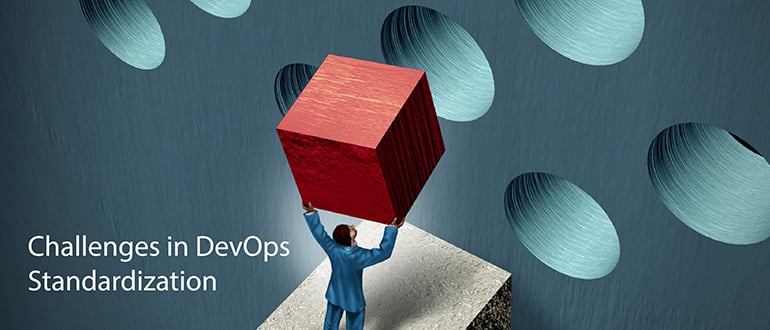
    Many organizations still face challenges in their Devops adoption journey enterprise-wide, especially when there is no standardization in tools, non-repeatable processes and adhoc practices and culture barriers. Here are some of the challenges in standardization and possible solutions to achieve standardization in DevOps as part of DevOps transformation journey.

    Business Case

    A survey conducted within multiple customer teams revealed they face challenges in standardization of tools and streamlining the process gaps due to lack of end-to-end orchestration, manual intervention, legacy practices, inconsistent environments, longer provisioning time and several other factors. Taken together, they necessitate standardization in DevOps across the enterprise to make it repeatable, predictable and consistent.

    Challenges in Standardization of DevOps

    Tools Challenges

    1. Multiple tools to evaluate with one or more overlapping features in the tools, learning curve involved to evaluate/do proof of concept and choosing the tools with short-term goals instead of long-term perspective.
    2. Limited knowledge of tools, used from the perspective of automation in their specific area, resulting in siloed automation and using manual, ad hoc process.
    3. Lack of out-of-box integration with most tools used in the CD pipeline and teams investing time to build custom integrations.

    Process Challenges

    1. There is no central DevOps team who can evaluate and recommend the right set of tools to be used, with individual project teams/groups try to set up their desired tools and serve their teams (Dev/QA/Ops), with no clarity on availability of infrastructure that can be shared across groups.
    2. There is no defined process framework detailing the different tenets in DevOps, including what activities and approach are needed to move to desired state, leaving teams to achieve their desired state of automation without a structured approach.
    3. There is a lack of knowledge on defining right KPI for each DevOps capability and how to measure the metrics to determine efficiency of the DevOps automation process and identify scope of optimization.
    4. There is a lack of SME knowledge on the application, application stack and environment management flowing between Dev and Ops teams to arrive at a standardized process.
    5. Multiple vendors are managing the different stages of an application and each following their own defined process for development life cycle.

    Cultural Challenges

    1. Standardization on metrics, process, practices, governance and organization-level control over DevOps implementation is challenging without a central authority (a central DevOps team) driving these practices across the enterprise.
    2. Teams operate in silos and follow their own DevOps practices and think in silos without having a holistic view, resulting in broken processes that are inconsistent.
    3. Teams still lack training in DevOps on the tools, practices to be followed in CI, continuous testing, continuous deployment and operations. Lack of DevOps skilled resources/expertise brings challenges in implementing end-to-end automation.
    4. DevOps is considered a concept, with every DevOps implementation unique for every organization and no standard approach for adoption of DevOps, causing confusion where to start and how to start. In addition, there is a conflict of interest and power of influence from multiple stakeholders while standardizing on tools.

    Proposed Solution(s)

    DevOps Adoption Framework (DAF)

    DevOps adoption framework (DAF) is a comprehensive framework for due-diligence, tools support and solution accelerators to create systematic and well planned-out transition road map and implement a continuous delivery toolchain and overcome the common challenges in DevOps implementation.

    Choosing the Right Set of Tools and Stack

    Tools selection should be based on the requirements and what best suits the need, decided based on various factors discussed in the attached whitepaper, and using one of the methodologies such as points given for out of box features and different factors/constraints.

    DevOps Automation Platform with Template-Based Infrastructure and Toolchain Orchestration

    DAAS (DevOps as a service) is an automation platform, which serves as a central platform to drive standardization across tool use, provisioning infrastructure, toolchain, managing the life cycle of VMs, bringing in central authority and governance, defining the KPI, monitoring and measuring the metrics, monitoring end-to-end pipeline giving real time analytics, providing self-service capabilities across multiple teams, bringing in audit and compliance, continuous improvement and drive consolidation and standardization.

    Future Direction

    • Increased focus on standardization of DevOps metrics with analytics and monitoring to identify the bottlenecks early and big data used for predictive analytics through the delivery pipeline.
    • Rapid DevOps adoption across the enterprise, with standardization and consolidation critical factors for scale, compliance and utilization with self-service DevOps automation platform enabling end-to-end pipelines.

    Conclusion

    The critical success factors for enabling DevOps adoption across enterprise needs focus on central DevOps team driving DevOps adoption with governance enabled with DevOps adoption framework and consolidation of the processes, standardization on metrics and tools, enabled with a DevOps automation platform.

    For a deeper look at the survey, download the white paper here.

    About the Author / Lavanya Subbarayalu

    Lavanya Subbarayalu is Senior Architect working with Technology Office in HCL Technologies. She has expertise in Azure, DevOps consulting & Microsoft technologies. She is associated with DevOps COE, working on design and Development of DevOps solutions and consulting tools. Connect with her on LinkedIn.

  • Preventing the DevOps Dilemma

    Preventing the DevOps Dilemma

    Clayton Christensen, in his bestseller, “The Innovator’s Dilemma,” first outlines how innovation occurs, and then why large incumbents often fail to recognize, leverage and invest in new innovations in their industries. What is interesting about his view is that failure isn’t directly correlated to simply not recognizing, or even adopting, new innovations, but rather that it occurs because these companies attempt to apply or force the innovation into existing architectures, business processes and customer bases.

    Definition of DevOps

    Perform a Google search for “DevOps” and you’ll be presented with thousands of results, each with their own nuanced definition of the term. More often than not, the discussion is around tactical approaches to “implementing or adopting DevOps,” as if it were concrete entity or a role/job title. The core goal of DevOps is really about disrupting a culture to be adaptive to the changing needs of the enterprise, and provide a strategic framework to scale and gain efficiencies.

    ‘DevOps Dilemma’

    The “DevOps Dilemma” often occurs when the cultural adoption isn’t driven by taking a fresh, holistic view of solutions and architectures, but instead automation and measurement approaches are layered on top of the current development and operations run-books. Instead of embracing true agility, this is a “waterfall-esque” approach that neither captures the true essence of the value of DevOps nor does it typically improve operational excellence and efficiency. The cultural shift toward DevOps needs to take a continuous approach where everyone is trying to improve and evolve the business by leveraging the core tenets of DevOps—collaboration, automation, measurement and sharing.

    Where To Start?

    One strategy for preventing DevOps dilemma and undertaking a successful cultural transformation to DevOps would be to do so in conjunction with a greenfield project. That assures that you don’t “bolt it onto” existing processes and methodologies. It also sends a clear message of the importance of combining effort with resources and moving dedicated focus away from the current status quo. This often also can result in creating a flexible playbook that you can use to go back and improve the areas that compose your core business. Your engineers will learn valuable new skills and rapidly evolve, and the company will be much better positioned for attracting new and developing existing talent.

    About the Author / Mike D. Kail

    Mike D. Kail is chief innovation officer at Cybric. Prior to CYBRIC, Mike was Yahoo’s chief information officer and senior vice president of Infrastructure, where he led the IT and global data center functions for the company. Prior to joining Yahoo, Mike served as vice president of IT operations at Netflix, where he was responsible for employee technology and various cloud engineering components. He has been widely recognized for his insightful industry commentary on social media Twitter, and was recently named by the Huffington Post as one of the “Top 100 Most Social CIOs on Twitter.” Connect with him on LinkedIn and Twitter.