Category: Application Performance Management/Monitoring

  • Senser Extends AIOps Reach to Manage SLOs and SLAs

    Senser Extends AIOps Reach to Manage SLOs and SLAs

    Senser is extending the reach of its artificial intelligence for IT operations (AIOps) platform to now include an ability to define and maintain service level agreements (SLAs) and service level objectives (SLOs).

    SLOs are a set of internal performance goals that require access to telemetry data from service level indicators (SLIs), while an SLA is a formal commitment to maintaining specific levels of service.

    Senser CEO Amir Krayden said the company’s AIOps platform collects data from SLIs and then applies predictive AI models to enable IT teams to achieve SLOs and SLAs. The Senser AIOps platform leverages extended Berkeley Packet Filter (eBPF) and graph technology to gain visibility into the entire IT environment versus requiring IT teams to deploy agent software. Machine learning algorithms are then used to aggregate and analyze that data to define thresholds for predicting performance in addition to recommending benchmarks for tracking SLOs and SLAs.

    That approach provides a single source of truth for identifying the actual level of service being provided based on a topology of the infrastructure, network, applications and application programming interfaces (APIs) that makes it possible to identify the root cause of issues and the potential impact of an outage for degradation of performance.

    IT teams have been attempting to achieve and maintain SLAs and SLOs for decades, but given all the dependencies that exist in a distributed computing environment, it’s difficult to achieve that goal. Senser is making a case for applying AI within the context of a platform for automating the management of IT to define and maintain SLOs and SLAs to make it possible to consistently manage SLAs and SLOs in a way that reduces the level of cognitive load that would otherwise be required. Senser is also working toward adding generative AI capabilities to provide summaries that explain what IT events have occurred.

    Collectively, the goal is to provide IT teams with a more efficient holistic approach to monitoring and observability that legacy platforms are not going to be able to achieve and maintain, said Krayden.

    At the core of that capability is eBPF, a technology that allows software to run within a sandbox in the Linux microkernel. That capability enables networking, storage and observability software to scale at much higher levels of throughput because they are no longer running in user space. That’s especially critical for any application that needs to dynamically process massive amounts of data in near-real-time.

    As the number of organizations running the latest versions of Linux continues to increase, more hands-on experience with eBPF will be gained. IT teams may not need to concern themselves with what is occurring in the microkernel of the operating systems, but they do need to understand how eBPF ultimately reduces the total cost of running IT at scale.

    Ultimately, the goal is to reduce the current level of complexity that today makes effectively managing highly distributed computing environments all but impossible for IT teams to manually maintain in an era where the pace at which applications are being built and deployed only continues to accelerate.

  • KubeCon 2023: Elevating Observability

    KubeCon 2023: Elevating Observability

    Speaker 1: This is Techstrong TV.

    Alan Shimel: Hey everyone. We’re live back here at KubeCon. I hope you’ve been enjoying our coverage today, Mitchell Ashley, our CTO and a GM of Techstrong Research. And I have been kind of splitting the duties. Just we’re that booked with people. I don’t know, there’s over 10,000 people here. I’m going to guess there’s 12 to 15,000 people.

    Alex Burkhardt: Yeah, there’s a lot of people.

    Alan Shimel: … At the event. Maybe more I’ll know more. I’ll find out tonight. But anyway, let me introduce you to our next guest. His name is Alex Burkart. Alex is with Observe Inc. Alex, welcome to Techstrong TV. Thanks for being here with us at KubeCon.

    Alex Burkhardt: Yeah, thanks Alan. I appreciate you guys taking some time to talk to me today.

    Alan Shimel: Absolutely. So let’s start with this. Let’s start with Alex.

    Alex Burkhardt: Yeah.

    Alan Shimel: What do you do at Observe?

    Alex Burkhardt: Yeah, so at Observe I run our technical customer facing team. We call it field engineering. And we work with customers from the first interaction when they’re in the sales cycle to figure out if observes a great solution for them, all the way to success and renewal and helping them realize value from their investment in our partnership.

    Alan Shimel: Okay. I mean, so you’re at that role, but let’s tell a little bit about more your personal journey.

    Alex Burkhardt: Oh yeah. So I started as a computer scientist actually in the Navy.

    Alan Shimel: Really?

    Alex Burkhardt: Yeah. I went to the Naval Academy, got a computer science degree, and they said, that’s great, go drive some ships.

    Alan Shimel: Such is life in the Navy, what do you expect?

    Alex Burkhardt: And then my journey brought me to Silicon Valley after I did some cybersecurity work for the Navy. And what I love more importantly than anything else is helping people find a way to use technology to solve a problem that makes their life better.

    Alan Shimel: Excellent. Now, when did you come to Observe?

    Alex Burkhardt: I’ve been at Observe for more than three years now. Yeah, I was employee 28. I think if my numbers are right, pre customers, in fact.

    Alan Shimel: Really early.

    Alex Burkhardt: I think when I started, we signed our first customer.

    Alan Shimel: Good for, good for you. Good for them. So we don’t have to assume, I know for a fact there are people out here who don’t know, Observe from, have never observed Observe. Tell them. How would you describe what Observe is and does to our audience?

    Alex Burkhardt: That’s a great question, Alan. So at Observe, what we realized is observability is a data problem. So we started by building a data company. What we wanted to figure out is can we bring a solution to market that allows customers to send any data they’d like to correlate it and interact with it in a way that allows them to get more value out of it more quickly. And what we’ve done is we’ve brought a solution to market that unifies the observability tooling into one platform that allows you to send logs, metrics, traces, and any other type of data structure or unstructured that you’d like to keep in your observable universe into one tool, one data store.

    Alan Shimel: Love it. And before we jump into news and stuff, for people who want to just say, hey, I’d like to just see what their website is, what’s the URL?

    Alex Burkhardt: Yeah, our website is www.observeinc.com.

    Alan Shimel: So it’s observeinc.com.

    Alex Burkhardt: Observeinc.com. We are Observe Inc technically. So observeinc.com.

    Alan Shimel: Makes sense to me. All right, we’ve got all that out of the way, Alex, let’s jump in. Now, you guys recently announced some new product feature releases. Why don’t we jump in right there and see what’s that about?

    Alex Burkhardt: Our last release was called Hubble, and Hubble is significant for a couple of reasons. One, naming after the Telescope, one of the things that we want to do is help people elevate their observability. And that came in two specific forms.

    Alan Shimel: I get it. I just got to ask, is the next release called Web?

    Alex Burkhardt: We have considered other satellites, and in fact, we had Erica on our launch. She was actually a NASA scientist.

    Alan Shimel: Very cool. All right.

    Alex Burkhardt: One of the things that we know is very important to our customers is if we bring a solution to market and it’s very, very powerful, is it easy to use and are we taking advantage of the latest and greatest technology that’s emerging in the market? On the ease of use side, one of the things that this Hubble launch and we did, we call it a launch included, was the recognition that when we introduced our logs in our metrics and our tracing explorer, we’ve seen an enormous increase in users engaging in the platform. And we supercharge that by adding one additional layer, which is how we leverage GPT or AI in our platform. And that happens in four specific locations. We have a chat bot that allows you to get guidance on how to use the tool, will actually allow the AI to write any of our query language for you if you’d like to do that. We call that copilot.

    We also have two cool functionalities in terms of making your data more actionable. You can click on a field and observe and ask Ollie or Ollie GPT specifically to explain what an error means and it will actually return an answer that helps you stop having to copy and paste into Google and do outside investigations. The last thing that’s most interesting is we leverage GPT to allow users to separate out their data and do those hard parsing and Reg X challenges that no one likes writing Reg Xs and anyone that has written them knows that regx101.com is their friend, and we wanted to kind of bring that into the product and make that easy for customers to use.

    Alan Shimel: Very cool. Very cool. Now this was released not here at the show, it was released earlier in the month.

    Alex Burkhardt: October 4th.

    Alan Shimel: What’s been the feedback?

    Alex Burkhardt: Well, we’ve more than doubled our monthly active users since we’ve released that.

    Alan Shimel: Really?

    Alex Burkhardt: Yeah.

    Alan Shimel: Since October 4th?

    Alex Burkhardt: Technically since late September. But yes.

    Alan Shimel: Wow.

    Alex Burkhardt: It’s really simple. We listen to our customers and we really care about what they say and how they experience ourselves on our platform. And when we say we’re focusing on ease of use, we mean it.

    Alan Shimel: So the entrepreneur in me just has to ask you.

    Alex Burkhardt: Okay.

    Alan Shimel: What were you waiting for?

    Alex Burkhardt: It’s very easy to make very quick, bad decisions. It’s a lot harder to take a data-driven approach to how to build a product better. And when we approach any problem at Observe, and it’s built into our culture as we first of all figure out this is an important problem, how can I measure the impact I can make on this problem? And that’s how we measured usability. Now for AI, we kind of knew that it was going to be something special and it could help. We’re still figuring out exactly how to measure the impact there, but every decision we make at Observe is grounded in what’s best for our customers and how do we help make the market better.

    Alan Shimel: So how much of this phenomenal growth in such a short period of time do you think is just attributed to riding the AI wave, if you will?

    Alex Burkhardt: That increase in active user growth actually wasn’t tied to the AI release. It was more to the ease of use functionality that we brought. And I think that’s important for any product, but more specifically, one as powerful as ours. When you’re solving big data problems, people get exposed to big data. And one of the things we thought very deeply about is how do we take the experience that a user has to have to get to the outcome they want and narrow that down and give them an obvious path to go through so that they don’t have to deal with all of the problems if they just want to come in and check their logs and see what’s not working. Sometimes it’s the simplest question of, hey, is it easy to do this in the tool? And when we decided ourselves that it wasn’t easy enough, then we started making some really serious changes and that was backed by every single one of our customers agreeing with us back in the active user growth.

    Alan Shimel: Sure. That’s fine. That’s phenomenal, man. Alex, I can’t look for those out here. This is impressive. Let’s talk a little bit about KubeCon here now. I mean, it’s only day one of the expo floor open and everything. What are you hearing from the crowd, from the attendees?

    Alex Burkhardt: Yeah, that’s a great question. This is my second KubeCon. I was new to it last year when we were in Detroit, and I really love this conference, Alan.

    Alan Shimel: Yeah, it’s great. It’s a great community.

    Alex Burkhardt: It’s a great community. It’s a great conference. And frankly, when people come up to our booth and want to talk to us, they want to talk about what we do. There’s not a lot of tire kickers. Everyone that’s here seems to be operators, people that are experienced and steepen the problem. And I love whenever someone comes up and talks to us. I think the other thing I’ve seen in this particular venue specifically, the room is packed. It’s crowded, so crowded that I think that we’re going to have to have a bigger footprint next year.

    Alan Shimel: Observers or the whole?

    Alex Burkhardt: Both.

    Alan Shimel: Yeah. Well, the problem is there’s a pretty big convention center. I mean, short of breaking into sort of a two different exhibit halls, which RSA used to do that. Now it’s one big continuous one. It’s hard. The other thing I will tell you, so we do the North American and the European. So in Amsterdam in the spring, they actually said, look, I think it was 12,000 was the number. At 12,000 they stopped selling tickets. They did a waiting list and a lot of people didn’t get to the show. They were on the waiting list. As anti-business as that sounds, I wouldn’t be surprised if they did something similar.

    Alex Burkhardt: Yeah, that makes sense. I mean, the quality of conversations and the quality of attendee keep the quality super high. And you asked about some of the conversations we’re having when people come by. It’s a variety of things and a couple of themes that I see. I’m curious if other people that have come on the show have said the same, but people continue to talk to us about saving money. They want to do more with less.

    Alan Shimel: That’s the big thing today.

    Alex Burkhardt: [inaudible 00:09:23].

    And I think they also want to figure out, do we need all of the tools? Is there a way we can both get some hard dollar savings and some soft dollar savings. By compressing some tooling and aligning teams we’re also seeing a lot of push and the DevOps teams are getting more involved in security conversations as well. Which I guess-

    Alan Shimel: No, no, that there’s no doubt.

    Alex Burkhardt: As a former security practitioner, if you had asked me five years ago if I thought these two markets would converge, I would not have said yes. Now I think it’s inevitable.

    Alan Shimel: I think it’s already happened, right? So there’s a lot of convergence going on. There’s security with DevOps into what we call DevSecOps. But there’s also, there was a time, and I’ve been going to these conferences now before Covid, so I don’t know, four or five years. There was a time where cloud native was very developer-centric, not as much centric, but it was very distinct from DevOps. There was DevOps and there was cloud native and then there was security. So you look at a company like ours, right? We have devopsy.kinsta.cloud, cloud native now, security boulevard.

    And I always knew there was an inherent overlap between them, but we’ve seen much more than an overlap now. We’ve seen a conversion around this with security being a primary concern of people. And you don’t do cloud native today without doing DevOps.

    Alex Burkhardt: Agreed.

    Alan Shimel: And everything getting pushed out today, especially Greenfield, not Brownfield stuff. It’s predominantly probably 85% or better cloud native.

    Alex Burkhardt: Yeah, I think that’s another thing I’ve seen too as well. Many, many customers are adopting the cloud native terminology, setting goals in those languages and words.

    Alan Shimel: Now, multi-threaded, no doubt. Container based, the whole cloud native thing. And now what I think we’re starting to see and we see, look, you’re naming your company’s Observe. It’s not just the architecture and development being cloud native, but the cloud native aspect of the operations of ops. Forget dev, forget dev ops, ops.

    Alex Burkhardt: It even touches revenue. So one of the things that we see very often is do the nature of how our platform can process data. We take technical telemetry from a customer’s application. We also take business data. Sometimes customers ask us, how can you Observe, help us give our customers a better experience? Well, one of the ways is we can tell you when a particular customer is hurting, when a customer has a challenge or help you reframe all these very deep technical jargon and things that are happening into the context of how does this impact the customer’s experience? How am I able to get proactive? Is what I’m doing in my infrastructure plan having a net positive impact on my customers, on my users?

    And those are questions that previously companies I don’t think they thought they could answer. And when they start working with us, they start seeing a path to that. And I love that. We have some customers even completely away from the DevOps side, that send us shipping data just because they want to know, can I make a support dashboard for my low level support employees so that they can be more efficient with their time and our data? It’s such a cool convergence. I agree with you. I love that word convergence.

    Alan Shimel: It really is. Let’s talk a little bit about observability though too. So over the last two years, so there was a KubeCon in LA during around Covid time that was a little dicey. Then there was the one in Europe, then got canceled. Then there was Detroit, then Amsterdam here. We’ve really seen the observability market just explode, right?

    Alex Burkhardt: Yeah.

    Alan Shimel: Prometheus. What’s the other, I’m drawing a blank. The other big observability open source. OpenTelemetry.

    Alex Burkhardt: OpenTelemetry. Yes. Everyone-

    Alan Shimel: I think of the second and third biggest projects of the gazillion projects in CNCF now. Right?

    Alex Burkhardt: That’s such a good point. I remember when OpenTelemetry was OpenTracing and it was still kind of a fractured project. If you asked us three years ago if we thought that open telemetry would be the way, we weren’t super sure a year into that. So two years ago we were like, yeah, this is the direction. It’s solid.

    Alan Shimel: No doubt about it. You look and you can’t see this at home guys because all you’re seeing is here, but there’s a-

    Alex Burkhardt: All our beautiful faces.

    Alan Shimel: … Big floor out there, but so much of it is based now on this. Really good stuff, really good stuff.

    Alex Burkhardt: I think the other thing, observability as a vernacular is kind of emerging even at the higher level in the business. By definition observability is, can I tell something about a system by looking at its outputs? And one of the things as we’re moving closer to cloud native is more and more systems have outputs and that kind of builds on that data problem I mentioned and why we were founded. So I look forward to seeing how this problem space changes in the next year.

    Alan Shimel: Oh, I think we’re just, look, when you start, you guys are already doing it with gen AI and stuff. You start adding gen AI to this stuff, we start putting more focus on it. We’re in for an interesting times. What’s the Irish proverb? May you live in interesting times.

    Alex Burkhardt: Yes.

    Alan Shimel: Definitely interesting times. Anyway, Alex, thanks for joining us here live at KubeCon. This is Observe Inc. So let me again observeinc.com. Check it out. Hey, they’re doing amazing things. This new release, something that gets twice as many new visitors right? In a couple of weeks, a month. It’s got to doing something right.

    Alex Burkhardt: Yeah.

    Alan Shimel: All right, we’re going to take a break. We’re live at KubeCon in Chicago. I think we have one or two more videos before we wrap for today. We’ll be right back.

  • KubeCon 2023: Telemetry and Data Management

    KubeCon 2023: Telemetry and Data Management

    Speaker 1: This is Techstrong TV.

    Alan Shimel: Hey everyone. We’re back here at KubeCon and it’s bustling, man. It’s a crazy big floor with a lot of people walking around, so we hope you like this. This is a little different than we usually do. Usually people can’t see the background because the cameras face this way, but we usually have sort of the typical background that you see at some of these other booths. But we wanted to give people kind of a flavor that we’re alive here.

    Tucker Callaway: We’re in the middle of it.

    Alan Shimel: We’re in the middle of it. So kind of like if you ever watch Sunday night football, they always have that. So that’s what we were shooting for. But anyway, let me introduce you to Tucker Callaway. Tucker is the CEO of a company called Mezmo. Now, some of you may have heard of, I think it was Log DNA.

    Tucker Callaway: Before. Yep.

    Alan Shimel: And they pivoted. Was it about four years ago?

    Tucker Callaway: About two years ago now.

    Alan Shimel: Two years ago.

    Tucker Callaway: I’ve been here for four, but big change was two years ago, renamed.

    Alan Shimel: Renamed to be Mezmo and a slightly different mission, let’s call it. And then I had a chance to catch up with Tucker at RSA last, I guess it was last April.

    Tucker Callaway: April. Yeah.

    Alan Shimel: This year it’s May. So I think it was around then last year. And for those of you who want to catch that interview, it’s actually available on Techstrong TV. If you look up RSA 2023, it’s there. But so Tucker, before we get into that, let’s back up. Mezmo. Not everyone out here. Look, not everyone out here knew Log DNA either, so don’t worry about it.

    Tucker Callaway: Fair enough. Yeah.

    Alan Shimel: Let’s start there. Let’s talk about the mission.

    Tucker Callaway: Yeah, so the mission of Mezmo is essentially to help people with their telemetry data. So we’ve found that there’s really kind of three main problems in the telemetry data space. There’s too much of telemetry data. It’s not in the right format. It’s not in the right location. So that was kind of one of our founding kind of principles of solving.

    Alan Shimel: Yeah, I think that.

    Tucker Callaway: Solving the problem.

    Alan Shimel: Those were three rock solid.

    Tucker Callaway: Hard to debate.

    Alan Shimel: Hard to debate. That’s the good way of putting that. And also, quite frankly, all three problems are like they compound each other.

    Tucker Callaway: They do.

    Alan Shimel: So it’s like you have too much data. That’s a big problem, but we have too much data that we don’t know how to categorize, so that exponentially makes that problem worse. So these are-

    Tucker Callaway: Compounding problems. No question about it.

    Alan Shimel: No doubt about it. So when we were at RSA, you felt like you were kind of on the cusp of a realization, right? You were going to help customers. Why don’t you? Well, you tell the story better than me.

    Tucker Callaway: So as we were talking about earlier, we had just launched this new product capability, the telemetry pipeline at RSA. We’ve got a lot of great customers and great experience since then. When we think about the core value of what it provides, it helps people with cost, it helps people get better insights and helps people enforce compliance. What we were surprised by though in the last couple months, is how little people actually understand of their data.

    In fact, we’ve put a lot of time and effort as an industry into getting control of our applications and getting control of our infrastructure, but we haven’t really gotten control of our telemetry data yet, and that’s like the big opportunity that we see. But with that, in order to get that value I described, people didn’t need to understand their data better. And so that was a big revelation for us.

    And we just launched our data profiling capability that helps people categorize and understand baseline, to do the schema management for their data, which is a really strong foundation for data ops principles applied to telemetry data. Then the next thing we found after we solved that problem was now that people understood their data and they were able to optimize it because they understood it. They also realized that the context and telemetry data changes rapidly. So for example, you don’t want to store all this data because you don’t need it until you need it, and then you really need it.

    Alan Shimel: I’ll take a little, they do want to store the data because people are data hoarders.

    Tucker Callaway: The data hoarder. Yeah.

    Alan Shimel: It’s when they get hit with the bill for storing all that data, they say, “Wait a second, I don’t need all this data. Not at that price.”

    Tucker Callaway: Something has to give somewhere.

    Alan Shimel: Exactly.

    Tucker Callaway: And so what we realized though was if you take the bookend of this value, we think of as understand, optimize and respond, we talked about understand and optimize the response stage was a really important one for us. So when new context comes in, the pipeline can change its behavior and change its optimizations to account for the current flow of data and the current needs. So if you’re sampling down to 20% and you see an event, you see performance, you can rehydrate, reprocess, dynamically change the responsiveness of the pipeline and get all the data to the right location for the right people, which helps address the cost problem, but also gives you the full visibility that you need.

    Alan Shimel: If one was going to do a business school case study on this, someone who’s not from this industry would say, “Hey, just the fact that you discovered that most of these organizations don’t even know how much data or what data they have would be enough to build a company around.”

    Tucker Callaway: Yeah, I’d like to think so.

    Alan Shimel: No, it’s logical. It makes sense, but it’s not, it’s the threshold. Because I think you’d hit the nail on the head here, Tucker, which is once they recognize that, now there’s a whole new vista of realization for them of, “Holy mackerel, I got all this data, now I want to start understanding it. Wow. I’m seeing stuff I never thought I’d see. Maybe I intuitively thought I had, but I got the goods now.”

    Tucker Callaway: We like to think of that as being mesmerizing, right?

    Alan Shimel: Okay, I love it. Mesmerized by Mezmo.

    Tucker Callaway: I couldn’t not take the shot, but that was just-

    Alan Shimel: Yeah, that was your shot.

    Tucker Callaway: That’s the derivative of the name.

    Alan Shimel: I feel used. I feel used.

    Tucker Callaway: I got back into it a little bit.

    Alan Shimel: So now you’re mesmerized and now like, “Oh my God, what can I do with this?” And that really becomes the business. And I guess that’s now where you are.

    Tucker Callaway: The next step for us is clearly that. Yeah, and I think there’s two plays on that, too. There’s a, “What do I do with it? Help me, tell me what to do. Give me the best practices that from all of your customers, what should I do?” And so we’ll be coming out probably later in the spring with something that actually allows you to simulate how that data might look when optimization’s applied to it so you can start to make those decisions more effectively.

    But then the second phase of that, too, is that also won’t be sufficient for certain organizations that want to look at their data as a strategic advantage. And they’re going to be looking for ways to take actions and drive more insights out of that data. And so the way we see that, we see that through recipes. We’ll give you the standard offerings, but then you have the ability to go in and edit as code and go do the things you need to do to go drive more value out of that data. If you’re ready for advanced yoga moves in the data space.

    Alan Shimel: Got it, got it, got it. My background is security.

    Tucker Callaway: Yep.

    Alan Shimel: Started a security company in 2001, and it was right when we were moving from IDS to IPS. So intrusion detection to intrusion prevention. Same thing with vulnerability management. We were moving from just finding vulnerabilities to patching, remediating, not always patching, remediating. Seemed like who wouldn’t want that? No brainer, right? Just don’t tell me I’m getting attacked. Block the thing. By the time you tell me, the attack went through. Don’t just tell me you found a vulnerability, make sure I’m not getting exploited. But a funny thing that I learned in that was a lot of people say, “Go slow here. I can’t afford, because sometimes the vulnerability or the attack or the data that you want me to act on can affect something that I consider more valuable.”

    Tucker Callaway: Yeah, fair enough.

    Alan Shimel: And I like to go slow when it comes to letting a program or an application or a product, just do things. Just give me my menu and I’ll decide what I want to do. Now, of course, that was before the world of AI and ML and a lot of the automations. And quite frankly, the speed of business was probably a little slower then. Do you see a way station where people are going to want that? Just give me best practices and I’ll decide when, how, and where I want to implement it. Or do we move right to, “Hey man, make it happen for me.”

    Tucker Callaway: I think there’s a way station, when we think about the data management, telemetry, data management in general, the word that’s the most important to us is trust, right? So it is one thing to optimize the data, but you have to trust that data is constantly being optimized and handled in the right way for all those varying needs you described.

    So I do see that the first step is a suggestion with a human in the loop. You want to hit that button still to say “go”, and then as you build trust in that data and you know that the algorithms are working, then you’ll let that go. Probably with some backstops on the side, I’m going to let it go, but I’m [inaudible 00:09:52] just in case. And then you’ll start to optimize it more and more. And I think naturally, almost like a realtime data platform, operating system will start to evolve.

    Alan Shimel: So really the key there is trust.

    Tucker Callaway: Key is trust.

    Alan Shimel: To build trust in the next. So as the CEO, how do you build that trust?

    Tucker Callaway: Well, trust is always a tough.

    Alan Shimel: I’m interested, you tell me.

    Tucker Callaway: Yeah. I think like anything else in life, you deliver trust through consistent delivery. And so that’s where I think that human in the loop step is important. It has to be sustaining. It can’t be a moment in time, it can’t be the very first implementation. It’s something that you earn over time where people can count on you or could count on the data or count on the ways that you treat data to get you to the outcome that you want to go through. So it’s really only through the delivery of outcomes to the customer that they will trust the systems and all those things.

    Alan Shimel: Makes sense?

    Tucker Callaway: Yeah.

    Alan Shimel: All right. Got to do a little housekeeping.

    Tucker Callaway: Okay, let’s do it.

    Alan Shimel: People who want to know more about Mezmo.

    Tucker Callaway: Come to the website. We’ve got an offer out there to profile anyone’s data for free right now.

    Alan Shimel: Do you really?

    Tucker Callaway: Yeah. Come to mezmo.com or stop by our booth.

    Alan Shimel: M-E-Z-M-O.com.

    Tucker Callaway: M-E-Z-M-O.com

    Alan Shimel: Out there in TV land or if you hear a coupon.

    Tucker Callaway: Come by the booth. I forget the number, but it’s over there.

    Alan Shimel: You know what, if you look on the, I don’t have it. If you look on the back of your ID thing, you could actually look stuff up like that.

    Tucker Callaway: Yeah, it’s back there. If you connected to the wifi here at KubeCon, it’s Mezmo Data.

    Alan Shimel: I’ve noticed that.

    Tucker Callaway: Is the wifi.

    Alan Shimel: I was like, “Wow, what a cool thing.” Yeah.

    Tucker Callaway: You have see us. Come see us. Profile your data will give you insight and understanding into that and talk to you about the next steps.

    Alan Shimel: All right, check it out at Mezmo. Tucker, thanks.

    Tucker Callaway: Thanks for having me.

    Alan Shimel: Actually, we’ll see you. Are you going to be at AWS?

    Tucker Callaway: Yeah, we’ll be there. Yeah, I’ll be there. Yeah.

    Alan Shimel: We’ll be doing videos, not on the show floor. It’ll be a little quieter in a private suite. And then of course you’ll be at RSA.

    Tucker Callaway: We’ll be at RSA.

    Alan Shimel: We’ll be there as well.

    Tucker Callaway: We might not be on the show floor at AWS just because of-

    Alan Shimel: It’s a little crazy there isn’t it? A little pricey.

    Tucker Callaway: Yeah.

    Alan Shimel: Yeah, I hear you. That’s why we’ll be at the wind in the studio.

    Tucker Callaway: I’ll see you there.

    Alan Shimel: Come on up. I’ll have coffee.

    Tucker Callaway: Sounds good.

    Alan Shimel: But RSA will be at broadcast alley and we’ll be doing our DevSecOps thing on Monday. And the usual kind of RSA craziness.

    Tucker Callaway: Looking forward to it.

    Alan Shimel: Absolutely.

    Tucker Callaway: Okay.

    Alan Shimel: Check out Mezmo.com.

    Tucker Callaway: Thanks everybody.

    Alan Shimel: Tucker Callaway here on Tech Drunk TV. We’re going to take a break. I guess it’s almost lunchtime here, but it’s still busy.

    Tucker Callaway: Near enough.

    Alan Shimel: Stay tuned. We’re here all day. We’ll be back. Bye-Bye.

  • Atlassian Delivers on Generative AI Promise for DevOps and ITSM

    Atlassian Delivers on Generative AI Promise for DevOps and ITSM

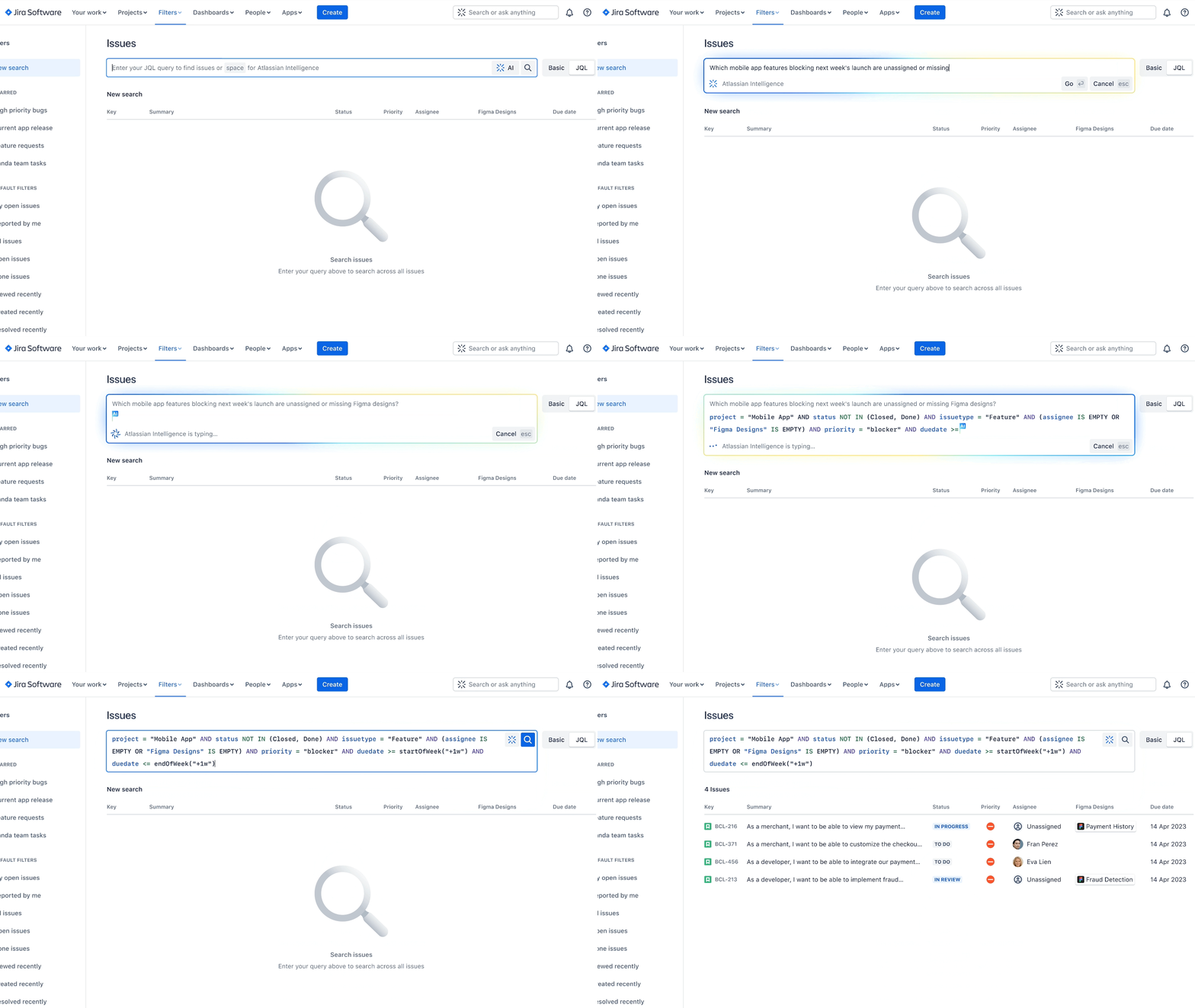
    During a virtual Unleash event, Atlassian today announced its generative artificial intelligence (AI) capabilities are now generally available across its Jira and Confluence suite of tools for managing IT and DevOps workflows.

    In addition, Atlassian also committed to adding generative AI capabilities to its Bitbucket continuous integration/continuous deployment (CI/CD) platform to enable DevOps teams to review pull requests and leave comments automatically with suggested changes around syntax and code conventions via a natural language interface. Developers will also be able to autogenerate pull request descriptions from commit messages.

    Matt Schvimmer, head of products for the Agile and DevOps division of Atlassian, said the capabilities provided by Atlassian Intelligence will reduce the level of toil and stress DevOps teams experience at a time when the velocity at which applications are being developed and deployed only continues to increase.

    Atlassian reported nearly 10% of its more than 265,000 customers have already leveraged Atlassian Intelligence since the launch of the beta program. Organizations, for example, can instantly create user stories within Jira Software tickets, change the tone of a customer response within Jira Service Management, create summaries, launch workflow requests via prompts and generate a starting point for a test plan in Confluence.

    Natural language capabilities, currently available for Confluence, will shortly be generally made available for Jira. An ability that promises to help demystify company-specific concepts, jargon or acronyms is also available now in beta, with support for Jira Software and Jira Service Management to shortly follow.

    There is little doubt at this juncture that AI will be pervasively applied across both ITSM and DevOps workflows. As those advances are made, it should also become feasible to reduce the level of toil these teams regularly encounter. At the same time, the level of scale at which ITSM and DevOps workflows can be effectively managed should also increase substantially.

    Each organization will need to decide how quickly to incorporate AI into those workflows, but hopefully, the level of burnout experienced by IT personnel will be sharply reduced as more tasks are automated. Less clear is the impact AI will have on the size of IT teams required to provide those services, but for the foreseeable future, there will always be a need for some level of human supervision.

    In the longer term, the war for IT and DevOps talent that has been waged now for multiple decades should diminish as managing these workflows becomes more accessible, noted Schvimmer. Organizations will not need to rely so much on the expertise of a handful of specialists, he added.

    Organizations, however, would be well-advised to make sure AI is embraced from both the bottom up and the top down to ensure optimal adoption, said Schvimmer.

    In the meantime, IT teams should take an inventory of the processes that are likely to be automated by AI today with an eye toward restructuring teams as more tasks are automated. Ultimately, the goal should be to let machines handle the tasks they do best to enable the IT staff to provide services that deliver more value to the business.

  • Sauce Labs Adds Visual Testing Tool to Platform

    Sauce Labs Adds Visual Testing Tool to Platform

    Sauce Labs has added native visual regression testing capabilities to its testing platform to enable DevOps teams to streamline workflows.

    Marcus Merrell, vice president of technology strategy for Sauce Labs, said Sauce Visual provides the ability to test user interfaces without requiring DevOps teams to acquire, maintain and integrate a separate tool.

    The overall goal is to make it possible to test functions and user interfaces in parallel by adding a single line of code to a DevOps workflow, he added. Updates to the visual presentation of a page are automatically highlighted, with any visual inconsistencies automatically surfaced. In comparison, a standalone visual testing tool increases the time it takes to execute a test suite, noted Merrell.

    Sauce Visual natively uses the same tools as the rest of the Sauce test automation platform, and can be integrated into any continuous integration/continuous delivery (CI/CD) workflow. At launch, Sauce Visual is compatible with Java/JUnit, Java/TestNG, WebDriverIO, Selenium, Appium (web) and Cypress testing tools with support for Playwright, Puppeteer, TestCafe, Espresso, and XCUITest forthcoming.

    The Sauce Labs approach also serves to reduce the total cost of application testing at a time when the number of applications organizations are building and deploying only continues to increase exponentially, said Merrell.

    In general, organizations are attempting to strike a balance between shifting responsibility for testing too far left toward developers that typically lack testing expertise and the need to verify application experiences are delivered as expected. Many organizations have shifted more responsibility for testing toward developers in the hope of improving code quality and reducing the number of vulnerabilities that might find their way into a production environment. The challenge is those efforts have also increased the level of cognitive load developers need to carry at the expense of having more time to write application code.

    Of course, in time, artificial intelligence (AI) tools will make it easier to generate test scripts, but there is still going to be a need for testers who were not involved in the writing of code to validate it, noted Merrell. The difference is those testers will not necessarily need to be rocket scientists as the process of creating tests becomes more automated, he added.

    Testing user interfaces is especially problematic for developers because many of them don’t have a lot of expertise in the business functions that the application they are building enables. In addition, there are often minute changes to user interfaces that developers are not always going to discern.

    As always, one of the first things that tends to be reduced whenever a developer falls behind schedule is testing. In a recent Sauce Labs survey found more than two-thirds (67%) admitted they pushed code into a production environment without testing, with more than a quarter (28%) acknowledging they do so on a regular basis.

    The assumption is that if any issues do arise, they can be addressed via the next update to the application. End users, however, are less tolerant of that approach when, in the age of digital services, an alternative application is readily available.

  • DevOps Strategies for Connected Car Development

    DevOps Strategies for Connected Car Development

    The concept of smart, connected vehicles is no longer science fiction but a day-to-day reality. These vehicles, empowered by internet connectivity and a suite of digital technologies, offer unprecedented convenience, safety and entertainment features. 

    But as the cars on our roads become smarter and more interconnected, the complexity of developing their software systems multiplies. DevOps is emerging as an indispensable strategy for organizations in the connected car industry, bringing together software development and IT operations to streamline, optimize and accelerate the development life cycle. 

    This article briefly reviews connected car technology and explores several DevOps strategies that can support connected car development. We’ll discuss how DevOps can manage the complexity of automotive software, accelerate development speed without compromising safety and provide the essential tools for efficient building, testing and deployment in a highly regulated environment.

    What Are Connected Cars?

    Connected cars are vehicles equipped with internet access, allowing them to share data with devices both inside and outside the car. Essentially, they offer a multitude of features that make the driving experience more convenient, safe and enjoyable. While this technology is still in its nascent stages, it’s rapidly evolving, and soon, connected cars will become a staple on our roads.

    These hyper-connected vehicles are part of a broader ecosystem that encompasses a network of physical objects—everything from other vehicles and traffic lights to pedestrian crosswalks and parking spaces—all connected by technology.

    The potential of connected cars is immense. They promise to transform our lives in numerous ways, from reducing traffic congestion to improving road safety and revolutionizing the way we travel.

    Key Features and Systems of Connected Cars

    Infotainment Systems

    An integral part of connected cars is the infotainment system. This comprehensive system provides both entertainment and information tailored to the driver’s needs. From navigation and music streaming to voice commands and hands-free phone calls, these systems are designed to enhance the driving experience while ensuring safety.

    Infotainment systems also offer a wide range of services, such as real-time traffic updates, weather forecasts, and points of interest. They can connect with a smartphone, allowing users to access apps, make calls and send messages without taking their eyes off the road.

    Telematics

    Telematics uses GPS and onboard diagnostics to record and transmit data about the car’s performance, location and usage. It allows for real-time tracking of the vehicle, making it particularly useful in fleet management and stolen vehicle recovery.

    Telematics data can also be used to assess driver behavior, monitor fuel efficiency, and predict maintenance needs. For instance, if the car’s engine starts showing signs of trouble, the telematics system can alert the driver and recommend a nearby service center.

    Advanced Driver-Assistance Systems (ADAS)

    Advanced driver-assistance systems (ADAS) are systems that help the driver in the driving process. These systems use sensors, cameras and radar to monitor the vehicle’s surroundings and assist the driver in various ways.

    ADAS can provide features like adaptive cruise control, lane-keeping assist and automatic emergency braking. These systems not only enhance driver comfort but also significantly improve road safety by reducing the risk of accidents.

    Vehicle-to-Everything (V2X) Communication

    Vehicle-to-everything (V2X) communication is a key technology in connected cars. It enables vehicles to communicate with any entity that may affect the vehicle and vice versa. This includes other vehicles (V2V), infrastructure (V2I), pedestrians (V2P) and networks (V2N).

    V2X communication can improve traffic flow, reduce accidents and enhance fuel efficiency. For instance, connected cars can receive information about road conditions, traffic jams or accidents ahead in real-time, allowing the driver to take appropriate action.

    Over-the-Air (OTA) Updates

    Over-the-air (OTA) updates are another key feature of connected cars. Similar to how you receive updates on your smartphone, OTA updates allow car manufacturers to update software, fix bugs or add new features remotely.

    OTA updates can improve vehicle performance, enhance security and extend the vehicle’s lifespan. They can also add new functionality, allowing the car to stay up-to-date with the latest technology without the need for a physical visit to a service center.

    Why DevOps is Essential for Connected Car Development

    Addressing the Complexity of Car Software Systems

    The connected car is a complex ecosystem of software systems. These vehicles have numerous systems that communicate with each other, the driver and the outside world. Managing the development of these systems can be a daunting task, and this is where DevOps strategies come in.

    DevOps aims to shorten the system development life cycle and provide continuous delivery with high software quality. This methodology is particularly suited to the complex software systems of connected cars, as it encourages a holistic view of the development process, ensuring that all components work together seamlessly.

    Moreover, DevOps helps to manage the complexity of car software systems by automating tasks, reducing errors and improving efficiency. The use of automated tools for configuration management, deployment and monitoring means less manual work, fewer mistakes, and quicker problem resolution.

    Enhancing Development Speed Without Compromising Safety

    One of the greatest challenges in connected car development is the need for speed. In this fast-paced industry, companies are under pressure to develop and deploy new features quickly to stay competitive. However, this must not come at the expense of safety, as any faults in the system can have dire consequences.

    With DevOps strategies for connected car development, it’s possible to enhance speed without compromising safety. The DevOps approach emphasizes a culture of rapid and frequent deployments, coupled with rigorous testing to ensure quality. By integrating development and operations, it enables teams to work together more effectively, leading to faster development cycles.

    Furthermore, the use of automation in DevOps allows for quicker detection and resolution of issues. Automated testing tools can run thousands of tests in a fraction of the time it would take a human, ensuring that any faults are identified and fixed before they can cause harm.

    Building, Testing and Deploying Efficiently in a Regulated Environment

    The automotive industry is heavily regulated, with strict safety and emission standards that must be met. These regulations add an extra layer of complexity to the development process, as they must be considered at every stage of design, testing, and deployment.

    DevOps strategies for connected car development are well-equipped to handle this challenge. By implementing a continuous integration/continuous deployment (CI/CD) pipeline, teams can ensure that all changes are tested and validated against regulatory requirements before they are deployed. This not only ensures compliance but also saves time and resources by preventing issues from reaching production.

    Additionally, DevOps encourages transparency and visibility across the development process, making it easier to demonstrate compliance to regulators. Through the use of version control systems, every change can be tracked and traced, providing a clear audit trail.

    DevOps Strategies for Connected Car Development

    Version Control for Connected Car Development

    In any software development project, version control is vital. It allows developers to track and manage changes to their code, making it easier to collaborate and preventing conflicts. In the context of connected car development, version control becomes even more critical due to the complex and interconnected nature of automotive software systems.

    Version control enables multiple teams to collaborate on projects without stepping on each other’s toes, using techniques like branching and merging. Furthermore, version control systems provide a history of changes, which is invaluable for debugging and understanding how the system has evolved over time. This can be particularly useful in a regulated industry like automotive, where there may be a need to provide an audit trail.

    Continuous Integration and Continuous Deployment (CI/CD)

    CI/CD is a core DevOps practice that involves integrating changes to the project regularly and automatically testing those changes to detect and fix problems early. The aim is to provide rapid feedback so that if a defect is introduced into the code base, it can be identified and corrected as soon as possible.

    For connected car development, a robust CI/CD pipeline is essential. It allows for fast-paced development without compromising quality or safety. By automating the build, testing and deployment processes, teams can ensure that new features and updates are delivered quickly and reliably.

    Automated Testing and Quality Assurance

    Given the complexity of connected car systems and the potential consequences of a malfunction, rigorous testing is of paramount importance. However, manual testing is time-consuming and prone to error. That’s where automated testing comes in.

    Automated testing is another key DevOps strategy for connected car development. By writing test scripts that can be run automatically, teams can save time, reduce the likelihood of human error and ensure comprehensive coverage of the system.

    Moreover, automated testing tools can be integrated into the CI/CD pipeline, allowing tests to be run every time changes are made. This provides immediate feedback on the impact of those changes and ensures that any issues are identified and addressed as early as possible.

    Infrastructure-as-Code (IaC) for Connected Car Environments

    The final piece of the DevOps puzzle is infrastructure-as-code (IaC). IaC is the practice of managing and provisioning computing infrastructure through machine-readable definition files rather than physical hardware configuration or interactive configuration tools.

    In the context of connected car development, IaC can be a powerful tool. It allows teams to create and manage their development, testing and production environments in a consistent and repeatable way. This not only enhances efficiency but also ensures that the environments are configured correctly and securely.

    Moreover, by using IaC, teams can automate the creation and teardown of environments, saving time and reducing the risk of human error. IaC also supports version control, enabling teams to track changes and roll back to a previous state if something goes wrong.

    Conclusion

    In conclusion, connected cars represent a significant advancement in the automotive industry, but they also bring a host of development challenges. By adopting DevOps strategies for connected car development, companies can navigate these challenges and unlock the full potential of this exciting technology. From managing complex software systems to ensuring rapid and safe development, DevOps offers a robust and flexible approach that is tailored to the needs of the connected car industry.

  • Key Cost Optimization Strategies for Multi-Cloud Environments

    Key Cost Optimization Strategies for Multi-Cloud Environments

    In today’s ever-changing technology landscape, businesses are realizing the advantages of multi-cloud environments. These environments allow organizations to tap into various cloud platforms and use their services as required. This change signifies a shift away from relying on just one cloud provider. Businesses now embrace the flexibility and adaptability that come with using multiple clouds simultaneously.

    In complex multi-cloud environments, it is crucial to manage costs effectively. It is important to strategically optimize costs while considering your organization’s specific needs. By utilizing tools, implementing processes and continuously monitoring costs, you can save money while still reaping the benefits offered by different cloud providers.

    What is Multi-Cloud?

    A multi-cloud environment describes a setup in which companies or individuals utilize cloud computing platforms or providers to fulfill their computing requirements. In a multi-cloud setup, organizations have the ability to integrate both public clouds (such as Amazon Web Services, Microsoft Azure or Google Cloud Platform) and private clouds (on-premises or hosted private clouds) to establish a diverse and adaptable computing infrastructure. Rather than relying on one cloud provider, multi-cloud strategies distribute workloads across several cloud environments. Rather than depending on a single cloud provider, a multi-cloud strategy involves distributing workloads across various cloud environments.

    Benefits and Challenges

    Multi-cloud environments offer organizations numerous benefits, including flexibility, reliability, scalability and cost optimization. When organizations distribute their workloads across various cloud platforms, they reduce the chances of downtime or service disruptions due to a single provider failure. This guarantees uninterrupted availability and minimizes any potential impact on business operations.

    It is quite challenging to manage a multi-cloud environment for several reasons. Organizations must tackle challenges related to governance, cost management, integration and compatibility. To overcome these obstacles effectively, it is important to implement a well-defined strategy with efficient management tools.

    Since each cloud provider comes with its own set of tools, APIs and policies, ensuring consistent governance across different cloud platforms is challenging. Since different cloud providers have differing pricing structures, it is quite difficult to monitor and optimize costs in a multi-cloud environment.

    Analyzing and understanding each provider’s cost model is necessary when tracking usage patterns across different platforms. Integrating services from different cloud providers into a cohesive system architecture can be challenging due to compatibility issues. Careful planning and expertise are needed to achieve seamless integration without conflicts or performance problems.

    The Importance of Cost Optimization in Multi-Cloud Environments

    In today’s evolving technology landscape, businesses need to make the most of various cloud environments to fully utilize their cloud capabilities. However, great power entails great responsibility and cost optimization is a critical aspect that should not be overlooked.

    As businesses expand their cloud presence across multiple providers, optimizing costs becomes necessary to maximize ROI and stay competitive in today’s fast-paced market. In a multi-cloud environment, organizations typically use several cloud platforms simultaneously, including Amazon Web Services (AWS), Microsoft Azure, and Google Cloud Platform (GCP), to reduce expenses and maximize efficiency by comparing the services, features, and pricing models offered by each of the providers.

    Multi-cloud environments offer opportunities for cost optimization by allowing organizations to choose the cost solutions tailored to their specific needs. With access to pricing models and options offered by providers businesses can optimize their expenditure based on workload requirements.

    Optimizing Costs in Multi-Cloud Environments

    To optimize costs in multi-cloud setups, one must carefully analyze and manage expense factors across providers and services. It involves understanding cost structures, pricing models and usage patterns while considering workload requirements to choose cost-effective options for different tasks. Achieving these financial benefits requires efficient resource allocation and minimizing unnecessary expenses.

    This section discusses the key strategies for optimizing costs in a multi-cloud environment.

    Automating Resource Management

    You can optimize costs in a multi-cloud environment by automating the management of resources. Efficiently optimizing costs in cloud environments relies heavily on automating resource management. This enables organizations to monitor usage levels and resources dynamically as required, effectively implement cost-saving policies and ensure optimal utilization of cloud services without the need for human intervention.

    ​Organizations can automate their processes and tasks to streamline their operations, thereby saving time and reducing the risk of overspending on unnecessary resources. To effectively handle resources, it is crucial to have monitoring tools that offer real-time observations on usage patterns and performance metrics. These tools enable businesses to identify underutilized resources, which can then be automatically shut down or adjusted in size as required.

    Automation also involves implementing automatic resource allocation capabilities based on demand fluctuations. By scaling up or down depending on workload requirements, organizations can optimize costs by ensuring they only pay for the resources they truly need at any given time.  By implementing these automated policies, organizations are able to enforce cost optimization practices. For example, by establishing guidelines for assigning metadata tags to resources, organizations gain visibility and control over expenditure across various cloud platforms.

    Additionally, scheduling non-production environments to automatically shut down during off-business hours can significantly reduce costs. By turning off development and testing environments when they’re not in use, companies can avoid paying for resources during periods of low activity.

    Analyzing Costs in Multi-Cloud Environments

    While analyzing costs in a multi-cloud environment is challenging, it is a crucial strategy for your organization to make the most of its resources and avoid unnecessary expenses. It’s important to understand usage patterns and expenditures to optimize costs effectively. Start by gaining visibility into spending across all clouds. Use cost management tools provided by the cloud platforms or consider third-party solutions that consolidate data. This helps track costs at a detailed level and identify areas of high expenses. Analyze usage patterns to find instances that can be resized or turned off when not needed. By adjusting resources based on demand, overprovisioning can be avoided and unnecessary costs reduced.

    Here are the key steps to analyze costs in a multi-cloud environment:

    • Identify and categorize workloads
    • Track usage patterns and cost
    • Analyze the usage patterns of your workloads
    • Automate cost optimization
    • Incorporate cost analysis into your decision-making process
    • Review cost optimization strategy regularly

    Use Spot Instances

    In multi-cloud environments, using spot instances is crucial for cost optimization. These instances are available from cloud providers at a much lower price than on-demand or reserved instances, leading to substantial cost savings for organizations. With spot instances, you can take advantage of unused or idle capacity on cloud providers’ infrastructure, resulting in substantial cost savings. Being strategic with spot instances provides economical access to compute resources. Cloud providers offer discounted spare resources in the absence of regular customer demand, making it favorable compared to on-demand or reserved instances. Use on-demand or reserved instances for critical tasks while employing spot instances for less critical workloads. To optimize costs, you should leverage on-demand, spot and reserved instances, i.e., a mix of all of them.

    Right-Sizing and Efficient Resource Allocation

    Rightsizing is a key strategy for cost optimization that reduces costs and enhances performance in multi-cloud environments, leading to substantial savings. One of the most important steps in this regard is capturing comprehensive data on resource utilization (CPU, memory, storage and network utilization). By identifying over-provisioned or underutilized instances, organizations can optimize resource allocation. Automated tools simplify this process by monitoring and recommending adjustments. Consolidating workloads into fewer instances and leveraging virtualization technologies or containerization platforms further improves performance and scalability.  Right-sizing and resource allocation are two key techniques that can help optimize costs in a multi-cloud setup.

    Here are the key strategies at a glance:

    • Analyzing workload requirements
    • Selecting the appropriate instance types
    • Regularly review and adjust resource allocations based on actual usage patterns
    • Implementing auto-scaling and load-balancing mechanisms
    • Utilizing resource tagging and monitoring tools for cost visibility
    • Right-sizing resources on demand
    • Automated scaling strategies

    Conclusion

    By implementing key strategies such as using reserved instances or savings plans, automating resource management, implementing rightsizing techniques, leveraging spot instances, optimizing data transfer and storage, applying automation and orchestration principles, practicing financial governance and budget management and keeping an eye on future optimizations, businesses can effectively control their cloud spending and ensure they are making the most of their multi-cloud investments while minimizing costs.

    However, it’s important to acknowledge that cost optimization in cloud environments comes with its own set of challenges. Managing costs can be quite challenging for cloud environments despite their flexibility and scalability. From dealing with pricing models to facing a lack of visibility across clouds, there are obstacles that need to be overcome.

    With careful planning and implementation combined with ongoing monitoring and review processes, organizations can mitigate the challenges and truly harness the power of multi-cloud. Your organization should adhere to the key strategies outlined in this article to take advantage of the benefits of multi-cloud while ensuring optimal costs in their cloud spending.

  • 8 Essential Generative AI Tools for Building Stand-Out Applications

    8 Essential Generative AI Tools for Building Stand-Out Applications

    Building advanced AI apps demands the right tools. Generative AI is a game-changer with the potential to transform how we craft AI-powered solutions. Whether you’re a pro or new to AI, the right generative AI tools can elevate your projects significantly. In this article, we’ll explore the essential generative AI tools that can help you build remarkable AI applications.

    These tools cover a wide range of functions, from content creation to design and data analysis. By the end of this blog, you’ll have a better understanding of how generative AI tools can elevate your AI projects to new heights.

    GPT-3 by OpenAI

    GPT-3, or Generative Pre-trained Transformer 3, is a remarkable language model designed to create text that closely resembles human writing. Its applications span content generation, language translation and chatbot development.
    ● Pros: GPT-3 is highly adaptable and capable of tackling a wide array of tasks. Its primary strengths lie in its ability to handle complex language-related challenges, making it a versatile tool for developers.
    ● Cons: While GPT-3’s capabilities are impressive, its availability may be limited and using it extensively could entail significant costs. These factors are worth considering for projects with high resource demands.

    Runway ML

    Runway ML is tailored to cater to the creative aspects of AI, offering a suite of tools tailored for artists, designers and developers. It encompasses a wide array of generative models that empower users to generate art, design prototypes and craft interactive experiences.
    ● Pros: Runway ML stands out for its user-friendly interface and real-time creative capabilities. This makes it an excellent choice for individuals venturing into the realm of creative AI projects, providing a smooth learning curve.
    ● Cons: It’s important to note that certain advanced features within Runway ML may be accessible only through a subscription, limiting full access in the free version. This subscription-based model should be considered when assessing its cost-effectiveness for your specific project needs.

    Hugging Face Transformers

    Hugging Face Transformers serves as a repository of pre-trained models specifically designed for natural language processing (NLP) tasks. Its applications are extensive, encompassing tasks such as sentiment analysis, text classification and more.
    ● Pros: Hugging Face Transformers stands out as an open-source platform with a vibrant and engaged community. This ecosystem offers a diverse array of models and tools, making it a valuable resource for developers seeking to harness the power of NLP.
    ● Cons: It’s important to acknowledge that newcomers to Hugging Face Transformers may face challenges when customizing models and engaging in model training. While this platform offers an array of resources, it may require a certain level of familiarity with NLP and machine learning concepts for optimal utilization.

    Midjourney

    Midjourney is a versatile tool designed to tackle creative tasks spanning text, music and image generation.
    ● Pros: Midjourney presents a robust offering of pre-trained datasets and generative models, catering particularly well to creative projects. Its user-friendly interface ensures accessibility for individuals, even those who are new to AI, making it an excellent starting point.
    ● Cons: However, it’s crucial to recognize that while Midjourney excels in the realm of creativity, it may not be the top choice for AI applications that require a strong focus on data-driven tasks. Depending on your project’s needs, this limitation might affect its suitability.

    Synthesia

    Synthesia is a specialized AI tool designed for video generation and customization. Its core function revolves around the conversion of text into AI-generated videos.
    ● Pros: Synthesia streamlines the video production process, delivering substantial advantages for content creators and marketers. Its user-friendly interface simplifies the video creation journey, ensuring that a wide audience, regardless of technical expertise, can harness its potential.
    ● Cons: However, it’s essential to recognize that Synthesia’s primary expertise centers on video generation. This specialization can occasionally limit its adaptability when dealing with a broader spectrum of creative tasks that extend beyond the realm of video production. Depending on your project requirements, this specialization may influence its suitability.

    DeepCode

    DeepCode is a specialized tool dedicated to code analysis and improvement. Its primary mission is to assist developers in identifying and rectifying issues within their codebase.
    ● Pros: DeepCode serves as a highly valuable resource for developers, offering concrete benefits such as the enhancement of code quality and the reduction of errors. It’s thoughtfully designed to streamline the coding process, making it more efficient and effective.
    ● Cons: It’s imperative to recognize that DeepCode’s focus is specifically centered around code analysis. This level of specialization may limit its applicability when addressing AI projects or tasks that fall outside the realm of software development. Depending on your project’s nature, this focus may impact its relevance to non-developer AI initiatives.

    Soundraw

    Soundraw is an AI-powered music generator designed to empower users to craft unique, royalty-free music, perfectly suited to enhance a wide range of projects and content.
    ● Pros: Soundraw’s most significant advantage lies in its ability to generate original compositions, thereby mitigating the risk of copyright issues. It also offers secure and enduring licenses for all creative uses, ensuring that your content remains free from copyright concerns.
    ● Cons: While Soundraw’s AI capabilities are impressive, it may occasionally lack the nuanced depth of creativity found in music created by human composers. The variety of available themes and moods may be somewhat limited, which could affect its suitability for highly specific or unique creative projects.

    VQ-VAE-2

    VQ-VAE-2 is a specialized tool known for its exceptional performance in image compression and generation tasks. It’s the preferred choice when the goal is to create high-quality images while simultaneously reducing data size.
    ● Pros: VQ-VAE-2 stands out as a robust solution for image-related AI applications, delivering substantial benefits in terms of enhanced compression and improved image quality.
    ● Cons: It’s essential to acknowledge that leveraging VQ-VAE-2 effectively may necessitate a solid understanding of image processing and AI concepts. This tool is best suited for users with advanced knowledge in these domains.

    Wrapping Up

    By using generative AI tools in your AI projects, you can open up exciting opportunities and make your work more efficient. But, it’s crucial to think about your project’s unique requirements, check if the tools are accessible, and understand their costs.

    Explore what each tool can and can’t do to decide which one suits your AI project best. With the right generative AI tools, you can bring your projects to life and shine in the world of artificial intelligence-powered applications.