Category: Application Performance Management/Monitoring

  • Continuous Monitoring: The Role of DevOps and APM

    Continuous Monitoring: The Role of DevOps and APM

    To enable faster and better response to changing customer needs, enterprises are increasing their release frequency for applications. This, in turn, demands tighter alignment and collaboration than traditionally has been seen between the line of business, development and IT operations, driving the need for enhanced collaboration, automation and information transparency among these groups. To achieve seamless internal collaboration, many enterprise customers are adopting a DevOps approach.

    DevOps is an enterprise capability that enables the continuous delivery and continuous deployment of software. It reduces the time needed to address customer feedback. DevOps brings once-siloed Dev and Ops together to improve agility and achieve these benefits:

    • Improves collaboration between developers and operations specialists by using shared DevOps tools.
    • Facilitates continuous delivery of software by enabling collaborative testing throughout the development and release processes.
    • Automates the manual processes of release management, infrastructure provisioning, orchestration, monitoring, containerization and virtualization.
    • Corrects misalignments of people and goals by building closer links between developers and operations.
    • Incorporates customer feedback in the development process to facilitate agile development.

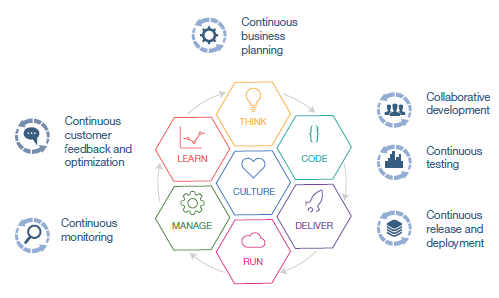
    IBM has identified six phases in the DevOps life cycle, plus necessary cultural considerations, for successful implementation of a DevOps approach (Fig 1).
    pic

    Fig. 1 – Six phases of the DevOps life cycle

    In the Manage phase of the DevOps life cycle, continuous monitoring of applications in production environments is typically implemented with application performance management (APM) solutions that intelligently monitor, analyze and manage cloud, on-premise and hybrid applications and IT infrastructure. These APM solutions enable you to monitor your users’ experience and improve the stability of your application infrastructure. It helps identify the root cause of issues quickly to proactively prevent outages and keep users satisfied.

    With a DevOps approach, we are also seeing more customers broaden the scope of continuous monitoring into the staging, testing and even development environments. This is possible because development and test teams that are following a DevOps approach are striving to use production-like environments for testing as much as possible. By running APM solutions earlier in the life cycle, development teams get feedback in advance of how applications will eventually perform in production and can take corrective action much earlier. In addition, operations teams that now are advising the development teams get advance knowledge and experience to better prepare and tune the production environment, resulting in far more stable releases into production.

    Applications are more business critical than ever. They must be always up, always fast and always improving. Embracing a DevOps approach will allow you to reduce your cycle times to hours instead of months, but you have to keep ensuring a great user experience! Continuous monitoring of your entire DevOps life cycle will ensure development and operations teams collaborate to optimize the user experience every step of the way, leaving more time for your next big innovation.

    This continuous monitoring blog is the first in a series that focuses on collaboration between development and operations teams. We will explore this topic in detail in upcoming blogs:

    • Synthetic Monitoring: Developers, testers and operations staff all need to ensure that their internet and intranet mobile applications and web applications are tested and operate successfully from different points of presence around the world.
    • Alert Management: Developers, testers and operations staff all need to send notifications via email, voice mail, text, mobile push notifications and Slack messages when specific situations or events occur in development, testing or production environments, to get the right people’s attention and to manage their response.
    • Deployment Automation: Developers, testers and operations staff use different tools to schedule and deploy complex applications and configure them in development, testing and production environments. We will discuss the best practices for these teams to collaborate effectively and efficiently and avoid potential duplication and erroneous information.
    • Analytics: Developers need to be able to look for patterns in log messages to identify if there is a problem in the code. Operations need to do root cause analysis across multiple log files to identify the source of the problem in complex application and systems.

    Stay tuned for the next blog on synthetic monitoring in the series and register for an upcoming interactive webcast, “Learn Why We Must Shift APM Left in the DevOps Lifecycle.”

    About the Author / Arun Biligiri

    Arun Biligiri

    Arun Biligiri is the leader of the Application Performance Management Offering Management team at IBM. Arun has over 20 years of experience in technology in various different roles including entrepreneurial, development, product management and sales engineering. He has worked closely with innovative enterprises and has extensive experience in addressing cloud, analytics needs in efficiently managing their data centers and clouds. He has an MBA from the Wharton School, and MS from the University of California, Berkeley. Connect with Arun on Twitter / LinkedIn

  • DevOps Matchmaking: APM + CI = A Perfect Marriage

    DevOps Matchmaking: APM + CI = A Perfect Marriage

    As anyone who has ever been set up on blind dates by friends can attest, finding the right match in today’s world is a tricky feat.

    There’s a lot of evidence suggesting that the frantic pace of life makes such matchmaking more difficult than ever. That said, when the right set of complimentary traits exist and there’s a willingness to find common ground, things can work out.

    Spike Jonzian-notions of artificial intelligence aside, certain technological partnerships are increasingly being perceived as “a perfect marriage” within the context of DevOps automation.

    Register today for the upcoming webcast: “Using APM to Turbocharge Continuous Integration”

    These technological matrimonies closely support the underlying tenets of DevOps methodology—collaboration, experimentation and increased velocity. In fact, it’s easy to wonder why no one ever conjoined them before. But we were using traditional waterfall development and operations and so couldn’t conceive of such a thing. On the other hand, emerging availability of tooling supporting new integrated workflows represents a significant catalyst.

    Finding the Perfect Fit

    One such DevOps confederation getting a lot of attention is the matchmaking of continuous integration (CI) and application performance management (APM) technologies. Tying together these once-disparate systems makes a lot of sense, despite the fact that few tools would seemingly appeal to more (traditionally) polarized constituencies.

    Continuous integration has been a staple of the development community for many years. It emerged as teams evolved the practice of long build times into more frequent check-ins to deliver code and look for potential errors more quickly. Today, with the rise of CI tools such as the Cloudbees Jenkins platform, some development teams are touting tens of thousands of builds per day.

    On the other end of the spectrum, squarely on the turf of IT operations, APM has been evolving rapidly over the past few years as organizations have sought to improve use experience and applications reliability via dedicated monitoring. Enabling this ability to identify and address emerging issues has resulted in APM becoming the fastest-growing segment in the IT ops management market, according to Gartner.

    DevOps matchmaking factors in when you bring these tools together to create an automated workflow that spans their respective use cases. A cross-functional team can leverage APM-level monitoring and KPIs within the domain of CI and testing to identify potential performance obstacles introduced in new code. Doing so then rather than waiting to respond later in the applications life cycle benefits everyone.

    Reaping the Benefits

    For example, say an e-commerce applications developer has implemented a new inventory search functionality—something considered a key differentiator by business management. The developer knows this feature could rely heavily on some back-end database system and wants to ensure it’s tested properly, even as the code is being introduced.

    Integrating APM and CI allows the entire team to monitor the process and test various conditions related to the update, tracking multiple builds and looking out for related performance issues. Such integration also allows for centralized tracking of other key attributes such as build number, status and build date, to further ease management.

    Most importantly, by tying these two critical aspects of the applications delivery life cycle together, the collaboration and feedback loops required to truly embrace DevOps methodology become ever more valuable as these core Dev and Ops functions become intrinsically linked.

    If this type of DevOps advancement gets your heart pumping, you’re not alone. Later this month, we’ll host a webcast here on devopsy.kinsta.cloud featuring experts from CA Technologies and Cloudbees. They’ll be discussing the benefits of matchmaking with APM + CI integration. They’ll also detail real-world benefits organizations leveraging integration of our respective technologies (CA APM and Cloudbees Jenkins) enjoy.

    We obviously feel that this is a DevOps tooling marriage that will mature, change and stand the test of time. We’d love to garner your questions and feedback on the topic.

    Which is all good, because thankfully there’s no such thing as Tinder for DevOps … yet.

  • Gartner Evaluates APM Tools for DevOps

    Gartner Evaluates APM Tools for DevOps

    In 2009, Gartner analyst Mark Nicolett created the Critical Capabilities report. Over time, this document became paired to individual Magic Quadrant reports, and in 2014, Gartner mandated that Critical Capabilities be paired with each Magic Quadrant. Instead of graphically plotting vendors on a x- and y-axis, this research takes a deeper look at a product and its fit for specific use cases.

    So how does this pertain to DevOps?

    In its latest “Critical Capabilities of Application Performance Monitoring” research, Gartner notes, “Because of its wide lifecycle purview, the DevOps release team often leverages many of the capabilities found in APM suites.” Since the foundation of DevOps is to foster collaboration among the two, typically disparate teams, modern application performance monitoring (APM) solutions are geared perfectly to help encourage this feedback loop. “When examining the capabilities valued by this buyer, APM tooling is critical when attempting to quickly assess the quality (and effectiveness) of a recent release. Detecting and diagnosing issues must be done quickly, which often requires in-depth data sourced from multiple, integrated tools,” according to Gartner.

    “Much of the activity of APM technology is focused on detecting and providing insight into root causes. Identification of the impact on system and application resources is based on existing (or proposed) transaction-level trends,” the report continues. “This capability provides IT operations and DevOps release teams with the ability to tell the (line of business) and application owners the potential impact for any planned changes or continuation of resource consumption trends. Although capacity-planning tools have often filled this role, APM suites increasingly offer predictive analytics capabilities for shorter-term horizons”

    Of course, we can’t ignore the key to DevOps success: culture. However, no tool—no matter how good—can foster the right type of culture. John Rakowski, my current colleague and ex-Forrester analyst, wrote a compelling ebook on the intangibles that successful DevOps teams need.

    The Critical Capabilities research report provides a comprehensive and technical product analysis ranking APM suites from 15 vendors on critical APM capabilities across five different usage scenarios, including DevOps. The capabilities assessed for each use case included business analysis, service monitoring, anomaly detection, distributed profiling, application debugging and workload planning.

    The vendors evaluated were AppDynamics, AppNeta, BMC Software, CA Technologies, Dell, Dynatrace, Hewlett Packard Enterprise, IBM, JenniferSoft, ManageEngine, Microsoft, Nastel Technologies, New Relic, Riverbed Technology and Tinygun.

    The report is free of charge and can be downloaded here.

  • Where will DevOps be in 10 years’ time?

    Where will DevOps be in 10 years’ time?

    What will the DevOps landscape look like in 10 years’ time? Ten years ago, Agile was seen as new and different. Now it’s part of everyday life of most developers. Will it be the same with DevOps? It’s time to clasp the crystal ball and unravel where the future is headed.

    First things first. DevOps is here to stay. The overwhelming trend towards the digitization of services accelerates the need for agility and shorter release cycles with DevOps as an invaluable building brick: think the Uber vehicle booking service, the Airbnb property rental service—even Amazon’s move to take the terrestrial version of Top Gear and launch it as a digital-only, on-demand broadcast service. Services are going digital. And so are companies: banks, retailers, telcos and others are increasingly positioned as software-driven businesses where IT makes the difference.

    These organizations will need to develop and deliver compelling, customer-centric apps quicker than ever before. Agile development will become the battle cry of every business. Dev and Operations teams will increasingly need to shake hands in a middle ground of rapid development and reliable, high performance services delivery.

    At a technical level, DevOps enablement will be driven by increased public and private cloud adoption: Infrastructure, Platform and Application Service Clouds are all important enablers for DevOps practices. Moreover, DevOps will also grow through the replacement of IT Operations Management tool chains – including automation, monitoring and service management – from non-DevOps to DevOps-enabled and DevOps-ready tools.

    If agile is a journey, DevOps can be seen just as another part of it; one, that suits companies, which successfully completed the first phases of agile transformation and are now looking at ways to further enhance their agile maturity levels and accelerate releases. The increased adoption of agile development methodologies and the increase of related maturity levels thus will also fuel growth. Gartner, for example, has indicated that agile development is essential for mobile application development, arguing that the traditional methods used to define and develop desktop applications will not work with mobile application development.

    Still not convinced? Then how about this. Research by Computing in the UK shows that 30% of 300 organizations surveyed in the run up to the 2015 DevOps Summit had either started to implement a DevOps strategy or had already merged Dev and Ops, with another 13% planning to go down this route.

    Awareness of existing DevOps success will also fuel this continued growth. Recent research, for example, shows that high-performing IT organizations are deploying code 30 times more frequently with 50% fewer failures using DevOps practices. And demand for DevOps skills is soaring too: DevOps engineers are among the highest paid IT practitioners today, according to APM Digest.

    Make no mistake, the software delivery chain will continue to accelerate and change cycles will shrink. In many competitive scenarios, an advantage can only be sustained through organizational agility. In fact, agility can make such a competitive advantage sustainable. Since IT is so important already in the “legacy” enterprise and becomes even more so in the digital economy, existing IT systems and methods will need to move towards agile.

    Here’s another thought. I predict that within the next 10 years the split of ‘Mode 1’ and ‘Mode 2’ companies will disappear. Mode 1 is the traditional approach to development, emphasizing scalability, efficiency, safety and accuracy. It’s the blueprint for how IT Operations works. Mode 2 meanwhile is non-sequential, emphasizing agility and speed. And it requires new thinking and processes around issues such as investment management, governance and collaboration.

    It will disappear for two reasons. First, distinct cultures and operational modes are not sustainable within the same business. Second, if agility is not a requirement, the service should not be operated within the boundaries of the firm for strategic reasons. Own “mode 1” operator companies should be used to outsource non-differentiated IT services.

    In due course, bimodal IT will flourish within organizations, servicing two modes of IT, each designed to develop and deliver information- and technology-intensive services in its own way. Success in both modes demands smarter, more flexible tools that support today’s complex IT operations. Bimodal IT is not without its risks and challenges, but it will be increasingly powerful in helping companies meet ever-growing customer expectations. DevOps will help firms help them bridge these two modes.

    Market demand for DevOps skills will continue to grow too in the next 10 years. Research indicates that DevOps engineers are among the highest paid IT practitioners today and aggressive hiring of people with DevOps expertise will continue in the years to follow.

    One final, more controversial thought. In 10 years’ time, we might not even be talking about DevOps anymore. By then, all stakeholders will understand how to work holistically to achieve business value through the end goal of delivering high quality applications and services to customers. So DevOps might even become redundant. But continuous delivery will be the norm.

  • Stackify APM+ brings real-time application performance management to .NET

    Stackify APM+ brings real-time application performance management to .NET

    It’s a fast-paced world. Recent research from Microsoft suggests that the attention span of the average human is about 8 seconds now. That means if your application doesn’t work as expected your users will quickly move on to find a suitable replacement. An application performance management tool can be crucial to identifying and resolving application issues as quickly as possible…while you still have the user’s attention.

    Stackify introduced APM+ to give .NET developers real-time application performance analysis. Stackify has already established itself as one of the leading vendors of application performance management. Its platform monitors important metrics like CPU, memory, and disk utilization on servers and alerts developers or admins when issues arise. Now it is extending that monitoring to Microsoft ASP.NET environments with APM+.

    “The level of real-time app performance and depth of APM+ analytics is unmatched in the market. Not only does Stackify give a complete 360-degree view of how a system is spending its time and where, but it also allows developers to quickly drill down to the heart of the code and see how it can be fixed or improved,” says Stackify CTO, Jason Taylor.

    Application performance management in general, and a tool like APM+ specifically, fit neatly with the principles of DevOps. As I noted in a previous article DevOps is “continuous” at virtually every level. There is no beginning or end—no point when an application is completed and deployed and you can kick back and relax. While finishing touches are being put on an app to prepare for a new release a laundry list of changes and updates is already being worked on to develop the next release. There’s no rest for the weary (developers).

    There will always be fixes and new features to work on for an app, but application performance management gives you insight into the changes that matter most. Knowing things like which app takes the longest time to load, or which app gets called the most often, or which app is failing the most gives developers a huge advantage that allows them to devote resources where they will have the most impact.

    According to a Stackify press release, “APM+ gives developers an increased understanding at every level of an application’s performance and offers code-level profile traces to provide unparalleled system visibility — including method calls, log statements, cache lookups, DB queries, and web service requests.”

    Why is that important? A couple reasons stand out. First, you want to be proactive about identifying and resolving issues with your apps. The old-fashioned method of waiting for users to report problems is too slow and reactionary. By that point you already have disgruntled users frustrated with your app.

    The second major reason is that a tool like APM+ gives you a streamlined ability to resolve the issue(s) plaguing the app. Rather than a user reporting a problem and developers poking and prodding to investigate what the underlying issue is, APM+ gives developers visibility into metrics and data that enable them to quickly find and fix the problem.

    APM+ is focused on the .NET framework initially but Stackify notes that it plans to offer support for a broader range of development languages later this year.

  • Can your DevOps and APM Initiatives Increase Customer Loyalty?

    Can your DevOps and APM Initiatives Increase Customer Loyalty?

    I’ve reached a point where I can rate most services based on the quality of my digital interactions. So much so in fact, that any human interjection into my daily digital consciousness has become, well, almost quirky.

    It was with some surprise that after a prolonged period of digital engagement with my bank, I received a call from a customer service representative. After the initial shock, I was brought back to earth by a pretty standard question:

    Based on the service you’ve received recently, how likely is it that you would recommend our company to a friend or colleague? Please rate on a scale of 0 to 10.

    Now with a background in marketing, I understand what’s in play here. It’s an attempt to build what’s called a Net Promoter Score (NPS); a simple management tool to gauge the loyalty of consumers. If I respond with a 9 or 10 I’m considered enthusiastic – a promoter. On the other hand if I think the service sucks and score 0 to 6, then I’m a detractor. The metric is calculated by subtracting the percentage of detractors from the percentage of promoters. Yep, management theory doesn’t have to be complex.

    NPS as an indicator of business performance is important because most leaders understand they’re competing primarily on the basis of the customer experience. And, since this experience is predominantly based on a journey of linked digital engagement, maintaining the quality of these interactions is vital.

    So what has all this to do with Application Performance Management (APM) and DevOps? Well, lots – let me explain.

    If we think about digital engagement, there’ll be many points across a customer journey (from app on-boarding to service renewal) that’ll help determine the overall experience and whether or not customers become promoters. I call these “magic moments”; points of interaction where businesses have an opportunity to deliver an experience that transcends beyond the purely transactional into a more powerful emotional connection. It’s vital therefore that these moments become the focal points for our APM strategies – only this requires some new thinking. Here’s my take:

    Monitor the Magic – IT teams must identify all the key magic moments (especially those that have the highest correlation to customer loyalty) and implement automated performance collection and measurement. Some of these may form part of a linked value chain (e.g. an airline flight experience = seat selection + mobile boarding pass + baggage collection + loyalty rewards), or be services designed to drive a recurring revenue model (e.g. free shipping / discount options), or even be delivered by partners through API’s. Whatever the model, APM must be capable of providing a unified end-user view into every contextual, situational or transactional interaction – mobile app and web-based – because it’s here that loyalty is determined and promoters are formed.

    Make Metrics Matter – when a prospect navigates to your application (perhaps via some promotional web-advertising) that’s great, but it’s not yet magic – that is until the visit converts into a sale. It’s at these points that we should be connecting our “listening” strategy (via APM) to the customer and determining effectiveness in a business context. This can be tricky because traditional (but still important) metrics like MTTR are introspective, whereas what’s really required are external customer-centric indicators. To address this, DevOps practitioners should consider applying newer APM analytical methods and instrumentation in order to learn the relationships between service elements (e.g. web site sign-on / authentication time, response times) and customer experience – using the intelligence gained to drive improvements where they’re most effective – yep, you guessed it – at those “magic moments”.

    Share the “Profits” – an advanced experience-based APM strategy must also include working with groups who can profit from rich information insights. From a DevOps perspective, this will involve development leveraging the data as the operational feedback needed to steer both functional and non-functional improvements – for example, mobile app usage and behavior analytics are critical early indicators of functional usability. But given the businesses reliance on digital services, many groups beyond IT will also profit. For example, if it’s reliably determined (and presented) that application performance is a key driver of Net Promoter (or any other business metric), which in turn is linked to improved financial outcomes, then this could serve as the basis upon which to prioritize future investment.

    Instrument Culture – aligning with metrics like NPS is valuable because it helps shape collaborative, customer-centric behaviors. However, this requires tools that can embed these behaviors into everyday operational practices. Improving customer experience is a shared goal, so APM processes must facilitate the feedback of intelligence between Dev and Ops, while also meeting the needs of every function (Developers, Application admins, Level 1 and 2 support etc.) within each group – especially in context of the role each plays in improving customer experience.

    As companies increasingly engage customers via digital channels it’s a given that IT will be measured on how it increases customer loyalty. While business metrics sounding like NPS may at first seem foreign, they present us with a unique opportunity to demonstrate what DevOps and APM is really all about – winning more customers and getting them to stick with you.


  • 5 ways APM can solve your DevOps worries

    5 ways APM can solve your DevOps worries

    This week at the InterOp conference in New York I had the chance to talk to a lot of IT managers transforming their organizations to adopt a DevOps culture. One of the key questions I heard repeatedly was – are there some best practices to break down the wall between Dev and Ops?  How do you get to a point where we can deploy code multiple times a day like Facebook , Amazon and Netflix without impacting our users’ experience ? How do we minimize the risk of deployment failures and the blame game that ensues? With the need to innovate and close the customer feedback loop quickly Ops is being asked to deploy code more rapidly than ever before.  The complexity of hundreds of developers updating code makes it a very sensitive environment. The last thing Operations wants is an outage leading to financial loss and the last thing development wants is to get a call in the middle of the night to figure out what code change caused it.

    To have tight control over this fast paced environment we need Application Performance Management at every step. APM can help break down the Chinese wall between Dev and Ops and eliminate the finger pointing that happens during outages. Here are 5 APM best practices to enable a smooth DevOps working environment

    1. Use the same APM tool in Dev and Ops: APM should not be an afterthought , should not be a tool that only Operations looks at to monitor apps. APM is essential in every step along the way , from dev/test to staging to production. As a part of test deployment, developers should use the same APM tool as Ops to see the impact of the code deployment on the application’s performance and catch issues before hand. With the same tool everyone is on the same page and there is less confusion on the metrics being tracked. Developers can’t say “Sorry Ops, we are not seeing the problem”
    2. Isolate and fix performance problems sooner with Code Level Diagnostics:  Today’s APM tools come equipped with deep diagnostics that lets you drill down to the line of code that may be causing a performance slowdown. When code deployed in the Test or Staging environment results in a response time spike, developers can use deep dive code diagnostics to detect the line of code, the SQL query, the method call that may have caused the spike and fix the problem before it is deployed on production. For example, you can detect that a SQL query is taking way longer than it did last week for a specific mobile device platform.
    3. Detect changes with Deployment Detection: When new version of code is deployed in production, the change should be detected automatically without having to reconfigure the APM tool.
    4. Analyze Pre and Post Deployment Performance Trends: Get before and after snapshots of the end to end transactions from your APM tool and compare performance trends over time. With topological visualizations you can, at a glance, see if any particular business transaction slowed down post deployment. With historical data you can see how the application’s performance and resource consumption is evolving over time. This will help fine tune your apps’ resources as well. For example you can determine whether an AJAX call has been slowing down over the last 2 weeks due to the slow down of a third party API call or because a disk consumption is increasing over time.
    5. Automate actions on failures: Configure your APM tool to take actions on failures. For example configure an action to automatically increase memory if a memory spike alert is generated post-deployment while you take the time to diagnose the root cause.

    Using APM let your developers focus on writing code rather than spend time fighting deployment catastrophes and enable a healthy collaborative working environment between Dev and Ops.