Author: Mike Vizard

  • CloudBees Brings Feature Flagging to On-Prem Environs

    CloudBees Brings Feature Flagging to On-Prem Environs

    CloudBees this week announced an update to CloudBees Feature Flags that now makes it possible to deploy this capability in on-premises IT environments.

    Moritz Plassnig, senior vice president and general manager for software delivery management and software delivery automation cloud at CloudBees, said CloudBees Feature Flags previously was available only as a software-as-a-service (SaaS) application following the company’s acquisition of Rollout last year.

    However, there are still many organizations in highly regulated industries that are prohibited from developing applications in the cloud. The latest version now allows those organizations to employ CloudBees Feature Flags to roll out new features in a more controlled way, he said.

    Cloud computing, of course, has been around for more than a decade. The adoption of cloud computing has increased dramatically in recent years; however, the bulk of applications are still deployed in on-premises IT environments. CloudBees makes on-premises editions of its platforms available alongside cloud services to meet IT teams wherever they are on the application development spectrum, said Plassnig.

    While feature flagging has been around for some time most enterprise IT organizations are just now starting to employ it. As organizations roll out new capabilities, feature flagging enables DevOps teams to make a new capability available to only a small segment of application users. Assuming all goes well, the DevOps teams can then go ahead make that capability available to all users with greater confidence. Feature flagging makes deploying updates to applications less scary for all concerned by reducing the inherent risks, Plassnig noted.

    Feature flagging is used mainly within the context of application development. However, Plassnig said eventually this capability will be deployed more widely in production environments. Organizations, for example, might employ feature flagging to make specific capabilities available to specific classes of users.

    Of course, CloudBees is not the only provider of a DevOps platform to embrace feature flagging. However, as the provider of an enterprise edition of one of the most widely employed continuous integration/continuous delivery (CI/CD) platforms, CloudBees is betting it’s in a better position to make feature flagging a standard capability within any software development life cycle (SDLC). Plassnig said DevOps teams should also expect to see CloudBees tighten the integration between CloudBees Feature Flags and CloudBees Flow, a tool for orchestrating releases and automating application deployments.

    With the rise of microservices, it’s become easier for DevOps teams to isolate functions within applications. The challenge is that managing all those modules of code often requires DevOps teams to implement more complex workflow processes. Advances in automation will simplify those processes; nevertheless, DevOps teams still have to define the workflow processes that will be automated.

    In the meantime, it’s only a matter of time before DevOps teams come to view feature flagging as a standard requirement. It will be interesting to see to what degree feature flagging might one day be incorporated into the core open source CI/CD platform itself.


  • Report: More Appreciate the Value of Observability

    Report: More Appreciate the Value of Observability

    Observability may be a core tenet of any best DevOps practice, but the number of organizations that actually engage in it is still not nearly as high as it should.

    A survey of 400 software engineers published this week by Honeycomb, a provider of an observability platform, finds nearly half said they are not currently practicing observability. However, the number of organizations that expect to embrace it is growing. The Honeycomb survey finds 75% of those respondents who haven’t implemented an observability plan to do so at an advanced level within the next two years.

    Conducted by ClearPath Strategies, the survey also finds that about a third of respondents are still evolving their observability capabilities. Only 10% of survey respondents exhibited what the survey describes as highly advanced capabilities.

    Liz Fong-Jones, principal developer advocate for Honeycomb, there is some correlation between the number of developers an organization employs and their reliance on observability. Among organizations that have advanced observability capabilities, 42% have more than 100 developers.

    In general, Fong-Jones said interest in observability is on the rise because it is becoming much easier to instrument applications. The emergence of open source agent software has made it much easier for observability platforms to collect relevant metrics that go way beyond simply monitoring an IT environment by sampling application traffic and analyzing logs, she noted. Observability platforms, in contrast, make use of technologies such as dynamic tracing to provide deeper insights into the root cause of an application issue.

    That approach also ties more closely to a specific user benefit versus simply collecting metrics that don’t surface any actionable intelligence, she added.

    Fong-Jones noted that observability platforms are now also playing a key role in eliminating technical debt. As organizations embrace microservices, for example, it’s becoming more challenging to identify bottlenecks and potentially redundant microservices. Observability platforms make it easier for DevOps teams to uncover these issues at a time when applications are becoming more complex, she said.

    There’s no doubt reliance of observability platforms will continue to substantially increase as organizations dive deeper into best DevOps practices. Most applications deployed by most enterprise IT organizations are not that deeply instrumented. As instrumentation becomes more pervasive, IT organizations will be able to drive more value from observability platforms. That could be crucial because it’s not uncommon for IT teams to spend weeks trying to find the source of an issue that might only take a few minutes to fix.

    Observability may not always be top of mind for IT teams but within the context of a best DevOps practice, it’s crucial. Many organizations are clearly racing to deploy applications without being able to observe how application code is behaving. In the absence of observability, it’s a foregone conclusion that tensions between developers and IT operations teams will rise. The challenge and the opportunity are to get everyone involved in IT on the same page in a way that ensures everyone involved is talking about the same thing at the same time.

  • Survey Surfaces Root Causes of DevSecOps Tension

    Survey Surfaces Root Causes of DevSecOps Tension

    Results of a survey published by SaltStack, a provider of IT automation tools, suggests tensions between cybersecurity and IT professionals on the one side and DevOps teams on the other are running high. According to the survey of 130 cybersecurity and IT leaders, 70% of respondents said their organization is sacrificing data security for faster innovation, with most cybersecurity and IT managers making a case for prioritizing data protection over innovation, speed to market and cost.

    Alex Peay, senior vice president for product at SaltStack, said that while it’s unlikely cybersecurity and IT leaders will be able to slow down the pace of innovation within their organizations, the survey results make it clear IT organizations are struggling to keep pace.

    On the plus side, the results also show that cybersecurity and IT operations teams are working more closely together. More than half—54%—of cybersecurity leaders said they communicate effectively with IT professionals, while 45% of IT professionals concurred.

    Best DevSecOps processes are, of course, meant to bridge the divide between DevOps teams and the rest of the IT organization. The expectation is that by pushing more responsibility for cybersecurity to the left, the pressure on cybersecurity and IT teams would be reduced. However, DevSecOps adoption remains nascent at best—many DevOps teams still don’t have the tools required to implement security controls programmatically within their applications.

    Even when they do have the tools needed to add security controls, organizations need to set up workflows that will enable cybersecurity teams to verify that those controls have been properly implemented. Given the chronic shortage of cybersecurity expertise, the rate at which applications are being deployed and updated easily overwhelms the amount of time cybersecurity teams have available to analyze modules of code that are now often updated several times a week. Most cybersecurity teams are already struggling to keep pace with patches for existing applications, let alone any new application modules.

    Of course, there’s not a lot of love lost between developers and cybersecurity teams. DevOps teams generally blame cybersecurity teams for slowing down the rate at which applications are deployed. In fact, one of the primary reasons DevSecOps is gaining traction among developers is that it represents a way to remove cybersecurity professionals from the application development process.

    Cybersecurity professionals, conversely, often view application developers as the root cause of the cybersecurity problem. Too many developers are reusing modules of code without first making sure those modules have been updated to address a known vulnerability. To add insult to injury, whenever a new vulnerability is discovered days, weeks or even months may go by before developers address it. To be fair, however, cybersecurity professionals are not especially adept at prioritizing vulnerabilities; as far as developers are concerned, the list of vulnerabilities presented is just one in a series of bugs that need to be addressed. Unless otherwise directed, developers will focus on bugs that impact features and performance before a potential security issue that has yet to manifest itself as an issue impacting end users.

    In general, advances in DevSecOps are being made that should provide some much-needed relief to IT and cybersecurity professionals. It’s just slowing down the rate at which applications are deployed and updated might not be one of them.

  • GitHub Extends Scope and Reach of Repository

    GitHub Extends Scope and Reach of Repository

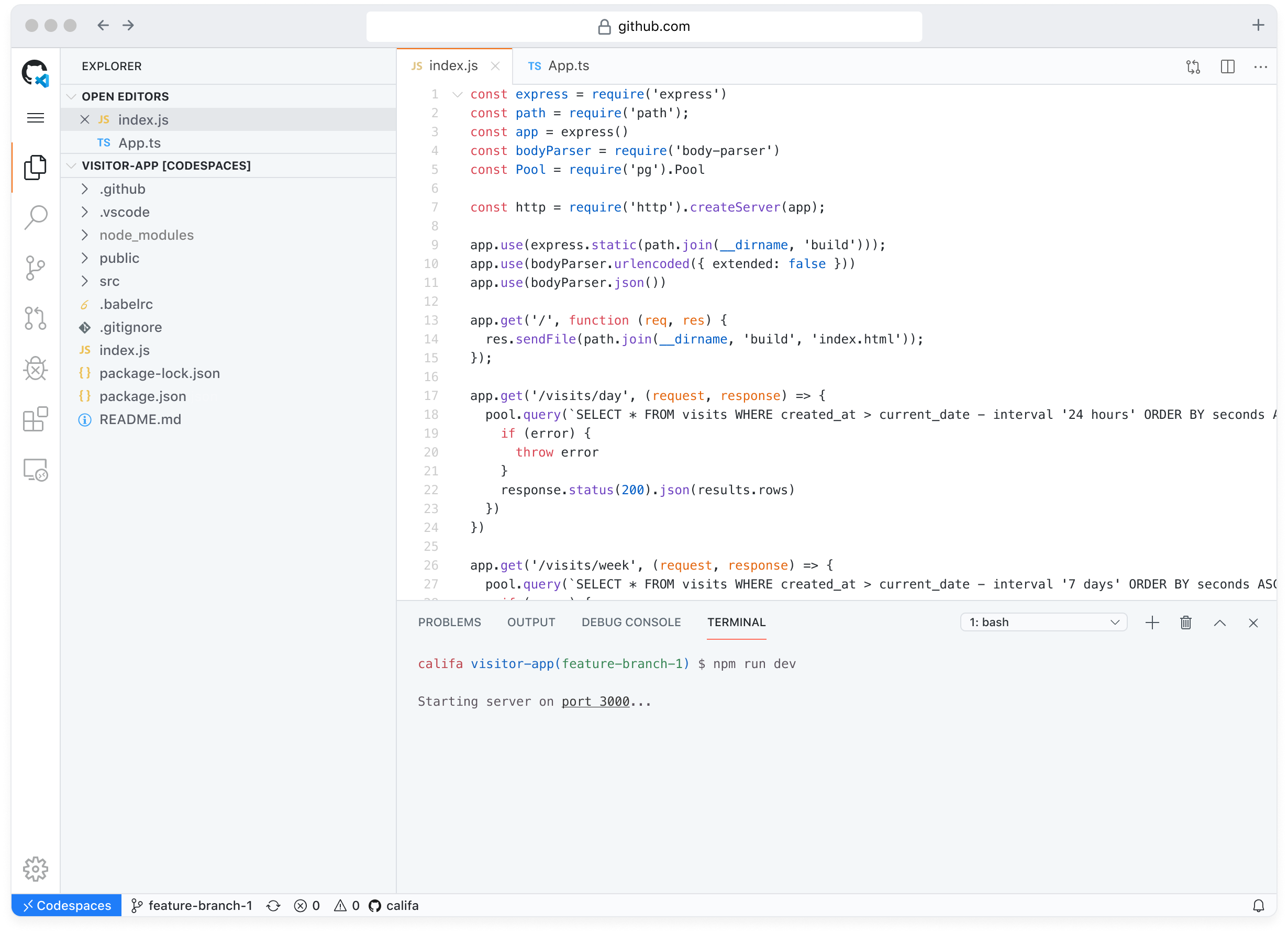
    GitHub today at its GitHub Satellite virtual conference announced it has made it easier for developers to either launch a project or join an existing project on its repository and has added collaboration tools directly within the platform.

    GitHub is also moving to advance DevSecOps by adding code scanning tools and making secret scanning tools available for private repositories, in addition to making available GitHub Private Instances to provide organizations in highly regulated industries access to a more secure managed implementation of the GitHub repository.

    Max Schoening, VP of Product Design, said GitHub Codespaces removes a lot of friction associated with starting or joining a project by enabling developers to spin up a project in seconds. In many cases, he said, developers never launch a project simply because the effort required was too great relative to the value of the effort.

    Available in limited public beta, GitHub Codespaces should not only improve developer productivity but also significantly increase the number of projects being hosted on GitHub, said Schoening.

    GitHub Discussions, meanwhile, will provide a threaded format to organize unstructured conversations without having to leave the GitHub repository. Scheduled to be available in beta shortly, GitHub Discussions should increase developer productivity in addition to providing a place for developers to maintain a frequently asked questions document. Over time, Schoening said GitHub expects millions of communities to be formed around GitHub Discussions.

    GitHub is also moving to make DevSecOps a natural extension of any application development project. GitHub Advanced Security Cloud provides access to native code scanning and secret scanning tools that can be embedded within the developer workflow. Currently in beta, GitHub Advanced Security Cloud is based on security tools it gained via its acquisition of Semmle last year. Every Git push can now be scanned using a CodeQL semantic analysis engine to discover vulnerabilities. GitHub Advanced Security Cloud is designed to be an extension of an existing GitHub Advanced Security service.

    Finally, GitHub Private Instances will provide a fully managed alternative that, among other things, allows for bring-your-own-key encryption, backup, archiving and compliance with various regional data sovereignty requirements. GitHub did not reveal, however, when GitHub Private Instances will be available.

    As GitHub continues to evolve as an arm of Microsoft, there is no doubt more IT teams will be embracing DevOps. The biggest challenge is often making it easy to get started. In fact, many developers may find themselves unconsciously embracing best DevOps and DevSecOps processes as they, for example, employ scanning tools baked into the GitHub repository.

    Of course, no one knows for sure whether organizations will continue the pace of application development projects in the wake of the economic downturn brought on by the COVID-19 pandemic. However, Schoening noted the amount of time between pull requests has declined on the GitHub repository, which he suggests is an indication of increased activity and productivity now that more developers are working away from the office.

  • IBM Looks to Drive Edge Computing

    IBM Looks to Drive Edge Computing

    IBM today at its Think Digital conference launched an edge computing initiative anchored around an IBM Edge Application Manager, through which a single administrator can manage up to 10,000 nodes.

    Hillery Hunter, vice president and CTO for IBM Cloud, said IBM Edge Application Manager is based on the Open Horizon open source software originally developed by IBM that is now under the auspices of LF Edge, an arm of The Linux Foundation focused on networking and edge computing platforms. Open Horizon makes uses of machine learning algorithms to automate the management of fleets of edge computing platforms.

    IBM also launched IBM Telco Network Cloud Manager to orchestrate both virtual and container network functions. IBM Telco Network Cloud Manager is built on top of an instance of Red Hat OpenShift, which is based on Kubernetes, and Red Hat OpenStack Platform.

    Finally, IBM is making available a range of edge-enabled applications, including IBM Visual Insights, IBM Production Optimization, IBM Connected Manufacturing, IBM Asset Optimization, IBM Maximo Worker Insights and IBM Visual Inspector.

    Like most IT vendors IBM sees the rise of application workloads on the edge as an opportunity to drive adoption of hybrid cloud computing. In the case of IBM, all of these offerings run on the Red Hat OpenShift platform.

    IBM also announced the IBM Edge Ecosystem, which brings together independent software vendors (ISVs) and IBM partners to craft edge computing solutions. Additionally, IBM launched the IBM Telco Network Cloud Ecosystem, which is more narrowly focused on edge computing platforms deployed for telco-focused environments such as a wireless 5G network.

    IT vendors participating in those initiatives with IBM include Cisco Systems, Dell Technologies, Juniper, Intel, NVIDIA, Samsung, Packet & Equinix, Hazelcast, Sysdig, Turbonomics, Portworx, Humio, Indra Minsait, EuroTech, Arrow, ADLINK, Acromove, Geniatech, SmartCone, CloudHedge, Altiostar, Metaswitch, F5 Networks and ADVA.

    Edge computing will undoubtedly force organizations to embrace DevOps more aggressively. Managing thousands of edge computing platforms will require not just higher levels of IT automation infused with machine learning algorithms, but IT teams will also need to be able to deploy, secure, update and manage applications distributed across thousands of endpoints.

    IBM, of course, is not the only IT vendor eyeing the edge computing opportunity. The challenge IT organizations will face first is building new classes of latency-sensitive applications running in near real-time that will be built mainly using microservices. Once those applications are built, organizations will then need to update them continuously within the context of a highly scalable IT management framework.

    Naturally, some organizations will prefer to rely on external IT service providers to rise to that challenge while others will continue to build and manage their own applications and infrastructure. Regardless of the approach, the level of scale and complexity at which IT is being applied is about to reach a level that once would have been unimaginable. Not only will more applications run in near real-time, those applications will be integrated and share data with batch-oriented applications running in the cloud and local data centers. The challenge is finding a way to automate the management of IT at scale without requiring organizations to rely on manual processes, for which there are simply not enough IT professionals available to manage.

  • New Relic Moves to Democratize Distributed Tracing

    New Relic Moves to Democratize Distributed Tracing

    New Relic has launched a service that leverages cloud resources to make analytics based on distributed tracing more accessible to DevOps teams.

    Andrew Tunall, general manager for New Relic serverless and emerging cloud services, said the New Relic Edge with Infinite Tracing service democratizes access to distributed tracing analytics by providing access via a software-as-a-service (SaaS) application that is managed entirely by New Relic. Rather than having to set up a platform to analyze distributed traces, Tunall said the New Relic Edge with Infinite Tracing service provides access to observability analytics for up to eight days.

    The service observes all application traces across distributed systems in a way that makes it easier to identify actionable issues, said Tunall. The amount of telemetry that’s emitted across a distributed system can easily involve tens of millions or even hundreds of millions of spans per minute. By keeping distributed tracing data on the public cloud, New Relic is also minimizing the amount of egress data from the cloud, which he noted serves to significantly reduce potential cloud computing costs given the fees cloud service providers charge for moving data off their platforms.

    Tunall said it’s become more feasible to employ distributed tracing rather than relying on sampling because modern applications are more highly instrumented. DevOps teams have realized access to telemetry data is at the core of any effort to enable observability within the context of best DevOps practices. The challenge has been that setting up the tools to achieve that observability goal has required the expertise of the equivalent of a site reliability engineer.

    The New Relic Edge with Infinite Tracing service, in contrast, provides easier access to observability tools based on distributed tracing to any member of the DevOps team, he said. That approach means for the first time in many cases, developers and members of the IT operations team will have access to a common set of tools for at least discovering the root cause of an application issue. In fact, the existence of such tools might go a long way toward fostering increased adoption of best DevOps practices.

    It’s not quite clear to what degree the rise of distributed tracing will impact the use of sampling to monitor IT platforms. In most cases, sampling is relied on to identify a potential issue, while distributed tracing provides the means to drill down to the point where the root cause of any issue is readily identifiable. However, as open source agents for capturing application metrics become more widely available and the cost of distributed tracing continues to decline, reliance on traditional sampling techniques might decline. At this stage, however, many organizations have not fully appreciated the difference between being able to completely observe an application and simply monitoring it, so it may be a while before distributed tracing is applied pervasively.

    In the meantime, at a time when applications are becoming more complex, the tools needed to manage them are, fortunately, becoming more accessible.

  • Dell Advances Convergence of Compute and Storage

    Dell Advances Convergence of Compute and Storage

    Dell Technologies today launched a revamped midrange storage platform that takes advantage of NVMe interfaces and solid-state drives (SSDs) to deliver 7x the performance of previous Dell EMC PowerStore platforms, in addition to allowing applications to run locally on an instance of a VMware virtual machine.

    Ben Jastrab, senior manager for storage product marketing at Dell Technologies, said the inclusion of a virtual machine in form of an AppsON capability means that rather than having to deploy applications on a server, for example, a data analytics application could be deployed directly on top of the data it needs to access on a storage system. In addition, the latest version of Dell EMC PowerStore adds support for instances of Kubernetes from VMware running on top of a virtual machine. Dell storage systems already provide support for the Container Storage Interface (CSI) needed to provide Kubernetes clusters access to external storage systems.

    Dell has also added support for Ansible and VMware vRealize Orchestrator frameworks to automate the deployment and ongoing maintenance of Dell EMC PowerStore systems. As part of that effort to automate the management of storage systems, Dell added built-in machine learning algorithms to automate labor-intensive tasks such as initial volume placement, migrations, load balancing and issue resolution. Dell EMC CloudIQ storage monitoring and analytics software makes it possible to combine machine learning and human intelligence for real-time and historical performance and capacity analysis.

    Jastrab noted that many of these innovations are made possible because the storage operating system employed within Dell EMC PowerStore has been completely revamped using microservices based on containers. That approach not only makes the operating system more flexible and resilient, but it also will afford Dell the opportunity to experiment with how it might present storage services in the future, he said.

    Automation coupled with technologies such as deduplication and compression will play a critical role in driving the total cost of storage lower in the months ahead, Jastrab said. In the wake of the economic downturn brought on by the COVID-19 pandemic, IT organizations will be under increased pressure to reduce costs at a time when both the amount and types of data that need to be analyzed and stored continue to increase, he noted, adding the Dell PowerStore system can provide access to 2.8PB of data when configured in a scale-up architecture and more than 11PB when configured using a scale-out architecture.

    IT teams will need to determine to what degree they want to rely on proprietary frameworks such as VMware vRealize to automate IT infrastructure versus an open source Ansible framework that can be applied more broadly to multiple platforms. Dell owns VMware, but Jastrab said the company is committed to providing support for multiple IT automation frameworks.

    It’s not clear to what degree applications will shift from being deployed on traditional servers to a storage system. Many next-generation applications are clearly more latency-sensitive than their predecessors, so providing more direct access to data over an NVMe interface may present IT teams with a compelling alternative. Regardless of the approach taken, the line between compute and storage continues to blur.

  • HPE Extends Reach of GreenLake Central

    HPE Extends Reach of GreenLake Central

    Hewlett-Packard Enterprise (HPE) has made available HPE GreenLake Central, a self-service portal through which IT teams can collaboratively manage and monitor instances of servers deployed in IT environments that are managed by HPE on their behalf.

    At its core, HPE GreenLake is a managed service that allows IT organizations to pay for IT infrastructure on a consumption basis. HPE meters usage and HPE ProLiant servers and bills customers accordingly. HPE GreenLake Central provides a portal through which IT teams can track usage themselves and provision applications both from HPE and third-party software vendors.

    Data management and file management software from Cohesity and Qumulo can be provisioned via the self-service portal. In addition, HPE GreenLake systems can now be co-located in data centers managed by CyrusOne.

    Keith White, vice president for HPE GreenLake, said HPE also provides via HPE GreenLake Central integration with Microsoft Azure Access Manager and Amazon Web Services (AWS) Access Manager services to make it easier for IT organizations to compare the cost of deploying workloads on-premises versus in the cloud, in addition to identifying potential compliance issues. IT teams still will need to access a separate portal provided by either AWS or Microsoft to spin up a virtual machine in the cloud.

    HPE claims to now have more than 800 enterprise customers consuming HPE GreenLake services. With many organizations opting to focus their efforts on building and deploying software, HPE is now making the case for a service through which it manages ProLiant servers and associated HPE storage on their behalf. In the wake of the economic downturn brought on by the COVID-19 pandemic, White said HPE expects to see increased demand for consumption-based pricing for IT infrastructure.

    Of course, IT teams have been consuming cloud infrastructure using various consumption-based pricing models for years. However, there are many workloads that for a wide variety of compliance, security and performance issues that still do not lend themselves to being deployed on a public cloud. HPE GreenLake provides the flexibility of a cloud service while still employing IT infrastructure deployed in a local data center.

    It’s unclear in the wake of the downturn how many additional application workloads might be moving into the cloud. The general expectation is that because many local data centers have been inaccessible during the pandemic, more organizations naturally will shift workloads to the cloud. However, a managed service from HPE also serves to eliminate the need to manage servers in an on-premises IT environment that are managed remotely by HPE. IT teams can remotely log into the HPE GreenLake portal from wherever they are located.

    Undoubtedly, the relationship between IT teams and vendors such as HPE is evolving. Many rote infrastructure tasks increasingly are becoming automated not just by the IT team, but also by the vendor that built the server or storage system. Of course, the automation being provided by the IT vendor only applies to their latest generation of infrastructure.

  • IBM Launches Ambitious AIOps Initiative

    IBM Launches Ambitious AIOps Initiative

    IBM today announced it will apply a range of artificial intelligence (AI) technologies to automate the management of IT operations and modernize applications, also known as AIOps.

    Announced at IBM’s Think Digital conference, Watson AIOps leverages algorithms to continuously optimize IT operations while Accelerator for Application Modernization with AI is a suite of tools that leverage continuous learning and interpretable AI models to help organizations stay current as modern of technology and platforms evolve.

    Made available as part of a Cloud Modernization Service engagement, the Application Modernization with AI tools span a range of tasks from applying AI to more accurately identifying software components that should be deployed as containers or converted into microservices to applying symbolic reasoning to dynamically define modernization steps that are surfaced via a natural language processing (NLP) engine.

    Watson AIOps, meanwhile, applies machine and deep learning algorithms to time series data, semi-structured logs, structured data and unstructured data spanning both IT incidents and human conversations to track the timeline of an issue. It then uses that data to correlate root causes, create an explainable diagnosis and generate a recommendation for the best course of action. Built on top of an instance of the OpenShift platform that IBM gained via its acquisition of Red Hat, the Watson AIOps also leverages semantic search techniques that can relate the current incident to past incidents to provide additional context.

    Rob Thomas, senior vice president for IBM Cloud and Data Platform, said Watson AIOps will be made accessible via Slack and comes integrated with Box cloud services. It also is integrated with IT monitoring solutions from vendors including Mattermost and ServiceNow. IBM is applying multiple AI technologies developed by IBM Research for various Watson services provided by IBM, including a Watson OpenScale initiative to make AI explainable to create Watson AIOps, he said.

    That explainability capability is especially critical when it comes to automating IT operations. In general, the main source of resistance to AIOps is a lack of transparency into how algorithms are determining how any given task should be automated. IT teams are concerned not only with whether they can roll back automation for a specific task but also about becoming locked into a specific AIOps platform.

    It is too early to say to what degree IT organizations will embrace AIOps. There is no doubt that in the wake of the COVID-19 pandemic there will be more pressure than ever to automate, especially among organizations that have had to downsize their IT staffs. However, IT automation manifests itself in many forms, not all of which employ machine and deep learning algorithms. At the same time, AI is being infused into every existing IT management tool, so it’s not clear to what degree a dedicated AIOps platform will be required.

    No one expects AI to eliminate the need for IT staff anytime soon. Algorithms, at best, can only augment IT professionals. The challenge now is defining precisely where that human-to-machine interface should optimally be applied.

  • Moogsoft Expands Reach of AIOps Platform

    Moogsoft Expands Reach of AIOps Platform

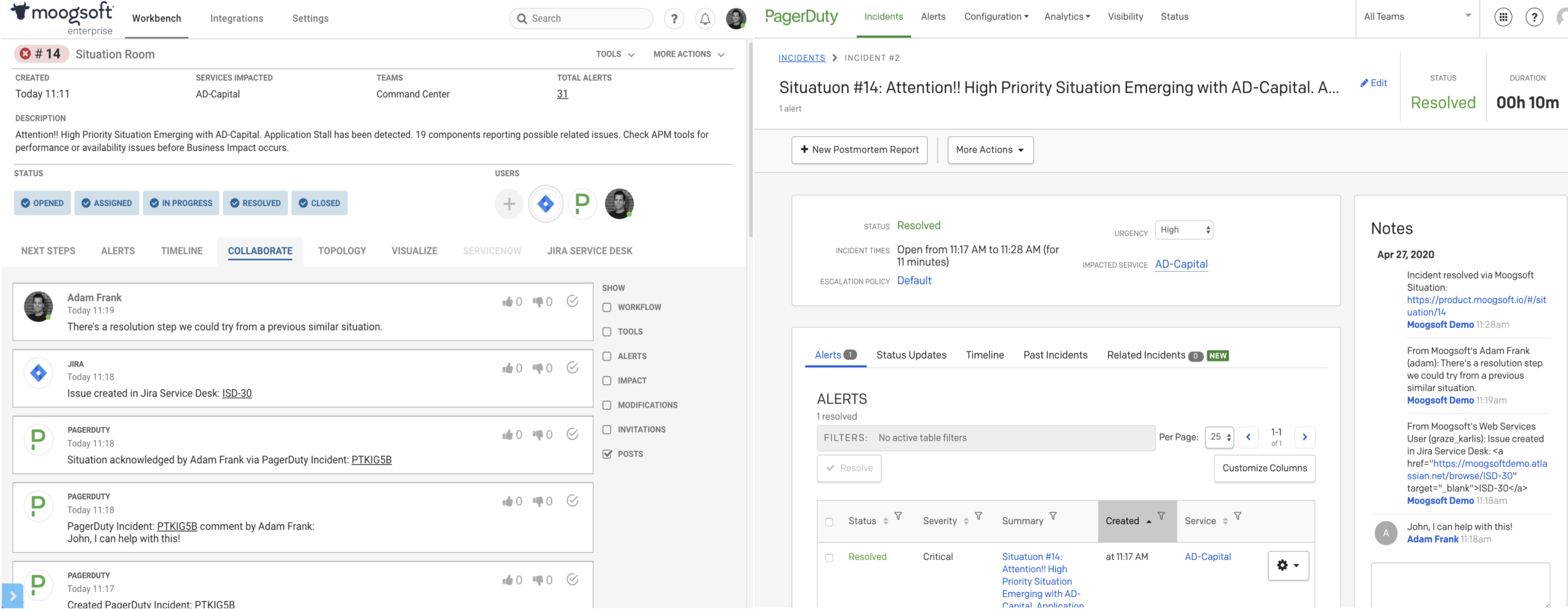
    Moogsoft this week updated its AIOps platform to enable IT organizations to construct a virtual network operations center (NOC) that pulls in data from incident management and DevOps platforms for remote IT management.

    Adam Frank, vice president of product and design at Moogsoft, said version 8.0 of Moogsoft Enterprise enables IT teams to aggregate alerts from multiple platforms in a way that enables machine learning algorithms to identify high-priority issues that require immediate attention.

    Moogsoft accomplishes that goal using noise reduction analytics to better prioritize alerts, which are then surfaced via an automated topology visualization tool that makes it easier to identify the root cause of any issue, he said.

    Version 8.0 of Moogsoft Enterprise adds integration with the Amazon Web Services (AWS) Firelens services to ingest EC2 log files, the PagerDuty incident management platform and the Opsgenie incident management platform from Atlassian.

    Moogsoft has also revamped its user interface and enhanced its Workflow Engine (WE) to ease the process of aggregating data from a variety of IT management platforms.

    Even before the start of the COVID-19 pandemic, IT organizations had been moving to embrace machine learning algorithms and other forms of AIOps to help manage increasingly complex IT environments. In the wake of the pandemic, Frank said it’s clear IT teams will be relying more on AIOps platforms. Many organizations simply will not be able to afford to maintain the current size of their IT teams, noted Frank. At the same time, resistance to adopting AI to manage IT is likely to decline because IT staff simply will not have the time to manually perform as many rote tasks as they do today.

    In the meantime, the debate over AIOps continues to heat up. Incumbent providers of IT management platforms contend they already have collected the relevant data, so it makes sense to apply algorithms to data where it already resides. Providers of AIOps platforms such as Moogsoft contend that for AI to be effective at scale machine learning algorithms need to be applied to data that currently resides in multiple IT platforms. As such it makes more sense to apply machine learning algorithms to data that has been aggregated in a single repository.

    Of course, machine learning algorithms will soon be pervasively applied throughout the IT landscape. The decision IT teams will need to make is which platform will ultimately serve as its primary control point for managing enterprise IT.

    While some IT organizations may be tempted to postpone that decision in the wake of the COVID-19 pandemic, Frank notes the pandemic has also highlighted the need to modernize IT management platforms that increasingly need to be accessed remotely. Legacy IT management platforms generally assumed the IT staff would be working on-premises. Moogsoft is designed to enable organizations to employ a virtual NOC that can be accessed more easily from anywhere.

    It remains to be seen just how the management of IT will evolve in the weeks and months ahead. The one thing that is certain is the way IT is managed is never going to be the same again.