Author: Mike Vizard

  • OpenStack Delivers Ussuri Update

    OpenStack Delivers Ussuri Update

    The OpenStack community today officially released Ussuri, an update to the cloud management framework that tightens integration between components including the ability to automatically provision bare-metal servers using the Ironic IT automation framework built for that purpose.

    In addition, the community has added IPv6 support to the Kuryr project for integrating OpenStack with container networking and support for the CRI-O image specification for Kubernetes clusters within the Zun container runtime project. As a result, IT teams can now employ Zun-created pods on Kubernetes clusters that can run Kata containers being developed under the auspices of the OpenStack Foundation.

    Jonathan Bryce, executive director of the OSF, said support for OpenStack remains strong with more than 1,000 developers from 188 different organizations making contributions to Ussuri. More than 24,000 code changes have been made to OpenStack in this release. According to 451 Research, the OpenStack ecosystem is on track to be valued at $7.7 billion by 2023.

    Most OpenStack deployments have been on top of virtual machines. However, as interest in bare-metal servers to run platforms such as Kubernetes has increased, so too has interest in employing OpenStack to automate the provisioning on that infrastructure.

    At the same time, the relationship between Kubernetes and OpenStack remains complex. Many organizations prefer to deploy Kubernetes on top of virtual machines to ensure isolation. Others view Kubernetes running on bare-metal servers as a way to eliminate the need for virtual machines altogether. It’s too early to say how that debate will play out but for now most instances of Kubernetes are deployed on virtual machines. The issue is whether to deploy Kubernetes on one of several open source virtual machines or employ commercial virtual machines from VMware that have been widely adopted in enterprise IT environments.

    The OSF is also trying to drive the development of Kata containers, which will enable IT teams to employ a container runtime on top of a lightweight virtual machine to achieve isolation between workloads. Bryce said IT teams should expect to see a significant upgrade to the Kata project that will, among other things, make the runtime easier to deploy.

    Investments in OpenStack over the last decade have been substantial, so it’s unlikely many organizations that have adopted it are going to abandon it anytime soon. However, in greenfield environments many organizations are considering rolling out next-generation cloud-native applications based solely on Kubernetes. The OpenStack community has already signaled its intent to foster as much interoperability as possible with Kubernetes, which is developed under the auspices of the Cloud Native Computing Foundation (CNCF).

    In the grand scheme of OpenStack history, it’s not likely Ussuri will be remembered as a major update. However, it does serve as a reminder of how active the OpenStack community remains, especially as telecommunications providers continue to rely on the cloud framework to automate the provisioning of both 4G and 5G networking services.

    In the meantime, enterprise IT teams that have embraced OpenStack as well should expect to be employing it to provision infrastructure to run both monolithic and microservices-based applications for years to come.

  • Divide Narrows Between Open Source Community, Standards Bodies

    Divide Narrows Between Open Source Community, Standards Bodies

    The path through which open source projects become industry standard is about to become a lot smoother. The Joint Development Foundation (JDF), an arm of The Linux Foundation, this week announced it has been approved to become an official submitter to the International Standards Organization (ISO) and the International Electrotechnical Commission (IEC).

    ISO and IEC previously came together to create a unified process for submitting proposals to establish technology standards. The JDF was created to provide a consistent corporate and legal framework for launching open source projects being advanced under the auspices of The Linux Foundation.

    Mike Dolan, vice president of strategic programs at the Linux Foundation, said now that the JDF has been recognized as an official submitter by ISO and IEC, it can represent open source projects that also want to establish a formal international standard. The first open source project to be submitted by the JDF is OpenChain, which provides a specification for achieving compliance using open source software within the context of a software supply chain.

    Historically, there’s been a significant amount of tension between open source projects and standards bodies. Standards have often been defined by vendors as part of an effort to promote the adoption of a technology by promising customers a level of interoperability to avoid vendor lock-in. However, many of those standards have been so loosely defined that it wasn’t really feasible for customers to switch vendors without incurring significant cost.

    The open source community has pursued a different approach to standards. Whichever project gains the most support from developers becomes a de facto standard. That approach has benefited organizations because adherence to a defined set of application programming interfaces (APIs) makes it comparatively simple to replace one distribution of a project such as Linux or Kubernetes with another. With endorsement by organizations such as ISO and IEC, many more of those de facto standards may become actual standards. That’s significant because there are still many organizations such as government agencies that are required to acquire technologies that comply with an official standard.

    To create an official international standard the JDF committed to a process for developing specifications that are neutral to all contributors. The specification must be developed with sufficient industry participation to ensure the resulting work is representative of industrywide consensus, and the specification must be formed in accordance with standard Publicly Available Specification (PAS) editing standards so that each specification is easily understood.

    It’s too early to say how this commitment on the part of the JDF will be received among the open source community. Many of them have long given up considering some standards bodies to be relevant. However, as the divide between the open source community and standards bodies continues to narrow, the impact an open source project might have on the state of IT could become a lot more profound.

  • Atlassian Acquires Halp to Gain Help Desk Based on Slack

    Atlassian Acquires Halp to Gain Help Desk Based on Slack

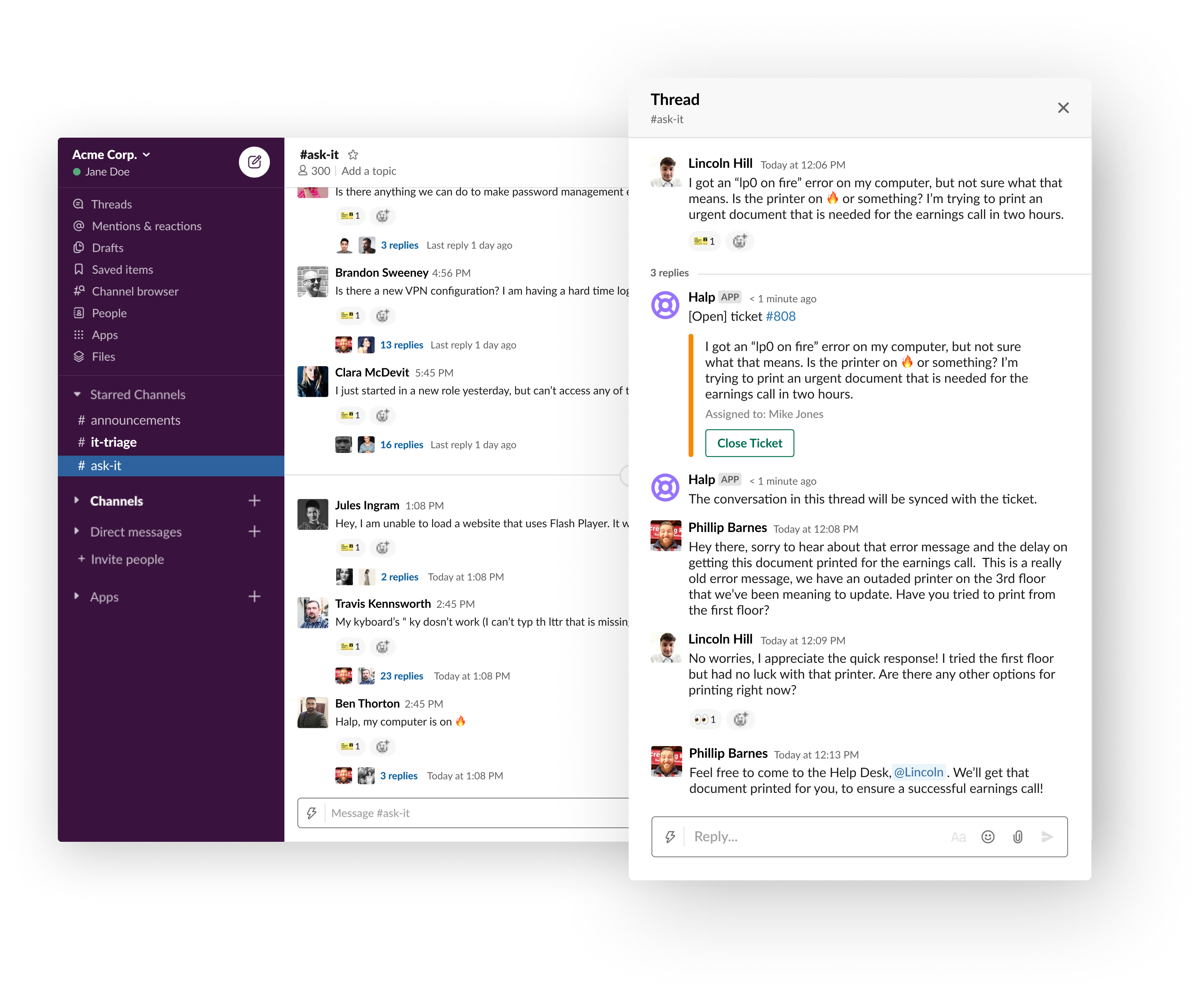
    Atlassian this week announced it has acquired Halp, a provider of a help desk platform that employs Slack as its user interface.

    Steve Goldsmith, head of product integrations at Atlassian, said Halp will provide organizations with a way to manage lightweight processes via an interface that is already commonly used within many organizations. The goal is to provide a level of integration between Halp and the JIRA Service Desk platform from Atlassian to handle more complex requests, he said.

    The Halp platform has already been integrated with Confluence, a knowledge base platform from Atlassian that enables help desk staff to share best practices for resolving known issues. Deeper integrations with JIRA and Confluence will be forthcoming, added Goldsmith.

    At the same time, Atlassian is working on tighter integration between its service desk platform and Microsoft Teams, which has emerged as a popular alternative to Slack, he noted.

    Halp CEO Fletcher Richman said that approach has gained traction because the biggest challenge when it comes to help desks is making it as easy as possible for an employee to generate a help ticket. Halp addresses that issue by enabling end users to simply drag and drop on an emoji to generate a help desk ticket.

    The help desk staff is then provided a web interface through which they can remotely manage tickets and respond to requests via Slack. That approach eliminates the need for the help desk staff to be physically located in an office or employ a virtual private network (VPN) to access a help desk platform running on a local area network, he said.

    Richman noted too often employees wind up supporting each other because the process of generating a ticket is too complex. At a time when many employees are working from home to help combat the COVID-19 pandemic, it’s not really possible for employees to currently provide that mutual support.

    It’s not really clear to how many employees might ever be heading back into an office at this point, so Halp also provides a way for remote employees to more easily remain productive, he added.

    Slack and JIRA, of course, are already de facto standards among many DevOps teams. Halp should provide developers with a means to instantly resolve a wide range of low-level issues in near real-time by generating a help desk ticket via Slack.

    Richman noted that for any IT service management (ITSM) platform to be successful, it needs to meet users where they are. If the platform is too complex or intimidating, users will look to their fellow employees for help first. Before long, however, all the mutual support saps productivity. By making help just a simple Slack message away, many more issues will be resolved by help desk personnel who already know the right answer, he said.

    It’s too early to say how many more help desk tickets might be generated because of Slack. However, in the wake of the rush to remotely enable the entire enterprise, the need for an easier way to provide support is now more apparent than ever.

  • LaunchNotes Adds Communications Tool for App Release

    LaunchNotes Adds Communications Tool for App Release

    LaunchNotes today launched a namesake software-as-a-service (SaaS) platform for managing the communications surrounding the release of an application.

    Company co-founder Jake Brereton said LaunchNotes streamlines internal and external communications for DevOps teams, eliminating the need to employ a collaboration tool such as Slack or a project management application.

    Each message can be designated as either a private communication for the internal DevOps team or shared publicly with business shareholders. Instead of having to subscribe to yet another Slack channel, business stakeholders now have a dedicated and easier means to track the progress of application releases, said Brereton.

    Communications surrounding application releases have always been problematic. Most applications are developed using multiple platforms, so standardizing the communications tools provided by those platforms isn’t usually practical. LaunchNotes is designed to provide an easy way to manage communications regardless of the platform employed to build and deploy an application, Brereton said.

    DevOps teams can also post things such as articles that might, for example, explain the history of any given application development project, he added.

    Interest in application release timetables has never been higher. In the age of digital business, more organizations than ever have come to equate with revenue the rate at which applications are deployed and updated. However, it’s not always been easy for business leaders to decipher the release notes that DevOps team members routinely share with one another. LaunchNotes is meant to provide a means for DevOps teams to communicate privately with one another while creating a separate channel within the same platform to share frequent updates in plain language in real-time with other members of the organization.

    The issue with Slack and other communications platforms is they have become too noisy, noted Brereton. In the stream of updates being provided about things going on inside the organization and beyond, it can be easy to miss a critical update about an application release.

    LaunchNotes has been available through a private beta involving 60 organizations. The company views its platform as a complement to project management applications rather than a replacement. The sole focus is on streamlining DevOps communications, said Brereton.

    To one degree or another most DevOps teams suffer from a failure to communicate. Most of the time that failure is not because a message wasn’t shared; rather, the medium employed to deliver that message made it easy to miss or be misconstrued. If the medium is the proverbial message, then DevOps teams might be better off employing a medium designed specifically for optimizing application release cycles.

    Of course, many organizations will continue to employ the communications tools that are most readily available. However, those general-purpose communications platforms also make it easy for users to be distracted by everything from messages from human resources about the latest form to be filled out to who won the football pool this week.

  • F5 Networks Surfaces Application Insights

    F5 Networks Surfaces Application Insights

    F5 Networks, at its Agility 2020 online event today, unfurled Beacon, a software-as-a-service (SaaS) platform that enables IT teams to better monitor and troubleshoot applications using telemetry data collected from networking equipment from both F5 and third-party sources.

    In addition, the company announced an update to NGINX Controller that enhances application analytics along with improvements to the declarative application programming interfaces (APIs) that NGINX Controller provides.

    Finally, F5 Networks unveiled an update to BIG-IQ, a set of tools for managing application services delivered via its network operating system. Version 7.1 of BIG-IQ adds visibility into legacy application services, streamlines management workflows and adds security management functionality.

    Hitesh Patel, senior director of product management for automation, orchestration and ecosystems at F5 Networks, said all three offerings are part of an ongoing effort to make it easier for IT organizations to meld network operations (NetOps) and best DevOps practices. Beacon, for example, ingests telemetry data streams from multiple sources to provide visibility and surface actionable insights via an application-centric view of the IT environment, he said, adding that approach makes it easier for NetOps and DevOps teams to collaborate.

    A companion Beacon Insights tool can be employed to detect anomalies and run analytics to determine the root cause of an issue, he said.

    Patel noted as IT environments become more complex, the need to eliminate silos that make managing IT holistically has become more pressing. For example, modern applications based on microservices are especially difficult to manage across an increasingly distributed computing environment.

    Less clear currently is how much or even whether DevOps and NetOps teams will merge. Network resources increasingly are being exposed via APIs that developers can programmatically invoke to provision resources. However, many IT teams are trying to control how much network bandwidth is allocated to any given application. As a result, many NetOps teams are setting up portals through which DevOps teams are given access to a maximum amount of bandwidth for specific sets of applications.

    On the plus side, Patel noted that as applications become more instrumented, thanks in part to the rise of DevOps, it’s becoming easier to apply analytics. That capability makes it easier for developers and NetOps teams to troubleshoot issues using a common set of metrics and dashboards that can feed data back to a continuous integration/continuous delivery (CI/CD) platform, he said.

    It may be a while before each IT organization finds the optimal level of convergence between their respective DevOps and NetOps teams. However, as applications become more distributed in the age of the cloud, networking will have a greater impact on application performance. The trouble is, most DevOps teams aren’t sure whether application performance issues are the result of the code written by developers or the latency being introduced by the network. Whatever the root cause, many IT teams are spending an inordinate amount of time trying to determine the root cause of application performance issues.

  • OpsRamp Offers Users Free IT Management Services

    OpsRamp Offers Users Free IT Management Services

    OpsRamp announced today that IT organizations that subscribe to its discovery and monitoring tools will now also receive free access to the company’s AIOps and remote access management service tiers for one year.

    Ciaran Byrne, vice president of product for OpsRamp, said the decision to provide free access to additional tiers of service is a direct response to the economic downturn brought on by the COVID-19 pandemic. IT teams are under pressure to reduce the total cost of ownership of IT at a time when they need remote access management capabilities more than ever, he said.

    With so many IT teams now working from home—what may become the new normal—OpsRamp is looking to make it less expensive to transition to a cloud-based platform for managing IT operations, he added.

    One of the byproducts of the pandemic, Byrne said, will be to accelerate the rate at which IT teams are automating processes. Many IT leaders are unsure how many members of the IT team they may be able to retain during a downturn. As such, many of them have already begun to aggressively automate many more processes as part of an effort to enable a potentially smaller IT team to remain effective, he said.

    OpsRampThe challenge, of course, is that the IT environment itself is increasingly complex to manage. In fact, as IT teams look to deploy cloud-native platforms to make applications more flexible and resilient, the IT environment is likely to become even more complex. In fact, according to a recent OpsRamp survey, as of the start of the economic downturn, 69% of respondents expect their organization to invest more in AIOps.

    It’s unclear to what degree the OpsRamp decision to make additional services available for free represents the start of a battle among SaaS IT management platform providers to gain market share. IT teams can expect that, given the current economic climate, these providers will be a lot more willing to negotiate terms and conditions.

    Of course, the biggest inhibitor to adopting a SaaS-based platform to manage IT has been inertia within the IT organization. The rate at which organizations now determine whether to migrate to a SaaS-based platform for managing IT will have a significant impact on the degree to which IT vendors will be willing to negotiate. Of course, incumbent providers of IT management platforms deployed in on-premises IT environments are also likely to be more aggressive in response.

    Not every IT organization will be able to make a fast transition to the cloud during the economic downturn. However, at a time when the pressure to transition to an opex versus capex financial model for IT increases, one of the easiest places to start making that transition is with the software employed to manage IT systems regardless of where they happen to be located.

  • Eclipse Foundation Moving to Brussels

    Eclipse Foundation Moving to Brussels

    The Eclipse Foundation announced today it will begin to transition its headquarters from Ottawa to Brussels as part of an effort to advance international expansion.

    Mike Milinkovich, executive director of the Eclipse Foundation, said with so many open source organizations based in North America, there is a clear need for an open source organization to have a larger presence in Europe. As nearly half of the strategic members that provide funding to the Eclipse Foundation are based in Europe, it made sense for the Eclipse Foundation to take on that role.

    The Eclipse Foundation is now home to 375 open source projects resulting in more than 240 million lines of code. Some of the most widely employed Eclipse Foundation projects include the Eclipse integrated development environment (IDE) and Jakarta, which is a follow-on to Java Enterprise Edition platform, previously owned by Oracle. In total, the Eclipse Foundation’s projects represent more than 13 billion Euros of investment.

    In general, Milinkovich said contributions to open source projects have accelerated in the wake of the COVID-19 pandemic. Developers who are staying home to help combat the epidemic apparently have more time to contribute to projects. The expectation is by moving to Brussels, more European developers will contribute to projects involving technologies such as internet of things (IoT) initiatives that address industrial use cases, he added.

    The Eclipse Foundation plans to establish a new legal entity sometime in July, with personnel relocating or added to a Brussels office over time depending on the nature of the Eclipse project being supported, Milinkovich said.

    It’s not clear to what impact being headquartered in Europe will have on open source projects, which are by their very nature global. However, Milinkovich noted most of the recent live events hosted by the Eclipse Foundation have been held in Europe. It may be a while before anyone is attending an IT conference in person, but Milinkovich noted European developers already play a major role in the Eclipse Foundation projects.

    Between the Eclipse Foundation, the Linux Foundation and the OpenStack Foundation, there is no shortage of opportunities for developers to contribute to open source projects. Many of those projects count on contributions from developers who work for IT vendors that have a vested interest in a specific project. In fact, many open source projects provide a way for IT vendors to defer the cost of creating a core piece of technology that doesn’t provide differentiated value. Rather than reinvent the wheel, it makes more economic sense to share open source code with potential rivals.

    Of course, it’s then up to each IT team to decide whether to employ that open source code themselves versus relying on an IT vendor to provide a curated instance of it under a support contract. Regardless, the total cost of IT would be prohibitively higher right now if it were not for the proliferation of open source software. It’s also worth noting many IT vendors that build platforms on top of open source software would be considerably less profitable.

  • NVIDIA Aims to Drive Disaggregation Following Cumulus Networks Buy

    NVIDIA Aims to Drive Disaggregation Following Cumulus Networks Buy

    Adoption of open source networking may be about to get a boost following the forthcoming acquisition of Cumulus Network by NVIDIA.

    The acquisition of the provider of a network operating system (NOS) based on Linux follows an earlier move by NVIDIA to acquire Mellanox, a provider of networking and storage systems.

    Kevin Deierling, senior vice president of marketing for the NVIDIA networking business unit, said Cumulus Networks adds a programmable NOS to the provider of graphical processor units (GPUs) that should find greater adoption as more organizations disaggregate the acquisition of network software and hardware. That trend toward disaggregation is especially strong in data centers and cloud computing environments that are building artificial intelligence (AI) applications based on NVIDIA GPUs, he said.

    As the worlds of DevOps and network operations (NetOps) continue to converge, NVIDIA is betting interest in a programmable NOS that is designed to scale will increase as well, added Deierling.

    Cumulus Networks has been trying to drive the adoption of Cumulus Linux since 2010 with mixed success. Cumulus Linux runs on more than 100 hardware platforms, including switches from Mellanox. While cloud service providers and some high-performance computing (HPC) environments have disaggregated networking software and hardware, most enterprise IT organizations continue to buy switches from Cisco Systems and Juniper Networks that come integrated with a NOS.

    Cumulus Networks CEO Josh Leslie said in time it’s apparent more enterprise IT organizations will be moving toward disaggregation of network software and hardware, especially as more application workloads move into the cloud. A NOS that is not tied to proprietary ASIC technologies embedded in a switch from Cisco or Juniper Networks makes it feasible for IT organizations to benefit from Moore’s Law as each new x86 processor generation is added, he noted.

    At the same time, he added, the tools for programming a NOS based on Linux are a lot more familiar and accessible to developers than tools designed for proprietary NOS platforms.

    It’s too early to say to what degree DevOps teams are going to need programmable access to shared networking resources. Ideally, developers will want more programmatic control over network resources as applications become more distributed than ever. That approach would enable them to also provision network resources to applications via application programming interfaces (APIs) without having to wait for network administrators to provision them manually.

    However, network bandwidth is a shared resource inside many organizations, and the concern is that one application will consume all the available network bandwidth at the expense of every other application on the network. As such, network administrators have been embracing automation and self-service portals to make network resources more readily accessible to developers without ceding total control of the network.

    Regardless of the approach, networking is becoming more agile. NetOps and DevOps teams may not necessarily converge; however, as networking becomes another class of infrastructure that can be treated as code, it’s clear the days when networking services are largely managed in isolation from the rest of the IT environment are coming to a close.

  • DevOps Deeper Dive: Teams Adjust to New WFH Normal

    DevOps Deeper Dive: Teams Adjust to New WFH Normal

    In the wake of the COVID-19 pandemic the level of software development activity has remained relatively constant, but developers—who, like everyone else—are now largely working from home, are putting in more hours. Organizations are now grappling with whether working remotely on software development projects now represents the “new normal.”

    A report published this week by GitHub shows that while there was a slight dip in activity in various regions of the world as the pandemic spread, activity on the public GitHub repository quickly recovered. Whether developers are spending more time working on projects is difficult to conclude given all the potential distractions at home, but according to the GitHub report, the amount of time spent on the platform per developer has increased. This could be due to various factors including the fact that developers are not commuting to work or are managing multiple tasks—some of which are directly related to work—across an extended working day. Others simply may be taking more breaks between activities.

    Despite working in isolation, it would appear developers are remaining productive, said Kelly Stirman, vice president of product strategy and marketing for GitHub. “More time to code increases productivity.”

    Providers of other DevOps platforms have observed similar increases in activity during the pandemic. Moritz Plassnig, senior vice president and general manager for software delivery management and software delivery automation cloud at CloudBees, said many organizations have been launching custom application development projects to drive digital business transformation initiatives. Now those projects are becoming core to the organization’s business continuity strategy.

    “The current situation has only accelerated that trend,” said Plassnig.

    The biggest challenge in managing a highly distributed workforce is ensuring the right code is being worked on at the right time, said Fred Simon, chief data scientist of JFrog. “Everyone needs feedback.”

    To provide that feedback, managers have employed collaboration tools such as Zoom and, when necessary, shifted work to DevOps platforms made available as a cloud service, added Simon.

    At the same time, the level of communications tooling baked into a DevOps platform matters more than ever, said Emrah Samdan, vice president of product at Thundra, a provider of a platform for securing and observing cloud-native microservices. Developers can collaborate with each other much more effectively using asynchronous communications tools to, for example, share code.

    “A lot of productivity is being lost setting up Zoom calls,” said Samdan.

    The issue now is whether working on software development projects remotely represents the new normal. A recent survey of chief financial officers published by PwC finds that nearly half of the respondents (49%) plan to make remote work a permanent option for roles within their organizations that allow for it.

    How employees will respond to that change will vary. According to results from a recent survey of workers conducted by GitLab, 52% of employees say they are more productive working remotely, while 48% are more efficient. Of course, those results also suggest half of employees don’t share that same level of appreciation for working from home.

    It’s worth noting that many software development teams were already heading in the direction of working remotely more often prior to the pandemic, said Brendan O’Leary, senior developer evangelist at GitLab. In fact, he noted, resources such as the GitLab Remote Playbook have been downloaded more frequently over the last few months.

    “I think it is a time that will see a real separation of bosses and leaders,” O’Leary said, noting leaders will go beyond simply tracking metrics to enable organizations to continue to launch innovative software development projects.

    Obviously, DevOps teams that were working in a distributed fashion prior to the pandemic have a distinct advantage over those that have worked primarily in the same central location. However, given all the current uncertainties organizations now face, it’s probable every member of a DevOps team going forward is going to be working from home a lot more often.

  • Citrix Makes Case for VPN Alternative

    Citrix Makes Case for VPN Alternative

    Citrix this week announced it will make its remote access tool that enables users to efficiently access their desktop PCs more widely available via the cloud.

    Gabe Carrejo, senior program manager for Citrix, said Remote PC Access provides a more efficient alternative to the virtual private networks (VPNs) that most organizations currently rely on to enable employees to remotely access their desktops.

    To use Remote PC Access, an IT administrator installs a small client on the remote systems. The client provides access to a range of networking services that Citrix makes available on top of its Independent Computing Architecture (ICA) remoting protocol to create a Secure Sockets Layer (SSL) tunnel, which Citrix markets collectively as High-Definition Experience (HDX) Technology.

    To make it easier to access a desktop PC remotely, Remote PC Access installs agent software that IT teams can now push out to an endpoint as long as they have licensed any one of several Citrix services, said Carrejo. In most cases, IT teams will employ a platform such as Microsoft System Center to deploy agent software on an endpoint.

    In the rush to provide employees with remote access almost overnight to help combat the COVID-19 pandemic, many organizations turned to VPN offerings they were using to provide a small number of employees with remote access. However, with almost every employee trying to access the same VPN, many of those IT teams have encountered network bandwidth issues. What’s more, many of the desktop applications installed in the office are not especially tolerant of the latency a VPN adds to the equation.

    Citrix has long been making the case for ICA as a more efficient protocol for providing remote access to desktops. Now, in response to the COVID-19 pandemic, the company is making it easier for IT teams to distribute HDX agent software across as many remote endpoints an IT organization needs to support. End users can then access applications on their office desktops remotely via any HTML5-compatible browser or virtual desktop software provided by Citrix.

    Carrejo said more organizations are re-evaluating their reliance on VPNs as it becomes clear that what once viewed as business disruption has become the “new normal.” Many organizations are looking closely at how many employees they need to come into an office when their job role may not require it. Remote computing is now a core element of a larger business continuity strategy. As such, Carrejo said many organizations are looking to find a way to provide more efficient remote access to office-based desktop systems while contemplating a possible transition to a virtual desktop infrastructure (VDI) platform deployed in a local data canter or in the cloud.

    It’s too early to say to what degree Windows desktops will be moving to VDI platforms. In the meantime, however, the remote access protocols that IT teams rely on suddenly matter a lot more.