Author: Mike Vizard

  • Cisco Acquires ThousandEyes to Advance Network Visibility

    Cisco Acquires ThousandEyes to Advance Network Visibility

    Cisco Systems this week announced its intent to acquire ThousandEyes, provider of an internet monitoring platform that Cisco plans to leverage to embed ThousandEyes agent software into a range of devices including network routers and switches, security tools and application performance management (APM) software from AppDynamics.

    As part of that effort, ThousandEyes will become the foundation of a newly formed Networking Services business unit in Cisco led by ThousandEyes CEO Mohit Lad. The terms of the acquisition were not disclosed.

    Todd Nightingale, senior vice president and general manager for enterprise, networking and cloud at Cisco, said the goal is to employ the data collected by ThousandEyes agent software to drive intent-based automation across the entire IT environment.

    ThousandEyes provides a networking intelligence service by deploying its software on points of presence across the internet. The data collected is then fed back to data centers operated by ThousandEyes to help organizations understand why, for example, a particular software-as-a-service (SaaS) application is performing suboptimally in one geographic region versus another.

    Nightingale said with multi-cloud computing now becoming a reality in the enterprise, the need for that level of insight into what are becoming highly distributed computing environments has dramatically increased.

    Once the deal closes, it may take Cisco a while before it can embed agent software from ThousandEyes across its portfolio. However, DevOps teams that deploy applications in IT environments with Cisco networking equipment should be able to troubleshoot applications more easily once the agent software from ThousandEyes is embedded in Cisco networking hardware and software.

    At the same time, Cisco will be feeding that data into AppDynamics, the application performance management (APM) platform it acquired in 2017. The AppDymanics platform is employed mainly by cloud operations teams to optimize the performance of applications deployed on various cloud computing platforms, noted Nightingale.

    Lad said by becoming part of Cisco, ThousandEyes will become the central nervous system through which organizations will be driving user experiences.

    Less clear at the moment is to what degree open source networking software initiatives may have on Cisco’s long-term ambitions. Open source agent software is now being widely deployed to instrument applications that in turn feed metrics back to a wide variety of platforms, including AppDynamics. It’s not only a matter of time before various open source initiatives extend agent software to the networking level.

    Regardless of that approach, DevOps teams should be able to count on attaining deeper insights into how network congestion is impacting application performance. As that analytics data becomes more accessible, it should become more feasible to dynamically reroute application traffic to maintain service levels.

    In the meantime, network operations and DevOps teams will continue to move closer together. The NetOps team may not necessarily be completed folded into DevOps. However, as networking becomes more programmable, it’s apparent DevOps teams will be exercising more programmatic control over networking services. The challenge and the opportunity now are to find a way to bring those disparate cultures together to minimize the inevitable friction that will ensue.

  • AppDynamics Survey Sees Rush to Digital Transformation

    AppDynamics Survey Sees Rush to Digital Transformation

    A survey of 1,000 IT professionals in organizations with annual revenue of at least $500 million conducted by AppDynamics, a unit of Cisco Systems, finds nearly three-quarters (74%) report digital transformation projects which typically would take more than a year to be approved are now being signed off on in a matter of weeks.

    The research also finds 95% of respondents changed their technology priorities during the pandemic, with 88% identifying digital customer experience as being a priority now.

    In addition, some 71% said some digital transformation projects have been implemented within weeks versus the months or years it would have taken to implement a similar initiative before the pandemic. At the same time, 66% of respondents noted the pandemic has exposed weaknesses in their digital strategies, creating an urgent need to accelerate initiatives.

    Not surprisingly, the survey also finds 81% of respondents said the pandemic has created the biggest technology pressure their organization has ever experienced, with 61% under more pressure at work than ever before. Almost two-thirds (64%) said they are now being asked to perform tasks and activities they have never done before.

    Despite the enormous pressure technologists are facing, 87% said this period of time is an opportunity for technology professionals to show their value to the business. In fact, 80% of survey respondents report that the response of their IT teams to the pandemic has positively changed the perception of IT within their organizations.

    The survey specifically identifies managing spikes in website traffic (81%), lack of unified visibility and insight into the performance of the technology stack and its impact on customers (80%) and managing mean time to resolution (MTTR) with a remote IT department (70%) as major challenges.

    IT teams during this time need clear goals and objectives (90%), real-time data at the point of need (89%), autonomy and accountability (88%) and the freedom to experiment and take risks (87%), the survey finds.

    Angie Mistretta, chief marketing officer at AppDynamics, said the survey mirrored an earlier AppDynamics report that tracked a rise in the use of search terms such as “digital experience monitoring” and “application performance management (APM).”

    In general, Mistretta said it’s also apparent the rate at which application workloads are moving into the cloud is accelerating as organizations look to deploy more resilient applications based on cloud-native technologies such as Kubernetes that are designed from the ground up to access remotely.

    It may take time for IT organizations to master cloud-native platforms to deploy microservices-based applications. As such, the number of monolithic applications being lifted and shifted into the cloud remains considerable. Once those applications are shifted, many IT teams will only then start to modernize those applications.

    Naturally, AppDynamics is betting many more organizations will require access to an APM platform to navigate this brave new world of legacy and emerging digital business applications in the cloud. The challenge for IT teams, however, is there have never been so many APM options available.

  • CircleCI Extends Core CI/CD Platform

    CircleCI Extends Core CI/CD Platform

    CircleCI today in partnership with Plandek launched an analytics plugin dubbed Buildtrakr for its namesake continuous integration and continuous delivery (CI/CD) platform. Buildtrakr integrates with CircleCI and Git to synthesize commit and build performance data, with critical metrics being surfaced via a dashboard.

    In addition, CircleCI has revamped its user interface and reconfigured a new fleet of Docker images, also known as CircleCI convenience images, to optimize them for a continuous integration environment.

    CircleCI CEO Jim Rose said Docker images made available by CircleCI are faster, easier to download and provide a more efficient way to build custom images. CircleCI also released a new category of convenience images available for languages such as Python, Ruby, Rust, Go and several others, that come with improved documentation, more stability and more efficient infrastructure. Those convenience images are individual open source projects and can be used in IT environments other than the CI/CD platform from CircleCI.

    Finally, the company also announced that its insights endpoints now offer start and end date parameters for workflows and jobs. These parameters restrict the range of executions returned based on their start times in addition to providing a new filter to use for testing analysis.

    Rose said the new user interface is significant because it makes it possible to view the status of entire pipelines more easily while making it easier for more advanced DevOps teams to leverage workflows.

    The redesigned interface also adds a filterable view with nested workflow and job information, making it easier to scan the status of recent builds. Pages were also overhauled to deliver more digestible job details, full-screen step outputs for easier debugging and a cleaner configuration-as-code view. There’s also been a 65% reduction in page load times, noted Rose.

    In general, Rose said activity on the CircleCI platforms in cloud environments is on the rise in the wake of the COVID-19 pandemic. Organizations that are working remotely due to stay-at-home directives and can’t access a local data center have come to realize that having a build box located under someone’s desk is no longer a viable option.

    Of course, it remains to be seen how much of that initial burst of activity will result in new applications being deployed. However, with more organizations starting to build and deploy digital business applications to engage customers, it may be only a question of when IT operations teams will be able to catch up to a building backlog of applications. In fact, many of those applications are now likely to be deployed on the same cloud where they were constructed.

    Whatever the path forward, there most certainly will be a greater reliance on metrics. Naturally, the hope is that analytics will be used to coach DevOps teams to become more efficient versus simply riding roughshod over developers. After all, the goal isn’t to write more code faster but to deliver better code at the right time.

  • Netlify Makes Build Plugins Available for Jamstack Platform

    Netlify Makes Build Plugins Available for Jamstack Platform

    Netlify, at a Jamstack Conf Virtual event, announced the general availability of open source Netlify Build Plugins that provide IT teams with a set of continuous integration/continuous delivery (CI/CD) workflows for building websites and web applications using JavaScript, application programming interfaces (APIs) and static HTML files without employing web servers, otherwise known as a Jamstack.

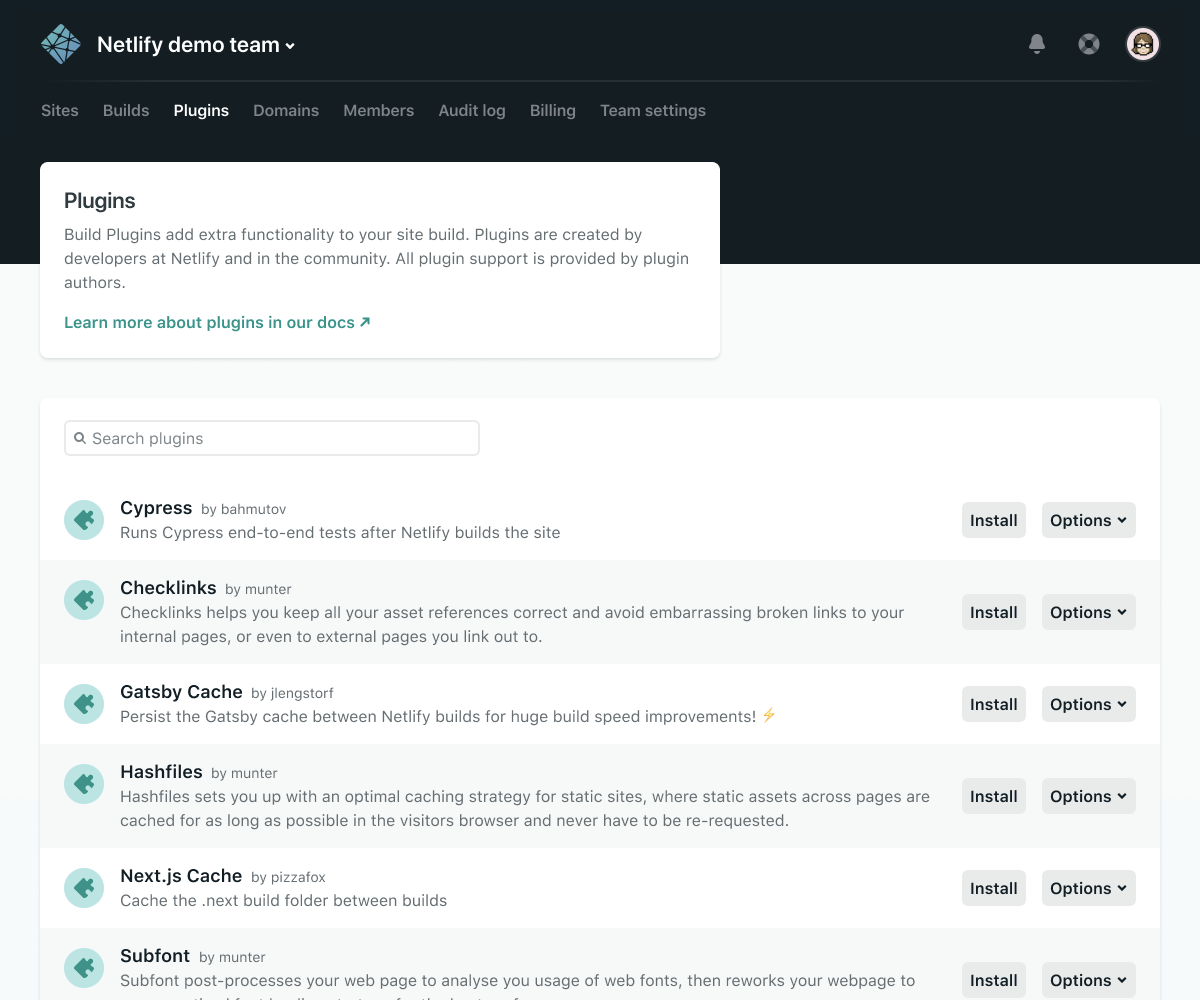
    Designed to be launched from within a Netlify platform to enable IT teams to build a website and launch it from a Git repository to a content delivery network (CDN), the Netlify Build Plugins are intended to make it easier to employ DevOps processes using, for example, a plugin to run an end-to-end Cypress test.

    Netlify CEO Mathias Biilmann said DevOps teams also can make use of a Netlify API to create their own plugins. Ultimately, the goal is to foster the development of a wide range of open source Netlify plugins that would be built and vetted by the Jamstack community, he said.

    Other Netlify Build Plugins provide a means to enable Ghost, an open source headless content management system based on Node.js that can be deployed on any framework; launch a Sentry tool to automatically discover, triage and prioritize bugs; or enable a Gatsby tool to create incremental builds on Netlify.

    A survey of more than 3,000 Jamstack developers published today by Netlify finds one-third have worked on sites serving millions of users over the last year. Nearly two-thirds of survey respondents (62%) work outside the tech industry, including advertising and marketing (21%), media and publishing (14%), education (14%), financial services (13%) and business support and logistics (13%). Well over a third (38%) work for a technology company. About a quarter (26%) have more than 10 years of experience.

    Top Jamstack benefits cited by all types of developers are performance, uptime, speed of development, security, compliance and avoiding vendor lock-in, the survey finds.

    Biilmann said Jamstack as a philosophy enables IT teams to separate the development of front- and backend websites and applications in a way that allows organizations to embrace best DevOps processes. That approach is agnostic as far as any specific JavaScript framework is concerned, but it does define a way to automate the build process for a web application or website.

    In the wake of the economic downturn brought on by the COVID-19 pandemic, more organizations are investing time and resources in modernizing their websites and applications. With more employees and end users depending on those websites to drive digital business processes, the quality of the application experience has become a much bigger concern. At the same time, end users have now come to expect those application experiences to be updated regularly, which in many cases will necessitate the adoption of best DevOps processes.

    In fact, it’s arguable that organizations that don’t embrace best DevOps practices to build and deliver web applications at scale will soon discover they have bitten off more than they can chew.

  • Micro Focus Updates LoadRunner Testing Tools

    Micro Focus Updates LoadRunner Testing Tools

    Micro Focus has revamped its venerable line of LoadRunner testing tools as part of an effort to both unify code bases and provide tighter integration with third-party application performance management (APM) tools from AppDynamics, a unit of Cisco Systems.

    Vicky Giavelli, director of product management for performance engineering at Micro Focus, said Micro Focus in now in the first stages of unifying the code base of instances of LoadRunner that run on-premises and the cloud to enable DevOps teams to more flexibly test applications regardless of where they are deployed.

    DevOps teams can already share licenses across LoadRunner products and rapidly scale up or down based on seasonal or ad hoc demands, she noted.

    As testing continues to shift left, Giavelli said, Micro Focus continues to invest in aligning the LoadRunner family of application testing tools with multiple DevOps platforms. LoadRunner tools currently support more than 50 application protocols and technologies and more than 52 scripting technologies in addition to providing integrations with open source continuous integration/continuous delivery (CI/CD) tools and data visualization platforms such as Grafana and InfluxDB.

    The alliance with AppDynamics extends that strategy by making it easier for DevOps teams that employ LoadRunner to consume and share data with users of one of the most widely employed APM platforms, she noted.

    Giavelli said Micro Focus continues to enhance the user experience of a testing platform that has been widely employed now for a quarter-century. While competition has increased considerably during that time, the LoadRunner family of tools has maintained its base among application testers, she said, while extending its appeal to developers, who increasingly are taking responsibility for testing as part of an integrated set of DevOps processes.

    Of course, it’s still not clear how far left toward developers application testing might shift. While the consensus might be that more testing on the part of developers is good, application testers may provide a more unbiased opinion about how well an application accomplishes the ultimate business goal.

    Regardless of the role of testing within the organization, the one thing that everyone agrees on is it should be easier to generate meaningful tests that reflect real-world use. No matter who does the testing, the goal is to not have to roll back an application once it is deployed in a production environment. As applications become more complex, Micro Focus continues to invest in machine learning algorithms and other forms to advanced analytics to identify potential issues sooner than later, noted Giavelli.

    It’s too early to say how the battle between application testing vendors will play out in the months ahead. The one thing that is certain is that in the wake of the COVID-19 pandemic, application testing has never been more critical. More organizations than ever are building digital business applications to make it easier to engage with their customers, at a time when many of them might not be returning to an office anytime soon. The issue, of course, is that not many of their end users will be especially tolerant of issues such as a mobile computing application that doesn’t live up to expectations the first time it’s deployed.

  • CTO.ai Launches SlackOps Tool for DevOps

    CTO.ai Launches SlackOps Tool for DevOps

    CTO.ai has launched SlackOps, a platform for managing DevOps workflows in real-time via the Slack communications and collaboration service.

    Company CEO Kyle Campbell said many DevOps teams are embracing Slack to share updates with one another. SlackOps takes that preference for DevOps a step further to enable complex DevOps processes, also known as ChatOps, to be launched from the Slack command line.

    That approach allows any member of the DevOps team to write a workflow once and securely share it regardless of what language is employed, added Campbell.

    SlackOps also provides access to a public registry that CTO.ai already makes available for sharing developer shortcuts within a specific community.

    Beyond streamlining communications processes across DevOps teams, Campbell said DevOps teams will be able to surface additional insights into workflows using DevOps research and assessment metrics to make them more efficient. SlackOps also makes it easier to onboard new members of a DevOps team, he noted.

    SlackOps is deployed as a container on the Slack platform and can be downloaded via the Slack marketplace in a couple of minutes.

    The goal is to enable organizations to embrace a lean approach to DevOps that enables them to quickly adjust processes as required, said Campbell. Rather than having to commit to a single tool or platform, developers should be able to advance the overall state of DevOps within their organizations without having to be concerned whether a new tool or platform will disrupt communications across the DevOps team.

    It’s too early to say to what degree Slack might emerge as a control plane for managing DevOps processes. It is, however, becoming more popular as a way to communicate across members who employ a broad range of tools. Rather than attempting to force DevOps teams to standardize on a single set of tools and platforms, Slack provides a more flexible means of communicating in real-time that is delivered as a cloud service.

    Of course, there are now plenty of alternatives to Slack. It will be up to each DevOps team to decide which communications medium best suits them. However, embedding a DevOps workflow application within a communications platform could serve to make Slack a more compelling option for many DevOps teams. Regardless of the communications medium, DevOps teams should expect to be more continuously engaged with one another. That may prove to be a critical requirement with most members of a DevOps team working from home for the foreseeable future in the wake of the COVID-19 pandemic.

    As workflows built around asynchronous email messages increasingly are giving way to real-time communications, the challenge many DevOps teams face is finding a way to embrace that higher level of interactivity without members of the DevOps team becoming overwhelmed by the volume of messages being shared. Making the transition to DevOps was enough of a cultural challenge for many organizations. Inundating DevOps teams with real-time messages, not all of which may be pertinent to a DevOps workflow, needs to be tempered by tools that help identify the DevOps signal within all the noise.

  • GitLab Releases Massive Update to CI/CD Platform

    GitLab Releases Massive Update to CI/CD Platform

    GitLab has updated its continuous integration/continuous delivery (CI/CD) platform with a raft of capabilities spanning everything from value stream management to cybersecurity.

    In addition, GitLab announced it is making generally available Gitaly Clusters, which enable DevOps teams to create a warm replica of a Git repository.

    Brendan O’Leary, senior developer evangelist at GitLab, said with release 13 GitLab continues to build on a single code base that allows the platform to be managed and accessed as an integrated set of applications rather than disparate components that DevOps teams need to pull together and then manage.

    In terms of core DevOps capabilities, the latest release adds the ability to customize the Value Stream Analytics module to specific workflows. GitLab is also planning to make it possible to visualize stages of a workflow.

    GitLab is also improving traceability between requirements and has added the ability to visualize the workflow associated with a specific release. A future release will enable DevOps teams to employ feature flags to conduct both A/B testing based as well as create feature flags from merge requests and to filter feature flags by status, according to the company.

    Other capabilities added include more customizable dashboards, with security dashboards now being shareable outside of GitLab to foster collaboration with IT security teams. Future releases will add Kubernetes Clusters to the dashboard to show all clusters and pods in use.

    DevOps teams now can route existing monitoring alerts to GitLab for triage and incident resolution. At the same time, GitLab has moved design management to the core platform.

    GitLab is also now making AutoDevOps, which provides pre-defined CI/CD pipelines, available on Amazon Web Services (AWS).

    In terms of cybersecurity, GitLab has revamped the way the platform manages vulnerabilities to make it easier in a future update to prioritize remediation efforts.

    GitLab also has static application security testing (SAST) support for .NET frameworks and has expanded support for offline environments. There’s also now support for dynamic application security testing (DAST) for REST application programming interfaces (APIs) and access to full commit history scan for secrets. Fuzz testing support will be introduced later this year, according to the company, along with an ability to secure secrets across services. GitLab also plans to add integration with security tools that track container behavior analytics, as well as an out-of-the-box container network policy.

    Thanks to GitLab’s collaboration with Okta, there is now also tighter integration with Okta’s System for Cross-domain Identity Management, which can be provisioned for a GitLab group.

    In terms of compliance, GitLab also plans to enable DevOps teams to establish a compliance framework, adopt its regulatory controls and simplify audit reporting. The company is also working on an initial security policy user interface to simplify setting up security guardrails.

    Finally, GitLab has become a Common Vulnerabilities and Exposures (CVE) ID Numbering Authority (CNA). GitLab users can request a CVE from GitLab, either for GitLab itself or for any project hosted on GitLab.com. In the future, users can request CVE IDs directly from within GitLab.

    O’Leary said GitLab is working toward increasing developer confidence in their security skills. By making it easier to embrace best DevOps practices, developers no longer will have to tiptoe around security issues that they today largely have little to no familiarity with, he said.

    In general, O’Leary said GitLab’s biggest challenge is getting organizations to move beyond simply using it to manage source code. Once organizations do make their first foray beyond source code management, however, it’s not too long before they are employing a wide range of modules, he noted.

    Of course, encouraging organizations to dive deeper DevOps has as much to do with the culture of the organization as it does the capabilities of the CI/CD platform employed.

  • CloudBees Extends SDM Service Reach

    CloudBees Extends SDM Service Reach

    CloudBees has extended the integrations embedded within its software delivery management (SDM) platform to add support for additional services provided by Google.

    Moritz Plassnig, senior vice president cloud and general manager for SDM at CloudBees, said these integrations with Google Cloud Build and Tekton pipelines are being provided as part of a long-standing alliance between the two companies to advance the adoption of best DevOps practices. The CloudBees SDM service runs on the Google Cloud Platform (GCP).

    As part of that effort, CloudBees has been making investments in an SDM platform that enables DevOps teams to pull metrics from any tool or platform. That data is then fed into an analytics cloud service through which CloudBees surfaces insights that identify, for example, how delays to a project might impact overall revenue goals.

    Interest in software delivery analytics has risen in the wake of the COVID-19 pandemic as organizations accelerate the building and deploying of digital business applications, said Plassnig. With employees and customers alike working from home to combat the pandemic, organizations are investing more in creating applications that provide digital alternatives to engaging end users, he noted, adding delays to any of those projects are likely to have a much bigger impact on business continuity strategies today than they did just a few short months ago.

    The CloudBees SDM service provides DevOps teams and business managers alike a real-time view of all product and feature development occurring across the organization, as well as a policy engine to trigger actions to better optimize the software delivery process. Organizations can also model and visualize the software delivery process while measuring overall DevOps performance.

    Rather than requiring organizations to standardize on a single platform to achieve that goal, Plassnig said CloudBees is leveraging application programming interfaces (APIs) to integrate metrics across a broad range of DevOps tools. That approach, he said, makes it possible to meet organizations wherever they are in terms of DevOps maturity.

    Support for Tekton pipelines is significant, Plassnig noted, because it’s expected that most continuous integration/continuous delivery (CI/CD) platforms in the future will be built using Tekton pipelines, which provide an open source framework for building platforms that are designed to be deployed on Kubernetes clusters. Jenkins X, originally developed by CloudBees, is one of the first CI/CD platforms to support Tekton pipelines, which were originally developed by Google. Jenkins X and Tekton pipelines are now being advanced under the auspices of the Continuous Delivery Foundation, an arm of the Linux Foundation.

    As more CI/CD platforms embrace Tekton, the platforms themselves will become less of a black box from an analytics perspective, noted Plassnig.

    In the meantime, CloudBees also expects Google to continue to gain momentum as a cloud service provider, he said. While Google trails Amazon Web Services (AWS) and Microsoft in terms of overall market share by a wide margin, Plassnig noted that with the arrival of Anthos, a cloud operating system capable of being deployed on multiple cloud and on-premises IT environments, it’s only a matter of time before services such as Google Cloud Build are employed more widely.

    Whatever the platform used, the one thing for certain is the rate at which software is being generated and deployed on various platforms will be watched much more closely.

  • Puppet Adds CIS Benchmark Compliance Service

    Puppet Adds CIS Benchmark Compliance Service

    Puppet this week announced it has added a service that makes it easier to achieve compliance with benchmarks defined by the Center for Internet Security (CIS).

    Yasmin Rajabi, global services strategy manager at Puppet, said the CIS Service offering from Puppet extends the ability to manage infrastructure as code into the realm of compliance. Via the service, analysts hired by Puppet will now scan infrastructure on behalf of customers and then generate a report identifying which machines do not meet CIS benchmarks.

    The service also provides a list of the controls that pass or fail per node as well as scores intended to help IT teams triage issues, said Rajabi. If any drift from a previous level of compliance is detected, IT teams can then use Puppet tools to return those machines to a previous state, she noted.

    The goal is to make available a service that automates what would otherwise be a time-consuming monotonous task internal IT teams normally would have to do themselves using scripts they would have to develop, she added.

    Rajabi said Puppet decided to focus on CIS benchmarks because they are often considered foundational for any number of compliance mandates. Achieving CIS benchmark compliance is about 60% to 70% of the work that might be required to achieve mandates that are required in various vertical industry segments.

    As IT environments become more complex many IT teams don’t have the time to manually assess their compliance with multiple mandates. However, because of audits many IT organizations wind up devoting a significant amount of time to compliance assessments. The CIS Service from Puppet offloads that tasks from IT departments in a way that produces reports that can be shared easily with an auditor, said Rajabi.

    It’s not clear to what degree compliance is about to shift left along with cybersecurity. What is certain is in the wake of the COVID-19 pandemic IT teams will be looking to automate every process imaginable simply because there may be no other way to accomplish a task. Many IT organizations have already either frozen headcount or been forced to reduce the size of their existing IT staff. A service that outsources a compliance process to specialists that are better equipped to handle that task might be a timely alternative.

    Whatever the motivation, most IT teams have no trouble finding ways to contribute to their organization that add a lot more value than achieving compliance. In fact, because most IT teams tend to give the compliance process short shrift because of other pressing demands on their time it’s likely mistakes will be made. Specialists who spend all their time on compliance assessments are likely to do a much better job in a fraction of the time. The challenge is making sure the IT staff doesn’t view that service as an existential threat to its existence. Of course, if they do, chances are high that the IT team in question has much bigger issues to address than simply making sure the right compliance report is being generated at the right time.

  • Dell Technologies Advances Hybrid Cloud Strategy

    Dell Technologies, in collaboration with VMware and Google, today advanced its hybrid cloud strategy by making its CloudFS storage system available on Google Cloud Platform (GCP) and adding support for VMware Tanzu Kubernetes Grid and VMware Cloud Foundation 4 to its VxRail hyperconverged infrastructure (HCI) platforms for on-premises IT environments.

    Varun Chhabra, vice president of product marketing for Dell Technologies, said both moves are part of Dell’s ongoing effort to provide IT organizations with a consistent cloud operating model spanning both on-premises IT environments and public clouds.

    In the wake of the economic downturn brought on by the COVID-19 pandemic, Dell is more aggressively making a case for reducing IT costs by consolidating the management of multiple clouds.

    Kit Colbert, vice president and CTO for the Cloud Platform Business Unit at VMware, said current spending levels on multiple cloud platforms are unsustainable. However, that doesn’t mean IT organizations should consolidate clouds. Rather, he said, organizations need to streamline the management of multiple clouds to reduce costs.

    VMware has been making a case for deploying its VMware vSphere platform both on-premises and on public clouds from Google, Amazon Web Services (AWS) and others to make it easier to build and deploy application workloads as organizations best see fit. Just because an application workload was created on a specific public cloud, for example, it doesn’t follow that workload needs to be deployed on that platform, Colbert said.

    At the same time, VMware has been making a case for deploying cloud-native workloads based on Kubernetes on top of VMware vSphere as well. VMware Cloud Foundation 4 provides access to a complete stack of infrastructure software that includes a distribution of Kubernetes that has been embedded in the latest update to VMware vSphere. VMware also provides a VMware Tanzu cloud service that can be employed to build, manage and deploy containerized applications across multiple distributions of Kubernetes.

    In effect, VMware and Dell are pushing to extend a management plane that is already widely deployed in on-premises IT environments to encompass both monolithic and microservices-based applications running in the cloud. There may be more workloads moving into the cloud than ever, but Colbert noted the bulk of application workloads and data still reside in on-premises IT environments.

    While Dell and VMware may have an advantage because of the number of IT organizations that already rely on its platforms to manage IT, every provider of a rival platform is making a similar hybrid cloud computing case. AWS, for example, is enabling VMware vSphere to run on its cloud while simultaneously pushing adoption of its infrastructure in on-premises IT environments as an alternative to platforms from Dell and Hewlett-Packard Enterprise (HPE).

    It may be a while before IT organizations define their hybrid cloud computing strategies. Most IT organizations today continue to manage IT environments in isolation from one another. However, the pressure to reduce the number of specialists required to manage each IT platform is mounting. Most IT organizations are being directed to do more with less regardless of how complex the IT environment becomes. The challenge now is figuring out how best to automate the management of what by any measure is now a confusing mix of platforms and workloads.