Author: Mike Vizard

  • VMware Embraces SmartNICs to Extend Virtualization

    VMware Embraces SmartNICs to Extend Virtualization

    VMware, as part of a bevy of updates to its portfolio announced today at its online VMworld 2020 conference, previewed its Project Monterey initiative to provide IT teams with composable infrastructure.

    At the core of that effort will be support for smart network integration cards (NICs) within VMware Cloud Foundation, the suite of software through which VMware bundles its vSphere, vSAN and NSX platforms. SmartNICs make it possible to offload network and storage I/O function from a virtual server by enabling its ESXi hypervisor to run on a SmartNIC.

    VMware also revealed plans to rearchitect VMware Cloud Foundation to enable disaggregation via SmartNICs that can be plugged into either a bare-metal server or a server running virtual machines from VMware. That capability will make it possible for applications to invoke bare-metal servers via an application programming interface (API) and will also enable VMware to extend its management framework to bare-metal servers that have SmartNICs installed.

    The decoupling of networking, storage and security functions will also allow IT teams to patch and update IT infrastructure independently from the server running VMware vSphere.

    VMware also noted that via Project Monterey each SmartNIC will be capable of running a stateful firewall along with other security software. IT teams will be able to enhance security by deploying thousands of firewalls on SmartNIC across the extended enterprise.

    There is no timetable for when Project Monterey will be available. Chris Wolf, vice president for the Advanced Technology Group in the Office of the CTO at VMware, said SmartNICs will play a major role in enabling IT organizations to compose IT infrastructure either using graphical tools employed by IT administrators or via APIs programmatically invoked by DevOps teams.

    Separately, VMware today also announced plans to update to its Virtual Cloud Network, a platform through which it bundles VMware NSX, VMware SD-WAN by Velocloud and VMware vRealize Network Insight in a single offering.

    VMware is committing to bringing more automation, making available predictive analytics enabled by machine learning algorithms, increased virtual networking scale enabled by VMware NSX-T 3.1. VMware will double the scale of NSX Federation, add advanced routing and multicast capabilities based on APIs and add support for configuration tools based on open source Terraform tools.

    Version 6.0 of vRealize Network Insight 6.0 will add assurance and verification capabilities as well as expanded support for VMware SD-WANs. VMware Edge Network Intelligence, meanwhile, adds a tool that applies artificial intelligence (AI) to optimize network performance.

    VMware also announced that its Virtual Cloud Network platform can now support Kubernetes clusters.

    In addition, VMware announced that VMware vRealize AI Cloud, a cloud service for optimizing application performance using machine learning algorithms, formerly known as Project Magma, is now available and that CloudHealth by VMware services has been extended to add support for Oracle Cloud Infrastructure along with tools for analyzing the security of workloads deployed on Google Cloud.

    Finally, VMware is making a series of other security updates, including providing access to VMware NSX Advanced Threat Prevention, which combines NSX Distributed IDS/IPS with malware detection software and network traffic analysis (NTA) technologies acquired from Lastline Inc.

    VMware is also committing to reselling a secure web gateway from Menlo Security as part of the VMware SD-WAN portfolio and formed an alliance with Zscaler to manage security as a service.

    Finally, VMware today launched VMware Carbon Black Cloud Workload, which combines vulnerability reporting with workload hardening software for both legacy platform and microservices-based applications deployed on Kubernetes clusters.

    VMware now has one of the broadest portfolios of offerings of any enterprise IT vendor. It’s not clear to what degree IT organizations are consuming all that software on top of VMware vSphere. However, for IT teams looking to reduce the number of vendors they need to engage VMware has become a compelling option.


  • VMware Starts to Gain Some Momentum on AWS

    VMware Starts to Gain Some Momentum on AWS

    The number of IT organizations planning to move application workloads to the cloud that today run on VMware appears to be accelerating in the wake of the COVID-19 pandemic.

    A survey of 1,054 IT and business professionals conducted by Faction, a provider of IT services, conducted in June finds more than half (51%) of all respondents are either accelerating their cloud adoption timeline or moving forward as planned. Among respondents considering deploying workloads on VMware Cloud on AWS the percentage is 8 points higher (59%), with scalability cited as the primary driver by more than half of respondents (52%). A quarter of respondents (25%) planning to make that transition said they plan to add or increase workloads on VMware Cloud on AWS in the next 12 months.

    Top use cases among IT organizations currently running VMware Cloud on AWS are data center extension (26%), AWS integrated applications (22%) and cloud migration (18%). Among those considering VMware Cloud on AWS, the top use cases cited are data center extension (25%), disaster recovery (23%) and test & development (17%).

    VMware may also be starting to gain some traction with cloud-native applications based on Kubernetes. The survey finds that while the VMware Tanzu platform is currently being used by only 1% of all respondents, 18% said they plan to adopt Tanzu in the next two years.

    Duan van der Westhuizen, senior vice president for marketing and product at Faction said the survey shows VMware is making clear gains in the cloud. The biggest issue now is a lack of skills among internal IT departments looking to deploy workloads on VMware Cloud on AWS, said van der Westhuizen.

    Of course, there are multiple ways to migrate application workloads to the cloud. Some IT organizations may opt to refactor applications to run natively on the open source virtual machines provided by AWS. Others may decide to encapsulate applications in containers that can then be deployed on top of any virtual machine. Regardless of the approach, the need to make applications available at a time when local data centers are inaccessible has driven many organizations to reconsider their options. One of the options is to do not do anything at all. VMware makes a variety of tools available via software-as-a-service (SaaS) platforms that IT teams can employ to remotely manage workloads running anywhere.

    It’s not clear to what degree workloads are moving to the cloud, given how unevenly vertical industries have been impacted by the economic downturn brought on by the downturn. The survey finds the top four industries considering VMware Cloud on AWS are technology services, financial services, health care and government. Among those organizations for which COVID-19 has paused or canceled cloud migrations, top factors are budget pressures (75%). Staffing shortages and macro-economic uncertainty each tied at 41%, the survey noted.

    Virtual machine platforms from VMware are not going to disappear from the IT landscape anytime soon. However, given the number of options, IT organizations now have at their disposal, it appears less likely VMware will be able to continue its historic dominance over application workloads in the enterprise.

  • Microsoft Advances DevOps Agenda

    Microsoft Advances DevOps Agenda

    Microsoft, at its online Ignite 2020 conference, has launched a bevy of updates that collectively further adoption of best DevOps practices on the Microsoft cloud platform, including for the first time a preview of an ability to store artifacts created using low-code Power Apps tools on GitHub.

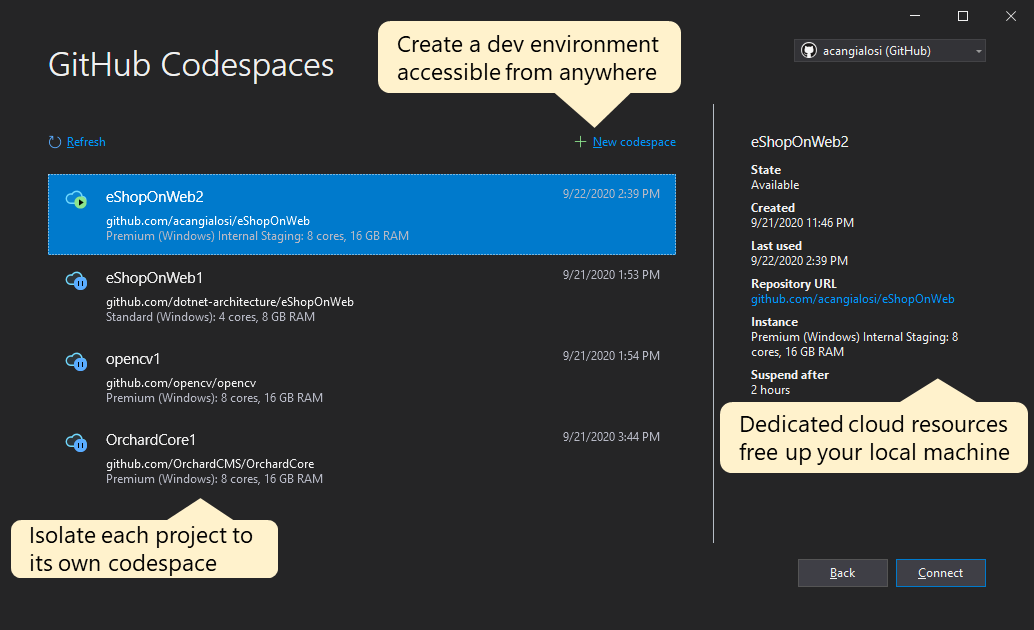
    In addition, Microsoft announced a preview of an update to Visual Studio 2019 16.8 that will add support for GitHub Codespaces, a previously announced capability that automatically creates repositories on GitHub. GitHub Codespaces is currently available in beta and soon will be accessible directly from within Visual Studio.

    Microsoft also revealed it has enhanced the Git tooling experience in Visual Studio to enable more asynchronous collaborations. A GitHub extension for Visual Studio Code enables developers to work with GitHub Issues and Pull Requests directly in the editor. Development teams that need to work in real-time alternatively can employ Visual Studio Live Share.

    A publish experience in Visual Studio also now has the option to generate a GitHub Actions workflow for continuous integration/continuous delivery (CI/CD) environments in Azure resources using the deployment secrets configured in a GitHub repository. GitHub Actions for Azure can now also scan Azure resources for policy violations and vulnerabilities in container images and issues involving Azure Resource Management (ARM) templates.

    Microsoft CEO Satya Nadella told conference attendees the velocity at which applications are developed and deployed has become even more critical as organizations embrace digital business transformation in the wake of the economic downturn brought on by the COVID-19 pandemic.

    GitHub support for Power Apps is especially significant because it will make it easier for so-called citizen developers to collaborate with professionals developers as they jointly develop applications, he said.

    Other notable updates to the Microsoft tools portfolio include a preview of an instance of the Azure Logic Apps workflow platform that can be deployed as a containerized runtime.

    A .NET 5 Release Candidate is also now available, with general availability expected next month. This update adds support to smaller, faster single-file applications that use less memory when employed within microservices and containerized applications. It also includes significant performance improvements, support for Windows ARM64 and new releases of C# 9.0 and F# 5.0 languages.

    Microsoft also announced several updates to App Service to make it easier and more cost-effective to migrate and modernize .NET web apps on the Azure cloud. A new Premium v3 (Pv3) App Service Plan can handle large-scale web apps, supporting more apps per instance and larger, memory-intensive apps with up to 32GB per instance. Microsoft is also making Windows Containers support in App Service generally available and will soon make Reserved Instance (RI) Pricing for App Service available to reduce costs.

    Finally, Microsoft made several Kubernetes enhancements, including a preview of a start/stop cluster feature that will be added to Azure Kubernetes Service (AKS), and announced general availability of an Azure Policy add-on for AKS, which makes it possible to audit and enforce policies across Kubernetes clusters. Microsoft also made generally available Bridge to Kubernetes extensions for Visual Studio and Visual Studio Code that allow teams to develop against microservices within a running AKS cluster to enable debugging existing services without having to reconfigure or deploy a new cluster.

    Nadella said keeping track of developer velocity and overall “tech intensity” within an organization is critical to success. It’s not yet clear how many organizations have put the metrics in place to measure either. However, it is clear that organizations that have yet to fully embrace best DevOps practices are already being left behind.

  • Survey Surfaces High Reliance on DevOps to Build and Deploy APIs

    A survey of 13,586 IT professionals who work with application programming interfaces (APIs) published today by Postman, provider of an API development platform, finds best DevOps practices are now widely employed to both produce and consume APIs.

    The primary method through which teams working on APIs collaborate is by sharing URLs (42%). However, publishing API artifacts to GitLab, GitHub, Bitbucket or other repositories came in a close second at 40%, followed by publishing API documentation to an API portal (39%) and instant messaging (28%).

    When queried about change management practices specifically, Git repositories topped the list at 63%, followed by versioning APIs (59%), versioning server code (34.6%), versioning client code (27.8%) and semantic versioning (21%).

    Respondents said when it comes to deploying APIs, the most widely used option was continuous integration/continuous delivery (CI/CD) pipelines (53%).

    A total of 77% of respondents listed their functional area as engineering/development, followed by DevOps/API Ops at 34% and developer relations/evangelism (13%).

    Among DevOps practitioners that participated in the survey, Jenkins is the most widely employed platform (41%), followed by AWS DevOps (30.7%) and Azure DevOps (26.1%).

    Overall, the survey finds REST is still the dominant architectural style for APIs (93%), followed by webhooks (34%), SOAP (33%) and GraphQL (23%). JSON Schema is the dominant API specification (76%), followed by Swagger 2.0 (44%), OpenAPI 3.0 (28%) and GraphQL (23 %).

    When asked to rate the percentage of their organization’s development effort spent working with APIs, 41% said more than half of the effort is spent on APIs.

    Kin Lane, chief evangelist for Postman, said the survey also makes it clear that more organizations have adopted an API-first philosophy to application development. Over 60% of respondents rated themselves as 5 or better out of 10 in terms of embracing an API-first philosophy.

    Nearly half of respondents said investment of time and resources into APIs will increase over the next 12 months, while another third stated that investments into APIs will stay the same. Eighty-five percent said APIs are playing a significant role in their digital business transformation initiatives, while nearly a third (31%) also noted APIs played a role in their organization’s ability to respond to COVID-19 by, for example, enabling customer communications or remote work options.

    APIs appear to have become a lot more stable in recent years, with more than half of respondents reporting APIs do not break, stop working or materially change specification often enough to matter.

    When it comes to producing APIs, the No. 1 obstacle by a wide margin is lack of time, while the No. 1 obstacle cited for consuming API is lack of documentation.

    The four most important factors individuals consider before integration with an API are reliability (72%), security (71%), performance (71%) and documentation (70%).

    Looking to future technologies, respondents appear to be most interested in microservices (49%), Kubernetes (44%) and containers (42%). Given the cloud-native attributes of those technologies, it appears all but certain the number of APIs strewn across the extended enterprise is about to increase exponentially.

  • Granulate Applies AI to Linux Server Optimization

    Granulate Applies AI to Linux Server Optimization

    Granulate today announced that a platform that leverages machine learning algorithms to optimize Linux server environments running on-premises or in the cloud is now generally available.

    The Granulate platform employs agents, dubbed gAgents, that install machine learning algorithms to continuously optimize deployments across a server environment, said company CEO Asaf Ezra. The company also launched gCenter, a portal through which IT teams can manage the deployments of those agents.

    The Granulate agents automatically learn the specific resource usage patterns and data flow of any applications. By analyzing CPU scheduling order, oversubscribed locks, memory, network and disk access patterns, the agent also identifies over-subscribed resources, bottlenecks and prioritization opportunities. It then tailors scheduling and prioritization decisions regarding CPU, locks, caches and network access at the operating system level to improve the application performance.

    Ezra said the agents created by Granulate will then automatically optimize the server environment based on parameters defined by IT teams using gCenter. That capability not only enables IT teams to reduce costs by 60% but it also results in a 40% improvement in response times and a 5X improvement in overall throughput without any changes to application code being required, he said.

    According to the company, more than 40,000 instances of gAgent have already been deployed by IT teams at PicsArt, Perion, AppsFlyer and Coralogix.

    The gAgents are designed to install easily using a single command line on any Linux server. Once installed, Ezra said, it’s not long before IT teams discover they can significantly reduce their cluster size and downsize their machines.

    In the wake of the economic downturn brought on by the COVID-19 pandemic, IT teams are under more pressure than ever to reduce costs. IT environments, however, have often become too complex to optimize without relying on some form of artificial intelligence to automate IT operations (AIOps).

    While many IT teams may have initially been dubious of the effectiveness of AI, it’s become increasingly apparent that optimizing IT environments without relying on machine learning algorithms to some degree isn’t feasible.

    The challenge, of course, is making sure that whatever form of AI employed is making the right optimization decisions. As such, most IT teams tend to launch small AIOps projects initially until they can verify that the decisions being made are valid. Once a level of trust is established, many of the tedious tasks that IT teams that once were performed manually are either eliminated or, at the very least, reduced sharply.

    It’s not clear exactly what impact AIOps in all its forms will have on IT jobs. In theory, smaller IT teams should be able to manage larger IT environments. However, rather than eliminating positions, most organizations appear to be increasing the volume of applications they can deploy as the overall IT environment becomes more automated.

    Like it or not, IT is becoming more automated. The issue now is determining precisely where the interface between IT administrators and machines that can manage themselves now lies.

  • Snyk Acquires DeepCode to Apply AI to DevSecOps

    Snyk Acquires DeepCode to Apply AI to DevSecOps

    Snyk today announced it has agreed to acquire DeepCode as part of an effort to apply artificial intelligence (AI) to DevSecOps.

    DeepCode has developed an interpretable machine learning semantic code analysis tool that scans code anywhere from 10 to 50 times faster than existing approaches. DeepCode currently supports Java, JavaScript, Python, TypeScript and C/C++ programming languages. Developers get started by connecting the DeepCode bot to their GitHub, BitBucket or GitLab accounts or directly within their integrated development environment (IDE). DeepCode then immediately starts reviewing each commit with no additional coding required. The bot is currently free for teams of up to 30 developers.

    Snyk CEO Peter McKay said those machine learning algorithms dramatically reduce both false negatives and false positives as they learn the application environment. That code scanning occurs in real-time, thanks to a Datalog solver developed by DeepCode, which McKay said means code scanning can now keep pace with the rate at which applications are being developed.

    While there’s widespread agreement that more responsibility for application security needs to shift left toward developers as part of any effort to embrace best DevSecOps processes, getting the right security tools into the hands of developers has been a challenge. Developers tend to resent having to wait for security scans to be completed, especially at a time when the rate at which applications are being developed and deployed has been accelerated as organizations embrace digital business transformation more aggressively.

    In effect, code scanning as implemented today is often viewed as a bottleneck. That issue goes away, however, if scanning can occurs in real-time. Armed with that data, it then becomes possible to also prioritize which vulnerabilities to address in code first in addition to in, some cases, automating bug fixes.

    In an ideal world, security will become a natural extension of any quality assurance process implemented by a DevOps team. The challenge right now is bridging a cultural divide between DevOps and cybersecurity teams that have workflows that operate at dramatically different cadences. The more automated the code scanning process becomes at the front end, the fewer security issues will need to be addressed by theses teams as applications are either being deployed or, worse yet, after they are already running in a production environment.

    Fresh off raising an additional $200 million in funding that was used in part to acquire DeepCode, Snyk claims there are already 1.5 million developers using its tools worldwide and that its revenue grew 275% in the last year. Privately held, Snyk claims to have a valuation of $2.6 billion. The next challenge is to expand adoption of Snyk tools across the roughly 24 million developers that are writing code today, said McKay. As part of that effort, Snyk recently formed technology alliances with both Red Hat and Docker Inc.

    Naturally, it may take some time for that goal to be realized. However, with more developers now being held accountable for security, the chances are good that many of them will soon be looking to ruthless automate security in much the same way they are moving to automate every other aspect of IT.

  • Instana Makes Maintaining App Service Levels Easier

    Instana Makes Maintaining App Service Levels Easier

    Instana announced today it has made it easier for DevOps teams to achieve and maintain service level objectives (SLOs) for applications when employing its application performance management (APM) platform.

    Announced at the DevOps World 2020 conference hosted by CloudBees, the Instana tools provided to configure, monitor and manage SLOs are based on a series of wizards that DevOps teams can employ to create a dashboard through which they can monitor all the components that make up a specific application service. An Application Perspectives creation wizard guides IT teams through a process to select filters that eliminate uncorrelated, unconnected systems from the application service they need to monitor.

    Chris Farrell, technical director and APM strategist for Instana, said as IT environments have become more complex thanks to the rise of microservices, IT organizations need access to APM platforms designed from the ground up to monitor, tune and optimize applications that are dependent on services strewn across an extended enterprise. Instana automatically deploys sensors to each part of the application stack, traces all application requests and profiles every process without requiring IT staff to configure those agents or restart applications. Any changes to the application environment are also automatically reflected in the model of the IT environment Instana creates.

    Instana is now extending its APM platform to make it easier for IT teams to meet service level guarantees regardless of application complexity, said Farrell.

    Given all the dependencies that exist between microservices, some type of observability platform is now a fundamental requirement. Previously, IT teams tended to only employ APM platforms to monitor their most critical monolithic applications because of the costs involved. In contrast, just about every application based on microservices needs to be instrumented to enable DevOps teams to optimize performance. Microservices-based applications are designed to degrade application performance gracefully by rerouting application traffic anytime there is an availability issue. While that approach prevents applications from crashing, it also makes discovering the root cause of an application issue that much more challenging for DevOps teams.

    It’s not clear to what degree organizations that have standardized on an existing APM platform might be willing to replace those platforms as the number of microservices-based applications deployed in enterprise IT environments increases steadily. However, there are many more IT organizations that are just now starting to employ an APM platform to enable them to better cope with these applications. Most are also embracing best DevOps practices that make observability a core tenet for continuously deploying and updating applications.

    As those DevOps practices continue to evolve, most IT organizations will transition toward monitoring application services that drive a business process rather than isolated instances of monolithic applications.

    Regardless of the APM platform selected, it’s clear the way applications are deployed and managed is fundamentally being transformed. The issue now is determining how best to visualize those application environments because, after all, no one can manage what they can’t actually see.

  • CloudBees Advances Expanding DevOps Agenda

    CloudBees Advances Expanding DevOps Agenda

    CloudBees today at its online DevOps World 2020 conference announced it is embedding additional DevSecOps capabilities that span the application development and deployment process within the continuous integration/continuous delivery (CI/CD) platform based on the open source Jenkins projects.

    In addition, CloudBees announced it will make generally available by the end of this year two additional modules for its Software Delivery Management (SDM) platform. Launched last year, the SDM platform provides a centralized mechanism for all stakeholders in the enterprise to track application development projects.

    The first module available today unifies the management of feature flags across an entire application development project. The second creates a system of record for tracking progress by importing and normalizing all the data made available by the tools that make up a DevOps platform.

    The DevSecOps offerings, meanwhile, provide IT teams with a hardened instance of the CloudBees CI offering, along with hardened audit-ready pipelines to ensure only immutable, approved components and environments are used without any drift or tampering. CloudBees is also adding support for role-based access controls based on fine-grained permissions as well as tighter integration with the feature-flagging capabilities of the CI/CD platform. If issues arise in a production environment, specific features can be pulled back with full traceability provided automatically.


    Finally, CloudBees has integrated its CI/CD platform with security automation applications from Anchore, Alcide.io, FOSSA, CyberArk, Checkmarx, Contrast Security, Shiftleft.io, Snyk, RunSafe Security, Sonatype, WhiteSource Software, Synopsys and Zimperium.

    CloudBees CEO Sacha Labourey said in the wake of the COVID-19 pandemic, it’s clear organizations are accelerating the development and deployment of more sensitive applications that drive digital business transformation initiatives. In fact, according to the results of a survey of 347 IT professionals conducted by Accelerated Strategies Group (ASG) on behalf of CloudBees published today, digital transformation objectives have somewhat or significantly increased in priority for nearly two-thirds (63%) of respondents.

    Slightly more than half said their organizations have also placed higher priorities on increasing their DevOps initiatives (52%). Many are also now practicing daily standup meetings (56%), using cross-functional teams (46%) and automating tasks (43%).

    Overall, 59% said their software teams have become somewhat or significantly more productive, with 43% reporting it is now easier to complete work tasks in a timely fashion. Nearly two-thirds (61%) said they are also finding it easier to work across time zones and, in some cases, even different continents (39%).

    Labourey said that as digital business initiatives continue to gain steam, more organizations will be applying DevOps principles to the business itself. SDM platforms will play a critical role in enabling that transition by providing a common framework through which IT and business professionals will be able to collaborate more closely, said Labourey. The goal should not be to turn software development into a factory, but rather to prioritize projects and initiatives in a way that benefits the business.

    Ideally, SDM also provides a framework through which IT teams can manage up at a time when many business leaders lack visibility into often complex DevOps processes that tend to have lots of dependencies, noted Labourey.

    In the meantime, the divide between all the application owners, IT teams and security professionals that make up an IT community within an organization continues to narrow. The challenge now will be determining what to do next, once all those constituencies are finally seeing the same thing at the same time.

  • Synopsys Report Shows DevSecOps Progress

    Synopsys Report Shows DevSecOps Progress

    A report based on analysis of the software security initiatives of 130 organizations conducted by Synopsys, a provider of static application security testing (SAST) and software composition analysis tools, suggests progress in terms of DevSecOps adoption is being made but there is still a long journey ahead.

    According to the survey results, 121 organizations now ensure host and network security basics are in place, with 73 organizations also monitoring application input.

    However, only 39 organizations said they define secure deployment parameters and configurations, followed by 36 that said they were ensuring cloud security basics and 33 that said they were protecting code integrity. Only 32 had embraced application containers, while 22 employ orchestration for containers and virtualized environments, according to the Synopsys report.

    Using code protection (13), attaching bills of material to application inventory (12) and using application behavior monitoring and diagnostics (7) were even farther down the list.

    Michael Ware, senior director of technology at Synopsys, said the results of the report are an encouraging sign as more software security teams increasingly report into a technology group or CTO rather than an IT security team or chief information security officer (CISO). As the responsibility for application security continues to shift left, IT teams are being reorganized accordingly, he noted.

    More IT organizations are also embedding security reviews within their continuous integration/continuous delivery (CI/CD) platforms as they replace high-friction, out-of-band security tasks with ones that are automatically triggered by events in the CI/CD pipeline, added Ware. That approach also enables organizations to overcome a chronic shortage of cybersecurity personnel that has now become a longstanding issue for most organizations, he noted.

    Longer-term, security will become deeper ingrained in the entire mindset of not just IT teams but also entire organizations, noted Ware. As part of an effort to make the entire organization more resilient to change, organizations are making a more concerted effort to address security issues at all levels of the organization.

    Less clear at the moment is to what degree DevSecOps will be achieved by automating tasks rather than melding workflows. DevOps and cybersecurity teams have distinctly different cultures. As cybersecurity tasks shift left, many DevOps teams will seek to ruthlessly automate those tasks in much the same way they have automated other IT management tasks. In fact, there may come a day when security issues are addressed as a subset of the overall quality assurance process, Ware noted.

    In the meantime, it’s clear much more needs to be done before applications can be considered fundamentally secure. Security issues that stemming from relying on tools to automate the configuration of cloud infrastructure are rampant. DevOps teams clearly need to take more responsibility for security, but cybersecurity teams still need to be able to verify the right policies are being employed. As long as humans write code, there will always be plenty of opportunity for error. The DevSecOps challenge now is to eliminate as many opportunities for that human error to occur as possible.

  • PagerDuty Applies AIOps to IT Incident Management

    PagerDuty Applies AIOps to IT Incident Management

    PagerDuty, at its online Summit20 conference today, unveiled a bevy of updates that apply machine learning algorithms across a wide range of workflows across the PagerDuty incident response platform.

    In addition, PagerDuty today announced it will acquire Rundeck, a provider of an IT automation platform that auto-remediates incidents by enabling playbooks to automatically execute whenever there is an issue, for $100 million.

    Jonathan Rende, senior vice president of products for PagerDuty, said the overall goal is to make IT teams more efficient by applying AIOps at a time when organizations are trying to reduce to the total cost of managing increasingly complex IT environments.

    At the same time, Rende said PagerDuty is also moving to reduce the fatigue that inevitably ensues when trying to determine the relationship between the thousands of alerts that all the elements of an IT environment can now generate. The goal is to provide IT teams with more context and actionable intelligence, said Rende.

    As part of that effort, PagerDuty is now integrating change events that occur in code repositories via new integrations with GitHub, Puppet and Evolven. The bulk of IT incidents stem from changes made to the IT environment so via these integrations it will become easier to identify the most likely root cause of an issue, said Rende.

    PagerDuty has also added new capabilities to its Service Directory that employs machine learning algorithms to dynamically surface dependencies between people, changes, incidents and services in real-time. As IT environments become more complex thanks to the rise of microservices, he said it’s now more critical than ever to track relationships across workflows spanning multiple IT teams. The challenge is that existing manual processes can keep pace with the rate of change now occurring in IT environments, Rende added.

    PagerDuty is also moving to reduce the number of alerts that are generated by enabling the PagerDuty Event Intelligence module to surface recommendations generated by machine learning algorithms that suggest ways to group alerts to better streamline incident responses. In addition, IT teams can now pause alerts if they decide to allow systems to auto-remediate before they decide to intervene.

    The company is also extending the reach of an application programming interface (API) for analytics it created to enable IT teams to launch queries against the data collected by PagerDuty. In addition, PagerDuty is making available an Analytics Maturity Model that provides access to benchmark data from more than 13,300 customers to both compare their efforts with other IT teams and discover additional best practices.

    PagerDuty today also announced one-click integration with the Zoom video platform to enhance collaboration, as well as extending its existing integration with Microsoft Teams to include a similar one-click capability.

    Finally, PagerDuty also launched an instance of its platform for customer service teams that also provides enhanced integrations with Zendesk and Salesforce Service Cloud. With more organizations dependent on digital business processes to survive, Rende said the need to automate customer service processes has never been more pressing.

    At the same time, IT teams are struggling to keep pace with the rate of tickets being generated by employees who are now working from home. Put it all together and it becomes abundantly clear that continuing to rely on legacy approaches to IT incident management will simply not suffice.